UNDERGRADUATE THESIS
IMPROVING THE STUDENTS`WRITING SKILL
IN PROCEDURE TEXT BY JUMBLED SENTENCES APPROACH AT THE TENTH GRADERS OF SMK IT BAITUNNUR PUNGGUR
IN THE ACADEMIC YEAR OF 2018/2019
By:
TRI MULYA INDAH WARDANI STUDENT. ID.14122287
Tarbiyah and Teachers Training Faculty English Education Department
STATE INSTITUTE FOR ISLAMIC STUDIES OF METRO 1440 H /2018 M
ii
IMPROVING THE STUDENTS`WRITING SKILL
IN PROCEDURE TEXT BY JUMBLED SENTENCES APPROACH AT THE TENTH GRADERS OF SMK IT BAITUNNUR PUNGGUR
IN THE ACADEMIC YEAR OF 2018/2019
Presented as a Partial Fulfillment of the Requirements for the Degree of Sarjana Pendidikan (S.Pd)
in English Education Department
By:
Tri Mulya Indah Wardani STUDENT. ID.14122287
Tarbiyah and Teachers Training Faculty English Education Department
Sponsor : Dr. Umi Yawisah, M.Hum
Co-Sponsor : Syahreni Siregar, M.Hum
STATE INSTITUTE FOR ISLAMIC STUDIES OF METRO 1440 H /2018 M
iii
iv
v
vi
vii ABSTRACT
IMPROVING THE STUDENTS’ WRITING SKILL
IN PROCEDURE TEXT BY JUMBLED SENTENCES APPROACH AT THE TENTH GRADERS OF SMK IT BAITUNNUR PUNGGUR
IN THE ACADEMIC YEAR 2018/2019
BY:
TRI MULYA INDAH WARDANI
The main purpose of this research is to investigate the students’ writing skill of SMK IT Baitunnur Punggur and to know what extend the Jumbled Sentences Approach could help the students’ learning process. The writer tries to attest that Jumbled Sentences Approach can be one of the teaching approach to improve the students’ writing skill. The researcher had outlined the problem in this research that focused on writing skill. It is related on the problem identification that most of the students get low score in writing procedure text..
In this research, the researcher conducted the classroom action research (CAR) which was done in two cycles. Each cycle consist of planning, acting, observing, and reflecting. The subject of this research was 26 students in X class of SMK IT Baitunnur Punggur. In collecting data, the researcher used test (pre- test, post test 1 and post test 2), observation, documentation and field note. The research was conducted collaboratively with an English teacher of SMK IT Baitunnur Punggur.
The result of this research shows that Jumbled Sentences Approach can be used as a teaching approach of writing. It provided by the average mark result of pre-test and post-test show that there were improved mark. At post test I is 64 and post test II is 73 it improved 9 point. The researcher concluded that there was significant improvement of using Jumbled Sentences Approach on the writing skill among the tenth graders of SMK IT Baitunnur Punggur.
(keyword : writing skill, jumbled sentence,classroom action reseacrh)
viii ABSTRAK
PENINGKATAN KETRAMPILAN SISWA DALAM MENULIS TEKS PROSEDUR
MELALUI PENDEKATAN JUMBLED SENTENCES DI KELAS SEPULUH SMK IT BAITUNNUR PUNGGUR
TAHUN PELAJARAN 2018/2019
OLEH:
TRI MULYA INDAH WARDANI
Tujuan utama dari penelitian ini adalah untuk menunjukan bahwa kemampuan menulis siswa SMK IT Baitunnur Punggur dan untuk mengetahui sejauh mana pendekatan jumbled sentences dapat membantu proses belajar siswa.
Penulis mencoba untuk membuktikan bahwa pendekatan jumbled sentences dapat menjadi salah satu pendekatan pembelajaran untuk meningkatakan kemampuan menulis siswa. Peneliti menggaris bawahi bahwa masalah pada penelitian ini difokuskan pada kemampuan menulis. Terkait pada identifikasi masalah yaitu sebagian besar siswa mendapat nilai rendah dalam menulis teks procedur.
Dalam penelitian ini, peneliti melaksanakan penelitian tindakan kelas yang dilakukan dalam dua siklus. Setiap siklus terdiri dari perencanaan, pelaksanaan, observasi dan refleksi. Subjek penelitian ini adalah 26 siswa kelas sepuluh SMK IT Baitunnur Punggur. Dalam pengumpulan data, peneliti menggunakan tes (pre- test, post test 1 and post test 2), observasi ,dokumentasi dan catatan lapangan.
Penelitian ini bekerjasama dengan guru Bahasa Inggris SMK IT Baitunnur Punggur.
Hasil penelitian ini menunjukkan bahwa pendekatan jumbled sentences dapat digunakan sebagai aktifitas pengajaran dalam menulis. Hal ini dibuktikan oleh hasil nilai rata-rata dari pre-test dan post-test yang menunjukkan bahwa adanya peningkatan nilai. Hasil nilai rata-rata dari post test I adalah 64 dan post test II adalah 73 dan meningkat 9 poin. Peneliti menyimpulkan bahwa terdapat peningkatan yang signifikan dengan menggunakan pendekatan jumbled sentences pada kemampuan menulis siswa di kelas sepuluh SMK IT Baitunnur Punggur.
(Kata kunci : kemampuan menulis, jumbled sentences, penelitian tindakan kelas)
ix
x
xi MOTTO
“If you are grateful, I will give you more.” (Q.S. Ibrahim:7)
``Intelligence is not the determinant of success, but hard work is the real determinant of your success.`` ( Jhons A.)
xii
DEDICATION PAGE
„‟I highly dedicate this undergraduate thesis to my beloved parents and all whom I love. Furthermore, to my alma mater, State Institute for Islamic
Studies of Metro‟‟
xiii
ACKNOWLEDGEMENT
Thanks to Allah SWT, as the one who always gives all what we need and sends the good figures around us to face this life. Thanks also to our idol of life, the man of perfection, Prophet Muhammad SAW, his families and companions.
This research ungraduate thesis entitles “Improving The Students`
Writing Skill In Procedure Text By Jumbled Sentences Approach At The Tenth Graders Of SMK IT Baitun Nur Punggur’’.
In this occasion, the researcher would like to express his greatest appreciation, honor and gratitude to his beloved parents (Slamet Riyadi and Dwi Wati),
for all their valuable supports and moral encouragement in motivating the researcher to finish his research.
The researcher also would like to express his deepest gratitude to his sponsor and co-sponsor, Dr. Umi Yawisah, M.Hum and Syahreni Siregar, M.Hum., for their advice, guidance, correction, and suggestion in finishing this undergraduate thesis. His gratitude also goes to: Finally, the writer hopes that this little piece of work can be useful for me and for all the readers, and also this paper can contribute soothing to the betterment of English teaching and learning in general. His gratitude also goes to:
xiv
1. Prof. Dr. Enizar, M.Ag, the Rector of State Institute for Islamic Studies of
Metro (IAIN Metro).
2. Dr. Akla, M.Pd, the Dean of Tarbiyah and Teacher Training Faculty.
3. Ahmad Subhan Roza, M.Pd, the Head of English Education Department.
4. His academic advisor, Dian Ekawati, M.Pd, for her advice, guidance, suggestion, and support.
5. All lecturers of English Education Department who have taught and educatedthe researcher during his study at IAIN Metro.
6. Supiar Ali, S.Pd., the Headmaster of SMK IT Baitun Nur Punggur, who has allowed theresearcher to conduct the research in his school.
7. All teachers and staff of SMK IT Baitun Nur Punggur. Especially, Khafid Royani,S.Pd, the English teacher of X TKJ SMK IT Baitun Nur Punggur.
8. His beloved brothers and Sister who support the researcher to finish thisundergraduate thesis.
9. His beloved best friends,Aulia latifah, Pipin yuliani, Riski Martalia, Prasetyo Budi, Siti Fatimah, Tendy Arma Yudha, and Setya Nova Rahayu, for sharing knowledge, care, motivation,time, supports, laugh and happiness.
10. His beloved friends Terpance TBI 14, for giving cares and supports.
xv
11. Any other person who cannot be mentioned one by one for their contribution to the researcher during finishing his undergraduate thesis. The words are notenough to say any appreciation for their help.
The researcher feels that it is really pleasure for him to receive criticisms and suggestions to make this undergraduate thesis better. He also hopes that this undergraduate thesis would be beneficial, particularly for him and for those who are interested in it.
Metro,September ,2018 The writer
Tri Mulya Indah Wardani St .Number 14122287
xvi
TABLES OF CONTENT
COVER ... i
TITLE ... ii
ABSTRACT ... iii
NOTA DINAS ... v
APPROVAL PAGE ... vi
NOTIFICATION LETTER ... vii
STATEMENT OF RESEARCH ORIGINALITY ... viii
MOTTO ... x
DEDICATION PAGE ... xi
ACKNOWLEDGEMENTS ... xii
TABLE OF CONTENTS ... xv
LIST OF TABLES ... xvii
LIST OF GRAPHS ... xix
LIST OF APPENDIXES ... xx
CHAPTER I INTRODUCTION ... 1
A. Background of the Study ... 1
B. Problem Identification ... 6
C. Problem Limitation ... 6
D. Problem Formulation ... 6
E. Objective ... 7
F. Benefits Of the Study... 7
G. Prior Research ... 7
CHAPTER II REVIEW OF THE RELATED THEORIES ... 12
A. The Concept of the Procedure Text Writing ... 12
1. The Conceptof Writing ... 12
xvii
a. Definition of Writing ... 12
b. Definition of Writing Skill ... 13
c. The Purpose of Writing ... 15
d. Teaching Writing ... 17
2. The Concept of Procedure Text ... 18
a. The Definition of Text ... 18
b. The Definition of Procedure Text ... 19
c. Language Feature of Procedure Text ... 19
d. The Structure of Procedure Text ... 20
3. The Measurement of Writing ... 22
B. The Concept of the Jumbled Sentence Approach ... 26
1. The Definition of the Jumbled Sentences ... 25
2. The Definition of the Jumbled Sentence Approach ... 26
3. The Procedure of the Jumbled Sentences Approach as Follows ... 28
4. TheKey for Putting the Jumbled Sentences in Order ... 29
5. The Implementation of the Jumbled SentencesApproach in Students Writing Skill in Procedural Text ... 30
6. Advantages and Disadvantage of Using the Jumbled Sentence Approach in Teaching Procedure text ... 31
C. Hypotheses Formulation ... 31
CHAPTER III RESEARCH METHODOLOGY ... 35
A. The Variable and Operational Definition of Variables ... 35
B. Setting of The Research ... 34
C. The Subject of the Research ... 34
D. Procedure of the Research ... 34
E. Data Collecting Method ... 40
1. Test ... 40
xviii
2. Observation ... 40
3. Documentation ... 41
4. The Field Note ... 41
F. Data Analysis Method ... 41
1. Formula ... 41
G. The Indicator of Success ... 43
CHAPTER IV RESULT OF THE RESEARCH ... 40
A. Description of The Research Location ... 40
1. The History of SMK IT Baitunnur Punggur ... 40
2. The Building Condition and School Facilities ... 40
3. The Condition of Teacher ... 46
4. The Quantity of SMK IT Baitunnur Punggur ... 47
5. School Map of SMK IT Baitunnur Punggur ... 47
B. The Description of The Research ... 49
1. Action and Learning at Pre Test ... 49
2. Action and Learning Activity in cycle1 ... 51
3. Action and Learning Activity in cycle 2 ... 58
C. Interpretation ... 66
1. Action and Learning Result in cycle 1 and cycle 2 ... 66
D. Discussion ... 69
CHAPTER V CONCLUSION AND SUGGESTION ... 71
A. Conclusion ... 72
B. Suggestion ... 73
BIBLIOGRAPHY APPENDIXES
CURRICULLUM VITAE
xix
LIST OF TABLE
1.The data of Pre survey in Writing of Procedure text at the tenth
graders of SMK IT Baitunnue Punggur ... 3
2. Frequency students score ... 4
3. The component of writing measurement ... 22
4. The facilities at SMK IT Baitunnur Punggur in Academic Year 2017/2018 ... 45
5. The teacher Education Baground of SMK IT Baitunnur Punggur ... 45
6. The Data of Teachers in SMK IT Baitunnur Punggur ... 46
7. The Data of Staff in SMK IT Baitunnur Punggur ... 46
8. The Quantity of SMK IT Baitunnur Punggur ... 47
9. The Result Score of Students Writing Test ... 49
10. Frequency of students score of in Pre Test ... 50
11. The Schedule of Action in Cycle 1 ... 52
12. The result of score Students Writing Post Test 1 ... 54
13. Frequency of Students score in Post Test 1 ... 55
14. Observation Sheet of Students Activities cycle 1 ... 56
15. The Result of Students Activity in Cycle 1 ... 57
16. The Result Score of Students Writing Skill Post Test II ... 60
17. Frequency of Students Score in Post Test 2 ... 61
18. Observation Sheet of Students activities Cycle II ... 63
xx
19. The Result of Students Activity in Cycle II ... 63
20. Result of The Students activities in cycle I and cycle II ... 65
21. Result of students Pretest, Post Test 1, Post Test 2 ... 67
6. The data of teachers in SMK IT Baitunnur Punggur ... 38
5. the data ofstaff in SMK IT Baitunnur Punggur. ... 38
5. Frequency of Students’ Mark of Pre-test of Writing Skill ... 40
6. The Students Post-Test 1 Result of Writingin Cycle I ... 45
7. Frequency of Students’ Mark of Post-Test 1 of Writing ... 46
8. The Students` Activities Result in Cycle I ... 47
9. The Students’ Mark of The WritingPost Test in Cycle II ... 51
10. Frequency of Students’ Mark of the writing Post-test in Cycle II ... 52
11. The Students’ Activities Result in Cycle II ... 53
12.The Result Mark of Students’ Pre-Test and Post Test 1 ... 56
13. The Result Mark of Students’ Post Test 1 and Post Test 2 ... 59
14. The Result Mark of Students’ Pre Test, Post Test 1 and Post Test 2 ... 61
15. The Percentage of Students’ Mark at Post Test Cycle I and II ... 63
16. The Result of The Students’ Activity in Cycle I and II ... 64
xxi
LIST OF GRAPH
1. The Result of Students Score on Pre Test.. ... 50
2. The Result Score of Students on Post Test 1.. ... 55
3. The Result Score of Students on Post Test 2... ... 62
4. The Comparison of Students Activity In Cycle I And Cycle II.. ... 66
5. Percentage of The Students Score in Pre Test, Post Test 1 and Post Test 1 ... 68
A. Background of the Study
English has been widely used for written language over oral communication. English is one of the languages in the world. In learning English, there were four basic language skills to be mastered: listening, writing, reading and speaking. English is an international language that can be used as an instrument to write important information and knowledge. It was used by all people in the world to communicate in such activities.
Writing was a complex sociocognitive process involving the construction of recorded messages on paper or on some other material, and, more recently, on computer screen.
Teaching English as foreign language was difficult because student learn new vocabularies, pharagraph, that they never learn. In process learning a foreign language, the teacher needs some approach which is suitable for the students. Before define approach, teacher must consider many factors of students, school, environment. In the learn English language has five skill , one of them was writing, writing was the representation of language in textual medium that usually called as writen language.
It has a very urgent place for knowledge development. Because without writing product, like books, newspaper, magazine, journals, articles, novels, and many others, knowledge will be very hard to be transfered and to
2
be developed. Even in some places, writen language was more effective than spoken language which always go to many people like what writing activity can do. Writing products sometimes can be larger in gaining the audience than speaking products can be.
Writing was also important for students to learn since it was one of productive skills, which was frequently used to convey the ideas in communicating with others. Students were expected to be able to express their idea in written form, especially in the form of the text. And it was important for students to master English in written form since Junior High School because, there will be lot of types of written form that should be learn in Senior High School level, for example, narrative, recount, report, news item, procedure, spoof, etc.
Aapproach refers to theories about the nature of language and language learning that serve as the source of practices and principles in language teaching or approach was a set of assumption dealing with the nature of language, learning and teaching. The procedural learning process was done by teacher, choosing approach can influence the successful in learning.
The pre-survey was done on November 25th 2017 at the tenth graders of SMK IT Baitunnur which was consist of one class for about 26 students, and after doing the pre-survey the at the tenth grade of SMK IT Baitunnur which located in Jl. Pesantren, Kec. Punggur Lampung Tengah, the researcher got the result as bellow:
Table 1
The data of Pre Survey in Writing of Procedure Text at the Tenth Graders of SMK IT Baitunnur
No Name Score Category
1 AS 51 Incomplete
2 AM 51 Incomplete
3 AH 50 Incomplete
4 ARN 75 Complete
5 BTT 48 Incomplete
6 BM 74 Complete
7 DAP 50 Incomplete
8 DR 51 Incomplete
9 DF 75 Complete
10 DL 54 Incomplete
11 EK 51 Incomplete
12 FP 51 Incomplete
13 LN 51 Incomplete
14 MAA 53 Incomplete
15 MM 51 Incomplete
16 M 49 Incomplete
17 NH 77 Complete
18 NL 49 Incomplete
4
19 QAF 50 Incomplete
20 RES 53 Incomplete
21 RR 52 Incomplete
22 SA 52 Incomplete
23 SR 49 Incomplete
24 ULM 52 Incomplete
25 VTS 54 Incomplete
26 YA 49 Incomplete
Total 1422
Average 54 Incomplete
Source: Pra Survey data of Class X in SMK IT Baitunnur.
Table 2
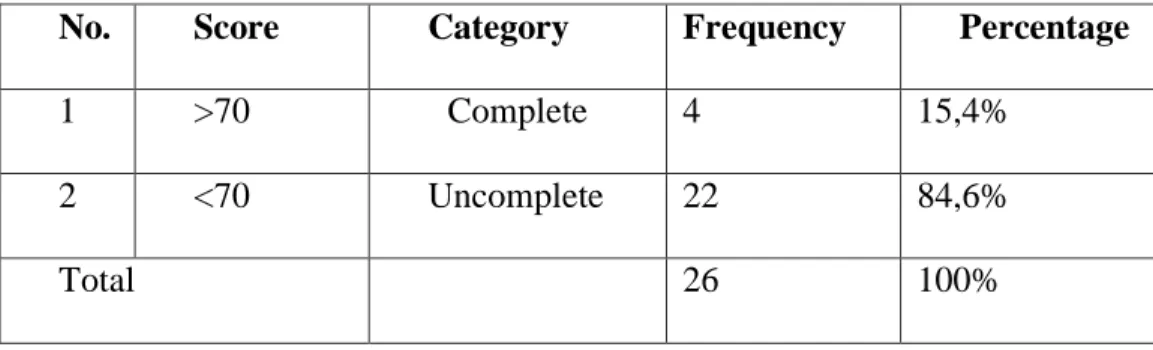
Table of Frequency Students` Score
No. Score Category Frequency Percentage
1 >70 Complete 4 15,4%
2 <70 Uncomplete 22 84,6%
Total 26 100%
The English minimum passing grade in this school was 70. It means that the students who got the score under 70 do not complete. Based on the data above, the students have low score in English teaching. There were only 4 students complete from 70, and 22 students incomplete from 70.
Based on the pre-survey result above the students have problems in learning writing, those were: Students do not have much motivation to write, The students do not active to follow the lesson English it was like talking and playing with friend while the teacher was explaining the lesson, The students feel bored in English learning process, Most of students do not comprehend the text, cause they do not know the meaning.
Seeing that problem, the researcher interest to conduct about improving the students writing skill in procedure text by using Jumbled sentences approach.
The researcher choose this approach because it assumes that jumbeld sentences approach was an effective approach for the student which the students should be taught how to plan and organize the ideas or supporting information before doing the composition so that they were able to improve their writing skill.
Jumbled sentences are a group of sentences arranged in illogical order.
In this research jumbled sentences are chosen to practice in developing students’ writing skill because it was a helpful approach in teaching writing.
By rearranging the jumbled sentences into logical order of a paragraph the students are expected to grasp the intended information.
6
B. Problem Identification
Based on the background of the problem, the researcher found some students problems in writing. They were the students’ motivation, interest and difficulties.
1. The students got difficulties in writing procedure text.
2. Most of the students get low score in writing procedure text.
3. The students were passive in learning process.
4. The students feel bored in the class so the students could not improve their material of procedure text.
C. Problem Limitation
Based on the problem identification, the limits the problem that the students got difficulties in procedure text, so the researcher on teaching writing skill use jumbled sentence approach to Improve the writing skill at the Tenth Graders of SMK IT Baitunnur Punggur in Academic Year of 2018/2019.
D. Problem Formulation
Based on the background of study and problems identification above, the researcher formulates the problem in this research is “Can the Jumbled Sentence Approach Improve the Students Writing Skill of Procedure Text at the Tenth graders of SMK IT Baitunnur ?”
E. The Objective
The objective of this research is to find out whether there is any positive and significant Can the implementation of Jumbled Sentence Approach to improve the Writing Skill and their learning activities at the tenth graders students of SMK IT Baitunnur Punggur.
F. Benefits Of the Study 1. Benefits of the Study
a. For the Students
1) As an effective approach to improve their writing skill at procedure text.
b. For the English Teacher
1) As information for the English Teacher, that jumbled sentences approach was effective to be used in teaching procedure text.
c. For the Researcher
1) By this classroom action research, the researcher (as a teacher) will improve the writing skill, so the optimal research of teaching learning process can be achieved.
G. Prior Research
The research entitled “Improving The Student’s Writing Skill In Procedure Text By Jumbled Sentences Approach At The Tenth Graders Of Smk It Baitunnur Punggur In The Academic Year Of 2017/2018” the researcher found some similar researcher that have ever done, first was by
8
Rini Putri Malinda,Cucu Sutarsyah, Gede Eka Putrawan FKIP Universitas Lampung, entitled was Improving Students’ Ability In Recount Text Writing Through Jumbled Sentences At The First Grade Of Sma Kartikatama.1
The aim of this study was to find out whether there was a statistically significant increase of students’ writing ability in recount text writing after they were taught through jumbled sentences. This research was a quantitative research. The subjects of this research were 25studentsat the first grade of SMA Kartikatama Metro. The writing test was administrated as the instrument of the research. The data were analyzed by using t-test as the significant level of p<0.05 through SPSS version 17.0. The result showed that there was a statistically significant increase of students’ writing ability. This suggests that teaching writing using jumbled sentences facilitates the students to develop their ideas easily. The finding of this research indicates that by using Jumbled sentences, the students’ writing ability was improved.
Based on the result of research, the researcher found that it was essential to use technique in teaching writing in order to improve the students’ ability; in this research, the technique used was jumbled sentences. The researcher found that, there was a significant improvement of the students’ writing ability after being taught using jumbled sentences.
1 Rini Putri Malinda,Cucu Sutarsyah, Gede Eka Putrawan FKIP Universitas Lampung,, Improving Students‟ Ability In Recount Text Writing Through Jumbled Sentences At The First Grade Of Sma Kartikatama.
This study also analyzed the improvement of each aspect of writing.
Vocabulary aspect was the lowest in the gain since the student could not add some details in developing the controlling ideas in their writing especially in pretest but in the posttest the students tried to add some sentences to improve their sentence in the paragraph.
Second was Dwi Yulies Putri yanty entitled Teaching Writing Using Jumble Sentences At The Eighth Grade Students Of Smp Negeri 1 Pabuaran.2 The Population of the research was the Eighth Grade Students of SMP Negeri1 Pabuaran, there were nine classes together 423 students.
The writer was taken sample of this study in one class, consisting of 40 students. The method of the research was experimental method which was done to the object being observe in actual case and happens at the time of research. The data of the research were the result of t-test. The result of analyzing the data was t Account (2.574) was bigger than table(2.023). It means the writer hypothesis was accepted. “ Does jumbled sentences improve students’ writing at the eighth grade of SMP Negeri 1 Pabuaran
”Teaching writing skills class students of SMP Negeri 1 Pabuaran VIIIA still under KKM (Complete Minimal Criteria). The average values of 47 students while the KKM 75. This was caused by several factors that come from students, teachers, or learning techniques were used. One of the factors that cause the students find it difficult to start writing the essay. Therefore, we need to overcome. In this study, the writer focus
2 Dwi Yulies Putriyanty , Teaching Writing Using Jumble Sentences At The Eighth Grade Students Of Smp Negeri 1 Pabuaran.
10
on the technique of writing skill that might be useful to improve the student achievement in writing skill
The third was Using Jumbled Sentence Games to Improve the Writing Ability of The Seventh Grade Students of MTs Muhammadiyah 6 Bayat, Klaten by elsha pramunindya whardani.3
This research was an action research. The setting and the subject of this research was the seventh grade students of MTs Muhammadiyah 6 Bayat Klaten. The numbers of the students were 24 students. This research was implemented in four cycles. Each cycle had two meetings. The data were gained from pre test and post test. The pre test was given before the treatment and the post test was given in the end of the treatment in each cycle. The topic was based on the KTSP curriculum. the research findings indicated that the jumbled sentence games could improve the students’
writing ability. It was proved by average score of the writing test which increased from the pre test 64.17 to the post test 88.12.The result of analyzing the data was account (2.260) was bigger than ttable (1.709).Therefore, Alternative hypothesis (Ha) was accepted the use of jumbled sentences games to improve writing ability of the seventh grade students of MTs Muhammadiyah 6 Bayat. It means the researcher’s hypothesis was accepted.
3 Elsha pramunindya whardani, Using Jumbled Sentence Games to Improve the Writing Ability of The Seventh Grade Students of MTs Muhammadiyah 6 Bayat, Klaten . 2015
The effectiveness of jumbled sentence games to improve the writing ability of the seventh grade viii students of MTs Muhammadiyah 6 Bayat was medium effect.
because it was higher than 3 while the threshold for a medium effect.That the research not only significant but also represented a fairly substantial.
Based on the prior researches above, it is known that all of prior researches have the similarity with the research that will be conducted by the writer. The similarity is known in the use of jumbled sentences. While, the focus of the second prior researches is same as this research in using jumbled sentences to improve the students’ writing skill. Nonetheless, in the second prior researches is focus on the students’ writing skill in procedure text while the writer will focus on the students’ skill in mastering the structure of procedure text to make the students be able to write procedure completely.
CHAPTER II
REVIEW OF THE RELATED THEORIES
A. The Concept of the Procedure Text Writing 1. The Concept of Writing
a. Definition of Writing
Writing is a process of communicating a writer’s idea to the readers in written form. The primary role of writing is expressing the ideas and conveying the message. In expressing the ideas, a writer should explore their thought to make readers' interest in their writing. It makes the readers understand the messages clearly.
writing is the most difficult skill because in writing, the student should know mor e on the language itselft, the vocabulary, the grammatical structure, and the characteristics of good writing.
Moreover, they should use appropriate language to make the readers understand about what they write about. In other words, the students should study harder in learning how to writee well.
And the other hand writing is a writing should not sound like talking, necessarily, but it should have a Personality that comes from the way you decide to approach a topic, to develop it with details, to say it your way.4
4 Paige Wilson,Teresa Ferster Glazier “ the Least You should know about english writing skill” . Wadsworth cengage learning, tenth edition 2005, P. 215
William Zinsser points out, “writing has no new discoveries to spring on us. We’re in no danger of reading in our morning newspaper that a breakthrough has been made in how to write [clearly]. . . . We may be given new technologies like the word processor to ease the burdens of composition, but on the whole we know what we need to know.”5
Writing is a psychological activity of the language user to put information in the written text. Brown says writing is a process to and up thinking something you cannot have started our thinking.6
From the the definition above that writing is our idea that we write down on the paper in order the other people know what we want in our brain.
b. Definition of Writing Skill
Effective Writing Skills deals not only with the printed but also the spoken word: for messages to be properly communicated andunderstood, clarity of speech is essential and a chapter is included for those giving audio-visual presentations and taking on public speaking assignments.7
5 Ibid,p.207
6H. Douglas Brown, teaching by Principle: An interactive Approach to Language Pedagogy, second adition, (Addison Wesley: Longman, 2001), p.337
7 John Foster ,”effective writing skills for public relation” Kogan Page Limited 1998, 2001 Second edition published in 2001. p,2
14
Rather than defining writing skills a talent that is owned by talented peopleas they birth, John Langan prefer defining writing as a skill that can be learn by anyone who wants to learn it similar to others skills such as diving, cooking, swimming. As long people do some practice, they can erite anything they want. John emphasized that a belief of writing as a natural gift limiyts the posssibility of personin masterin writing skill.
Besides definding writing as a skill that can be learnt by anyone, John Langan also defined writing as a difficult and complex matter that require not only grammatical and rhetoritical devices but also conceptual and judgements elements to master it.
He added that writing needs many other various skills that are necessary to learnt to produce a good writing,language use, mechanical skills, treatment of content, stylistic skills, and judgements skills.8
From the definitions above it can be concluded that writing skill that can be learnt by anyone who wants to learn it similar to others skills, it is means that everyone can understand and learn writing. In writing skill we must mastering the concept. Mastering writing means that mastering other skills that can help and support the writing skill. If these skills are well learnt and mastered, writing skill can be successfully acquired.
8 J.B Heaton, Writing English Language Tests, (United States of America: Longman, Inc, 1988), First Print, p. 135.
c. The Purpose of Writing
Acording to miller, to make the writing keep on the track and clear to whom it is written, writing should have some purposes9:
1) To Inform
The students usually have more knowledge about thing that they want to share to readers. Here, the writing is not based on the students experience but published sources which usually do in most frequently in university courses.10
The information which is given should be accurate, clear, concise,and objective. The students can give the information througt kind form, such as newspapers, nonfictionbooks, text book, guidebooks, etc.11
2) To Explain
Writing does not only give the information to the readers but also how to deliver or explain it well to make the readers understand about the writing. Moreover, not all readers understand easly or have same knowledge about what the students write.12 In addition, the students also have to ensure that the readers can figure out about the complex topic they
9Robert Keith Miller, Motivives for Writing, fifth edition , ( New York: McGraw Hill, 2006), p.5.
10George Braine and Claire May, Writing from Sources: A Guide for ESL Students, (California: Mayfield Publishing Company, 1995), p. 141.
11David Nunan, Language Teaching Methodology, (New York: Prentice Hall,1991), p. 84
12 Robert Keith Miller, Motivives for Writing,. . . . ., p.173
16
made. So, explanation in writing is important to make sure that the readers probably understand or not about the writing, then the students can engage it in meaningful communication in their writing.
3) To Persuade
Persuasion is fundamental to everyday life, because it can attempt to get someone to do something what the people want.13 Throught writing, the students can accuse or defend and affect the readers minds, because writing persuades the readers to engage with hteir thoughts or actions. The examples of persuasive writing are recipes, maps, instruction on food and tools,telephone directories, ballot paper, etc.14 4) To Amuse
Same as writing, the student may give an entertainment to refresh readers mind by using humor so the written is appealing the readers to read. Here, the students primary object is to make the readers enjoy themselves by triying to laught with rather than at, for instance making a joke. But, the students also nneed being good-humored in joking for not making the readers become offended.15 In makin a joke, the students should not write satirical things
13Robert Keith Miller, Motivives for Writing,. . . . ., p.451
14 David Nunan, Language Teaching Methodology, . . . ,p.84
15Robert Keith Miller, Motivives for Writing,. . . . ., p.570
such as gender, religion, ethnicity, racial identity, social class, etc. That can make the readers offended.
From the definitioan obove can be concluded that writing has several purposes to make the reader understand and interest in writing.
Writing can give the information througt kind form, such as newspapers, nonfictionbooks, text book, guidebooks, etc. Deliver or explain it well to make the readers understand about the writing, persuade readers to affect the readers minds and the last amuse the readers by using humor to entertaiment and refresh the readers.
d. Teaching Writing
Teaching writing covers teaching of a language ability and organization ofideas. Writing is one of language skills in communication. Thus,Harmer stated that writing as the basic language skill that must be taught. It means that teaching writing to the students isimportant as the other language skills.
In teaching writing, the teacher must be balance on the product or on the process itself. Brownstated that in the process teaching writing, the teacher must be balance between writing process and writing product.
Writing as a process do most of the following:
a) Focus on the process of writing that leads to the final written product;
b) Help student to understand their own composing process;
c) Help them to build repertoires of strategies for prewriting, drafting, and rewriting;
18
d) Give students time to write and rewrite;
e) Place central importance on the process of revision;
f) Let students discover what they want to say as they write;
g) Give students feedback throughout the composing process (not just on the final product) as they attempt to bring their expression closer and closer to intention;
h) Encourage feedback from both the instructor and peers;
i) Include individual conferences between teacher and student during the process of composition.16
2. The Concept of Procedure Text a. The Definition of Text
A text is a meaningful lunguistics unit in a context. A linguistics unit is a phoneme or a morpheme or a phrase or clause, or a sentence or a discourse. Meaningful is full of meaning.
Context refers to either linguistic unit before and after a text. Non linguistics context is outside a text. So a text is any meaningful linguistic unit in both lingustic context and non linguistic context.
A text is both a spoken text and a written text. A written text is any meaningful written text. It can be notice or a direction or anadvertisment or a paragraph or an essay or an article or a book ect.17
16 H. Douglas Brown,Teaching by Principles: An Interactive Approach to Language Pedagogy(2nd Ed), (California: Pearson ESL, 2000), p.336
17 Sanggam siahaan and kisno shinoda, “Generic Text Structure, Yogyakarta( graha ilmu first edition), 2008. p.1
b. The Definition of Procedure Text
Procedure is a type of text to tell how to do something.
There are goal and steps in sequence as its organization structures.
Procedural texts are complex structure, they often exhibit a quite complex rational (the instructions) and irrational structure which is mainly composed of advices, conditions, peferences, evaluation, user stimulations, etc. They form what is called the explaination structure, which motivates the goal instructions structure. A mamber of these elements are forms of argu,entation, they provide motivations and a strong and esential internal coherence to procedural texts. 18
c. Languange Features of Procedure Text19
1) Nouns or noun group are used in the listed material or equipment e.g. screws, nuts, bolts, screwdriver, wood.
2) Often the name of an item is omitted instead of being constantly repeated and an ellipsis is used. The person following the instructions may not be referred to or may be referred to in a general way as one or you, there is little use of personal pronouns.
18 R. Goebel, J. Siekmann, and W. Wahlster “Advances in Natural Language Processing”
6th International Conference, Gothenburg, Sweden (GoTAL 2008 ),P.366
19 Cliff walt.Halaman, “Targeting text recount, procedure ,exposition middle primary”, Green Giara Press ,Singapura,1998, P.45
20
3) Conjunctions are used to show chronological order. E.g. before, while, then, after,when.
4) Action verbs start most sentences. E.g. take ,put, link.
5) Short statements or commands are used. E.g. pick them up 6) Adjectives add details relating to size, shape, colour and
amount. E.g. place the red cube there
7) Words related to direction and specific location are found. E.g.
left, north,jamison street.
8) Present tense is generally used.
9) Vocabulary ranges from technical to everyday language according to the target audience.
10) Emphasis is often given to important inormation by underlining it or writing in bold.
11) Adverbs, prepositions and adverbial phrase add detailed information about how, where and when.
12) Clear, simple, precise but detailed languge is used.
d. The Structure of Procedure Text
The structure of procedure text usually consists of three stages :20
1) An introductory statement that gives the heading, the goal or the aim of the activity and states shat the procedure is aiming to achieve. Sometimes the goal is indicates in the main heading
20 Ibid, P.45
for example, “building a model of a dinosaur”. This may be aided by a diagram or map.
2) The listing of materials or equipment to be used for the procedure.
3) The method or sequence of steps waritten in the order in which they should be completed.
Procedures focus on people and things in general terms, referring to the reader in general terms as you. They provide specific descriptions of things, such as amounts of ingredients or size and shape of equipment, specific information is included about how, when and where actions are to be carried out, for example quickly, until cooked through (how), after the top has dried (when), in a large dish (where).
Here are a few variations of the above :
1) Recipes generally are divided into ingredients and method.
2) Instructions for games usually include how to play, rules of the game, method of scoring and number of players.
3) Scientific experiments usually have the purpose of the experiments, equipment, procedure, observations and conclusion.
Each stages plays a role in explaining what we need or what precisely we have to do next. Each step is ordered and sometimes numbered. Some procedures have an optional stage that explains
22
reasons for steps and will offer alternative methods. The next may include comments, or warnings about dangerous aspects and consequences, or describe enjoyable aspects of the task. Hints or warnings can be added at different points, for eample”take care when picking up the sharp point”.
3. The Measurement of Writing
There were measurements in writing ability. Jacobs, et.al defined that scripts were rated on five aspect of writing: content, organization, vocabulary, language use, and mechanics.21
Table 3
The components of writing measurement22
Score Level Criteria
Content
30-27 Excellent to very good: knowledgeable;
subtantive; thorough development of theswas;
relevant to assigned topic
26-22 Good to average: some knowledge of subject;
adequate range; limited development of theswas;
mostly relevant to topic; but lucks detail
21-17 Fair to poor: limited knowledge of subject; little substance; inadequate development of topic 16-13 Very poor: does not show knowledge of subject;
non-substantive; non pertinent; or not enough to
21 Sara Cushing Weigle, Assessing Writing., p.115
22 Ibid., p. 116
evaluate
Organization
20-18 Excellent to very good: fluent expression; ideas clearly stated/supported; succinct; well- organized; logical sequencing; cohesive
17-14 Good to average: somewhat choppy; loosly organized but main ideas stand out; limited support; logical but incomplete sequencing 13-10 Fair to poor: non-fluent; ideas confused or
dwasconnected; lacks logical sequencing and development
9-7 Very poor: does not communicate; no organization; or no enough to evaluate
Vocabulary
20-18 Excellent to very good: sophwasticated range;
effective word/idiom choice and usage; word form mastery; appropriate regwaster
17-14 Good to average: adequate range; occasional errors of word/idiom form, choice, usage; but meaning not obscured
13-10 Fair to poor: limited range; frequent errors of word/idiom form, choice, usage; meaning confused or obscured
9-7 Very poor: essentially translation; little knowledge of English vocabulary, idioms, word
24
form; or not enough to evaluate
Language Use
25-22 Excellent to very good: effective complex constructions; few errors of agreement, tense, number, word order/function, articles, pronouns, prepositions
21-18 Good to average: effective but simple constructions; minor problems in complex constructions; several errors of agreement, tense, number, word order/function, articles, pronouns, prepositions but meaning seldom obscured 17-11 Fair to poor: major problems in simple
constructions; major problems in complex constructions; frequent errors agreement, tense, number, word order/function, articles, pronouns, prepositions and/or fragments, run-ons, deletions; meaning confused or obscured
10-5 Very poor: virtually no mastery of sentence construction rules; dominated b errors; does not communicate; or not enough to evaluate
Mechanics
5 Excellent to very good: demonstrate mastery of conventions, few errors of spelling, punctuation, capitalization, paragraphing
4 Good to average: occasional errors of spelling,
punctuation, capitalization, paragraphing but meaning not obscured
3 Fair to poor: frequent errors of spelling, punctuation, capitalization, paragraphing, poor handwriting, meaning confused or obscured 2 Very poor: no mastery of conventions,
deminated by errors of spelling, punctuation, capitalization, paragraphing, handwriting illegible, or no enough to evaluate paragraphing, -handwriting illegible,
-or not enough to evaluate.
B. The Concept of the Jumbled Sentence Approach 1. The Definition of the Jumbled Sentences
Jumbled sentences is material "writing skills" or skills that trains students to write random sentences into coherent paragraphs or text, can include descriptive text, report, procedure, recount and narrative. Using jumbled sentences is one of the teaching aids that teachers depend on in their teaching. The word jumbled is used to describe something which is in disorder or not in proper order.
A paragraph as we know consist of set a sentences, and in the context of these types of questions, this set is jumbled and mixed,
26
which gives us a jumbled paragrpah that may or may not make sense in the given order.23
Rearranging jumbled sentences or jumbled words or linking the jumbled halves of sentences also appears to be quite enjoyed by younger pupils. Is a slightly more advanced version, pupils rearrange sentences given in random order to produce a letter or similar communication.24
Sentence ordering or para jumbles paragraph. Basically, you are given a paragraph- but the sentences are not in the right order. It is to you to unite this not and rearrange the sentences so that they logically make sense.25
According to the definition above, can be understood that jumbled sentence are arrange these jumbled sentence into a good paragraph. Jumbled sentences rearranging deal with the questions on jumbled paragraph and sentences and arrangement of the given phrases or sentences. The student has to choose a logical sequence to make a meaningful sentence or paragraph.
2. The Definition of the Jumbled Sentence Approach
According to Brown, approach is theoretically well−informed positions and beliefs about the nature of language, the nature of
23 Ajay, Das “english based on ncf”, Disha Olympiad Champ, New Delhi, 2005, P. 227
24 Colin wringe. “The effective teaching of modern languange”. Rouledge ,London and New york 2013, P.
25 Arvin Mohan Clat “Common Law Admission Test : Details Study Materials of English, by Diamond Power Learning ,2014. P.265
language learning, and the applicability of both to pedagogical settings.26
This topic requires different approach attempting is the candidate should try to arrange the sentences in chronological order, with is one of the best way to solve out. For this, they should read all the sentences and try to get the theme stated. Commad over vocabulary, knowledge of grammatical rules will also be helpful in solving the questions related to sentece reconstruction.27
Another catogary of sentence arragement questions is of jumbled sentence. In this test, the students have to rearrange the jumbled sentences into a meaningful paragraph. This type of test judges the students’ s ability to understand the logical pattern, thematic unity and evaluation of ideas in a paragraph.28
The use of jumbled sentences approach for effectiveness the writing learning has been one of the most popular ways of teaching English. Jumbled are commonly used for learning new words associated with the topic presented by the teacher. Jumbled sentences must be delivered carefully and it is hoped that this study will shed some light on how teachers make these choices.
From definition above the writer concludes that jumbled sentences apparoach are visual aid which their function are
26 Brown H Douglas , “Teaching By Principle An Interactive Approach To Language Pedagogy” Second Edition. Longman, P. 13
27 Jagran Josh “General English E-Book For Banking. Indian Education Website”.
28 Dr Malti Agarwal “Objective English For Competitions” Dept Of English NAS (Pg) College Meerut 2010, P.389
28
transmitted messages from the source to receiver and attract receiver attention, clear the idea, and illustrate the act. Jumbled sentences are simple and easy to make.
3. The Procedure of the Jumbled Sentences Approach as Follows:
Willy renadya state that are some procedure to using jumbled sentence in writing as follow:29
a) Ask the students to rearrange the paragraphs.
b) Write down the proper order of a jumbled text following the situation-problem- solution-evaluation structure.
c) Students can undertake this task individually if the class size is small, or in small groups when the class size is big. At this stage, teachers may also introduce the Michigan corpus of upper- level student papers ,an online database of successful writing that can be used by students to improve their writing. Students can directly interact with the database to learn about features of academic writing in an innovative way.
The other procedure to applicaes jumbed sentences in teaching writing are as follow:30
1) Students number jumbled sentence in a logical order, then write them in the numbered order to form paragraph and essays.
2) Arranging sentences involves figuring out the writer’s logic.
29 Willy A renandya. English language teacing today.springer international. Switzerland 2016.P.186
30 Arthur whimbey, myra j.linden. “Teacherr‟s manual and answer key for analytical writing and thinking”. Lawrence erlbaum associates ,United States Of America. 1990, P. 4
3) As student read the sentence, they constantly think, “where does this fit?” what exactly does it say?” what should come next?” they have to follow the author’s logic to arranging material general , specifics, transitions. To encourage internalization of the syntax grammar and spelling of standard english.
4) Students write the sentences partly from memory, cheking back to the original and correcting any differences. This activity gives them immediate feedback on organizatio and language.
4. The Key for Putting the Jumbled Sentences in Order
The key skills that are identified for solving jumbled sentences approach are as follow:31
a) Find proper opening sentences: You can look for a proper beginning sentences. This sentence introduces an idea for the rest of paragraph or group of sentences.
b) Look for concluding sentences: If you find a sentence which sums up an idea or comes to a conclusion, this is probably a concluding sentence. Be careful, though- sometimes paragraph have conclusions at the beginning and then the argument is explained in further detail afterward.
31 Arvin Mohan. “Common Law Admission Test : Details Study Materials of English”,P.265
30
c) Look for connecting sentences: You will usually find sentences, which you know for certain connect with each other. From there you can build upon the information that will fit in between. Figure out the sentences which match with each other, and looks for these pairs in your choice selections.
5. The Implementation of the Jumbled Sentences Approach in Students Writing Skill in Procedural Text
There are several processes to implement jumbled sentences rearranging in the class they are as follow:32
a) Prior teaching
Students should understand the structure of a procedure and be able to identify feature such as the use of present tense an adverbs.
b) Preparation
Photocopy sufficient copies of HVS for each student in the class.
c) Activity
1) The work sheet has a jumbled procedure listed on it.
2) the students read through the information on the sheet and think about the order the procedure should be in. Once they have thought about this.
32 Lynne sung and helen richard, “Targeting english assessment”, Australia Blake Education , Autralia ,2002, P.80
3) The students arrange the jumbled procedure into a new sheet of paper.
4) Then they rewrite the procedure text which completed by their own word.
6. Advantages and Disadvantage of Using the Jumbled Sentence Approach in Teaching Procedure text
Another catogary of sentence arragement questions is of jumbled sentence. In this test, the students have to rearrange the jumbled sentences into a meaningful paragraph. The advantages and disadvantage of jumbled sentence as follow :33
a) The advantages are:
This type of test judges the students ability to understand the logical pattern, thematic unity and evaluation of ideas in a paragraph.
b) The disadvantage are:
1) It requires a thorough knowledge of syntax and semantics C. Hypotheses Formulation
Based on the theoretical review above, the writer formulates the action hypothesis of the study is:
33Dr Malti Agarwal “Objective English For Competitions” Dept Of English NAS (Pg) College Meerut 2010.p.389
32
By Using Jumbled Sentences Approach the Students Can Improve Their Writing Procedure Text at Tenth Graders of SMK IT Baitunnur.
A. Variable and Operational Definition of Variables
Operational definition of variable is explained about variables that used in this research. The indicators included in a variable are result of the synthesis theory which is used on the theoretical review.
The object in this research includes 2 variables; they are independent variable and dependent variable.
a. Independent Variable (X)
The independent variable in this research is simulation approach. Independent variable is the major variable which is hoped to investigate. It is the variable which selected, manipulated, and measured by the writer. Independent variable of this research was using Jumbled Sentence as approach which can be defined as tool to help students easier to write the writing procedure.
Moreover, indicator of this variable was the students of SMK IT Baitunnur Punggur can perform their writing spontaneously and structured
b. Dependent Variable (Y)
Dependent variable of this research was the variable which was observed and measured to determine the effect of the independent variable. Writing Procedure as the dependent variable defined as built
34
from the Writing skill of someone that has develop or practiced on a classroom.
B. Setting of the Reasearch
This research was carried out at the SMK IT Baitunnur Punggur Lampung Tengah which located was Pesantren street 1, Tanggulangin Punggur, Central Lampung.
C. The Subject of the Research
The subject of this research was the tenth grade students of SMK IT Baitunnur Punggur in academic year of 2018/2019. There were five classes and classroom action research. The researcher chooses class X TKJ which consist of 26 students.
Table 3
The Number of X.TKJ Students Class
Sex
Total
Male Female
X.TKJ 6 20 26
Source: Teacher’s archive, number of students at X.TKJ class of SMK IT Baitunnur Punggur.
D. Procedure of the Research
In this research, the researcher chosen classroom action research because the researcher wanted to encourage the students to active in learning process activities and improving students’ writing skill by using jumbled sentence approach.
Action research in education as a systematic inquiry conducted by teachers, principals, school counselors, or other stakeholders in the teaching learning environment that involves gathering information about the ways in which their particular schools operate, the teachers teach, and the students learn.34
According to Donald say that “Classroom action research is a process to improve education by incorporating change and involves educators working together to improve their own practice”.35
Another state, Valsa Koshy in her book Action Research fo Improving Practice state that action research was about working towards practical outcomes, and also about creating new forms of understanding, since action without understanding is blind, just as theory without action is meaningless.36
From the explanation above, it can be inferred that classroom action research was a research in teaching and learning in the class which the aim was to solve problem or to repair something.
Action research deals with social practice and it involves the direct interaction of teachers and group of students. It portrayed as a cyclical spiral process involving step of planning, acting, observing, and reflecting.
34 Gay ,Mills, And Airasian, Educational Research: Competencies For Analysis And Applications.Tenth Edition (New York: Pearson) p.508
35 Donald, Ary. Introduction to Research in Education. Eight edition(USA. Wadsworth.
2010)p.515
36Valsa Khosy,Action Research for Improving Practice: A Practical Guide (London: Paul Chapman Publwashing, 2005) p.9
36
Here was step of classroom action research design:
(Activities in CAR, adapted from Mc Taggart design and modified by the writer)37
1. Action PLan a. Cycle I
1) Planning
Planning is the first step in every activity, A plan develop for taking action and or for gathering information and data in order to observe or capture the experience or monitor the practice.
Without planning, the researcher’s activity would not focus. The planning would be reference in doing action. Here were the steps that the researcher did in planning:
a) The researcher identify the problem causes and finds the problem solving.
b) The researcher make a lesson plan.
c) The researcher prepare the material, approach and technique of teaching.
d) The researcher prepare the source of learning
37 Valsa Khosy, Op Cit.; P.4
CYCLE 2
Plan Reflect
Act Observe
Revwa CYCLE 1
Plan Reflect
Act Observe
e) The researcher prepare format to observe
f) The researcher prepare the instrument of evaluation.
2) Acting
Doing action was the second step in activity. The researcher implements the plan or changes a practice and collects data. Data may be collected from a variety of sources.
Without the action the planning just imagination that never can be real.
After finishing the planning, the learning process have done in the tenth grade of SMK IT Baitunnur. It described about teaching procedures of the research. There were the steps that the researcher will do in the action:
a) The teacher apply the lesson plan
b) The teacher explain the approach of learning to writing skill.
c) The teacher ask the students to discuss with their group about the lesson or materials.
d) The teacher guide the students in teaching learning process based on the lesson plan.
3. Observing
Observing was activity when researcher synthesizes and analyzes the data. Key issues related to the problem were identified.
38
The observation was done in teaching learning process.
Based on the observation, the researcher can determine whether there was anything that the researcher has to be improved soon in order that the action can achieve the aim of researcher wants.
In this step, the researcher observed the process of teaching learning by using form of observation.
4. Reflecting
By reflection, the researcher analyze and discuss result during teaching learning like the weakness and strength done by the researcher and the students during teaching learning process.
The researcher decides that the next cycle focused on the weakness in preview cycle.
b. Cycle II
1) Planning
a) The researcher identified the problem and found the problem from the first cycle
b) The researcher prepare a lesson plan
c) The researcher prepare the material, method and strategy of teaching
d) The researcher prepare the source of learning e) The researcher prepare format to observe
f) The researcher prepare the instrument of evaluation.
2) Acting
This stage design on the basis of result of planning of cycle II.
3) Observing
In this step, the researcher observe the process of teaching learning by using format of observation to collect the data in action plan II.
4) Reflecting
In this step, the researcher comperes the score of pre-test and post test. The researcher review and reflect on students’
activity and teacher performance whether it was positive or negative, the second cycle enough or need for the next step.
CAR will apply in this study. It regard important for the researcher to develop writing skill of the tenth graders at the SMK IT Baitunnur applying jumbled sentence rearanging approach. By applying this approach, it was expect to solve student’s problems in teaching learning process of writing skill.
The classroom action research design apply in this study a collaborative classroom action research. In conducting the research, the researcher will collaborate with the real English teacher of SMK IT Baitunnur as an observer and collaborator.