i
AN UNDERGRADUATE THESIS
THE INFLUENCE OF USING ROTE LEARNING STRATEGY ON THE STUDENTS’ VOCABULARY MASTERY
AT THE EIGHTH GRADERS OF SMPN 1 PUNGGUR IN THE ACADEMIC YEAR OF 2017/2018
By :
AMALIA ROHMI Student Number: 13106507
Tarbiyah and Teacher Training Faculty English Education Department
STATE INSTITUTE OF ISLAMIC STUDIES OF METRO 1439 H / 2017 M
AN UNDERGRADUATE THESIS
ii
THE INFLUENCE OF USING ROTE LEARNING STRATEGY ON THE STUDENTS’ VOCABULARY MASTERY
AT THE EIGHTH GRADERS OF SMPN 1 PUNGGUR IN THE ACADEMIC YEAR OF 2017/2018
Presented as a Partial Fulfillment of the Requirements for the Degree of Sarjana Pendidikan (S.Pd.)
in English Education Department
By :
AMALIA ROHMI Student Number: 13106507
Tarbiyah and Teacher Training Faculty English Education Department
Sponsor : Dra. Umi Yawisah, M.Hum.
Co-Sponsor : Trisna Dinillah Harya, M.Pd.
STATE INSTITUTE OF ISLAMIC STUDIES OF METRO
1439 H / 2017 M
iii
iv
v
vi
vii
THE INFLUENCE OF ROTE LEARNING STRATEGY ON THE STUDENTS’ VOCABULARY MASTERY AT THE EIGHTH GRADERS OF SMPN 1 PUNGGUR
IN THE ACADEMIC YEAR OF 2017/2018 ABSTRACT
By:
AMALIA ROHMI
The purpose of this research is to determine whether the use of rote learning strategy can improve students’ vocabulary mastery at the eighth graders of SMPN 1 Punggur in the Academic Year of 2017/2018. In this research, researcher gave test in the form of pre-test to determine students’ vocabulary mastery and a post-test to find out the result of students’
vocabulary mastery after treatment by using rote learning strategy.
This research was conducted by using quantitative research. The subject of this research are 33 students at the eighth graders of SMPN 1 Punggur in the academic year of 2017/2018.
The technique used to obtain the sample was purposive random sampling. For the data collection method researcher used test and documentation. Researcher used the test to obtain data on students through a multiple choices about vocabulary. This test is used to determine whether students can use rote learning strategy to improve their vocabulary mastery. Then, researcher used analysis by using Chi-Square and t-test.
Finally, the data analysis by using Chi-Square shows that x2observed is higher than x2table. It can be written as 5.991<11.856>9.210. .x2observed was higher than x2table (5.991) in 5% and (9.210) in 1 %. Can be infered that (Ha) is accepted and (Ho) is rejected. Meanwhile, the data analysis by using t test shows that tobserved” = 14.725 was higher than “ttable” level of signficant 5% = 1.694 and “ttable” level of significant 1 % = 2.449. Therefore, it can be concluded that Ha is accepted and Ho is rejected. This shows that the use of rote learning strategy has a positive and significant influence on the students’ vocabulary mastery at the eighth graders of SMP N 1 Punggur in the Academic Year of 20172018.
Keyword: Vocabulary Mastery, Rote Learnng Strategy
viii
PENGARUH PENGGUNAAN STRATEGI ROTE LEARNING PADA PENGUASAAN KOSAKATA SISWA
DI KELAS DELAPAN SMPN 1 PUNGGUR TAHUN AJARAN 2017/2018
ABSTRAK Oleh:
AMALIA ROHMI
Tujuan dari penelitian ini adalah untuk mengetahui penggunaan strategi rote learning dapat meningkatkan penguasaan kosakata siswa pada siswa kelas delapan SMPN 1 Punggur tahun ajaran 2017/2018. Dalam penelitian ini, peneliti memberikan tes dalam bentuk pre-test untuk mengetahui penguasaan kosakata siswa dan post-test untuk mengetahui hasil penguasaan kosakata siswa setelah menggunakan strategi rote learning.
Penelitian ini dilakukan dengan menggunakan pendekatan kuantitatif. Subjek penelitian ini adalah 33 siswa kelas delapan SMPN 1 Punggur tahun ajaran 2017/2018. Teknik yang digunakan untuk mendapatkan sampel adalah purposive random sampling. Dalam metode pengumpulan data peneliti menggunakan tes dan dokumentasi. Peneliti menggunakan tes untuk mendapatkan data siswa melalui pilihan ganda tentang vocabulary. Tes ini digunakan untuk mengetahui apakah siswa dapat menggunakan strategi rote learning untuk meningkatkan penguasaan vocabulary mereka. Kemudian, peneliti menggunakan analisis dengan menggunakan uji Chi-Square dan t-test.
Hasilnya, analisis data dengan menggunakan Chi-Square menunjukkan bahwa x2observed
lebih tinggi dari x2table. Dapat ditulis dengan 5.991 <11.856> 9.210. x2observed lebih tinggi dari x2table (5,991) untuk 5% dan (9,210) untuk 1%. Dapat disimpulkan bahwa (Ha) diterima dan (Ho) ditolak. Sedangkan analisis data dengan menggunakan uji t tes menunjukkan bahwa tobserved = 14,725 lebih tinggi dari ttabel, untuk nilai signficant 5% = 1,694 dan ttabel untuk nilai signifikan 1% = 2,449. Oleh karena itu, dapat disimpulkan bahwa Ha diterima dan Ho ditolak. Hal ini menunjukkan bahwa penggunaan strategi rote learning strategy memiliki pengaruh positif dan signifikan terhadap penguasaan vocabulary siswa pada kelas delapan SMPN 1 Punggur tahun ajaran 2017/2018.
Kata Kunci: Penguasaan vocabulary, strategi rote learning
ix
x
xi MOTTO
اَيْنُّدلا ُةاَيَحْلا ُمُكَّنَّرُغَت َلََف
“So let not this present life deceive you." – (Q.S Fatir: 5)
“Never Stop Learning Because Life Never Stop Teaching”
xii
DEDICATION PAGE
“ I highly dedicate this undergraduate thesis to my beloved family, my beloved friends and all of the lecturers at IAIN Metro.
May Allah SWT bless us.”.
xiii
xiv
TABLE OF CONTENTS
COVER ... i
TITLE PAGE ... ii
NOTA DINAS ... iii
APPROVAL PAGE ... v
RATIFICATION PAGE ... vi
ABSTRACT ... vii
STATEMENT OF RESEARCH ORIGINALITY ... ix
MOTTO ... xiii
DEDICATION PAGE ... xii
ACKNOWLEDGMENT ... vi
TABLE OF CONTENTS ... xiv
LIST OF TABLES ... xvi
LIST OF FIGURES ... xvii
LIST OF CHARTS ... xviii
CHAPTER I INTRODUCTION ... 1
A. Background of Study ... 1
B. Problem Identification ... 3
C. Problem Limitation ... 4
D. Problem Formulation ... 4
E. Objectives and Benefit of The Study ... 4
1. Objectives of The Study ... 4
2. Benefits of The Study ... 5
CHAPTER II REVIEW OF THE RELATED THEORIES ... 6
A. The Concept of Vocabulary ... 6
1. Definition of Vocabulary ... 6
2. Definition of Vocabulary Mastery ... 7
3. Parts of Speech ... 9
4. Elements of Vocabulary ... 9
5. Types of Vocabulary ... 10
6. Meaning And Function of Vocabulary ... 11
7. Importance of Vocabulary ... 13
8. Vocabulary Learning ... 14
9. The Assessment of Vocabulary ... 17
B. Concept of Rote Learning Strategy ... 18
1. Definition of Rote Learning Strategy ... 18
2. Categorization of Rote Learning Strategy ... 22
3. The Procedures of Rote Learning Strategy ... 24
4. View of Rote Learning Strategy ... 25
C. The Influence of Rote Learning Strategy on The Students’ Vocabulary Mastery 26 D. The Theoretical and Paradigm ... 27
1. Theoretical Framework ... 27
2. Paradigm ... 27
E. Hypothesis... 28
1. Hypothesis Formulation ... 28
2. Statistical Hypothesis ... 28
xv
CHAPTER III RESEARCH METHODOLOGY ... 29
A. Research Design... 29
B. The Operational Definitions of Variables ... 31
1. Independent Variable ... 31
2. Dependent Variable ... 31
C. Population, Sample and Sampling Technique ... 32
1. Population ... 32
2. Sample ... 32
3. Sampling Technique ... 33
D. Data Collection Method ... 33
1. Test ... 33
2. Documentation ... 34
E. Research Instruments ... 35
1. Instrument Blueprint ... 35
2. Instrument Calibration ... 36
F. Data Analysis Technique ... 37
CHAPTER VI RESULT OF THE RESEARCH ... 38
A. Description of Data ... 38
1. Research Setting ... 38
2. Research Data ... 41
B. Hypothesis Testing ... 50
C. Discussion ... 57
D. Limitation ... 59
CHAPTER V CONCLUSION AND SUGGESTION ... 60
A. Conclusion ... 57
B. Suggestion ... 58 BIBLIOGRAPHY
APPENDICES
CURRICULUM VITAE
xvi
LIST OF TABLES
1. The Test Result of Pre Survey of Vocabulary at the Eighth Graders of SMP N 1 Punggur
Class VIII.5 ... 3
2. Instrument Blueprint ... 34
3. The Period of Leaderships of SMPN 1 Punggur ... 38
4. Teachers Educational Background SMPN 1 Punggur in The Academic Year 2016/2017 ... 39
5. The Students’ Quantity of SMPN 01 Punggur in the academic year 2016/2017 ... 39
6. Pre-test result ... 41
7. Total Class Interval of Pre-Test ... 43
8. Students’ Level Category of Pre-Test ... 44
9. Post-test Result... 46
10. Total Class Interval Of Post-Test ... 47
11. Students’ Level Category of Post-test... 58
12. The Contingency Table of the Expected Frequency at the Result of Students’ Vocabulary Mastery in Pre-Test and Post-Test. ... 49
13. Testing of the Data ... 49
14. The List of Pre-Test and Post-Test Result of Students’ Vocabulary Mastery at The Eighth Graders of SMPN 1 Punggur ... 50
15. Descriptive Statistics ... 52
16. Paired Samples Test for Confidence Interval of the Difference 95% ... 53
17. Paired Samples Test for Confidence Interval of the Difference 99% ... 53
18. Critical Value of ttable ... 54
xvii
LIST OF FIGURES
1. Vocabulary and the four language skills ... 11 2. Diagram of RL in relation to memory strategies as applied in the present study
... 24 3. Paradigm of the Research... 27 4. The Structure Organization of SMPN 1 Punggur ... 40
xviii
LIST OF CHARTS
1. Total Class Interval of Pre-Test ... 43 2. Total Class Interval of Post-Test... 47
i
1 CHAPTER I INTRODUCTION A. Background of The Study
In English, there are four components of language skills covering;
listening, speaking, reading and writing that should be learned by the learners deeply and appropriately. Those four skills cannot be separated since they are integrated. Vocabulary as one of language components is a very important thing besides other language components. Without vocabulary, people cannot say anything in English. People with many vocabularies are more proficient in language skills rather than people that have low vocabulary.
Furthermore, vocabulary is one aspect of language that has to be taught by the teacher of English as a foreign language. It is considered to be the most important aspect besides the structure/grammar, pronunciation, and spelling because it will directly influence the mastery of the four language skills.
Simply, it can be said that by mastering vocabulary it will be easier for us to master the four language skills.
It can be concluded that vocabulary is one of important aspects for learning English. Moreover, if the learners have lack vocabularies, they are difficult on mastering English. Furthermore, there are many kinds of vocabulary learning strategies that can be applied on learning vocabulary.
One of learning strategy that the students use on learning vocabulary is rote learning strategy. Rote learning means learning something in order to be able to repeat it from memory rather than learning it in order to understand it.
2
Rote learning system does not involve any processes which enable the learner to understand or interpret the information learnt. The only thing such systems do is memorize or store the incoming information for later use.
Rote learning strategy plays an important role in vocabulary learning strategies because rote learning is defined as repetition, memorization, and practicing. Repetition is a type of strategy that is frequently used by second language learners. When using learning strategies in vocabulary learning, there have been seen usually many strategy terms, such as memorization and repetition that relate with rote learning strategies. These strategies are
interchangeably used in language learning strategy area. The two biggest examples of rote learning are the alphabet and numbers.
Based on the pre-survey data, students still had lack of vocabulary. It made them confused when they do some tasks or assignment even talk with the teacher. They also forgot the new vocabularies easily. Moreover, the students’ ability in acquiring meaning of words is considered low. Whereas, vocabulary is very important for the students in learning English. Meanwhile, one of strategies that the students used on learning vocabulary is rote learning strategy. Based on the explanation above, the researcher would like to know whether there is influence of using rote learning strategy on the students’
vocabulary mastery.
3 Table 1.
The Test Result of Pre Survey of Vocabulary at the Eighth Graders of SMP N 1 Punggur Class VIII.6
No Student’s Score
Category Number of Students
Precentage
1. 59-70 Good 6 18%
2. 47-58 Fair 10 30%
3. 35-46 Bad 17 52%
Total 36 100%
Souce: The Pre-Test Result, Taken on July, 2017
Based on the data above, it could be seen that the level of their
vocabulary were low. The total subject of research were 36 students but three students were absent. Only 6 students included into good level for the score 59-70 (18%), 10 students included into fair level for the score 47-58 (30%), and 17 students included into bad level for the score 35-46 (52%).
Based on the explanation above the researcher would conduct the research entitled “the influence of using rote learning strategy on the students’
vocabulary mastery at the eighth graders of SMPN 1 Punggur in the academic year of 2017/2018”.
B. Problem Identification
Regarding to the background of the study, the researcher identifies the problem as follows:
a. The students is lack of vocabulary mastery.
b. The students’ ability in acquiring meaning of words are considered low.
c. The students are difficult to memorize the new vocabulary.
d. There is rare occasions for students to practice using the words that they have recognized.
4 C. Problem Limitation
Based on the problems above, the researcher would focus the research was on the students of SMPN 01 of Punggur at the eighth graders are lack on vocabulary mastery.
D. Problem Formulation
The researcher had discussed the problems in this study, as formulated through the question as follow: “Is there any positive significant influence of using rote learning strategy on the students’ vocabulary mastery at the eighth graders of SMPN 1 Punggur?”
E. Objectives and Benefits of The Study 1. Objectives of the Study
The objective of the study is to know whether there is the influence of using rote learning strategy on the students’ vocabulary mastery at the eighth graders of SMPN 1 Punggur in the Academic Year of 2017/2018.
2. Benefits of The Study
In line with the objectives, the results of the research were expected to have the following uses:
a. For the English teachers: the research that can be used as alternative learning materials basically on the use of rote learning strategy on the students’ vocabulary mastery.
b. For the students: it can be a problem solving for the students in learning vocabulary.
5
c. For the headmasters: as a material consideration in development for teachers, especially teachers of English.
d. For the further researchers: as preliminary information for further research.
6 CHAPTER II
REVIEW OF THE RELATED THEORIES
A. The Concept of Vocabulary Mastery 1. Definition of Vocabulary
According to Richard, J. C. et al, vocabulary is as a set of lexemes which includes single words, compound words and idioms.1 Hornby, A.
S. et al as quoted by Mayuree Siriwan stated that vocabulary is as the total number of words which make up a language; and a range of words known to or used by a person.2 Moreover, Lotfi Ghazal said that vocabulary is central to language and is of great significance to language learners.3
It can be concluded that vocabulary is seen as the study of vocabulary items which includes single words, compound words and idioms. vocabulary concerns not only simple words in all their aspects, but also complex and compound words.
According to Elfrieda H. Hiebert and Michael L. Kamil, generically, vocabulary is the knowledge of meanings of words.4 More over Michael McCarthy, et al stated that vocabulary is all about words.
1 Richards, J. C., Platt, J., And Platt, H., Language Teaching And Applied Linguistics (2nd Ed.), (Essex: Longman, 1992), p. 400
2 Mayuree Siriwan, English Vocabulary Learning Strategies Employed By Rajabhat University Students,(Thailand Rajabhat University, 2007), p. 18
3Lotfi Ghazal, Learning Vocabulary In Efl Contexts Through Vocabulary Learning Strategies, Research On Youth And Language, (Islamic Azad University), Vol. 1, p. 84
4 Elfrieda H. Hiebert and Michael L. Kamil, Teaching and Learning Vocabulary, (London: Lawrence Erlbaum Associates, 2005), p. 3
7
When we use language we use words all the time, thousands of them. If we know a language well, we know how to write its words and how to say its words.5 It can be seen that vocabulary is about word and also its meaning and function in language context. When learning English, students not only learn about word but they also have to understand about its meaning.
Based on the explanation above, the writer can conclude that vocabulary is group of words that has meaning which is used in English teaching and learning.
2. Definition of Vocabulary Mastery
Vocabulary mastery is always being an essential part of English.
According to Thomas, mastery is a term that all educators use and believe they understand well.6 While Mosher in Thomas states that mastery is simply reaching a certain level of understanding of particular content, whereas competence represents the ability to apply what has been mastered.7
One of the components to master English as a foreign language is vocabulary mastery. It means that the students have ability in understanding and using the words and meaning. It also plays an
5 Michael McCarthy, et al., Vocabulary Matrix, (Canada: Nelson Education, Ltd., 2010), p. 1.
6 Thomas R. Guskey and Eric M. Anderman, “In Search of a Useful Definition of Mastery”,Educational Leadership, Volume 71/ December 2013/January 2014 | | Number 4, p. 1
7 Ibid.
8
important role in English language skills.8 Vocabulary plays an exceedingly important role in learning second or foreign language.
Vocabulary is regarded as an essential part of mastering a second language.9 As quoted by Virginia F. Allen that to master the language by learning, learners also should know and understand the word meaning and how the words work together in sentence.10
Furthermore, Ying He said that vocabulary is knowledge of words including explanations of word meanings. To master a word is not only to learn its meaning but also to learn its register, association, collocation, grammatical behavior, written form, spoken form and frequency.11
Based on the explanation above, the writer can conclude that vocabulary mastery is a skill to understand the list of words and their meanings of language. It would be impossible to learn a language without vocabularies. Learning a language means learning its vocabularies. In other words, vocabulary is a key indicator of both one’s language learning and one’s ability to learn language.
8 Yagoub Zahedi And Mortaza Abdi, The Impact Of Imagery Strategy On Efl Learners’
Vocabulary Learning, International Conference On Education And Educational Psychology, (Elseiver, 2012), p. 2264
9 Soheil Rahimi, “The Effect Of Vocabulary Learning Strategy Instruction On The Depth Of Vocabulary Knowledge” In International Journal Of Language Learning And Applied Linguistics World (Ijllalw),(Islamic Azad University), No. 4/ April 2014, p. 91
10 Virginia French Allen, Techniques in Teaching Vocabulary, (New York: Oxford University Press, 1983), p. 2.
11 Ying He, A Study Of L2 Vocabulary Learning Strategies, (Kristianstad University, 2010), p. 11.
9 3. Part of Speech
Parts of speech are essential to the definition and use of words.
Knowing a word’s part of speech enables you to use it effectively.12 The first is noun. Noun refers to a person, place, thing, or idea. The second is Adjective. Adjectives describes, or modifies, a noun. The third is verb. A verb expresses an action or indicates a state of being. Te last is adverb.
An adverb modifies a verb, an adjective, or another adverb. Many adverbs end in -ly.13
4. Elements of Vocabulary
There are three kinds of word elements: prefixes, roots, and suffixes. A prefix is a group of letters that is attached to the beginning of a word root. A root is the central, or main, portion of a word. A suffix is a group of letters that is attached to the end of a root.14
a. Prefixes
A prefix such as im- attaches to the beginning of a root. The hyphen at the end of im- shows where the root attaches. When a prefix joins a root, the result is a new word with a different meaning. In the word impolite, for example, the prefix im- means
“not.” When im- is joined to the root polite, the new word formed by the prefix and root means “not polite.”
co- (together) _ exist _ coexist (to exist together)
co- (together) _ operate _ cooperate (to work or operate together).
12 Margaret Ann Richek, The World of Words 8th Edition, (USA: Wadsworth, 2011), p. 1.
13 Ibid.
14 Ibid,p. 131.
10 b. Roots
A root is the central portion of a word, and it carries the basic meaning. There are two types of roots: base word and combining root. A base word is simply an English word that can stand alone, such as polite or operate, and may be joined to a prefix or a suffix.
e- (a prefix meaning “out”) _ ject (a root meaning “throw”) _eject re- (a prefix meaning “back”) _ ject (a root meaning “throw”) _reject
c. Suffixes
A suffix, such as -ly, is added to the end of a root. The hyphen at the beginning shows where the root attaches. Most suffixes change a base word from one part of speech to another15 5. Types of Vocabulary
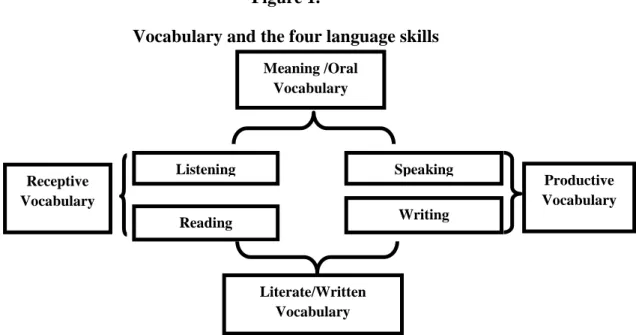
Based on type of vocabulary in general, there are four categories of vocabulary learning: listening vocabulary, speaking vocabulary, reading vocabulary, and writing vocabulary.16 Listening vocabulary refers to words that learners use to understand what they hear. Speaking vocabulary is known as words they use when they speak. Reading vocabulary concerns words in prints that they recognise and use to understand what they read, and writing vocabulary involves words they use in their own writing.
15 Ibid, p. 132.
16 Mayuree Siriwan, English Vocabulary Learning Strategies Employed By Rajabhat University Students, p. 29
11 Figure 1.
Vocabulary and the four language skills
Figure 1: Vocabulary and the four language skills
6. Meaning and Function of Vocabulary17
a) Meaning/Oral vocabulary refers to words language learners use in order to understand what they hear in speech, and words they use when they speak. This involves both receptive and productive vocabulary. For listening, if they lack meaning/oral vocabulary knowledge, they would have difficulties in what they are hearing in authentic situations or from authentic texts. That is, they probably miss the points of what they are listening to. In developing learners’ spoken English vocabulary, it is best to give learners practice in being able to say a lot, using a small number of words.
b) Literate/Written vocabulary refers to words language learners use in order to understand what they read, and words they use in
17 Ibid., p. 30.
Meaning /Oral Vocabulary
Listening
Reading
Speaking
Writing
Literate/Written Vocabulary Receptive
Vocabulary
Productive Vocabulary
12
writing. This, again, includes both receptive and productive vocabulary. Receptive vocabulary involves being able to recognise it when it is seen. When one reads, he or she needs a number of vocabulary items to understand texts he or she is reading. Likewise, when one writes, he or she needs a number of vocabulary items to produce his or her ideas in the writing texts.
c) Receptive vocabulary concerns words language learners use in order to understand what they hear in speech, and words used to understand what they read. It is generally acknowledged that language learners need receptive vocabulary for their listening and reading. The better one’s vocabulary knowledge, the easier one would find it to understand the conversation or a large amount of reading.
d) Productive vocabulary involves words language learners use to express their thoughts and ideas in speaking and writing.
The writer concluded that vocabulary items can be generally categorized into four main groups as receptive, productive, meaning/oral and literal/written vocabulary based on their meanings and functions. It is apparent that vocabulary is vital for the improvement of the four language skills. To improve language skills, language learners need to involve receptive and productive, meaning/oral, and literal/written vocabulary. The following section particularly involves how many words a language learner needs for the four language skills.
13 7. Importance of Vocabulary
Vocabulary is an important aspect in our life. It is because people need vocabulary in expressing their ideas both of in mother tongue or foreign language.18 Even though vocabulary is the sub-skill of a language, it plays a very important role in language learning and teaching. Of all the language skills, it is widely acknowledged that vocabulary is a very important part in English language learning, that no one can communicate in any meaningful way without vocabulary.19 As Judy Willis stated that with enhanced vocabulary, students grow in skills of verbal fluency, writing, and comprehension. When students build vocabulary mastery, they can more effectively communicate their ideas, knowledge, and voice.20
It can be conclude that words are the tools learners use to think, to express ideas and feelings, as well as to explore and analyse the world around them. A limited vocabulary keeps them from expressing their thoughts and feelings. On the other hand, rich vocabulary gives them the right words to use at the right time.
The importance of vocabulary21:
a) An extensive vocabulary aids expressions and communication
18Risqi Ekanti Ayuningtyas Palupi, Enriching Vocabulary Mastery Using Short Texts, (Surakarta: Sebelas Maret University, 2010), p. 10.
19 Mayuree Siriwan, English Vocabulary Learning Strategies Employed By Rajabhat University Students, p. 20
20 Judy Willis, Teaching the Brain to Read, (Alexandria: ASDC Publications, 2008), p.
80.
21 Stahl, Steven A. Vocabulary Development. "The Cognitive Foundations Of Learning To Read: A Framework", (Cambridge: Brookline Books, 1999), p.14
14
b) Vocabulary size has been directly linked to reading
c) Linguistic vocabulary is synonymous with thinking vocabulary d) A person may be judged by others based on his or her vocabulary.
Vocabulary is something adhered to someone. Each vocabulary development learners have, it decides their future. It means the vocabulary is one important that be viewed by the society.
8. Vocabulary Learning
According to H. Brown Douglas, learning is acquiring or getting of knowledge of a subject or a skill by study, experience, or instruction.
Learning is retention of information or skill. Retention implies storage systems, memory, cognitive organization. Learning involves some form of practice, perhaps reinforced practice.22
Robert Michael Easterbrook stated that learning is viewed as a complex process that uses many cognitive resources, not least of all a cognitive ‘tool’ to ‘acquire’ generally both skills and knowledge and experience.23 In other word, learning can be defined as acquisition.
Learning is a process getting information or subject.
Lotfi Ghazal explained that vocabulary learning is one of the major challenges foreign language learners face during the process of learning a language. One way to alley the burden is to assist students in becoming independent learners during the process of target language vocabulary
22 H. Brown Douglas, Principles Of Language And Teaching, (Longman: San Fransisco State University, 2000), p. 7.
23 Robert Michael Easterbrook, The Process Of Vocabulary Learning: Vocabulary Learning Strategies And Beliefs About Language And Language Learning, (The University Of Canberra: 2013), p. 6
15
learning. This could be achieved through instructing learners to apply vocabulary learning strategies as efficiently as possible.24
Vocabulary learning is an essential part in foreign language learning as the meanings of new words are very often emphasized, whether in books or in classrooms. It is also central to language teaching and is of paramount importance to a language learner.25 Vocabulary learning is central to language acquisition, whether the language is first, second, or foreign. Given the difficulties of vocabulary learning in a second or foreign language, along with the obvious necessity of trying to overcome them, one would expect that vocabulary instruction would be at the top of the agenda for language teachers.26
According to Mayuree Siriwan, vocabulary learning is of great importance since vocabulary is a key unit in building up skills and knowledge. However, learning vocabulary items is not simply a matter of committing them to memory, but how to use them in appropriate situations as well as how to expand the knowledge of one’s vocabulary is also crucial.27
Moreover, learning is generally defined as being connected with thinking or conscious mental processes. Some of the factors involved in
24 Lotfi Ghazal, Learning Vocabulary In Efl Contexts Through Vocabulary Learning Strategies, Research On Youth And Language, p. 84.
25 Mofareh Alqahtani, “The Importance Of Vocabulary In Language Learning And How To Be Taught”, International Journal Of Teaching And Education, (Saudi Arabia: King Khaled Academy), N0.3/Maret 2015, p.21.
26 Samira Hayati Samian And Mansoor Tavakoli, “The Relationship Between Iranian Efl Learners Rote Learning Strategy Use And Their Level Of Proficiency”, Journal Of Language Teaching And Research, (Academy Publisher), No. 3/July 2012, p. 625
27 Mayuree Siriwan, English Vocabulary Learning Strategies Employed By Rajabhat University Students, p.70
16
learning the vocabulary of another language that is learning the vocabulary relatively easy or relatively difficult.28 The learner must establish relationships between form, meaning and function, both in utterances and intexts; they must establish the elaborate knowledge about individual words so they can be used communicatively; and they must establish an associational network of words. The learner must know the meanings associated with stand-alone vocabulary items, bound items or multiword items, in the case of English.
The writer conclude that vocabulary learning is as student’ activity to improve their words and its meaning. Vocabulary learning involves activating students’ apprehension of and use of words that the student is not likely to learn through an oral medium, with the goal of increasing students’ expressive vocabulary.
The main goals of vocabulary learning should be focused on why language learners particularly learn vocabulary both in isolation and in context. For example, students need to hear a new word in isolation as well as in context, so that they can notice the sounds at the beginning and end, the stress pattern of the word, and the syllables that make up the word. They will need to hear the word spoken in isolation several times to catch all this information
There are several stages on vocabulary learning, those are29:
28 Robert Michael Easterbrook, The Process Of Vocabulary Learning: Vocabulary Learning Strategies And Beliefs About Language And Language Learning, p. 19
29 Marilyn Lewis, How To Study Foreign Languages, (London: Macmillan Press 1999), p.
123
17 a) Finding New Words
b) Understanding words meaning c) Recording new words
d) Remembering new words e) Self-testing
f) Using new words in natural language 9. The Assessment of Vocabulary Mastery
According to John vocabulary assessment seems straightforward in the sense that word lists are readily available to provide a basis for selecting a set of words to be tested. 30 There are some types that are convenient to use for vocabulary testing as follows:
a. Multiple-choice (choose the correct answer) Example:
The principal was irate when she heard what the students had done.
a) Surprised b) Interested c) Proud d) angry
b. Completion (write in the missing word) Example:
At last the climbers reached the s of the mountain.
c. Translation ( give the L1 equivalent of the underline word)
30 John Read, Assessing Vocabulary, (New York: Cambridge University Press:2000), p. 2
18 Example:
They worked at the mill.
These test items are easy to write and to score, and they make efficient use of testing time. Multiple-choice items particular have been commonly used in standardized tests.
B. Concept of Rote Learning Strategy 1. Definition of Rote Learning Strategy
Margaret Ann Richek said that Learning Strategy provides methods that will help you learn words independently.31 Xiuping Li explained that rote is usually disapproving of memory or habit, rather than understanding. To learn something by rote, or rote learning means learning something in order to be able to repeat it from memory rather than learning it in order to understand it.32
According to Ruth Gairns And Struart Redman, another memorization technique which has a long history in language learning is rote learning. This involves repetition of target language items either silently or aloud and may involve writing down the items.33 These items commonly appear in list form.
Items and Their Translations:
Door = Pintu Work = Kerja
31 Margaret Ann Richek, The World of Words 8th Edition, p. 1.
32 Xiuping Li, An Analysis Of Chinese Efl Learners’ Beliefs About The Role Of Rote Learning In Vocabulary Learning Strategies, (University of Sunderland, 2004), p. 8.
33 Ruth Gairns And Struart Redman, Working With Words: A Guide To Teaching And Learning Vocabulary, (Cambridge University Press, 1986), p. 93.
19
Beautiful = Cantik Lie = Bohong
Paired Items:
Hot = Cold Right = Wrong
Tall = Short Left = Right
Rote learning system does not involve any processes which enable the learner to understand or interpret the information learnt. The only thing such systems do is memorise or store the incoming information for later use.34
Nasser Rashidi and Ahmad Omid stated that further literature research shows that rote learning strategy may also be one of the Memory Strategy, seeing that it can aid memory as well. Due to the essential nature of the MSs' role in vocabulary learning, and their contribution to the storage and retrieval of vocabulary, especially the rote learning is as one of the most important subcategories of memory strategy, the importance of memory strategy should not be ignored.35
Judy Willis states that rote memory is the most commonly required memory task for students in primary and secondary school. This type of learning involves memorizing, facts that are often of little primary interest or emotional value to the student, such as a list of vocabulary words.36 Moreover, Xiuping Li explained that rote learning strategy is
34 Ibid.
35 Nasser Rashidi And Ahmad Omid, “A Survey On Iranian Efl Learners' Beliefs On The Role Of Rote Memorization In Learning Vocabulary And Its Effect On Vocabulary Achievement”, Pan-Pacific Association Of Applied Linguistics, (Shiraz University), Vol. 15, 2011, p. 141.
36 Judy Willis, M.D., Research-Based Strategies to Ignite Student Learning, (Alexandria:
ASDC, 2006), p. 6
20
basically a simple and passive process. However, it does illustrate some issues that are relevant to more complex learning issues. Rote Learning strategy focus on repetition, practice and memorisation. They all refer to the strategies which contribute to storage and retrieval of new knowledge, and storage and retrieval of new knowledge are the two key functions of memory strategies.37 Therefore, Rote learning strategy can be regarded as one of the MSs which cover repetition, practice and memorization. 38
a) Repetition
Repetition define as saying or doing something over and over:
listening to something several times; rehearsing; imitating a native speaker.
b) Practice
Prectice refers to strategies which contribute to the storage and retrieval of language while focusing on accuracy of usage. Practice involves strategies such as: repetition, rehearsal, experimentation, application of rules, imitation, and attention to detail.
c) Memorization
Memorization also refers to strategies which focus on the storage and retrieval of language; therefore some of the strategies, such as drill and repetition, used for practice are the same as memorisation strategies.
37 Xiuping Li, An Analysis Of Chinese Efl Learners’ Beliefs About The Role Of Rote Learning In Vocabulary Learning Strategies, p. 9.
38 Ibid, p. 10.
21
One of the characteristics of rote learning strategy is memorizing.
Scott Thornbury explains that the learner needs not only to learn a lot of words, but to remember them. In fact, learning is remembering. Unlike the learning of grammar, which is essentially a rule-based system, vocabulary knowledge is largely a question of accumulating individual items.39
George M. Landes stated that one of the most important of learning vocabulary is repetition. By constantly hearing and seeing words again and again, we learn how they are used and what they mean. It was through the repetitious hearing of the words in English in a variety of contexts that we learned what they meant long before we could read them or know anything about the principles of their grammatical arrangment.40
In the early stages of Language learning, repetition gives the students the opportunity to manipulate the oral and written forms of language items, and many learners derive a strong sense of progress and achievement from this type of activity. For this reason it can be valuable.
Repetition is a type of strategy that is frequently used by second language learners.
When using learning strategies in vocabulary learning, there have been seen usually many strategy terms, such as memorization and repetition that relate with rote learning strategies. These strategies are
39 Scott Thornbury, How to Teach Vocabulary, (England: Pearson Education Limited, 2002), p. 23.
40 George M. Landes, Building Your Biblical Hebrew Vocabulary: Learning Words By Frequency And Cognate, (Society of Biblical Literature, 2001), p. 19.
22
interchangeably used in language learning strategy area. Therefore, it should be researched to these learners who are applying rote learning in their learning, such as how they improve their vocabulary acquisition and how they understand ways of rote learning usage in vocabulary learning.
Most Asian countries are still utilizing the traditional learning style in which rote learning strategy has been used especially in vocabulary learning because rote learning strategies are most often used as an essential part in vocabulary learning for the Asian EFL learners according to many researches.41
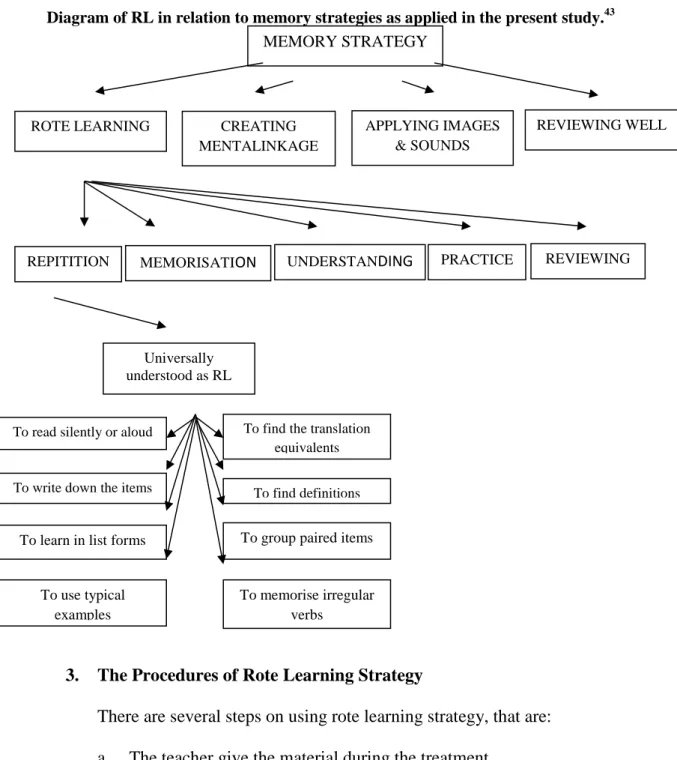
2. Categorization of Rote Learning Strategy and Memory Strategy The four categories of Memory Strategy are Rote learning, Creating mental linkages, Applying images and sounds and Structured reviewing. 42
a) Creating mental linkages
1) Grouping classifying or reclassifying language material into meaningful units.
2) Associating/elaborating relating new language information to concepts already in memory.
3) Placing new words into a context b) Applying images and sounds
1) Using imagery
41 Kantatip Sinhaneti, Ei Kalayar Kyaw, A Study Of The Role Of Rote Learning In Vocabulary Learning Strategies Of Burmese Students, (Bangkok: Shinawatra International University, 2012), p. 988
42 Xiuping Li, An Analysis Of Chinese Efl Learners’ Beliefs About The Role Of Rote Learning In Vocabulary Learning Strategies, p. 16.
23 2) Semantic mapping 3) Using keywords
4) Representing sounds in memory c) Reviewing well
Reviewing in carefully spaced intervals. For example: a review 10 minutes after the initial learning, then 20 minutes later, an hour or two later, and so on in order to remember the new target language information.
Therefore, in the present study, rote learning is placed here and the order of the four MSs are rearranged with rote learning as the first one in order to stress its significance. To illustrate this classification more clearly, the diagram is as presented below:
24 Figure 2.
Diagram of RL in relation to memory strategies as applied in the present study.43
3. The Procedures of Rote Learning Strategy
There are several steps on using rote learning strategy, that are:
a. The teacher give the material during the treatment.
b. The teacher make a list of difficults’ word from the material and the students make on their own note.
43 Ibid, p. 18
MEMORY STRATEGY
ROTE LEARNING CREATING
MENTALINKAGE
APPLYING IMAGES
& SOUNDS
REVIEWING WELL
REPITITION MEMORISATION UNDERSTANDING PRACTICE REVIEWING
Universally understood as RL
To find the translation equivalents To write down the items To find definitions To read silently or aloud
To use typical examples
To memorise irregular verbs
To group paired items To learn in list forms
25
c. The teacher ask the students to memorize the word. The ways of rote learning strategy that the students can use are:
1) Write down the words.
2) Group paired items.
3) Read a word silently or aloud.
4) Read the word repeatedly.
5) Learn word in list form.
6) Review the word.
4. View of Rote Learning Strategy44
a. Negative view of Rote Learning Strategy
RL is regarded by some researchers as primitive and misguided MSs. RL strategies seem to stress passive learning, which is frowned upon or despised by many researchers. In other words, RL is understood as the mechanical use of the memory without necessarily understanding what is memorised; and learning by rote, in this sense, means surface level learning. RL seems to be a hindrance in meeting the varied challenges of life.
b. Positive views of Rote Learning Strategy
Despite the negative beliefs about RL, the review of the literature also indicates positive beliefs about RL in vocabulary learning. RL is identified as a cultural preference and an effective way of getting basic knowledge in the early stages oflanguage
44 Ibid, p. 52
26
learning. It is felt that basic skills of learning can be developed through RL and RL may be beneficial for the accuracy of knowledge. The positive beliefs about RL also suggest that RL does not necessarily have to be meaningless repetition: it may help consolidate knowledge and deepen understanding.
C. The Influence of using Rote Learning Strategy on Students’
Vocabulary Mastery
Vocabulary has important role and should be recognized as a central element in language and it should be given from the beginning stages, in order to make the students mastering in vocabulary will be able to use the suitable or appropriate word in sentences for each situation in making communication to other person.
It is widely know that there are four skills of language, listening, speaking, reading, and writing. In this case the writer will be focused on vocabulary, because vocabulary is important aspect for learning English.
The students will be able to enrich and gain many vocabularies by using appropiate strategy. Rote learning strategy have been used by many students to enrich their vocabulary. Rote learning proved to be more effective in growing passive vocabulary knowledge in comparison with other vocabulary learning strategies.
Based on the explanations above, the researcher can assume that using rote learning strategy can improve the students’ vocabulary mastery.
27
D. The Theoretical Framework and Paradigm 1. Theoretical Framework
There are two variable in this research. They are independent variable (X) and dependent variable (Y). The independent variable is rote learning strategy and the dependent variable is vocabulary mastery.
If the rote learning strategy used by students correctly, students’
vocabulary mastery is good. If the rote learning strategy used by students incorrectly, students’ vocabulary mastery is bad.
2. Paradigm
Based on the theoretical framework above, the writer describes the paradigm as following:
Figure 3.
Paradigm of the Research
Figur 3: Paradigm of the Research Learning
Vocabulary by Using Rote Learning Strategy
Students’
Level Vocabulary
Mastery
Good
Fair
Bad
Hypotheses
28 E. Hypothesis
Based on the theoretical framework and paradigm above, the researcher formulates the hypotheses as follows :
1. Hypothesis Formulation
a. Ha: There is a positive and significant influence of the “ Using Rote Learning Strategy on the Students’ Vocabulary Mastery at The Eighth Graders of SMPN 1 Punggur in the Academic Year of 2017/2018.”
b. Ho: There is no positive and significant influence of the “Using Rote Learning Strategy on the Students’ Vocabulary Mastery at The Eighth Graders of SMPN 1 Punggur in the Academic Year of 2017/2018.”
2. Statistical Hypothesis
If = Fo > Ft, Ha is accepted and Ho is rejected.
If = Fo < Ft, Ha is rejected and Ho is acceted.
29 CHAPTER III RESEARCH METHOD A. Research Design
The research would be conducted based on quantitative research.
According to Cresswell, in quantitative research, the investigator identifies a research problem based on trends in the field or on the need to explain why something occurs. Describing a trend means that the research problem could be answered best by a study in which the researcher seeked to establish the overall tendency of responses from individuals and to note how this tendency varies among people.45
The design of this research was pre-experiment design by using One-Group Pretest–Posttest Design. Donald Ary stated that the one-group pretest–posttest design usually involved three steps: administering a pretest measuring the dependent variable; applying the experimental treatment X to the subjects and administering a posttest, again measuring the dependent variable. Differences attributed to application of the experimental treatment are then evaluated by comparing the pretest and posttest scores.46
45John W. Creswell, Educational Research Methodology: 4thEditionn, (Boston: Pearson Education, 2011), p. 13.
46 Donald Ary, et al., Introduction to Research in Education: 8th Edition, (USA:
Wadsworth, 2010), p. 303.
30
One-Group Pretest–Posttest Design
Y1 : Pre-test Y2 : Post-test
X : Treatment/Independent
This research was conducted in SMPN 1 Punggur especially on eighth graders. The researcher used quantitative research. This research was to investigate whether rote learning strategy could be used to improve the students’ vocabulay mastery significantly by comparing the means of the pre-test with the means of the post-test. Firstly, the researcher administered a pre-test to the students to identify their level on vocabulary mastery. Then eventually a post-test was administered to identify their achievement on their level of vocabulary mastery after being taught by using rote learning strategy. If the means of the pre-test was higher than the means of the post-test, it indicated that rote learning strategy could not be used to improve students’ vocabulary mastery significantly. However, if the means of the post-test was higher than the means of the pre-test, it showed that rote learning strategy could be used to improve students’
vocabulary mastery significantly.
Y
1X Y
231
B. The Operational Definitions of Variables 1. Independent variable
Independent variable was the major variable which was hoped to investigate. It was the variable which were selected, manipulated, and measured by the researcher. Independent variable in this research was rote learning strategy. Rote learning strategy is as a strategy that the students used in learning process. Rote learning strategy refers to memorization, repetition and practicing. The terms are usually used on learning vocabulary. The indicator of rote learning strategy in learning vocabulary of the eighth graders of SMPN I Punggur in the academic year of 2017/2018 was to identify and activate such information, rote learning strategy that could be easily used by students in the vocabulary learning process.
2. Dependent Variable
Dependent variable of this research was the variable which were observed and measured to determine the effect of the independent variable. Dependent variable of this research was vocabulary mastery that could be defined as to gain the total number of words mastered by students. The researcher used written test to measure their vocabulary mastery. The kind of test that the researcher used was multiple choice.
The researcher devided the students’ level vocabulary on three levels.
There were good, fair and bad. Moreover based on the theoretical review, the indicators of vocabulary mastery in leaning English of the eighth graders of SMPN I Punggur in the academic year of 2017/2018
32
were students be able to improve their vocabulary mastery and did some tasks or questions in English.
C. Population, Sample and Sampling Technique 1. Population
According to Creswell, a population is a group of individuals who have the same characteristic47. Moreover, Donald Ary stated that a population is defined as all members of any well-defined class of people, events, or objects.48 It means that population is total number of subject or unit of analysis who has gather characteristics to contrast with others.
The population of this research was all of the eighth graders of SMPN I Punggur in the academic year of 2017/2018. The total population in this research was 275 Students who were divided into eight classes.
2. Sample
Donald Ary stated that a sample is a portion of a population49 whereas Creswell explained that a sample is a subgroup of the target population that the researcher plans to study for generalizing about the target population. 50 It means that sample is small unit of population.
The sample of this research was all of the eighth graders of SMP N I Punggur class VIII.6 in the academic year of 2017/2018. The total
47 John W. Creswell, Educational Research Methodology: 4thEditionn, p. 142.
48 Donald Ary, et al., Introduction to Research in Education: 8th Edition, p. 148.
49 Ibid.
50 John W. Creswell, Educational Research Methodology: 4thEditionn, p. 142.
33
sample in this research was 36 Students who are included into class VIII.6.
3. Sampling Technique
Marczyk et. al defined sample is as a subset of population.51 It means that sample is the part of population which represents that population will be researched. The researcher used cluster sampling technique in this research.
According to Donald Ary, cluster sampling is the unit chosen is not an individual but, rather, a group of individuals who are naturally together.52 By using purposive cluster sampling, the researcher chose VIII.6 for doing this research. The reason why the researcher chose the class because class VIII.6 had low score in comparison with other class VIII.
D. Data Collecting Technique 1. Test
According to Creswell, a test is a set of stimuli presented to an individual in order to elicit responses on the basis of which a numerical score can be assigned.53 Moreover, the researcher used written test as a data collection method to measure the dependant variable. The researcher used objective tests. It was multiple choices test. Multiple choices vocabulary test is highly reliable and
51Geoffrey Marczyk et. al., Essential of Research Design and Methodology, (New Jersey:
John Willeyan Sons Inc., 2005), p. 84
52 Donald Ary, et al., Introduction to Research in Education: 8th Edition, p. 154.
53 Ibid, p. 201.
34
distinguishes learners effectively according to their level of vocabulary knowledge.54
The researcher used multiple choices test which consists of four options for each answer (A, B, C, and D). The materials would be tested was about vocabulary. The researcher used 20 items for pre-test and 20 items for post-test. The measurement are:
a) Good : The students could answer 75%-100% from the questions.
b) Fair : The students could answer 40%-70% from te questions.
c) Bad : The students could answer 0%-35% from the questions.
The researcher measured the use of rote learning strategy on the the students’ vocabulary mastery by pre-test, post-test, and treatments.
a) Pre-test
To know whether the using on rote learning strategy could improve the students’ vocabulary mastery, in this case, the researcher gave pre-test before the students get treatment. From this result, the researcher knew the students’ level in answering a multiple choices of vocabulary exercise and the weakness of learning process.
b) Post-test
After doing pre-test, the researcher asked to the students about the difficulties in answering the exercise and gave more explanation about the vocabulary and rote learning strategy until
54 John Read, Assessing Vocabulary, (New York: Cambridge University Press:2000), p. 2
35
the students understood. Finally the researcherer gave the post- test.
2. Documentation
Documentation was one of instruments to collect some data and informations in the form of written source or documenter such as book, encyclopedia, daily note, etc. In this research, the researcher recorded the students’ name at the eighth grader of SMPN 1 Punggur to know total of the students and took the data about description of research area included profiles of SMPN 1 Punggur.
E. Research Instrument 1. Instrument Blueprint
To earn the data related to the research problems, the researcher designed with indicator which had been decided. The instrument which used in this research was written test.
Table 2.
Instrument Blueprint
Concept Indicators Item Number Total
Vocabulary Test
Part of Speech 1,2,3,4,5,6,7 6
Synonym 8,9,10,11,12 6
Antonym 13,14,15,16 4
Meaning in Context
17,18,19,20 4
Total 20
1. Instrument Calibration
a. The instruments which used on vocabulary test was test
36
Pre-test was given before the treatment in order to identify how far the students’ level on vocabulary mastery. Post-test was given after the treatment, in order to identify the improvement of the students’ level on vocabulary mastery. The researcher used multiple choices test which consists of four options for each answer (A, B, C, and D). The materials would be tested was about vocabulary. The writer used 20 items for pre-test and 20 items for post-test.
b. The instruments which used by documentation was documentation guidance, as follows:
1) Documentation about the condition teachers and officials employees in SMPN 1 Punggur in the Academic year of 2017/2018.
2) Documentation about the quantity of the students of SMPN 1 Punggur in the Academic year of 2017/2018.
3) Documentation about organization structure of SMPN 1 Punggur in the Academic year of 2017/2018.
F. Data Analysis Technique
The researcher used simple statistical formula to comparing the result of the pre-test and post-test. The data would be analyzed by using t- test formula to know the significant and treatment effect and using Chi-