THE EFFECT OF GENRE-BASED APPROACH (GBA) TOWARD STUDENTS’ WRITING SKILL
(A Pre-Experimental Research at the Ninth Grade Students of SMP Muhammadiyah 1 Makassar)
A THESIS
Submitted to the Faculty of Teacher Training and Education
Makassar Muhammadiyah University in Part Fulfillment of the Requirement for the Degree of English Department
RIA OCTAVIA 10535 6062 14
ENGLISH EDUCATION DEPARTMENT
FACULTY OF TEACHER TRAINING AND EDUCATION MAKASSAR MUHAMMADIYAH UNIVERSITY
2019
MOTTO
Perbaiki hatimu, dan hatimu akan memperbaiki pikiranmu, dan pikiranmu akan memperbaiki lidahmu, dan lidahmu akan memperbaiki hidupmu, dan hidupmu akan memperbaiki akhiratmu.
Tidak ada akhir yang menyedihkan bagi
mereka yang percaya kepada Allah
ABSTRACT
RIA OCTAVIA, 2018, The effect of Genre-Based Approach (GBA) Toward Students’ Writing Skill (A Pre-Experimental Research at the Ninth Grade Students’ of SMP Muhammadiyah 1 Makassar). English Education Department, faculty of Teacher Training and Education, Makassar Muhammadiyah University (Supervised by Syamsiarna Nappu and Eka Prabawati Rum).
This research aimed to find out whether Genre-Based Approach (GBA) effect the students’ writing skill in terms of content, organization and language use at SMP Muhammadiyah 1 Makassar. This research used pre-experimental research with pre-test and post-test design. The population of the research was the ninth grade students of SMP Muhammadiyah 1 Makassar in the academic year of 2018-2019. The researcher applied purposive sampling to select the sample. The number of the sample was 25 students. The research variable were teaching writing skill through genre-based approach (GBA) as independent variable and students’ writing skill in recount text as dependent variable.
The result of the data analysis shows that the mean score of the students’
writing recount text in terms of content in pre-test was 56 and post-test was 80, the mean score of the students’ writing recount text in terms of organization in pre-test was 53 and post-test was 64. While, the mean score of the students’
writing recount text in terms of language use in pre-test was 41 and post-test was 73. Then, there was significant enhancement in the students writing development after being taught genre-based approach (GBA). It was proved by the result of the statistical analysis of the level of significant 0.05 with degree of freedom (df=N-1, 25-1=24), it found that the t-table value is 2.06. Indicated that the value t-test of content is greater than t-table (13.66>2.06), the value t-test of organization is greater than t-table (3.77>2.06), and also the value t-test of language use is greater than t-table (10.42>2.06). It means that, through of genre-based approach (GBA) was very good to improve the students' writing skill especially in writing content, organization and language use of recount text.
Keywords: Genre-Based Approach (GBA), Recount Text, Writing Skill.
ACKNOWLEDGEMENTS
می حر لا نمحر لا لله مس ب
Alhamdulillahi Rabbil Alamin, the researcher would like to express her highest gratitude to Allah SWT who has given her blessing, mercy and health so the researcher can complete the writing of her thesis. Salam and Shalawat are delivered to our prophet Muhammad SAW who has brought us from the darkness into the lightness, His families and followers until the end of the world. This writing thesis has been finished under the assistance, direction, and guidance of some people. As a result, the researcher would like to express gratitude, appreciation and thanks giving, especially :
1. The researcher beloved parents, Tahir Darisik and Sumarni who always pray, encourage, and provide countless material, as well as support, so the researcher could finish the process of writing this thesis. Also, The researcher beloved brother, Nur Syawal, S.Kom. and Erwin Afrendi who always accompany, support, and assist me whenever and wherever.
2. Dr. Syamsiarna Nappu, M.Pd. and Eka Prabawati Rum, S.Pd., M.Pd., as the first and the second consultant who always give the critiques and suggestions for the better result of this thesis.
3. Prof. Dr. H. Abdul Rahman Rahim, SE., MM., the Rector of the University of Muhammadiyah Makassar.
4. Erwin Akib, S.Pd., M.Pd., the Dean of Teacher Training and Education Faculty.
5. Ummi Khaerati Syam, S.Pd., M.Pd., as the Head of English Education Department of FKIP UNISMUH Makassar.
6. All lectures and staff of English Education Department of FKIP UNISMUH Makassar who has given a lot of contributions and advices.
7. Husain Abdul Rahman, S.Pd., M.Pd.I., as the Head Master of SMP Muhammadiyah 1 Makassar, especially Abdi Akhiruddin, S.Pd. and all the teachers and students at the ninth grade as their participation and respondent.
8. Thanks also to friends: Andi Rahmayanti, Irdayanti Nanda Rauf, Musyarafah, Nurul Aoliyah Rostam, Nurdiana Hamid, Nurhidayah, Noer Fadilah Ramadhani, Siti Fathimah azzahra, Yusnaini and all of friends in Gorgeous Class (G Class) especially, as well as all of the students of English Department of Makassar Muhammadiyah University 2014 generation generally, for their support in finishing this study.
The researcher realizes that this thesis is still need more improvement to get better result, so that suggestions and advises are always expected. Finally, willingly the researcher prays may all our efforts be blessed by Allah SWT.
Makassar, 2018
The researcher
TABLE OF CONTENTS
COVER ... i
APPROVAL SHEET ... ii
COUNSELLING SHEET ... iii
SURAT PERJANJIAN ... vi
SURAT PERYATAAN ... vii
MOTTO ... viii
ABSTRACT ... ix
ACKNOWLEDGMENTS ... x
TABLE OF CONTENTS ... xii
LIST OF TABLES ... xv
LIST OF CHARTS ... xvi
LIST OF FIGURES ... xvii
CHAPTER I INTRODUCTION ... 1
A. Background ... 1
B. Problem Statement ... 3
C. Objective of The Research... 4
D. Significance of The Research ... 4
E. Scope of The Research ... 4
CHAPTER II LITERATURE REVIEW ... 5
A. Previous Related Research Findings ... 5
B. Theoretical Review ... 7
1. Concept of Writing ... 7
a. Definition of Writing ... 7
b. Components of Writing ... 8
c. Types of Writing ... 12
d. Main Part of Paragraph ... 15
2. Genre Based-Approach (GBA) ... 17
a. Definition of Genre ... 17
b. The Implementation of GBA ... 18
c. Advantages of GBA ... 21
C. Conceptual Framework ... 22
D. Hypothesis ... 23
CHAPTER III RESEARCH METHOD ... 24
A. Research Design ... 24
B.Research Variables ... 25
1. Independent Variable ... 25
2. Dependent Variable ... 25
C. Population and Sample ... 25
1. Population... 25
2. Sample ... 26
D. Research Instrument ... 26
E. Procedure of Collecting Data... 27
F. Data Analysis ... 29
CHAPTER IV FINDINGS AND DISCUSSION ... 34
A. Findings ... 34
1. The Students’ Writing Recount Text in Term of Content ... 34
2. The Students’ Writing Recount Text in Term of Organization ... 36
3. The Students’ Writing Recount Text in Term of Language Use ... 38
B. Discussions ... 41 1. The Students’ Writing Recount Text in Term of
Content ... 41
2. The Students’ Writing Recount Text in Term of Organization ... 43
3. The Students’ Writing Recount Text in Term of Language Use ... 46
CHAPTER V CONCLUSION AND SUGGESTION ... 51
A. Conclusion ... 51
B. Suggestion ... 52 BIBLIOGRAPHY
APPENDICES
CURRICULUM VITAE
LIST OF TABLES
Table 3.1 Research Design ... 25
Table 3.2 Recount Scoring Profile ... 30
Table 3.3 Classification of Students’ Score ... 32
Table 4.1 The Students’ Writing Skill in Terms of Content ... 34
Table 4.2 Classification of the Students’ Writing Recount Text Using Genre Based Approach in Terms of Content (Pre-test and Post-Test) ... 35
Table 4.3 The Students’ Writing Skill in Terms of Organization ... 36
Table 4.4 Classification of the Students’ Writing Recount Text Using Genre Based Approach in Terms of Organization (Pre-test and Post-Test) ... 37
Table 4.5 The Students’ Writing Skill in Terms of Language Use ... 38
Table 4.6 Classification of the Students’ Writing Recount Text Using Genre Based Approach in Terms of Language Use (Pre-test and Post-Test) ... 39
Table 4.7 T-test Value of the Students’ Writing Skill of Recount Text ... 40
LIST OF CHART
Chart 2.1 Teaching-Learning Cycle of GBA ... 19
LIST OF FIGURES
Figure 2.1. Conceptual Framework ... 22
Figure 4.1 The Students’ Writing Skill in Terms of Content ... 35
Figure 4.2 The Students’ Writing Skill in Terms of Organization ... 37
Figure 4.3 The Students’ Writing Skill in Terms of Language Use ... 38
CHAPTER I INTRODUCTION
This chapter presents the background of the research, problem statement, objective of the research, significance of the research, and scope of the research.
A. Background
Nowadays, people are more aware of how important the language is.
Language is our primary source of communication. It is the method through which we share our ideas and thoughts with others. The use of language cannot be separated from human life because it is a tool that is used by people in speaking or writing. Corder (1962: 20) states that language is an object like a tool, which we can pick up, use for some purposes, and put down again. By using language, we can exchange our ideas, ask other people to do something, tell about experiences and communicate with each other.
One of the languages that can be used to communicate is English.
English is an international language and it has an important role for communication in the world. In Indonesia, English is the first foreign language and it is taught as a compulsory subject in the school.
Since English is foreign language, Indonesian students have to face many obstacles when learning English, one of them is writing skill. Writing is a basic and very important language skill because it is integrated in learning process and it can improve the students’ academic performances but it cannot
be learned in a short time. Clay (1983) claimed that writing as a skill is very paramount for many reasons. The first reason is that writing involves much more than the transcription of speech. The second reason for focusing on writing is that it is an attempt to communicate in the new mode that students most effectively discover and master the relationship between speech and written text. The third reason is that writing is a surer way than reading into mastering the written code.
As a part of English skill, most of Indonesian students generally get some difficulties in learning writing skill. The difficulties occur generally due to the lack of knowledge about vocabulary and grammar. According to Richard and Renandya (2002), the difficulties include those in (1) generating and organizing ideas using an appropriate choice of vocabulary and (2) putting such ideas into an intelligible text.
In terms of teaching writing, most of the teachers just focus on providing their students with vocabularies related to the required topic and some guiding questions in order to help them shape their ideas into the completed paragraphs. However, teaching writing with this way does not help students in producing text with the correct language models.
Based on the researcher’s experience in Magang III (Internship) at SMP Muhammadiyah 1 Makassar, many students still have difficulties in learning English, especially in writing. The first is difficulty in finding creative ideas because they lack of motivation to writing. Second, students’
did not have enough vocabularies and poor on grammar, they are lazy to open
a dictionary when find new vocabularies or difficult words. The last, students’
junior high school get bored when the teacher only focused to answer the questions in the students’ worksheet.
This research is an endeavour to seek for ways that can both enhance students’ writing skills and build up their positive perceptions towards learning this skill. The genre-based approach (GBA) is chosen to solve students’ difficulties in learning. Genre-Based Approach is used to conduct the classroom activity in teaching and learning process.
There are many researchers investigated about Genre Based-Approach in teaching and learning (Khodabandeh, 2014 and Dirgeyasa, 2016).
However, they focus on examination and process of teaching using Genre Based-Approach. Whereas, this research focuses on increasing students’
writing skill in terms of content, organization and language use, especially recounts text.
Based on the explanation above, the researcher is interested to know the effect of Genre-Based Approach (GBA) toward students’ writing skill.
This research focused on Junior High School students especially at the ninth grade because in this level they need more knowledge of grammar.
B. Problem Statement
Based on the background above, the researcher formulates problem statement as follow:
“Does Genre-Based Approach effect the students’ writing skill in terms of content, organization and language use at SMP Muhammadiyah 1 Makassar?”
C. Objective of the research
Related to the research question above, the objective of the research is to find out whether Genre-Based Approach (GBA) effect the students’
writing skill in terms of content, organization and language use at SMP Muhammadiyah 1 Makassar.
D. Significance of the research
The research is expected to give both positive theoretical and practical significances. Theoretically, the research is expected to be useful and helpful for the teachers in general to improve the quality of the English teaching, to add information and improve teaching skill, and to encourage students to be more active, creative, and innovative to write. Practically, the research expected to be a reference to search for an approach or the appropriate learning methods in teaching writing skill. In addition, this research was provide insight and understanding to English University students as prospective teachers to develop a model of learning that can be used to make the students interested and motivated in learning.
E. Scope of the research
The scope of this research is limited to find out the effect of Genre- Based Approach toward students’ writing skill in terms of content, organization and language use at SMP Muhammadiyah 1 Makassar. The researcher focused on the generic structure of recount text.
CHAPTER II LITERATURE REVIEW
This chapter presents the previous related research findings, theoretical review, and conceptual framework.
A. Previous Related Research Findings
There are some researchers have conducted GBA research by using few of technique in teaching English. These researches are mostly carried out to find techniques that are more efficient, and easy in teaching and learning process.
The research by Changpueng (2009), entitled The effects of the Genre- Based Approach on Engineering Students’ Writing Ability, investigated mechanical engineering students. This research is performed to find out the attitudes of students with different levels of English proficiency toward writing instruction based on the Genre Based-Approach. The three lessons were taught with the same method (GBA), but the explanation of the teaching method will be described based only on the request e-mail lesson. The test consisted of three items (request and enquiry e-mails, and reports) and to collect the data this research used Questionnaire and Interview. The result, Genre Based-Approach could be an effective alternative to teaching writing to students with different levels of proficiency.
The next research by Foo (2007), entitled The effects of the Process- Genre Approach to writing instruction on the expository essays of ESL
students in a Malaysia secondary school. This research applies a quasi- Experimental design which aims to investigate the effects of adopting a process genre approach to writing instruction. The experiment involves explicit instruction in process-genre writing strategies that encompasses the entire composing process to selected Form Six ESL students whose ages range between eighteen to nineteen years. In this research, students are instructed to write expository essays. The result of this research shows that the instruction in process-genre strategies neither promoted better ability in the way they organized their ideas nor their control of language. Nevertheless, it enhanced their overall writing proficiency.
The last research conducted by Purnomo (2008), the research entitled Teaching Speaking Skills Through Genre-Based Approach, uses purposive sampling technique which is Technique to collect the data by using observation, in-depth interviews, and document analysis. This research is a descriptive-qualitative research which aims to evaluate the teaching and learning process of speaking skills, with the source data are collected from three different sources: (1) informants, (2) events, and (3) documents. The informants are three lecturers and fifteen students who involve in the teaching and learning process, the curriculum makers, and the course book authors.
The events are the teaching and learning process of speaking skills-subjects (Speaking Acquisition 1 and Speaking Acquisition 2). The documents are the curriculum, syllabus, lesson plan, and course book. The result of this research shows that the teaching speaking skills through genre based-approach at
Language Center of Muhammadiyah University of Surakarta has not been optimal yet.
The three researches mention previously has the similarity and the dismilarity with this research. The similarity of the reseach is the researchers find out the learning strategies used Genre-Based Approach in teaching learning process. The dismilarity of the research in the first research conducted research on Engineering Students’, the second using Genre-Based Approach as a writing instruction on the expository essays, and the last one focuses on improving students speaking skill. While in this research, the researcher focused on teaching writing recount text at SMP Muhammadiyah 1 Makassar and find out the effect of Genre-Based Approach (GBA) toward students’ writing skill.
B. Theoretical Review 1. Concept of Writing
a. Definition of Writing
Coulmas (2007) stated that writing is a set of visible or tactile signs to represent units of language in a systematic way, the purpose of recording massage which can be retrieved by everyone who knows that language in questions and the rule of which is unit are encoded in the writing system. According to Chandler (1993), writing is the representation of language in a textual medium through the use of a set of signs or symbols (known as a writing system).
Besides, when people speak, they also must be able to write their
language. Peter (1998) stated that writing is a system of more less permanent marks used represent an utterance in such a way that is can be recovered more or less exactly without the intervention the speaker.
There are additional reasons for writing that may be even more important. According Meyer (1999) writing is thinking of paper. Thinking is a mind at work, finding facts, seeing relationship, testing the truth of them, and researching conclusion. Writing is skill of English which share the ideas into written. Gebhard (1996) stated writing is a process of creating an idea and express the meaning in written-form. It means that writing could be defined as a part of language skill which requires ability in order to construct a brief and good order of sentence. As one of the language skill in English, writing is used to express the student ideas, opinion or comments which are conveyed in the written form.
Based on the various definitions above, The researcher concludes that writing is a tool of communication to express our ideas or to transmit the massages through written-form.
b. Components of Writing
Tardif (2007) states that writing skills are complex and sometimes difficult to teach. To requiring mastery not only of grammatical and rhetorical devised but also conceptual and
judgmental elements. Heaton (1988) divided the components of writing into five areas. They are as follows:
a. Content
The content of writing should be clear for the readers so that the readers can understand the message conveyed the information from it. In order to have a good content of writing, its content should be well unified and completed. This term is usually known as unity and completeness, which become characteristics of good writing.
The good paragraph has unity, which means that in each paragraph; only one main idea is discussed. Furthermore, every supporting sentence in the paragraph must be directly related to the main idea. Do not include any information that does not directly support the topic sentences.
The complete paragraph means that the main idea must be explained and developed fully completeness as comments out the controlling idea which is developed thoroughly by these of particular information. It is relative to know how to complete writing. It is expected that the content of writing will be clear and understandable for the readers.
b. Organization
Organization of the writing is the writer focuses on how to arrange and organize the ideas chronologically. The writer should
present their ideas based on the order which flows from the beginning to the end. There are many ways used to organize or to arrange the writing. This organization is mainly recognized as order.
Coherence in writing means sticking together and in coherent essay, all the idea sticks together. A coherence paragraph is a paragraph that all of the idea are put in right order and never confused. This makes the writer’s thought easy to follow the sentence and paragraph.
c. Language Use
Language use in writing involves correct usage of the rules of language or grammar. It focuses on verbs, noun, and agreement.
Specific nouns and strong verbs give a reader a mental image description. This specific noun can be characterized by using modifier of adjective, adverbs, and participle forms. A modifier can be phrases. There are many opportunities for errors in use of verb and mistakes in arrangement are very common. Mistakes in written work, however are much serious than in science as we have opportunity to re-read and to correct what we have written. We should avoid errors in verbal forms, subject- verb agreement, and pronoun antecedent agreement in a case of noun and pronoun.
In this part also the writer should care about vocabulary.
Vocabulary is one of the language aspects dealing with the process
of writing study. In the process of writing, the writer always thinks about putting words into sentences and then putting sentences into paragraphs until the can create a piece of writing. So, mastering word choice can help us to develop our writing.
d. Vocabulary
Vocabulary is one of the language aspects dealing the process of writing. The writers always think about putting words into the sentences and putting the sentences into the paragraph until they can create a piece of writing.
It is clear now that we cannot write or express if we do not have sufficient vocabulary. Therefore, we cannot understand the writing passage without having a lot of vocabularies.
e. Mechanic
Mechanic in writing deals with capitalization, punctuation and spelling appropriately. These aspects are very important in leading the readers to understand or recognized immediately what the writer means to express definitely. The use of favorable mechanics in writing will make reader easy to understand to convey ideas or messages stated in the writing.
1) Capitalization
The use of capitalization in the writing can clarify the ideas. If the sentences are capitalized incorrectly, ambiguous meaning and misunderstanding would be appeared. Besides,
correct capitalization also helps the reader to differentiate one sentence to another.
2) Punctuation
It can be used as a unit of meaning and suggest how the units of its relation to each other.
3) Spelling
There are three important rules followed in using spelling appropriately. They are suffix addition, plural addition, and handling error within the words.
c. Types of Writing a. Narration
Oshima (1997: 27) explained that narration is story writing.
When you write a narrative paragraph or essay, you write about events in the order that they happened. In other words, you use time to organize your sentence. In the model essay, the writer uses time order to divide the essay into paragraphs. An outline of the essay narration would like this: orientation, complication, and resolution.
The researcher concludes that narration text is a kind of text that purposes to entertain the reader. This text use past tense. This text includes short story, poem, novel, etc.
b. Description
Oshima (1997: 50) explain that descriptive writing to the senses, so it tell how something looks, feels, smells, tastes, and/or
sounds. A good description is like a “word picture”, the reader can imagine the object, place, or person in his or her mind. A writer of a good description is like an artist who paints a picture that can be
“seen” clearly in the mind of the reader. In a description, writers often use spatial order to organize their ideas. Spatial order is the arrangement of items in order by space. An outline of description would like this: introduction, body and conclusion.
To sum up, description text is kinds of text which is purposed to describe things or person. This text mainly uses present tense.
c. Explanatory
There are three kinds of explanatory composition, they are:
1) Explaining a Process.
To write an explanatory composition that explains a process relies on the same abilities you have used in everyday situations. Explain the steps in the process briefly and clearly.
Start with the first step and proceed through all the steps in the order in which they must be completed. It is essential that the steps be presented in the correct sequence and that they must be accurate and complete. An effective way to organize an explanatory composition that explains a process is to follow this plan: introduction, steps in the process, and conclusion.
2) Stating an Opinion
An explanatory composition may express an opinion and explain why others should accept strong, specific reasons or facts. An effective way to organize an explanatory composition that stating an opinion is to follow this plan:
introduction (express your opinion, as directly as possible), body (supporting opinion), and conclusion (summarize your argument as forcefully as you can).
3) Sating a Definition
To write a good definition, you must do three things.
First, name the word to be defined. Second, name the general class to which the subject belongs. The last, name the particular characteristic of the subject. By defining a subject you will be able to resent a complete and informative picture of it. An effective way to organize an explanatory composition that stating a definition is to follow this plan: introduction (your definition serves as the topic sentence for the composition), body (the most informative way to develop a definition is with or with facts and figures), conclusion (the sums up the main idea of your definition).
The researcher concludes that explanatory text is text that explain how to or make something.
d. Recount
Recount is a text which retells events or experience in the past. Its purpose is to retell events. The generic structures of recount are orientation-events-reorientation. It has a similarity with the generic structure of narrative. The differentiated of recount text with narrative text only is in events. There is no complication in recount.
The researcher concludes that recount text is a text that tells about one experience. This text purposes to entertain the reader.
d. Main Part of Paragraph
Oshima and Hogue (1997:71) classify three main parts of paragraph which are: topic, supporting, and concluding sentences.
a. Topic Sentence
The topic sentence is the most general statement of the paragraph. It is the key sentences because it names the subject and the controlling idea, the writer’s main idea, opinion, or feeling about that the topic. The topic sentence is a complete sentence. It has three parts: a subject, a verb, and a controlling idea. The topic sentences will tell the reader what the paragraph is about.
b. Supporting Sentences
The supporting sentences develop the topic sentences by giving specific details about the topic. The supporting sentences that follow the topic sentences should develop the main idea of the paragraph. The topic sentences can be supported by giving
definition, reason, example, fact, comparison and effect. In order to choose detail to support the topic sentence, rephrase it as a question, and answer that question with your supporting sentences.
The supporting sentences follow the topic sentences and make up the paragraph.
c. Concluding Sentences
This sentence tells the reader that the paragraph is finished, and it completes the development of the subject of the paragraph.
The concluding sentences remind the reader of the topic sentences.
When the writer writes a concluding sentence, you can state the topic sentences in different word or summarize some of the main points in the paragraph.
2. Genre-Based Approach a. Definition of Genre
Genre approach in writing are relatively new in teaching and learning English. Genre in writing is a part of genre in language use.
Thoreau (2006) simply states that genre in writing or genre writing is a kind or type of writing in which it has a typical style, particular target of readers, and a specific purpose. “Genre” refers not only to types of literary texts but also to the predictable and recurring patterns of everyday, academic and literary texts occurring within a particular culture (Hammond and Derewianka, 2001).
Derewianka (1990) identified further six main genres according to their primary social purposes: (1) narratives: tell a story, usually to entertain; (2) recount: to tell what happened; (3) information reports: provide factual information; (4) instruction: tell the listeners or readers what to do; (5) explanation: explain why or how something happens; (6) expository texts: present or argue a viewpoint. The social function of the text-genres to determine the linguistic input of the text (i.e. their linguistic conventions, often in the form of Schematic structure and linguistic features). Schematic structure refers to the internal structure or organization of the text type the text in the form of introduction, body and conclusion, whereas the linguistic aspect consists of features such as grammar, vocabulary, connectors, etc.
Referring to the statements above, it can be concluded that genre is a process of communication which has a certain goal for its members in a certain event of communication due to certain social context.
b. The implementation of Genre-Based Approach
Basically a verbal-communication activity is a process of creating texts, both spoken and written, which happens because persons interpret and respond the texts in a discourse. So, a text is a product of situational context and cultural context.
A genre-based approach placed great emphasis on the relationship between text-genres and their contexts (Hyon, 1996). In doing so, it aimed to help students become effective participants in their academic and professional environment as well as in their broader communities (Hammond and Derewianka, 2001).
The genre-based approach emphasizes the importance of exploring the social and cultural context of language use on a piece of writing. The context decides the purpose of a text, an overall structure of a text in terms of language features and text features often in the form of linguistic conventions (Hammond and Derewianka, 2001; Hyon, 1996). This approach argues that students can only produce a composition to be successfully accepted by a particular English-language discourse community once they take the context of a text into account into their own writing papers.
In this approach, any student who wants to be successful in communicating in a particular English-language discourse community needs to be able to produce texts which fulfill the expectations of their readers in regards to grammar, organization, and content.
In planning the lessons in foreign language education context, teachers need to go around the six meetings.
Chart 2.1 Teaching–learning cycle of GBA
Hammond inKongperch (2006:9) Stage 1 – Building knowledge of the field (BKOF), where teachers and students build cultural context, share experiences, discuss vocabulary, and grammatical patterns. All of these are geared around the types of genre writing and topics they are going to deal with at the second stage.
Stage 2 – Modeling of the text (MOT), in this stage, the teacher and the students discuss the text genre by modeling and deconstruction or even manipulating the text. After that, the students
are directed and situated in order to know and understand the function of the text, the communicative purpose of the text.
Stage 3 – Joint Construction of Text (JCT), the students start to do something more practical and operational dealing with writing.
However, their work of genre writing is not writing at all because they modify and manipulate the text given. The students are still guided and helped by the teacher before they become really independent writer of a certain genre taught and learned.
Stage 4 – Independent Construction of Text (ICT), The student write a given genre type independently. They may find ideas themselves, organizing ideas and generating ideas with good steps of writing process (constructing ideas, drafting, conferencing, editing, and publishing).
c. Advantages of Genre-Based Approach
Hayland (2004) sees the advantages of a genre based writing instruction that can be summarized as follows:
Explicit. Makes clear what is to be learned to facilitate the acquisition of writing skills
Systematic. Provides a coherent framework for focusing on both language and contexts
Needs-based. Ensures that course objectives and content are derived from students needs
Supportive. Gives teacher a central role in scaffolding student learning and creativity
Empowering. Provides access to the patterns and possibilities of variation in valued texts
Critical. Provides the resources for students to understand and challenge valued discourses
Consciousness raising. Increases teacher awareness of texts and confidently advise students on their writing.
C. Conceptual of Framework
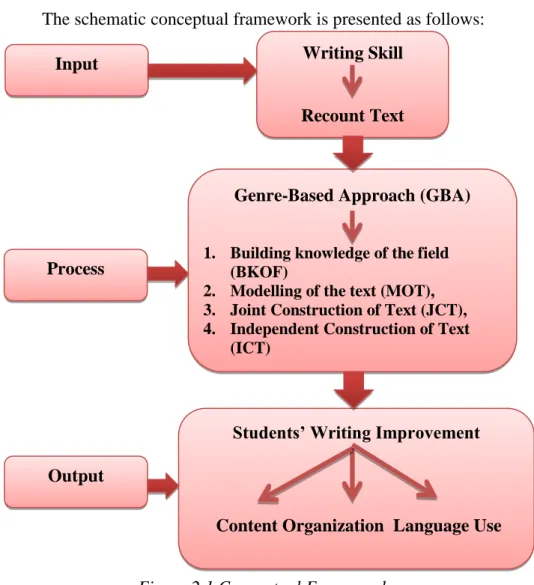
The schematic conceptual framework is presented as follows:
Figure 2.1 Conceptual Framework Input : Teaching Material
Refers to the material of thr research is writing skill specially recount text.
Process : Treatment given Genre-Based Approach (GBA)
The process of the research was illustrated by Figure above.
It shows the writing recount text using Genre-Based Approach (GBA) with four stages. (1) Building knowledge of the field, in this stage the researcher starts from introducing the social Input
Process
Output
Writing Skill
Recount Text
Genre-Based Approach (GBA)
1. Building knowledge of the field (BKOF)
2. Modelling of the text (MOT), 3. Joint Construction of Text (JCT), 4. Independent Construction of Text
(ICT)
Students’ Writing Improvement
Content Organization Language Use
context of recount texts, control of relevant vocabulary, and gave the grammatical pattern. (2) Modelling of the text, the researcher gave them another model of genre writing generally.
(3) Joint construction, by researcher guide let them join together and have them the producted of recount text in the form of discussion. (4) Independent construction, in the last stage the students’ made a recount text individually.
Output : Students’ writing improvement
By applying Genre-Based Approach, the researcher expects that the students’ can improve their writing skill in terms of content, organization and language use.
D. Hypothesis
According to Arikunto (2014: 110) hypothesis is a temporary answer to the research problem until it is proved by the data that will be collected”.
Based on the theoretical framework and conceptual framework above, the hypothesis can be formated:
1. H1: There is a difference between Pre-test and Post-test on students’ score in writing recount text using Genre-Based Approach (GBA).
2. H0: There is no difference between Pre-test and Post-test on students’ score in writing recount text using Genre-Based Approach (GBA).
CHAPTER III RESEARCH METHOD
This chapter presents the research design, research variables, population and sample, instrument of the research, procedure of collecting data, and technique of data analysis.
A. Research Design
The approach of this research was quantitative research. Quantitative research involving formal, objective information about the world, with mathematical quantification; it can be used to describe test relationships and to examine cause and effect relationships. Generally, qualitative research is collected when researcher has adopted the positivist epistemological approach and data is collected that can be scientifically. According to Matthews and Ross (2010) quantitative research methods are basically applied to the collection of data that is structured and which could be represented numerically.
This research applied a Pre-Experimental design. The purpose of this research to found out the effect of Genre-Based Approach toward students' writing skill at SMP Muhammadiyah 1 Makassar. This research consists of three steps; they were pre-test, treatment, and post-test. The design of this research is presented in the following table:
Tabel 3.1 Research design
(Gay, 2012:265) Notes: : Pre-test
X : Treatment : Post-test B. Research Variables
The kinds of variable related to research consisted of independent and dependent variable. Independent variable or often called as a stimulus variable, predictor, or antecedent the variable that affects or which became the reason of the change or the onset of dependent variable. Whereas, dependent variable or commonly referred to as output variable, criteria, or the consequent is the variable that is affected or that becomes a result due to the independent variable. There variables in this research are:
a. Independent variable (X) : Genre-Based Approach
b. Dependent variable (Y) : Students’ writing skill in recount text C. Population and Sample
1. Population
The population of this research was the ninth grade students of SMP Muhammadiyah 1 Makassar in the academic year of 2018-2019.
2. Sample
The researcher applied purposive sampling technique to select the sample of this research. The researcher took only one class as the sample
X
of this research. The members of the sample was 25 students in class IX.A. The sample of this research was class IX.A because in this level they need more knowledge of grammar. This class was assumed to be homogeneous based on the recommendation of an English teacher that handles the ninth grade students of SMP Muhammadiyah 1 Makassar.
D. Research Instrument
The instrument in collecting the data used writing test. The students made a recount text based on topic given by researcher. The researcher applied pre-test before giving treatment and post-test after treatment. The forms of the test was writing a paragraph.
1. Pre-test
The researcher gave the pre-test to experimental class. The pre-test used to see the students’ former writing ability before the implementation of Genre-Based Approach in the treatment.
2. Post-test
The post-test gave after treatment to see the effect of Genre-Based Approach in writing recount text. It was compare with the pre-test.
E. Procedure of collecting data 1. Pre-test
Before giving treatment, the researcher explained about recount text in general to the students. The researcher explained the characteristic and generic structure of recount text. The pre-test was give after the explanation.
In pre-test the students write a recount text based on the topic.
1. Treatment
The treatment conducted for 6 meetings, it took 90 minutes for each meeting. Genre-Based Approach (GBA) used in learning process, and the topic is a real topic that the students encounter in their life. The steps conduct in treatment as follows:
a. Building knowledge
The first stage in a text-based starts from introducing the social context of the texts. In this case was recount text. Then the shared experience, control of relevant vocabulary, and gave the grammatical pattern. Activities conducted in the classroom are:
1. Present the context and social goals.
2. Then shared experience through class discussion, starting with the example of the researcher in advance.
3. The next stage we gave an example of any vocabulary commonly used in writing the recount text.
4. The last stage in building knowledge was giving grammatical pattern used in the recount text. That is the simple past tense.
b. Modelling of the text
In the second stage, the students observed the patterns and characteristics of the text being taught. The researcher gave them model of the procedure text, narrative text, descriptive text, explanation text and report text in generally. Then students compare models with another text.
c. Joint construction of the text
In this stage, let the students join together and have them the product of recount text in the form of discussion, guide by the researcher. The researcher made the students cooperate and produce the best product, discussion and inquiry technique that insist students to find their own ideas.
d. Independent construction
The students’ did assignment about recount text individually. The research gave them chance to make their own product. They may found ideas themselves, organizing ideas and generating ideas with good steps of writing process (constructing ideas, drafting, conferencing, editing, and publishing).
2. Post-test
In the last meeting after the treatment, the researcher gave post-test to found the students’ writing skill. The students made a recount text based on the theme.
F. Data Analysis
The collecting data through the test analysis by using pre-experimental method to found out the students writing ability, the three components of writing as follows:
1. Content 2. Organization 3. Language Use
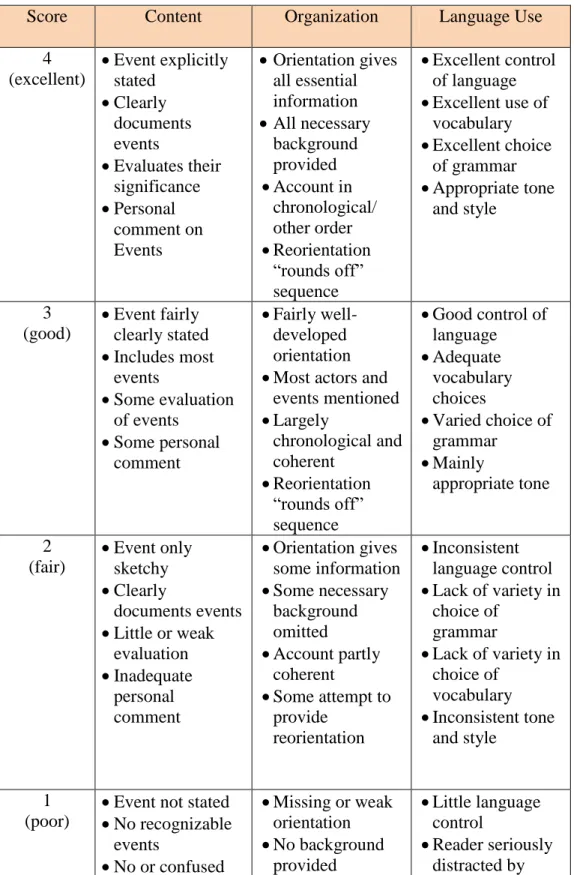
Scoring and classifying the students ability into the following criteria.
Table 3.2 Recount Scoring Profile
Score Content Organization Language Use
4 (excellent)
Event explicitly stated
Clearly documents events
Evaluates their significance
Personal comment on Events
Orientation gives all essential information
All necessary background provided
Account in chronological/
other order
Reorientation
“rounds off”
sequence
Excellent control of language
Excellent use of vocabulary
Excellent choice of grammar
Appropriate tone and style
3 (good)
Event fairly clearly stated
Includes most events
Some evaluation of events
Some personal comment
Fairly well- developed orientation
Most actors and events mentioned
Largely
chronological and coherent
Reorientation
“rounds off”
sequence
Good control of language
Adequate vocabulary choices
Varied choice of grammar
Mainly
appropriate tone
2 (fair)
Event only sketchy
Clearly
documents events
Little or weak evaluation
Inadequate personal comment
Orientation gives some information
Some necessary background omitted
Account partly coherent
Some attempt to provide
reorientation
Inconsistent language control
Lack of variety in choice of
grammar
Lack of variety in choice of
vocabulary
Inconsistent tone and style
1 (poor)
Event not stated
No recognizable events
No or confused
Missing or weak orientation
No background provided
Little language control
Reader seriously distracted by
(Hyland, 2004: 231) The data collecting in this research analyzed by using the procedures as follows:
1. Scoring the students correct answer of pre-test and post-test.
Students Score = × 100
(Gay, 1981:316) 2. Calculating the mean score of the students’ writing test use the following
table:
=
Notation : : Mean Score
∑x : Total sum of all scores
N : The total number of the sample
(Gay, 1981:264) 3. To find out the improvement of percentage:
% = x 100
Notation : % : the percentage of improvement : the total score of Post-test : the total score of Pre-test
(Gay, 1981, 298) 4. Calculating the percentage of students’ score:
P = x 100%
evaluation
No or weak personal comment
Haphazard and incoherent sequencing
No reorientation or includes new matter
grammar errors
Poor vocabulary and tone
Notation :
P : Percentage
F : Number of correct answer N : The number of subjects
(Gay, 1981:168) 5. To classify the students’ score in writing
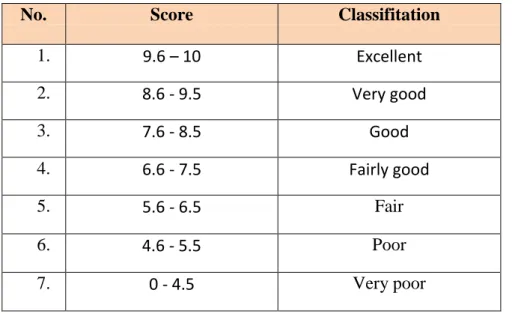
Table 3.3 Classification of students’ score
No. Score Classifitation
1. 9.6 – 10 Excellent
2. 8.6 - 9.5 Very good
3. 7.6 - 8.5 Good
4. 6.6 - 7.5 Fairly good
5. 5.6 - 6.5 Fair
6. 4.6 - 5.5 Poor
7. 0 - 4.5 Very poor
(Depdikbud, 1985:6)
6. Calculating the value of t-test to indicate the significance between post-test and pre-test, the researcher used the formula as follow:
t =
Where : =Notation :
t : Test of significance
: The mean of different score
: The sum of total score of significance : The square of the sum for difference
: The total number of subject
(Gay, 1981:361) ≥ : Having significant influence
: > or P-value < α 0.05
≤ : Having no significant influence : = or P-value ≥ α 0.05
CHAPTER IV
FINDINGS AND DISCUSSION
This chapter discusses about finding and discussion. The findings describe about the result of the data collected from the test. And discussion explains and interprets the findings. The result of the research was described in the following description:
1. Findings
The results of the data findings find that the effect of Genre-Based Approach can improve the students’ achievement in writing of content, organization and language use and also the classified the students’ score in writing. In the further interpretation of the data analysis are given below:
1. The Students’ Writing Recount Text in Terms of Content
The improvement of the students’ writing skill of content at the ninth grade students of SMP Muhammadiyah 1 Makassar as result of the students assessment of pre-test and post-test can be seen clearly in the following table:
Table 4.1 The Students’ Writing Skill in Terms of Content
Variable Pre-test Post-test Improvement %
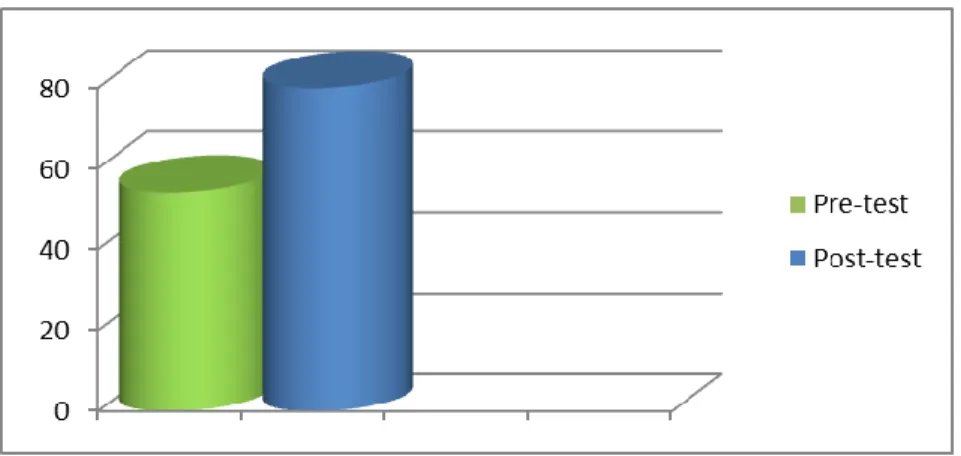
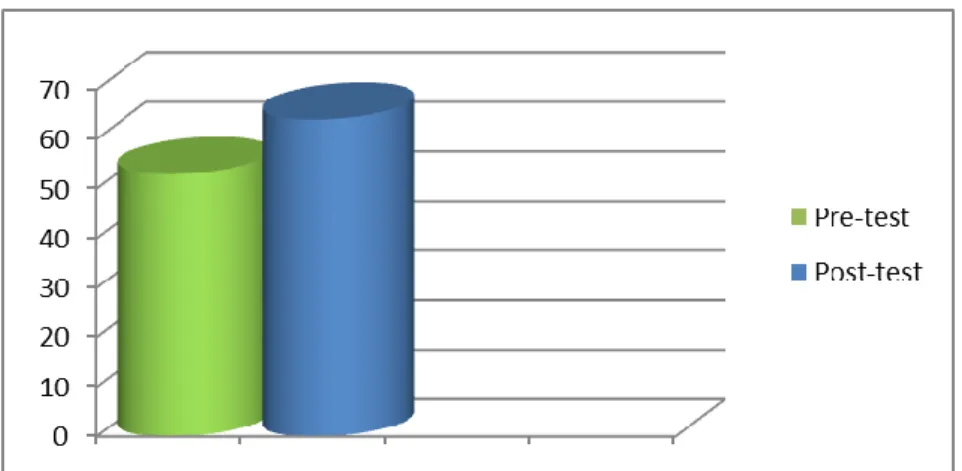
Content 56 80 42.86%
The data on Table 4.1 shows that the score of content has improved (42.86%) from the mean score of pre-test (56) to post-test (80), it is more
clearly shown in the figure below:
Figure 4.1 The Students’ Writing Skill in Terms of Content In other part, the researcher describes the students’ pre-test and post-test score in writing by using genre-based approach. They were classified into seven levels of classification. They were excellent, very poor, good, fairly good, fair, poor, and very poor.
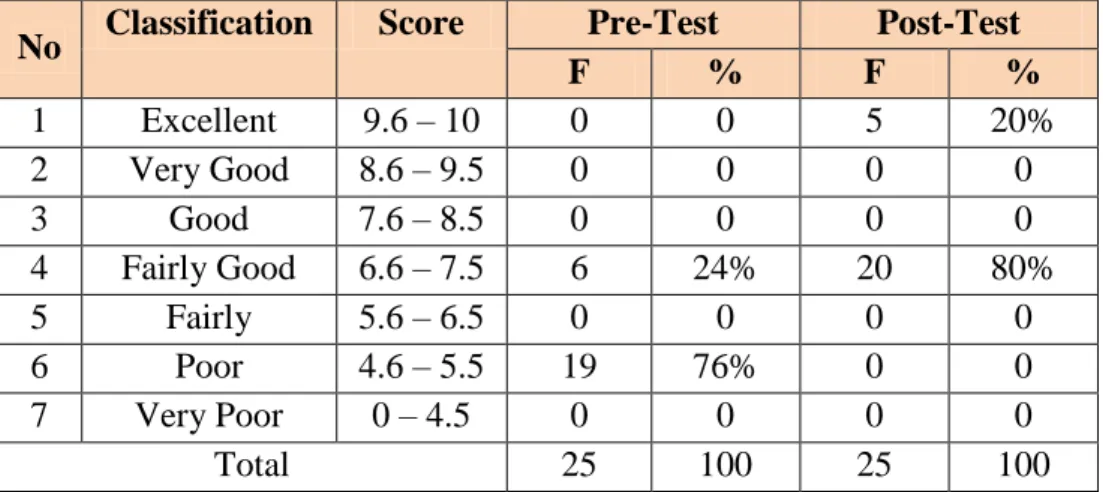
Table 4.2 Classification of the Students’ Writing Recount Text Using Genre-Based Approach in Terms of Content (Pre-test and Post- test)
No Classification Score Pre-Test Post-Test
F % F %
1 Excellent 9.6 – 10 0 0 5 20%
2 Very Good 8.6 – 9.5 0 0 0 0
3 Good 7.6 – 8.5 0 0 0 0
4 Fairly Good 6.6 – 7.5 6 24% 20 80%
5 Fairly 5.6 – 6.5 0 0 0 0
6 Poor 4.6 – 5.5 19 76% 0 0
7 Very Poor 0 – 4.5 0 0 0 0
Total 25 100 25 100
Table 4.2 shows that the classification of the students score in content from pre-test there are 19 (76%) poor and 6 (24%) students got fairly good. While, from post-test there are 5 (20%) students excellent and 20 (80%) students got fairly good.
2. The Students’ Writing Recount Text in Terms of Organization
The improvement of the students’ writing skill of organization at the ninth grade students of SMP Muhammadiyah 1 Makassar as result of the students assessment of pre-test and post-test can be seen clearly in the following table:
Table 4.3 The Students’ Writing Skill in Terms of Organization Variable Pre-test Post-test Improvement %
Organization 53 64 20.75%
The data on Table 4.3 shows that the score of organization has improved (20.75%) from the mean score of pre-test (53) to post-test (64), it is more clearly shown in the figure below:
Figure 4.2 The Students’ Writing Skill in Terms of Organization In other part, the researcher describes the students’ pre-test and post-test score in writing by using genre-based approach. They were classified into seven levels of classification. They were excellent, very poor, good, fairly good, fair, poor, and very poor.
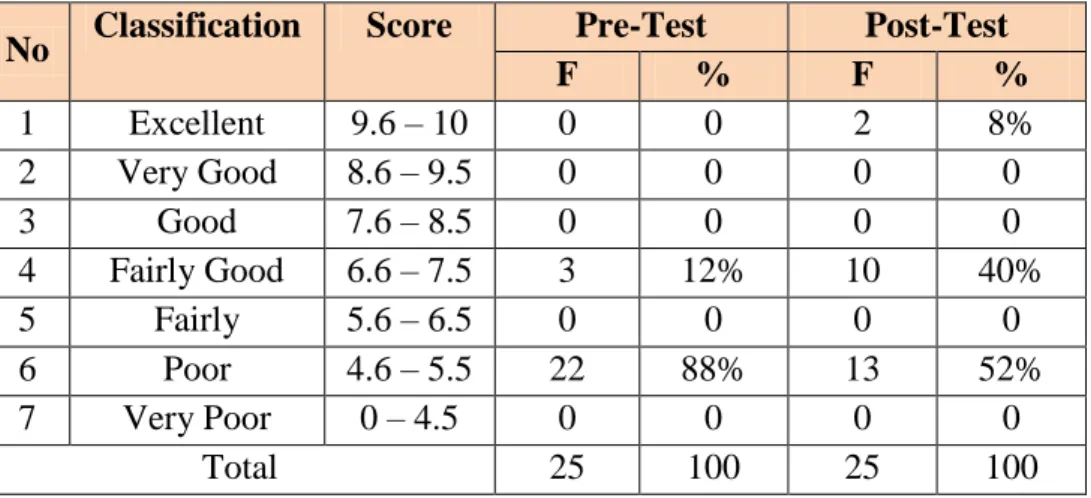
Table 4.4 Classification of the Students’ Writing Recount Text Using Genre-Based Approach in Terms of Organization (Pre-test and Post-test)
No Classification Score Pre-Test Post-Test
F % F %
1 Excellent 9.6 – 10 0 0 2 8%
2 Very Good 8.6 – 9.5 0 0 0 0
3 Good 7.6 – 8.5 0 0 0 0
4 Fairly Good 6.6 – 7.5 3 12% 10 40%
5 Fairly 5.6 – 6.5 0 0 0 0
6 Poor 4.6 – 5.5 22 88% 13 52%
7 Very Poor 0 – 4.5 0 0 0 0
Total 25 100 25 100
Table 4.4 shows that the classification of the students score in organization from pre-test there are 22 (88%) students poor and 3 (12%) students got fairly good. While, from post-test there are 2 (8%) students excellent, 10 (40%) students got fairly good, and 13 (52%) students got poor.
3. The Students’ Writing Recount Text in Terms of Language Use
The improvement of the students’ writing skill of language use at the ninth grade students of SMP Muhammadiyah 1 Makassar as result of the students assessment of pre-test and post-test can be seen clearly in the following table:
Table 4.5 The Students’ Writing Skill in Terms of Language Use Variable Pre-test Post-test Improvement %
Language Use 41 73 78.05%
The data on Table 4.5 shows that the score of language use has improved (78.05%) from the mean score of pre-test (41) to post-test
(73), it is more clearly shown in the figure below:
Figure 4.3 The Students’ Writing Skill in Terms of Language Use In other part, the researcher describes the students’ pretest score in writing by using genre-based approach. They were classified into seven levels of classification. They were excellent, very poor, good, fairly good, fair, poor, and very poor.
Table 4.6 Classification of the Students’ Writing Recount Text Using Genre-Based Approach in Terms of Language Use (Pre-test and Post-test)
No Classification Score Pre-Test Post-Test
F % F %
1 Excellent 9.6 – 10 0 0 2 8%
2 Very Good 8.6 – 9.5 0 0 0 0
3 Good 7.6 – 8.5 0 0 0 0
4 Fairly Good 6.6 – 7.5 3 12% 19 76%
5 Fairly 5.6 – 6.5 0 0 0 0
6 Poor 4.6 – 5.5 11 44% 4 16%
7 Very Poor 0 – 4.5 11 44% 0 0
Total 25 100 25 100
Table 4.6 shows that the classification of the students score in language use from pre-test there are 11 (44%) students very poor, 11 (44%) students got poor and 3 (12%) students fairly good. While, from
post-test there are 2 (8%) students excellent, 19 (76%) students got fairly good and 4 (16%) students got poor.
To analyze t-test is used to find out the significant difference of the students’ result of pre-test and post-test. In order to know the level significance 5% (0.05), degree of freedom df=N-1 (df is N – 1 = 25 - 1 = 24) it is found that the t-table value is (2.06), the result of the calculation is shown as follows:
Table 4.7 T-test Value of the Students’ Writing Skill of Recount Text Variables T-test T-table Comparison Classification
Content 13.66 2.06 t-test ˃ t-table Significant Organization 3.77 2.06 t-test ˃ t-table Significant Language Use 10.42 2.06 t-test ˃ t-table Significant
The data on Table 4.7 shows that the value of t-test is higher that the value of t-table. It indicated that there was a significant different between the result of the students’ ability to write content, organization and language use after treatment.
It can be concluded that there was significant different between the result of student writing ability before and after teaching by using Genre- Based Approach (GBA). This also means that Null Hypothesis ( ): There was no improvement different between the students’ ability to write recount text after teaching by Genre-Based Approach at the ninth grade students of SMP Muhammadiyah 1 Makassar is rejected and Alternative Hypothesis ( ): There was an improvement different between the
students’ writing ability to write recount text after teaching by using Genre-Based Approach at the ninth grade students of SMP Muhammadiyah 1 Makassar is accepted.
2. Discussions
In this part, the discussion dealing with the interpretation of findings derived from the result of findings about the students’ writing ability of content, organization and language use. The result of the data analysis through the writer test shows that the students’ writing ability improved significantly. It is indicated by the students’ achievement in pre-test and post- test.
1. The Students’ Writing Recount Text in Terms of Content
Based on the finding explain previously, the data was collected through the test as explained in the previous finding section showed that the students’ ability to write content was significantly improvement.
After the implementation of GBA during six meetings, student had been accustomed to write the material faster while looking for the important information.
The variable content of the students’ ability in writing recount text has improvement from pre-test to post-test. The improvement can be seen after testing the students’ where the mean score of the content in pre-test was = 56. The low value of the students because the students are less accustomed to writing in the form of a paragraph, they
are more often the task multiple choice and essay on the student worksheet.
After being given the post-test with the same theme on pre-test is First experience in the school (new student). The mean score in post-test was = 80, improvement was 42.86%. It indicated that the mean score of post-test greater that mean score of pre-test. This improvement is attributable to the granting of treatment over six meetings with the use of Genre-Based Approach (GBA) that focused on creating paragraphs in only in the form of a recount text and students have been able to make the paragraph unity. This result is commensurate with the finding of Septiadi (2014) demonstrate that the implementation of the genre-based approach was able to improve students’ writing skills. The joint construction and the independent construction of the text stages improved the students’ ability in exploring ideas and developing them into a good text. There are some examples from the students’ works in the category of excellent, good and poor.
a. Excellent Category
b. Good Category
c. Poor Category
The excellent category in term of content because the event is explicitly stated, clearly events and transformation from one idea to another is smooth and provides reader with clear understanding that topic is changing. Then, writing in the good category because the event fairly is clearly stated, includes most events, some evaluation of events and there are view transitional markers or repetitive transitional markers.
While, writing in the poor category because the event is not stated, no recognizable events, no evidence concept and confused evaluation.
This is in line with Heaton (1988) stated the good paragraph has unity, which means that in each paragraph only one main idea is discussed and every supporting sentence in the paragraph must be directly related to the main idea. Do not include any information that does not directly support the topic sentences.
2. The Students’ Writing Recount Text in Terms of Organization
Based on the finding above in using Genre-Based Approach (GBA) in teaching recount text, the data was collected through the test as explained in the previous finding section showed that the students’ ability to write organization was significantly improvement. After the implementation of GBA during six meetings, student had been accustomed to write the material faster while looking for the important information.
The variable organization of the students’ ability in writing recount text has improvement from pre-test to post-test. The improvement can be seen after testing the students’ where the mean score of the organization in pre-test was = 53. The low value of the students because the students were not used to write a paragraph and less motivation in writing, making the students write a paragraph alignment without regard for one another.
After being given the post-test with the same theme on pre-test is First experience in the school (new student). The mean score in post-test was = 64, improvement was 20.75%. It indicated that the mean score of post-test greater that mean score of pre-test. This improvement is attributable to the granting of treatment over six meetings with the use of Genre-Based Approach (GBA) that train students to write more often in particular wrote a paragraph recount.
This makes the students are able to write a good paragraph with attention to the unity and coherence of a paragraph, students have also been able to craft a sentence appropriate chronology. Despite this increase in term of organization the lowest compared to the improvement in terms of content and language use, this is due to some students is still difficult and confused finding the appropriate sentences to align paragraphs with one another. This result is commensurate with the finding of Ikawati (2010 showed that the students' scores improved. By using the steps of GBA, the students have been able to craft a story based on chronology. There are some examples from the students’ works in the category of excellent, good and poor.
a. Excellent Category
b. Good Category
c. Poor Category
The excellent category in term of organization, because orientation gives all essential information, all necessary background provided, account in chronological, appropriate title, effective introductory paragraph, topic is stated and conclusion logical and complete. Then, writing in the good category because fairly well- developed orientation, most actors and events mentioned, largely chronological and coherent, some ideas are not fully developed, sequence is logical but transactional expression may be absent or misused. While, writing in the poor category because missing orientation, no background provided, haphazard and incoherent sequencing and no orientation or includes new matter.
This is in line with Heaton (1988) stated organization of writing is the writer focuses on how to arrange and organize the ideas chronologically. The writer should present their ideas based on the order which flows the beginning to the end.
3. The Students’ Writing Recount Text in Terms of Language Use
Based on the finding above in using Genre-Based Approach (GBA) in teaching recount text, the data was collected through the test as explained in the previous finding section showed that the students’ ability to write language use was significantly improvement. After the implementation of GBA during six meetings, student had been accustomed to write the material faster while looking for the important information.
The variable language use of the students’ ability in writing recount text has improvement from pre-test to post-test. The improvement can be seen after testing the students’ where the mean score of the language use in pre-test was = 41. The low value of the students due to several factors, namely; 1) Poor grammar, lack of knowing the type of tense. 2) students do not know what the tense must use, most of them are still using the present tense in writing recount text, which should use the past tense. 3) students lack of vocabulary, especially vocabulary in the past tense (Verb two) commonly used in writing a recount text.
After being given the post-test with the same theme on pre-test is First experience in the school (new student). The mean score in post-test was = 73, improvement was 78.05%. It indicated that the mean score of post-test greater that mean score of pre-test. After the giving of the treatment during the six meetings using a Genre-Based Approach (GBA), the ability of the students is increasing sharply. This improvement was caused because the students have been taught a form of tense should be used in writing a recount text, namely the simple past tense.
In addition to this, instruction using the GBA to make students have been able to distinguish several types of genre writing, Narrative text, descriptive text, even text, procedure text, and text explanation.
They also had to know the vocabulary commonly in writing a recount text. This result is commensurate with the finding of Khoeriyah (2018) showed the data was obtained through pre-test and post-test. After 4 meeting of treatments, the post-test result were calculated and analyzed using t-test formula. It can be concluded that process-genre approach gave moderate effect toward students’ writing ability on recount text.
There are some examples from the students’ works in the category of excellent, good and poor.