THE USE OF SELF REGULATED STRATEGY
DEVELOPMENT (SRSD) TO IMPROVE THE STUDENTS’
WRITING SKILL
( A Classroom Action Research At The Eleventh Grade Students of MA Muhammadiyah Datarang Kabupaten Gowa)
A Thesis
Proposed as the Fulfillment to Accomplish Sarjana Degree At Faculty of Teacher Training and Education
Makassar Muhammadiyah University
FITRAWATI 10535 4898 11
ENGLISH EDUCATION DEPARTMENT
FACULTY OF TEACHERS TRAINING AND EDUCATION MAKASSAR MUHAMMADIYAH UNIVERSITY
2015
ACKNOWLEDGEMENT
In the name of Allah, Most Gracious, Most Merciful
Alhamdullilahi Rabbil „Alamin, first of all I would like to express my deepest praise and gratitude to Allah SWT who has given me His blessing and merciful to complete this thesis. Shalawat and salam are addressed to the final chosen religious messenger, the Prophet Muhammad SAW.
Further, the researcher dedicated this thesis for my beloved parents (Sahar Dindo and Mariati), my beloved husband (Hilman Nn), and my friends for their prayer, love, care, financial, motivation, suggestions and sacrificed for my success, and their love sincerely and purely without time.
There is no appropriate symbol which suitable to state my thanks to them.
The researcher realized that in crying out the research and writing this proposal, many people have contributed their valuable suggestion, guidance, assistance, and advice for the completion of this thesis.
Therefore, the researcher would like to express her appreciation and sincere thanks to:
1. Dr. H. Irwan Akib, M.Pd., the rector of Muhammadiyah University of Makassar.
2. Dr. A. Sukri Syamsuri, M. Hum, the Dean of Teachers Training and Education Faculty.
3. Erwin Akib, S.Pd., M.Pd, the head of English Education Department of FKIP Unismuh Makassar.
4. Supervisors who help very much from the beginning to the end of this thesis (Dr. H. Bahrun Amin M.Hum and Nurdevi Bt. Abdul, S.Pd., M.Pd).
5. Finally, for all everybody that could not mentioned one by one, may Allah SWT the almighty good be with us now and forever.
Billahi Fi Sabilillah haq Fastabiqul khaerat.
Researcher
FITRAWATI
TABLE OF CONTENTS
Page
COVER ... i
ACKNOWLEDGMENT ... ii
TABLE OF CONTENTS ... iv
LIST OF TABLES ... vi
LIST OF FIGURES ... vi
LIST OF CHARTS ... vi
ABSTRACT ... vii
CHAPTER I: INTRODUCTION A. Background ... 1
B. Problem Statement ... 3
C. Objective of the Study ... 3
D. Significance of the Study ... 4
E. Scope of the Study ... 4
CHAPTER II: REVIEW OF THE RELATED LITERATURE A. Some Previous Related Research Findings ... 5
B. The Concept of Writing ……… ... 6
C. The Concept of Descriptive ... 15
D. Self Regulated Strategy Development (SRSD)... 19
E. Conceptual Framework... 25
CHAPTER III: RESEARCH METHOD A. Research Design ... 27
B. Research Subject ... 31
C. Research Instruments ... 31
D. Research Variables and Indicators ... 31
E. Data Collection ... 32
F. Data Analysis ... 36
CHAPTER IV FINDING AND DISCUSSION A. Findings ... 40
B. Discussion ... 43
CHAPTER V CONCLUSION AND SUGGESTION A. Conclusion ... 50
B. Suggestion ... 51
BIBLIOGRAPHY ... 53
APPENDICES ... 54 CURICULUM VITAE
LIST OF FIGURES
Figure 2.1 : Process of writing ... 11 Figure 2.2 : Conceptual Framework ... 25
LIST OF TABLES
Table 4.1 : The improvement of the students‟ writing skill ... 40 Table 4.2 : The observation result of the students‟ activeness
in learning process ... 42
LIST OF CHARTS
Chart 4.1 : The Improvement of the Students‟ Writing Skill... 41 Chart 4.2 : The Improvement of the Students‟ Activeness ... 42
ABSTRACT
FITRAWATI. 2015. The Use of Self Regulated Strategy Development (SRSD) to Improve the Students’ Writing Skill at the Eleventh Grade Students of MA Muhammadiyah Datarang Kabupaten Gowa. Thesis. Faculty of Teacher Training and Education, Makassar Muhammadiyah University. Guided by H. Bahrun Amin, and Nurdevi Bt Abdul.
This research was aimed at knowing the improvement of the students‟
writing skill in terms of content, organization, and grammar in descriptive text through Self Regulated Strategy Development (SRSD) at the Eleventh Grade Students of MA Muhammadiyah Datarang Kabupaten Gowa. The research was implemented in MA Muhammadiyah Datarang Kabupaten Gowa at the Eleventh Grade Students through a classroom action research (CAR). The researcher took 34 students as the subject of the research. The researcher taught writing English using SRSD. To find the results, the researcher got the information from the students‟ answers on writing test in the form of test of cycle I and test of cycle II.
The result of the research using SRSD showed that the researcher used the CAR principle to collect the data. The research conducted through two cycles with each cycle consisted of four meetings.
The mean score of the students‟ writing test in cycle I was 6.26. But the result was not significant from the result which was expected according to the background namely 6.50, so the research was continued to the cycle II and the mean score of the students‟ writing achievement of cycle II was 7.78. It also indicated that there were a significant score from the result expected in the background namely 6.50. The result above was acquired from the students‟
writing skill in terms of writing content, organization, and grammar. Its means that SRSD is an effective technique in teaching English writing skill at the Eleventh Grade Students of MA Muhammadiyah Datarang Kabupaten Gowa.
CHAPTER I INTRODUCTION
A. Background
Writing is as a means of communication. Writing involves transferring a message from our thoughts using language in the written form and it is a communicative competence. According to Brown (1994: 222), communicative competence is relative, not absolute, and depends on the cooperation of all the participants. Communicative competence enables one to convey and interpret messages and to negotiate meanings interpersonally within specific context. In addition, communicative competence consists of grammatical competence, discourse competence, sociolinguistic competence, and strategic competence. The grammatical competence and discourse competence reflect the use of linguistic system itself. The sociolinguistic competence and strategic competence reflect the functional aspects of communication. By acquiring communicative competence, the students are expected to have knowledge of grammar and vocabulary of the language; to have knowledge of rules of writing and to be able to apply it in real communication appropriately.
Learning English deals with four skills namely reading, writing, speaking and listening. Reading and listening are receptive skills, while speaking and writing are productive skills. These skills are connected one another and equally important. Because of that, students should be able in all of skills but the fact
shows that some of the students get difficultly in learning English especially in writing skill.
However not many students are interested to develop their talent in communicating in this language, this atmosphere occurs everywhere. It means that the forward educational institution has as the same problem as other institution.
To create the comfortable atmosphere in class needs some method in order that the students enjoy learning English. In relation to the problem above the researcher found students‟ problem at MAM Datarang Kab. Gowa in writing skill.
Such as, some students lack the ability to formulate ideas and to write cohesive texts, and the student struggle to organize and use mechanics of writing.
Nowadays, there are some method that can be used in teaching English, especially in writing skill. One of them is SRSD (Self-Regulated Strategy Development). According to Case (1992:45) by using this method supporting students compose the text and helping them develop relevant cognitive and self- regulation skill and Cutler (2008: 907-919) state that with SRSD learners are explicitly taught writing strategies for different writing genres such as paragraph writing, persuasive writing, narrative.
Writing is an activity that the students do in almost of their study. Through paragraph writing, persuasive writing, narrative writing and give information.
Besides, they are also expected to be able to produce a good piece of writing, writing skill is considered, difficult because it is more formal and compact.
Among the four of language skills, writing is more complicated for students to
master because it needs long process. It is started from pre-writing and up to editing and it needs some kinds of writing skills or abilities.
Based on the observation of the Eleventh Grade Students of MAM Datarang Kab. Gowa, the researcher found that the skill of students in writing is still low especially in writing. The mean score of the students in writing skills is 4.01 score rate, this score under expected by successful Minimal Criteria (KKM) is 65 and the researcher has target till 75-80. According to their teacher, it is happened because the students have poor motivation in learning English.
Although, the teacher has method of learning process in the classroom, but it is could not make the students‟ interest. For this reason, the researcher purposes a research in writing entitle “The Use of Self Regulated Strategy Development (SRSD) to Improve The Students’ Writing Skill at the Eleventh Grade Students of MAM Datarang Kab. Gowa”
B. Problem Statements
Regard the title of the research and description on the background above, the researcher formulates this research questions as follow:
How is the improvement of the students‟ writing skill in terms of content, organization, and grammar in descriptive text by using SRSD at the Eleventh Grade Students of MAM Datarang Kab. Gowa?
C. Objectives of the Study
Based on the problem statement above, the objective of the research are to find out:
To know the improvement of the students‟ writing skill in terms of content, organization, and grammar in descriptive text by using SRSD at the Eleventh Grade Students of MAM Datarang Kab. Gowa.
D. Significance of the Study
The researcher hopes this research will have some benefits in the study of teaching writing. The following benefits are:
1. Theoretical Benefits
This research is hoped to improve teaching learning process in general and learning the English as a foreign language in particular and to improve the method used by English teacher in selecting effective technique and appropriate condition especially in teaching writing.
2. Practical Benefits
a. To give more information for English language teachers about one of suitable method or strategy which can used in teaching writing
b. This research can be used as one of the references for those who want to conduct a research in English teaching learning process.
E. The Scope of the Study
The scope of the research was restricted to the use of SRSD to improve the students writing skill. The students were wrote descriptive paragraph based on the topic. It focused on content, organization, and grammar.
CHAPTER II
REVIEW OF RELATED LITERATURE
A. Some Previous Related Research Findings
Ramlan (2007) reported that the SRSD method effective to improving the students English competence, especially in teaching writing. It has proved by the research that had been done at SMA Negeri 1 Basappu. The students writing ability increase (2.68) score or occurred (70%) writing improvement.
Perin (2007) in her research with SRSD, learners are explicitly taught writing strategies for different writing genres such as paragraph writing, persuasive writing, story writing.
Haris (2003) in his research SRSD has a strong impact on improving the writing performance of upper-elementary and middle school students (effect sizes typically exceed 0.80), including enhancing the writing of youngsters attending urban schools.
Lienemann (2009) in his research indicated that the SRSD model is more effective at improving writing performance than are all other instructional approaches.
All of the research findings above are expected to be useful information to the researcher. There are relationship among them especially in skill and the methodology. In contrary, the differences are the sample, populations, and the instrument of the research.
B. The Concept of Writing 1. Definition of Writing
Lindbolm in Fatmawaty (2009: 13) gives definition of writing as studying to focus our mind on important matters, and learning about them. By this activity, a person can find the solution of difficult problem, master the fact even by writing, a person can also communicate their mind that cannot be done through other way. We can say that writing is the act of expressing something through the application of language system. So, when we write, there are two problematic areas namely “what to write and how to write it”.
Another statement about writing skill comes from Widdowson in Saleha (2008:15) states that writing is a communicative activity and is carried out in accordance with certain general principal in which underline the use of language in communication.
Graham (2007:3) explain that writing well is not just an option for young people-it is a necessity. Writing skill is predictor of academic success and a basic requirement for participation in civic life in the global economy, while Writing is not a simple language skill to perform because of it is large areas that must be involved. In producing a piece of writing, linguistic competence and extra linguistic competence are always involved. The fact is that writing is not only a means of expression, but it is also an essential criterion of competence in any field. This means that to write is to seek expression or to have something to say through the application of linguistic system.
Based on some definition above, the researcher can concluded that writing is expression of writer‟s idea in a written symbol form on paper in order the reader can read it and get the meaning of writer opinion.
2. The Importance of Writing
There are a lot of reasons why writing is important by Hairston in Saleha (2008: 5):
a. Writing is a tool for discovery. We stimulate our thought process by the act writing into information and tab into information and image we have our unconscious mind.
b. Writing helps us to organize our ideas. We can arrange them in coherent form.
c. Writing generates new ideas by helping us to make connection and see relationship.
d. Writing helps us to observe and process information when we write a topic, we learn it better.
e. Writing enables us to solve the problems by putting the element of them into written form; we can examine and manipulate them.
f. Writing on a subject makes us active rather than passive learns of information.
3. The Characteristic of Good Writing
Adelstein (1980) state some characteristic of the good writing as follows:
a. Good writing reflects the writer‟s ability to use the appropriate voice even though all good writing convey the sound and someone talking to someone else, the voice heard through the writing must also suit with the purpose and audience of the occasion.
b. Good writing reflect the writer‟s ability to organize the material into a coherent writing so that it moves logically from a central, dominant idea to supporting points and finally to consistent ending conveying to the reader a sense of a well thought out plan.
c. Good writing reflects the writer‟s ability to write clearly and unambiguously, to use sentence structure, language and example so that the one possible meaning is the writer‟s intended one.
d. Good writing reflects the writer‟s ability to write convincingly to interest readers in the subject and to demonstrate a though and sound understanding of it.
e. Good writing reflects the writer‟s criticize the first draft and revise it.
Revision is the key of effective writing.
4. Types of Writing a. Narration
Oshima, et al (1997: 27) explains that narration is story writing.
When you wrote a narrative paragraph or essay, you write about events in the order that they happened. In other words, you use time order to organize your sentence. In the model essay, the writer uses time order
to divide the essay into paragraphs. An outline of the essay narration would like this: orientation, complication, and resolution.
b. Description
Oshima, et al (1997: 50) explains that descriptive writing to the senses, so it tells how something looks, feels , smells, tastes, and/or sounds. A good description is like a “word picture”, the reader can imagine the object, place, or person in his or her mind. A writer of a good description is like an artist who paints a picture that can be “seen”
clearly in the mind of the reader. In a description, writers often use spatial order to organize their ideas. Spatial order is the arrangement of items in order by space. An outline of description would like this:
introduction, body, and conclusion.
c. Explanatory
There are three kinds of explanatory composition, they are:
1) Explaining a process
To write an explanatory composition that explains a process, rely on the same skills you have used in everyday situations.
Explain the steps in the process briefly and clearly. Start with the first step and proceed through all the steps in the order in which they must be completed. It is essential that the steps be presented in the correct sequence and that they be accurate and complete. An effective way to organize an explanatory composition that explains
a process is to follow this plan: introduction, steps in the process, and conclusion.
2) Stating an opinion
An explanatory composition may express an opinion and explain why others should explain why others should accept that opinion. In an explanatory composition, you need to present strong, specific reasons or facts. An effective way to organize an explanatory composition that stating an opinion is to follow this plan: introduction (express your opinion, as directly as possible), body (supporting opinion), and conclusion (summarize your argument as forcefully as you can).
3) Stating a definition
To write a good definition, you must do three things. First, name the word to be defined. Second, name the general class to which the subject belongs. Third, name the particular characteristic of the subject. By defining a subject you will be able to present a complete and informative picture of it. An effective way to organize an explanatory composition that stating a definition is to follow this plan: introduction (your definition serves as the topic sentence for the composition), body (the most informative way to develop a definition is with or with facts and figures), conclusion (the sums up the main idea of your definition).
(Littell, McDougal 1981: 122-140 )
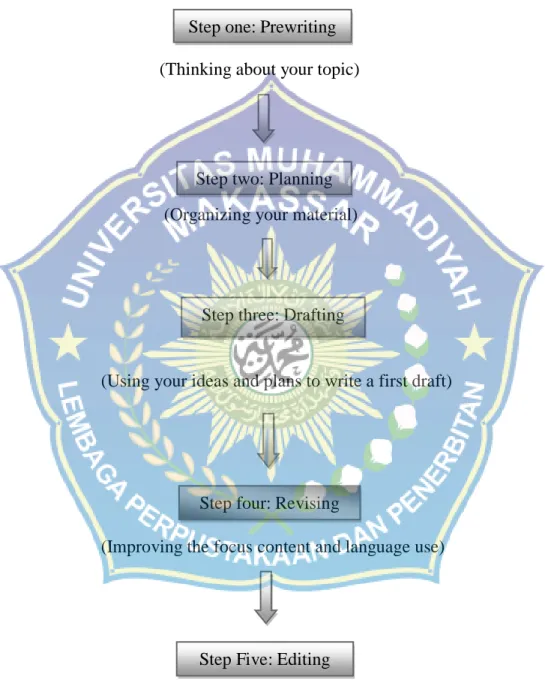
5. Process of Writing
The following steps which develop through the processes may help students become better writer.
(Thinking about your topic)
(Organizing your material)
(Using your ideas and plans to write a first draft)
(Improving the focus content and language use)
(Checking grammar, spelling, capitalization, punctuation and word choice)
Figure 2.1: Process of Writing Step one: Prewriting
Step two: Planning
Step three: Drafting
Step four: Revising
Step Five: Editing
This section includes a description of the activities leading to the writing the previous essay. These activities include prewriting, writing and rewriting.
a. Prewriting
Graham (2007: 18) explain that pre-writing engages students in activities designed to help them generate or organize ideas for their composition. Engaging the students in such activities before they write a first draft improves their quality of their writing. Prewriting activities include gathering possible information for a paper through reading or developing a visual representation of their ideas before sitting down to write.
Alexander (1990: VI-3) in this section, the students are required to cluster or list what they know for each topic before deciding on one topic as the subject of their report of information essay. Some students list subtopics for two or three choices and then select the topic that yield the greatest number of subtopics.
Oshima (1997: 15) states that brainstorming is prewriting activity in which you come up with a list of ideas about a topic on your own in small groups with your classmates. Follow these brainstorming steps:
1) Write down your general subject or specific topic.
2) Make a list everything that comes to your mind about it.
3) Use words, phrase, and/or sentences. Don‟t worry about the order of ideas, mechanics, grammar, or spelling.
4) Just keep writing down whatever comes to your mind until you run out of ideas. Because you are only brainstorming, don‟t be concerned if you repeat several ideas.
b. Writing
Graham (2007: 20) the process of writing approach stresses activities that emphasize extended opportunities for writing. Writing for audiences, self-reflection, personalized, instruction and goals, and cycles of planning, ad reviewing.
Litell, McDougal (1981: 7 ) at this point in the process of writing, you are ready to write. Simply put your pencil to paper and write. Don‟t fuss with the writing. Don‟t worry about organizing ideas.
Don‟t fuss about spelling or punctuation. Just Write.
c. Rewriting
At this stage of the process you will need to work more carefully. Read what you have written and repair it as you can.
Finally, when you are satisfied that your writing is clear and correct, write it out its final form. Write carefully. Make your work as neat as possible.
6. Components of Good Writing
Jacob (1991: 22) points out five kinds of components in writing. They are content, organization, language use, vocabulary, and mechanics.
a. Content
The content of writing should be clear for the readers so that the readers can understand the message convey and gain information from it.
In order to have a good content of writing, its content should be well unified and completed. This term is usually known as unity and completeness, which become characteristic of good writing.
b. Organization
The purpose of organizing material in writing involves coherence, order of importance, and general to specific, chronological order and spatial order of pattern. When writing the learner should arrange their writing chronologically. They should present their ideas based on the order of which happened from the beginning to the end.
c. Vocabulary
Vocabulary is one of the language aspects dealing with the process of writing study. In the process of writing the writer always thinks about putting words into sentences and then putting sentences into paragraphs until they can create a piece of writing. The lack of vocabulary make someone fails to compose what they are going to say because they felt difficult to choose the appropriate vocabulary.
d. Language use
Language used in writing description and other form of writing involves connected languages and point of grammar should be one that
is capable of producing grammar. We should not be able to do anything more than latter separate function. And also grammar can help the students improve the use of formal language.
e. Mechanics
Mechanics in writing deals with capitalization, spelling and punctuation. Capital letters have principal use in English writing. This may be used distinguish between particular and general classes of person, places and things.
C. The Concepts of Descriptive 1. Definition of descriptive writing
Jack, Breton (1982:59) state that there are ways to go about writing a description of a place; start from the overall impression, and break it down into the details, or start from the details and build up toward and overall impression.
Neeld in Fatmawaty (2009:14) defined Descriptive writing is a way to present details; even though it is often appears with other form or pattern of development. When we write, we are constantly describing people, place and objects.
Description gives sense impression they feel, sound, taste, smell, and look of things. Emotion may be described too, feelings such as happiness, fear, loneliness, gloom and joy. Description helps the reader, through his/her imagination, to visualize a scene or person, or to understand sensation or an emotion (Wishon, 1980:130).
When we plan a description, we may to list as many details as possible before writing. However, select only the most important details to include in the description. Choose the details that show the subject us unique and help to create a sharp, unified impression of the subject. So that the reader will easily understand the description of a person a place, or an object if it organize and write description.
In connection with the statement above, the researcher concludes that descriptive writing is a common way to present details and in the impression of a person, a place, and an object to the readers.
a. Definition of Descriptive Paragraph
Neeld in Fatmawaty, (2009:15) defined description paragraph is a paragraph that describe about people, place, and object. Description appears in almost writing because writers try hard to create word image of ideas that convey. A descriptive paragraph is a word picture of an object, a scene or a person. Its sensory details usually create particular mood.
In order to write an effective description, you need to explore both the details and the feelings related to your experience. Begin by selecting details that appeal to all the sense-sight, hearing, touch, taste and smell.
Because your senses are what tell you about your surroundings, use them to provide the vivid details of description. Select specific sensory words that will bring an experience to life. Work from the vocabulary of the sense that you have been building as following steps:
1) Dominant Impression
The first sentence or even the first word of a description may establish the dominant impression succeeding will then reinforce and expand it by supplying further information and feeling in details. In order words, the sentence of the paragraph.
The example is follow:
The bank clacks a look of trust worthiness about him. He had clear, intelligent eyes surrounded by plain, old-fashioned eye- glasses. One could thrust those eyes. The few hairs left on his balding head were healthily and carefully brushed into place. He seemed to have counted his money. It was obvious that the same suit had served him for several years, just the sort of good, long-term investment the bank no doubt believed in. in short, everything about him seemed as solid, sensible, reliable, as the situation he worked for.
2) Mood
A mood is feeling that goes beyond measurable physical appearances. Feelings and emotion such as joy, happiness, fear, and land anxiety evoke or create mood. Mention of good or bad qualities mat contribute to establishing the general mood.
The example is follow:
During the whole of dull, and soundless day the autumn of the year when the clouds hung oppressively in the heavens, I have been passing alone, on horseback, through a singularly dreary tract
of country; and length found myself, as the shades of evening drew on, view of the lancholy house of usher.
3) Logical Development
A good piece of descriptive has some logical plan development. The writer tries to give a picture of impression of person, place, or thing but unlike the photographer or the painter, who as chemical or pigments to work with; the writer has only words to use. Therefore, to be effective, written description should have an efficient, sensible, carefully through-all, logical plan. The writer may start with the specific details and conclude with a dominant impression.
The example is follow:
Abraham lincoln was a strong man. Both physically and mentally. He was 1.90 meters stall. He was thin, But weight 81 kilos. He was physically powerful, and he never seemed to tire mentally or physically. He was very plain looking and plain acting.
Although his physically appearance and dress ma them him common. (Wishon, 1980:130).
In connection with statement above, the researcher concludes that a descriptive paragraph is a paragraph that describe about dominant impression (information), mood (feeling or emotion), and logical development (people, place, things). The writer tries to give a detail about writing that can support this writing clearly.
b. Types of Description
Lennon in Herman (2010:18) state that there are two types of description. They are:
1). Objective Description
Objective description is based purely on observable details: it is not colored by writer emotion or like and dislikes. Objective description records exactly see from the writer‟ vantage point. Some descriptive have not topic statement, however they always begin with some kinds of orienting statement, because the goal of such the description is merely to catalog the details of subject so that reader can visualize it.
2). Subjective Description
Subjective description can be defined as that which has descriptive details by Colored by personal impression, the usual goal of subjective description is to create a mood or to share feelings.
D. Self Regulated Strategy Development (SRSD) 1. The meaning of SRSD
SRSD is an empirically validated model for supporting students as they compose text (Case, et al 1992: 45). SRSD has a strong impact on improving the writing performance of upper-elementary and middle school students, including enhancing the writing of youngsters attending urban school (Graham, 2003: 44).
Numerous specific writing strategies have been developed for genres including story writing, narrative, expository, persuasive writing, and revising strategies.
Each strategy includes a mnemonic acronym for learning the strategy steps.
a. The benefit of using SRSD
SRSD is designed to help students become fluent, independent, self- regulated, goal-oriented learners (Graham, et.al 1992: 45). SRSD for writing encourages students to accomplish writing tasks through explicit instruction and simplifying the process of composing narrative, expository, and persuasive essays while integrating self-regulatory practices of goal setting, self-instruction, self-assessment, self-evaluation, and self-reinforcement.
SRSD show the writer in three strategies. First, strategy usage assists students in developing knowledge about the writing process, there by increasing the skills students need for effective planning, writing, revising, and editing. Second, students are supported in the development of the self- regulation procedures needed to monitor and manage their own writing. The third, development of positive attitudes about writing and views of themselves as writers is supported. After working through the SRSD process, improvements in quality, length, mechanics, and structure of normal and low achieving students' compositions, as well as their attitudes and beliefs about writing, have been maintained over time and generalized across settings (Harris & Alexander (1998: 128)).
b. The Role of SRSD in Teaching Writing
In SRSD, writing is considered a problem-solving task that involves planning, knowledge, and skills (Graham 2003: 158)). Planning includes planning, drafting, and revising the essay. Knowledge includes knowing information about the topic, the audience, and the genre (e.g., persuasive or narrative essay). Skills include the writing conventions of handwriting or keyboarding, spelling, and grammar. Given the complex demands of writing, self-regulation training is embedded in the explicit instruction so that students can eventually compose text with decreasing teacher direction and support.
Self-regulation refers to “self-initiated thoughts, feelings, and actions that writers use to attain various literary goals, which include improving the writing skills and enhancing the quality of the text they create” Graham &
Harris (2000: 35). When writers use self-regulation, they regulate their environment and their behavior (including time spent writing and organizing ideas), and they enact internal control over their activities (through goal setting, task-analyzing objectives, and self-reinforcement). Self-regulatory techniques are integrated into each of the six stages of SRSD for writing that are guided systematically by teachers.
Harris & Alexander (1998: 155) state that SRSD model is composed of the following stages:
Stage 1: Develop Background Knowledge
Stage 1 involves increasing background knowledge. It might include discussions with students of how to write successfully, the purpose of
writing, and what pre-skills are needed to achieve a writing goal. Teachers may assess for prior knowledge by collecting baseline writing samples.
Development of any prerequisite background knowledge and skills specific to the genre of writing happens in this stage. For instance, if story writing essays were targeted, the teacher and students would discuss what it means to write good stories and examine examples of good stories. Then the mnemonic chart containing the strategy steps are introduced (POW+WWW, What = 2, and H
= 2) : P = Pick your idea; O = Organize your notes; W = Write and say more. The WWW = Who is the main character? When does the story take place, Where does the story take place? What = What does the main character do? and What happens then? H = How does the story end? and How does the main character feel? . Students work on identifying parts of a good essay after discussing individual components of the strategy. Self-regulation strategies, including goal setting, are also introduced.
Stage 2: Discuss It
The second stage emphasizes the importance of how and when to use the SRSD model and the selected SRSD writing strategy. The role of student effort in learning the strategy and the self-regulation procedures is discussed.
Self-monitoring is particularly emphasized during this stage in relation to goal setting. Goal setting involves identifying reasonable, measurable, and attainable goals. The goals, which are individualized, are developed based upon individual skills and a task analysis of the end product (e.g., length of
writing, number of story elements in a story). Students may sign individual learning contracts containing the final goal of writing the targeted essay independently to formalize a commitment to learning the writing strategy and the self-regulation components. Stages 1 and 2 may be completed in a single lesson.
Stage 3: Model It
In the third stage, teachers model is completed, students are taught how to graph essay components as a way to determine whether all required story components are in the written essay.
Stage 4:Memorize It
During the fourth stage, students practice the steps of the strategy and the meaning of any mnemonics used to reinforce fluency. Teachers provide students with cue cards (described above), common think sheets, planning sheets, and graphic organizers, that act as concrete reminders of the critical steps involved in writing compositions.
Stage 5: Support It
In the fifth stage, teachers provide scaffolding and continuous feedback while students practice writing. During this stage teachers may work collaboratively with the students following all of the planning and organizing steps to ensure student success. Gradually, as students begin to master the
components of the essay writing process, the cue and prompt cards, mnemonic charts containing strategy steps, and graphic organizers are removed. Generally, Stage 5 takes the longest of the six stages for students.
When required, “booster” lessons will be introduced to reinforce or scaffold the use of the strategy and/or the mnemonics.
Stage 6: Independent Performance.
During the final stage, students require little to no support from teachers.
Students write independently without the use of the graphic organizers and, because they have internalized the strategy steps, they use fewer audible self- statements. During this stage students continue with goal-setting and self- monitoring procedures but may extend their learning to work collaboratively with other students and to work independently.
E. Conceptual Framework
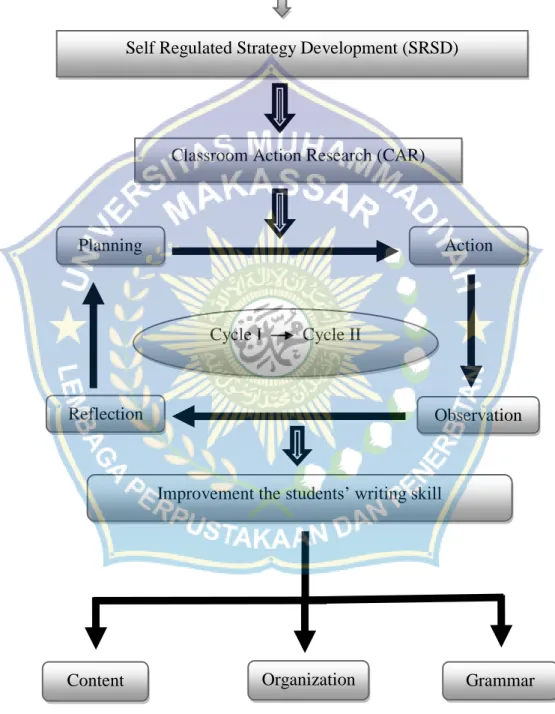
The theoretical framework in this research is presented by diagram below:
There are two components were briefly discussed below:
1. The PIEE is used to measure the students‟ writing ability in term of Exposition Paragraphs.
2. The Exposition Paragraphs scope writing of Content, Organization, Vocabulary, Grammar and Mechanics.
Figure 2.2 : Conceptual Framework Reflection
Improvement the students‟ writing skill
Grammar Organization
Self Regulated Strategy Development (SRSD)
Observation Action Planning
Cycle I Cycle II Writing
Content
Classroom Action Research (CAR)
Based on the conceptual framework above, this research focused on writing by using Self Regulated Strategy Development (SRSD) method to improve the students writing skill. The researcher used Classroom Action Research (CAR) which contains of four stage, they were: Planning, Implementation of Action, Observation, and Reflection. CAR held around two cycle, they were first and second cycle and each cycle was the series of activity which had close relation. Where the realization of the second cycle was continuing and re-correcting from the firs cycle. The scope of this research was restricted the ability of the students to write descriptive text. The elements of the skill consist of content, organization, and grammar.
CHAPTER III RESEARCH METHOD
This chapter deals with research design, research procedure, research variables and indicators, research location, time and subject of the research, research instrument, data collection, and data analysis.
A. Research Design
In this research the researcher used Classroom Action Research (CAR) Classroom Action Research is systematic inquiry with the goal of informing practice in a particular situation. Classroom Action Research is a way for teacher to discover what works best in a classroom situation, thus following informed decision about teaching, which contains of four stages, they were: Planning, Implementation of Action, Observation, and Reflection.
This research held around two cycles. They were first and second cycle and each cycle was the series of activity which had close relation. Where the realization of the second cycle was continuing and re-correcting from the first cycle.
Cycle 1 1. Planning
The activities that had done in this stage were follows:
a. Studying and understanding the material that would be taught in learning process.
b. Making the lesson plan for the implementation of action based on the syllabus.
c. Making the sheet of students‟ assessment to measure the students‟
achievement in writing.
2. Implementation of Action
In this activity, it has scenario learning process. It based on the concept of SRSD method. The activities that had done in this stage were follows:
a. The researcher talked with the students about the strategy namely: POW
= WWW, What = 2, How = 2.
b. The researcher talked aloud throughout modeling as he or she goes over the steps in the strategy, describes what the students will do at each step, and demonstrates how the strategy is used.
c. The researcher gave the topic of legend story to the students then ask them to pick their idea and write the parts of story.
d. The students practiced the steps of the strategy that it can help them to reinforce fluency.
e. The students asked to organizing the story from the topic into a complete descriptive paragraph. Initially, the teacher supportted the implementation of the strategy.
f. Evaluating the students‟ ability to independently apply the strategy.
3. Observation
The activities in this stage as follows:
a. Identifying and made note all problems that need the teacher when teaching and learning process is running based on observation paper that arranged.
b. Doing evaluation based on the result of study.
c. Giving the students chance to give suggestion and question in action research.
4. Reflection
Result of data that have been done was continued in the analysis until reflection after action research. The reflection was discussed as well as a lecturer‟s guidance while researcher made research planning for the next cycle.
The research plan was the plan for next cycle which repair from I cycle.
Cycle 2 1. Planning
The activities that had done in this stage were follows:
a. Continuing the activities that have been done in first cycle.
b. Improving the weakness in the first cycle.
c. Making plan again in the scenario learning process from the result of cycle 1 reflection.
d. Action research was repaired.
2. Implementation of Action
The activities that had done in this stage were follows:
a. The teacher asked the students to remember the strategy namely: POW = WWW, What = 2, How = 2.
Pick an idea.
Organize the story using WWW, What = 2, How = 2.
Write and say more.
Who is the main character?
When does the story take place?
Where does the story take place?
What does the main character do?
What happens then?
How does the story end?
How does the main character feel?
b. The teacher gave another topic of descriptive text to the students then ask them to pick their idea and write the parts of story.
c. The student asked to organizing the story from the topic into a complete paragraph.
3. Observation
The activities in this stage as follows:
a. Identifying and made note all problems that teacher needed when teaching and learning process is running based on observation paper that arranged.
b. Giving the student chance to ask for suggestion and question in action research.
4. Reflection
Analyzing all of the data which collected from observation to assess the teaching program‟s achievement after giving an action at the second cycle.
B. Research Subject
This research had been done at MA Muhammadiyah Datarang Kab.
Gowa. The subject of this research was the eleventh grade (XI IPA) students of MAM Datarang Kab. Gowa, first academic year 2015/2016 which consisted of 34 students in class.
C. Research Instrument
There were two instruments used:
1. Observation Sheet
Observation sheet aimed at finding the students‟ data about their presence and activeness in teaching learning process.
2. Test
Test aimed at finding the students‟ response toward teaching learning process through SRSD method.
D. Research Variables and Indicators 1. Research variables
This research used two variables, they were:
a. Independent variable
The independent variable was implementation of SRSD. This was a technique used by the researcher when teaching the material.
b. Dependent variable
The dependent variable of the research consisted of the students‟
ability in writing descriptive text.
2. Indicators
The indicators of the students‟ ability in writing descriptive text were content, organization, and grammar.
E. Data Collection
To collect the data has done with the following procedures:
1. Observation Sheet
The researcher used observation sheet to finding the students‟ participant in teaching learning process through SRSD method. It was summed at the end of cycle one and two.
2. Test
The researcher gave test to the students to finding their improvement in writing through SRSD method. The researcher tested the students by asking them to pick their idea from the topic that was given namely the legend story then describe the part of story and write it into descriptive text.
There were some components to be concern by the researcher in this research to measure the student‟s ability to write descriptive paragraph. The score of each component was determining by using the following rating scale:
a. Content
Score Level Criteria
30 – 27 Very good
knowledgeable substantive thorough development of thesis relevant to assigned topic
26 – 22 Good
some knowledge of subject adequate range limited development of thesis mostly relevant to the topic, but lacks detail
21 – 17 Poor
limited knowledge of subject little substance inadequate development of topic
16 – 13 Very Poor
does not show knowledge of subject non-substantive not pertinent OR not enough to evaluate
(Heaton, 1989-146) b. Organization
Score Level Criteria
20 – 18 Very good
fluent expression ideas clearly stated/ supported succinct well-
organized logical sequencing cohesive
17 – 14 Good
somewhat choppy loosely organized but main ideas stand out
limited support logical but incomplete sequencing
13 – 10 Poor
non-fluent ideas confused or disconnected lacks logical sequencing and development
9 – 7 Very poor
does not communicate no organization OR not enough to
evaluate
(Heaton, 1989-146) c. Grammar
Score Level Criteria
25 – 22 Very good
Effective complex constructions few errors of agreement, tense, number, word order/ function, articles, pronouns, prepositions
21 – 18 Good
effective but simple constructions minor problems in complex constructions several errors of agreement, tense, number, word order/ function, articles, pronouns, prepositions but meaning seldom obscured
17 – 11 Poor
major problems in simple/ complex constructions frequent errors of negation, agreement, tense, number, word order/ function, articles, pronouns, prepositions
and/ or fragments, run-ons, deletions meaning confused or obscured
10 – 5 Very poor
virtually no mastery of sentence construction rules dominated by errors does not communicate OR not enough to evaluate
(Heaton, 1989-146) F. Data Analysis
The data from cycle I and cycle II was analyzed through the following steps:
1. To calculate the score using the following simple formula:
(Heaton, 1989-146) 2. Calculating the mean score of the students‟ writing test by using the following
formula:
X=
∑Where: X = mean score ∑ = the sum of all score
The gain score
A Student's Score = --- X 10 The maximal score
= Number of student
(Gay, 1981)
3. To calculate the percentage of the students‟ achievement, the formula which by using as follows :
F
P = --- x 100 4 X N
Notation: P : Rate Percentage
F : Frequency of the students‟ achievement N : The Total Number of Students
(Sudjana, 1999) 4. To calculate the students‟ improvement score, the formula which was used
as follows:
X2 – X1
P = x 100%
X1
Notation : P : Students‟ improvement score X1 : Mean cycle I
X2 :Mean cycle II
(Gay, 1981)
CHAPTER IV
FINDINGS AND DISCUSSION
This chapter consists of findings of the research and its discussion. The findings of the research present the result of the improvement of the students‟
writing skill that covers the students‟ writing content, organization, and grammar, and the discussion of the research covers further explanation of the findings.
A. The Findings
The finding of this classroom action research deals with the answer of the problem statement which is aim to improve the students‟ writing skill covers content, grammar and organization. The findings consist of the improvement of the students‟ content, grammar and organization in writing skill and the students‟
activeness in teaching and learning process. The findings of the research detect that the use of Self Regulated Strategy Development (SRSD) can improve the students‟ writing skill in eleventh grade students of MA Muhammadiyah Datarang Kab. Gowa.
There are activities that have been conducted before finding the results of the research. The activities are such as the teacher asks students stating the point, illustrating it and putting forward an explanation end with a statement about the main point, not on some detail from the example. It‟s a very effective guideline to use, as it specifies all the steps that would be necessary to offer up a thorough discussion.
To explain further about how SRSD can develop paragraphs more the teacher makes change in cycle II, like ask the students begin their writing the strategy steps are introduced (POW+WWW, What = 2, and H = 2) : P = Pick your idea; O = Organize your notes; W = Write and say more. The WWW = Who is the main character? When does the story take place, Where does the story take place? What = What does the main character do? and What happens then? H = How does the story end? and How does the main character feel? . Students work on identifying parts of a good essay after discussing individual components of the strategy.
After guide the steps in practice writing descriptive text, the researcher give score to the students based on their writing skill. In assessing the students‟
progression during learning writing material using SRSD, the researcher use writing assessment of good writing from Heaton (1989:146) and the data from cycle I and cycle II is analyze through calculate the gain score is multiply with standard score (10) divided with maximal score in each component in writing.
The result is the students‟ score. For mean score, the researcher calculates the sum of all score divide with the number of students. The researcher also calculate the percentage of the students‟ achievement with use formula as frequency of the students‟ achievement multiply with 100 and divided the total number of students, the total number of students must multiply with 4 because there are four meetings in each cycle.
1. The Improvement of the Students’ Writing Skill
The use of SRSD in improving the students‟ writing skill deals with content, organization, and grammar. It can be seen clearly in the following table and chart:
Table 4.1: The improvement of the students’ writing skill
No Indicators
The Student’ Score Cycle I Cycle II
1. Content 6.68 8.28
2. Organization 6.47 7.86
3. Grammar 5.65 7.21
4.
X
6.26 7.78The table above indicates that there is the improvement of the students‟
writing skill from cycle I to cycle II, the students‟ writing skill in cycle I is (6.26) then the students‟ writing skill increases in cycle II (7.78). Therefore, the improvement of students‟ writing skill achievement from cycle I until cycle II is increasing significantly.
The table above proves that the use of SRSD in teaching and learning process can improve the students‟ writing skill after taking action in cycle I and cycle II has been achieved the standard score.
To see clearly the improvement of the students‟ writing skill, the following chart is presented:
Chart 4.1: The Improvement of the Students’ Writing Skill in Term of Content, Organization, and Grammar
Chart 4.2: The Improvement of the Students’ Writing Skill
0 1 2 3 4 5 6 7 8 9
CONTENT ORGANIZATION GRAMMAR
Cycle I Cycle 2
62.60%
77.80%
40.90%
36.90%
0.00%
10.00%
20.00%
30.00%
40.00%
50.00%
60.00%
70.00%
80.00%
90.00%
Improvement Writing Skill
Cycle I Cycle 2 D Test Improvement
The chart above shows that the improvement percentage of the students‟
writing skill after taking an action through SRSD is higher than before. It is proved by the improvement of the students‟ writing skill in cycle I to cycle II (6.26– 7.78).
2. The Result of the Students’ Activeness in Teaching and Learning Process
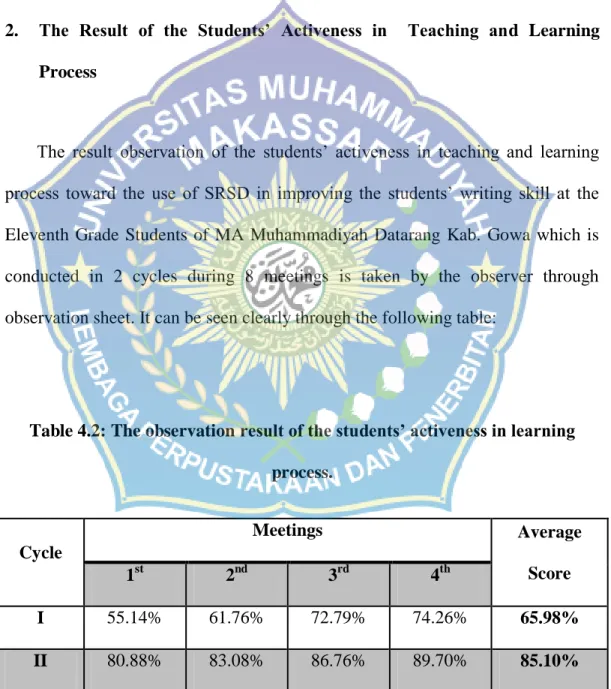
The result observation of the students‟ activeness in teaching and learning process toward the use of SRSD in improving the students‟ writing skill at the Eleventh Grade Students of MA Muhammadiyah Datarang Kab. Gowa which is conducted in 2 cycles during 8 meetings is taken by the observer through observation sheet. It can be seen clearly through the following table:
Table 4.2: The observation result of the students’ activeness in learning process.
Cycle
Meetings Average
Score
1st 2nd 3rd 4th
I 55.14% 61.76% 72.79% 74.26% 65.98%
II 80.88% 83.08% 86.76% 89.70% 85.10%
The result of the students‟ observation about their activeness can also be shown in the graphic below:
Chart 4.2. The Improvement of the Students’ Activeness
The chart above shows that the students‟ activeness in cycle I is lower than the students‟ activeness in cycle II. It because in cycle I, Self Regulated Strategy Development (SRSD) is unfamiliar with them. They are still did not know that technique‟s steps and purposes. The researcher also limited the students chance to write intensively. Therefore, the students are not interested in learning because they didn‟t enjoy the material. As result they are less active to participate in learning and teaching process. But in cycle II the researcher tried to give clearer instruction to students about Self Regulated Strategy Development (SRSD). As
65.98%
85.10%
0.00%
10.00%
20.00%
30.00%
40.00%
50.00%
60.00%
70.00%
80.00%
90.00%
Students' Activeness
Cycle I Cycle 2
result, the students became accustom with it. They get many ideas to write intensively, so during this cycle they became more active than previous cycle.
Through the chart above, the researcher concludes that the use of Self Regulated Strategy Development (SRSD) can improve the students‟ activeness in learning writing.
B. Discussion
1. The Improvement of the Students’ Writing Content
Content is a component of writing skill. According to Jacob (1991 : 22) the content of writing should be clear for the readers so that the readers can understand the message convey and gain information from it. In order to have a good content of writing, its content should be well unified and completed. This term is usually known as unity and completeness, which become characteristic of good writing.
The use of Self Regulated Strategy Development (SRSD) can improve the students‟ writing content. The table 1 indicates that the improvement of the students‟ writing content in cycle II is greater than cycle I. The students‟ mean score improve from 6.68 become 8.28. The process that can be explained from cycle 1 to cycle 2 as follows:
a. At the beginning of the implementation of the first cycle has not been suitable with planning yet this matter is cause by:
1. The Students are poorly described incomplete information to gain the aim in their writing.
2. The Students are difficult to think creatively and develop thoughts, excluding all irrelevant information.
3. The Students‟ writing is ambiguous and misunderstanding cause he Students did not use capitalization, punctuation, and spelling.
Therefore, most of them are difficult to write clearly and still felt difficult to think creatively. As result, the mean score of the students‟ content in cycle 1 is still low. As we can see in table 1 that the mean score is only 6.68. Its result is still under the completeness grade standard in SMA.
b. At the end of the second cycle can be concluded:
1. Students already wrote well describe, give the readers very clear information.
2. Students can think creatively, so they can understand what the messages convey.
The explanation above explains that, when the researcher conducted action in cycle II, the students‟ mean score improve from 6.68 to 8.28. It has achieved the standard score in SMA. In this cycle, the researcher intensively interested the students to write. The researcher help the student‟s in improving their writing content.
2. The Improvement of the Students’ Writing Organization
Organization is a component of writing. According to Jacob (1991 : 22) the purpose of organizing material in writing involves coherence, order of importance, and general to specific, chronological order and spatial order of pattern. When writing the learner should arrange their writing chronologically.
They should present their ideas based on the order of which happened from the beginning to the end.
The use of Self Regulated Strategy Development (SRSD) can improve the students‟ writing organization. The table 1 indicates that the improvement of the students‟ writing organization in cycle II is greater than cycle I. The students‟
mean score improve from 6.47 become 7.86. The process that can be explained from cycle 1 to cycle 2 as follows:
a. At the beginning of the implementation of the first cycle has not been suitable with planning yet this matter is cause by:
1. The Students are low ideas and topic which relevant in a topic.
2. The Students are can‟t understand what they write because their writing did not organize.
Therefore, most of them are low ideas and they can‟t understand what they write. As result, the mean score of the students‟ organization in cycle 1 is still low. As we can see in table 1 that the mean score is only 6.47. Its result is still under the completeness grade standard in SMA.
b. At the end of the second cycle can be concluded:
1. Students already developed ideas and topic which relevant in a united form.
2. Students can arrange and organize the ideas or messages in writing.
The explanation above explains that, when the researcher conducted action in cycle II, the students‟ mean score improve from 6.47 to 7.86. It has achieved the standard score in SMA. In this cycle, the researcher intensively interested the students to write. The researcher helps the students‟ in improving their writing organization.
3. The Improvement of the Students’ Writing Grammar
Grammar is a one component of writing skill. According to Jacob (1991:22) language used or grammar in writing description and other form of writing involves connected languages and point of grammar should be one that is capable of producing grammar. We should not be able to do anything more than latter separate function. And also grammar can help the students improve the use of formal language.
The table above indicates that the indicators of the students‟ writing grammar improve significantly. The students‟ writing grammar improvement is quite significant from cycle I (5.65) to cycle II (7.21). In fact, the use of SRSD made the students‟ writing grammar increase. The processes that can be explain from cycle 1 to cycle 2 as follows:
a. At the beginning of the implementation of the first cycle has not been suitable with planning yet this matter is cause by:
1) The Students are afraid to make mistake in grammar.
2) Some students‟ writing is containing with errors in verb, noun, agreement and imperative sentence.
3) Some students still did not give attention for preposition, conjunction, articles and tenses.
Therefore, most of them are difficult to write correct and appropriate sentences. As result, the mean score of the students‟ grammar in cycle 1 is still low. As we can see in table 1 that the mean score is only 5.65. Its result is still under the completeness grade standard in SMA.
b. At the end of the second cycle can be concluded:
1) Students already write correct and appropriate sentences.
2) Students are giving attention for rule of grammar and relationship of words in sentences.
The explanation above explains that, when the researcher conducts action in cycle II, the students‟ mean score became improve from 5.65 to 7.21. It has achieved the standard score in SMA. In this cycle, the researcher intensively gives understanding or explanation and chance about Self Regulated Strategy Development (SRSD). The researcher helps the students‟ in improving their writing grammar.
The research indicated that the students‟ writing skill using Self Regulated Strategy Development (SRSD) show the improvement in content, organization, and grammar.
The researcher has change the activity more interesting in cycle II so that students can show the improvement in the first cycle the researcher give less explanation about Self Regulated Strategy Development (SRSD) to students‟ but in cycle II students‟ really enjoy the SRSD because the researcher give explanation intensively and giving more chance for students.
At the first, students are lazy to participate in Self Regulated Strategy Development (SRSD) but the researcher usually encourages them and made SRSD more interesting by choosing fun material. As a result students became enjoy and fun in learning process.
The observation in the cycle I and II, the teacher making note to the all activities of the students in every meetings, so the teacher can measure the improvement of the students‟ writing skill dealing with content, organization, and grammar. Then, the teacher identity and making note all the problem that we need when teaching and learning process on observation paper and the students doing the evaluation which use the result of the study to know how far their improvement after using Self Regulated Strategy Development (SRSD).
After exceeded several processes in cycle I and cycle II which consisted of eight meetings, the result of the data analysis through the writing test show that the students‟ writing skill in terms of content, organization, and grammar improve significantly. It is indicate by the mean score of result of the students‟ D-Test is
4.09. It is also lower than the mean score of the students‟ writing test in cycle I that is 6.26 and cycle II is 7.78. Those scores are got from writing content, organization, and grammar. The students‟ enthusiasm also increases along with their improvement.