THE APPLICATION OF VENN DIAGRAM METHOD TO IMPROVE THE STUDENTS’ WRITING ABILITY
(A Classroom Action Research at Class X Year Students of SMK Muhammadiyah 3 Makassar)
A THESIS
Submitted to the Faculty of Teacher Training and Education Makassar Muhammadiyah University in Partial Fulfillment of the Requirement for the
Degree of Sarjana Pendidikan
ELMA DAMAYANTI 10535 5980 14
ENGLISH EDUCATION DEPARTMENT
FACULTY TEACHER TRAINING AND EDUCATION MUHAMMADIYAH UNIVERSITY OF MAKASSAR
2019
MOTTO
“BERDO’A, MENGHARGAI PROSES, SABAR, IKHLAS DAN SELALU BERUSAHA ADALAH KUNCI
KESUKSESAN”
I dedicated this thesis to : My beloved parents, my siblings, and my friends, for the sincerity and support to do this thesis.
ABSTRACT
Elma Damayanti, 2018. The Application of Venn Diagram Method to Improve The Students’ Writing Ability (A Classroom Action Research in Class X of SMK Muhammadiyah 3 Makassar). A Thesis FKIP Universitas Muhammadiyah Makassar (Guided by Ummi Khaerati Syam and Hj. Ilmiah).
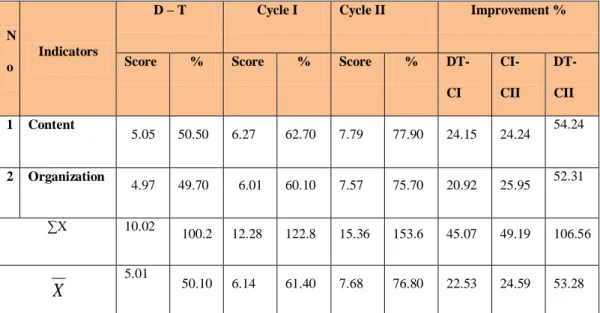
The objective of this research are to find out the improvement of the students‟ writing ability in terms of content and organization through Venn Diagram Method at Class X year students of SMK Muhammadiyah 3 Makassar.
This research used Classroom Action Research (CAR). It had conducted two cycles. Where each cycle is consisted of four meeting. It employed writing test as instrument. The number subject of the research were 28 students and consist of 5 men and 23 women. Implementation of the first and the second cycle during the four meeting. Technique of the data collection used the cycle, based on the material being taught.
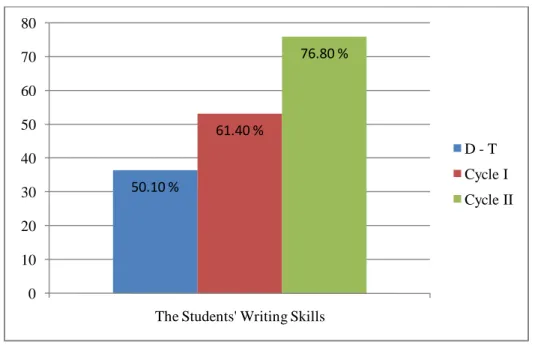
The research findings indicated that the application of Venn Diagram Method was significant in improving the students‟ writing proficiency in terms of writing content and writing organization. Where the mean score in content was 7.79 and mean score in organization was 7.57. Based on the explanation, the researcher concluded that the application of Venn Diagram Method was improving the students‟ writing content and writing organization at class X of SMK Muhammadiyah 3 Makassar.
Keywords: Venn Diagram, Teaching Method, Writing.
Tujuan dari penelitian ini adalah untuk mengetahui peningkatan kemampuan menulis siswa dalam hal konten dan organisasi melalui Metode Diagram Venn siswa di Kelas X SMK Muhammadiyah 3 Makassar.
Penelitian ini menggunakan Penelitian Tindakan Kelas (PTK). Penelitian ini telah dilakukan dua siklus. Dimana setiap siklus terdiri dari empat pertemuan.
Penelitian melibatkan tes menulis sebagai instrumen. Jumlah Subjek penelitian adalah 28 siswa dan terdiri dari 5 laki-laki dan 23 perempuan. Pelaksanaan siklus
pertama dan kedua selama empat pertemuan. Teknik pengumpulan data yang digunakan siklus, berdasarkan materi yang diajarkan.
Berdasarkan temuan penelitian, peningkatan kemampuan menulis mahasiswa dalam konten dan organisasi yang signifikan ditingkatkan. Dimana nilai rata-rata dalam konten adalah 7.79 dan berarti nilai dalam organisasi adalah 7.57. Ini berarti bahwa dengan menggunakan metode Diagram Venn dapat meningkatkan kemampuan menulis mahasiswa. Berdasarkan penjelasan tersebut, peneliti menyimpulkan bahwa penerapan Metode Venn Diagram meningkatkan konten tulisan dan organisasi menulis siswa di kelas X SMK Muhammadiyah 3 Makassar.
Kata Kunci: Diagram Venn, Metode Pembelajaran, Menulis.
ACKNOWLEDGEMENT ميحرلا نمحرلا الله مسب
Alhamdullilahi Rabbil Alamin, the writer would like to express his deepest gratitude to the Almighty Allah swt, the only provider, the most merciful who gives his guidance, inspiration and good health all the time to conduct the writing this thesis. Also Shalawat and Salam are delivered to our/ the great prophet Muhammad SAW who has brought us/ his adherent from the darkness to the lightness.
Further, the writer devotes her highest thanks, love and appreciation to her lovely parents, the best father that writer has, Daeng Matasa, who always gives her so much love, support, attention, advice, braveness to do her best in her life and keep struggling in facing all of the things, and her lovely mother, Sulmiati, many thanks for love and everything that she gives her during her growth. She is very proud to be your daughter. The writer also devotes profound appreciation to all of her lovely sister, Elvina Mulyarini and also her lovely brothers, Ewil Agus Saputra and Eril Dwi Muspikar. Thanks for love and support that have been given.
The writer realized that in carrying out the writing this thesis, many people have contributed their valuable suggestion, guidance, assistance, and advice for the completion of this thesis. Therefore, the writer would like to express the greatest thanks and appreciation for those people, they are:
1. Rector of Muhammadiyah University of Makassar, Dr. H. Abd. Rahman Rahim, S.E.,MM.
2. Dean of Faculty of Teacher Training and Education (FKIP), Erwin Akib, M.Pd., Ph.D.
3. Head of English Education Department, Ummi Khaerati Syam, S.Pd., M.Pd.
4. My greatest thanks are due to my first consultant Ummi Khaerati Syam, S.Pd., M.Pd and my second consultant Hj. Ilmiah, S.Pd., M.Pd who have given their valuable time and patient, to support assistance and guidance to finish this thesis.
5. All of the lectures of FKIP UNISMUH who have taught all knowledge for the researcher.
6. The writer classmate in English Department 2014 and others best friends that couldn‟t mention the name one by one thanks for your love, help, support and encouragement.
7. All people who help the researcher and cannot be mentioned one by one.
The researcher realizes that, the writing of this thesis is far from the perfectness still the simplest one. Remaining errors are the writer‟s own;
therefore, constructive criticism and suggestions will be highly appreciated.
Finally, willingly the researcher prays, May all our/the efforts are blessed by Allah swt.Aamiin.
Makassar, October 2018 The Writer
Elma Damayanti 10535 5980 14
TABLE OF CONTENT
TITLE PAGE ... i
APPROVAL SHEET ………. ii
COUNSELING SHEET ………. iii
SURAT PERNYATAAN ... iv
SURAT PERJANJIAN ……….. v
MOTTO ... vi
ABSTRACT ……….…………... vii
ACKNOWLEDGMENT ………... viii
TABLE OF CONTENT ………... xi
LIST OF TABLES ... xiii
LIST OF GRAPHICS ………... xiv
CHAPTER I A. Background ... 1
B. Problem Statement ... 4
C. Objective of the Study ... 4
D. Significance of the Study... 5
E. Scope of the Study ... 5
CHAPTER II. REVIEW OF RELATED LITERATURE A. Some Previous Research Findings ... 6
B. Some Partinent Ideas ... 7
1. Venn diagram Method ... 7
2. The Concept of Writing ... 12
3. The Concept of C.A.R ... 22
C. Conceptual Framework ... 28
CHAPTER III. RESEARCH METHOD A. Research Design ... 31
B. Research Time and Subject ... 31
C. Research Variables and Indicators ... 31
D. Research Design in Action Research ... 33
E. Research Instrument ... 36
F. Data Analysis ... 37
CHAPTER IV. FINDINGS AND DISCUSSIONS A. Findings ……… 43
B. Discussion ……… 51
CHAPTER V. CONCLUSION AND SUGGESTION A. Conclusion ……… 55
B. Suggestion ……… 56 BIBLIOGRAPHY
APPENDIXES
CURRICULUM VITAE
LIST OF TABLES
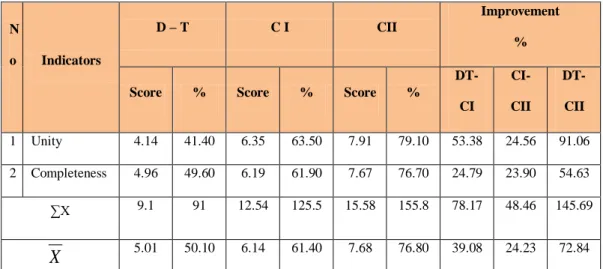
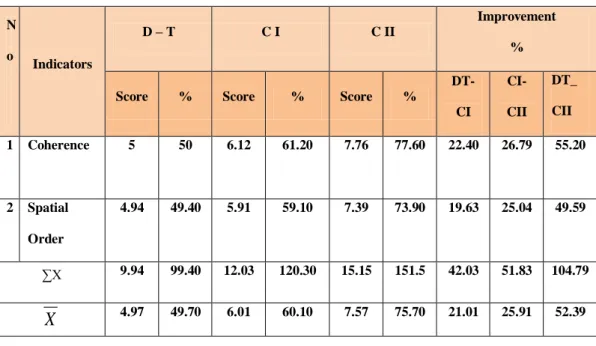
TABLE 1 The Student‟s Improvement in Content ……… 46 TABLE 2 The Student‟s Improvement in Organization ……… 48 TABLE 3 The Students‟ Improvement in Writing ………. 50
LIST OF GRAPHICS
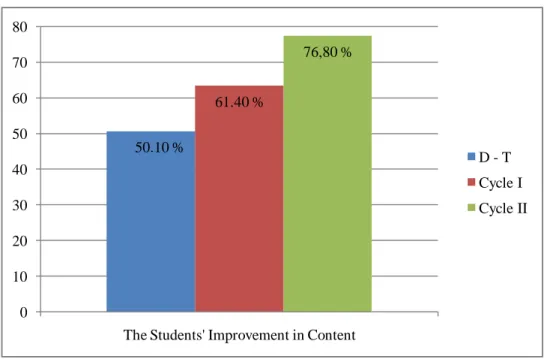
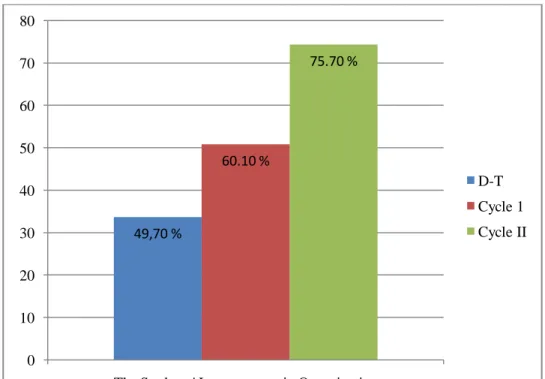
FIGURE 1: The Students‟ Improvement in Content ………. 47 FIGURE 2: The Students‟ Improvement in Organization ………. 49 FIGURE 3: The Students‟ Improvement in Writing Skill ……….. 51
CHAPTER I INTRODUCTION A. Background
The need for English nowadays is increasingly felt in almost every face of life in our country, Indonesia. We can not deny that the material of English is quite necessary for Indonesian people. Because it is use as communication tool.
Jacobs. G (2008: 1) states that writing is one of the language skills that palys an important role in human communication. The most important of writing is coming to be more and more recognized. It is the written mark that links with the outside world is formed.
There is no doubt that English writing is important as the other language skills. The ability to write is frequently demanded in many occusions in our life.
For many reasons writing skill is crusial to most people. In relation about that, Adelstain and Vipal (1980) state that in all subjects in our life or in all profession, the ability to write or express oneself clearly is essential basic for success. Writing is crucial mean of human communication. It use to communicate with other people in sociaty and to express our feeling and opinions. Writing means of both communication and self expression.
Writing means how to communicates our opinion to other on the paper.
But reality shows that it can not be done well because it is very difficult to express. Furthermore, Goldman and Heaton (1986:126) states that many students
still encounter difficulties in writing because it is complex and difficult. In studying English, many students who study in the tertiary level still often make errors in writing though they have learned it for many times, even years.
The difficulty of writing is also caused by the components of writing.
Jacobs. G (1981:10) tell that there are five components of writing. The five components are content, organization, vocabulary, language use and mechanics.
They are intergrating related to each other when students producing a good piece of writing. Without having a good mastery of writing components, the students cannot write successfully. Sometimes, when they write the students get difficulties in expressing their ideas or thoughts. In this case, the students have a lot of ideas, but they cannot organize their writing out into a piece of writing.
Specially the students‟ problems or difficulties in formulating or expressing their ideas or thoughts into written-form are: first, the students do not know how to develop their ideas or thoughts into wider or broader writing that is related to the topic of writing. Second, the students do not know how to arrange idea or topic of writing in illogical order, so the students writing seem unclear, confusing, and incoherent.
The two problems above are usually faced by the students and therefore certain way is required to help them write well which may be expected to increase their ability to write.Furthermore, Goldman and Heaton (1986:114) states that no single method of writing works for all writers. They need to find a method to will work best. The methods of writing must cover three broad areas. Three broad
areas are discovering a massage and purpose, developing a method of presentation, and using suitable language.
According to the information that researcher has got from the English teacher at SMK Muhammadiyah 3 Makassar and observation have done for several days in learning English which found the real fact of the situation at class X keep a big potency but they were still low in writing. They have a difficulty in expressing their ideas. The students‟ ability is still proportional where there are students which so predominate the class other student tend to passive.
To overcome the students‟ problems in SMK Muhammadiyah 3 Makassar expecially class X needs a good strategy and it is the teacher‟s responsibility to increas their potency. In order for students to communicate well they need to have to expand their cognitive academic language proficiency level. It is important for students to learn how to think critically and creatively.
As teachers, we have the responsibility of improving and enhancing students' writing, in both content and in organization. In order for these children to succeed, they need to be equipped and well aware of the genres of power which rule the world. Whether oral or written, the different types of genres are a child's key to power, prestige and privilege. By developing these styles of writing, a child is empowered to use this key to unlock any door that leads to success. Writing is a transitory verb, therefore, one should not just teach writing, but teaches to write something.
To teach the students how to write easily and creatively, there are many methods that can be used. Venn Diagram method or known as comparing and
contrasting two issues and the circles represent the quality of each issue, a method developed by John Venn is one of methods in teaching writing that may support the expected situation. This method can help the students to determine the cause and effect of two problem statement that contrast by using a model two circles or Venn diagram. It can be very enjoyable for students to be creatively in writing.
B. Problem Statements
Based on the previous description, the researcher presents some research questions, as follow:
1. How is the improvement of the students‟ writing content through Venn diagram Method at class X year students‟ of SMK Muhammadiyah 3 Makassar?
2. How is the improvement of the students‟ writing organization through Venn diagram Method at class X year students‟ of SMK Muhammadiyah 3 Makassar?
C. Objectivesof the Study
Based on the problem statement above, the objective of this research are to find out:
1. The improvement of the students‟ writing content through Venn Diagram method at class X year students of SMK Muhammadiyah 3 Makassar.
2. The improvement of the students‟ writing organization through Venn Diagram method at class X year students of SMK Muhammadiyah 3 Makassar.
D. Significance of the Study
By using Venn diagram Method, it is hoped that the teacher will be able to motivate the students to learn especially in writing subject, so that the writing ability of the students can be improved. The results of the research is expected to be valuable information and give a meaningful contribution for teachers in learning process to create a good strategy and to motivate the students to be interested in learning English.
E. Scope of the Study
The content is a very important component of writing which should be clear for the students to understand the message conveyed and gain information.
Organization of writing is concerned with the ways to arrange and organize the ideas in order the message in the words. By this reason, thisstudy will be focusedon improving the students‟ ability to write explanatory composition text especially to the stating an opinion restricted on the Content and the Organization of the text at class X year Students‟ of SMK Muhammadiyah 3 Makassar.
CHAPTER II
REVIEW OF LITERATURE A. Some Previous Research Finding
There are some researchers who have conducted research that related with this topic as follows:
Sri Santi Kadevie, (2014) in her research, The Effectiveness of Teaching Reading Comprehension by Using Venn Diagram Technique. The result of analysis on this research showed that the mean score of pre-test improved from 70.44 to 83.61 in the post-test. The result of t-test showed that the teaching reading comprehension of report text by using venn diagram technique can improve students‟ ability in learning. The result of analysis on effect size also proved that venn diagram technique categorized as highly effective and succeeded to improve students‟ achievement in comprehend the report text.
Agnes Febrian Harlan, (2016) in his research, The Implementation of Venn Diagram Strategy to Improve Reading Comprehension of Analytical Exposition Texts. The result of the research showed some changes after the second cycle. The changes were indicated by the students‟ better understanding of the text and the increase of students‟ engagement during group work as observed and noted in the observation sheets. As the consequence, the improvement of scores in reading comprehension test in cycle two also took place.
Noor Hameed Majeed Al-Abidi, (2016) in his research, Perceptions of EFL Teachers of Using Venn Diagrams for Developing Secondary School Students’
Reading Strategies in English Literature Submitted. A suitable statistical means
has been applied to the results of the study to achieve the aims of the study which reveal that the EFL teachers‟ perceptions are good (very important) toward using venn diagrams strategy for developing reading strategies of EFL students‟ in English literature. Since, they have a good scientific practice and qualifications to use one of the modern teaching strategies such as (venn diagrams).
Based on the research findings above, the researcher explains that her research is different from Sri Santi Kadevie, Agnes Febrian Harlan, and Noor Hameed Majeed Al-Abidi findings. First findings concern to the effectiveness of teaching reading omprehension by using venn diagram technique, second findings concern to the implementation of venn diagram strategy to improve reading comprehension of analytical exposition texts and the third findings concern to perceptions of EFL teachers of using venn diagrams, while this research concern to the application of venn diagram method to improve the students‟ writing ability.
B. Some Pertinent Ideas 1. Venn Diagram Method
a. Definition of Venn Diagram Method
According to John Venn “On the Diagramatic and Mechanical Representation of Propositions and Reasoning” (1880: 59) define Venn diagram is a tactic that can be used to teach in learning objectives that have been written. A Venn diagram is a visual organizer used to compare and contrast defined concepts. Venn Diagrams are made up of two or more overlapping circles. The circles show relationships between defined
concepts and allow learners to visually organize similarities and differences between the defining characteristics of the defined concepts.
Below is an example of Venn diagram method:
Learn Plays
(Example of Venn diagram)
The picture above is the example of the Venn diagram method where it shows the comparing and contrasting two issues. Where they overlap in the centre represents where they are similiar. The issues are put on the top of the circles which it‟s as a topic.The centre contains the general ideasand the outside sections contain the specific differences or supporting ideas which related to both the issues. From the picture we can see that there aretwo issues those contras. But from the issues we can compare be a writing unity.
John Venn (1880: 59) states that Venn diagram is useful in visually organizing related information about defined concepts in a structured manner that facilitates comprehension by showing the similarities and
*Learn facts, dates
*Work together
on projects
*Compety for
grades
Socialize *watching TV alone
Competition *playing with neighbour
neighbours
differences between defined concepts. This is especially important for coordinate concepts (related concepts that share some or many characteristics) because a Venn diagram helps clearly show which characteristics make the coordinate concepts different from one another.
According to Jeremy Jones ( 2010 : 27) Venn Diagrams can be used with other tactics such as Concept Frames and Concept Maps. It is important to note that Venn Diagrams can become complicated and difficult to interpret as more concepts are compared. They work best when only two or three concepts and their characteristics are compared in a single diagram.
b. A compare and contrast essay will ultimately follow this basic format:
1) Introduction and Thesis Statement (one paragraph).
2) Topic One (at least one paragraph, can be more, discussing just one of the ideas, people, or objects being discussed in great detail).
3) Topic Two (will follow the same guidelines as topic one).
4) Topic One and Topic Two Together (analyze both topics together can be one or more paragraphs).
5) Conclusion (sum up the compare and contrast essay, should generalize the thesis and should reaffirm the thesis).
The first paragraph of the essay will be an introductory paragraph. It will also include the essay's thesis statement. The first paragraph should
present the first comparison from the Venn diagram, the second paragraph should present the second comparison from the Venn diagram, and the third paragraph should present the third comparison from the Venn diagram. If there are more comparisons on the Venn diagram, more paragraphs can be added. The fourth paragraph should present the first contrast from the Venn diagram. The fifth paragraph should present the second contrast from the Venn diagram. The sixth paragraph should present the third contrast from the Venn diagram. Like the comparison, more contrast paragraphs can be added. The eighth paragraph should present the comparisons and contrasts together. The ninth paragraph should present the conclusion, generalization of the thesis, and reaffirmation of the thesis. ( David Within: 2000: 46) c. The Elements of Venn Diagram Method
The elements of the Venn diagram method will be explained as follows:
1) Topic in the top of the circles. There are two topics which contras both them and comparing.
2) Keyword that is from related the topic. There is no limit for the keyword. The keyword or supporting ideas must put in the circles.
3) General ideas. It‟s must related the two issues and put it on the centre represent.
d. Teaching Procedure by Using Venn Diagram Method
The following are teaching procedure by using Venn diagram method:
1) The first step, the teacher explains to the students the aim of Venn diagram method.
2) The second step, teacher dvide students into pairs or small group if desired.
3) The thirth step, the teacher provides one example for the students to see as an example of Venn diagram method.
4) The fourth step, teacher gives students the paper size A4 as thing to create Venn diagram.
5) The fifth step, teacher writes the topic on the paper which the topic appropriate comparing and contrasting two issues and ask all students to determine the two issues from the topic and general ideas from the topic then ask them to find as much as words that related to the both the issues then fill in the circles.
6) The process of Venn diagram, teacher is suggested to give correction toward students‟ mistakes if the students do not respond correctly.
e. The Advantages of Venn Diagram Method
The following is a summary of advantages of Venn diagram method as follows:
1) This is the most enjoyable strategy to organize thoughts because the students can see the whole subject/area.
2) Venn diagram method will improve memory, concentration, creativity and ability in writing.
3) Venn diagram method will improve the understanding of the relationship between facts.
4) Encourage problem solving by showing students new creative pathways.
5) Venn diagram method enables the students to be extremely efficient.
6) Be enjoyable to look at, read, muse over, remember and write.
7) Venn diagram method helps the students to stimulate the memory to know many vocabularies.
8) Venn diagram method helps the students to absorb and processes information more quickly and easily.
2. The Concept of Writing a. Definition of Writing
Writing is one of four language skill; it communicates ideas by means of conversational symbol that are traced, incites, draw or otherwise formed on the surface or some materials. Writing gives permanence to men‟s knowledge and enables them to communicate over great distance.
This is excellence of writing compared to speaking because people may save message through writing longer than speaking. As one of language
skill in English, writing is used to express ideas. In writing, the writer will be involved in the process of building the larger units of ideas from the larger ones.
Writing is the production of graphic symbols to form words in a sequence of sentence arranged in a particular order and linked together in certain ways, also writing is the process of encoding a message to transfer meaning to the reader (Byrne, 1984: 19).
Another statement about writing skill comes from Widdowson (1985: 30) states that writing is a communicative activity and is carried out in accordance with certain general principal in which underline the use of language in communication.
Writing skill is predictor of academic success and a basic requirement for participation in civic life in the global economy, while Writing is not a simple language skill to perform because of it is large areas that must be involved. In producing a piece of writing, linguistic competence and extra linguistic competence are always involved. The fact is that writing is not only a means of expression, but it is also an essential criterion of competence in any field. This means that to write is to seek expression or to have something to say through the application of linguistic system.
b. Part of Paragraph
Oshima (1981: 71) classify three main parts of paragraph they are: topic sentences, supporting sentences, and concluding sentences.
1. Topic sentences
The topic sentence is the most general statement of the paragraph. It is the key sentences because it names the subject and the controlling idea, the writer‟s main idea, opinion, or feeling about that the topic. The topic sentence is a complete sentence. It has three parts: a subject, a verb, and a controlling idea. The topic sentences will tell the reader what the paragraph is about.
2. Supporting sentences
The supporting sentences develop the topic sentences by giving specific details about the topic. The supporting sentences that follow the topic sentences should develop the main ideas of the paragraph. The topic sentences can supported by supporting sentences to develop and explain the topic sentences by giving definition, reason, example, fact, comparison and effect. In order to choose detail to support the topic sentence, rephrase it as a question, and answer that question with your supporting sentences. The supporting sentences follow the topic sentences and make up of paragraph.
3. Concluding sentences
This sentence tells the reader that the paragraph is finished, and it completes the development of the subject of the paragraph. The concluding sentences remind the reader of the topic sentences. When the writer writes a concluding sentence, you can state the topic
sentences in different word or summarize some of the main points in the paragraph.
c. Types of Writing 1. Narration
Oshima (1981: 37) explains that Narration is story writing.
When you wrote a narrative paragraph or essay, you write about events in the order that they happened. In other words, you use time order to organize your sentence. In the model essay, the writer uses time order to divide the essay into paragraphs. An outline of the essay narration would like this: orientation, complication, and resolution.
2. Description
Oshima (1981: 37) explains that descriptive writing to the senses, so it tells how something looks, feels, smells, tastes, and/or sounds. A good description is like a “word picture”, the reader can imagine the object, place, or person in his or her mind. A writer of a good description is like an artist who paints a picture that can be “seen”
clearly in the mind of the reader. In a description, writers often use spatial order to organize their ideas. Spatial order is the arrangement of items in order by space. An outline of description would like this:
introduction, body, and conclusion.
3. Explanatory
There are three kinds of explanatory composition, they are:
a.) Explaining a Process
To write an explanatory composition that explains a process, rely on the same skills you have used in everyday situations. Explain the steps in the process briefly and clearly. Start with the first step and proceed through all the steps in the order in which they must be completed. It is essential that the steps be presented in the correct sequence and that they are accurate and complete. An effective way to organize an explanatory composition that explains a process is to follow this plan: introduction, steps in the process, and conclusion.
b.) Stating an Opinion
An explanatory composition may express an opinion and explain why others should explain why others should accept that opinion. In an explanatory composition, you need to present strong, specific reasons or facts. An effective way to organize an explanatory composition that stating an opinion is to follow this plan: introduction (express your opinion, as directly as possible), body (supporting opinion), and conclusion (summarize your argument as forcefully as you can).
c.) Stating a Definition
To write a good definition, you must do three things. First, name the word to be defined. Second, name the general class to
which the subject belongs. Third, name the particular characteristic of the subject. By defining a subject you will be able to present a complete and informative picture of it. An effective way to organize an explanatory composition that stating a definition is to follow this plan: introduction (your definition serves as the topic sentence for the composition), body (the most informative way to develop a definition is with or with facts and figures), conclusion (the sums up the main idea of your definition). (Littell, 1981: 122-140).
d. Process of Writing
This section includes a description of the activities leading to the writing of the previous essay. These activities include prewriting, writing and rewriting.
1). Prewriting
Oshima (1981: 39) states that brainstorming is prewriting activity in which you come up with a list of ideas about a topic on your own in small groups with your classmates. You quickly write down a list of ideas that come to your mind as you are thinking about a general subject or specific topic. Follow these brainstorming steps:
1. Write down your general subject or specific topic.
2. Make a list everything that comes to your mind about it.
3. Use words, phrase, and/or sentences. Don‟t worry about the order of ideas, mechanics, grammar, or spelling.
4. Just keep writing down whatever comes to your mind until you run out of ideas. Because you are only brainstorming, don‟t be concerned if you repeat several ideas.
2). Writing
Litell (1981: 7) at this point in the process of writing, you are ready to write. Simply put your pencil to paper and write. Don‟t fuss with the writing. Don‟t worry about organizing ideas. Don‟t fuss about spelling or punctuation. Just Write.
According to Oshima (1981: 40) there are several steps in writing process, they are:
1. Prewritten to get previous ideas 2. Organize the ideas
3. Write the rough draft 4. Editing the rough draft 5. Write the second draft 6. Write the final draft.
3). Rewriting
At this stage of the process you will need to work more carefully. Read what you have written and repair it as you can.
Finally, when you are satisfied that your writing is clear and correct, write it out its final form. Write carefully. Make your work as neat as possible.
e. Components of Good Writing
Jacob (2008: 23) points out five kinds of components in writing.
They are content, organization, language use, vocabulary, and mechanics.
1). Content
The content of writing should be clear for the readers, so that the readers can understand the message conveyed and gain information from it. In order to have a good content of writing, its content should be well unified and completed. This term is usually known as unity and completeness, which become characteristic of good writing.
a.) Unity
The writing regards to have good unity, if it has some main ideas and the sentences contained in it develop that idea. The main idea is stated in the topic sentences and each or every supported sentences and related to that idea of the topic sentences. If a writer wants his writing is unified, he or she should not include the sentences that do not support the main idea of the topic sentences.
b). Completeness
Writing is said to have completeness if the main idea have been explained and developed fully completeness. The controlling idea with develop thoroughly by these of particular information. It is relative to know how complex or general the topic sentences by
having a complete writing. It is expected that the content of writing will be clear and understandable for readers.
2). Organization
In organization of the writing concern with the ways through writer arranges and organizes the ideas in order the message in the words. There are many ways used by the writers to organize or arrange the writing this organization is mainly recognized as order.
There are two parts of organization in this case, they are below:
a). Coherence
Coherence means that sticking together and in coherence essay, all the idea sticks together. A coherence paragraphs is each idea in supporting sentence related to the topic sentence or the idea.
One in which the ideas are put in the right order and never confused. This makes the writers through essay to follow sentence paragraph.
b). Spatial Order
If the purpose of the paragraph is to tell them something looks most effective organization pattern is usually spatial, if the writers write a description of neighborhood, a room, or a holding that they want to the readers have a mental picture of what they are describing a house of building, they will probably describe the exterior and the interior of the building by moving systematically
rather than haphazardly over the scene, convey the viewer of the overall plan arrangement of the scene.
3). Language Use
Coke (1939:78) states that language use in writing description and other forms of writing involve correct usage and point of grammar. However, considering that there are many points of grammar, the writer would like to quote a little literature about verbs, use modifier or adjective, adverbs, and participles in the writing, a modifier may other be a phrase. A single, well-chosen- modifier is often more effective than several used together. If it is difficult to describe with over used or warn-out modifier, find more interesting synonyms, in the dictionary.
4). Vocabulary
Vocabulary is one of the language aspects dealing the process of writing. The writers always think about putting words into the sentences and putting the sentences into the paragraph until they can create a peace of writing.
It is clear now that we cannot write or express if we do not have vocabulary. Therefore, we cannot understand the writing passage without having a lot of vocabulary.
Vocabulary as one of the important components of writing should take in to consideration by the English leaner and English
teacher, because there is a doubt that learning the words of the language.
5). Mechanic
The use of mechanics is due to capitalization, punctuation, and spelling appropriately. These aspects are very important, it leads the readers to understand, to recognize immediately. The use of favorable mechanic in writing will make readers easy to group the conveying ideas or the message to the written materials. Further explanations about mechanics are capitalization.
The use of capital letters makes our writing easier to read.
Capital letters call attention to certain special words, as well as to words that begin sentences. There are specific rules for capitalizing words.
The words which are capitalized, names (e.g. A. E. Housman) and titles ( e.g. the Secretary of State), the pronoun I, months ( e.g.
November), days (e.g. Monday), and holidays ( e.g. Memorial Day), names of organization (e.g. Democratic Party) and institution (e.g.
Wright Junior College), etc.
3. The Concept of C.A.R (Class Action Research) a. Definition
Classroom Action Research was first introduced by the American social psychologist named Kurt Lewin in the 1946. Kurt Lewin'score idea was then developed by other experts such as Stephen Kemmis, Robin Mc
Taggart, John Elliot, Dave Ebbutt, and other experts. This type of research can be done in the field of organizational development, management, health or medicine, education and so on.
In this research, the researcher uses Classroom Action Research according to Kemmis and Mc Taggart cited by David Nunan, Classroom Action Research is a group activity, and a descriptive research carried out by a teacher in his or her own classroom, without the involvement of others, which is aimed at increasing our understanding rather than changing the phenomenon under investigation, would not be considered by these commentators to be action research.
It is reasonable that Classroom Action Research is different with other research. This research is done to improve and repair the teaching method which is done by teacher. Besides, Kemmis and Mc Taggart cited by David Nunan argues that the three defining characteristics of Classroom Action Research are; it is carried out by practitioners (for our purpose classroom teachers) rather than out side researchers, secondly that it is collaborative, thirdly that it is aimed at changing things.In the implementation of Classroom Action Research, the teachers need todo every step of this study together or collaborative from the beginning to end.
Action research is a simply form of collective self-reflective enquiry undertaken by participants in social situations in order to improve the rationality and justice of their own social or educational practices, as well as their understanding of those practices and the situations in which the
practices are carried out. The approach is only action research when it is collaborative, though it is important to realize that action research of the group is achieved through the critically examined action of individual group members.
Classroom Action Research is an activity undertaken by teachers to improve their performance and teaching skills in the classroom. They do it by evaluating their teaching approaches and then making improvements.
By doing this repeatedly, they should improve their performance and skills. (Training in Applicative Classroom Action Research)
Classroom Action Research is research designed to help a teacher find out what is happening in her or his classroom, and to use that information to make wise decisions for the future. Method can be qualitative or quantitative, descriptive or experimental. (Indiana University South Bend, Division of Education)
b. The Synthesis
From all the definitions of Research Action and Classroom Action Research we can make conclusion and the simple definition:
Action Research is the research or investigating which is done by participants in social situation in order to improve their social practice, their understanding, and the situation of something which is observed more deeply. Here, the scope is wider than Classroom Action Research; it includes the social world or situation not the educational situational only.
The researcher is not only teacher but also it can be the government or social institution.
While Classroom Action Research is the action research which happens in a classroom (educational situation) about the problem during the process of teaching and learning activities which is done by the teacher to raise awareness of his or her personal theory; tryout new strategies;
record their work in a form which is readily available to and understandable by other teachers; and thus develop a shared theory of teaching; and also to improve his or her skill especially his or her professionalism.
c. The Review
1). The Concept of Classroom Action Research
Classroom action research begins with a question or questions about classroom experiences, issues, or challenges. It is a reflective process which helps teachers to explore and examine aspects of teaching and learning and to take action to change and improve. The purpose of teacher research is to gain understanding of teaching and learning within one‟s classroom and to use that knowledge to increase teaching efficacy/student learning.
Research in English learning is a scientific activity that aims at investigating the rules that work in the process of English learning.
Research activities in English learning cover four steps: observing, describing, analyzing, and explaining. The way each step is done
depends on the nature of the data and the objective of the research.
Classroom Action Research for English Learning aims at developing a certain instructional strategy to solve practical instructional problems in English classrooms. Each English learner is basically able to learn English provided that he or she is given the appropriate help as each learner has his or her own style and strategy of learning. Classroom Action Research for English Learning aims at discovering learning- teaching strategies that match learners‟ style and strategies in learning English. Classroom Action Research is done in several cycles each of which is repeated in the following cycle if the result is not satisfactory yet with the better revised lesson plan. Each cycle begins with lesson planning, implementing the plan (acting), observing the implementation, and reflecting or evaluating the process and the result of the implementation. According to Kemmis and Mc. Taggart there are four components in one cycle for doing classroom action research. It consists of :
a) Planning b) Action c) Observing d) Reflecting
Those four components are related each there as a cycle.
Planning is the first step the researcher has to do before doing something. The planning is expected to be futuristic and flexible to
face some non-anticipated effects. By the planning, we can prepare to handle the troubles early. By a good planning, a researcher can be easier to face some problems and it will be more effective in doing research.
Acting is an applying of the planning. It can be a teaching method applying that has a purpose to repair or complete a certain model.That action can be applied by the persons who are involved in the applying a teaching method which the result also will be sued for completing in doing assignment. Observing is used to see andcapture some influences caused by a classroom action. This observation's result is a basic of doing reflection so that the research should be able to show the real situation. In the observation, the researcher should take a note of the process of action, the action's effects, environment, and some troubles.
Reflecting consists of: analysis, synthesis, interpretation, explanation, and conclusion. The reflection's result is having revision of the planning which has been done, and it can be used for repairing the teacher's performance in the future. Thereby, the action research can't be held in only one meeting because it needs more time to do the reflection's result as a planning for the cycle after.
d. Purpose and Significance
The purposes of Classroom Action Research:
1) To understand more about teaching and learning
2) To develop teaching skills and knowledge 3) To improve the students in learning.
The significances of Classroom Action Research:
1) Providing a framework for trying out different approaches and ideas 2) Helpingto develop reflective practice
3) Enablingthe teachers to make choices and decisions about their teaching styles
4) Helpingto develop confidence
5) Helpingthe teachers improve student learning 6) Curriculum development.
C. Conceptual Framework
Writing is very important skill that must be mastered by the English students. It communicates ideas by means of conversational symbol that are traced, incite, draw or otherwise formed on the surface or some materials. People may save message through writing longer. The conceptual framework underlying in this research given below:
Based on the conceptual of Venn diagram method, the researcher would like to use Venn diagram method as teaching in classroom action research.
The research is conduct two cycles. In cycle 1, the teacher use free writing to the students for writing explanatory exposition text focuse on stating an opinion and would like to continue the researcher if there is weakness or the target of the teacher does not achieve yet. The teacher will implement both of the teaching material above for improving the students‟ writing ability. Therefore, in the final
Teaching Writing
Process CAR
(Classroom Action Research)
Reflection Planing
observation Action Venn
Diagram
Cycle I and Cycle II
The Improvement of the Students’ Writing Skill
version the teacher can get information about the improvement of the students‟
writing ability.
CHAPTER III RESEARCH METHOD A. Research Design
This research applied a classroom action research (CAR). It was conducted through two cycles to observe the students‟ skills to write English through Venn diagram method. Where, the realization of the second cycle was continued and repaired from the first cycle. It consisted of planning, action, observation, and reflection. The classroom action research was carried out by researcher and English teacher as collaborator.
B. Research Time and Subject
The research was done at Vocational Hight School at SMK Muhammadiyah 3 Makassar for English subject. As subject in this research was class X for 2018-2019 academic years with students number as about 28 students.
All the students were consisted of male and female.
C. Research Variables and Indicators 1. Variables
The following were the variables of the research:
a. Independent variable of the research was the used of Venn diagram method. It was the important process to which allows the students to share and develop ideas/opinion to improve the writing skills.
b. The dependent variables of the research consisted of the students‟ skills to write explanatory focused on stating an opinion text focused on the content and organization.
2. Indicators
The following were the main indicators of each variables:
a. The indicators of the content were the unity and the completeness of the students‟ writing. There were some sub indicators of unity and completeness as follows:
1) The ideas were about the topic selected 2) The ideas were clearly stated
3) The ideas were clearly supported 4) The ideas were comprehensible 5) The ideas were well developed 6) The ideas were relevant
7) The ideas fluently expressed
b. The indicators of the organization were the coherence and the spatial order of the students‟ writing. There were some sub indicators of coherence and spatial order as follows:
1) The ideas were-well organized 2) The organization was concised 3) The ideas were cohesion 4) The ideas were coherent
5) The ideas were relevant to outline
6) The ideas were presented in logical sequencing.
D. Research Design in Action Research
This action research carried out through two cycles. Each cycle consisted of four meetings. Both cycles consisted of teaching learning process and tests. In this research, the procedure divided into two cycles:
Cycle I
The first cycle in this classroom action research consisted of planning, action, observation and reflection as follows:
1. Planning
a. Researcher analyzed syllabus to know basic competency to be conveyed to the students by using Venn diagram method.
b. Made lesson planning of Venn diagram, and also made instrument evaluation used in the classroom action research cycles.
c. Arranged instruction evaluation instruments.
d. Prepared observation forms for observer.
2. Action
Conducted the scenario of learning process, it was based on the Venn diagram method in learning English especially in writing skills improvement through Venn diagram method. After gave pre-action, the students were given English materials by using Venn diagram method for five times of meeting.
Each meeting spends 90 minutes. The activities as follows:
a. The first step, the teacher explained to the students the aim of Venn diagram method.
b. The second step, teacher devided students into pairs or small group if desired.
c. The thirth step, the teacher provided one example for the students to see as an example of Venn diagram method.
d. The fourth step, teacher gave students the paper size A4 as thing to create Venn diagram.
e. The fifth step, teacher wrote the topic on the paper which the topic appropriate comparing and contrasting two issues and asked all students to determine the two issues from the topic and general ideas from the topic then asked them to find as much as words that related to the both the issues then filled in the circles.
f. The process of Venn diagram, teacher was suggested to give correction toward students‟ mistake if the students do not responde correctly.
3. Observation
a. Identified and made note all the problem that we need when teaching and learning process based on observation paper that had been arranged.
b. Done the evaluation which used the result of the study to know how far they has improvement.
c. Gave the students‟ chance for giving suggestion in action research.
4. Reflection
The result of data had been done continue in the analysis until can be reflected after action research. The reflection discussed as a guidance lecture
while teacher made research planning for the next cycle. The research plan was planed for the next cycle which had been reparsed from cycle.
Cycle II
This cycle conducted four times meeting include one time for test in cycle II. The main activities were:
1. Planning
The ways that was done:
a. Continued the activities that had done in the first cycle.
b. Improved the weakness in the first cycle.
c. Replanned the scenario in learning process from the result of cycle I reflection.
d. Action research repaired.
2. Action
In the stage, action was done to improve the result based on the cycle reflection I; the stages were done same with the previous cycle that was to say, to do improvement of the applied teaching strategy, the activities as follows:
a. The teacher explained to the students the aim of Venn diagram method.
b. The teacher provided one example for the students to see as an example of Venn diagram method.
c. The teacher gave students the paper size A4 as thing to create Venn diagram.
d. The fourth step, teacher wrote the topic on the paper which the topic appropriate comparing and contrasting two issues and asked all students to determine the two issues from the topic and general ideas from the topic then asked them to find as much as words that related to the both the issues then filled in the circles.
e. The process of Venn diagram, teacher was suggested to give correction toward students‟ mistakes if the students do not respond correctly.
3. Observation
In the reality, the observation done at the cycle II was almost same with the observation at cycle I.
4. Reflection
According to the achieved result of the observation that had been collected and analyzed. From the result of the research, the researcher can make conclusion that Venn diagram method can improve the students‟
writing skills.
E. Research Instrument
There were two instruments used, they are:
1. Observation sheet
Observation sheet aimed at finding out the students‟ data about their presence and activeness in teaching learning process.
2. Test
Facts test aimed to get information about students‟ improvement after teaching learning process by using Venn diagram method.
F. Data Analysis
The data gained from cycle I and cycle II was analyzed through the following steps:
1. Observation (field notes)
Observation aimed at collecting data about the students‟ participation in teaching learning in writing and in the implementation of Venn diagram method. It used to note finding and improvement during action step in each cycle. The guideline of the field note encompassed:
a. Observation towards the students‟ activities.
b. Observation towards the teacher‟s way of teaching.
2. Test
According to Syarman (1999) has conducted a research to the students to write composition. He found out that the students have fair ability in writing English explanation composition. The test was used that the students must be given something different in teaching English writing especially through Venn diagram method that can improve the students‟ writing skills.
a. Scoring students‟ writing skills
The assessment of students‟ writing skills competence for the content‟s component.
Score Range Indicators of unity and completeness
A (9-10) Very Good
1. The ideas are about the topic selected 2. The ideas are clearly stated.
3. The ideas are clearly supported.
4. The ideas are comprehensible 5. The ideas are well developed 6. The ideas are relevant
7. The ideas fluently expressed
B (7-8 ) Good
1. The ideas are about the topic selected.
2. The ideas are clearly stated.
3. The ideas are clearly supported.
4. The ideas are quite comprehensible 5. The ideas are generally well-
developed.
6. The ideas are adequate relevant.
7. The ideas are adequately expressed
C (5-6) Average
1. The ideas are about the topic selected 2. The ideas are rather clearly stated.
3. The ideas get enough supports.
4. The ideas are quite comprehensible.
5. The ideas are generally developed.
6. The ideas are quite relevant.
7. The ideas are sufficiently expressed.
D (3-4) Poor
1. The ideas are about the topic selected.
2. The ideas are not clearly stated.
3. The ideas get limit to support.
4. The ideas are not comprehensible 5. The ideas are not quite relevant.
6. The ideas are lack of developing.
7. The ideas are non-fluent expressed.
E (1-2) Very Poor
1. The ideas are about the topic selected 2. The ideas are not clearly stated.
3. The ideas are not clearly supported.
4. The ideas are incomprehensible.
5. The ideas are irrelevant.
6. The ideas have very poor development.
7. The ideas are not communicative.
(Depdikbud, 2004) The assessment of students‟ writing skills competence for the organization‟s component.
Score Range Indicators of coherence and spatial order
A (9-10) Very Good
1. The ideas are-well organized.
2. The organization is concise.
3. The ideas are cohesion.
4. The ideas are coherent
5. The ideas are relevant to outline.
6. The ideas are presented in logical sequencing.
B (7-8 ) Good
1. The ideas are adequate organized.
2. The organization is adequate concise.
3. The ideas are adequate cohesion.
4. The ideas are adequate coherence.
5. The ideas are relevant to outline.
6. The ideas are sufficient sequencing
C (5-6) Average
1. The ideas are generally organized.
2. The organization is quite concise 3. Few ideas are a break out cohesion.
4. The ideas are generally coherent.
5. The ideas are mostly relevant to outline.
6. The ideas are in some logical sequencing.
D (3-4) Poor
1. The ideas are almost loosely organized.
2. The organization is not concise 3. The ideas are inadequate cohesion 4. The ides are inadequate coherent.
5. The ideas are somewhat relevant to outline.
6. The ideas are lack logical sequencing.
E (1-2) Very Poor
1. The organization are loosely organized 2. The organization is not concise
3. The ideas are confuse and disconnected.
4. The ideas are incoherent.
5. The ideas are not or almost not relevant to out line.
6. The ideas are not or almost not presented in logical sequencing.
(Depdikbud, 2004) b. Scoring the student‟s answer by using the following formula:
Student‟s correct
Score = x 10 Depdikbud (2004) Total number of item
c. Calculating the means score of the students‟ writing test by using the following formula:
X = N
XWhere: X = Mean score for sample
∑x = Total new Score
N = Total Number of students (Gay, 1981:298)
d. Computing the frequency and rate percentage the students‟ score.
P = 𝐹
𝑁𝑥 100%
While:
P = Percentage F= Frequency
N= Total number of teaching material
(Hatch and Hossen in Yunus, 1982:92) e. The percentage of the students improvement applied as follow:
Improvement: P =𝑋2−𝑋1𝑋1 𝑥 100%
Where: P = percentage X1 = 1st cycle X2 = 2nd cycle
(suharsimi Arikunto, 2006: 306)
CHAPTER IV
FINDINGS AND DISCUSSIONS
This chapter particularly presents the finding of the research cover with the description of the students‟ improvement in organization and content. In the discussion part, the writer described the findings in detail.
A. Findings
1. Implementation of Venn Diagram Method
The teacher conducts planning before the action, where she prepared the lesson plan through implementing Venn Diagram Method, teaching material, and evaluation for students.
The activity in action stage for cycle I is the implementation of the lesson plan. It means that the implementation of every steps of the learning process through Venn Diagram Method which have been arranged in the planning stage.
Firstly, the teacher explains to the students about the aim of Venn Diagram method. Secondly, the teacher provides one example for the students to see as an example of Venn Diagram method. Thirdly, the teacher gave the students the paper size A4 as thing to create Venn Diagram. Fourthly, the teacher writes two topics on the cycle. Fifthly, the teacher asks all students to determine the the topic appropriate comparing and contrasting two issues and ask all students to determine some ideas related to the two issues from the topic and general ideas from the topic then ask them to find as much as words that related to the both the issues then fill in the circles. Sixthly, for the final project, the teacher orders the
students to develop the keywords or general ideas into paragraph. Seventhly, the process of Venn Diagram, teacher is suggested to give correction toward students‟
mistakes if the students do not respond correctly and if the result of the students‟
scores do not achieve the target then cycle II will be taken.
The activity in the second cycle is almost same with the first cycle. Where, before taking action, the teacher previously makes planning and implies it in the action stage. The difficulty that the researcher found in the cycle I is the students still difficult to get idea and organize their writing to be a good paragraph.
An explanatory composition may express an opinion and explain why others should explain why others should accept that opinion and in the writing project, the teacher has chosen a topic that is relative to their environment.
Meanwhile, the result of the students‟ writing is still vague the readers. They do not finish their writing about “My Friends Who Have Similar Character”. From three general ideas, almost of them just develop one until two general ideas fully and only one or two sentences for the remained general ideas.
It can be understood if considering the class situation during the teaching process. Only few of them show their interest in learning and following the teaching process. The others look bored and have no mood in learning process.
They are very noise and just playing around the class. It shows that the teaching process during cycle I is not interesting at all for them. So, the teacher decides to make some revision for the next cycle.
The result of revision planning to resolve the students‟ difficulty in getting idea is providing some interesting topics for the students‟ writing project. Besides
providing some interesting topics the teacher also reforms many aspects such as more relaxed in teaching, gives the students motivation before entering the main learning material, explains the learning material clearly, raises the voice, and re- corrects the class management, and time management. The teacher also gives the students chance to ask the question, explains the students‟ mistakes in writing clearly and guided the students in writing well.
Besides that, the result of their writing is also influenced by their mood and interest to the topic specifically and the writing lesson generally. By considering those aspects, the teacher tries to make them more enjoy by giving them a game and jokes before starting the material. She finds also that the students can be more understand about the space of paragraph, for example: the explanatory paragraph about “The Different Between The Smart Students and the Lazy Students”, the students explains the topic which they may choose one of their friend who have characteristic of the smart and lazy students. They explain the Introduction-body-conclusion. That topic is related to their self in class and the researcher can see how interested they are in doing their writing project. Finally, the students‟ mean score can achieve the target score. The teacher concludes that the students‟ writing mean score based on the elements of organization and content that the target that has been said in the chapter I could be achieved.
2. The Improvement of Students’ Content
The use of Venn Diagram Method in the form of teaching strategy of English Writing skills could improve the students‟ content. It was proved by the writing