Phylogeny and classification of Cucujoidea and
the recognition of a new superfamily Coccinelloidea (Coleoptera: Cucujiformia)
J A M E S A . R O B E R T S O N
1,2, A D A M ´S L I P I ´N S K I
3, M A T T H E W M O U L T O N
4, F L O Y D W . S H O C K L E Y
5, A D R I A N O G I O R G I
6, N A T H A N P . L O R D
4, D U A N E D . M C K E N N A
7, W I O L E T T A
T O M A S Z E W S K A
8, J U A N I T A F O R R E S T E R
9, K E L L Y B . M I L L E R
10, M I C H A E L F . W H I T I N G
4and J O S E P H V . M C H U G H
21Department of Entomology, University of Arizona, Tucson, AZ, U.S.A.,2Department of Entomology, University of Georgia, Athens, GA, U.S.A.,3Australian National Insect Collection, CSIRO, Canberra, Australia,4Department of Biology and M. L. Bean Museum, Brigham Young University, Provo, UT, U.S.A.,5Department of Entomology, National Museum of Natural History, Smithsonian Institution, Washington, DC, U.S.A.,6Faculdade de Ciências Biológicas, Universidade Federal do Pará, Altamira, Brasil,7Department of Biological Sciences, University of Memphis, Memphis, TN, U.S.A.,8Museum and Institute of Zoology, Polish Academy of Sciences, Warszawa, Poland,9Chattahoochee Technical College, Canton, GA, U.S.A. and10Department of Biology and Museum of Southwestern Biology, University of New Mexico, Albuquerque, NM, U.S.A.
Abstract. A large-scale phylogenetic study is presented for Cucujoidea (Coleoptera), a diverse superfamily of beetles that historically has been taxonomically difficult. This study is the most comprehensive analysis of cucujoid taxa to date, with DNA sequence data sampled from eight genes (four nuclear, four mitochondrial) for 384 coleopteran taxa, including exemplars of 35 (of 37) families and 289 genera of Cucujoidea.
Maximum-likelihood analyses of these data present many significant relationships, some proposed previously and some novel. Tenebrionoidea and Lymexyloidea are recovered together and Cleroidea forms the sister group to this clade. Chrysomeloidea and Curculionoidea are recovered as sister taxa and this clade (Phytophaga) forms the sister group to the core Cucujoidea (Cucujoideas.n.). The nitidulid series is recovered as the earliest-diverging core cucujoid lineage, although the earliest divergences among core Cucujoidea are only weakly supported. The cerylonid series (CS) is recovered as monophyletic and is supported as a major Cucujiform clade, sister group to the remain- ing superfamilies of Cucujiformia. Currently recognized taxa that were not recovered as monophyletic include Cucujoidea, Endomychidae, Cerylonidae and Bothrideridae.
Biphyllidae and Byturidae were recovered in Cleroidea. The remaining Cucujoidea were recovered in two disparate major clades: one comprising the nitidulid series+erotylid series+Boganiidae and Hobartiidae+cucujid series, and the other comprising the cery- lonid series. Propalticidae are recovered within Laemophloeidae. The cerylonid series includes two major clades, the bothriderid group and the coccinellid group. Akalyptois- chiidae are recovered as a separate clade from Latridiidae. Eupsilobiinae are recovered as the sister taxon to Coccinellidae. In light of these findings, many formal changes to cucujiform beetle classification are proposed. Biphyllidae and Byturidae are trans- ferred to Cleroidea. The cerylonid series is formally recognized as a new superfamily,
Correspondence: James A. Robertson, Department of Entomology, University of Arizona, 410 Forbes Building, Tucson, AZ 85721-0036, U.S.A.
E-mail: [email protected]
The authors declare no conflict of interest.
746 J. A. Robertsonet al.
Coccinelloidea stat.n. Current subfamilies elevated (or re-elevated) to family status include: Murmidiidae stat.n., Teredidae stat.n., Euxestidae stat.n., Anamorphidae stat.rev., Eupsilobiidae stat.n., and Mycetaeidae stat.n. The following taxa are redefined and characterized: Cleroideas.n., Cucujoideas.n., Cerylonidaes.n., Bothrid- eridaes.n., Endomychidae s.n.A new subfamily, Cyclotominae stat.n., is described.
Stenotarsinaesyn.n.is formally subsumed within a new concept of Endomychinaes.n.
Introduction Cucujoidea
The beetle series Cucujiformia is a uniquely diverse lineage of life on Earth, containing >173 000 species. The group is currently divided into six superfamilies: Lymexyloidea (ship-timber beetles;c. 50 species), Tenebrionoidea (darkling beetles, blister beetles, tumbling flower beetles, etc.;>34 000 species), Cleroidea (checkered beetles, soft-winged flower beetles, etc.; >10 200 species), Cucujoidea (flat bark beetles, pleasing fungus beetles, lady beetles, etc.; >19 000 species), Chrysomeloidea (leaf beetles, longhorn beetles, etc.;>50 000 species) and Curculionoidea (weevils;>60 000 species) (Young, 2002; Huntet al., 2007; Oberprieleret al., 2007; Gunteret al., 2013, 2014). Of the six cucujiform superfamilies, Cucujoidea is the most problematic with regard to classification and no synapomorphies supporting its monophyly have been identified (Leschenet al., 2005; Leschen & ´Slipi´nski, 2010). Cucujoidea is a heterogeneous group of beetles which have a similar appearance (e.g. small, drab colouration, clubbed antennae) (Fig. 1) that could not be placed satisfactorily elsewhere. The group was established for convenience and represents the largest taxonomic dumping ground among the superfamilies of Coleoptera. Cleroidea in particular shares many characters with certain groups of Cucujoidea such that these two superfamilies are difficult to separate (Crowson, 1955; Lawrence & Newton, 1982). As such, characterizing Cucujoidea is problematic. The current classification recognizes 37 families of Cucujoidea (Leschen et al., 2005; Leschen & ´Slipi´nski, 2010; Lordet al., 2010; Cline et al., 2014). Cucujoids exhibit a broad range of host utilization and typically have cryptic life histories in leaf litter, dead wood or fungi (Fig. 2).
Cucujoidea is an extremely diverse and taxonomically difficult superfamily. In Crowson’s (1955) classification of the families of Coleoptera, he states ‘In the number of families included, the Cucujoidea greatly exceed any other superfamily of Coleoptera, and the diversity of structure and habit among them is corre- spondingly great; the establishment of a rational order or natural key to these families is a task beset with the most formidable dif- ficulties’ (p. 87). The verity of Crowson’s assessment is reflected in the fact that more than half a century later, the current family concepts and hypothesized relationships of higher cucujoid taxa remain unstable.
In their review of the classification of Coleoptera, Lawrence &
Newton (1982) outlined three major advances in the taxonomy
and classification of Cucujoidea. The first was the recognition of several presumed ‘primitive’, primarily south temperate groups such as Protocucujidae (Crowson, 1955), Boganiidae, Hobartiidae, Phloeostichidae and Cavognathidae (Sen Gupta &
Crowson, 1966, 1969a; Crowson, 1973). Members of these fam- ilies were either misplaced among existing taxa or previously unknown. The second contribution was the transfer of several taxa from Cryptophagidae to other families, primarily Languri- idae (now Erotylidae) (Sen Gupta & Crowson, 1969b, 1971).
The third major advancement in cucujoid systematics was the recognition of a group of beetles related to Cerylonidae, termed the cerylonid group, or cerylonid series (CS) (Crowson, 1955).
More recently, Leschen et al. (2005) performed a formal cladistic study of the ‘basal Cucujoidea,’ an informal group comprising all non-CS cucujoid families. The objective of their study was primarily to determine the relationships of taxa allied to the family Phloeostichidae using adult and larval morphology. Leschenet al. (2005) recognized five new families of Cucujoidea that were previously treated as subfamilies within Phloeostichidae. Their study did not include any taxa belonging to the CS.
Huntet al. (2007) performed the first large-scale molecular study focused on reconstructing the higher-level relationships within the entire order Coleoptera using18S,16SandCOIand broad taxon sampling across all major beetle groups. The study included 54 exemplars representing 24 families of Cucujoidea in their 320 taxa dataset and their results recovered Cucujoidea as grossly polyphyletic. Silvanidae and Phloeostichidae were recovered sister to Curculionoidea; Byturidae and Biphyllidae were placed within Cleroidea; the CS was recovered as the sister group to Cleroidea; the family Sphindidae was supported as the sister group to Tenebrionoidea (including Lymexyloidea);
the remaining cucujoid exemplars formed a large clade sister to Chrysomeloidea.
Bocak et al. (2014) constructed and analysed a superma- trix of all Coleoptera sequences available in GenBank com- bined with a substantial number of sequences new to that study for four markers: nuclear ribosomal 18S and 28S and mito- chondrial rrnL and COI. Their supermatrix comprised over 8000 terminals (not all were different species). Cucujoidea were recovered as polyphyletic with Byturidae+Biphyllidae recovered sister to Cleroidea; Sphindidae+Cybocephalidae [=
Cybocephalinae (Nitidulidae) (Cline et al., 2014)] were sup- ported as an isolated cucujiform lineage; most of the core cucu- joids formed a clade sister to Phytophaga; Nitidulidae (most, including Passandridae)+Kateretidae formed the sister group
Fig. 1. Habitus photographs of cucujoid (A–H), cleroid (I) and coccinelloid (J–L) taxa. Taxonomy follows proposed classification introduced in the text. (A)Paracucujus rostratus(Boganiidae). (B)Megaucheniasp. (Nitidulidae). (C)Psammoecussp. (Silvanidae). (D)Pharaxonothasp. (Erotylidae).
(E) Ericmodes sylvaticus(Protocucujidae). (F) Cryptophagussp. (Cryptophagidae). (G)Anthonaeus agavensis(Kateretidae). (H)Hobartius sp.
(Hobartiidae) (I)Diplocoelussp. (Biphyllidae). (J)Teredolaemussp. (Teredidaestat.n.). (K)Bystussp. (Anamorphidaestat.n.). (L)Bicavasp.
(Latridiidae). Scale bars=1 mm. Photos by JAR.
to the weevils (Curculionoidea); and the CS were supported as the sister group to the remaining cucujiform lineages.
Lawrenceet al. (2011) conducted a monumental phylogenetic study of Coleoptera based on 516 adult and larval morphological characters, and 359 taxa representing 165 beetle families and 314 subfamilies. Their analysis recovered a grossly polyphyletic Cucujoidea with taxa classified as Cucujoidea recovered in five different clades within Cucujiformia. Surprisingly, the CS was also not recovered as monophyletic.
Cerylonid series
The cerylonid series is a cluster of presumably highly derived families within Cucujoidea (Crowson, 1955) com- prising Alexiidae, Bothrideridae, Cerylonidae, Coccinellidae, Corylophidae, Discolomatidae, Endomychidae, Latridiidae and most recently Akalyptoischiidae (Lordet al., 2010). Together, the CS families comprise 32 subfamilies, 54 tribes (Bouchard et al., 2011; Robertson et al., 2013), 660 genera and nearly
748 J. A. Robertsonet al.
Fig. 2. Photos of cucujoid taxa in their corresponding microhabitats. (A)Cucujus cinnaberinus (Cucujidae) (photograph by Siga, Wikimedia Commons). (B) Stephostethus lardarius (Latridiidae) (photograph by Pavel Krásenský, used by permission). (C)Aethina tumida (Nitidulidae) (photograph by Alex Wild, used by permission). (D)Philothermussp. (Cerylonidae) (photograph by Alex Wild, used by permission). (E)Bothrideres bipunctatus(Bothrideridae) (photograph by Walter Pfliegler, used by permission). (F)Cholovocerasp. (Endomychidae) (photograph by Luigi Lenzini, used by permission).
10 000 species. It is one of the few hypothesized groupings of Cucujoidea (Sen Gupta & Crowson, 1973; ´Slipi´nski, 1990;
´Slipi´nski & Pakaluk, 1991) that has been consistently shown to form a clade (Huntet al., 2007; Robertsonet al., 2008; Bocak et al., 2014).
Recently, several molecular phylogenetic studies covering higher-level relationships of CS taxa have emerged: Hunt et al. (2007), Robertsonet al. (2008) and Bocaket al. (2014).
Huntet al. (2007) included 21 CS exemplars in their sampling of 320 beetle taxa and recovered the CS as monophyletic.
Whereas Huntet al.’s (2007) study indicates that the CS fam- ilies Endomychidae and Cerylonidae are not monophyletic, most of the inter-familial and subfamilial clades of the series were not resolved (see fig. S2 therein). Noteworthy CS inter- nal relationships that were recovered in their study include a
sister grouping of Corylophidae and the endomychid subfamily Merophysiinae (as Holoparamecinae). Huntet al. (2007) also recovered a well-supported clade comprising Bothrideridae, Cerylonidae and Discolomatidae (although Bothrideridae and Cerylonidae were not recovered as monophyletic) that forms the sister group to the remaining CS taxa.
The monophyly of the CS was also supported by Robertson et al. (2008), the first molecular phylogenetic analysis to focus solely on CS relationships. Robertsonet al. (2008) sampled two nuclear genes,18Sand28Sfor 61 CS taxa, representing seven of the nine families and roughly half of the CS subfamilies.
This study also supported the monophyly of many CS families and subfamilies, while revealing the paraphyletic nature of some higher-level taxa, including Endomychidae, potentially Latridiidae, and multiple subfamilies recognized at that time
(e.g. Corylophinae s.s., Chilocorinae, Scymninae). Nonetheless, it should be noted that the analysis of Robertsonet al. (2008) lacked many key taxa, thus the monophyly and the internal relationships of multiple CS taxa remain equivocal. Although recovered as monophyletic, the tests of monophyly for the families Cerylonidae, Bothrideridae and Corylophidae were weak due to the small and unrepresentative taxon sampling included for these taxa. Notable internal relationships recov- ered by Robertson et al. (2008) include a sister grouping of the endomychid subfamily Anamorphinae with Corylophidae, and this clade forms a trichotomy with Coccinellidae and the clade comprising the remaining Endomychidae. The results of Robertson et al. (2008) also indicate a close affiliation of Bothrideridae, Cerylonidae and Discolomatidae.
Bocaket al. (2014) were the first to sample all of the CS fami- lies (withAkalyptoischionAndrews treated as Latridiidae). Key results of Bocaket al. (2014) include several novel hypotheses of relationships and monophyly for groups within the CS. For example, Bocaket al. (2014) recovered all CS families as mono- phyletic except for Bothrideridae, which were paraphyletic with respect to Discolomatidae and Cerylonidae. Endomychidae were supported as the sister group to Corylophidae, and Alexiidae formed the sister group to Coccinellidae.
Taken together, the studies of Huntet al. (2007), Robertson et al. (2008) and Bocaket al. (2014) suggest a basal dichotomy of two superfamilial CS clades: one clade comprising Both- rideridae, Cerylonidae and Discolomatidae; a second clade including Corylophidae, Coccinellidae Endomychidae and usually Latridiidae. The analysis of Bocaket al. (2014) further indicates that Alexiidae and Akalyptoischiidae are also included in the second clade. Nonetheless, with roughly only half of the CS subfamilies represented in the above molecular studies (Huntet al., 2007; Robertsonet al., 2008; Bocaket al., 2014), these hypotheses of CS phylogeny should be taken as prelimi- nary. Indeed, the inclusion of all CS families, subfamilies, and major or enigmatic tribes and genera is needed to clarify the his- torically problematic relationships among this diverse lineage.
The morphological analysis of Lawrence et al. (2011) is the only phylogenetic study to date to not recover a mono- phyletic CS. Members of the CS family Bothrideridae were recovered in two disparate regions of the topology: Xylar- iophilus Pal and Lawrence (Xylariophilinae) and Teredolae- musSharp (Teredinae) were placed among the main cluster of non-CS cucujoids sister to Monotomidae;BothrideresDejean (Bothriderinae) was recovered sister to Passandridae, form- ing a clade that subtends Phytophaga.Hypodacnella ´Slipi´nski (Cerylonidae)+BystusGuérin-Méneville (Endomychidae) was recovered as a sister grouping within a small, isolated cucujiform clade including the cucujoid families Phalacridae, Cavognathi- dae and Myraboliidae. The above placements of CS taxa are unexpected, not consistent with traditional views and warrant further investigation.
Here we present a large-scale molecular phylogeny of Cucujoidea with an emphasis on the CS based on the most com- prehensive dataset of Cucujoidea to date. We test the monophyly of the superfamily Cucujoidea with respect to the remaining cucujiform lineages. We also test the monophyly of the CS,
CS families, subfamilies and higher taxa. We investigate the placement of the CS within Cucujoidea and attempt to clarify family relationships within Cucujoidea. Using a denser taxo- nomic sampling, we investigate the higher-level relationships within the CS and each of the CS families. Finally, we use our results to present a revised higher-level classification within Cucujiformia.
Materials and methods Taxon sampling
The terminal taxa used in this study are listed in Table S1. This sampling includes 384 taxa representing all six superfamilies of Cucujiformia, 35 of the 37 families of Cucujoidea (including all nine CS families), 26 of the 32 CS subfamilies and nearly 300 genera. The two missing cucujoid families are Tasmos- alpingidae (two species) and Lamingtoniidae (three species), both of which are monotypic, rarely collected taxa restricted to Tasmania and other select regions of Australia. Given the like- lihood of Cucujoidea not being monophyletic (Leschenet al., 2005; Huntet al., 2007; Robertsonet al., 2008; Lawrenceet al., 2011; Bocak et al., 2014), we attempted to include sufficient representation of the remaining superfamilies of Cucujiformia in order to provide a rigorous test of monophyly for this superfamily. We sampled within Tenebrionoidea (15 exemplars representing 12 families), Cleroidea (13 exemplars represent- ing 6 families), Chrysomeloidea (8 exemplars representing 4 families), Curculionoidea (10 exemplars representing 7 families) and Lymexyloidea (1 exemplar). Seven beetle taxa out- side Cucujiformia – representing Buprestoidea, Dascilloidea, Derodontoidea, Elateroidea and two Caraboidea (Adephaga), Calosoma Weber (Carabidae) and Macrogyrus Régimbart (Gyrinidae) – were included as distant outgroups. Our sampling throughout the CS is particularly extensive, with 271 exemplars including 27% of the known generic diversity (181 of 660 gen- era represented). To the extent possible, sampling within each CS family is commensurate with lineage and species diversity, and is as follows. Akalyptoischiidae: three exemplars (mono- generic, 100% generic representation); Alexiidae: two species (monogeneric, 100% generic representation); Bothrideridae:
21 species, 12 of 38 genera included (32% generic represen- tation); Cerylonidae: 28 species, 14 of 52 genera included (27% generic representation); Coccinellidae: 87 species, 70 of 360 genera included (19% generic representation); Cory- lophidae: 39 species, 16 of 27 genera included (59% generic representation); Discolomatidae: seven exemplars, 4 of 16 genera included (25% generic representation); Endomychidae:
63 species, 41 of 135 genera included (30% generic represen- tation); and Latridiidae: 23 species, 16 of 29 genera included (55% generic representation). Five CS subfamilies are not represented in the current analysis: Notiophyginae, Pondonati- nae and Cephalophaninae (Discolomatidae), and Danascelinae and Xenomycetinae (Endomychidae). Although these repre- sent enigmatic taxa, particularly the endomychids, we were unable to obtain molecular-grade specimens due to their rarity.
750 J. A. Robertsonet al.
Authorship and publication dates for most family group names follow Bouchardet al. (2011) and Lawrence & Newton (1995).
Molecular sampling and techniques
Specimens used in this study were collected into 100% EtOH and stored at−80∘C. Techniques and protocols associated with specimen dissection and vouchering, follow that outlined in Robertsonet al. (2004, 2013). For each specimen the abdomen was carefully disarticulated from the metathorax and the remainder of the specimen (head and thorax intact) was used for the clearing process during the genomic DNA extraction proce- dure. Once cleared, the specimen was retained with the intact abdomen in 100% EtOH. Genomic DNA was extracted using the Qiagen DNeasy tissue kit (Valencia, CA). Voucher spec- imens are deposited in: the University of Georgia Coleoptera Tissue Collection (UGCA), Athens, GA, U.S.A. (most); the Brigham Young University Insect Genomics Collection (BYU IGC), Provo, UT, U.S.A.; the Santa Barbara Museum of Natural History (SBMNH), Santa Barbara, CA, U.S.A. [CO477 Rev- eliera californica Fall, CO488 Dienerella intermedia Belon, CO902 Oxylaemus californicus Crotch, CO905 Deretaphrus oregonensis Horn, CO931 Mychocerus discretus (Casey), CO934Aenigmaticum californicusCasey]; and the Australian National Insect Collection (ANIC), CSIRO, Canberra, Australia (ccoc_234BoganiumSen Gupta and Crowson).
We sampled eight genes in this study: nuclear 18S rRNA (18S), 28S rRNA (28S), histone subunit 3 (H3) and carbamoyl-phosphate synthetase (CPS locus of CAD), and mitochondrial 12S rRNA (12S), 16S rRNA (16S), cytochrome-c oxidase subunit I (COI) and cytochrome-c oxidase subunit II (COII). The nuclear gene Arginine kinase (ArgK) was also initially sampled but was found to have paralogous copies and was thus not included in the present analysis. Primers and protocols for the amplification and sequencing of target genes are outlined in Robertson et al. (2013). Product yield, specificity, and potential contamination were monitored by agarose gel electrophoresis. PCR products were purified using MANU 96-well filtration plates, sequenced using BigDye Terminator v3.1 (Applied Biosystems, Foster City, CA) on an ABI 3730 DNA Analyzer (Applied Biosystems, Foster City, CA). DNA fragments were sequenced in both directions with sufficient overlap to ensure the accuracy of sequence data. Assembly of sequence fragments and editing of contig sequences was performed in Sequencher 4.2.2 (Gene Codes Corp., Ann Arbor, MI). All resulting nucleotide and AA (pro- tein encoding genes) sequences were BLASTed prior to use in this study. Sequences generated in this study are deposited on GenBank under the accession numbers KP828836-KP829929 and KR351312-KR351323. Gene coverage for the 384 terminal taxa included herein is presented in Table S1 but summarized as follows [gene: # of terminals for which gene is sampled]:
18S: 380;28S: 380;H3: 247;CAD: 184;12S: 338;16S: 312;
COI: 356;COII: 313. In general, terminal taxa were included in the analysis if three or more markers were available with one of those being either 18S or28S. The two exceptions to
this criterion arePeriptyctusBlackburn (28Sonly) andCarin- odulinka ´Slipi´nski & Tomaszewska (COI and COII only);
both represent important genera with phylogenetic placement previously well established ( ´Slipi´nskiet al., 2009; Seagoet al., 2011; Robertsonet al., 2013).
Sequence alignment
The protein encoding genes H3 and COI were length-invariant; thus alignment of these genes was trivial, based on conservation of amino acid (AA) reading frame.
Both COII and CAD, however, contained a length-variable region in the coding sequence. Using Mesquite 2.75 (Mad- dison & Maddison, 2011), CAD and COII were translated into AA sequence and aligned using MUSCLE (Edgar, 2004) as implemented in Mesquite. The CADand COII nucleotide sequences were then aligned via Mesquite to match the aligned AA sequences. Alignment of ribosomal genes was achieved using the mafft 6.5 webserver (Katoh & Toh, 2008) (http://align.bmr.kyushu-u.ac.jp/mafft/online/server) using the G-INS-i search strategy. Owing to their longer length,18Sand 28Swere each spliced into three regions prior to alignment in an effort to facilitate more efficient alignment, minimize com- putational constraints and to accommodate gapped or otherwise incomplete sequences. Resulting alignments were visually inspected to check for ambiguously aligned regions and align- ment artifacts. Four length-variable regions in28Swere found to contain obvious alignment artifacts (most often caused by one to several sequences containing a large expansion region) and were each realigned using mafft as described above. In both the18S and28Salignments multiple length-variable regions remained ambiguously aligned and were removed from the alignment and excluded from further analysis. In total, 308 and 1079 characters were removed from the18Sand28Salignments, respectively.
Phylogenetic inference
We used PartitionFinder 1.0.1 (Lanfearet al., 2012) to simul- taneously select the best-fit partitioning scheme and the corre- sponding nucleotide substitution models for our data. The data were initially partitioned with ribosomal markers partitioned by gene- and protein-encoding genes partitioned by codon position. The analysis was run using a greedy search scheme (search=greedy), with all models considered (models=all) using the Akaike information criteria (AIC). Alignments of the individual markers were concatenated using Sequence Matrix 1.7.8 (Vaidyaet al., 2011) and subsequent analyses were per- formed using this combined dataset using maximum-likelihood inference (ML). Heuristic ML searches were performed using the program RAxML (Stamatakiset al., 2005) hosted on the Cipres Science Gateway (Milleret al., 2010) (www.phylo.org/).
Initial RAxML analyses were executed for each gene to mon- itor potential contamination and assess gene performance.
We performed RAxML rapid bootstrapping with a subse- quent ML search (Stamatakiset al., 2006, 2008) executing 500
bootstrap inferences using a GTR+ Γmodel [as recommended in Stamatakiset al. (2008; the RAxML 7.0.3 manual)]; we addi- tionally implemented these analyses using a GTR+ Γ +I model (the best fit model for the data). We performed the RAxML anal- yses on the concatenated data both as unpartitioned (a single subset and model) and as partitioned (using the data subsets and models suggested by PartitionFinder). Four independent anal- yses for each partition/model regime were performed on the combined molecular dataset to ensure convergence.
Results
Sequence partitioning and models
PartitionFinder subdivided the data into four subsets as fol- lows: (1)18Sand28Scombined; (2)12Sand16Scombined;
(3)CADcodon positions 1–3,H3 codon positions 1–3,COI codon positions 1–2,COIIcodon positions 1–2; (4)COIcodon position 3,COIIcodon position 3. Each of the four subsets of data best fitted the GTR+ Γ +I model of evolution. Running the analyses without the highly variable third codon position of mitochondrial markersCOIandCOII(i.e. subset 4) resulted in a very similar but overall better-supported topology (indicat- ing that the third codon position ofCOIandCOIIwas mostly contributing noise), thus this subset was excluded from further analysis. Concatenation of the three remaining subsets yielded a matrix of 8260 nucleotides, 4714 of which were informative.
Phylogenetic results
The ML analyses implementing the varying model (GTR+ Γ vs GTR+ Γ +I) and partitioning strategies (undivided vs.
divided into subsets/partitions) resulted in very similar topolo- gies differing only in the resolution of a few clades (e.g.
Hobartiidae+Boganiidae relative to the Nitidulidae group and/or the clade comprising Helotidae, Erotylidae and allies) and placement of select taxa (e.g. Phloiophilidae placed sister to Biphyllidae+Byturidae). The ML analyses using a par- titioned dataset and GTR+ Γ scheme produced a tree that although very similar to the topologies resulting from the remaining schemes, contained two aberrant placements of taxa:
the nitidulid series was recovered as the sister group of Phy- tophaga, and Boganiidae and Hobartiidae were not recovered as sister taxa.
In general, much of the tree is characterized by moderately long terminal branches with relatively short internal branches comprising the backbone of the tree. This general pattern is consistent with other broad-scale, molecular phylogenetic stud- ies of Coleoptera (McKenna & Farrell, 2009; McKenna, 2014;
McKenna et al., 2014). Not surprisingly, low branch support often corresponds to several major divergences comprising short branches along the backbone of the topology, whereas major clades are in general strongly supported. When discussing sup- port for clades of interest below, the relevant ML bootstrap value is listed in parentheses.
Of the six superfamilies of Cucujiformia, only Curculionoidea and Chrysomeloidea were recovered as monophyletic in the present study. The monophyly of Lymexyloidea was not tested in the present analysis because only one exemplar was included. Tenebrionoidea were paraphyletic with respect to Lymexyloidea; although the grouping of these two super- families was well supported, the nesting of Lymexyloidea within Tenebrionoidea was only weakly supported. Byturidae and Biphyllidae were strongly supported as the sister group of Cleroidea. The superfamily Cucujoidea was polyphyletic.
Chrysomeloidea and Curculionoidea were recovered as sister taxa and this clade (Phytophaga) formed the sister group to the non-CS cucujoids (core Cucujoidea). The nitidulid series was recovered as the earliest-diverging core cucujoid lineage, although the earliest divergences among core Cucujoidea were only weakly supported.
The CS was recovered as monophyletic and was supported as a major Cucujiform clade, sister group to the remaining superfamilies of Cucujiformia. The CS families Discolo- matidae, Corylophidae, Coccinellidae and Latridiidae were recovered as monophyletic. Bothrideridae were paraphyletic with respect to Cerylonidae and Discolomatidae; Cerylonidae were paraphyletic with respect to Bothrideridae (Anommatinae, Teredinae, Xylariophilinae) and Discolomatidae; the latter was recovered as the sister group toMurmidiusLeach. Endomychi- dae were not recovered as monophyletic due to the placement of Mycetaeinae and Eupsilobiinae closely allied to Coccinellidae, and the recovery of Anamorphinae as sister to Corylophi- dae. Akalyptoischiidae (Akalyptoischion) were not allied with Latridiidae and were supported as a distinct family within the CS. CS subfamilies not supported as monophyletic include Teredinae (Bothrideridae), Endomychinae (Endomychidae) and Stenotarsinae (Endomychidae).
Discussion
Major cucujiform lineages
Phylogenetic studies that specifically address the major cucu- jiform relationships are lacking (Leschen & ´Slipi´nski, 2010).
However, molecular studies treating the phylogenetic relation- ships of specific subgroups of Cucujiformia (Robertsonet al., 2008; Marvaldi et al., 2009; McKenna et al., 2009; Kergoat et al., 2014) or Coleoptera as a whole (Huntet al., 2007; Bocak et al., 2014) provide myriad hypotheses and arrangements of cucujiform taxa. In fact, there is little consensus regarding the major divergences within Cucujiformia between these studies.
Given the anatomical heterogeneity, varied taxonomic history and recent phylogenetic analyses of Cucujoidea (Huntet al., 2007; Robertsonet al., 2008; Marvaldiet al., 2009; McKenna et al., 2009; Bocaket al., 2014; Kergoatet al., 2014), the failure to recover this superfamily as monophyletic in the present study is not surprising. Taxa currently classified as Cucujoidea were recovered in three isolated, well-supported clades (Fig. 3): (i) the CS was strongly supported as the sister group to the remain- ing Cucujiformia, (ii) Byturidae and Biphyllidae were strongly
752 J. A. Robertsonet al.
Fig. 3. Maximum-likelihood tree illustrating the polyphyly of Cucujoidea. Cucujiform superfamilies are coloured following the inset. Byturidae and Biphyllidae are recovered sister to Cleroidea, the core Cucujoidea forms the sister group to Phytophaga and the Cerylonid Series forms the sister group to the remaining cucujiform lineages. Major Cerylonid Series lineages are labelled in grey.
supported as the sister group of Cleroidea, (iii) the remain- ing ‘basal cucujoid’ families, or core Cucujoidea, formed a clade sister to Phytophaga (Chrysomeloidea+Curculionoidea).
Leschenet al.’s (2005) designation of ‘basal Cucujoidea’ was not meant as a hypothesis of monophyly but was more of an informal grouping of convenience, thus it is interesting that most of these families did in fact form a monophyletic group in the present study.
The megadiverse Phytophaga were strongly supported as the sister group to the core Cucujoidea (90). Among previous large-scale molecular studies, this sister grouping was sup- ported only in the study of Marvaldiet al. (2009), even though Crowson (1960) implied a close relationship of these major groups when he suggested that the chrysomeloid–curculionoid stock might be an offshoot of the cucujoid stock. In all our analyses, Tenebrionoidea (including Lymexyloidea) and
Cleroidea (including Byturidae and Biphyllidae) were recov- ered as sister taxa; however, bootstrap support for this sister grouping was consistently low (<50). A sister grouping of Tenebrionoidea+Cleroidea represents a novel hypothesis for cucujiform superfamilial relationships. The strongly supported position of the CS forming the sister group to the remaining Cucujiformia and therefore being distantly related to the remain- ing core cucujoid taxa explains why Crowson (1955) considered this clade ‘highly derived’ compared to the other cucujoid fam- ilies. Interestingly, within Cucujoidea the CS is the only subgroup that has been repeatedly hypothesized to form a clade, when in fact the CS is not even part of Cucujoidea (see below).
Tenebrionoidea and Lymexyloidea
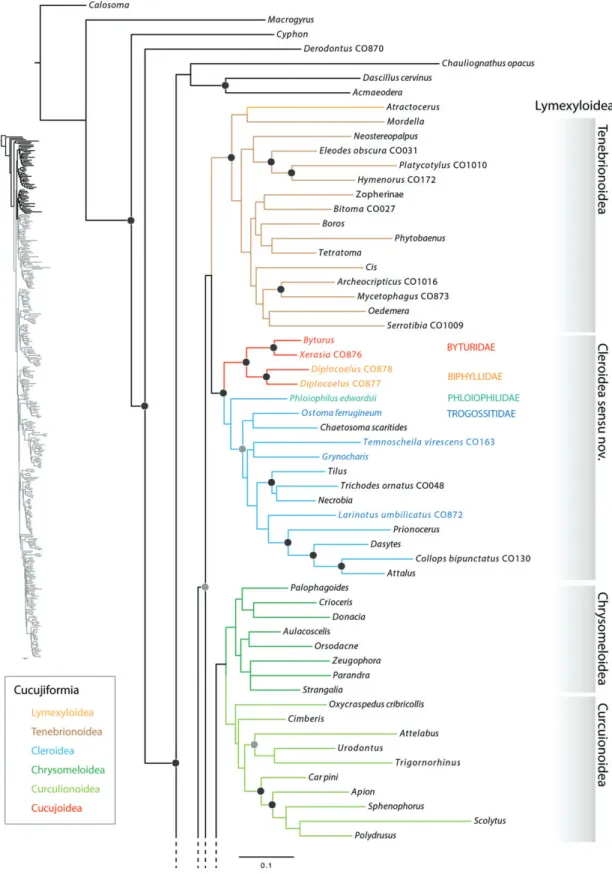
Our sampling within the diverse superfamily Tenebrionoidea is not extensive, with only 11 of 28 families (Bouchardet al., 2011) represented. Furthermore, topological support among tenebrionoid lineages was generally low, as in other studies to date (Haranet al., 2013; Gunteret al., 2014; Kergoatet al., 2014). However a few noteworthy results recovered herein bear upon tenebrionoid relationships and should be noted. Lymexy- loidea were recovered as the sister group to Mordellidae, albeit with weak support (<50) (Fig. 4). Although the placement of Lymexyloidea nested within Tenebrionoidea was somewhat unexpected, Hunt et al. (2007) also recovered this placement for Lymexyloidea in their study. The clade comprising Lymexy- loidea and Tenebrionoidea was well supported (93); thus, despite the unconvincing nodal support for the nesting of Lymexyloidea within Tenebrionoidea, our results suggest that these two super- families at least form a clade together, possibly as sister taxa as suggested by Bocaket al. (2014) and Gunteret al. (2014).
Cleroidea
The placement of Biphyllidae and Byturidae has challenged coleopterists historically. These taxa have been considered allied with Cucujoidea (Crowson, 1955; ´Slipi´nski & Pakaluk, 1991; Leschenet al., 2005), Tenebrionoidea (Crowson, 1960;
Lawrence, 1977) and Cleroidea (Lawrence & Newton, 1995;
Huntet al., 2007; Bocaket al., 2014). Despite their current clas- sification within Cucujoidea, the placement of Biphyllidae and Byturidae within Cleroidea has been repeatedly demonstrated in recent molecular phylogenetic studies (Hunt et al., 2007;
Bocaket al., 2014) and in the present one (Fig. 4). Furthermore, this placement is supported by a number of morphological fea- tures, the most characteristic being the nature of the aedeagus, which in a number of cleroids – as well as Biphyllidae and Byturidae – includes a tegmen of the ‘double’ type (Crowson, 1964a) with paired tegminal struts in addition to the common anterior strut. Given the overwhelmingly strong evidence for Biphyllidae and Byturidae belonging to Cleroidea, we formally transfer both families to Cleroideas.n.
Our taxonomic sampling within Cleroidea was moderately strong, with 6 of the 11 families represented. Phloiophilidae
were supported as an early diverging cleroid lineage (Fig. 4), consistent with previous views (Crowson, 1960). Phloio- philidae were alternatively recovered as the sister group to Biphyllidae+Byturidae in the partitioned GTR+ Γ +I analy- sis. Crowson (1955) outlined the similarities of Biphyllidae and PhloiophilusStephens including the nature of the metendoster- nite and a fungivorous life history, and suggested that Phloio- philidae may in fact represent Cucujoidea rather than Cleroidea.
Interestingly, XerasiaLewis (Byturidae) was included in the family Phloiophilidae by Pic (1926) (see also Crowson, 1955).
Several larval features are unique to Biphyllidae, Byturidae and Phloiophilidae including frontal arms lyriform (V- or U-shaped in most remaining Cleroidea), maxillary articulating area present (absent in most remaining Cleroidea), and having the inner apical angle of mandible with one or more teeth (character states from Lawrence & Leschen, 2010; Lawrence et al., 2011). Trogossitidae is an enigmatic and morphologically heterogeneous family with a convoluted taxonomic history rich with rank changes depending on the author (see Kolibáˇc &
Leschen, 2010). Crowson (1964a) considered the family to have diverged relatively early from the remaining cleroid lineages and further (1964a, 1966, 1970) elevated the rank of several subfamilies, leading to the recognition of three separate fami- lies: Trogossitidae, Peltidae, Lophocateridae. Recent molecular analyses also indicate that the family Trogossitidae as currently circumscribed is not monophyletic (Huntet al., 2007; Gunter et al., 2013; Bocaket al., 2014). The results of the present study corroborate the above hypotheses with Ostoma Laicharting, Temnoscheila Westwood,Grynocharis Thomson andLarino- tusCarter and Zeck scattered among the remaining sampled cleroids (Fig. 4), indicating that this family is not monophyletic and is in critical need of a thorough phylogenetic revision.
Other internal cleroid relationships recovered in the present study, including Prionoceridae recovered as the sister group to Melyridae (includingDasytesPaykull) and the melyrid lineage closely allied to Cleridae, are consistent with the results of Gunteret al. (2013).
Phytophaga
Consistent with previous studies (e.g. Farrell, 1998; Marvaldi et al., 2009; McKenna et al., 2009) the phytophagan super- families Chrysomeloidea (60) and Curculionoidea (60) were recovered with only weak to moderate support in the present study (Fig. 4). Our analysis also provided weak support for the monophyly of Phytophaga (Chrysomeloidea+Curculionoidea) (<50). Although the monophyly of Phytophaga is not ques- tioned from a morphological and ecological standpoint, several recent large-scale molecular analyses (e.g. Hunt et al., 2007;
Bocak et al., 2014) have surprisingly failed to recover Phy- tophaga as monophyletic. The weak support for Phytophaga, Chrysomeloidea and Curculionoidea in the present study, may be attributed to the inadequacy of the suite of molecular loci used herein for recovering these divergences, terminals jump- ing around (potential rogue taxa), the relatively sparse taxon sampling within these megadiverse taxa, and/or short internal
754 J. A. Robertsonet al.
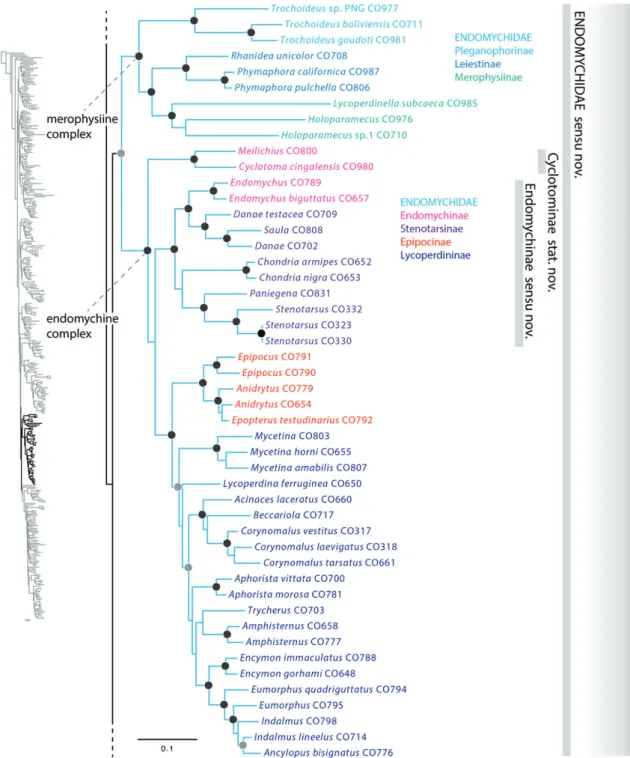
Fig. 4. Maximum-likelihood tree (part 1 of 6). The full topology is shown to the left of the figure with the emboldened region enlarged and coloured for discussion. Branches are coloured by superfamilial classification prior to this study following the legend. Select families are coloured as indicated to the right of the corresponding terminals. Nomenclatural changes proposed in this study are denoted to the far right of the tree with grey bars. Nodes supported by bootstrap support≥90 are indicated by black circles, and nodes with support between 70 and 89 are indicated by grey circles.
branches spanning the divergences of these major radiations comprising relatively long terminals.
Early diverging core Cucujoidea
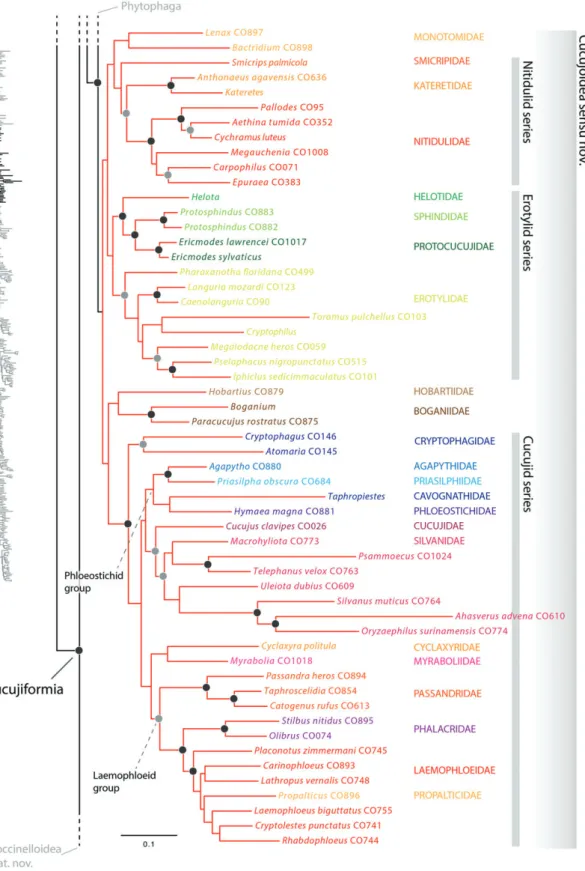
The early diverging lineages of core Cucujoidea recov- ered in the present study include three major clades:
(i) Monotomidae+nitidulid series, (ii) erotylid series (Helotidae-Protocucujidae-Protosphindus Sen Gupta &
Crowson-Erotylidae), (iii) Boganiidae+Hobartiidae (see Fig. 5); all three lineages comprise taxa that have been con- sidered as early diverging cucujoids and plesiomorphic from a morphological perspective (Crowson, 1955, 1960, 1990). For example, Crowson (1955) postulated that Nitidulidae, Smicrip- idae and Monotomidae were closely related to Protocucujidae and Sphindidae based on anatomical characters of the adult form. He considered Protocucujidae to represent the most plesiomorphic form of extant cucujoids. Crowson (1990) also suggested a potential relationship between Boganiidae and Chrysomeloidea. This hypothesis was based on both having distinctive microsculpture on the hindwing of the adult and an articulated mala in the larval form; the fossilParandrexis Martynov representing a putative intermediate form between boganiids and chrysomeloids bolstered his suspicion. Whereas the previous major clades comprise the early diverging core cucujoid lineages in the present study, their relative position at the base of core Cucujoidea was unstable across analyses as reflected in the weak nodal support spanning these three clades.
Based on the present analysis and patterns of support, any one of the above three lineages (Monotomidae+nitidulid series, erotylid series, Boganiidae+Hobartiidae) represents a viable candidate for the earliest diverging lineage of core Cucujoidea.
At present, additional data are needed to identify the earliest diverging core cucujoid lineage.
Nitidulid series and Monotomidae
Members of the Nitidulidae group (Leschenet al., 2005) – or nitidulid series – including Kateretidae, Smicripidae and Nitidulidae, formed a monophyletic group, albeit with only weak support (<50) (Fig. 5). Whereas morphology strongly supports this grouping (Leschen et al., 2005; Jelínek et al., 2010; Cline, 2010; but see also Lawrenceet al., 2011 for an exception), the present study is the first phylogenetic analysis based on molecular data to recover a monophyletic nitidulid series; previous studies did not include sufficient representation of the series, or did not recover it as monophyletic (Huntet al., 2007; Bocak et al., 2014). Hunt et al. (2007) only sampled Nitidulidae in their three-gene analysis. Their taxon-heavy analysis of18Sdata alone also included several exemplars of Kateretidae, but these were not recovered as a monophylum with Nitidulidae; rather, Kateretidae was placed within Phy- tophaga, allied with Cerambycidae and Silvanidae (Huntet al., 2007). Bocaket al.’s (2014) analysis recovered a sister grouping of Kateretidae and Nitidulidae, but the family Passandridae was
nested within the latter, rendering Nitidulidae paraphyletic.
The study of Cline et al. (2014) focused on the higher-level relationships within Nitidulidae and recovered a well-supported clade comprising Kateretidae+Nitidulidae. The enigmatic and monotypic family Smicripidae was not represented in Huntet al. (2007), Bocaket al. (2014) nor Clineet al. (2014).
Lawrence et al. (2011), based on morphological data, did recover a sister grouping of Kateretidae+Nitidulidae, butSmi- cripsLeConte was far removed, recovered as the sister group toRentonellumCrowson (Cleroidea: Trogossitidae) which, in turn, was sister to Laemophloeidae+Propalticidae. Although Smicripsis an enigmatic taxon, this poorly supported grouping withRentonellumand others is not consistent with traditional views (Cline, 2010).
Nitidulidae is among the more ecologically diverse and species-rich families of Cucujoidea withc.4500 species clas- sified in c. 351 genera (Jelínek et al., 2010). In contrast, Kateretidae and Smicripidae exhibit meagre to poor species diversity withc.95 and six species, respectively (Cline, 2010;
Jelínek & Cline, 2010). Historically there has been much debate regarding the internal relationships both among, and within, the families of the nitidulid series, with considerable taxonomic instability among taxa variously classified within these families.
As reviewed by Cline (2010), major suites of characters support all three possible sister-group relationships between Nitidulidae, Smicripidae and Kateretidae. Our results support a sister group- ing of Nitidulidae and Kateretidae (78) withSmicripssubtending this clade.
Monotomidae was weakly supported (<50) as the sister taxon to the nitidulid series (Fig. 5), another relationship formally recovered for the first time in the present study yet consis- tent with previous views (e.g. Crowson, 1955). Monotomidae are an enigmatic group with dubious phylogenetic affinity within Cucujoidea. Crowson (1955) noted the similarity of Monotomidae and the nitidulid group based on shared adult anatomical features including aedeagus uninverted and of the cucujoid type, elytra truncate, and procoxae transverse with the trochantin exposed. The phylogenetic position of Monotomidae remained dubious in the analysis of Leschenet al. (2005) based on adult and larval characters. In both Huntet al. (2007) and Bocaket al. (2014) Monotomidae are allied with Protocucujidae and Helotidae, the former representing another family cited by Crowson (1955) as potentially allied with Monotomidae based on the form of the metendosternite and male tarsi (5-5-4).
The well-supported yet aberrant placement of Monotomidae in Lawrenceet al. (2011) as the sister group to teredine and xylariophiline Bothrideridae is likely a result of convergent general similarity in body shape and form (JAR, NPL, personal observation). It should be noted that only two exemplars of Monotomidae,LenaxSharp andBactridiumKunze (Monotom- inae), were sampled in the present study. A sister grouping of Monotomidae+the nitidulid series is supported by multiple character states including abdominal tergite VII exposed in dorsal view and tergite VIII in the male with sides curved ven- trally forming a genital capsule (Leschenet al., 2005; Jelínek et al., 2010). Given the lack of support and consensus with the current suite of morphological and molecular data, it is clear
756 J. A. Robertsonet al.
Fig. 5. Maximum-likelihood tree (part 2 of 6). The full topology is shown to the left of the figure with the emboldened region enlarged and coloured for discussion. Branches are coloured red for Cucujoidea following the legend in the previous figures. Families are coloured as indicated to the right of the corresponding terminals. Nomenclatural changes proposed in this study are denoted to the far right of the tree with grey bars. Nodes supported by bootstrap support≥90 are indicated by black circles, and nodes with support between 70 and 89 are indicated by grey circles.
that more work is needed to clarify the phylogenetic position of Monotomidae.
Erotylid series: Helotidae, Protocucujidae, Sphindidae and Erotylidae
The sister grouping of EricmodesReitter (Protocucujidae) and Protosphindus (Sphindidae) is strongly supported in the present study (97) (Fig. 5). A close relationship of these taxa has long been recognized (Crowson, 1955; Thomas, 1984b) and is well supported by morphological data (McHugh, 1993;
Leschenet al., 2005). Along withEricmodesandProtosphin- dus, HelotaMaclay has been considered to be a relatively early diverging cucujoid. Helotidae in particular is an enigmatic taxon. The family exhibits several anatomical features that are considered to be plesiomorphic for Cucujiformia. They are the only cucujoids with a complete discrimen and transverse suture (katepisternal suture) on the metaventrite. The family also possess excavate metacoxae that extend laterally to the elytral epipleura in adults and a divided mala in the larval form.
Previous authors suspected a close relationship with Nitidul- idae, owing to similarities of the aedeagus (Sharp & Muir, 1912) and labrum-epipharynx (Kirejtshuk, 2000). However, to date no formal phylogenetic analysis has supported a sister grouping or close relationship of Helotidae and Nitidulidae;
rather, most have recovered Helotidae sister to Protocucujidae and relatively close to Monotomidae and Erotylidae (Leschen et al., 2005; Huntet al., 2007; Bocaket al., 2014). In the present study, we consistently recovered Helota sister to the clade Ericmodes+Protosphinduswith low to moderate support (67), with Erotylidae forming the sister group to this clade. A sig- nificant portion of what is now considered Erotylidae was until recently scattered in other families, primarily Languriidae and Cryptophagidae. Accordingly, most of the historical hypotheses for the sister group of Erotylidae included one of these two families. With Languriidae now subsumed within Erotylidae in its entirety (W ¸egrzynowicz, 2002; Leschen, 2003; Robertson et al., 2004) including the former cryptophagids that linked Erotylidae to Cryptophagidae, few sister-group hypotheses for Erotylidae have been proposed recently. Previous molecular data point to Erotylidae being closely related to Protocucujidae, Helotidae and Monotomidae (Hunt et al., 2007; Bocak et al., 2014); surprisingly, Bocaket al. (2014) recovered Boganiidae well nested within Erotylidae, a hypothesis neither consistent with traditional views nor the present study.
Boganiidae+Hobartiidae
Boganiidae and Hobartiidae were originally classified together in a broader family concept of Boganiidae (Sen Gupta &
Crowson, 1966, 1969a). Lawrence (1991) formally recognized the family Hobartiidae presumably based on the larval form described therein. As reviewed by Tomaszewska & ´Slipi´nski (2010), Hobartiidae and Boganiidae share very few anatomical features and those that are in common are widespread in other
cucujoids and presumed to be plesiomorphic. In Leschenet al.
(2005)ParacucujusSen Gupta & Crowson andHobartiusSen Gupta & Crowson were far removed from each other. The present study is the first molecular phylogenetic analysis to include members of both Boganiidae and Hobartiidae. The recovery of these taxa forming a sister group (Fig. 5) is therefore intriguing, yet this relationship is only weakly supported (<50) and warrants further investigation.
Cucujid series
We recovered a strongly supported clade (95) comprising Cryptophagidae and the remaining core cucujoid families (Fig. 5). In terms of the families included, this clade is nearly consistent with the cucujid series of Huntet al. (2007) and Bocak et al. (2014), although the series is not consistent between those two studies: Huntet al. (2007) does not include Silvanidae in the cucujid series, whereas Bocaket al. (2014) does not include Pas- sandridae. Our results strongly supported both Silvanidae and Passandridae included within the cucujid series clade as well as a south temperate clade (see below) comprising Phloeostichidae and allies; these results are consistent with the findings of McEl- rathet al. (2015). The internal relationships within the cucujid series clade recovered in the present study and that published previously (Hunt et al., 2007; Bocak et al., 2014; McElrath et al., 2015) are only partially concordant. In all four analyses Laemophloeidae and Propalticidae form a clade and Phalacridae subtends this group. The placement and monophyly of the fam- ilies Cryptophagidae, Cucujidae, Silvanidae, Passandridae and Phloeostichidae and allies vary between studies (see below).
Phloeostichid group
Until recently, the family Phloeostichidae comprised a heterogeneous assortment of Notogean taxa that had been placed previously in a wide variety of families and superfam- ilies (see Lawrence & ´Slipi´nski, 2010). Leschenet al. (2005) demonstrated that this family circumscription did not reflect a monophyletic group and recognized several new, mostly monogeneric, families accordingly, including Agapythidae, Priasilphidae, Tasmosalpingidae and Myraboliidae, leaving four genera in a redefined Phloeostichidae. This study represents the first molecular analysis to include exemplars of these enigmatic, species-poor families. We recovered a weakly supported clade comprising south temperate taxa including Agapytho Broun (Agapythidae),PriasilphaBroun (Priasilphidae),Taphropiestes Reitter (=CavognathaCrowson) (Cavognathidae) andHymaea Pascoe (Phloeostichidae) (Fig. 5). Within this cladeAgapytho formed the sister group toPriasilpha obscuraBroun (97); the remaining nodes were only weakly supported. The position ofTaphropiestesin the present study was unstable. Although Taphropiestes was recovered as the sister group of Hymaea (<50), it often placed within the clade comprisingMyrabolia Reitter and Cyclaxyra Broun in preliminary analyses. The alternative support for this placement is evident in the poor
758 J. A. Robertsonet al.
branch support along the backbone divergences spanning these alternate placements. Multiple larval features ofTaphropiestes point to an affiliation with Myrabolia and Cyclaxyra (see below). The phylogenetic position of Cavognathidae within Cucujoidea has been elusive. WhenCavognathawas originally described it was attributed to Cucujoidea but was not classified at the family level (Crowson, 1964b), owing to it belonging to an undescribed family. Sen Gupta & Crowson (1966) later described the family Boganiidae and treated Cavognathidae as a subfamily within the newly erected family. Sen Gupta &
Crowson (1969a) elevated Cavognathidae to family level and pointed out features suggesting an affiliation with the family Cryptophagidae. Whereas our results do not support an affilia- tion with Crytophagidae, this study does support the recognition of Cavognathidae at the family level.
Cucujidae+Silvanidae
Our analyses consistently recovered a sister grouping of Cucujidae+Silvanidae (Fig. 5) with moderate support (78).
Both families were at one time classified together with Lae- mophloeidae and Passandridae in a broadly defined Cucujidae (Cucujidae s.l.). Crowson (1955) recognized at the familial level both Passandridae (with reservation) and Silvanidae, thereby removing them from Cucujidae s.l. The laemophloeids were retained in Cucujidae s.l. for some time later until Thomas (1984a,b, 1993) demonstrated that they were more closely related to passandrids and phalacrids than Cucujidae (Thomas, 1993). To date, no phylogenetic study has supported the mono- phyly of Cucujidae s.l. (see McElrath et al., 2015). However, multiple studies have shown that Cucujidae and Silvanidae are likely sister taxa (Leschen et al., 2005; McElrathet al., 2015) or otherwise treated them as such (Thomas & Nearns, 2008).
Several anatomical features support Cucujidae and Silvanidae as sister taxa (see Leschen et al., 2005). Surprisingly, few molecular studies have supported this sister grouping.
Cucujidae is a relatively small family with 48 species (Thomas
& Leschen, 2010a) classified in four genera:CucujusFabricius, PediacusShuckard,PalaestesPerty andPlatisusErichson. An unanticipated result in Bocaket al. (2014) was the paraphyly of Cucujidae:Cucujus was recovered sister to Silvanidae but Pediacuswas supported as the sister group toCyclaxyrain that study. It should be noted that only one of four molecular markers was available for the exemplars of Pediacusin that analysis, thus it is possible that the significant amount of missing data may have contributed to this surprising result. Even so, the monophyly of Cucujidae has never been the subject of rigorous phylogenetic investigation.
In contrast to Cucujidae, Silvanidae is more species-rich with nearly 500 species placed among 58 genera (Thomas
& Leschen, 2010b). The internal classification of Silvanidae currently includes two subfamilies, Silvaninae and Brontinae, with two brontine tribes – Brontini and Telephanini (Thomas, 2003; Thomas & Nearns, 2008). Our results strongly supported the monophyly of Silvaninae (100). This clade was characterized by some of the longest branches in our phylogeny. We did not
recover Brontinae or the tribe Brontini as monophyletic either due to the placement ofUleiota Latreille (Brontini) sister to Silvaninae. Branch support for this relationship as well as that forMacrohyliotaThomas (Brontini) sister to Telephanini was weak (57, 53, respectively), thus these relationships are only tentative. In a study that focused entirely on the relationships among and within the families formerly included in Cucujidae s.l. (McElrath et al., 2015), support for the monophyly of Brontinae and Brontini between analyses was inconsistent; the ML results of McElrath et al. (2015) did not support either Brontinae or Brontini whereas the Bayesian results did recover these higher taxa as monophyletic, albeit with weak support.
Thomas & Nearns (2008) conducted a cladistic analysis of the family Silvanidae based on 15 characters of the adult and larval form. Most of their resulting clades were consistent with the existing classification; the monophyly of Brontini, however, was in question. Clearly, additional work is needed to clarify the relationships and limits of higher taxa within Brontinae and refine the classification if necessary.
Cyclaxyra and Myrabolia
The monogeneric family Cyclaxyridae, comprising two species restricted to New Zealand, was until recently (Lawrence et al., 1999) classified within the family Phalacridae, with earlier ties to the families Sphindidae (Crowson, 1955) and Nitiduli- dae (see Leschenet al., 2010).Cyclaxyrawas placed sister to Tasmosalpingidae (not sampled here) in Leschenet al. (2005), a monotypic family with two Tasmanian species. Despite its previous classification in the family Phalacridae, beyond super- ficial resemblance including a convex body form, there have been no convincing synapomorphies uniting Cyclaxyra and Phalacridae. In the recent cladistic analysis of Phalacridae by Gimmel (2013),Cyclaxyrawas recovered as the sister group to phalacrids based on several anatomical characters; however, it should be noted that the outgroup sampling in Gimmel (2013) was not extensive because the scope of that study was to infer the internal relationships of Phalacridae. In Lawrenceet al. (2011) Cyclaxyrawas recovered as the sister group to Lamingtoniidae (not sampled here), whereas Phalacridae was surprisingly found as the sister to Hypodacnella (Cerylonidae)+Bystus (Endomychidae). The spurious affiliation of Phalacridae,Hypo- dacnellaandBystusin Lawrenceet al. (2011) is not consistent with previous views (Leschenet al., 2005; Huntet al., 2007), nor is it consistent with the present study. In our analyses Cyclaxyra was consistently recovered as the sister group to MyraboliaReitter (Myraboliidae) (Fig. 5) with weak support (50), a grouping that has never been suggested previously; this study is the first molecular analysis to include exemplars of either family. Myraboliidae represents another species-poor, monogeneric family with 13 species restricted to Australia. The inclusion ofMyraboliain multiple cucujoid families historically (e.g. Cucujidae, Silvanidae and Phloeostichidae; see ´Slipi´nski et al., 2010a) reflects the unclear phylogenetic position of this enigmatic genus. In Leschen et al. (2005) Myraboliaformed the sister group to a large clade comprising several cucujoid
families, whereas in Lawrence et al. (2011) it was recovered sister toTaphropiestes(=Cavognatha). The clade comprising MyraboliaandCyclaxyrarepresents a second Notogean cucu- joid lineage supported by the present study (see phloeostichid group above). Interestingly, the clade Myrabolia+Cyclaxyra forms the sister group to the laemophloeid group. Several larval features corroborate this clade and suggest that Taphropiestes may also be affiliated with this superfamilial grouping. The larval form of Myrabolia, Cyclaxyra, Taphropiestes and the laemophloeid group have the mesal surface of the mandible without a mola, the maxillary articulating area absent, and the hypopharyngeal sclerome absent (from Lawrenceet al., 2011).
Although these larval states represent losses of features, our phylogenetic results suggest that they are likely homologous.
Laemophloeid group
Thomas (1984a) suggested that Laemophloeidae, Propalti- cidae, Phalacridae and Passandridae form a natural lineage based on a number of morphological features including unequal protibial spurs, structural similarities of the male genitalia, and the presence of pronotal lines and elytral cells. Our results support this grouping (hereafter referred to as the laemophloeid group) (Fig. 5) as the above four families form a clade with moderately high branch support (89). Interestingly, previous molecular (Hunt et al., 2007; Bocak et al., 2014; McElrath et al., 2015) and morphological phylogenetic studies (Leschen et al., 2005; Lawrenceet al., 2011) have not recovered the lae- mophloeid group as monophyletic; the present study represents the first instance in which this clade has been supported in a formal phylogenetic analysis. In most cases, the failure to recover the laemophloeid group in the above studies is due to the placement of the enigmatic family Passandridae elsewhere [e.g.
sister to Cucujidae (Hunt et al., 2007), sister to Bothriderinae (Lawrenceet al., 2011), nested within Nitidulidae (Bocaket al., 2014)]. The study of McElrath et al. (2015), which focuses on the relationships of Laemophloeidae and allied families, recovered a clade nearly concordant with the laemophloeid group, with Passandridae supported as more closely related to Cyclaxyridae and Myraboliidae than to the remaining lae- mophloeid group taxa. Laemophloeidae and Propalticidae have been considered to be sister taxa (e.g. Lawrence & Newton, 1995; Leschenet al., 2005; Huntet al., 2007; Lawrenceet al., 2011). Interestingly, our results recovered Propalticus Sharp nested within Laemophloeidae (Fig. 5). These results concur with recent findings by Bocaket al. (2014) and McElrathet al.
(2015), and support the proposal by McElrathet al. (2015) to subsume Propalticidae within Laemophloeidae.
Cerylonid series
The strongly supported position of the CS forming the sister group to the remaining Cucujiformia and therefore not allied with any of the existing superfamilies of Cucujiformia, including the remaining Cucujoidea, was one of the most significant
results of the present study. The support for the CS clade was high (97), as was the support for Cucujiformia (98) and the clade comprising the remaining cucujiform lineages (83) (Fig. 5). Although the exact placement of the CS in Hunt et al. (2007) and Bocaket al. (2014) is not concordant with our results, both studies independently demonstrated the isolated position of the CS clade relative to the remaining cucujiform lineages. Given our resulting topology and previously published results (Huntet al., 2007; Bocaket al., 2014), there seems no reasonable way to treat the CS except to recognize it as a new superfamily of Cucujiformia. Of the CS family group taxa, Coccinellidae Latreille has priority (Latreille, 1807). Thus we formally recognize the cucujiform superfamily Coccinelloidea stat.n., which in terms of taxonomic constitution is synonymous with the current concept of the cerylonid series.
Internal relationships of Coccinelloidea
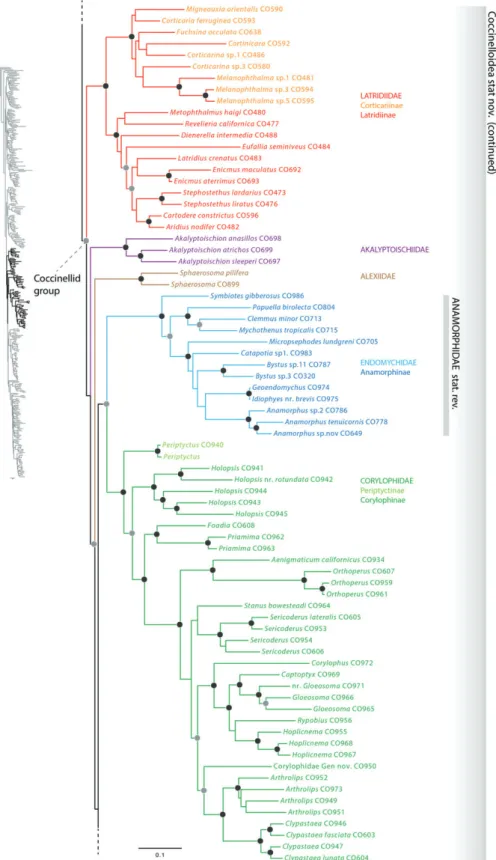
Our results corroborated previous molecular results (Hunt et al., 2007; Robertson et al., 2008; Bocak et al., 2014) in recovering a basal dichotomy of two well-supported superfa- milial coccinelloid clades: one clade comprising Bothrideridae, Cerylonidae and Discolomatidae (hereafter referred to as the bothriderid group) (100); the second clade including Alexiidae, Akalyptoischiidae, Corylophidae, Coccinellidae, Latridiidae and multiple endomychid lineages (hereafter referred to as the coccinellid group) (87).
Bothriderid group (Bothrideridae, Cerylonidae, Discolomatidae)
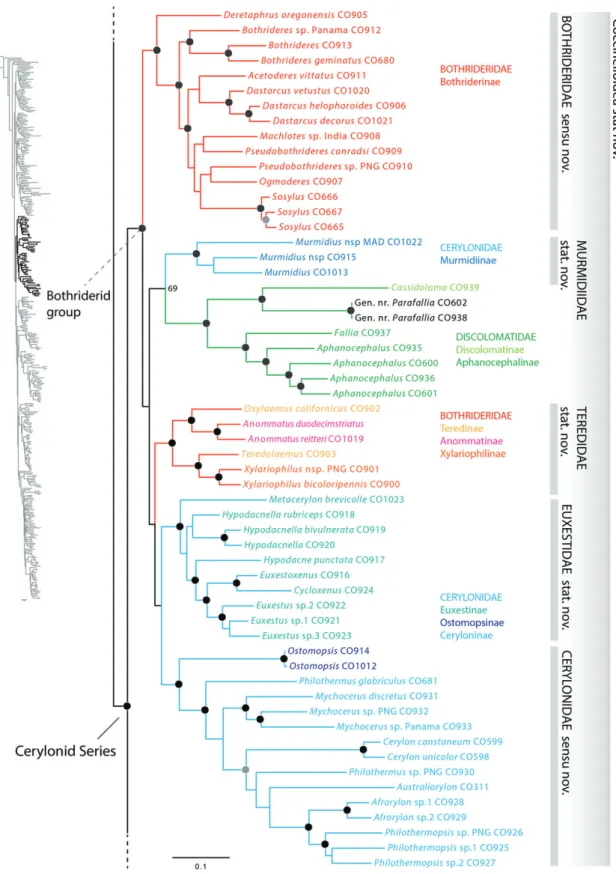
The grouping of the families Bothrideridae, Cerylonidae and Discolomatidae (Fig. 6) has been suspected by previous authors ( ´Slipi´nski, 1990; Lawrence, 1991; ´Slipi´nski & Pakaluk, 1991) and is consistent with recent molecular phylogenetic studies (Huntet al., 2007; Robertsonet al., 2008; Bocaket al., 2014).
The bothriderid group exhibits a broad range of phenotypic vari- ation and comprisesc.1250 species. Members of the bothriderid group are typically subcortical with either a mycophagous, myx- ophagous, predaceous or parasitoid life history. Some of these beetles are also known to inhabit leaf litter, fungi and similar microhabitats. Despite the varied biology, members of all three families are known to produce silken cocoons to house the pupal stage ( ´Slipi´nski, 1990; Lord & McHugh, 2013; JAR, personal observation e.g. Bothrideres, Cassidoloma Kolbe), a charac- teristic rare among beetles and not known in any of the other coccinelloid or cucujoid families. Even so, not all taxa within the bothriderid group have been observed to produce silken cocoons [e.g.Teredolaemus leai(Grouvelle)] ( ´Slipi´nskiet al., 2010b). To date, no anatomical synapomorphies have been identified uniting members of all three families. With a single exception [SosylopsisGrouvelle (Bothrideridae)] adult bothrid- erids, cerylonids and discolomatids have the procoxal cavities internally open (Robertson, 2010). Little is known about the internal phylogenetic relationships within the bothriderid group.
760 J. A. Robertsonet al.
Fig. 6. Maximum-likelihood tree (part 3 of 6). The full topology is shown to the left of the figure with the emboldened region enlarged and coloured for discussion. Branches are coloured by family and terminals by subfamily as indicated to the right of the corresponding terminals. Nomenclatural changes proposed in this study are denoted to the far right of the tree with grey bars. Nodes supported by bootstrap support≥90 are indicated by black circles, and nodes with support between 70 and 89 are indicated by grey circles.