P R 0 G RAM M I N G:
AN INTRODUCTION TO COMPUTER SCIENCE
OHN ZELLE
FRANKLIN, BEEDLE [INDEPENDENT PUBLISHERS SINCE 1985]
PYTHON PROGRAMMING
AN INTRODUCTION TO COMPUTER SCIENCE
THIRD EDITION
John M. Zelle
Wartburg College
Franklin, Beedle & Associates Inc.+ 2154 NE Broadway, Suite 100 +Portland, Oregon 97232 + 503/284-6348 + www.fbeedle.com
Production Associate Cover Photography Printed in the U. S. A.
Jaron Ayres Jim Leisy ©2012
Names of all products herein are used for identification purposes only and are trademarks and/or registered trademarks of their respective owners. Franklin, Beedle & Associates Inc. makes no claim of ownership or corporate association with the products or compa
nies that own them.
©2017 Franklin, Beedle & Associates Incorporated. No part of this book may be repro
duced, stored in a retrieval system, transmitted, or transcribed, in any form or by any means-electronic, mechanical, telepathic, photocopying, recording, or otherwise
without prior written permission of the publisher. Requests for permission should be addressed as follows:
Rights and Permissions
Franklin, Beedle & Associates Incorporated
2154 NE Broadway, Suite 100
Portland, Oregon 97232
Library of Congress Cataloging-in-Publication data
Names: Zelle, John M., author.
Title: Python programming : an introduction to computer science I John M.
Zelle, Wartburg College.
Description: Third edition.
I
Portland, Oregon : Franklin, Beedle &Associates Inc., [2016]
I
Includes bibliographical references and index.Identifiers: LCCN 2016024338
I
ISBN 9781590282755 Subjects: LCSH: Python (Computer program language)Classification: LCC QA76.73.P98 Z98 2016
I
DDC 005.13/3--dc23 LC record available at https:/ /lccn.loc.gov/2016024338Contents
Foreword, by Guido van Rossum ... ix
Preface . . . . . . . x
Chapter 1 Computers and Programs
1.1 The Universal Machine . . . 11.2 Program Power . . . 3
1. 3 What Is Computer Science? ....... 3
1.4 Hardware Basics ............. 5
1.5 Programming Languages ................ 6
1.6 The Magic of Python ................ 9
1. 7 Inside a Python Program ........... 15
1.8 Chaos and Computers .................... 18
1. 9 Chapter S u m mary ............... 20
1.10 Exercises ... 21
1 Chapter 2 Writing Simple Programs 27
2.1 The Software Development Process ........... 272. 2 Exam pie Program: T em perature Converter ... 28
2.3 Elements of Programs ... 31
2.3.1 Names ... 31
2.3.2 Expressions ................... 32
2.4 0 utput Statements ................... 34
2. 5 Assignment Statements ........... 36
2. 5 .1 S i m pIe Assign men t ................... 3 7 2.5.2 Assigning Input ........... 39
2.5.3 Simultaneous Assignment ........... 41
2. 6 Definite Loops ................ 43
2.8 2.9
Chapter Summary ... 50
Exercises . . . 51
Chapter 3 Computing with Numbers 57
3.1 Numeric Data Types ... 573. 2 Type Conversions and Rounding ... 62
3.3 Using the Math Library . . . 65
3.4 Accumulating Results: Factorials ... 68
3.5 Limitations of Computer Arithmetic ... 71
3.6 Chapter Summary ... 75
3. 7 Exercises ... 76
Chapter 4 Objects and Graphics 83
4.1 Overview ... 834. 2 T h e 0 b j ect of 0 b j ects. . . . 84
4.3 Simple Graphics Programming ... 85
4.4 Using Graphical Objects ... 91
4.5 Graphing Future Value ... 96
4.6 Choosing Coordinates ... 103
4. 7 Interactive Graphics ... 107
4.7.1 Getting Mouse Clicks ... 107
4. 7.2 Handling Textual Input ... 109
4.8 Graphics Module Reference ... 112
4.8.1 Graph Win Objects ... 113
4. 8. 2 G ra ph i cs 0 b j ects. . . . 115
4.8.3 Entry Objects ... 119
4.8.4 Displaying I mages ... 120
4.8.5 Generating Colors ... 121
4.8.6 Controlling Display Updates (Advanced) ... 121
4. 9 Chapter Sum mary . . . 122
4.10 Exercises ... 123
Chapter 5 Sequences: Strings, Lists, and Files 129
5.1 5.2 5.3 5.4 The String Data Type ... 129Si m pie String Processing ... 133
Lists as Sequences ... 136
String Representation and Message Encoding ... 139
5.4.1 String Representation ... 139
5.4.2 Programming an Encoder ... 141
5.5 String Methods ... 142
5.5.1 Programming a Decoder ... 142
5.5.2 More String Methods ... 146
5.6 Lists Have Methods. Too ... 147
5. 7 From Encoding to Encryption ... 150
Contents
5.8 Input/Output as String Manipulation . . . 151
5. 8.1 Exam pie Application: Date Conversion . . . 151
5. 8. 2 String Formatting ............... 154
5.8.3 Better Change Counter .... 157
5. 9 File Processing ........... 158
5.9.1 Multi-line Strings ... 158
5.9.2 File Processing ... 159
5.9.3 Example Program: Batch Usernames ... 163
5.9.4 File Dialogs (Optional) ... 164
5.10 Chapter Summary ... 167
5.11 Exercises . . . 168
Chapter 6 Defining Functions 175
6.1 6.2 6.3 6.4 6.5 6.6 6.7 6.8 6.9 The Function of Functions ... 175Functions, Informally ... 177
Future Value with a Function ... 181
Functions and Para meters: The Exciting Deta i Is ............... 183
Functions That Return Values ............... 187
Functions that Modify Para meters ........... 193
Functions and Program Structure ........... 199
Chapter Summary ... 202
Exercises ... 203
Chapter 7 Decision Structures 209
7.1 Sim pie Decisions ... 2097.1.1 Example: Temperature Warnings ... 210
7.1.2 Forming Simple Conditions ... 212
7 .1.3 Example: Condition a I Program Execution ... 214
7. 2 Two-Way Decisions ... 216
7.3 Multi-Way Decisions ... 220
7.4 Exception Handling ... 223
7. 5 Study in Design: Max of Three ........... 227
7.5.1 Strategy 1: Compare Each to All. ................ 228
7.5. 2 Strategy 2: Decision Tree ........... 230
7 .5.3 Strategy 3: Sequential Processing ... 231
7 .5.4 Strategy 4: Use Python ... 234
7 .5.5 Some Lessons ... 234
7.6 Chapter Summary ... 235
7. 7 Exercises ... 236
Chapter 8 Loop Structures and Booleans 243
8.1 For Loops: A Quick Review ... 2438.2 Indefinite Loops ... 245
8. 3 Common Loop Patterns ... 24 7 8. 3.1 Interactive Loops ............... 24 7 8.3.2 Sentinel Loops ................... 249
v
8.3.4 Nested Loops . . . 254
8.4 Computing with Boo leans ... 256
8.4.1 Boolean Operators ... 256
8.4.2 Boolean Algebra ... 260
8. 5 Other Common Structures . . . 262
8.5.1 Post-test Loop ... 262
8.5.2 Loop and a Half ... 264
8.5.3 Boolean Expressions as Decisions ... 266
8.6 Example: A Simple Event Loop ... 269
8. 7 Chapter Summary ... 275
8. 8 Exercises . . . 277
Chapter 9 Simulation and Design 283
9 .1 S i m u I at i n g Ra cq u et ba II. . . . 2 83 9.1.1 A Simulation Problem . . . 2849 .1. 2 Ana lysis and Specification ... 284
9. 2 Pseudo-random Numbers ... 286
9.3 Top-Down Design ... 288
9. 3.1 Top-Level Design . . . 289
9. 3. 2 Separation of Concerns . . . 291
9.3.3 Second-Level Design . . . 291
9.3.4 Designing simNGames . . . 293
9.3.5 Third-Level Design . . . 295
9.3.6 Finishing Up . . . 298
9.3. 7 Summary of the Design Process . . . 300
9.4 Bottom-Up Implementation ... 301
9.4.1 Unit Testing ... 301
9.4.2 Simulation Results ... 303
9. 5 Other Design Techniques . . . 304
9.5.1 Prototyping and Spiral Development . . . 304
9.5.2 The Art of Design . . . 306
9.6 Chapter Summary . . . 306
9. 7 Exercises . . . 307
Chapter 10 Defining Classes 313
10.1 Quick Review of Objects . . . 31310.2 Example Program: Cannonball . . . 314
10.2.1 Program Specification . . . 314
10.2.2 Designing the Program ... 315
10.2.3 Mod ularizing the Program ... 319
10.3 Defining New Classes ... 321
10.3.1 Example: Multi-sided Dice ... 321
10.3.2 Example: The Projectile Class . . . 325
10.4 Data Processing with Class . . . 327
10.5 0 bjects and Encapsulation . . . 331
Contents
10.5.1 Encapsulating Useful Abstractions ... 331
10.5.2 Putting Classes in Modules ... 333
10.5.3 Module Documentation . . . 333
10.5.4 Working with Multiple Modules . . . 335
10.6 Widgets . . . 337
10.6.1 Example Program: Dice Roller ... 337
10.6.2 Building Buttons ... 338
10.6.3 Building Dice ... 342
10.6.4 The Main Program ... 345
10. 7 Anima ted Can non ba II . . . 346
10.7.1 Drawing the Animation Window ... 347
10.7 .2 Creating a Shot Tracker ... 348
10.7.3 Creating an Input Dialog ... 350
10.7.4 The Main Event Loop ... 353
10. 8 Chapter S u m mary . . . 355
10.9 Exercises ... 356
Chapter 11 Data Collections 363
11.1 Exam pie Problem: S i m pie Statistics ... 36311.2 Applying Lists ... 365
11.2.1 Lists and Arrays ... 366
11.2. 2 List 0 perations ... 367
11.2.3 Statistics with Lists ... 370
11.3 Lists of Records ... 375
11.4 Designing with Lists and Classes ... 379
11.5 Case Study: Python Ca leu Ia tor ... 385
11.5.1 A Calculator as an Object ... 385
11.5. 2 Constructing the Interface ... 385
11.5.3 Processing Buttons ... 388
11.6 Case Study: Better Can non ba II Animation ... 392
11.6 .1 Creating a Launcher ... 393
11.6.2 Tracking Multiple Shots ... 396
11.7 Non-seq uenti a I Collections ... 401
11.7 .1 Dictionary Basics ... 401
11.7. 2 Dictionary 0 perations ... 402
11.7.3 Example Program: Word Frequency ... 404
11. 8 Chapter S u m mary . . . 409
11.9 Exercises ... 410
Chapter 12 Object-Oriented Design 419
12.1 The Process of OOD ... 41912.2 Case Study: Racq uetba II Simulation ... 422
12.2.1 Candidate Objects and Methods ... 422
12.2.2 Implementing SimStats ... 424
12.2.3 Implementing RBaiiGame ... 426
12.2.4 Implementing Player ... 429
VI I ..
12.3 Case Study: Dice Poker ... 433
12.3.1 12.3.2 12.3.3 12.3.4 12.3.5 Program Specification . . . 433
Identifying Candidate Objects . . . 434
Implementing the Model . . . 436
A Text-Based U I ... 440
Developing a G U I ... 443
12.4 00 Concepts ... 451
12.4.1 Encapsulation ... 452
12.4.2 Polymorph ism ... 453
12.4.3 Inheritance ... 453
12. 5 Chapter S u m mary . . . 455
12.6 Exercises . . . 456
Chapter 13 Algorithm Design and Recursion 459
13.1 Searching ... 46013.1.1 13.1.2 13.1.3 13.1.4 A Si m pie Searching Problem ... 460
Strategy 1: Linear Search ... 461
Strategy 2: Binary Search ... 462
Com paring Algorithms ... 463
13.2 Recursive Problem Solving ... 465
13.2.1 Recursive Definitions ... 466
13.2.2 Recursive Functions ... 468
13.2.3 Example: String Reversal ... 469
13.2.4 Example: Anagrams ... 471
13.2.5 Example: Fast Exponentiation ... 472
13.2.6 Example: Binary Search ... 473
13.2. 7 Recursion vs. Iteration ... 4 7 4 13.3 Sorting Algorithms ... 4 77 13.3.1 Naive Sorting: Selection Sort ... 477
13.3.2 Divide and Conquer: Merge Sort ... 479
13 . 3 . 3 Com pa r i n g Sorts . . . 481
13.4 Hard Problems ... 484
13.4.1 Tower of Hanoi ... 484
13.4.2 The Halting Problem ... 489
13.4.3 Conclusion ... 492
13.5 Chapter Summary ... 493
13.6 Exercises ... 494
Appendix A Python Quick Reference Appendix C Glossary
Index
503
513
525
Foreword
When the publisher first sent me a draft of this book, I was immediately excited.
Disguised as a Python textbook, it is really an introduction to the fine art of pro
gramming, using Python merely as the preferred medium for beginners. This is how I have always imagined Python would be most useful in education: not as the only language, but as a first language, just as in art one might start learning to draw using a pencil rather than trying to paint in oil right away.
The author mentions in his preface that Python is near-ideal as a first pro
gramming language, without being a "toy language. " As the creator of Python I don't want to take full credit for this: Python was derived from ABC, a language designed to teach programming in the early 1980s by Lambert Meertens, Leo Geurts, and others at CWI (National Research Institute for Mathematics and Computer Science) in Amsterdam. If I added anything to their work, it was mak
ing Python into a non-toy language, with a broad user base and an extensive collection of standard and third-party application modules.
I have no formal teaching experience, so I may not be qualified to judge its educational effectiveness. Still, as a programmer with nearly 30 years experi
ence, reading through the chapters I am continuously delighted by the book's clear explanations of difficult concepts. I also like the many good excercises and questions which both test understanding and encourage thinking about deeper ISSUeS. •
Reader of this book, congratulations! You will be well rewarded for studying Python. I promise you'll have fun along the way, and I hope you won't forget your first language once you have become a proficient software developer.
-Guido van Rossum
.
IX
This book is designed to be used as a primary textbook in a college-level first course in computing. It takes a fairly traditional approach, emphasizing problem solving, design, and programming as the core skills of computer science. However, these ideas are illustrated using a non-traditional language, namely Python. In my teaching experience, I have found that many students have difficulty mastering the basic concepts of computer science and programming. Part of this difficulty can be blamed on the complexity of the languages and tools that are most often used in introductory courses. Consequently, this textbook was written with a single overarching goal: to introduce fundamental computer science concepts as simply as possible without being simplistic. Using Python is central to this goal.
Traditional systems languages such as C++, Ada, and Java evolved to solve problems in large-scale programming, where the primary emphasis is on struc
ture and discipline. They were not designed to make writing small- or medium
scale programs easy. The recent rise in popularity of scripting (sometimes called
"agile") languages, such as Python, suggests an alternative approach. Python is very flexible and makes experimentation easy. Solutions to simple problems are simply and elegantly expressed. Python provides a great laboratory for the neophyte programmer.
Python has a number of features that make it a near-perfect choice as a first programming language. The basic structures are simple, clean, and well designed, which allows students to focus on the primary skills of algorithmic thinking and program design without getting bogged down in arcane language details. Concepts learned in Python carry over directly to subsequent study of
X
Preface
systems languages such as C++ and Java. But Python is not a "toy language."
It is a real-world production language that is freely available for virtually every programming platform and comes standard with its own easy-to-use integrated programming environment. The best part is that Python makes learning to pro
gram fun again.
Although I use Python as the language, teaching Python is not the main point of this book. Rather, Python is used to illustrate fundamental principles of design and programming that apply in any language or computing environment.
In some places I have purposely avoided certain Python features and idioms that are not generally found in other languages. There are many good books about Python on the market; this book is intended as an introduction to computing.
Besides using Python, there are other features of this book designed to make it a gentler introduction to computer science. Some of these features include:
•
Extensive use of computer graphics.
Students love working on programs that include graphics. This book presents a simple-to-use graphics package (provided as a Python module) that allows students both to learn the principles of computer graphics and to practice object-oriented concepts without the complexity inherent in a full-blown graphics library and event-driven programming.
•
Interesting examples.
The book is packed with complete programming examples to solve real problems.•
Readable prose.
The narrative style of the book introduces key computer science concepts in a natural way as an outgrowth of a developing discussion. I have tried to avoid random facts or tangentially related sidebars.
•
Flexible spiral coverage.
Since the goal of the book is to present concepts simply, each chapter is organized so that students are introduced to new ideas in a gradual way, giving them time to assimilate an increasing level of detail as they progress. Ideas that take more time to master are introduced in early chapters and reinforced in later chapters.
•
Just-in-time object coverage.
The proper place for the introduction of object-oriented techniques is an ongoing controversy in computer science education. This book is neither strictly "objects early'' nor "objects late,"but gradually introduces object concepts after a brief initial grounding in the basics of imperative programming. Students learn multiple design
.
XI
typing), and object-oriented methods. Additionally, the textbook material is flexible enough to accommodate other approaches.
•
Extensive end-of-chapter problems.
Exercises at the end of every chapter provide ample opportunity for students to reinforce their mastery of the chapter material and to practice new programming skills.Changes in the Second and Third Editions
The first edition of the textbook has aged gracefully, and the approach it takes remains just as relevant now as when it was first published.
While fundamental principles do not change, the technology environment does. With the release of Python 3. 0, updates to the original material became necessary. The second edition was basically the same as the original textbook, except that it was updated to use Python 3. Virtually every program example in the book had to be modified for the new Python. Additionally, to accommodate certain changes in Python (notably the removal of the string library), the mate
rial was reordered slightly to cover object terminology before discussing string processing. A beneficial side effect of this change was an even earlier introduction of computer graphics to pique student interest.
The third edition continues the tradition of updating the text to reflect new technologies while maintaining a time-tested approach to teaching introductory computer science. An important change to this edition is the removal of most uses of eval and the addition of a discussion of its dangers. In our increasingly connected world, it's never too early to begin considering computer security is
sues.
Several new graphics examples, developed throughout chapters 4-12, have been added to introduce new features of the graphics library that support anima
tions, including simple video game development. This brings the text up to date with the types of final projects that are often assigned in modern introductory classes.
Smaller changes have been made throughout the text, including:
• Material on file dialogs has been added in Chapter 5.
• Chapter 6 has been expanded and reorganized to emphasize value-returning functions.
Preface
• Coverage has been streamlined and simplified to use IDLE (the standard
"comes-with-Python" development environment) consistently. This makes the text more suitable for self-study as well as for use as a classroom text
book.
• Technology references have been updated.
• To further accommodate self-studiers, end-of-chapter solutions for this third edition are freely available online. Classroom instructors wishing to use alternative exercises can request those from the publisher. Self-studiers and instructors alike can visit https:/ /fbeedle.com for details.
Coverage Options
In keeping with the goal of simplicity, I have tried to limit the amount of material that would not be covered in a first course. Still, there is probably more mate
rial here than can be covered in a typical one-semester introduction. My classes cover virtually all of the material in the first 12 chapters in order, though not necessarily covering every section in depth. One or two topics from Chapter 13 ('�gorithm Design and Recursion") are generally interspersed at appropriate places during the term.
Recognizing that different instructors prefer to approach topics in different ways, I have tried to keep the material relatively flexible. Chapters 1-4 ("Com
puters and Programs," "Writing Simple Programs," "Computing with Numbers,"
"Objects and Graphics") are essential introduction and should probably be covered in order. The initial portions of Chapter 5 ("Sequences: Strings, Lists, and Files") on string processing are also fundamental, but the later topics such as string formatting and file processing can be delayed until needed later on.
Chapters 6--8 ("Defining Functions," "Decision Structures," and "Loop Structures and Booleans") are designed to stand independently and can be taken in virtu
ally any order. Chapters 9-12 on design approaches are written to be taken in order, but the material in Chapter 1 1 ("Data Collections") could easily be moved earlier, should the instructor want to cover lists (arrays) before various design techniques. Instructors wishing to emphasize object-oriented design need not spend much time on Chapter 9. Chapter 13 contains more advanced material that may be covered at the end or interspersed at various places throughout the course.
. . .
XI I I
My approach to CSl has been influenced over the years by many fine textbooks that I have read and used for classes. Much that I have learned from those books has undoubtedly found its way into these pages. There are a few specific au
thors whose approaches have been so important that I feel they deserve special mention. A.K. Dewdney has always had a knack for finding simple examples that illustrate complex issues; I have borrowed a few of those and given them new legs in Python. I also owe a debt to wonderful textbooks from both Owen Astrachan and Cay Horstmann. The graphics library I introduce in Chapter 4 was directly inspired by my experience teaching with a similar library designed by Horstmann. I also learned much about teaching computer science from Nell Dale, for whom I was fortunate enough to serve as a TA when I was a graduate student at the University of Texas.
Many people have contributed either directly or indirectly to the produc
tion of this book. I have also received much help and encouragement from my colleagues (and former colleagues) at Wartburg College: Lynn Olson for his un
flagging support at the very beginning; Josef Breutzmann, who supplied many project ideas; and Terry Letsche, who prepared PowerPoint slides for the first and third editions.
I want to thank the following individuals who read or commented on the manuscript for the first edition: Rus May, Morehead State University; Carolyn Miller, North Carolina State University; Guido Van Rossum, Google; Jim Sager, California State University, Chico; Christine Shannon, Centre College; Paul Tymann, Rochester Institute of Technology; Suzanne Westbrook, University of Arizona. I am grateful to Dave Reed at Capital University, who used early ver
sions of the first edition, offered numerous insightful suggestions, and worked with Jeffrey Cohen at University of Chicago to supply alternate end-of-chapter exercises for this edition. Ernie Ackermann test drove the second edition at Mary Washington College. The third edition was test driven in classes by Theresa Migler at California Polytechnic State University in San Luis Obispo and my colleague Terry Letsche; and David Bantz provided feedback on a draft. Thanks to all for their valuable observations and suggestions.
I also want to acknowledge the fine folks at Franklin, Beedle, and Associ
ates, especially Tom Sumner, Brenda Jones, and Jaron Ayres, who turned my pet project into a real textbook. This edition is dedicated to the memory of Jim Leisy, the founder of Franklin, Beedle and Associates, who passed away unex-
Preface
pectedly as the third edition was getting off the ground. Jim was an amazing man of unusually wide-ranging interests. It was his vision, guidance, relentless enthusiasm, and a fair bit of determined prodding, that ultimately molded me into a textbook author and made this book a success.
A special thanks also goes out to all my students, who have taught me so much about teaching, and to Wartburg College for giving me sabbatical support to work on the book. Last, but most importantly, I acknowledge my wife, Elizabeth Bingham, who has served as editor, advisor, and morale booster while putting up with me during my writing spells.
-JMZ
XV
Chapter 1
Objectives
Computers and Programs
• To understand the respective roles of hardware and software in computing systems.
• To learn what computer scientists study and the techniques that they use.
• To understand the basic design of a modern computer.
• To understand the form and function of computer programming languages.
• To begin using the
Pyth
on programming language.• To learn about chaotic models and their implications for computing.
lt.ll The Universal Machine
Almost everyone has used a computer at one time or another. Perhaps you have played computer games or used a computer to write a paper, shop online, listen to music, or connect with friends via social media. Computers are used to predict the weather, design airplanes, make movies, run businesses, perform financial transactions, and control factories.
Have you ever stopped to wonder what exactly a computer is? How can one device perform so many different tasks? These basic questions are the starting point for learning about computers and computer programming.
1
A modern computer can be defined as "a machine that stores and manipu
lates information under the control of a changeable program." There are two key elements to this definition. The first is that computers are devices for ma
nipulating information. This means we can put information into a computer, and it can transform the information into new, useful forms, and then output or display the information for our interpretation.
Computers are not the only machines that manipulate information. When you use a simple calculator to add up a column of numbers, you are entering information (the numbers) and the calculator is processing the information to compute a running sum which is then displayed. Another simple example is a gas pump. As you fill your tank, the pump uses certain inputs: the current price of gas per gallon and signals from a sensor that reads the rate of gas flowing into your car. The pump transforms this input into information about how much gas you took and how much money you owe.
We would not consider either the calculator or the gas pump as full-fledged computers, although modern versions of these devices may actually contain em
bedded computers. They are different from computers in that they are built to perform a single, specific task. This is where the second part of our definition comes into the picture: Computers operate under the control of a changeable program. What exactly does this mean?
A
computer program
is a detailed, step-by-step set of instructions telling a computer exactly what to do. If we change the program, then the computer performs a different sequence of actions, and hence, performs a different task.It is this flexibility that allows your PC to be at one moment a word processor, at the next moment a financial planner, and later on, an arcade game. The machine stays the same, but the program controlling the machine changes.
Every computer is just a machine for
executing
(carrying out) programs.There are many different kinds of computers. You might be familiar with Macin
toshes, PCs, laptops, tablets and smartphones, but there are literally thousands of other kinds of computers both real and theoretical. One of the remarkable discoveries of computer science is the realization that all of these different com
puters have the same power; with suitable programming, each computer can basically do all the things that any other computer can do. In this sense, the PC that you might have sitting on your desk is really a universal machine. It can do anything you want it to do, provided you can describe the task to be accomplished in sufficient detail. Now that's a powerful machine!
1.2. Program Power
11.21 Program Power
You have already learned an important lesson of computing:
Software
(programs) rules the
hardware
(the physical machine). It is the software that determines what any computer can do. Without software, computers would just be expensive paperweights. The process of creating software is called
program
ming,
and that is the main focus of this book.Computer programming is a challenging activity. Good programming re
quires an ability to see the big picture while paying attention to minute detail.
Not everyone has the talent to become a first-class programmer, just as not ev
eryone has the skills to be a professional athlete. However, virtually anyone
can
learn how to program computers. With some patience and effort on your part, this book will help you to become a programmer.
There are lots of good reasons to learn programming. Programming is a fundamental part of computer science and is, therefore, important to anyone in
terested in becoming a computer professional. But others can also benefit from the experience. Computers have become a commonplace tool in our society. Un
derstanding the strengths and limitations of this tool requires an understanding of programming. Non-programmers often feel they are slaves of their comput
ers. Programmers, however, are truly in control. If you want to become a more intelligent user of computers, then this book is for you.
Programming can also be loads of fun. It is an intellectually engaging ac
tivity that allows people to express themselves through useful and sometimes remarkably beautiful creations. Believe it or not, many people actually write computer programs as a hobby. Programming also develops valuable problem
solving skills, especially the ability to analyze complex systems by reducing them to interactions of understandable subsystems.
As you probably know, programmers are in great demand. More than a few liberal arts majors have turned a couple of computer programming classes into a lucrative career option. Computers are so commonplace in the business world today that the ability to understand and program computers might just give you the edge over your competition regardless of your occupation. When inspiration strikes, you could be poised to write the next killer app.
lt.3l What Is Computer Science?
You might be surprised to learn that computer science is not the study of com
puters. A famous computer scientist named Edsger Dijkstra once quipped that
3
computers are to computer science what telescopes are to astronomy. The com
puter is an important tool in computer science, but it is not itself the object of study. Since a computer can carry out any process that we can describe, the real question is "What processes can we describe?" To put it another way, the fundamental question of computer science is simply "What can be computed?"
Computer scientists use numerous techniques of investigation to answer this question. The three main ones are
design, analysis,
andexperimentation.
One way to demonstrate that a particular problem can be solved is to actu
ally design a solution. That is, we develop a step-by-step process for achieving the desired result. Computer scientists call this an
algorithm.
That's a fancy word that basically means "recipe." The design of algorithms is one of the most important facets of computer science. In this book you will find techniques for designing and implementing algorithms.One weakness of design is that it can only answer the question "What is computable?" in the positive. If I can devise an algorithm, then the problem is solvable. However, failing to find an algorithm does not mean that a problem is unsolvable. It may mean that I'm just not smart enough, or I haven't hit upon the right idea yet. This is where analysis comes in.
Analysis is the process of examining algorithms and problems mathemati
cally. Computer scientists have shown that some seemingly simple problems are not solvable by
any
algorithm. Other problems areintractable.
The algorithms that solve these problems take too long or require too much memory to be of practical value. Analysis of algorithms is an important part of computer science; throughout this book we will touch on some of the fundamental princi
ples. Chapter 13 has examples of unsolvable and intractable problems.
Some problems are too complex or ill-defined to lend themselves to anal
ysis. In such cases, computer scientists rely on experimentation; they actually implement systems and then study the resulting behavior. Even when theoret
ical analysis is done, experimentation is often needed in order to verify and refine the analysis. For most problems, the bottom line is whether a working, reliable system can be built. Often we require empirical testing of the system to determine that this bottom line has been met.
As
you begin writing your own programs, you will get plenty of opportunities to observe your solutions in action.I have defined computer science in terms of designing, analyzing, and eval
uating algorithms, and this is certainly the core of the academic discipline.
These days, however, computer scientists are involved in far-flung activities, all of which fall under the general umbrella of computing. Some examples
1.4. Hardware Basics
Output
CPU Devices
Input
Devices
Main Secondary
Memory Memory
Figure
1.1:
Functional view of a computerinclude mobile computing, networking, human-computer interaction, artificial intelligence, computational science (using powerful computers to model sci
entific processes), databases and data mining, software engineering, web and multimedia design, music production, management information systems, and computer security. Wherever computing is done, the skills and knowledge of computer science are being applied.
I 1.41 Hardware Basics
You don't have to know all the details of how a computer works to be a successful programmer, but understanding the underlying principles will help you master the steps we go through to put our programs into action. It's a bit like driving a car. Knowing a little about internal combustion engines helps to explain why you have to do things like fill the gas tank, start the engine, step on the accelerator, and so on. You could learn to drive by just memorizing what to do, but a little more knowledge makes the whole process much more understandable. Let's take a moment to "look under the hood" of your computer.
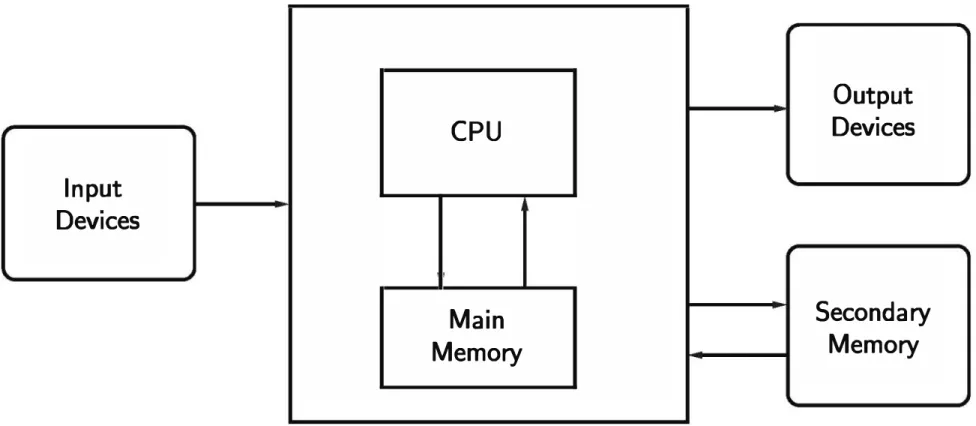
Although different computers can vary significantly in specific details, at a higher level all modem digital computers are remarkably similar. Figure
1.1
shows a functional view of a computer. The
central processing unit
(CPU) is the"brain" of the machine. This is where all the basic operations of the computer are carried out. The CPU can perform simple arithmetic operations like adding two numbers and can also do logical operations like testing to see if two numbers are equal.
5
The memory stores programs and data. The CPU can directly access only information that is stored in
main memory
(called RAM forRandom Access Mem
ory).
Main memory is fast, but it is also volatile. That is, when the power is turned off, the information in the memory is lost. Thus, there must also be some secondary memory that provides more permanent storage.In a modem personal computer, the principal secondary memory is typically an internal hard disk drive (HOD) or a solid state drive (SSD). An HOD stores information as magnetic patterns on a spinning disk, while an SSD employs elec
tronic circuits known as flash memory. Most computers also support removeable media for secondary memory such as USB memory "sticks" (also a form of flash memory) and DVDs (digital versatile discs), which store information as optical patterns that are read and written by a laser.
Humans interact with the computer through input and output devices. You are probably familiar with common devices such as a keyboard, mouse, and monitor (video screen) . Information from input devices is processed by the CPU and may be shuffled off to the main or secondary memory. Similarly, when information needs to be displayed, the CPU sends it to one or more output devices.
So what happens when you fire up your favorite game or word processing program? First, the instructions that comprise the program are copied from the (more) permanent secondary memory into the main memory of the computer.
Once the instructions are loaded, the CPU starts executing the program.
Technically the CPU follows a process called the
fetch-execute cycle.
The first instruction is retrieved from memory, decoded to figure out what it represents, and the appropriate action carried out. Then the next instruction is fetched, decoded, and executed. The cycle continues, instruction after instruction. This is really all the computer does from the time that you turn it on until you turn it off again: fetch, decode, execute. It doesn't seem very exciting, does it? But the computer can execute this stream of simple instructions with blazing speed, zipping through billions of instructions each second. Put enough simple instructions together in just the right way, and the computer does amazing things.
lt.5l Programming Languages
Remember that a program is just a sequence of instructions telling a computer what to do. Obviously, we need to provide those instructions in a language that a computer can understand. It would be nice if we could just tell a com
puter what to do using our native language, like they do in science fiction
1.5. Programming Languages
movies. ("Computer, how long will it take to reach planet Alphalpha at maxi
mum warp?") Computer scientists have made great strides in this direction; you may be familiar with technologies such as Siri (Apple), Google Now (Android), and Cortana (Microsoft). But as anyone who has seriously useded such systems can attest, designing a computer program to fully understand human language is still an unsolved problem.
Even if computers could understand us, human languages are not very well suited for describing complex algorithms. Natural language is fraught with am
biguity and imprecision. For example, if I say "I saw the man in the park with the telescope," did I have the telescope, or did the man? And who was in the park?
We understand each other most of the time only because all humans share a vast store of common knowledge and experience. Even then, miscommunication is commonplace.
Computer scientists have gotten around this problem by designing notations for expressing computations in an exact and unambiguous way. These special notations are called
programming languages.
Every structure in a programming language has a precise form (itssyntax)
and a precise meaning (itssemantics).
A programming language is something like a code for writing down the instruc
tions that a computer will follow. In fact, programmers often refer to their programs as
computer code,
and the process of writing an algorithm in a programming language is called
coding.
Python is one example of a programming language and is the language that we will use throughout this book.l You may have heard of some other com
monly used languages, such as C++, Java, Javascript, Ruby, Perl, Scheme, or BASIC. Computer scientists have developed literally thousands of programming languages, and the languages themselves evolve over time yielding multiple, sometimes very different, versions. Although these languages differ in many details, they all share the property of having well-defined, unambiguous syntax and semantics.
All of the languages mentioned above are examples of
high-level
computer languages. Although they are precise, they are designed to be used and understood by humans. Strictly speaking, computer hardware can understand only a very low-level language known as
machine language.
Suppose we want the computer to add two numbers. The instructions that the CPU actually carries out might be something like this:
1This edition of the text was developed and tested using Python version 3.4. Python 3.5 is now available. If you have an earlier version of Python installed on your computer, you should upgrade to the latest stable 3.x version to try out the examples.
7
load the number from memory location 2001 into the CPU load the number from memory location 2002 into the CPU add the two numbers in the CPU
store the result into location 2003
This seems like a lot of work to add two numbers, doesn't it? Actually, it's even more complicated than this because the instructions and numbers are repre
sented in
binary
notation (as sequences of Os and ls).In a high-level language like Python, the addition of two numbers can be expressed more naturally: c = a + b. That's a lot easier for us to understand, but we need some way to translate the high-level language into the machine language that the computer can execute. There are two ways to do this: a high-level language can either be
compiled
orinterpreted.
A
compiler
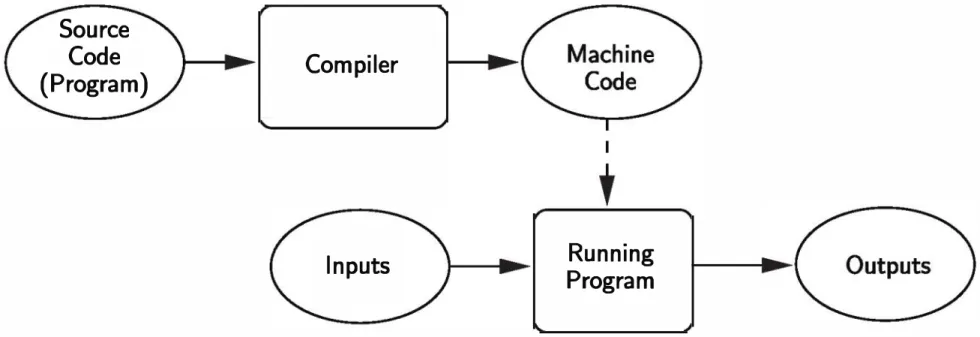
is a complex computer program that takes another program written in a high-level language and translates it into an equivalent program in the machine language of some computer. Figure
1.2
shows a block diagram of the compiling process. The high-level program is calledsource code,
and the resulting
machine code
is a program that the computer can directly execute. The dashed line in the diagram represents the execution of the machine code (also known as "running the program").Source Code
(Program) Compiler
Inputs Running
Program
Figure
1.2:
Compiling a high-level languageAn
interpreter
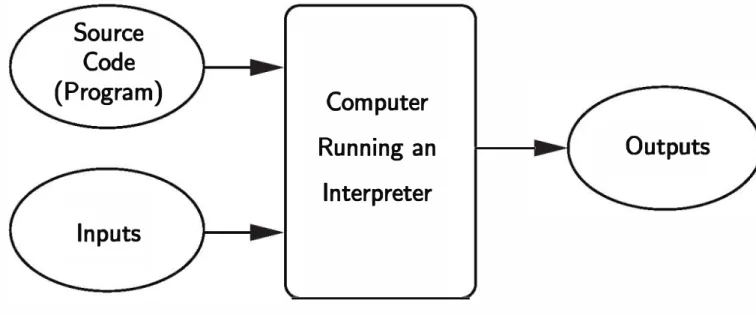
is a program that simulates a computer that understands a high-level language. Rather than translating the source program into a machine language equivalent, the interpreter analyzes and executes the source code instruction by instruction as necessary. Figure
1.3
illustrates the process.The difference between interpreting and compiling is that compiling is a one
shot translation; once a program is compiled, it may be run over and over again without further need for the compiler or the source code. In the interpreted
Source Code (Program)
Inputs
1.6. The Magic of Python
Computer Running an
Interpreter
Outputs
Figure
1.3:
Interpreting a high-level languagecase, the interpreter and the source are needed every time the program runs.
Compiled programs tend to be faster, since the translation is done once and for all, but interpreted languages lend themselves to a more flexible programming environment as programs can be developed and run interactively.
The translation process highlights another advantage that high-level lan
guages have over machine language:
portability.
The machine language of a computer is created by the designers of the particular CPU. Each kind of computer has its own machine language. A program for an Intel i7 Processor in your laptop won't run directly on an ARMv8 CPU in your smartphone. On the other hand, a program written in a high-level language can be run on many different kinds of computers as long as there is a suitable compiler or interpreter (which is just another program).
As
a result, I can run the exact same Python program on my laptop and my tablet; even though they have different CPUs, they both sport a Python interpreter.lt.6l The Magic of Python
Now that you have all the technical details, it's time to start having fun with Python. The ultimate goal is to make the computer do our bidding. To this end, we will write programs that control the computational processes inside the machine. You have already seen that there is no magic in this process, but in some ways programming feels like magic.
The computational processes inside the computer are like magical spirits that we can harness for our work. Unfortunately, those spirits only understand a very arcane language that we do not know. What we need is a friendly genie that can direct the spirits to fulfill our wishes. Our genie is a Python interpreter. We can give instructions to the Python interpreter, and it directs the underlying spirits
9
to carry out our demands. We communicate with the genie through a special language of spells and incantations (i.e., Python) . The best way to start learning about Python is to let our genie out of the bottle and try some spells.
With most Python installations, you can start a Python interpreter in an in
teractive mode called a
shell.
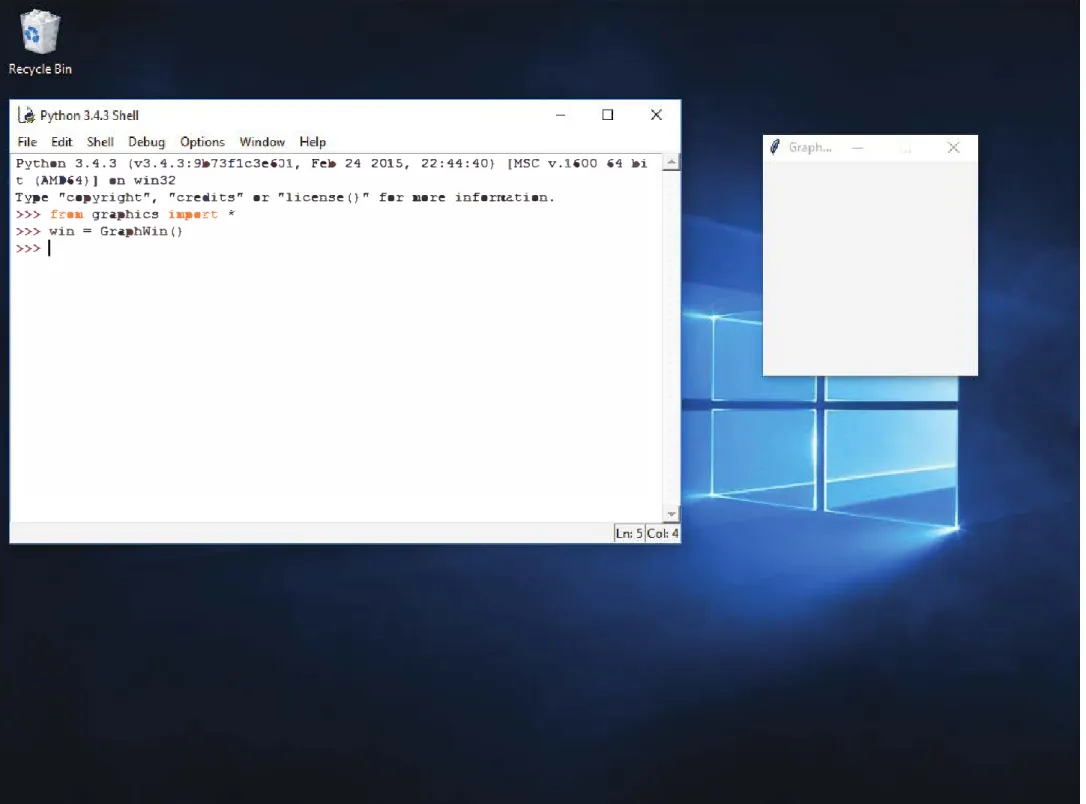
A shell allows you to type Python commands and then displays the result of executing them. The specifics for starting a shell differ for various installations. If you are using the standard Python distribution for PC or Mac from www.python.org, you should have an application called IDLE that provides a Python shell and, as we'll see later on, also helps you create and edit your own Python programs. The supporting website for this book has information on installing and using Python on a variety of platforms.When you first launch IDLE (or another Python shell), you should see some
thing like the this:
Python 3.4.3 (v3.4.3: 9b73f1c3e601, Feb 24 2015, 22: 43: 06) [MSC v.1600 32 bit (Intel) ] on win32
Type "copyright", "credits" or "license() " for more information.
>>>
The exact opening message depends on the version of Python that you are run
ning and the system that you are working on. The important part is the last line;
the > > > is a Python
prompt
indicating that our genie (the Python interpreter)is waiting for us to give it a command. In programming languages, a complete command is called a
statement.
Here is a sample interaction with a Python shell:
>>> print("Hello, World!") Hello, World!
>>> print(2 + 3) 5
>>> print("2 + 3 =", 2 + 3) 2 + 3 = 5
Here I have tried out three examples using the Python print statement. The first statement asks Python to display the literal phrase Hello, World! . Python responds on the next line by printing the phrase. The second print statement asks Python to print the sum of 2 and 3. The third print combines these two ideas. Python prints the part in quotes, 2 + 3 =, followed by the result of adding 2 + 3, which is 5.
This kind of shell interaction is a great way to try out new things in Python.
Snippets of interactive sessions are sprinkled throughout this book. When you