This reproduction is the best copy available.
UMI
®All rights reserved. The Southern Baptist Theological Seminary has permission to reproduce and disseminate this document in any form by any means for the purpose chosen by the Seminary, including, without limitation, preservation or instruction.
AND TEAM EFFECTIVENESS OF DEACON MINISTRIES IN SOUTHERN BAPTIST CHURCHES
A Dissertation Presented to the Faculty of
The Southern Baptist Theological Seminary
In Partial Fulfillment of the Requirements for the Degree
Doctor of Philosophy
by
Francis Gerard Trascritti December 2009
UMI Number: 3401801
All rights reserved
INFORMATION TO ALL USERS
The quality of this reproduction is dependent upon the quality of the copy submitted.
In the unlikely event that the author did not send a complete manuscript and there are missing pages, these will be noted. Also, if material had to be removed,
a note will indicate the deletion.
UMI
Dissertation Publishing
UMI 3401801
Copyright 2010 by ProQuest LLC.
All rights reserved. This edition of the work is protected against unauthorized copying under Title 17, United States Code.
ProQuest LLC
789 East Eisenhower Parkway P.O. Box 1346
Ann Arbor, Ml 48106-1346
THE RELATIONSHIP BETWEEN SERVANT LEADERSHIP AND TEAM EFFECTIVENESS OF DEACON MINISTRIES
IN SOUTHERN BAPTIST CHURCHES
Francis Gerard Trascritti
Read and Approved by:
Hal K. Pettegrew (Chairperson)
Michael S. Wilder
Date: /J?~/£~0 f
To my wife, Teresa,
our sons, Frank, Jamie, and Nicholas, our daughter, Markie, and her husband, Derek,
who have loved me well beyond what I have deserved.
Page
LIST OF ABBREVIATIONS vii
LIST OF TABLES viii LIST OF FIGURES x
PREFACE xi Chapter
1. RESEARCH CONCERN 1 Research Problem 2 Research Purpose 15 Delimitations of the Study 15
Research Questions 16 Terminology 17 Research Assumptions 19
Procedural Overview 19
Summary 21 2. PRECEDENT LITERATURE 23
Ecclesiology 23 Leadership Theories 43
Servant Leadership 45
iv
Chapter Page Summary of Servant Leadership Practices 53
Team Effectiveness 60 An Integrated Team Effectiveness Model 74
Summary 79 3. METHODOLOGICAL DESIGN 83
Research Question Synopsis 84 Research Design Overview 85 Population and Sample 86 Limitations of Generalization 86
Instrumentation 86 Research Procedures 88 Analysis of Data 89 Ethical Assurances 90
Summary 91 4. ANALYSIS OF FINDINGS 93
Compilation Protocol 93 Presentation of Findings 96 Evaluation of the Research Design 106
5. CONCLUSIONS 118 Research Purpose 118 Research Implications 118 Research Applications 129
v
Further Research 140 Summary of Conclusions 142
Appendix
1. INVITATION TO PARTICIPATE IN A RESEARCH STUDY 145
2. DEMOGRAPHIC SURVEY INSTRUMENT 146 3. SERVANT LEADER PROFILE - REVISED 148
4. TEAM EFFECTIVENESS SURVEY 152 5. THE DEACON MINISTRY ASSESSMENT SURVEY 154
6. PERMISSION FOR USE OF SLPR 157 7. PERMISSION FOR USE OF TES 160 8. EXPERT PANEL SELECTION LETTER 161
9. ONE WAY ANOVA: CHURCH SIZE COMPARED TO SL AND TE . . . . 162
REFERENCE LIST , 164
vi
LIST OF ABBREVIATIONS DMAS Deacon Ministry Assessment Survey
OLA Organizational Leadership Assessment SBC Southern Baptist Convention
SCBO State Convention of Baptists in Ohio SLPR Servant Leadership Profile - Revised TEQ Team Effectiveness Questionnaire TES Team Effectiveness Survey
vii
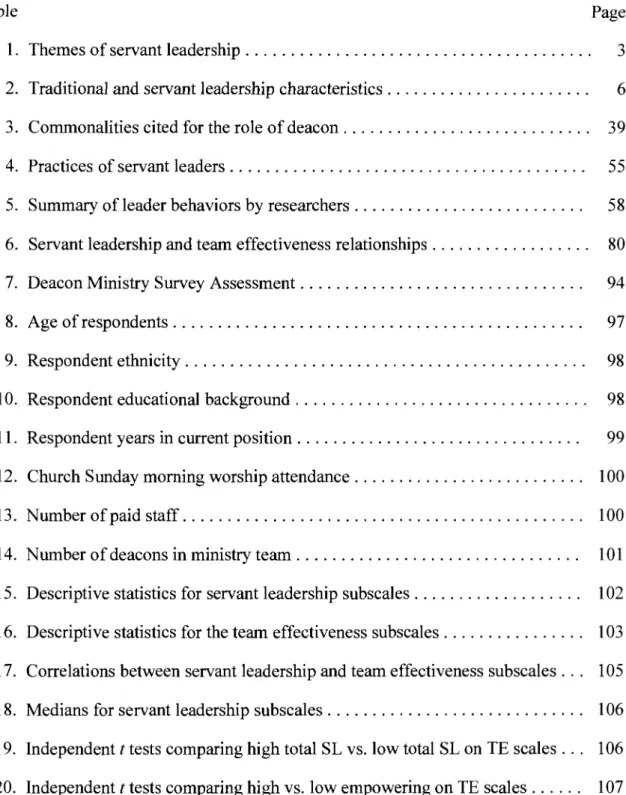
Table Page 1. Themes of servant leadership 3
2. Traditional and servant leadership characteristics 6 3. Commonalities cited for the role of deacon 39
4. Practices of servant leaders 55 5. Summary of leader behaviors by researchers 58
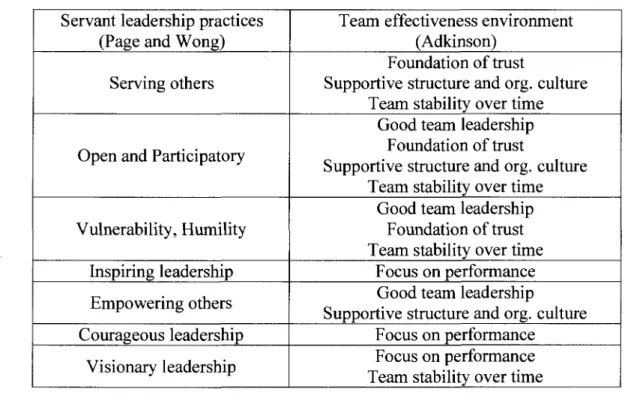
6. Servant leadership and team effectiveness relationships 80
7. Deacon Ministry Survey Assessment 94
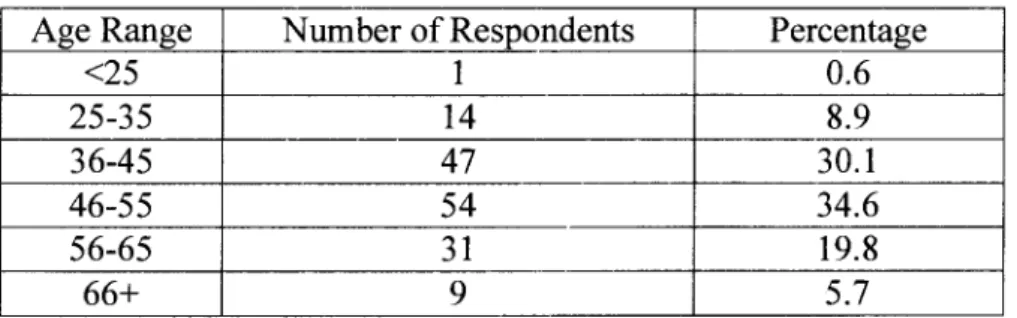
8. Age of respondents 97 9. Respondent ethnicity 98 10. Respondent educational background 98
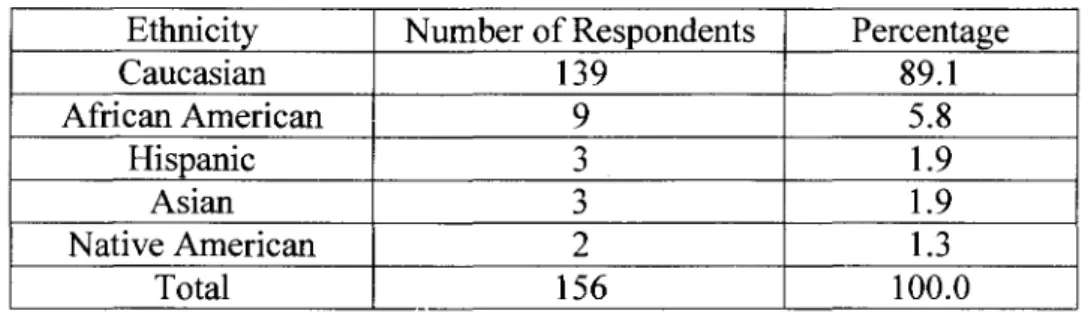
11. Respondent years in current position 99 12. Church Sunday morning worship attendance 100
13. Number of paid staff 100 14. Number of deacons in ministry team 101
15. Descriptive statistics for servant leadership subscales 102 16. Descriptive statistics for the team effectiveness subscales 103 17. Correlations between servant leadership and team effectiveness subscales . . . 105
18. Medians for servant leadership subscales 106 19. Independent t tests comparing high total SL vs. low total SL on TE scales . . . 106
20. Independent t tests comparing high vs. low empowering on TE scales 107
viii
Pag
21. Independent t tests comparing high vs. low vulnerability on TE scales 108 22. Independent t tests comparing high serving vs. low serving on TE scales . . . . 108
23. Independent t tests comparing high vs. low participatory on TE scales 109 24. Independent t tests comparing high vs. low inspiring on TE scales 110 25. Independent t tests comparing high vs. low visionary on TE scales 110 26. Independent t tests comparing high vs. low courageous on TE scales I l l 27. Church Sunday worship attendance with combined categories 112 28. Number of deacons in ministry team with combined categories 112 29. Significant ANOVA results of number of deacons for SLPR subscales 113
30. Significant ANOVA results of number of deacons for TES subscales 114
31. Ranking order for the team effectiveness subscales 122 32. Independent t tests comparing high total SL vs. low total SL to TE totals . . . . 124
ix
Figure Page 1. Relationship of ministry roles within the Church 41
2. Model of servant leadership 49 3. Characteristics of people in healthy organizations 56
4. Hackman's conditions for success 63
x
PREFACE
I want to express my appreciation for several people. First, I would like to thank Dr. Hal Pettegrew and Dr. Michael Wilder for their encouragement, advice, and warm friendship throughout this process as members of my Dissertation Committee.
Second, I want to express my appreciation to Cohort 01, as we have travelled this journey together in love and encouragement. Third, my many thanks goes to Dr. Jesse Adkinson, Dr. Paul Wong, and Dr. Don Page for their important work and also for their
graciousness in allowing me to build upon their efforts in this research. I also praise God for my brothers in Christ, Dennis Holmes, Dr. Ken Dillard, and Dr. Steve Hopkins, who served as members of my expert panel and encouraged me with their guidance and
assistance. That stated, I also praise God for my many professors, friends, and colleagues for taking the time to help me to come, grow, serve, and share Christ. God has used them to influence me for the Kingdom.
Throughout my ministry experience, several godly men and women come to mind. My love and appreciation goes to my wonderful church, First Baptist Church of Mt. Healthy in Cincinnati, and to my godly deacons, who encouraged me to take time to work on this research- they have blessed me beyond words as they have displayed servants' hearts! I am grateful for those pastors who have inspired and modeled many aspects of serving Christ in ministry for me as I served under their leadership: Steve Boyd, Jason Karr, and Jerry Webb. I want to thank Pastor Bill Krick and his wife, Diana,
xi
and instruction while demonstrating the principles of being a servant leader.
I wish to express my love and thanks to my parents, Frank and Marie France Trascritti, who prayed for and encouraged me since the beginning of my faith in Christ.
Their example and influence allowed my eyes to be open to the gospel of Christ. Also, I want to express my love to Dom, Brigitte, and my many friends, who have all seen me over the years at my worst and yet still cared for me.
Finally, I would like to thank my amazing wife, Teresa Trascritti, for her love, support, encouragement, and example of godliness as we pursued multiple degrees together while being partners in ministry and in life. I also want to express my love and pride as a dad for our children, Frank, Markie (and Derek), Jamie, and Nicholas-1 am so proud of them and what God has done in their lives so far!
Finally, I praise my Lord and Savior, Jesus Christ. You are the lover of my soul, dying for me in spite of my own sinfulness. Thank you, Jesus, for choosing me.
May I be able to glorify your name and finish well for You!
Francis Gerard Trascritti Louisville, Kentucky
December 2009
xii
CHAPTER 1 RESEARCH CONCERN
Long ago, Jesus Christ taught and demonstrated servant leadership to His disciples while on the earth. Jesus told them,
You know that those who are considered rulers of the Gentiles lord it over them, and their great ones exercise authority over them. But it shall not be so among you. But whoever would be great among you must be your servant, and whoever would be first among you must be slave of all. For even the Son of Man came not to be served but to serve, and to give his life as a ransom for many. (Mark 10:42-45, ESV) The secular rulers of Jesus' day were often appointed leaders, ruling at times with violent and brutal methods in an egotistical pursuit of greatness, yet Christ called His disciples to a different sort of leadership. Jesus called His disciples to serve others unselfishly, to being last instead of first, and to follow His example of sacrificial servanthood.
The Greek word for deacon, diakonos, means to serve. From this all important word, servanthood is clearly expressed, and the concept of servanthood and servant leadership relates to the task of ministering as a deacon. Deacons who are seeking to grow and serve in the ministry would find it profitable in studying about servant leaders, both as shown in Scripture as well as in contemporary literature. Also, deacon ministry teams are called to serve Christ and His church with honor (1 Tim 3:13) cooperating with the church as it pursues the Great Commission. The question is whether deacons can be servant leaders while being effective as a ministry team. This research study will explore the relationship between servant leadership and team effectiveness in deacon ministries.
1
Research Problem
Robert Greenleaf emphatically sounded the call about the need for servant leadership to be practiced in all institutions, secular or sacred, when he wrote:
But, alas, we live in the age of the anti-leader, and our vast educational structure devotes very little care to nurturing leaders or to understanding followership. If there is any influence, formal education seems to discourage such pursuits.
Educators argue, speciously I believe, that such preparation is implicit in general education. If that is true, how can it be that we are in a crisis of leadership in which vast numbers of "educated" people make such gross errors in choosing whose leadership to follow, and which there is so little incentive for able and dedicated servants to take the risks of asserting leadership? The conclusion I reach is that educators are avoiding the issue when they refuse to give the same care to the development of servant leaders as they do to doctors, lawyers, ministers, teachers, engineers, scholars. (Greenleaf 1977, 4)
The subject and practice of "servant leadership is attracting increased attention from scholars, writers, researchers, and practitioners" (Laub 2004, servant.pdf). As a result, servant leadership development is becoming more commonplace as organizations attempt to avoid a crisis of leadership in the midst of what Greenleaf called "the age of anti- leadership" (Greenleaf 1977, 4). "Servant leadership is an emerging leadership theory that exhibits promise in revitalizing and energizing employees as business and industry brace for the challenges of the 21st century and beyond" (Rauch 2007, 4). Churches, as well as business and industry, can be revitalized in the same way by recapturing the biblical concept of servant leadership.
For the purposes of clarity about servant leadership, it is helpful to define basic concepts, terms, and ideas. "We have not clearly and concisely defined our terms and this has caused much confusion in how we talk about leadership, management, and servant leadership" (Laub 2004, servant.pdf). A lack of clarity or poorly trained servant leaders may result in a return to old habits, even more authoritarian, and this may have already occurred at times as "there is increasing evidence of Christian leaders who abuse
3
rather than serve their followers" (Wong and Page 2003, 2). In contrast, "organizations should operate to upgrade their standard community-based operations with team-building promoted by servant-leadership" (Chamberlain 1995, 171). For servant leaders to be able to promote team building, it is important then to understand the basic terms and concepts associated with servant leadership.
Servant Leadership
The writings of Robert Greenleaf launched new interest and research in the field of servant leadership. Researchers such as Spears, Laub, Patterson, Wong, Page, and Irving, among many others, are researchers who have explored servant leadership.
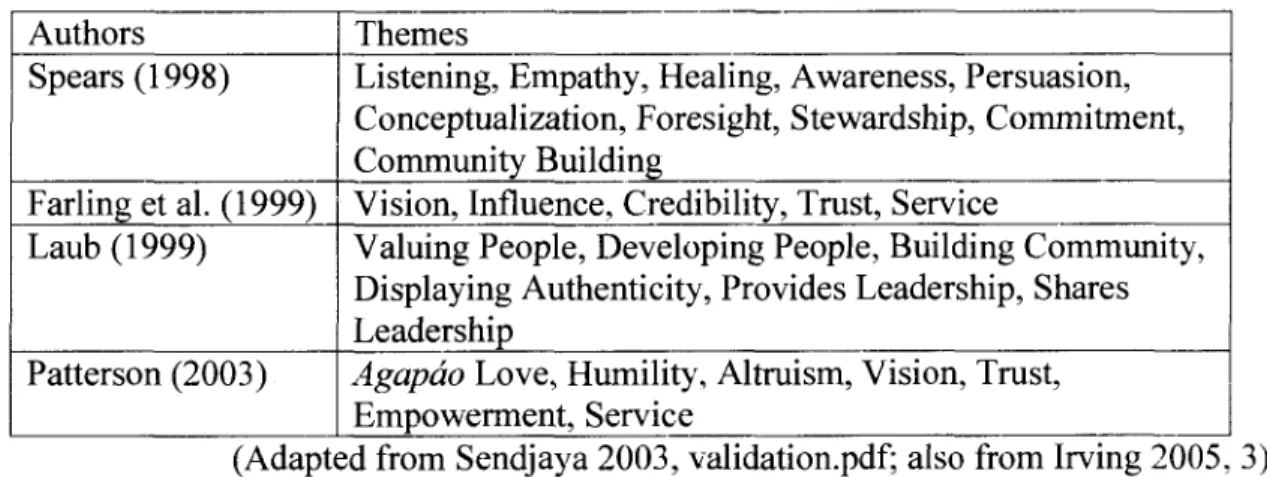
Recent research in servant leadership has produced a plethora of conclusions about the practices of servant leaders and has resulted in several recurring themes. The themes have been documented to show the practices of servant leaders, as shown in Table 1.
Table 1: Themes of servant leadership Authors
Spears (1998) Fading etal. (1999) Laub (1999)
Patterson (2003)
Themes
Listening, Empathy, Healing, Awareness, Persuasion, Conceptualization, Foresight, Stewardship, Commitment, Community Building
Vision, Influence, Credibility, Trust, Service
Valuing People, Developing People, Building Community, Displaying Authenticity, Provides Leadership, Shares Leadership
Agapdo Love, Humility, Altruism, Vision, Trust, Empowerment, Service
(Adapted from Sendjaya 2003, validation.pdf; also from Irving 2005, 3)
As shown, Spears identified ten common themes of the practices of a servant leader:
listening, empathy, healing, awareness, persuasion, conceptualization, foresight,
stewardship, commitment, and community building. This research provides "an
articulated framework for what characterizes servant leadership" (Barbuto and Wheeler 2006, 300). Others listed in the table have similar results, reinforcing Greenleaf s
original claims that servant leadership based on serving the needs of others and that those served are "healthier, wiser, freer, more autonomous, more likely themselves to become servants" (Greenleaf and Spears 1998, xx).
The servant leader model of leadership has been making its way to the forefront as a viable form of leadership. Servant leadership has become applicable to leaders in business, industry, and government. Several universities have begun to offer programs and graduate degrees that focus on servant leadership. Among others, Gonzaga University in Spokane, Washington offers a Master's degree in Organizational
Leadership, and a PhD in Leadership Studies both of which focus on the philosophy and practice of Servant Leadership. In 2004, a servant leadership curriculum was established at the Milwaukee School of Engineering. Viterbo University in La Crosse, Wisconsin offers a Master of Arts degree in Servant Leadership (University of La Crosse 2008).
The study of servant leadership has become more common in the university campus.
In an attempt to understand servant leaders, Barbuto and Wheeler described five factors of servant leadership: (a) altruistic calling, which is a deep-rooted desire to make a positive difference in others' lives, (b) emotional healing in the form of a highly empathetic good listener, (c) persuasive mapping, or the use of sound reasoning and mental frameworks, (d) wisdom, defined as an awareness of surroundings and
anticipation of consequences, and (e) organizational stewardship, or making a positive contribution to society though community development programs, and outreach.
5
In summary, to be a servant leader, one must care for others as the organization works toward a goal. Servant leaders understand that commitment to the work of Christ means a commitment to the body of Christ. Servant leaders guide others to effectively serve without expectation of a reciprocal response: "Servant leaders are described as categorically wise, and their decision processes and service orientations appear to be vehicles for invoking organizational wisdom, described as the meshing of applied knowledge and informed experience to make both optimal and altruistic choices"
(Barbuto and Wheeler 2006, 300). "The servant leader directs his team toward shared goals, but does it without manipulation or exploitation" (Choun 2001, 627) in a new kind of leadership that is a departure from traditional leadership. Table 2 shows the
relationship between characteristics of the traditional leader as compared to those of the servant leader.
It is evident that servanthood is a desirable characteristic for leaders of the church. Church leaders are to be examples to all "in speech, conduct, love, faith and purity" (1 Tim 4:12). Leaders are called to study, teach and practice the Word of God (Ezra 7:10) and in doing so, submit to and apply "the scripture principle, [which] carries with it the obligation to interpret correctly the inerrant word and to apply its principles, imitate its virtues, and fulfill its demands in the most practical and personal of ways"
(House 1997, 81-82). The example of leaders in their love for one another is how the gospel is to be shown, as "all men will know that you are My disciples, if you have love for one another" (John 13:35). This is the essence of servant leadership in the church.
Servant Leadership and Deacon Ministries
Churches in the Southern Baptist Convention have been unified in identifying
Table 2: Traditional and servant leader characteristics Traditional Leader
Motivation: personal drive to achieve.
Highly competitive; independent mindset; seeks to receive personal credit for achievement.
Understands internal politics and uses them to win personally.
Focuses on fast action.
Relies on facts, logics, proof.
Controls information to maintain power.
Spends more time telling and giving orders.
Believe that personal value comes from individual talent.
Sees network of supporters as power base, and perks and titles as a signal to others.
Eager to speak first; dominant
speaker; feels ideas are superior; may intimidate.
Uses personal power and intimidation to leverage what he or she wants.
Accountability is more often about whom to blame.
Uses humor to control others.
Servant as Leader Motivation: desire to serve others.
Highly collaborative and
interdependent: gives credit to others generously.
Sensitive to what motivates others and empowers all to win with shared goals and vision.
Focuses on gaining understanding, input and buy-in.
Uses intuition and foresight to balance logic, facts, proof.
Shares information generously.
Listens deeply and respectfully to others.
Feels that personal value comes from mentoring and working collaboratively with others.
Develops trust across a network of constituencies; breaks down hierarchy.
Most likely to listen first; values others' input.
Uses personal trust and respect to build bridges and do what's best for the
"whole."
Accountability is about making it safe to learn from mistakes.
Uses humor to lift others up and make it safe to learn from mistakes.
(McGee-Cooper and Trammel 2002, 145-46)
the two church offices as defined by Scripture: pastors/elders/overseers and deacons (bfm2000.asp). Deacons, lay leaders within the church (Tucker 2004, 124), are charged in Scripture to "be beyond reproach" (1 Tim 3:10) in their walk and service. Deacons who serve well gain respect in the church and a great confidence in their faith in Christ (1
7
Tim 3:13). Deacons are a highly valued part of the church (Choun 2001, 626).
Deacons are at their roots servants of the people. One author wrote, "The root of Diakonos has commonly been supposed to be Dia and Konis, [or] one who is dusty from running, or, simply, one who is dusty without reference to the manner of it" (Lord 1875, 531). Another writer commented, "The root idea is one who reached out with diligence and persistence to render a service on behalf of others" (Hiebert 1983, 153).
One example of the concept of servanthood is shown through the example of the seven chosen men, as found in Acts 6. The murmuring of the Greek-speaking members against the Aramaic speakers was over the neglect of the diakonia, or ministry service of the Apostles. As a result, the Apostles directed the new church to set apart some laymen,
"seven men of good reputation" (Acts 6:3) to carry out the diakonia by the daily serving of tables. The Apostles were then able to devote more time for the ministry of the Word and to prayer. This is an example where the ministry of the Word and the ministry of tables are separate, yet mutually dependent on one another (Cartwright 1957, 1).
Ministry of people is a key ingredient to freeing pastoral leaders to spend time in study and prayer. One author agreed that deacons are an invaluable help to pastors in the temporal matters when he wrote, "most interpreters believe that deacons, from the beginning, served as assistants of church leaders" (Grissom 1991, number-T1536).
Throughout Baptist history, deacons have been considered to be one of the two officers in the church (Howell 1851, 16). In the Southern Baptist Convention, R. B. C.
Howell was very influential on SBC thought regarding deacon roles when he wrote that as was the case in Acts 6, deacons in the local churches were to handle temporal affairs, thereby relieving the pastor of certain duties so they could concentrate on more spiritual
matters (Cartwright 1957, 24). This concept has been influential throughout the history of the convention and was dominant for years.
Church leaders have differed as to what aspect and what details the temporal matters specifically refer to in the church ministry. MacArthur wrote that the word diakonos "gradually broadened until it came to include any kind of service in the church"
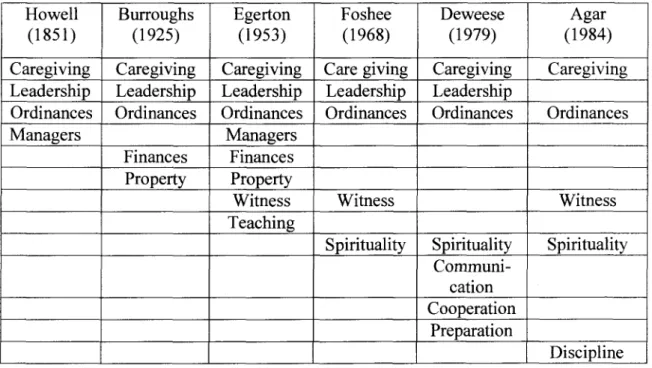
(MacArthur 1997a, deacon). These broadened temporal duties have, at times, included the management of daily administrative functions (Egerton 1953, 72), the overseeing of benevolence requests (Deweese 1979, 35), and even the governing of ministry teams (Foshee 1968, 25). As one can see, temporal matters have a broad definition and application in the church, and the duty descriptions listed above do not bring out images of the practices and the attitudes of servant leadership.
The wide breadth of the definition of temporal matters has led to some
divergence from biblical principles. Churches that have used a pragmatic expediency to
"get the job done" often ignore biblical principles behind the practice (MacArthur 1993, xiii). In some churches, leaders have operated on instinct, "without giving any
explanation as to their reasons" (Hammett 2005, 160). Biblical teaching and grounding is set aside to take care of tasks at hand, making it easier to simply place more
administrative and board-like duties on the deacon ministries (Naylor 1955, 4).
The variety of deacon practices and underlying behaviors can raise questions within the church. Are pastors, for example, to become subservient to the deacons? Are deacons to be nebulously defined in their roles, other than to be called servants? Both situations exist in churches today, and yet, in both questions, deacons are commonly considered by all to be servants. "The nature of deacon leadership and the scope of
9 deacon ministry have often been misunderstood in the life of the church" (Sheffield 1991, 4).
The confusion has allowed for extremes in temperament and attitude. For example, the placement of deacons in administrative roles has created feelings and attitudes of what Naylor calls "bossism" and directorship:
There are churches where deacons have appropriated to themselves authority which is contrary to New Testament teaching. It may have gone so far that bossism has developed. There is a 'board' complex and a general feeling that deacons are 'directors' of the church. Nothing could be farther from the Baptist genius or the New Testament plan. Anywhere this condition exists, there inevitably are those who say that deacons are not needed. The truth is that such deacons as this . . . are not needed in churches. (Naylor 1955, 3-4)
Naylor asserts that deacons with a board complex are harmful to the church as it pursues the Great Commission. Basically put, he claims that "boss deacons" are unneeded and unwelcome. The numerous and conflicting expectations of the deacon roles, practices, and behaviors as members of the church has created confusion, which defines the rationale for the present study.
In contrast, there is a cry for deacons to become servant leaders in serving Christ and His church. One author wrote:
Never in the long history of the church has the office of deacon been so necessary.
Never has it had such broad opportunities of ministry. The modern deacon is a model of servanthood to the congregation. (Bailey 1979, 86)
Within the church, people are called to an attitude of love and service to one another, as Galatians 5:13 says, "you were called to freedom, brethren; only do not turn your
freedom into an opportunity for the flesh, but through love serve one another." In spite of the fact that some churches have had deacon boards with a corresponding attitude of
"bossism," servant leadership is needed, desired, and as shown, prescribed in Scripture.
Pastors and churches would welcome a new and different attitude - an attitude of
humility and love that comes with the practice of servant leadership in the lay leaders in the church.
To bring about a move toward servant leadership within the deacon ministry and to avoid pragmatic compromises, pastors must be mindful to help guide the church to a return to the principles of the Bible. "The people in our churches need not only a general knowledge of how to interpret the bible but also an understanding of how to interpret the biblical passages that address ministry in the local church" (Malphurs 2007, 65). The goal is for the people of the Word to measure practice according to the word.
One writer stated that "A survey and analysis of the biblical material reveals definite patterns and discernable guidelines on how the churches in the New Testament functioned" (Akin 2004, 26). The various church guidelines allow the various church members to "all work together to accomplish the church's overall purpose - to glorify God" (Malphurs 2007, 79). In other words, a thorough examination is always beneficial for a church (Malphurs 2007, 168), measuring faithfulness to biblical standards
(orthodoxy) and effectiveness (orthopraxy) in the quest to fulfill the Great Commission.
Pastors, the lead teachers within the church, are perhaps the best equipped to instruct, lead, and guide the church body towards a return to biblical principles. Since many pastors have received training in leadership and in biblical interpretation, they might be a logical choice in guiding the deacons to a practice of servanthood for their ministry teams. As an outside observer, the pastors would be a helpful and more objective resource for assessing deacon ministry training needs than if the assessment was done from within the deacon team. For these reasons, it would be beneficial for a researcher to seek the pastor's perceptions of the deacon ministry, as he can be an
11 important tool in guiding the deacons to be effective servant leaders within the church.
The development of servant leaders presumably would bring about a new attitude of servanthood to prevail, which changes the culture of the organization as a whole (Greenleaf and Spears 1998, 22). When servant leaders minister effectively in love and humility, the attitude of directorship is diminished, impacting the church in a positive way in its pursuit of the Great Commission.
It might be seen that the positive influence of an attitude of servanthood can be felt throughout a church. In addition, Justin Irving's research claimed that on a general basis servant leadership is "statistically related to the effective performance of teams"
(Irving 2004, 7). He also wrote that "organizations utilizing teams will benefit from paying attention to creating an organizational environment that fosters team effectiveness through servant leadership" (Irving 2004, 7). Yet in the church context, what about deacon ministers? Is it possible for deacons to be effective as a team while still ministering as servant leaders? To help answer these questions, an examination of the effectiveness of teams may first be warranted.
Team Effectiveness
Beginning in 1927 and continuing to the present day, leaders from all types of organizations have been interested in determining and measuring, on a quantitative basis, the components of team effectiveness. In a church setting, "to be the best steward of the greatest resource available, people, one of the most pressing issues is how to build and lead effective teams" (Adkinson 2006, 3). For team effectiveness to be measurable,
"observed performance (whether it be cognitive or behavioral) must be assessed"
(Cannon-Bowers and Salas 1997, 53). Madman's research in 2002 found five conditions
that may increase the likelihood of effectiveness in teams (Hackman 2002, 31). He proposed asking five questions of the groups to determine team effectiveness:
1. Is the group a real team, with clear boundaries, interdependence among members, and at least moderate stability of membership over time?
2. Does the team have a compelling direction, a purpose that is clear, challenging, and consequential- and that focuses on the ends to be achieved rather than the means the team must use in pursuing them?
3. Does the team's structure- its task, composition, and core norms of conduct- enable rather than impede teamwork?
4. Does the team's social system context provide the resources and support that members need to carry out their collective work?
5. Is competent mentoring available to help members get over rough spots and take advantage of emerging opportunities, and is such mentoring provided at times in the team life cycle when members are most ready to receive and use it? (Hackman 2002, 31)
Hackman's premise is that an organization can develop conditions that will promote both healthy teams and team performance (Adkinson 2006, 3). "No leader can make a team perform well. But all leaders can create conditions that increase the likelihood that it will" (Hackman 2002, ix). In an attempt to measure effectiveness, Hackman developed, with others, a Team Diagnostic Survey to help measure a given team's grade on the measures that he identified. However, the survey was written for a secular setting, and it may be difficult to transfer the terminologies and concepts to the church ministry context.
LaFasto and Larson, in a similar way, focused on quantitative dimensions to team leadership. The quantitative elements that were used in their Team Effectiveness Survey measures conditions as follows: (a) clear, elevating goal; (b) results-driven structure; (c) competent team members; (d) unified commitment; (e) collaborative climate; (f) standards of excellence; (g) external support and recognition; and (h) principled leadership (Irving 2006, 49). The survey has since been adapted and used by
13 others in an eleven item questionnaire as shown in Northouse's work, Leadership:
Theory and Practice (Northouse 2001, 180-81). Two recent dissertations have used this instrument with conflicting results as to its usefulness. However, no research has been conducted to determine how team effectiveness behaviors affect deacon ministries.
In 2006 Adkinson developed a Team Effectiveness Survey (TES) for use in measuring team effectiveness of paid staff in local churches. His survey was based mainly on Hackman's work, and is applicable to the church setting. It measures the culture within the church to seek a level of team effectiveness. For example, if a culture encourages team development, the team performance may be affected significantly (Adkinson 2006, 3). This survey was useful for the purpose of measuring team effectiveness in the local church, measuring paid staff in a church setting.
Servant Leadership and Team Effectiveness
A limited amount of research has focused on team effectiveness in its
relationship to servant leadership in different settings. Irving "broke new ground in that it was the first study to empirically examine the relationship between servant leadership and team effectiveness" (Irving 2005, 5). Irving soon wrote a dissertation on this same topic, and posited that servant leadership had a significant impact on the overall
effectiveness of teams in an international nonprofit organization (Irving 2005, 69). He used the Organizational Leadership Assessment (OLA), the Team Effectiveness Questionnaire (TEQ), as well as the Servant Leadership Assessment Instrument developed by Robert Dennis in 2004.
Kenneth Rauch conducted similar research in a for-profit organization (Rauch 2007, 105). In his research, Rauch found a "correlation between servant leadership and
team effectiveness" (Rauch 2007, 4) among paid workers in a for-profit manufacturing company. This study utilized Laub's Organizational Leadership Assessment (OLA) instrument, as well as other industry specific standards for measuring team effectiveness.
Rauch's conclusions applied to his industry specific setting.
Though both dissertations advanced the base of knowledge significantly, neither of the studies were applicable to the effectiveness of deacon ministry teams as they practice servant leadership. In both the Rauch and the Irving dissertations, paid workers were studied as opposed to volunteers such as what would occur in a church ministry team setting. One reason that this is significant is that paid workers often have a culture of ongoing leadership training in a work venue. Second, neither study researched teams within the church setting. Neither these two studies nor any other research has shown the relationship of servant leadership to team effectiveness within the church ministry context, and even more specifically, within deacon ministry teams.
Further, the servant leadership instrument used in the studies may not useful in the deacon context. Though the OLA has been a proven instrument, the terminology used in the instrument makes it difficult to apply to the deacon ministry context. An alternate instrument not used in the two dissertations is the Wong and Page Servant Leader Profile - Revised. This instrument measures practices of a servant leader, and it has been developed and tested it on more than one thousand subjects, and since then "has been used by more than one hundred organizations and universities for research and evaluation purposes" (Wong and Davey 2007, 5). The Wong and Page Servant Leader Profile - Revised measures seven practices of servant leaders and is easily adaptable to measure servant leadership in a deacon ministry context.
15 In addition, the two dissertations used different standards for measuring team effectiveness. The Irving dissertation used the LaFosta and Larson Survey, which had very limited use and has a questionable validity in measuring team effectiveness (Dannhauser 2007, 357). The Rauch study used industry specific standards to measure team effectiveness in a for-profit industrial setting and is not easily transferable to the church. Instead, Adkinson created an instrument for measuring team effectiveness in the local church called the Team Effectiveness Survey (TES), transferable to the deacon context. The synthesis of both the TES and the SLPR has not been done to date, as no quantitative study has been conducted that has examined servant leadership with regard to team effectiveness of deacon ministries in the Southern Baptist Convention.
Research Purpose
The purpose of the present quantitative study was to survey pastors in Southern Baptist churches regarding their deacon ministry servant leadership practices and team ministry effectiveness. The conclusions and implications of this research could be helpful to churches within the Southern Baptist Convention, especially with churches that are struggling with understanding the servant leadership practices of their deacons and are looking to see more effective deacon ministry teams.
Delimitations of the Study
In 1845, the Southern Baptist Convention membership had an estimated 350,000 members (McBeth 1987, 391), and in 2007 the membership was over sixteen million. In addition to voluntary cooperation in the national convention, many SBC churches work together within local associations and state conventions. Most SBC churches in the state of Ohio belong to the State Convention of Baptists in Ohio. The
State Convention of Baptists in Ohio (SCBO) presently contains more than 700 churches.
Culturally, the state of Ohio is diverse and represents a variety of cultural identities of states that are northern (Eastern Ohio), southern (Southwest Ohio), Midwest (Toledo and Great Lakes Region), and Appalachia (Southeast Ohio), and it contains urban, suburban, and rural elements (Barlow and Silk 2004, 216). In respect to this diversity, it has been written that the state of Ohio is essentially a microcosm of the United States as a whole (Quest 2004, index.html). The sample therefore focused on all Southern Baptist Churches within the state of Ohio. The churches were selected from an SCBO database taken from self-reported profiles submitted annually by all member churches. Surveys were sent to pastors and churches with email addresses and internet access in order to take the web based survey. This was done in order to gain insight into the pastoral perceptions of team effectiveness and servant leadership practices of their church's deacon ministry.
Research Questions
Based on the purpose of the study, the following questions have driven the methodological design of the study:
1. To what degree do existing deacon ministries practice servant leadership?
2. To what degree do deacon ministries demonstrate team effectiveness?
3. What relationship, if any, exists between the servant leadership practices and team effectiveness of deacon ministries?
4. What relationship, if any, exists between selected demographic and organizational context factors and servant leadership practices of deacon ministries?
5. What relationship, if any, exists between selected demographic and organizational context factors and team effectiveness of deacon ministries?
Further discussion of the research questions will be found in chapter 3.
17 Terminology
Church. As defined by Scripture, churches (ekklesia) are the local body of believers bound together in the Lord Jesus Christ (1 Cor 12:12). The church is an organism of sinful but regenerate men and women (Cordeiro 2001, 179).
Deacon. Deacons are one of the two officers of the church as shown in Scripture. The highest form of lay leader in the church (McBain 1977, 37), deacons may be found in passages such as Acts 6:1-7, First Timothy 3:8-13, and Philippians 1:1.
Deacon minister. The term deacon minister is synonymously used with the term deacon (Barnett 1995,161).
Deacon ministry. The deacon ministry is body of deacons that work within the local church. The work of the deacons is the secular or temporal duties (Howell 1851,
18), "that of serving tables: the table of the Lord, the table of the minister, and the table of the poor" (Deweese 1979, 20).
Leadership. Leadership is "the exercise of one's spiritual gifts under the call of God to serve a certain group of people in achieving the goals God has given them toward the end of glorifying Christ" (Gangel 1989, 31).
Ministry teams. The definition of ministry teams is church ministry as
organized in the church by member groups that utilize their gifts for the fulfillment of the Great Commission (Cordeiro 2001, 46).
Ministry team leaders. The ministry team leaders are influential individuals within the ministry team that for leaders and followers "intend real changes that reflect their mutual purposes" (Rost 1991, 102). "Leaders move people from selfish concerns to the common good" (Pinchot 1996, 26).
Organizational Leadership Assessment. The Organizational Leadership
Assessment (OLA) is a survey instrument used for research, and "has been the predominate instrument for measuring servant leadership at the organizational level"
(Irving and Longbotham 2006, 3).
Pastor. A pastor, overseer, or elder is one of two officers in the church as shown by Scripture (1 Tim 3:1-7).
Senior pastor. A senior pastor is the lead elder, overseer, or pastor of the local church. "The title senior pastor combines the designation for older with the Latin word for shepherd. The term evolved to describe the experienced clergyman who worked in association with one or more younger colleagues . . . . Today the term senior pastor indicates a multiple-staff situation" (Anthony 2001, 623).
Servant leadership. Servant leadership is the practice of a leader which involves "a newer model - one based on teamwork and community, one that seeks to involve others in decision making, one strongly based in ethical and caring behavior"
(Spears 2002, 2). "Servant leadership is an understanding and practice of leadership that places the good of those led over the self-interest of the leader" (Laub 2005, 160).
Servant Leader Profile - Revised. The Servant Leader Profile - Revised (SLPR) is a survey instrument developed by Paul Wong and Don Page to measure the best practices of a servant leader (Wong and Page 2003, 8). This instrument is based on a survey of literature on servant leadership.
Southern Baptist churches. Southern Baptist churches are a body of cooperating churches within the Southern Baptist Convention (SBC.net).
Southern Baptist Convention (SBC). Organized in 1845, the Southern Baptist Convention is both a denomination and an annual meeting. The SBC is composed of
19 1,200 associations, 41 state conventions, and over 44,000 churches
(http://www.sbc.net/aboutus).
Team effectiveness. Team effectiveness is "the attainment of common objectives or goals by means of the coordinated activity of the members of a team"
(Irving 2005, x).
Team Effectiveness Survey. Based on Adkinson's 2006 work, the Team Effectiveness Survey instrument "provides a single-scale assessment of team effectiveness" (Irving 2005, 43).
Research Assumptions
The following assumptions were inherent in the research design:
1. Every measure that is reasonably possible was taken to assure objectivity and representation of the field of study.
2. This researcher assumed that all volunteers for this study were accurate in their responses.
3. Effective ministry is a supernatural work of God in the Church; however, team leadership principles are useful for the local church.
4. It is assumed that pastors were able to assess the deacon ministries and complete the surveys.
5. It is assumed that pastors were the best persons outside of the deacon ministry to assess the deacon ministry team.
Procedural Overview
In an examination of literature written about servant leadership, team effectiveness, and deacon ministry, no study has of yet tied the three together in a quantitative research. This present quantitative study surveyed pastors in Southern Baptist churches in Ohio regarding the deacon ministry servant leadership practices and team effectiveness. This study has sought to find a relationship, if any, between deacon
servant leader ministry teams and team effectiveness.
The study employed a Web-based survey of pastors in the Southern Baptist Convention in Ohio. The study was conducted in the late spring and the summer of 2009.
A list of prospective participants was assembled through the help of the State Baptist Convention of Ohio and a letter of invitation to participate in the study was distributed electronically (Appendix 1). The tool for the construction of the questionnaire and analysis was SurveyMonkey.com. SurveyMonkey is an Internet software tool.
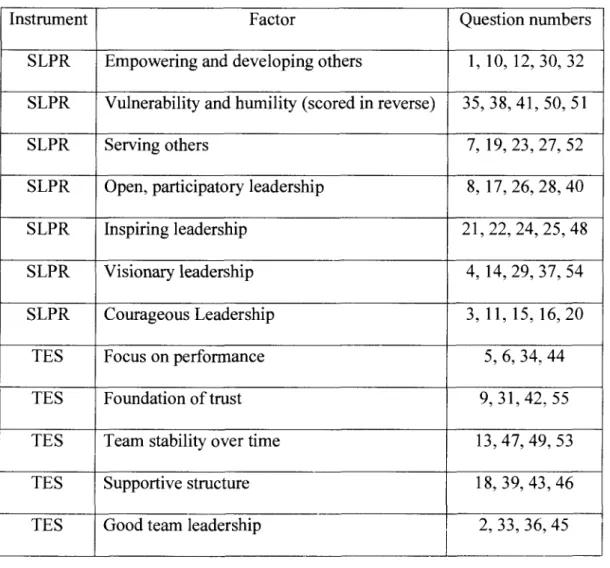
The survey process began with a demographic survey of the respondents (Appendix 2) in order to help answer research questions 4 and 5. Next, the researcher synthesized two separate instruments, the Servant Leader Profile - Revised (Appendix 3) and the Team Effectiveness Survey (Appendix 4), into a new survey. Appendix 5
contains the synthesized survey, the Deacon Ministry Assessment Survey (DMAS), which will utilize a Likert scale to measure responses. To assist in the construction and sysnthesis of a valid instrument, the DMAS was analyzed by a panel of experts and adjusted as recommendations were made and analyzed by the researcher. Afterwards, three separate pilot tests were conducted in order to adjust the survey questions for the best possible Cronbach's alpha score for reliability. The final pilot test was administered to a small, selected sample of pastors from the SCBO to ensure that an overall
Cronbach's alpha coefficient of .70 or more was achieved. This final pilot test helped to ensure that there was a reliable instrument for the research.
Once the instrument was deemed valid by the expert panel and an acceptable reliability was realized, the full research was ready to take place. The invitation to the survey was sent electronically to the participants, who were able to click on the link
21 supplied to them in the letter of invitation. Reminder calls or emails were made in
subsequent weeks to prompt those who may not immediately respond to the initial letter of invitation. The participants that clicked on the link to the survey were then informed of their consent and agreement to participate in the study, which included demographic questions as well as the survey instrument questions. An option to supply the
participant's email address was also added so that participants could freely enter in a random drawing for gift cards as a token of thanks for their participation. It should be noted that the email addresses were not linked to the survey question responses in any way so that participant anonymity was maintained.
Summary
Research has shown that the use of servant leadership can be practiced in many different types of organizations and contexts. From the very definition of the word diakonos, the concept of servanthood and servant leadership has a direct relationship to the ministry of the deacon. Deacons who seek to grow and serve in ministry would be more capable of serving Christ and His church with honor (1 Tim 3:13). However, since it is evident that a lack of clarity exists as to how the deacons may practice servant leadership in their ministry, terms need to be defined and application made of how servant leadership is applied to the ministry of the deacon. Further, as deacons recover their purpose as servant leaders, the question of the impact upon team effectiveness can and should be considered. As of this time, no research has been conducted in
discovering the relationship of deacon servant leaders and team effectiveness in deacon ministry teams.
The precedent literature is examined in the next chapter in order to establish an
understanding on the related topics. This also served to provide a backdrop for a greater knowledge related to the instruments used in the research. A review of the topics as shown in Scripture also provided a point of integration for the subject area and the Word of God. Further, contemporary research on the topics of servant leadership, deacon ministry, and team effectiveness was also researched to provide further understanding of the subject.
The methods defined in chapter 3 have a description of the instruments that were used for the purpose of gathering information. The first instrument, the Servant Leader Profile - Revised (SLPR), is an instrument that has been used to measure the practices of servant leaders and is easily adaptable to the local church. The second instrument synthesized is the Team Effectiveness Survey (TES), developed by Jesse Adkinson. The TES has also been shown to have been reliable in research, being used to measure team effectiveness of paid staff in the local church (Adkinson 2006, 163).
CHAPTER 2
PRECEDENT LITERATURE
The church exists to spread the gospel of Jesus Christ, ever since two thousand years ago when Jesus entrusted the Great Commission to the church (Matt 28:19-20). It is the goal for those that take the Great Commission seriously to be effective witnesses through the proclamation of God's love and truth (1 Pet 1:20-21). The members of the church are witnesses of the changing power of the gospel to all: "You will receive power when the Holy Spirit has come upon you; and you shall be My witnesses both in
Jerusalem, and in all Judea and Samaria, and even to the remotest part of the earth" (Acts 1:8). The Christian is saved to serve both God and man, being a beacon of light and truth to the world (Matt 5:16-17).
Baptists have affirmed the canon to be authoritative for works of service. The Second London Baptist Confession of Faith states:
The whole counsel of God concerning all things necessary for His own glory, man's salvation, faith, and life, is either expressly set down or necessarily contained in the Holy Scripture; unto which nothing at any time is to be added, whether by new revelation of the Spirit, or traditions of men. (Lumpkin 1969, 250)
The church is to submit to the Word of God for all faith and practice. This includes, but is not limited to structure (ecclesiology), leadership style (servant leadership), and team ministry effectiveness, all for the glory of God in Christ.
Ecclesiology
Those in the church have experienced the regenerative power of Christ to man.
23
The salvation of all men is only through Jesus Christ (John 14:6). Christ "suffered not only death, but a humiliating one at that" (Erickson 2001, 246). The atonement, "the work Christ did in his life and death to earn our salvation" (Grudem 1994, 568), was to be offered to the world (1 John 2:2), but in doing so, would effectively result in salvation for His chosen people (John 6:44, John 10:11, Acts 20:28, Rom 8:33-34). As one writer penned, "The atonement has made our salvation possible" (Erickson 2001, 250).
It is by grace that a person is saved through faith (Eph 2:8-9). Faith is a gift of God free from any character or work of human means (Rom 6:23, Eph 2:8-9). It is an effectual calling that occurs, as one author explained:
Because all humans are lost in sin, spiritually blind and unable to believe . . . some action by God must intervene between His eternal decision and the conversion of the individual within time . . . . Effectual calling is God's special work with the elect, enabling them to respond in repentance and faith, and rendering it Certain that they will. (Erickson 2001, 306-07)
The triune God works together, the Son through the atonement, the draw of the Holy Spirit on the elect (John 6:44) and the sovereign will of the Father, all in the process of the call of a person to salvation (Mitchell 2001, 368). John Calvin put it in these terms:
Nevertheless, it is not fitting to suppress the distinction that we observe to be expressed in Scripture. It is this: to the Father is attributed the beginning of activity, and the fountain and wellspring of all things; to the Son, wisdom, counsel, and the ordered disposition of all things; but to the Spirit is assigned the power and efficacy of that activity. (Calvin 1960, 143)
In this case, one might appreciate the unity and the work of God on the elect known as His church.
"In your English Bible translations, when you read the word 'church,' it is not the Greek word kuriakos; it is the Greek word ekklesia" (Miller 2007,
page.php?page_id=2027). The Greek word that is translated "church" in English is
25
EKKAeaia (ekklesid) (Dever 2007, 768). "Ekklesia was used by the early Greek- speaking people with its full meaning of those called forth" (Saucy 1972, 12). "It is derived from the verb ekkaleo. The compound ek means 'out' and kaleo means 'to call or summon'" (Wilmington 1984, 691). The chosen people of God are called out from a sinful and depraved life (Eph 2:1-5) to a new life for Christ (Eph 2:8-9).
The church is united together under God (Eph 4:1-3). "The Lord Jesus is the Head of the Church, which is composed of His true disciples, and in Him is invested supremely all power for its government" (The Southern Baptist Theological Seminary, Abstract of Principles). The Baptist Faith and Message 2000 reads:
A New Testament church of the Lord Jesus Christ is a local body of baptized believers who are associated by covenant in the faith and fellowship of the gospel, observing the two ordinances of Christ, committed to His teachings, exercising the gifts, rights and privileges invested in them by His Word, and seeking to extend the gospel to the ends of the earth. (Baptist Faith and Message 2000)
The church, whether local and worldwide, is a living, breathing organism (Cordeiro 2001, 179), which includes "all of the redeemed of all the ages" (Baptist Faith and Message 2000).
The church is always seen, or as Robert Saucy once wrote, "As members of the local church are concrete people, so are members of the universal church" (Saucy 1972,
17). In fact, the people of God are often referred to with concrete terms such as the
"Body of Christ" (Rom 12:5), the "Bride of Christ" (Eph 5:22), the "temple of God" (1 Cor 3:16-17), "branches" of the living vine (John 15:5), planted through the "seeds of the gospel" (Mark 4:8), which is "watered" (1 Cor 3:6), and "grown" in the Word (1 Pet 2:2).
However concrete these terms are, one writer cautions that the church is never found in the Bible to mean "a building, a denomination, or a state church" (Deffinbaugh 2007,
417), but instead to mean the people of God.
It has not always been smooth for the people of God, especially in the area of church government. A desire to follow Scripture has caused "Southern Baptists to begin reexamining their ideas of church polity" (Wring 2005, 189), and polity has always been considered a subject of great importance worthy of exploration, going as far back as John L. Dagg, the great Baptist theologian of the nineteenth century (Dever 2001b, v). In his discussion about a particular type of church polity, Daniel Akin once wrote:
Single-pastor Congregationalism is often a sight to behold. It is not necessarily a pretty one. A somewhat paranoid autocrat as pastor, monthly business meetings dedicated to senseless issues that only eat up time, a committee structure that looks like the Department of Education and is about as efficient, and a deacon board that functions like a carnal corporate board. (Akin 2004, 25)
Akin's humorous description of a confused quagmire of church polity effectively portrayed a church polity example that looked more like the world than the Word.
In addition, college and seminary presidents have written various works on the topic, such as David Dockery and his 2008 publication on consensus and unity within the SBC. Daniel Akin, from Southeastern Baptist Theological Seminary, wrote entries on single pastor polity as one of five authors in the book Perspectives on Church
Government: Five Views of Church Polity. Paige Patterson of Southwestern Baptist Theological Seminary likewise added his thoughts in the book Who Runs The Church?
Four Views on Church Government. Chuck Kelley of New Orleans Baptist Theological Seminary contributed to the discussion in conferences and in The Journal for Baptist Theology and Ministry. In many cases, the roles and practices within the church are extensively laid out and debated, as will be the case in the next section.
27
A Brief Survey of Various Church Officers
Biblical guidance in dealing with the subject of church polity is found in various passages, including 1 Timothy 3:1-13, Titus 1:1-7, and Acts 6:1-7, all of which will be dealt with in following sections. From an historical perspective, early Baptist leaders advocated two offices that included both deacons and pastors/elders. John Smyth, in his short confession of faith writes, "the ministers of the church are, not only bishops (episcopos), to whom the power is given of dispensing both the word and the sacraments, but also deacons, men and widows, who attend to the affairs of the poor and sick
brethren" (Lumpkin 1969, 101). Likewise, the Second London Confession of 1677 declared a separation of pastors and deacons by writing, "The officers appointed by Christ to be chosen and set apart by the church . . . are bishops or elders and deacons"
(Lumpkin 1969,28). Every Baptist Faith and Message has affirmed this belief, and so throughout the history of the SBC, churches have continued to affirm the two officers of pastors and deacons.
The Office of Pastor
Pastors (also called elders or overseers) are the appointed under shepherds of the church. The Greek word for pastor or shepherd, T\OI\IEV (poimeri), can be found in its usage in Ephesians 4:11, which states, "and He gave some as apostles, and some as
prophets, and some as evangelists, and some as pastors and teachers." In this usage, the word for pastor is mentioned together with the word for teacher, 5i8a<JKaAoa
(didaskalos). This combination of pastors and teacher is significant, since through divine inspiration the Apostle Paul obviously intended for the pastors to also possess the gift of teaching, something that is brought out more directly in 1 Timothy 3:2 (Schreiner 2002).
Pastors who are men of good repute are shepherds who rule mainly through the teaching the Word of God.
Scriptural references on the position of pastor (though expressed as elder or overseer) are found elsewhere, such as in the book of Acts, where the connection between the words pastor, elder, and overseer is made. In Acts 20:17 Paul is found calling "to him the elders of the church" and while giving the group instructions on dealing with the church, told them to "be on guard for yourselves and for all the flock, among which the Holy Spirit has made you overseers, to shepherd (pastor) the church" (Acts 20:28, emphasis added). Though the use of the word shepherd in this case is not used as a title, but as a duty (a verb versus a noun), the concept was clear that these men, called also the overseers or elders, were to shepherd or pastor the church. The link between the three words should not be overlooked and has important implications within the church.
Whether a church terms this position as pastors, overseers, or elders, they are nonetheless to "shepherd the flock of God among you, exercising oversight not under compulsion, but voluntarily, according to the will of God; and not for sordid gain, but with eagerness" (1 Pet 5:2). This supervision includes "caring, leading, guiding, and protecting - all duties and responsibilities a shepherd has for his flock" (Walvoord and Zuck 1983, 855). Most SBC churches have used the term pastor for this office in recent years, and though any of the three terms for the same office may be used, the term pastor has received, for the time being, a cultural acceptance with the least amount of confusion within the many SBC churches.
The Office of Deacon
The second office also affirmed by SBC churches, the deacon, has appeared to
29
be harder to specifically define in practical terms. In recent history, many SBC
organizations have operated in a system of congregational polity which includes a single pastor and a small group of deacons to function in the church. Deacons in this setting have evolved for practical reasons from being "administrators and budget managers in the '50s and '60s to various and increasing degrees of servant leadership in the 70s, '80s and '90s" (Hammett 1998, Emerging.html). The duties and practices of deacons can be widespread and confusing. Are pastors, for example, to become subservient to the deacons? Or are deacons to be purposely nebulously defined in their roles, other than to be called servants? Both situations exist in churches today, and yet in both examples deacons are called servants.
A Study of the Word Diakonos
According to a study of the word deacon, it is evident that deacons are
servants. In the Bible, diakonos, the word used for deacon, literally means to serve. One author wrote, "The root idea is one who reached out with diligence and persistence to render a service on behalf of others" (Hiebert 1983, 153). Servanthood is clearly connoted in this study of the origin of the word.
One example of the concept of servanthood is shown through the example of the seven chosen men as found in Acts 6. The murmuring of the Greek speaking
members against the Aramaic speakers was over the neglect of the SICCKOVICC (diakonia), or ministry service of the Apostles. As a result, the Apostles directed the new church to set apart "seven men of good reputation" (Acts 6:3) to carry out the diakonia by the daily serving of tables. The Apostles were then able to devote more time for the ministry of the Word and to prayer. This shows an example where the ministry of the Word and the
ministry of tables (diakonia) are separate, yet mutually dependent on one another
(Cartwright 1957, 1). A healthy ministry of one group promotes a healthy ministry of the other, all for the cause of Christ.
The terms diakonia and diakonos are common expressions of service either to Christ or through Christ (Vincent 1924,233). The terms were not used to describe the seven in Acts 6, although it is clear that some of their duties relate to and precede that of the office of deacon (Cartwright 1957, 2). Even if the passage was not referring
specifically to deacons, but merely to seven men used to resolve an issue, most scholars still take the service of the seven as an example to point to the need for deacons to minimally serve through the work of benevolence, care for the widows, and maintain unity in peace.
According to the New Testament, a deacon is to be husband of one wife, a good manager of his home, and one who enjoys a good reputation and respect within the church (1 Tim 3:8, 12). A deacon may not necessarily have the giftedness to teach as that of a pastor, though he certainly is not prohibited from teaching in the church. The role of a deacon is large, even without the responsibility of teaching, and this calling should be taken on with soberness, since it is shown in First Timothy 3:13 that deacons are to perform ministries to the church and community with excellence for the witness of Christ's gospel.
What Do Deacons Do?
Deacons' roles have been widely defined over the various periods of church history. This may be due to a theory of some that the definition of the word diakonos in itself evolved in the church. MacArthur wrote that the word itself "gradually broadened
31 until it came to include any kind of service in the church" (MacArthur 1997a, deacon).
Andreas J. Kostenberger concluded, "Although Paul does not spell out the precise realm of service for the office of deacon, one may surmise that this includes various kinds of practical help and administration, such as benevolence, finances, and physical
maintenance" (Kostenberger 2005, midwestern_3.pdf). In addition, the serving of tables as shown in Acts 6 can be thought to be inclusive of many other aspects of church life, such as managerial duties.
As already mentioned, it is true that Acts 6 shows that the early predecessors of the deacons performed the acts of "physical service," and may have been expanded greatly to other related and needed duties (Dever 2001b, 6). John Mac Arthur comments on this passage with regards to the need for assistance given to the Apostles in the duties of serving tables:
It may be helpful to note that the word for tables, trapeza, can mean "a table or counter of a money changer," or "money matters," as well as an eating table (cf.
such use in Matt. 21:12; Luke 19:23). To involve themselves in the details of serving meals and handling money matters would take them away from their calling. (MacArthur 1997b, Acts 6)
MacArthur's summary is that as the Apostles needed to make their priorities the Word and prayer, so should pastors. He wrote, "The apostles' pledge to devote themselves to their ministry set the pattern for all to follow" (MacArthur 1997b, Acts 6).
To make this priority possible on a practical standpoint, deacons are likewise to follow the example of the seven and take care of the people-oriented work of service, such as benevolence or financial matters. By attending to these details, deacons preserve the unity of the spirit (Acts 6:5), allowing the pastors to spend time in the Word and prayer.
Any expansion of service by the deacons, though, should be met with caution in case the administration goes too far. Robert E. Naylor sounded the call to be wary of
authority contrary to biblical teaching, which creates a general feeling of "bossism"
(Naylor 1955, 3-4). To avoid this sense of "bossism," it is possible that deacons may focus on their humble duties of the benevolence to the people. John Smyth in 1607 wrote that deacons are to "relieve the necessities of the poor and impotent brethren concerning their bodies" (Lumpkin 1969, 121-22), in other words, ministering to the physical needs of the people within the congregation. Charles Deweese also points out that in the early church, "deacons were the real agents of the charity provided through the church, providing for widows and orphans" (Deweese 1979,12). John Calvin summed this concept up by writing, "Scripture specially gives the name of deacons to those whom the Church appoints to dispense alms, and take care of the poor, constituting them as it were stewards of the public treasury of the poor" (Calvin 1994, 322). This is the work of the ministry to people, as relationships develop and needs are made known.
Ministry of People
Ministry of people (most specifically in benevolence) is, then, a key ingredient in the duties of deacons to free pastors to lead in their ministry of the Word and in prayer.
One author agreed that deacons are assistants to pastors, and not superiors, when he wrote, "most interpreters believe that deacons, from the beginning, served as assistants of church leaders" (Grissom 1991, number=T1536). Since a tendency can exist, and has historically happened, for a deacon to go from servanthood to "bossism," an open dialogue on this issue is relevant. In addition, a humble and cooperative spirit should be at the forefront to enable deacons to contribute a valuable service and free up the pastors for their ministry of the Word and to prayer.
The ministry of the deacon is shown through Scripture to be that of a ministry