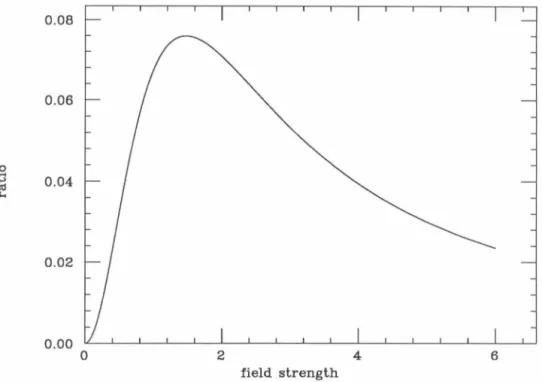
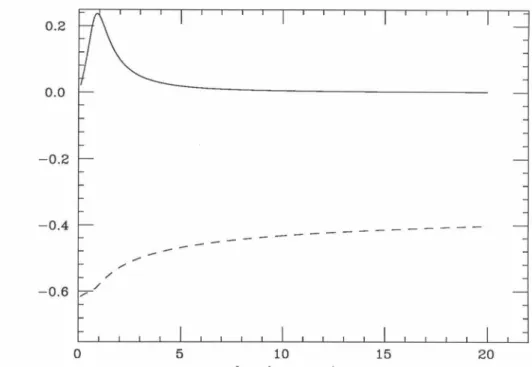
7 Fermion vacuum polarization by refracted soliton 3.8 Fermion vacuum effect on refracted soliton. Convergence of the WKB approximation for fermion rings Fermion loop corrections to the bending soliton.
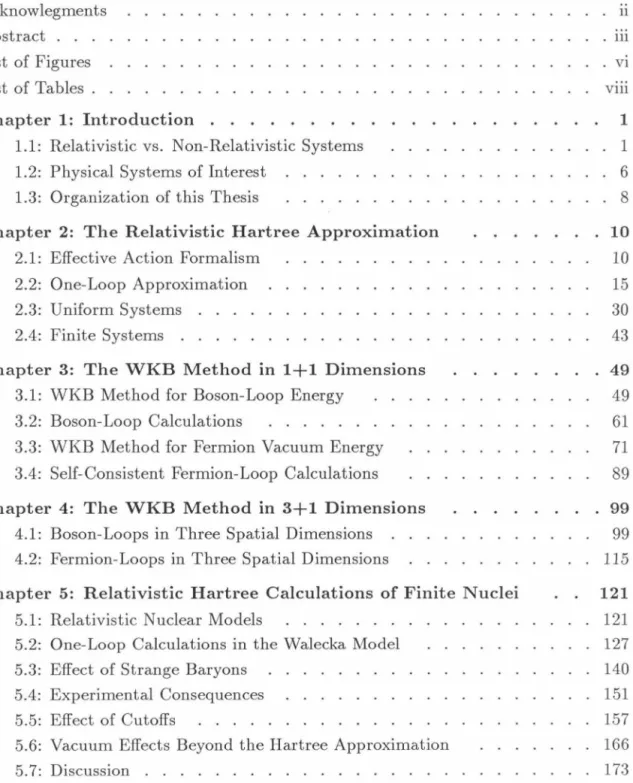
Organization of this Thesis
Another idea is that the structure of the vacuum will change slightly in the nuclear matter. Since the vacuum plays a large role in determining the structure of the nucleon, we would expect this to cause the properties of the nucleons in nuclear matter to change.
Chapter 2
The Relativistic Hartree Approximation
Effective Action Formalism
The physical states extremize the effective action, giving rise to the energy and scalar field expectation value of the quantum state. Consider first the calculation of the energy E and the expectation value of the scalar field, ~(x) = (Oiq)(x)IO), for the ground state IO).
One-Loop Approximation
As in the boson case, ~ corresponds to the classical extremum of the Lagrangian plus the source term,. The energy relative to the vacuum, which with the inclusion of one-loop mode terms is finite, is.
Uniform Systems
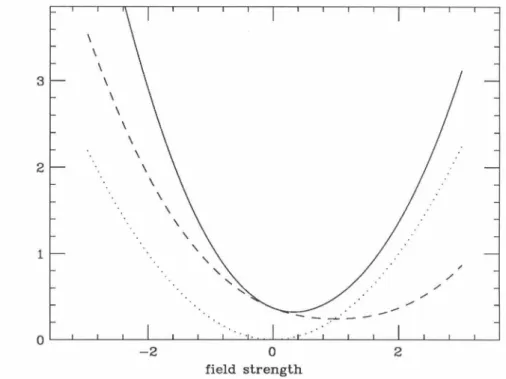
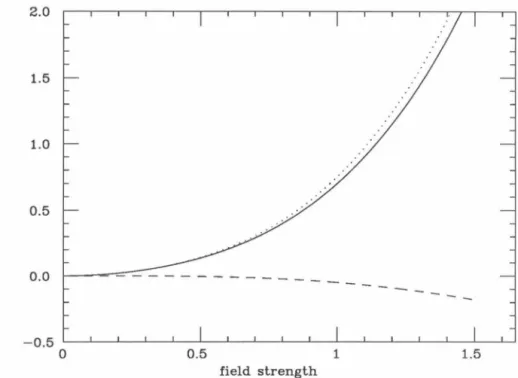
Consequently, the general structure of the effective potential is unchanged by including the first quantum correction. The induced densities are then simply calculated by taking the derivative of the effective potential.
Chapter 3
WKB Method for Boson-Loop Energy
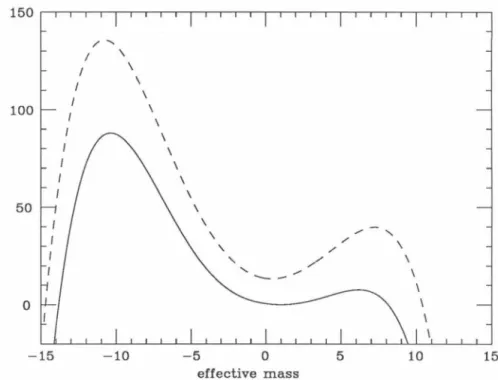
Equation (3.29) is an exact expression for the boson loop energy in terms of the energies of the bound states and the phase shifts of the continuum states. The calculation of the phase shift integral can be significantly improved by using the WKB approximation to obtain an analytical expression for the phase shift valid at large energies. The potential region between ¢ = -1 and ¢ = 1 is concave down, so local expressions for the boson loop energy are inapplicable.
Note that at k = 0 the actual phase shift is 21r, reflecting the existence of the two bound states, while the WKB phase shift is about 20%. To better understand the WKB approximation, consider the boson-loop corrections to a background field of the form. The primary reason for the inaccuracy of the local density approximation in this regime is that the boson loop energy is significantly affected by the energy of the isolated bound state, an effect largely missed by LDA.
We now develop the WKB method for calculating the energy of one fermion loop in the presence of a scalar background field.

N nco)
Self-Consistent Fermion-Loop Calculations
Physically, the changes in the meson fields are due to the polarization of the vacuum by the fields, which induces non-vanishing densities in the vacuum, which then act as sources for the meson fields. The first, m2 I>., controls the relative magnitude of the scalar field energy and the fermion loop energy, while the second, G = g IV">., determines how strongly the fermions couple to the scalar field. We observe that the induced scalar density in the vacuum persists far beyond the "radius" of the soliton.
This is shown explicitly in Figure 3.8, where the slope of the soliton at the origin is plotted as a function of G. Esol is the classical energy of the soliton, Efl is the fermion loop energy, Eb is the binding energy of the most bound fermion level, E~!ial is the sum of the valence and the classical energies, and E~~ial is the full one-loop energy. The presence of the vacuum causes the binding energy and the fermion vacuum energy to be significantly reduced.
At the conclusion of this section, we have presented some sample calculations showing how the local WKB method can be effectively used to study the effect of vacuum self-consistency on a soliton.

Chapter 4
Boson-Loops in Three Spatial Dimensions
The single loop energy is calculated from the energy integral of the phase shift which can be written as. Note that the high-energy behavior of the phase shift is independent of the angular momentum. Although the energy in each partial wave channel diverges only logarithmically, the total energy diverges at a greater rate due to the addition of angular momentum.
Note that this is exactly the divergent part of the counterterm in the zth subwave. The energy integral of the phase shifts can easily be performed analytically, while the energy integrals in the counterterms cannot. Also note that as the angular momentum increases, the magnitude of the phase shift decreases as expected.
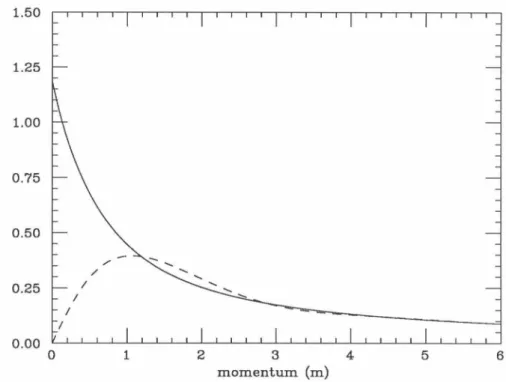
The peak of the phase shift increases and the magnitude decreases with increasing angular momentum.
Fermion-Loops in Three Spatial Dimensions
The decomposition of partial waves is performed as in the previous section, where we now use the eigenstates of the Dirac equation (4.44) to perform the tracking. For the scalar field, we can take advantage of the symmetry of the energy spectra and directly apply the results from the previous section. Note that h2 is in the form of the bosonic operators studied in the previous section.
This implies that the boson loop energy calculated from h2 will be minus the fermion loop energy calculated from h. the positive and negative energy solutions at a given momentum and the fact that the trace of a single gamma matrix is zero. We can isolate the high-energy behavior of the counterterm as in the previous section, yield. 4.72) which cancels the divergent part of the WKB approximation. This completes our discussion of the formalism required to use the WKB approximation for three-dimensional fermion-loop calculations.
The behavior of the approximation with respect to several partial waves is as in the previous section, so additional results are not presented here.
Chapter 5
Relativistic Hartree Calculations of Finite Nuclei
Relativistic Nuclear Models
Furthermore, the nucleon-nucleon interaction can be efficiently parameterized in terms of exchange of mesons, taking into account the finite size of the particles involved in top form factors [24]. In the isosinglet channel, short-range repulsion is attributed to the exchange of the isosinglet vector w meson, while the intermediate-range attraction is due to correlated exchange of two pions that can effectively be modeled by a single scalar meson, o-. Instead, the Walecka model is formulated in terms of the strong interaction's correct long-range degrees of freedom.
It is also important to add the photon isospin effect (AIL) as it contributes several MeV per nucleon of energy to a typical nucleus. Valence is the energy of valence nucleons and is given by the sum of the one-particle energies of the occupied nucleon states. For given parameter values, it is straightforward to solve the previous equations for nuclear matter and finite closed-shell nuclei [23].
When these nuclear densities are combined with hadron-nucleon scattering amplitudes, the success of Dirac phenomenology is reproduced.
One-Loop Calculations in the Walecka Model
The effect of the Dirac sea in nuclear matter (the effective potential) was calculated by Chin and Walecka [26]. Therefore, to a very good approximation, the energy change in the Dirac sea is given by The changes in the values of the parameters in Table 5.1 with respect to the different approximations can be understood as follows.
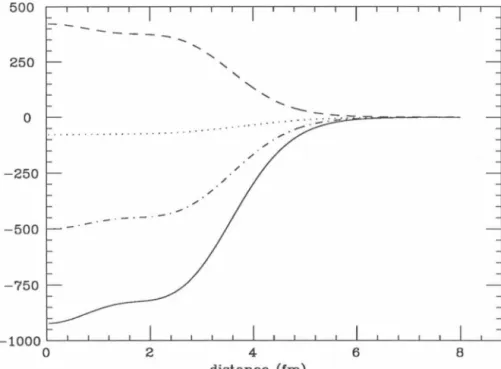
The presence of the derivative terms changes the role that the valence nucleons play in determining the total nucleon density. The rearrangement of the valence nucleons does have a noticeable effect on the binding energies of the nuclei. Also note that the energy of the correlations relative to the Hartree condition will be positive.
The involvement of the strange vacuum has a small effect compared to the effect of the nucleon vacuum.
RMS VNR
Vacuum Effects Beyond the Hartree Approximation
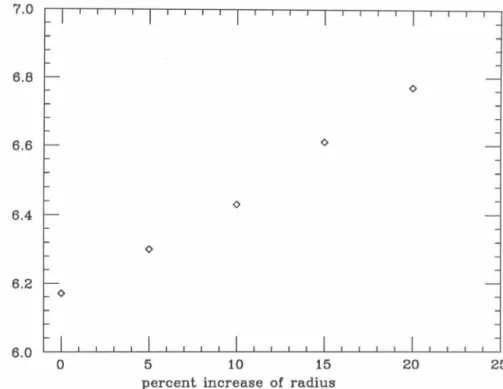
Assume that the Dirac sea corrections to the Walecka model are in fact a poor representation of the role played by the vacuum. This effect is built into the Walecka model by assuming that the charge radius of the nucleon is increased by a fraction .\ so that. The density is expressed as the fraction of the total nucleon density that it represents.
We now incorporate such variations of the meson mass into the Walecka mean field theory to see what effect this has. The increase in binding energy is a direct consequence of the density dependence of the mass. The density dependence allows the shape of the nuclear surface to change, and rightly so.
The vacuum polarization effects are large, but are mainly reflected in a redefinition of the bare parameters in the lagrangian.
Appendix A
Renormalization Details
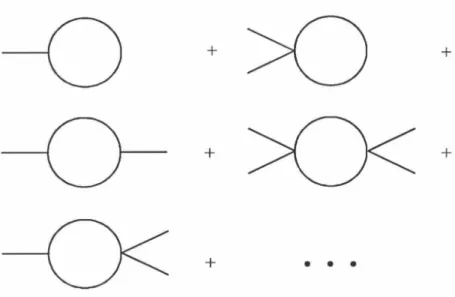
The divergent diagrams are the boson loops with one (quadratic divergent) and two (logarithmically divergent) vertices. The diagrams with one vertex are calculated as in the previous section and are renormalized by The diagram with m external legs at one vertex and n external legs at the other is equal to.
The divergence in the diagram with two external legs is independent of the momentum flow through it in 1 + 1 dimensions, so we simply need to evaluate it at zero external momentum. The infinities in the 1,3 and 4 scalar meson legs are all independent of the external momentum passing through the legs, while the diagram with two scalar meson legs has a divergence that depends quadratically on the external momentum. According to our definitions in the expression for the counterterm, if we renormalize against zero momentum, the value of the diagram with n external lines is -ian, true.
This completes the calculation of the five counterterms needed at the level of a fermion loop. The counter terms have been chosen to cancel all one-loop diagrams at zero external momentum, so that all coupling constants and masses correspond to the coefficients obtained in the lowest order terms of a Taylor series expansion of the effective action. In this thesis, the only such quantity we will be interested in is the physical mass of the vector meson.
The mass of the physical vector meson corresponds to the pole of the vector meson propagator.

Appendix B
Derivative Expansions