CHAPTER I INTRODUCTION
1.1.Background of the Study
There are several ways to communicate across the globe; one of the most common is through language. Language is a kind of human-to-human verbal communication in which a variety of random sounds are arranged to convey certain meanings. To communicate, one must employ a collection of symbols known as language. The signs can be spoken or written in both English and Arabic. Language has an impact on how people act. It is a long-term record of knowledge passed down in written form from one generation to the next and a spoken communication medium.
Language is the most crucial component of human intelligence. Traditional verbal, physical, or written symbols are used by human beings to identify themselves as members of a social group and participants in its culture. In addition to communication and self-expression, language may be used for play, creative expression and emotional release. In most sources, language is primarily designed to allow conversation or information transmission between individuals.
To put it another way, we can't function without it.
English has become a globally recognized language. Many individuals speak it as a first or second language. Even in places where English is not the national tongue, people speak, learn, and understand the language. The English language is employed in several fields of study and professions such as education and medical as well as engineering and advanced studies. Today, English is taught and learned
ideas and get a better understanding of theirs since language is a medium of communication. It's impossible to communicate without the use of words. We can't communicate with one another if we can't communicate.
Language is used in a wide range of contexts. A teacher's job is to help students improve their communication skills by teaching them how to speak English accurately and efficiently. English classes help students acquire a specified literacy level in junior high school. Students are required to speak vocally or in writing in daily situations. Speaking fluency is an absolute need for English-speaking students in the classroom. Students of the English language must have remarkable and deliberate proficiency in the art of speaking in order for any strategy to work.
However, students have long been aware of a difficulty with English language acquisition. For children who are functionally skilled but aren't able to speak well, this is an issue. This problem can only be solved by addressing the fluent conversation's underlying processes. It is a method of expressing oneself in the English language.
The conversation is a style of speaking that occurs casually, symmetrically, and to form and maintain social bonds. Because it is a social event, it adheres to etiquette guidelines. At the same time, it is generally a one-on-one conversation (synchronous). When we chat, we may learn from one another, coordinate our efforts for mutual benefit, and accomplish particular objectives all at the same time. If we follow a few easy guidelines, we may acquire and improve our conversational skills in a short period of time. Be friendly and polite, reply to the other person, utilize signals to help the other person and create emotional ties. In
most encounters, both motor-receptive ability and interpersonal skills are necessary. To do oral exercises well, this combination often requires a deep knowledge of both languages. Learning the precise sequence of the language's sounds and structures is essential for all motor skills. Making judgements about what to say and how to say it are all part of effective interaction skills.
While students regard speaking as a problem, teachers must be inventive to find a way to spark students' interest and make the speaking lesson more enjoyable and engaging. The instructor should encourage the students to speak effectively to promote their oral production for English conversation. The following steps may be taken by students to make the process of composing oral presentations simpler for themselves: Layering new sentences on top of existing ones using coordinating conjunctions and is a sign that the structure is being simplified. In order to communicate more effectively, speakers may utilize the ellipsis method, which involves omitting parts of speech. Formulaic expression: a style of speech based on commonly used idiomatic or colloquial terminology. An idiom is a set of words and phrases that are often used together in a speech. There are a number of methods that may be used to help speakers organize their ideas while they are speaking, such as fillers and pauses like "you see," "sort of," or
"you know."
When teaching English, teachers should seek for practical ways to make learning the language easier, more fun, and more engaging for their students. It was exciting to see whether and how well a strategy like dialogue might help students improve their speaking abilities, given that it is often believed to be one
of the most successful methods for doing so.
SMELT I 4.0. DE is a learning platform that intends to assist students in developing a set of abilities that will enable them to operate as whole extraordinary individuals in the twenty-first century. Students' thinking abilities will be honed, learning and teaching will be more personalized, and students' self- confidence and motivation will be boosted.
Cognitive abilities will become more important as technology eventually replaces knowledge-based work. To be sure, the behavioral and noncognitive abilities necessary for teamwork as well as creative thinking and problem-solving will become more vital (Schwab, 2015). The most important determinant of quality manufacturing will be individual talent rather than financial wealth (Schwab, 2016). Those who are able to adapt to the changing nature of their profession and the technology they employ will be more highly regarded in the workplace (Kayembe & Nel, 2019).
Based on the researcher’s preliminary research at SMA Negeri 7 Medan especially on Grade XI. The researcher chooses this title first, because there are many students who cannot speak English well. Second, the students did not have self-confidence to speak because the students’ afraid to make fault in speak English. It means that many students could not pass the KKM. Form this fact it can be concluded that the process of teaching and learning has not success. In this case, elicitation technique was useful for the students of SMA Negeri 7 Medan on Jl. Timor No. 36 Medan. Elicitation technique was used to teach students in grade XI senior high school.
Teacher elicitation as an essential type of classroom technique is more relevant teaching technique because the students’ participation is involved in a learning
community and promotes students’ cognitive development (Wash and sattles, 2005). It helps develop a learner-centered dynamic. It makes learning memorable as learners can link new and old information and it can help produce dynamic and stimulating ideas. The last curriculum namely K-13 (Kurikulum 2013), expects Senior High School students to be able to actively communicate in English. In learning English as a foreign language, most students cannot speak English well because of various reasons.
In general, some people realize that there are some factors of the difficulties in speaking ability. There are internal and external factors. Internal factors can from the students themselves. This is concerned with the psychological and physical aspects, for instance feeling ashamed to speak. This can make students afraid of making interactions with their peer during the teaching-learning process. It also makes students reluctant to express their ideas even though they do not understand, they do not want to take risk of being criticized by they friend. It is concern with the teaching-learning techniques.
At present, in teaching speaking usually the teacher is oriented to the students’
English book. He/she teaches by asking the student to read the dialogue. Based on the statements discussed above, the researcher conducts this study to know the effect of using elicitation technique on students’ speaking ability.
To find out what current trends in employment, skills, and recruiting imply for various sectors and geographical regions throughout the globe, prominent global employers hosted the 2016 Future of Jobs event (which focuses on the future of employment, skill-building and workforce strategy) (Costello, 2017). At double- digit growth rates through 2030, Costello's results reveal that the need for higher-
level abilities like creativity critical thinking, and sophisticated information processing, will be needed by employees in 2022 more than any other year in the next decade. While critical and creative thinking is often thought of as different skills, success in the modern workplace will need a combination of the two.
To put it another way, the fourth industrial revolution has arrived, and as a result, we want SMELT I 4.0 DE. This is because new technologies are merging with older ones, creating a technological vacuum that must be filled (Schwab, 2015). Global digitization and automation of labor are widely seen as a major social and economic shift that will have far-reaching effects on employment, industry and society over the next several decades (Arntz et al., 2016).
The writer will perform research titled "The Effect of SMELT I 4.0 DE by Applying Elicitation technique on Eleventh Grade Students’ Ability in English Conversation at SMAN 7 Medan" based on the preceding explanation.
1.2.The Problems of the Study
Following the research's context, the study's issues are outlined as follows:
How is the effect of SMELT I 4.0 DE by Applying Elicitation technique on eleventh grade students’ ability in English conversation at SMAN 7 Medan?
1.3. The Objectives of the Study
This study aims to describe the effect of SMELT I 4.0 DE by Applying Elicitation technique on eleventh grade students' ability in English conversation at SMAN 7 Medan.
1.4.The Scope and Limitation of the Study
The study's focus is on a transactional sort of discussion. The study's scope is
grade students of the 2021/2022 academic year of SMAN 7 Medan.
1.5.The Significance of the Study
The study's conclusions are relevant because of the following aspects:
1. Theoretical
The goal of this study is to provide students with a better understanding of the Elicitation Technique and how it may be used to enhance their communication skills.
2. Practical
a. The outcome might improve teacher and headmaster performance to implement the model correctly.
b. For the teacher, strengthen their understanding of the Elicitation technique as an appropriate method for teaching speaking.
c. For the students, to help them improve their English language skills.
d. For the reader, it is hoped that the findings would be put to good use in the classroom to motivate children to study English.
CHAPTER II LITERATURE REVIEW
2.1. Speaking
2.1.1. Definition of Speaking
Experts say there are various different ways to define the term "speaking."
Speaking is any procedure in which individuals exchange information, ideas, and feelings, according to Garry (2014:45). So, speaking is a process that offers information that talks between two or more individuals. Speaking may communicate our ideas via oral communication to deliver and receive messages.
Speaking is a linguistic ability that develops in a child's life and is formed through listening skills, according to Carnegie (1962:3-4) During this time, students will improve their speaking abilities. Speaking is one of the English abilities associated with teaching and learning, according to Carnegie's technique.
Students' enthusiasm and self-assurance soar when they are able to communicate well in English.
In 1998, Chaney stated that speaking is the process of using verbal or non- verbal symbols to produce and communicate meaning in a range of situations.
Speaking also refers to an act of sharing information with two or more people.
Speaking is a way for a person to show their thoughts and feelings.
According to Hornby (1995:427), speaking may express feelings through words and even discussion with others. It signifies that speaking is a method of communicating with others through uttering sounds or words to convey information.
itself as well as experimentally Brown (2004:140). However, such observations are necessarily impacted by the correctness and efficacy of the test-listening taker's abilities, limiting the reliability and validity of oral invention. Speaking is a way of communication or an expression. People may also use contact to make new connections, find friends, and share information.
The researcher concludes that speaking is exchanging ideas, knowledge, information, or opinion based on the preceding description. Speaking is a crucial skill to teach in English classes. Because it is not only necessary to talk but also to comprehend grammatical rules and vocabulary knowledge. Speaking is a talent that aims to communicate, discuss, and convey information, thoughts, or opinions in general.
2.1.2. The Different Types of Speaking Performances
There are six levels of speaking competence, according to Brown, (2004:271). These are the six groups:
1. Imitative
The capacity to practice intonation and to concentrate on certain linguistic structural components falls under this group. Repeating a word, phrase, or sentence is all that is required. The most important thing to keep in mind is to focus on pronunciation. Drilling is a common method of teaching and learning. Drilling helps students listen and audibly repeat certain words, which is its purpose.
2. Intensive
In this performance, students work on their pronunciation and grammar skills. Reading aloud, for example, entails reading a text,
conversing with a partner, reading facts off a chart, and so on.
3. Responsive
Interaction and test understanding are part of the responsive performance, but only to the degree that they are limited to short brief discussions, greetings, and light talk at the start of the interaction, simple requests, and remarks. This is a fast answer to the teacher's or students' queries or comments, offering advice and direction. Typically, these replies are appropriate and instructive.
4. Transactional (Dialogue)
It is carried out to send or exchange data. Here is an example of a pair conversation in action.
5. Interpersonal (Dialogue)
Rather than conveying knowledge, the primary goal of this practice is to sustain interpersonal connections. Interviews, role-plays, talks, chats, and games are all examples of interpersonal speaking performances.
6. Extensive (Monologue)
Students are subjected to lengthy monologues in oral report reviews, storytelling, and brief speeches from the teacher. It may be deduced from the initial concept that there are numerous characteristics of speaking that should be assessed. The pronunciation, vocabulary, and language functions that students will use must be known. In order to use the language effectively, students need to be well-prepared and well- informed.
2.1.3. The Purpose of Speaking
The role of communication in human contact has been described in several ways. According to Brown and Yule, there are three types of speech, as indicated by Richards: A conversation can be perceived as an interaction, a transaction, or a performance. Each of these activities has its purpose, organization, and a range of instructional methodologies. Richards also devised the following three communication goals in human interaction:
1. Talk as an interaction
When people meet, they greet one other, engage in small talk, recount recent occurrences, and so on, in order to create a welcoming and trusting environment for conversation.
2. Talk as transaction
"Talk as a transaction" is a phrase used to describe situations when the focus is placed on the words or actions that are exchanged. The message and one's own self-awareness are more important than socializing and connecting with others.
3. Talk as performance
Discourse as performance is the fourth kind of talk that may be properly divided. The act of delivering a speech or presentation in front of a large group of people is referred to like public speaking.
4. Implications for teaching
When designing speaking activities for an English class, there are three essential issues to keep in mind. The first step is to decide on the specific speaking skills that will be addressed in the course. Is it going to
cover all three of the previously stated genres equally, or will some get more attention than others? An informal needs assessment is the initial stage.
5. Teaching talk as interaction
The interactional conversation is a highly complicated and nuanced phenomenon that occurs under the supervision of unwritten laws, making it one of the most challenging skills to teach. One guideline of small talk is to start conversations with a statement on anything proximity or something that both parties are aware of. Because the agreement is face- saving and non-threatening, the comment should inspire agreement. As a result, safe topics must be picked, such as weather and traffic.
6. Teaching talks as transaction
Practicing using speak to share and collect information and carry out real-world transactions is easier since modern communicative materials offer a rich range of group activities, information gap exercises, and role- plays. These activities are ranked value clarification, brainstorming, and simulations.
7. Teaching talk as performance
A new approach is needed when teaching public speaking as a performing art. In this strategy, speeches, oral presentations, stories, and other sorts of displays are provided as examples or models through video or audio recordings or written excerpts. Afterwards, they are analyzed, or
"deconstructed," in order to discover how texts work and what linguistic
and organizational qualities they possess.
2.1.4. Speaking Ability
A person's capacity to articulate ideas is their speaking ability. The grammatical system, which describes how language units may be joined, focuses on the structural aspect. It is well acknowledged that speaking is a challenging and complex skill, particularly for foreign language students. This ability encompasses a wide range of talents. According to Hedge (2000:110), speaking ability comprises four elements: content, fluency, eye contact, and pronunciation. In a nutshell, speaking necessitates the employment of several talents simultaneously.
Being able to communicate effectively via the four language skills of speaking is essential for all people. According to Campbell (1989:39), speaking is an action in which one person tries to make himself understood by another. This concept means that the individual who becomes the speaker must utilize a communication instrument that the audience can understand.
As a result, speaking may be interpreted as applied communication, and the speaker should select the language that the listener understands to prevent misunderstandings when expressing his views. Speaking in certain schools, according to entails students repeating words or conversations. Students must practice the language they are learning in a comparable setting to their daily lives.
They must engage in genuine dialogue, which includes chatting about their lives, discussing current events, expressing their opinions, debating issues, debating themes connected to their material, and discussing business. Furthermore, listeners should voice their thoughts immediately and spontaneously; otherwise,
communication becomes monotonous and ineffectual.
2.1.5. Aspect of Speaking
People who want to speak English fluently must grasp some language features. Accuracy (grammar, vocabulary, and pronunciation), fluency, and understanding are all factors to consider.
1. Accuracy a. Grammar
Grammar is the study of language and how linguistic components such as words and phrases are integrated to form sentences Murphy (1989:15). Grammar is a collection of words ordered into an expression to convey information.
Heaton (1990:5), claims to employ structure and discriminate grammar. Furthermore, according to Harmer (2010:12), a language's grammar describes how words may alter their forms and join phrases.
b. Vocabulary
According to Hornby (1995:137), vocabulary refers to all a language's terms that anybody may use. Vocabulary is described as
"all the words that a person knows or uses" in the Oxford dictionary. As a result, vocabulary is a part of speech. When they speak English, it is also a term that must be mastered. The number of words in a language is vocabulary Hornby (1995:131). People cannot communicate successfully in English unless they memorize the terminology. Whether a person has an extensive vocabulary or
not, they can communicate effortlessly.
c. Pronunciation
What we call "pronunciation" simply means "the act of pronouncing" According to the Oxford Dictionary, "pronunciation"
relates to the way a language or a particular word or sound is spoken. Research conducted by the Adult Migrant English Program Research Centre (2002:1) suggests that pronunciation influences the way our brains generate the sounds that convey meaning. A language's sounds (segments), aspects of speech beyond the individual sound, such as intonation (phrasing), stress (timing), rhythm (suprasegmental elements), how the voice is projected (voice quality), and, in its broadest definition, attention to gestures and expressions that are closely related to the way a language is spoken are all considered (attention).
2. Fluency
Fluency is the capacity to communicate language verbally through speech. Many language learners strive for speaking fluency. Fluency should be a goal for beginning language learners, and it should remain a goal as learners go through the phases of language acquisition. Brown agrees with this remark (2004:269). When teachers assess a student's fluency, they should talk freely without interrupting the learning process.
It will make it easier for kids to communicate.
3. Comprehension
According to Cohen et al., comprehending refers to the fact that participants fully comprehend the nature of the research endeavor, even if
the procedures are difficult and contain risks (2021:51). As a result, comprehension is a skill that relates to students' understanding of what the instructor says to avoid misunderstandings. The teacher might ask students questions to see if they comprehend the content. The teacher and students can communicate whether they understand each other.
2.1.6. The Problem of Speaking Achievement
According to Nunan et al., (2003:133), there are five main reasons why students are hesitant to speak out in class, including:
a. Lack of Confidence
Students said they had a limited command of the English language.
Despite the students' ability to reply to the teacher's question in English, their lack of confidence or sense that their English is inadequate caused them to react with hesitation.
b. Students' fear of making a mistake and derision
Students also fear embarrassing themselves in front of their friends.
Furthermore, in many Asian countries, a cultural component prevents students from speaking up to their peers.
c. Teacher’s intolerance of silence
Many of the teachers who took part in the study provided their children with short wait times or none. Students are unwilling to practice because of this situation.
d. Uneven allocation of turns
This is most likely related to silent intolerance. The instructor could be sure that there would be no stillness or confusion in their
classroom if they targeted the better kids.
e. Incomprehensible input
The instructor may believe that they have taught the students correctly or provided the questions accurately. However, it is occasionally incomprehensible, causing the students to get confused.
The elicitation method is one way to improve students' speaking abilities. The purpose of Elicitation is to elicit a linguistic response.
However, a nonverbal reaction such as a nod or a raised hand may suffice.
2.1.7. Teaching Speaking
Teaching speaking is a way of teaching children how to communicate verbally with others. When it comes to transmitting and sharing thoughts and feelings, Fisher says that speaking is unique to the human species (2015:16).
Training in public speaking aims to increase the effectiveness of one's ability to communicate.
Teaching speaking involves helping students understand the sounds and rhythms of English, as well as the word and sentence emphasis, intonation patterns, and the rhythm of the second language. They must also learn how to logically arrange their ideas. Teaching students to communicate their ideals via language is an important part of this, as Nunan in Kayi lays out in his book (2003:1).
Brown (2004:237) says that in order for language to work interactively, there must be social interaction. A person's body language and nonverbal clues are more important than the words they use to convey their thoughts and feelings.
Rather than being a substitute for the real world, the classroom is a location where students may learn how to utilize it as a compliment.
In Nunan's view, training English language learners to talk includes teaching them the following:
a. Sound out words and phrases in the language of your choice.
b. Put emphasis, intonation, and rhythm into your sentences while speaking the second language.
c. Make sure the words and phrases you use are appropriate for your intended audience.
d. Organize their ideas in a way that makes sense to them.
e. Language is a means of expressing one's views and judgments.
f. Fluency is defined as communicating swiftly and confidently with minimal awkward pauses.
In light of the above, it is clear that teaching students how to communicate effectively via speaking is an essential component of any curriculum. It implies that having a debate necessitates the development of the habit of speaking.
2.1.8. Techniques in Teaching Speaking
Some of the most typical classroom speaking exercises include the following:
1. Acting from a script
As part of this activity, students reenact scenes from plays or textbooks and then video the results. Acting out dialogue is a common practice among students. Teachers often have to stand in front of the
class for this.
2. Games of communication
Speaking activities are usually a useful way for younger students to get the practice they need. Practice oral approaches like explaining, predicting, simplifying and asking for feedback by playing games.
3. Discussion
When students are afraid to speak out in front of the whole class because they have nothing to say or don't know how to say it, conversations often fall flat. Many children feel vulnerable while participating in group conversations.
4. Prepared speeches
It is common for students to give a prepared speech in which they discuss a subject of their choosing. Students should speak from notes rather than reciting lines from a script. Pre-planned lectures are a useful and well-defined kind of public speaking that can be very interesting for both the speaker and their audience if well-organized.
5. Questionnaire
It is critical to conduct surveys. Because they are pre-planned, they guarantee that both the questioner and the reply will have something to say. As a result, receptive language patterns may be found in the centre of our communication continuum depending on how tightly tailored they are. Students are free to design questions on any subject of their choice. To aid students in their design process, the teacher may become a resource.
6. Simulation and role-play
Many kids benefit from role-playing and simulation. An actual-life situation is reenacted by students in a classroom setting. It is possible to improve pupils' oral fluency and prepare them for certain scenarios via role-playing and simulation.
7. Debate
Debate encourages students to communicate with one another.
Debate is the process of weighing many points of view and making a conclusion, and anybody from a person may use it to persuade others to agree with their point of view. All the speaking exercises encourage students to talk in class. The teacher should select appropriate activities from the list above based on the kids' levels. Every teaching and learning process may be enjoyable provided the teacher choose an appropriate activity for the student's level of ability. Aside from that, the means by which information is disseminated is straightforward.
2.2. Elicitation Technique 2.2.1. Definition
Experiential and knowledge-based learning is the focus of elicitation, according to (Nunan et al., 2003). Helps students grow more independent by diverting their focus away from text as a source of authority. The teacher gets the students to offer rather than receive information. For a variety of reasons, elicitation is a vital technique in the classroom. By enabling students to establish connections between new and old content, it helps to foster a dynamic and engaging learning environment that puts the student at the center of the process.
learning activities to understand a topic via Elicitation, according to the above definition.
2.2.2. Step of Elicitation Technique
Some steps of the Elicitation Technique, according to (Nunan et al., 2003).
There are a few:
a. The teacher offers a problem or asks an open-ended inquiry with several possible replies.
b. Students possess a wealth of information, both language and the real world. This information must be activated and put to good use.
c. New knowledge is frequently taught based on what the students already know.
d. Questioning aids in self-discovery, which helps knowledge stick in mind.
2.2.3. The Purpose of Elicitation
Learning is more memorable when new and old content is linked together, which is why Elicitation contributes to the creation of an engaging, student- centered classroom environment. Language and world knowledge are not the only things that may be elicited. There are several ways in which the teacher might provoke thoughts and feelings. Students' knowledge and lack of knowledge may be discovered via elicitation, which is a useful diagnostic tool for instructors. As a result of eliciting, educators are forced to adjust and move forward rather than depending entirely on the content they have previously mastered.
2.2.4. The Advantages of Elicitation
Elicitation, according to (Nunan et al., 2003), "helps to divert the emphasis from the text as the figure of knowledge and makes students become much more
self-reliant" since it "emphasizes learners' experience and knowledge." Elicitation is also a fantastic lead-in to various other critical thinking and inquiry exercises.
According to (Rosenberg, 2009), there are several benefits to adopting Elicitation as a strategy for teaching speech. There are a few:
a. Eliciting keeps the student alert
Even the most exemplary students will occasionally find their thoughts wandering if someone at the front of the room is speaking, especially if what is being said is a foreign language grammatical explanation. If they can be summoned at any moment, there is less risk that they will forget about a forgotten item on their shopping list or anything their ex-girlfriend said to them. One way to take advantage of this is to pick people at random rather than walking along the row and combine this with posing a generic question to which the entire class must respond.
b. Eliciting helps teachers realize if the students are listening and understanding or not.
If you say, "The Present Perfect is employed to talk about things that connect the present and the past," you have no way of knowing if the kids comprehended what you said (even if they were listening) at that point. If you ask, "What are the similarities and differences between these Present Perfect sentences?" or "What is the difference between these Simple Past and Present Perfect sentences?" Instead, a lack of response indicates that they are not listening or following you (see below for additional possibilities). However, a proper response
suggests that they are aware and following your explanation.
c. Eliciting helps teachers find out what they already know.
A teacher may build their confidence with the initial questions and understand the limitations of their knowledge once their answers become partial or incorrect by starting with easy questions and working their way up to more challenging ones. Knowing what students know and do not know can help you focus your class time on the most relevant topics and organize future sessions accordingly.
There is a risk that you will only discover the boundaries of particular students' knowledge, or that you will undervalue their understanding because they know but are not stating it, or because they know but have not articulated themselves properly.
d. Increased student participation via Elicitation may reduce teacher speaking time.
e. Eliciting helps students develop their ability to make educated guesses.
f. Elicitation provides an opportunity for students to acquire or be exposed to accidental functional language.
g. Using elicitation, they will be able to figure it out for themselves.
2.2.5. The Disadvantages of Elicitation
As a result, there are several drawbacks to employing the elicitation approach. There are a few:
1. Elicitation can take a long time.
2. TTT does not always result from Elicitation (Teacher Talking Time).
3. Elicitation can be performed automatically.
4. Elicitation can meet with silence.
5. Elicitation does not use the same vocabulary as regular communication.
2.3. Synergetic Multilayered English Language Teaching for Industry 4.0 and Disruption Era (SMELT I 4.0 DE)
2.3.1. The Definition of SMELT I 4.0 DE
SMELT I 4.0 DE is a learning model to help students build the skills they will need to be entirely exceptional people in the twenty-first century. (Suherdi, 2019a) To be more precise, it intends to foster individuals who can make the most significant contribution to human existence in this period while also being the most resilient in the face of disruptions brought on by the rapid growth of science and technology inherent in this changing era.
The ways SMELT I 4.0 DE support students learning autonomy is also motivating. Problems around students’ lack of participation may put the model in a good position as an alternative to solving these everlasting problems in Indonesian educational contexts. Another strength that SMELT I 4.0 DE offers is its ways of developing transversal competences. The nature of digital technology brings with it a ‘special force’ to discipline, motivate, sustain, quality oriented, punctual, honest, and serious in accomplishing all the assignments given. To sum up, this set of advantaged help students acquire quality learning, motivation, comfort and academic as well as psychological rewards.
SMELT I 4.0 DE has been developed to meet a far more complicated and
ICT can offer, the development of digital technology has made communication more complex. The texts used in today’s communication are mostly multimodal and multi-semiotic, even in very basic daily conversations between friends, siblings and neighbors. Social media networks are developing pictographs like emoticons, emoji, etc. in a high enthusiasm. This has made mono-modal and mono-semiotic texts by no means rare, if not impossible at all as far as the 21st century communication is concerned. Consequently, taking multimodal and multi- semiotic nature of today’s texts into consideration is a must in today’s ELT enterprise.
2.3.2. Four Components of SMELT I 4.0 DE
When it comes to the creation of SMELT I 4.0 DE, there are four key components, according to (Suherdi, 2019c):
a. ICTC (Information and Communication Technology Cultivation)
ICTC has received several reports of English-teaching initiatives.
"Technology provides interaction between teachers and students, provides understandable input and output, helps learners develop thinking skills, makes learning and teaching more student-centered, promotes student autonomy and helps learners feel more confident,"
Ahmadi (2018:122) found in his review of the literature on the use of technology in English language learning.
b. SRLI (Self-regulated Learning Inculcation)
It is the second layer of SRLI's goal to enhance "the ability to monitor and alter one's cognitions, emotions, and behavior to accomplish one's purpose and adapt to the cognitive and social demands of specific
contexts" (Berger, Kofman, Livneh and Henik, 2007:257). SRL is a good predictor of learning performance; thus, the effort is crucial.
All trends may only be possible if students develop autonomous self- regulated learning. Learning more frequently in different time and different places, learning in a personalized fashion, choose topics, method and monitor own choices, being responsible for a project, ownership, and completing more demanding exams will only be possible if students develop SRL. Otherwise, counter-productive effects will be resulted.
c. TVCD (Transversal Competency Development)
The 2013 Asia Pacific ERI-Net annual meeting suggested and proposed TVCD refers to "skills, competencies, values, and attitudes essential for the holistic development of learners, such as teamwork, self- discipline, resourcefulness, and environmental respect". This word was proposed as a unifying name for various terminology used by different nations, economies, and organizations, such as "21st-century skills" and
"21st-century learning."
d. CSM (Curriculum Subject Matter)
The fourth is the core, the subject matters or the curriculum subjects, such as civics education, natural sciences, physics, mathematics, English, etc. The three layers concisely will work to help develop their mastery of the subject matter in a synergetic fashion together with the development of the relevant skills inheret in the three other layers.
There are three different modalities of Transversal Competencies (TC)
integration into education, according to (Suherdi, 2019b):
1) Specified Subject: Transversal competencies are acquired in the formal curriculum as a well-defined entity, such as a subject with specific aims and syllabuses for proper instruction.
2) Cross-Subject: Learning transversal competencies cross all
"vertical topics," i.e., traditional school subjects.
3) Extra-Curricular: The acquisition of transversal competences is made a part of daily school life and is purposely incorporated in various non-classroom activities.
2.4. Previous Studies
Some researchers had conducted a few studies and found a related result of the research as follow:
Journal by Didi Suherdi entitled Teaching English in the Industry 4.0 and Disruption Era: Early lessons from applying SMELT I 4.0 DE in the Senior High School Class (2019b) The Disruptive Era and Industry 4.0 are discussed in this article, as well as the implications for English language education in Indonesia and the SMELT I 4.0 DE model as an option for teaching English in this new era.
Synergetic and multilayered SMELT I 4.0 has been described and properly studied; some implications have been proposed at the conclusion of this study. A significant part of ICTC's work has been to help students get and keep their drive to succeed in their English studies while also providing them with a variety of options for doing so. They planned, executed, monitored, amended, and concluded their work with the assignment as their goal.
documented, but its overall influence on students' ELT learning has not yet been thoroughly investigated. As a consequence, an investigation into the use of SMELT I 4.0 DE is both theoretically and practically intriguing. Because of this, in the first semester of 2018/2019, a one-semester pilot project was conducted at Universitas Pendidikan Indonesia Senior High Lab School to implement the idea in an English as a foreign language (EFL) lesson. The study's goal was to report the results of the SMELT I 4.0 DE pilot project, which was descr ibed before. The information was gathered from 29 students using surveys, interviews, document analysis, and observations.
ICTC, SRLI, and TVCD have been shown to be effective in increasing students' motivation and engagement, as well as encouraging students' creativity;
SRLI has triggered students' self-regulation in planning, doing, and assessing their learning, self-selection of learning focus and materials, and strategies; and TVCD has enhanced students' learning through self-discipline, honesty, and confidence.
All pupils' learning has improved significantly after the introduction of the SMELT I 4.0 DE system. (Suherdi et al., 2019)
During the 2015/2016 academic year Farida Fatmawati did a study named
"Teaching Speaking by Using Elicitation Technique to the Eighth Grade Students of SMPN 1 Bangsri Jepara in 2015/2016." English-speaking ability may be increased if the correct teaching methods are employed and are based on the principles of speaking instruction. One of the best methods to improve a student's English-speaking abilities is via the elicitation approach. To improve students' lack of self-confidence in speaking English, elicitation activities are used because they require pupils to express their thoughts based on the material offered. Student
self-esteem soars as a result of this program. The study's ultimate purpose is to investigate whether eighth-grade students at SMPN1 Bangsri Jepara in the 2015/2016 academic year show a substantial improvement in their speaking abilities before and after they were taught utilizing the Elicitation technique.
Experiments are being conducted in this case. A single group is used by the researcher in this experiment. SMPN1 Bangsri Jepara's eighth-grade pupils in the 2015/2016 school year comprise the population of this study's sample, which is class VIII-A.
The content consists of descriptive language. The writer begins by administering a pre-test, then helps therapy across four meetings, and then issues a post-test to determine the variations in results before and after using the Elicitation Technique. It was found that the pre-test averaged 54.5 and the post- test averaged 70.9%, with a standard deviation of 6.38, in the experiment. At a 5%
level of significance, the t-observation was found to be 11.59 using the degree of freedom (df) N-1 (40-1 = 39) and the t-table 2.021. Another way of putting it is that the t-test is inside the acceptable range. As a result, the null hypothesis has been rejected, whereas the research hypothesis has been verified. SMPN1 Bangsri Jepara eighth-graders who were taught using Elicitation Technique in the 2015/2016 academic year showed "a major change in their speaking competency,"
according to the findings of the research.
“An Analysis of Teachers Elicitation Techniques in the Classroom at SMA Pembangunan Laboratorium UNP” by Delia Sasmita. The research is a descriptive study that tried to determine the elicitation procedures employed by three English teachers. The researchers in this study gathered their information via
a combination of direct observation and in-depth interviews. While observing, a video camera is employed to record the learning process. They spent a lot of time listening to and studying this audio. Teachers conducted interviews to get more information from the data gathered from observation. According to the study, instructors use four types of elicitation techniques: asking questions (54.8 per cent), asking questions with visuals (5.5 per cent), asking questions with text or conversation (38.7%), and asking a question using non-verbal language (38.7%).
(1 per cent). The teacher does not employ a strategy for asking questions integrated with a game or activity. According to the study's findings, asking questions was identified as one of the most employed tactics for eliciting replies from students. The professors commonly employed the "asking inquiry" strategy before and during class. Teachers said that asking questions was a simple and successful way to get children to participate. The approach of "asking questions while employing texts or conversation" was then used. Teachers advised using elicitation techniques to encourage kids to speak up in novel ways. The teacher should use various questioning tactics so that the students can readily answer them. Then, to get the most out of this strategy, individuals should pay attention to what, how, and when inquiry in Elicitation should be raised.
When it comes to selecting appropriate teaching and learning approaches, the writer recommends that teachers be more imaginative. Its key objectives are student involvement and pleasure.
2.5. Conceptual Framework
According to the preceding definition, teaching is the process of passing on information to someone in order for them to be able to do a job. To assist pupils
better understand a topic, the teacher should use some kind of teaching approach.
The researcher uses the SMELT I 4.0 DE method in this example. The teacher will explain the SMELT I 4.0 DE and Elicitation technique to the students before implementing it.
After that, the teacher will make an online class in Google Classroom and named it with ‘SMELT I 4.0 DE’ also adopt a elicitation technique. And then, the students make a video practice about their assignment from the teacher. In the last meeting, the teacher will take notes on the students' pronunciation and vocabulary
during the performance.
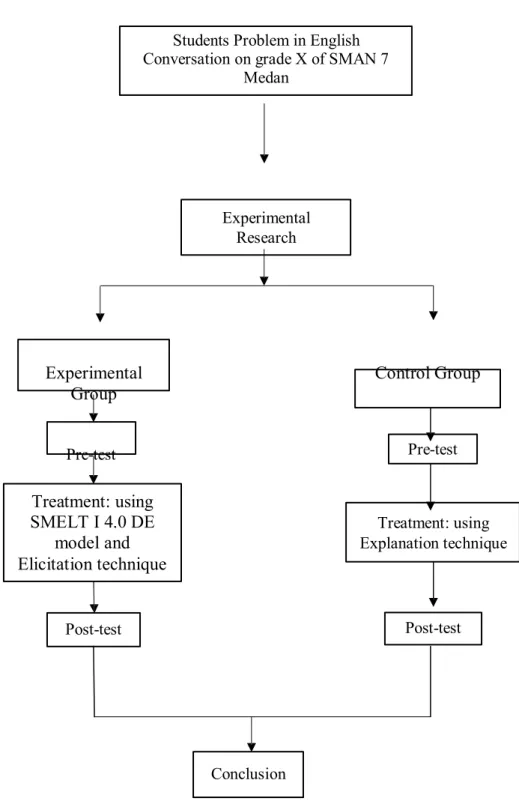
Students Problem in English Conversation on grade X of SMAN 7
Medan
Experimental Research
Experimental Group
Control Group
Pre-test Pre-test Treatment: using
SMELT I 4.0 DE model and Elicitation technique
Treatment: using Explanation technique
Post-test Post-test
Conclusion
Figure 2.1 Conceptual Framework of The Effect of SMELT I 4.0 DE by Applying Elicitation Technique on Eleventh Grade Students’ Ability in English
Conversation at SMAN 7 Medan
CHAPTER III
RESEARCH METHODOLOGY
3.1. Research Design
This research aimed at experimental research. It called two groups Pre-test and Post-test design. The pre-test gave before the treatment. The treatment in the experimental group taught by the Elicitation technique and Explanation technique in the control group. After the treatment, the post-test gave in both groups. So, the result of the treatment knew accurately because it compared the situation before giving treatment and after passing the post-test.
The research design figured as follows:
Table 3.1
Table of Research Design
No. Group Pre-test Treatment Post-test
1. Experimental √ Elicitation
Technique
√
2. Control √ Explanation
Technique
√
This research used pre-test and post-test given to both groups to collect the data.
1. Pre-Test
The pre-test was conducted to the experimental and control group before treatment. The pre-test used to know the mean scores of both
groups before receiving treatment
2. Treatment
Treatment was given after the pre-test. The experimental group used the elicitation technique and the control group’s explanation technique.
The process of providing treatment was conducted in three meetings.
Therefore, there will be five group meetings, including pre-test and post-test.
3. Post-Test
After the treatment is done, the experimental and control group was done post-test. The group's result was analyzed to determine the effect of using the elicitation technique on students' achievement in speaking, whether it is significant or not. The researcher was recorded their performance one by one.
3.2. Population and Sample
The population in this research was the students from eleventh graders of SMA Negeri 7 Medan in 2021-2022. The total number of students in the first year are about 240 students in 8 different classes. XI-MIPA consist of 5 classes and XI-IPS consists of 3 classes. The researcher used purposive sampling in this research, XI-MIPA-3 and XI-IPS-3 was the sample.
a. Population
People, objects, and items are all examples of a "population,"
according to Best (1982:13). Samples from these populations used in the assessment. Participants in this study was grade 11th students from SMAN 7 Medan. The total populations are about 240 students.
b. Sample
A sample is a subset of the data that is available Corbetta (2003:211).
For this research the researcher took two classes as the sample, that is XI-MIPA-3 and XI-IPS-3, it means there are 64 students. From the population the researcher took 32 students as sample. Because there were some changes about class hour in school. They used two waves in teaching and learning activities, it started from 7 a.m. and ended at 9.45 a.m. was the first wave class and at 10 a.m. until 11.45 a.m. was the second wave class. The school divided the order starting from the first attendance number to sixteen number.
This decision made with the consideration that these two classes they were teach by the same teacher. They were split into two groups: the experimental and control ones. The experimental group consists of 16 students, and the control group comprises 16 students.
3.3. Instrument of the Research
The data of the research collected by using a conversation test. The test was in the form of speaking, and the students asked to make a dialogue in the expression of asking and giving opinion and then perform it in front of the class.
3.4. The Procedure and Technique of Collecting Data
The procedure in this research was a test. The test was used in this research was pre-test, treatment, and post-test.
a. Pre-test
A pre-test is a training or test that give to students before teaching
in speaking before doing treatment and to find out the difference in grades that conducted in control and experimental classes. A pre-test conducted in the control and experimental class.
b. Treatment
Treatment was used in the experimental class after conducting the elicitation technique. The material that taught in the control and experimental classes was the same, but with different treatments or strategies. In the experimental class, the writer taught students using the elicitation technique. Students got material and video examples of asking and giving opinion and explanations through the PowerPoint and students asked to practice asking and giving opinion in pairs and asking and giving opinion about studying abroad in the forms of dialog.
A: what do you think about studying abroad?
B: I think it will be funny. Because, I will meet natives.
A: I think so. That’s why I would like to studying abroad someday.
B: Wow. That’s cool. Good luck.
Students took turns asking and asking their partner’s opinion about studying abroad, so they can made asking and giving opinion that they know. As for the control class, the writer taught without using the elicitation technique. The writer taught the material asking and giving opinion with conventional methods. Students listened to the explanation of the material asking and giving opinion from the writer and make students asked to practice a short dialogue and demonstrate it with their partner in
front of the class.
3.4.1. Teaching Procedures of Experimental and Control Group Treatment for Experimental Class
No. Teacher Activities Student Activities 1 The writer will greet the
students.
(Good morning…, Hello class…, etc)
The students will respond the writer.
2 The writer will explain the material by asking and giving opinion.
The students will listen to the writer.
3 The writer will give a pre-test.
(about asking and giving opinion)
The students will answer the pre-test by answer the question.
4 The writer will ask the students to make a group consist of two students in each group, then ask them to practice asking and giving opinion in front of the class in pairs.
Students will make a group in pairs.
Students will come to the front of the class in pairs to practice asking and giving opinion.
5 The writer will ask students in pairs to come in front of the test.
The students show their speaking ability about the topic given.
6 The writer will record students’
performance group by group.
The group will perform their conversation in front of class.
7 The writer will observe how the students speak and if they make mistake in pronunciation, the writer tries to fix it by asking others student to help.
The students will listen to the writer’s explanation and answer the incorrect pronunciation by group who is perform in front of the class.
8 The writer will give the post-test to the students.
The students will listen to the writer.
The students will answer the post- test.
9 The writer will check their work and give the score later on after the class meeting.
Treatment for Control Class
No. Teacher Activities Student Activities 1 The writer will greet the
students.
The students will respond the writer.
2 The writer will explain the material by asking and giving opinion.
The students will listen to the writer.
3 The writer will give a pre-test. The students will answer the pre-test by answer the questions.
4 The writer will give the students the explanation of asking and giving an opinion, then the writer will ask them to read the textbook about asking and giving opinion.
Students will listen to the researcher explanation.
Students will read the textbook about asking and giving opinion.
5 The writer will discuss and make examples of asking and giving opinion to students. Then the researcher will ask the students to make and practice asking and giving opinion materials in pairs.
Students will choose their partners then will discuss and come to the front of the class to make asking and give opinion conversation
6 The writer will record students’
performance group by group.
The group will perform their conversation in front of class.
7 The writer will give directions relate to the post-test and will give the post-test
The students will listen to the researcher and will do the post-test.
8 The writer will check their work and give the score later on after the class meeting.
c. Post-test
After applying the elicitation technique by asking and giving opinions, the writer gave a post-test to the control and experimental class. The test that was given was the same as the test in the pre-test to find out the difference in the average value in the control and experimental class. The results of the post-test was played an important role in knowing whether
there was an effect of blended learning on students’ speaking ability.
3.5. Technique of Analyzing Data
After collecting the data from the test, the data was analyzed by the following procedure:
1. Five indicators of speaking ability are included in a score based on standards. According to Brown (2004:406), there are five criteria to examine when assessing a student's speaking ability: vocabulary, understanding, pronunciation, fluency, and grammar.
Table 3.5
The Five Components of Speech Ability Evaluation 1. Vocabulary (20)
Level Explanation
16-20 Very good: the problem is infrequent 11-15 Good: Inappropriate linguistic
terminology is occasionally employed 6-10 Fair: often uses the incorrect phrases or
only uses minimal terminology
1-5
Unsatisfactory: a limited range of language and a high level of difficulty in understanding
2. Comprehension (20)
Level Explanation
16-20 Very good: a few minor blunders 11-15
Good: there may be occasional
grammatical faults that do not obfuscate the intended meaning
6-10
Fair: when a grammatical mistake obscures the essential structure of the meaning
1-5
Unsatisfactory: poor use often needs building redone or limits oneself to the
3. Pronunciation (20)
Level Explanation
16-20 Very good: clear and comprehensible 11-15 Good: just a handful stand out
6-10 Fair: mispronunciation of a simple word 1-5
Unsatisfactory: difficulty
comprehending due to the tone, accent, pitch, and issues
4. Fluency (20)
Level Explanation
16-20 Very good: clear and comprehensible 11-15 Good: Speak naturally in most situations 6-10 Fair: a few stumbles, but I'm able to
reword and keep going
1-5
Unsatisfactory: utterance length and pace are much lower than normal lengthy pauses utterances, which are often left incomplete
5. Grammar (20)
Level Explanation
16-20 Very good: grammatical mistakes are quite infrequent
11-15 Good: excellent command of the rules of grammar
6-10 Fair: the structure is impeccable, yet grammatical command is lacking 1-5
Unsatisfactory: grammatical mistakes are common while learning a new language
ii. Scoring the pre-test and post-test for the control group and experimental group to find out the mean score for each group by using:
� = Σ�
�
√[
Σ�: The total score
N: The number of students
iii. Tabulating the data for the control group and the experimental group iv. Comparing the data by using the T-Test. The T-Test used to determine
the differences between the two groups:
�� − ��
=
Σ� 2 + Σ� 2 1 1
] [ + ]
�� + �� − 2 �� ��
In which: Mx: mean of the experimental group My: mean of the control class
x: the deviation square of the experimental group y: the deviation of the control class
Nx: the total number of samples of the experimental group
Ny: the total number of samples of the control class
3.6. Validity of the Test
Validity is a measure of how well a measuring instrument fulfills its purpose by determining if it measures the behavior or quality it is designed to measure. The understandable and suitable interpretation of the data produced from the measuring instrument as a result of the analysis determines validity.
According to Garson (2013:179), Validity is the most important consideration for people who are creating measurements. People who want to get the best results from an evaluation are more concerned with the accuracy of the
this statement as the foundation of every reliable and correct evaluation.
Based on Arikunto (2010:168) stated that the validity is a measurement that shows the levels of the instrument’s validity. An instrument can be said valid if it can measure what is supposed to be measured. There are four types of validity, namely: content validity, construct validity, face validity, and concurrent validity. The researcher has applied the content validity because it is about is the test can measure the speaking skill of the students especially on speaking fluency on the students or not.
3.7. Testing Hypothesis
Based on previous calculation the hypothesis is tested by using t-test formula and if the result shows that t-observation higher than t-table, it is mean the hypothesis is accepted. If t-observation lower than t-table it is mean hypothesis is rejected.