3rd International Conference on Power and Energy Systems Engineering, CPESE 2016, 8-10 September 2016, Kitakyushu, Japan
Edited by Hassan Bevrani Volume 100,
Pages 1-560 (November 2016) Download full issue
Previous vol/issue Next vol/issue
Research article Open access
Geometry of Power Flows and Convex-relaxed Power Flows in Distribution Networks with High Penetration of Renewables
Shaojun Huang, Qiuwei Wu, Haoran Zhao, Zhaoxi Liu
Menu Search in this journal
Energy Procedia
Open access
Editorial board
Pages 1-7
Download PDF Article preview
Research article Open access
Successful Experience of Renewable Energy Development in Several Offshore Islands
Jhih-Hao Lin, Yuan-Kang Wu, Huei-Jeng Lin Pages 8-13
Download PDF Article preview
Research article Open access
Renewable Energy: Past Trends and Future Growth in 2 Degrees Scenarios
Wina Crijns-Graus Pages 14-21
Download PDF Article preview
Research article Open access
Optimum Ratio of Chicken Manure and Napier Grass in Single Stage Anaerobic Co- digestion
Panomchai Weerayutsil, Umaporn Khoyun, Kulyakorn Khuanmar Pages 22-25
Download PDF Article preview
Research article Open access
Comparison Study of Sugarcane Leaves and Corn Stover as a Potential Energy Source in Pyrolysis Process
Pasakorn jutakridsada, Rattanaporn Sriprasoed, Nisa Patikarnmonthon, Khanita Kamwilaisak Pages 26-29
Download PDF Article preview
Research article Open access
Effect of Temperature on Increasing Biogas Production from Sugar Industrial Wastewater Treatment by UASB Process in Pilot Scale
Leenawat Artsupho, Pasakorn Jutakridsada, Atip Laungphairojana, Jose Filemon Rodriguez, Khanita Kamwilaisak
Pages 30-33
Download PDF Article preview
Research article Open access
Internet of Things Role in the Renewable Energy Resources
A.R. Al-Ali Pages 34-38
Download PDF Article preview
Research article Open access
Design of Solar Inverter Based on CPLD
Yi-You Hou, Hung-Hsiang Tsai, Chu-Yi Wang, Kun-Xu Lee, Wen-Sheng Hsiao Pages 39-42
Download PDF Article preview
Research article Open access
Convex Relaxation of Optimal Power Flow in Distribution Feeders with Embedded Solar Power
Alexander Hermann, Qiuwei Wu, Shaojun Huang, Arne Hejde Nielsen Pages 43-49
Download PDF Article preview
Research article Open access
The Selection of the Best Solar Panel for the Photovoltaic System Design by Using AHP
Figen Balo, Lütfü Şağbanşua
Pages 50-53
Download PDF Article preview
Research article Open access
Daylight Factor Estimation Based on Data Sampling Using Distance Weighting
Yose Rizal, Imam Robandi, Eko Mulyanto Yuniarno Pages 54-64
Download PDF Article preview
Research article Open access
Dust Effect and its Economic Analysis on PV Modules Deployed in a Temperate Climate Zone
Julius Tanesab, David Parlevliet, Jonathan Whale, Tania Urmee Pages 65-68
Download PDF Article preview
Research article Open access
Guide Construction of an Efficient Inspection, Maintenance and Asset Management of Photovoltaic Power Generation System Using GIS
Atsushi Shiota, Gai Fuchino, Yuki Koyamatsu, Yusuke Kakumoto, ... Yasunori Mitani Pages 69-77
Download PDF Article preview
Research article Open access
Spatial Factors Consideration in Site Selection of Ground-mounted PV Power Plants
Pantip Piyatadsananon Pages 78-85
Download PDF Article preview
Research article Open access
A Comparative Study of Feed in Tariff and Net Metering for UCSI University North Wing Campus with 100 kW Solar Photovoltaic System
Rodney H.G. Tan, T.L. Chow Pages 86-91
Download PDF Article preview
Research article Open access
A Thermodynamic Model of Solar Thermal Energy Assisted Natural Gas Fired Combined Cycle (NGCC) Power Plant
Xingchao Wang, Edward K. Levy, Carlos E. Romero Pages 92-97
Download PDF Article preview
Research article Open access
Design and Analysis of Solar Dryer for Mid-Latitude Region
Maundu Nicholas Musembi, Kosgei Sam Kiptoo, Nakajo Yuichi Pages 98-110
Download PDF Article preview
Research article Open access
Multi-time Combined Gas and Electric System Optimal Power Flow Incorporating Wind Power
Shuang Chen, Guoqiang Sun, Zhinong Wei, Sheng Chen, Yichi Li Pages 111-116
Download PDF Article preview
Research article Open access
Assessment of Potential Variability of Net Load Following the Integration of 3 GW Wind Power in Taiwan
Yuan-Kang Wu, Li-Tzo Chang, Po-En Su, Ting-Yen Hsieh, Bo-Shiung Jan
Pages 117-121
Download PDF Article preview
Research article Open access
Development of a PMSG-based Wind Turbine Modeling by ADAMS, FAST and MATLAB
Yuan-Kang Wu, Yi-Liang Hu, Mao-Hsiung Chiang Pages 122-126
Download PDF Article preview
Research article Open access
Study the Different effects of SFCL and Outer Crowbar on Fault Ride-through Capability Enhancement of Wind Farms
Emad A. Mohamed, Yaser Qudaih, Yasunori Mitani, Mohamed Ebeed Pages 127-136
Download PDF Article preview
Research article Open access
Reconstruction of Wind Velocity Distribution Using POD Model
Ying Sun, Shanxun Sun, Jingyin Zhang, Shi Liu Pages 137-140
Download PDF Article preview
Research article Open access
Wind Resource Assessment Using Computer Simulation Tool: A Case Study
C. Balakrishna Moorthy, M.K. Deshmukh Pages 141-148
Download PDF Article preview
Research article Open access
Estimation of Energy Levels of Self-assembled Ferrocenyls and Investigation of Charge- driven Electro-crystallization of Ferricenyl Materials
Hakikulla H. Shah, Muhammad Changez, Vandita Singh, Mohammad Luqman, ... Frank Marken Pages 149-154
Download PDF Article preview
Research article Open access
Production of Ionic Liquid-tolerant Cellulase Produced by Microbial Consortium and its Application in Biofuel Production
Prapakorn Tantayotai, Phakamas Rachmontree, Wawat Rodiahwati, Kittipong Rattanaporn, Malinee Sriariyanun
Pages 155-159
Download PDF Article preview
Research article Open access
Enzymatic Saccharification of Rice Straw under Influence of Recycled Ionic Liquid Pretreatments
Kraipat Cheenkachorn, Tom Douzou, Supacharee Roddecha, Prapakorn Tantayotai, Malinee Sriariyanun Pages 160-165
Download PDF Article preview
Research article Open access
The Influence of Multi-walled Carbon Nanotubes Additives into Non-edible Biodiesel- diesel Fuel Blend on Diesel Engine Performance and Emissions
Ahmed I. EL-Seesy, Ali K. Abdel-Rahman, Mahmoud Bady, S. Ookawara Pages 166-172
Download PDF Article preview
Research article Open access
Depolymerization of Organosolv Lignin to Valuable Chemicals over Homogeneous and Heterogeneous Acid Catalysts
Wanwitoo Wanmolee, Pornlada Daorattanachai, Navadol Laosiripojana Pages 173-177
Download PDF Article preview
Research article Open access
Effect of Water Injection into Exhaust Manifold on Diesel Engine Combustion and Emissions
M. Nour, H. kosaka, Ali K. Abdel-Rahman, M. Bady Pages 178-187
Download PDF Article preview
Research article Open access
Evaluation of Surfactant Synthesized from Waste Vegetable Oil to Enhance Oil Recovery from Petroleum Reservoirs
Ademola M. Rabiu, Samya Elias, Oluwaseun Oyekola Pages 188-192
Download PDF Article preview
Research article Open access
Improvement of Boiler's Efficiency Using Heat Recovery and Automatic Combustion Control System
Ratchaphon Suntivarakorn, Wasakorn Treedet Pages 193-197
Download PDF Article preview
Research article Open access
The Effects of Turbine Baffle Plates on the Efficiency of Water Free Vortex Turbines
Pongsakorn Wichian, Ratchaphon Suntivarakorn
Pages 198-202
Download PDF Article preview
Research article Open access
Fuel Conversion Benefit of Producer Gas over Gasoline – An Experimental Analysis
M.S. Babu, S. Clement, N.K.S. Rajan Pages 203-209
Download PDF Article preview
Research article Open access
Investigating the Stability of Ru-promoted Fe-based Fischer-tropsch Catalyst at high Synthesis Gas Conversion
Ian Fraser, Ademola M. Rabiu, Eric van Steen Pages 210-216
Download PDF Article preview
Research article Open access
Performance Enhancement of Constant Voltage Based MPPT for Photovoltaic Applications Using Genetic Algorithm
Mohamed Lasheen, Ali K. Abdel Rahman, Mazen Abdel-Salam, S. Ookawara Pages 217-222
Download PDF Article preview
Research article Open access
Hydrothermal Carbonization (HTC) of Sugarcane Stranded: Effect of Operation Condition to Hydrochar Production
Witchaya Pruksakit, Suthum Patumsawad Pages 223-226
Download PDF Article preview
Research article Open access
Effect of Bio-polymer Additive on the Fuel Properties of Palm Biodiesel and on Engine Performance Analysis and Exhaust Emission
Karoon Fangsuwannarak, Ponrawee Wanriko, Thipwan Fangsuwannarak Pages 227-236
Download PDF Article preview
Research article Open access
Deadbeat Current Controller Design for Multilevel Grid Connected Inverter
Yousry Atia, Mahrous Ahmed, Aref Eliwa, Mahmoud Salem Pages 237-242
Download PDF Article preview
Research article Open access
Optimal EV Charging Control Strategy Based on DC Microgrid
Wu Shengjun, Xu Qingshan, Li Qun, Yuan Xiaodong, Chen Bing Pages 243-247
Download PDF Article preview
Research article Open access
Experiment Analysis of Combustion Performance in Pulse Jet Engine
Liu Min, Yu Ling, Cai Wen-xiang Pages 248-252
Download PDF Article preview
Research article Open access
Domestic Electrical Load Management Using Smart Grid
S. Rauf, S. Rasool, M. Rizwan, M. Yousaf, N. Khan Pages 253-260
Download PDF Article preview
Research article Open access
Study on an Improved Model Predictive Control Strategy with Power Self-coordination for VSC-MTDC
Jiang Binkai, Wang Zhixin, Zhou Jianlong, Shi Li Pages 261-265
Download PDF Article preview
Research article Open access
Study on Voltage and Reactive Power Control in the Case of Massively Connecting Distributed Generators to Power Grid
Saoly Chhay, Mohammad Farhan Bin Mohd Fauzi, Hidenori Aoki Pages 266-270
Download PDF Article preview
Research article Open access
A Developed Voltage Control Strategy for Unbalanced Distribution System During Wind Speed Gusts Using SMES
Mohamed M. Aly, Emad A. Mohamed, Hossam S. Salama, Sayed M. Said, ... Yaser Qudaih Pages 271-279
Download PDF Article preview
Research article Open access
Optimal Overcurrent Relays Coordination in Microgrid Using Cuckoo Algorithm
Amir Ahmarinejad, Seyed Mohsen Hasanpour, Mojtaba Babaei, Mohammad Tabrizian Pages 280-286
Download PDF Article preview
Research article Open access
Analysis of Class-E LC Capacitive Power Transfer System
Yusmarnita Yusop, Shakir Saat, Huzaimah Husin, Sing Kiong Nguang, Imran Hindustan
Pages 287-290
Download PDF Article preview
Research article Open access
Electromagnetic Torque and Speed Estimators for Permanent Magnet Synchronous Motor Drive Systems
Mojtaba Babaei, Reza Asgharei, Amir Ahmarinejad Pages 291-296
Download PDF Article preview
Research article Open access
Instantaneous Torque Control of Magnetically Suspended Reaction Flywheel
Feng Jian, Liu Kun, Wei Jingbo Pages 297-306
Download PDF Article preview
Research article Open access
An Analytical Method for Optimal Capacitors Placement from the Inversed Reduced Jacobian Matrix
Ardiaty Arief, Antamil, Muhammad Bachtiar Nappu Pages 307-310
Download PDF Article preview
Research article Open access
Network Losses-based Economic Redispatch for Optimal Energy Pricing in a Congested Power System
Muhammad Bachtiar Nappu, Ardiaty Arief Pages 311-314
Download PDF Article preview
Research article Open access
Implementation of Extended Kalman Filter Based Dynamic State Estimation on SMIB System Incorporating UPFC Dynamics
Meera R. Karamta, J.G. Jamnani Pages 315-324
Download PDF Article preview
Research article Open access
A Robust Economic Region Considering Load Uncertainty for Security and Economic Operation Optimization in Power Systems
He Liangce, Lu Zhigang, Zhao Hao, Wang Huijing, Liu Yane Pages 325-335
Download PDF Article preview
Research article Open access
Value Assessment of Distribution Network Reconfiguration: A Danish Case Study
Georgios Vaskantiras, Shi You Pages 336-341
Download PDF Article preview
Research article Open access
Parallel PI/CDM Frequency Controller to Support V2G Plan for Microgrid
Yaser Qudaih, Ibrahim Moukhtar, Tarek Hassan Mohamed, Adel A. Elbaset, ... Yasunori Mitani Pages 342-351
Download PDF Article preview
Research article Open access
Heuristics-based Central Controller in Resilient Microgrids (RMGs) for Transportation Systems
Hossam Gaber, Ahmed M. Othman, Kartikey Singh
Pages 352-359
Download PDF Article preview
Research article Open access
Application of Geographic Information System to Power Distribution System Analysis
Yusuke Kakumoto, Yuki Koyamatsu, Atsushi Shiota, Yaser Qudaih, Yasunori Mitani Pages 360-365
Download PDF Article preview
Research article Open access
Practical Impact of Not Self-disconnected VSPP During Faults and Unintentional Islanding on Distribution System Reliability
Noppatee Sabpayakom, Somporn Sirisumrannukul Pages 366-374
Download PDF Article preview
Research article Open access
Robust Multivariable Microgrid Control Synthesis and Analysis
M. Naderi, Y. Khayat, Y. Batmani, H. Bevrani Pages 375-387
Download PDF Article preview
Research article Open access
Power Losses Reduction and Reliability Improvement in Distribution System with Very Small Power Producers
Noppatee Sabpayakom, Somporn Sirisumrannukul Pages 388-395
Download PDF Article preview
Research article Open access
A Day-ahead Optimal Economic Dispatch Schedule for Multi Energy Interconnected Region
Zeng Aidong, Xu Qingshan, Wang Kai, Jiang Ling, Wang Xudong Pages 396-400
Download PDF Article preview
Research article Open access
Energy Prices between Beijing and Shanghai: Testing for the Long-run Equilibrium
Gaolu Zou, Jiquan Wang Pages 401-404
Download PDF Article preview
Research article Open access
Evaluation of the Impact of Environmental Variables on Line Rating and Energy Dispatch
J. Chinchilla-Guarin, J. Rosero Pages 405-411
Download PDF Article preview
Research article Open access
Opening Performance Simulation in Natural Ventilation Using Design Builder (Case Study: A Residential Home in Rasht)
Abdollah Baghaei Daemei, Armita Khalatbari Limaki, Hossein Safari Pages 412-422
Download PDF Article preview
Research article Open access
Power Analysis and Efficiency Calculation of the Complex and Closed Planetary Gears Transmission
Li Jianying, Hu Qingchun
Pages 423-433
Download PDF Article preview
Research article Open access
Choice of the Optimal Output Channels Configuration in the Gas Chromatograph Detector
D.A. Uglanov, V.I. Platonov, S.S. Dostovalova Pages 434-438
Download PDF Article preview
Research article Open access
Design of Microreactor Flow Channel for Fischer Tropsch Synthesis Using Computational Fluid Dynamic
Apichaya Theampetch, Wanthana Chaiwang, Nuttawoot Jermkwan, Phavanee Narataruksa, ... Chaiwat Prapainainar
Pages 439-447
Download PDF Article preview
Research article Open access
Performance Tracking of Thailand's Energy Management System under Energy Conservation Promotion Act
Wongkot Wongsapai Pages 448-451
Download PDF Article preview
Research article Open access
Energy-saving Operation and Optimization of Thermal Comfort in Thermal Radiative Cooling/Heating System
Akihiro Satake, Hiroaki Ikegami, Yasunori Mitani Pages 452-458
Download PDF Article preview
Research article Open access
Emergency Response for Thailand Energy Sector
Chatchawan Chaichana, Sarawut Kaewtathip Pages 459-462
Download PDF Article preview
Research article Open access
Use of Hybrid PV and Wind Turbine – Grid Connected System in a Local Emirati Home in Dubai-UAE
Bassam Abu-Hijleh Pages 463-468
Download PDF Article preview
Research article Open access
Breaking through the Barriers to Green Building Movement in Indonesia: Insights from Building Occupants
Mia Wimala, Emma Akmalah, M. Rangga Sururi Pages 469-474
Download PDF Article preview
Research article Open access
Assessing Potential of Power Generation Investment in ASEAN Countries
Siripha Junlakarn, Weerin Wangjiraniran Pages 475-479
Download PDF Article preview
Research article Open access
Relationships between Natural Gas Production in Persian Gulf States and Natural Gas Consumption in the European Union
Gaolu Zou, Dingsheng Feng, K.W. Chau
Pages 480-483
Download PDF Article preview
Research article Open access
Green Coal: A New Energy Source from Leaves
K. Malak, C. de la Seiglière, C. Fernández, M. Swaminathan, ... D. Arora Pages 484-491
Download PDF Article preview
Research article Open access
Integrated Model for Energy and CO Emissions Analysis from Thailand's Long-term Low Carbon Energy Efficiency and Renewable Energy Plan
Wongkot Wongsapai, Chaichan Ritkrerkkrai, Jakapong Pongthanaisawan Pages 492-495
Download PDF Article preview
Research article Open access
The Study on Assessment of Fish Habitat in De-watered River Channel Due to Diversion- type Hydropower Station
Yang Li, Jia-peng Wu, Lai-sheng Liu, Lei-xiang Wu, Wei-jie Huo Pages 496-500
Download PDF Article preview
Research article Open access
Regasication of the Cryogenic Working Substance in Tanks Using Cryogenic Generators Due to its Use of Cold Energy
Dovgyallo Alexandr, Nekrasova Svetlana, Novikov Artem, Dmitry Uglanov Pages 501-511
Download PDF Article preview
2Research article Open access
Evaluation of Cryogenic Agents Cold Energy in Various Phase States
Blagin Evgeny, Dovgyallo Alexandr, Nekrasova Svetlana, Novikov Artem, Uglanov Dmitry Pages 512-517
Download PDF Article preview
Research article Open access
Numerical Heat Transfer Study of Turbulent Tube Flow through Winglet-pairs
Sombat Tamna, Somchai Sripattanapipat, Pongjet Promvonge Pages 518-521
Download PDF Article preview
Research article Open access
Numerical Heat Transfer Investigation in a Heat Exchanger Tube with Hexagonal Conical- ring Inserts
Somchai Sripattanapipat, Sombat Tamna, Nuthvipa Jayranaiwachira, Pongjet Promvonge Pages 522-525
Download PDF Article preview
Research article Open access
Transmission Theory Analysis of a Dynamic Spiral Combination Lifting Mechanism
Faliang Zhou, Xiaojun Xu, Haoyue Zhang, Xiang Zhang Pages 526-531
Download PDF Article preview
Research article Open access
An Experimental Study of Electricity Generation Using a Horizontal Spiral Turbine
Ratchaphon Suntivarakorn, Sujate Wanchat, Wiroon Monatrakul Pages 532-536
Download PDF Article preview
Research article Open access
Control System Design of an Ultra-small Deep Space Probe
Sidi Ahmed Bendoukha, Kei-ichi Okuyama, Szasz Bianca, Masanori Nishio Pages 537-550
Download PDF Article preview
Research article Open access
Different Control Strategies on the Rotor Side Converter in DFIG-based Wind Turbines
Yuan-Kang Wu, Wu-Han Yang Pages 551-555
Download PDF Article preview
Research article Open access
Study on Simulation Test Device of Transformer Split Type Cooling System
Wei Bengang, Huang Hua, Li Honglei, Wu Nannan, Dai Mingqiu Pages 556-560
Download PDF Article preview
Previous vol/issue Next vol/issue
ISSN: 1876-6102
Copyright © 2022 Elsevier Ltd. All rights reserved
Copyright © 2022 Elsevier B.V. or its licensors or contributors.
ScienceDirect® is a registered trademark of Elsevier B.V.
1876-6102 © 2016 The Authors. Published by Elsevier Ltd. This is an open access article under the CC BY-NC-ND license (http://creativecommons.org/licenses/by-nc-nd/4.0/).
Energy Procedia 100 ( 2016 ) 469 – 474
ScienceDirect
3rd International Conference on Power and Energy Systems Engineering, CPESE 2016, 8-12 September 2016, Kitakyushu, Japan
Breaking through the Barriers to Green Building Movement in Indonesia: Insights from Building Occupants
Mia Wimala
a*, Emma Akmalah
a, M. Rangga Sururi
a,
aInsitut Teknologi Nasional. Jalan P.H.H. Mustofa No. 23. Bandung 40124. Indonesia.
Abstract
As one of the biggest countries in the world and the 4th rank in construction industry in Asia, Indonesia is very far behind compared to some neighboring countries in terms of green building movement. It is confirmed by the fact that only 16 buildings in Indonesia that have been earned GREENSHIP, the certification issued by the Green Building Council Indonesia up to present.
Therefore, the research was conducted to identify the barriers to green building movement in Indonesia from building occupants’
point of view. The data presented in this paper are mainly derived from interviews and responses to a questionnaire which distributed randomly to building occupants who had experiences either in conventional or in green buildings around Jakarta and Bandung. Based on the findings from 75 respondents, it was identified that the barriers are: burdensome implementation, lack of supported atmospheres, resistance to change, inadequate knowledge and information, negligence, high cost of green building options, insufficient supervision, lack of awareness, low availability of green products on the market, and lack of building management role. The work concludes with recommendations of performance improvement strategies analyzed by SWOT method.
© 2016 The Authors. Published by Elsevier Ltd.
Peer-review under responsibility of the organizing committee of CPESE 2016.
Keywords: green building movement; barriers; building occupants
1. Introduction
According to a report issued by United Nations Environment Programme (UNEP) in 2009, the building sector consumes up to 40% of the global annual energy consumption, 20% of global annual water usage, and contributes to 40% of global annual total waste as a result of building construction and demolition activities, and more so, 40% of global annual greenhouse gas (GHG) emissions [1]. Given the massive growth of construction industry all over the world for the last decades, if nothing is done, it is estimated that the construction industry will be responsible for the destruction of natural habitats and wildlife on over 70% of the Earth’s land surface by 2032 [2].
2. Green building in Indonesia
In Indonesia, the green building movement has just evolved in recent years. In fact, the Green Building Council Indonesia (GBCI), a non-for-profit organization that plays an important role to the development of this movement in
* Corresponding author. Tel.: +62-22-7272215 (ext. 135); Fax: +62-22-7202892 E-mail address: [email protected]
© 2016 The Authors. Published by Elsevier Ltd. This is an open access article under the CC BY-NC-ND license (http://creativecommons.org/licenses/by-nc-nd/4.0/).
Peer-review under responsibility of the organizing committee of CPESE 2016
Indonesia was only established in 2008. However, since then, a lot of efforts have been done by GBCI, and one of them was the GREENSHIP. It is the first comprehensive rating scheme for evaluating the environmental design and performance of Indonesian buildings. It was developed specifically to suit the local market, considering the tropical weather, environmental and development context, cultural and social needs. 6 main categories, i.e. appropriate site development, energy efficiency and refrigerant, water conservation, material resources and cycle, indoor air health and comfort, and building and environment management, are considered in the evaluation of a green building in Indonesia. This rating scheme is currently classified only into 3 types: for new building, existing building, and interior design. GBCI, collaborating with the Ministry of Environment, is also committed to disseminate the information to the community in applying best practices and facilitating the transformation towards a sustainable construction industry.
To date, the council has awarded only 16 GREENSHIP certificates - 9 of them to new developed buildings, 6 to existing buildings, and the other 1 to interior design. Those buildings consist of commercial buildings, head offices, government buildings, bank, library and education building. This number is still very far behind, even compared to the other Asian countries. China as the largest construction market in Asia, currently, has 2,965 buildings in China are registered or certified as green buildings under the two standards, i.e. LEED and GBEL [5], while Hong Kong had 9 million m2 space and 50,000 residential units HK-BEAM certified, accounting for more than 37% of commercial space, and approximately 28% of homes built in 2009 [6]. Japan, the second largest market, had more than 450 buildings CASBEE certified, as of April 2015 [7]. Up to December 2015, more than 3,456 building are registered with the IGBC, out of which 754 buildings are certified and fully functional in India [8]. Moreover, 900 other buildings are certified by LEED, making India the third rank in the top 10 countries outside the U.S. [9]. As in the nearest neighboring countries, Singapore and Malaysia, great achievements have been accomplished by both countries for the past few years. Singapore’s Green Mark certification has been awarded to 25 million m2 space, accounting for about 12% of all built-up space in Singapore, plus 12 million m2 more in Vietnam, China and Malaysia in 2011 [10]. Meanwhile, Malaysia already has 327 certified buildings and thousands more on the way up to October 2015 [11].
Considering all these facts, it can be inferred that the green building movement in Indonesia still requires great endeavor. One question is: “what are the problems faced by Indonesia to date that leads to the slow movement?” To answer the question, this research aims to identify the barriers that hinder the success of green building movement in Indonesia. Figuring out these barriers is necessary, and only after that, can corresponding solutions can be planned effectively. In this paper, however, only the barriers faced by the building occupants that will be further discussed.
3. Research methodology
First of all, literature reviews on green and sustainable development in Indonesia, as well as in other countries were carried out. Basically, the reviews aimed to classify the differences between conventional and green building characteristics, and to identify the barriers encountered along with the approaches taken in green building movement overseas which could be implemented in Indonesia’s context. Survey and interview were developed soon after the reviews, in order to understand more detail about the movement in Indonesia, and to identify the other possible barriers from the feedback of the occupants which were not reckoned in the literature review. The survey was conducted through a questionnaire distributed randomly to building occupants; who had experiences either in conventional or in green buildings around Jakarta and Bandung.
The questionnaire form was designed into 4 main sections: (1) Respondent’s background, (2) General knowledge and perception about green building, and its relation to global warming, (3) Green building practices, and (4) Barriers to green building movement. The respondents were asked to answer a few essays, and mostly to rate some statements with Likert scales (on 1 to 4 point basis). In addition, the interviews were also done to building owners and managers, to gain deeper insight and understanding of the barriers. Furthermore, the data was qualitatively analyzed using Strengths, Weaknesses, Opportunities, and Threats (SWOT) method, and as the result, new strategies were recommended to eliminate the barriers in the future.
4. Barriers to green building movement
Out of the 150 questionnaires disseminated, 75 completed copies were received at the end of November 2015.
The respondents were divided into 80% with age up to 30 years old, and 20% above 30 years old. 79% of respondents have achieved the education up to senior high school, 5% with a college degree, 7% with a post graduate degree, and the rest was occupants with junior high school. As for occupation, the majority of respondents were students with 76%, employee 11%, housewife 7%, lecturer 5%, and businessman 1%. The results revealed that, 82.13% of respondents are “familiar” with basic knowledge of green building concept, and its relation to global warming. However, only 30.5% of the respondents claimed to practice it in everyday life. Furthermore, the barriers encountered during implementation can be summed up as follows:
1. Burdensome implementation experienced by 58.55% of the respondents as the biggest issue. Disposing the organic and non-organic waste, smoking in the designated space, turning off unused electronic stuffs, providing 30% green area at home, making biopori holes in every home, applying “one tree-one house” concept, carrying their own shopping bag, bringing their own water bottle, were some efforts that considered as being troublesome to do in their everyday life.
2. The second barrier faced by 47.23% of respondents was lack of supportive atmospheres. The referred atmospheres were as follows: limited space at home for biopori holes and/or 30% of green areas, ignorant smokers that made the green efforts ineffective, uncertain hygiene due to water/soap saving, discomfort due to weather, environment and building condition that forced the excessive use of AC, re-mixing of pre-sorted wastes in the final waste disposal site that made the green efforts seemed useless, and limited eco-community causing no assistance for the beginner to do the efforts.
3. Resistance to change was considered by 36.05% of respondents to be one of the barriers. The respondents already felt comfortable doing the old practices, regardless the environmental impacts caused by such practices.
4. 34.5% of respondents, including the ones who have and have not implemented the green building practices, equally felt the issue of inadequate knowledge and information about green building concept was still considered as one of the barriers. Based on the survey results, one-third of respondents have done the green building practices in daily life, such as turning off the unused electric appliances, and using LED lamps, rechargeable batteries, and reusable containers, without knowing that such efforts were considered in green building concept. It shows that those respondents were not fully understood about the concept. Knowledge and latest information throughout the building’s life cycle are needed to maintain the results of green building efforts from previously phase(s). In the case of new buildings, an issue that often arises was the absence of further evaluation or follow-up of the green building practices after the closing-out and commissioning phase.
5. Negligence due to unaccustomed with green building practices was experienced by 31.93% of respondents as another issue that led to ineffective implementation. The survey showed that the respondents had already understood what acts to do to support the green movement; however, they admitted that they tend to forget it most of the time. The reason was, the respondents did not see the immediate benefits of such acts.
6. 30.04% of respondents underwent higher costs for green building options than conventional ones. Energy- saving lamps, energy-efficient electric appliances (TVs, air-conditioners, and washing machines), auto water taps, auto and/or dual flushes toilet, biopori holes, infiltration wells, recycled tissues were some examples of the referred green products for daily needs, according to them. Lack of local products accounted for the higher cost, and further affected the promotion and marketing of the imported products. The price difference between the two could reach 10 times, and it could certainly make building owners and/or managers unwilling to use the green products. In addition, the respondents experienced a longer time to recoup their purchase’s money on the green products and therefore, they often viewed the costs of these products to be too high.
7. Insufficient supervision from responsible parties, i.e. fellow occupants, building owners and/or building managers, and others, considered by 21.18% of respondents to be the barrier. The respondents demanded an active role from the building owner to use more green products in occupied buildings. They also thought that the building management team has not performed well in terms of periodic evaluation of the green efforts. In addition, the respondents hoped that fellow occupants could warn one another if there were any inappropriate behaviors/actions.
8. 18.40% of respondents said that lack of awareness of the building occupants has contributed to the slow movement of green building in Indonesia. The respondents have not fully convinced on the benefits of green building in short and long term. There were not enough research and case studies in Indonesia to prove the payback time and the benefits they could obtain as the results of practicing the green efforts, such as the effects of indoor quality on the health and productivity of the building occupants, the effect of good light and ventilation on energy saving, etc.
9. Low availability of green products on the market was another barrier according to 12.06% of respondents. A few respondents admitted that they have decided to use earth-friendly items; however, the hurdle was they could not find them on the market without any trouble. For example, solar panels for housing needs were not easy to obtain. The suppliers tend to choose selling solar panels with a greater capacity for industrial purposes for better profit.
10.Lack of building management role in supporting green building movement, such as placing reminder stickers to turn off unused lamps, air-conditioners, and taps; setting up green information center on occupied buildings; providing smoking area, separated waste bins, waste recycle center; supervising the implementation, activating the reward and penalty system, and so forth, contributed to the slow green movement. The respondents thought that these supporting acts should always be done by building owners/managers towards more effective implementation.
Interviews with the building owners and/or managers also managed to find some barriers from their point of view, namely:
1. Risk of investment. The building owners opined that the high risk of investment on green building projects caused by unequal distribution of benefits. They thought that the building users were the ones who would accrue more benefits generated from the green building than them. They agreed that the high investment cost due to the high risk could be passed on to the users, but it certainly would not be an instant process. In addition, the building owners were also concerned about the high price/rents that would cause disinterest from the third parties on choosing the green buildings. This would certainly lead to longer time in obtaining the profits. They also expressed their concerns on the high costs that needed to be spent on their old buildings to meet the green requirements.
2. Achieving green certification added a layer of accountability and integrity to the building owners. However, the cost incurred to obtain the GREENSHIP certification in Indonesia was very expensive according to the interviewees. The fee ranged from Rp. 75 to 165 million, depending on the building type and size, for a 3-year validity period. This number did not include the Rp. 5 million of donation cost, and other costs required on the assessment period. Meanwhile, in 2014, Indonesia GDP per capita was only USD 1865.65 (approximately equal to Rp. 26,053,802), and GDP from construction was Rp. 223,600. It certainly became a burden to the building owners, and no wonder that the high cost of certification was also considered as a barrier to them.
3. Deficient financial support from the government and banks. To support the green building movement in Indonesia, the government, along with GBCI, Ministry of Environment, and Ministry of Public Works, has conducted some programs i.e. issuing laws and regulations, promoting “Program Bangun Praja” which was actually a program of sustainable city, building a pilot project, and giving incentives to those who implemented the green efforts. However, the building owners said that the incentives, i.e. tax holiday, investment allowance, exemption of payable and import duty, and also other programs developed by Government Investments Center (Government Regulation No. 3/2005), were still unclear. The reason was the absence of detail explanation on the amount and procedure in the current regulation. They would also like more support from the banks. So far, only 2 banks in Indonesia, i.e. Bank Negara Indonesia (BNI), and Bank Jawa dan Banten (BJB) which are members of United Nation Environment Programme Finance Initiative, a public-private partnership between UNEP and financial sector that coordinates its environmental activities, assisting developing countries in implementing environmentally sound policies and practices. Current programs offered by the two banks were credits, and low interest loans for green projects.
It can be concluded that despite some barriers, the building occupants still had the desire to get involved in the green building movement. Of the respondents who have not practiced any green building efforts, 88.57%
respondents were so aware of the current environmental problems, and it motivated them to practice the green efforts in the future. Other reasons that motivated them were cost savings on energy and water (20% of respondents), and the benefit to health and comfort (11.43% of respondents). They also expressed their willingness to participate in self-development programs, and change the lifestyle in accordance with the green building concept.
5. Analysis and recommendations
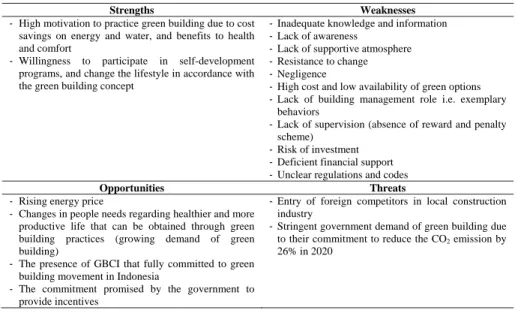
SWOT analysis was used to identify the strengths and weaknesses (i.e. internal factors according to building occupants), and opportunities and threats (i.e. external factors according to other stakeholders, i.e. government and GBCI, present currently in green building movement in Indonesia (see Table 1). Furthermore, some improvement strategies related to building occupants towards the success of green building movement can be recommended as follows:
1. Comprehensive education programs on green building are needed in order to increase the knowledge, and raise the public awareness. One thing that should be emphasized on the programs is the benefits of green building practices that people can gain both in short and long term. By doing so, they are expected to automatically implement the green practices by themselves. The government and GBCI can work together with schools, universities, and industries to run programs through talks, seminars, presentations, competitions, study tours, research, advertisements, etc. The media influences should also be harnessed to communicate the key messages of the green movement, raise awareness, support research, and conduct awareness sessions and trainings.
2. The schools and universities need to incorporate green building practices in their curriculum in order to prepare the next generations who concern about the environment. With enough knowledge, the students are expected to be able to implement the green practices as a habit in daily life, including in the workforce later on.
3. The government, together with the industries and particularly universities should also be active in providing grants for research and creative innovation on green options. It is intended to enhance the local products at a more affordable price. The industries also have to improve the marketing strategies to effectively introduce and bring more updates of green options to other stakeholders.
4. The efforts to raise public awareness on green building movement in Indonesia definitely will take decades to reach the expectation. In order to generate maximum result, this bottom-up approach should be combined with top-down approach. It is admitted by the respondents that somehow, the interference and pressure from the government to raise the green building practices will most likely be more effective due to the nature of Indonesian people. This top-down approach ensures the green practice done by all, even by the one who actually do not want to adopt it. For this moment, the top down approach would be faster and more effective on achieving the objective.
Tabel 1. SWOT analysis
Strengths Weaknesses Ǧ High motivation to practice green building due to cost
savings on energy and water, and benefits to health and comfort
Ǧ Willingness to participate in self-development programs, and change the lifestyle in accordance with the green building concept
ǦInadequate knowledge and information ǦLack of awareness
ǦLack of supportive atmosphere ǦResistance to change ǦNegligence
ǦHigh cost and low availability of green options ǦLack of building management role i.e. exemplary
behaviors
ǦLack of supervision (absence of reward and penalty scheme)
ǦRisk of investment ǦDeficient financial support ǦUnclear regulations and codes
Opportunities Threats Ǧ Rising energy price
Ǧ Changes in people needs regarding healthier and more productive life that can be obtained through green building practices (growing demand of green building)
Ǧ The presence of GBCI that fully committed to green building movement in Indonesia
Ǧ The commitment promised by the government to provide incentives
ǦEntry of foreign competitors in local construction industry
ǦStringent government demand of green building due to their commitment to reduce the CO2 emission by 26% in 2020
5. Reward and penalty scheme is one way to support the top down approach. The rewards in the form of incentives, i.e. green soft loans, tax reduction, exemption of payable and import duty, cash money, award, recognition, etc.
can be offered by the government, banks, industries, and even the building management for a saving on energy and water. However, to balance the previous efforts, the penalty must be given strictly to any violations of green practices, starting from a warning to real punishments. Supervision is required to ensure that such scheme works well. Only then, the public will respect the applicable rules/regulations and will continue to practice the green efforts. The supervision can be done by all the stakeholders, either by the government, building management, or even by each individual.
6. The existing regulations should be deepened in the forms of codes of practices, as well as GREENSHIP requirements into more detailed measurements, in order to ease the building occupants and other stakeholders on implementing the green practices. In relation to the certification, based on complaints conveyed by the building occupants, GBCI is expected to consider a reduction of certification fee to raise interest from the stakeholders to label their green products/buildings.
7. All stakeholders should be active in developing and promoting green programs or approaches to the public.
Especially to the building users, the role of building management is very important to a successful green movement. Approaches such as organizing green talks/seminars, competitions, and training for appropriate skills, utilizing green options in occupied buildings, promoting and reminding users of daily green practices using posters, stickers, and banners, providing smoking area, and more important, evaluating the green practices done by building users are some examples needed to reduce the negligence and raise awareness among the building occupants.
6. Conclusions
The findings revealed that the main barrier of green building movement in Indonesia is inadequate understanding of green building concept from building occupants, and even from other stakeholders. This key issue leads to other problems such as burdensome implementation, lack of awareness, negligence, and resistance to change to the new green lifestyle. Top-down approach which relies on high level of coercion and strict enforcement to other stakeholders to incorporate green building practices in future developments are expected to address the issues of reluctance and indifference of Indonesian people on green building movement. Lack of supports, appreciations, as
well as exemplary behaviors from the government, banks, industries, and building managements also creates a challenge to building practitioners and occupants to own, design, build and practice in green concept more effectively. In addition, unclear current regulations and codes, less detailed measurements of GREENSHIP, lack of creative innovations and ineffective marketing strategies of green products are some issues that need to be considered for future developments by the relevant parties. At the end, only through the integration of all efforts by the stakeholders in construction industry can it play the great result of green building movement in Indonesia.
References
[1] United Nations Environment Programme. http://www.unep.org/sbci/pdfs/BuildingsandClimateChange.pdf. 2009.
[2] United Nations Environment Programme. Global Environmental Outlook 3. http://www.unep.org/geo/geo3/english/pdfs/prelims.pdf.
2002.
[3] United States Environmental Protection Agency.http://archive.epa.gov/greenbuilding/web/html/about.html. 2014.
[4] U.S. Department of Energy. Re-Assessing Green Building Performance: A Post Occupancy Evaluation of 22 Buildings .2011.
[5] Bisagni Environmental Enterprise and the U.S. Consulate General Shanghai Commercial Service. China’s Growing Green Building Industry and How U.S. Companies Can Get Involved.
http://www.export.gov/china/build/groups/public/@eg_cn/documents/webcontent/eg_cn_088721.pdf . 2015.
[6] BEAM Plus Certified Building. http://www.beamsociety.org.hk/en_beam_assessment_project_4.php. 2012.
[7] CASBEE Certification System . http://www.ibec.or.jp/CASBEE/english/statistics.htm. 2015.
[8] Confederation of Indian Industry. https://igbc.in/igbc/redirectHtml.htm?redVal=showAboutusnosign. 2015.
[9] S. Buente. Top 10 Countries for LEED National Profile: India. http://www.usgbc.org/articles/top-10-countries-leed-national-profile- india. 2015.
[10] Keung. J. Singapore: Small Nation but Big Vision for the Built Environment. Proceeding of 2011 International Green Building Conference .2011.
[11] Green Building Index. Executive Summary. http://www.greenbuildingindex.org/organisation-certified-buildings-Summary.html. 2015.