SERIES OF PUBLICATIONS OF THE S M I T H S O N I A N I N S T I T U T I O N The emphasis on publications as a means of disseminating knowledge was expressed by the first Secretary of the Smithsonian Institution. Drypainting is only one item of the complex symphony of the arts that make u p a N a v a h o sang ceremonial. Lita O s m u n d s e n , director of research, W e n e r - G r e n F o u n d a t i o n for Anthropological Research, resulted in financial assistance for the typing of the manuscript, a task that mrs.
Such rites are discussed in detail and three versions of the m y t of Blessingway are presented in a publication by W y m a n (1970). Even the seemingly most insignificant of these is indispensable; all are interdependent and are complementary parts of the whole. Bundles of prayer sticks (wooden sticks decorated with painted symbols and feathers) are inserted vertically into a m o u n d of e a r t h in front of the door to the hogan to notify him and supernatural beings that a sand painting must be made.
Indeed, only after the first day on each of the first four mornings, a sweat and emetic ceremony repels an evil from internal and external purification. Consequently, most of the reproductions in the collections in our museums are made by white people. Some Navajos wanted to defy supernatural orders, and the creator of the paintings in the Walcott collection was one of them.
MYTHOLOGY
The distribution of the main mythic motifs within the five m y t h versions of M a l e Shootingway is shown in T a b l e I. However, in the latter this episode is a wedding with the serpent, while in two of Holyway's stories (Blue Eyes and Boy of the singing woman) is just a visit. Some of the hero's most perilous adventures on a visit are the result of disobeyed supernatural orders.
In fact, there is nothing u n i q u e in Flintway's myth except for the p e r h a p s emphasis on the restoration of the hero by the GUa Monster. Some of the attacking supernaturals are Bears and W h i t e Weasel (in Blue Eyes) and An t People (in R e d Point). The following motifs are not included in the table because each occurs in only one of the five myths.
MYTHIC MOTIVES OF FEMALE SHOOTINGWAY In W o m a n Singer's m y t of Female Shootingway the most important motifs are the Separation of the Sexes (W y m a n.
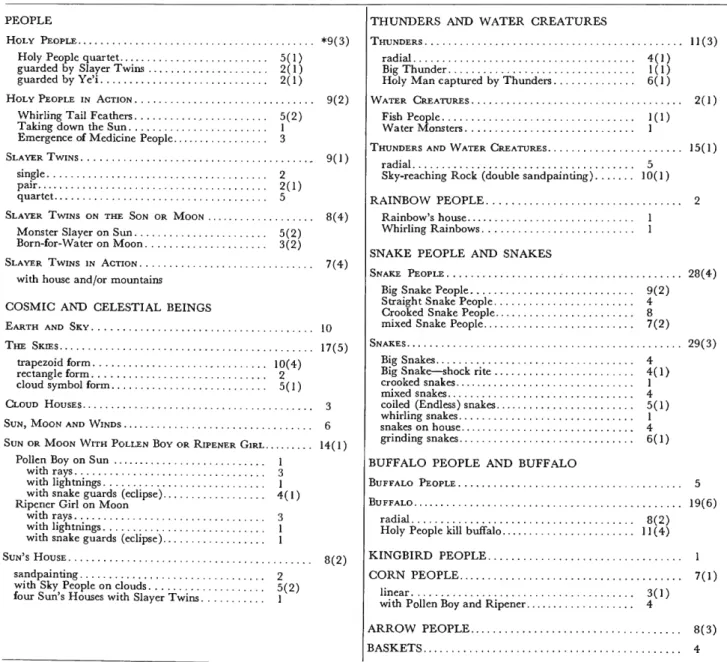
SYMBOLISM IN SHOOTINGWAY SANDPAINTINGS
- radial compositions 36 have the four sacred domesticated plants—^corn, beans, squash, and to-
- of the 141 sandpaintings that have small paired guardians of the eastern entrance (an optional
- SHOOTINGWAY 15 Straight r a i n b o w arrow were used (Reichard, 1950,
- SHOOTINGWAY 17
These two rainbow motifs thus make up half of the guardians used in Shootingway sand paintings. Four of the Corn People paintings have yellow Pollen Boy and blue Maiden as guards (3) or a pair of Maidens (1). On the second and fourth mornings of the House of the Sun, BW and W sing crooked lightning arrows, a WY straight sunbeam arrow, and an R U.
The main distinguishing symbol of the Sun's House phase of M a l e Shootingway is a representation of place: the Sun's permanent house in the eastern part of the sky. 8 In the notes accompanying the photographs taken by the late Katherine Harvey of the sand paintings from a Sun's House performance (presumably near Kayenta, Arizona, circa 1930) are the statements. The sand painting Mixed Snake People with Corn, considered the most important painting of the Snake Group, is often used as the first painting in the Sun House Phase (W y m a n, 1960, no.
The painting was unusual in that the guardian pair of the east was a pollen boy and a R i p e n e r girl, whereas usually they are a b a t and a sun tobacco pouch (as in five of the seven recorded guardian pair paintings).
REPRODUCTIONS OF SHOOTINGWAY SANDPAINTINGS
SHOOTINGWAY 21
A wool symbol with seven heads of Sky People rising from it can be used separately (Sky, Sun, Water, or Summer People) as a prayer painting in the early moming of the Sun's House or the Prayerstick phase of Male Shootingway (see Newcomb and Reichard, 1937, p This is described in the myth of Male Shootingway dictated to Father Berard Haile in 1924 by Blue (Gray) Eyes of Lukachukai, Arizona (MS. in MNA). Holy Young Man and the Bear, which represented by costumed impersonators in the rite in practice (see Wyman, 1965, p. 57), is shown east of the black ground (see Plate 37, herein).
Most of the Shootingway sand painting reproductions in the collections are from the men's branch. A version of the Holy Man caught by Thunders is one of the Sand Paintings for the Hallway in the Oakes Collection (No. 51). Blessingway's Corn People dry paintings are a single figure in one case and a pair of twelve-toothed Corn People in the other.
The direction of movement of figures in radial compositions is towards the sun in most paintings, and in linear compositions it is towards the south. In the files of the M u s e u m of N a v a h o Ceremonial Art there is a description of a ninth night ceremony M o u n t a i n - Shootingway, written by the late M a r y C. Two quartets, one of men and the other of Mountain Sheep People, facing the sides of the center ( verse), holding curved rainbows or feathered wands in a painting (Plate 40).
The Monster Slayer is standing south of the Sun; in the other, Born-for-Water stands to the south of the Moon, with guardians of the Rainbow and paired guardians of bears (Plate 43). Of the 18 Mountain-Shootingway sand paintings described above, seven are identical or similar to designs used in other ceremonies. Swallowed by a Fish depicts an event like t h a t shown in the southern composition of M a l e Shootingway's double sand painting, but the design is completely different.
Nine characteristic paintings unique to M o u n t a i n - Shootingway are those of M y t h People (3), Heavenly People (1), a n d dancers of various properties (5). Armer in Black M o u n t a i n a n d the Sky People in the paintings, by Miguelito (Red Dot) show the difference of sex according to the shape of the head-.
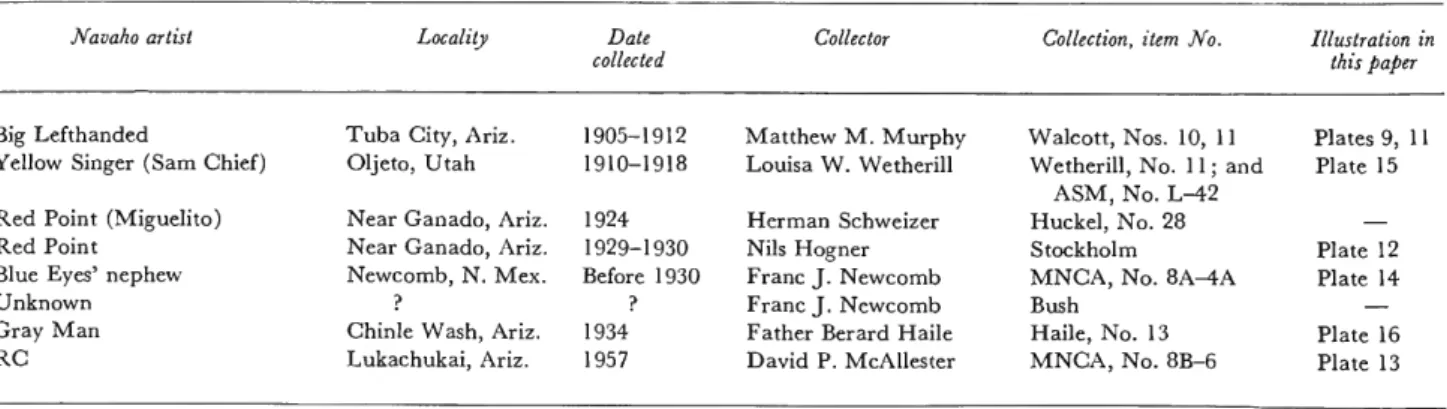
Also, the Walcott collection is one of three (or perhaps four) of the ten major collections that contain paintings m a d e directly by local informants. S a n d Painting, there are four other [lay] pictures (not the S a n d painting) which my father will present to the buyer of the paintings. The M U n t i o n a l catalog of states for the painting is followed (in parentheses) by the Bureau of American Ethnology (BAE) negative n u m e r e p h o t o g r a p h and then by the dimensions (given in inches of the painting).
A reference to a similar painting from another song gang is followed by the name of the song in brackets. He overcame it by means of his bows and arrows, and he got the image of the holy people who overcame it by its guardian. 3 All quotations (and references to statements) of informants included in the discussions about the paintings in the collection are from Mrs.
Reproductions of the E a r t h or Heaven, as separate paintings, have been illustrated as follows: Wheelwright, 1949, p. As this painting is incomplete, the description of its details is reserved for N u m b e r 6, which is a complete version of it. same basic design. The sequence of colors on the House of the Sun is the origin of the House of the Sun stripes in the face paint of Shootingway (see nos. 3, 17).
Once when Farmer-Dog was walking by the lake [shown in the center of the sand painting] he saw a plant growing out of the water. This painting shows the Holy M a n leaving the earth, while N u m b e r 9 illustrates his arrival at the house of T h u n d e r s . Trying to reach the cornstalk, he fell into the water and was swallowed by a large fish, which was taken to the people of the West at the bottom of the lake.
There he cut his way out of the fish using flint spikes, and then healed the creature with medicine herbs (in other versions, Holy Man cuts the fish and pulls out his brother). The corn stalk used to lure Holy Boy is located to the south of the painting in number 10, while in number 11 it is in the center.
- BUFFALO PEOPLE AND HOLY PEOPLE
One of these (MNCA 8A-4A, the work of Blue Eyes' nephew from Newcomb, New Mexico) was made in colored sand and stabilized as a centerpiece for the main exhibit room of the Museum of Navaho Ceremonial Art. This is one of the features that indicate that the supposed Plumeway sand painting mentioned in No. 9 (above) is a copy of a part of No. 10. Having the head of the Rainbow Guardian in the southeast is a unique feature not only to this painting , but for all sand paintings.
Northwest: yellow (pollen) Ascending Rock, around which are four black lakes, with a duck on each (W U Y P); yellow wolf and black bear east of the rock. Main Theme Symbols: W Y U B Big Fish; the rainbow in the eastern Fish's m o u t touches Holy Boy's head. Other unique features are the water monsters, the crooked lightning rod around the entire painting, and the eastern opening's b a t guardian.
VERSIONS OF DOUBLE SAND Since there are ten recorded versions of Sky-reaching Rock, well spaced in time and origin, it is interesting to compare them by version. Many variations of the double sand painting were described above when discussing the unique features of Numbers 10 and 11. This design seems to call for a lightning guardian, as in the other variations to be described it is surrounded by lightning bolts or lightning. guardian, and in all recorded versions of this motif as a separate sand painting, the guardian is a white and black curved lightning bolt.
T h e R a i n bow partly encircles the sky-knowing rock complex and ends with the head just east of it, while the heather u a r d i a n of the n o r t h e r n composition also ends at the same place next to the head of the R a i n bow 15 (see plate). Big Starway Evilway is used to remedy problems attributed to the evil influence of the ghosts of the Navahos or witchcraft. Snakes and Snake People are prominent both in the sand paintings and in the etiology of the song.
This sand painting represents Beautyway dancers performing t h e d a n c e of standing bows as described by M a t h e w s (1887) in the D a r k Circle of Branches of a ceremonial M o u n t a i n w a y . No other sand paintings like this are recorded, there are paintings of M y t h People in radial compositions or r e in t h e Wetherill, M N C A, N e w c o m b, Oakes, a Stockholm collection. Nightway's sand paintings mostly deal with various combinations of members of the class of supernaturals k n o w n as Ye'i.
Masked impersonators of male and female gods (Ye'i) appear in dances performed on the n i n t evening of the Nightsong.
J'EAS'
INDEX 97
INDEX 99
Sun's House with Sky People on clouds, [sandpainting], 21 Sun's House with Slayer Twins [sandpainting], 21, 88 Sun's House strepe, sien strepe.