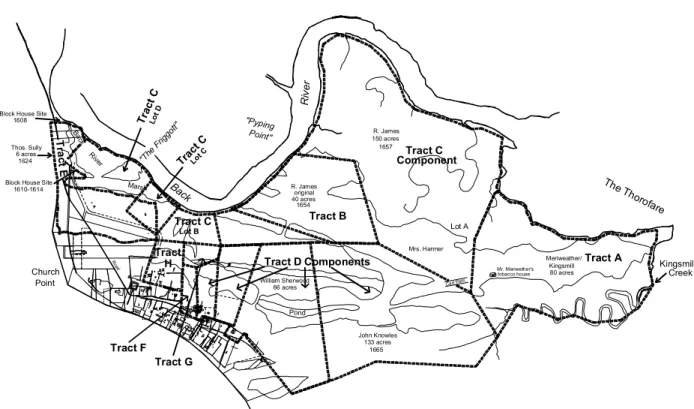
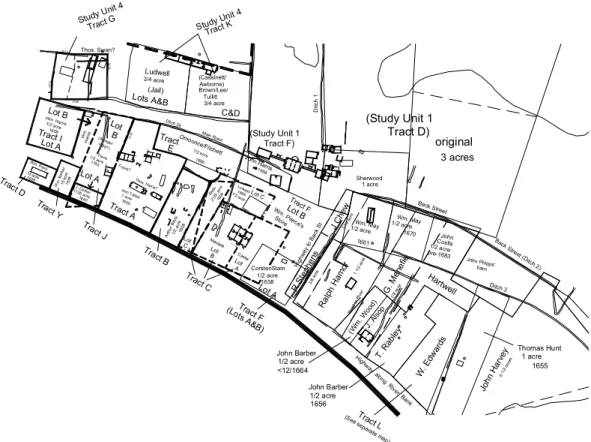
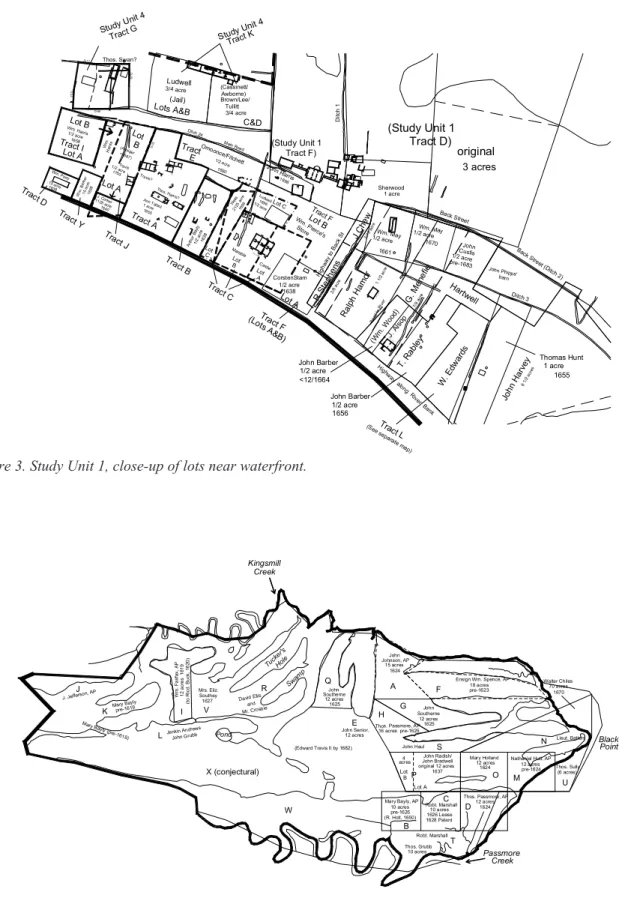
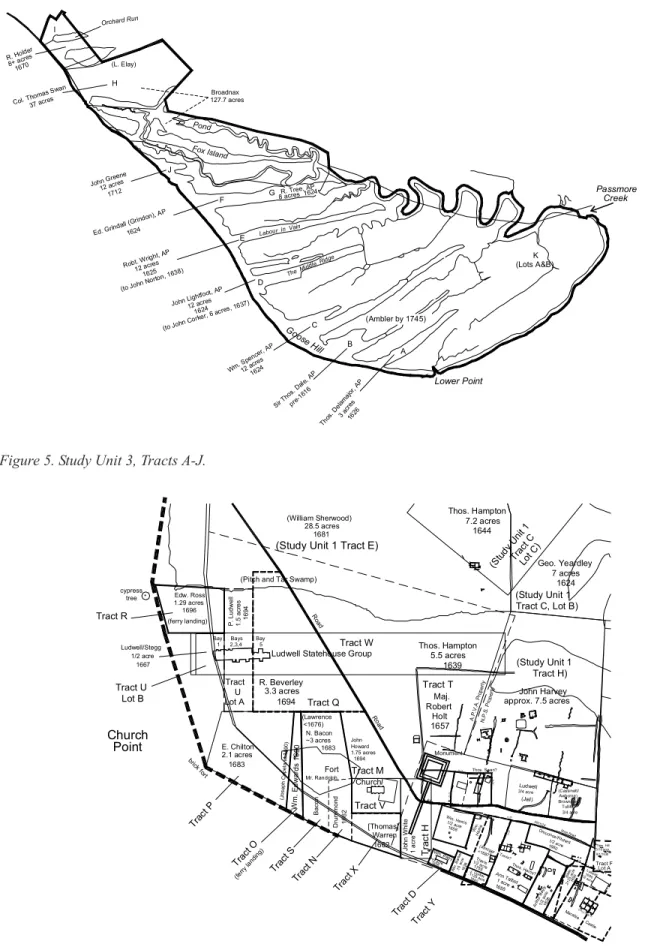
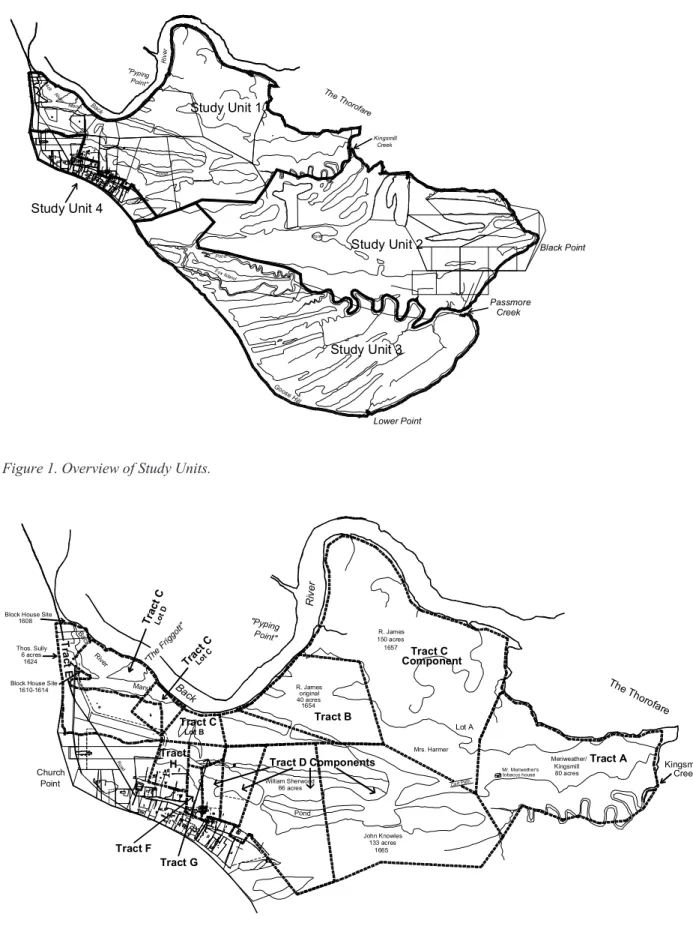
Study Unit 1 is bordered by Kingsmill Creek to the east, Sandy Bay to the west, and the Back River (or Back Creek) to the north. Study Unit 2 is defined by the James River to the east, Kingsmill Creek to the west, and the Back River.
Introduction
Research Design
The Ambler Manuscripts, portions of which are held at the Library of Congress and the University of Virginia, provide a wealth of information about the Ambler plantation on Jamestown Island and on the mainland in the eighteenth and nineteenth centuries. . The preliminary report that follows draws on many of the sources identified to date, a significant number of which await in-depth exploration.
Assessment of Contemporary Literature, BY L ORENA S. W ALSH
Moving on in the New World: Migration and Out-migration in the Seventeenth-Century Chesapeake.” Galenson, "Economic Aspects of the Growth of Slavery in the Seventeenth-Century Chesapeake," in Slavery and the Rise of the Atlantic System, ed.
Evolution and Change: A Chronological Discussion
The development of the sequoia trade in Sierra Leone and Sherbo was an important achievement. Gambia Adventurers, a subsidiary of Royal Adventurers, controlled the trade in Gambia, Sierra Leone, Sherbo and North West Africa.
The Wider Context, BY L ORENA S. W ALSH
In the lower-tidal Chesapeake, most new Africans arrived between the mid-1680s and the mid-1730s. As a result, the proportion of common planters in older Chesapeake communities has declined over the last quarter of a century.
1619-1630: Arrival and Dispersion
1 1 Hugh Thomas has noted that some of the Africans in Virginia in 1625 came to the colony with emigrating white families (Thomas. Daniel Poole, who resided on the lower side of the James River at Treasure Plantation, was identified as "A Frenchman."
1630-1642: A Pivotal Period of Change
It is likely that some of the workers involved in the manufacture of tanned leather and goods were black. All the men's terms would be extended and all but one (Day) would receive 39 lashes at the whipping post in Jamestown (McIlwaine 1924:383). All but one of the runaways (a carpenter) would receive 39 lashes at the whipping post in Jamestown and their time would be extended to cover the cost of a boat they had stolen from William White I (Study Unit 4 Tract H ) and then lost (McIlwaine 1924:382).
Included would have been any Africans he acquired while an agent for the Royal African. Samuel Thompson of Surry County", believed to be one of the "principal actors" in the conspiracy, had escaped. All the slaves were to be taken to Barbados, Jamaica or another island in the West Indies, where they would be sold.
1991 "Economic Aspects of the Growth of Slavery in the Seventeenth-Century Chesapeake." In Slavery and the Rise of the Atlantic System, ed.
1642-1652: Berkeley’s First Term
1652-1660: The Commonwealth Period
The arrival of the Parliamentary fleet caused "the summoning of the Assembly, and the disbanding of their troops (of which there were about 1,000 or 1,200 under arms at James City)" (Stanard 1904:35). The text of the legislation passed by the Assembly confirmed that they encouraged the importation of African slaves. In the first half of the seventeenth century, some blacks and Indians received religious instruction.
It seems that in the 1980s and 1990s, most (if not all) children were considered servants and not slaves.
1660-1677, Berkeley’s Final Term
Colonel Joseph Bridger of Isle of Wight County, councilor at the time of Bacon's Rebellion and staunch supporter of Governor William Berkeley, was reportedly building "houses" in Jamestown on September 20, 1683. The lawmakers noted that “several persons are purchasing female servants to work in the ground, thereby enabling them to avoid payment of duties.” In recognition of this tax avoidance strategy, a new law specified that “all female servants whose common duty consists of working in the harvest shall be considered tythable” (Hening 1809-1823:II:170). The Court ordered Bryan to pay Kirkman for providing “a good, well-designed lash” in accordance with the law (McIlwaine 1924:347).
In April 1676 he and his men set out for the southern part of the colony.
1678-1699: The Old Capital’s Decline and Demise
She suggested that most of the slaves brought to Virginia after the early 1670s had stopped very briefly in the Caribbean. He did, however, hold bay 3 of the Ludwell Statehouse Group (on Study Unit 4 Tract U Lot A) while employed by the Royal African Company. With the loss of Royal African Company control, the number of shipments of African slaves transported directly to the Chesapeake increased dramatically.
By the turn of the eighteenth century, only about ten percent of the Africans imported to the Chesapeake arrived aboard ships belonging to the Royal African Company (Walsh 1997:54).
Three Microcosms: The Travis and Ambler Plantations and Green Spring
Thus, it is certain that James had at least one African as part of the labor force on his plantation. In October 1680, Mrs. Frances Berkeley's fortunes took another turn, for she married Colonial Secretary Philip Ludwell I, who had inherited Rich Neck from his brother, Thomas (Hening II:559; Stanard 1925:352). In 1683, Philip Ludwell I and Lady Frances Berkeley disposed of some of her late husband's estate, at which time a deed was recorded in the records of the General Court.
Lady Frances Berkeley died in 1689 and Philip Ludwell inherited her property, which passed into the hands of the Ludwell heirs.
1700-1792, The Plantation Period
The accused person was to be arrested and detained until the governor could be informed of the need to convene a court of Oyer and Terminer. He recognized the important role slaves played in the life of Virginia's economy and said so even before the war. Once again, the owners of slaves sentenced to death or transported from the colony had to be compensated.
The suspected leaders of the plot were assembled and tried by the General Court, found guilty and sentenced to be transported out of the colony. He added that "The language of the young negroes is various harsh slangs and their religions and customs as best described by Mr. All slaves from those two states who were still in Virginia a year after the British had been expelled. they would be released from the state.
Microcosms: The Travis and Ambler Plantations, the Broadnax Holdings, Urban
During the administration of Governor Robert Dinwiddie, Philip Ludwell III began leasing 825 acres of the governor's land. Likewise, all slaves on the Hot Water Canal who were under the care of overseer Richard Branch were classified as planters. By July 4, the bulk of the British army was encamped on the mainland near Jamestown Island.
It is uncertain how many of the 99 slaves credited to William Lee in 1784 belonged to the late Philip Ludwell III in 1767.
1793-1803: Steps Along the Path to Freedom
In December 1804, a newly formulated law stated that black orphans and mulatto children, when entrusted to the care of County Overseers of the Poor, could not learn to read and write if such children were sent away (Shepherd 1970: III:124). It required that all slaves emancipated after the passage of the law must leave the state of Virginia within twelve months or “lose all such right.” Furthermore, former slaves who failed to leave the state “may be apprehended and sold by the overseers of the poor of any country or business where he or she may be found” (Shepherd 1970:III:251-253). Fortunately, the passage of the new law post-dated the emancipation of the slaves belonging to William Lee's son and heir, William Ludwell Lee of Green Spring.
On July 14, 1802, when the latter made his will, he instructed his executors to free his slaves on January 1 of the year following his death.
Microcosms: The Travis and Ambler Plantations, Urban Jamestown, and
John Ambler II is said to have granted life rights to the farm known as "The Maine" or "Amblers" to his married daughter, Mary Ambler Smith, wife of John Hill Smith, a Williamsburg attorney. In 1771, William Lee and his wife, Hannah Philippa, daughter and heiress of the late Philip Ludwell III, came into possession of two lots owned by his father in Jamestown, one of which was described as "improved." The improved lot may have enveloped the east end of Structure 115 (Study Unit 4 Tract K Lots C and D, Bays 3 and 4), which was purchased by Philip Ludwell II after it was rebuilt. After the death of Lewis Burwell III, Study Unit 4 Tract S may have become part of the Ambler plantation.
William Lee died at Green Spring on June 27, 1795, at which point Green Spring Plantation and most of his other property passed into the hands of his son, William Ludwell Lee (Stanard 1929:293).
Looking to the Future
During the 1830s, James City County's free blacks included three carpenters, two shoemakers, a wheelwright, a mason plasterer, and a midwife. Between 1830 and the eve of the Civil War, the amount of acreage owned by James City County's free blacks increased markedly. The Warmwater tract was occupied by free blacks until the end of the Civil War and was identified as such on contemporary maps (James City County Land Tax Lists Gilmer.
About one-third of James City County's black heads were described as "mulatto," i.e., they were.
Recommendations for Future Research
A study should be made of the use of indentured servants on Jamestown Island and Green Spring. 1998 "From Slaves, Convicts, and Servants to Free Travelers: The Transformation of Immigration in the Age of the American Revolution." Journal of American History 85: 43-76. 1963 Tracts and Other Papers Relating to the Origin, Settlement, and Progress of the Colonies in North America.
1957 A True Discourse of the Present Fortune of Virginia and the Success of Affairs there to the Eighteenth of June 1614.
Guide to the Database