
Matching describes approaches where users compare output from the devices involved to confirm or reject a connection. These mechanisms enable devices to be aware of the availability of other devices on the network. Here, association is directly tied to a physical relationship of the devices in the world, and users establish connections by bringing devices into this relationship.
To form an association, a user points a cell phone camera at a visual tag of the target device. Because their involvement is minimal, it is conceptually difficult for users to monitor the association's progress.
![Fig. 2. A conceptual example of “Touch-and-Play” [Park et al. 2006a, 2006b]: a user can print a desired photo stored in a digital camera by touching a printer while holding the camera.](https://thumb-ap.123doks.com/thumbv2/123dok/11343698.0/6.918.358.563.175.341/conceptual-example-touch-desired-digital-touching-printer-holding.webp)
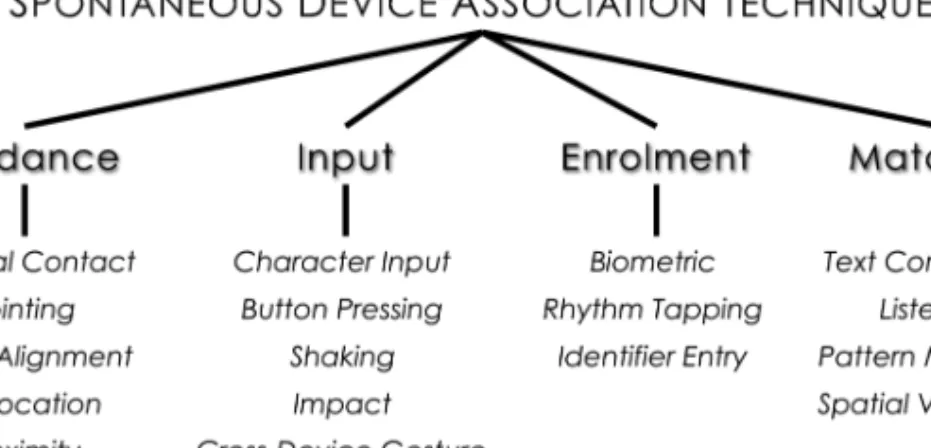
INPUT-BASED ASSOCIATION
- Character Input
- Button Pressing
- Shaking
- Impact
- Cross-Device Gestures
The user then authenticates by mimicking the sequence of gestures (the response) on the mobile device. Gestures, on the other hand, require extra effort because users must first get to know the system. When a user wants to pair two devices, the user presses the SyncTap buttons on both devices simultaneously [Rekimoto et al.
SyncTap is based on the time domain of button events; can only associate devices with concurrent events. On the other hand, using the sequence domain requires the user to be consciously aware of which button to press next. 2001] proposed "Smart-Its Friends", the first system to suggest the use of quick shakes to associate devices.
By forcing the same motion on the devices, they capture relatively symmetrical data, and the system uses this symmetrical input to identify bonding devices. The longer the user shakes the devices, the stronger the security of the connection becomes—the entropy of the generated key becomes higher. For example, a user can drop photos onto a photo or collect a photo from a precise location on the surface [Schmidt et al.
Interaction can be seen as a metaphor for (1) joining objects into one by pushing them together, as well as (2) building a relationship of trust by knocking objects together (eg, the label of people "knocking" drinking glasses during a toast) .
![Fig. 6. An illustration of “Touch-and-Connect” [Iwasaki et al. 2003]. A user first presses the (P)lug button on a source device to indicate an intention for associating devices](https://thumb-ap.123doks.com/thumbv2/123dok/11343698.0/13.918.306.608.170.340/illustration-connect-iwasaki-presses-indicate-intention-associating-devices.webp)
ENROLMENT-BASED ASSOCIATION
Rhythm Tapping
A TapSong password consists of the rhythm of tap-down/up events based on a jingle timing model created by users. During spontaneous encounters with other (RhythmLink-compatible) devices, the user can record the same rhythm in a target device.
Identifier Entry
MATCHING-BASED ASSOCIATION
- Text Comparison
- Listening
- Pattern Matching
- Spatial Validation
Strings (SASs)” [Vaudenay 2005], SAS for groups of devices [Laur and Pasini 2008], MANA IV (which can be seen as a generalization of the earlier string-based protocols) [Laur and Nyberg 2006], an extension of MANA IV for groups [Valkonen et al. In HAPADEP, the system uses a single audio channel for both protocol communication and human verification [Soriente et al. The system speaks the sentences and users verify this by comparing the words of the sentences [Goodrich et al.
Their system outputs verification data using devices' binary outputs - by emitting blink or beep signals - for manual comparison. They used the combination of radio frequency and ultrasound to detect the distance (using the speed of sound) and the relative orientation of the target device. Once detected, the system also displays information from the available surrounding devices for users to physically verify the target.
To avoid ambiguity (e.g., multiple devices located on the same line of sight), the user must turn as well as walk back and forth so that the system updates new positions and thus disambiguates the source of the signals. Their system automatically detects surrounding entities, calculates their relative positions, and displays a spatially mapped visualization of the detected entities (see Figure 11). The user matches the virtual representation with the actual device in the real world and then selects the target device from the visual display.
Their results show that participants were able to select the target unit correctly and made very few errors.
SUMMARY OF SPONTANEOUS DEVICE ASSOCIATION SYSTEMS
Two spatial reference user interfaces adopted by Mayrhofer et al. Right) View of the map of Kortuem et al. The matching-based techniques mentioned above require users to verify some form of information generated by the device. A pairing technique can fall into one of the following three categories: pairing (only two devices), limited (can accommodate multiple devices but limited by some physical limitations), and unlimited (no limit on the number of devices).
Applying a pairing technique to a group association requires its users to perform multiple pairings; if N devices are involved, users must perform N−1 pairings. Controllability indicates social context; an association could be controlled by either a single user, with the rest of the users having to surrender possession of their units, or individual users, with each user holding on to their own units. Perceptibility categorizes the affordance of how users perceive the performance of an association (i.e., the cues provided by the hardware that indicate an association is occurring).
If a system adopts a technique that requires devices to be within a reachable distance, the devices are forced to be together during association. However, if the surrounding context forces the devices to be separated (eg by a glass window), the user cannot bring the device with a reachable action for association. The last two columns in the tables indicate whether the literature includes a discussion of how to incorporate security within the proposed association technique, as well as the out-of-band channel(s) used to establish an association.
The summary tables are convenient and useful for choosing an association technique with specific requirements.
EMPIRICAL STUDIES
Preliminary Studies
From a system's point of view, it is important to show that a device association technique works for its intended purpose. From a usability point of view, however, the importance lies in whether the technique is usable by people (besides the designers themselves) as well as how they feel about the interaction. For the first step in understanding usability, researchers conduct preliminary (or informal) user studies in laboratory settings to determine people's performance (i.e., quantitative results) as well as their acceptance (i.e., qualitative results) of a technique.
For example, Ayatsuka and Rekimoto [2005] reported small-scale preliminary user studies with five or fewer participants. It gives no indication of how well people perform and/or prefer to use the technique compared to other existing ones.
Comparative Studies
The results of the study show that Select-and-Confirm, Copy-and-Confirm, and Choose-and-Enter had non-zero fatal error rates, caused by users not strictly following the prescribed order of interaction. If one device had a speaker and the other had a microphone, audio coupling (e.g., HAPADEP [Soriente et al. 2008; Goodrich et al. 2009]) was the preferred method. The results show that for devices with limited interface (e.g. headsets) BEDA Vibrate-Button [Soriente et al.
2011] refined the study by including only techniques that enable “social pairing”. Similar to the “Individual User” controllability described by Chong and Gellersen [2012], a social pairing scenario involves two different users establishing the pairing between their respective devices. While these studies mainly focused on finding the most usable and secure method(s) among several existing approaches, Ion et al. In their study, four techniques (Select the device, take a picture, listen and press the button) and three situations (print a document, make a payment and send electronic business cards) were tested.
Their findings showed that people do not always use the easiest or most popular method. Four group bonding techniques were tested with variable group sizes between two and six members per group. Overall, their results show that the peer verification technique with users inputting the group size achieved the best usability results and was also the most robust against simulated attacks in the study.
Studies that have investigated many methods simultaneously can easily overwhelm the participants with fatigue and confusion [Ion et al.
User-Defined Action Studies
Although all the studies mentioned above compared different user interaction techniques for connecting devices, they were all motivated by usability security. More than 70% of moves resulted in a change in relative distance; also, more than 70% caused the phone's absolute location to change. Only 20% of phone-to-public display gestures involved touching two devices, while touch events occurred twice as often (39%) in the phone-to-phone and phone-to-desktop conditions.
2010] provided an analysis of the fundamental properties of gestures, which is useful for designing future phones (eg, choosing sensors that can recognize gestures). They conducted a large-scale study to understand, rather than just gestures and despite the limitations presented by current hardware, the types of actions people spontaneously produce to connect wireless devices. The first five categories have similar parts, and their sum dominates over 80% of the total occurrences.
Besides their dominance, the results also show their high coverage across different device combinations, but not a single category had achieved dominance in any of the combinations. The results of Chong and Gellersen [2011] only represent scenarios where unit associations were controlled by one operator. The results of the study show that many people conceptualize group affiliation as a one-step procedure rather than multiple pairings.
People often talk about how techniques for connecting devices should be similar to interactions they have previously learned or encountered with other systems [Chong and Gellersen.
![Fig. 12. (Left) The low-fidelity acrylic prototypes used in Chong and Gellersen [2011]](https://thumb-ap.123doks.com/thumbv2/123dok/11343698.0/29.918.193.722.172.362/fig-left-fidelity-acrylic-prototypes-used-chong-gellersen.webp)
CONCLUSION
- Understand People
- Group Association
- Get Out of the Lab
- Usability Versus Security
- Device Dissociation
- Final Remarks
InProceedings of the 2nd International Workshop on Security and Privacy in Spontaneous Interaction and Mobile Phone Use (IWSSI/SPMU 2010). I Proceedings of the 12th IFIP TC 13 International Conference on Human-Computer Interaction: Part II (INTERACT'09). I Proceedings of the 12th International Conference on Human Computer Interaction with Mobile Devices and Services (MobileHCI'10).
Proceedings of the 4th European Conference on Security and Privacy in Ad-Hoc and Sensor Networks (ESAS'07). Proceedings of the 12th International Conference on Human Computer Interaction with Mobile Devices and Services (MobileHCI'10). In Proceedings of the 23rd Annual ACM Symposium on User Interface Software and Technology (UIST'10).
InProceedings of the 11th International Conference on Human-Computer Interaction with Mobile Devices and Services (MobileHCI'09).
![Fig. 3. Examples of “Seeing-Is-Believing” (SiB) [McCune et al. 2005, 2009]. A phone running SiB scans the barcode of a target device to capture its cryptographic information](https://thumb-ap.123doks.com/thumbv2/123dok/11343698.0/8.918.324.589.173.308/examples-seeing-believing-mccune-running-barcode-cryptographic-information.webp)
![Fig. 4. An illustration of “Touch & Connect” [Seewoonauth et al. 2009]. (Left) A laptop is attached with an NFC tag that is embedded with the laptop’s Bluetooth address](https://thumb-ap.123doks.com/thumbv2/123dok/11343698.0/10.918.279.634.176.301/illustration-touch-connect-seewoonauth-attached-embedded-bluetooth-address.webp)
![Fig. 5. An illustration of “tranSticks” [Ayatsuka and Rekimoto 2005]. Two memory cards are first registered to share a unique identity plus key](https://thumb-ap.123doks.com/thumbv2/123dok/11343698.0/11.918.233.682.177.285/illustration-transticks-ayatsuka-rekimoto-memory-registered-unique-identity.webp)
![Fig. 7. “Shake Well Before Use” [Mayrhofer and Gellersen 2007b, 2009]: A user holds two mobile devices in one hand and shakes them rapidly for several seconds to establish an association.](https://thumb-ap.123doks.com/thumbv2/123dok/11343698.0/14.918.373.544.172.307/shake-mayrhofer-gellersen-devices-rapidly-seconds-establish-association.webp)
![Fig. 9. “PhoneTouch” [Schmidt et al. 2010]: (Left) An illustration showing how the system detects phone tapping events](https://thumb-ap.123doks.com/thumbv2/123dok/11343698.0/15.918.175.738.351.508/phonetouch-schmidt-left-illustration-showing-detects-tapping-events.webp)
![Fig. 8. An illustration of “Synchronous Gestures” [Hinckley 2003]: (Left) A user connects two devices by bumping one device into another one](https://thumb-ap.123doks.com/thumbv2/123dok/11343698.0/15.918.178.743.177.283/illustration-synchronous-gestures-hinckley-connects-devices-bumping-device.webp)
![Fig. 10. An illustration of “Stitching” [Hinckley et al. 2004]: A user connects two tablets by drawing a stitching stroke from the top tablet to the bottom tablet.](https://thumb-ap.123doks.com/thumbv2/123dok/11343698.0/16.918.352.563.173.393/illustration-stitching-hinckley-connects-tablets-drawing-stitching-stroke.webp)
