AN UNDERGRADUATE THESIS
INCREASING THE READING COMPREHENSION ABILITY BY USING STUDENT TEAM ACHIEVEMENT DIVISION (STAD) METHOD AT THE TENTH GRADERS OF MA DARUN NASYI’IN
BUMI JAWA IN ACADEMIC YEAR 2017/2018
By:
EKA ARIF YANI Student Number: 1064547
Tarbiyah Faculty
English Education Department
STATE INSTITUTE FOR ISLAMIC STUDIES OF METRO
1439 H / 2018 M
INCREASING THE READING COMPREHENSION ABILITY BY USING STUDENT TEAM ACHIEVEMENT DIVISION (STAD) METHOD AT THE TENTH GRADERS OF MA DARUN NASYI’IN
BUMI JAWA IN ACADEMIC YEAR 2017/208
Presented as a Partial Fulfillment of the Requirements for the Degree of Sarjana Pendidikan (S.Pd.)
in English Education Department
By:
EKA ARIF YANI Student Number: 1064547
Tarbiyah Faculty
English Education Department
Sponsor :Drs. Kuryani, M.Pd.
Co-Sponsor :Dra. Yerni, M.Pd.
STATE INSTITUTE FOR ISLAMIC STUDIES OF METRO
1439 H / 2018 M
INCREASING THE STUDENTS` READING COMPREHENSION ABILITY BY USING STAD METHOD AT THE TENTH GRADERS OF
MA DARUN NASYI’IN BUMI JAWA IN ACADEMIC YEAR 2017/2018 ABSTRACT
By:
Eka Arif Yani
Many students at the tenth graders of Islamic Senior High School, East Lampung consider that reading is difficult aspect in learning English. It is caused the students’ still have difficult when they have to find difficult vocabularies in a reading text. Moreover, the students’ are lack of enthusiasts in joining the learning process. In this research, the researcher used Student Team Achievement Division (STAD) method to increase the students’ reading comprehension ability. Reading texts is as of media. So the aim of the researcher is to establish situation in wich individual achievement a given or effect by group of achievement.
The researcher was used Classroom Action Research (CAR). This research was conducted in two cycles. Between one cycle with the other has relationship.
They are including planning, acting, observing and reflecting. The subject of the research was the students of tenth graders of the Islamic Senior High School MA Darun Nasyi’in Bumi Jawa
In collecting data, the researcher used test and documentation. the test consist of pre-test and post-test. The purpose of pre-test and post-test are to know how far the students’ reading comprehension ability before and after being giving the treatment.
The result of pre-test and post-test show that there is increase from the pre- test and post-test. The average score of the post test is higher than pre-test. The average score of pre-test 42.16, then the average score of post-test I is 51,33. The average score of post-test II is 59,83. From pre-test to the post-test cycle I there is increase for about 4. 66 points, and from pre-test and the post-test cycle I to the test cycle II, There is increase points. So, STAD method can increase the students learning activity and the students’ reading comprehension ability.
MENINGKATAN PENGUASAAN PEMAHAMAN MEMBACA MENGGUNAKAN METODE STAD DI KELAS SEPULUH
MA DARUN NASYI’IN BUMI JAWA TAHUN 2017/2018
ABSTRAK Oleh:
Eka Arif Yani
Banyak siswa kelas sepuluh (X) di MA Darun Nasyi’in Bumi Jawa menganggap bahwa membaca adalah sebuah kesulitan ketika mereka mempelajari Bahasa Inggris. Hal ini disebabkan para siswa masih kesulitan dalam membaca ketika mereka menemukan kosa kata yang sulit daalam sebuah teks bacaan. Selain itu, para siswa kurang antusias dalam mengikuti proses pembelajaran. Siswa juga tidak aktif selama proses belajar mengajar. Dalam penelitian ini, peneliti menggunkan metode Student Team Achievement Division (STAD) method sebagai media belajar.jadi, menciptakan situasi dimana keberhasilan individu ditentukan atau dipengaruhi oleh keberhasilan kelompoknya.
Penelitian ini menggunakan Penelitian Tindakan Kelas (PTK). Penelitian ini dilakukan dalam dua siklus. Masing-masing siklus terdiri dari perencanaan, tindakan, pengamatan, dan refleksi. Subjek dari penelitian ini adalah siswa kelas sepuluh yaitu kelas sepuluh MA Darun Nasyi’in Bumi Jawa.
Dalam pengumpulan data, peneliti menggunakan tes dan dokumentasi. Tes terdiri dari tes sebelum diberi STAD method (pre-test) dan tes sesudah diberi STAD method (post-test). Tujuan dari tes tersebut adalah untuk mengetahui sejauh mana pemahaman siswa sebelum dan sesudah diberi STAD method.
Hasil tes menunjukkan bahwa ada peningkatan hasil dari pre-test dan post- test. Nilai rata-rata post-test lebih besar dari nilai pre-test. Nilai pre-test sebesar 42.16, kemudian nilai rata-rata post-test pertama sebesar 51.33, dan nilai rata-rata post-test kedua sebesar 59,83. Peningkatan yang terjadi dari pre-test ke post-test pertama sebesar 4,66 points, kemudian dari pre-test pertama dengan pre-test ke dua sebesar poin. Jadi, STAD method dapat meningkatkan kemampuan aktifitas pembelajaran dan penguasaan pemahaman membaca pada siswa
MOTTO
“ Ilmu adalah kehidupan bagi fikiran “ (Sayyidina Abu Bakar Asshidiq)
“ Knowladge Is The Life Of The Mind "
(Sayyidina Abu Bakar Asshidiq)
DEDICATION PAGE
I highly dedicate this undergraduate thesis to:
1. Almighty Allah SWT. Thanks and god all about the precious gift inside to me.
2. My beloved family, especially my parent Mr. Khoeroni and Mrs. Siti Aisah.
3. My beloved Husband Muhammad Muhtar, who always love me every time.
4. My beloved son Muhammad Aldrik Almuarify who always gives me motivate for me.
5. My beloved brother, Muhammad Irfan Nadhori.
6. My beloved friends in IAIN Metro, and whom I love 7. My beloved Almamater of IAIN Metro
ACKNOWLEDGEMENT
Glory is to Allah SWT, the Most Gracious, and the Most Merciful, who always gives all what we need and has taught human beings of what they don’t know. Allah has given His gift to the writer that he could accomplish the research proposal. Peace and salutation will not stop to be upon our prophet Muhammad SAW, his family and his companions.
The research proposal entitles “The Influence of Using STAD Method toward Students’ Reading Comprehension at the Tenth Graders of MA Darunnasyi’in Bumi Jawa in Academic Year 2017/2018”. The research will be conducted to the student of the tenth graders of Madrasah Aliyah Darunnasyi’in Bumi Jawa. In the research, the writer will focus on analyzing the influence of using STAD toward students’ reading comprehension.
There were many helpful individuals involved in accomplishing the research proposal that the writer could not mention one by one. Her big thank goes to both of her advisors, Drs. Kuryani Utih, M.Pd. and Dra. Yerni, M.pd who played prominent role in conducting the undergraduated thesis. May Allah SWT gives them reward for supporting and guiding during the undergraduated thesis. Her deepest gratitude goes to her parents and all family who strongly inspire.
Furthermore, the writer also would like to express her inner thanks to the lecturers of English Education Study Program, the students of English Education Study Program, and also all friends of her.
Last but not least, a wise-man said ”take what happen as a lesson”. As human being, the writer completely realizes that her undergraduated thesis still quite needs many corrections. The writer apologizes for all mistakes she has made in writing and presentation items. All constructive comments and suggestions are welcomed to straighten up the quality of the undergraduated thesis. Hopefully, the research proposal can be a benefit for the writer and English language teaching.
Metro, June 05th, 2018 The Writer,
EKA ARIF YANI ST.N 1064547
TABLE OF CONTENT
COVER ... i
TITLE PAGE ... ii
ABSTRACT ... iii
NOTA DINAS ... v
APPROVAL PAGE ... vii
RATIFICATION PAGE ... viii
STATEMENT OF RESEARCH ORIGINALITY ... ix
ORISINALITAS PENELITIAN ... x
MOTTO ... xi
DEDICATION PAGE ... xii
ACKNOWLEDGEMENT ... xiii
TABLE OF CONTENT ... xv
LIST OF TABLE ... xvii
LIST OF PICTURE ... xviii
LIST OF GRAPE ... xix
LIST OF APPENDIXES ... xx
CHAPTER I INTRODUCTION Background of the Study ... 1
Problem Identification ... 5
Problem Limitation ... 5
Problem Formulation ... 5
Objectives and Benefits of the Study Objectives of the Study ... 6
Benefits of the Study ... 6
CHAPTER II THEORETICAL REVIEW Concept of the Reading Comprehension Ability The concept of Reading ... 8
The concept of Reading Comprehension ... 12
The concept of Reading Comprehension Ability ... 16
Measurement of Reading Comprehension Ability ... 19
Concept of Student Team Achievement Division (STAD) method Definition of Student Team Achievement Division (STAD) ... 21
Principle of Student Team Achievement Division (STAD) method Purposes of (STAD) method ... 22
Components of STAD Method ... 24
Implementation Steps STAD Method... ... .26
Advantages and Disadvantages of STAD Method Advantages of STAD Method ... 26
Disadvantages of STAD Method ... 27
Action Hypothesis ... 27
CHAPTER III RESEARCH METHOD Setting of the Study ... 28
Subject of the Study ... 29
Research Procedure ... 29
Data Collecting Technique ... 33
Research Instrument ... 35
Data Analysis Technique ... 36
Indicator of Success ... 38
CHAPTER IV RESULT OF THE RESEARCH Description of the Research Location ... 39
Description of the Research Action and Learning at Pre-Test ... 44
Cycle I ... 46
Cycle II ... 56
Interpretation ... 64
CHAPTER V CONCLUSION AND SUGGESTION Conclusion ... 73
Suggestion ... 74 BIBLIOGRAPHY
APPENDIXES
CHAPTER 1 INTRODUCTION
A. Background of the Study
English is one of the languages which is used widely in the world.
Moreover, English is one of the second or formal languages in many countries in the world. In this way, English becomes a key of knowledge because a big part of important literatures written in English.
In English, four basic skills are available, namely: listening, speaking, reading, and writing. Reading is one most difficult skill to teach, because it is a complex process and it involves many different elements, such as mechanical eye movement and intellectual comprehension such as imagining, reasoning, evaluating, problem solving, spelling, grammar and phonetic. Moreover, from time to time teachers are often faced by new method of teaching or theory as the result of newest finding. So, the teachers should know and try to apply the appropriate method in teaching to reach the successful of learning process especially in reading comprehension.
Reading comprehension is the ability to understand and interpret the text. Be able to accurately understand the text, the students need be able to 1) decode what they read, 2) make connections between what they read and they already know, and 3) think deeply about what they have read. Therefore, to gain the aim of reading comprehension is not only done by students but also by teacher, because it is impossible for students to master this skill without
helping from teacher, and this is the only reason to teacher to provide the right strategy, method, and technique in teaching English especially on reading subject.
In fact, many problems are faced by students when they want to achieve the purpose of reading. Those problems are about reading habit, reading technique, eyes work, motivation and reading interest. Maximal reading skill cannot be achieved if there is still any bad habit when they are reading. Interpret word by word of the text is one of the readers’ bad habit. It is not effective because they need much time to interpret all the words of the text.
Additionally, students’ lack of understanding on reading lesson is also caused by an inappropriate technique when teacher attempts to explain reading material. The technique that used by teacher is unattractive and monotonous. Accordingly, the students feel bored, lazy and they were busy with themselves because they have not skill in reading text.
In emphasizing this research, the writer had taken the data of students’ reading at the tenth graders of MA Darunnasyi’in to be pre-survey data. The result of pre-survey can be seen on the table below:
No. Score Explanation Frequency Percentage
1. 80-100 Excellent 8 27%
2. 66-79 Good 5 17%
3. 56-65 Fair 7 23%
4. 40-55 Poor 9 30%
5. 30-39 Very Poor 1 3%
Total 30 100%
Table 1. Students’ reading result
The English standard value in this school is 65. Referring to the table above, it can be known that the students’ reading result is low. It indicates 17 students (53%) of them did not pass the test and 13 students (47%) of them passed the test.
Based on the result of preliminary research at MA Darunnasyi’in, the writer sees that many students could not comprehend the reading text.
Most of them are less of vocabulary. It means that they cannot construct the meaning of the text well. In line with this problem, the students are not able to get the main idea of the text. They still found some difficulties to identify some information. Furthermore, they are not active during teaching learning process.
In line with, it is necesary for the English teacher to teach reading. It may be done by selecting proper material for the students. The reading program may be useless if it is not done properly. The teacher should select reading materials properly which are relevant to the students’ need and interest.
The teachers’ technique to teach reading is the important factor that may affect the students’ ability in reading comprehension. There are some kinds of methods and techniques which can be applied by teacher to develop the students’ ability in reading comprehension. In relation to the situation above, the teachers are expected to be more creative in choosing the method and technique so that the learning goal will be achieved.
One of the teaching learning techniques that can be used by teacher in teaching reading is Student Teams Achievement Division (STAD). Student Team Achievement Division (STAD) is a cooperative-learning strategy in which small groups of learners with different levels of ability work together to accomplish learning goal. In addition, cooperative learning can decrease the number of the students in the class and it helps the teacher to make effective process teaching and learning.
The writer will try to help and overcome the students’ learning difficulties with the strategy of learning namely the cooperative learning by cooperative learning the students can share experience with their friends of express their difficulties and ask for help. The writer chooses one of model of cooperative learning that is Student Teams Achievement Division (STAD).
Student Team Achievement Division (STAD) is a cooperative-learning strategy in which small groups of learners with different levels of ability work together to accomplish learning goal. Besides, cooperative learning can decrease the number of the students in the class and it helps the teacher to make effective process teaching and learning.
The students’ weaknesses in reading comprehension and the teacher difficulties in teaching are becoming the interest for the writer to do research in MA Darunnasyi’in and the reason to give the title of the thesis namely, Increasing the Students’ Reading Comprehension Ability by using students team achievement division (STAD) method at the Tenth Graders of MA Darunnasyi’in Bumi Jawa.
B. Problem Identification
Regarding to the background of study, the writer identifies some problems as follow:
1. The students are less of vocabulary
2. The students are difficult in identifying generic structure what they read.
3. The students are not able to understand the content of what they read.
4. The students are lack to identify some important information from the text.
5. There is a possibility that teacher applies inappropriate technique in teaching learning process.
6. Students have the difficulties to increase their reading comprehension abilities.
C. Problem Limitation
In line on the problem identification, the researcher limits the problem to the last problem, that is students have the difficulties to increase their reading comprehension abilities.
D. Problem Formulation
Referring to the background of the study and problem limitations, the writer formulates the problem of this research as follows:
Can students team achievement division (STAD) method increase the students’ reading comprehension ability at the tenth grade of MA Darunnasyi’in in academic year 2017/2018?”
E. Objective and Benefit of Study
1. The Objective of the Study
The objectives of the study in this research are:
a. To show that using students team achievement division (STAD) method can increase the students’ reading comprehension ability at the tenth graders of MA Darunnasyi’in.
b. To show that using students team achievement division (STAD) method can increase the students’ learning activities at the tenth grade of MA Darunnasyi’in.
2. The Benefits of the Study
Overall, this research is expected to be useful and helpful to give good information to the students of MA Darunnasyi’in in increasing the quality of reading comprehension. Specifically, it is expected to give benefits as follows:
a. Theoritically
This research hopefully could give the contribution of an additional knowledge and awareness about how importance the mastering of grammatical aspects is in composing abstract of scientific writing.
b. Practically
The writer stressed practical benefit of this research as the reference of the common problem for the students in order to improve their reading comprehension ability.
1) For students
For students as people that have a good goals must study hard especially to reading comprehension ability.
2) For teachers
For teachers must give fun attention for students’ reading comprehension ability, and have method to improve their reading comprehension because theacher is priority for students in the study.
3) For the head master
For the head master is very important as supported and give motivation for teacher to be a motivator for their students’
more good.
CHAPTER II
REVIEW OF RELATED THEORIES
A. Concept of the Reading Comprehension Ability 1. The Concept of Reading
a. The Definition of Reading
Reading is the activity to learn, that has a purpose to get information from the reading material. If we want to learn language especially English, we have to study reading because reading is very important to get information when we learn English as a foreign language.
If we understand the concept of reading, it can be easy for us to get information or ideas when we read something. Wilis explains that Reading is not a natural part of human development.1 It is part of skills in learning language that is effective to learn to improve language development. Reading gives the way for the human to get information about something even though it is not natural part of human development.
Etymologically, in Oxford Advanced Learner’s Dictionary is the word of reading is derived from the word “read” that can be defined as follows: a) to look at and understand the meaning of written or printed words or symbol. b) To go through written or
1Wilis, Judy, Teaching the Brain to Read, ( Virginia USA: Alexandria, 2008), p.2
printed word, silently or a loud to other. c) To discover or find out about somebody or something by reading.2
Terminologically, there are some experts that have different definitions for reading. Reading is one of the four language skills.
It is categorized into the area of a receipted skill. This category is a skill to comprehend a piece of information in the written language.2 In addition, reading is a cognitive activity that takes place rapidly and privately in our minds. Reading is the meaningful interpretation of printed or written verbal symbols. Reading is a result of the interaction between the perception of graphic symbols that represent language and the reader’s language skill, cognitive skills, and knowledge of the word. In this process the reader tries to re-create the meanings intended by the writer.3
Harris clarifies that reading is not only a cognitive activity, it is also complex process in which the recognition and comprehension of written symbols are influenced by readers’
perceptual skills, decoding skills, experiential background, mind sets, and reasoning abilities as they anticipate meaning on the basis of what they have read. The total process is gestalt, or whole; a serious flaw in may prevent adequate performance.4
2Siahaan,Sanggam , Issues in Linguistics,(Yogyakarta: Graha Ilmu,2008), p.106
3 Albert J. Harris and Edward R. Sipay, How To Increase Reading Ability,(New York &
London: Longman, 1985), p.12
4Ibid, p.13
Moreover, Jane states that “Reading is the active thinking process of understanding an author’s ideas, connecting those ideas to what you already know, and then organizing all the ideas so you can remember and use them”.5 It means that reading is an activity that used to understand something by written or printed word and the way to know more about something to get information from organizing the ideas of the passage. Reading is receipted skill. It is a skill to comprehend a piece of information in the written language.6
Furthermore, Anthony, Pearson, and Raphael in Thomas S.C Farrell state that reading is the process of constructing meaning through the dynamic interaction among the reader’s existing knowledge, the information suggested by the written language, and the context of the reading situation.7
Based on the quotations above, the writer can make a conclusion that reading is the act or activity of reading aloud written to get the meaning or what the writer wants and to get the information of the text. Reading is used to ease people get information from the text, book, magazine, newspaper, and other.
With reading the learners can also improve their skills in learning English exactly.
5McGrath,JaneL,Building Strategies for College Reading,(New Jersey:prentice Hall, 1998), p.1
6Siahaan,Sanggam,Issues in Linguistics,(Yogyakarta:Graha ilmu,2008),p.106
7 Thomas S.C. Farrell, Planning Lesson for a Reading Class, (Singapore:SEMEO Regional Language Centre,2002), P.1
b. Kinds of Reading
In processing learning activity, reading skill can be clasified as follows:
1. Reading Aloud
Reading aloud is when students listen to an adult read different types and genres of text and then engage in talking about book.The material tobe read aloud may be fiction and nonfiction books, poems, articles, or book chapters.8
This activity is intended to train the students with good pronunciation and utterance. Besides that, it has been also done for teaching the correct stress and intonation in English.
2. Silent
Reading
Silent reading has been applied for the advanced English class. It has been done for understanding the passage or the text.
The teacher gives 5-10 minutes for the students to read the text silently. Then, she/he gives the questions about the content of the text. The students can answer oral or written.
3. Reading Comprehension
This activity concentrates to get information from the text.
It is done for knowing whether the students have understood the contents of reading text or not, the teacher will give questions to
8Rasinski T. and Padak N, Effective Reading strategies: Teaching Children Who Find Reading Difficult, second edition, (Ohio:Merrill-Prentice Hall,2000), p.22
the students about the text. In this case, reading activity can be combined with speaking activity if the students answer orally.
The students can write their answers or coppy some of utterances or certain sentences for the text.
4. Independent Reading
If the students have been able to read silently or read loudly and read understanding, so they will concern to independent reading. The students need time for seeing the written language or learning reading text and guessing the meaning of word contextually. Kasihani state that helping the students to become independent readers is the efforts of student language skills development. 9 It’s mean that independent reading is very important to developing reading skill.
2. The Concept Reading Comprehension a. Definition of Reading Comprehension
Etymologically, the word “reading” based on Oxford Advanced Learner’s Dictionary is derived from the word “read”
that can be defined as follows:
1) To look at and understand the meaning of written or printed words or symbols.
2) To go through written or printed words, in silence or aloud to others.
9Kasihani K.E Suyanto, English For Young Learner, (Jakarta: BumiAksara , 2007), p.64.
3) To discover or find out about somebody or something by reading.10
Reading is a receptive skill.This means it involves responding to text, rather than producing it. In other words, reading involves making sense of text.11
Moreover, reading can be seen as an active process of comprehending where students need to be taught strategies to read more efficiently, for example, guess from context, define expectations make inferences about the text, skim ahead to fill in the context, etc.12In addition, reading can be seen as an interactive process between a reader and a text which leads to automaticity or reading fluency. Reading is an active, fluent process which involves the reader and the reading material in building meaning.
The statement above indicates that there must be involved together between the reader and the reading that is aimed to build the meaning.
Furthermore, Farrell states that reading is the process of constructing meaning through the dynamic interaction among the reader's existing knowledge, the information suggested by the
10A S Hornby, Oxford Advanced Learner’s Dictionary, (New York: Oxford University Press, 2000), p. 1096.
11Mary Spratt, Alan Purveness, Melanie Williams, The Teaching Knowledge Test Course, (United Kingdom: Cambridge University Press, 2005), p. 21.
12Hesham Suleiman Alyousef, “Teaching Reading Comprehension to Esl/Efl Learners”
on The Reading Matrix, Vol. 5, No. 2/September 2005, p. 143.
written language, and the context of the reading situation.13In addition, Aebersold and Field mentioned that “reading has been described as what happens when people look at a text and assign meaning to the written symbols in that text”.14
From the quotations above, it can be assumed that reading is not a passive skill because it needs so many times to practice and exercise. The improvement of the readers’ comprehension is based on how they work on it. It means that if the reader read more, they get better reading or comprehension.
Reading can’t be separated from comprehension because the purpose or the result of reading activity is to comprehend what has been read. Comprehension is an exercise that trains students to understand language.15It’s mean that constructing meaning from text or spoken language is not a separate literacy skill, but a merging of all acquired prior knowledge, personal experience, and vocabulary with the strategies of deductive and inductive reasoning and making connections.16
Many experts describe the definition of reading comprehension. According to Lems, reading comprehension is not
13Thomas S. C. Farrell, “A strategic Approach to Teaching Reading” on REACT, (Singapore: National Institute of Education), Vol. 21, No. 2/December 2002, p. 137.
14Aebersold, J. A. and M. L. Field, From Reading to Reading Teacher: Issues and Strategies for Second Language Classrooms, (Cambridge: Cambridge University Press, 1997), p.15.
15Hornby, Oxford Advanced., p. 263
16Judy Willis, M.D, Teaching the Brain to Read, (USA: Association for Supervision and Curriculum, 2008), p. 127
a standing competency. It differs the aspect according to the purposes for reading and the text that is involved. When the condition skills are in place, reading becomes an evolving interaction between the text and the background knowledge of the reader. This is reached through the use of strategies, both cognitive and metacognitive.17
It comes the conclusion that reading comprehension means the students’ ability in understanding the message from the written materials they read, in other words, the students are not only hoped to know the word but also its meaning.
b. Models of Reading Comprehension
There are three main models of how reading occurs:
1) Bottom-up theory
It argues that the readers construct the text from the smallest unit (letters to words to phrases to sentences, etc.) and that the process of constructing the text from those small units becomes so automatic that the readers are not aware of how it operates.18
2) Top-down theory
It argues that the readers bring a great deal of knowledge, expectations, assumptions, and questions to the text and,
17Kristin Lems, Leah D. Miller, Tenena M. Soro, Teaching Reading to English Language Learners, (New York: The Guilford Press, 2010), p. 170.
18Aebersold, J. A and M. L. Field, From Reading., p.18.
given a basic understanding of the vocabulary, they continue to read as long as the text confirms their expectations.
3) The interactive of theorists
Both Top-down and Bottom-up processes are occurring, either alternately or at the same time. These theorists describe a process that moves from bottom-up and top-down depending on the type of the text as well as on readers’
background knowledge, language proficiency level, motivation, strategy used, and culturally shaped beliefs about the reading.
3. The Concept Reading Comprehension Ability a. Definition of Reading Comprehension Ability
According to Moreillon, “Reading is making meaning from print and from visual information, but reading is not simple.
Reading is an active process that requires a great deal of practice and skill.”19 It illustrated that reading is the process of thinking and knowing by someone to get meaning and information that show out from the language. Moreover, P. Johnson states that “Reading is the practice of using the text to create meaning. The two key words here are creating and meaning. If there is no meaning being created, there is no reading taking place.”20 Then, Serravallo says
19 Judi Moreillon, Collaborative Strategies for Teaching Reading Comprehension, (Chicago:
American Library Association, 2007), p.10.
20 Andrew P. Johnson, Teaching Reading and Writing, (USA: Rowman & Littlefield Publishing Group, 2008), p.3
that “Reading is thinking and understanding and getting at the meaning behind a text.”21
Based on the some definitions stated by some experts, the researcher can conclude that reading is concerned mainly in understanding fully for the reader in creating the meaning intended by the writer. Reading is a special aim of activity that someone did to achieve the purpose that she or he want.
Reading comprehension has been argued by John T. Guthrie et.all that “Reading comprehension is learning from text. The reader interacts with the printed material to build new meanings. A relatively good reader can construct more, higher level meanings from a wider diversity of texts, than a relatively poor reader.”22
Thus, it can be added by K. Klingner, he explained that: 23
“Reading comprehension involves much more than readers’
responses to text. Reading comprehension is a multi component, highly complex process that involves many interactions between readers and what they get bring to the text (previous knowledge, strategy use) as well as variables related to the text itself (interest in text, understanding of text types).”
Related to the Torgesen in Peter’s book, he stated that:24
“Reading comprehension is both a cognitive and an affective activity. Good readers are ‘active’ in the sense of becoming involved cognitively and emotionally in what they are reading.
They are often keen to use text as a way of obtaining new
21 Jennifer Serravallo, Teaching Reading in Small Groups: Differentiated Instruction for Building Strategic, Independent Readers, (USA: Heineman, 2010), p.43.
22 John T. Guthrie, et.all, Motivating Reading Comprehension: concept-oriented reading instruction, (USA: LEA, 2004), p.12.
23 Jannete K. Klingner, Teaching Reading Comprehension to Students with Learning Difficulties, (New York: The Guilford Press, 2007), p.8.
24 Peter Westwood, What teachers need to know about, (Australia: ACER Press, 2008), p.33.
information, acquiring new ideas, solving problems, and as a source of enjoyment.”
It can be cited that the learning about understanding the text is called reading comprehension. The reader who has good comprehension in reading can understand more about the text, he can know about all of the sets of text, than the reader who understand yet. Reading comprehension is the activity of the readers to understand new information from the text. Cognitive and affective activities of reader are the processes of reading comprehension.
The word ‘ability’ can be defined as the quality/state if being, capacity to do, capacity to do something and having the necessary power. In other word, abilities are the qualities of being able to do something especially the physical, mental, financial, or legal power to accomplish something, a natural or acquired skill or talent and the quality of being suitable for or receptive to a specified treatment. Then, Jean Wallace and Charles pointed out that
“Reading ability is a measure of one’s general knowledge.”25 It can be stated that reading ability should aim to increase vocabulary mastery. Reading ability is the search for meaning; actively using our knowledge of the world and of text to understand each new thing we read. Another opinion is reading is language ability. It means that reading is first of all language ability. The raw materials
25Jean W.G. and Charles T, Understanding Reading Problems: assessment and instruction Ed.4, (New York: Harper Collins College Publishers, 1994), p.04.
of reading are sounds, words, sentences and communicative intentions that are much the same as that of language in general.
Related to the definitions above, it can be concluded that reading comprehension abilities are the readers’ quality and talent and capacity of being able to understand new information by involving the readers’ prior knowledge, cognitive skill and strategy use to gain important knowledge from the text.
4. Measurement of Reading Comprehension
Traditional measures of reading comprehension are limited in that they prepare only a common indicator of how the student understands to text, and they are not based on experts’ knowledge of what good readers to do comprehend text.26A wide range of assessment instrument of procedures is available. When selecting a test or assessment of procedure to use with students with LD, it is important to select the measure that most closely matches the user’s needs or purpose.27
Reading comprehension measures should help teachers to manage the comprehension of their students over time and provide information that use is useful in designing reading comprehension intervention programs.28
26 Janette K.Klinger, Sharon Vaughn, and Alison Boarman, Teaching Reading Comprehension to Students’ with Learning difficulties, ( New York : the Guilford, 2007), p.15
27Ibid, p.16
28Ibid,p.18
To know how far the students’ reading comprehension, it should be measured by the assessments of reading as follow:
1. Promina Question, Imperatives
The questions require learners to make a written answer.
which can range the in length from a single word to several paragraphs.
Usually for comprehension, short answers are required and these forms of questions are called short answer questions.
2. True/ False, Yes/No, Alternatives Question, multiple-Choice.
In these questions the answer is contained within the questions or instructions. Multiple-Choice questions focus on detail and more general aspect of the text. The correct answer is not always shorter or longer than the distractor.
3. Transfer Information
Incomplete information can be used to measure comprehension of the text. The learners and read the text and fill in the diagram with short notes.29
In the research, the researcher used Multiple Choice questions to measure the students’ reading comprehension.
B. Concept of Student Team Achievement Division (STAD) 1. Definition of STAD (Student Team Achievement Division)
29 I.S.P. Nation, Teaching ESL/ EFL Reading and Writing, (New York: Rout Ledge, 2009), p. 77-79
“Student Team Achievement Divisions (STAD) is a type of cooperative learning that very simple”. It is also the best method for beginner for teacher who is not implementing a cooperative approach yet.30
Cooperative learning is an active and dynamic process based on students’ expanding curiosity in their world. It should be student- centered and responsive to the students’ own developing social interests and activities. In this regard, he believed that schools had a responsibility to build on students’ natural interest in their social environment by fostering interpersonal communication and group involvement. By interacting with others, students receive feedback on their activities, they learn socially appropriate behaviors and they understand what is involved in co-operating and working together.
Cooperative learning is a process or a learning model that not only prioritizes the achievement of students in cognitive (intellectual skills) but also the study that is expected to optimize the ability or skill other domains, especially students in understanding the nature of consciousness itself, the nature of relationships with others and the environment. STAD consists of five major components: class presentation, team, quiz, scores of individual progress, team recognition. Students are placed in learning teams of four to five students who are mixture according to the level of performance, gender and ethnicity. The teacher delivering course material and then the students work in teams to ensure that all team members have mastered the lesson. Eventually all students will be given the quiz on the
30RobertE.Slavin,CooperativeLearning,(Bandung:PTNusaMedia, 2005),p.143
material but the students are not allowed to help each other. Then the scores that the students get from the quiz will be compared with the average score before. After that, the score will be obtained to get the team score. The team that has special criteria will be awarded.
The differences between STAD Method and reading comprehension method are: in STAD, the each group is formed based on different intelligent. Each group have to ensure that all member of the group mastering the material. The students also must do the quiz individually. The students’ score would be compared with previous score. By using the score, each team would get point based on students’ score improvement. Those are rules in the implementation of STAD method.
2. Principle of Student Team Achievement Division (STAD) method a. The Purpose of Using STAD Method
Generally, this method will help students:31
1) To motivate the students in order to support and assist each other in mastering the skills taught by the teacher. In this case the students are expected to master the reading materials.
2) Train the responsibility of the students individually or in groups. Because the students are decided into groups, they have to help each other in solving the material.
3) The cooperative learning will form or guide the attitudes of students in order to form the ideal behavior in social life.
31 ibid
4) To increase empathy among students through communication and interaction with other groups.
5) Train the students' ability to argue
6) Very useful for low-ability students to improve their abilities.
7) Encourage them to do their best and revive a norm that learning is important, valuable and exiting.
b. The Components of STAD Method
According to Slavin, STAD consists of five main components, namely the class presentations, group work (team), quiz, scores of individual recognition, and team recognition.
1. Class Presentation.
In STAD, early learning material presented in class presentations. In this presentation, the teacher explains how STAD method runs. So, students are emphasized to know the concept of STAD method. It means that the students should be concern during the presentation run. The method used usually by direct teaching or teacher guided class discussion. During the presentation of the class, students should really pay attention because it can help them in the individual quiz and also determine the score of the group.
2. Team-works.
Each group consisted of 4-5 students are heterogeneous (male and female, have different abilities). The main function of the group is to prepare members of the group so that they can work well indo the quizzes. After the teacher explains the material, each member of the group discuss the worksheets, comparing the answers with other member of the group if meet the difficulties. The teachers should remind and emphasize to each group do their best in their group frequently.
3. Quizzes
After the teacher gave the presentation, students will be given individual quiz. Each student is not allowed to help each other during the quiz runs. Each student is responsible for studying and understanding the material that has been delivered.
4. Individual Score Improvement.
Increasing of score of individualist made to show the goals of learning. It is also to show the result of their effort. Each student can donate a maximum value in the group and each student has a basic score that is obtained from the average of previous tests or quizzes. Furthermore, the students donated the score to the group based on their Individual Improvement Score that they obtained.
5. Team Recognition.
Group earn certificates or other awards if the average group score exceed certain criteria. Team score can also be used to determine the twenty percent of their ratings.32
c. The Implementation Steps STAD Method
The implementations of using STAD are as follows:
1. Teachers deliver materials and problems in learning to the students according to the basic competence that will be achieved. The materials are specifically designed for STAD and adapted from text book, other published sources, and teacher’s made material.
2. The teacher gives a quiz or test to each student individually so the students would be obtained the early score.
3. The teacher assigning the students into groups. Team or group in STAD should be heterogeneous. Each group consists of 4 to 5 students with different abilities (high, medium and low). The students cannot choose their own teams because they will tend to choose others they like.
4. The materials that have been prepared are discussed in the group to achieve basic competence. Cooperative learning in type of STAD is usually used to strange then the understanding of material.
32 RobertE.Slavin,CooperativeLearning,(Bandung:PTNusaMedia, 2005),p.147
5. The teacher facilitates the students in making a summary, directing, and giving emphasis on learning materials that have been studied.
6. The teacher gives a quiz or test to each student individually.
7. Teachers give awards to groups based on the acquisition of Individual Score Improvement from the base score to the next score.33
d. Advantages and disadvantages of STAD Method
These are several advantages and disadvantages of STAD (Student Team Achievement Division) Method:
1. Advantages of STAD method
a) Students cooperate in achieving the goal of fostering the norms of the group.
b) Students actively help and motivate spirit to gain the success together.
c) Active as peer tutors to increase the success of the group.
d) Interaction between students can train them to give opinions.
e) To increase the acquisition of individual and group.
f) Not tobe competitive.
g) Not having a sense of revenge 2. Disadvantages of STAD method
a) Contributions from low students’ achievements become less.
33 Robert E.Slavin, Cooperative Learning, (Bandung: PT Nusa Media, 2005), p.170
b) Students who are low achievers tend to feel disappointment because of the role that intelligent members more dominant.
c) It takes longer time for students and it make difficult to achieve the target of curriculum.
d) It takes a longer time for teachers so that the teachers generally do not want to use cooperative learning.
e) Require special skills for teachers so that not all teachers can make cooperative learning.
f) It force student to have certain attitude, like team work.34 C. Action Hypothesis
Based on the theoretical and assumption above, the researcher formulates the action hypothesis as follow:
1. Using STAD method can increase the reading comprehension ability at the tenth graders of MA Darunnasyi’in Bumi Jawa.
2. Using STAD method can increase the students’ learning activity at the tenth grade of MA Darunnasyi’in Bumi Jawa.
34Jumanta Hamdayama, Model dan Metode Pembelajaran Kreatif dan Berkarakter, (Bogor : Ghalia Indonesia, 2014) p.116-118
CHAPTER III
RESEARCH METHODOLOGY
A. Setting of the Study
The research is aimed to increase teaching and learning process, so the researcher uses the Classroom Action Research (CAR). According to Anne,
“Action research is a part of a board movement that has been going on in education generally for some time. It is related to the ideas of ‘reflective practice’ and ‘the teacher as researcher’. AR involves taking a self-reflective, critical, and systematic approach to explore your own teaching contexts.”35 Furthermore, McNiff defines that “Action research is a name given to a particular way of researching your own learning. It is a practical way of looking at your practice in order to check whether it is as you feel it should be.”36 It can be concluded that Classroom Action Research is the inquiry towards the problems faced in the learning activity by conducting an action and analyzing the action taken of the process and result of learning.
The research will conducted in MA Darunnasyi’in Bumi Jawa. In this research, the researcher investigates the students’ reading comprehension at the tenth graders of MA Darunnasyi’in Bumi Jawa using STAD method.
35 Anne Burns, Doing Action Researching English Language Teaching; A guide for Practitioners, (New York: Rutledge 270 Madison Ave, 2010), p.2.
36 Jean McNiff and Jack Whitehead, Action Research: principles and practice, (London and New York: Rutledge Flamer, 2002), p.16.
B. Subject of the Study
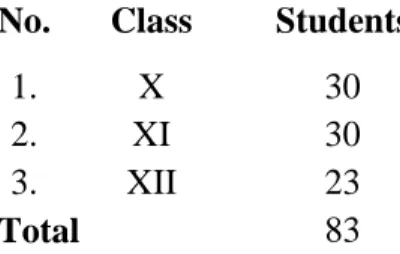
The subject of this research is the tenth graders of MA Darunnasyi’in Bumi Jawa in Academic Year of 2017/2018. There are three classes of the tenth graders and the total of the students are 83. The researcher chooses ‘X’
class that consists of 30 students, because most of the students have no strong reading comprehension abilities. In this research, the researcher will collaborate with an English teacher, Mrs. Rumiati, S.Pd
No. Class Students
1. X 30
2. XI 30
3. XII 23
Total 83
Table 2.The students of MA Darunnasyi’in Bumi Jawa C. Research Procedure
In the Classroom Action Research, there are four steps in each cycle which have relationship one another. The steps are planning, acting, observing and reflecting. Those steps can be seen in the following design:
Picture 1
Sequences of action-reflection cycles by Jean McNiff.37
The procedure of Classroom Action Research (CAR) cycles are:
37 Ibid, p.41.
1. Cycle I a. Planning
Planning is the first step of this research. Planning is a step to arrange an action plan explain about what, why, when, where, who and how the action will be conducted.
There are some plans which conducted by the researcher in this step namely:
1) The researcher makes a lesson plan to teach reading.
2) The researcher prepares the material and media of teaching reading.
3) The researcher makes observation sheet.
4) The researcher prepares evaluation sheet to evaluate the students’
activities after learning process.
b. Acting
The second step of action research is acting. Acting is the implementation of planning in the class. Without the action, the planning is only imagination that never can be real.
The implementation of action, the teaching and learning process would be done at the X class of the tenth graders of MA Darun Nasyi’in that is related to the schedule of Reading subject in this class. Here are the steps that the researcher does in the action:
1) Pre-teaching Activities
a) Greeting, praying together and checking attendance list.
b) The researcher asks the students some question related to the topic.
c) The researcher explains the use of STAD Method in learning process.
2) While-teaching Activities
a) Teacher delivers materials and problems in learning to the students according to the basic competence that will be achived.
b) The teacher gives a quis or test to each student individually so the students would be obtained the early score.
c) Teacher divides the students into some groups. Each group consists of 4/5 students.
d) The materials that have been prepared are discussed in the group to achieve basic competence.
e) The teacher facilitates the students in making a summary, directing, and giving emphasis on learning materials that have been studied.
f) The teacher gives a quis or test to each student individually.
3) Post-teaching Activities
a) The researcher ask to the students about the difficulties of the lesson.
b) The researcher gives motivation to the students.
c) The researcher closes the meeting by praying and greeting.
c. Observing
On the third step, this researcher had done observe. Observation done, in teaching learning process.
d. Reflecting
The last process in this process is reflecting. It is to analyze all actions that conduct through collecting data, and conduct evaluating to complete the next acting. In this step, the researcher uses the data for evaluation to make improvement for the second cycle.
If the cycle I is not successful, the researcher should conduct cycle II.
The result of cycle I is for evaluation material and for reflection to the second research. By the reflection, the researcher would know the strength and weakness from the action.
2. Cycle II a. Planning
1) The researcher identifies the problem and finds the problem from the first cycle.
2) The researcher arrangers the detail plans about the action on cycle II.
3) The researcher prepares the material and media of teaching.
4) The researcher prepares the format to observe.
5) The researcher prepares the instrument of evaluation.
b. Acting
The researcher applies the action in this research with the same action in cycle I. The difference is the researcher will use another topic about recount text.
c. Observing
In this step, the researcher observes the process of teaching learning in the class.
d. Reflecting
In this step, the researcher analyzes the result of the action. The researcher compares the score distribution of pre-test and post-test. The researcher will review and reflect on the students’ activity and lecturer performance whether it’s positive or negative. If in the second cycle the result is satisfied, the researcher will be stopped. While, if in the second cycle is unsatisfied, the researcher will be continued.
D. Data Collecting Technique
In collecting the data, the researcher uses test, observation, documentation and field note. The collecting data as follows:
1. Test
In this research, the researcher gives the students two tests that are pre- test and post-test to know the improvement of students’ reading comprehension ability. The kind of this test is written test with multiple choice test. The test is given to know the students’ achievement before and after learning process.
a. Pre-test
The pre-test will be given before applying treatment through Student Team Achievement Division (STAD) Method in order to know ability of the students in reading comprehension. The researcher gives the students
some questions that related the text. The researcher uses multiple choice questions to assess the students’ reading comprehension. Thus, the researcher conducts the treatment after giving pre-test to the students.
b. Post-test
The post-test is given in the last meeting after doing treatments to find out whether the treatment gave any contribution to the students’
achievement in the class or not. The improvement can be seen if the average scores of the post-test is higher that pre-test.
2. Observation
In this research, the researcher observes the application of Student Team Achievement Division (STAD) Method and the students’ activities in the learning process to know how the process of learning is held. The researcher makes the observation sheet that contains of list of the students’
activities.
3. Documentation
Documentation is a way that using a written source such as public documentation or private documents. In this research, the researchers takes the data from the school, such as the pictures of subjects’ activities, the total of the students, the learning equipment from the school, the history of school, the teacher and staff in the school and condition of the school.
4. Field Note
Field note is a note that used in the research to write the activity during learning process. If the teacher is teaching, the collaborator notes everything
that happens in the class. This note is used to review whether any problems during instructional and from this note the researcher can analyze what the strength or weakness when the researcher uses STAD Method to increase the students’ reading comprehension.
E. Research Instrument 1. Instrument Blueprint
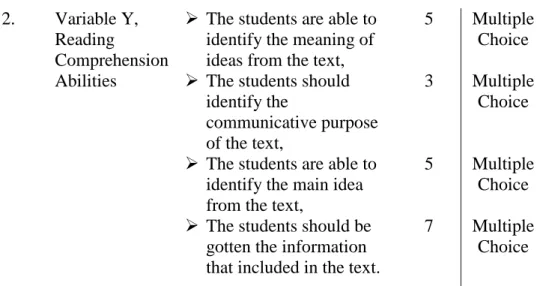
In this research, the instrument is designed and compiled with the indicators which have been specified. To get the data, the researcher used pre-test and post-test instrument for the experimental class. The instrument that used as follows:
Instrument Blueprint
No. Variable Indicator Item Form
1. Variable X, STAD method
The students should be accountable their responses
The students should be confidence in sharing their ideas
The students should process information, communication, thinking, review of material, and check prior knowledge.
2. Variable Y, Reading
Comprehension Abilities
The students are able to identify the meaning of ideas from the text,
The students should identify the
communicative purpose of the text,
The students are able to identify the main idea from the text,
The students should be gotten the information that included in the text.
5 3
5 7
Multiple Choice Multiple
Choice Multiple
Choice Multiple
Choice
Table 3.The instrument grilles test for Reading Comprehension
2. Instrument Calibration
Instrument calibration used to know the validity and reliability instrument degree. Validity has three distinct aspects; content validity, creation validity and construct validity. The researcher will use content validity based on the syllabus and materials at the tenth graders of MA Darun Nasyi’in Bumi Jawa
F. Data Analysis Technique
The researcher will compare between pre-test and post-test. Then, the result is matched by the minimum mastery criteria (KKM) in this school at least 65. If from cycle I, there are some students not successful, the researcher must conduct cycle II. The formula to get the average of pre-test and post-test as follows:38
38 Donald Ary, et.all., Introduction to Research in Education, (USA: WADSWORTH, 2010), p.108-109.
N X X
Note:
X = mean
= sum of X = raw score
N = number of cases.
Furthermore, to know the result the researcher will compare the average score between pre-test and post-test for each cycle. Then to know the percentage of increasing score in students learning activities, the researcher will use the percentage formula as follow:39
%
100
N P X
Note :
P = Percentage
∑x = Total Score of the Students N = Total of Students.
G. Indicator of Success
The research can be successful if the indicator of research can be reached. Indicator of success is if ≥ 80 % of the students got the score at least 65 as English minimum mastery criteria (KKM) in the post test. It
39Burhan Nurgiyantoro, Gunawan, & Marzuki, Statistik Terapan, (Yogyakarta: Gajah Mada University Press, 2004), p. 64.
means that through Student Team Achievement Division (STAD) Method in English learning is success to increase the reading comprehension ability and the learning activities of the students at the tenth grade of MA Darun Nasyi’in Bumi Jawa
.
CHAPTER IV
RESULT OF THE RESEARCH
A. Description of the Research Location
The general description that assessed is as the complementary data. It is subjectively concerned in condition of school namely history of school, geographical of school, building condition of school, and structure of organizational school.
1. The History of MA Darun Nasyi’in Bumi Jawa
MA Darun Nasyi’in Bumi Jawa is located on Jl. Nusantara Raya Bumi Jawa kecamatan Batanghari Nuban, East Lampung. This school was established on 2012 by a society figure of East Lampung. The name of MA Darun Nasyi’in.
Since it was established the headmaster of the school had been changed as follow:
Irham Satari, S.H ( 2012 – 2014 ) Samrodin, S.Pd.I (2014 – until now).
2. Building Condition and School Facilities
MA Darun Nasyi’in Bumi Jawa has the satisfy facilities to support the learning activity. Specifically, the facilities as follows:
Table 4.
Facilities in MA Darun Nasyi’in Bumi Jawa in academic year 2017/2018 No. Name of Room Number of Unit
1. Classroom 3
2. Headmaster’s room 1
3. Teachers’ room 1
4. Administration’s room 1
5. Library 1
6. Canteen 1
7. Square 1
8. Laboratory 1
9. Auditorium 1
10. Mosque 1
11. Toilet 2
Source: Documentation of MA Darun Nasyi’in Bumi Jawa in academic year 2017/2018 on May 26th 2018.
3. Total of the students at MA Darun Nasyi’in Bumi Jawa
Total of the students divided some classes that can be identified as follows:
Table 5.
The number of students at MA Darun Nasyi’in Bumi Jawa in academic year 2017/2018
No. Class Sex
Amount Male Female
1. X 10 20 30
2. XI 12 18 30
3. XII 12 23 23
Amount
Source: Documentation of MA Darun Nasyi’in Bumi Jawa in the academic year 2017/2018 on May 26th 2018.
4. Vision and Mission of MA Darun Nasyi’in a. Vision
“Morality, Excellence in Achievement, Professional, and Religious.”
Indicated by:
1) Focusing on the modern potential of future.
2) Balancing on the rules and wish of society.
3) Achieving the superiority.
4) Improving the spirit and commit of all members.
5) Improving the better changes.
6) Directing the mission strategy steps.
b. Mission
1) Implement the learning process and affective coaching.
2) Implement coaching Al-Islam regularly, integrated and programmed.
3) Implement and increase the application of science, technology and art.
4) Improved the members of school development in religion, work hard, democratic, critics, creative, tolerance and professional.
5) Carry out the development of facilities and infrastructure.
5. School Map of MA Darun Nasyi’in
a. School’s name : MA Darun Nasyi’in Bumi Jawa
b. School’s address Jln. Nusantara Raya Dusun V Desa Bumi Jawa Kec. Batanghari Nuban Kab. Lampung Timur
c. School map :
Picture 2.
School Map of MA Darun Nasyi’in Bumi Jawa
Source: Documentation of MA Darun Nasyi’in Bumi Jawa on May 26th 2017.
Notes:
1. Gateway 2. Securitys’ room 3. Administration’s room 4. Headmasters’ room 5. Teachers’ room 6. Canteen
W N
S
E
8 1
12
13
3
4
5
10 9
14
11
7
6 2