Foreword
As an executive coach, I have worked with some remarkable leaders – people with outstanding achievements and unbelievable wealth. Any outsider would assume they were happy.
They'd be wrong. Even these fortunate people often struggle to find
happiness. Like so many others, they succumb to the great Western disease
—I will be happy when. When I get promoted. When I reach the next
professional milestone. When I make a certain amount of money. In reality, while it feels good to buy a fancy car or get the corner office, that joy wears off pretty fast. That's why I tell my clients not to hold out for prizes. Be happy now.
Jacob Morgan understands this fundamental truth—which is one reason I find this book so compelling. He makes a strong case for the value of jobs that create happiness, satisfaction, and well‐being in the present.
He's right that extrinsic rewards (like pay or bonuses) don't really motivate workers. Once they reach a certain baseline salary, money is no longer the main driver. They need something more. Reams have been written about the Millennial generation's hunger for impact and meaning at work. In one way, I think Millennials (and Generation Z, coming up after them) are not so different from the rest of us. They just voice desires the rest of us have learned to keep quiet.
We don't want to suffer through an unpleasant job so that we can get a reward on payday, or when we at long last reach retirement—especially now that the borders of the workday are blurring. With flexible work arrangements and technology that follows us home after the workday has officially ended, our personal and professional lives are no longer truly separate. If we wait until work is over to start accruing satisfying and meaningful experiences, we might end up waiting an awfully long time.
In my seminars, I argue that employees don't have to depend on a boss or an organization to make their working lives better. They can bring about
positive change all by themselves. I recommend a process called the Daily Questions, which involves asking yourself a series of questions every day to
see how much effort you put toward your main priorities. (I pay a colleague to call me every day for this very reason!) This way, the individual can be an agent of change, creating meaning, happiness and engagement from within.
Employees can engage themselves much better than an HR program can.
And yet it's in the interest of organizations to improve levels of employee engagement, so they try. Given the stiff competition for top talent, it's easy to see why. Yet the billions they've invested haven't yielded much, as
Morgan rightly notes. His explanation: they are looking at effects
(engagement) without causes (the experiences that lead to certain levels of engagement). He recommends focusing on the root cause: the
technological, physical, and cultural environments around the employee.
By looking closely at how environments affect workers, he offers some fresh and timely perspective. Most of us go through life unaware of how powerfully our environments shape our behavior. Because of another Western predilection to assume that we are in control—of ourselves and of our circumstances—we often fail to see that our environments rule us instead of the other way around.
My book Triggers: Creating Behavior That Lasts, Becoming the Person You Want to Be (with Mark Reiter; Crown, 2015) explores our triggers—the people and situations that often lure us into behaving in a manner unlike the colleague, partner, parent, or friend we hope and imagine ourselves to be.
These triggers are relentless, constant, and omnipresent. The smell of bacon wafts up from the kitchen, and we forget our doctor's advice on lowering our cholesterol. Our phone chirps, and we glance instinctively at the glowing screen instead of looking into the eyes of the person we're with.
Without a plan or a structured approach, these distractions can easily send our careers and lives off course.
Environmental triggers have profound implications in the workplace, which Morgan explores in admirable depth. His research reveals what cutting‐edge companies are doing to create environments that are helpful and
stimulating, instead of taxing and draining. He has done his homework, and as a result he's able to show a wide range of fascinating new ideas and strategies. Whether you connect with all of them or just a few of them, this book is worth a read for the insight into what the future portends.
In our age of rapid technological advancement and unprecedented volatility, the only true certainty is change. The Employee Experience will arm leaders and organizations with future‐focused intelligence about how to get great people and keep them inspired and motivated.
Marshall Goldsmith
Acknowledgments
When I wrote The Collaborative Organization, I was engaged. When I wrote my second book, The Future of Work, I was married. Now, with The Employee Experience Advantage, I'm a dad.
Each book thus far has been accompanied by a major life event and
amazing new experiences. I am grateful for all of them and am excited to see what will happen when I write my next book!
My wife, Blake, has been my biggest source of inspiration, encouragement, and support. We spend most of our time together working and playing, and I'm so fortunate to have married my best friend. She makes me a better person. My family both near and far, I love you very much and appreciate your continued support and curiosity for what I do!
Writing a book is certainly a journey, and this one has been no exception, especially when considering the extensive research project that was
conducted. I want to thank the John Wiley & Sons team for helping make this book possible: Lia, Peter, Shannon, and Elizabeth, you have all been a pleasure to work with (again!). Serge da Motta Veiga from American University, thank you for your support and guidance during the launch of this project. Steve King from Emergent Research, your advice, e‐mails, and phone calls really helped shape this project; thank you so much for your brilliant insights. Connie Chan, my business partner at The Future of Work Community, thank you for your continued support. A big thank‐you to all the members of The Future of Work Community, who continue to
graciously share insights, ideas, and interesting topics for me to explore and think about. I've interviewed hundreds of senior executives at organizations around the world; thanks to all of you for being so open and transparent with me.
A big thank‐you to my team, who do an awesome job supporting me. Allen Mendoza, you're the best creative designer I have ever worked with; thank you for creating the book jacket and all the images in this book! Megan and Jen, thanks for keeping me on track and organized and for all you do to help make sure my ideas and messages keep spreading! Vlada, many thousands
of people have listened to my podcasts and videos that you helped put together; thank you. Trisa, Teresa, Stacy, Alexis, and Erica, thanks for helping me research the hundreds of companies for this research project.
Jeffrey, you are an awesome data scientist and analyst. Thank you for the hundreds of hours you contributed to help make sure all the collected data was accurate, reliable, and something that I could actually understand!
Two organizations graciously agreed to sponsor the research that is shared throughout this book. Those two organizations are Lever and Cisco, which you will learn more about in the following chapters. Francine Katsoudas, Gianpaolo Barozzi, and Leela Srinivasan, thanks for your continued support and for believing in me and in this project!
We All Care about Experience (Introduction)
Life is short, very short. We might as well make the most of it while we have it. This is why so many of us want to explore the world, try new
things, and otherwise venture off the beaten path, because as humans we are by nature curious. This is also why many of us focus on creating
experiences instead of simply owning material things. We save up to eat at fancy restaurants on special occasions, go skydiving, visit exotic cities thousands of miles away from where we live, climb mountains, and do all sorts of other experiential activities. Nobody makes us do these things; we do them because we want to, all for the sake of getting that experience that will hopefully last us a long time or a lifetime. Most people don't stop to think about it, but experiences are really one of the main things that make us human.
Research done by Cornell University psychology professor Dr. Thomas Gilovich, University of Chicago postdoctoral research fellow Dr. Amit Kumar, and Dr. Matthew Killingsworth, who studies human happiness at the University of California, San Francisco, found that when people spend their money on experiences, over time their satisfaction goes up whereas when people spend money on physical things, over time their satisfaction goes down. The research also found that waiting for an experience elicits more happiness than waiting for a material good. Finally, they found when we spend money on experiences, those purchases are also more associated with our identity, connection, and social behavior. People who spend money on experiences instead of things are just happier all around.
In the past year, how many times have you spent your time or money on creating experiences for yourself or for others? A hundred times? Fifty times? What about in the past six months or the past week? What about in the past 24 hours? I'm willing to bet that you spend quite a bit of time and money on creating experiences regularly. Experiences stay with us
throughout our lives. Not only do they shape who we are as human beings, but also they help us connect with and build relationships with others.
Clearly we as human beings care about experiences because we are willing to spend our hard‐earned time and money on creating them. We don't do
this simply for the experiences themselves and for the feelings we get during a particular moment but because they create memories. The
experiences themselves may be ephemeral, but the memories they create last far longer. So if experiences are so vital to our existence as human beings, then what happened to experience inside of our organizations?
When you consider that we spend about 30 percent of our entire lives working (assuming you work only 40 hours a week, which many of us go far beyond) this becomes a scary statistic. We can even take this one step further and ask, “What happened to the humanity inside our organizations?”
These experiences and their subsequent memories help shape the type of relationship we want (or don't want) to have with a coworker, manager, or organization as a whole.
As the world becomes more fascinated with discussions of robots and automation, this experience aspect is more important than ever! While many futurists and business leaders believe that robots and automation are taking jobs away from humans, I believe that it's the humans who are taking the jobs away from robots.
Decades ago before the Internet, when modern management was just getting started, we didn't have any type of connectivity, and these
discussions around robots and automation weren't even an afterthought. It was perhaps a much simpler time when the role of humans was simply to show up at the same time every day, do the same job over and over, wear the same outfit or uniform, report to the same person, take a break at the same time, not ask any questions or cause any problems, and work like a robot basically. But we didn't have robots or automation at the time so what did we do? We used humans. Basically we have designed perfect
organizations for robots and automation, but because we didn't have those at the time, we used the next best thing: people. Now, when these
technologies finally exist, they are claiming the jobs and responsibilities that we designed for them to begin with. Humans were simply placeholders like bookmarks in a novel. Today organizations around the world are trying to figure out how they have to redesign themselves to focus more on
people…more on humans. Robots don't care about experiences at work but humans do.
The experiences organizations design are ultimately what shape the actions that employees take and the relationships or associations that they want to
have with your organization (if any). The challenge we have to overcome today is how to shift our relationship with work from feeling like a physical purchase, where satisfaction starts to decline over time, to an investment in an experience, where our satisfaction increases over time.
This is further supported with research done by career website Glassdoor.
On its blog Mario Nuñez posted an article titled “Does Money Buy
Happiness? The Link Between Salary and Employee Satisfaction,” which revealed something quite surprising. According to the article:
One unexpected finding is that there is a clear relationship between years of experience and happiness at work. In short, older workers tend to be less satisfied. For example, a one‐year increase in years of experience is associated with a 0.6‐point decrease in overall employee satisfaction, after controlling for all other factors. This might reflect learning about the quality of work environments over time. Or perhaps workers become more jaded with their employer as they progress throughout their career.1 This was based on a sample of 221,000 Glassdoor users.
In my last book, The Future of Work (Wiley, 2014), I shared that synonyms for employee include cog, servant, and slave; synonyms for manager
include boss, slave driver, and zookeeper. Synonyms for work include drudgery, struggle, and daily grind. This is quite literally how we have structured many of our organizations over the past few decades. We have actually designed the humanity out of our organizations. However, today we are starting to realize that this way of thinking about work no longer makes any sense.
The one big assumption we have always had about our organizations has now proven to be completely wrong. Organizations have always assumed that people needed to work there. After all, you have expenses, bills to pay, a family to look after, and things you want to buy. The organization has a job it can offer you to help you take care of those things so it's clearly a good fit. This has been the traditional relationship between employer and employee, and organizations have always had all the control and the power.
Again this was the simple equivalent of purchasing a physical good.
Oftentimes these same organizations were simply able to rely on their brand power to attract and retain talent.
Today that is no longer the case. The war for talent has never been fiercer, and in an effort to attract and retain the best and brightest, organizations have to shift from creating places where they assume people need to be to creating organizations where people truly want to be. This shift in approach from need to want is also causing organizations to move from utility to employee experience.
NOTE
1. Nuñez, Mario. “Does Money Buy Happiness? The Link Between Salary and Employee Satisfaction.” Glassdoor Economic Research Blog, June 18, 2015. https://www.glassdoor.com/research/does‐money‐buy‐
happiness‐the‐link‐between‐salary‐and‐employee‐satisfaction/.
PART I
The Evolution of Employee Experience
As with anything in the business world, things evolve and change. The evolution that we are seeing today continues to shift organizational
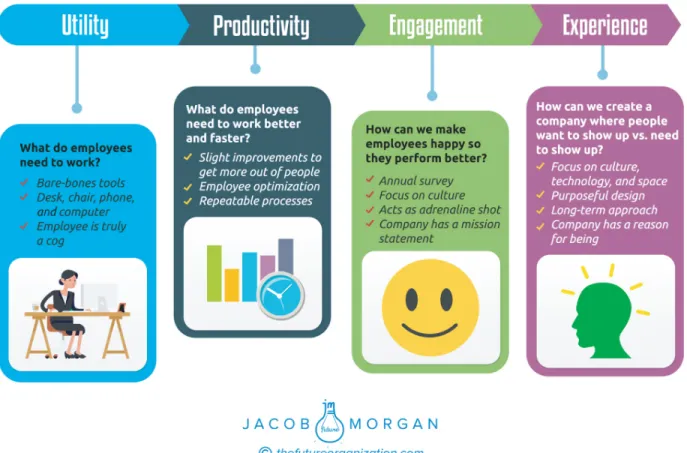
priorities more and more toward focusing on people and bringing humanity and experiences into our organizations. This is an immensely exciting thing to see! Years ago with the advent of what many would consider modern business, focusing on utility,that is, the basic components of work,made sense. At the time, it was just common practice, and pretty much every organization took the same approach. Then, this shifted toward productivity, getting the most out of people. Next, we saw the emergence of engagement, which is all about making employees happy and engaged at work. Now, we are shifting to what I believe is the next and most important area of
organizational design, employee experience. Let's look at this evolution and how we got to where we are.
CHAPTER 1
Defining Employee Experience UTILITY
Decades ago the relationship we had with our employers was pretty
straightforward. Employers had jobs they needed to fill; we had bills to pay, things we wanted to buy, and certain skills we could offer, so we tried to get that open job. This basic relationship also meant that work was always about utility, that is, the bare‐bones, essential tools and resources that an employer can provide employees to get their jobs done (see Figure 1.1).
Today that is typically a computer, desk, cubicle, and phone. In the past this may have been a desk, pen, notepad, and phone, or perhaps just a hammer and nails. That was it. Can you imagine if someone were to bring up health and wellness programs, catered meals, bringing dogs to the office, or
flexible work efforts in the past? Give me a break! They would be laughed at and the employee most likely fired on the spot! These things are all
relatively new phenomena that are now only starting to gain global attention and investment. Granted, there are still plenty of organizations out there that are still stuck in the utility world.
Figure 1.1 Evolution of Employee Experience
PRODUCTIVITY
After the utility era came the productivity era. This is where folks like Frederick Winslow Taylor and Henri Fayol pioneered methods and approaches to optimize how employees worked. Managers literally used stopwatches to time how long it would take employees to complete a task to shave off a few seconds here and there. It was analogous to trying to get a sprinter or swimmer to improve his or her lap time. All of this was designed to improve productivity and output while emphasizing repeatable processes, such as the famous factory assembly line. Unfortunately at the time, we didn't have robots and automation to do these jobs (which they would have been perfect for), so instead we used humans. Today, we finally have the technology capable to do the jobs they were designed for, and the humans who were simply acting as placeholders are now in trouble. Robots aren't taking jobs away from humans; it's the humans who took the jobs away from robots. As with the utility era, there also wasn't much focus on
creating an organization where the employee truly wanted to be.
Productivity was simply utility on steroids!
ENGAGEMENT
Next came engagement, a radically new concept where we saw the
collective business world say, “Hey, maybe we should pay more attention to employees and what they care about and value instead of just trying to
extract more from them.” And thus, the era of engagement (or
enlightenment) was born. This was actually quite a revolutionary approach that shifted some of the focus away from how the organization can benefit and extract more value from employees to focusing on what the
organization can do to benefit the employees and understand how and why they work. The more engaged an employee is, the better! This is where we stopped and where we have been for the past two or three decades. There have been all sorts of studies that have shown engaged employees are more productive, stay at the company longer, and are generally healthier and happier.
I'll admit that when I first started writing this book, I was convinced that employee experience and engagement were at odds with each other. I
mistakenly believed that experience must replace engagement. In fact there were thousands of words originally devoted to that very rationale that I had to scrap from this book. I've since changed my tune. Employee experience doesn't need to replace engagement. The two can actually work together, and in fact, they have to. Instead I view employee experience as something that creates engaged employees but focuses on the cultural, technological, and physical design of the organization to do that. Still, our current
definitions and understanding of employee engagement need to evolve before that can happen. Many of the questions and frameworks used to explore engagement haven't changed since they were first introduced into the business world, which creates some challenges.
EMPLOYEE EXPERIENCE
Let's say you buy an old car at a junkyard and then spend thousands of dollars on new paint, upholstery, rims, and interior upgrades. Even though
the car will look beautiful, it will still drive like the same car you brought home from the junkyard. If you want to improve how the car performs, then you need to replace the engine. Organizations around the world are
investing considerable resources into things such as corporate culture programs, office redesigns, employee engagement initiatives, and well‐
being strategies. Unfortunately these things make the organization look better but have little impact on how it actually performs.
Many organizations today use employee engagement and employee
experience interchangeably without any distinguishable difference, which is incorrect. Employee engagement has been all about short‐term cosmetic changes that organizations have been trying to make to improve how they work. If this approach doesn't work for a car, then it certainly won't work for an organization.
If employee engagement is the short‐term adrenaline shot, then employee experience is the long‐term redesign of the organization. It's the focus on the engine instead of on the paint and upholstery. Chances are you've heard of the term customer experience, which is typically defined as “the
relationship that a customer has with a brand.” Most people reading that would say, “Well, of course that's what it is. Isn't that obvious?” Yes it is, which is why I think it's really a meaningless definition that provides no context or direction for what that actually looks like. This is why I wanted to avoid simply defining employee experience as “the relationship between an employee and the organization.” That doesn't help anyone or provide any value, and as with the customer experience, it's rather obvious. So then what is employee experience?
There are a few ways we must look at this. The first is through the eyes of the employee, the second is through the eyes of the organization, and the third is the overlap between the two. When reading through these you may decide to lean toward the side of the employee or the organization, but since two parties are involved, it is in both the employee's and the organization's best interest if we view employee experience as something that is created and affected by both.
For the people who are a part of your organization, their experience is
simply the reality of what it's like to work there. From the perspective of the organization, employee experience is what is designed and created for
employees, or put another way, it's what the organization believes the employee reality should be like. This, of course, is a challenge and one we see in our everyday lives. Have you ever said or done something to a loved one or friend that was well intentioned yet was perceived as being rude or disrespectful? This is the same scenario we see play out between
organizations and employees all the time. Just because the organization does something doesn't mean the employees perceive it in the intended way.
Naturally this causes problems not just in our personal lives but also at work.
You may have seen The Truman Show, a film about a man who is living in a world that was designed for him by an organization. His entire perceived world was constructed from a massive stage, and although he didn't realize it, every action and event that took place was planned. Regardless of how hard the organization tried to keep Truman from leaving the world that was created for him, he eventually did break free. In some ways this is how our organizations operate. They tell us when we can work, what tools we should use, what to wear, when we can get promoted or learn something new,
whom we can talk to, and when we can eat or take breaks. Not only that but they also control the environments we work in and pretty much anything and everything else that happens within the walls of the organization. As an employee you have virtually no say in what happens for around 8 to 10 hours of your day. Although our organizations aren't exactly Truman‐izing our lives, there are parallels that can be drawn here. So where does that leave us?
The ideal scenario is the overlap between the employee's reality and the organization's design of that employee reality. In other words, the
organization designs or does something, and the employees perceive it in the intended way. This is possible because as you will see in the following chapters, employees actually help shape their experiences instead of simply having them designed by the organization (aka the Truman approach).
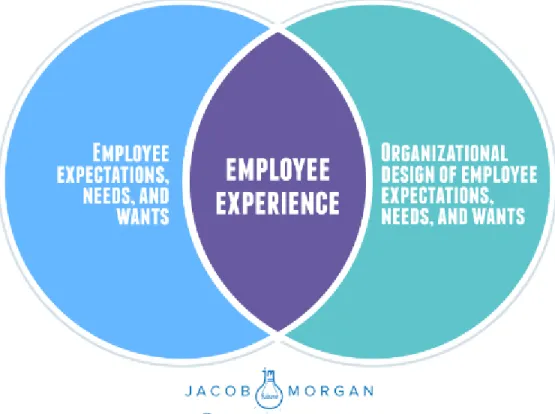
Taking that viewpoint, one can define employee experience as “the intersection of employee expectations, needs, and wants and the
organizational design of those expectations, needs, and wants.” You can see this in Figure 1.2 below.
Figure 1.2 Employee Experience Design
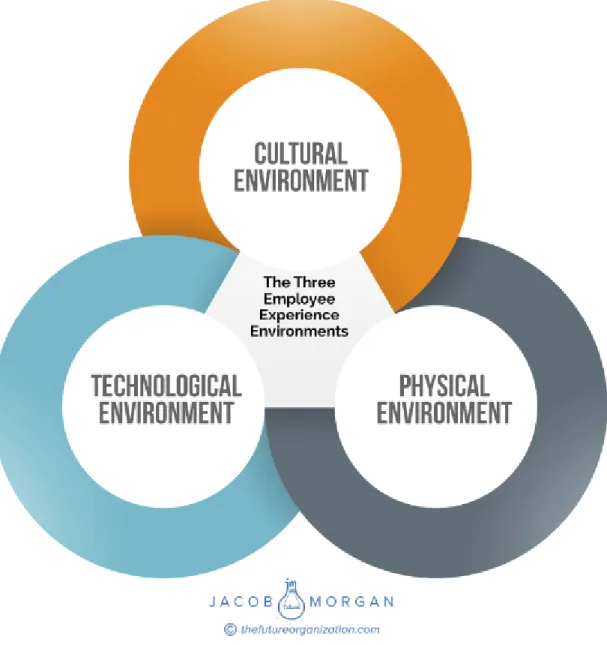
However, what resonates more with people is saying “designing an organization where people want to show up by focusing on the cultural, technological, and physical environments.” Phrasing it this way essentially encapsulates the entire relationship and journey that an employee
experiences while interacting with an organization, but it also breaks it down a bit into three distinct environments, which makes it easier to understand than saying, “Employee experience is everything.”
One crucial thing to keep in mind is that employee experiences can't be created unless the organization knows its employees. The word
organization is broadly used as a way to represent executives, managers, and the collective workforce. If you've ever booked a trip through a travel agent, you know that he or she spends an extensive amount of time getting to know who you are. That way he or she can plan a trip for you that is sure to give you a memorable experience. In the same way that travel agents truly know who their customers are, the organization must truly know who its workforce is. As you will see later in this book, that means not only leveraging people analytics but also having a team of leaders who have the
capacity and the desire to connect with people on a truly individual and human level.
Experience is also subjective because human beings have emotions,
different perceptions, attitudes, and behaviors. If we all behaved the same way and thought the same way, then it would be quite easy for
organizations to design perfect employee experiences all the time for
everyone. Of course, this is not the case. Does this mean that organizations should simply give up? Clearly not. As you will see in this book, employee experiences are made up of a specific set of environments and variables, and the leading organizations have invested considerable time and resources into making sure they are implemented properly. Every organization in the world has employees who have their own experiences. Whether you help create them or not, they still exist. Employee experience is simply too important and too key of a business differentiator simply to be left up to chance.
As I mentioned earlier, though, this employee experience design process isn't just done for employees; it's done with them. That's a very important point to keep in mind because many organizations get stuck in the design for mentality, which kills their efforts.
The majority of this book will explore how to design and create employee experiences by building what I call the Experiential Organization. Let's define what this actually means:
An Experiential Organization (ExpO) is one that has been (re)designed to truly know its people and has mastered the art and science of creating a place where people want, not need, to show up to work. The Experiential Organization does this by creating a Reason for Being and by focusing on the physical, technological, and cultural environments.
From here on out we will take a deep dive into what these environments are, the variables that shape them, and how to go about creating an Experiential Organization that outperforms the competition.
CHAPTER 2
Research on Employee Experience
I certainly didn't coin the term employee experience, but I did create the frameworks and approaches that you will find in this book. As far as I'm aware, I'm the only one to create a structured framework of employee experience that is based on actual data and organizational analysis of hundreds of organizations, so it only makes sense to share how it all came about. Although new titles, roles, and practice areas are emerging around employee experience regularly, there's a lot of confusion and uncertainty about what this actually is and what it looks like. Part of the reason for this is unlike traditional human resources (HR), which is very clearly defined, employee experience looks quite different depending on the organization, and that's okay. Because this is a very human‐centric role, there should naturally be differences in how various organizations approach this. I reached out to many chief employee experience officers, directors, managers, and even HR leaders who are responsible for employee experience to get their perspective on what this new shift is all about.
Many business executives and leaders I talked to were very candid and said they weren't entirely sure what this role focused on, what experience will become, or even what it will include because it's so new. Naturally this presented me a bit of a challenge in writing a book about this topic. Over the past two years I've had a few hundred conversations with senior executives and employees at various levels. Although I received many responses when I asked, “What makes up employee experience?” or “How do you design employee experiences?” a pattern started to emerge that allowed me to break this down. I started to see that every organization around the world regardless of size, industry, or location was investing in and focusing on three areas, which I like to think of as environments. The environments that affect employee experience are the technological
environment, physical environment, and cultural environment.
Once I determined these three environments, the next step was to figure out what the major attributes were within these environments. In other words,
what do employees care about most that create great technological, physical, and cultural environments?
This wasn't an easy task because we all care about and value different things. I took the same approach I used with determining the three
experience environments. I looked for patterns in the many studies, articles, and research reports I read and added information from the hundreds of conversations I've had with executives and employees at organizations around the world. Based on that I created a series of questions to measure organizational effectiveness in each of the three employee experience environments.
To design great employee experiences and to create a place where
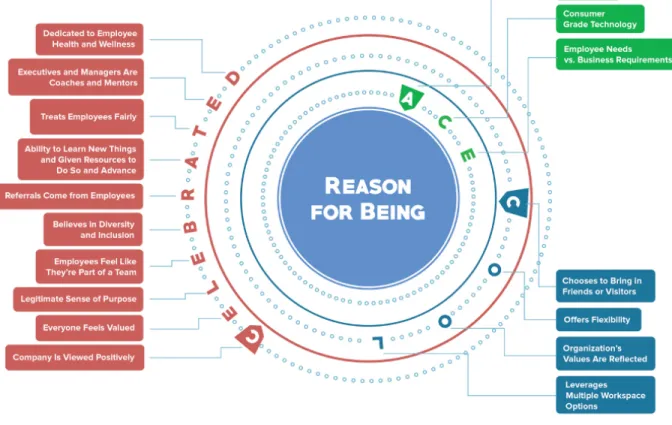
employees truly want to show up, organizations must focus on a Reason for Being followed by 17 attributes that are abbreviated as ACE technology, COOL physical spaces, and a CELEBRATED culture (see Figure 2.1).
Figure 2.1 The 17 Employee Experience Attributes
What I found especially fascinating is that every one of these 17 attributes positively affects the employees and the organization as a whole. This isn't one sided so even by investing in the overall success of the company, the employee experience is also hugely affected positively. Everyone wins.
Together these 17 attributes make up what I like to call the Employee
Experience Score (ExS). You can get your organization's EXS by answering the questions that appear in the Appendix. The collective rankings of the organizations that I evaluated then comprise the Employee Experience Index (EEI). You can see the full index as well as get your own EXS by visiting https://TheFutureOrganization.com.
To come up with these attributes and the model of employee experience, I:
Interviewed C‐level executives and business leaders at over 150 organizations around the world, including:
the chief human resources officer (CHRO) of LinkedIn, CHRO of Accenture
the CHRO of Marriott International
management professor Marshall Goldsmith the chief technology officer of Xerox
the co‐CEO of Gensler
the chief diversity and inclusion officer at SAP the chief economist at General Electric
the chief people officer of Cisco the chief information officer of IBM the chairman of the board at Yahoo!
the president of Infosys, and many others
Reviewed over 150 research articles on culture, technology, and the physical work environment from the likes of Genser, Deloitte, Aon, Steelcase, government agencies, Harvard Business Review, and MIT Sloan Management Review
Read dozens of media publications
Analyzed over 250 organizations, including the Fortune 100, Fortune's 100 Best Places to Work, the Glassdoor Best Places to Work, and others Worked with an academic institution (American University, with Serge P. da Motta Veiga, assistant professor of management) to help structure the survey and get advice about data collection
Brought on a research advisor (Steve King from Emergent Research) to provide overall project guidance
Developed a team of executives to review the attributes and provide feedback and suggestions on the survey
Based on the research conducted for this book, the cultural environment contributes 40 percent to the employee experience, and the technological and physical environments each contribute 30 percent. The total possible score that an organization can receive is 115.5, with 19.5 points coming from technology, 26 points from physical space, and 70 points from culture.
Note that the point allocation doesn't reflect the percentage allocated to each environment.
I encourage organizations to take the methodologies in this book and apply them internally. While I don't claim to have all the answers, I do believe that what I have been able to put together does provide some valuable insights into what employee experience is, why it's crucial, and how to go about designing employee experience to create an organization where people actually want to be.
A NOTE ABOUT THE RESEARCH SPONSORS
Two organizations were instrumental in enabling me to conduct the research required for this book. As you can imagine, hiring a team of researchers and data scientists to review 252 organizations can be quite a resource‐intensive task. Lever and Cisco were the two cosponsors of my research. Lever is best described as a modern recruiting technology that dramatically simplifies the hiring and applicant tracking process. I met with Leela
Srinivasan, the chief marketing officer of Lever, in its San Francisco office when I started writing this book. She was intrigued with the research and decided to support it. Cisco is the world's leading IT company on a mission to help connect everyone and everything. I've been fortunate to have a relationship with Cisco that has spanned a few years. After hearing what I wanted to do, Francine Katsoudas, Cisco's chief people officer, and
Gianpaolo Barozzi, Cisco's senior director of HR, agreed to sponsor this research. I'm grateful to both Lever and Cisco for believing in this concept and for wanting to shed more light on employee experience. Both of these organizations had no say, influence, input, or decision‐making ability of any kind on any aspect of the research to make sure it remained 100 percent objective.
CHAPTER 3
Employee Experience Drivers
You might be wondering why employee experience is gaining traction just now. After all, customer experience has been around for decades, so why has it taken so long for organizations to look inward? Not only that but we've also been talking about employee engagement for decades as well.
Clearly there is something going on that is creating this shift, forcing organizations not only to create new titles and roles but also to actually redesign the way they are structured and how they operate. In my previous book, The Future of Work, I explored five trends shaping the future of work, which I will briefly outline here:
1. Mobility: Access to people and information anytime, anywhere, and on any device
2. Millennials and changing demographics: In addition to the five‐
generation workforce, organizations are struggling to adapt to an entirely new generation of millennials.
3. Technology: Big data, wearables, the Internet of things, AI, and automation are just some of the new technologies organizations are trying to figure out.
4. New behaviors: Thanks to social technologies, we are all comfortable living a more public life where we share ideas and information for the world to see.
5. Globalization: The world itself is becoming like one big city where the boundaries and barriers to doing any type of business are disappearing.
These five trends are still very relevant today from a broader perspective.
However, when looking specifically at employee experience, we need to pay attention to a few other things.
POOR SUCCESS WITH ENGAGEMENT
There are all sorts of associations, institutes, and surveys that organizations can use to measure and look at employee engagement. Unfortunately with all the talk of engagement and with all the trainings and rankings of
organizations around the world, engagement has remained relatively
unchanged despite our collective investments. According to Gallup, which has become the global authority on this topic, worldwide employee
engagement is at 13 percent,1 which is almost unimaginably low. Perhaps what's more shocking is that this number has barely budged in years!
Interestingly enough Aon has global employee engagement at 65 percent for 2016, with a 3 percent improvement since 2014.2 The fact that these numbers are so far away from each other is another matter entirely.
This is quite an interesting paradox. Engagement has become one of the key focus areas for organizations around the world, and the growth in the
industry has never been stronger. Yet somehow the numbers aren't budging.
How can that be the case?
There are a few issues I see with focusing on employee engagement and you might have identified others.
Engagement Measures Downward
Let's look at one of the most popular engagement models in the world today. This particular framework categorizes three types of employees:
1. Actively disengaged: unhappy employees who undermine their coworkers
2. Not engaged: employees who are checked out and sleepwalking through their jobs
3. Engaged: employees who work with passion, feel connected to the company, and help move the organization forward
In this model which you can see in figure 3.1, an engaged employee should be the minimum of what an organization should expect from anyone. If we're being honest, then it's fair to say that an engaged employee should be an average employee. In grading terms this would be a C. Hiring for
passion and the ability to drive the organization forward is something any business leader looks for and asks about during an interview. If employees
don't help move the company forward and they don't feel a connection to the company, then they have no business being there and perhaps we should also ask how they got there to begin with? Organizations bringing in these types of employees must review their hiring practices. I know it's harsh but that doesn't make it any less true.
Figure 3.1 Employee Engagement Measures Average Employees Who Are Either Below Or Just Above Water, What About the Rest?
A not engaged employee is the equivalent of a D, and an actively
disengaged employee is a big fat F. So looking at this model, the best that an organization can do is hire an average employee who will perform as
expected. Everyone else is either below or very below average. Imagine what kind of an organization this creates, better yet, we know what kinds of organizations this creates as evidenced by the current engagement scores around the world.
What about the employees who do feel a sense of passion and who go above and beyond what is expected of them to help others? Or, what about the super employees who constantly exceed expectations and act as brand cheerleaders even when not at work? These types of employees don't fit into the traditional model of engagement. This is what I mean when I say employee engagement is stuck measuring downward instead of upward.
You can be only a C employee or worse when looking at this type of a model.
Engagement Has Become the New Annual Review
Organizations question the value of annual employee reviews yet for some reason are okay with measuring employee engagement every year. This makes no sense. In many cases employee engagement surveys are simply replacing the annual review and are becoming the very thing that
organizations are trying to get rid of! There is no right answer for how often you should measure employee engagement. That's something I believe your people should control and be able to do when and where they want as often as they want. Organizations need to understand that this is a dynamic and fluid thing that changes constantly. We are not light switches that are either on or off.
Anything related to people should be measured continuously. Perhaps you have a short single‐question pulse survey weekly, monthly culture
snapshots, semiannual engagement reviews, and a larger state of the
company survey. Of course, this is just an illustrative example to show that doing one annual survey may not give you an accurate reflection of what's going on inside of your company. Some companies I've spoken with don't even look at people metrics annually. They might do so only once every few years! If annual reviews don't do a good job of measuring employee performance, then annual engagement surveys don't make much sense for measuring the pulse of the organization.
Another approach that some organizations, such as General Electric (GE), take is to run constant surveys to random employees. So you might do a survey for 1,000 employees one month, another thousand the following month, and so on. The idea is to get employee data and feedback constantly from a representative sample size of the organization. For an organization like GE that has over 300,000 employees around the world, this approach makes much more sense than trying to do one annual survey. I'll talk about this a bit later in the book as well.
Engagement Tends to Look at the Effect but Not the Cause
In most models the ideal scenario for organizations is to get as many engaged employees as possible. They do this maniacally as if they are collecting Pokémon characters. It's as if for every engaged employee an organization gets, it will level up and will finally be able to take on that giant monster! Unfortunately, many organizations get so stuck focusing on engagement that they forget to take a step back to understand what causes engagement to begin with let alone understand the impact that engaged employees are having on the organization. This means that engagement just boils down to a number, and a number without context is quite useless. If you recall the famous book and movie The Hitchhiker's Guide to the
Galaxy, the answer to “What's the meaning of life?” is 42. It's just a number as are most employee engagement scores that organizations receive. You scored a 68? Wonderful! A 92? Even better! Now what? Does this mean if you get to 100 you can stop? See what I'm getting at here? The cause is employee experience; the effect is an engaged workforce.
Engagement Surveys Are Exhaustingly Long
It's common for employee engagement surveys to be well over 100
questions long that ask pretty much everything and anything. This makes me think of my college days when I had to take multiple choice tests on scantrons (remember those?). Those exams were around 30 to 40 questions, and sometimes we even got a 15‐minute break! Who in his or her right mind would want to sit and take an exam about his or her organization, and more important, who would actually sit through and answer all the
questions honestly?! Speaking of honesty, let's not forget that employee
engagement surveys can also be manipulated. I once spoke with a chief human resources officer of a global company who told me that if she
wanted to increase her employee engagement score quickly, then she would ask employees to take it once on a cloudy, rainy day and then again on a sunny day. Boom! Ten point improvement! Some organizations also have the scary habit of manipulating their engagement scores by either offering incentives to get people to score higher or reprimanding employees who don't score their organizations high enough.
Engagement Acts as an Adrenaline Shot
One of the things that I find quite fascinating is when people start working at an organization, they are already engaged. Rarely have I talked to an employee just starting out at an organization who says, “Man, this job is terrible!” The exact opposite is actually true. When employees start
working for an organization, they are typically excited to be there and are very much looking forward to being a part of your team and making an impact. Think back to the jobs you have had in the past. You may have been a bit nervous or scared when starting a new job, but chances are that you rarely started being unhappy or disengaged. So something happens to turn these already engaged and happy employees into unhappy and disengaged people. Right about this time the organization does one of its employee engagement surveys, and when it sees the negative results, managers say,
“What? Our engagement scores are that low? Quick, we need to do
something!” At that point some new perks might be introduced. Maybe a flexible work approach is implemented, some office layout changes might happen, and perhaps catered meals a few times a week are introduced because clearly free food makes us happier. Then things improve a bit on the engagement score temporarily before dropping off again and the same cycle repeats itself as you can see in figure 3.2. Basically engagement in many organizations acts as an adrenaline shot to temporarily boost
employee happiness and satisfaction whereas employee experience is the ongoing design of the organization. Unfortunately engagement efforts simply feel like manipulation and thus doesn't create trust or loyalty and does nothing to unlock human potential which also means no business impact for the organization.
Figure 3.2 Employee Engagement as the Short‐Term Adrenaline Shot Instead of the Long‐Term (Re)design of the Organization
Employee engagement has been a wonderful tool for us to think differently about our organizations, but it's also been used as a bit of a crutch to justify the existence and importance of human resources (HR) as a function. We also have to remember that just because you measure something doesn't mean you improve it. While there's nothing wrong with continuing to measure employee engagement, it's time for us to look at a new approach for a rapidly changing world that is focused on the long‐term designing of employee experiences which then yields an engaged workforce.
In fact, I believe that employee engagement can and should simply be measured by asking employees one question. What that question is can certainly vary from one organization to the next. When doing research for this book, I wanted to say it should be something along the lines of “Do you wake up every morning wanting to go to work?” Although this type of a question is tempting to ask, I don't think it's the right approach. In other words how an employee feels is not a good indicator of engagement, but what he or she actually does is. This is why I think a question such as “Do you show up to work every day with the intention of helping others
succeed?” is far better suited to measure engagement. Success in this case is a very subjective metric that can mean anything from helping people feel good to actually helping them deliver on a project, but in this case the subjectivity is a good thing. When I spoke with Pat Wadors, the CHRO at LinkedIn, she told me that if she could pick just one way to measure engagement at her company, it would be “If employees show up to work each day wanting to create a sense of belonging for others.” In Pat's case she has the data to back up the significant positive correlation between this criterion and employee engagement. Focusing on an action is better than focusing on a feeling because it looks at a tangible impact.
Beth Taska is the CHRO of the world's largest gym, 24 Hour Fitness. When I met with her in 2016, she echoed what Pat told me. The whole point of employee engagement is to unlock the discretionary effort within
employees. This is the amount of effort that employees could put in if they actually wanted to. But what does that mean? If you think about most of the interactions you have daily with various brands, you will realize that they are very linear and static. There is very little differentiation. Whether you go to a retail store, a supermarket to purchase groceries, a check‐in gate to board a flight, or a restaurant to order food, you pretty much know what will happen and what to expect. It's always the same thing. So how is it that some organizations are able to go above and beyond to deliver customer experiences? The answer is discretionary effort. What organizations like LinkedIn and 24 Hour Fitness have figured out is that when you focus on employee experiences, employees go above and beyond to help not only one another but also your customers. Discretionary effort is measured in terms of an action, which is why I believe that measuring something like “if employees help others become more successful” is more meaningful and telling than simply asking, “Do you feel a connection to the organization?”
At organizations like wireless provider T‐Mobile, this level of discretionary effort all comes down to the impact that employees have on their customers.
I spoke with Marty Pisciotti, T‐Mobile's vice president of employee careers, who told me that across T‐Mobile in the United States, every employee knows the first line of the company values, “Frontline first, because customers are first.” T‐Mobile believes that frontline employees always come first because the better they are treated, the better they will treat their customers. T‐Mobile realized that when employees feel like the company cares, they start to act more like owners who are empowered to truly go above and beyond a traditional job description. To further get this point across, the company introduced a program over three years ago that gives all employees—including those in retail and customer care call centers—
stock in the company, which is vested over a three‐year period. These are free shares in the company that T‐Mobile gives to all employees to help them feel like they are truly making an impact on the business, are vested in the success of the organization, and are able to unlock their maximum
potential.
While employee experience needs to look at many aspects of the organization and requires several questions to determine and measure, employee engagement needs just one. So what's the one question you could ask your employees to determine whether they are indeed engaged? Go ask it.
THE WAR FOR TALENT
When you hear the phrase the war for talent, it should make you wonder,
“When have we ever not been in a war for talent?” Ever since the dawn of modern business, organizations have been seeking to attract and retain the best possible people they could. This isn't new. The war for talent is
actually a phrase coined in 1997 by Steven Hankin of McKinsey &
Company that is meant to refer to the changing landscape around attracting and retaining talent, basically, that it's getting more challenging. This was 30 years ago. Today it's not just challenging. It's downright hard and complex. In a report called War for Talent—Time to Change Direction, KPMG surveyed HR professionals around the world, and 59 percent
reported that “There is a new war for talent and this time it is different than in the past.”3
Facebook understands this better than most. It starts with one simple
question, which is “If you had the best talent in the world, what would you need to do to attract and retain them?” Organizations like Facebook aren't just looking for people; they are also looking for the best people. This is perhaps one of the largest changes we are starting to see. Technology is replacing bodies, which means that organizations are looking for something more We also have to remember that the war for talent isn't just about
attracting potential employees but also keeping existing ones.
Let's break the war for talent down a bit further. The war for talent is being fueled by a few things.
Skills Gap and Talent Shortage
A McKinsey Quarterly article by Richard Dobbs, Susan Lund, and Anu Madgavkar titled “Talent Tensions Ahead: A CEO Briefing” stated that
“new research from the McKinsey Global Institute (MGI) suggests that by 2020, the world could have 40 million too few college‐educated workers and that developing economies may face a shortfall of 45 million workers with secondary‐school educations and vocational training. In advanced economies, up to 95 million workers could lack the skills needed for employment.”4 The most recent ManpowerGroup Talent Shortage Survey of “more than 41,000 hiring managers in 42 countries and territories found that 38% of employers are having difficulty filling jobs.”5 There is little agreement on what is causing this skills gap, what the potential solutions are, and whether the skills gap is even a real thing! Most of the executives I speak with acknowledge that the skills gap is real. Perhaps what makes this even more challenging is that we aren't sure what the jobs of the future will be or when they will be here. Consider that by the time most people
graduate from college, the skills and the things they have learned are mostly rendered obsolete. This means organizations are looking to hire employees for jobs that don't yet exist. Not only do we have a skills gap, but we also have a skills uncertainty. The number one thing that potential and current employees can do to succeed in this type of environment is to learn how to learn. In other words, have the ability to learn new things regularly and
apply the things that you learn to new and current situations and scenarios.
This is further evidenced by the dozens of publicly available conversations I have had with CHROs at the world's largest companies. You can listen to and read about all of these discussions by visiting
https://thefutureorganization.com/future‐work‐podcast/.
What's fascinating is that organizations that focus on creating employee experiences aren't feeling this skills gap as much as those who aren't. It appears that in the coming years, organizations are going to want to hire people, and there just won't be enough high‐skilled labor to go around.
Changing Demographics
According to a report by Robert I. Lerman and Stefanie R. Schmidt called An Overview of Economic, Social, and Demographic Trends Affecting the US Labor Market:
BLS [Bureau of Labor Statistics] projections imply that over the next decade, 40 million people will enter the workforce, about 25 million will leave the workforce, and 109 million will remain. Although only a
modest reduction will take place in the overall growth in the workforce (from 1.3 percent per year to 1.1 percent per year), the composition of growth will generate rising shares of young (under 25) and older (45 and over) workers and a decline in the share of middle‐age workers.6
We are already starting to see this trend. Today, millennials are already the largest demographic, surpassing baby boomers in 2016. By 2020 they are expected to comprise 50 percent of the workforce, and by 2025 this is expected to be 75 percent of the workforce. We also see Gen Z (the
generation after the millennials) creeping into the workplace as well, and they currently comprise over 25 million people in the United States alone.
Not only that but also the labor participation rate in the United States appears to be gradually yet consistently shrinking. This changing mix of demographics brings new values, attitudes, expectations, and ways of
working. Still, this isn't new. Our organizations have always had to adapt to new generations entering the workforce, but the overall sense is that
previous adaptations were very slow and gradual and have now become more aggressive.
Changing Face of Talent Competition
In the past organizations used to compete on a few levels, which were typically skills and seniority, location, and direct rivals. This meant that if you lived in San Francisco, you would compete against other people in the area, or that if you were Coca‐Cola, you'd compete against Pepsi, Ford versus Toyota, Boeing versus Airbus, or McDonald's versus Burger King.
Today, with the exception of certain specialized skills and roles, everyone is competing with everyone. Coca‐Cola is competing against Toyota and
McDonald's is competing against Airbus. Not only that but organizations are also competing on a global scale (read globalization) in a world where many perceive a skills shortage in an environment that is seeing traditional employment and business models change. This competition also extends to the gig economy, where smart and talented individuals might decide to drive for Uber or join an online freelance marketplace instead of working for you.
Psychology (and Sociology)
Employee experience is very much a psychological and sociological pursuit as many of the concepts around team building, motivation, performance, and success are influenced by studies that psychologists and sociologists have been conducting for decades (there are several referenced in this book). Any business book that you pick up today is bound to have several mentions of this. Organizations are now taking these pursuits more
seriously as they try to truly create environments where people want to show up to work. This is no longer just a challenge that an organization can overcome with perks, higher pay, or gimmicks. Instead the business world is turning to the social scientists to really help them understand why and how people tick. It should come as no surprise that according to the U.S.
Bureau of Labor Statistics, industrial organizational psychology is one of the fastest growing professions. These scientists are influencing how we hire and recruit people, design our office spaces, lead and manage, and even build and run our HR departments. Organizations such as Johnson &
Johnson work with teams of psychologists for these exact purposes. This too speaks to the trend toward focusing on longer‐term organizational design instead of shorter‐term engagement programs.
Business Turbulence
According to Mark J. Perry of the American Enterprise Institute, a public policy think tank, almost 90 percent of the Fortune 500 have disappeared since the original list was created in 1955.7 In the past to really disrupt a large global company, you had to be a large global company. Not only that but also these organizations usually had a sense of where their threats were coming from. Today competition can come from a door‐to‐door fax
salesperson (Spanx), a college dropout (Facebook), a former customer (Netflix), or someone who just raises a ton of money (Uber and Airbnb).
The point is that in a world that appears to be getting smaller, at a time when change is getting faster, your competition can come from anywhere, and you'll never see it until it's in your face. In this environment
organizations are struggling to hire the best talent that will help them see potential threats and uncover new opportunities. By focusing on employee experience many companies are hoping to be able to reverse that trend.
TECHNOLOGY
The proliferation of mobile devices with global connectivity allows us to work anywhere and anytime. Videoconferencing and internal social networks allow us to communicate and collaborate at scale without any boundaries. On‐demand platforms, such as Catalant, Upwork, and Kaggle, allow organizations to quickly scale their workforce up or down while being able to access top talent anywhere in the world. Big data (and its analysis) is allowing us to gain new insight into how we work, why we work, and what we can do to drive performance, experience, and
engagement. Robots and automation are predicted to replace many jobs around the world, leaving a questionable future of employment. This is why I was so shocked to see the lack of discussion and debate around
automation and job displacement during the recent presidential election. We are worried about losing jobs to other countries but it appears that the larger threat may be losing jobs inside of our country to software and AI. This is why the discussions around Universal Basic Income are becoming so
prevalent. The idea is that if AI and automation replace many people around the world, that giving everyone a guaranteed regular income can solve the
financial burden of not having a job. UBI is a widely contested topic that still has many questions which need to be answered.
The Internet of things promises to create a connected world which along with artificial intelligence will yield more productivity, efficiency, and abundance. Virtual and augmented reality will change the way we interact with physical and virtual worlds by combining and overlaying the two. The list goes on and on.
Technology is not only enabling us to work more effectively, but it's also creating entirely new ways of working in addition to creating new jobs and eliminating many older ones. What I find fascinating is that in the past, progressive views around how work can and should be done were stalled by not having technologies to actually enable those new ways of working.
Today organizations have access to technologies that can enable and
empower almost anything that can be thought of. Technology has caught up to and has indeed far surpassed what our organizations can actually
implement. The sky's the limit!
I give around 40 keynote talks around the world each year. Regardless of the audience or the location I speak at, technology is consistently ranked as the top (or one of the top) thing that attendees believe will affect their
organizations. Later in the book I'll explore the role of technology and automation on employee experience, but a full look at how technology is affecting the future of work is beyond the scope of this book. If you want to learn more, there are several great resources on this very topic, including a free, 150‐page report the University of Oxford and Citi published called Technology at Work v2.0.
We must also remember that technology is but one aspect in a changing world. Before various technologies can be scaled and adopted there are many other things which must be considered. Futurists use a framework with the acronym STEEPLE which stands for: Social, Technological, Economic, Environmental, Political, Legal, and Ethical. Notice that
technology is just one of the seven things which need to be looked at. Take the autonomous vehicle as an example. There is little doubt that the
technology is there today to produce a fully functioning self‐driving car.
But how long will it take for us to see this at scale and how long before these vehicles will displace all of the human drivers today? We need to
consider things such as insurance, infrastructure, rules and regulations, ownership, security, production, and much more before we can see these cars take over. Today the autonomous cars you see actually have two drivers instead of one. One driver sits in the driver seat as a backup and another sits in the passenger seat and collects data. We haven't even touched on the comfort level of people getting into an autonomous vehicle or the ethical challenges that we need to explore. For example, how does a self‐
driving car decide between an unavoidable accident where it will either risk the life of the passenger or risk the life of a bystander?
Technology is indeed a powerful disruptor but it must be placed in context of what else is required for that technology to scale and have an impact.
ALTERNATIVE WORK ARRANGEMENTS AND THE GIG ECONOMY
Does focusing on employee experience even make sense in a world that is supposedly going to be dominated by freelancers and short‐term
employees? There's been a lot of debate and confusion around this space, so it only makes sense to explore what's going on here. The umbrella term that nontraditional employment models fall under is alternative work
arrangements. This includes everyone from Uber drivers to construction workers who work on independent contracts to those of us who work with staffing agencies for temporary employment. Figure 3.3 should help clarify what all of this looks like. When most people refer to the gig or freelance economy, they are specifically referring to people who work through online intermediary sites, such as Uber, Upwork, and Airbnb. To make things easier we will refer to this as the online gig economy for the rest of this section. You will see where that term came from later. With that context in mind we can look at what's going on. The image in Figure 3.3 shows the broader category of alternative work and where the online platforms fit in.
Figure 3.3 Alternative Work Arrangements
Source: Lawrence F. Katz and Alan B. Krueger.8
Growing Fast but Not Dominating
The first thing we need to understand is that although the online gig economy is growing, it is by no means going to dominate the workforce, not even close. The vast majority of us will continue to be full‐time employees the way we are today. It's true our workforce will be more dynamic and fluid, but employment as we know it won't be going anywhere.
Ted Egan is the chief economist for the Office of the Controller in the City and County of San Francisco. Recently he released a report called The Gig Economy in San Francisco: Prevalence, Growth, and Implications. In it he cited the JPMorgan Chase Institute, which found that as of September 2015 in the United States, the “percentage of adults who earned income from online platforms” (such as Uber, Upwork, Airbnb, and the like) in the past year was just over 3 percent, and this isn't even people who make a full‐
time living from freelancing (that number is undoubtedly much smaller).
Even in San Francisco, the supposed home for innovation and technology, wage employment has still been growing faster than self‐employment.9 In a 2016 article by Emily Green for SFGate called “Gig Work Isn't
Changing Job Landscape, SF Economist Finds,” Robert Habans, a research associate at the University of California, Los Angeles, Institute for
Research on Labor and Employment, summed up this fascination with the gig economy (again specifically looking at online intermediaries)
wonderfully. He said, “It's kind of hard to reconcile that [findings from Egan's report] with how intensely everybody is talking about the gig
economy, especially in a place like San Francisco. Most recent studies have failed to demonstrate a wholesale shift toward the gig economy, including this one.” In that same article Lawrence Mishel, from the Economic Policy Institute (and someone whom I had the privilege of discussing this at length with), said, “Digital platform work is just a small part of a broader set of employment practices.”10
Another fascinating paper by Seth D. Harris, the former U.S. secretary of labor and now professor at Cornell University, and Alan B. Krueger, an economist at Princeton University and former chairman on the White House Council of Economic Advisers, called A Proposal for Modernizing Labor Laws for Twenty‐First‐Century Work: The “Independent Worker found that
“about 600,000 workers, or 0.4 percent of total U.S. employment, work with an online intermediary in the gig economy,” such as Uber or
TaskRabbit.11
Lawrence F. Katz, a professor of economics at Harvard, and Alan B.
Krueger, published a fantastic presentation called “The Rise of Alternative Work Arrangements & the ‘Gig’ Economy.” The term they used to refer to online intermediaries is the online gig economy, which is what I have used here.
Although they have found the online gig economy to be quite tiny, they also found that it is growing remarkably quickly. In fact they cited Diana Farrell and Fiona Greig's 2016 finding that there was a 10× increase in the
percentage of adults participating in the online gig economy each month and a 47× increase in the cumulative percentage of adults who have ever participated in the online gig economy. These are truly remarkable numbers.
Another interesting but perhaps not surprising finding from the presentation
is that Uber could represent half to two‐thirds of all online gig economy work. If you were to remove Uber from the equation, the online gig economy would be almost nonexistent.
However, if we look at the broader category of alternative work
arrangements, we appear to see a very different story, one of much larger growth and impact. According to same presentation by Katz and Krueger,
“All net U.S. employment growth since 2005 appears to be in alternative work arrangements.” This category has grown from 10.1 percent of all employment in February 2005 to an estimate of 15.8 percent at the end of 2015, or around 24 million people, based on Katz and Krueger's analysis of their 2015 survey Bureau of Labor Statistics data.12
Another piece of evidence I'll mention here is a great article published by Josh Zumbrun and Anna Louie Sussman in the Wall Street Journal called
“Proof of a ‘Gig Economy’ Revolution Is Hard to Find.” According to the article, “Official government data shows around 95% of those who report having jobs are accounted for on the formal payroll of U.S. employers, little changed from a decade ago.” The article continues, “But the share of people who hold multiple jobs is also in decline—only 4.8% of workers do, down from 5.5% in 2005 and 6.3% in 1995.”13
These are a few of the many studies that have been done that show that the gig economy as we know it (looking at online intermediaries) is tiny (but growing). The studies I mention here have been conducted with academic rigor and are among the best efforts I have seen undertaken to quantify the true size of the gig economy. I want to stress the importance here of the academic rigor because there are plenty of other studies that have the size of the gig economy exponentially larger. These studies are oftentimes done by organizations that have a vested interest in inflating numbers and they do so by asking questions guaranteed to do so. For example they might ask if in the past 12 months you have done some form of work for money, which falls outside the realm o