Thomas S. Kane
If you purchased this book without a cover, you should be aware that this book is stolen property. It was reported as "unsold and destroyed" to the publisher, and neither the author nor the publisher has received any payments for this
"stripped book."
Acknowledgments
This book is based on The Oxford Guide to Writing: A Rhet- oric and Handbook for College Students, and thanks are due once more to those who contributed to that book: my friend and colleague Leonard J. Peters; Professors Miriam Baker of Dowling College, David Hamilton of the University of Iowa, Robert Lyons and Sandra Schor of Queens College of the City University of New York, and Joseph Trimmer of Ball State University, all of whom read the manuscript and con- tributed perceptive comments; Ms. Cheryl Kupper, who copyedited that text with great thoroughness and care; and John W. Wright, my editor at the Oxford University Press.
For the present edition I am again grateful to Professor Leonard J. Peters and to John W. Wright. In addition I wish to thank William P. Sisler and Joan Bossert, my editors at Oxford University Press, who encouraged, criticized, and im- proved, as good editors do.
Kittery Point, Maine T.S.K.
December 1987
Contents
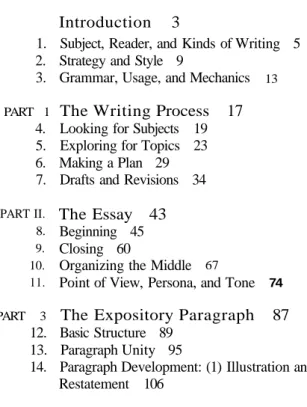
Introduction 3
1. Subject, Reader, and Kinds of Writing 5 2. Strategy and Style 9
3. Grammar, Usage, and Mechanics 13 PART 1 The Writing Process
4. Looking for Subjects 19 5. Exploring for Topics 23 6. Making a Plan 29 7. Drafts and Revisions 34
17
PART II.
8.
9.
10.
11.
The Essay 43 Beginning 45 Closing 60
Organizing the Middle Point of View, Persona,
67
and Tone 74 PART 3 The Expository Paragraph 87
12. Basic Structure 89 13. Paragraph Unity 95
14. Paragraph Development: (1) Illustration and Restatement 106
8 CONTENTS
15. Paragraph Development: (2) Comparison, Contrast, and Analogy 114
16. Paragraph Development: (3) Cause and Effect 125 17. Paragraph Development: (4) Definition, Analysis,
and Qualification 132
PART 4. The Sentence 149
18. The Sentence: A Definition 151 19. Sentence Styles 161
20. The Well-Written Sentence: (1) Concision 191 21. The Well-Written Sentence: (2) Emphasis 200 22. The Well-Written Sentence: (3) Rhythm 223 23. The Well-Written Sentence: (4) Variety 234
PART v. Diction 241 24. Meaning 243
25. Clarity and Simplicity 262 26. Concision 281
27. Figurative Language 295
28. Unusual Words and Collocations 325 29. Improving Your Vocabulary: Dictionaries 336
PART vi. Description and Narration 349 30. Description 351
31. Narration 366
PART VII. Punctuation 377 Introduction 379 32. Stops 383
33. The Other Marks 417 Name Index 439 Subject Index 445
The New Oxford Guide
to Writing
Introduction
Two broad assumptions underlie this book: (1) that writing is a rational activity, and (2) that it is a valuable activity.
To say that writing is rational means nothing more than that it is an exercise of mind requiring the mastery of tech- niques anyone can learn. Obviously, there are limits: one can- not learn to write like Shakespeare or Charles Dickens. You can't become a genius by reading a book.
But you don't have to be a genius to write clear, effective English. You just have to understand what writing involves and to know how to handle words and sentences and para- graphs. That you can learn. If you do, you can communicate what you want to communicate in words other people can understand. This book will help by showing you what good writers do.
The second assumption is that writing is worth learning. It is of immediate practical benefit in almost any job or career.
Certainly there are many jobs in which you can get along without being able to write clearly. If you know how to write, however, you will get along faster and farther.
There is another, more profound value to writing. We cre- ate ourselves by words. Before we are businesspeople or law- yers or engineers or teachers, we are human beings. Our
INTRODUCTION
growth as human beings depends on our capacity to under- stand and to use language. Writing is a way of growing. No one would argue that being able to write will make you mor- ally better. But it will make you more complex and more interesting—in a word, more human.
CHAPTER
1
Subject, Reader,
and Kinds of Writing
Choosing a Subject
Often, of course, you are not free to choose at all. You must compose a report for a business meeting or write on an as- signed topic for an English class. The problem then becomes not what to write about but how to attack it, a question we'll discuss in Chapters 5 and 6.
When you can select a subject for yourself, it ought to in- terest you, and interest others as well, at least potentially. It should be within the range of your experience and skill, though it is best if it stretches you. It ought to be neither so vast that no one person can encompass it nor so narrow and trivial that no one cares.
Don't be afraid to express your own opinions and feelings.
You are a vital part of the subject. No matter what the topic, you are really writing about how you understand it, how you feel about it. Good writing has personality. Readers enjoy sensing a mind at work, hearing a clear voice, responding to an unusual sensibility. If you have chosen a topic that is of general concern, and if genuine feeling and intelligence come through, you will be interesting. Interest lies not so much in a topic as in what a writer has made of it.
6 INTRODUCTION
About Readers
You don't want to repel readers. This doesn't mean you have to flatter them or avoid saying something they may disagree with. It does mean you must respect them. Don't take their interest for granted or suppose that it is the readers' job to follow you. It's your job to guide them, to make their task as easy as the subject allows.
Ask yourself questions about your readers: What can I ex- pect them to know and not know? What do they believe and value? How do I want to affect them by what I say? What attitudes and claims will meet with their approval? What will offend them? What objections may they have to my ideas, and how can I anticipate and counter those objections?
Readers may be annoyed if you overestimate their knowl- edge. Tossing off unusual words may seem a put-down, a way of saying, "I know more than you." On the other hand, la- boring the obvious also implies a low opinion of readers:
don't tell them what a wheel is; they know. It isn't easy to gauge your readers' level of knowledge or to sense their be- liefs and values. Sensitivity to readers comes only with ex- perience, and then imperfectly. Tact and respect, however, go a long way. Readers have egos too.
Kinds of Writing
The various effects a writer may wish to have on his or her readers—to inform, to persuade, to entertain—result in dif- ferent kinds of prose. The most common is prose that in- forms, which, depending on what it is about, is called exposition, description, or narration.
Exposition explains. How things work—an internal com- bustion engine. Ideas—a theory of economics. Facts of every- day life—how many people get divorced. History—why Custer attacked at the Little Big Horn. Controversial issues laden with feelings—abortion, politics, religion. But whatever
SUBJECT, READER, AND KINDS OF WRITING 7
its subject, exposition reveals what a particular mind thinks or knows or believes. Exposition is constructed logically. It organizes around cause/effect, true/false, less/more, positive/
negative, general/particular, assertion/denial. Its movement is signaled by connectives like therefore, however, and so, be- sides, but, not only, more important, in fact, for example.
Description deals with perceptions—most commonly visual perceptions. Its central problem is to arrange what we see into a significant pattern. Unlike the logic of exposition, the pat- tern is spatial: above/below, before/behind, right/left, and so on.
The subject of narration is a series of related events—a story. Its problem is twofold: to arrange the events in a se- quence of time and to reveal their significance.
Persuasion seeks to alter how readers think or believe. It is usually about controversial topics and often appeals to reason in the form of argument, offering evidence or logical proof.
Another form of persuasion is satire, which ridicules folly or evil, sometimes subtly, sometimes crudely and coarsely. Fi- nally, persuasion may be in the form of eloquence, appealing to ideals and noble sentiments.
Writing that is primarily entertaining includes fiction, per- sonal essays, sketches. Such prose will receive less attention here. It is certainly important, but it is more remote from everyday needs than exposition or persuasion.
For Practice
> List ten or twelve topics you might develop into a short essay.
Think of topics that deal not so much with things, places, or how-to- do projects as with your opinions and beliefs. Pick subjects that interest you and are within your experience, yet challenging. Be specific: don't simply write "my j o b " but something like "what I like most (or hate most) about my j o b . "
£> Selecting one of the topics on your list, compose a paragraph about the readers for whom you might develop it. Consider how
8 INTRODUCTION you wish to affect those readers, what you want them to understand and feel. Think about their general knowledge, values, attitudes, biases; whether they are your age or older or younger, come from a similar or a different background; and how you would like them to regard you.
CHAPTER
2
Strategy and Style
Purpose, the end you're aiming at, determines strategy and style. Strategy involves choice—selecting particular aspects of a topic to develop, deciding how to organize them, choosing this word rather than that, constructing various types of sen- tences, building paragraphs. Style is the result of strategy, the language that makes the strategy work.
Think of purpose, strategy, and style in terms of increasing abstractness. Style is immediate and obvious. It exists in the writing itself; it is the sum of the actual words, sentences, paragraphs. Strategy is more abstract, felt beneath the words as the immediate ends they serve. Purpose is even deeper, supporting strategy and involving not only what you write about but how you affect readers.
A brief example will clarify these overlapping concepts. It was written by a college student in a fifteen-minute classroom exercise. The several topics from which the students could choose were stated broadly—"marriage," "parents," "teach- ers," and so on—so that each writer had to think about re- stricting and organizing his or her composition. This student chose "marriage":
Why get married? Or if you are modern, why live together? Answer:
Insecurity. "Man needs woman; woman needs man." However, this
IO INTRODUCTION cliche fails to explain need. How do you need someone of the opposite sex? Sexually is an insufficient explanation. Other animals do not stay with a mate for more than one season; some not even that long. Companionship, although a better answer, is also an in- complete explanation. We all have several friends. Why make one friend so significant that he at least partially excludes the others?
Because we want to "join our lives." But this desire for joining is far from "romantic"—it is selfish. We want someone to share our lives in order that we do not have to endure hardships alone.
The writer's purpose is not so much to tell us of what she thinks about marriage as to convince us that what she thinks is true. Her purpose, then, is persuasive, and it leads to par- ticular strategies both of organization and of sentence style.
Her organization is a refinement of a conventional question/
answer strategy: a basic question ("Why get married?"); an initial, inadequate answer ("Insecurity"); a more precise ques- tion ("How do we need someone?"); a partial answer ("sex");
then a second partial answer ("companionship"); a final, more precise question ("Why make one friend so significant?");
and a concluding answer ("so that we do not have to endure hardships alone").
The persuasive purpose is also reflected in the writer's strat- egy of short emphatic sentences. They are convincing, and they establish an appropriate informal relationship with readers.
Finally, the student's purpose determines her strategy in approaching the subject and in presenting herself. About the topic, the writer is serious without becoming pompous. As for herself, she adopts an impersonal point of view, avoiding such expressions as "I think" or "it seems to me." On another occasion they might suggest a pleasing modesty; here they would weaken the force of her argument.
These strategies are effectively realized in the style: in the clear rhetorical questions, each immediately followed by a straightforward answer; and in the short uncomplicated sen- tences, echoing speech. (There are even two sentences that are grammatically incomplete—"Answer: Insecurity" and "Be-
STRATEGY AND STYLE 11
cause we want to 'join our lives.' ") At the same time the sentences are sufficiently varied to achieve a strategy funda- mental to all good prose—to get and hold the reader's attention.
Remember several things about strategy. First, it is many- sided. Any piece of prose displays not one but numerous strategies—of organization, of sentence structure, of word choice, of point of view, of tone. In effective writing these reinforce one another.
Second, no absolute one-to-one correspondence exists be- tween strategy and purpose. A specific strategy may be adapted to various purposes. The question/answer mode of organizing, for example, is not confined to persuasion: it is often used in informative writing. Furthermore, a particular purpose may be served by different strategies. In our example the student's organization was not the only one possible. An- other writer might have organized using a "list" strategy:
People get married for a variety of reasons. First. . . Second . . . Third . . . Finally . . .
Still another might have used a personal point of view, or taken a less serious approach, or assumed a more formal re- lationship with the reader.
Style
In its broadest sense "style" is the total of all the choices a writer makes concerning words and their arrangements. In this sense style may be good or bad—good if the choices are appropriate to the writer's purpose, bad if they are not. More narrowly, "style" has a positive, approving sense, as when we say that someone has "style" or praise a writer for his or her
"style." More narrowly yet, the word may also designate a particular way of writing, unique to a person or characteristic of a group or profession: "Hemingway's style," "an academic style."
12 INTRODUCTION
Here we use style to mean something between those ex- tremes. It will be a positive term, and while we speak of errors in style, we don't speak of "bad styles." On the other hand, we understand "style" to include many ways of writing, each appropriate for some purposes, less so for others. There is no one style, some ideal manner of writing at which all of us should aim. Style is flexible, capable of almost endless varia- tion. But one thing style is not: it is not a superficial fanciness brushed over the basic ideas. Rather than the gilding, style is the deep essence of writing.
For Practice
t> Selecting one of the topics you listed at the end of Chapter 1, work up a paragraph of 150 to 200 words. Before you begin to write, think about possible strategies of organization and tone. Or- ganization involves (1) how you analyze your topic, the parts into which you divide it, and (2) the order in which you present these parts and how you tie them together. Tone means (1) how you feel about your subject—angry, amused, objective, and so on; (2) how you regard your reader—in a formal or an informal relationship;
and (3) how you present yourself.
When you have the paragraph in its final shape, on a separate sheet of paper compose several sentences explaining what strate- gies you followed in organizing your paragraph and in aiming for a particular tone, and why you thought these would be appropriate.
CHAPTER
3
Grammar, Usage, and Mechanics
Purpose, strategy, and style are decided by you. But the de- cision must be made within limits set by rules over which you have little control. The rules fall into three groups: grammar, usage, and mechanics.
Grammar
Grammar means the rules which structure our language. The sentence "She dresses beautifully" is grammatical. These var- iations are not:
Her dresses beautifully.
Dresses beautifully she.
The first breaks the rule that a pronoun must be in the sub- jective case when it is the subject of a verb. The second vio- lates the conventional order of the English sentence: subject- verb-object. (That order is not invariable and may be altered, subject to other rules, but none of these permits the pattern:
"Dresses beautifully she.")
Grammatical rules are not the pronouncements of teachers, editors, or other authorities. They are simply the way people
14 INTRODUCTION
speak and write, and if enough people begin to speak and write differently, the rules change.
Usage
Usage designates rules of a less basic and binding sort, con- cerning how we should use the language in certain situations.
These sentences, for instance, violate formal usage:
She dresses beautiful.
She ain't got no dress.
Sentences like these are often heard in speech, but both break rules governing how educated people write. Formal usage dic- tates that when beautiful functions as an adverb it takes an -ly ending, that ain yt and a double negative like a in't got no or haven't got no should be avoided.
Grammar and usage are often confused. Many people would argue that the sentences above are "ungrammatical."
Our distinction, however, is more useful. Grammatical rules are implicit in the speech of all who use the language. Usage rules, on the other hand, stem from and change with social pressure. Ain't, for example, was once acceptable. The adver- bial use of an adjective like beautiful was common in seventeenth-century prose. Chaucer and Shakespeare use double negatives for emphasis.
The fact that usage rules are less basic than grammatical ones, however, and even that they may seem arbitrary, does not lessen their force. Most of them contribute to clarity and economy of expression. Moreover, usage applies to all levels of purpose and strategy, to informal, colloquial styles as well as to formal ones. For example, grammatically incomplete sentences (or fragments), frowned upon in formal usage, are occasionally permissible and even valuable in informal com- position. (Witness the two fragments in the student paragraph on marriage on page 8.) So is regarded in formal English as a subordinating conjunction which ought not to introduce a
GRAMMAR, USAGE, AND MECHANICS I 5
sentence. But in a colloquial style, it may work better than a more literary connective like consequently or therefore.
Mechanics
In composition mechanics refers to the appearance of words, to how they are spelled or arranged on paper. The fact that the first word of a paragraph is usually indented, for example, is a matter of mechanics. These sentences violate other rules of mechanics:
she dresses beautifully She dresses beautifuly.
Conventions of writing require that a sentence begin with a capital letter and end with full-stop punctuation (period, question mark, or exclamation point). Conventions of spell- ing require that beautifully have two Is.
The rules gathered under the heading of mechanics attempt to make writing consistent and clear. They may seem arbi- trary, but they have evolved from centuries of experience.
Generally they represent, if not the only way of solving a problem, an economic and efficient way.
Along with mechanics we include punctuation, a very com- plicated subject and by no means purely mechanical. While some punctuation is cut-and-dried, much of it falls into the province of usage or style. Later, in the chapter on punctua- tion, we'll discuss the distinctions between mechanical and stylistic uses of commas, dashes, and so on.
Grammar, Usage, and Style
Grammar, usage, and mechanics establish the ground rules of writing, circumscribing what you are free to do. Within their limits, you select various strategies and work out those strat- egies in terms of words, sentences, paragraphs. The ground rules, however, are relatively inflexible, broken at your peril.
16 INTRODUCTION
It is not always easy to draw the line between grammar and usage or between usage and style. Broadly, grammar is what you must do as a user of English; usage, what you should do as a writer of more or less formal (or informal) English; and style, what you elect to do to work out your strategies and realize your purposes.
"Her dresses beautifully," we said, represents an error in grammar, and "She dresses beautiful," a mistake in usage.
"She dresses in a beautiful manner," however, is a lapse in style. The sentence breaks no rule of grammar or of usage, but it is not effective (assuming that the writer wants to stress the idea of "beauty"). The structure slurs the emphasis, which should be on the key word and which should close the state- ment—"She dresses beautifully."
Most of our difficulties with words and sentences involve style. For native speakers, grammar—in our sense—is not likely to be a serious problem. Usage (which includes much of what is popularly called "grammar") and mechanics are more troublesome. But generally these require simply that you learn clearly defined conventions. And having learned them, you will find that rather than being restrictive they free you to choose more effectively among the options available to you as a writer.
Style is less reducible to rule, and more open to argument.
No one can prove "She dresses in a beautiful manner" is poorer than "She dresses beautifully." (One can even imagine a context in which the longer sentence would be preferable.) Even so, it violates a principle observed by good writers; use no more words than you must.
You may think of that principle as a "rule" of style. We shall discuss and illustrate that and other stylistic "rules," but remember: they are generalizations about what good writers do, not laws dictating what all writers must do.
P A R T
I
The Writing Process
Writing in its broad sense—as distinct from simply putting words on paper—has three steps: thinking about it, doing it, and doing it again (and again and again, as often as time will allow and patience will endure).
The first step, "thinking," involves choosing a subject, ex- ploring ways of developing it, and devising strategies of or- ganization and style. The second step, "doing," is usually called "drafting"; and the third, "doing again," is "revising."
The next several chapters take a brief look at these steps of the writing process.
First a warning. They're not really "steps," not in the usual sense anyway. You don't write by (1) doing all your thinking, (2) finishing a draft, and then (3) completing a revision. Ac- tually you do all these things at once.
If that sounds mysterious, it's because writing is a complex activity. As you think about a topic you are already beginning to select words and construct sentences—in other words, to draft. As you draft and as you revise, the thinking goes on:
you discover new ideas, realize you've gone down a dead end, discover an implication you hadn't seen before.
It's helpful to conceive of writing as a process having, in a broad and loose sense, three steps. But remember that you
18 THE WRITING PROCESS
don't move from step to step in smooth and steady progress.
You go back and forth. As you work on a composition you will be, at any given point, concentrating on one phase of writing. But always you are engaged with the process in its entirety.
CHAPTER
4
Looking for Subjects
People write for lots of reasons. Sometimes it's part of the job. A sales manager is asked to report on a new market, or an executive to discuss the feasibility of moving a plant to another state. A psychology student has to turn in a twenty- page term paper, or a member of an art club must prepare a two-page introduction to an exhibit.
In such cases the subject is given, and the first step is chiefly a matter of research, of finding information. Even the prob- lem of organizing the information is often simplified by fol- lowing a conventional plan, as with scientific papers or busi- ness letters. Which is not to dismiss such writing as easy.
Being clear and concise is never easy. (To say nothing of being interesting!) But at least the writing process is structured and to that degree simplified.
At other times we write because we want to express some- thing about ourselves, about what we've experienced or how we feel. Our minds turn inward, and writing is complicated by the double role we play. / am the subject, which somehow the / who writes must express in words. And there is a further complication. In personal writing, words are not simply an expression of the self; they help to create the self. In struggling to say what we are, we become what we say.
Such writing is perhaps the most rewarding kind. But it is
2O THE WRITING PROCESS
also the most challenging and the most frustrating. We are thrown relentlessly upon our own resources. The subject is elusive, and the effect can be a kind of paralysis. And so peo- ple say, "I can't think of anything to write about."
That's strange, because life is fascinating. The solution is to open yourself to experience. To look around. To describe what you see and hear. To read. Reading takes you into other minds and enriches your own. A systematic way of enriching your ideas and experiences is to keep a commonplace book and a journal.
The Commonplace Book
A commonplace book is a record of things we have read or heard and want to remember: a proverb, a remark by a writer of unusual sensibility, a witty or a wise saying, or even some- thing silly or foolish or crass:
Sincerity always hits me something like sleep. I mean, if you try to get it too hard, you won't. w. H. Auden Women have served all these centuries as looking glasses possess- ing the . . . power of reflecting the figure of a man at twice its nat- ural Size. Virginia Woolf I hate music—especially when it's played. jimmy Durante Shrouds have no pockets. English proverb
All this—and perhaps. Yiddish proverb
To keep a commonplace book, set aside a looseleaf binder.
When you hear or read something that strikes you, copy it, identifying the source. Leave space to add thoughts of your own. If you accumulate a lot of entries, you may want to make an index or to group passages according to subject.
A commonplace book will help your writing in several ways. It will be a storehouse of topics, of those elusive "things
LOOKING FOR SUBJECTS 21
to write about." It will provide a body of quotations (occa- sional quotations add interest to your writing). It will im- prove your prose. (Simply copying well-expressed sentences is one way of learning to write.) Most important, keeping a commonplace book will give you new perceptions and ideas and feelings. It will help you grow.
The Journal
A journal—the word comes from French and originally meant "daily"—is a day-to-day record of what you see, hear, do, think, feel. A journal collects your own experiences and thoughts rather than quotations. But, of course, you may combine the two. If you add your own comments to the pas- sages you copy into a commonplace book, you are also keep- ing a kind of journal.
Many professional writers use journals, and the habit is a good one for anybody interested in writing, even if he or she has no literary ambitions. Journals store perceptions, ideas, emotions, actions—all future material for essays or stories.
The Journals of Henry Thoreau are a famous example, as are A Writer's Diary by Virginia Woolf, the Notebooks of the French novelist Albert Camus, and "A War-time Diary" by the English writer George Orwell.
A journal is not for others to read. So you don't have to worry about niceties of punctuation; you can use abbrevia- tions and symbols like "&." But if a journal is really to help you develop as a writer, you've got to do more than compose trite commonplaces or mechanically list what happens each day. You have to look honestly and freshly at the world around you and at the self within. And that means you have to wrestle with words to tell what you see and what you feel:
July 25, Thursday. . . . Today: clear, flung, pine-chills, orange nee- dles underfoot.
I myself am the vessel of tragic experience. I muse not enough
22 THE WRITING PROCESS on the mysteries of Oedipus—I, weary, resolving the best and bring- ing, out of my sloth, envy and weakness, my own ruins. What do the gods ask? I must dress, rise, and send my body out.
Sylvia Plath
But journals do not have to be so extraordinary in their sensibility or introspection. Few people are that perceptive.
The essential thing is that a journal captures your experience and feelings. Here is another, different example, also fresh and revealing. The writer, Rockwell Stensrud, kept a journal as he accompanied an old-time cattle drive staged in 1975 as part of the Bicentennial celebration:
Very strict unspoken rules of cowboy behavior—get as drunk as you want the night before, but you'd better be able to get up the next morning at 4:30, or you're not living by the code of respect- ability. Range codes more severe than high-society ideas of man- ners—and perhaps more necessary out here. What these cowboys respect more than anything is ability to carry one's own weight, to perform, to get the job done well—these are the traditions that make this quest of theirs possible.
CHAPTER
5
Exploring for Topics
Before beginning a draft, you need to explore a subject, look- ing for topics. (Subject refers to the main focus of a compo- sition; topic to specific aspects of the subject. The subject of this book is writing. Within that subject grammar, sentence style, and so on, are topics. Any topic, of course, can itself be analyzed into subtopics.)
Some people like to work through a subject systematically, uncovering topics by asking questions. Others prefer a less structured, less analytical approach, a kind of brainstorming.
They just begin to write, rapidly and loosely, letting ideas tumble out in free association. Then they edit what they've done, discarding some topics, selecting others for further development.
Neither way is "right"—or rather both are right. Which you use depends on your habits of mind, how much you already know about a subject, and of course the subject itself.
If you are writing about something that is easily analyzed—
why one candidate should be elected, for instance, rather than some other—and if you've already thought a good deal about the matter, the analytical, questioning approach is better. But if your subject is more nebulous—your feelings about war, say—and you have not thought long and hard, you may get stuck if you try systematic analysis. It might be better to
24 THE WRITING PROCESS
scribble, to get ideas on paper, any ideas, however far-fetched, in whatever order.
Finding Topics by Asking Questions
What happened?
How?
When?
Why? What caused it? What were the reasons?
How can the subject be defined?
What does it imply or entail?
What limits should be set to it?
Are there exceptions and qualifications?
What examples are there?
Can the subject be analyzed into parts or aspects?
Can these parts be grouped in any way?
What is the subject similar to?
What is it different from?
Has it advantages or virtues?
Has it disadvantages or defects?
What have other people said about it?
These are general questions, of course; and they are not the only ones you might ask. Particular subjects will suggest oth- ers. Nor will all of these questions be equally applicable in every case. But usually five or six will lead to topics.
Suppose, for example, you are interested in how young adults (20 to 30) in the 1990s differ from similar people in the 1960s. Try asking questions. Consider definition. What do you mean by "differ"? Differ how? In dress style? Eating habits? Political loyalties? Lifestyle? Attitudes toward love, sex, marriage? Toward success, work, money?
Already you have topics, perhaps too many. Another ques- tion suggests itself: Which of these topics do I want to focus on? Or, put another way: How shall I limit the subject? The choice would not be purely arbitrary; it would depend partly on your interests and partly on your ambitions. In a book you might cover all these topics. In a ten-page paper only one
EXPLORING FOR TOPICS 25
or two or three. We'll imagine a short paper and focus on love, sex, and marriage.
Now you have three major topics. How to organize them?
Sex, love, and marriage seems a reasonable order. Next, each topic needs to be explored, which you do by again asking questions. How do the attitudes of the sixties and the nineties differ? Why? Examples?—from friends, popular culture (songs, advertisements, magazine articles, films), literature, sociological studies? Can you find useful quotations or stories or movies that support your points? Are there virtues in the attitudes of the nineties? Disadvantages? How do you eval- uate those of the sixties? Was a comparable generational shift in values evident in other places and other times?
You're not going to get answers off the top of your head.
But at least you know what you're looking for. You can begin to collect information, interviewing friends, studying maga- zines and movies and television shows, reading novels and stories, looking into scholarly studies of changing social attitudes.
You've got a lot to write about.
Finding Topics by Free Writing or Brainstorming
Free writing simply means getting ideas on paper as fast as you can. The trick is to let feelings and ideas pour forth. Jot down anything that occurs to you, without worrying about order or even making much sense. Keep going; to pause is to risk getting stuck, like a car in snow. Move the pencil, writing whatever pops into mind. Don't be afraid of making mistakes or of saying something foolish. You probably will. So what?
You're writing for yourself, and if you won't risk saying something foolish, you're not likely to say anything wise.
Here's how you might explore the different attitudes of the 1990s and the 1960s on sex, love, and marriage:
Sex—less permissive today. Herpes? AIDS? More conservative mo- rality? Just a generational reaction, a swing of the pendulum?
l6 . THE WRITING PROCESS Cooler about love and marriage. Less romantic. Harry and Ellen.
Maybe feminism. If they have a chance at careers—prestige, money—women are harder-headed about marriage. Maybe more demanding about men, less willing to accept them on men's own terms. Maybe men leery of modem women.
Economics? It's a tougher world. Fewer good jobs, more com- petition. Everything costs—education, cars, housing, kids.
Materialism. Young people seem more materialistic. Concerned with money, worldly success. They want to make it. Be millionaires by thirty. Admiration for winners, fear being losers.
Less idealistic? Do disillusion and cynicism push toward self- interest? But people in their twenties today aren't really cynical and disillusioned. Never been idealistic enough. They don't have to learn the lesson of The Big Chili They grew up in it.
Such jottings are not finely reasoned judgments. Many of the ideas are speculative and hastily generalized; some are probably biased. Still, topics have surfaced. The next task would be to look at them closely, rejecting some, choosing others; and then to gather information.
Thus both methods of exploration have led to topics, the rudiments of an essay. But notice that while they cover the same general subject, they have led in rather different direc- tions. The analytical questions have stressed what—the na- ture of the changes in attitude; the free writing has stressed why—the reasons for the changes.
These different emphases were not planned. They just hap- pened. And that suggests an important fact: it is profitable to use both methods to explore for topics. Questions have the advantage of focusing your attention. But a focused attention sees only what is under the lens, and that is a severe limitation.
Brainstorming can be wasteful, leading in too many direc- tions. But it is more likely to extend a subject in unforeseen ways and to make unexpected connections.
The two methods, then, are complementary, not antithet- ical. Temperamentally, you may prefer one or the other. But it's wise to try both.
EXPLORING FOR TOPICS 27
For Practice
D> Below is a series of provocative quotations. Select one that appeals to you and explore it for topics. You don't have to agree with the idea. The goal is just to get your thoughts on paper.
First, fill one or two pages with free writing. Put down everything that comes to mind. Then try the more analytical approach of ask- ing questions. (A variation of this exercise is to work with several friends; group brainstorming can be more productive than working alone.)
Beware of all enterprises that require new clothes. Thoreau Know thyself. Greek maxim
"Know thyself?" If I knew myself I'd run away. Goethe The business of America is business. Calvin Coolidge
Business underlies everything in our national life, including our spiritual life. Woodrow Wilson In love always one person gives and the other takes.
French proverb
Sex is something I really don't understand too hot. You never know where the hell you are. I keep making up these sex rules for myself, and then I break them right away. j . D. Salinger No man but a blockhead ever writes, except for money.
Samuel Johnson
He's really awfully fond of colored people. Well, he says himself, he wouldn't have white servants. Dorothy Parker If we wanted to be happy it w o u l d be easy; but we want to be happier than other people, which is almost always difficult, since we think them happier than they are. Montesquieu Wrest once the law to your authority:
To do a great right, do a little wrong. Shakespeare A lawyer has no business with the justice or injustice of the cause which he undertakes, unless his client asks his opinion, and then
28 THE WRITING PROCESS he is b o u n d to give it honestly. T h e justice or injustice of t h e cause is t o be decided by the j u d g e . Samuel Johnson [College is] four years under the ethercone breathe deep gently n o w that's the w a y to be a g o o d b o y o n e t w o three four five six get A's in some courses but d o n ' t be a g r i n d . John Dos Passos If a t h i n g is w o r t h d o i n g , it is w o r t h d o i n g badly. c. K. Chesterton
CHAPTER
6
Making a Plan
You've chosen a subject (or had one chosen for you), explored it, thought about the topics you discovered, gathered infor- mation about them. Now what? Are you ready to begin writing?
Well, yes. But first you need a plan. Perhaps nothing more than a loose sense of purpose, held in your mind and never written down—what jazz musicians call a head arrangement.
Head arrangements can work very well—if you have the right kind of head and if you're thoroughly familiar with the subject.
But sometimes all of us (and most times most of us) require a more tangible plan. One kind is a statement of purpose;
another is a preliminary, scratch outline.
The Statement of Purpose
It's nothing complicated—a paragraph or two broadly de- scribing what you want to say, how you're going to organize it, what you want readers to understand, feel, believe. The paragraphs are written for yourself, to clarify your ideas and to give you a guide; you don't have to worry about any- one else's reading them. Even so, you may find on occasion that composing a statement of purpose is difficult, perhaps
30 THE WRITING PROCESS
impossible. What that means is that you don't really know what your purpose is. Yet even failure is worthwhile if it makes you confront and answer the question: Just what am I aiming at in this paper?
Not facing that question before they begin to write is one of the chief causes people suffer from writing block. It's not so much that they can't think o/what to say, as that they haven't thought about what they can say. Ideas do not come out of the blue; as we saw in the last chapter, they have to be sought. And when they are found, they don't arrange them- selves. A writer has to think about the why and how of using them.
Many of us think better if we write down our ideas. That's all a statement of purpose is really, thinking out loud, except with a pencil. The thinking, however, is not so much about the subject itself as about the problems of focusing and com- municating it.
Here's how a statement of purpose might look for a theme about attitudes toward sex, love, and marriage in the 1990s:
It seems to me that today people in their twenties feel differently about sex, love, and marriage than young people did in the 1960s.
I'm not claiming the differences are universal, that every young adult today feels one way, while every young adult twenty years ago felt another. Just that the predominant tone has changed. I want to identify and describe these differences, focusing on the nineties, and to discuss why the changes came about. I see a problem of organization. Am I going to organize primarily around the differ- ences themselves, first attitudes toward sex, then attitudes towards love and marriage? In this case, a discussion of causes would be subordinate. On the other hand, I could make the causes my main points of organization, beginning with a relatively detailed discus- sion of how attitudes today are different, but spending most of the paper in discussing how feminism, the hardening economy, and a tougher, more self-centered approach to life have combined to bring about the changes. I think I'll do it this second way. What I want readers to see is less of the facts about the new attitudes to-
MAKING A PLAN 31 ward sex, love, and marriage, and more of the social and cultural causes generating the change.
The Scratch Outline
An outline is a way of dividing a subject into its major parts, of dividing these in turn into subparts, and so on, into finer and finer detail. There are formal outlines, which are usually turned in with a composition and even serve as compositions in their own right. And there are informal outlines, often called "working" or "scratch" outlines. The formal variety follows rules that prescribe the alternating use of numbers and letters and the way in which the analysis must proceed. But formal outlines and their rules will not concern us here.
Our interest is in the scratch outline, which serves only the writer's use and may be cast in any form that works. Begin by asking: What are the major sections of my composition?
For example:
I. Beginning
II. How attitudes toward sex, love, and marriage in the 1990s differ from those in the 1960s
III. Why the differences occurred IV. Closing
Now apply a similar question to each major section:
I. Beginning
A. Identify subject and establish focus—on the reasons for the change rather than on the change itself
B. Quality and limit: attitudes in question are the predominat- ing ones, those which set the tone of a generation
II. How attitudes toward sex, love, and marriage differ in the 1990s from those in the 1960s
A. Sex—less permissive, less promiscuous
B. Love—cooler, not so completely a preemptive good
32 THE WRITING PROCESS C. Marriage—more calculating, rational; avoid early marriage,
first get career on track III. Why the differences occurred
A. Feminism—more job opportunities for women and greater independence; also stronger sense of their own worth—all this weakens the allure of love and marriage
B. Tighter economy—future has to be planned more carefully, less room for romantic illusions
C. More self-centered view of life—partly a result of the two conditions above, but becomes a cause in its own right IV. Closing
A. The attitudes of the nineties more realistic, less prone to disillusion
B. But perhaps idealism has been sacrificed, or weakened, and the prevailing materialism is too ready to sell the world short
Thus the analysis could go on: the A's and B's broken down, examples introduced, comparisons offered, and so on.
Generally, it is better to proceed with the analysis one step at a time, as in the example above. This keeps the whole subject better in mind and is more likely to preserve a reasonable balance. If you exhaustively analyze category I before moving on to II, then carry II down to fine detail before tackling III, you may lose sight of the overall structure of the composition.
How far you take a scratch outline depends on the length of your composition and obviously on your willingness to spend time in planning. But the more planning you do, the easier the actual writing will be. A good scratch outline sug- gests where possible paragraph breaks might come, and the ideas you have jotted down in the headings are the germs of topic statements and supporting sentences.
But however you proceed and however far you carry the scratch outline, remember that as a plan it is only tentative, subject to change. And the odds are that you will change it.
No matter how much you think about a subject or how thor- oughly you plan, the actuality of writing opens up unforeseen possibilities and reveals the weakness of points that seemed
MAKING A PLAN 33
important. A scratch outline is a guide, but a guide you should never hesitate to change.
For Practice
D> Imagine you are going to write an essay of eight or ten pages, using the topics you arrived at by exploring one of the quotations at the end of the preceding chapter. First, compose a statement of purpose for that essay in one or two paragraphs totaling about 250 words. Second, make a scratch outline for the theme, indicating the primary divisions and the major subdivisions within these.
CHAPTER
7
Drafts and Revisions
Drafting
A draft is an early version of a piece of writing. Most of us cannot compose anything well at the first try. We must write and rewrite. These initial efforts are called drafts, in distinc- tion from the final version. As a rule, the more you draft, the better the result.
For drafting, the best advice is the same as for the free writ- ing we discussed in Chapter 5: keep going and don't worry about small mistakes. A draft is not the end product; it is tentative and imperfect. Writing becomes impossible if you try to do it one polished sentence at a time. You get lost looking for perfection. Rough out your report or article, then develop and refine, keeping the total effect always in mind.
Accept imperfections. Don't linger over small problems. If you can't remember a spelling, get the word down and correct it later. If you can't think of exactly the term you want, put down what you can think of and leave a check in the margin to remind yourself to look for a more precise word. Your main purpose is to develop ideas and to work out a structure.
Don't lose sight of major goals by pursuing minor ones—
proper spelling, conventional punctuation, the exact word.
These can be supplied later.
DRAFTS AND REVISIONS 3 5
There is a limit, however, to the similarity between drafting and free writing. Free writing involves exploration and dis- covery; your pencil should move wherever your mind pushes it. A draft is more reined in. You know, more or less, what you want to do, and the draft is an early version of an organ- ized composition. Therefore you are not as free as in the ex- ploratory phase. If you get into blind alleys in a draft, you must back out and set off in a new direction. The mistake will not be unproductive if it tells you where you don't want to be.
Some people prefer to draft with a pen or pencil; others can work successfully on a typewriter or word processor. If you draft in longhand, skip every other line and leave adequate margins: you will need the space for revisions. If you type, double space. Use only one side of the paper, reserving the other side for extensive changes or additions. When you num- ber the pages of your draft, it's a good idea to include a brief identifying title: "First draft, p. 1," "Second draft, p. 3."
In a composition of any length, consider stopping every so often at a convenient point. Read over what you've written, making corrections or improvements; then type what you've done. Seeing your ideas in print will usually be reassuring. If you don't have a typewriter or word processor, copy the sec- tion neatly in longhand; the effect will be much the same.
Turn back to the draft; work out the next section; stop again and type. The alternation between drafting and typing will relieve the strain of constant writing and give you a chance to pause and contemplate what you have accomplished and what you ought to do next.
But this is advice, not dogma. People vary enormously in their writing habits; what works for one fails for another. The best rule is to find a time and a place for writing that enable you to work productively and to follow a procedure you find congenial. You may like to draft in green or purple ink, to listen to music as you write, to compose the entire draft of a ten-page essay and then retype the whole thing instead of doing it section by section. Do what works for you.
36 THE WRITING PROCESS
As a brief sample, here is a draft of the beginning of the composition we've been discussing for the last several chap- ters—how young people in the 1990s feel about sex, love, and marriage.
I have some friends in their late twenties. They live in Chicago, where he is starting out as a lawyer and she as an accountant. Both are presently junior members of large firms, but they are ambitious and hope eventually either to track upward in their companies or to get out on their own. They live together; they say they are in love, and they seem to be. But they are surprisingly cool about it and about the prospect of marriage. " W e l l , " Dee says, "I have my career and Jack has his. It's good we're together, but who knows where we'll be in two years or how we'll feel?" Their coolness surprises me. I find it admirable and yet a bit repelling. I admire their good sense. Still, I think to myself, should young love be so cool, so rational, so pragmatic? Is such good sense at so youthful an age perhaps purchased at too great a price? My friends are not, I believe, unusual, not certainly among young, college-educated professionals. The lack of emotional intensity and commitment—
about love, at least—seems the dominant tone of their generation.
How is it different from the attitudes I grew up with, the attitudes of the sixties? And why is it different? These are the questions I want to consider.
A good deal of improvement can be made in that draft.
First, though, it would help to say something about revision in general.
Revising
Both drafting and revising are creative, but they differ in em- phasis. Drafting is more spontaneous and active; revision, more thoughtful and critical. As a writer of a draft you must keep going and not get hung up on small problems. As a reviser you change hats, becoming a demanding reader who expects perfection. When you write you see your words from inside; you know what you want to say and easily overlook
DRAFTS AND REVISIONS 37
lapses of clarity puzzling to readers. When you revise you put yourself in the reader's place. Of course you cannot get com- pletely outside your own mind, but you can think about what readers know and do not know, what they believe and con- sider important. You can ask yourself if what is clear to you will be equally clear to them.
To revise effectively, force yourself to read slowly. Some people hold a straightedge so they read only one line at a time, one word at a time if possible. Others read their work aloud.
This is more effective (though you cannot do it on all occa- sions). Reading aloud not only slows you down, it distances you from the words, contributing to that objectivity which successful revision requires. Moreover, it brings another sense to bear: you hear your prose as well as see it. Ears are often more trustworthy than eyes. They detect an awkwardness in sentence structure or a jarring repetition the eyes pass over.
Even if you're not exactly sure what's wrong, you hear that something is, and you can tinker with the sentences until they sound better. It also helps to get someone else to listen to or to read your work and respond.
Keep a pencil in hand as you revise (some like a different color). Mark your paper freely. Strike out imprecise words, inserting more exact terms above them (here is the advantage of skipping lines). If you think of another idea or of a way of expanding a point already used, write a marginal note, phras- ing it precisely enough so that when you come back to it in an hour or a day it will make sense. If a passage isn't clear, write "clarity?" in the margin. If there seems a gap between paragraphs or between sentences within a paragraph, draw an arrow from one to the other with a question mark. Above all, be ruthless in striking out what is not necessary. A large part of revision is chipping away unnecessary words.
As we study diction, sentences, and paragraph structure, you will become aware of what to look for when you revise, but we shall mention a few basics here. Most fundamental is clarity. If you suspect a sentence may puzzle a reader, figure out why and revise it. Almost as important is emphasis.
38 THE WRITING PROCESS
Strengthen important points by expressing them in short or unusual sentences. Learn to position modiners so that tHey interrupt a sentence and throw greater weight on important ideas. Look for unsupported generalizations. Even when it is clear, a generalization gains value from illustrative detail.
Sharpen your diction. Avoid awkward repetitions of the same word. Replace vague abstract terms with precise ones having richer, more provocative connotations. Watch for fail- ures of tone: don't offend readers and don't strike poses.
Be alert for errors in grammar and usage and in spelling and typing. Make sure your punctuation is adequate and con- ventional, but no more frequent than clarity or emphasis re- quires. Guard against mannerisms of style. All of us have them: beginning too many sentences with "and" or "but";
interrupting the subject and verb; writing long, complicated sentences. None of these is wrong, but any word or sentence pattern becomes a mannerism when it is overworked. One
"however" in a paragraph may work well; two attract a reader's notice; three will make him or her squirm.
As an example of revision let's look again at the opening of our imaginary essay.
Dull opening. Perhaps:
"Dee and Jack are an at-
tractive c o u p l e . . . . " I have some friends in their late twenties.
Not important enough for a jn e y | jv e jn Chicago, where he is starting main clause
out as a lawyer and she as an accountant.
Both are presently junior members of large firms, but they are ambitiouo and hope Poor emphasis and w o r d y committed to their careers, eager to move ahead
eventually either to track upward in their 1 New paragraph companies or to get out on their own. They
live together; they say they are in love,
DRAFTS AND REVISIONS 39
The point is that marriage is not a likely prospect.
New sentence for emphasis
New paragraph Wordy
"Repelling" is too strong.
New paragraph
Wordy and awkward
and they seem to be. But they are surpris- ingly cool about it and about the
possibility
prospect of marriage. "Well," Dee says, "I have my career and Jack has his. It's good we're together, but who knows where
Or
we'll be in two years ef how we'll feel?"
1 I find
Their coolness surprises me. I find it admi-
unsettling
rable and yet a bit repelling. I admire their good sense. Still, I think to myself, should young love be so cool, so rational, so prag- matic? Is such good sense at so youthful an age purchased at too great a price?
1 Dee and Jack
My friends are not, I believe, unusual, not certainly among young, college-
Low-key ed
educated professionals. The lack of
emotionalism seems the dominant tone of their song of
emotional intensity and commitment—
love.
about lovo at least seems the dominant tone Rework these rhetorical
questions; they seem heavy- handed and jar the infor- mal tone.
of their generation. How is it different from the attitudes I grew up with, the attitudes of the sixties? And why is it different? These are the questions I want to consider.
4 0 THE WRITING PROCESS
Here now is the revision:
Dee and Jack are an attractive couple in their late twenties—
bright, well-educated, ambitious. He is starting out as a lawyer, she as an accountant, junior members of large firms, they are commit- ted to their careers and eager to move ahead.
They live together. They say they are in love, and they seem to be. But they are cool about it, and about the possibility of marriage.
" W e l l , " Dee says, "I have my career and Jack has his. It's good that we're together, but who knows where we'll be in two years?
Or how we'll feel?"
I find their coolness admirable, and yet a bit unsettling. Should young love, I think to myself, be quite so cool, so rational, so prag- matic? Is good sense at so youthful an age purchased at too high a price?
Dee and Jack aren't unusual, not among college-educated young professionals. Low-keyed emotionalism seems the dominant tone of the contemporary song of love. It's all very different from the attitudes I shared in the sixties. It occurred to me to wonder why.
I don't think there is any single, simple reason.. . .
Probably you wouldn't write such extensive marginal notes to yourself, but those in the example suggest how you should be thinking. The revisions are toward precision, emphasis, and economy.
How many drafts and revisions you go through depends on your energy, ambition, and time. Most people who publish feel they stopped one draft too soon. Many teachers and ed- itors are willing to accept corrections so long as they are not so numerous or messy that they interfere with reading. Some, on the other hand, do want clean copy—that is, pages with no corrections, additions, or deletions.
Final Copy
Whether or not you are allowed to revise it, your final copy should always be neat and legible. Keep margins of an inch or more. If you type, use standard typing paper and type on
DRAFTS AND REVISIONS 41
only one side. Double space and correct typos by erasure or tape, not by overstriking. Keep the keys clean and invest now and then in a new ribbon. If you write in longhand, use con- ventional, lined composition paper. Unless directed other- wise, skip every other line and write only on one side. Leave adequate margins for corrections and comments. Take time to write legibly. No one expects a beautiful copperplate hand, but it is fair to ask for readability.
P A R T
II
The Essay
CHAPTER
8
Beginning
An essay is a relatively short composition. It does not claim scholarly thoroughness (that belongs to the monograph), but it does exhibit great variety. Essays can be about almost any- thing; they can be speculative or factual or emotional; they can be personal or objective, serious or humorous. The very looseness of the term is a convenience; it would be a mistake to define it precisely. Here essay really will simply mean a short prose piece. There are differences among articles and reports and essays. But they have much in common, and what we say about the essay—its beginning, closing, structure, and so on—applies to compositions generally.
Readers approach any piece of prose with a set of questions.
What is this about? Will it interest me? What does the writer intend to do (or not do)? What kind of person is the writer?
To begin effectively you must answer these questions, one way or another. From the writer's point of view, beginning means announcing and limiting the subject, indicating a plan, catching the reader's attention, and establishing an appropri- ate tone and point of view.
Not all of these matters are equally important. Announcing and limiting the subject are essential. Laying out the plan of the paper and angling for the reader's interest, on the other hand, depend on your purpose and audience. Tone and point
46 THE ESSAY
of view are inevitable: whenever you write you imply them.
In the beginning, then, you must establish a tone and point of view conducive to your purpose.
The length of the beginning depends on the length and complexity of what it introduces. In a book the opening might take an entire chapter with dozens of paragraphs. In a short article a single sentence might be adequate. For most essays a single paragraph is enough. Whatever their length, all effective openings fulfill the same functions.
Announcing the Subject
In announcing a subject you have two choices: (1) whether to be explicit or implicit, and (2) whether to be immediate or to delay.
Explicit and Implicit Announcement
In explicit announcement you literally state in some fashion or other, "This is my subject." The philosopher Alfred North Whitehead begins Religion in the Making like this:
It is my purpose to consider the type of justification which is avail- able for belief in the doctrines of religion.
The words "It is my purpose" make this an explicit an- nouncement. It would have been implicit had Whitehead begun:
Belief in the doctrines of religion may be justified in various ways.
This sentence does not literally tell readers what the subject is, but the subject is clearly implied.
Because of its clarity, scholars and scientists writing for their colleagues often use explicit announcement. On less for- mal occasions it may seem heavy-handed. A school theme,
BEGINNING 4 7
for instance, ought not to begin "The purpose of this paper is to contrast college and high school." It is smoother to es- tablish the subject by implication: "College and high school differ in several ways." Readers don't have to be hit over the head. Implicit announcements may appear as rhetorical ques- tions, as in this essay about historians:
What is the historian?
The historian is he who tells a true story in writing.
Consider the members of that definition. Hilaire Belloc
Similarly the theme on college and high school might have opened:
In what ways do college and high school differ?
Opening questions, however, can sound mechanical. While better than no announcement at all, or the clumsiness of "The purpose of this paper is," rhetorical questions are not very original. Use them for announcement only when you can do so with originality or when all other alternatives are less attractive.
The same advice holds for opening with a dictionary defi- nition, another way of announcing subjects implicitly. Noth- ing is inherently wrong in starting off with a quote from a reputable dictionary, but it is trite. Of course a clever or an unusual definition may make a good opening. John Dos Pas- sos's definition of college as "four years under the ethercone"
is certainly novel and provocative and might make a fine beginning.
When the purpose of an essay is to define a word or idea, it is legitimate to start from the dictionary. But these excep- tions admitted, the dictionary quotation, like the rhetorical question, has been overworked as a way of implying the subject.
48 THE ESSAY
Immediate and Delayed Announcement
Your second choice involves whether to announce the subject immediately or to delay. This opening line of an essay called
"Selected Snobberies" by the English novelist Aldous Huxley falls into the first category:
All men are snobs about something.
Letting readers in on the subject at once is a no-nonsense, businesslike procedure. But an immediate announcement may not hold much allure. If the subject is of great interest, or if the statement is startling or provocative (like Huxley's), it will catch a reader's eye. Generally, however, immediate an- nouncement is longer on clarity than on interest.
So you may prefer to delay identifying the subject. Delay is usually achieved by beginning broadly and narrowing until you get down to the subject. The critic Susan