THE USE OF EXTENDING CONCEPT THROUGH LANGUAGE ACTIVITIES (ECOLA)
TO IMPROVE READING COMPREHENSION
(A Classroom Action Research at the Second Grade Students of SMA Perguruan Islam Makassar)
A THESIS
Submitted to the Faculty of Teacher Training and Education
Makassar Muhammadiyah University in partial fulfillment of the requirement For the degree of education in English department
By:
SULKIFLI 10535 3290 08
ENGLISH EDUCATION DEPARTMENT
FACULTY OF TEACHER TRAINING AND EDUCATION MAKASSAR MUHAMMADIYAH UNIVERSITY
2013
Motto
EVERYTHING IS GONNA BE OK WITH BIMILLAHIRAHMANIRRAHIM
ABSTRACT
SULKIFLI, 2013. Increasing the Students’ Ability to improve reading comprehension Through ECOLA (Extending Concept Language Activities) Method (A classroom action research at the second grade of SMA Perguruan Islam Makassar), under the thesis of English Education Department, the Faculty of Teachers Training and Education, Muhammadiyah University of Makassar.
Supervisor by Hj. Andi Tenri Ampa and Ummi Khaerati Syam.
This research aimed at find out the improvement of the students’ ability reading comprehension Through ECOLA (Extending Concept Language Activities) Method at the Second grade of SMA Perguruan Islam Makassar.
The method of this research was a Classroom Action Research that consisted of two cycles. One cycle consisted of four meetings. It means that there were eight meetings for two cycles. The instrument of the research was observation and reading test indicated that the students have high score in reading achievement. The subject of this research was the Second grade of SMA Perguruan Islam Makassar academic years 2013-2014 by ECOLA (Extending Concept through Language Activities) Method. It consisted of 30 students.
The findings of this research indicated that the improvement of the students’ in reading comprehension Through ECOLA (Extending Concept Language Activities) Method and the students’ participation in teaching and learning process. The means scores of reading comprehension in diagnostic test was 36.65 become 51.87 in first cycle, and after revision in the second cycle the mean score in the second cycle was 77.08. The improvement of students’ ability in reading comprehension viewed from Literal and Interpretative through ECOLA (Extending Concept Language Activities) Method was presenting reading text material at Class XI IPS of SMA Perguruan Islam Makassar, improves the students’ ability signifincatly. The mean score of literal and interpretative in the cycle II was greater than the mean score of test in cycle I (59.15>37.05). The researcher findings indicated that use of ECOLA (Extending Concept Language Activities) Method could increase of students’ ability in reading comprehension, in terms of literal and interpretative. The result of the students activeness in the first meeting of cycle I was 54.16% then it became 84.16% in fourth meeting of second cycle. The successful of minimal criteria (KKM) was 4 while first cycle, there was only (36.65%) students achieved the successful minimal criteria but the other (77.08%) did not achieve the teacher target. In cycle 2 there were no student get poor and fair, 5 (20.83%) get good, 17 (70.83%) get very good and 2 (8.3%) get Excellent. It means that the teacher could achieved the target become 7, this indicated of ECOLA (Extending Concept Language Activities) Method can make the students more active and enthusiast in learning process.
ACKNOWLEDGEMENTS
In the name of Allah, Most Gracious, Most Merciful
Alhamdulillah. First and foremost, I would like to praise to Allah SWT, the Almighty, for the blessing and leading so that I am able to finish my thesis.
Best regards be upon the Prophet Mohammad SAW, his family, his companions and all of his followers.
I realizes that many hands given their helps and useful suggestion for the completion of this thesis. Therefore, I would like to express my appreciation and sincere thanks to all of them particularly:
1. My beloved parents (Syamsuddin T. M.Pd and Dra. Hj. Hamirah M.Pd), and my beloved Brother (Nurul Aswar M.Pd, Fadly Akbar, Ahmad Musafir, Rahmat Hidayat) for their prayer, love, care, financial, motivation, suggestions and sacrificed for success, and their love sincerely and purely without time.
There is no appropriate symbol which suitable to state my thanks to them.
2. Dr. Irwan Akib , M. Pd, the Rector of the Makassar Muhammadiyah University
3. Dr. A. Syukri Syamsuri, M. Hum, the Dean of Teacher Training and Education Faculty.
4. Erwin Akib, S.Pd, M.Pd, the Head of English Education Department of FKIP Makassar Muhammadiyah University.
5. Dra. Hj. Andi Tenri Ampa., M.Hum, my first supervisor, for guiding and supporting me in every step to make and complete this thesis, and to Ummi Khaerati Syam, S.Pd., M.Pd, my second supervisor for her time, patience and carefulness in reading and correcting this final project.
6. My heartful thank to all lecturers of the FKIP UNISMUH especially to the lecturers of English Department and all staff of Makassar Muhammadiyah university of for their guidance during the years of my study.
7. My deep appreciation for Adnan, S.Pd.,M.Pd as the Headmaster, Muhammad Tubagus M. as English teacher and all the students of SMA Perguruan Islam Makassar especially for the students of the second grade who have spared their time and activities for being subject of this research.
8. My special thanks for my motivators, Firman S.pd, Rezky Amaliah Ramadhani who had given to me motivation, suggestion (become someone better and confidence) trusty and all great.
Finally, I dedicate this thesis for my beloved brothers and sisters in UKM Seni & Budaya Talas who are given to me great experience, make me to be in my real character and found the truly brotherhood.
Makassar, Desember 2013
LIST OF CONTENT
TITLE PAGE……… i
APPROVAL SHEET ... … ii
SURAT PERNYATAAN ... . iii
SURAT PERJANJIAN ... .. iv
MOTTO……… v
ABSTRACT ... vi
ACKNOWLEDGMENTS ... vii
LIST OF CONTENTS ... .. ix
LIST OF TABLES... xi
LIST OF CHARTS……… xii
LIST OF APPENDIXES... xiii
CHAPTER I. INTRODUCTION A. Background ... 1
B. Problem Statement ... 3
C. Objective of the research ... 4
D. Significance of the research... ... 4
E. Scope of the research ... 4
CHAPTER II. REVIEW OF RELATED LITERATURE A. The Concept of ECOLA ... 5
B. Concept of Reading... 11
C. Reading Comprehension... ... 13
D. Theoritical Framwork ... 16
CHAPTER III. RESEARCH METHOD
A. Research Design ... 17
B. Research procedures ... 17
C. Research Subject ... 20
D. Research Variables And Indicators ... 21
E. Research instrument ... 21
F. Technique of Data Collection ... 22
G. Technique of Data Analysis ... 22
CHAPTER IV. FINDINGS AND DISCUSSION A. Findings ... 26
B. Discussion ... 33
CHAPTER V. CONCLUSION AND SUGGESTION A. Conclusion ... 35
B. Suggestion ... 36
BIBLIOGRAPHY ... 38 APPENDIXES
CURICULUM VITAE
LIST OF TABLES
Table 1: The Students’ Improvement in Literal ... 27
Table 2: The Students’ Improvement in Interpretative ... 28
Table 3: The Students’ Improvement in Reading Ability ... 30
Table 4: The Result of The Students’ Observation in Learning reading ... 32
LIST OF CHARTS
Graphic 1: The Students’ Improvement in Literal ... 27
Graphic 2: The Students’ Improvement in Interpretative ... 29
Graphic 3: The Improvement of the Students’ Reading Comprehension ... 31
Graphic 4: The Improvement of the Students’ in Learning proces ... 32
LIST OF APPENDIXES
APPENDIX A ... 48
APPENDIX B ... 53
APPENDIX C ... 81
APPENDIX D ... 82
APPENDIX E ... 85
APPENDIX F ... 95
APPENDIX G ... 100
APPENDIX H ... 101
APPENDIX I ... 104
CHAPTER I
INTRODUCTION
A. Background
Reading is one of the communicative skills of english. It is an important part of English, this is the way of gaining information from written source. Hammer (1991:68), states that reading is useful for other purpose; it provides good models for english writing and also provides opportunities to study language. For the reasons it will be important to make the reading activity as effective as possible.
The purpose of reading in many languages is to inform ourselves about something we are interested, or to challenge certain our methods. In other words, to extend our experience of the world in which we live. A person may read to get information. He may also read for enjoyment, or to enhance knowledge of the language being read (Janz: 2004). Although every student knows how to read, many have never learned good reading skills. (Royse, 2001: 127).
The purpose for reading is to guide the reader to select the appropriate texts, to determine the appropriate to reading comprehension.
The observation result when the researcher conducted teaching practice in second Grade Students of SMA Perguruan Islam Makassar, the students’ reading comprehension skill still poor. All of the students can be read but only a few of students can comprehend or can understand what they have read especially English text. It because many factors such as the students consider that English is a subject that very difficult,bored and scares because meaning and letters are different.The other factor is
the teacher always uses the same method to teach English subject like the direct method. It is also make the students more bore to study English. As value of observation in the class room the students’ has score 6.0. This score is as a poor category. In this research the aim is to solve this problem until the students have a good score, while the standard curriculum is 6.5. The researcher wants to achieve the score at 7.0 target in learning reading comprehension.
The technique of teaching English is to develop especially to improving reading comprehension, because the technique of teaching influences the students’ success. So, the teacher of English should select the suitable method or technique to teach and material to teach. There are many approaches or techniques have been applied in the English curriculum. In general the techniques in reading found at High School are comprehension question answering exercises, therefore can improve the teaching of reading in order that the students’ activity involves in reading class particularly in the given tasks.
Davies (1984:2) confirms that success learning in English requires knowledge of words. One who wants to do well in English must learn the words to pay attention to new words. The students should recognize and know the meaning of words or lexical as soon as they see them in reading passage. The students tend to read word by word, stop, thinking, and look up the dictionary and then move on the next sentences, by the time they reaches the end of the sentences, they might lose sight of its meaning. They are not aware that certain words may come from other words, through lexical simplification process. The students can be easy of in order to make reading as a fun activity, teacher should attempt to find any method. At this moment, writer want to offer a method that is group work technique.
In writer point of view, one of the easiest methods in improving students reading comprehension is using group work, because it is a very simple instruction that can easy to comprehend a reading passage as well as finding the main idea.
Based on the writer’s experience while attending various training and education, the writer hypothesize that the learning techniques (learning theory) constructivism is appropriate when used in learning these basic competencies. The writer is interested in conducting a research under the title: The Use of Extending Concept Through Language Activities (ECOLA) to Improve Reading Comprehension at The second Grade Students of SMA Perguruan Islam Makassar.
B. Problem Statement
Based on the description above, the writer formulated research questions as follow:
1. How does ECOLA improve the students’ ability in reading comprehension viewed from literal?
2. How does ECOLA improve the students’ ability in reading comprehension viewed from interpretative?
C. Objective of the Research
From the previous background and the problem statement, the objectives of the study are:
1. To know students ability in literal of reading comprehension through ECOLA.
2. To know students ability in interpretative of reading comprehension through ECOLA.
D. Significance of the Research
The result of the research is expected to be useful information and a reference for the English learners in general, particularly for the students at the Senior High School. So do for the teachers, they can use ECOLA (Extending Concept Through Language Activities) method as one of method in teaching English especially for reading.
E. Scope of the Research
The scope of this research is limited to the use of ECOLA (Extending Concept Through Language Activities) in improving the students’ literal (main idea and supporting idea) and interpretative reading comprehension (conclussion and summarising) through ECOLA at the second year student’ of SMA Perguruan Islam Makassar.
CHAPTER II
REVIEW OF RELATED LITERATURE
A. The Concept of Technique ECOLA
ECOLA (Extending Concept through Language Activities) developed by Smith-Burke (1982), reveals an effort to integrate reading, writing, speaking, and listening for the purpose of developing reading skils. The ability is useful to interpret and monitor student understanding. As noted by Smith-Burke (via Tierney, 1990:154), ECOLA focused on "the activities of the student until the student build to ensure that the proper interpretation of their 'natural ability to read and need monitoring to ensure that they are appropriate interpretation". For that purpose, the most important ECOLA learning framework lies in learning experiences following
1. Reading with a purpose. The purpose of reading the text was developed based on the intent of the author and some of the reasons why educators choose readings. Nevertheless, the goals remain to be determined by the student read.
2. Written response. students are expected to perform their own interpretations as outlined in the activity of writing. Interpretation of the results can be reviewed after they discuss.
3. Discussion. Discussion is seen as the basis for generating ideas, testing objectives, evaluate, meaning, and consider the effectiveness of the strategies used in reading.
4. Self monitoring. The student or students are encouraged to express their confusion, to interpret independently, and engage in a discussion about strategies for reading comprehension as well.
a. Step-by-Step Implementation ECOLA
According Darmiyati Zuchdi (2007: 161) ECOLA built through five stages:
(1) determining the communicative purpose for reading, (2) silent reading for a purpose and standard tasks, (3) bring understanding through writing activities, (4) carrying out the discussion and clarification of the meaning, and (5) writing and compare. ECOLA stages can be described below.
1. Determine the purpose of the communicative
Teacher can encourage the student or students to engage in a discussion in the classroom to determine their reading goals. The students determining their own goals in reading. Determination of reading in reading can be based on a consideration of the author's purpose. However, the students can define their objectives when considering the reasons teacher give reading.
Learning in elementary school, the role of the teacher is very important to direct students in reading goals. This should be done by the teacher for learning in the classroom should be associated with SK and KD content standards.
2. Silent Reading
The student are reminded of the purpose of their reading that led to the realization that they must be able to support their interpretation of the ideas from the readings, based on background knowledge or their reasons.
Smith-Bureke (through Tierny, 1990: 155) in Darmiyai Zuhdi (2007:162)
suggests that it is feasible to do so for different students with different purposes when reading. In it is also worth doing by the students in reading in class because the technique can develop the ability to read individually.
3. Realizing Understanding Through Writing Activity
The purpose of this phase is to develop the ability of the student or students to perform self-monitoring and start learning to express what they do not understand. During this phase, each student and teacher to write responses to all questions and the purpose of reading. In writing a response, students can ensure that their answers would be guaranteed confidential. They are encouraged to interpret and write about all that confusing. To clarify the problems encountered, the students are encouraged to ask to students or other students. It is the responsibility of others to explain how they deal with the same problem.
4. Discussion
The student organized into groups of no more than four people and a deadline. They are expected to discuss their interpretation of the results, comparing the responses, and change their conclusions. Each student and students are encouraged to exchange ideas and to explain the basis of their conclusions.
5. Writing and compare
The last step that must be taken by a student, either in small groups or individually, is another interpretation raises. If it is done in a group, then the consensus happens to be enriched by discussion and agreement. After
reviewing the results of the interpretation that has been completed, the student are encouraged to discuss the changes (interpretation) that was created to reveal the strategies they found. ECOLA technique (Extending Concept Through Language Activities) can improve reading comprehension.
This happens because this technique includes the monitoring of the results of interpretation. In addition, the technique Ecola encourage students to always discuss effective strategies to gain a good understanding. The process of discussions in this technique to build the capacity the students to work together in teams. The cooperation is a strategic move to gain knowing better in reading.
Based on the results of a study be conducted by Darmiyati Zuchdi et al.
(2007:164), entitled "Increasing the Effectiveness of Reading Students Ecola technique can be concluded that the use of Ecola techniques can improve reading comprehension of students. This is evidenced by an increase in reading comprehension scores were obtained from the difference in the mean pre-test scores with pst-test mean score. Enhancement mean score at
post-test 2, 1875).
Based on the frequency, end of cycle test results showed no more students scored in the range of 6.0 to 7.5. Frequency of students with scores above 8.0 by 16 people (100%). From the assessment process, it is known that the more ordinary student implement Ecola techniques in the classroom. They began to enjoy the use of such techniques. There does not appear within their boredom, and even tend to be passionate, enthusiastic, and very dynamic.
Other findings obtained in this study is the conclusion that the use of the
technique with its phases Ecola can enhance cooperation in the team, especially for discussions about reading comprehension strategies. In terms of frequency, as many as 14 people (87, 5%) stated that their ability to work together in teams to increase, mainly in an effort to gain a better understanding. Ability to work together in groups is indicated on two things, (1) an attitude of openness to the ideas of others, and (2) the dynamics of expressing an idea or ideas when talking with. Frequency of students who stated that he was a lot more open. A total of 10 people (62.5%) stated that they are much more open to new ideas and understanding of others.
With the implementation of Ecola atmosphere more dynamic space.
Students are trained to respond and their arguments better. Learning environment more enjoyable.
b. Ecola Applications in Learning.
In a study in the Basic, teachers should pay attention to psychology students. Teachers should not be one hundred percent to apply such measures.
Adjustments to the students needs to be done by the teacher. Adjustment measures can applay, including the following.
Step 1 : Teachers and students before reading asking questions about what should be learned in the meeting today. Teacher directs the basic competencies and indicators in the curriculum. If students are to move on variabel and indicators, the teacher tried to ask what purpose will the students achieved the learning of students in the variabel. If no one answers the student, the teacher
pointed to understand the purpose of reading.
Step 2 :Once students know the purpose of reading in the first step, the teacher reminded that students should be able to achieve the desired goal. By the time students read silently, the teacher carefully monitor these activities so that activities can be effective. For development, learning reading will be interrupted if one of the students to do something. The place
should be quiet in the silent reading.
Step 3 : Finish reading with purpose, the students wrote what is the hitch in the silent reading. Students freely express their opinions about the difficulty and ease of reading.
Step 4 : Finished writing students are expected to solve problems that hinder the learning activities. Students try to solve their own problems by writing the steps to overcome the problems. Students are free to interpret these.
Step 5 : Students in groups to discuss the results of the purpose of reading and interpretation of the results of measures to address the problem. During the discussion, students can change the interpretation of the results and the results read individually. In discussing the positive input to consider, if necessary, can Be used.
Step 6 : Comparing individual results with the results of the group that had discussing. They can provide conclusions on the results of individual and group results after discussing activities
B. Concepts of Reading 1. What is reading?
Reading is an exercise dominated by the eyes and the brain, the receive messages in the brain then has to work out the significance of' these messages.
Many students said that they have read one book, but when they were asked about the main idea of the book, they said nothing. It is not reading at all, except parroting. Read one book without any comprehension of this reading cannot be called as reading. In the dictionary of' reading and related terms (1980) presents some definition of reading as follows:
a. Godman (1968) defines that reading is an interaction between the writer and written language, through which the reader attempts to reconstruct a massage from the writer.
b. Gephart (1970) defines reading is an interaction by which meaning encoded in visual stimuli by an author becomes meaning in the main of the reader.
c. Kustaryo (1988) defines that reading is the interaction various written symbols with exiting knowledge and comprehension of information and ideas communicated.
2. Reading Process
There are three models of reading process namely:
a. Bottom-up model, (2) Top-Down Model, and (3) Interactive model
Eskey (1986) denoted that the bottom-up model of the reacting process is that reading a price process involving exact, detailed, sequential perceptions and identification of letters, words, spelling patters and larger language unit. This model assumes that reader process by moving his eyes from left to right across the page, first taking in the letters, combining these
two from words, then combining the words to from the phrases, clauses, and sentences, of the text.
b. The top-down model of reading process deals with the general notion of reading as the reconstruction of meaning based on a skill ful sampling of the text and such specific notion as the use of linguistic redundancy, the crucial rule of prior knowledge in prediction in the necessity for a reading at a reasonable rate in larger. More meaning full chunks of text. This models involved and interaction between thought and language.
c. The interactive models of reading process deals with a particular type of cognitive behavior, which is based on certain kinds of knowledge, which from a part puff the reader cognitive structure:
Wiryodosoyo (1989: 10 – 11) put forward sonic states of reading process as following:
1) Perceptions
The perception here indicates the ability to read words as significant units.
2) Comprehension
The comprehensions refer to the ability to make the authors or writer’s words conductive to useful through as read in context.
3) Reaction
The reaction is the action that requires consideration with what have been said by the author or writer.
4) Interaction
The interaction reveals to the ability to comprehend or understand or concepts towards the experience background F the writer that can be useful as parts of the reader’s experiences.
C. Reading Comprehension
1. Definition reading comprehension?
Niles (1980: 266) defines reading comprehension is understand what is read. Person and Comperell (1981) in Alexandre (1988: 164 - 165) stated that lack of comprehension of a given passage may be accounted in least three ways:
a. The reader doesn’t have appropriate schemata.
b. The clues provide by the author aren’t sufficient to suggest the appropriate schemata.
c. The reader finds a consistent interpretation that is not intended be the author.
According to Smith and Jhonson (1980:28) reading comprehension depends on many factors:
a. The reader’s ability to attend the printed idea.
b. The readers background knowledge to which new information must he added
c. The quality or lucidity of the writing itself.
d. The reader’s purpose or goal on reading material.
2. Level of comprehension
Levels of reading comprehension according to Smith (1969) and Wayne (1979) are:
a. Literal comprehension, which is the skill of getting the pr mar-v direct literal meaning of a word, ideas, or sentences in context.
b. Interpretation, that is identify ideas and meaning that are not explicit stated in the writing text.
c. Critical reading, that is to evaluate what is read and to examine critical the thoughts of the writer.
d. Creative reading, that is to apply ideas from the text to new situation and recombine author’s ideas with other ideas to front i1es concepts or to expand old ones.
Levels of reading comprehension according to Carnie in Carnie (1990) are:
1. Comprehension skill fin the primary level consist of:
a. Literal comprehension, that is to receive information stated in passage b. Sequencing comprehension skill that is to order several events from a
passage according to when they happened.
c. Summarization, that is to generate or to select a sentence the main idea.
2. Factors Influencing Comprehension
There are external and internal factors in reading comprehension.
All of which share the success in reading comprehension.
a. Motivation
Motivation is very important, the success and failure in reading depends one’s motivation to read, when the students have high motivation to read they will work hard to ever come the difficulty
material. One’s motivation could be influenced by internal and external factors, such as the material used by the teacher and prior knowledge.
b. Concentration
Concentration means to focus our attention clearly on a purpose. Concentration is very easy to do if we are interested in what we read.
c. Teacher’s Guidance
Teacher’s guidance influences how the students understand particular assignment because lack of sufficient guidance may also the major factor in low reading comprehension.
D. Theoretical Framework
Dealing with the theories previously stated, conceptual framework can be visualized of follows is:
Conceptual Framework
Reading Comprehension
CAR
TECHNIQUE ECOLA TEACHING LEARNING PROCESS
Improvement of Students Reading Comprehension
Literal Interpretative
CHAPTER III RESEARCH METHOD A. Research Design
This research used classroom action research (CAR). It conducted through two cycles to observe the improving the students’ reading comprehension through Extending Concept Through Language Activities (ECOLA) method..
B. Research Procedures
In this Classroom Action Research (CAR), the writer used the CAR principle with some cycle in procedure planning, action, observation, and reflection.
Cycle I 1. Planning
a. Created lesson plans using the gradual pattern Ecola techniques namely (1) determined the communicative purpose for reading, (2) read silently for a purpose and standard tasks: (3) creating understanding through writing activities, (4) conduct discussions through clarification of the meaning, and (5) wrote and compare.
b. Made the observation sheet to see how the process teaching and learning conditions in the classroom when the technique is applied to ECOLA reading comprehension.
c. Made teaching aids to use in order to optimize students' skills in reading.
d. Designing an evaluation tool to see if students understand the reading ability increased, sensitivity to the better reading.
2. Action
In this section the researcher conducted two cycles, where each cycle consisted of four meeting. Each meeting the researcher gave the reading material trough Extending Concept Through Language Activities (ECOLA). Teaching instruction and learning process based on the concepts of the given method. The teacher gave the reading text materials to the students and then the students had to do some steps below:
1. The teacher determined the communicative purpose for reading 2. The student read silently for a purpose and standard tasks.
3. Teacher asked The student creating understanding through writing activities,
4. conducted discussions through clarification of the meaning, and 5. wrote and compared what the student find from the text.
3. Observation
The observation used follow:
a. Students’ participation
b. The students’ respond of the material about “Three Fish” and doing the task
In this case, researcher observed the students response and activeness during the teaching and learning process by making a note all
the students’ activities. The researcher gave evaluation to the students to know the skills the students’ during answer the question.
4. Reflection
The value of the observation steps gathered for analysis and evaluation by the observer. The action was evaluated, the result of data is checked to draw a conclusion, and if the criteria were success, the action would be finished and if it was not, the action would be continued. So, by this activity the researcher was able to create a new better process in the second cycle.
Cycle II 6. Planning
a. In this section, the teacher prepared the new material about Reading Comprehension gave to the students (the passage).
b. The teacher made a lesson planning for the first meeting, the second meeting, the third meeting, and the fourth meeting about Reading Comprehension material.
c. Made research instrument.
7. Action
In this section the researcher conducted two cycles, where each cycle consisted of four meeting. Each meeting the researcher gave the reading material trough Extending Concept Through Language Activities (ECOLA). Teaching instruction and learning process based on the
concepts of the given method. The teacher gave the reading text materials to the students and then the students had to do some steps below:
1. The teacher determining the communicative purpose for reading 2. The student read silently for a purpose and standard tasks.
3. Teacher ask The student creating understanding through writing activities,
4. conduct discussions through clarification of the meaning, and 5. write and compare what the student find from the text.
6. Observation
In the case the observation done at the cycle II is almost same with the done observation at cycle I.
7. Reflection
Reflection was done to seem the result of the second cycle action process, to analyze, understand and made conclusion activity. The researcher analyzed and evaluated the whole action process to draw a conclusion whether the teaching and learning process had been successful or not.
C. Research Subject
The subject of this research was the students of SMA Perguruan Islam Makassar in 2012/2013 academic year in second grade . The number of the subject consists of 30 students. 19 femaleand 11 male.
D. Research Variables and Indicators 1. Variables
The following were the variables of the research:
a. Independent variable was Extending Concept Through Language Activities (ECOLA) method. It was important process which allows the students to improve the reading comprehension.
b. Dependent variables consisted of students’ literal and interpretative in reading comprehension.
2. Indicators
The indicators of this research used to measure the variables.
Those are language literal and interpretative. Literal (main idea, supporting idea) and interpretative (ability to conclution and summarize).
E. Research Instrument
The instrument used in this research as follows:
1. Reading Test
Reading test aimed to get information about students’ improvement after teaching learning process ends.
2. Observation Sheet
Observation was to find out the students’ data about their presence and activeness in teaching and learning process.
Students’ Correct Answer Total Score of Points F. Technique of Data Collection
The technique of data collection in this research as follows:
1. Test, it used to measure the students’ competence in learning English reading comprehension.
2. Observation, it used to know the students’ participation during the teaching and learning process.
G. Technique of Data Analysis
1. Scoring the students correct answer by used this formula:
Score = x 100
Sudijono (1999) 2. After collecting the data of the students, the researcher classified the score of the students. To classify the students’ score, there were seven classifications which were used as follows:
No. Rate of score Categories
1. 76 – 100 Excellent
2. 51 – 75 Very good
3. 26 – 50 Good
4. 0 – 25 Fairly good
(Gay, 1981: 298) 3. To calculate students’ participation and activeness, researcher used this
formula:
Where:
P = Percentage of the students’ score FQ = Frequency of the students’ score N = Subject
(Sudjana, 1990:85)
4. Scoring student’s in reading comprehension Main Idea/ Supporting Idea.
Indicators Score
Student locates and uses all relevant information stated directly in the text to answer questions, complete tasks, or otherwise demonstrate clear understanding.
4 Student locates and uses most relevant information stated directly in the text to answer questions, complete tasks, or otherwise demonstrate clear understanding
3 Student locates and uses some relevant information stated directly in the text to answer questions, complete tasks, or otherwise demonstrate clear understanding.
2 Student locates and uses little or no relevant information stated directly in the text to answer questions, complete tasks, or otherwise demonstrate clear understanding
1 (staff.highschool.spsd.org/.../Reading-rubric.) 5. Calculating the mean score of the students’ reading comprehension test by
used the following formula:
Where:
= Mean Score = Total Score
N = Number of Subject
(Gay 1981: 298) 6. To know development of the students’ reading comprehension, the
researcher used percentage technique.
Where:
P = percentage of the students X₁ = the first mean score X₂ = the second mean score
(Hasan in Arief, 2011) 7. Calculating the percentage of the students’ activity in learning process used
formula:
P = 100%
Note:
P = Percentage
F = Frequency N = Total number of Subject
(Hatch and Faraday (1982)
CHAPTER IV
FINDINGS AND DISCUSSION
This chapter presents the finding and discussion of the research. The findings consist of the data obtained through achievement test to see the students’
achievement after being taught the materials of reading comprehension through extending concept through language activities (ECOLA) Method and data collected through observation sheet and test to see the students’ improvement in learning reading comprehension after being given treatment in the first and second cycle of the research.
A. Findings.
The results of the data findings found that teaching reading comprehension through extending concept through language activities (ECOLA) Method can improve the students’ achievement in litera and interpretativel comprehension consist of mind ideas and conclution. In the further interpretation of the data analysis were given below:
1. The Improvement of the Students’ Literal Through Extending Concept Through Language Activities (ECOLA) Method.
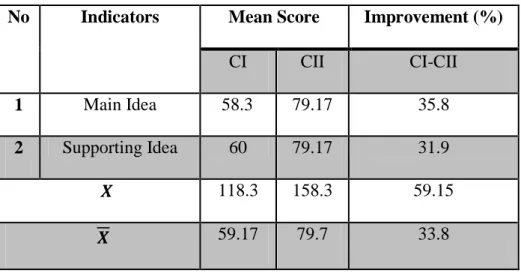
The improvement of the students’ Literal of details as indicators in XI IPS of SMA Perguruan Islam Makassar, as result of the students’ assessment of Diagnostic-Test, cycle I and cycle II can be seen clearly in the following table:
Table 1. The Improvement of the Students’ Literal
No Indicators Mean Score Improvement (%)
CI CII CI-CII
1 Main Idea 58.3 79.17 35.8
2 Supporting Idea 60 79.17 31.9
118.3 158.3 59.15
59.17 79.7 33.8
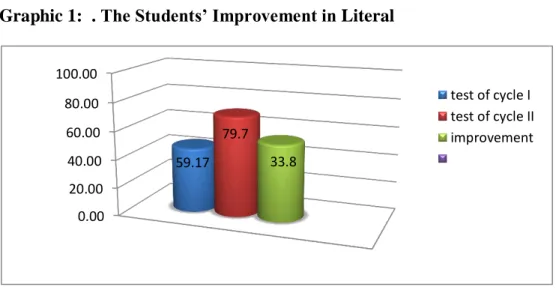
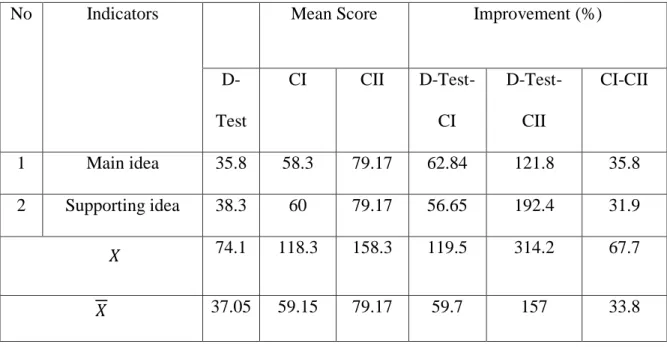
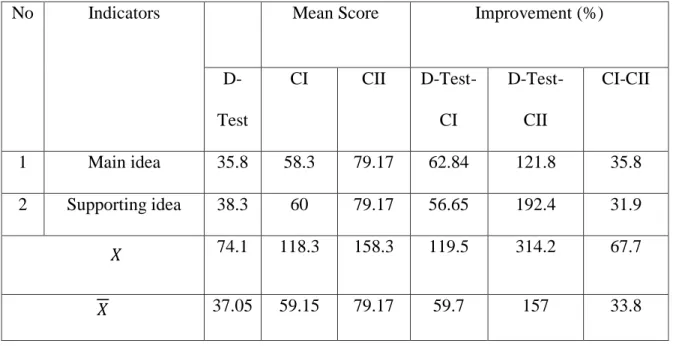
The table above indicates the significant improvement of the students' Main Ideas from cycle I to cycle II where the students’ literal comprehension in cycle I is 59.17 and in cycle II is 79.7. Thus, the improvement of students’ literal comprehension achievement from cycle I to cycle II is 33.8%
To see clearly the improvement of the students’ literal comprehension, the following chart is presented:
Graphic 1: . The Students’ Improvement in Literal
0.00 20.00 40.00 60.00 80.00 100.00
59.17 79.7
33.8
test of cycle I test of cycle II improvement
The chart above shows the improvement of the students’ literal comprehension dealing main ideas in which cycle II is higher (79.7). Than that in cycle I (59.17). (79.7>59.17) After evaluation in cycle I and cycle II, there is significant improvement of the students’ literal in reading comprehension dealing min ideas where the result of cycle I is categorized as fairly and cycle II categorized as very good. The improvement is shown clearly in the chart above that is 33.8%.
2. The Students’ Improvement in Interpretative.
The improvement of the students’ interpretative, which focused on as indicators in XI SMA Perguruan Islam Makassar. as result of the students’
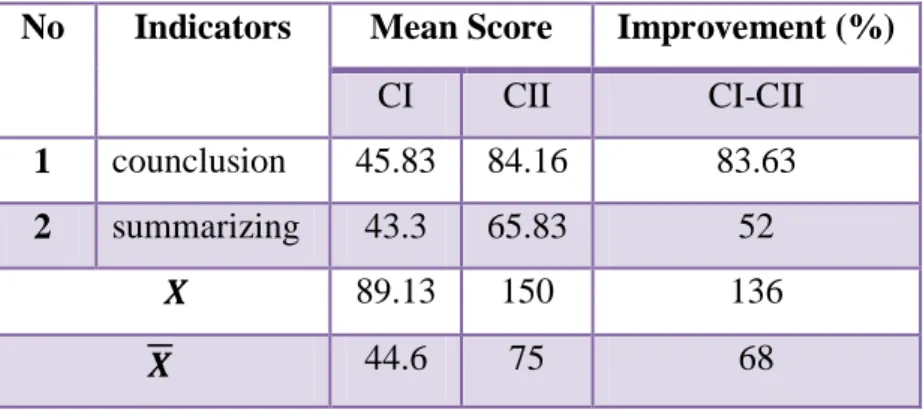
assessment of cycle I and cycle II can be seen clearly in the following table:
Table 2: The Improvement of the Students’ Interpretative No Indicators Mean Score Improvement (%)
CI CII CI-CII
1 counclusion 45.83 84.16 83.63
2 summarizing 43.3 65.83 52
89.13 150 136
44.6 75 68
The table above indicates that there is the improvement of the students’ Interpretative details cycle I and cycle II (44.6<75), After evaluation from cycle I to cycle II where the students’ literal details in cycle I is 45.38 and in cycle II is 84.16. Thus, the improvement of students’
sequence details achievement from cycle I to cycle II is 83.63%
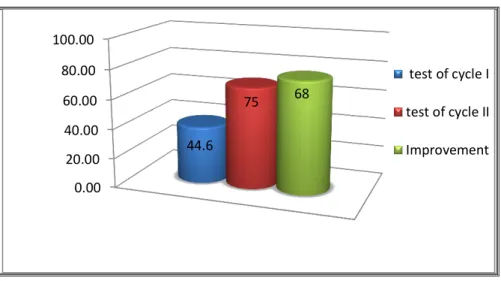
To see clearly the percentage score improvement of the students’
interpretive comprehension following chart is presented:
Graphic 2:The Improvement of the Students’ Interpretative
The chart above shows the improvement of the students’ sequence details in cycle II is higher (75) than that in cycle I (44.6). It also shows that the result of cycle I is the lowest achievement. (44.6<75). After evaluation in cycle I and cycle II, there is significant improvement of the students’
Interpretative details that shown clearly in the chart after taking an action in cycle through Extending Concept Through Language Activities (ECOLA) Method that is 68%.
3. The Improvement of Students’ Reading Comprehension Through Extending Concept Through Language Activities (ECOLA)) Method.
The improvement of the students’ reading comprehension Through Extending Concept Through Language Activities (ECOLA) Method, which focused on literal (main idea supporting idea) and interpretative (conclution and Summarizing) as variables details in XI IPS SMA Perguruan Islam
0.00 20.00 40.00 60.00 80.00 100.00
44.6
75 68
test of cycle I test of cycle II Improvement
Makassar, as result of the students’ assessment of cycle I and cycle II can be seen clearly in the following table:
Table 3 :The Improvement of the Students’ Reading Comprehension No Variabel Mean Score Improvement (%)
CI CII CI-CII
1 Literal 59.15 79.17 33.8
2 Interpretative 44.6 75 68.16
103.75 154.17 101.96
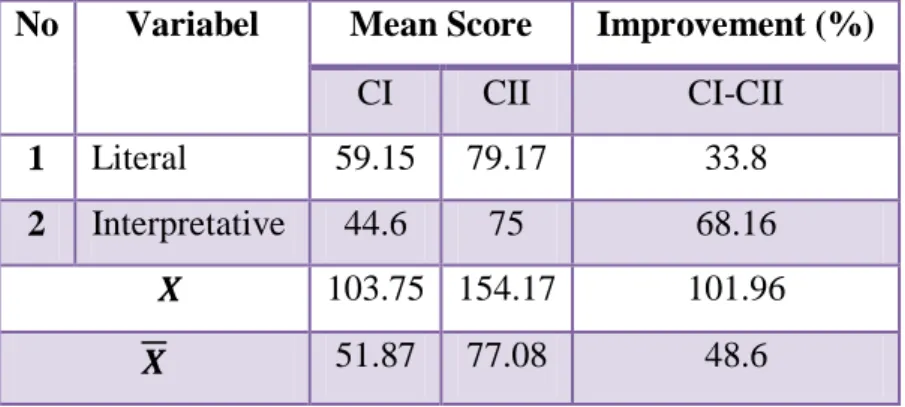
51.87 77.08 48.6
The table above indicates that there is improvement of the students’
literal reading comprehension from cycle I and cycle II, which in evaluation in cycle I the students’ literal reading comprehension indicate the significant improvement of students reading comprehension from cycle I to cycle II where the students’ reading comprehension in cycle I is 51.87. The students’
achievement in cycle I categorized as fairly, and in cycle II is 77.08. The students’ achievement in cycle II is categorized as good.
The table above proves that the use of Extending Concept Through Language Activities (ECOLA) Method in teaching and learning process is able to improvement of students’ reading comprehension after taking action in cycle I and cycle II where the students’ achievement in cycle II is the highest (77.08> 51.87) and the improvement of students’ reading ability from cycle I to cycle II is 48.6%
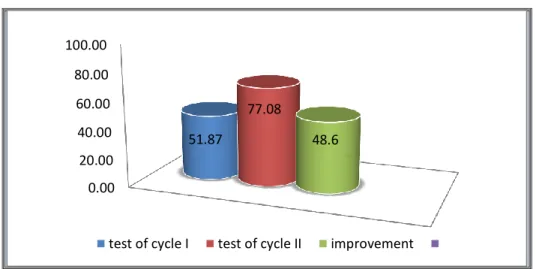
To see clearly the improvement of the students’ reading comprehension, following chart is presented:
Graphic 3: The Improvement of the Students’ Reading Comprehension
The chart above shows the improvement of the students’ reading comprehension in cycle II is higher (77.08) than that in cycle I (51.87), (77.08> 51.87). It also shows that the result of evaluation in cycle I and cycle II, there is significant improvement of the students’ literal reading comprehension where the result of cycle I is categorized as fair and cycle II categorized as good. The improvement is shown clearly in the chart above that is 46%.
4. The Result of the Students’ Activateness in Learning Process.
The result of observation of the students’ activeness in teaching and learning process during 8 meetings was taken by the observer through observation sheet. It could be seen clearly through the following table:
0.00 20.00 40.00 60.00 80.00 100.00
51.87
77.08
48.6
test of cycle I test of cycle II improvement
Table 4. The Result of the Students’ Activeness in Each Meeting
Cycle Meetings Average
Score
Improvemen
I II III IV t
I 54,16% 63,33% 68,33% 80% 65.83% 13%
II 73,33% 78,33% 78,44% 84,16% 78.76%
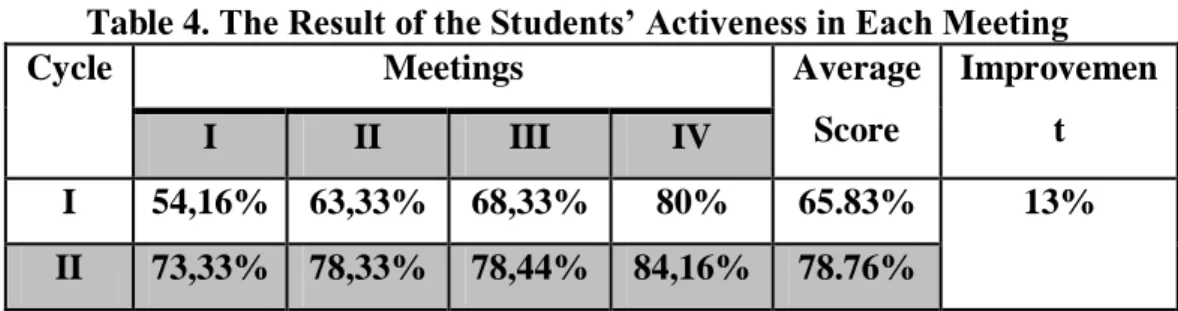
The table above explains about the average of the students’
activeness in teaching and learning process through observation sheet by observer. The table above shows the process the students’ activity in each meeting. The percentages of the cycle I from the first meeting to the fourth meeting are 54,16%, 63,33%, 68,33%and 80% Moreover, the percentage of the cycle II from the first meeting to the fourth meeting are 73,33%, 78,33%, 78,44% and 84,16%. In addition, the average score in every cycle, in cycle I is 65.83% and in cycle II is 78.76%. Hence, the improvement of the students’
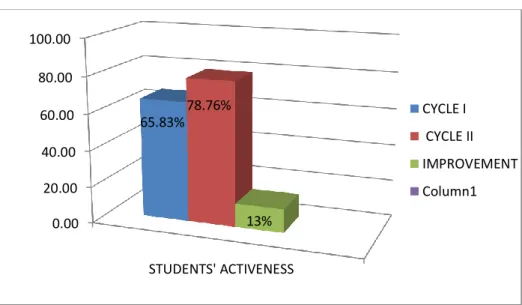
activity is 13%. To know the improvement clearly, look at the following chart:
Graphic 4: The students’ Observation in Learning Reading.
0.00 20.00 40.00 60.00 80.00 100.00
STUDENTS' ACTIVENESS 65.83%
78.76%
13%
CYCLE I CYCLE II IMPROVEMENT Column1
The chart above, presented the students’ situation during teaching and learning process in reading from cycle I to the cycle II. From the graphic it is known that there is a changing of students’ situation in learning reading is 65.83% and the changed to be 78.76% with improvement 13%
B. Discussions.
In this part, discussion deals with the interpretation of findings derived from the result of findings about the students’ Literal (main idea, supporting idea) and Interpretative (conclution summarize) reading comprehension. The application of Extending Concept Through Language Activities (ECOLA) Method in teaching reading comprehension at the XI IPS SMA Perguruan Islam Makassar can improve the students’ achievement and their ability to understand the material of reading comprehension in cycle I and cycle II inside the learning process in XI IPS SMA Perguruan Islam Makassar specially English subject is 70.
Before taking a classroom action research through Extending Concept Through Language Activities (ECOLA) Method, the researcher hold diagnostic test to measure the students’ prior knowledge in English reading.
After gave diagnostic test, the researcher found that the students’ reading comprehension at the XI IPS SMA Perguruan Islam Makassar was poor, so it must be improved. The diagnostic tests score was that all of students’ got very poor.
To improve the students’ reading comprehension, the researcher decided to use Extending Concept Through Language Activities (ECOLA)
Method and then prepared to do cycle I that consisted of 4 phases namely:
planning, action, observation, and reflecting. In cycle I, the researcher found that the students still difficult and confused to comprehend the text. The difficulty of the students in reading had been analyzed, so the researcher had to think the solution of the problem. The researcher decided to do cycle II by doing revision in the lesson plan. In cycle II, the researcher got a good response from the students. Students are fair active in classroom. They can enjoy the teaching and learning process, and their score was improved in cycle II.
The mean score of the students’ literal reading comprehension in cycle I was 59.15 and in cycle II was 79.17. Finally the mean score of reading comprehension Extending Concept Through Language Activities (ECOLA) method in cycle II 77.08 and 51.87 in cycle I with the students’ improvement from cycle I to Cycle II 48.6%. It means that the students’ reading comprehension improved significantly through Extending Concept Through Language Activities (ECOLA) method
The observation result of students’ activeness in teaching and learning process improved significantly through Extending Concept Through Language Activities (ECOLA) method in improving the students’ reading comprehension. It was proved by the improvement of the mean score of the students’ activeness in cycle I namely 65.83% became 78.76% in cycle II with improvement 13%. It also means that there is improvement of the
students’ activeness in learning reading through Extending Concept Through Language Activities (ECOLA) Method.
Based on the discussion above, we can know that there was different result between cycle I and cycle II in teaching reading through Extending Concept Through Language Activities (ECOLA) Method. The researcher may say that teaching reading through Extending Concept Through Language Activities (ECOLA) Method is a good way to improving the students’
reading comprehension.
CHAPTER V
CONCLUSION AND SUGGESTION
This chapter presents the conclusion and suggestion the conclusion is drawn based on the findings and discussion. And suggestion is given based on the conclusion.
A. Conclusion
1. The students’ reading ability viewed from literal of diagnostic test is 37.05, in cycle I is 59.15, and cycle II is 79.17. The students’ progress from the diagnostic test to the cycle I is 59.7%, the cycle I to the cycle II is 33.8%, and diagnostic test to cycle II is 157%.
2. The students’ reading ability viewed from interpretative of diagnostic test is 36.25, the cycle I is 44.06, and cycle II is 75 The students’ progress from the diagnostic test to the cycle I is 23.05%, the cycle I to the cycle II is 68%, and diagnostic test to cycle II is 107.2%.
B. Suggestion.
Based on the conclusion above, the reseacher addresses the following suggesstion and recommendation.
1. It is suggested that the teachers use Extending Concept Through Language Activities (ECOLA) Method as the alternative among to be used in teaching reading comprehension.
2. It is suggested that the English teachers use Extending Concept Through Language Activities (ECOLA) Method in presenting the reading
comprehension materials, because it is effective to improve the students’
achievements.
3. For the teachers, they attempt to call up all the abilities to increase the learning process quality as responsibility by doing or using a Classroom Action Research in many classes.
4. For next researcher, they use Extending Concept Through Language Activities (ECOLA) Method in doing researchers, because it can give enough opportunity to the students’ to practice their reading comprehension
5. It is suggested that the teacher help the students enrich their literal reading comprehension of word meaning and main ideas
The students are expected to improve their reading comprehension in learning reading with through Extending Concept Through Language Activities (ECOLA) Method.
BIBLIOGRAPHY
Alexander (1987:160) Stated that comprehension is a specific kind of thinking process that the reader comprehend.
Alyousef . H. S. (2006). Teaching Reading Comprehension to ESL/EFL Learners.
Albaya Intermediate School, Riyadh, Saudi Arabia.
Comperell (1981)Improving the Students’ Reading Comprehension Through Sustained Silent Reading Method.
Dianne McKay (2007) Idealisation in sociolinguistics: the choice of the standard dialect. In D. Schiffrin (ed.) GURT 84: Meaning, Form and Use in Context:
Linguistic
Darmiyati Zuchdi. (2010 : 1). Narratives vs. Non-narratives, Reading and Responding.
Darmiyati Zuchdi (2007: Extensive Reading: from graded to authentic text.
Eskey (1986) . Improving Students’ Reading Comprehension Using Jumbled Pictures Stories and Jumbled Paragraphs in Teaching Reading Comprehension
(Gatra, March 14, 2012). Teaching material (opinion about exam)
Gay, L. R. 1981. Educational Research New York, Gharles Menu Publishing Co.
A Bell Homel Company
Good, Carter Victor, 1973, Dictionary of education. New York : Mc Graw – Hil Company.
Godman (1968). Research Design and Statistics for Applied Linguistics. Rowley, Massachusetts: Newbury House.
Gephart (1970) . Improving the Students’ Reading Comprehension Through REDW Strategy. Makassar.
Harmer (1953:33) Oxford Advanced Learner’s Dictionary (sixth edition).
London: Oxford University Press.
Hill Middle School staff, Long Beach Unified School District, 11/1999
Hoover, J.J. 1989 Study skills and the education of students with learning disabilities. Journal of Learning Disabilities, 22 (7).
Kustaryo (1988) The scholia to Sophocles’ Philoctetes. A thesis submitted for the degree of Doctor Philosophy at the Universitas of Oxford, Faculty of Classis 2004
Layman, 1972:216) Volume 10,11,12, New jersey. Laid law brother published
Ministry of Education. (2010). The Learner as a Reader NZ: Learning Media.
Some features of narrative texts page 98 - 106. Retrieved for http://englishonline.tki.org.nz /English-Online/Teacher-needs/Reviewed- resources/Reading/Features-of-text-forms/Narrative on 24 september 2011.
Smith-Burke (1982),ECOLA (Extending Concept through Language Activities) developed by http://www.4shared.com/office/1eTiZZuZ/TEKNIK_ECOLA.html Smith and Jhonson (1980:28). Optimized Learning Strategy. Prestasi Pustaka:
Jakarta
Smith (1969) and Wayne (1979). Narrative psychology: The storied nature of human conduct. New York: Praeger.
Staff.highschool.spsd.org (2006). Reading rubric available in staff. highschool.
spsd.org/.../Reading-rubric. On 20 February 2012
Sudijono, Anas. 2010. Pengantar Statistik pendidikan. PT. Raja Grafindo: Jakarta
Sudjana. 1990. Metode Stastistika. Bandung. PT Gramedia.
Via Tierney, 1990:154), Psycholinguistics and Reading. Holt Reneart and Winston Inc. USA.
Walter Pauk (2004). Behavior modification for the classroom teacher. USA:
McGraw-Hill, Inc.
Walters (1992:2) Monitoring School Performance: A Non-technical Guide for Educational Administrators, Lewes, Falmer Press.
Wayne (1979). Improving reading comprehension ability of the second year students of MA Syech Yusuf Sungguminasa through directed reading activity (DRA). Thesis. Muhammadiyah University of Makassar.
APPENDICES
A. Teaching Material B. Lesson Plan
C. Instrument (Test CI&CII) D. Diagnostic Test
E. Observation Sheet F. The Result CI & CII G. Tables of Percentages
H. Table improvement of reading skill I. Tabel Result of Student Activenes
Appendix A
TEACHING MATERIAL Pertemuan 1 -2
National Exam, expenses or answer?
National Exam (UN) will be held back. To level the educational unit SMA / MA / SMK examination will be held on 16 to 19 April 2012. As for the SMP / MTS will be held on 23 to 26 April 2012. Formula graduation the same as last year, ie 40% of the value of school and 60% of the value of the National Exam.
The purpose is to measure the achievement of student competencies as learning outcomes set curriculum.
But the goal is then dipertegaskan back, ie where the goals are to dicapaikan UN in 2012 and is UN honest achievement. Therefore, beginning with the implementation of the UN 2012 UN pledges honest and achievement. There are three important points pledges made by the students, teachers and education managers. First, building a learning culture based on religious teachings and values of the national character, the faithful, pious, honest, clean, polite, intelligent, disciplined, creative and work well as bertanggungjawab.Kedua, honestly UN success and achievement, and third, receiving and implement anti- corruption education. (Gatra, March 14, 2012).
Irrational Culture
Ideally, the UN is an instrument to measure the success rates of students who conducted properly, natural and full of educational values. But in preparation for the UN has been a tendency contrary to educational values, the natural learning process, full of creativity, process, and still refers to the ability and the reality of the students and school. Reality the opposite is true, the emergence of irrational culture, which is something unreasonable, or contrary to the spirit of science, which is an objective, logical, scientific and critical. Such as developing learning patterns racing last night, mengqosharkan (compacting) examination
subjects in the learning process for months ignoring other subjects. Setting up a successful team, and more.
In this regard, the UN has not been an answer to measure the success rate of students. UN is regarded as a burden to be borne, and implications for the social and moral sanctions for schools that fail to implement the UN. First, they will not get pupils / students because society considers new school even though the school is not standard with the UN hold honest and candid. Second, the school principal will primarily reprimanded Head or Head of Region for not being successful in the learning process so that the school would be reduced assistance or subsidies. Third, these schools feel the school does not mean, because there is a social stigma memperspesikannya as the school is not good.
Therefore, it is rather difficult for us to expect too big on the success of the UN as a measure of success in the learning process because the process of preparation, implementation and post-examination lot of processes or measures taken both by schools, teachers, students and even an actual conflict areas with the spirit of education itself. As learned racing last night, compacting UN subjects with other subjects left, forming a successful team, and a number of other fraud and to sanction schools that fail UN, and others.
Properly, the UN is the answer in our efforts to realize the educational process an honest and achievement. But the opposite happened. Therefore, it should be, the UN should not heralded, let it go natural, reasonable, proceed as appropriate. In other words, the UN should be mounted as an evaluation instrument, not a political instrument. During the UN dianggapkan as political instruments to raise the image of the school, the teachers, the region, the implementation of the UN during the same will be borne not the answer.
In the face of UN no choice but to learn, resignation and prayer. Go for natural learning, natural and proceed as implement tutoring, optimization clinic study (OBK), test questions UN (tryout), remedial for students who have difficulties in learning, enrichment material examination for students who have