1
THE USE OF ICE BREAKER TO IMPROVE STUDENTS’ SPEAKING ABILITY AT THE JUNIOR HIGH SCHOOL (SMP NEGERI 3 MA’RANG)
PANGKEP
A Thesis
Submitted as the Fulfillment to Accomplish the Degree of Education at the Faculty of Teacher Training and Education
Muhammadiyah University of Makassar
ALAMSYAH 10535554613
ENGLISH EDUCATION DEPARTMENT
FACULTY OF TEACHERS TRAINING AND EDUCATION MUHAMMADIYAH UNIVERSITY OF MAKASSAR
2017
SURAT PERNYATAAN
Saya yang bertanda tangan di bawah ini:
Nama : Alamsyah
Nim : 10535 5546 13
Jurusan : Pendidikan Bahasa Inggris
Judul Skripsi : The Use of Ice Breaker to Improve Students‟ Speaking Ability at the Junior High School ( SMP Negeri 3 Ma‟rang ) Pangkep
Dengan ini menyatakan bahwa:
Skripsi yang saya ajukan di depan Tim Penguji adalah hasil karya saya sendiri dan tidak dibuatkan oleh siapapun.
Demikian pernyataan ini saya buat dengan sebenarnya dan saya bersedia menerima sanksi apabila pernyataan ini tidak benar.
Makassar, Januari 2018 Yang membuat pernyataan
Alamsyah
SURAT PERJANJIAN
Saya yang bertanda tangan di bawah ini:
Nama : Alamsyah
Nim : 10535 5546 13
Jurusan : Pendidikan Bahasa Inggris
Judul Skripsi : The Use of Ice Breakerto Improve Students‟Speaking Ability at the Junior High School (SMP Negeri 3 Ma‟rang) Pangkep
Dengan ini menyatakan perjanjian sebagai berikut:
1. Mulai dari penyusunan proposal sampai selesainya skripsi saya, saya akan menyusun sendiri skripsi saya (tidak dibuatkan oleh siapapun).
2. Dalam penyusunan skripsi saya akan selalu melakukan konsultasi dengan pembimbing, yang telah ditetapkan oleh pimpinan fakultas.
3. Saya tidak melakukan penciplakan (Plagiat) dalam penyusunan skripsi ini.
4. Apabila saya melanggar perjanjian saya seperti butir 1, 2, dan 3, maka saya bersedia menerima sanksi sesuai aturan yang berlaku.
Demikian perjanjian ini saya buat dengan sebenar-benarnya.
Makassar, Januari 2018 Yang Membuat Perjanjian Alamsyah
MOTTO DAN PERSEMBAHAN
„‟ When you have never made a mistake, it means you have not tried anything’’
You will never fall if you are afraid to climb.
But there is no enjoy in living your entire life onthe ground
Ku persembahkan karya ini untuk orang-orang yang saya cintai karena Allah SWT.
Kepada kedua orang tuaku, saudaraku, sahabatku dan saudara seperjuanganku di LDK LPKSM
ABSTRACT
ALAMSYAH.2017. The Use of Ice Breaker to Improve Speaking Ability Ability of the Junior High School Students’ at SMP Negeri 3 Ma’rang Pangkep, A thesis of English Education Department, Faculty of Teacher Training and Education, Muhhamdiyha University of Makassar, guided by H. Basri Dalle as the first consultan and Maharidha as the second consultant.
The objective of the research was to find out the improvement of the students‟
speaking ability through the Ice Breakrer at the nine of class in terms accuracy and fluency.
The researcher applied a pre experimental design with one group pre test and post test design. The subject of the reserch was the nine of class students‟ of Junior High School Students‟ at SMP Negeri 3 Ma‟rang Pangkep academic year 2017-2018.
The sample consists of 24 students‟. The research was held in six meeting.
The result of data analysis showed that there was significant difference between pretest and posttest. The research findigs indicated that indicated that the Ice Breaker was effective to improve the students‟ speaking ability in terms accuracy and fluency. It was provided by the students „ mens score of speaking acccuracy was 2.39 and pre teat was 3.08, so the students‟ means score of speaking fluency in posttest was 2.11 and posttest showed that the students‟ speaking ability was higher than pre test. The valuae of t-test from speaking accuracy was 7.55 and it was greater than t- table 2.064, so the value t-test from speaking fluency was 11,.2 and it was greater than t-table 2.064 at the level of sigificant (p) =0.05 and degrre freedom (df) = 24-1=
23, it was found that the result of t-test value was greaterthan t-table(7.55>2.064) and (11.2>2.064). it is said that the null hyphotesis(H0) was rejected and the altenative hypothesis (H1) was accepted. It was be concluded that there was a significant difference between students‟ speaking ability before and after using Ice Breaketr in speaking process in improving the students‟ speaking ability of the Juinior High School Students‟ at SMP Negeri 3 Ma‟rang Pangkep.
Keywords: Ice Breaker, Speaking Ability, Junior High School.
ACOWLEDGEMENT
In the name of Allah, Most Gracious, Most Merciful
Alhamdulillah Robbil „ Alamin, the writer is grateful for all the bounties that Allah SWT, has showered on one which enabled me to complete this thesis. Shalawat and salam are addresed to the final chosen religious messenger, the Prophet Muhammad SAW who has changed the human life
The researcher realizes that many hands many have given their helps and useful suggestion for the completion of this thesis. Without the assistance of these people, this thesis never have existed. Therefore, the researcher would like to express her appreciation and sincere thanks to all of them particualry:
1. My highest appreciation and deepest thankfulness to my beloved parents Syamsuddin Arsyad and Musniati Kani who always be my best parents and for my brothers Sudirman, Saddam, Aksan , Sahrul and alm my brother Akram.
2. My highest appreciation for the Rector of Muhammadiyah University of Makassar, Dr. H. Abd. Rahmam Rahim, S.E., M.M
3. The high appreciation and great thankfulness are due to consultant Prof.
Dr. H. M. Basri Dalle, M.S and Maharhidha S.Pd., M.Pd as the consultant who given their valuable time and patient, to support assistance and guidance to finish this thesis.
4. Erwin Akib. M.Pd., Ph.D, the Dean of Teacher Training and Education Faculty.
5. Ummi Khaerati Syam,S.Pd.,M.Pd,the Head of English Education Departement.
6. The heartful thank to all lecturer of the FKIP UNISMUH especially to the lectures of English Departement and all staff of Muhammadiyah University of Makassar for their guidence during the years of the researcher‟s study.
7. Drs. Muhammad Amin.M.Pd the headmaster SMPN 3 Ma‟rang who sacrified their time and activities for being sample of this research.
8. Thank you vey much to my teacher in Magang I, II ,III and my best teacher in P2K.
9. The heartful thank to big family, Syakiruddin Nadi and Fachruddin, thank you so much always helping to finish the study in Makassar.
10. All to thanks to the beloved friends in LDK LPKSM MAKASSAR, always supporting and helping to finish and give me motivation until finish in Makassar,and to my best friends especially LPKSM „013” for the all everybody that cannot be mentioned one by one and may Allah almighty bless us now and forever.
11. Thank you su much to my friends in E (CRINEXT) class, that cannot be mentioned one by one.
Makassar, January 2018
Alamsyah
LIST OF CONTENTS
LIST OF CONTENTS ... ii
CHAPTER I INTRODUCTION A. Background ... 1
B. Research Question ... 4
C. Objective of the Research... 4
D. Significance of the Research ... 5
E. Scope of the Research... 5
CHAPTER II REVIEW OF RELATED LITERATURE A. Concept of Ice Breaker... 6
B. Concept Of Speaking ... 12
C. Conceptual Framework ... 26
CHAPTER III RESEARCH METHOD A. Research Design ... 28
B. Hyphothesis ... 30
C. Research Variable and Indicators ... 30
D. Research Instrument ... 32
E. Data Collection ... 35
F. Teachnique of Data Analysis ... 36
CHAPTER IV FINDINGS AND DISCUSSION
A.The Findings ... 37 B. Discussion.. ... 43 CHAPTER V CONCLUSION AND SUGGESTION
A.Conclusion.. ... 47 B.Suggestion. ... 48 BIBLIOGRAPHY ...iii
LIST OF TABLES
Table 1 : Total Number of Population... 31
Table 2 : The Assessment of Pronunciation...32
Table 3 : The Assessment of Intonation...33
Table 4 : The Assessment of Pauses... ...33
Table 5 : The Assessment of Hesitation... .34
Table 6 : The Assessment of Smoothness...34
Table 4.1 : The Mean Score Speaking Accuracy...37
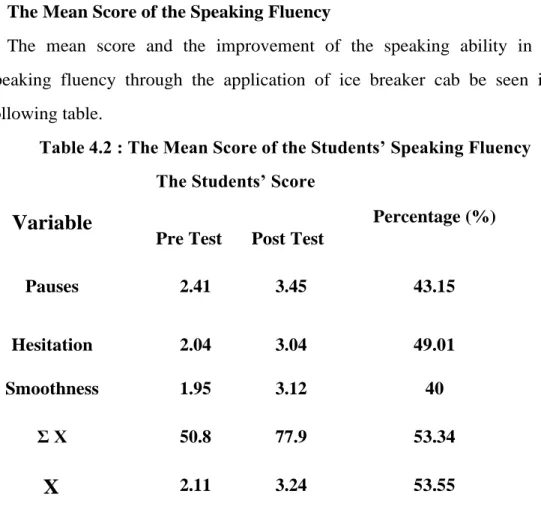
Table 4.2 : The Mean Score Speaking Fluency...39
Table 4.3 : The t- Test and t- table Students Speaking Accuracy ...41
Table 4.4 : The t- Test and t- Table Students Speaking Fluency...42
LIST OF APPENDIX
Appendix A : Documentations Appendix B : List of Students
Appendix C : Speaking Ability Score in Pre Test Appendix D : Speaking Ability Score in Post Test
Appendix E : The Result Speaking Accuracy in Pre Test and Post Test Appendix F : The Result Speaking Fluency in Pre Test and Post Test
Appendix G : The Significance Different Speaking Accuracy and Speaking Fluency
Appendix H : The distribution ot t- Table Appendix I : Instrument
Appendix J : Lesson Plan Curriculum Vitae
CHAPTER I INTRODUCTION A. Background
English is the international language used by most of the world's population.
As Wardhagh opinion (1986: 55), "Today, English is used in very much places and for very much purposes as a lingua franca, e.g. Often in travel and in trade. "In English, the two countries have different languages can make economic transactions with ease. Similarly, the students are the development of technology that they can hone their English language abilities or professional development in online media (e-mail, facebook, twitter, yahoo messenger).
Therefore, it is very important that English lessons are taught in schools throughout the world, including Indonesia. English learning in schools throughout Indonesia emphasized the mastery of the four aspects of language skills, in listening, speaking, reading, writing. This is in line with the function and purpose of the English language as specified in the curriculum subjects in English (2004:
14), "the ability to communicate (in English) includes listening (listening), speaking (speaking), reading (reading), and writing ( writing)."The skill of language is very important and mutually supports each other. Listening skills will not function perfectly without the skills of writing, reading, and speaking. As well as speaking skills will be less meaningful without the three other skills.
Speaking skill in communication has an important role of the three other skills. Due to the ability of speaking, one can put what you have in mind in the form of speaking, and it may be an ability to produce and be accepted by society, the speaking ability in English has a role quite important in the world of work.
In general, students in schools consider it difficult to speak English. Students typically have difficulty in speaking. The students don‟t know what to use vocabulary. In addition, they also do not have the courage to reveal the word or phrase. It is caused by a lack of vocabulary owned and ignorance will be the preparation of such words with a precise pattern. In speaking to memorize or know more mainstream vocabulary.
River (1968: 32) states that the teacher need to give students ample opportunity to practice the speaking skill. This means that much practice is needed to overcome the problem of speaking faced by the students who learn a foreign language
In relations to statement above, the teachers of English were expected to create and effective teaching and learning process in improving the students skills to speak English. One of strategies was use of the Ice Breaker strategy of teaching speaking.
Dixon et al (2008) exposed that an ice breaker is an ungraded activity designed to allow the teacher to get to know the students and for them to get to know each other. It is clear enough that ice-breakers are well-designed to make the students get to know with the each other, feel more relaxed and get them prepared for materials.
Eva and Herbert (1997:19) state that language is one of communication tool, which is carried out through human activities, namely speaking. In speaking we build up for other people to understand our ideas and hope people give us feedback. That is why the two activities cannot be separated each other. They are integral part of language. It means that when we study language we also think of how people speak and understand each other. Further, states that speaking is fundamental instrument of language act. Speaker talk in order to have some effect on their listeners, the nature of the speech act should therefore play a central role in the process of speech production.
Rasyid ( 1992: 15) describes that speaking is more direct, social and prestigious that other language skills, most acts of communication through speaking are performed in face interaction in which the interlocutors can directly say their message, and add some information and negotiate with their listeners.
People tend to put higher value on a particular language, and be able to speak that particular language lift up person prestige or status.
Paul (2003) stated that most of young learners‟ teachers found difficulties in finding a good technique designed to get students‟ attention, to help students to put aside distracting thoughts, and to get them ready to focus individually and as group on activities follow. For a teacher who has ability to make jokes with students, it might be easier to grab students‟ attention, but for some others, it might be the opposite. It needs an activity to make the students pay attention and focus on the learning process.
Moreover they stated in the Encyclopedia of the Ice-breakers, Ice breakers are tools that enable the group of leader to foster interaction, stimulate creative thinking, challenge basic assumptions, illustrate new concepts, and introduce specific material. Ice breaker activities also help in creating a bond between students and teachers. Classroom ice breaker activity on new class or school can help newcomers to mix with the old students and also help to make them feel comfortable and settle in.
The researcher ever did pre observation at the ten year students‟ of MA Ponpes Yasrib Lapajung Soppeng , SMA Muhammadiyah 1 Unismuh Makassar and SMPN 3 Ma‟rang Pangkep, the researcher found many problem in teaching speaking English from this school. The problem were; first, the students had low motivation to spoke English. The second, the students difficult to find ideas. Third, the students always ashamed because they lacked of vocabulary. Thus, made the students had not self-confidence to spoke in English.
One method that is used to create a classroom atmosphere is not dull, drowsy, saturating and can increase the confidence of students is an ice breaker. An ice
breaker is a transitional situation of a dull sleepy, and relaxes tense, excited, not sleepy and there is a sense of fun to listen to or look at the person speaking in front of a class or room, with a view to eliminating the ice-coldness among participants so that they know each other, understand and can interact well with each other.
Basically the method ice breaker is needed by teachers in presenting material in class. In the learning process students quickly become exhausted, saturated and material can‟t be understood properly. This proves the existence of a decrease in the grasp of memory students and students feel saturated with lessons delivered by teachers.
The previous research also shows the use of Ice Breaker on the students in outside Makassar, particularly in Pangkep District. The researcher also did not find yet the study of ice breaker mentioned it is limitation in the use speaking process.
Based on that reason, the researcher was interested to investigate the use of Ice Breaker on students in Pangkep, whether this ice breaker was effective or not in improving the students‟ speaking ability by carrying out the research under the tittle ‟The Use of the Ice Breaker to Improve Students' Speaking Ability at the Junior High School‟‟
B. Problem Statement
Based on the explanation above, the research question in this research was.
1. How does the use of ice breaker improve the students‟ speaking accuracy?
2. How does the use of ice breaker improve the students‟ speaking fluency ? C. Objective of the Research
From the formulation of the problem described above, as for the purpose of research to be done is to find out whether or not the Ice Breaker can improve the students‟ speaking ability of the Junior High School at the SMP Negeri 3 Ma‟rang, Pangkep
D. Significance of the Research
It is hope that this study will gave advantages to:
1. The Students
For the students, hopefully it can provide information about ice breaker.
Therefore, they will have more understanding about it. They know the importance of ice breaker.
2. The Teachers
For the teachers, it gives some information about the technique of teaching and learning.
3. The Further Research
This research expected to give a new knowledge of the further research to do better research of teaching and learning.
E. Scope of the Research
The scope of the research limits to the use ice breaker and limit to speaking ability especially in accuracy (pronunciation and intonation) and fluency. It is implementation in speaking ability at the nine of class of Junior High School specially SMP Negeri 3 Ma‟rang Pangkep
19 CHAPTER II
REVIEW OF RELATED LITERATURE A. The Concept of Ice Breaker
M. Said (2010) reveals, is an ice breaker is a game or activity that serves to change the atmosphere of the ice in group. There is also mention that the Ice Breaker is a transition the situation of a dull, sleepy, saturating and relaxes tense, excited, not sleepy and there is no sense of attention and happy to hear or see the person speaking in front of the classroom or meeting room.
Dixon et al (2008) exposed that an ice breaker is an ungraded activity designed to allow the teacher to get to know the students and for them to get to know each other. It is clear enough that ice-breakers are well-designed to make the students get to know with the each other, feel more relaxed and get them prepared for materials.
It is important for students to feel comfortable with each other, confident in probably happens to Elementary school students that are usually shy and doubt to say something in English when they are in English lesson. Through using an ice- breaker activity the teacher can force student to speak and communicate each other.
Jenkins (2001) stated that icebreaker games are designed to force people to speak and mingle.
According to Johnson (2007) ice- breaking activity is very important in learning process to freshen the atmosphere of learning, to eliminate boredom and drowsiness that can be faced by anyone, including students and to create positive attitudes towards school and learning. The statement means that to achieve good result, to provoke desire of study and to avoid any uncomfortable feelings of children in learning English, the teacher should create good condition and interesting way by using ice-breakers as pacemaker.
Setiawan in his little book Ice Breakers (2009) called ice breaking "energizer"
or "refocus", as a technique used in a forum to break the ice and saturation that occurred in the forum. The reason for its use, the audiences / students need to be involved in the forum so that the emergence of a sense of belonging and togetherness, the saturation when the learning atmosphere in a relatively long time, the limited concentration of each person in receiving information, and the various conditions (learning modalities) of students before the learning process.
There are many names for Icebreakers: warm-ups, de-inhibitizers, tension reducers, and brainteasers, getting acquainted activities, feedback/disclosure loops, energizers and games (Forbes-Green, 2007).
Similarly, ice breaking activity helps the students to interact with one another and also to exchange learning through series of games and activities and teamwork.
Icebreaker helps to clear the way for successful exchange of ideas by making the participants more comfortable and engaging them in conversation.
Ice breakers are a part of creative thinking, strategic thinking, positive thinking, problem solving and learning strategies, not only in business organizations but also for students of all age groups. The reason is classroom ice breaker activities help to develop various soft skills such as interpersonal skill, communication skills that include written, verbal and non-verbal and team building skills (Forbes-Green, 2007). Moreover they stated in the Encyclopedia of the Ice-breakers, Ice breakers are tools that enable the group of leader to foster interaction, stimulate creative thinking, challenge basic assumptions, illustrate new concepts, and introduce specific material. Ice breaker activities also help in creating a bond between students and teachers. Classroom ice breaker activity on new class or school can help newcomers to mix with the old students and also help to make them feel comfortable and settle in.
Based on the above it can be concluded that ice breaker is an activity of design to get to know students, how to the teachers can be change atmosphere in our class
and situation in the teaching and learning of process. The teacher can be mix study and games in our activity learning and teaching process.
In the process of learning in the classroom, ice breaking is required by teachers and students (Hidayatullah Syah 2012). The purposes of using ice breaking include:
a. Direct the brain to be on alpha wave conditions (8 s.d 12 Hz).
b. Rebuild the learning atmosphere to be serious, relaxed, and fun
c. Maintaining the stability of physical condition as well as psychic audiences / students to keep fresh and comfortable in absorbing information.
The benefits of using ice breaking in classroom learning are:
a. The occurrence of delivery process and absorption of information optimally and maximally.
b. Growing motivation of teachers and students in the learning process.
c. Strengthen the relationship between teachers and students.
Ice breaking in context learning in the classroom indeed used to melt the atmosphere, keep the concentration of learning, foster good relationships among the class, can also be used to sharpen the memory in the lesson. The use of ice breaking for teachers is useful to lift the positive image of learning, while for students learning becomes not tedious but fun. With an ice breaking a teacher can also accommodate student learning modalities, multiple intelligences students, or activate IQ, EQ, and SQ students.
Ice breaking applied on learning time takes place past the age limit of student focus minutes, can also be given when the teacher sees a student's saturation, or is given when the learning material is related to the given ice breaking technique and material.
a. Variety of Ice Breaking Techniques
There are several techniques that can be done in ice breaking (Johnshon and Lou Anne), among them:
1) Tap
Clapping hands is activities that are easy enough and immediately applicable without the need for complicated and long preparations. The time required to clap between 1-3 minutes.
2) Gymnastics / motion
Move your hands, feet, or other organs alternately or simultaneously, in a simple easy to do, not too draining or sweating, harmless, and contains an element of fun.
3) Singing
Singing or styling is an activity that many people love to adulthood. Singing makes the classroom cheerful again. Teachers a little creative, change (not damage) poems songs that are "in" or familiar without changing the tone, and of course packaged in educational. Singing time takes 3 to 5 minutes.
4) Game
Game or game in ice breaking is a simulation activity involving audiences / students reflecting a certain wisdom or example. The time required in the game between 1 to 5 minutes.
5) Storytelling
Storytelling (story telling) is the activity of delivering a stories, real good, based on reality, or fiction that contains wisdom or example. Storytelling takes 2 - 4 minutes.
6) Puzzles or Guesses
Puzzles, guesses, or quizzes are activities to stimulate students' curiosity and build student credibility in making the answer to problems from a unique side.
This activity involves more powerful cognition because it is required to answer while the time is just 1 to 2 minutes.
7) Sentences are Beautiful and Meaningful
Present words or phrases that are inspirational, positive, and motivate learning that contain wisdom and example. Time which is required between 2 – 4 minute.
8) Movies
Positive movie playback inspiration, and motivating students can be done by teachers in filling boredom or saturation of the classroom atmosphere. Movie play length does not exceed 5 minutes.
9) Alphabetic Method
The Alphabet method is a peg memory technique similar to, but more sophisticated than, the Number/Rhyme system
b. Strategies of Using Ice-breakers
Groover (2005) mentioned the strategies of using ice-breakers as follow:
1) Objectives and Execution
Before teachers start any icebreaker activities, they need to be aware of two things: what they are going to achieve and how they are going to achieve it. If they are not aware of these, icebreaker strategies will be forced and likely
unsuccessful.
2) Group Size
Teachers also need to choose activities based on the size of the group. If the teachers have a large number of people, they can have them interact with a series of leading questions, such as, "If you were a Star Wars character, which one would you be, and why?" By giving them leading questions and having them talk to one another, the teachers force them to talk about things other than small talk, which will let them find some common ground.
Small groups can have their ice breaker with the teacher rather than having them interact independently. The teachers could just follow the questions stated previously, but with they asking rather than having them ask one another.
Alternatively, the teachers can play games such as "two truths themselves and focus on the English lesson rather than on other distractions. Teachers are demanded to be creative, risk-taking, thoughtful, communicative and happy to work with students.
Ice breakers are a part of creative thinking, strategic thinking, positive thinking, problem solving and learning strategies, not only in business organizations but also for students of all age groups. The reason is classroom icebreaker activities help to develop various soft skills such as interpersonal skill, communication skills that include written, verbal and non-verbal and team building skills (Forbes-Green, 2007). Moreover they stated in the Encyclopedia of the Ice-breakers, Icebreakers are tools that enable the group of leader to foster interaction, stimulate creative thinking, challenge basic assumptions, illustrate new concepts, and introduce specific material. Icebreaker activities also help in creating a bond between students and teachers. Classroom ice breaker activity on new class or school can help newcomers to mix with the old students and also help to make them feel comfortable and settle in.
Paul (2003) stated that most of young learners‟ teachers found difficulties in finding a good technique designed to get students‟ attention, to help students
to put aside distracting thoughts, and to get them ready to focus individually and as group on activities follow. For a teacher who has ability to make jokes with students, it might be easier to grab students‟ attention, but for some others, it might be the opposite. It needs an activity to make the students pay attention and focus on the learning process.
According to Scoot and Ytenberg (1990) children have an amazing ability to absorb new language through play and other activities which they find enjoyable. It and a lie," in which people each states two truths and one lie about them and their new coworkers try to guess which is which.
3) Appropriateness
Teachers should choose an icebreaker strategy based on how appropriates it is for the students. The icebreakers that will be used in the classroom also be consideration for the teacher to get the student‟s attention.
The teacher should make sure that ice- breaker chosen is actually connected to the intended purposes of the ice-breaker. This is very important because not all kind of ice- breakers work for intended end.
B. Concept of Speaking
1. The Nature of Speaking
Speaking is a means of oral communication that gives to others. It is the most essential way in which the speaker can express himself through the language.
Widdowson (1985: 9) states that act of communication through speaking are commonly performed in face-to-face interaction and occur as a part of dialogue or rather than verbal exchange. He further states that the act of speaking involves not only the production of sound but also the use of gesture, the movement of the muscles of face, and in dead of the whole body. All of these no vocal accompaniments of speaking as a communication activity are transmitted through the visual medium.
Speaking is considered as the productive and oral skill. As cited by Nunan (2003:48), speaking is the productive aural / oral skill. Scott (2005:iv) also states
that speaking is a skill, and as such needs to be developed and practiced independently of the grammar curriculum. Speaking is interactive and requires the ability to co-operate in the management of speaking turns. It also typically takes place in real time, with little time for detailed planning.
Scoot (2005:79) states that speaking is cognitive skill, is the idea that knowledge becomes increasingly automated through successive practice. To conclude Speaking is an activity that can express thoughts, ideas, and opinions orally to respond to the verbal and non-verbal information.
Widdowson ( 1985: 30 ) clarifier the term” speaking „‟ for manifestation of language as usage and refers to the realization of language use in spoken interaction as „ talking „ we can make the generalization of the nature of speaking as follows:
Speaker : Wants to say something
Has a communication purpose Select from language storage
Figure ! The summary generalization of the nature of speaking ( in Rasyid 2004 ) Rasyid ( 1992: 15) describes that speaking is more direct, social and prestigious that other language skills, most acts of communication through speaking are performed in face interaction in which the interlocutors can directly say their message, and add some information and negotiate with their listeners.
People tend to put higher value on a particular language, and be able to speak that particular language lift up person prestige or status.
Bourdius in Sulaiman ( 2004: 20) states that spoken language needs the mastery of vocabulary , pronunciation, structure, and the social context of culture and situation. In short, it needs the mastery of the linguistic and the cultural competence. Therefore, as more efforts are required on the part of students and more concern of sequential arrangements of activities are also required on the part of teachers. It is not enough the method and technique of teaching.
Rasyid (1977: 20) exemplifies that most jobs after private companies require the applicants to be conversant with English, Sivil servants who can speak English are considered to be distinguished ones at the university level, the lectures are strongly recommended to learn English.
2. Speaking
Eva and Herbert (1997:19) state that language is one of communication tool, which is carried out through human activities, namely speaking. In speaking we build up for other people to understand our ideas and hope people give us feedback. That is why the two activities cannot be separated each other. They are integral part of language. It means that when we study language we also think of how people speak and understand each other. Further, states that speaking is fundamental instrument of language act. Speaker talk in order to have some effect on their listeners, the nature of the speech act should therefore play a central role in the process of speech production.
3. Speaking Ability
According to Bailey (2005:42) conversation is one of the most basic and pervasive of human interaction conversations are unscripted. It involves two or more people. In conversation the topic can change and the individuals take turn.
By definition, conversations are interactive: although one speaker is more talkative than another, in a conversation, two or more individuals communicate.
William (1981:1) states that the goal of foreign language teaching is communicative ability. It is mean that the teaching speaking ability must be increased in order to get the goal of the language learning.
Speaking ability is an important thing in the process of language learning.
Speakers communicate through oral expression to gain much more information efficiently. Getting students to speak in class can sometimes be extremely easy. In a good class at an appropriate level will often participate freely and enthusiastically if we give them interesting activity and task.
The interesting activity will be implemented by writer in this thesis is debate activity. Debate is oral activities in learning process.
According to Bambang, (2006:125) Debate is the activity which is used for understanding of the topic. It is done by two groups. Every group consist three or five students. It is “pro” group and “contra” group. Debate caused a feeling of confident, can give motivation to convey learner‟s opinion and respond the argument by using English language. It can build up their listening ability and speaking ability and increase their motivation in speaking.
However, speaking ability is not easy, it has something to do with the mental factor of the students such as their mood, motivation and readiness. According to Sardiman (1992:84) Motivation is an essential condition of learning. The goal of the study will be optimal if teacher gives students motivation in language learning process, especially in a foreign language learning.
Student often think that the ability to speak a language is the product of language learning. The skill of speaking is much more than the oral production of grammar or vocabulary items. Scoot (2005:116)
The main concern of teaching is communication with case in the target language without being occupied with error correction. The target language should be presented in such a way as to reveal its character as communication. Therefore, designing an English course, for students of science, should cover common topics in basic science and language item. The purpose of English teaching is to develop in the students‟ awareness of the ways in which the language system is used to express scientific facts and concepts. Their idea suggests that the target language be used in an immersion program in order for the teaching of target language to be communicative.
For teaching of speaking teacher must understand the basic concepts of language teaching, the language learner, and the method to use for organizing classroom.
Richard and Rodgers in Bambang (2006:147), states that there are four basic assumptions about language are proposed:
1) Language is a system for the expression of meaning.
2) The primary function of language is interaction and communication 3) The structure of language reflects its functional and communicative uses
4) The primary units of language are not merely its grammatical and structural features, but categories of functional and communicative meaning as exemplified in discourse.
The four basic assumption of language suggest what aspects of the language should be taught, how language should be presented in language class and how language competence should be evaluated. The four assumptions mentioned above seem to derive from a single theory that emphasizes the use of language in daily life for practical reason communication.
Bambang (2006:147-148) said that language as means of communication and interaction. This assumption suggest language teacher to consider what language should be taught. The decision on what aspects of foreign language should be taught will lead us to decide what syllabus is appropriate for our language learners.
This discussion also influences the sequence of materials that has been chosen to be the language syllabus.
Tarigan (1990:3-4) defines that speaking is a language skill that is developed in child life, which is produced by listening skill, and at that period speaking skill is learned.
Based on Competence Based Curriculum speaking is one of the four basic competences that the students should gain well. It has an important role in communication. Speaking can find in spoken cycle especially in Joint Construction of Text stage (Departmen Pendidikan Nasional, 2004). In carrying out speaking, students face some difficulties one of them is about language its self. In fact, most of students get difficulties to speak even though they have a lot of vocabularies and have written them well. The problems are afraid for students to make mistakes.
Speaking is the productive skill. It could not be separated from listening.
When we speak we produce the text and it should be meaningful. In the nature of communication, we can find the speaker, the listener, the message and the feedback.
Speaking could not be separated from pronunciation as it encourages learners to learn the English sounds.
Harmer, (in Tarigan, 1990: 12) writes that when teaching speaking or producing skill, we can apply three major stages, those are:
1) Introducing new language
2) Practice
3) Communicative activity.
Speaking has been regarded as merely implementation and variation, outside the domain of language and linguistic proper. Linguistic theory has mostly developed
in abstraction from context of use and source of diversity. Therefore, Clark and Clark said that speaking is fundamentally an instrument act. Speakers talk in order to have some effect on their listener. It is the result of teaching learning process. Students‟
skill in conversation is core aspect in teaching speaking, it becomes vitally aspect in language teaching learning success if language function as a system for expression meaning and the successful in speaking is measured through someone ability to carry out a conversation in the language. We confess that there are many proponent factors that influence teaching speaking success and there are many obstacle factors why it is not running well.
According to Ladouse (1991) speaking is described as the activity as the ability to express oneself in the situation, or the activity to report acts, or situation in precise words or the ability to converse or to express a sequence of ideas fluently.
Furthermore, Tarigan (1990:8) said that “Berbicara adalah cara untuk berkomunikasi yang berpengaruh hidup kita sehari-hari”. It means that speaking as the way of communication influences our individual life strongly.
From the explanation above, the researcher concludes that speaking is what we say to what we see, feel and think. When we feel something, we want someone can hear us. So, in this process we can call it is an interaction between two sides.
When someone speak to other person, there will be a relationship. The relationship itself is communication. Furthermore, Wilson (1983:5) defines speaking as development of the relationship between speaker and listener. In addition speaking determining which logical linguistic, psychological a physical rules should be applied
in a given communicate situation”. It means that the main objective of speaking is for communication. In order to express effectively, the speaker should know exactly what he/she wants to speak or to communicate, he/she has to be able to evaluate the effects of his/her communication to his/her listener, he/she has to understand any principle that based his speaking either in general or in individual.
Based on the statements above the researcher infers that if someone speaks, he/she should understand what is he/she about. In this section, the writer should develop ideas or build some topics to be talked and to make other responds to what speakers says.
Stern (in Risnadedi, 2001: 56-57) said watch a small child‟s speech development. First he listens, then he speaks, understanding always produces speaking. Therefore this must be the right order of presenting the skills in a foreign language. In this learning of language included speaking, there is an activity of speaker or learner and it has to have an effect to build speaker‟s or learner‟s desires and express how his/her feeling and acting out his/her attitudes through speaking.
Thus the learning of speaking cannot be separated from language.
On the other hand, speaking can be called as oral communication and speaking is one of skills in English learning. This become one important subject that teacher should give. That is why the teachers have big challenge to enable their students to master English well, especially speaking English in class or out of the class.
Wallace (1978:98) stated that oral practice (speaking) becomes meaningful to students when they have to pay attention what they are saying. Thus, the students can learn better on how to require the ability to converse or to express their ideas fluently with precise vocabularies and good or acceptable pronunciation.
Speaking ability is the students‟ ability in expressing their ideas orally which is represented by the scores of speaking. Speaking is only an oral trail of abilities that it got from structure and vocabulary, Freeman (in Risnadedi, 2001: 56-57) stated that speaking ability more complex and difficult than people assume, and speaking study like study other cases in study of language, naturalize many case to language teachers.
Speaking is a Productive Skill
Speaking is the productive skill. It cannot be separated from listening. When we speak we produce the text and it should be meaningful. In the nature of communication, we can find the speaker, the listener, the message and the feedback.
Speaking cannot be separated from pronunciation as it encourages learners to learn the English sound.
Assessing Speaking
Assessment is an ongoing process that encompasses a much wider domain.
Whenever a student responds to a question, offers a comment, or tries out a new word or structure, the teacher subconsciously makes an assessment of students‟
performance. Written work-from a jotted down phrase to a formal essay is
performance that ultimately is assessed by self, teacher and possibly other students (Brown, 2003:4).
Brown (2003:141) states as with all effective tests, designing appropriate assessment tasks in speaking begins with the specification of objective or criteria.
Those objectives may be classified in term of several types of speaking performance:
4. Elements of Speaking
In speaking, speakers are not only expected that they can speak and communicate with others but also they have the elements involved in English speaking particularly.
a. Accuracy
Accuracy is degree of being correct so the accuracy in speaking ability is the quality if being accurate is speaking. English ability in this case divided into things. They are grammar (structure) pronunciation and vocabulary.
1) Grammar
Grammar is being of rules for the use of the words. In speaking skill, Grammar always to be handicaps in performs pure speaking. It causes by the speaker sometimes afraid to make mistake of grammar in perform speaking while the arrangement of words in a sentence is not the same in difficult language. They are not even the same in sentence pattern.
As the use of grammar signal, students should learn it by acquiring a set of habits and not merely by recording examples of usage. It has been state that sentences patterns, students should be trained to acquire the habit of producing it automatically. This is best one through oral pattern practice. For instance, students imitate the teacher in producing a certain a patterns as “he is a lecture in such a way that they can produce it with relatives‟ case. Such as practice involves intonation, stress as well as phonemes in this case the teacher must be good model.
2) Vocabulary
Vocabulary is a word is thus any segment of sentence bounded by successive points at which pausing is possible. Vocabulary is a words consist of sound, or a combination of sound, that has become conventionalized in a culture or a linguistic community, that is commonly used in certain responses in a hearer belonging the same community.
In learning English, Indonesia students‟ tend to transfer their vocabulary habits to the foreign language. They will transfer meaning, form, and distributions of the lexical units of Bahasa Indonesia, and if these units operate satisfactory in English there will be facilitation of learning and the units will not create learning problem, but on the other hand , it the lexical units of pattern of their language will not operate satisfactorily in the target language because they are not functionally or formally like, then, there will be no case of learning problem. Thus, the students will have problems to overcome.
One of the special handicaps in speaking perfectly is caused by the lack of vocabulary. People sometimes fail to compose that they are going to say, because of their limited vocabulary. They face to following difficulties in buildings up vocabulary.
3) Pronunciation
Pronunciation is one factor influencing the students ability in speaking language, because by good pronunciation someone can understand what were have said. Pronunciation teaching deals with two integrated skills recognitions or understanding (Widdowson ,1985: 9).The flow of speech and production or fluently in spoken language. These skills rely very little on intellectual mastery of any pronunciation rules. Ultimately it is only practice in listening and speaking which give the learners the skill.
Accuracy is measure by means of the percentage of error-free clauses. The result shows that plan time promote higher fluency for all three task types.
Planning also has beneficial effect for accuracy, but only for the personal and narrative tasks, and for complexity in the case of the personal task and decision- making task. ( Housen, 2012: 175) . Furthermore, according to Robert B Kaplan, (2002: 32) maintaining formal accuracy is only one facet of the more general process of ensuring that conceptualization, formulation, and articulation of the message conforms to the speaker‟s underlying intentions.
4) Intonation
Intonation is the cooperation between the tone, the pressure, the duration, and the stops that accompany a speech, from the beginning to the last stop (Gorys Keraf, 1991).
Thus, the most important elements in intonation are pressure, tone, duration, and rest. These elements include the language supra segmental element.
b. Fluency
Fluency means that speech where the message is communicated coherently with few pauses and hesitation, thus causing minimal comprehension difficulties for the listeners ( Christiene and Anne , 2012 : 43). While, according to (Housen, 2012: 5) fluency can be distinguished to at least three sub dimensions. They are : i. Speed fluency ( rate and density of linguistic units produced )
ii. Breakdown fluency ( number, length, and location of pauses)
iii. Repair fluency ( false starts, miss formulations, self-corrections and repetitions)
O‟ Malley and Chamot in Housen , (2012: 55) state that speed fluency will clearly be reliant or procedures for storage and recall , while breakdown and repair fluency are related to the extent to learner is confident that was has been stored is reliable. In addition, the extents to which the learner has also created procedures
which can be brought into operation to repair the situation when communication breakdown occurs, for whatever reason.
Beside that, Lennon on two senses of fluency, the board sense, in the
“broad” sense fluency appears function as a cover term for oral proficiency. In this sense, fluency represents the highest point in scale that measure spoken command of a foreign language, in its narrow sense, fluency in EFL refers to one, presumably isolatable, component of oral proficiency. This sense is found particularly in procedure for grading oral examinations, and many readers will be familiar with having score candidates for fluency as well as, perhaps, correctness, relevance, appropriateness, pronunciation, lexical range, and so on (Candalin and Hall ,2002: 12)
In addition, Fluency is the state of being able to speak a language smoothly and easily (oxford learner pocket dictionary, 1995:10) and students are to communicative easily to others friends. Brown, (1980:255) fluency is ready and expensive use of language. It is probably best achieved by allowing the „stream‟
of speech to “flow‟ then, assumed of this speech spills over beyond comprehensibility to river bank of instruction or same details of phonology, grammar and discourse explained that fluency defined as the ability to across communicative intent without too much hesitation and to many pause or breakdown in communication. It refers to how well you communicative in a natural manner.
Definition of fluency often include references to flow or smoothness, rate of speech, absence of exercise pausing, absence of distract hesitation makers, length of utterances, and connectedness ( Kooponen,1995)
a) Smoothness
Smoothness is the ability of speaking English through a good clustering and reduces form (Brown 1980: 267). A good clustering is to speak English with
phrasal fluently. It means that speak English not word by word and reduce forms are to use English with contraction, elisions, and reduce vowels.
b) Pauses
Pausing is often viewed as a factor of diffluent speech (Rossiter, 2009. P398), however, pausing is not an uncommon or wholly negative feature of fluent language. Pauses are utilized as space for breathing and thinking when participating in any form of oral discourse (Griffiths,1991)
c) Hesitation.
Hesitation phenomena such as fillers are most likely occur at the beginning of an utterance or phrase, presumably as a consequence of the greater demand on planning processes at these junctures ( Barr 2001: Beattie:1979: Maclay and Osgood 1959). Hesitation dis fluencies showed an interesting pattern: Participants were more likely to repeat words, but no more likely to use fillers such as, in the fast conditions.
C. Conceptual Framework
Based on the theory of the research, the theoretical framework is described in following:
INPUT
Teaching Speaking
Where:
Input : Teaching material
Process : Treatment given
Output : Improvement of the skill
The conceptual framework above shows the process of teaching and learning presentation in improving the speaking ability with use ice breaker. Ice breaker strategy was one of the good strategies that could encourage the students. So, teacher would be easy to know the students‟ improvement ice breaker in speaking by using this method.
PROCESS Teaching and learning
process Using Ice Breaker
OUTPUT Speaking Ability
CHAPTER III RESEARCH METHOD A. Research Design
This research applied the pre-experimental research with one group pretest-posttest design to find out the improvement speaking ability by using Ice Breaker. The group selected will be given pretest, treatment, and posttest.
The design can be seen in the following chart:
Where:
O1 : Pretest X : Treatment O2 : Posttest
( Arikunto,1993) 1. Pretest
The teacher gave material about speaking specially conversation. By seeing result of the students‟ speaking test, the researcher analyzed it to see the prior students speaking ability.
2. Treatment
The teacher was treated by using an ice breaker. The treatment took place within four meetings and it took 90 minutes for each meeting. The
O1 X O2
teacher conducted treatment and collected the data or information from my student. The procedure of treatment followed the procedure as follows:
1) The first meeting the teacher gave explanation what we do in our class.
After that the teacher gave the teaching material about expression of asking repetition. Then, the teachers explain to the students about definition expression of asking repetition. After that the teacher invited to students make a dialogue about expression of asking repetition and invite students practice in front of class. Then, the teacher gives a proper value based on the students practice. Given ice breaker to students especially alphabet game.
2) The second meeting the teacher gave ice breaker and explained about next material. In this meeting, the teacher provided the same treatment to the students as in the first meeting, but in this meeting the teacher provide the different material to the students and the teacher provide different ice breaker.
3) The third meeting the teachers gave material about procedure text and explain about procedure text to students. After that the students make a simple procedure text and then the teacher invite students see procedure text made by other friends. Then, the students explain procedure text. In the last, the teachers provide different ice breaking.
4) The fifth meeting the teachers provide same treatment, but this meeting the teacher gives material about report text and the teacher gave explanation about that material and the teacher implemented different ice breaker.
The first until the last meeting, the teacher always monitoring and handled the speaking class by Ice Breaker
3. Post Test
The post test is conducted after treatment to find the improvements speaking ability. The researcher distribution the different speaking test as used in pretest to check the result of the treatment in improving speaking ability.
Pretest and posttest is compared in order to find out whether they were different significantly or not.
The pre-test is used to see the students‟ earlier speaking ability. The treatment is gives using the ice breaker. After that, posttest is administration to saw the effect of the treatment.
B. Hypothesis
A hypothesis was a tentative answer of the research problem, they are:
1. Alternative Hypothesis (H1)
There was significant improvement on the speaking ability before and after being taught by using ice breaker.
2. Null Hypothesis (H0)
There was no significant improvement on the speaking ability before and after being taught by using ice breaker.
C. Research Variable and Indicators This research used two variable, they are:
1. Independent Variable
The independent variable is Ice Breaker. It is as a strategy used by the teacher when teaching the material.
2. Dependent Variable
The dependent variable is the improving speaking ability in accuracy and fluency.
D. Population and Sample 1. Population
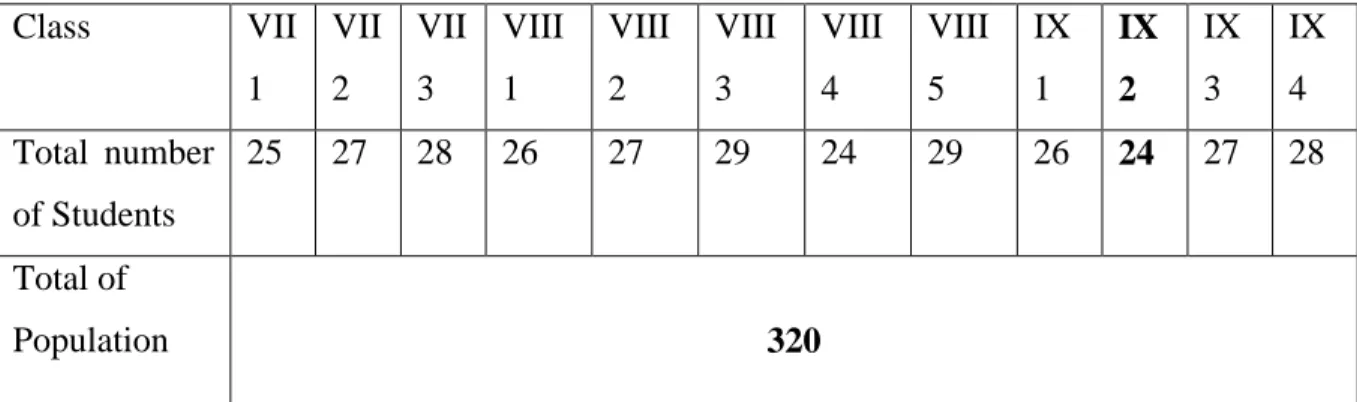
The population of this research was students of SMP Negeri 3 Ma‟rang, Pangkep. The students of SMP Negeri 3 Ma‟rang Pangkep have thirteen classes. For the total number of population as following:
Table 1 : The total number of population
Class VII
1
VII 2
VII 3
VIII 1
VIII 2
VIII 3
VIII 4
VIII 5
IX 1
IX 2
IX 3
IX 4 Total number
of Students
25 27 28 26 27 29 24 29 26 24 27 28
Total of
Population 320
2. Sample
Based on the population above, the researcher used a purposive sampling to select the sample because the population is too big. In this case, the researcher took 24 students from the population. So, the researcher chose nine class especially IX.2 class and the researcher would be easy to manage the class.
E. Research Instrument
The instrument of the research is speaking test.
1. Speaking Test
Before treatment, the teacher gave materials about speaking. The pre- test used to see the students‟ earlier speaking in accuracy and fluency. The treatment is give using the ice breaker. After that, posttest is administrated to see the effect of the treatment.
The data from the English speaking test gave score based on the five speaking skill scoring classification. In this case the writer gave score based on the students‟ pronunciation, intonation, smoothness, pauses and hesitation.
To make it clear the writer described all classification below:
a) Accuracy
Table 2: The Assessment of Pronunciation
Classification Score Criteria
Excellent 5 Pronunciation are almost always very clear/ accurate
Very good 4 Pronunciation are usually clear/accurate with a few problem areas
Good 3 Pronunciation errors sometimes make it difficult to understand the student
Average 2 Frequent problems with pronunciation
Poor 1 The Students‟ speak very hasty, and more sentences are not appropriate in pronunciation and little or no communication
(Addapted from Longman, 2005) Table 3: The Assessment of Intonation
Classification Score Criteria
Excellent 5 Almost perfect
Very good 4 There are some errors but not interfere with meaning Good 3 There are some errors and interfere with meaning Average 2 Many errors and interfere with meaning
Poor 1 Too many errors and difficult to understand
(Addapted from Longman, 2005) b) Fluency
In scoring result of the students‟ test evaluated based on three aspects of speaking below:
Table 4: The Assessment of Pauses
Classification Score Criteria
Excellent 5 Speak continuous with few pauses and stumbling
Very good 4 Speak flows naturally most of the time but has some pauses Good 3 Speak choppy with frequent pauses and few incomplete
thoughts
Average 2 Speak with too long pauses and there is no incomplete thoughts
Poor 1 Speak with too many stopping and there is no incomplete thoughts
(Addapted from Longman, 2005) Table 5: The Assessment of Hesitation
Classification Score Criteria
Excellent 5 Speak smoothly, there is no hesitation that does not interfere with communication
Very good 4 Speak smoothly with little hesitation that does not interfere with communication
Good 3 Speak with some hesitation, but it does not usually interfere with communication
Average 2 Speak with some hesitation, which often interferes with
communication
Poor 1 Hesitation too often when speaking, which often interferes with communication
(Addapted from Longman, 2005) Table 6: The Assessment of Smoothness
Classification Score Criteria
Excellent 5 Speak smoothly, there is no hesitation that does not interfere with communication
Very good 4 Speak smoothly with little pauses that does not interfere with communication
Good 3 Speak with some smoothness, but it does not usually interfere with communication
Average 2 Speak with some smoothness, which often interferes with communication
Poor 1 Smoothness too often when speaking, which often interferes with communication
(Addapted from Longman, 2005) F. Data Collection
In data collection, the researchers follow the procedure as follows:
1. The researcher gave explanation about ice breaker to students‟ and then performance pretest.
2. After that the researcher gave speaking test ( conversation) in pre test 3. Before give the speaking test, the researcher gave ice breaking to improve
speaking ability
4. In our learning process, the ice breaker combines with teaching material.
5. The researcher gave conversation in post test
6. After that the researcher got a proper value on the students‟.
G. Technique of Data Analysis
In this case the researcher gave score of students‟ accuracy and fluency. To make it clear the researcher describes all classifications as follow.
1. To find out the mean score of the students test, the researcher used the formula:
Where:
X = Mean Score
Σx = Total score
N = The number of students
(Gay, 1981:298 in Kurniati,2014:27) 2. To know the significant of differences between the score of the
pretest and posttest the writer calculate the value of the tank by using the following formula:
Where :
Ď = Σ D
N
Where:
X- Σ
N
t = Test of significant differences
D = The differences between two scores compared Ď = The mean of different scores
ΣD = The sum of D scores
(ΣD)2 = The total number of students
( Gay, 1981: 366) 3. To find out the improvement of percentage:
% = Where,
% : The percentage of improvement X2 : The total score of Post-Test X1 : The total score of Pre-Test
( Gay, 1987 )
CHAPTER IV
FINDINGS AND DISCUSSION
This chapter consisted of findings of the research and discussion of interpretation of data analysis in detail. The findings of the research covered the result of the data collected about the improvement of the students speaking ability in terms of accuracy and fluency and discussion of the research covers further explanation of the findings.
A. The Findings
1. The Students Mean Score in Speaking Accuracy with pronunciation and Intonation
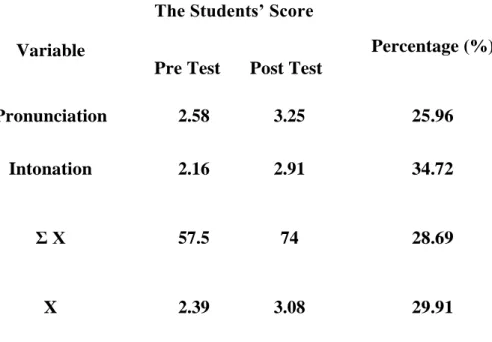
The Findings of this research deal with the students‟ score. The mean score and the improvement of the students‟ speaking ability in terms speaking accuracy dealing with pronunciation and intonation through the application of ice breaker can be seen in the following table.
Table 4.1: The Mean Score of the Students’ Speaking Accuracy
Variable
The Students’ Score
Percentage (%) Pre Test Post Test
Pronunciation 2.58 3.25 25.96
Intonation 2.16 2.91 34.72
Σ X 57.5 74 28.69
X 2.39 3.08 29.91
The table 4.1 above indicates that with is percentage improvement of the
students‟ speaking accuracy dealing pronunciation and intonation from pre-test to post-test which in pre-test of the students‟ mean score achievement in speaking accuracy is 2.39, after giving the treatment the students‟ speaking accuracy dealing with pronunciation and intonation becomes 3.08, so the percentage of the students‟ speaking accuracy with pronunciation from pre-test to post-test (29.91%). The score of pronunciation which pre-test and post-test in speaking accuracy is 2.58, after giving the treatment becomes 3.25 so the percentage improvement of pronunciation (25.96%) and The score of intonation which pre-test and post-test in speaking accuracy is 2.16, after giving the treatment becomes 2.91 so the percentage of intonation (34.72%)
The table above proves that the application of ice breaker in strategy in teaching speaking was able to improve the students‟ speaking accuracy dealing with pronunciation and intonation. After the treatment, the mean score of students‟ speaking accuracy dealing with vocabulary was increase from 2.39 to 3.08. To see clearly the improvement of the students‟ speaking accuracy dealing with pronunciation and intonation, the following chart is presented:
Fi gure
0 5 10 15 20 25 30
pre test post test Improvement
2.39 3.08
29.91
Mean Score
mean score