By
YUNITA WAHYUNI Reg Num. 15.1300.008
ENGLISH EDUCATION PROGRAM TARBIYAH FACULTY
STATE ISLAMIC INSTITUTE (IAIN) PAREPARE
2020
ii SKRIPSI
USING CONVERSATION CARD GAME TO IMPROVE THE STUDENTS’ SPEAKING SKILL
AT ACE COURSE PAREPARE
By
YUNITA WAHYUNI Reg Num. 15.1300.008
Submitted to the English Education Program of Tarbiyah Faculty of State Islamic Institute of Parepare in Partial of Fulfilment of the Requirements for the Degree of
Sarjana Pendidikan (S.Pd)
ENGLISH EDUCATION PROGRAM TARBIYAH FACULTY
STATE ISLAMIC INSTITUTE (IAIN) PAREPARE
2020
iii
USING CONVERSATION CARD GAME TO IMPROVE THE STUDENTS’ SPEAKING SKILL
AT ACE COURSE PAREPARE
Skripsi
As a Part of Fulfilment of the Requirement for the Degree of Sarjana Pendidikan (S.Pd)
English Education Program
Submitted by
YUNITA WAHYUNI Reg Num. 15.1300.008
to
ENGLISH EDUCATION PROGRAM TARBIYAH FACULTY
STATE ISLAMIC INSTITUTE (IAIN) PAREPARE
2020
iv
v
vi
vii
ACKNOWLEDGMENT
In the name of Allah, the most Gracious, the most Merciful.
First of all, the researcher would like to extend her sincere to Allah swt, the king of the king, and the lord of the universe who has been giving opportunity and courage to accomplish this script by the tittle “Using Conversation Card Game to Improve The Students’ Speaking Skill at ACE Course Parepare” peace and blessing be upon beloved prophet Muhammad saw, and his family, his companion, his followers. The best messenger for people all over the world.
The researcher wants to thank a lot to all people who have supported and helped her. She realizes that without their support and help, she was not able to finish this skripsi.
In this opportunity, the researcher wants to give her sincerest gratitude to her beloved family for their supporting, given her strengths and motivation to pass this study, and always pray for her until the Undergraduate Degree. The researcher would like to express her gratitude also to Hj. Nurhamdah, S.Ag, M.Pd and Mujahidah, M.Pd for their explanation, advice, guidance, dedication, correction, and suggestions in finishing this skripsi.
There are also some people that the researcher would like to thank to:
1. The Rector of State Islamic Institute (IAIN) Parepare, Dr. Ahmad Sultra Rustan, M.Si. and his staffs for their help during she finished her study.
viii
2. Dr. H. Saepudin, S.Ag., M.Pd. as Dean of Tarbiyah Faculty of IAIN Parepare, who has arranged a positive education for the students in Tarbiyah Faculty.
3. Mujahidah, M.Pd. as the Chairman of English Education Program of IAIN Parepare for the fabulous serving to the students.
4. All lecturers of English Education Program who have already taught the researcher during her study in IAIN Parepare.
5. All of organizers of Bidikmisi who have believed the researcher receive the scholarship to her study in IAIN Parepare.
6. Adri Aladin S.Pd as The Owner of ACE Course Parepare who has allowed the researcher to conduct and observe the research at the course.
7. Her best friends: Rita Sutra, Hardiana, A. Al Amirah An Nabilah, Nurul Aqsha, Rika Sutra, Zulkarnain, Nasrullah, and Ardan who always motive and accompanied her start from the first semester until now and always give their support, share knowledge, give advice, and courage as well as their helping for finishing this script.
8. All of her students in ACE Course as respondents of this research and inspiring her to research this game for giving various appropriate activities in teaching.
9. Her other family in Historic 15 who have pushed her to finish the research.
10. The big family of LIBAM for being one of place to study and get experiences.
11. Her friends in English Education Program of Tarbiyah Faculty 2015. Thanks for giving support and sharing their time and being good friends.
ix
12. All awesome people and amazing friends that the researcher can not mention it one by one who have given their support to her sincerely.
Finally, the researcher expresses her gratitude to many people who saw through this skripsi for their support and contribution to accomplish it. May Allah swt counts our effort as kindness in this world and hereafter.
At least, it is undeniable that this skripsi is still far from perfection although many efforts have been made to make it complete. Therefore, critics and suggestions from the reader are necessary to complete the lack of this writing. Hopefully, this skripsi can assist the reader both theoritically and pratically in English Language Teaching field or another related field.
Alhamdu lillahi rabbil ‘alamin
Parepare, 9th January 2020 The Researcher,
Yunita Wahyuni
Reg. Num. 15.1300.008
x
DECLARATION ON THE AUTHENTICITY OF THE SKRIPSI
The researcher who signed the declaration below:
Name : Yunita Wahyuni
Student Reg. Number : 15.1300.008
Place and Date of birth : Ujung Pandang, May, 17th 1997 Study Program : English Education
Faculty : Tarbiyah
Title of Skripsi : Using Conversation Card Game to Improve the Students’ Speaking Skill at ACE Course Parepare Stated this skripsi is her own writing and if it can be proved that it was copied, duplicated or compiled by any other people, this skripsi and the degree that has been gotten would be postponed.
Parepare, 9th January 2020 The Researcher,
Yunita Wahyuni
Reg. Num. 15.1300.008
xi
ABSTRACT
Yunita Wahyuni.Using Conversation Card Game to Improve the Students’ Speaking Skill at ACE Course Parepare (Supervised by Hj. Nurhamdah and Mujahidah).
This research aims to see the improvement of the students’ speaking skill by using conversation card game at ACE Course Parepare. Conversation Card Game is some topics in conversation presented on the card to guide the students when they speak. The students are able to ask and respond about some topics based on pictures and instructions on the card. conversation card game is known as a fun way to facilitate the students speaking English. The teacher should aware that it is important to apply the technique or teaching strategy in order to make the students more easily to express their ideas and more active in learning process.
The population of this research where the students at ACE Course. This research used total sampling technique which consisted of 12 students. The design of this research was quantitative method using pre-experimental with pre-test and post- test design. The students were given the pre-test to measure the students’ prior knowledge. Then, they were given the treatment namely conversation card game for 4 times, and post-test to find out the students’ achievement in speaking skil after using conversation card game. The criteria of speaking skills are fluency, accuracy, content, pronunciation and they were used to measure the students’ speaking skill. It aimed to know whether using conversation card game can improve the students’ speaking skill.
The result in this research showed that there was improvement of the students’ speaking skill. It was indicated by the students’ mean score of post-test (71.5) was greater than pre-test (51.5). Even, for the level significant (p) 5% and (df )= N-1=12-1=11, and the value of table is 1.796, while the value of t-test is 1.49. it means that, the t-test value is greater than t-table (1.49 ≥ 1.796). Thus, it can be concluded that the students’ speaking skill is significant better after getting the treatment. So, the null hypothesis is accepted that using conversation card game able to improve the students’ speaking skill at ACE Course Parepare.
Keywords: Speaking Skill and Conversation Card Game.
xii
TABLE OF CONTENTS
COVER PAGE ... i
PAGE OF TITLE ... ii
SUBMISSION OF PAGE ... iii
ENDORSEMENT OF CONSULTANT COMMISSIONS ... iv
APPROVED OF CONSULTANT COMMISSIONS ... v
ENDORSEMENT OF EXAMINER COMMISSIONS ... vi
ACKNOWLEDGEMENT ... vii
DECLARATION OF THE AUTHENTICITY OF THE SKRIPSI ... ix
ABSTRACT ... x
TABLE OF CONTENTS ... xi
TABLE OF TABLES ... xii
TABLE OF FIGURES ... xiii
LIST OF APPENDICES ... xiv
CHAPTER I INTRODUCTION 1.1 Background ... 1
1.2 Problem Statement ... 4
1.3 Objective of the Research ... 4
1.4 Significance of the research ... 5
CHAPTER II REVIEW OF RELATED LITERATURE 2.1 Some Partinent Ideas ... 6
2.2 Previous Related Research Findings ... 30
2.3 Conceptual Framework ... 33
xiii
2.4 Hypothesis ... 34
2.4 Variable Operational Definition of Research ... 34
CHAPTER III METHODOLOGY OF THE RESEARCH 3.1 Research Design ... 36
3.2 Location and Duration of the Research ... 36
3.3 Population and Sample ... 37
3.4 Instrument of The Research ... 37
3.5 Procedure of Collecting Data ... 38
3.5 Technique of Data Analysis ... 39
CHAPTER IV FINDINGS AND DISCUSSION 4.1 Findings ... 44
4.2 Discussion ... 62
CHAPTER V CONCLUSION AND SUGGESTION 5.1 Conclusion ... 66
5.2 Suggestion ... 67
BIBLIOGRAPHY ... 68
APPENDICES... 70
xiv
LIST OF TABLES
No The Title of Tables Page
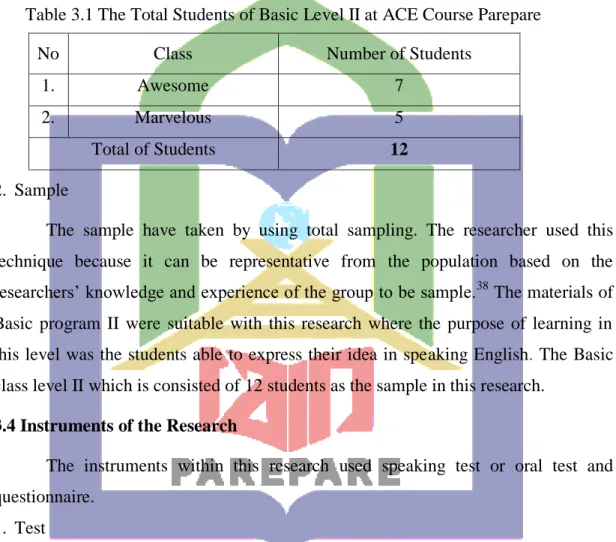
3.1 The Total Students of Basic Level II at ACE Course Parepare 37 3.2 Scoring Formulation for Students’ Speaking Skill 40
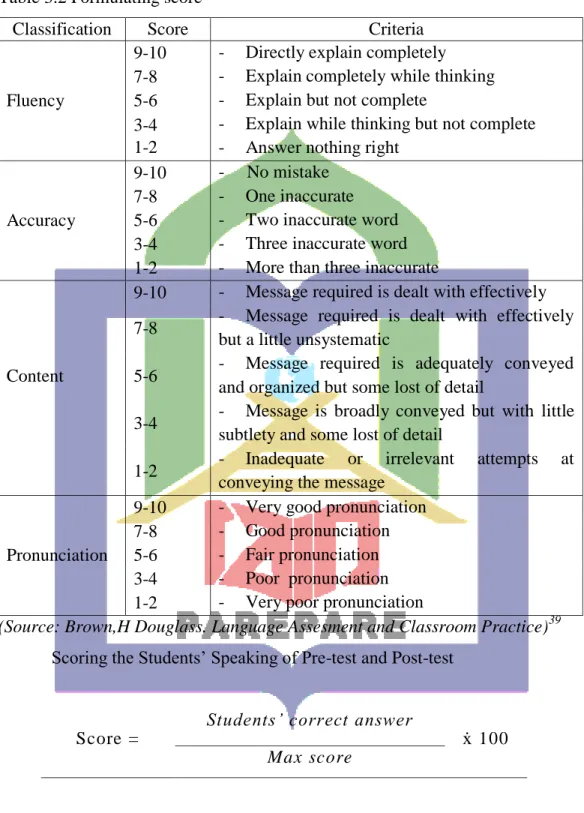
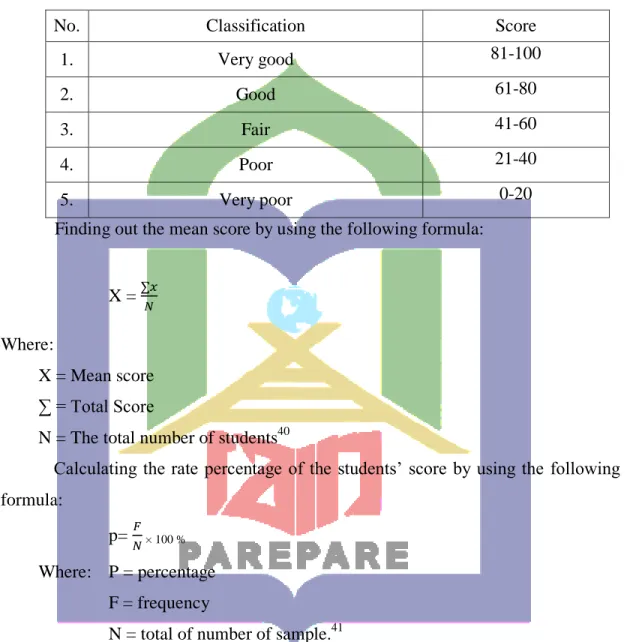
3.3 The Classification Students’ Score 41
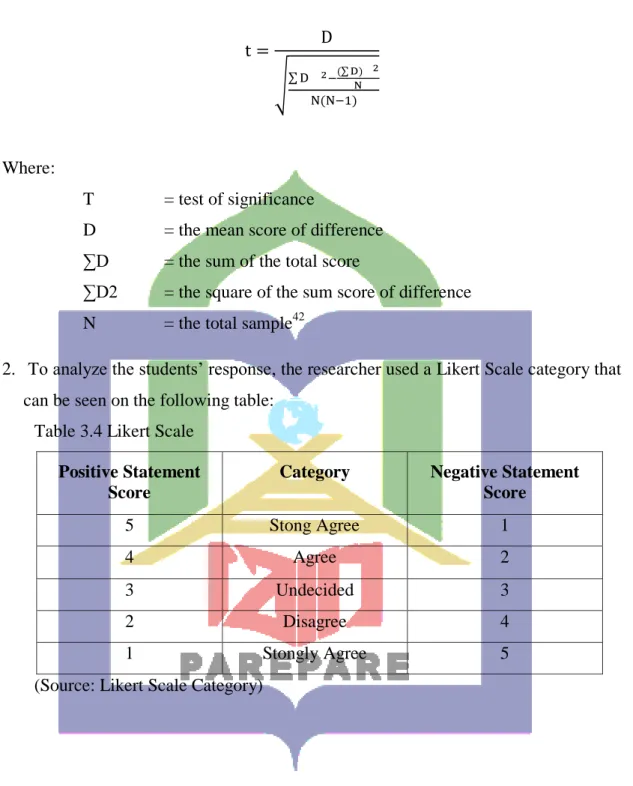
3.4 Likert Scale of Qustionnaire 42
3.5 Rating Score of Questionnaire 43
4.1 The Students’ Score in Pre-test based on Speaking Skill 45
4.2 The Students’ Speaking Score in Pre-test 46
4.3 The Rate Classification, Frequency, and Percentage of The Pre-
test 46
4.4 The Students’ Score in Post-test based on Speaking Skill 48
4.5 The Students’ Speaking Score in Post-test 49
4.6 The Rate Classification, Frequency, and Percentage of The Post-
test 50
4.7 The Mean Score and Standard Deviation of Pre-test and Post-
test 52
4.8 The Worksheet of The Calculation The Score in Pre-test and
Post-test of The Students’ Speaking Skill 52
4.9 The Test of Significant 54
4.10 The Score of The Students’ Response 55
4.11 The Precentage of The Students’ Response 56
xv
LIST OF FIGURES
No The Title of Figures Page
2.1 Conversation Card Game 20
2.2 The Conceptual Framework of the Research 33
3.3 The Formula of the Research Design 36
xvi
LIST OF APPENDICES
No The Title of Appendices
1 Instrument of the Pre-test and Post-test 2 The Questionnaire of the Research 3 Topic Cards
4 Lesson Plan
5 Students’ Speaking Skill of Pre-Test 6 Transcripts of the Students’ Treatments 7 Students’ Speaking Skill of Post-Test 8 Students’ Questionnaire
9 Distribution of T-Table 10 Value of Chi Kuadrat 11 Documentation 12 Curriculum Vitae
1
Speaking is a paramount skill that should be practiced to communicate orally.
Speaking skill is a crucial part of the language learning process. Through speaking people are able to express thought and feeling. Students must be able to use the language appropriately in their social interactions.
The speaking ability can measure the success of language learning. To detect how success English learning is soon generally through speaking skill. The components of English that the student have to master are grammar, vocabulary, pronunciation, and fluency. Syakur in Herlina and M Holandyah argue that grammar is needed for student to arrange a correct sentence in conversation. Vocabulary means the appropriate choice that is used in communication. Pronunciation is the way for students’ to produce clearly language when they speak. Fluency can be defined as the ability to speak fluently and accurately.1
Nowdays, most of the students understand English. In other hand, less of the students difficult to share English orally. Based on the researcher’s experience as a teacher at ACE Course, there are some problems faced by the students in speaking such as the students do not have adequate vocabulary, problem in organizing and expressing idea with appropriate word choices, pronouncing English words correctly so, it makes them feel embarrassed and it can make their anxiety to speak because they are afraid of making mistake, limitation of opportunity to practice speaking
1Herlina and M. Holandyah, “Teaching Speaking Skill by Using Guided Conversation Technique through Pair Taping to the Seventh Grade Students of SMP PTI Palembang” (published Journal; UIN Raden Fateh Palembang, 2015), p. 108 (Accessed on Sunday, April 14th, 2019)
2
English in their daily life, the students sometimes had no partner to practice speaking English after studied in course, and they produce the sentence become extermely so hard.
As a teacher, the researcher always give some vocabulary and common expression that the students have to memorize in every meeting but the students can not still express their idea into a good sentence. In other words, the students seldom practice in their live what they have learn or memorize.Therefore, students should be given opportunity to practice English at least when they are communicating with other during the process of teaching and learning.
Penny Ur conluded that there are some problems in speaking activities. The problem are inhibition that learners are worried about making mistakes or fearful, nothing to say that students have no motive to express themselves, uneven participation that only can talk at a time if he is to heard in large group and the tendency of some learners to dominate, and mother tongue use that learners who share the same mother tongue tend to use it because it is easier and because learners feel less exposed if they are speaking their mother tongue.2 Samira supported that students are unable to speak in English because they lack the necessary vocabulary items and grammar structures. They also lack sentence formation skills, which result in using the mother tongue. Students also think of making mistakes in speaking in front of their classmates very embarrassing, which result in preferring not to speak to
2Penny Ur, A Course in Language Teaching, Practice and Theory (Sidney: Cambridge University Press,1996), p. 121.
avoid such situations. They do not spend enough time to practice their speaking. And teaching strategies also contribute to the problem of speaking difficulties.3
In this case, the teacher should make the students fun in learning process. If the students are not fun and interested in the lesson, the teacher will be very difficult to make the students understand the lesson. Therefore, to overcome this problem, the teacher needs a appropriate technique, activities for teaching, media, or games to absorb information and ideas for making their students have a capability in English.
Conversation is essential thing and one of method to make student fluently in speaking. This method is not focus on grammar only but how the students can speak up also. Conversation is a way to make students brave express their feeling. Starting with a conversation is a common problem encountered by many people, especially shy people.4 In other side, conversation can help the students giving expression with their pairs in the classroom at course. The students will use their vocabulary which their pairs and also to train the student accustomed to speak English.
To make the students could express their ideas, information, opinion orally to the others, the teacher should apply some various strategies, media, or games that make the students more intrested in speaking. Therefore, the researcher recommends a game that able to make the students easier to express their ideas with conversation in speaking.
3Samira Al Honi, “Speaking Difficulties Encountered by Young EFL Learners” (published Journal; IJSELL,Vol.2, 2014), p. 28 (Accessed on Monday, July 8th, 2019)
4Kaharuddin Bahar, Interactional Speaking A Guide to Enhace Natural Communication Skills in English (Yogyakarta: Trusmedia, 2014), p. 13.
4
Gibson concluded in his journal that “Toss ‘n Talk” or Conversation Card Game can be a useful supplementary activity in the English foreign language or English second language classroom. Teachers who have tried it in their classes report a significant increase in participation and enthusiasm. It is a fun way for students of different proficiency levels to talk with one another about topics that are of interest to them. By reinforcing the “Question”, “Respond”, and “Follow up” (QRF) pattern, students develop their ability to think quickly, listen carefully and speak spontaneously. These are the skills they need to move beyond the textbook and use their English naturally, in real conversation.5
In accordance with the explanation and problem describes above, the researher conducted a research study entitled “Using Conversation Card Game to Improve the Students’ Speaking Skill at ACE Course Parepare.”
1.2 Problems Statement
In relation with the background above, the problem of the research can be stated as follow:
1. Is using conversation card game able to improve the students speaking skill?
2. How are the students’ responses towards the use of conversation card game at ACE course Parepare?
1.3 Objective of Research
Based on the problems statement above, the objective of research are as follows:
1. To find out the students’ improvement in speaking through conversation card game.
5Don R Gibson, “Toss ‘n Talk Conversation Card Game” (Published Journal: JALT Conference Proceedings, 2002), p. 350 (Accessed on Wednesday, June 26th 2019)
2. To find out the students’ responses through using conversation card game.
1.4 Significance of Research
The researcher formulates some uses of this research. The uses of this research are:
1. For the students, in using conversation card game will help the students easier to express their ideas, able to speak English about some topics in their lives, enjoy with the card game as a clue which is help them in speaking. It is able to make the students more active in learning process.
2. For the teachers, this research will help the teacher in considering that what technique that good for the students in improving their speaking skill and motivate the teacher to apply this technique in the classroom.
3. For the course, the result of this research is able to use in developing English language teaching and learning process and evaluation.
4. For the researcher, this research animprove the knowledge and experience in teaching.
5. For the readers, it is hoped to give more information and contributes the knowledge.
6 CHAPTER II
REVIEW OF RELATED LITERATURE 2.1 Some Pertinent Ideas
In this part, there are some pertinent ideas that explain the concept of the variable of the research.
2.1.1 The Concept of Game 2.1.1.1 Definition of Game
Game is activity that has rules and aims its fun and amusing. According to Fauziah a game is a form of entertainment that is often used as a refreshing sense of fatigue of the main caused by the activities and routines.6 In Merriam Webster dictionary game is activity engaged in for diversion or amusement.7 In oxford advanced dictionary stated that the game is an activity or a sport with rules in which people or teams compete against each other: card games, board games, a game of chance or skill, ball games, such.8 In addition Jill mentioned that game is an activity with rules, a goal and element of fun. In educational environment, games usually use as learning media.9 Cailonas also has argument that game is an activity that is voluntary and enjoyable.10 Moreover, games activity that used in classroom which help students to learn better, sometimes called educational games.
6Fauziah, Definition of Game, http://carapedia.com./definition of game _ (Accessed on June 28th, 2019)
7Webster’s Third New International Dictionary: 1982.
8Internasional Students’ Edition Oxford Advance Learners Dictionary of Current English.
(New York: Oxford University Press), p. 30.
9Deesri, A. “Games in the ESL & EFL Class” (published journal: The Internet TESL Journal, 2002), p.1 (Accessed on June 28th,2019)
10Garris, R., Ahlers, R., & Driskel, J. E, “Games Motivation and Learning: A Research &
Practice mode” (Simulation & Gaming vol.33 no.4, 2002), p. 441 (accessed on June 28th, 2019)
Games are good media to help students learn better because games will make them study in fun and relax way, it is because games is activity not only amusing activity but also can enhance their ability in every skill. In line with this, Poulsen stated that playing a game is an activity that enhancing skill use to solve the obstacle and playing a game is also basically a learning experience.11
Games also teach students other things that they do not get from usually way learning activities. For example, playing games can motivate them to win the game, teach them to be optimistic, make them add some encouragement to show their opinion, to be confident, feel more relax through they are studying. Smith in her article also agrees that games help students to overcome their anxiety and enhance their skill, games can also help students master the skills useful through out life, such as: teamwork, competition, strategy, problem solving, victory, and retention.12
There is a lot of kind of game in teaching learning process. Wright, Betteridge, and Buckby classify games for teaching material into the following kinds:
1. Picture Games
Most of these games involve the learners in the relative free use of all language at their command. They involve comparing and contrasting pictures, considering differences or similarities and possible relations between pictures.
2. Psychology Games
These games let us work with the human mind and sense. They involve telepathy, visual perception, characters, imagination and memory. They also encourage the students’ concentration and language use.
11Poulsen M, “What is game based learning?”, 2010. http://www.mathiaspoulsen.com/what- is-game-based-learning/
12Smith, L.“Games to motivate students to Learn”, 2008. Retrieved from:
http://voices.yahoo.com/games- motivate-students-learn-759811.html
8
3. Magic Tricks
Language can sometimes be exemplified in a concise and memorable way through a magic trick. These tricks always attract attention and invite comments.
4. Sound Games
Sound effects can create in the listeners an impression of people, places and actions. There is a demand for the listeners to contribute through imagination. This inevitably leads to individual interpretations and interactions as well as the need to exchange points of view and to express ideas and opinions.
5. Card and Board Games
These games can be adaptations of several well-known card games and board games like snakes and ladders.
6. Word Games
These games are used for spelling, meanings, using words for making sentences, words in contexts and word for categorizing according to grammatical use.
Students, in many cases, have to communicate in full sentences, give new ideas and argue at the same length.
7. False Games
In these games someone makes a statement which is either true or false. The game is to decide which it is.
8. Memory Games
These games measure the players’ ability to remember different events which, in turn, leads to discussion, in which opinions and information are exchanged.
9. Caring and Sharing Games
These games pretend to encourage students to trust and get interested in others. They have the participants share personal feelings and experiences with other class member.
10. Guessing and Speculating Games
In these games someone knows something and the others must find out what it is. There are many games and variations based on this simple idea.
11. Story Games
These games provide a framework for learners to speak as well as write stories and share them with classmates.13
From the definition above, the researcher concludes that conversation card games include on picture, card, and word game. It is one of game like flashcard that can be used in teaching learning process, help the student to express their idea orally based on a picture and sentence object. By using it, students more active and they would not confused what they want to say.
2.1.1.2 The Characteristic of Game
Games are fun and students like them. Through games students can experiment, discover, and interact with their environment. Through playing games, students can learn English the way students learn their mother tongue without being aware they are studying. Thus without stress, they can learn a lot even shy students can participate positively. The point way of choosing a game as follows:
1. A game must be more than just a fun.
2. A game should involve “friendly” competition.
3. A game should keep all of the students involved and interested.
4. A game should encourage students to focus on the use of language rather than on the language itself.
5. A game should give students a chance to learn, practice, or review spesific language material.14
13Leon, U. W., Cely, V. E. “Encouraging Teenagers to Improve Speaking Skills through Games in Columbian”(2010), p. 11 (Accessed on June 28th, 2019)
14Mania Moayad, “The Effect of Using Educational Games on the Students’ Achievement in English Language for the Primary Stage,” (Hunter RWC, Vol.33, No.1,2012), p.7 (accessed on July10th, 2019)
10
Students may wish to play games purely for fun. The key of successful language game is that the rules are clear, the ultimate goal is well defined and the game must be fun. Conversation card game is one of card game that includes with the fifth characteristic of game that have been mentioned previously. That is why playing conversation card game in the classroom will be more effective. The students race to be first in reaching the higher point and they also can compete friendly with their friends to reach goal of the game.
2.1.1.3 The Advantages of Applying Game
There are many advantages of using games in the classroom. They will be described as follows:
1. Games are the welcome break from the usual routine of the language class.
2. They are motivating and challenging.
3. Learning a language requires a great deal of effort, games help students to make and sustain the effort learning.
4. Games provide language practice in the various skill such as speaking, writting, listening, and reading.
5. They encourage students to interact and communicate.
6. They create a meaningful context for language use.15
Conversation card game is relating with most of the advantages that have been mentioned previously. Conversation card game can motivate and challenging for the students. It provides language practice in the speaking skill. It can encourage the
15Mania Moayad, “The Effect of Using Educational Games on the Students’ Achievement in English Language for the Primary Stage” (Hunter RWC, Vol.33, No.1,2012), p. 6 (accessed on July10th, 2019)
students to interact and communicate. The most important is teaching speaking by applying conversation card game can create a meaningful context for language use.
2.1.2 The Concept of Conversation Card Game
The researcher has given the explanation about the game, so conversation card game means that some topic in conversation will be written in some cards with clue as a conversation game which are used to improve the students’speaking skill. Gibson stated that a conversation card game is a card game suitable used in speaking class to generate daily conversations.16 It is a student-centered activity that can increase participation, cooperation, and enthusiasm. Pike supported that conversation card game is a fun way to help students begin a conversation with a spesific topic, feedback between asking and responding questions about the topic, make comments, and maintain the topic for a spesific period of time.17
The conversation on the card as the basic for the students to open their mind and develop their ideas to speak. By using this conversation card games, the students will not confuse what they want to say when their friends ask them some question to speak. In other hand, the students can improve their speaking by this learning process.
In short, these activities will train them to think critically and creatively. The function of the conversation card games is to guide the speaker when she or he speaks to someone.
A conversation card game is the result of Gibson’s classroom experience, collaboration with his colleagues. Gibson namely conversation card game is “Toss ‘n
16Don R Gibson, “Toss ‘n Talk Conversation Card Game” (Published Journal: JALT Conference Proceedings, 2002), p. 350 (Accessed on Wednesday, June 26th 2019)
17Susan Pike, “Topic Talk Conversation Card Game” (Super Duper Publication: 2006), p. 1 (Accessed on June 29th, 2019)
12
Talk” cause his efforts to reduce the obstacles that limit conversation practice.
Conversation card game offers teachers a student-centered activity that generates lively conversations. It is based on a “Question, Response, Follow-up question”
(QRF) conversation pattern developed by one of his colleagues with personal communication in October 2000. It enables students to interact with their pairs even if they are at lower proficiency levels.
The “QRF” conversation pattern introduced when his workshop at Shizuoka the JALT Conference just as he usually do in class to give the participants an idea of how the card game is set up. Before students can play the card game, it is necessary to introduce the conversation pattern upon which it is based. He have used this games in both ninenty-minute and forty five minute classes, and the intoduction of the “QRF”
pattern usually takes about twenty minutes. Teachers who use the game should adapt this introduction to fit their teaching style and proficiency level of their students. For example, the components of the pattern can be presented one at a time to allow students to practice them separately before they are asked to produce them by playing the game.
The QRF Conversation Pattern:
1. The Question
Begin by telling the students that we will practicing a conversation pattern that called “QRF”. “Q” is for question. The question introduces the topic of the conversation. “Question = Topic” , using the word “topic” here because it is the word that students will see on the cards when they play the game and emphasize that the topic of the conversation is in the question that is asked:
“Where do you come from?”
“do you have a part-time job?”
“What do you like to do in your free time?”
2. The Response
Continuing by saying that when we ask question, we will get an answer, and write "Answer”. Then point to “Question” again as repeat the questions and this time we model possible answers as we point to the word "Answer":
“I’m from Seattle.”
“Yes, I do.”
“I like to go skydiving.”
Tell the students that when someone answers our question, we show interest by offering a “Response”. Teacher writes some common responses on the board: "Oh, really?", "I see", "Wow!" Teacher say that another way to respond to what someone says is to "Echo", which means to repeat key words from the answer we hear. They tell the students that the response, we want them to practice in this conversation pattern is the “Echo”, and Teacher writes “Response = Echo”. using the word echo here because this is also the word that is on the card when they play the game. Then, model the pattern so far by repeating the three “Questions, answers, and Responses”
while pointing to the corresponding words, “Question = Topic”, “Response = Echo”
so that students can begin to visualize how the components of the pattern fit together:
“Where are you from?”
“I'm from Seattle.”
“Seattle?”
14
This is also an excellent opportunity to review how intonation can affect meaning and have students practice various responses with intonation that is appropriate to the answers they hear.
3. The Follow-up Question
Next, tell the students that one of the best ways to keep a conversation going is to ask a Follow-up question. Follow-up questions ask for more information.
Teacher writes "Follow-up question" and model the pattern again, pointing to each component as we did before:
“Where are you from?”
“I'm from Seattle.”
“Seattle?”
“Do you like the Mariners?”
“Yes, I do.”
Demonstrating that at this point in the “QRF” pattern, we can continue the conversation by echoing the new answer and asking more follow-up questions.
4. How about you? + Question
The final component of the QRF pattern is "How about you? + Question".
Teacher tell the students we use this when we want to change the speaker, and write
"How about you? + Question". Admittedly, native speakers don't always ask a question after "how about you," but teacher want the students to do so in order to maintain the focus of the conversation.
For example:
“Where are you from?”
“I'm from Seattle.”
“Seattle?”
“Do you like Mariners?”
“Yes, I do. How about you? Where are you from?”
The last question "Where are you from?" reminds the speakers that the topic of the conversation is still hometowns and not baseball.
Finally, Gibson model the complete QRF pattern as teacher point to each of the components:
Q : where do you come from?
A1 : I come from Seattle
R : seattle? (F): Do you like the Mariners?
A2 : yes, I do. (H+Q): how about you? Where do you come from?
A3 : I’m from Saitama.
R : Saitama? How long does it take you to come to school?
A4 : about two hours.
And the pattern continues.18
A sample Round of “Toss ‘n Talk”:
The following example is intended to illustrate the points at which cards are played during the game. We call the players Eriko, Taro, Mari, and Ken. Mari has been chosen to start.
Mari : The topic is sports. What kind of sports do you like Ken?
Ken : I like baseball.
18Don R. Gibson, “Toss ‘n Talk Conversation Card Game” (Published Journal: JALT Conference Proceedings, 2002), p. 347-348 (Accessed on Wednesday, June 26th 2019)
16
Taro : (plays an Echo card.) baseball? (plays a Follow-up question card.) can you play baseball?
Ken : Yes, I can.
Eriko : (plays an Echo card.) Oh really?
Mari : (plays a Follow-up question card.) How often do you play?
Ken : About once a month. (plays a How about you card.) How about you Mari? What sports do you like?
Mari : I like tennis. I play tennis two or three times a month. I belong to the Tennis Club. (plays a how about you card.) How about you Eriko? Do you like sports?
Eriko : No, I don’t. But I watched the World Cup with my friends.
Taro : (plays a Topic card.) New topic. Let’s talk about part-time jobs.
Mari : Yes, I do. (plays a how about you card.) How about you Ken?
Do you have a job?
Ken : Yes, I do.
Taro : (plays a follow upquestion card.) what do you do?
Ken : I’m a writer.
Mari : (plays a Topic card.) New topic. Where do you come from, Eriko?
Eriko : I’m from Osaka.
Taro : (plays a how about you card.) how about you Mari? Where do you come from?
The game continues until two players have used all of their cards.19
Pike supported a conversation card game from “Toss ‘n Talk” by Gibson in conference JALT 2002 and called “Topic Talk”. “Topic Talk” produced by Super Duper Publication. The games includes 75 topic cards, 70 talk cards, 30 question cards, 20 double talk cards, and 10 wild cards. Total of cards are 205 cards with a Five-minute timer.
Topic Talk Cards devided into 2 types card. There are topic cards, and conversation cards. The explanation about kinds of cards as follow:
1. Topic cards players use the cards to begin the game with a topic and to change topics during the game. Topics vary from descriptive (A TV show you watch....) to imaginative (a dream i had ...). There are 75 topic cards.
2. Conversation Cards: there are four groups of conversation cards.
a. Question Cards.
Players use these cards to ask another player questions about a topic. If the topic is “A TV show you watch…”, a player might ask, “What time of day is the show on TV?”. Every time a player asks a question, play changes direction.
b. Talk Cards.
Players use these cards to make a comment about a specific topic or to answer a question from another player (e.g., I watch that show, too).
19Don R. Gibson, “Toss ‘n Talk Conversation Card Game” (Published Journal: JALT Conference Proceedings,2002), p. 349-350 (Accessed on Wednesday, June 26th 2019)
18
c. Double Talk Cards.
Players use these cards to make two related comments about a specific topic, or answer a question from another player and give one related comment (e.g., I watch that show, too. It makes me laugh.).
d. Wild Cards.
Players use these “special” cards as substitutes for Question, Talk, and DoubleTalk Cards.20
The previous applying conversation card game is the teacher gives some material about how to asking and giving opinion, like and dislike, expression of opening question, extending question, etc. The students prepare and try to answer the question from every card and discuss in conversation with their groups. Discuss the way teacher should correct in speaking activities, not interrupting while they are going on, but giving feedback later.
Conversation card game make the students memorize the question and the student try their best to answer it. When the students meet the same questions in their live. So, the students will be able to answer it. Because they have material about the question or discuss about. Using conversation card game the student can make the notes in their book what they have new knowledge from their experience in learning process, such as new vocabulary, how to organize their idea, etc. Teacher puts students in pair or groups and gives them some conversation card game so that when a student’s picks up the top card in a pile he or she has to answer the question from
20Susan Pike, “Topic Talk Conversation Card Game” (Super Duper Publication: 2006), p. 1.
(Accessed on June 29th,2019)
the card suggests. By using conversation card game student will be more interest in learning since they are able to link the materials with image or script.
The advantages of using conversation card game have a great influence in teaching and learning process of a foreign language, because it could be one of the ways to give students better condition to improve communicative skill in daily context. Using conversation card game in the class, the teacher will ask the students to perform based on the clues. The activity trains the students to speak in front of the public to build their self-confidence. Therefore, they will be accustomed to speak in front of many people. The speaker talent for speaking will increase automatically. It is clear if the public speaking will be better with speak up in front of the friends or class. Most importantly, being able to use expressions in a discussion increases a persons’ confidence in their overall communicative proficiency in spoken English.
From the explanation above, many people try to adopt the function of card game to improve students’ speaking achievement in the class. In the education, conversation card game one of game in teaching and learning process.
Based on the quotation, conversation card game can improve students’
speaking skill with natural ways. Using conversation card game will be an interesting activity because students play an educational game in the class. This is the example of conversation card game can be used in the class. The researcher make conversation card game adapted from “Topic Talk” by Susan Pike produced by Super Duper Publication.
20
“Topic Cards”
There are 75 topic cards, it can be seen as follows:
TOPIC
Talk about your parents look like.
1
TOPIC
Talk about something nice you have done.
TOPIC
Talk about funny thing that happened to you.
52
TOPIC
Talk about your presepective of
success.
75
See the complete of the topic cards in Appendix 3.
TOPIC
Talk about what makes you unique.
66
TOPIC
Talk about why people learn a second
language.
67
TOPIC
Talk about which is more valuable money
or happiness.
69
TOPIC
Talk about the benefit of law.
38
22
“Conversation Cards”
There are 130 conversation cards. Consists of 70 talk cards, 30 question cards, 20 double talk cards, and 10 wild cards. It can be seen as follows:
2.1.1.5 The Procedures of Applying Conversation Card Game in Teaching Speaking.
By doing this research. There are some steps to apply conversation card games.
Step 1 : The researcher divides the students into groups.
QUESTION TALK
DOUBLE TALK
WILD
Step 2 : The researcher seperate the topic cards from the conversation card (Talk, Question, Double talk, and Wild) and shuffle. Place them facedown in the center of the table.
Step 3 : The researcher shuffle the conversation cards and deal each player seven cards. Place them facedown in the center of the table.
Step 4 : The first player begins by turning over a topic card. this will be the topic for the first conversation.
Step 5 : The first player looks at his/her cards. To start, the first player must have a Talk, DoubleTalk, or a Wild Card.
Step 6 : The first player places one of these cards face up next to the Conversation Card pile and makes a commentabout the topic to begin the conversation.
Play continues to the left.
Step 7 : The second player has the option of playing any of the “Conversation Cards” in his/her hand. The second places the card face up next to the
“Conversation Card” pile and makes a comment “Talk”, asks a question
“Question”, or makes two comments “DoubleTalk”about the topic.
Step 8 : Play continues until one player no longer has any cards.
Note:
1. If the player does not have a talk, wild, or double talk card, then he/she draws from the conversation card pile until he/she gets one of those cards.
2. If the player uses a question card to ask a question, then play changes direction.
The player to the right or left (depending on the previous direction of play) must then answer the question using a talk, double talk, or wild card.
24
3. To start a new game, the dealer (winning player) shuffles and deals seven conversation cards to each player. Then, the dealer turns over a new topic card.
player to the left of the dealer goes first.
4. During play, the researcher can judge whether or not the player’s comments are appropriate. This will help the players to improve conversation and social skills.
5. For advance play, use the timer to determine how long to spend discussing a topic (topic card). when the time runs out, turn over a new topic and continue the game.
2.1.3 The Concept of Speaking
There are some part will be explained here, they are definition of speaking, the element of speaking, and the function of speaking.
2.1.3.1 Definition of Speaking
The following are some definition of speaking according to scientist.
According to Oxfordspeaking be willing to be friendly toward somebody, especially after an argument speak your mind express your opinion openly.21
Brown states that speaking is an interactive process of constructing meaning that involve producing and receiving and processing information.22 Widdowson also add that speaking is the active productive skill and makes use of oral production.23 Speaking is an active productive skill involving the knowledge of language when the speaker one produce sentences.
21Oxford Learner’s Pocket Dictionary, p. 426.
22Brown, Doughlas, Language Assessment: Principle and Classroom Practices (New York:
Pearson Education, 2004), p. 140.
23Widdowson, H. G. Teaching Language as Communication (Oxford: Oxford University Press, 1984), p. 54.
Bailey in Kaharuddin argues that speaking is the capability which is express the main what we want to extend.24 It means that how the people are able to conduct in expressing their ideas.
From interaction, people will know well someone has capability in a language. Taylor argues that by practicing speaking to others, people can learn a great deal about themselves, about their strength and weaknesses.25 By speaking the speakers can express their idea and the listener can accept everything about themselves.
Based on the various definition above, the researcher concludes that the definition of speaking as the essential skill of language is naturally the way of human communicate to express their ideas, feelings,opinion to achieve a particular goal while maintain social relations between people.
2.1.3.2 Element of Speaking
In speaking we should know the elements of speaking, or the crucial thing which in speaking that we able to master in.
1. Vocabulary
Vocabulary is a list of words and phrases usually alphabetically arranged and explained or designed.26 Vocabulary is the most important thing to be known or to be mastered for people who want to have skill in speaking. It is very important because the weapon of speaking is vocabulary, without having knowledge about vocabulary the learners not be able to say something. Lado states that vocabulary is the lexicon of
24Kaharuddin, Bahar. Interactional Speaking (Yogyakarta: Trust Media Publishing, 2014), p.
1.
25Taylor, Anita. Speaking in Public (New Jersey: Practice Hall,inc, 2014), p. 7.
26Webster’s Third New International Dictionary: 1982, p. 572.
26
written language, which is called words.27 So, we need as much as possible vocabularies to build our language well. In this case, vocabulary is the first element of speaking.
2. Pronunciation
According to Morris the goal of learning English is how to pronunce that language.28 In English, ther are many words that have the same pronunciation but different meaning. Inother words, if we speak with wrong pronunciation, the listener will not understand or catch the point what we just said.
Pronunciation is the act or manner of producing something. Articulate utterance.29 Definitely, pronunciation cannot be separated between intonation and stress. Pronunciation, intonation, and stress are largely learnt successfully by imitating and repetition. Pronounciation is the way for the students to produce the word clearly when they are speaking. A speaker who constantly mispronounces a word can be extremely dificult for a speaker from another language community to understand what the speaker says.
3. Grammar
Through speaking English, the students should be master and know exactly what the speaker wants to talk if the speaker make mistake in grammar when conversation occurs.
In reality, most of studenthas competence to express their ideas. To master in grammar, student should be able to increase their learning English in grammatical so
27Lado,Robert. Language Teaching a Scientific Approach (New York: Mc. Raw- Hill.University Press,1977), p. 183.
28Morris.I. Spoken and Written Language. (London: Longman,1980), p. 58.
29Webster’s Third New International Dictionary: 1982.
that they will be able to get plus when they speak well because they have a good grammar. A good grammar we have, it makes the people also who hear what we say can understand. Byrne supports this statement that grammar is the base knowledge in learning a language.30 So structure or grammar of English plays a very important role in speaking.
Grammar is how to arrange words become good sentences and a listener can get the ideas from speaking. The listener will be very confused when someone speaks ungrammatically.
4. Fluency
Fluency applies a significant influence of communication between the speaker and listener. If the speaker speaks with great difficulty and too clumsy, it is highly likely that the listener will neither understand nor respond relevantly to what the speaker says. Fluency can be defined of the fluently or accurately to speak.
When the students have capability in this forth element, they will not to spend much time to express the message, because they have only small number of pauses and “ums” or “ers”. Thus, the students who becomes a speaker rather easily and conveniently in order that the listener is able to respond accordingly.
2.1.3.3 Function of Speaking
Numerous attempts have been made to classify the function of speaking in human interaction. Based on Brown and Yule as cited by Richards, the functions of speaking are classified into three types: talk as interaction, talk as transaction, and talk as performance. Each of these activities is quite distinct in term of form and
30Bryne, Donn, Basic Comperhension Passages (Longman: Longman Group Ltd, 2006), p.
34.
28
function and requires different teaching approaches.31 Below are some the explanations of the function of speaking:
1. Talk as Interaction
Talk as interaction refers to what we normally mean by “conversation” and describes interaction that serves a primarily social function. When a person meet with others, they exchange greetings, engage in small talk, recount recent experiences, and soon.because they wish to be friendly and to build a comfortable zone of interaction with others. The focus is more on the speakers and how they wish to present themselves to each other than on the massage.
Talk as interaction has several main features as follows:
a. Has a primarily social function b. Reflects role relationships c. Reflects speaker’s identity d. May be formal or casual
e. Uses conversational conventions f. Reflects degrees of politeness g. Employs many generic words h. Uses conversational register i. Is jointly constructed
31Jack C. Richard, Teaching Listening and Speaking from Theory to Practice (Cambridge University, 2008), p. 21-28.
Some of the skills involved in using teaching as interaction are the following things:
a. Open and close conversation b. Choose topic
c. Make small talk d. Joke
e. Recount personal incidents and experiences’
f. Turn talking
g. Using adjacency pairs h. Interrupt
i. React to others
j. Use an appropriate style of speaking32
Mastering the art of talk as relation s difficult and may not be a priority for all students.
2. Talk as Transaction
Talk as transaction refers to situation that focus is on what is said or done.
a. It has a primarily information focus
b. The main focus is on the massage and not the participants
c. Participants employ communications strategies to make themselves understood
d. There may be frequent questions, repetitions and comprehension checks, as in the example from the preceding classroom lesson
32Kaharuddin, Bahar, Interactional Speaking a Guide to Enhance Natural Communication Skill in English (Yogyakarta: Trust Media Publishing, 2014), p. 3-4.
30
e. There may be negot iation and digression f. Linguistic accuracy is not always important.
3. Talk as Perfomance
This refers to public that transmits information before audience, such as classroom presentation, public announcement, and speeches.
The main features of talk as performance are:
a. Explaining a need or interaction b. Describing something
c. Asking questions d. Asking for clarification e. Confirming information f. Justifying an opinion g. Making suggestion h. Clarifying understanding i. Making comparison j. Agree and disagree33
2.2 Some Previous Research Finding
Elza Eka Putri in her research “Using Cue Card Media to Improve the Students’ Speaking Ability at the second year of SMK Negeri 4 Pinrang” finding that after doing classroom action research by using cue card media was able to improve the speaking ability of the students. There are difference before and after using cue card, through students has active to speak English using cue card. in cycle I just 53,8
33Jack C. Richard, Teaching Listening and Speaking from Theory to Practice (Cambridge University, 2008), p. 30.
of students speaking skill have achived but in cyle II, there was 76,8 of students speaking skill have achived. The researcher found that using cue card media with make a story, make conversation and giving opinion based on the cue card create a good learning atmosphere to get students’ to participate more and made the students’
enjoy the learning atmosphere in order to reduce anxiety. They expressed their minds, emotion and their feeling freely. This case they felt comfort and convenience in progress their idea. This media also build up students’ motivation, enthusiasm, and stimulate students’ to speak up freely.34
Nur Azizah in her research “The Applying of Conversation with Different Topics to Improve Speaking Ability of Class VIII at MTs DDI Kanang Kab. Polewali Mandar conclude that result of data analysis showed that there was significant improvement of the students’ speaking ability through conversation with different topics method. It is provide through the mean score of pre-test 17 and the mean post- test was 23. Teaching speaking by using conversation between different topics could help the students in learning english speaking everywhere specially in the school. It was proved by the researcher sample of this research, most of them could speak english without shy, this method was interesting and easy to learn.35
Don R Gibson in his journal “Toss ‘n Talk A Conversation Card Game”
finding that “Toss ‘n Talk”or Conversation Card Game can be a useful supplementary activity in the English foreign language or English second language classroom.
34Elsa Eka Putri, “Using Cue Card Media to Improve The Students’ Speaking Ability at the Second Year of SMK Negeri 4 Pinrang” (Unpublished Scrips; English Department: Parepare, 2014), p.
x.
35Nur Azizah, “The Applying of Conversation with Different Topics to Improve Speaking Ability of Class VIII at MTS DDI Kanang Kab. Polewali Mandar” (Unpublished Scrips; English Department: Parepare, 2017), p. 21.
32
Teachers who have tried it in their classes report a significant increase in participation and enthusiasm. It is a fun way for students of different proficiency levels to talk with one another about topics that are of interest to them. By reinforcing the Question, Respond, and Follow up (QRF) pattern, students develop their ability to think quickly, listen carefully and speak spontaneously. These are the skills they need to move beyond the textbook and use their English naturally, in real conversation.36
Based on the research finding above that shown of some researcher have been done the research with the some method and other way that they used to improve the students’ speaking skill. That is all about how the card game are able to improve students’ speaking skill. In this research, the researcher focused on students’ speaking skill by using conversation card game. The difference between prior research were the researcher use different card namely conversation card game adapted from Susan Pike produced by Super Duper Publication, design method, location and sample of the research were the students of ACE Course Parepare. It aims to know how important conversation card game able to improve students’ speaking skill at ACE Course Parepare.
36Don R Gibson, “Toss ‘n Talk Conversation Card Game” (Published Journal: JALT Conference Proceedings, 2002), p. 350 (Accessed on Wednesday, June 26th 2019)
2.3 Conceptual Framework
The following is the conceptual framework that research underlying:
The Result of Gibson’s Classroom Experience “Toss ‘n Talk or Conversation Card Game”
Input
Conversation Card Game
(Adapted from Susan Pike Produced by Super Duper Publication)
Output
The students’ improvement in speaking skill
Grouping Student
Playing Conversation Card
Picking Up
“Topic Card”
Sharing Information By: questioning, talking, double talking,
and Wild Card
34
There are three components explained in the following:
Input : It refers to the material of that is applied
Process : It refers to teaching and learning speaking by using conversation card game, include research gave pre-test after that give treatment and post-test in the last meeting.
Output : It refers to the Students’ Improvement in Speaking Skill.
In this case, the researcher makes the process of collecting data about students in improving speaking skill at ACE Course. The researcher used pre-test, treatment and post-test to know how is the English skill of students’ at ACE Course.
2.4 Hypothesis
In this research, the researcher put forward the hypothesis as follow:
After giving the treatments, the result of post-test score better than pre-test score or conversation card game has significant improvement from testing students’
pre-test to post-test score. It means that conversation card game is able to improve the students speaking skill atACE Course Parepare.
2.5 Variabel and Operational Definition 2.5.1 Variable
In this research there are two variable involve, dependent variable and independent variable, which are dependent variable is the students’ speaking skill and the independent variable is using conversation card media.
2.5.2 Operational Definition
1. Conversation card game is one of card game used the researcher in teaching and doing activities in the class room. Conversation card game is the way of the
students’ to be easier to express their ideas orally based on question that they get from the topic card.
2. The students’ speaking skill an oral which used to communicate with other people in expressing ideas, feelings, opinion, suggestion, willingness, intention, etc. The indicators of the speaking skill are fluency, accuracy, content and pronunciation.
Fluency means directly explain completely, the students’ able speak a language easily and well without many pauses. Accuracy means no mistakes, the quality of being correct in explaining an idea. Content means the ideas that students express and pronunciation means when producing something the listener can understand what are speaker saying.
36 CHAPTER III
THE RESEARCH METHOD
This part covers about the description of the research design, setting of the research, research variable and the operational definitions, instrument of the research, procedure of collecting data, and technique of data analysis.
3.1 Research Design
The research design of this research was a pre-experimental with pre-test and post-test design. The students did the pre-test, got the treatment and did the post-test.
It aimed to know whether using conversation card game especially in speaking skill could improve the students’ speaking at ACE Course. The following is the formula:
E= O1 X O2
Where: E: Experimental Class O1: Pretest
X: Treatment O2: Posttest37
3.2 Location and Duration of the Research
The location of the research have conduct at ACE Course. This research used the quantitative research that had several times to collect and analyze the data. So, the researcher used one month for collecting the data.
37Sugiyono, Metode Penelitian Pendidikan Kuantitaif, Kualitatif, dan R & D (Bandung:
Alfabeta, 2015), p. 110-111.