In general, there are no markets to mediate between these two kinds of agents—the one who affects and the one who is affected. It is interesting to note that environmental considerations have made inroads into both the discourse on governance and development in a coherent manner. One is to ensure development in society as an agent for the entire development paradigm.
On the contrary, as a developing country, India is part of the global bandwagon of neo-liberal paradigm and is also on an economic growth ladder. In the process, it will examine the evolution of environmental governance in India over decades with the support of constitutional and institutional maneuvers. The problem is not that changes will occur, but that we do not know with certainty how and when these changes will occur (i.e. the changes will, from our point of view, be random in nature) and we do not know what the implications will be . of these changes on future resource availability.
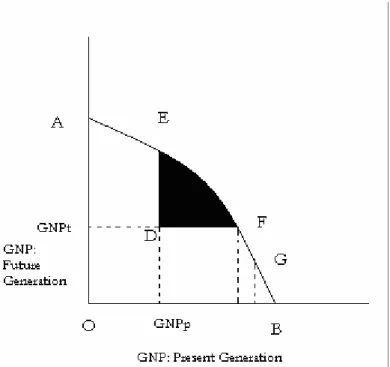
We must not satisfy the needs of the present at the expense of future needs (well-being). Furthermore, it is assumed that the overall capacity of the finite natural world would be strained by the scale of the human economy. It is also clear from the above analysis that market efficiency cannot solve the issue due to negative externalities, irreversibility and uncertainty of economic impacts on nature.
On the one hand, as part of the neoliberal governance model, it must take care of the development objectives of the time.
Evolution of Environmental Governance in India: A Journey through Constitutional and Institutional Manoeuvrings
54 Regulation of mines and mineral development to the extent that such regulation and development under the control of the Union has been declared by Parliament to be expedient in the public interest by law. 29 Preventing the spread of infectious or contagious diseases or pests affecting humans, animals or plants from one country to another. The rest of the entities which are not included in any of the said lists are under the jurisdiction of the Union Government under Article 248.
The plan documents can serve as a first-hand assessment of the evolution of institutional efforts to protect and govern the environment in India as a conglomeration of legislative acts and institutional manipulations. Genuine environmental concerns were absent from the drafts of the first three five-year plans. It was created under Pitambar Pant, a member of the Planning Commission, and was entrusted with the task of identifying the environmental effects of programmed activities and recommending modifications to preserve the quality of the environment.
The latter paved the way for the establishment of Central and State Pollution Control Boards (CPCBs and SPCBs) to implement the provisions of this Act and the Air (Prevention and Control of Pollution) Act, 1981 and the Environment (Protection) Act , 1986'.49 They were responsible for implementing legislation relating to pollution prevention and control. Although one of the most important aspects of institutional environmentalism in India, Environmental Impact Assessment (EIA) was undertaken in 1977 to ensure environmental compatibility of any economic project The Government of India appointed a Committee for Recommending Legislative Measures and Administrative Machinery for Environmental Protection under the chairmanship of N.D. Tiwari, the then Deputy Chairman of the Planning Commission.
One of the recommendations of this committee was the creation of a Ministry of Environment at the Center to give explicit recognition to the central role that environmental conservation must play in national development. Environmental Planning (NCEP) was also established in April 1981 on the recommendation of the Tiwari Committee. Aligned with the rationale behind sustainability, the approach paper of the Seventh Plan contained a formulation of a national conservation strategy.
Finally, the Eleventh Five-Year Plan states the following in relation to the environment and climate change: “Protecting the environment must be a central part of any strategy for sustainable inclusive growth. This aspect of development is especially important in the Eleventh Plan when awareness of the dangers of environmental degradation has greatly increased. In this sense, the role of the Ministry of Environment and Forests (MoEF) is very crucial.
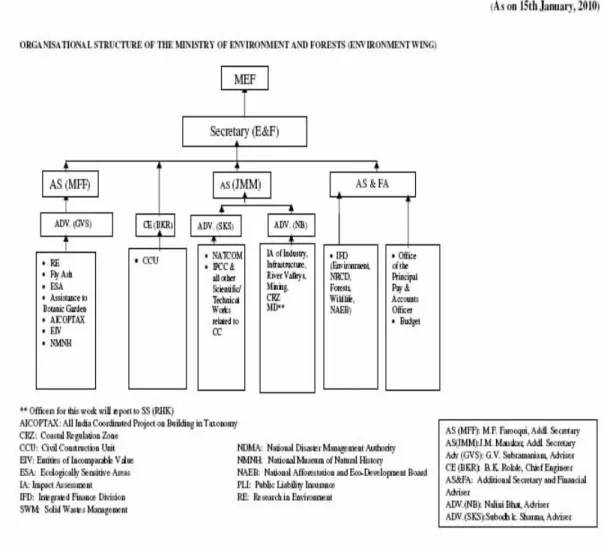
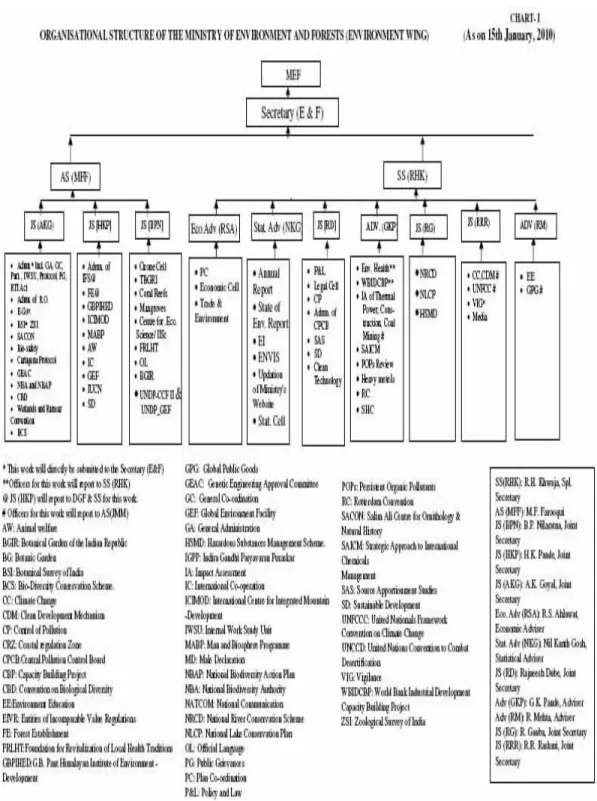
The following is the structure of the Ministry of Environment and Forestry (MoEF) to date. The next section of this article will concentrate on the assessment of the development and functioning of environmental management in India in accordance with the ecological conclusions, derived from the discussion of the theoretical understanding in the previous section of this article.
An Appraisal
The term 'sustainable development' had its roots in the publication of the Brundtland Commission's report, Our Common Future, (in World Commission on Environment and Development, 1987). However, India never ever wanted to be a part of the bandwagon for these issues. The Preface and the Development Perspective chapter of the 'Fourth Five-Year Plan' reflected some tensions regarding the status of certain crucial natural resources and the new demand for resources as follows.
Faster growth with declining natural capital and increasing real cost of environmental amenities, as well as integration with global market rates are certainly worthy contributions to the country's governance. On the other hand, the consequences of "developmental disasters" on the "commons" of the country; and sustainable environmental movements in some parts of India for rights over natural resources were other influential factors in the direction of environmental governance. Rights-based politics in some environmental issues has brought a considerable amount of populism to the country's governance.
MoEF has emerged as a mediator of tensions and conflicts between economic, ecological and political aspirations. Article 142 of the Constitution offered the Supreme Court a decisive power to shape its decisions to ensure complete justice. It was due to the fact that environmental management in India took the approach of Command and Control (CAC) with a set of laws designed to perform a preventive role.
Under the 'Biodiversity Act 2000', biodiversity and knowledge are included in the regulation of the proposed National Biodiversity Authority (NBA), whose structure is tilted in favor of strong bureaucratic control, undermining two factors - the representation of civil society groups and decentralization of environmental management. In July 2005, a few individuals accidentally came across a redacted copy of the NEP that was marked "secret" on every page. Environmental Impact Assessment (EIA), introduced in 1977, is one of the key tools of environmental management.
This area comprised the coastal stretches of the Andaman and Nicobar Islands, Lakshadweep and other small islands. But over the years, the following deregulatory measures have been taken for the productive interests of industrial, commercial and other groups and lobbies. Therefore, with the process of reforms, environmental governance is weakening its principles as far as the management of coastal stretches in India is concerned.
The effectiveness of environmental management has suffered serious shortcomings, as the measures taken fail to deliver results that meet the best needs of society. It requires re-examination of value systems – insofar as they influence human preferences.
Environmental Governance in India: A Dilemma?
The competition can be placed between the purely economic aspirations of society and the country and the inevitable ecological concern for the very existence of the economy and human society. The MoEF's divisional structure shows how broad, comprehensive and complicated the governance structure it has as it stands today. It gradually reveals how critical the task of governance is, at the receiving end, instead of the pressure from several other ministries such as – the Ministry of Finance, the Ministry of Business, the Ministry of Power, the Ministry of Trade and the Ministry of Industry.
All the aforementioned ministries are on the same scale of performance when it comes to issues of good governance and on the same ladder of growth that has no virtual end. However, the thermal resource base is still depleting and there is an increasing potential of the uranium ore to produce electricity that nevertheless generates toxic waste. 7 Economists' world view of sustainability places emphasis on the long-term stability of economic output, income and consumption, while ecologists argue for long-term preservation of the biosphere.
8 The expression "sustainable development" originates from the publication of the Brundtland Commission Report, Our Common Future (in World Commission on Environment and Development, 1987). This report defined sustainable development as “development that meets the needs of the present without sacrificing the ability of the future to meet its needs”. 13 Environmentalism is a broad philosophy and social movement related to concern for environmental conservation and improvement of the state of the environment.
15 Intertemporal choice is the study of the relative value people assign to two or more payoffs at different points in time. So, we are not aware of the effect of some economic activities on natural environmental amenities and the scale of impacts. 32 Man-made capital consists of the results of past production, such as the surplus of production over consumption.
(c) that the functioning of the economic system does not result in the concentration of wealth and means of production to the detriment of the common good.”. 42 Ambiguity arose when Article 37 stated: “The provisions in this part shall not be enforced by any court….”. It indicates that the Court cannot compel the state to enact a law or enforce a particular principle of state policy, nor can action be taken against the state in a court of law for failure to implement the directive principles to lay.
47 Section 249 empowers the Union Government to legislate in relation to a matter in the List of States in the national interest, if the Council of States (Upper House of the Union Parliament) has declared by resolution supported by not less than two-thirds of the members present and vote that it is necessary or expedient in the national interest for Parliament to legislate on it. Environmental Science, Sustainability and Politics', Transactions of the Institute of British Geographers, New Series, Vol.