American Physical Society (APS) March New Orleans, Louisiana (USA), Bulletin of the American Physical Society. The powder patterns in the lower part of the diagram show additional magnetic intensities due to the magnetic arrangement of the.
Introduction to Correlated Electron Systems: Focus on Oxide Spinels
Magnetic Ordering and Interactions
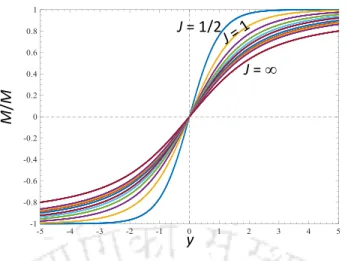
- Atoms in a Magnetic Field
- Long-range Magnetic Ordering
- Spin glass Phenomena
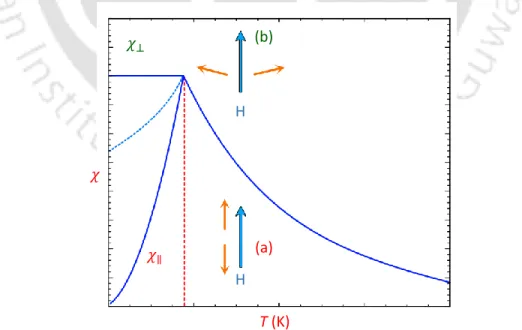
For example, as shown in Figure 1.11, where the temperature dependence of the magnetization M(T) of inverse spinel, TiCo2O4 bulk grain sizes exhibits zero net magnetization above 32 K under both ZFC and FC conditions, which corresponds to TCOMP [13, 14]. In the graph, (b) and (d) represent such data χdc(ZFC) and it is called zero field cooling (ZFC).
Phenomenology of exchange bias
The magnetic hysteresis loop (FC mode) shown in Figure 1.19 illustrates the spin configuration in the FM–AFM layers. During the magnetic field reversal, the spins start to rotate in the FM layer and easily drag the spins into the AFM layers (figure 1.19 (e)).
![Figure 1.18. Magnetic hysteresis (M-H) loops of partially oxidized Co particles measured at 77 K [34]](https://thumb-ap.123doks.com/thumbv2/azpdfnet/10557954.0/45.918.189.770.117.530/figure-magnetic-hysteresis-loops-partially-oxidized-particles-measured.webp)
Motivation and Description of the Problem
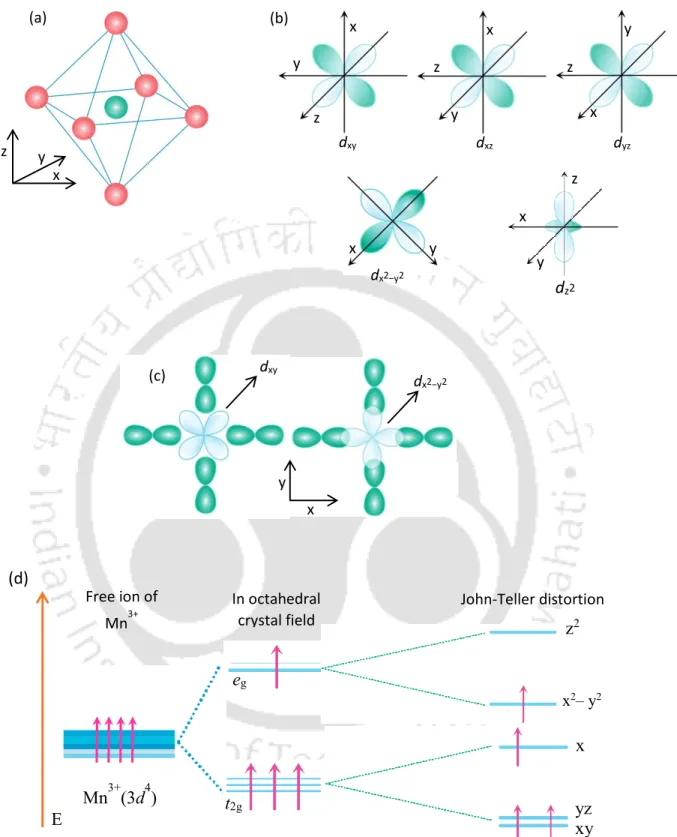
Therefore, in modern physics the Jahn-Teller effect is an interesting phenomenon which is related to the changes that occur in the crystal and magnetic structure. Both the crystal field theory and the Jahn-Teller effect will be further discussed in the following chapters in accordance with the results obtained in the present work. Most of the reports available in the literature on both systems are mainly focused on the synthesis and characterization of porous nanostructures with special emphasis on their catalytic and electrochemical properties [57–72].
In particular, dilution in MnCo2O4 systems was missing from the literature when we started this work.
Fabrication and Characterization Techniques
Fabrication of Oxide Spinels
- Solid-state reaction method
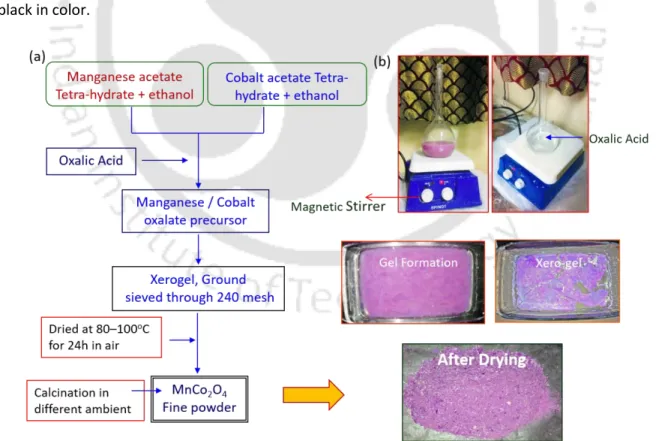
- Sol-gel Processing
- Crystal Structure and Morphology
- Elemental Analysis using the X-ray Photoelectron Spectroscopy
- XPS Instrumentation
- Magnetic Characterization
- AC-Magnetic Susceptibility
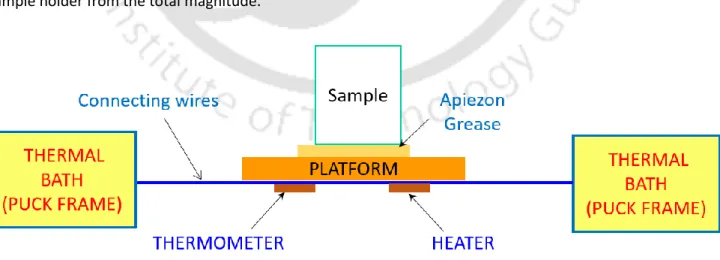
- Specific Heat
- Neutron Properties
- Neutron scattering theoretical and Experimental background
- Neutron Powder Diffractometers
The SQUID sensor changes the magnetic flux in the output voltage which is proportional to the change in the magnetic moment of the sample (Figure 2.6 (c)). The iterative regression mode easily compensates for the thermal expansion of the sample holder assembly. Using the E6 diffractometer (installed in the T4 beam tube), we investigate the magnetic structure of the compounds.
Thus, it is possible to change the orientation of the resolution ellipsoid with respect to the scattering vector Q.
Magnetic Ground State and Field-Induced Transitions in Kagomé GeCo 2 O 4
Introduction
The above issues are important regarding the nature of the ground state of Co2+ in GeCo2O4. These gaps in the literature in the GeCo2O4 magnetization data for T > TN were necessary to be reconciled with the magnetization data for T < TN for an understanding of the nature of the magnetism in this system. The phase diagram for GeCo2O4 needs to be redrawn and the magnitude of the dominant exchange links determined.
In the following sections, we discuss the experimental details, including the synthesis procedure and brief characterization details used to reveal the electronic and magnetic structure of the polycrystalline GeCo2O4 system.
Experimental Details
Therefore, in this work we aim to reinvestigate the ground magnetic state and field-induced transitions in GeCo2O4 with the specific aim of filling the gaps in the literature discussed above.
Results and Discussion
- Electronic Structure
- Crystal Structure and Phase Evaluation
- Temperature dependence of DC-Magnetization
- High Temperature Series and Exchange Interaction
- Saturation Magnetization and Magnetic Ground State
- Field dependence of Néel Temperature
- Band Structure and Optical Behavior
In this section, we discuss the temperature dependence of the magnetization (M) measured between temperatures from 2 K to 400 K in the presence of different external magnetic fields (HDC = 100 Oe, 500 Oe, 10 kOe and 50 kOe). The locations of the humps in dM/dH are determined by the critical fields HC1 and Hd used in the H-T phase diagram of Figure 3.10. Temperature change of critical fields Hd, HC1 and HC2 determined from M-H data.
In the above equation, ħ𝜔 is the energy of a single photon and 𝛼 is the absorption coefficient.
Overview, Motivation and Objectives
Moreover, these solid solutions are particularly interesting because of the unique magnetic properties of both the previously reported end compounds TiCo2O4 and MnCo2O4. Some of the intriguing properties of these compounds are: (i) the coexistence of longitudinal ferrimagnetic order and transverse spin-glass state below freezing point due to the diluents at the B sites, (ii) negative magnetization under the compensation point and bipolar exchange bias under ZFC condition. Since both end compounds exhibit very different magnetic ground states, it is worthwhile to investigate the magnetic and crystal structures of the intermediate assemblies of these two end compounds, which is the primary goal of this work.
In the following sections, we discuss the details of the experiments we performed and their results.
Experimental details
60 to understand the magnitude of moment and valence of the individual magnetic metal ions for different compositions of MnxTi1–xCo2O4; Second, the majority of the reports available in the literature on both end members TiCo2O4 and MnCo2O4 are primarily focused on the synthesis and characterization of the porous nanostructures with special emphasis on their catalytic and electrochemical properties, but little literature is available on the low-temperature neutron diffraction studies with special emphasis on their magnetic ground states and cationic distribution. Therefore, motivated by the unique magnetic properties of the proposed systems, an attempt was made in the present work to investigate a detailed crystal structure and magnetic ordering of MnxTi1−x Co2O4 polycrystalline samples using the neutron powder diffraction and dc- and AC magnetization measurements. The magnetic properties of the bulk polycrystalline samples were studied by the SQUID magnetometer (from Quantum design MPMS XL) in the temperature range 4-300 K and magnetic field (H) up to ± 50 kOe.
The detailed working principle of the above mentioned instruments and their technical details have already been discussed in Chapter-2.
Results and Discussion
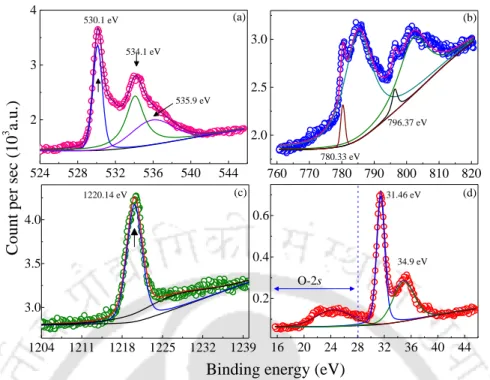
- Elemental Analysis using XPS
- Crystal Structure from Neutron Powder Diffraction
- dc-Magnetic Susceptibility
- Thermal variation of Specific-Heat
An enlarged image of the two magnetic reflections is shown in the inset of Figure 4.5 using a logarithmic scale. Temperature dependence of the magnetic moments of (a) Ti0.8Mn0.2Co2O4 and (b) Ti0.6Mn0.4Co2O4 polycrystals in which the cations are located at the A and B sites. Temperature dependence of the dc magnetic susceptibility χ(T) of polycrystalline Ti0.6Mn0.4Co2O4 system measured under zero field cooled (ZFC) and field cooled (FC) conditions in the presence of external direct current magnetic field Hdc is equivalent to (a) 500 Oe and (b ) 50 kOe.
74 values (in Tp-ZFC and Tp-FC) are mainly due to the different temperature dependence of the magnetic moments associated with the cations occupying the A and B sites.

Conclusions
80 The crystal structure refinements in the space group I41/amd provide evidence of a weak tetragonal distortion with c/a < 1 for both compositions. However, the refinements in the tetragonal structure give rise to weak changes in the apical and equatorial bond lengths. These changes are compatible with the trend expected for a Jahn-Teller activity of the Mn3+ ions with the 3d4 configuration.
The thermal variation of the individual and net magnetic moments 2μFI(TB) – µFI(CoA), obtained from neutron diffraction, is consistent with the χdc(T) data.
Brief Literature Review
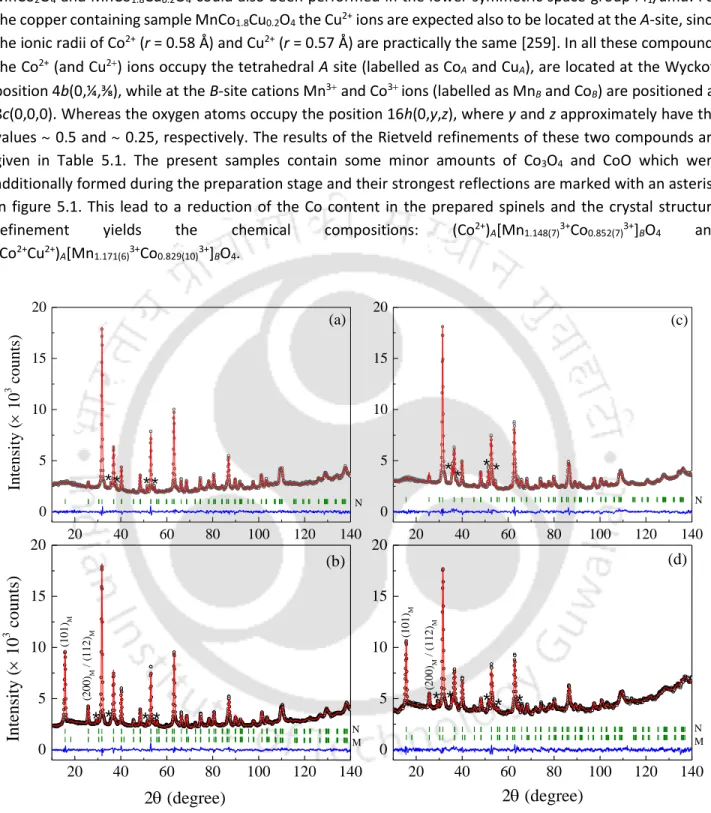
Neutron powder diffraction experiments on MnCo2O4 and MnCo1.8Cu0.2O4 were performed on the instruments E2, E6 and E9 at the BER II reactor of the Helmholtz-Zentrum Berlin. As stated in the previous chapter that the instrument E9 uses a Ge monochromator which selects the neutron wavelength λ. The instrument E9 was used to investigate the crystal structure parameters of both MnCo2O4 and MnCo1.8Cu0.2O4 from data sets collected at 2 and 295 K, respectively.
A detailed temperature dependence of the neutron powder diffraction was investigated for the samples on the instrument E6.
Results and Discussions
- Magnetic ordering using E2 and E6
Therefore, the reason for the increase in the cell volume of MnCo1.8Cu0.2O4 should be explained by other physical effects. Results of Rietveld refinements of the neutron powder diffraction data of MnCo2O4 and MnCo1,8Cu0,2O4 collected on the E9 instrument at 2 and 295 K. For both compounds MnCo2O4 and MnCo1,8Cu0,2O4, the thermal variation of the magnetic moments located at sites A and B are shown in Figure 5.3 showing the FIM coupling.
The temperature dependence of the experimentally obtained magnetic moments of the ions in (a) MnCo2O4 and (b) MnCo1.8Cu0.2O4 located at the A and B sites.
Introduction
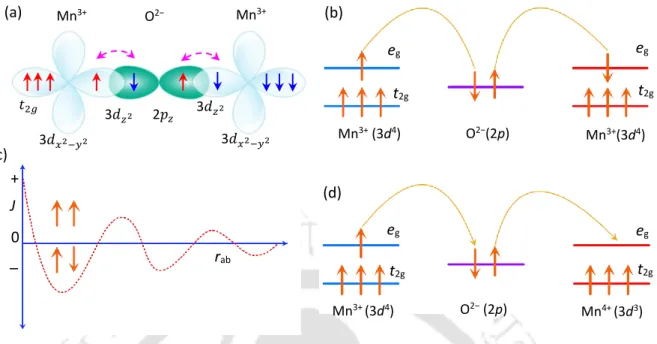
Generally in tetrahedral crystal field the d orbitals split into eg and t2g levels with lower and higher energies respectively. The Cu2+(3d9) ions donate an odd number of electrons to the eg and t2g levels and can cause lattice distortion. Thus, the Cu substitution at the tetrahedral sites may invoke a constructive approach to probe the discontinuity in the fourfold symmetry by partially filling the doubly degenerate levels.
Due to the above fundamental reasons, we undertook the studies on the effect of Cu substitution at the tetrahedral sites on the electronic and magnetic properties of the MnCo2O4 system.
Experimental details
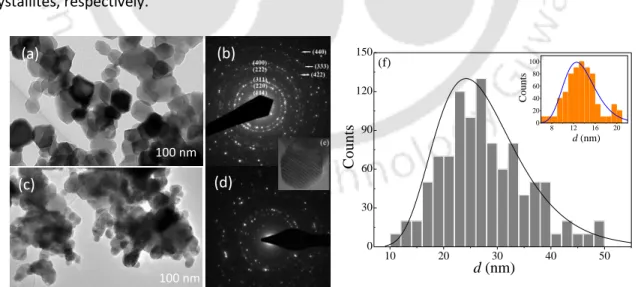
- Crystal structure and Morphology
- Magnetic Properties
Temperature dependence of the real component of ac magnetic susceptibility χ′(T), χ′′(T) of (a) MnCo2O4 and (b) MnCo1.8Cu0.2O4nanocrystallites recorded at different frequencies in the range 0.17 Hz ≤ f . Logarithmic variation of the relaxation time ln(τ) plotted as a function of ln(T/TF − 1) corresponding to the Power law. Logarithmic variation of the relaxation time ln(τ), plotted as a function of the peak temperature (Tf) corresponding to the Vogel-Fulcher law for (i) MnCo2O4, (ii) MnCo1.8Cu0.2O4, (iii) Mn0.8Zn0. 2Co2O4 and (iv) MnCo1.9Zn0.1O4 nanoparticles.
Here, the solid lines represent least-squares fits of the experimental data to the AT-line equation.
Conclusions and Prospective for Future Work
Prospective for Future Work
In Chapter 3, we discussed the magnetic ground state of the GeCo2O4 sample and determined the exchange constants in detail. However, phonon dynamics and optical properties at low temperatures can be studied because this system exhibits a structural distortion along 16 K below the temperature of long-range magnetic ordering (TN ~ 21 K). Therefore, in our future work we plan to study a detailed temperature dependence of the optical properties. ii) We then extend our work to the MnxTi1−xCo2O4 system with a particular focus on the application of magnetic cooling.
We plan to perform a detailed characterization regarding the magnetic entropy change (ΔSM) over order temperature and tune the magnitude and polarity of ΔSM as a function of Mn concentration.
Bibliography
Moulder, Handbook of X-ray Photoelectron Spectroscopy: A Reference Book of Standard Spectra for the Identification and Interpretation of XPS Data (1992). Singh The Nature of Magnetic Ordering in Cobalt-Based Spinels, Chapter 4 in 'Magnetic Spinels–Synthesis, Properties and Applications', edited by M. 114 [202] NIST 2000 NIST X-ray Photoelectron Spectroscopy Standard Database NIST20 ) (Gaithersburg MD: National Institute of Standards, Technology) p 20899.
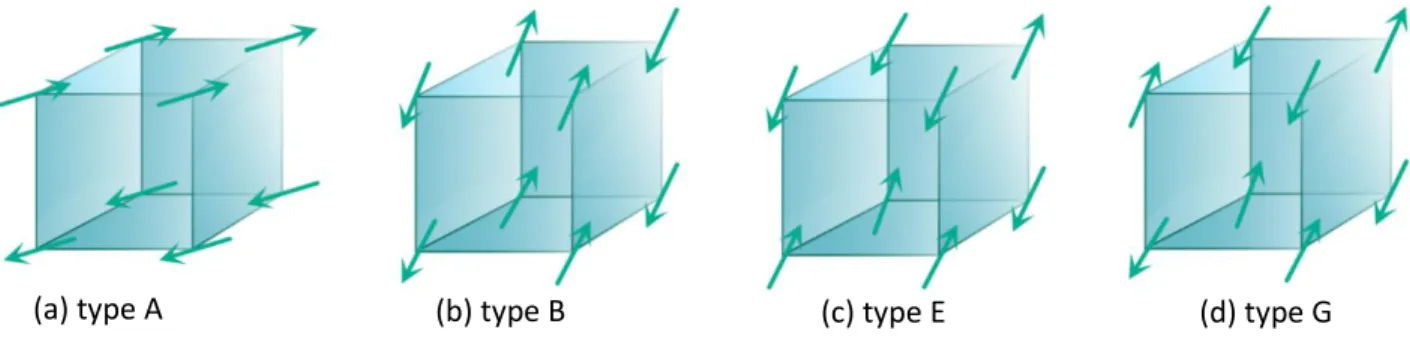

![Figure 1.19. The spin configuration schematics corresponding to the FM–AFM coupling at various stages of an asymmetric M-H loop with (i) large antiferromagnetic anisotropy and (ii) weak anisotropy [34]](https://thumb-ap.123doks.com/thumbv2/azpdfnet/10557954.0/46.918.169.840.104.409/configuration-schematics-corresponding-coupling-asymmetric-antiferromagnetic-anisotropy-anisotropy.webp)
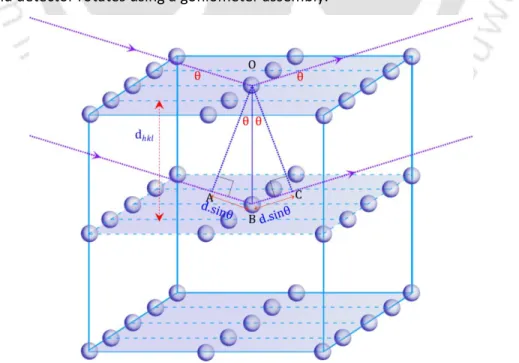
![Figure 2.5. Typical components of the XPS instrumentation and schematic demonstration of the measurement method Ref [113].](https://thumb-ap.123doks.com/thumbv2/azpdfnet/10557954.0/57.918.159.811.101.517/figure-typical-components-instrumentation-schematic-demonstration-measurement-method.webp)