Multidimensional periodic structures made by interference lithography are used in a variety of applications such as photonic crystal, data storage, and energy device. The intensity of UV light at the bottom of the thick SU-8 photoresist film is reduced due to high absorption of SU-8 in the UV region. Polyhedral oligomeric silsesquioxane (POSS) is one of the interesting materials with ultrahigh transparency, good thermal and mechanical stability.
POSS-based photoresist has difficulty with the lithography process because resin remains in a liquid phase. Due to these properties, PGP is superior to SU-8, conventional photoresist, for fabricating ultra-thick patterned structures via interference lithography. An ultra-thick PGP patterned structure helps capture light by increasing the amount of light traveling through the active material.
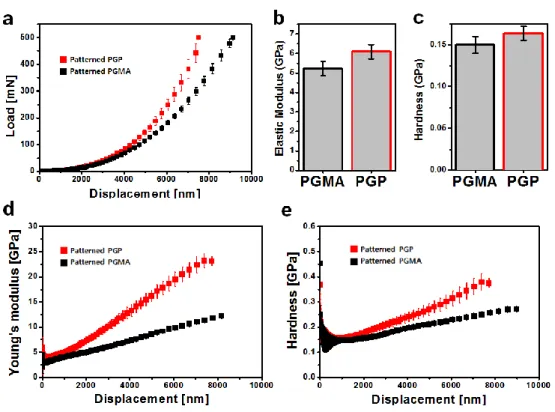
As a result, an active material including the ultra-thick PGP patterned structure greatly increases the efficiency of solar desalination. The transmittance spectra of the 100-thick PGP film are confirmed via UV-Vis spectrophotometer, b) UV-Vis spectrometry of the synthesized PGP and SU films. 6 Mechanical strength of PGMA and PGP-2 film with square pattern. a) Load-displacement curves of PGMA and PGP-2 film with structures modeled with a maximum load of 500 mN. b) Young's modulus and c) Strength that is investigated by the Oliver-Pharr nonlinear curve fitting method. d) Young's modulus-displacement curves and e) Hardness-displacement curves obtained at 15 % film thickness or 1.5 μm indentation displacement.
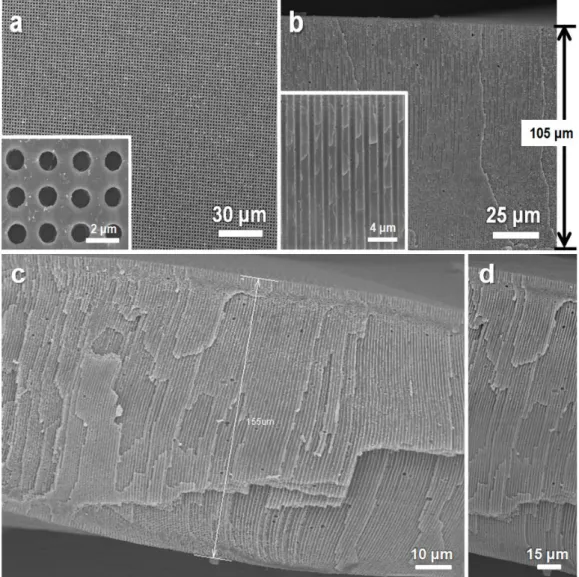
7 Scanning electron microscopy (SEM) images of PGP structures with a square pattern with a thickness of 105 μm. a) Top view.
Introduction
Fabrication of patterned structure
- Interference lithography
- Photoresist
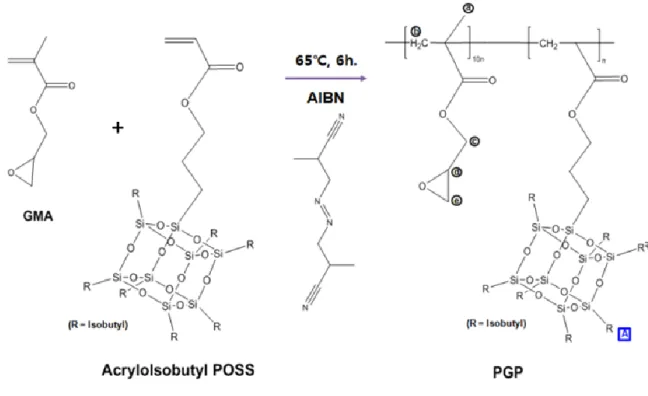
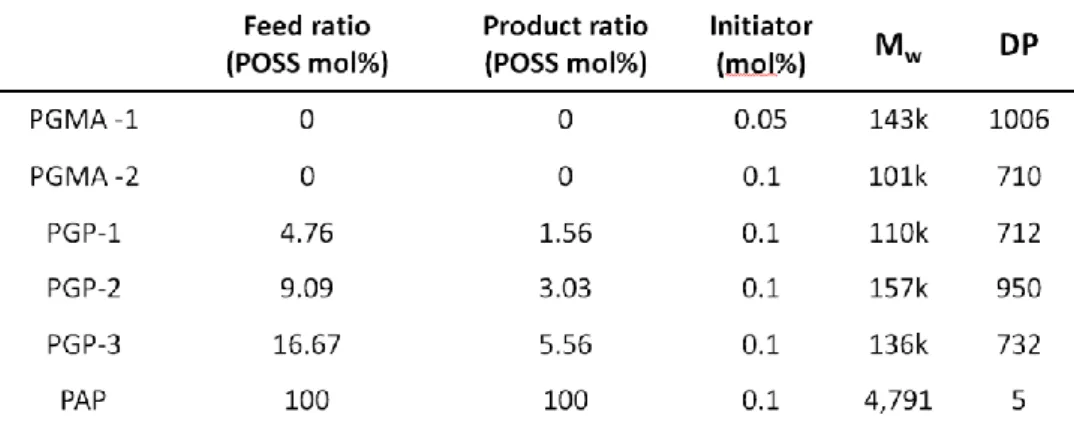
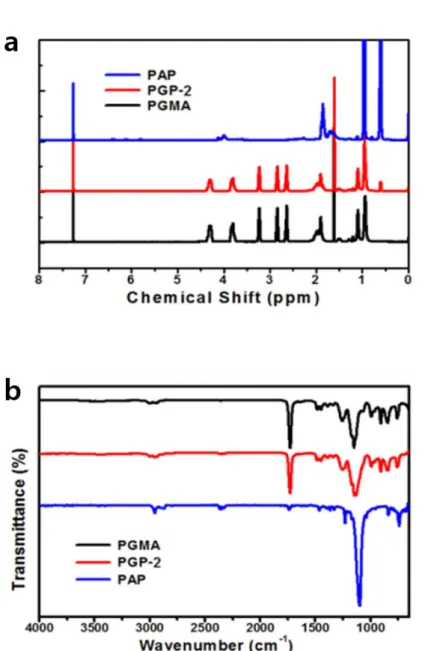
Polyhedral oligomeric silsesquioxane (POSS) is one of the interesting materials with an extremely high transparency, excellent mechanical properties and good thermal stability due to the existence of the cube-octameric framework composed of functional groups RSiO1.5.11 It is expected that POSS-based polymer capable of photopatterning functionalized with an acrylate or epoxy ring has improved transmittance. Here, I present the solid-type POSS-based photoresist with a high transparency that enables the fabrication of ultra-thick submicron hard structures. To solve the main disadvantage of conventional photoresists, poly(glycidyl methacrylate-co-acrylisobutyl POSS) (PGP) is synthesized by polymerization of an epoxy ring-containing acrylate monomer and transparent POSS acrylate containing silica components.
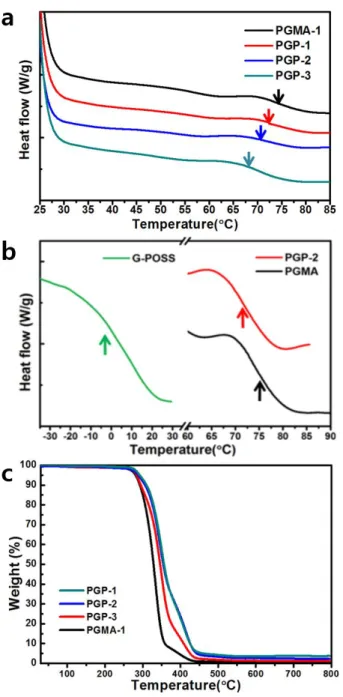
PGP exhibits ultrahigh light transmittance in the UV-vis range (96.6% at 355 nm of a 100 μm film), high Tg improved mechanical properties, low volume shrinkage and easy removal. Due to these properties of PGP, the proposed photoresists outperform conventional photoresists such as SU-8, PGMA, commercially available POSS for ultra-thick patterned structure fabrication. The ultra-thick, large surface area of the uniform submicron PGP structure has improved mechanical properties, providing tremendous potential in a variety of applications.
Solar desalination
Experimental methods
Fabrication of patterned structures
- Materials
- Polymerization
- Patterning with photoresist
- Characterizations
Solar desalination
- Materials
- Preparation of the photo-absorber materials
- Characterizations
- Solar steam generation measurements
Results and Discussion
Fabrication of patterned structures
Solar desalination
To increase the absorption of sunlight, ultra-high absorption carbon nanotube (CNT) was drop-coated on the patterned film, as shown in Fig 9a and b. While the PGP film exhibited about 0% of the absorption value, the CNT/PGP film and the CNT/p-PGP film exhibited high absorption exceeding 90% in the solar spectral range in Fig 10b. Furthermore, the absorbance of the CNT/p-PGP film was slightly higher than that of the CNT/PGP film. The hydrophilicity of CNT-PGP films before and after acid treatment was confirmed by a contact angle investigation as shown in Fig. 11. Me.
In the case of an acid-treated CNT-PGT film in Fig. 11c, as soon as water falls, it spreads across the film. As shown in Fig. 9c and d, the wood has a vertically connected tubular structure with vessels of several tens of micrometers. Steam is generated via thermal evaporation in the upper part of the bulk water in which the active material is present.28 As shown in the digital camera image in Fig.
After 1 hour of exposure at 1 sun, the temperature on the surface of the bare wood and the CNT/p-PGP film increased to about 27 ℃ and 37 ℃, respectively, as shown in Figure 12 b, c, and d. The temperature on the bare wood is lower than that of CNT/p-PGP film since the photothermal conversion mechanism does not work. Because the piece of wood not only transports water, but also localizes heat only to the wood, there is a temperature difference between the top of the wood and the bottom of the devices.
The temperature of the surface of the photoabsorber is lower than that of the wood because the heat generated evaporates the water. As shown in Figure 13, the mass change of 3.5% salt water was measured to calculate the solar energy to vapor conversion efficiency of CNT/PGP, CNT/p-PGP under simulated solar illumination of 1 Kw/𝑚2. All evaporation rates were calculated. in steady state after simulated sunlight was illuminated for 1 hour. At a solar intensity of 1 kW/𝑚2, the mass change rate of CNT/p-PGP on the piece of wood was as high as 1.78 kg/ᆞh, which is about 4 times greater than that of 0.48 kg salt water alone /ᆞ. H.
The CNT/PGP on the wood exhibits mass change of 1.45 kg/ᆞh because lower sunlight absorption without light scattering effect of pattern structure (Fig. The evaporation rate and solar-to-vapor conversion of CNT/p-PGP was much higher than that of CNT/PGP due of the increased light absorption and the vapor escape channel of patterned structures Although the absorption of two photoabsorbers is similar in the absorption for the full sunlight spectrum range, the reason for the difference is in the evaporation rate and effective solar-to-vapor conversion Although the absorption of the two photoabsorbers were similar in the full sunlight spectrum, CNT/p-PGP on the wood piece seems to have greater evaporation rate and effective solar-to-vapor conversion due to the vapor escape channel of CNT/p-PGP.

Conclusions