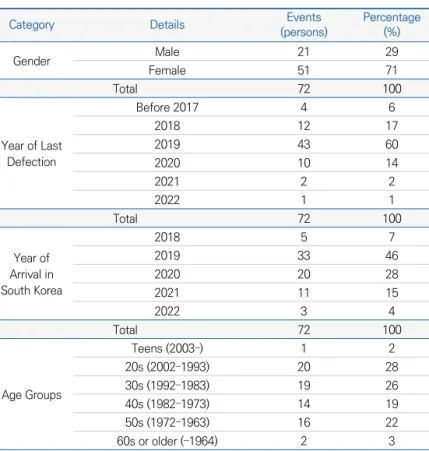
The White Paper on Human Rights in North Korea 2022 is based on interviews with 72 North Korean defectors. The White Paper on Human Rights in North Korea 2022 refers to the collection of North Korean laws and regulations as of October 2022.
Table Ⅰ-1 Ratification of or Accession to International Human Rights Treaties by North Korea
North Korea’s Human Rights Legislation and Perspective on Human Rights
Criminal law; Lawyer's law; Courts Constitution Act; Complaints and Petitions Act; Equal Rights for Men and Women Act; Law on the Protection and Promotion of Women's Rights.
Responses to Human Rights Issues in North Korea
Third, the concept of human rights in North Korea emphasizes the rights of the state, and North Korea explains human rights in relation to its sovereignty. Since 2005, the Assembly has also adopted resolutions on North Korean human rights every year, expressing serious concerns about the human rights situation in North Korea.
Table Ⅰ-4 Ratification of or Accession to Major International Human Rights Treaties and Submission of Reports by North Korea
Extrajudicial, Summary or Arbitrary Execution
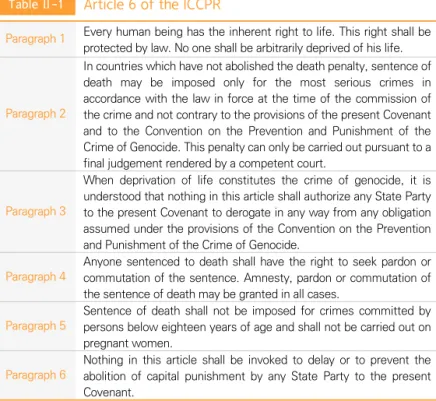
Amnesty, pardon or commutation of the death penalty may be granted in all cases. In accordance with the provisions of Article 6 of the PGP, Article 14 of the PPPPP (which establishes the right to a fair trial) and Article 15 of the PPPPP (which establishes the principle of prohibition of retroactive punishment), out-of-court, abbreviated or arbitrary enforcement is prohibited.
Broad Application of the Death Penalty for Offenses
In cases where the act referred to in paragraph 3 is particularly serious, the person shall be subject to an indefinite labor sentence or the death penalty. Extremely serious kidnapping (Article 8) Unlimited labor punishment or the death penalty Extremely serious rape (Article 9) Unlimited labor punishment.
Table Ⅱ-2 Crimes Subject to Capital Punishment under Criminal Law and their Legal Requirements and Statutory Penalties
Death Sentence for Juvenile Offenders and Execution of Pregnant Women
In addition, it is necessary to check whether the actual number of public executions has decreased or whether public executions have been replaced by non-public ones. However, cases in which minors were sentenced to death or the death penalty was carried out on pregnant women were not documented in recent research.
Imposition of Capital Punishment for Violation of Emergency Quarantine Regulations
Negligence in carrying out an order, ordinance, decision or instruction relating to an emergency quarantine measure (Section 65). When the case is extremely serious, unlimited term corrective labor punishment or the death penalty Negligence in complying with emergency quarantine.
Other Infringements of the Right to Life
Evaluation
However, if public executions are simply replaced by non-public executions, it must be assumed that the violation of the right to life remains a problem in North Korea. As in the UDHR, Article 7 of the ICCPR also prohibits torture and inhumane treatment and even goes a step further by explicitly prohibiting medical or scientific experimentation without consent.
Torture and Inhuman Treatment in the Handling of Criminal Cases
Despite these regulations in the North Korean Criminal Law and Criminal Procedure Law, torture and inhumane treatment frequently occur in the actual process of dealing with criminal cases, and the use of torture is common because it has been established as one of the investigative methods for obtaining of confessions of suspects during interrogation.39 Testimonies alleging that cruel treatment takes place in detention facilities under the Ministry of State Security have been collected (
). A North Korean defector was investigated for human trafficking by the MSS District Branch in Onsong County, North Hamgyeong Province in February 2015 and was frequently beaten in the investigation process.
Public Execution of the Death Penalty
If an extrajudicial, summary or arbitrary execution is carried out in public, it will violate both Article 6 and Article 7 of the ICCPR. In general, however, public executions of the death penalty appear to be carried out more frequently in border areas than in interior areas, and in cities than in rural areas.
Enforced Disappearances and Deaths in Detention Facilities
It has been analyzed that this trend may be because there are relatively more illegal activities in border regions and cities, and the North Korean authorities are trying to warn and incite fear among residents of these regions. Therefore, both the people subject to enforced disappearances and their families are victims of torture and/or inhumane treatment.
Evaluation
However, due to limited information and testimony, it is difficult to fully verify the reality of and changes in the trend of public executions. No one shall be held in slavery; slavery and the slave trade in all their forms must be prohibited.
Labor Training Punishment for Minor Offenses
Penalties depriving personal liberty and imposing forced labor in the Criminal Law of North Korea include the penalty of corrective labor—that is, the penalty of indefinite corrective labor and the penalty of limited corrective labor—and the penalty of training work (Article 27). The sentence of indefinite/limited-term correctional labor detains criminals in prison camps (kyohwaso) and forces them to work, with the period of the sentence of limited-term correctional labor ranging from 1 year to 15 years ( article 30).
Labor Exploitation of Detainees in Holding Centers (Jipkyulso)
A North Korean defector who was held in a detention center (jipkyulso) in Chongjin, North Hamgyeong Province for 20 days in 2017 testified that he/she was used to build factory fences and harvest the fields. A North Korean defector who was held in a detention center (jipkyulso) in Chongjin, North Hamgyeong Province from July to August 2018 testified that he/she was not investigated and farm work, construction work and sweeping work from 5:00 a.m. did until 8:00 p.m. .55 The witness was carrying blocks on his/her back at a construction site and was beaten by a guard when he/she tried to drink water on a hot day that reached 40°C.56 A North- Korean.
Re-Educational Labor Discipline
In addition to the Administrative Punishment Law, the 2007 Law on the Implementation of Public Security provides that public security institutions and the Association of Responsible Workers have the authority to impose re-educational labor discipline on those who commit acts that violate the legal order (Article 57 of the People). Security Enforcement Law). Cases of forced labor in violation of the UNCRC have been documented repeatedly and the intensity of labor appears to be high.
Arbitrary or Unlawful Arrest or Detention
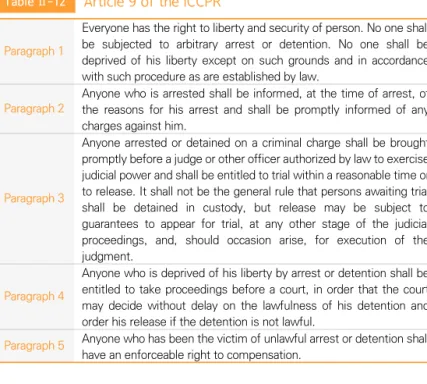
Whoever is deprived of his freedom by arrest or detention has the right to initiate proceedings before the court so that the court can decide without delay on the legality of his detention and order his release if the detention is not legal. Regarding arrest or detention during preliminary examination, the North Korean Criminal Procedure Law states that citizens may not be arrested or detained for reasons not prescribed by law or without following procedures prescribed by law (Article 176).
Insufficient Notification of Reasons for Arrest and Alleged Charges
According to his/her testimony, he/she was released because of Kim Jong Un's policy of “sparing one's life if the person has 1%.
Excessive Length of Pre-Trial Detention
The preliminary investigation of a criminal case subject to a labor training penalty must be completed within ten days. With regard to a complex criminal case that may result in a labor penalty for which the preliminary examination cannot be completed within the period specified in Article 150, paragraph 2, of this law, the detention period of a preliminary examinee may be extended by five days, after approval by a public prosecutor.
Insufficient Procedural Guarantee and Compensation
Korea stated in the report that Article 2 of the said regulation stipulates that "the state will compensate the mental and physical suffering and property loss of the person who has been innocently arrested and detained or convicted by investigation, preliminary examination or judicial bodies. ” In the Joint Basic Documents submitted to the UN in 2016, North Korea also mentioned a compensation system for those whose rights have been violated. He indicated that there is a criminal compensation system as well as a civil compensation system.74 However, the general population of North Korea is not aware of the existence of the criminal compensation system and the system is not used.75.
Evaluation
Korea as punishment for the lawful exercise of the rights guaranteed in the ICCPR, and it clearly constitutes arbitrary arrest and detention. Nor does North Korea appear to recognize the right to request a review of the legality of arrest and detention.
Inhuman Treatment of Persons Deprived of Liberty
A North Korean defector who had been detained in the MSS provincial detention center (jipkyulso) in Yanggang Province in 2018 testified that he/she was forced to remain in a real estate. Another North Korean defector who had been detained in the MSS City Detention Center (guryujang) in Hyesan, Yanggang Province in 2016 testified that he/she was forced to remain in a fixed position from morning to night.
Figure Ⅱ-1 Location of Prison Camps (Kyohwaso)
Issues Related to the Treatment of Unconvicted Prisoners
As discussed above, there appears to be a basic separation of unconvicted and convicted prisoners in North Korea; premises for those sentenced to correctional sentences, sentences for work training or work disciplinary training are different from premises for suspects or defendants. More detailed research is needed to better determine whether unsentenced detainees receive appropriate treatment that differs from that of convicted prisoners.
Issues Related to the Treatment of Convicted Prisoners
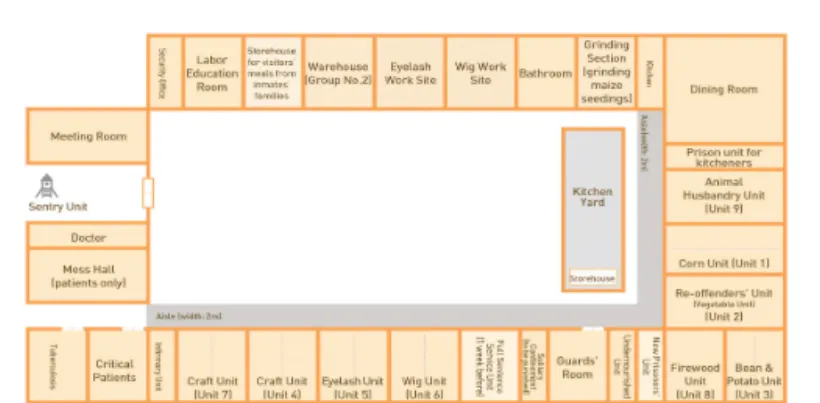
A North Korean defector who was detained in Gaecheon Kyohwaso from 2014 to 2015 testified that he/she worked in the eyelash unit and the weaving unit for five months, respectively, and when he/she failed. August 2016, the witness worked to drag three meter long trees when he was very weak.
Issues Related to the Treatment of Unconvicted and Convicted Juvenile Prisoners
The use of violence and cruel treatment in detention facilities may also constitute a violation of Article 7 of the ICCPR (which prohibits torture and inhuman treatment), and deaths in detention facilities may constitute a violation of Article 6 of the ICCPR (which provides for the protection of the right to life). The right to free movement and residence is one of the basic human rights.
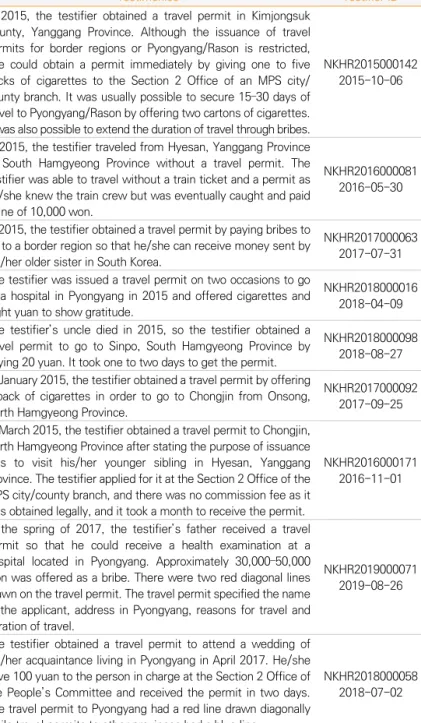
Using Travel Permits to Control People and Restrict Movement
In 2015, the witness traveled from Hyesan, Yanggang Province, to South Hamgyeong Province without a travel permit. The witness obtained a travel permit in April 2017 to attend a wedding of his/her acquaintance who lived in Pyongyang.
Table Ⅱ-25 Cases Related to Travel Permits
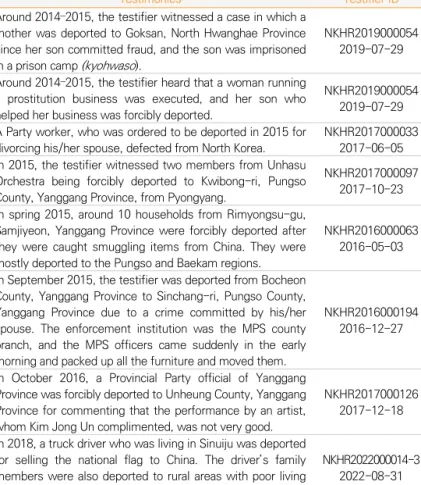
Restrictions of Access to Certain Areas and Forced Deportation
Such broad restrictions on public access to various special districts are a violation of the right to freedom of movement and residence. The UN Human Rights Committee has interpreted in its General Comments that the right to freedom of residence includes protection against "all forms of forced internal displacement" and "prevention of the entry or residence of persons in a specified part of the territory"164 Forced deportation . carried out by the North Korean authorities constitutes a representative example of forced displacement by a state.
Table Ⅱ-26 Cases Related to Forced Deportation
Restrictions on Entry to Border Areas and Prohibition against the Freedom to Leave
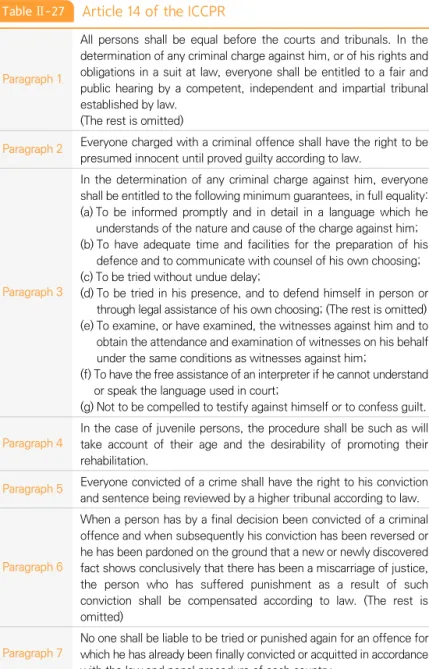
According to Article 13 of the Immigration Law, North Korean residents may be issued a border area immigration document for official or private purposes. In North Korea, courts are established in accordance with the Constitution and the Law on the Constitution of the Courts of 2011.
Table Ⅱ-27 Article 14 of the ICCPR
Denial of Judicial Independence
People's jurors participate in trials at first instance (Article 9 of the Law on the Constitution of the Courts). Rulings and decisions are made by majority vote of the judges and people's jurors participating in a trial (Article 17 of the Law on the Constitution of Courts).
Unfair and Perfunctory Trials
A North Korean defector who defected in 2020 testified that he/she witnessed a platoon leader of the. There is inconsistent testimony from North Korean defectors as to whether judges, prosecutors, defense counsel, and popular jurors attended the trials.
Operation of Quasi-Judicial Systems
North Korea's Criminal Procedure Law requires cases involving crimes against the state and people to be investigated. Administrative penalties are also specified in the People's Security Enforcement Law and the Prosecution and Supervision Law.
Infringement of the Right to Defense
In addition, the North Korean Bar Law states that a defense attorney is entitled to speak or correspond with a preliminary examinee or a person accused of a crime (Article 9(1)). The testimony said that when he/she told the defense attorney that he/she could not afford to offer a bribe, the attorney sided with the prosecutor during the trial.
Insufficient Guarantee of the Right to Appeal and Perfunctory Operation of the Appellate System
MATERIALS AND METHODS The effects of temperature on the duration and survival of egg, larval and pupal stages, adult female weight and fecundity, and reproductive potential were
Apakah Anda tertarik untuk menghasilkan pendapatan pasif? Mari kita mulai bersama kami.
Semakin banyak dokumen yang Anda bagikan, semakin banyak uang yang Anda hasilkan!