Prof., Academy of Justice of the Supreme Court of the Republic of Kazakhstan, Nur-Sultan, Kazakhstan (Philosophy). Unity and diversity in history and modernity", supported by the Ministry of Science and Education of the Russian Federation.
A. Atygayev
The author quotes information from historical sources indicating the existence of the Institute of Atalykship in the Kazakh Khanate. The Institute of Atalykship was one of the important state-building elements in the Kazakh Khanate from the 15th to 17th centuries.
Преемственность и сохранение традиционных политических и правовых институтов народов
The aim of the study is to analyze the main scientific ideas about the degree of continuity and the possibility of preserving traditional political and legal values in the countries of the Turko-Mongol world in the context of globalization. The authors assessed the degree of study of the subject of research, highlighted the most important scientific ideas, analyzed the possibility of preserving traditional values of the Turko-Mongol world in the context of globalization.
Түркі қағанаты дәуіріндегі Алтайдың тарихи географиясы (VI-XIII ғғ.)
Түркілердің тарих сахнасына шыуындағы Алтайдың рөлі
5Пинглян кирме ху (平凉杂胡) ‒Қытайдың Хэси дәлізіндегі әртүрлі көшпелі этникалық топтар.
Алтайды мекендеген Динлин, Гаошэ, Басмыл және Тоғыз оғыздар
429 жылы Вэй патшасы Тобатау (Тай У-ди) шығыс гаоштардан 100 000 отбасын тізе бүктірді және 1 миллионнан астам жылқы, сиыр, қойларды тұтқынға алды [9; 28 б.]. VI ғасырдың ортасында Алтай тауының телдері Түрік Түмен қағанның соңынан еріп, Жоужандарға шабуыл жасағаннан кейін Қытай бекінісінің солтүстігінде тұратын телдер 15 руға бөлініп кетті.
Түркі қағанаты кезіндегі Алтай VI ғасырдың орта кезінде түріктер
To answer that question, in the second part of the article we will briefly outline the history of various ethnic groups that formed the Turks. In the middle of the VI century, the Turks grew from the Telians who inhabited Altai.
Право и суд Улуса Джучи (Золотой Орды)
Yu. Pochekaev 1,2
2 "The Great Altai" scientific educational center of Altaistics and Turkology at Altai State University, Barnaul, Russia. The article analyzes the information from Catholic missionaries (Franciscans and Dominicans) as a source of information about the legal realities of the Golden Horde at the end of the 13th-14th centuries. century. Using an interdisciplinary approach combining the methods of history and law, the reports of representatives of the Catholic clergy who had visited the Golden Horde during the period in question, as well as fragments of works by European authors, were based on information provided by such missionaries. investigated.
В то время как в своих заметках о праве и правосудии в Золотой Орде они демонстрируют «европоцентрический подход» и во многом привязаны к взглядам, возникшим в результате И. В землях «Северной Тартарии»: Сведения латинок источников о Золотом Орде в управлении хана Узбека На земли «Северной Тартарии»: сведения из латинских источников о Золотой Орде в годы правления хана Узбека. Эволюция социально-политической организации монголов в конце XII - начале XIII века.
Pochekaev Roman Yulianovich – Doctor of Historical Sciences, Candidate of Law, Associate Professor, Head of the Department of Theory and History of Law and the State of the National Research University Higher School of Economics, St. Petersburg, Russia; Principal investigator of the Scientific Educational Center for Altaism and Turcology “The Great Altai” at Altai State University, Barnaul, Russia.
Индикаторы модернизации образования Центрально- Азиатского региона Российской империи во второй
Количество учащихся детей-казахов в
Количество обучающихся мальчиков и девочек в Ферганской области
- V. Rygalova
Indicators of modernization of education in the Central Asian region of the Russian Empire in the second half of the 19th and early 20th century. In this respect, the Central Asian region of the Russian Empire in the second half of the 19th and early 20th centuries is of great interest to researchers, since the modernization of peripheral Russia had its own characteristics, characteristics related to geography, ethnic composition and traditionalism of society. Based on information from the sources, as well as on the details of development in the peripheral areas of the Russian Empire, indicators of educational development were identified and described in detail in the article (the number of educational institutions and the involvement of the population in the educational process, the involvement of the indigenous population in education (considered separately due to the specific composition of the population, of whom more than 50% were foreigners), the involvement of girls in the education process (this indicator should also be treated with special attention ).
The analysis of the set of indicators indicates that the Russian authorities pursued a policy of systematic modernization of the area, and that there was no radical break in the traditional foundations of society. Dynamics of the level of agricultural production in Russia in the first half of the 19th century]. Concepts of modernization and modernity in the context of Russian transformations of the 19th – 20th centuries].
Turkestan in the discourse of frontier modernization of the Russian Empire at the end of the 19th and the beginning of the 20th century]. Vocational education in the remote areas of the Russian Empire in the 1880s – early XX centuries] Samarskij nauchnyj vestnik [Samara Scientific Journal].
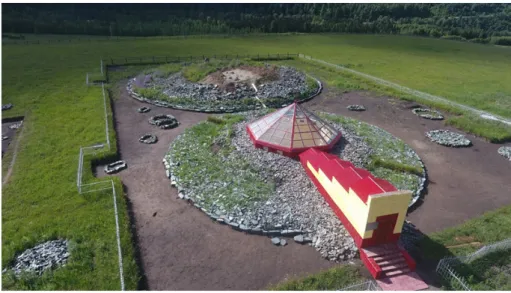
Study, Preservation and Museumification of the Berel Necropolis Monuments at the Present Stage
2 ground structure studies from the Early Iron Age showed that the monument is closely adjacent to the mound No. Margulan Institute of Archaeology, a dendrochronological analysis of the frame and trough-coffin of the mounds No. Hasanov, is actively involved in the research of monuments from the Xianbian period for three years.
Kitov and an anthropologist of the Center for Egyptological Research of the Russian Academy of Sciences (Moscow, Russia) A. Museum experts publish the results of these research works together with archaeologists A. After the archaeological excavations, the arrangement of St. started an open-air museum above Mound 11 (Figure 6).
The issue of lack of own restoration laboratory is also on the agenda. 674 "On the establishment of the republican state enterprise "State Historical and Cultural Reserve-Museum Berel"].

Күйс-Толғой (НТ1) брахми мәтінінің байырғы түрікше оқылымы
Sartkoja
Published historical documents related to the language and history of the nomadic peoples of Central Asia from the VIII-XI centuries and preserved to this day. Until 2017, the text of the column was not deciphered, and for 43 years the inscription was ignored. The author of the article read the text in the ancient Turkic language using the Brahmi alphabet, reproduced and performed its historical and linguistic analysis.
Reliable information remained about the fate and death of the leaders of the period when the first ancient Jurassic Khaganate was divided into Western and Eastern. It was about two great rival groups on the Mongolian plateau, the Kipchaks and the main tribes of the Oguz group. Küis-tolgoi inscription - signs and sounds. interpretation of the inscription Hüis-tolgoi.2017 at the 60th PIAC in Hungary.
Journal of Central Asia [Pakasaritaan dagiti Mongol sakbay ni Genghis Khan segun kadagiti taudan ti Insik ken Mongol, ken dagiti dokumentasion a napreserba babaen ni Rašīdu-d-'dīn. Ti Ginget ti Vostok iti sosial a teritorio dagiti Mongol idi umuna a kagudua ti VI ti XII a siglo.
Извлечения по истории Золотой Орды из
Шаджара-йи турк ва мугӯл»
The Shajara-yi Turk as an important source on the history of the relations between Khiva and its neighbors // Journal of Persianate studies. Excerpts on the history of the Golden Horde from the Shajar-yi turk va mugūl. The article analyzes information about the history of the Golden Horde, contained in the seventh article of historical work of Abū al-Gāzī khan Chīngīzī Khvārazmī the Shajara-yi turk va mugūl, which is one of the most important monuments of Turkish written heritage.
The purpose of the study is to introduce a new translation of valuable material on the history of the Chingizids into scholarly circulation. The work Shajara-yi turk va mugūl is well known to scholars as the text of the manuscript. Abū al-Gāzī khan, using existing sources, supplemented the history of the rulers of the Golden Horde with individual facts; The Khiva work contains information missing from other authors.
The Shajara-yi Turk as an important source for the history of relations between Khiva and its neighbors. Ulus-i arba-yi Chingizi" kak istochnik po izucheniyu istorii Zolotoy Ordy ["Ulus-i Arba-yi Chingizi" as a source for studying the history of the Golden Horde].
Janasozdik: codifying an inclusive Kazakh slang
Nevertheless, centuries of Russian/Soviet rule and forced (arguably genocidal) demographic changes have led to linguistic changes in Kazakhstan.3 Russification policies beginning in the late 1930s suppressed the development and daily use of the Kazakh language: "in 1938, the teaching of Russian in all non-Russian schools became compulsory. After the dissolution of the USSR, many of Kazakhstan's urban centers remained (and remain) Russian. This growth in Kazakh-language education is closely related to the government's policy of Kazakhization, whose goal is "to upgrade the status of the Kazakh language" [5, 449 p.].
For example, Genina refers to Dave (2007) when she notes that "in post-Soviet Kazakhstan it is common to hear discussions of the Kazakh language as. The politics and movement of Kazakhization have necessitated a dedication to the purity of the language as well as to the social ideologies. In fact, efforts to "Kazakhify" the Kazakh language have created expressions that even a large part of the Naghyz-Kazakh population would prefer to keep in Russian - indicating the level to which even the Naghyz-Kazakhs speak "shala-Kazakh language." Tairov (2005) writes that "I grew up in an aul, graduated from a Kazakh[-medium].
Foster devoted a lot of research to the "life" of the "joke-Kazakh language", so it is worth considering it as a phenomenon that adheres to the rules of a "unified language", while recognizing heteroglossia in the society around it [22, 26]. The multilingualism that is janasozdik's advantage in creating authenticity and expressiveness is also its advantage in ensuring the development of the Kazakh language: by recognizing and codifying it, janasozdik creates a Kazakh language - and Kazakh slang - that Kazakh speakers can relate to and contribute to , regardless of their own qualifications.
Көшпелі түркімендердің органикалық интеллектуалы Отман Баба
Sinan
The article examines a social structure in the Ottoman Empire based on the classification and comparative analysis of groups of intellectuals according to the concept of an organic intellectual. On the basis of the analysis of the image of Otman Baba, the intellectual feature of the nomadic Turks is revealed. The second type of intellectuals consists largely of the apostles (Ahis), who represent the artisans of the cities and the workers in these branches of craft.
The third type of intellectuals are the abdals who are the intellectuals of the Turkmen-Yörük, who are the main oppressed class of society. Another phenomenon is the survival of the Ottoman sovereign to continue to block the period of the Republic of Turkey intellectuals.