DEBT SUSTAINABILITY AND ECONOMIC GROWTH IN MALAYSIA
TUANG GENG QIANG
Bachelor of Economics with Honours (International Economics)
2016
DEBT SUSTAINABILITY AND ECONOMIC GROWTH IN MALAYSIA
TUANG GENG QIANG
This project is submitted in partial fulfillment of
the requirements for the degree of Bachelor of Economics with Honours (International Economics)
Faculty of Economics and Business UNIVERSITI MALAYSIA SARAWAK
2016
UNIVERSITI MALAYSIA SARAWAR
Grade:
Please tick ('I)
Final Year Project Report
G2l
Masters
D
PhD
D
DECLARATION OF ORIGINAL WORK
This declaration is made on the ':l."1 ... ...day of ... ~':"'.~......2012,.
Student's Declaration:
I J~~~~
...
S'.~...
~!~"j...!~.~;e.'e.l...:'.!~~...
~~.-,~)!. . ...?\...
_~~~!~.~•...•~.~•.• . ~."""~.~~..•. ...(PLEASE INDICATE STUDEN1"S NAME, MATRIC NO. AND FACULTY) hereby declare that the work entitled .J!r~L..~~q.J~~"~!"I·
.. "'-« ....
·<-.l.a<JP.~~L...f!CQ!-!,;""""!~.,.,,~-,,,-'~p;~... is my original work. I have not copied from any other students' work or from any other sources except where due reference or acknowledgement is made explicitly in the text: nor has any part been written for me by another person.(,,";0 \ ) Date submitted Name of the student (Matric No.)
Supervisor's De claration:
1...J)I.~.~_
...
~~Jt......... ·... (SUPERVISOR'S NAME) hereby certifies t.hat t.he work entitled J\,-~:L...~~.~.~!Et... ~~-? ....~.~~~_...fu.~~!~...Ji).~~~ITLE) was prepared by the above named student, and was submitted to the "FACUL IT" as a * partial/full fulfillment for the conferment of ~~f!.&ilC....Jlt..~"-'!I-'(S..••.",':'.~...t\ •.""~:L.
.1!~i~~.~1'.~~1..."""fj3fJtASE INDICATE THE DEGREE), and the aforementioned work, to the best of my knowledge, is t.he said student's work.Date: '1:$/6/;'0) b
Received for examination by:
(N arne of the supervisor)
I declare that Project/Thesis is classified as (Please tick (-.i)):
D CONFIDENTIAL (Contains confidential information under the Official Secret Act 1972)"
DRESTRICTED (Contains restricted information as specified by the organi sation where research was done)*
E10PEN ACCESS
Validation of Project/Thesis
I therefore duly affirm with free conse nt and willingly declare that this said Project/Thesis shall be placed officially in the Centre for Academic Information Services with the abiding interest and rights as follows:
• This Project/Thesis is the sole legal property ofUniversiti Malaysia Sarawak (UNIMAS).
• The Centre for Academic Information Services has the lawful right to make copies for the purpose of academic and research only and not for other purpose.
• The Centre for Academic Information Services has the lawful right to digitalise the content for the Local Content Database.
• The Centre for Academic Information Services has the lawful right to make copies of the Project/Thesis for academic exchange between Higher Learning Institute.
• No dispute or any claim shall arise from the student itself neither third party on this Project/Thesis once it becomes the sole property ofUNIMAS.
• This Project/Thesis or any material, data and information related to it shall not be distributed, published or disclosed to any party by the student except with UNIMAS
permlSSlOl1.
Student signa ture
_~ ~", ~'----_---<c ' '
",1 w3",6",I,--_'--, b,--Supervisor sig(Date) (Date)
Current Address:
>'+
r.""," s,.,Notes: • !fthe ProjectlThesis is CONFIDENTIAL or RESTRICTED, please attach together as annexure a letter from the organisation with the period and reasons of confidentiality and restriction.
-
[The instrument is duly prepared by The Centre for Academic Information Services]Statement of Originality
The work described in this Final Year Project, entitled
"Debt Sustainability and Economic Growth in Malaysia"
is the best of the author's knowledge that of the author except where due reference is made.
___________________ ______________________
(Date Submitted) Tuang Geng Qiang
44501
ABSTRACT
DEBT SUSTAINABILITY AND ECONOMIC GROWTH IN MALAYSIA
By
Tuang Geng Qiang
The general objective of this study are to investigate the relationship between external debt and economic growth in Malaysia. In addition, this study also examine whether the Malaysia's external debt is consistent with a sustainability path. To achieve the general objective, the annual data of growth rate in GDP per capita (GDP) and ratio of external debt to GDP (EDY) are covered from 1975 to 2014. Besides, the annual data that covered from 2001 to 2013 are used to test the second purpose of this study. Based on the empirical results, it shows that the variable of GDP is I(0) whereas the EDY is I(1). Moreover, the empirical results also provide the evidence of the existence of long run relationship between GDP and EDY with one cointegrating vector. Furthermore, based on the results of VECM test, it shows that this study consist of one long run causality relationship between GDP and EDY.
However, there is no short run causality relationship between GDP and EDY based on the VECM based Granger causality test. Apart from that, the results of EDD equation indicate that the external debt in Malaysia is consisting on a sustainability path.
ABSTRAK
HUTANG KEMAPANAN DAN PERTUMBUHAN EKONOMI DI MALAYSIA
Oleh
Tuang Geng Qiang
Tujuan umum bagi kajian ini adalah untuk mengkaji hubungan antara hutang luar negeri dan pertumbuhan ekonomi di Malaysia. Kajian ini juga berminat untuk memeriksa sama ada hutang luar negeri Malaysia konsisten dengan kemapanan. Bagi mencapaikan tujuan am kajian ini, data tahunan untuk kadar pertumbuhan KDNK per kapita (GDP) dan nisbah hutang luar negeri terhadap KDNK (EDY) adalah merangkumi dari tahun 1975 hingga 2014. Selain itu, data tahunan merangkumi dari tahun 2001 hingga 2013 telah digunakan untuk mengkajikan matlamat yang kedua bagi kajian ini. Berdasarkan keputusan empirikal, ia menunjukkan bahawa GDP adalah I(0) manakala EDY adalah I(1). Di samping itu, keputusan empirikal menunjukkan kewujudan bukti hubungan jangka panjang antara GDP dan EDY dengan satu vektor kointegrasi. Seterusnya, berdasarkan keputusan ujian VECM, ia menunjukkan bahawa kajian ini mengandungi satu hubungan sebab-akibat jangka panjang antara GDP dan EDY. Bagaimanapun, kajian ini tidak mewujud hubungan sebab-akibat jangka pendek antara GDP dan EDY dengan Ujian Penyebab Granger VECM. Selain itu, keputusan persamaan EDD menunjukkan bahawa hutang luar negeri Malaysia konsisten dengan kemapanan.
ACKNOWLEDGEMENT
The author would like to express his sincere thanks and deepest appreciation to the several persons who have continuously support him in the long journey in obtaining his bachelor degree in International Economics. Without their supports, it is impossible for him to complete this study.
First of all, the author would like to express his deepest appreciation to his supervisor, Assoc. Prof. Dr. Evan Lau which is the Deputy Dean of Faculty of Economics and Business (FEB) in supervising and assisting the author by giving him advices, guidance and important comments in his final year project (FYP) thesis. In addition, his supervisor is a very knowledgeable person and active in doing researches in the economic field. Moreover, his supervisor always ready to help the author whenever the author need him.
Besides that, the author wishes to show his gratefulness to his beloved family for their love and support from the beginning until the end of the life. Without their encouragement and support in both mentally and physically, this thesis would not been completed.
Last but not least, the author would like to express his sincere thanks to those who are kindly help him in conducting his study, especially the lecturers and staffs of FEB UNIMAS and his friends. Without their help, this study would not smoothly and successfully completed.
vii
TABLE OF CONTENTS
LIST OF TABLES x
LIST OF FIGURES xi
CHAPTER ONE: INTRODUCTION
1.0 Introduction 1
1.1 Definition of the Terms 2
1.1.1 Debt 2
1.1.2 Sustainability of Debt 3
1.1.3 Economic Growth 3
1.2 Background of the Study 4
1.2.1 The Trend of the External Debt 4
1.2.2 Trend of Economic Growth Rates in Malaysia 5
1.3 Problem Statement 8
1.4 Objectives of the Study 10
1.4.1 General Objective 10
1.4.2 Specific Objectives 11
1.5 Significance of the Study 11
1.6 Scope of the Study 12
1.7 Organization of the Study 12
viii CHAPTER TWO: LITERATURE REVIEW
2.0 Introduction 14
2.1 Related Theoretical Studies 14
2.2 Related Studies on Developing Countries 20
2.3 Related Studies on Developed Countries 37
CHAPTER THREE: METHODOLOGY
3.0 Introduction 44
3.1 Empirical Model 45
3.2 Data Description 45
3.3 Data Analysis 45
3.4 Methodology 47
3.4.1 Unit Root Tests 47
3.4.1.1 Augmented Dickey-Fuller (ADF) Unit Root Test 48
3.4.1.2 Philips and Perron (PP) Unit Root Test 49
3.4.1.3 Kwiatkowski-Philips-Schmidt-Shin (KPSS) Unit Root Test 50
3.4.2 Cointegration Test 51
3.4.2.1 Johansen and Juselius (1990) Procedure 52
3.4.3 Granger Causality Test 54
3.4.4 Explosive Debt Dynamics equation 56
ix
CHAPTER FOUR: EMPIRICAL RESULTS AND DISCUSSIONS
4.0 Introduction 59
4.1 Unit Root Tests 60
4.2 Johansen and Juselius Cointegration Test 63
4.3 Granger Causality Tests 64
4.4 Explosive Debt Dynamics equation 66
CHAPTER FIVE: CONCLUSION AND POLICY IMPLICATIONS
5.0 Introduction 72
5.1 Conclusion 72
5.2 Policy Implications 75
5.3 Limitations and Recommendations for Future Study 77
REFERENCES 80
x
LIST OF TABLES
Table 2.1 Reviews on Theoretical Articles 18
Table 2.2 Reviews on Developing Countries 27
Table 2.3 Reviews on Developed Countries 40
Table 4.1 Unit Root Tests Results 62
Table 4.2 Johansen and Juselius Cointegration Test Results 64 Table 4.3 Results of VECM based Granger causality tests 66 Table 4.4 Debt-to-GDP ratio sustainability in Malaysia 69
xi
LIST OF FIGURES
Figure 1.1 Total External Debt in Malaysia from Year 1975 to 2014 5 Figure 1.2 Economic Growth Rate (GDP per capita) from Year 1975 to 2014 8 Figure 4.1 GDP Growth Rate and Interest Rate on External Debt from Year
2001 to 2013 70
Figure 4.2 Maximum Horizon Level of EDY from Year 2001 to 2013 70
Figure 4.3 Change in EEDYt from Year 2001 to 2013 71
Figure 4.4 Debt Gap from Year 2001 to 2013 71
1
CHAPTER ONE INTRODUCTION
1.0 Introduction
Debt is a big issue and no country can avoid from that even is the developed country like the United States. This is because the easiest and better way to have enough funds to finance is through borrowing compared to the printing money which will cause inflation. Malaysia also one of the countries that have debt and the amount of debts keep increasing in the past two decades.
Basically, debt can divide into two types which are internal debt and external debt. Internal debt is the amount of debt that state borrows from lenders within the same country; while the external debt is the amount of debt that the state owes from foreign lenders. In addition, according to Lerner (1948), only the external debt could cause some certain burden on future generations. This is because the external debt can cause a reduction of consumption level for the future generation if the debt is used to finance current consumption; while the internal debt is simply owed between the members of future generations.
Moreover, there have more researchers study on the relationship between debt and economic growth for developing and developed country. For example, Fosu (1996), Iyoha (1999), Choong, Lau, Liew and Puah (2010) and Zouhaier and Fatma (2014) study on developing country; while Baum, Checherita-WestPhal and Rother
2
(2013) and Spilioti and Vamvoukas (2015) study on the developed country. In addition, among the researchers, they show there has both negative and positive effect on growth. However, there is only a few or immature of this similar study regarding Malaysia.
For the past three decades, Malaysia increased amount of debts to raise enough funds to finance the state expenditures and recover the economy from the shocks.
Hence, reducing the debt and keep it sustainable is the primary task for Ministry of Finance Malaysia to avoid Malaysia from bankruptcy. This is because if the debt increase infinity, the state will not able to pay back the debt, hence the economy will crash and then will become second Greece. Therefore, to overcome this problem, the state need to know well where is the level that it can afford at most.
1.1 Definition of the Terms
In order to be clear about this thesis topic, the definitions of the terms are explained in this section.
1.1.1 Debt
The term of "deficit" and "debt" need to be explained before further discuss the thesis because many non-economists often use these term interchangeably.
According to Rosen and Gayer (2010), the term "deficit" is defined as the excess of expenditures over revenues during a period of time; in contrast, the term "surplus" is
3
defined as the excess of revenue over spending during a period of time; while the term "debt" is the algebraic sum of past deficits and surpluses at a given point in time.
In other words, reduce the debt value is possible if the budget surplus is made;
therefore, the financial management is very important because it can reduce the debt burden and even induce the debt burden.
1.1.2 Sustainability of Debt
Sustainability of debt is often referred as the capability of a country to meet its debt burdens without requiring debt relief. In addition, Postole (2013) reported that
"payment obligations for an entity are sustainable if they cover the updated value of the budget constraints without any major corrections in the income and expenses balance considering market financing costs".
1.1.3 Economic Growth
In general, economic growth is defined as an increase in production that in an economy over a period of time. In addition, the economic growth commonly measured as the percent rate of increase in real gross domestic product (real GDP) or real gross national product (real GNP) which are adjusted for inflation.
4 1.2 Background of the Study
Basically, the nature of debt can be classified as internal debt and external debt. These are the two types of debt exist in every country including Malaysia. In Malaysia, the internal debt often called as domestic debt; while external debt is called as the national debt. Moreover, the domestic debt is the amount that state owes its citizens, hence the currency of debt is the same as the nation currency which is ringgit Malaysia (RM). On the other hand, the external debt is the amount that state owes foreigners, hence the currency of borrowing funds are mostly in foreign currency. In addition, the major currency of external debt that Malaysia state owes is U.S. dollars and Japanese yen. Hence, the only external debt could cause some certain burden on future generations.
1.2.1 The Trend of the External Debt
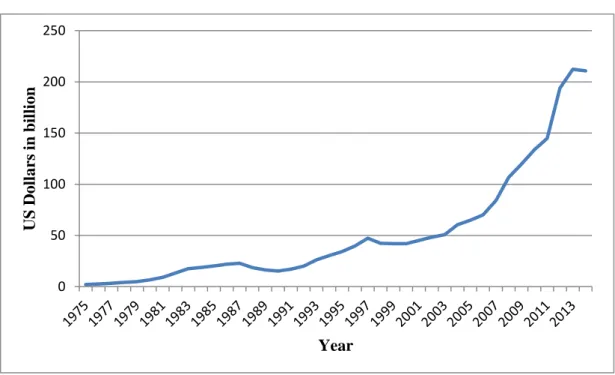
Figure 1 shows the trend of total external debt in Malaysia from the year 1975 to 2014. The figure overall shows that trend is moving up over 40 years. Based on the figure, it shows that there have 2 periods the total external debt declined which are from the year 1987 to the year 1990, and from the year 1997 to the year 2000.
Moreover, the amount of the total external debt decreased US$ 7,511 million or 32.89 percent, and US$ 5,282 million or 11.18 percent for the period from the year 1987 to the year 1990, and from the year 1997 to the year 2000 respectively. In addition, Malaysia was able to prepay some existing loans since the current account turned surplus at the year 1987, and thus reduce its outstanding long-term debt to
5
about $18.4 million at the end of the year 1988.1 Apart from that, according to Athukorala (2010), although the ringgit Malaysia depreciated because of the Asian Financial crisis 1997, but it increased Malaysia economy growth and high employment because it turned Malaysia to a greater export-orientation nation. In addition, Athukorala (2010) also added that almost 85 percent of the total debt shock in between 1998 to 2000 came from domestic borrowing.
Figure 1.1: Total External Debt in Malaysia from Year 1975 to 2014
Source: World Bank database (2016)
1.2.2 Trend of Economic Growth Rates in Malaysia
Figure 2 shows the trend of growth rate in gross domestic production (GDP) per capita from the year 1975 to 2014. Based on the figure below, it shows that the trend is fluctuated over the period. In addition, there have six times show that the
1 Adopted from Lee and David (1989).
0 50 100 150 200 250
US Dollars in billion
Year
6
Malaysia's economic growth rate become negative, which are at the year 1975, the year 1985, the year 1986, the year 1998, the year 2001 and the year 2009.
From the figure, it shows that the growth rate at the year 1975 is negative and bounce back to a positive growth rate at the next year. According to Malaysian Developmentalist (2011), Malaysia undergo a negative growth rate at the year 1975 is because of the influence of the Organization of Petroleum Exporting Countries (OPEC) oil crisis. In addition, Malaysia also experience the highest inflation of the decade with 18%2.
Besides that, there have Commodity Shocks at 1985-1986 which cause Malaysia's economic growth rate declined and become negative at the year 1985 and the year 19863. In addition, the commodity crisis cause Malaysia's overall export price index and term of trade declined by 30% and 20% respectively. Moreover, the reason that cause massive collapse of world commodity trade is because of the US high interest rate policy which also known as Volker Shock in the early 1980s.
Apart from that, according to Athukorala (2010), Malaysia economy was in recession in 1998 was because of the Asian Financial crisis. In addition, based on the trend which shown in Figure 2, the result that gained for year 1998 is the lowest economic growth rate over the past three decades which recorded with the value of negative 9.64%. However, Malaysia's economic growth rate rebounded quickly at the year 1999 from negative 9.64% to 3.63%. This is because of the policy that
2 Adopted from PBS (2002).
3 Retrieved from Athukorala (2010).
7
announced by the state which are fixed the exchange rate and capital controls (Athukorala, 2010).
Next, at the year 2001, Malaysia's economic growth also shows a negative value which is negative 1.58%. Based on Bank Negara Malaysia (2002), the reason cause Malaysia's economic growth declined is because of the global economic downturn and US economic slowdown. The global economic downturn cause the Malaysia's exports declined sharply. This is due to the Malaysia's major export products included electronics and electrical products at the early 2000s. Besides that, US is one of the major industrial countries, hence the Malaysia's economic growth declined when the US economic slowdown.
Furthermore, Malaysia's economic growth at the year 2009 has been affected by the Global Financial Crisis 20084. In addition, the trade shock is the issue the influence most on the Malaysia's economy. Moreover, the share prices in Malaysia declined sharply after the Global Financial Crisis, however the amount of declined is far less than the Asian Financial Crisis (Athukorala, 2010).
4 Retrieved from Athukorala (2010).
8
Figure 1.2: Economic Growth Rate (GDP per capita) from Year 1975 to 2014
Source: World Bank Database (2016)
1.3 Problem Statement
According to the data gained from the World Bank Database (2016), Malaysia total external debt keeping increasing from year 1975 until 2014. This issue needs to be concerned because Malaysia would become insolvent if the debt increasing without a limit. One of the countries that insolvent because of debt is Greece.
Moreover, there have several studies show that debt can have positive and/or negative influence on economic growth and some of the studies show that there has a two-sided relationship between debt and economic growth. For example, Spilioti and Vamvoukas (2015) showed that the state debt has a positive effect on economic growth for Greek but become negative once the level of debt-to-GDP exceeds 110 percent. This statement shows that the state can use the debt to promote the economic growth, however if the debt is not manage with wisely, it will harm the
-15 -10 -5 0 5 10
Percentage
Year
9
economic growth. For example, the Malaysia's debt is keep increasing since the past two decades, if the debt is not be managed with wisely, it will cause the Malaysia become insolvent.
In the other hand, there have few of factors cause the debt to increase or decrease. One of the factors is to fulfil the needs of state to finance the country and recover the economy from crisis. The Figures 1 above shows Malaysia total external debt increased during the Global Financial Crisis 2008-2009. However, during the Commodity Crisis 1985 and Asian Financial Crisis 1997-1998, the external debt shows declining trend. The reason that during the Global Financial Crisis, the external debt increase is because the state needs money to help to recover the economy. Besides that, the external debt decreased during the Commodity Crisis is because the rising tourism and exports earning5. In addition, the reason that the amount of the external debt resorted during the Asian financial crisis is because the internal debt were not enough to overcome the impact of financial crisis6.
Besides that, accumulate the funds through borrowing also important especially for developing countries for them to developing their country into a developed country. Then, the problem of managing the debt will occur because if the state manage the debt inefficiency, the country will be insolvent hence the economy of that country will be negatively influenced. This situation will occur is because if the state poorly manage the debt, the level of debt will keeping increase and thus cause the country inability to solve the debt.
5 Adopted from Lee and David (1989).
6Adopted from Zakaria, Hussin, Noordin and Sawal (2010).
10
Moreover, debt can also influence the investment rate because if the debt level is very high, the investor might worry about the ability of debt payback which will cause a decrease in investment rate. Therefore, debt also has an indirect relationship to economic growth. According to Choong, Lau, Liew and Puah (2010), large external debt leads to a negative impact on domestic investment.
Therefore, the external debt needs to be minimized or maintain at a sustainable path to avoid negatively affect the Malaysia's economic growth.
1.4 Objectives of the Study
This section discussed the objectives that need to achieve in this study. The objectives have managed into two types which are general objective and specific objective.
1.4.1 General Objective
The general objective of the study is to examine the relationship between external debt and economic growth rate in Malaysia.
11 1.4.2 Specific Objectives
i. To test the short run and long run relationship between debt and economic growth in Malaysia.
ii. To investigate the direction of causality pattern between debt and economic growth in Malaysia.
iii. To test the debt sustainability by using the Explosive Debt Dynamics equation.
1.5 Significance of the Study
The main purpose of this study is to examine whether the external debt in Malaysia is consistent with a sustainability path. The total external debt increasing in overall during the past three decades. Therefore, it is important to find out the sustainable level of debt at which it at most can handle because, from the findings of the previous studies, it show a large amount of debt which exceed the level where the state can handle, it can bring negative impact on economic growth.
Moreover, the state can set the maximum level of debt at a certain level where the turning point of having a negative effect on growth. This is the simplest way to ensure the debt can be reduced and hence easier to achieve the aim of sustainability.
Furthermore, the policy maker can make a better fiscal policy and rules easier based on the findings to set a certain period of time to eliminate the debt with the schedule.
Hence, this study would help to contribute in debt management if the policy makers