b
Design and Implementation of e-Book Authoring and Customization
u i v
by
Nurul Zawiyah binti Mohamad
Dissertation submitted in partial fulfillment of the requirements for the
Bachelor of Technology (Hons) (Information Technology)
JUNE 2005
Universiti Teknologi PETRONAS
Bandar Seri Iskandar 31750 Tronoh Perak Darul Ridzuan
UNIVERSITI TEKNOLOGI PETRONAS information Resource Center
IPB172610
CERTIFICATION OF APPROVAL
Design and Implementation of E-Book Authoring and Customization
by
Nurul Zawiyah binti Mohamad
A project dissertation submitted to the Information Technology Programme
Universiti Teknologi PETRONAS In partial fulfillment of the requirement for the
Bachelor of Technology (Hons) (Information Technology)
-fc
Approved by, ^7
-7-. Awm'CV^Wi^
?• VT JVS --"\^^;
UNIVERSITI TEKNOLOGI PETRONAS TRONOH, PERAK
JUNE 2005
(Ms Noreen Izza Arshad)
CERTIFICATION OF ORIGINALITY
This is to certify that I am responsible for the work submitted in this project, that the original work is my own except as specified in the references and acknowledgements, and that the original work contained herein have not been undertaken or done by unspecified sources or persons.
(NURUL ZAWIYAH BINTI MOHAMAD)
n
ABSTRACT
Electronic book (e-Book) is an electronic version of traditional print book that can be read by using a personal computer or an e-Book reader. Users can purchase an e-Book on diskette or CD, but the most popular method of getting an e-Book is to purchase or download the e-Book from a Web site to be read from the user's computer or reading device. The e-Book future has not been clearly seen yet, as some says that nothing can beat the original printed books but some others would say that e-Book is the future of reading. This report is a final year project involving a research and implementation of an improved version of e-Book. The research is conducted to get a better understanding on the e-Book itself, what it is and what are the advantages and disadvantages of e- Books. On the implementation side, an improved version of e-Book is developed, with the focus on the design, and functionalities and the special facilities. The implementation will also improve the way e-Book is presented. The newly improved e- Book is expected to enhance the reading of e-Book. Scope of study will cover on the e- Book, the comparison between e-Books in the internet, the programming language that is used for the development of the project; which is HTML, PHP and JavaScript, and also on the human and computer interaction to ensure the interactivity between user and the computer. This project adopted the Rapid Application Development methodology to converge early towards an acceptable and a feasible design of the project. The results of this project will cover the survey analysis on e-Books, and the improved version of e-
Book.
i n
ACKNOWLEDGEMENT
Bismillahirrahmanirrahim.
Alhamdulillah, for with His blessings I am able to complete this final year project.
First and foremost, I would like to record my profound gratitude and grateful thanks to
my final year project supervisor, Miss Noreen Izza Arshad for sharing her knowledge and experiences, for guiding me throughout the development of this project, and for providing constant feedback that has driven me to continuously improving the project.
Thanks a lot to my parents who have given me spiritual as well as moral and financial support throughout the process ofcompleting my project. Special gratitude is dedicated to the FYP Coordinator, Mr. Mohammad Noor Ibrahim, for providing the guidelines of the final year project, and keeping us all motivated in finishing the project.
I would also like to thank those who are responsible for helping me in writing this report and improving my project. To Awangku Fakrulnizam, the best that I've ever had, thanks for your love and support. Lastly to all my friends, my family and those who involved directly or indirectly in this project, thank you so much. Your help is highly
appreciated and always kept in my heart.IV
TABLE OF CONTENTS
CERTIFICATION OF APPROVAL i
CERTIFICATION OF ORIGINALITY ii
ABSTRACT iii
ACKNOWLEDGEMENT iv
TABLE OF CONTENTS v
LIST OF FIGURES vii
LIST OF TABLES vii
ABBREVIATIONS AND NOMENCLATURES viii
CHAPTER 1: INTRODUCTION 1
1.1 Background of Study 1
1.2 Problem Statement 3
1.2.1 Problem Identification 3
1.2.2 Significant of the Project 4
1.3 Objective and Scope of Study 5
1.3.1 Objectives 5
1.3.2 Scope of Study 6
1.3.3 Relevancy of the Project 6
1.3.4 Feasibility of project within
period 7
CHAPTER 2: LITERATURE REVIEW 8
2.1 What is e-Book? 8
2.2 The pros and cons of e-Book 8
2.3 E-Book Design 11
CHAPTER 3: METHODOLOGY 12
3.1 Procedure Identification 12
3.1.1 Research 12
3.1.1.1 Survey 12
3.1.2 Design Methodology 13
3.1.2.1 Planning 15
3.1.2.2 Analysis 15
3.1.2.3 Design 15
3.1.2.4 Develop and Testing 16
3.1.2.5 User Review 16
3.1.2.6 Deploy 16
3.2 Tools Required 17
3.2.1 Software 17
3.2.2 Hardware 17
CHAPTER 4: RESULTS AND DISCUSSIONS 18
4.1 Questionnaire 18
4.2 Product Analysis 23
4.2.1 E-book functions 23
4.2.2 Website functions 28
CHAPTER 5: CONCLUSION AND
RECOMMENDATION 32
5.1 Conclusion 32
5.2 Future Enhancements 32
REFERENCES 34
APPENDICES 36
APPENDIX A Source Code 37
APPENDIX B Questionnaire Sample 41
APPENDIX C Gantt Chart 43
VI
LIST OF FIGURES
Figure 3.1 Traditional Development Phases (Creative Data, 2001) Figure 3.2: Rapid Application Development (Creative Data,2001) Figure 4.1 Percentage of users that know what is an e-Book Figure 4.2 Percentage of the sources of e-Book according to users Figure 4,3 Users' preferences
Figure 4.4 Search function (searches in a single page) Figure 4.5 Search function (searches the entire e-book) Figure 4.6 Chapter search results
Figure 4.7 Hyperlinks
Figure 4.8 Bookmark function
Figure 4.9 Dictionary /Thesauri function Figure 4.10 Upload page (E-book Gallery) Figure 4.11 Download page (E-book Gallery) Figure 4.12 Creating trial e-book page
Figure 4.13 Example of layout preview Figure 4.14 Content customization
LIST OF TABLES Table 4.1 Percentage of user satisfaction while reading e-Book Table 4.2 Percentage of efficiency in having reading customization
Table 4.3 All-In-One function in e-book
v n
ABBREVIATIONS AND NOMENCLATURES
HTML - HyperText Markup Language PHP - Hypertext Preprocessor
v m
CHAPTER 1 INTRODUCTION
This chapter features the basic information of the project; consisting on its background, its problem statements, its objectives and the scope involved. This project will mainly focus on the design and implementation of e-Book authoring and
its customization.
1.1 Background of Study
Reading has become an important verb in this high technology world. Besides just as a hobby, it is the only way for us to reach all the knowledge in the world to be our knowledge. Books are the medium to convey all these knowledge to us humans.
Centuries to centuries, human enhanced the implementation of books as a reading material from carving into stones up to printing onto papers. Nowadays, with the presence of high technologies around us, books are transformed into digital format, or electronic format, and called as e-Book.
In the education field, e-Books are designed as learning tools that allow students to learn independently in an interesting and different way. Their purpose is to compliment existing classroom programs. It is also suited to enhance learning outside the classroom, and can significantly reduce the burden associated with computationally intensive course material (i.e. for engineering students).
The e-Book concept was bora when everything was made electronic. Names such as, e-mails, e-commerce, e-banking, e-shopping leads to e-Book. There is only one common reason for the implementation of the 'electronic thingy', which is for
human convenience.
For an e-Book, convenient means to have a downloadable book from the web, and can be read immediately. By convenient, we hope the e-Book is as well as pleasant to read. This factor depends on the design of the e-Book and the type of the e-Book, whether it is for education purposes, business or professional purposes, or entertainment purposes. For example, e-Books for education purposes could have colorful or artistic design, while for business or professional purposes, a professional design should be applied.
1.2 Problem Statement
1.2.1 Problem Identification
This project is about e-Books, and the implementation of them- the design and the interactivity. It is not about comparing e-Book with the real books, but focusing on problems when reading e-Books and ways to boost them. The problems faced when reading an e-Book, can be listed as the followings:
O Most of the e-Books are in PDF format (other formats are OeB, XML, .LIT), which load slowly when the size of the file is very large. Reading a PDF file format requires readers to have Adobe Acrobat to be installed in their
computer.
# E-Book interface depends on the subject itself. Educational e-Books can be colorful and pleasant to read; but some other e-Books were written in plain white pages and sometimes there are too many words chunked up in one page. This problem will make the readers hard to scan word by word on the page. Another disadvantage is readers will needto scroll down whenreading.
Aside from that, PDF format replicates book "too well" and many e-Books
features can be added.
© Specific types of format are created for specific readers only (e.g. PDF for Adobe), for specific devices and specific OS.
© The current e-Books do not have the authoring feature, which is needed for non-IT people /managers who have a lot to share with their employees yet do not have enough time.
ft The current e-Books do not really have all functionalities combined together in a single e-Book. (i.e. functions - search, bookmark, thesauri/dictionary, hyperlink)
1.2.2 Significant of the Project
These e-Books are not only for home readers, but also for business purposes, which means we need to market those e-Books. To sell our product, we need to sell the best we have and not forgetting the contents of it. Mentioning about contents, the interface is one of the important elements that are not to be left out. It is important to emphasize on the human and computer interaction factor when designing the interface. In this computer information age, everything needs to be done very quickly includingreading. People will not screen word by word for information, yet they will search for the keywords in the fastest way.
This project will improve the common e-Books features that are found in the web, especially in design and its functionalities. The project also focuses on the uniqueness that is included in the e-Book to optimize the usage of it. The elements
those are included in the e-Book:
ft Dictionary and Thesauri ft Hypertext / Hyperlink function
ft Search facility (jumps between chapters or even better jumps between searched words)
ft Careful designs of buttons and interface ft Bookmarking
Besides, this project will help new authors or non-FT people who wanted to start off creating their own e-Book using the 'Create e-Book' feature in the e-Book website.
Other features included in the website are:
ft Upload and download e-Book (sharing)
ft Color and text customization
1.3 Objectives and Scope of Study
1.3.1 Objectives
The project objectives are as follows:
ft To implement an e-Book that is improved in design, functionalities (i.e. searching, bookmarking) and integrated with added tools (i.e.
dictionary, thesauri)
ft To implement an e-Book authoring tool for users who wanted to
create their own e-Book
ft To make an e-Book look presentable and attractive that can attract
users to read them
1.3.2 Scope of Study
Evaluation and comparison between internet free or downloadable e-Books are done.
Points that concern with design and functionalities are analyzed in each e-Book samples. Users' expectations are also taken into account to implement a better e- Book according to their preferences. Besides design and functionalities, the implementation is covering the human-computer interaction factor to ensure interactivity between user and the e-Book.
Other than that, the scope of study also covered the learning of programming languages that are used in developing the project which are HTML, PHP, and JavaScript. Human and computer interaction factors are also taken into account to ensure interactivity between user and computer.
1.3.3 Relevancy of the Project
An improved e-Book will offer several benefits, especially on the promotional side on reading the e-Book. When people in this high technology world is more focused on e-Books, e-Books will have a big potential to breakthrough the online market as well as e-business, e-shopping and other method that is transformed into electronic version. As it is shared in the Internet, user will never bothered to go to store and queue to buy books that are sometimes not even available yet in the bookstore. This will provide convenience to the users or we can say here; to the frequent readers.
1.3.4 Feasibility of project within period
This project is limited and is done under a planned period. Surely, time constraints and possible limitation has been detected during the development of the project.
Somehow, the goal is to achieve the main objective, which is to implement e-Book that is improved in design and functionalities. This objective is achieved in the development of the project. Other objectives are achieved as well during the development phase. The limitations of the product have been identified and these limitations could be improved in future enhancements.
CHAPTER 2
LITERATURE REVIEW AND THEORY
2.1 What is e-Book?
From several definitions that have been crossed over on the Internet, e-Book is basically the digital [1] or an electronic version of traditionally print book that is downloadable and can be read at a personal computer or e-Book reader[l][2].
Usually e-Books are available in Adobe PDF or e-Book Reader format, or in Microsoft's LIT format [3]. E-Book are said to be versatile, portable, and convenient [4].
2.2 The pros and cons of e-Book
Everything in this world has its own pros and cons. From the sources that have been collected; e-Books are better than books in many ways. From an article that is written by James M.Bryant (M) entitled 'The paperless book', he said that:
If the electronic book is ever to rival - let atone replace - the paper form, it seems to me that they must be comparable in price and usability. The book buying public must perceive it as an improvement on the paper version. This will not be achieved by promoting entirely new features such as hypertext - valuable as these are - but by emphasizing that the 'e-book' offers a way of overcoming many of the disadvantages ofthe paper book.
These disadvantages include size, weight and environmental impact - my collection occupies nearly 80m of shelf space and weighs about 1500 kg, probably representing the wood pulp from a medium-sized tree. Moreover, most books are made of acid- pulp paper with glued spines, and have a shelf life expectancy of no more than decades, which can fall to weeks ifthey are heavily used.[6]
Reading a review by Steve Grant;
"[But] the potential advantages of ebooks are enormous. Publishers and vendors save the costs of printing, binding, warehousing, shipping, and handling retailer returns; content updates are vastly easier. Because publishing a new ebook is less expensive and thus poses lower financial risk for publishers, authors (especially beginning ones) find it easier to get new books published. In fact, authors can even self-publish; they can perhaps even make their first book available for free or at very low cost as a way to acquire a following.[8]
His point of view on the format of eBook, which is in digital format;
"Advantages for readers are manifold, too. There is greater and faster availability—
download a book from anywhere, at any time, and begin reading it immediately.
Because maintaining a file on a publisher's server costs little, ebooks need never go out of print. You can't lose or damage ebooks....
"The digital format itself offers tremendous advantages to readers: keyword searching, hyperlinked cross references, captions, tables of contents, indexes, and glossaries; changeable fonts; embedded audio...
"Advantages to libraries are also considerable: no unpacking or processing, no shelving and reshelving, no physical circulation (patrons perform self-checkout), no overdue or fine collection, no lost books or replacement of them, no repair, no shelf space required..."
Additional sources regarding e-Book advantages include:
• clicking is easier than page-turning[5]
• you can customize the viewing experience (enlarge font size and style, change orientation on device, modify screen contrast) [5]
• the potential to add multimedia (graphics, audio, video) and hyperlinks to other information, including your own reference materials[5]
• you can read in the dark[5]
• they save trees and paper and avoid pollution (caused by inks, dyes, coloring) [5]
• they require less library space, shelfreading, inventory time, weeding, repair and replacement [5]
Contrasting from the above, e-Books still have the disadvantages comparing to printed books, listed below:
• screen resolution is still much below that of print on paper[5]
• prices ofreading devices and e-Books are still too high[5]
10
2.3 E-Book Design
Based on an article written by Nadia Catenazzi, entitled "The Design and Evaluation of Electronic Books: The Hyper-Book Experience", it describes their experience in designing and evaluating e-Books. She also stated the electronic medium offers a number of facilities (e.g. ease of updating and customizing, navigation support, history mechanisms, searching and multimedia facilities). These facilities are not fully exploited by the users. In order to make electronic facilities really usable and effective, an important requirement is that information is presented as familiar and user-friendly way.[7]
From the statement above, clearly, a good design with good interactivity with the readers can produce a goode-Book. User friendly way means using the right colorto emphasize, using the appropriate icon to symbolize and placing menus on right places where users can see them. We can test the interaction between user and this electronic function by conducting an observation on users to see whether they can use the facilities without facing any problems. Besides, we would like to make sure that users would not get bored reading a plain white document on computers and straining their eyes on the screen at the same time. A mixture of text and graphics would be good for users to enjoy reading an e-Book.
Another factor that has been an important factor is that users will like it better if they can click to turn pages, instead of scrolling down towards the end. Let's say that a novel e-Book, which contains up to 200 pages in one file, can cause fatigue to the users. The best way is that to keep pages in line with the resolution of the computer or e-Book reader, and to turn the pages, users just need to click to the next page, or jumps to other chapters by clicking on a hypertext.
11
CHAPTER 3 METHODOLOGY
This chapter will describe the methodology that is used to work on the project.
Rapid Application Development was chosen for this project so that the project can finished on time toward an acceptable and feasible design to all users. Besides, it is also intended to limit this project's exposure to the forces of change. And lastly, to save development time, possibly at theexpense of economy or product quality.
3.1 Procedure Identification
3.1.1 Research
Forthis project, a time constraint factor is involved. A fast methodology is needed
that can help save a lot of time while concentrating on many areas. By using rapid application development, project can be developed iteratively, where re-design, re evaluate and re-specify whenever needed is available in the development stages.This is because the research and development need to be done in the same time. For the research part, survey on e-Book is applied.
3.1.1.1 Survey
To collect information for this project, the followings have been done:
• Reviewing articles - to extract important points of e-Books and its
functionalities
• Download free e-Book from the web - to compare between each e-Book and identifyproblems, advantages and disadvantages of the e-Book.
• Download e-Book authoring software - to see how an e-Book creator works and see what features are to be included to create a good e-Book.
12
Besides gathering all these information, questionnaire was given out to a sample of users, to see whether they know about e-Book, to see what they are expecting from e-Book, to see whether they are satisfied when reading current e-Book, and what they think of the customization of e-Book. The results are analyzed, and are considered as users' expectation on e-Book, and this information helps to develop a better e-Book, and a good e-Book authoring tool.
3.1.2 Design Methodology
Forthe design methodology, base of all software development phases are used;
which are;
Traditional Development
k
Figure 3.1 Traditional Development Phases (Creative Data, 2001)
But to have these phases in a short time of period, it is a need to consider that at some phases, say analyzing phase, the project may needs to be re-analyzed, and in the designing phase, maybe at some point, the project needs to be re-designed. The application needs to be testedeverytime after one function or several functions have been added to ensure that it is working and meet the expectation on how it works.
13
Traditional Development
Planning
Planning
Iterative Development RAD
Figure 3.2: Rapid Application Development (Creative Data, 2001)
RAD is a methodology for compressing the analysis, design, build, and test phases into a series of short, iterative development cycles [10]. An important, fundamental principle of iterative development is that each iteration delivers a functional version of the final system. It is a properly engineered, fully working portion of the final system and is not the same as a prototype. For example, the first iteration might deliver 100% of 10%, the second iteration 100% of 25% [10]. The stages involved in this methodology are, planning phase, analyzing phase, designing phase, development phase, testing phase, user review and deployment.
14
3.1.2.1 Planning
For the planning stage, brainstorming was done, listing down the task that should be done. A set of questions were written to trigger information needed for this project.
The planning phase also involved planning the design of the project, plan on how to implement the project, meaning how to start and end the project. Planning phase is very important, as this project is depending on the limited time schedule, so everything that is planned, has to be followed accordingly.
3.1.2.2 Analysis
This phase is for the research part, where materials for the project need to be collected and analyzed, to dig out useful and needed information for the project. As mentioned above, samples of e-Book and samples of e-Book authoring software has been downloaded and compared to each other, and articles and journals about e- Book have been reviewed and analyzed. The importance of this phase is that to make sure everything is analyzed because the findings are be used to develop this project. During this phase, there might be a recycle of activities, or in other words, some documents, information may need to be re-analyzed to get accurate and valid findings.
3.1.2.3 Design
This phase is the one of the most important phase in this methodology. Careful design need to be planned, to meet users' expectations, and to ensure product's interactivity. The design phase is divided into two small parts, because this project needs an implementation of improved e-Book version and another one is the implementation of an e-Book authoring tool. First round outputs such as storyboard of the design were analyzed, to find any defect, and after finding a better solution,
15
the original design can be re-designed. After some cycles of redesigning, it is tested to check any errors or bugs, until the best output is achieved.
3.1.2.4 Develop and Testing
This phase, is the critical phase, where after the initial phases are done, everything is developed one by one. This phase also will take most of the development time, and will be facing many problems while executing the application. This phase was going through a number of testing phases, to check for errors, and to find a better solution for the best output.
3.1.2.5 User Review
This phase is a phase whereby some end users were needed to run the product while being observed. The thing that is evaluated during the user review phase is the interactivity of the product, whether the product can give correct feedback to user or not. After observation is done, points that are taken during the observation were revised to improve the interactivity of the product.
3.1.2.6 Deploy
In this phase, everything that has been done from the beginning is executed. The final product is a working product, after small refinements and improvements during the development.
For both Joint Application Development (JAD) and Document Requirements, these phases have been skipped during the development of this project, because it is not applicable to the project.
16
3.2 Tools required
3.2.1 Software
• Adobe Photoshop 7.0
• Adobe Acrobat 6.0 Professional
• Macromedia Dreamweaver
• Macromedia SwishMax
3.2.2 Hardware
Personal computer
17
CHAPTER 4
RESULTS AND DISCUSSIONS
In this chapter, the findings of the questionnaire that has been given out to a sample of users will be analyzed. It will be a guideline in creating a better e-Book. In creating this e-Book, some points might need to be taken into account. The e-Book needs to be marketable, and could encourage people to read it; especially the e-Book readers. The questionnaire is given to a sample of 40 persons
4.1 Questionnaire
The questionnaire is one of the important elements during the research. It will collect all the users' opinions and expectations on current e-Books and the findings will be analyzed to aid in creating an upgraded version of e-Book.
Ql. Percentage of users that know what is an e-Book
Percentage
inn--'' y jk
80
60
40
20-
0
! y
W S B f f i M ^ "
Yes No Options
Figure 4.1 Percentage of users that know what is an e-Book
For this question, 100% of the users know what an e-Book is, and none answered
'No'.
18
02. Source of e-Books
Percentage
90 80 70 60 50 40 30
20 10 0
y y
y y y y y
Internet Diskette Options
Figure 4.2 Percentage of the sources of e-Book according to users
From the question, which asked users to select the source of their e-Books, the graph shows a very big percentage of users who selected Internet as their source of e- Books. 90% from 40 people, which is 36 people, answered for 'Internet', 10%, which is 4 people selected 'CD' and none selecting 'Diskette'.
Q3 and Q4 are about whether the users have ever purchased an e-Book online; and if they do, they need to state the differences from the free e-Book, if there is any. For these questions, 100% answered 'No', which means none of them in the sample has ever purchased an e-Book online. Most probably, they only downloaded free
versions of e-Book that are available in the Internet. If there is any difference between purchased e-Book and free e-Book, the differences cannot be predicted unless the questionnaire is given to more samples.
19
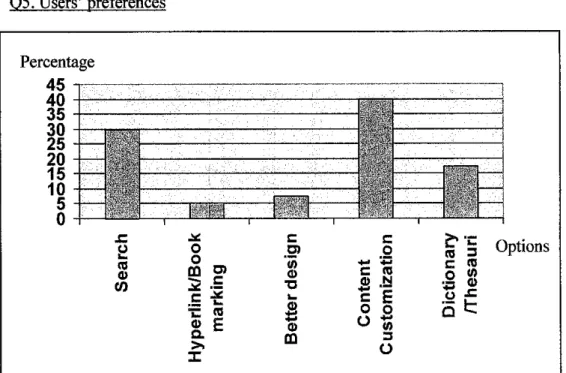
05. Users' preferences
Figure 4.3 Users' preferences
From the bar graph, 'Content Customization' is the most preferred element, with 40% of percentage. The second rank is the 'Search' function which holds the percentage value 30%, third rank is the 'Dictionary/Thesauri' function with holds 17.5% of percentage value, fourth rank is the 'Better Design' element, 7.5%, which consists of colors, button designs, and last rank is the 'Hyperlink and Bookmarking' function which holds 5% of percentage value. The calculation was based on the majority of each function, which is then converted into percentage. From the finding, it is clear that users preferred content customization because this would be interesting when they can customize the e-Book according to their own preferences.
20
06. User satisfaction when reading current e-Book
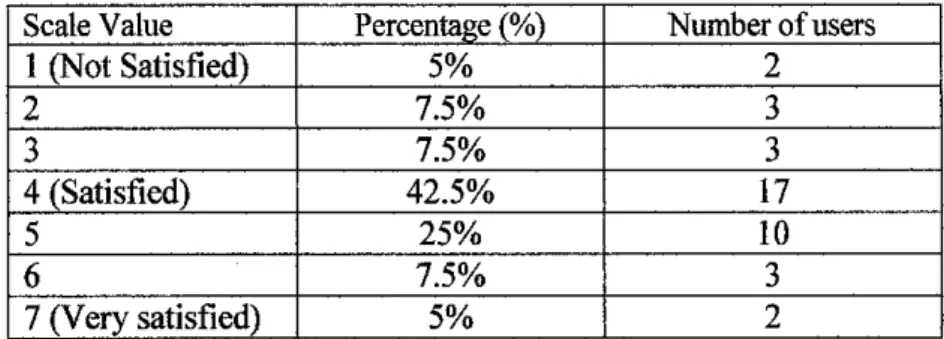
This question is in the form of interval scale, where user can select a value from the scale from 1 which means 'Not satisfied', 4 means 'Satisfied' and 7 which means 'Very Satisfied'. 42.5% the middle value, which is 4, that means 'Satisfied'. For this question they tend to select the average value because some of them are unsure of there level of satisfaction. However, in the table below will list the percentage of this
matter.
Scale Value Percentage (%) Number of users
1 (Not Satisfied) 5% 2
2 7.5% 3
3 7.5% 3
4 (Satisfied) 42.5% 17
5 25% 10
6 7.5% 3
7 (Very satisfied) 5% 2
Table 4.1 Percentage of user satisfaction while reading e-Book
21
Q7. Efficiency in having reading customization while reading e-Book
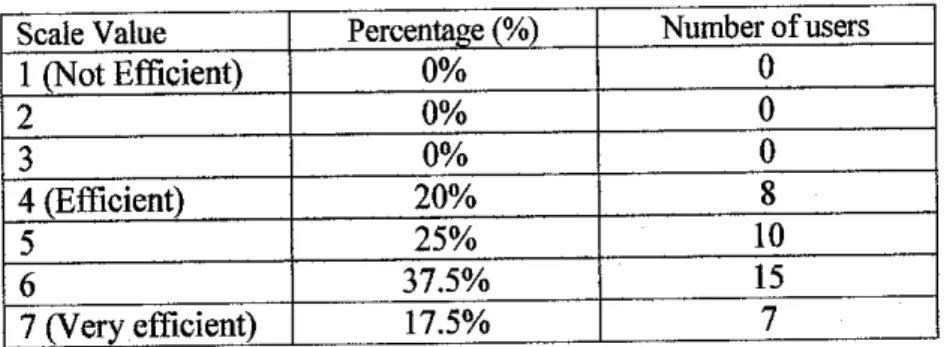
This question also is in form ofinterval scale, and the results are shown in the table
below.
Scale Value
1 (Not Efficient)
Percentage (%) 0%
Number of users 0 0%
0%
4 (Efficient) 20%
25% 10
37.5% 15
7 (Very efficient) 17.5%
Table 4.2 Percentage ofefficiency inhaving reading customization
From the table above, it is clear that users think it is efficient to have the reading customization function in thee-Book. This result will make theproject meaningful if the function is implemented in every e-Book. Itcan promote the e-Book itself, while attract many users to read the e-Book that is authored.
22
4.2 Product Analysis
4.2.1 E-book functions
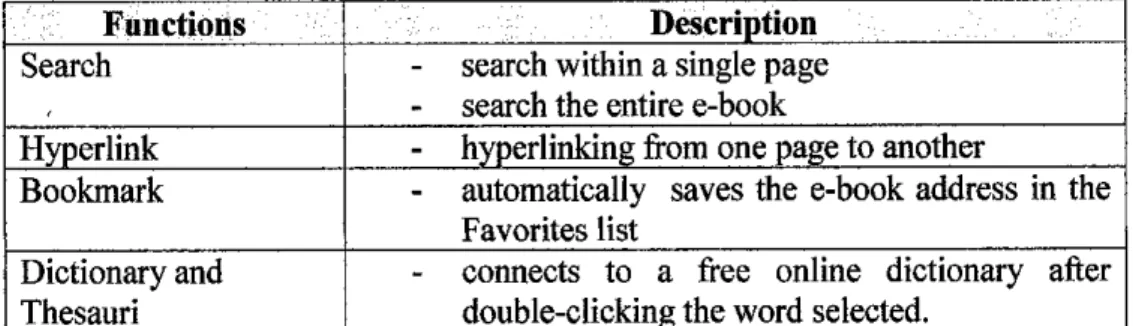
In this project, the e-books created have the 'All-In-One' function, which consists of:
Functions Description
Search - search within a single page
- search the entire e-book
Hyperlink - hyperlinking from one page to another
Bookmark - automatically saves the e-book address in the
Favorites list
Dictionary and
Thesauri
- connects to a free online dictionary after double-clicking the word selected.
Table 4.3 All-In-One function in e-book
i) Search function
f «t * r r% "* >skVT. *
4 RESPowsaiyt
Figure 4.4 Search function (searches in a single page)
23
This function is used when a user would like to search for a keyword in a single
page opened. User should enter a keyword in the text box, and click the 'Search Page' button, and it will move to the first matched word that is in the page. For example, when user insert 'supervisor' in the text box, it will highlight the first 'supervisor' word that is in the page. Itwill continue highlighting the matched word
until the user find what he or she is searching. If the word is not in the page, an alert with the message 'Phrase/word not found' will appear.
Another search function that is available in the e-book is the function where user can
search the entire e-book. It is located in thenavigation frame on the right side of the
e-book.
learcli entire**
<-
j i -
'•A -~w?t •?'-- "fi;..iii
r*fc .'sf-t*!" f'lr.^i."1 **?«. 0*4*1 Oft* tip
Figure 4.5 Search function (searches the entire e-book)
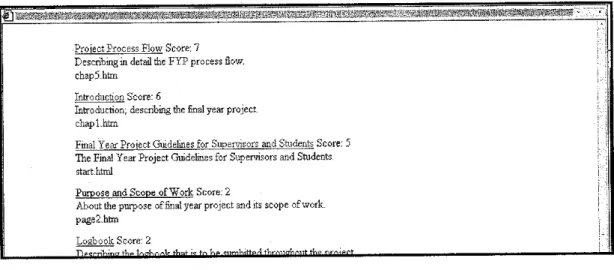
This function allows user to move from chapter to chapter if the user is not sure
which chapter to go. The user should type the word in the text field and click 'Search'. The results will appear ina new window where the main topics are listed
24
with their ranks. The most relevant topic will be on top. The search results listed
contain the chapter title, relevancy tothe searched word, a little bitdescription of the chapter, and the address ofthe chapter. User can click on the topic name to go tothe
page intended.
l i g i i ^ « i g g i ^ ^
Project Process Flow Score; 7 Describing in detailthe FYP process Bow.
chap5.htm Introduction Score: 6
Introduction; describing fee final year project.
chapl.htrn
Final Year Project Guidelines for Superiors and Students Score: 5 TheFinal YearProjectGuidelines for Supervisors andStudents
start, html
Purpose and Scope of Work Score: 2
About thepurpose offinal yearproject anditsscope ofwork.
page2.htm Logbook Score: 2
Figure 4.6 Chapter search results
ii) Hyperlink
In this e-book, the hyperlink function is used to skip from chapter to chapter. The reason that a hyperlink is being included in the e-book is to avoid too much scrolling
in the e-book. Too much scrolling throughout the content can cause eyestrain,besides causing the readers to feel bored reading the e-book. For a short e-book, scrolling may not be a big problem, but for a lengthy e-book, say 100 pages, scrolling is a big deal. In this e-book, hyperlink is available in the 'Table of
Contents' page, (see Figure 4.7)25
Figure 4.7 Hyperlinks
Hi) Bookmark
Using this function, user can automatically savethe e-book in their Favorites list, by just clickingthe link 'Click here to bookmark'. The Favorites box will appear, and it is up to the user to locate the e-book.
_.A.-j Internet Explore! will add this page to your Favorite. Iit 0K
i Make available offline ~=ncel
Name: ;ebook
Create in d Favorites
O Fyp-ebook
•|£2t kerohanian
* j£) learn Q links
|£) other
Submission of Titles and Project Synopsis
Figure 4.8 Bookmark function
Create in «
New Folder.,.
26
iv) Dictionary and Thesauri
To see the meaning or the thesaurus on certain words in the e-book, the user just need to double-click on the word, and it will automatically connects to the online free dictionary where the definition and thesaurus for the selected word are displayed. This function will be depending on the internet connection, the faster the connection, the faster the page loads.
2. PURPOSE
^sms-i
Search Pag§»
*
The purpose of the project is to develop a IramoVork, which •>
students' skillsinthe process ol applyingknowledge, expand!
solving problems independently and presenting findings throut
guidance and supervision. *
3. SCOPE OF WORK
The protect can be in the formnf laboratory experiments, comi programming, modelling, simulations, analysis and product des to explore researchftiesigwprobfems, build research/design ol approprlatejpattiodrtBa^jarialyse and/orproducethe outqsmi lirrdingsj'The areaandsc&ne ofthe projec£ slaxiM Benarrow*
the protect isIWjfSBB end clytaJie«ompleted within the alloc?
Theprojbt^work must_ejjhlMt elemento( originality, whichindl level torthefihfll yeaT^chelordegreeprogramme.
www.microstrain.cain
feasible ^ (teVbsl)
adj.
1. Capable of being accomplished or brought about; possible; a i Synonyms at possible.
2. Used or dealt with successfully; suitable: feasible new source 3. Logical; likely: e feasible explanation.
[Middle English t esable, from Old French faisable, from fairs Lalin f aoere; see dbS- in Indo-European roots.]
fe.i si-bit ily, fe.i si'bleiiess n.
fe<i sj-bly adv.
Til.: .lm"Titian Henin<yei> Pktlen.lry f.Tthe English Lan^'i J3.1. Fourth Edition c(
Updati J in 2003. Put'lichsd b\. Houghton 1>
Thesaurus
Leyend: ^Synonyms [[Related Words jAntonyms
Ailj. 'I. feosible - capable of being done with means at hand and circur :'executable, viable, workable, practicable
1possible - capable ofhappening or existing; "a breakthrough m
|"anything is possible"; "warned ofpossible consequences"
Adv. 1. feasible - in a practicable manner; so as to be feasible [j practicably
Examples from classic literature
Figure 4.9 Dictionary /Thesauri function
27
4.2.2 Website functions
4.2.2.1 Upload and Download
The website is created to host e-book sharing among users. Users can upload their e-book, and can download other e-books as well. To upload, users can go to the upload page, browse for the e-book that they wanted to share, and simply upload it.
Uploaded files will appear in the e-book gallery, where it will be available for other
users to download.
• T4-IF ^^H
^^^^
Hgajtea -' '"^WMtl
• E-BOOK HUB J|P
Thursday Q9th of June 2003 w a n e j f GBOOK J
•SAL.LCRV Jr cpmerre wour J CBOOK :• ^T
Figure 4.10 Upload page (E-book Gallery)
28
Uploaded files (rJid, ilk to i<ow,wadJ
CiKit Ai>r»to upload a new file
EBOOK EXAMPLES (did: thumbnail to cpen)
Final y<w Guidelines for SupeiYtso: ,indSiu&rits by Universiti Teknologi Petunias
Figure 4.11 Download page (E-book Gallery)
4.2.2.2 Create trial e-book
This function allows users to try creating their own e-book. They are required to fill in some fields and just typed in anything but limited to 5000 characters. They can
include images and links in the text area, by clicking the buttons provided. After
finished entering all the particulars, users should click on the Generate Source button,to generate all that has been written into HTML format. It will not be saved, unless users copied and pasted it in their own text editor and saved it in HTML format.
However, the users are able to previewtheir e-bookbefore finalizing it.
(see Figure 4.12)
29
Figure 4.12 Creating trial e-book page
30
sgrn^^Mi^seimMaTflsraa^^sw^^^rffi^^^^^^^i^^ -:.::>:
Ebook Author
Tiinl E-book
Questions? Comments?E-Mail me:
Author email address
Figure 4.13 Example of layout preview
4.2.2.3 Content Customization
Content customization feature is also provided to allow users to set their basic content colors to their own preferences. This page will have the HTML coding for the background colors, link colors and text color so that user can use them to create the trial e-book. This will give the users simplicity to choose a color without having
to search for its hexadecimal value to be written in html files.
File Edit View Favorites Toots Help
Set your preferences
!A' Background i "JText [j j Link
!."] Visited Link •""•Active Link
Background Image: [ I:. ,^9^se-
i\"iBol<l V.iitaiic
Font size: "T'1 rf;2 ;_*J 3 LIU V.~5
Figure 4.14 Content customization
31
and view the results
text color
regular link: color
visited link color active link, color
This is the HTML coding you need
B G C O L O R ^ "HFFFFFF"
B A C K G H O U H D - " "
T E X T = " H O O O O O O "
L I H K f " ttOOOOFF « V L I H K = « # 6 6 3 3 3 9 •' A L X H K = " t t F F O O B O " >
CHAPTER 5
CONCLUSION AND RECOMMENDATIONS
5.1 Conclusion
This project is designed to prove that e-Book has a big potential to boost the online market especially in the education department. The project itself is about making a better version of e-Book, which has the enhanced elements such as, own search function, hypertext in the e-Book, and aided with dictionary and thesauri.
Implementing the improved version is the major part ofthe project and is the main objective. Besides this, a website is created to provide a host to users who wanted to share their e-Book (authored by themselves) to others. They can upload and
download from the host and can read each other's e-Book. Another minor part of theproject is to create the authoring tool for users to write short e-Books or trial version
of e-Books.
During the development process, some constraints and limitations has been experienced in the project due to some problems such as the author is not very familiar with the coding language and the scope is changing after the internal exhibition. It is fully recommended that the project will be enhanced in timely manner. Things that can be done include increasing the efficiency and reliability of
the product itselfby enhancing the coding part.
5.2 Future Enhancements
Forfuture enhancements, it is recommended that a research needs to be conducted in
order to differentiate between free e-Books and purchased e-Books. The researchshould be focusing on the elements in the e-Book itself, including the design and the
32
functions. Besides, a built in dictionary can be added, to provide convenience with users who does not have internet connection while reading the e-Book. Another future enhancement that can be done is to add more fimctionalities in the create e-
Book page, for example have the HTML code to be saved automatically inside the
server and available for downloads. The bookmarking function could be improved to bookmark the current page thatthe useris reading instead of bookmarking the wholee-Book.
33
REFERENCES
1. eBook Glossary - South - Western.
Availablehttp://www.swcollege.com/ebooks/glossary.html
2. LIS 2004 Glossary of Terminology.
Availablehttp://lscc.cc.fl.us/librarv/Iis20Q4/glossary.htm
3.1st World Library. Available http://lstworldIibrarv.com/html/glossary.htm
4. Glossary of Terms - Factory 3x5.
Available http://www.factory3x5.com/more info/glossary.xml
5. (^Evolutionary (e)Book.
Availablehttp://facuitv.mckendree.edu/wliliam_harroff/ebe/
6. James M.Bryant (M) (1995). IEE REVIEW NOVEMBER. The paperless book.
Available: http://www.ieee.org/ieeex.plore
7. Nadia Catenazzi, (1995). The Design and Evaluation of Electronic Books: The Hyper-Book Experience, pi - 2. Available : http://www.ieee.org/ieeexptore
8. Grant, Steve (May/June 2002). Ebooks: Friend or Foe?.Book Report 21: 50 Academic Search Elite. EBSCO Publishing,Cabrillo College Library, Aptos,CA.
Available: http://www.ieee.org/ieeexplore
9. Free JavaScript sources. Available: http://]avascript.intemet.com
10. Creative Data, Inc. (2001). Rapid Application Development - Development Methodology (RAD). Available: http://credata.com/researcli/rad.htinl
34
11. Online Free Dictionary and Thesaurus.
Available: http://www.iln.net/main/resources/dictionary/
35
APPENDICES
36
APPENDIX A Source Code
Dictionary / Thesauri function
<SCRIPT LANGUAGE="JavaScript">
<!-- Original: Nick Simonov ([email protected]) -->
<!- web Site: http://www.iln.net->
function opennewwin(text) { if(text>"){
newwin = wtndow.open('http://www.iln.net/rnain/resources/dictionary/default.asp?Word=,+text, 'dictionary', 'width^OO, height=600, resizable=yes, menubar=no, toolbar=no, scrollbars=yes');
setTimeout('newwin.focusO', 100);
} } // End->
</script>
Search (word by word) function
<scriptlanguage-'JavaScript">
<!- Original by http://javascriptintemet.com ->
varNS4= (document.layers); // Which browser?
var IE4 = (documentall);
var win = window; // window to search.
varn =0;
function fmdlnPage(str) {
var txt, i, found;
if(str="") return false;
// Find nextoccurance of the given string onthepage, wrap around to the // start of the page if necessary.
if (NS4) {
// Look for match starting atthecurrent point. If notfound, rewind
// back to the first match.
if(!win.fmd(str))
while(win.fmd(str, false, true))
n++;
37
else n++;
// Ifnot found in either direction, give message.
if(n«0) alert("Not found.");
}
if (IE4) {
txt = win.document.body.createTextRange();
// Find the nth match from the top ofthe page.
for (i ~ 0; i <= n && (found= txt.findText(str)) != false; i++) { txt.moveStart("character", 1);
txt.moveEnd("textedit");
}
// Iffound, mark it and scroll it into view.
if (found) {
txt.moveStart("character"? -1);
txt.findText(str);
txtselectO;
txt.scrollIntoView();
n++;
}
// Otherwise,start over at the top of the page and find first match.
else{
if (n > 0) { n = 0;
findlnPage(str);
}
// Not found anywhere, give message.
else
alert("Phrase/word not found.");
) }
return false;
}
</script>
38
Search (entire e-Book) function
<SCRIPT LANGUAGE="JavaScript">
<!—Source: http://javascript.internet.com->
<!- Begin
var item = new ArcayO;
/* Here is where all the magic happens.
Justenteras manyadditional pagesthat that you wantto search, then fill in the additional listingsfor each page.
•/
// "Page Name","path","Page Title","Many,Key,Words","Descriptive Comments"
c=fl; item[c]=new Array("start.htmt","","Final Year Project Guidelines for Supervisors and Students"/front, page","The Final
YearProject Guidelines forSupervisors andStudents.");
C++; iiem[c]=new Array("page2.htm",""/Purpose and Scope ofWork","purpose,scope,work","About the purpose offinal year
projectand its scopeof work.");
C++;item[c]=new
Array("resp.hto"/"/Responsibilities","commitee,su^
theFYP Committee, Supervisor,Advisor,Panel ofExaminers andStudents");
C++; item[c]=new Array("chap5.htm",""/Project Process FIow"/process,flow,submission,approval,title,project","Describing
in detail the FYP processflow.");
C++; item[c]=new ArTay("chap6.htm\"","Wirting Fonnat","reportJoutline,writing,format"/All the documentation details,
report writing guidelines andformat");
C++; item[c]=new Array("chap7.htm",""/Logbook"/logbook,activities!activity,detair/Describing the logbook that is to be
sumbittedthroughoutthe project");
C++; item[c]^ew Array("chap8.htm'7''7'Evaluatw^
structure for the final year project. Assessment contribution from supervisor and panel ofexaminers");
c++; item[c]=newArray("chap9.htm",""/GradingScheme","grading!scheme,grade","Grading scheme for students' project.");
C++; item[c]-newArray("chapl0.htm","","Copyright","copyright,patents3findings"/Copyright ofthe final year project");
c++; item[c]=new Array("chapl .htm"/"/Introduction"/intoduction,project,semester,credit hour"/Introduction; describing the
final year project.");
page="<html><headxtitle>Search ResuIts</titlex/headxbody bgcolor='white'xcenterxtable borderO cellspacing=10
width=S0%>";
function search(frm) {
win= window.open(""," "/scrollbars");
win.document.write(page);
txt = frm.srchval.value.split("");
39
fhd = new Array(); total=0;
for (i = 0; i < item.length; i++) { fhd[i] = 0; order = new Array(0,4,2,3);
for (j = 0; j < order.length; j++) for (k = 0; k < txtlength; k++)
if(item[i][order[j]].toLowerCase().indexOf(txt[k])>-l &&txt[k] !="") fhd[i]+=(j+l);
}
for (i = 0; i < fhd.length; i++) { n = 0;w--l;
for (j = 0J < fhd.length; j++) if(fhd[j]>n){n = rhd|j];w=j;};
if (w > -1) total += show(w,win, n);
fhd[w] = 0;
}
win.document.write("</tablexbr>Total found: "+total+"<brx/bodyx/html>");
win.document.close();
}
function show(which,wind,num) { link = item[which][l] + item[which][0];
line = "<trxtdxa href^'"+Hnk+'">"+item[which][2]+"</a> Score: "+num+"<br>";
line+= item[which][4] + "<br>"+link+"</tdx/tr>";
wind-document.write(line);
return 1;
} // End->
</script>
Bookmarking function
<SCRIPT LANGUAGE="JavaScript">
<!—Source : http://javascript.intemet.com->
if ((navigator.appName — "Microsoft Internet Explorer")
&& (parselnt(navigator.appVersion) >=4))
!
varurl="HTTP://localhost/ebook/ebookl/index.html";
var title="ebook";
document.write('<AHREF="javascript:window.external.AddFavorite(url,title);"');
document.writeC<small>Click hereto Bookmark</smaIlxbrx/a>');}
else {
var msg = "<b>Bookmark me!</b>";
if(navigator.appName = "Netscape") msg +-" <b> - press(Ctrl-D) on your keyboard.<br>Mac users press Command-D</b>"
document, write(msg);
}
</script>
40
APPENDIX B
Survey questions
1. Do you know what an e-book is?
A. Yes B. No
(Proceed ifyour answer is Yes)
2. Where do you usually get your e-book?
A. Internet B. CDs C. Diskettes D. Others
3. Have youpurchased e-book online?
A. Yes B. No
C. I always download free e-books
4. Is there a difference between purchased e-book and free downloadable ebook?
If yes, statethe difference(s):
5. If an e-book isupgraded toa better e-book, what do you expect in the new e- book? Rank these options according to your preference. (1- mostpreferred,
5- leastpreferred)
No Options Rank
1 Better design (have some colors)
2 Have its own search function 3 Hypertext and Bookmarking
4 Dictionary and Thesauri
5 Reading customization
6. Are you satisfied when reading current e-books?
Not satisfied at all Satisfied
1
41
Very satisfied
7. Do you think that itis efficient to have reading customization while reading
an ebook?
Not effective Effective Very effective
42
3•/' 4V 5v' 6V 7 S 9</' 10 11 12 13V" 14-/' 15V 16^ 17• 1B 19• 20-/' 21V
1,2"Bri'efin"gontllle1dayFri01/28/05 2.ResearchBdaysFri01/28/05 2.1mtemet/journals/sourceresearch"4daysFri01/28/05 2.2IdentifyproblemsofeBooks2daysThu02/03/05 3.PreliminaryResearch5days.Mon02107706 3.1Introduction1day:Mon02/07/05 3.2Objective1dayTue02/08/05 3.3.Listofreference/LiteratureReview2daysWed02/09/05 3.4Projectplanning1dayFrl02/11/0S 4.ProjectWork-todaysMon02/07/05 4,1Listofreference/Literature2daysMon02/07/05 4.2PracticalWork/DevelopmentPhase21daysFri02/11/05 4.3WorkingonProgressReport3daysMon03/14/05 4.4ContinueProjectWork7daysFri03/18/OE 4.5Finishedapplicationdevelopment1daySun03/27/05 4.6Testingapplication4daysMon03/28/05 5.WorkingondissertationFinaldraft7daysMon03/28/05 6.Preparationonoralpresentation4daysWed04/06/05 7.FinalizedProjectDissertation&Submission7daysTue04/12/05 Project:C:\DccumentsandSettings\N Date:Mon06/20/05 Task Progress Milestone Summary
02/07p^-02/08 02/11 RolledUpTaskj-- RolledUpMilestone<^>
RolledUpProgress Split
03/14.Jm^-03/16 ExternalTasks ProjectSummary
03/27hi-,03/27 03/281...I03131 ll04'11 GroupBySummary