MELTING OF ICE FOR STEFAN PROBLEM USING FINITE DIFFERENCE METHOD
NUR SURIANI BINTI
Bachelor of Computer Science with Honours (Computational Science)
2019
NUR SURIANI BINTI HUSIN
14/08/2020
DECLARATION OF ORIGINALITY
I hereby declare that this research together with all of its content is none other than my work, with the consideration and the exception of research based information and relative materials that were adapted and extracted from other resources which have evidently been quoted or stated respectively.
Signed,
……….
NUR SURIANI BINTI HUSIN
Faculty of Computer Science and Information Technology, 12 December 2019 Universiti Malaysia Sarawak
ACKNOWLEDGEMENT
All praises to Allah the Almighty for giving me the strength and patience to complete my final year project.
I would like to express my deepest gratitude and thank you to my supervisor, Dr Nuha binti Loling Othman, lecturer in Faculty of Computer Science and Information Technology, UNIMAS, Sarawak for guide me and giving me the encouragement and motivation to complete this project.
Also, I would like to thanks to my family for the encouragement, support and assistance given to me in various forms including the financial support I needed to finish this project. Thanks also to my colleagues who also helped and shared information throughout the process of completing this project. Without the help of all of them, it would have been difficult for me to finish this project.
TABLE OF CONTENT
FORM C ...
DECLARATION OF ORIGINALITY ...
ACKNOWLEDGEMENT ...
LIST OF FIGURES ... 1
ABSTRACT ... 9
ABSTRAK ... 10
GLOSSARY VARIABLES ... 11
CHAPTER 1: INTRODUCTION ... 1.1 Overview ... 12
1.2 Problem Statement ... 13
1.3 Scope ... 13
1.4 Objective ... 14
1.5 Brief Methodology ... 14-15 1.6 Significant of project ... 15
1.7 Project Schedule ... 16
1.8 Expected Outcome ... 16
CHAPTER 2: LITERATURE REVIEW ...
2.1 Introduction ... 17 2.2 Mathematical and Numerical Model of Solidification Process of Pure Metal ... 18-20 2.3 Freezing of Porous Medium with Water Supply Coupled Stefan Problem ... 21-23
2.4An Application of Stefan’s Problem to the Freezing of the Cylindrical Food-Stuff... 24-25 2.5 Summary ... 26
CHAPTER 3: METHODOLOGY ...
3.1 Introduction ... 27 3.2 Modelling Process Methodology ... 28-31 3.2.1 Phase 1: Define Goal ... 28 3.2.2 Phase 2: Characterize Model ... 28 3.3.3 Phase 3: Model Formulation ... 29-31
CHAPTER 4: IMPLEMENTATION AND ANALYSIS ...
4.0 Introduction ... 32 4.1Finite Difference Method ... 32
4.2Implementation Process ... 33-34 4.3 Result ... 35-37
4.3 Conclusion... 38
CHAPTER 5: Conclusion and Future Work ... 5.0 Introduction ... 39
5.1 Significant of study ... 39
5.2 Limitation of Study ... 39
5.3 Improvement in future study ... 40
APPENDIX A ... 41-42 Project Schedule for Final Year Project 1 ... 41
Project Schedule for Final Year Project 2 ... 41
Source Code ... 42
REFERENCE... 43
8
LIST OF FIGURES
Figure 2.1.1 Solidification scheme (a) pure metal (b) alloys ... 18
Figure 2.2.2 Temporary state of pure metal solidification process ... 19
Figure 2.3.1 Show that freezing water satured soil ... 21
Figure 2.4.1 Schematic model ... 24
Figure 3.2.3.1 Computational domain of vertical ice layer process ... 28
Figure 4.3.1. Symbols used in the source code ... 35
Figure 4.3.2 Initialization in source code ... 35
Figure 4.3.3 The graph of phase change in ice cube 1 ... 36
Figure 4.3.3 The graph of phase change in ice cube 2 ... 37
9
ABSTRACT
Stefan Problem exists in heat and mass transfer in objects under phase changes in many physical processes such as solidification of pure metals, freezing of water, deep freezing of foodstuff this is the processes that involve in which phase changes from solid to liquid or vapor states.
The object is assumed to undergo a phase change with a moving boundary that has to be tracked as part of the solution. Various numerical methods used for Stefan Problem. We will use Finite Difference Method to solve of Stefan Problem.
10
ABSTRAK
Masalah Stefan terlibat dalam pemindahan haba dan jisim dalam objek yang menjalani perubahan fasa dalam banyak proses fizikal seperti pemejalan logam tulen, pembekuan air, pembekuan dalam barangan makanan dan sebagainya seperti proses yang digunakan di mana fasa perubahan dari keadaan pepejal, cecair atau wap. Objek ini dianggap telah menjalani perubahan fasa dengan sempadan yang bergerak yang perlu dijejak sebagai sebahagian daripada penyelesaian. Pelbagai kaedah berangka yang digunakan untuk masalah Stefan.
Kami akan menggunakan kaedah perbezaan terhingga untuk menyelesaikan masalah Stefan
11
Glossary 𝑢 = 𝑇𝑒𝑚𝑝𝑒𝑟𝑎𝑡𝑢𝑟𝑒
𝑓 = 𝑓𝑙𝑢𝑥 𝑑𝑒𝑛𝑠𝑖𝑡𝑦
𝑘 = 𝑡ℎ𝑒𝑟𝑚𝑎𝑙 𝑐𝑜𝑛𝑑𝑢𝑐𝑡𝑖𝑣𝑖𝑡𝑦 𝛺 = 𝑑𝑜𝑚𝑎𝑖𝑛
𝑡 = 𝑡𝑖𝑚𝑒
𝜑 = 𝑇𝑟𝑖𝑎𝑙 𝑓𝑢𝑛𝑐𝑡𝑖𝑜𝑛
12
CHAPTER 1: INTRODUCTION
1.1 Overview
Stefan Problem is one of the classical initial boundary value problem in parabolic partial differential equations. It is the simplest mathematical model of phenomenon of change of phase such as heat distribution phase. Usually, this phenomenon arises in a process where solidification of pure metals, freezing water, deep freezing of food and many more where the process will involve phase change of either solid to liquid or to vapor states or either way, depends with process that we want (Jonnsson & Tobias, 2013). The process will involve a portion of domain boundary that is priori unknown (free boundary).
Then, we have:
𝑑𝑢
𝑑𝑡+ 𝑘. ∇𝑢 = 𝑓 (1.1)
Let 𝑢 is temperature, 𝑓 being the flux density and 𝑘 is a physical parameter. During heat distribution process, assume that the change of a total quantity should be equal to the net flux through the boundary Ω.
In this FYP, we will study and focus on solving the Stefan problem of ice melting phase using finite difference method with periodic boundary condition.
13
1.2 Problem Statement
There are three phase changes of water where the first phase as a liquid where we can find in lake, rivers, oceans etc (Kurschner, Maki-Marttunen, Vestergaard, & Wandl, 2008). The second phase is a solid for example, snow and ice while for the third phase is in mushy.
Physically, the process of ice melting can be explained in with an example; slab of ice is being heated on one side and it will start to melt in water or liquid.
In the process of melting, it is difficult to know the exact location of the phase change of ice on its interface. Therefore, we need to define where the phase change started. This is what we called the moving boundary problem and all of this process is fall under Stefan problem.
1.3 Scope
This scope of study is to model a melting ice phase change under Stefan problem and solving it numerically using finite difference method.
14
1.4 Objective
1. The main objective of this research is to model phase change of ice melting based on Stefan problem,
Other objectives include:
i. To simulate the model by using MATLAB software.
ii. Solving the model numerically using finite difference model.
1.5 Brief Methodology
1.5.1 Define goals and objective
The goal of the problem will be the same as the objectives for this project. As, for this case we would like to study and understand more the melting process in Stefan Problem using finite difference method.
1.5.2 Characterize the model
To understand the term and variable and generate the equation used in modelling the diffusion equation in melting of ice.
15 1.5.3 Define rules for the model
In this research we will formulate and solving the Mathematical Formulation in Partial Differential Equation, Matlab, and Numerical Method
1.5.4 Solve and simulate the model
We will solve the model numerically using finite difference model and use Matlab to do the simulation.
1.5.5 Analyse the model
The results of the simulation will be analysed once the model is being simulated. Using this result we will see whether the model has been correctly stimulate.
1.6 Significant of Project
Based on the outcome we should be able to understand the process of ice melting and we should be able to simulate our problem and analyze the result based on our model.
16
1.7 Project schedule
Show in appendix
1.8 Expected Outcome
Based on the outcome of this project, are we able to model Stefan problem for melting of ice. Solved diffusion equation numerically using finite difference method and analyse the simulation result.
17
Chapter 2: Literature Review 2.1 Introduction
Mathematical modeling is the process of transforming problems from an application into traceable mathematical formulas, the conceptual and numerical analysis of which provid es useful insight, answers and guidance for the original application.
The integral heat-balance method is applied to analyze in Cartesian and spherical coordinates for one-region and two-region inverse Stefan problems. The distribution of temperature, the position and velocity of the moving boundary are evaluated. The size of the domain and the oscillation amplitude of the periodically oscillating surface temperature are shown to have a strong influence on the temperature distribution and the boundary motion for the given oscillation frequency. In addition, there is good agreement between the present finite difference results and the numerical results previously obtained using the integral nodal approach.
18
2.2 Work A: Mathematical and Numerical Model of Solidification Process of Pure Metals
The solidification process of pure metal in the two-dimensional domain is considered.
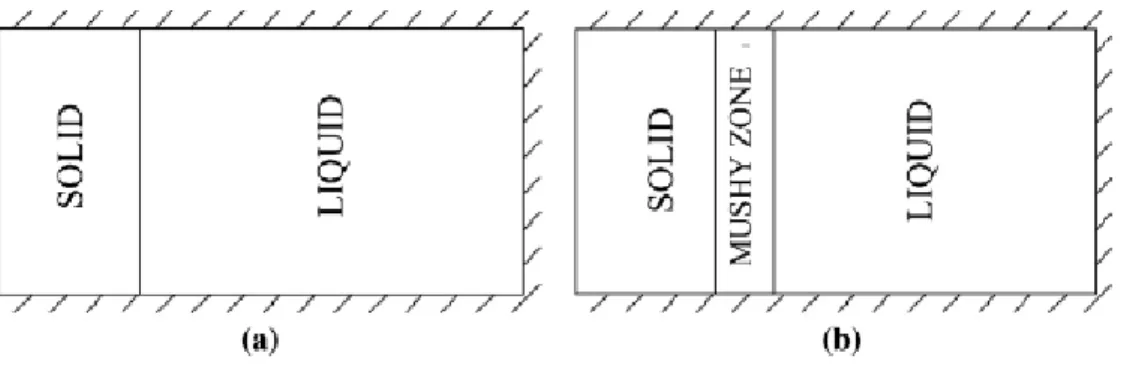
The convective motion of the liquid is neglected. The front stays flat all the time during the directional solidification of pure metals. The absence of impurities is the reason for simplifying the solidification process, which in this case could only happen under the control of lowering the temperature below a certain threshold value called the temperature of equilibrium. The difference in temperature gradients on the interface’s solid and liquid side determines the front speed.
Fig 2.2.1 solidification scheme (a) pure metal (b) alloys
Fig. 2.2.1 shows the solidification process schematically for pure metals and alloys.
The methods described in the literature for front tracking method can be divided into two groups:
19
Method based on modification approximation function infinite elements cut by the solidification front. Finite elements is not depending on the time in this context. Each category belongs to the model presented. This method focused on mesh modification where it is suit with the changing positions of the mesh.
Fuzzy front-based method. At a constant temperature, solidification substituted by the process at narrow temperature range, as in the case of alloys.
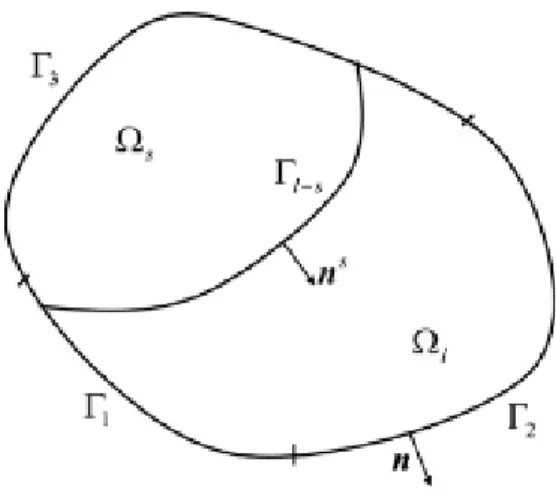
Fig 2.2.2 Temporary state of pure metal solidification process
20
The temporary state of the process within solidifying area is shown in Fig. 2.2.2 Sub areas filled with liquid Ω𝑙 and solid Ω𝑠 are separated by a sharp, moving boundary 𝑇𝑙−𝑠 .The energy is transferred in the direction of Ω𝑠 during the solidification, where the solid phase develops. The growth of the solid phase is changing 𝑇𝑙−𝑠 position. The mathematical description of these phenomena requires the introduction of the equation of heat conduction and the equation of motion front (Skrzypczak & Weegrzyn-Skrzypczak, 2012). At the solidification interface, the mathematical model is supplemented with appropriate initial and boundary conditions as well as the continuity conditions.
The region under consideration is subject to spatial discretization by dividing it into a set of simple primitive geometry such as triangles or quadrangles. All this figure called as finite element. They create the mesh that approximates the area's shape. The accuracy of approximation increases with the number of elements. At the vertices of the elements are measured values of quantities such as temperature. These discrete points are often referred to as nodes.
The described mathematical and numerical model of the pure metal solidification process allows the continuity conditions to be correctly taken into account on the sharp solidification front. A useful tool for solving the problems with moving internal boundaries is the presented front tracking technique based on the level set method.
21
2.3 Work B: Freezing of Porous Medium with Water Supply Coupled Stefan Problem
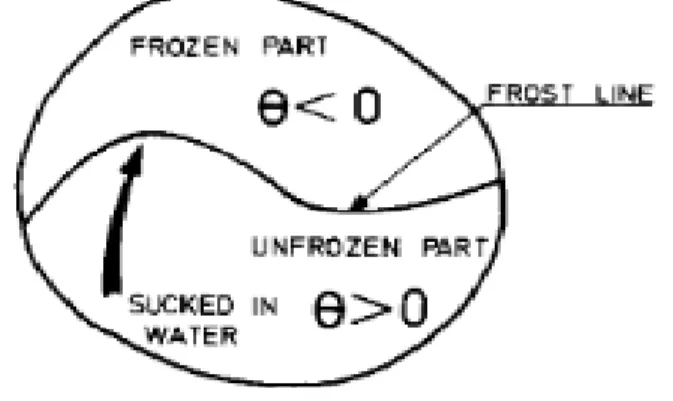
Consider a wet porous medium, such as a water-saturated soil that becomes artificially or naturally freezing. The 0℃ isotherm called the frost line divides the frozen and unfrozen zones (Fig. 2.3.1), which is a time-dependent free surface.
On the frost line, phenomena linked to capillarity induce a depression: the cryogenic suction (Malhotra & subramanian, 1994). It causes the movement of water toward the frost line.
The absorbed water freezes on the frost line and heats the soil up to a few decimetres. The measured frost heaves are larger than those resulting from the water density variation in the order of magnitude. During the thaw, the melted water causes a significant reduction in the soil's bearing capacity. This phenomenon is of some scientific importance, for example artificial soil freezing for civil engineering, construction of gas pipes and road construction and maintenance.
Fig 2.3.1 show that a freezing water saturated soil.
22
They assume there are three stages in the porous medium: the frozen water, the unfrozen water, and the skeleton. Following the classical theory of porous media, they define the average values of temperature 𝜃, liquid water content, water head, etc. at each point 𝑥 of the Ω domain occupied by the porous medium. They assume the heat exchanges are instantaneous between the various phases, water, ice and skeleton. Then, all these phases at the same temperature. The mechanical effects (stresses) are neglected. Therefore, assuming that porosity constant, 𝐸 is natural.
The heat is transported by conduction, diffusion of water, and convection of skeleton in the porous medium. We assume that in decreasing order of magnitude the different types of heat transport are listed.We consider the first of those transport terms, which are not zero in the energy conservation equation. On the frost line, both terms of conduction and diffusion are considered.
The diffused water's latent heat through the porous medium is important. One of the main aspects of soil freezing is this heat transported by water diffusion. As mentioned earlier, frost heave is mainly caused by cryogenic suction; the difference in density between ice and water is ignored.
The basic equations are the energy and mass conservation laws, the constitutive laws. We use water mass conservation (frozen and unfrozen), skeleton mass conservation, water conservation (frozen and unfrozen) and skeleton energy conservation.
𝑑
𝑑𝑡∫ 𝜀𝜌𝑤𝜇𝑑𝜑 + 𝑑
𝑑𝑡∫ 𝜀𝜌𝜑 𝑤(1 − 𝜇)𝑑𝜑 = 0
𝜑 , ∀𝜑 (2.3.1)
where
𝜌𝑤= volume mass of water 𝜇 = mass of content
23 𝑡= time
𝑑
𝑑𝑡 = material derivate
At the 0°𝐶 temperature, there are one which has non-zero density, which mixtures of water and ice in those regions.We emphasize the clouds or mushy regions, on regions where water and ice coexist at the phase change temperature 0°C. The cloud's physical state is determined by the mass of water content 𝑝, (0 < 𝑝 < 1); if 𝑝 = 0 is air if 𝑝 = 1 is water, and if 0 < 𝑝 < 1 is a mixture of water and ice.
The domain Ω is divided into three parts at any time t of the time interval [ 0, 𝑇], (𝑇 <
+ ∞) of the phenomenon we consider: Ω1(t), the unfrozen part where the temperature 𝜃 is strictly positive, Ω2 (t), the frozen part where the temperature is strictly negative, Ω3 (t), the cloud where the temperature is zero. The lines of frost divide the three parts (Komori & Hirai, 1991).