Mobile Order Tracking System
By
Mohammad Arifiriazul Bin Paijo
First Draft submitted in partial fulfillment of the requirements for the
Bachelor of Technology (Hons) (Business Information System)
JUNE 22,2006
Universiti Teknologi PETRONAS
Bandar Seri Iskandar 31750 Tronoh
Perak Darul Ridzuan
Approved by,
CERTIFICATION OF APPROVAL
Mobile Order Tracking System
by
Mohammad Arifiriazul Bin Paijo
Final Draft (Supervisor & External Examiner) submitted in partial fulfillment of
the requirements for the Bachelor of Technology (Hons)
(Business Information System)
MAY 2006
(Mr. Mohd Noor Ibrahim)
Universiti Teknologi PETRONAS
Bandar Seri Iskandar 31750 Tronoh Perak Darul Ridzuan
CERTIFICATION OF ORIGINALITY
This is to certify that I am responsible for the work submitted in this project, that the original work is my own except as specified in the references and acknowledgements, and that the original work contained herein have not been undertaken or done by unspecified sources or persons.
(MOHAMMAD ARIFIRIAZUL BIN PAIJO)
UNIVERSITI TEKNOLOGI PETRONAS
Certification of FYP Final Draft Submission
Hereby I, Mohammad Arifiriazul Bin Paijo (3486), certify that I am responsible for the work submitted in this project, and I have done all the modifications according to my supervisor's advice.
Thank you.
Submit by Student Verify by Supervisor Signature
Name Mohammad Arifiriazul Bin Paijo Mr. Mohammad Noor Ibrahim Student ID 3486
Date 17*May2006
ABSTRACT
The objective of the "Mobile Order Tracking System" is to build a restaurant or cafe ordering and sales tracking system prototype to improve the business process. One of the
main problems of food ordering the problem with the restaurant business operation is the phases that need to be covered before the food can beprepared, thephases that need to be
covered before the food can be delivered, and the phases that need to be covered beforethe transaction bill can be prepared. Prompt and fast service to customers is very important to increase the revenue of the business. With the system, all the integrated components in the business process can be done easily. The existing of this system will also improve the existing system that performs the same function which is the "Wireless
Mobile Application for F&B Ordering System" with additional feature and improvement on the system framework. The important feature that has been added to the existing system is the sales tracking and analysis. In the future it is optimistically that this system will assist the flow of the business and could assist the corporate level to conduct the sales analysis as well as the sales projection. An addition to that the system is equipped with wireless technology and also still maintaining the ordinary wired technology. It is to show the capabilities and benefits of wireless technology that are available to smaller scale business operation particularly food and beverages industry without costing huge investment and possibility ofallowing high ROI (return ofinvestment).
Keywords: mobile application, Customer Relationship Management, m-commerce, e-
commerce.
ACKNOWLEDGEMENT
For the past one year of hard work, this project is the most challenging work that the author has done before and has give good experiences to the author. Thus, the author would like to take this opportunity to express his sincere gratitude to the following persons, who have contributed to this project directly or indirectly by offering tremendous help and support while facing all sorts of challenges and difficulties.
First of all, the author would like to thank ALLAH S.W.T. for giving the author strength and opportunities to do this project. A part from that the author would like to thank his family, for their continuous support and encouragement. Without their spiritual and moral support, no doubt the project would not be so successful.
Not forgetting Mrs. Michelle Beh Hoi Ching and Mr. Mohammad Noor Ibrahim, who acts as project supervisor, for his guidance and advice for the whole duration of the project especially in the aspect of the system designing and development. Beside that all the experiences shred by the author's supervisors have assist the author to complete this project.
Lastly, the author would also like to thank Mr Helmi Hassan and Mr Izuddin for their effort in providing valuable assistance and everyone else who have provided useful comments and inspiration to help the author complete the system successfully. Having to know each and every one of them personally, the author can feel the kindness of them for giving me numerous chances to learn from mistakes.
TABLE OF CONTENTS
ABSTRACT
ACKNOWLEDGEMENT
CHAPTER 1:
CHAPTER 2:
CHAPTER 3:
CHAPTER 4:
CHAPTER 5:
REFERENCES APPENDICES
INTRODUCTION . . . .
1.1 Background of study .
1.2 Problem statement
1.3 Objectives and scope of study.
LITERATURE REVIEW AND THEORY METHODOLOGY/PROJECT WORK . 3.1 Methodology
3.2 Tools
3.3 Sales Tracking and Analysis .
RESULTS AND DISCUSSION .
4.1 Findings. . . . .
4.2 Discussion . . . .
CONCLUSION AND RECOMMENDATION
5.1 Conclusion . . . .
5.2 Recommendation
11
24 24 33 36
38 38 55 58 58 59 62 65
LIST OF FIGURES
Figure 1.1 : The workflow for restaurant business operation.
Figure 2.1 : Statistic on tourist arrival to Malaysia in the year 2004
Figure 2.2 : A McDonald's waitress taking an order from their customer using mobile technology
Figure 2.3 : Mobile Works Architecture
Figure 2.4 : The mobile .NET framework system architecture implemented by Virtigo
Figure 3.1 : Software Process using Waterfall model.
Figure 3.2 : The architecture for Mobile Order Tracking System
Figure 3.3 : WAP Proxy Framework for Mobile Order Tracking System Figure 3.4 : Mobile Order Tracking Systemprocess workflow
Figure 3.5 : UML Use Case Diagram ofthe System Figure 4.1 : Login page for Mobile Order Sub-System
Figure 4.2 : The navigation page of the mobile system which will help user to access to the system
Figure 4.3 : The food menu listing that being offered to the client of the business Figure 4.4 : The description of particular menu offered by cafe.
Figure 4.5 : The itemdescription and the desired quantity required.
Figure 4.6 : The option page either completing or making other transaction.
Figure4.7 : The confirmation page of the transaction/order made by the client (Shopping cart)
Figure 4.9 : Login page for user verification
Figure 4.10 : Welcoming page for the One World Cafe" which also the navigation page.
Figure 4.11 : Menu list and order taking page.
Figure 4.9 : Login page for user verification
Figure 4.10 : Welcoming pagefor the One World Cafe" whichalso the navigation page.
Figure 4.11 : Menu list and order taking page.
Figure4.12 : User profile management for the client side.
Figure 4.13 : Page for adding and updating the menu selection for the cafe"
Figure 4.14 : Page for adding user/client profile.
Figure 4.15 : Page for updating and mamtaining the user prepaid account.
Figure 4.16 : Sales Report navigation toolbar
Figure 4.17 : Total sales report that the business operator manage to achieve
Figure 4.18 : The total sales analysis and tracking based on the transaction date using a
line chart
Figure 4.19 : Items sold report for dessert category Figure 4.20 : Items sold report for beverage category Figure4.21 : Items sold report for the food category
Figure 4.22 : The items sold projection through chart categorized by the product
category
LIST OF TABLE
Table 2.1 : Wireless Connectivity Technologies. Adapted from IEEE International Workshop on Wireless and Mobile Technologies in EducationMaul
Morales Salcedo. Universidad de las Americas.
Table 3.1 : The table consist the user information.
Table 3.2 ; The table consist the menu information.
Table 3.3 : The table consist the credit value for user.
Table 3.4 : The table consist the sales history
CHAPTER 1 INTRODUCTION
1.1 Project background
CRM is one of very important element in a business organization. CRM is strengthening with three main components. The components have been stated earlier. Two of the three components are sales tracking and transaction support. In a business organization those two components are most critical components to manage in order to have a better return [!]•
Sales tracking is important for the business organization for business forecasting. The
business organization should have a good tracking system and process in order to make sure that allthedata are relevance. This will lead to a batter business analysis.
Transaction support is important for the business organization to conduct the transaction made by both customer and seller. An efficient transaction process can derive to a batter return earning to the business.
Based on the justification above, in order to operate the business effectively and in order
to have a batter return earning to the business organization, both element should be handled very well.As for specific industry, the food selling industry such as restaurant and cafe" those two components are crucial element that should be taken care. Customer service includes the transaction processes and involves the transaction support. Beside that, the business forecasting is also important in order to mobile the business a step forward in the future.
This will involve a good business tracking and analysis on the business operation. The potential products and services need more attention compare to other products and services. That is why CRM is so important in order to mobile any business organization
forward, especially the business which relate directly with customers like the food industry.
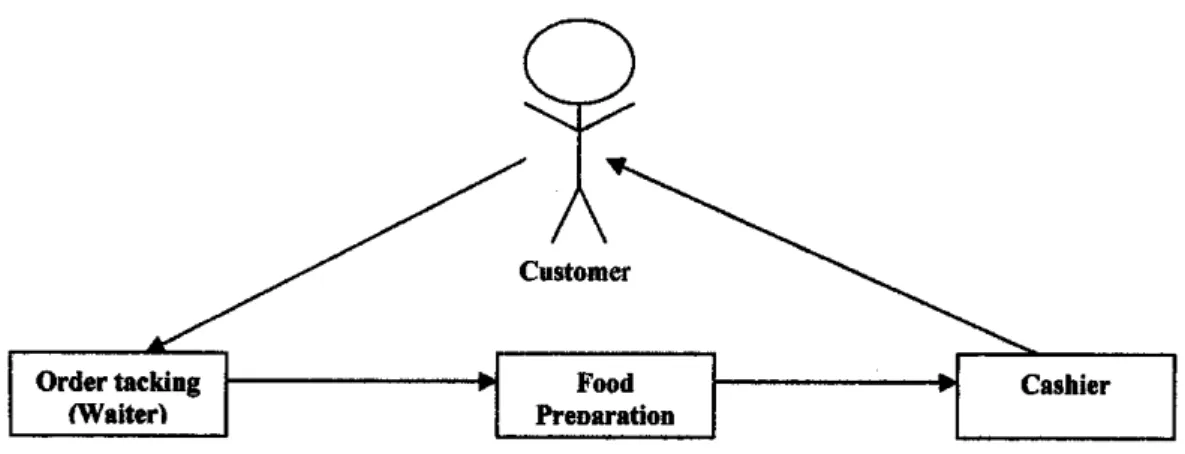
In order to cater those elements for the industry, themost practical way is to improve the business operation itself. This means all components in the business operation should be improved. This includes from the order tacking process, food preparation process, payment process, and sale management and analysis. This required all processes need to
be integrated and centralized.
With those reasons, a Mobile Ordering Tracking System need be implemented. The system need to be mobile in order to ease the waiter/waitress. Information captured from the mobile order tacking will be transmitted to the server and all other components in the operating area will retrieve the same data without having any manual data transmission.
The study is initiated in order to develop amobile commerce application by exploring the fundamental ofwireless application design block. While wireless technologies are readily
available and employed at certain industry, there is still lack ofinnovation in the services
industry particularly food and beverage business. Thus the ultimate goal of this study is to make wireless mobile application for food and beverage ordering system areality [16].
1.2 Problem statement
As stated earlier, the food industry relies on the customer relationship management. Ifthe service that being delivered by the restaurant is poor, then the business will eventually
fail. The problem with the restaurant business operation is the phases that need to be covered before the food can be prepared, the phases that need to be covered before the food can be delivered, and the phases that need to be covered before the transaction bill can be prepared. Those phases could be abarrier for the business organization to perform
well in theirbusiness operation.
1.2.1 Problem Identification
This problem actually happened because each order or transaction will require several
phases to be done; order taking phase, food preparation phase and payment phase. This
will actually reduce the pace of work from each section in the business operation. When the pace of work has been reduced the duration time in order to have the meal prepared will also increase. The common sections that involve are order taking section, food preparation section, and cashier section. Those three sections will rely on each other in order to make sure the completion of each transaction. In the real world, the integration between those three sections can not be fully coordinated. This has been reducing the
efficiency of the business operation which affected the business organization image.
The uncoordinated integration between those three sections often happened during the peak hour for the business operations. During the peak hour, the numbers of customer will be high. In order to process all orders, will be kind of problematic to manage all
order with high traffic of transaction.
1.2.2 Significance of the Project
The problem that has been raised is significant with the luxurious restaurant and cafe.
Although other level ofrestaurant and cafe" deal with the same problem and issue, but the
effectto it business operation is minor.
That is why this industry required a good system to manage all transactions and business
operations. A mobile system that can control the in-flow and out-flow of each order and
transaction is also become necessary for the industry. The sales tracking component also
need to be emphasized in order to build up an efficient system to mange the business
operation. The sales analysis has become a vital element for the business forecasting. To
integrate the transaction process and the sales tracking is the best idea to make sure the
business operation canperform very well.Customer
Order tacking
(Waiter)
Food Preoaration
Cashier
Figure 1.1: The workflow for restaurant business operation.
1.3 Objectives
As for this research, the author has defined two main objectives. The objectives are derived from the problem statement and the components ofCRM that are Tracking Sales
and Transaction Support.
0 To improve sales tracking for better business analysis.
As stated, business analysis is one of the crucial parts in a business. In order to produce the best business analysis, the sales tracking should be well defined and structured. That is why, the sales tracking should be formed as an integrated system
together with the transaction components.
The sub-objectives inorder to accomplish the first main objective are;
o To find bestsolution for sales tracking.
o To find best method for businessanalysis.
0 To improve business operation transaction flow.
As being practiced, the business operation is conducted manually. In a manual
system, if there is any process problem at any sections in the transaction flows thewhole transaction process will have problem. In order to reduce the possibility ofthe problem, thewhole transaction sections should be integrated and centralized.
The sub-objectives in order to accomplish the second main objective are;
o To analyze the real case study on restaurant operation.
o To develop a Mobile Order Tracking System that consists of several
modules and feature.
• Develop a take order system
• Develop a sales analysis system
Based on existing system, the mobile system only focus on the implementation
through the Personal Digital Assistant (PDA). The author has broad the project
focus not only focus on the implementation through PDA but also focus on thenormal web based services. This will expand the scope of user that may use this
system andwill eventually increase the sales andperformance ofthe business.1.4 Scope of study
The scope of this project is to build an F&B ordering submission and which also consist
of the sales analysis and tracking function. Recently there is such application or system
that can perform a service to the user to get the order mobile. In order to enhance the functionality of the existing system, the author has included several more features. This has lead to the expanding ofthe scope f study that not only focus on the order submission but also several other aspects. Among the aspects are;
0 Research on the fast and effective mobile system for restaurant operation.
The research will bemore focus onthebest mobile devices. This research will also focus onthe system framework for mobile system.
0 Study onthe best sales tracking system.
As part of the CRM, the sale tracking will be also being part of the research. The research will be more focus on the effective way to track the sales and also the
efficient wayto conduct sales analysis for the business.0 Userfriendly system.
The systems that being develop will have the most user friendly features where by
the first focus will b the most easy to use platform for the system. Among the
focus platform are the PDA and the ordinary web based system.
Apart from that, the focus is also on the benefits and challenges of implementing wireless solution for food and beverages industry. All the findings from the study will be further elaborated in the report and a prototype system will be developed to support the findings.
CHAPTER 2
LITERATURE REVIEW AND THEORY
2.1 Customer Relationship Management
First of all, it must be understood that at its core, Customer Relationship Management (CRM) is more than just a set of technologies: it is a process. This fact will be of significant importance to Information Technology (IT) professionals who will be asked to support CRM with information and applications. Furthermore, it is intended to be a
repeatable process to ensure ongoing, continually improving, and consistent results.
Simply stated, CRM comprises the acquisition and deployment of knowledge about customers to enable an airline to sell more oftheir product and service more efficiently
m.
CRM focuses on providing and maintaining quality service for customer, by effectively
communicating and delivering product, services, information and solution to address
customer problem, wants, and needs.
Component of CRM are call handling, sales tracking, and transaction support. Call
handling is to maintain outbound and inbound calls from customer and service representative. Sales tracking is to track and record all sales made by the business.
Transaction support is where technology and people used to conduct business transaction.
CRM has evolved since its earliest incarnation, originally driven by an inside-out focus, through three phases ofevolution: technology, integration and process. Recently have we
seen a major leap forward to a fourth phase: customer-driven CRM - an outside-in approach that has intriguing financial promise.
Customer Relationship Management (CRM), sometimes it is called customer
management, customer value management, customer centricity, and customer-centric
management [5], The deeper the relationship the business organization holds with these
customers, the more opportunities there will be for selling additional products and
services. The need to attract, acquire, leverage, and retain customers is still of primary
concern to most businesses.
2.2 Technology Involve in CRM
There are several technologies being implemented in CRM. For example in e-CRM that being implemented in airline industry is Airline e-CRM System Model. Airline e-CRM model can be conceptualized as a system that is made up of components, linkages amongst the components, and dynamics-that takes advantage of the properties of the
Internet to make money. It takes advantage of the properties of the Internet in the way it builds each of the components-value, scope, revenue sources, pricing, connected activities, implementation, capabilities and sustainability-and crafts the linkages among
these components. It is what, preferably, enables an airline to have a sustainable
competitive advantage. It includes three components (subsystem): Web Based Airline- Passenger Interaction subsystem; Airline Data Warehouse subsystem; and Airline e-CRM operation subsystem. Airline e-CRM model is an asset-based solution that includes best-
of-breed components to build an e-CRM infrastructure and enable any-channel, any-time
communication withcustomers [3].
In the IT industry today, the mobile technology and CRM has been integrated. The Mobile Reply mobile CRM is the example of the mobile technology which integrated with CRM. The Mobile Reply mobile CRM direct marketing platform offers retailers to benefit from its web based service (no need for any setup investments), supporting awide range of SMS communication scenarios, and a strong emphasize on segmentation and
analysis of the shoppers population [6].
2.3 E-commerce for CRM
Several findings that have been made, in order to increase the business revenue the
business operation should be increased. In "e-commerce e-business for Managers", a
business organization should offer convenience, personalization and excellent service
plays role in the success and differentiation ofmany other business [1]. Revenue growth
through customer acquisition and retention remains a major requirement for competing
successfully. Several studies document that the average company loses half its customers every 5 years and that it costs five to ten times as much to obtain a new customer as to keep an existing one [2].
2.4 Relationship between Malaysia Economy and Tourism
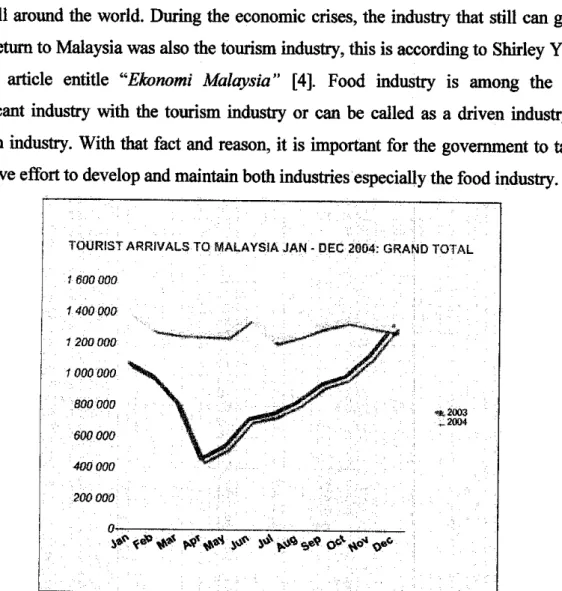
Currently tourism industry is one of the key industries for economic earning generator in Malaysia. As been stated by Ministry of Tourism more than 20% of Malaysia earning comes from tourism industry. For the year 2004 Malaysiahas received 15 million visitors
from all around the world. During the economic crises, the industry that still can give a good return to Malaysia was also the tourism industry, this is according to Shirley Yoong in her article entitle "Ekonomi Malaysia" [4]. Food industry is among the most significant industry with the tourism industry or can be called as a driven industry for tourism industry. With that fact and reason, it is important for the government to take a proactive effort todevelop and maintain both industries especially the food industry.
TOURISTARRIVALS TO MALAYSIA JAN - DEC 2G04: GRANDTOTAL
1600000
1 400 000
1200000
1000 000
800 000
600 000
400 000
200 000
<*,2003
0'
&**&** f»V*s & a^tsift«# o*^^
Figure 2.1: Statistic ontourist arrival to Malaysia in the year 2004
If further discussion is being made, the food industry has several driven force in order to
support other industry. Among the strong factors that can affect the performance of food
industry are the type of food, the location of the restaurant/cafe, and the customer
relationship. In term of management, the customer relationship is a very important point as has been discussed earlier. The most significant value with the customer relationship and food industry is how the process of serving the customer is being made; either the customer will have to wait few minutes or few hours to get their meal done. This is the main point where the business organization should look after very well.
2.5 Mobile Commerce
This also has beenexperienced by bigger company, such as McDonald. Customers today demand fast service. Long drive-thru lines and congested counter lines may push customers to your competition. McDonald's franchises and corporate-owned restaurants
have overcome this challenge. Implement McDonalds Mobile Order Taking System [9].
Figure 2.2: AMcDonald's waitress taking an order from their customer using mobile
technology
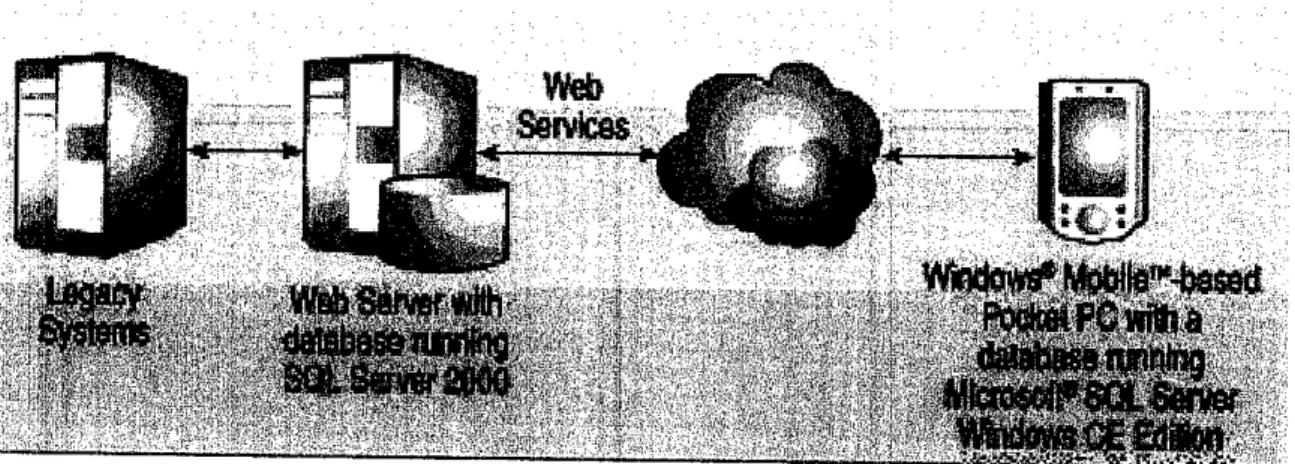
Expertek developed MobileWorks, a business solution that enables salespeople to connect to the business system, retrieve information about customers and products, and store that information in a database residing on a mobile device. They can take orders in the field, and at the same time, send orders to the business system to be processed to
completion [10].
Using MobileWorks, salespeople can now capture data on a Pocket PC running Microsoft
SQL Server™ 2000 Windows® CE Edition (SQL Server CE), Then, at any point, with
any connection to the Internet, they can synchronize the device. Using Web services, the
device connects to a SQL Server 2000 database on the Web server and transmits data to and from the Pocket PC. When an Internet connection is available, master file information is periodically downloaded to the Pocket PC, keeping it synchronized with the business system. Users can then upload the day's orders to the office back-end system for processing and fulfillment [10].
Legacy Systems
Web Services
< *
Wfeb Sewer «nh
database mming SOL3&ffir 2000
Figure 2.3: Mobile Works Architecture
windows* Mobile'* tesetf
daflabKB running MIcrawiPSQL tower
WferitaiftCE Edition
2.5.1 Mobile Technology Platform
According to Expertek, with Windows Mobile software and Visual Studio.NET, Expertek was able to take advantage ofcomprehensive Microsoft resources and tools to
develop amobile business solution that not only extended its existing technology assets and infrastructure, but allowed the company to reuse code to develop adesktop version ofMobileWorks and capture market opportunities much more quickly.
2.5.1.1 Access to Comprehensive Resources
The Expertek developers relied on Windows Mobile and Microsoft development resources. A Microsoft-sponsored .NET developer training course gave Expertek developers an introduction to developing with .NET connection software. Expertek's universal subscription to MSDN provided the development team with early access to the beta version ofVisual Studio .NET 2003. For technical support, the team relied on the information-rich newsgroups on MSDN. In addition to relying on Microsoft's world-class resource for developers, Expertek found useful the error-reporting and
error-handling tools in the .NET Compact Framework.
2.5.1.2 Extends Existing Infrastructure
The addition of the MobileWorks application and a Web service extends Expertek's existing infrastructure. Using SQL Server CE on the Windows Mobile-based Pocket PCs was a natural choice because Expertek was already using SQL Server technologies with its other custom applications. SQL Server CE synchronizes directly with the SQL
Server 2000 database used for back-end data. MobileWorks extends the rest of the
company's infrastructure as well. "MobileWorks captures the same ordering information that our e-commerce sites capture, so adding the MobileWorks application
and a Web service let us easily extend our existing infrastructure to the field," says
MacGregor.
Developing a mobile solution helped customers extend their ERP systems to the field while eliminating manual, time-consuming tasks. With MobileWorks, salespeople can create orders atthe client, and then synchronize their handheld atthe end ofthe day.
Developed with integration in mind, MobileWorks enters all orders sent to the back-end
into the customer's ERP system. The solution pushes data effortlessly from handheld to
front-end to back-end.
2.5.1.3 QuicklyCaptures Market Opportunities with Code Reuse
When another customer needed MobileWorks functionality in a desktop version,
Expertek wasable to deliver veryquickly by leveraging its skills, code, and assets.
To port the Pocket PC edition of MobileWorks to a desktop edition, Expertek switched the data access code from SQL CE for the Pocket PC edition tothe full-version ofSQL
Server for the desktop edition.
"Because we used the Microsoft .NET Framework, we were able to achieve over 90 percent code reuse for the desktop version of MobileWorks. In fact, both versions of
MobileWorks are compiled from the same code base. As a result, we saved
development time and were able to bring a new product to market quickly. Our
customer couldn't have beenmore delighted," saysMacGregor.In addition, Expertek wanted to develop on a platform where they could use their existing development skills. They planned to migrate from Visual Studio 6.0 to Visual Studio .NET, and from Microsoft Active Server Pages (ASP) to ASP.NET. "Clearly with the platform transfer ability, we'd be able to use those same skills and same tool sets to develop a new application," says MacGregor.
AristoCraft Supply, one of New England's largest full service distributors of dry cleaning, laundry, and tailoring supplies, uses MobileWorks and another Expertek
solution called CommerceLink.
"MobileWorks lets our sales people enter sales orders and query customer credit, pricing data, and inventory availability in the field. Using MobileWorks running on Windows Mobile-based Pocket PCs, our sales force is more productive and can handle substantially more accounts without increasing our headcount," says Doug Ross,
President of AristoCraft Supply.
2.5.1.4 Windows Mobile Developer Customer Solution Case Study
Microsoft offers developers arich, flexible platform to build innovative applications for Windows Mobile-based Smartphones and Pocket PCs. The Windows Mobile platform offers extensive API support, integrated development tools, and familiar Windows programming models, so developers can use existing code and skills to quickly build and deploy applications. Comprehensive technical support and marketing programs, such as Mobile2Market, also help developers reduce time to market and capture new market opportunities. For enterprise scenarios, the Windows Mobile platform helps developers extend their PC and .NET programming skills as well as existing business
systems, conserving time and money.
2.5.2 Windows Mobile Platform
Microsoft provides developers with a rich, flexible platform, world-class tools and comprehensive resources to build innovative applications for Windows Mobile-based Pocket PCs and Smartphones. Windows Mobile developers can benefit from [13]:
S Powerful platform capabilities
S Reduced development time and costs S Increased market opportunities
S Access tocomprehensive developer resources and support
2.5.2.1 Flexible, Powerful Development Platform The Windows Mobileplatformoffers:
S Seamless and secure data connectivity (XML support, built-in security
features, encryption libraries)
S Rich API support (Configuration Service Provider, Telephony, Bluetooth,
POOM, GamingAPIs)
f An extensive range of programming models (native code, managed code,
mobile web development)
* Device resources (industry standard expansion interfaces, multithreading and
multitasking)
2.5.2.2 Reduced Development Time and Cost
Windows Mobile developers can take advantage of a unified software platform, a familiar Window development environment, a consistent programming model and
comprehensive technical resources to reduce development time and costs.
• Develop and test applications quickly with familiar development tools and
free resources from Microsoft
^ Use existing .NET programming skills (Windows Mobile is based on Windows CE and .NET Compact Framework)
• Reuse existing code to target new devices (85% of Windows Mobile-based Smartphone and Pocket PC APIs are identical)
* Reach new markets through multilingual support
S Deploy mobile enterprise applications through Auto-run and remote management tools
2.5.2.3 Increased Market Opportunities and Reduced Time-to-Market
Mobile2Market, Microsoft's certification and marketing program for Windows Mobile applications, helps independent software vendors (ISV) increase revenue and reduce time-to-market by streamlining application development and logo testing and providing
worldwide distribution channels.
2.5.2.4 Access to Comprehensive Developer Resources and Support
Microsoft provides comprehensive resources to help corporate and ISV developers stay
abreastof mobile technologies. These resources include:
v Access to free tools at theMSDN Mobile andEmbedded Developer Center
</ Free webcasts, chats andnewsgroups
* Microsoft's world-class premier support offering (fees may vary)
2.5.3 M-Commerce Device
In most M-Commerce activities, the most common device that is being used is the Personal Digital Assistant (PDA). There are several reasons ofusing the PDA as the most
usable device as the assistant in M-Commerce.
2.53.1 PDA's advantages
Aside from being cool, a PDA might make sense for the user as part of a personal navigation system for a number ofreasons. Some ofthe advantages include [15]:
• Larger screens: PDAs have larger, higher-resolution, color screens compared with handheld GPS receivers. This is a big plus if the user eyesight isn't as good as it used to be and it's really important if the user are using the PDA while driving. Most user want to be able to quickly glance at a map on the screen, determine their location, and then get their eyes back onthe road.
• More maps: Most of the maps that the user can upload to GPS receivers don't
have a lot of detail; especially the topographic maps. These maps tend to be
vector line maps and don't have the resolution or detail found on paper maps that the user would use for hiking. Several mapping programs are available for PDAs that support all types of maps, and the user can even create their own custom maps. With a PDA, the user can use more detailed maps, like scanned, color 1:24,000 topographic maps. The extra feature that the PDA could provide to the user is the user may not locked in to using only a GPS receiver manufacturer's proprietary software and maps.
• Expandable memory: Unlike many GPS receivers, which have fixed amounts of memory, most PDAs support expandable memory with plug-in memory cards.
The only limitation to the number of the maps and amount of data that you can
store is the size of the memorycard.• Usability: Although handheld GPS receivers are fairly easy to use, the user interfaces found on PDAs are even simpler. Using a touch screen and stylus to enter data and commands is a lot faster and easier than using the buttons on a
handheld GPS receiver.
• Custom programs: Developers can easily write custom programs for PDAs that access the data output from a GPS receiver. Ifthe user are collecting information that's based on location data, this can make their job much easier than pressing
buttons on a GPS receiver and then hand-writing remarks ina field notebook.
• PDA features: PDAs have all sorts ofuseful programs such as address books, contact lists, and databases designed for readily storing data. A fair amount ofthis
information tends to be location based (like addresses), and having a single
information/navigation device isthe definition ofpractical.
2.53.2 PDA's disadvantages
After reading through advantages of using a PDA as the navigation system of choice,
most user are probably sold on a using a PDA. Some of downsides that the user should
aware of are:
• Ruggedness: Handheld GPS receivers are designed to take more abuse than
PDAs, which often fail when they're dropped or knocked around. Although the
user can buy ruggedized (with special enclosures that make them waterproof,
drop-proof, bear-proof, and kid-proof) PDAs, they are considerably more expensive than off-the-shelf models; expect to spend at least several hundred ringgits more.
• Weather/water resistance: Unlike GPS receivers, PDAs aren't designed to be waterproof or even weatherproof. This can be a major issue if the user plan on using their PDA navigation system outdoors in damp, rainy, or snowy weather, the user are around water, or the user have a leakywaterbottlein yourbackpack.
•
Power considerations: Most PDAs use internal batteries that are recharged through a docking cradle. If the user are away from a power source, this can be a serious issue because you can't swap out dead or dying batteries for a convenient set of spare AA or AAA batteries like you can with a handheld GPS receiver.2.5.4 Key Mobile and Wireless Technologies
Below are the summarized key technologies available for usage in mobile and wireless services. Many of these technologies are available after its specifications become a standard and being adopted by group ofcompanies that created them:
Table 2.1: Wireless Connectivity Technologies. Adapted from IEEE International Workshop on Wireless and Mobile Technologies in Education. Raul Morales Salcedo.
Universidad de las Americas.
Third Generation Mobile Telephony (3G)
Wireless technology (Bluetooth)
By liberating us from slowconnections, cumbersome
equipment and immovable access points, 3Genable new
waysto communicate, access information, conductbusiness and learn. The 3G wireless network technologies
are WCDMA, CDMA2000 and EDGE.
UMTS is one ofthe Third Generation (3G) mobile systems
being developed within the ITU's IMT-2000 framework.
UMTS is a global 3G system implemented with WCDMA technology.
Bluetooth wireless technology is a short-range radio technology. Bluetooth wireless technology makes it
possible to transmit signalsover short distances between
telephones, computers andother devices and thereby
General Packet Radio Service (GRPRS)
Global System for Mobile Communications (GSM)
simplify communication and synchronization between devices. It is a global standard that:
i) eliminates wires and cables between both stationary and
mobile devices
ii) facilitates both data and voice communication
iii) offers the possibility of ad hoc networks and delivers the ultimate synchronicity between all your personal
devices
The Bluetoothwireless technology comprises hardware, softwareand interoperability requirements. Beyond
unleashing devices by replacing cables, Bluetoothwireless technology provides a universal bridge to existing data networks, a peripheral interface, and a mechanism to form
small private adhoc groupings of connected devices away
from fixed network infrastructures.
Bluetooth radio uses a fast acknowledgement and
frequency-hopping scheme to make the link robust, even in
noisy radio environments.
Apacket-linked technology that enables high-speed
wireless Internetand other data communications. GPRS
provides more than four times greater speed than
conventional GSM systems. Using a packet data service, subscribers are always connected and always online so
services will be easy and quick to access.
GSM, which wasfirst introduced in 1991, is one of the leading digital cellular systems. It uses narrowband TDMA.
Eight simultaneous calls can occupy the same radio
frequency. GSMsimplifies data transmission to allow laptop andpalmtop computers to be connected to GSMphones. Itprovides integrated voice mail, high-speed data, fax, paging and short message services capabilities, aswell as secure communications. It offers the best voice quality
of any current digital wireless standard.Originally a European standard fordigital mobile
telephony, GSM has become the world's most widely used
mobile system in use in over 100 countries. GSM networks operate on the 900 MHz and 1800 MHz waveband in Europe, Asia and Australia, and on the MHz 1900
waveband in North America and in parts of Latin America
and Africa.
IMS - IP Multimedia Subsystem
Internet Protocol (IP)
The telecom industry is currently shifting towards All-IP systems, driven by the fundamental need to reduce costs, create new revenue generating services and to protect the operator business model. All-IP service delivery is the goal
for both fixed and mobile communications in both the
operator and enterprise domains: the benefits in terms of service creation, integration and cost savings.
IMS - IP Multimedia Subsystem is defined by
3GPP/3GPP2 as a new core and service 'domain' that
enables the convergence of data, speech and network technology over an IP-based infrastructure. It is the operator choice of control and servicelogic for IP/packet based person-to-person communication.
For users, IMS-based services will enable communications
in a variety of modes - including voice, text, pictures and video, or any combination of these - in a highly
personalized and secure way.
IMS is designed to fill thegap between theexisting
traditional telecommunications technology and Internet technology that increased bandwidth alone does not provide. This allows operatorsto offer new, innovative services that share holders and endusers are expecting.With the creation of the World Wide Web (WWW), the
Internet has become the global network for business, research and personal use. As a result, IP, the corecommunications protocol for the Internet, has become the
defacto standard for data networking.
Internet protocol specifies the format and address scheme
of information packets sent over the Internet. IP allows you
to label a package with the destination addressof the receiver and have the network carry the packet to that destination, but there's no direct link between sender and receiver (IP is a 'connectionless' protocol). When combined with specific higher-level protocols - such as TCP
(Transport Control Protocol) - a virtual connection is
established between two hosts so that they reliably can send
messages back and forth.
The current version of IP is IPv4. A newstandard, IP version 6 (IPv6), is nowincreasingly being introduced in products and networks. IPv6 incorporates functions
essential for building scalable and cost effective IP
Multimedia Messaging Service (MMS)
Short Message Service (SMS)
Wireless Application Protocol (WAP)
networks. New services, such as interactive multimedia, require users to be 'always connected-always reachable1.
IPv6, with its very large address space will guarantee a globally unique IP address for each connected device.
Ericsson, a pioneer in IPv6, sees IPv6 as a key component, and a complement to IPv4, in evolving today's networks.
Our vision is that all IP-based products eventually will be
IPv6-enabled.
Multimedia Messaging Service (MMS) makes it possible
for mobile users to send and receive multimedia messages.
MMS builds on the huge success of SMS usage and enhances the communication possibilities for mobile users
further by adding multimedia. Multimedia Messaging (MM) can for example be a photo or video clip annotated with text and/or anaudio clip or a synchronized playback
of audio, text, video and/or photo.MMS enables an infinite number ofapplications covering
communication, information and entertainment. In the area
ofcommunication, the Ericsson MMS solution simplifies the creation ofmultimedia messages, provides storage
capacity for all types of multimedia and features media processingfor an optimal user experience.
Short message service is a wireless service available on
digital mobile networks. It enables the transmission of text messages between mobile phones and other systems such
as electronic mail, paging and voice mail.
Up to 160 characters can be sent and received through the network operator's message system to the mobile phone.
SMS is analternative to paging services, and can beused to provide reminder services, stock and currency quotes,
airline schedules, and account information.
A free, unlicensed protocol forwireless communications
that makes it possible to create advancedtelecommunications services and to access Internet pages from a mobile telephone. Wireless application protocol is a de facto industry standard supported by a large number of
suppliers.
WAP supports most wireless network standards including CDMA, GSM, PDC, PHS, TDMA, FLEX, DECT, and Mobitex, as well as operating systems like EPOC. WAP devices understand the WML language (an XML
application) that is optimized for small screens and
navigation without a keyboard. WAP also supports
Wireless Local Area Network
(WLAN)
WMLScript scripting language.
Wireless Local Area Network (WLAN) technologies complement access technologies for cellular networks.
WLAN enable higher data rates than UMTS - up to 54 Mbps - for coverage in in-door hot spots. WLAN is a short- range packet data communication between base stations and user terminals. Direct communication between terminals is possible. WLAN allows the business professionals to access their company's Intranet.
There are several standards for the WLAN air interface. It
is only in the lastyearthat market developments have made it clear that IEEE 802.1 lb is the dominating standard. This is the technology used in almost all commercial products
today. Other WLAN standards (existing/coming) are:
- IEEE 802.1 la; 5 GHz, onlyallowed in the US -IEEE 802.1lg; 2.4 GHz
-HIPERLAN/2;5GHZ
- IEEE 802.1 Ih; 5 GHz, will incorporate HiperLAN functionality
2.5 Case Study on Vertigo implement Pocket PC with .NET Compact Framework Can Office applications really scale to handheld devices? Vertigo proved it's possible to quickly deploy Office functionality on powerful Pocket PC devices. Their application lets people control PowerPoint® presentations from aPocket PC handheld. Taking only
one developer two months to develop using the .NET Compact Framework, the application lets users view, annotate, and adjust live PowerPoint presentations, as well as track speaker time, display speaker notes, and preview slides before they are displayed.
"This app was the result of my own PowerPoint experience," says Scott Stanfield,
Founder and CEO. "An old agenda slide had accidentally been inserted in my deck. Iwas
embarrassed when Ihe slide appeared during the presentation, but I realized later that a
remote control application, running untethered from the laptop, would have let me catch
the wrong slide, and jump over it without the audience knowing." [13]
The Right Toolfor the Task
Vertigo was able to leverage their existing development expertise with the .NET Framework to rapidly prototype and build the remote control application. "We would not have attempted to build this product if not for the .NET Compact Framework," says Stanfield. "Our development staff is already trained in the .NET Framework and Visual Studio® .NET. The jump to build .NET Compact Framework applications is much easier than, say, going to eMbedded Visual Basic® or eMbedded Visual C++®. So there's a lot more existing expertise that we can take advantage of to get the applications done more quickly." [13]
PowerPoint Remote Client
.NET Compact
Framework
J
PowerPoint
Application
PowerPoint Remote Server
Full -NET Framework
Presentation
Files (.ppt)
Pocket PC Desktop/Laptop
Figure 2.4: The mobile .NET framework system architecture implemented by Virtigo
High Technology, Low Cost
Vertigo was also able to save a lot of money by making use of the robust device
emulators provided by the .NET Compact Framework. The development and testing
cycle was augmented by testing and debugging on an emulator and then downloading to
the real device when it was ready to go live. "That meant we didn't have to buy a
handheld for everyone onourteam," says Stanfield. [13]
Further, the .NET Compact Framework made quick work of the wireless networking and user interface aspects of the application. Wireless networking was necessary to communicate between the Pocket PC handheld and the laptop. "802.11 and Bluetooth are the ones we're using," says Stanfield. "We didn't have any problems with the network stack and that was something we were concerned about. "[13]
The .NET Compact Framework also made quick work of the user interface mechanisms associated with the Pocket PC handheld. "What kind of amazed me in the process is that we kept exploring how we could make this experience better for the mobile user. Every time we came up with an idea, we were able to easily integrate the user interface idioms (stylus, thejoystick pad, etc.) and make a better userexperience. Ultimately, we give the
presenter complete control without letting theaudience sees what they're doing." [13]
CHAPTER 3
METHODOLOGY/PROJECT WORK
3.1Methodology
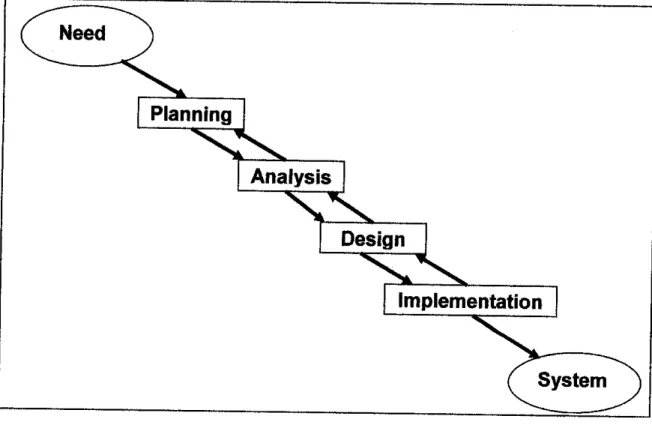
Waterfall development has been chosen as the software process model. The waterfall model is a software development model (a process for the creation of software) in which
development is seen as flowing steadily downwards (like a waterfall) through the phases of requirements analysis, design, implementation, testing (validation), integration, and maintenance. Thus the waterfall model maintains that one should move to a phase only when its preceding phase is completed and perfected. Phases of development in the waterfall model are thus discrete, and there is no jumping back and forth or overlap
between them [11].
Planning
Analysis
Design
Implementation
Figure 3.1: Software Process using Waterfall model.
For this project, the author will use waterfall model of system development life cycle
approach. This leads to four phases inthis project implementation:
3.1.1 Definition and Planning
In this phase, the author will define the underlying principle and scope of this project, the project timeline as well as the tools and the resources that will be used to produce the deliverables. This is the crucial part in this project development life cycle where by this stage will directthe projectdirection and become the base for this whole project. In order
to have a successful result for this project all the elements in this stage need to be
carefullydefined and plan.In order to get the proper definition and understand the generic integrated restaurant and
cafe" operation and also the business flow, an interview can be conducted with a fewpeople that are related to the subject matter. Interview can be very crucial as the data can be retrieved direcdy from the interviewee. Thus, to get the accurate data, preplanning has to be done such as preplanning of the questions that going to asked either opened question or closed question or it can be both. As for the study, questions has being
prepared in terms of basic business flows, pros and cons of available and new user
requirements. The research also be done through paper research and survey made by the
related organization.
Beside that the information and data are being collected through journals and findings that have been done by previous researcher. The reasons of getting the information
through journals are not only because it is readily documented but also the results of the
research are proven to be correct and success.
As been mentioned in the first paragraph of this section, in the earlier phase of this
project the author have focus on the fundamental ofthis project and the principal ofthis
project in order to bring this project to the proper direction. Among the elements that
being consider as the fundamental elements in this project are the project background for
this project, the problem background that lead to the initiation of this project, and the project objectives and the scope of study. These are elementsthat need to be clarified and need for data gathering for a betterdevelopment of this project. Thoseelements needed to be collect at this early stage.
Apart from that, the planning category requires identification of tasks and procedures that are necessary to complete the system. The tasks and procedures are apart of scope definition that defines the scale of the project. A Gantt chart (Please refer to the appendices) is produced as part of the scheduling plan to ensure it the feasibility of the project within the given time frame and within the scope ofthe project as well.
3.1.2 Analysis and design
In this phase, the author designs the framework for the mobile system. This includes analyzing the available techniques to implement the best mobile system. This will also include the techniques for analyzing and managing financial part in the organization. The software in question is designed and a "blueprint" is drawn for developmet phase. This design should be aplan for implementing the requirements given. When and only when the design is fully completed, then the implementation phase can take place. This shows how important the desinging phase for the development of the system and also the implementation of the system itself. Beside that the desininig phase is really rely on the
planning and definitaion phase that has been completed earlier.
The purpose of the design phase is to transform the requirements statement into design
specifications for system development. The designing category also addresses how
technology will be used in the project. As for the purpose ofthis project several elements
need to be design in order to have a good view ofthis system before the development
phase take part. Among the elements that are needed to be included in the desgining
phase are the system architecture and the system design document is necessary to ensure
the development can be sustained during the project's progress. These design
requirements are a representation of system flow in terms of entities, attributes, relationships and rules.
3.1.2.1 System Architecture
The Mobile Order Tracking System consists of several modules and sections as shown in Figure 3.2. The modules are ordertaking module, food preparation module, cashier module, and management module. All those modules will be integrated and all information will be centralized in one server. In the system architecture it clearly
represent the newbusiness transaction flow where by the order can be made either using the mobile systemor the web based system.
In theconservative system, thearchitecture of the system only included order taking, food preparation, and cashier. The information between those sections will only be
delivered manually without any centralization on the information. The conservative system also excluded the management level, where by the information related to the sales
will only be available atthe end ofthe day. Different with the Mobile Order Tracking System, the information related to sales are always available for sales tracking analysis.
Order taking (Wireless)
Q .
A
Customer
Order taking (Web based)
dbMOTS
Order Collection
Food Preparation
Management
Level
Figure 3.2: The architecture for Mobile Order Tracking System
Cttmt I
nm ******
WAP Micro Browser
^
CpTlDO^feEBl t-jflDfltfirxt
WAPPr&xp
A Fotibw Ettfaaocmeata
O
Figure 3.3: WAP Proxy Framework for Mobile Order Tracking System
The novel architecture for Wireless Application Protocol (WAP) 2.0 employing a proxy to isolate the wireless domain from the wired domain and an advanced data compression scheme to significantly reduce the wireless access time (WAT) while overcoming the WAP 1.x end-to-end security problem.
a. A novel proxy architecture employing an advanced data compression scheme is introduced for WAP 2.0. The compression scheme combines TCP content
compression with Robust Header Compression (ROHC), which minimizesthe air- interface traffic without protocol conversions and overcomes the end-to-end security problem in WAP 1.x.
b. The WAP programming model is the WWWprogramming model with a few enhancements such as Push model and Telephone Support(WTA).
c. WAP 2.0 does not require a WAP proxy, since the communication between the client and server can be conducted using HTTP 1.1.
d. However, deploying a proxy, as shown in Figure 4.2, can optimizethe
communication process and may offer mobile service enhancements, such as location, privacy, and presence based services.
e. In addition, a WAP proxy is necessary to offer Push functionality.
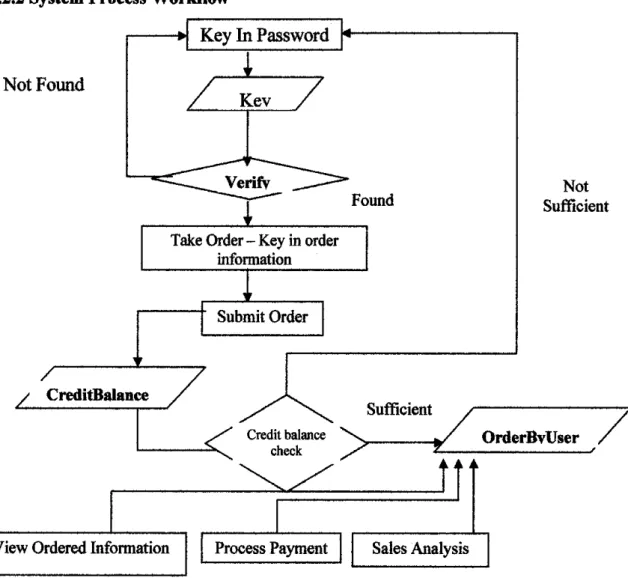
3.1.2.2 System Process Workflow
Key In Password
Not Found
Not Sufficient
Figure 3.4: Mobile Order Tracking System process workflow
There are the process workflows for the Mobile Order Tracking System. Figure 3.4 shows the general workflow for the system. The details for the workflow are as follows;
i. The user/client will take their order using the mobile order application. The process will be performed either using PDA or web based system. The order will be submitted to the server. For the security purposes the system is equip with the user verification function whereby only authorized user can key in the details into the order system.
ii. After the system have verified the user, then the user can have the access to the system which only to submit their order. In the ordering section the user will be displayed with the menus that give the user with sets of option on the menu.
iii. After done with the menu selectionthe user simply submitstheir order and the system will once again check either the user has sufficient credit balance or not.
The process and transaction can only be completed if the user has sufficient credit. If not the system will automatically logoutfrom the system and the user is required to top up their credit balance,
iv. The submitted order will be stored in the server. The server will be a centralized
server,
v. As the orderbeing submitted, the information at the food preparation module will be updated. The person in charge willprepare the foods base on the updated
information on this module,
vi. The cahier also can process the customer payment byaccessing the cahier module. Transactions that havebeen submitted earlierwill be processed in this module and the transaction will be completed as soonas the payments have been
done,
vii. At themanagement module, the information regarding thesales will be processed
into the sales analysis form to ease the management to make a saleanalysis andto make any business decision.3.1.23 UML Use Case Design
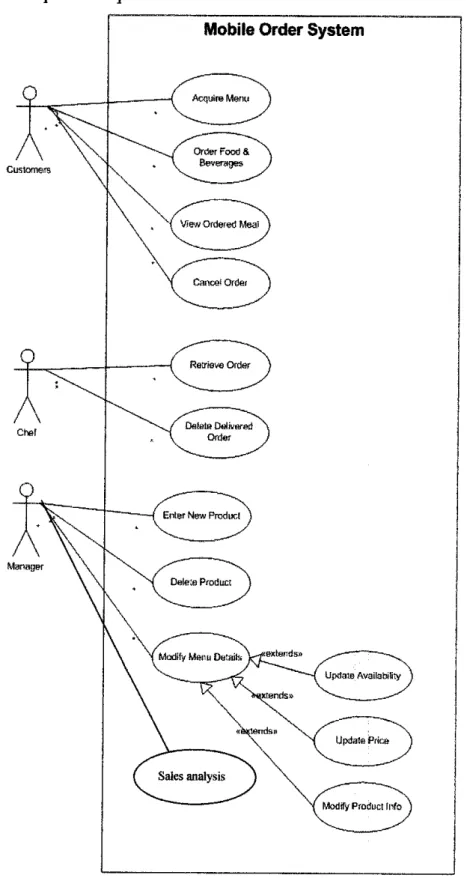
The Use Case in Figure 3.5 describes the actions that occur between the users and the system. Basically, there are three types of users, namely the customers, chef and manager. Customers are able to acquire menu that provide details of food and beverages
that are available in the restaurant. Then they can choose and order the items that they
want by submitting the order to the system. Apart from that, they can view ordered meal and subsequent able to cancel any ordered meal if they wish to. The system will store the order in the database while chef will retrieve order queue from the system. Afterdelivering the order, chef has to delete the order queue. Manager has the authority to
enter new product by creating new entry into the electronic menu and able to delete any entries in the electronic menu as well. Apart from that, manager can modify the menu details regarding the product name and description, and update product's price and availability. Once modified, the changes will be reflected instantly in the electronic menuthat is accessed by customers. The additional part that the manager can use in this particular system is the sales analysis part whereby the manager can evaluate their sales performance for a particularperiod.
Mobile Order System
Customers
Manager
Figure 3.5: UML Use Case Diagram of the System
3.1.2.4 Database design
Table 3.1: The table consist the user information.
ID(PK)
Name Address Phone No
Password
RegisteredJDate UserJType
String String String Integer
String
Date/Time
String
Table 3.2: The table consist the menu information.
Menu_Code (PK) Integer
Menu Name String
MenuJType String
Price Currency
Menu_Description Registered_Date
String
Date/Time
Table 3.3: The table consist the credit value for user.
ID(PK) Credit Balance
Last Update
•.• I..IIW M.lf——••• — •
String Currency
Date/Time
Table 3.4: The table consist the sales history Transaction_No (PK)
Sales Value
Integer Currency
Transaction Date Date/Time
Above are the tables that have been created by author. Basically in order to have the system full function, those are the table required by the system. All those tables are stored
in one database. The database is dbMOTS.
3.1.3 System Development
With the designed specifications, system development phase is a stage where the modules can be constructed. The purpose of system development is to build a system that fulfills system requirements and design specifications and to implement the interfaces between the modules. Among the tasks to be implemented includes the databases, web application programs, and user interface. Please refer to Chapter 4: Results and Discussion for further
details.
Actually before author manages to reach to this phase, the prototype development has to the picture based on the design. The prototypes were developed using VB.NET to represent all modules in the systems which are the mobile ordering modules and the financial management modules.
3.1.4 Testing and Implementation
For testing, several data samples will be used to test the efficiency and the effectiveness of the prototype in performing the order taking functions and managing the financial elements for the organization, whether the system is efficient enough for the organization or not. The parameter will be how fast the order made by the client received by the food preparation sections and how efficient is the finance management for the organization.
3J System tools
Basically there are two main categories of tools that are necessary in this project development work, there are software and hardware. These equipments are also necessary to simulate a real working environment of a running production system.
However, some items are not available due to resource constraints, thus they are replaced by either emulated devices and assumed to work the same in real world.
3.2.1 Software
Among the software that I need in this project are:
• Microsoft Windows XP Professional Edition
• Microsoft Visual Studio .Net 2003
• Microsoft SQL Server 2000 Developer Edition/ Ms Access 2003
• Microsoft Internet Information Services 5.1
• Microsoft .Net Framework 1.1
• Microsoft Pocket PC 2002 Emulator
• Microsoft Internet Explorer 6.0
For the purpose of development work, Microsoft Windows XP Professional Edition is
chosen because the platform offers more stability and reliability over other Windows platforms. Furthermore Professional Edition is bundled with Internet Explorer 6.0 and Internet Information Services 5.1 which is vital for the purpose ofweb hosting ASP.Net pages. For the purpose of database storage, Microsoft SQL Server 2000 Developer Edition is used because this edition allows developers to build any type of application on top of SQL Server. It includes all the functionality ofEnterprise Edition but limited for the purpose of development and not production. Another important point is that it will install in workstation operating systems and not restricted to server operating systems,
unlike Enterprise Edition.
As for the development environment, the tool that is necessary is Microsoft Visual Studio .Net 2003. It comes bundled with Microsoft .Net Framework 1.1 and Microsoft Pocket PC 2002 Emulator. Visual Studio .NET is a complete set of development tools for building ASP Web applications, XML Web services, desktop applications, and mobile applications. Visual Basic .NET, Visual C++ .NET, Visual C# .NET, and Visual J# .NET all use the same integrated development environment (IDE), which allows them to share tools and facilitates in the creation of mixed-language solutions. In addition, these languages leverage the functionality of the .NET Framework, which provides access to key technologies that simplify the development ofASP Web applications and XML Web
services.
ASP.NET Mobile Designer extends ASP.NET and the .NET Framework, allows development of Web applications for mobile phones, PDAs, and pagers. This designer is integrated into the Visual Studio IDE. Thus to create mobile Web applications, the Mobile Designer is used to modify a mobile Web form. Then it can build and run the application, all from within Visual Studio. Emulator is a simulation of the hardware and software operation of mobile devices. Emulator software allows viewing of ASP.NET mobile Web Forms application as it might appear on the manufacturers' hardware devices. Developing and testing with emulators in addition to actual devices if it's available provides opportunity for me test the mobile Web application more easily before being deployed.
3.2.2 Hardware
A development machine is vital for the purpose of web hosting, database storage, system development, testing and simulation. The hardware that will be used are;
i) PDA or emulator.
This will be main component of this system since the main focus is to conduct a mobile order tacking system. The system is using PDA since that is the most compatible and stable mobile device. PDAs have all sorts of useful programs such as address books, contact lists, and databases designed for readily storing data. A fair
amount of this information tends to be location based (like addresses), and having a single information/navigation device is the definition of practical [8]. Although the
cost is quite expensive, but when comparing the cost of buying the PDA and the amount of profit that can be earned it much more reasonable. If the PDAs is available then the user PDA's user is required to have several specification on their PDAs in order to access to the system, that are;• Pocket PC 2002 PDA with Wi-Fi capabilityto replace emulator
• Wi-Fiaccess point to replace simulationof wireless network using LAN
ii) Computer; Act as a server
The server will be used to store the database of the system. The system will basically
have a centralized database. All the information will be stored inside the database.
The server will be center of all t