HEAVY METALS IN EDIBLE SEAFOOD
EMELIA GIRI (16190)
Bachelor of Science with Honours (Resource Chemistry)
2009
Faculty of Resource Science and Technology
Heavy Metals in Edible Seafood
EMELIA GIRI (16190)
This report is submitted in partial fulfillment of the requirements for the degree of Bachelor of Resource Chemistry with Honours
Faculty of Resource Science and Technology UNIMAS
2009
DECLARATION
This project is submitted of the requirements for the degree of Bachelor of Resource Chemistry with Honours for Faculty of Resource Science and Technology, Universiti Malaysia Sarawak. I declared that this report is made by my own work except for the information that is taken from some resources as references.
………..
EMELIA GIRI 22 MAY 2009
I
ACKNOWLEDGEMENT
I wish to especially thankful to God Almighty for the blessing throughout the preparation and completion of this final year project. I would also like to express my deepest appreciation and gratitude to my supervisor, Mdm. Devagi a/p Kanakaraju, for her invaluable guidance, encouragement and constructive criticism throughout the entire research project. My sincere thanks also goes to my parents for their untiring support rendered to me, financially as well as academically.
My appreciation is also extended to all the lecturers, staff of FRST, especially our Assistant Science Officer, Mr. Tomy Bakeh, and our laboratory assistants. They have given and provided me with the much needed technical assistance.
I also owe my acknowledgement to all my friends in the Resource Chemistry programme of 2006/2007 session. Thanks also to all my friends in UNIMAS for their undivided support throughout my campus life in UNIMAS. Definitely not the least, once again I must not forget to dedicate this project to my family. The success of this project will not be possible without their encouragement, prayer, love and support throughout my entire three-year course in Universiti Malaysia Sarawak (UNIMAS). I love them all.
II
TABLE OF CONTENTS
Content Page
ACKNOWLEDGEMENT I
TABLE OF CONTENTS II
LIST OF ABBREVIATIONS III
LIST OF TABLES AND FIGURES IV-V
ABSTRACT 1
CHAPTER ONE: INTRODUCTION 2-3
CHAPTER TWO: LITERATURE REVIEW 4-17
CHAPTER THREE: MATERIALS AND METHODS
3.1 Sample Collection 18-19
3.2 Sample Preparation 20
3.3 Heavy Metals Analysis 20-21
3.4 Statistical Analysis 22
CHAPTER FOUR: RESULTS AND DISCUSSIONS
4.1 Heavy Metal Concentrations in Analyzed Seafood Samples 22-33 4.2 Comparisons of Metals Accumulation in Among the Edible Seafood
Samples
34-37
4.3 Comparison of Metal Concentrations in Edible Seafood Samples with Permissible Limits
38-39
CHAPTER FIVE: CONCLUSION AND RECOMMENDATIONS 40
REFERENCES 41-45
APPENDIX 46-51
III List of Abbreviations
ANOVA Analysis of Variance
Ca Calcium
Cd Cadmium
Co Cobalt
Cr Chromium
Cu Copper
FAAS Flame Atomic Absorption Spectrophotometer
Fe Iron
Hg Mercury
HNO3 Nitric acid
JECFA Joint Food and Agriculture Organization/World Health Organization Expert Committee on Food Additives
K Potassium
Mg Magnesium
Mn Manganese
Ni Nickel
Pb Lead
PMTDI Provisional Maximum Tolerable Daily Intake PTDI Provisional Tolerable Daily Intake
PTWI Provisional Tolerable Weekly Intake
Zn Zinc
IV
List of Tables Page
Table 2.1 : Maximum Permissible Limit Concentration of Heavy Metals in Seafood Recognized by JECFA (1982, 1983, 1993 and 2000) and Malaysian Food Act and Regulations (1996)
11
Table 2.2 : Tolerable Daily Intake of Heavy Metals by Human as Prescribed by JECFA (1982, 1983, 1993 and 2000)
11
Table 3.1 : Seafood Samples that were Analyzed 18 Table 3.2 : Working Conditions for the Analysis of Heavy Metals by Flame
Atomic Absorption Spectrophotometer (FAAS)
21
Table 4.1 : Mean Concentration (mg/kg) of Heavy Metals in Various Edible Seafood Samples
24
Table 4.2 : Comparisons of Metal Concentrations in Edible Seafood Samples with the Maximum Permissible Limits
38
V
List of Figures Page
Figure 3.1 : The Picture of Analyzed Edible Seafood 19 Figure 4.1 : Concentration of Mg in Analyzed Seafood Samples 23 Figure 4.2 : Concentration of Fe in Analyzed Seafood Samples 25 Figure 4.3 : Concentration of Zn in Analyzed Seafood Samples 26 Figure 4.4 : Concentration of Mn in Analyzed Seafood Samples 27 Figure 4.5 : Concentration of Ni in Analyzed Seafood Samples 28 Figure 4.6 : Concentration of Cr in Analyzed Seafood Samples 29 Figure 4.7 : Concentration of Cu in Analyzed Seafood Samples 30 Figure 4.8 : Concentration of Pb in Analyzed Seafood Samples 31 Figure 4.9 : Concentration of Co in Analyzed Seafood Samples 32 Figure 4.10 : Essential Heavy Metal Accumulations in Selected Edible
Seafood Analyzed
34
Figure 4.11 : Non-essential Heavy Metal Accumulations in Selected Edible Seafood Analyzed
36
1
Heavy Metals in Edible Seafoods Emelia Giri
Program Kimia Sumber Fakulti Sains dan Teknologi Sumber
Universiti Malaysia Sarawak
Abstract
Commercial fish and shellfish obtained from the Satok market in Kuching was analyzed for selected heavy metals content (Pb, Cr, Co, Ni, Mg, Fe, Zn, Cu and Mn). The samples were evaluated using Flame Atomic Absorption Spectrometer (FAAS). The concentration of Pb, Cr, Cr, Co, Ni, Mg, Fe, Zn, Cu and Mn ranges from 0.5-1.7 mg/kg, 12.0-17.7 mg/kg, 0.7-3.7 mg/kg, 9.0-26.7 mg/kg, 227.0-636.5 mg/kg, 59.3-141.4mg/kg, 19.0-50.0 mg/kg, 2.7-8.7 mg/kg, and 17.7-32.7 mg/kg respectively. The results obtained show that fish and shellfish samples obtained from the market are safe for human consumption as the levels of heavy metals among all the edible seafood samples not exceeding the maximum permissible limits which are stipulated under Joint Food and Agriculture Organization/World Health Organization Expert Committee on Food Additives (JECFA) and Malaysian Food Act 1996 guidelines. Statistical analysis of One-Way ANOVA showed significantly difference (P < 0.05) between heavy metals contents in all the samples analyzed.
Key words: Heavy Metals; Seafood; Fish; Shellfish; FAAS
Abstrak
Ikan komersial dan kerang-kerangan diperolehi dari pasar Satok di Kuching telah dianalisis untuk menentukan logam berat yang terpilih (Pb, Cr, Co, Ni, Mg, Fe, Zn, Cu Dan Mn). Sampel-sampel tersebut telah dianalisis menggunakan spektrometer penyerapan atom nyalaan (FAAS). Julat kepekatan Pb, Cr, Cr, Co, Ni, Mg, Fe, Zn, Cu dan Mn dalam sampel-sampel tersebut masing-masing menujukkan 0.5-1.7 mg/kg, 12.0-17.7 mg/kg, 0.7-3.7 mg/kg, 9.0-26.7 mg/kg, 227.0-636.5 mg/kg, 59.3-141.4mg/kg, 19.0-50.0 mg/kg, 2.7-8.7 mg/kg, dan 17.7-32.7 mg/kg. Keputusan yang diperolehi menunjukkan sampel ikan dan kerang-kerangan diperolehi dari pasaran adalah selamat untuk kegunaan manusia berdasarkan tahap logam berat dalam semua sampel makanan laut yang boleh dimakan tidak melebihi had maksimum yang dibenarkan dan disyaratkan di bawah Joint Food and Agriculture Organization/World Health Organization Expert Committee on Food Additives (JECFA) dan garis panduan Akta Makanan Malaysia 1996. Analisis statistik One-Way ANOVA menunjukkan perbezaan ketara (P <
0.05) antara kandungan logam berat dalam semua sampel yang dianalisis.
Kata Kunci: Logam Berat; Makanan Laut; Ikan; Kerang-kerangan; FAAS
2
CHAPTER ONE
INTRODUCTION
1.1 Introduction
Heavy metals pollution in the marine environment has long been recognized as a serious environmental concern. Heavy metals are continuously released into the marine environment commonly through natural geological processes and anthropogenic activities. Anthropogenic activities such as coal combustion, solid waste incineration, agricultural runoff, mining, and direct discharge from the industrial processes will release heavy metals into the marine environment that will cause contamination in marine organisms. These heavy metals will accumulate in the tissues of marine organisms and being conveyed through human by consuming the seafood.
Heavy metals are inorganic chemicals that are non-biodegradable and they cannot be metabolized by the body and tend to accumulate through time. Thus, it is important to determine the heavy metal concentrations in edible seafood in order to evaluate the impacts of metals on human health. The heavy metals can be divided into two areas of concern, which are nutritional and toxicological. Heavy metals such as Fe, Zn, and Cu are nutritional because they are necessary for maintenance of optimum health while heavy metals such as Pb and Cr are toxicological and detrimental to optimum health (Yebra-Biurrun et al., 2000). Therefore, the knowledge of heavy metal concentrations in edible seafood is of a great interest in order to evaluate their hazard level in relation to the maximum residual limit for human consumption.
3 1.2 Statement of Problems
Edible seafood is regarded as healthy and tasty food for human (Ranau et al., 2001) because it is rich in protein even though in some cases it can pose hazards to health due to the harmful levels of toxins intake when certain types of seafood are eaten frequently. It is important to determine the concentration of heavy metals in the edible seafood to ensure the seafood is safe for consumption. Edible seafood is contaminated by heavy metals due to the increasing chemical pollution of the environment caused by various human activities. Therefore, it is essential to examine the concentration of heavy metals present in edible seafood particularly in seafood which are commonly consumed by local folk and those which are commonly at the local markets.
1.3 Objectives
The objectives of this study are:
i. to determine selected heavy metals content (Pb, Cr, Co, Ni, Mg, Fe, Zn, Cu and Mn) in tissues of various edible seafood samples.
ii. to compare the level of heavy metal concentrations in seafood samples analyzed with the guidelines set by Joint Food and Agriculture Organization/World Health Organization Expert Committee on Food Additives (JECFA) and the Malaysian Food Act and Regulations (1996).
iii. to perform statistical analysis of One-Way of Variance (ANOVA) to compare the concentrations of heavy metals between different edible seafood samples.
4
CHAPTER TWO
LITERATURE REVIEW
2.1 Heavy metals
According to Duffus (2002), heavy metals are defined as chemical elements that are relatively having high density exceeding 6 g/cm-3 or high relative atomic weight which is greater than sodium (atomic weight=23), such as mercury, chromium, cadmium, arsenic and lead. Heavy metals can damage living things at low concentrations and tends to accumulate in the food chain. The heavy metals such as lead and cadmium are known as non-essential metals. They are toxic even in small amounts and harmful to human health. Normally, human body requires some of the heavy metals such as copper, iron, nickel and zinc. These metals are also known as essential metals. However, the essential metals can be toxic if taken in large quantities (Keskin et al., 2007; Tüzen, 2002). In this study, nine elements of heavy metals will be determined in the edible seafood. They are lead, chromium, cobalt, nickel, magnesium, iron, zinc, copper and manganese.
2.1.1 Lead (Pb)
Lead is a soft grey metal with atomic number 82 and atomic weight 207. Lead forms solid at normal temperatures and melts at 327.5oC. Nowadays, lead is the fifth most commonly used metal in the world. Lead is widely used in batteries, cables, plumbing, gasoline, steel products, food packaging, glassware, ceramic products, and pesticides (WHO, 2000). The use of this metal in plumbing has continued from ancient times to the present day. The term plumbing originated from the Latin plumbum, for lead. From an environmental viewpoint, lead also
5
exists as tetraalkyl leads, especially tetraethyl lead that has recently been the largest metal used as an additive octane enhancer for gasoline (Wright and Welbourn, 2002).
According to Schröder (2007), human have been exposed to lead for many centuries through the inhalation of dust or other particles and through ingestion of contaminated food and water, such as through intake of seafood. Exposure to lead can occur from many sources but usually arises from industrial use, such as mining and smelting. Leaded gasoline has been banned for several years due to its negative effects on children’s physical and mental development.
Lead exposure may cause neurological deficits such as mental retardation in children and kidney disease such as interstitial nephritis to adults. According to WHO (2000), exposure to lead may also contribute to hypertension and cardiovascular disease. Lead tend to accumulate in bone and lie dormant for years, and then pose a threat later in life during events such as pregnancy, lactation, osteoporosis, and hyperthyroidism and hyperparathyroidism, in which mobilizes stores of lead ion bones (VMICC, 2003).
2.1.2 Chromium (Cr)
Chromium is a hard brittle gray transition metal with atomic number 24 and relative atomic mass 51.99. The form of various alloys and compounds from chromium has been in widespread commercial use for over 100 years. Chromium has also been widely used in chromium alloys and chrome plating in recent decades. The major uses of chromium are for transportation, construction products, machinery equipment, home appliances and equipment, plating of metals, and pigment and paints (IARC, 1990). Chronic effects of chromium
6
exposure occur in the lung, liver, kidney, gastrointestinal tract, and circulatory system (WHO, 1988).
2.1.3 Cobalt (Co)
Cobalt is tough silver-white transition metal with atomic number 27 and atomic weight 58.93.
This element is widely used in alloys, magnets, in the production of tungsten carbide, in catalysts, pigments and enamels. Although cobalt is an essential element for life in minute amounts, but at higher levels of exposure it shows mutagenic and carcinogenic effects similar to nickel. According to Bradbury et al. (2008), cobalt and its salts are relatively non toxic by ingestion. Most cases of cobalt toxicity relate to occupational skin contact or inhalation.
Cobalt can enter the body by ingestion, inhalation, or through the skin. Chronic cobalt ingestion can cause the possibility of cobalt cardiomyopathy. Chronic inhalation also can cause asthmatic problems and established pulmonary fibrosis. Cobalt is a topical irritant and a well recognized cause of occupational contact dermatitis.
2.1.4 Nickel (Ni)
Nickel is with the atomic number 28 and atomic weight 58.69. It is commonly found in the environment in the 2+ oxidation states. Nickel is a naturally occurring, shiny, light-colored metal with high electrical and thermal conductivities. Nickel is widely used as an alloying element for stainless steel and its compounds are commonly used in nickel-cadmium batteries, in electronic and computer element, and as constituents of pigments in the glass and ceramics industries (WHO, 1991). Human activities such as base metal mining, smelting, refining, fossil combustion and solid waste disposal are the significant sources of this metal discharge to the environment. Large amount of this metal may be transferred to marine environment through
7
municipal sewage effluent containing industrial waste. Besides, acid rain may mobilize nickel from soils and rocks in watershed areas which will be present in both terrestrial and marine biota. In aquatic system, nickel is distributed between dissolved and particulate forms, which are depending on the pH, redox potential, and suspended sediment load (Wright and Welbourn, 2002).
Nickel has long been considered relatively nontoxic when compared to other heavy metals. Nevertheless, the situation has changed in the last decade. Previous study by Yebra et al., (2007), nickel exposure may lead to serious health problems, including respiratory system cancer. Nickel can also cause a skin disorder known as nickel-eczema.
2.1.5 Magnesium (Mg)
Magnesium is a grayish-white metal with atomic number 12 and atomic weight 24.31.
Magnesium is the ninth most abundant element in the universe by mass. Magnesium is the eleventh most abundant element by mass in the human body and its ions are essential to all living cells, where they play a major role in manipulating important biological polyphosphate compounds like ATP, DNA, and RNA (Waster, 1987).
Magnesium ion's high solubility in water helps ensure that it is the third most abundant element dissolved in seawater. The Mg2+ cation is the second most abundant cation in seawater (occurring at about 12% of the mass of sodium there), which makes seawater and sea-salt an attractive commercial source of Mg (Nadler et al., 2007). Magnesium is commonly used in alloys to make airplanes, missiles, racing bikes and other things that need light metals.
Magnesium deficiency may result in hypokalaemia and hypocalcaemia (Kenneth, 2005).
8 2.1.6 Iron (Fe)
Iron with atomic number 26 and atomic weight 55.84, can exist in forms of divalent [Fe(II) ferrous] and [Fe(III)ferric]. Ferrous iron is more soluble and in more toxic form. However, it is readily converted to ferric iron under aerobic conditions, where it is much less soluble and much less toxic. Iron is widely used in various applications, such as in the automobiles, ships, land-based construction, machinery, and containers. However, smelting and refining of metals, steel manufacturing, and metal plating that mobilized iron by the human activities may lead to the iron contamination in marine environment. These human activities will release iron and its runoff to the aquatic system. Much of this iron is in the form of suspended particulates in water (Wright and Welbourn, 2002).
Iron is an essential trace element required by all forms of life such as required nutrient for human, where the metal having a role in many redox reactions in metabolic functions and being a component of hemoglobin. Iron is just like copper where it rarely contaminates seafood due to its tendency to bind with organic matter in marine environment (WHO, 1983).
2.1.7 Zinc (Zn)
Zinc with the atomic number 30 and atomic weight 65.29, and naturally present in relatively high amount in marine sediments. Large amounts of zinc found to be released into the coastal environment. It is used as sacrificial anodes on boats, metal finishing industry, galvanized iron roofing sheets and paint as well as in dye manufacturing industries (Najihah et al., 2008). Zinc is mobilized into air and water in the mining and primary smelting of zinc, in electroplating, on fossil fuel combustion, and in solid waste incineration. From the atmosphere, deposition soil and dissolution into water occurs. The dissolution in these media will increase if
9
acidification occurs and this is a major source for marine biota. Zinc is transferred into the aquatic food chain although this metal is not biomagnified (Wright and Welbourn, 2002).
Zinc is also one of the essential elements in human nutrition, animals and plants as well as copper and iron. Zinc deficiency in humans can cause disorder to the immune system, prostate problems, diabetes and macular degeneration. However, marine environment are of major concern related to zinc toxicity. Fish and shellfish are normally having high concentrations of zinc. Zinc accumulates in various tissues; however, it is not magnified. Zinc may cause homeostasis, which is achieved through a system of binding zinc to small proteins in the kidney (WHO, 1973).
2.1.8 Copper (Cu)
Copper is a reddish-brown transition metal with atomic number 29 and atomic weight 63.54.
Copper is very malleable and ductile in metallic form and it is an excellent conductor of heat and electricity. Generally, this metal is found naturally in a wide variety of mineral salts and organic compounds, as well as in the metallic form. Copper is sparingly soluble in water, salt or mildly acidic solutions, but it can be dissolved in nitric and sulfuric acids as well as basic solutions of ammonium hydroxide or carbonate (WHO, 1998).
Copper is one of the essential metals since it plays an important role in biological system (Keskin et al., 2007). Copper has a low availability in many foods because of its tendency to bind with organic matter. Copper rarely contaminates seafood in marine environment. Thus, values of toxicity of copper in seafood are very rarely. However, toxicity by copper may cause liver and kidney disease and copper poisoning could lead to stunted human growth (Gorman, 1993).
10 2.1.9 Manganese (Mn)
Manganese is found as a free element in nature which often in combination with iron and in many minerals. It is silver-gray transition metal with a pinkish tinge, with atomic number 25 and atomic weight 54.94. This free element is a metal with important industrial metal alloy uses, particularly in stainless steels. Manganese also widely used in batteries, axles, rail switches, safes, plows and ceramics (Kenneth, 2005).
According to Elsner et al. (2005), manganese compounds are less toxic than those of other widespread metals such as nickel and copper. A form of neurodegeneration similar to Parkinson's disease called manganism has been linked to manganese exposure amongst miners and smelters since the early 19th Century. Allegations of inhalation-induced manganism have been made regarding the welding industry.
2.2 JECFA Guidelines and Food Act and Regulations (1996)
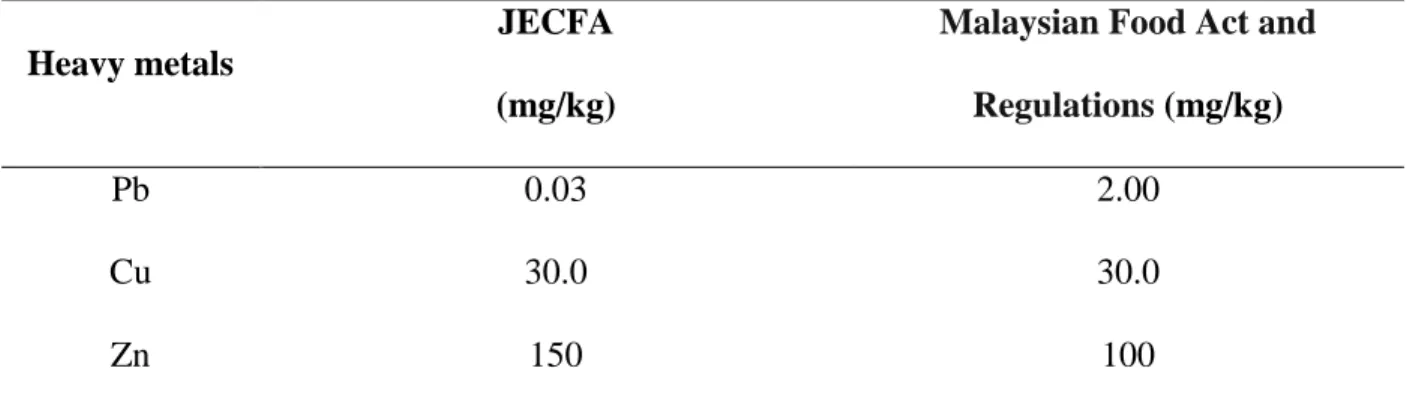
The concentration of heavy metals as stipulated under the guidelines of JECFA (1982, 1983, 1993 and 2000) and Malaysian Food Act and Regulations (1996) are as appended in Table 2.1.
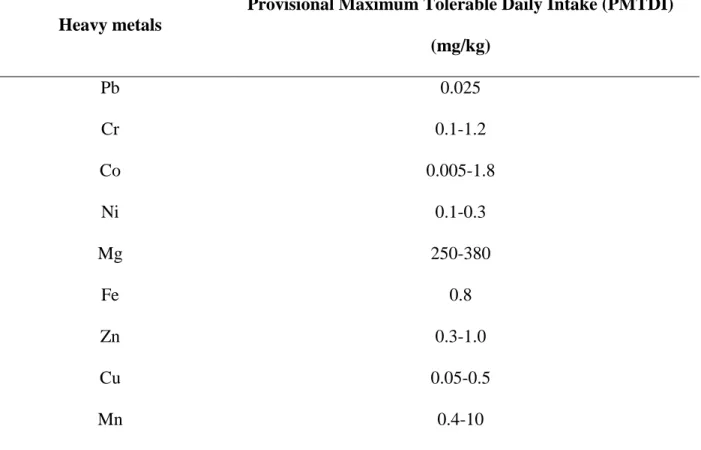
The Provisional Maximum Tolerable Limit for Daily Intake (PMTDI) of the heavy metals for human consumption as permitted under the guidelines as prescribed by JECFA (1982, 1983, 1993 and 2000) are shown in Table 2.2.
11
Table 2.1: Maximum Permissible Limit Concentration of Heavy Metals in Seafood by JECFA (1982, 1983, 1993 and 2000) and Malaysian Food Act and Regulations (1996)
Heavy metals
JECFA (mg/kg)
Malaysian Food Act and Regulations (mg/kg)
Pb 0.03 2.00
Cu 30.0 30.0
Zn 150 100
Table 2.2: Tolerable Daily Intake of Heavy Metals by Human as Prescribed by JECFA (1982, 1983, 1993 and 2000)
Heavy metals
Provisional Maximum Tolerable Daily Intake (PMTDI) (mg/kg)
Pb 0.025
Cr 0.1-1.2
Co 0.005-1.8
Ni 0.1-0.3
Mg 250-380
Fe 0.8
Zn 0.3-1.0
Cu 0.05-0.5
Mn 0.4-10
12 2.3 Edible Seafood
Edible seafood is defined as fish or shellfish from the sea that are served as food. In other words, they are fish or crustaceans that are suitable and deemed fit for human consumption.
Recently, seafood is a widely “global player” since the total volume of seafood traded internationally has increased from about 10 million to around 24 million metric tons during the last two decades (Yasuada and Bowen, 2006).
2.3.1 Benefits of Seafood
Over two billion people rely on seafood as a major source of protein in their diets around the world (Howgate et al., 1997). According to Martí-Cid et al (2007), the nutritional benefits of fish are its contents of high quality proteins, vitamins and other essential nutrients. Shellfish and crustaceans are good sources of protein. They are low in saturated fat, although some of them contain moderate amounts of cholesterol. Seafood products seem to have an important role in the prevention and modulation of neurological dysfunction, mild hypertension (high blood pressure) and cardiovascular diseases, (Valfrè et al., 2003; Gebauer et al., 2008) since they contains rich protein, B vitamins, and minerals, such as potassium, phosphorus and selenium (Gebauer et al., 2008).
2.3.2 Contamination of Edible Seafood
Rapid industrialization and the discharge of heavy metals into the marine environment has become a serious problem nowadays. These anthropogenic activities have increasingly affecting the safety level of seafood consumed. Anthropogenic chemical contamination, which includes Pb and Cd in the marine environment, has led to the increasing threat of high levels of heavy metals presence in the marine food chain (Dewailly et al., 2000). Many of the heavy
13
metals accumulate in the food chains. Plankton and algae in the ocean absorb the metals.
Small fish feeds on these plants and larger fish will eat these small fish and in due process incorporate the metals in their tissues (Schröder, 2007).
Microbial contamination by bacteria and viruses also lead to the decrease in the safety consumption level of the seafood as well as the increase in chemicals contamination (Fleming et al., 2006). Microbial contamination generally caused by sewage dumping as well as from indirect contaminated run off. Human are exposed to microbial contamination by consuming contaminated seafood, such as seafood poisoning. Shellfish such as oysters, mussels, and clams live in estuarine areas and obtain their food by filtering large amounts of water.
However, if sewage or chemical pollutants contaminate the filtered water, a wide variety of organisms and toxin pathogenic to human can accumulate in the shellfish alimentary tract.
2.4 Previous Studies on Determination of Heavy Metals in Edible Seafood
Numerous studies have been conducted to determine the presence of heavy metals in seafood samples in various parts of the world. The studies varied with different species, different analysis methods and the findings are also varied from one country to another country.
Levent et al (1998) carried out their analysis on mussel Mytilus galloprovincialis collected from the Sinop coasts of the Black Sea. The study showed that the levels of Cd and Pb in Mytilus galloprovincialis were higher whereas the levels of Zn and Cu were lower.
Higher concentration of these heavy metals could be related to higher industrial discharge of pollutants into the area. They found that used lead batteries were occasionally encountered on the Sinop coast and this leads to the higher concentration of Cd in Mytilus galloprovincialis.
The levels of the metals found in this study were generally lower than the permitted levels as
14
stated by The Food Safety (Live Bivalve Mollusks and Other Shellfish) Regulation 1992 and concluded that the mussel Mytilus galloprovincialis in the area is therefore still safe for human consumption.
Study by Keskin et al (2002) conducted their analysis on commercial seafood collected from different parts of Marmara Sea, Turkey. The study showed that edible mussel in that area contained higher levels of Cd and Hg and more higher than the maximum permissible limit by the Turkish Food Codex Regulation. However, Hg content in fish and crustacean species was slightly lower than the maximum permissible limit. Mussels accumulated more pollutants in their tissues as compared to the fish and crustaceans due to the fact that mussels are filter feeders.
Previous study carried out by Yap et al (2003) showed heavy metal concentrations in green-lipped mussel Perna viridis (L.) collected from nine sites in the west coast of Peninsular Malaysia did not pose acute toxicities. The heavy metal concentrations found or presence are lower than the permissible limits for human consumption and concluded that this was the result of mussels living in the west coast were not exposed to contaminate water.
According to Gras et al (1992), Chilean seafood which obtained from a company dealing with exporting canned and frozen products showed high concentration of trace elements in mollusk samples. This probably could be due to the food intake mechanism of these organisms. They noted that the canned mollusks in this form began subsequently to be discarded in the industrial canning process.
In Carvalho et al, research on 2005, had their analysis done on fish and octopus from fish markets along the Portuguese coast, Portugal. From the study, K and Ca are the most
15
abundant essential elements in the species studied. The highest value of K is in the octopus and poorest of Se content. The toxic elements Hg was the most abundant in all the species studied. The highest value of Hg is in the rockfish and poorest Hg content is in the octopus.
The high levels of Hg contained in the rockfish are due to the pollution by the toxic elements.
The coast was polluted due to the process of industrialization program.
Analysis on fish, shellfish and fish products from market in and around Cochin, India has been done by Sivaperumal et al (2007). The results from this study showed that all the samples contained heavy metals but within the maximum level permitted by the European Union except for Cd, Pb and Hg. The samples showing a higher concentration of these heavy metals could be related to industrialization activities in these areas.
Edible fishes collected from Azuabie creek in the upper Bonny estuary, Nigeria contained significantly higher levels of Pb than Cd. The higher Pb and Cd concentrations could be due to the industrial wastes discharge to the Azuabie creek. However, the concentrations of Pb and Cd found in the fish still save and suitable for human consumption (Daka et al., 2007).
Reddy et al (2007) analyzed heavy metals in fishes Harpodon nehereus and crabs Metopograpsus maculatus collected from Alang-Sosiya and Mahuva coast of the Gulf of Combay, India. The study showed that heavy metal concentrations in crabs are much higher compared to fishes due to the major functional differences in their body. The high bioaccumulation of heavy metals in fishes and crabs believed to be occurring due to rigorous anthropogenic activities.
16
Analysis on some fish species from Saudi’ market in Saudi Arabia was done by Al- Bader (2008). From the study, zinc showed has the highest levels of heavy metal concentrations followed by nickel and lead in the fish head compared to fish muscle. This is due to the refineries and petrochemical industry wastes discharged to Arabian Gulf. However, the concentration of heavy metals was not exceeding the maximum allowed limit by the Saudi and International Legislations and still safe for human consumption.
The research done on some fish species collected from Aegean and Mediterranean seas showed that metal levels in fish muscles were generally lower than those in livers. The metal levels in fish muscles and livers were far below than the Provisional Tolerable Weekly Intake (PTWI) and Provisional Tolerable Daily Intake (PTDI) values estimated for examined fish.
Therefore, it can be concluded that consumption of the fish species from each seas is not harm to human health (Türkmen et al., 2008).
Study carried out by Ololade et al (2008) found that heavy metal concentrations were higher in periwinkles L. littorea and blue crab C. sapidus collected from Ondo coastal region, Nigeria. The heavy metal concentrations in both periwinkles and blue crab were slightly higher than in fish due to the increased metal burden in their soft tissue through bioaccumulation. Dry and winter season are also play a major role in the bioaccumulation of these heavy metals by edible marine seafood. On dry season may present the greater risk of Co and Zn while on winter season may present the greater risk of Cu, Fe and Mn due to the increased productivity factor. However, they concluded that the edible marine seafood in the area should be safe for human consumption.