PROMOTING HEALTH EDUCATION- CHANGING LIFESTYLES
By
Qurratul Ain Asmawi 11297
Dissertation submitted in partial fulfilment of The requirements for the
Bachelor ofTechnology (Hons) (Business Information System)
AUGUST 2011
Universiti Teknologi PETRONAS Bandar Seri Iskandar
31750 Tronoh Perak Dam! Ridzuan
ABSTRACT
According to Health Facts published by Ministry of Health Malaysia (MOH) in 2010 most non communicable disease (NCD) consists of diseases that are implications of unhealthy lifestle are the main causes of death in Malaysia. This translates into the need of educating citizens on how to have a healthy lifestyle to avoid the risks of getting fatal NCDs. A Heahh Education Division has already been set up as one of the 5 division under the Public Health Department Ministry of Heahh Malaysia that could be seen through their various websites. The issue is the lack effectiveness of the website to educate regardless of the increasing number of online users. Thus, this research is planned to effectively conduct health education to reach the online citizens by the use of Human Computer Interaction theories as well as a learning theories. The main objective ofthis project is to implement these two theories in the development of the website is to create awareness to the community on the importance of living a healthy life as well as the implications of doing otherwise. The content of the website includes the main criteria of lifestyle such as hygiene, nutrition and physical activities and the knowledge of how to conduct a healthy lifestyle base on the criteria, and the implications of not doing so. The website also displays basic information regarding the disease which includes the causes of the disease, the implications to the body, the implication towards the life of a patient infected with the disease, and what can be done to prevent the disease, as well as what can be done to help people infected with the disease. The educating and learning process is also equipped with risk assessments of diseases that would act as a decision support system to the users. The result of this project is the increase of interest and awareness regarding the importance and knowledge of having a healthy lifestyle among the internet users. The conclusion of this research project is conducting health education online is effective if the right theories and techniques are applied, as well as taking into account the user's perspective.
ACKNOWLEDGEMENT
First and foremost, the author would express her most gratitude tu the Al- Mighty for His blessings which enabled her to uudergo the two short semesters to develop this project. Secondly, the author would like to express her utmost appreciation to Ms Penny Goh Kim Nee as her supervisor throughout the development of this project, for her kind guidance and precious time spent throughout every phase of the development to ensure the quality and successfulness of the project. Special thanks would also go to the author's family for the full support they showered upon the author especially morally and fmancially.
Next is appreciation to everyone that has contributed directly and indirectly, especially those who participated in the data gathering phase particularly the surveys done in order for the author to gain more information and insight of the potential users of the project. Lastly, special thanks to the author's fellow friends and acquaintances who have been a rigid supporter and encourager since the beginning of the development of the project towards the end.
This project would never be accomplished and successful without those mentioned above, thus once again I would like to express my greatest gratitude to all.
TABLE OF CONTENTS
CERTIFICATION OF APPROVAL ii
CERTIFICATION OF ORIGINALITY iii
ABSTRACT iv
ACKNOWLEDGEMENT v
TABLE OF CONTENTS vi
LIST OF FIGURES vii
LIST OF TABLES viii
CHAPTER 1: INTRODUCTION 1
1.1 Background of Study 1
1.2 Problem Statement 4
1.3 Objectives 4
1. 4 Scope of Study 5
CHAPTER 2: LITERATURE REVIEW 7
2.1 Human Computer Interaction 7
2.2 HCI Models and Theories 11
2.3 Comparison between similar websites 12
2.4 Gagne's Condition oflearning theories 16
CHAPTER 3: METHODOLOGY 18
3.0 Research Methodology 18
3.1 Planning Phase 19
3.2 Analysis Phase 19
3. 3 Design Phase 19
3.4 Development Phase 20
3.5 Tools 20
CHAPTER4: RESULTS AND DISCUSSION 21
4.1 Analysis of Questionnaire 21
4.2 Website Wireframe 27
4.3 Functional Modeling 29
4. 4 Website Interface 35
4.5 Tree Diagram 40
4.6 User Acceptance Test 42
CHAPTER 5: CONCLUSION AND RECOMMENDATION 43
5.1 Conclusion 43
5.2 Recommendation 43
REFERENCES 44
APPENDIX A (ONLINE QUESTIONNAIRE) 46
APPENDIX B (DOCTOR'S QUESTIONNAIRE) 48
APPENDIX C (GANTT CHART) 49
LIST OF FIGURES
Figure 1: Main page of Malaysia's Health Education Website 12 Figure 2: Main page of Singapore's Health Education Website 13 Figure 3: Classification of user category of Malaysia's Health Education Website 13 Figure 4: Singapore's heahh education website information classification 14 Figure 5: Malaysia's health education website self assessment tools 15 Figure 6: Singapore's heahh education website self assessment tools 15
Figure 7: Waterfall Methodology 18
Figure 8: Gender of questionnaire respondents 21
Figure 9: Age range of questionnaire respondents 21
Figure 10: Smoking habit of questionnaire respondents 22
Figure 11: Awareness of sickness causes of questionnaire respondents 22 Figure 12: Health seeking behaviour of questionnaire respondents 23 Figure 13: Time taken to consult doctor by questionnaire respondents 24 Figure 14: Willingness to learn about heahh issues by questionnaire respondents 25 Figure 15: Methods to conduct health education by questionnaire respondents 26
Figure 16: Website Interface 27
Figure 17: Activity Diagram for Medical Officer 29
Figure 18: Activity Diagram for User 30
Figure 19: Activity Diagram for Administrator 32
Figure 20: Use Case Diagram for the website 33
Figure 21: Overview interface for the website 35
Figure 22: Lifestyle Criteria for the website 36
Figure 23: Diseases interface for the website 36
Figure 24: Lifestyle Criteria for physical activities for the website 37
Figure 25: Risk assessment of the website 3 8
Figure 26: Forum for the website 38
Figure 27: Tree Diagram for Diabetes Risk Assessment 40
Figure 28: Tree Diagram for Stroke Risk Assessment 41
LIST OF TABLES
Table 1: Ten main causes of death in government hospitals Table 2: Health conditions of Malaysians in 2008
Table 3: Malaysians activity done online Table 4: Captology Outlines
Table 5: User Acceptance Test Results
I 2 3 10
42
CHAPTER 1: INTRODUCTION
1.1 Background of Study
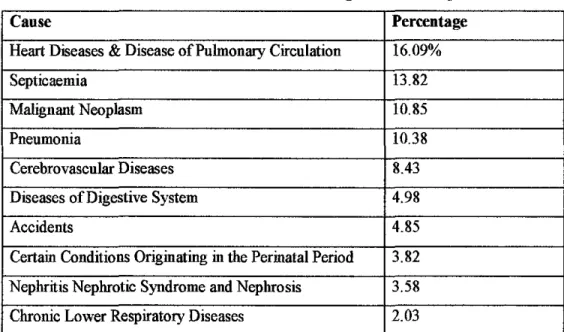
Based on health facts of 2009 published by the Ministry of Health, the population of Malaysia is 28,306,700 where 14,407,200 are male citizens while the remaining 13,899,400 are fumale. According to Health Facts published by Ministry of Health Malaysia (MOH) in 2010, below are the 10 main causes of death in MOH hospitals.
Table l: Ten main causes of death in government hospitals
Cause Percentage
Heart Diseases & Disease of Puhnonary Circulation 16.09%
Septicaemia 13.82
Malignant Neoplasm 10.85
Pneumonia 10.38
Cerebrovascular Diseases 8.43
Diseases ofDigestive System 4.98
Accidents 4.85
Certain Conditions Originating in the Perinatal Period 3.82 Nephritis Nephrotic Syndrome and Nephrosis 3.58
Chronic Lower Respiratory Diseases 2.03
Based on various researches done, below ts the table of fmdings regarding Malaysian's health situation in 2008.
Table 2: Health conditions of Malaysians in 2008
Criteria Percentage
.
National prevalence of diabetes 25.7%
50% of Malaysian male adults (age>l8) smoke. 11.0%
2 out of 5 adults is obese/ overweight 53.5%
14.9% ofaduhs (age >30) have diabetes 25.5%
43% of aduhs (age >30) have hypertension 60.1%
20.7% of adults (age >18) have high cholesterol level 31.6%
Non communicable disease (NCD) consists of diseases such as heart attack, asthma, cancer, diabetes and stroke. WHO also indicated that these NCD occurrences are the implication of inhabiting unhealthy and other factors such as socioeconomic development, enviromnental degradation and pollution. By observing the NCDs, we can conclude that each have similarities in terms of risk factor which pretty much relates to unheahhy lifestyle shown in Table 2 above. Based on a survey done to 10 doctors in 2011 at Hospital Sultanah Nor Zahra Terengganu, 2 in 3 doctors when asked their hope towards Malaysian's health is would answer changes in lifestyles.
Malaysian Society of Hypertension (MSH) in 2009 has revealed that 3 out of 4 with high blood pressure is not knowledgeable about the key regulator of blood pressure in the body, but 8 out of 9 of them indicates that they do understand the symptoms of high blood pressure is something to take concern for, and they also wanted to understand what is happening in their body system that has caused the heahh complication. MSH also indicated through a survey done to 2400 adults, 90% does understand the importance of the knowledge and understanding regarding health complications that has affected themselves or their loved ones. This indicates the low level of knowledge regarding heahh issues possessed by our dear Malaysians, and also a sign that they are willing to learn as it will also benefits them. This is where Health Education becomes vital.
A Health Education Division has already been set np as one of the 5 division under the Public Health Department Ministry of Health Malaysia that could be seen through their website. The issue is the methods of conveying these Health Care lessons to the society. One method to be considered is through the internet, as according to Nielsen Media Index survey in 2008, the growth of Internet usage in Malaysia has been increasing steadily, with the percentage of two in I 0 of the population and the rate of usage of the internet is 1-2 hours daily for 4 out of I 0 people. Other fmdings from the Nielsen Media Index survey are as follow:
Table 3: Malaysians activity done online
Activity Percentage
Online TV /music/games 47%
Message/chat/blogging 45%
Reading newspaper/magazines 35%
The fact that Malaysian citizens spend a lot oftime a day online shows a lot in the behaviour of the citizens. It also indicates the characteristics of an online service that attracts them to spend time on the net; easy access, simpler method of gaining information, and low cost to no cost at all. Still, the big number of netizens did not translate into wider coverage of audience when it comes to online heahh education.
1.2 Problem Statement
1. The increase of non communicable diseases and fatal diseases among the Malaysian population that are proven in most cases as the implications of non healthy lifestyles implemented in citizen's daily life.
n. The lack of knowledge and understanding of human body function that results in ignorance of health issues and complications of oneself.
m The willingness and awareness of citizens to gain the knowledge regarding health but the ignorance of how to achieve it.
tv. The inability of the public to project the long term implications of critical diseases cause them to look at the disease with low priority, thus the poor prevention of the diseases.
v. The emerging number of netizens of Malaysians yet the inability to conduct health education effectively throughout the World Wide Web.
1.3 Objectives
The aim of this project is to produce a website that will focus on Health Education in regards to promote healthy lifestyles for Malaysia citizens.
The objectives of the project are:
I. To develop a website that is designed as a Health Education tool particularly in promoting changes towards a healthy lifestyle.
II. To apply human computer interaction and learning theories in pursuit to enhance Health Education effectively.
1.4 Scope of study
1.4.1 Human Computer Interaction
According to SIGCHI Curriculum Development Group (1992), human-computer interaction is a discipliue concerned with the design, evaluation and implementation of interactive computing systems for human use and with the study of major phenomena surrounding them. Don Norman (2004) pointed out that design is emotional was au important step that helped bring additional attention to existing affective computing. Different theories of human computer interaction will be studied throughout the project timeliue.
1.4.2 Health Education and Lifestyle Changes
Health education is basically giving lessons and education on health. It is very vital in order to give everyone the opportunity to acquire information and the skills needed to make quality health decisions. Lifestyle changes in this context is the promotion of having a balanced life that eliminates all bad habits, activities, behaviours and routines that could jeopardize or effect one's health condition in a negative way. It is also important to treat a healthy lifestyle as a journey, not merely a destination to be achieved in one's life. (Whitehead, 2003).
In terms of the health education aspect, the following health criteria will be evaluated and studied based on recommendations from Edisi Sihat 1 and Edisi Sihat 4 (2008):
1. Hygiene n. Social health iii Food and nutrition tv. Physical activities v. Health seeking behaviour
Apart from the above health aspects, diseases that results from such bad lifestyle or health practice will also be studied as in:
1. Cancer
n. Diabetes mellitus iii. Hypertension
IV. Cardiovascular diseases v. Obesity
1.4.3 Website development
The project will focus on user centred website development as the project will be built to accommodate users. During the timeline, various websites will be studied and compared in terms of their content organization, visual organization, colour, typography, accessibility, globalization and personalization. Whichever method and characteristics in developing a website that is found to be suitable and appropriate will be implemented into the project.
CHAPTER 2: LITERATURE REVIEW
2.1 Human Computer Interaction
According to Baele and Peter (2008), as affect and emotion plays an important role in our daily lives, when it comes to interactivity, we become more aware of emotion, whether seeing another's person emotional expression or not getting any emotional expression when we are anticipating it. According to A Razek, Chaffar, Frasson and Ochs (2006), the effectiveness of intelligent tutoring systems can be improved when learner's emotion are also considered when developing the system. As this situation occurs, it becomes relevant to study the human-computer interaction, to observe the underlying principles, study the roles they play, to develop methods to quantifY them and to develop applications applying them.
2.1.1 Functional Triad
According to Fogg, Cueller and Danielson (2009), the functional triad is the framework for persuasive technology. Form a user's perspective, the computer functions in three fundamental ways:
(a) Tools (b) Media (c) Social actors.
2.1.2 Computer as tools
As computer functions as tools, there are four general ways a computer could persuade by:
1. Increasing self-efficacy
11. Providing tailored information, m. Triggering decision making and
1v. Simplify or guide people through a process.
l Increasing self-effzcacy
Perceived self-efficacy is defmed as people's beliefs about their capabilities to produce designated levels of performance that exercise influence over events that affect their lives (Bandura, 1994). An analogy is a heart rate monitor that provides information such as calories burned during a workout session would make people feel more effective in achieving their exercise goals (Fogg eta!, 2009).
Il Providing tailored information
The second way a computer can persuade human is by providing tailored information. As we all know every human has different needs and desires. Based on many scholars opinion, tailored information are more likely able to increase potential of behavioural and attitude changes, as opposed to general information as tailored information is more likely able to increase attention and arousal of humans. An example used in the book is Chemical Scorecard (www.scorecard.org) which triggers user to enter their zip code and outputs the chemical hazards of the area of zip code entered, the reasons of hazards exist and the potential health risk to achieve a persuasive outcome.
Ill Triggering decision making
Third factor of persuasiveness of a computer towards human is by triggering decision making. The method could be as easy as alerting people before they access potentially harmful or inappropriate web based contents as well as before they send private and confidential information over the net. Some other sophisticated methods of persuading human by triggering decision making is in decision support system usually designed for business practice to make decisions regarding the organization or business practice based on the data and information collected by the system in the knowledge database.
IV. Simplify or guide people through a process.
The last method of human computer persuading is by simplifying or guiding people through a process. As the computer literacy increases as time, computer complexity also increases. Having a computer process that could lower down these barriers and limitations by facilitating and simplifying the process. This especially applies to e- commerce, as ease of the business process such as decreasing the time needed and steps required to achieve a goal, the business has already remove the barriers for purchasing their products through the net.
2.1.3 Computer as persuasive media
According to Fogg et al (2009), another area that computers can be used to interact with human is through persuasive media In this context, "media" refers to computer simulation such as providing people with first hand or vicarious experiences. Three types of relevant computer simulation are:
1. Simulated canse and effect scenarios n. Simulated environments
m. Simulated objects
2.1.4 Computer as social actors
The third functional triad mentioned by Fogg et al (2009) is computers as social actors. It is proposed that computers as social actors can persuade people to change their attitudes and behaviours by
1. Providing social support
n. Modelling attitudes or behaviours nt Leveraging social rules and dynamics.
As health education regarding changes m lifestyle is mainly about educating, motivating and persuading people, the most appropriate method of computer persuasion as a tool is by increasing self-efficacy, providing tailored information as well as having features that triggers decision making. From the perspective that computers as persuasive media, the suitable simulations would be used is simulated cause-and-effect as it can demonstrate consequences of an action done immediately and credibly.
The third Functional Triad method, computers as persuasive social actors, the method that will be implemented in this project are computers that model attitudes and behaviours as it is used to provide social support, and computers that leverage social rules and dynamics as human are usually more honest in interacting with a proximate computer than having to interact with a computer that is believed to be far away from them.
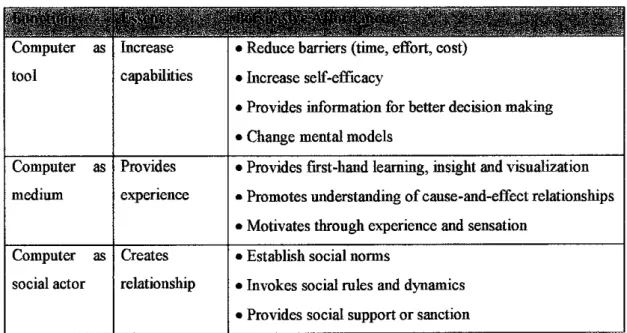
Below is the Captology Outlines of the three ways computers influence people, as according to Fogg et al (2009):
tool
as medium
Computer as social actor
Table 4: Captology Outlines
capabilities • Increase self-efficacy
• Provides information for better decision making
• Change mental models
• Provides frrst-hand learning, insight visualization expenence • Promotes understanding of cause-and-effect relationships
• Motivates through experience and sensation
• Establish social norms
relationship • Invokes social rules and dynamics
• Provides social support or sanction
2.2 Human Computer Interaction Models and Theories
According to Alan Dix, Janet Finlay, Gregory D. Abowd, and Russell Beale, there are different theories and models of Human Computer Interaction. Among them are cognitive models, socio-organizational issues and stakeholder requirements, communication and collaboration models and task analysis.
2.2.1 Cognitive Models
The techniques and models in cognitive models in a way represent users as users will interact with an interface, based on users' understanding, knowledge, and intentions and processing. Each level of representation differs from each techniques and the way to classifY the model in by how the model describe features of the competence and performance of the user.
Competence model tends to be the ones that can predict legal behaviour sequences but generally do this without reference to whether they could actually be executed by users. In contrast, performance models not only describe what the necessary behaviour sequences are but usually describe both what user needs to know and how this is employed in actual task execution.
2.2.2 Socio-organizational issues and stakeholder requirements
Based on Alan et al, problem in systems arises when it introduces without adequate understanding of all the people who will affect by it. To better understand and support complex organizational structures, workgroup and conflicting stakeholder needs, it is important to capture and analyze the requirements within the work context, not abandoning the complex mix of concerns felt by different stakeholders.
Stakeholders can be defmed as any individual that is affected by the success of failure of a system.
2.2.3 Communication and collaboration modds
Effective communication usually implies much collaborative work and many systems aimed to support communication at a distance. This indicates the importance of having good communication within a system to enable it to produce desired output among the users. Types of communication that relates to this model are face to face communication such as eye contact and gaze, as well as gestures and body language, conversation and its structure, and also inducing text-based communication.
2.3 Comparison between similar website
For this project, there are two similar websites taken into account for analysing purposes. The websites are Malaysian Health Education site, www.infosihat.gov.my and the comparison website is Singapore Health Education site, www.hpb.gov.sg
2.3.1 Main page
Below is the main page of both websites. As English and Malay are the main language spoken in Malaysia, the Malaysian website offers two different languages for visitors to view, where as the Singaporean website only offers English as the main language spoken in Singapore is English.
---··-·"
... _._.
-
._.,.,...,._._
.__._.
...
~---
_...__ ...Figure 1: Main page of Malaysia's Health Education Website
HPB O ttfitte
--~-_.., -;.
l d l Cillflft ,._._. ..., .. . . ,.,... . _ . . " _ _ e-ra ~-=-- ... ~
- - .... _ ... . ,..._
~.... a
Learn more about health screening.
Figure 2: Main page of Singapore's Health Education Website
2.3.2 Classification of information
Next is the comparison between the classifications of the information displayed of the website. Each website has categorised the health information based on the user's characteristics.
Figure 3: Classification of user category of Malaysia's Health Education Website
The classification of users for the Malaysia health education website is more to categorizing the users based on age ranges. The classifications are IUds, Teenagers, Prime Years as well as Golden Years. Each category displays information that is relevant to the age range chosen.
As an example, by choosing the Kids category, information displayed will be mainly about children's health like importance of mouth hygiene and allergies. In Teenagers category, information includes smoking implications to health as well as bad habit such as taking too much alcohol. In the Golden Years category, the information includes osteoporosis and menopause for elder ladies.
I am ...
an Educator
a Healthcare & Fitness Professional
a Workplace Health Facilitator a Community Health Promoter a Caregiver or Older Adult a Youth
a Parent
Figure 4: Singapore's health education website information classification
For the Singapore's health education websrte, the users are categorized by their nature of lifestyle, such as parents, educator, or caregiver. It differs from the Malaysia's health education website because this website focuses more on the type of people and their daily routine, and work nature. By having these types of criteria.
it helps the user to better relate to the information given in the website, thus making it easier and more appropriate to be applied mto their daily life.
2.3.3 Self Assessment tools
Apart from the categories for users in each website, there are also self assessment tools available to users that could help them assess their health level Both website offers interactive self assessment tools such as calorie calculator, body mass index calculator, smoking level of dependency, asthma control test as well as heart disease risk.
...
...
~ -...~.,..-
... _ ... _ ... ...
..,.a.._...,...,._... __ J _ ... _ ...
PHYSICAl AC-.lTY
h.,. ... '""-
,....,. ... ..
.
~'~..,,.I'~ •
~· :. ' ~~
...
~ A,._..,,_._. •• ;
~'""'••v.,ttt:
,·
..
~URTD1SE...ASE
f I ' • ~.
~,:~·;: ···" .... (_."-
,...,
... _ ..
,....,..._ ... ,_
...
...,... o..,_...c . -
. . . _IIOD'I".u&IIICID.
-"'- -
Figure 5: Malaysia's heahh education website self assessment tools
Health Tools
uu hs CIHnalr 1D
COMCII(IUI'.-.~
hl-.e cfuloe at 10411 Ull~lnd~
i kiiHO J tuM!ng
""'
haniiO 11n0 htall\41 t--..n..'{fN?lrt l l u U u i i O - klt~llnO
... _,..
Aathma Control Teet
fhd ... IMlMOf ~ ta.Wtftlt"-rfltfll
·-- ----
•••"'*lllcQnd-·""'
F.ndN,_.man.,- calonu , . , Meel per 41'1'. USinG ow C..O••
c . . -
811 Calalletor
AttflltJII'I ... ht_,
l"'f''t?Cft.td: pcu Elo$Yauftlt«
fMJ.-..obSIDIIi
NHd.,CI'IIInlti!Qif
""""-"
--
Cinft P (lu"9f' ii Af!c>o~nw.,.Clna .PotfldWWCI otSdiO<IIom.
Figure 6: Singapore's health education website self assessment tools
2.4 Gagne's Condition of Learning Theory
Cognitive Psychology is the study of how people think, understand, and know about an issue or knowledge. Based on Gagne's Condition of Learning Theory (1974) which applies cognitive psychology, there are different types of learning levels in individual which are verbal information, intellectual skills, cognitive strategies,motor skills as well as attitudes. According to Ronda Critchlow (2006), these 5 types of learning levels are discussed as follow:
I. Verbal information: Reciting something from memory II. Intellectual skills:
• Discrimination: Recognizing that two classes of things differ
• Concrete concept: Classifying things by their physical features alone
• Defined concept: Classifying things by their abstract (and possibly physical) features
• Rule: Applying a simple procedure to solve a problem or accomplish a task
• Higher-order rule: Applying a complex procedure (or multiple simple procedures) to solve a problem or accomplish a task
III. Cognitive strategies: Inventing or selecting a particular mental process to solve a problem or accomplish a task
IV. Attitudes: Choosing to behave in a way that reflects a newly-acquired value or belief
V. Motor skills: Performing a physical task to some specified standard
Gagne (1974) also indicated that instructional events do not only produce learning, but may also support the learner's internal process. These events include such as follow:
1. Gain Attention: it is related to the processing of perception
11. Inform objectives: it builds up expectancy
111. Stimulate recall of prior knowledge: it initiates the retrieval from working memory
IV. Present stimulus material: it focuses on selectively perceiving stimulus v. Provide learner guidance: it related to the encoding process
v1. Elicit performance: the focus is response
VII. Provide feedback: the focus is reinforcing response
vm. Assess performance: it establishes cueing retrieval
IX. Enhance retention and transfer: it requires generalization process
CHAPTER3:METHODOLOGY
3.0 Research Methodology
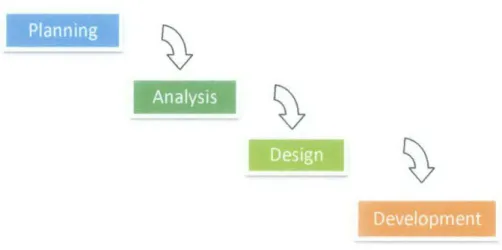
During the project timeline, a methodology will be adopted as it is important to have a clear, organi7.ed, structured planning of tasks to be done in order to accomplish the project's objectives. The method used to complete this research is the Waterfall Methodology.
· Planning
··1~-Analysi~ :
.
'Figure 7: Waterfall Methodology
The Waterfall Methodology model describes a development with distinct goals for each phase of development where each phase is completed before the next phase is started - resembling a waterfall Below are the lifecycle development stages, where each stage is pre-specified of the planned tasks to be completed.
3.1 Planning Phase
• Redefined the project scope and plan thoroughly the objectives to be met.
• Thorough research on scope of study namely Human Computer Interaction, Decision Support System, Website Development and Health Issues.
• Conduct interviews, questionnaire and surveys to get coUect data and gain more knowledge and understanding of underlying scope of study.
• Decide development tools that will be used in developing the final product.
3.2 Analysis Phase
• Analyze work done in planning phase and lists of fmdings are documented based on the studies done.
• Ensure fmdings can help mitigate the issues and limitations stated in the problem statement and background of study as stated in previous section.
• Compare other similar systems and abstract the appropriate characteristics that could be used in developing the project/system.
3.3 Design Phase
• Design algorithm of the decision support system that will be implemented based on studies done prior to the design phase.
• Design user interface of website by implementing the suitable theories ofhuman computer interaction
• Design flow of information that will be displayed in the final product.
3.4 Development Pbase
• Develop a decision support system that uses the algorithm designed above with adequate and appropriate data and information covering the scope of study.
• Develop a website implementing theories of human computer interaction and equipped with findings
• Perform user acceptance test (UAT) of the fmal product
• Implementation of the final product and analysis of the results generated.
3.5 Tools
• PHP
• phpMy Admin - MySQL database
• Macromedia Dreamweaver
• Microsoft Office tools
t
CHAPTER 4: RESULT AND DISCUSSION
4.1 Analysis of Questionnaire
A online questionare was conducted in the Planning phase to better gtve understanding and knowledge of the target audience that will contribute to the development of this project. 70 people had participated in the survey, and below are their responses as weU as the analysis of the responses.
Gender
• Male Female
J
Figure 8: Gender of questionnaire respondents
Based on the information gathered, of the 70 people that participated in the survey, 66% ofthem are female; whereas the remaining 34% are male respondents.
Age
•18-25
• 26-35 36-45
>46
Figure 9: Age range of questionnaire respondents
6?0/o of the online questionnaire respondents are aged 18-25 years old. 19% are 26- 35 years old, 10% are 36-45 years old, as the remaining 4% are aged more than 46 years old. This reflects that the analysis of behaviour of the respondents in this online
questionnaire will be more favouring the youth as they are the majority of the respondents. This is also a reflection that people aged 18-35 will be the main focus of the project development in the future.
Smoking Habit
Smoker Non-smoker
Figure l 0: Smoking habit of questionnaire respondents
J
7% of the 70 respondents admit to be smokers; whereas the remaining 93% are not smokers. Based on this information gathered, it is poss1ble to conclude that smoking b.abit changing wilJ not be stressed in this project as much as other bad habits as smokers are only the minority of the target audience.
Awareness of Sickness C auses
aves
No Not Sure
Figure ll: Awareness of sickness causes of questionnaire respondents
Based on the online questionnaire, 50% of the respondents answered 'Yes' when asked are they aware of the causes of their sickness or disease that has infected them.
31% do not know the causes of their diseases where as the remaining 19% are not sure about the causes. This is an indicator that the public is not fully aware of the causes of the disease or sickness that has infected them. By not knowing the cause, it is difficult for an individual to take further action in order to prevent repeat infection, what more to cure it.
Health Issue Seeking Behav iour
• Family members/
Friends Internet
Doctors
Figure 12: Health seeking behaviour of questionnaire respondents
The diagram above indicates the behaviour of the public when faced with curiosity of their body function/ health issues. 40% of the respondents opt to search information regarding the issue on the internet; where as another 39% will seek help from their family members/ friends. Only 21% will opt to consult a doctor immediately. This reflects the behaviour of the public that they are more comfortable to tum to the information in the internet, anonymously, but also vulnerable to wrong and imprecise information, that could further jeopardize the heahh situation/ knowledge of an individual.
The 39% of respondents that chose to seek information from family members/
friends indicate that the public are more willing to turn to people they are comfortable and fond to, in search of information regarding health issues. This is also a risk of getting imprecise information, as not aU family members/ friends are equipped with the right information regarding health, especially those who are not in line with any health section.
The remaining 21% of respondents opt to immediately seek a doctor when encountered curiosity or difficulty regarding their health matters. Even though this is the best practice as doctors are very knowledgeable in heahh aspects in terms of the causes and remedy of any disease, the public does not favour this option as they will have to put more effort to consult a doctor. This effort includes money, time, and etc, thus resulting in low respondents choosing this option in seeking information regarding their body function or health issues.
Time taken to consult doctor after infected with disease
Same/Next day
The same week
Just wait for it to heal by itself
Figure 13: Time taken to consult doctor by questionnaire respondents
Based on the diagram above, the majority of respondents (39%) said after infected with disease such as cough, flu, or fever, they will just wait for the sickness to heal by itself, as in not consulting the doctor at all. Another 20% chose not to consult a doctor till it gets out of hand. This indicated the behaviour of the public, which take health issues lightly without the urge to consult a doctor immediately if being infected with sickness.
The public may not be fuUy aware of the implication and degree of seriousness of the disease or sickness. This is a risk to the public health as any disease or sickness that is not properly treated could worsen the health stage of an individual. However, 23%
will consult the doctor immediately within the same or next day after being infected, and the remaining 18% will consult the doctor in the same week. This is a good habit, thus the number should be increased by having proper health education.
Willingness to lea rn ab out health issues / body function
Yes
No Maybe
Figure 14: Willingness to learn about health issues by questionnaire respondents
84% of the 70 respondents of the online questionnaire have the interest to learn about health issues or their body function. As mention is previous section above, this indicates that the public does understand the importance of the knowledge and understanding regarding health complications that has affected themselves or their loved ones and a sign that they are willing to learn as it will also benefits them. 13%
are undecided whether or not to learn or not, while the remaining 3% chose not to learn about health issues. Though this number is smal~ it is important to make the public willing to learn about health issues or body function, and this is where health education plays an important role.
Interested Met hod o f C onducting Health Education
• Website
• Books Pamphlets
• Speech
Exhibitions Others
Figure 15: Methods to conduct health education by questionnaire respondents
The diagram above shows the methods the respondents are interested to learn health education from. 44% are interested in learning through websites, which indicates that the public prefer to learn from a medium that is available 24 hours a day, easily accessible, despite where and when they would want the information to be available.
20% are interested in pamphlets, an indication that they would want the information to be short and simple, without leaving out any important information.
16% of the respondents prefer to read books to obtain health education, indicating that they would like the information to be detailed, precise, and adequate in the effort of learning about health issues or body function. ll% would prefer exhibitions, which reflects their interest in learning through real life cases, pictures, facts, and people. 4% chose to learn through speeches of health officers, but the small number indicates that this choice is obsolete and less preferable by the rest of the respondents. The remaining 5% chose other methods of learning about health education, such as learning from an individual that has experienced a particular disease or sickness, or through an internet application, such as Twitter.
4.2 Website Wireframe
[~--BANNER_~]
OVERVIEW LIFESTYLE DISEASES RJSK FORUM OTHER
CRITERIA ASSESS- LINKS
MENT
INTRO
[ LOGrn
l
[ CONTACTUS
l
Figure 16: Website Wireframe
Website key criteria based on the wireframe design above:
• Banner: The banner of the website.
• Overview: Contains the introduction of the project, login for users, admin and medical officers as well as the contact person for the project or website.
o Lifestyle Criteria: Criteria of a lifestyle that is focused during this project such as hygiene, social health, as well as food and nutrition, and the information of right way to have a lifestyle based on these criteria.
o Diseases: The detailed information that also includes long term projection of top fatal diseases or sickness such as diabetes, high blood pressure and heart failure.
o Risk Assessment: Self assessment tools that will help predict the risk of an individual being diagnosed with certain diseases based on their lifestyle criteria they provide.
o Forum: An online discussion site where people can hold conversations in the form of posted messages, which will also be governed and handled by medical officers from Ministry of Health Malaysia.
4.3 Functional Modeling
4.3.1 Activity Diagram
Activity diagrams are used to model the behaviour in a business independent of objects. It also includes notation that address the modelling of parallel, concurrent activities and complex decision making. Below is the activity diagram for each different user of the system. This website is targeted toward youth aged 18-25 therefore the information will be tailored accordingly. There are three types of actors in the Health Education Website:
(i) Medical Officers
Post in Forums
•
Edit Forum Posts
Figure 17: Activity Diagram for Medical Officer
The above diagram is the activity diagram for the third actor of the website, the medical officer. The medical officer must frrst login into the website to he authorised to perform their designated task. The two tasks allocated for the medical officer is 'Post in Forum' and 'Edit Forum Posts'. These two tasks are to enable the medical officer answer the questions posted by the user, as well as to edit his/her forum posts.
(ii) User
I
Choose Activity9
~ ~ ~ ~
I
Lifestyle CriteriaI I
Disease Fcrum Risk~
AssessmentChoose ( Select disease
'Login
[ SignupJ
Key inlifestyle
~
informationcriteria
Information of disease Information of
right lifestyle
Post in EditFmun
Forum post
Prediction of disease displayed
*
•
Figure 18: Activity Diagram for User
Based on the figure above, the actor is the user. There are 4 main functions a user can use, which are clicking the tab 'Lifestyle', 'Disease', 'Risks' and 'Forum'. By choosing the tab 'Lifestyle', the website will display the types of lifestyle habits which include hygiene, social health, food and nutrition, physical activities and health seeking behaviour.
After selecting the type of lifestyle habit desired by the user, the website will display the information on how to have a healthy lifestyle based on these criteria. An example is which food and nutrition is good for the body as well as which physical activities are needed in order to keep fit every day. This information is generic and not tailored to the user's unique classifications.
If the user selected the 'Disease' tab, it will display a list of fatal diseases which are cancer, diabetes mellitus, hypertension, cardiovascular diseases and obesity. Due to the limited time of the project development, the project will only focus on these 5 diseases which are the most common disease in the nation. After selecting the type of disease a user wishes to learn about, the website will display information regarding the disease. This include (but not limited to) the causes of the disease, the implications to the body, the implication towards the life of a patient infected with the disease, and what can be done to prevent the disease.
When the user selected the 'Risk Assessment' tab, the website will display a fun interactive tool that is designed to predict users' risk of being diagnosed with certain diseases among the five diseases mention above based on the information provided by the user. This information includes the details of the current lifestyle a user is having and the tool will predict the risk of the user to be diagnosed with a disease given that he/she continues to have a bad lifestyle.
The 'Forum' tab is for the users to ask health related questions to the appointed doctor of the website. To be able to post/view the forum, a user must first register themselves. She/he will also be able to view other people's post in the forum and communicate with the community of the website.
(iii) Administrator
EditForwn post
Manage users
•
Maintain information
Figure 19: Activity Diagram for Administrator
The figure above is the activity diagram for the administrator of the website. An administrator must first login in order to have the authorisation as an admin After being logged in, there are three tasks available to the admin which are 'Edit Forum post', 'Manage users', and 'Maintain information', 'Edit Forum post' task is to maintain the forum from any post that could jeopardize the credibility and quality of the website due to undesired post such as advertisements, and most importantly rude, inappropriate and racist posts that could conflict the nations' harmony and peace.
An admin can also manage the users in terms of housekeeping of the users, which includes deleting users that are idle for a certain period of time. The admin can also maintain the information display within the website. This could be adding or editing information that could be insufficient or incorrect. It is also designed for further expansion of the horizontal and vertical function of the website in the future.
4.3.2 Use Case Diagram
Administrator
Medical Officer
Maintain information
displayed
<<extend>>
•
«extend»Manage
<<extend>>
Answer question in
Forum
<<extend>>
Update personal information
Figure 20: Use Case Diagram for the website
User
The figure above is the use case diagram for the website. Based on the diagram, there are three actors in the system, namely Admin, User and Medical Officer.
1. Administrator
• Maintain information displayed:
- Add information on diseases - Delete information of diseases - Add/ Edit type of diseases displayed
• Maintain users:
- Delete idle users
- Approve new users' registration
• Manage Forum posts:
-Edit posts - Delete posts -Add posts
2. Medical Officer
• Manage Forum post - Edit his/her post - Delete his/her post
• Answer questions posted in Forum
3. User
• Ask questions in Forum
• Edit personal information
4. 4 Website Interface
---..-~-,
... _
...·-,
... ~..._-....
,... - .. -,.... ...
Figure 21: Overview interface for the website
Above is the picture of the overview of the website. It shows the objective of the website and a brief introduction of the functionality of the website to ensure user's basic uuderstanding on how the website operates. According to the Human Computer Interaction (HCI) theories, this can be translated into a persuasive technology where the computer will function as a tool to persuade by providing tailored information and simplify or guide through a process. The login function available at the right hand side of the website is to enable users to login and communicate with the community or even ask medical questions to the doctor available at the foruut.
Through the implementation of Gagne's Condition of Learning Theory, the website is design so that it would gain attention and inform the learners of the objective, which tells the learners what they are able to do after the learning session.
·~-
... -
......- . ...
...
~···-·...,-......
- --
--- --
- - -.-
Figure 22: Lifestyle Criteria for the website
r: -- · - -- .
o ...
• CAIJCF:R
• C/'.~01-0Y""CLL/'.~
Dl"E""<"C""
• D l.An Efl:<;
·oF.~ln
•
wrrR.~f.K!otJ . __ --- .... __
-·
Figure 23: Diseases interface for the website
The second tab and third tab is the Lifestyle Criteria and Diseases tab. As mentioned above, the Lifestyle Criteria tab displays five types of lifestyle habits which includes hygiene, social health, food and nutrition, physical activities and health seeking behaviour. It will then display the information on how to have a heahhy lifestyle based on these criteria. This information is generic and not tailored to the user's unique classifications. Meanwhile, the Diseases tab also displays 5 types of highly fatality diseases. By clicking each disease, the website will display information which includes the causes of the disease, the implications to the body, the implication towards the life of a patient infected with the disease, and what can be done to
This feature is applying the concept of computers as tools in HCI, where it will display useful information designed to increase the level of knowledge of the users.
It can also trigger decision making through the degree of depth of the information provided regarding the lifestyle. It also implies the HCI concept of computer as persuasive media by creating simulated cause and effect scenarios through ftrst hand learning, insight and visualisation which could motivate changes through experience and sensation.
Lifestyle Criteria » Pllyslul Activities
TM~ G4CIUI'fla.ofllfftMI'rcvr.•..e•ww~onkllJ'
..., .. ,..."""" ...
-."""'"~-Figure 24: Lifestyle Criteria for physical activities for the website
Most of the interface applies Gagne's learning theory of level of cognitive strategies, by presenting stimulus and providing guidance learning by displaying the contents with distinct features as weU as using a meaningful learning method. Because most of the information will be lengthy, it may cause boredom and lack of interest to the users. This is why the website uses videos containing the information required. This way, it is planned that the learning process becomes more fun and attractive.
---·--
_ . . H . . . . . - . .
-~-~
__
..__._--
Figure 25: Risk assessment of the website
The next tab in the above picture is the Risk Assessment tab. This tab contains a simple risk assessment of highly fatality diseases in Malaysia, which can also act as decision support system to users. Based on the information regarding their lifestyle provided by the users, it will calculate the percentage of risk of a disease to affect the user. The four risk assessment for the diseases provided are for diabetes, lung cancer, heart disease and also stroke. This applies the HCI theoryofusing computers as tools to trigger decision making. When a user uses the risk assessment tool and get to know their risk of having a disease, it will defmitely take control of their life and start a healthy lifestyle to lessen the risks of diseases.
Forum
__ .... .,... ... -=-
~- - ,_ ... ·•
. ....
~u :::::..., -=-
T011fS0 _ _ _.,..
-·
u"
--
... ...,... ,-· ... _
u -- -·
,-· ...
.,.u -
L ~ ~,_. ~·
...
--
'(1'01.'0-....-:•~This website is also equipped with a forum, that enables users to communicate among the website community, about anything regarding health. A doctor will also be active in the forum, which allows users to directly ask the doctor health issues or questions they may want to relay to the doctor. According to the functional triad by Fogg, Cueller and Danielson (2009), this refers as computer as social actors by providing social support to the users.
From Gagne's learning theory perspective, the forum can be viewed as the tool of eliciting performance, providing feedback, as well as assessing performance. The communication between users of the forum and the doctors is a good example of how feedbacks are given regarding their health issues or enquiries, that users may not have a time, opportunity or guts to set an appointment with a doctor to rectify about the issue.
4. 4 Tree Diagram
CHAPTER 5: CONCLUSION AND RECOMMENDATION
5.1 Conclusion
In conclusion, the Final Year Project entitled 'Implementing Human Computer Interaction in Promoting Health Education - Changing Lifestyles' is targeted for public that are still in their youth, particularly those aged 18-25 because the author believes changing lifestyle is a step to be taken in the early stages of life so that a person can well accept and conceived the health education targeted towards them.
Continuous research is still being done in order to gather as much as possible information and knowledge regarding this project, particularly in Human Computer Interaction as well as health issues that contributes the initial idea of this project.
Gathering data such as by having questionnaires are conducted to give deeper knowledge and understanding of the target audience of this project. UML diagrams such as activity diagrams and use case diagrams are developed in order to better facilitate the task needed to be done within the project as well as giving more overview of how the project will function.
5.2 Recommendation
In order to improve the capability and usability of this website, future works can be considered to enhance the prototype. Improvement ideas include:
• Add more disease types in the scope of the project, not only limited to 5 types of fatal disease
• Improve user interface and add features that create more interactivity between system and user
• Create profile for each user with communication features such as personal message to enable them to increase level of communication with the rest of
REFERENCES
1. Planning and Division Center, Ministry Of Heahh. (2009). Health Facts 2009.
2. WHO Western Pacific Region, N.D. Malaysia- Heahh Situation. Retrieved
Feb, 12, 2011, from
http://www.wpro.who.int/countries/2010/maa/health_situation.htm.
3. Malaysian Society of Hypertension. (16 June 2009). New Survey Finds Majority Of Adults Don't Understand A Key Source Of High Blood Pressure.
In The Press Retrieved Feb 12, 2011, from
http://www.msh.org.my/article.php?aid=l86
4. The Nielsen Company. (23 October 2008). Mainstream Media Continues To Lead Malaysia's Media Scene - Internet Penetration Doubles In Five Years.
Trends And Insight Retrieved Feb 15, 2011 from http://my.nielsen.com/news/20081023.shtml
5. Hewett, Baecker, Card, Carey, Gasen, Mantei, Perhnan, Strong and Verplank.
(1996). CHAPTER 2: Human-Computer Interaction. ACM SIGCHI Curricula for Human-Computer Interaction. Retrieved Feb 22, 2011, from http://old.sigchi.org/cdg/cdg2.html#2 _1.
6. Norman, D,: Emotional Design: Why We Love (Or Hate) Everyday Things.
Basic Books, New York (2004)
7. D. Whitehead. (2005). In Pursuit Of Pleasure: Health Education As A Means Of Facilitating The "Health Journey" Of Young People. Health Education.
105(3), 213-227.
8. Beale, R. & Peter, C. (2008). Role and Affect of Emotion in HCI. In R.
Beale. & C. Peter. (Eds. ), Affect and Emotion in Human Computer Interaction (Pp 1-11 ). Germany: Springer-Verlag Berlin Heidelberg.
9. Razek M., Chaffar S., Frasson C., Ochs M. (2006). Using Machine-Learning Techniques to Recognize Emotions for Online Learning Systems. In M.Pivec (Eds.S), Affective and Emotional Aspect of Human Computer Interaction (Pp 255-265). Netherlands: lOS Press.
10. Fogg B.J, Cueller G, Danielson D. (2007). Motivating, Influencing and Persuading Users: An Introduction to Captology. In A. Sears and J. A Jacko (Eds), Human Computer Interaction- Fundamentals (Pp 109-122). Florida:
CRCPress
11. Bandura, A. (1994). Self-Efficacy. In V. S. Ramachandran (Ed.), Encyclopaedia of Human Behavior (Vol 4, Pp. 71-81). New York: Academic Press. (Reprinted In H. Friedman [Ed.], Encyclopaedia Of Mental Health. San Diego: Academic Press, 1998). Retrieved Feb 26, 2011 From http://www.des.emory.edu/mfp/banency.html
12. Fogg B.J, Cueller G, Danielson D. (2007). Motivatiog, Influencing and Persuading Users: An Introduction to Captology. In A. Sears and J. A Jacko (Eds), Human Computer Interaction- Fundamentals (Pp 109-122). Florida:
CRCPress
13. Dix A., Finlay J., Abowd G. D., Beale R. (2004). Human-Computer Interaction. England: Pearson Education Limited.
14. Dennis A., Wixom B. H., Tegarden D. (2005). Systems Analysis and Design with UML Version 2. 0. United States of America: John Wiley & Sons, Inc.
15. Critchlow R. (2006). Organization is the hallmark of effective instructional materials [Power Point slides]. Retrieved from US Embassy of Hungary website:
http:/ /hungary. usembassy.gov/ .. ./gagnes _nine_ events_ of_ instruction.ppt
APPENDIXES
Appendix 1: Survey/ Online Questionnaire
1. Gender (Male/Female) A. Male
B. Female
2.Age A. 18-25 B. 26-35 C. 36-45 D. >46
3. Are yon a smoker?
A. Yes B. No
4. Are you fully aware of your heahh conditions and the causes of it? E.g.:
Diseases/Sickness A. Yes B. No C. Not Sure
5. If you are curious about your body function/ health, where/whom do you turn to?
A. Family members/ Friends B. Internet
C. Consult a doctor immediately
6. How long does it take for you to consuh your doctor after being infected with sickness such as flu/diarrhoea/cough?
A. The same/next day B. The same week
C. Just wait for it to heal by itself D. Not until it gets out of hand
7. Do you wish to know and learn about your health issues?
A. Yes B. No C. Maybe
8. What medium you think is in your best interest to learn about heahh issues?
A. Website B. Books C. Pamphlets D. Speech E. Exhibitions
F. Other (please specify)
Appendix II: Surveys to Doctors of Hospital Sultanah Nur Zahra Terengganu
l. Where did you complete your MBBS?
A Overseas B. Within Malaysia C. Twinning
2. How many years have you been a Medical Officer/ House Officer/ Doctor?
A Less than two years B. Less than five years C. Less than ten years D. More than ten years
3. What would you hope regarding the future ofhealthcare in Malaysia?
A More sophisticated medical equipments in Malaysia hospitals
B. More effective drugs as medicine created by the pharmaceutical industry C. More awareness and knowledge of having a healthy lifestyle among fellow
Malaysians
Appendix 2: Gantt Chart
Year 2011
Jan Semester 1 May Semester
No Task Name
Jan Feb Mar Apr May June Jut Aug Sept
3 4 I 2 3 4 1 2 3 4 I 2 3 4 I 2 3 4 1 2 3 4 I 2 3 4 1 2 3 4 1 2 FINAL YEAR PROJECT I
I Selection Supervisor of Project Topic and
~ ~
I~ ~
2 Submission of Proposal
>
-i~I
3 Planning Phase
- ~
0 'z
I ProJect lmlJatJon
~ ~
II Information Gathering
en
tTl?<:! ;;o:::
iii Conduction of lntervu:ws 4 Analysis Phase
-
I Analysis of Information Gathered Observation and Studies on
II
Similar Projects
Ill Formulation of Strategy
- - - · - - - - ~
Year 2011
Jan Semester j May Semester
No Task Name
Jan Feb Mar Apr May June Jut Aug Sept
3 4 1 2 3 4 1 2 3 4 1 2 3 4 1 2 3
4 . . . . 3
4 1 2 3 4 1 2
Design Phase E E
D~ign of Algorithm for Decision X X
i Support System A A
D~ign of User Interface for M M
u Website 1 1
D~ign flow of information of N X
111
finaJ product A A
6 Development Phase T T
Dec1sion Support System 1 1
i Construction 0 0
ii Website Development N N
iii System Integration
w w
iv User Acceptance T~t E E
E E
7 Documentation - Dissertation K K