perkasa sarawak timber industry development corporation
april-june 2011 quarterly newsletter
Sarawak Planted Forests
SARAWAK TIMBER INDUSTRY DEVELOPMENT CORPORATION (STIDC) Wisma Sumber Alam, Jalan Stadium, Petra Jaya,
93050 Kuching,
P.O.Box 194, 93702 Kuching, Sarawak, Malaysia.
Tel: 6082-473000 Fax: 6082-442691 E-mail: [email protected]
PERKASA quarterly newsletter is published by Sarawak Timber Industry Development Corporation (STIDC). All rights reserved. No part of this publication may be reproduced in any form without prior consent of the Publisher.
The title “PERKASA”, its logo and contents remain the property of the Publisher. Opinions expressed by advertiser are not necessarily of the Publisher or Editor ADVISOR Datu Haji Sarudu Haji Hoklai General Manager
CHIEF EDITOR Tuan Haji Hashim Haji Bojet Deputy General Manager
EDITOR Sharifah Norolah Binti Wan Ahmad Corporate Affairs Manager
WRITER Norman Botes Noma MARKET PERFORMANCE / TRADE STATISTICS Ermi Fariza Rambli EDITORIAL TEAM
Editorial
03 New Hope For Stability And Continuity For Business Sectors Including The Timber Industry
Feature
04 Planted Forest Projects
06 Planted Forests Showing Positive Result
News
08 Global Woodmart 2012
10 Bright Future For Timber Industry
12 RM20 Million For POIC
14 Tanjung Manis Fishing Safari
16 Attachment System Module
17 Study Tour
2011 Market Performance
18 January to March 2011
Trade Statistics, Sarawak
22 January to March 2011 | January to March 2010
contents
STIDCwebsite:www.sarawaktimber .org.my
editorial
S
arawak’s 10th general election is over. Barisan Nasional ruling coalition victory in retaining the two-thirds majority brings new hope for stability and continuity for business sectors including the timber industry at least for the next five years.With the victory, the government has the mandate to preceed with its economic development programmes through various initiatives such as the Economic Transformation Programme and Sarawak Corridor of Renewable Energy (SCORE).
One of the constituencies captured by the coalition was Belawai (N35). Its success
in defending this seat is crucial as it is the focal point of SCORE, a 20-year development master plan for the central region of Sarawak. It is also where Tanjung Manis New Township and Tanjung Manis Halal Hub are located.
Presently, the Belawai Assemblyman is the Honorable Datu Haji Len Talif Salleh who held key positions in the civil service previously including the Director of Forests, Deputy Permanent Secretary of the Ministry of Planning and Resource Management and General Manager of STIDC. With over 30 years working experience, he definitely will help in realising the government’s aspiration to transform Tanjung Manis into a vibrant port city and the world’s largest halal hub by 2030. This will certainly benefit the locals particularly in terms of business and employment opportunities.
STIDC continues to stand by the government of the day to ensure successful outcome particularly on the development of Tanjung Manis New Township and Tanjung Manis Halal Hub. It is also hoped that the timber industry would continue to support the government policies for mutual benefit.
New hope for
stability and
continuity
for business
sectors
including the
timber industry
PLANTED FOREST PROJECTS
Sarawak Planted Forest Sendirian Berhad (SPF) is among the local timber companies in Sarawak participating in planted forest project
C
oncerted efforts were made by the State Government of Sarawak to ensure sustainable supply of forest resources for the benefit of the local wood-based industries and the people as a whole. This is evident with the existence of planted forest projects in the state which were being implemented through joint venture initiatives with the private sector.The designation of Bintulu Division as the Planted Forest Zone (PFZ) manifests the government’s commitment in realising its objective to establish one million hectares of planted forests by 2020. This is in support
of the proposed state’s first pulp and paper mill in Bintulu by supplying high quality pulpwood from the planted forests. The projects which provide an alternate source of raw materials emphasise on fast growing tree species such as Acacia mangium.
Sarawak Planted Forest Sendirian Berhad (SPF) is among the local timber companies in Sarawak participating in planted forest project. It was tasked by the State Government to manage the project in the PFZ. Hence, SPF uses the facilities of the Forest Department’s nursery at Samarakan, Bintulu for the production of Acacia seedlings. The nursery uses superior quality Acacia mangium seeds to ensure that only the healthy, high growth-potential seedlings are planted. Being one of the most modern nurseries in Malaysia, Samarakan nursery is equipped with state-of-the-art technology and is capable of producing 36 million seedlings annually. Additionally, smaller nurseries, each at Nanga Kakus and Nanga Tubau also supplement seedling supplies as well as to hold the seedlings from Samarakan.
With steady supply of seedlings, SPF is able to fulfill the task of planting Acacia mangium smoothly. As at 30th June 2011, 124,618 hectares were planted. This represents 83% of the planting target of 150,000 hectares.
In undertaking its task, SPF is committed to sustainable forest management principle.
This is achieved through research and development programmes which focus on continuous genetic improvement of Acacia mangium by establishing a breeding programme that involves progeny trials, clonal seed orchard establishment and genetic gain trials. The improved genetic materials are expected to yield a Mean Annual Increment (MAI) of 30 m³/ha/
year. The research and development programmes had resulted in the world-class productive, cost-effective and sustainable forest plantation.
t Seven years old and above Acacia trees at SPF plantation in Bintulu
t Bee keeping
SUMMARY
Concerted efforts were made by the State Government of Sarawak to ensure sustainable supply of forest resources.
As at 30th June 2011, 124,618 hectares were planted with Acacia mangium.
The planted forest project and its downstream activities particularly pulp and paper mill are poised to benefit the rural communities significantly especially those in the PFZ.
The planted forest project and its downstream activities particularly pulp and paper mill are poised to benefit the rural communities significantly especially those in the PFZ. Businesses will surely boom and employment opportunities will definitely arise. Local peoples could be employed in the forest plantation and also in the pulp and paper mill. The planted forest project is also likely to lead to other development projects and services like roads, infrastructures, facilities, transport service and many others. These help to keep the rural folks in their settlements and mitigate rural-urban migration.
In ensuring the success of planted forest project, the State Government through SPF had initiated a Community Development Programme (CDP) in order to build rapport with the peoples in the PFZ and to gain their support for the project. CDP which aims to improve their living standard includes agricultural projects (bee keeping, vegetable and fruit growing, livestock rearing as well as other food crop producing), improvement of village facilities and amenities, socio- economic survey providing education on concept of forest planting operations, assisting in land disputes and claims as well as other liaison works.
t A view of SPF R&D laboratory
t SPF R&D measurement team on field duty
t Workers at the Samarakan nursery
S
arawak is embarking on planted forest establishment through smart partnership with the private sector. This is in realisation of the State Government’s aspiration to plant one million hectares of planted forests by 2020 with emphasis on fast growing tree species including Acacia mangium. This is to ensure sustainable supply of raw materials for local processing as well as to mitigate over dependency on raw materials from natural forests.Planted forest projects are showing positive result as the planters begin to harvest the Acacia to produce sawn-timber. In Bintulu Division, Sarawak, Kilang Papan Bintulu Sendirian Berhad is processing Acacia sawn-timber since January this year. The company obtains its raw materials from the nearby industry players who participate in planted forest establishments.
The company’s managing director, Mr. Loi Chee Kiong said his company is processing
Acacia sawn-timber in support of the government’s efforts to mitigate pressure from natural forests. The company’s three production lines are run by thirty staff who are both locals and foreigners.
According to him, Acacia woods with the average diameter of 20-30cm are processed to produce sawn-timber. With the monthly production of 300 tons, the sawn-timber is sold to other players in Miri Division and the Peninsular Malaysia. The sawn-timber is kyln-dried to ensure high quality end products. Among the uses of Acacia sawn-timber is for manufacturing door-frames, louvers and engineered doors.
The finished products are either used locally or exported to Europe. Wood residues are sold to the nearby wood-chip companies to produce charcoal briquette and therefore nothing goes to waste.
SHOWING POSITIVE
RESULT
PLANTED FORESTS
Planters begin to harvest Acacia to produce sawn-timber
t Engineered Acacia door
t Acacia sawn-timber
SUMMARY
Sarawak is embarking on planted forest establishments to plant one million hectares of planted forests by 2020.
The prospect of Acacia wood is better compared with other timber species due to continuous supply of raw materials.
Research and development on Acacia wood is imperative in order to support the down- stream industry as well as to add value and diversity the finished products.
“The prospect of Acacia wood is better compared with other timber species due to continuous supply of raw materials.
This is because the State Government is promoting intensive planted forest establishments with emphasis on Acacia.
Some people said that Acacia is not viable, however I find that it is the otherwise because of the sustainable supply of raw materials and strong demand. With adequate knowledge and skills on this timber species, the future is promising”, Mr. Loi said.
He opined that research and development on Acacia wood is imperative in order to support the down-stream industry as well as to add value and diversity the finished products. This will help to expand the industry besides accelerating the economy and its spin-off benefits.
A counterpart in Miri Division said, presently, his company is using Acacia sawn-timber on experimental basis and is looking into the possibility of acquiring high recovery rate of the products. Aiming to be the leader
in terms of Acacia products, it aspires to focus on product diversification in order to penetrate the global market and secure a bigger share.
Although Acacia is a new alternative, eventually the wood-based industries will rely on this timber species because of its sustainability. In view of this, there is a need to know more about Acacia.
t A close view of Acacia sawn-timber
t Louvers made from Acacia wood
F
ollowing a successful debut in 2010 in Kuala Lumpur, the MTC Global WoodMart (MGW) 2012 will once again take centre-stage at the Kuala Lumpur Convention Centre from 4th – 6th October 2012 providing a premier one-stop selling, buying and networking platform for local and international timber suppliers and buyers for temperate boreal and tropical timber.MGW 2012 was launched on 4th April 2011 by Tan Sri Bernard Dompok, Minister of Plantation Industries and Commodities (MPIC) in a ceremony attended by representatives from the industry and government agencies. The Minister was represented by the Secretary General of MPIC, Datin Paduka Nurmala Abdul Rahim.
Representatives from 13 companies and
government agencies including STIDC which had confirmed participation in MGW 2012 signed Letters of Undertaking during the launch witnessed by Datin Paduka Nurmala, MTC Chairman, Datuk Aaron Ago and MTC Chief Executive Officer, Mr. Cheah Kam Huan.
A new feature of MGW 2012 is the ‘Wood in Art’ section, specially introduced for craftsmen to express their creativity in timber in various finished forms. There will also be a ‘Best Presentation Award’ for the most creative exhibitor’s booth.
Apart from facilitating business among local and overseas suppliers, agents, distributors, importers, manufacturers, wholesalers and others in the supply chain, the MGW 2012
Providing a premier one-stop selling,
buying and networking platform for
local and international timber suppliers
and buyers for temperate boreal and
tropical timber
SUMMARY
Apart from facilitating business, MGW 2012 also aims to promote and encourage the wider
application and use of timber from Malaysia and international sources.
MGW 2012 will feature a wide selection of tropical and temperate hardwood and softwood products.
STIDC takes this opportunity to encourage the local industry players to participate actively in this programme.
also aims to promote and encourage the wider application and use of timber from Malaysia and international sources.
In his opening remarks, the MTC Chairman said, MTC is confident that the Global WoodMart 2012 would be another outstanding success and based on exhibitors and visitors’ positive feedback, the Global Woodmart has already become trade event that is looked forward to by the timber trade in 2012.
MGW’s debut show in 2010 attracted 108 exhibitors from more than 20 countries including Australia, Brazil, Canada, China, France, Germany, India, New Zealand, South Korea, the UAE, the UK and the USA. In addition, over 2,000 trade buyers from 50 countries attended with sizeable representations from Japan, the Netherlands, China, India, Singapore, Thailand and the UAE.
MGW 2012 will feature a wide selection of tropical and temperate hardwood and softwood products such as logs, sawn- timber, plywood and panel products, wooden flooring, wooden decking, doors and windows, mouldings and furniture components.
Being the leader and catalyst of the timber industry in Sarawak, STIDC takes this opportunity to encourage the local industry players to participate actively in this programme in order to keep abreast with the latest trends and remain competitive.
t Nibong furniture
BRIGHT FUTURE
FOR TIMBER INDUSTRY
T
he Honourable Datu Haji Len Taliff Salleh, former general manager of STIDC was elected as the new State Assemblyman for Belawai Constituency, N35 at the recent Sarawak general election. As one of the pioneers of STIDC, he joined the Corporation on 8th October 1979 as forestry executive officer.He was promoted as senior executive officer in 1984 and deputy general manager on 1st July 2001. Subsequently, on 31st May 2003, he was promoted as the general manager.
While at the helm, Datu Haji Len brought tremendous transformation particularly in terms of office administration which emphasised on productivity and quality.
There is light at the end of the tunnel despite volatile global market situation
This was evident when he devised a formula to encourage the establishment of new downstream industries. This had benefited the State in terms of revenue earnings, foreign exchange, new employments, product diversification and technology transfer.
Through STIDC Vendor Development Programme, he also helped the Bumiputera furniture entrepreneurs to gain new height.
Furniture complexes were developed to provide conductive workplaces to the vendors and to help them in their business.
Datu Haji Len‘s important contribution to Sarawak’s timber sector were also marked in his tireless efforts in the implementation of Log Quota Policy and the establishment of pulp and paper industry.
He also played pivotal roles in leading the trade missions abroad to promote timber products and new investment opportunities.
This helped to entice foreign investors into the State either through direct investment or joint ventures.
His active involment in overseas dialogues and meetings with international counterparts manifested his commitment
in addressing pertinent issues for common good. This was reflected in his meeting with international organisations such as International Timber Trade Organisation (ITTO), United Nation Food and Agriculture Organization (FAO), Timber Trade Federation (TTF), Commonwealth Scientific Industrial Research Organisation (CSIRO), Swedish International Development Agency (SIDA) and the European Union (EU).
While others have negative perception on the future of the wood-based industry, he remains optimistic that there is light at the end of the tunnel despite volatile global market situation. To him, what is important is that the policy makers must move in pace with the current situation.
t The Honourable Datu Haji Len explaining the bigger picture on Sarawak’s wood-based industry and Tanjung Manis
t STIDC housing in Tanjung Manis
According to him, wood-based industry is the mainstay of the economies particularly among the developing countries in view that it contributes significantly in terms of revenue and employment opportunities.
Because of this the government will sustain this industry for mutual benefits.
“Over the last ten years, Sarawak is moving forward from relying on natural forest. This is in line with the government’s policy on SFM and to establish one million hectares of planted forest by 2020 with emphasis on fast growing timber species. It also augurs well with the state’s proposed pulp and paper industry in Bintulu. Based on ten years cutting circle, the planted forest establishment is poised to produce 20-25
million cubic metres of raw materials per year compared with the current 10-12 million cubic metres from natural forest “he said.
Apparently, the state’s wood-based industry is having a bright future and is on the right track to go further downstream taking advantage of the abundant supply of fast growing timber in the market.
His direct involvement in the Rajang Master Plan as well is in the overall developments of Tanjung Manis New Township had also brought tremendous transformation to the township. From a humble beginning, the township is now equipped with modern communication and transportation network as well as basic amenities. The economic
SUMMARY
wood-based industry is the mainstay of the economies particularly among the developing countries.
Over the last ten years, Sarawak is moving forward from relying on natural forest.
The state’s wood-based industry is having a bright future and is on the right track to go further downstream.
activities of Tanjung Manis had also diversified into many fields like the timber industry, fishery, aquaculture, agriculture, manufacturing, shipbuilding, Central Oil Distribution Terminal, Palm Oil Industrial Cluster, integrated port, fishmeal industry and halal product industry.
Pledged to pursue the State Government’s development agenda he emphasised that his priority now is to ensure that Tanjung Manis is further developed as this will spur the economy of its nearby areas like Bintulu, Bakun, Sibu, Sarikei, and Bandar Sri Aman.
“Now the basic infrastructure is in place and will continue to he enhanced to facilitate the economic activities as well as to entice investors to Tanjung Manis” he added.
t Tanjung Manis Airport
t Tanjung Manis Port t An aerial view of Tanjung Manis
t The proposed master plan for Tanjung Manis Halal Hub
RM20 MILLION FOR
For the implementation of POIC and the
related projects under the 10 th Malaysia Plan in Tanjung Manis
T
he Ministry of Plantation Industries and Commodities, Malaysia had agreed to sponsor the Palm Oil Industrial Cluster and the related projects under the 10th Malaysia Plan (2011 – 2015) in Tanjung Manis. In line with this, theministry had given an allocation of RM20 million to STIDC to implement the projects.
MoU on the sponsorship was signed on 25th April 2011 by the Secretary General of the Ministry, Datin Paduka Nurmala Abdul
POIC
SUMMARY
POIC is one out of the ten key industries identified as priority industry under SCORE.
PO1C will see the development of the relevant segments.
POIC has the potential to create 70,000 new employment opportunities by 2030.
Rahim and STIDC General Manage, Datu Haji Sarudu Haji Hoklai.
POIC is one out of the ten key industries identified as priority industry under the Sarawak Corridor of Renewable Energy (SCORE). Tanjung Manis on the other hand is among the five new growth nodes under SCORE. It was also earmarked as one of the locations for PO1C.
PO1C will see the development of the relevant segments such as plantation and crushing, refining,oleo-chemicals , biomass and bio-diesel as well as by-products industries.
Efforts will be concerted to ensure the success of POIC by promoting investments in oil palm plantations, promoting the expansion of the refining capacity and physical development of POIC infrastructure in Tanjung Manis.
This is in line with the global annual forecasted demand growth of 8.5% of palm oil with continued fast growth expected in the oleo-chemical segment.
POIC has the potential to create 70,000 new employment opportunities by 2030.
By then the potential GDP contribution could hit USD800 million.
t STIDC General Manager, Datu Haji Sarudu Haji Hoklai (2nd right) and MPIC Secretary General, Datin Paduka Nurmala Abdul Rahim (2nd left) exchanging the documents after the MoU signing while STIDC Deputy General Manager, Tuan Haji Hashim Haji Bojet (right) looks on
TANJUNG MANIS FISHING
SAFARI
The competition among others aimed at promoting Tanjung Manis as an eco-tourism destination
T
he eighth series of the annual Tanjung Manis Fishing Safari was held on 21st – 22nd May 2011.Graced by the Tanjung Manis Member of Parliament, the Honourable Datuk Hajjah Norah Tun Abdul Rahman, this year’s competition was participated by 113 anglers form throughout the state.
The competition among others aimed at promoting Tanjung Manis as an eco-tourism destination.
t The Honourable Datuk Hajjah Norah (front centre) officiating at the Tanjung Manis Fishing Safari 2011
t Fish caught during the competition
In her address, Datuk Hajah Norah said besides enticing tourists to Tanjung Manis, the competition also helps to generate business opportunities among the locals.
This helps to boost their living standards as well as the local industries such as handicraft and home-stay programme. In addition, it also provides the platform to foster closer rapport among the people in consonance with the 1Malaysia concept.
In view of this, she hoped that the federal government would continue to channel the assistance to develop the aquatic sport facilities as well as the shipping industry so as to provide the impetus to leverage the fishing safari to greater height. She also urged STIDC to organise the competition at grander scale in future.
“There is a lot more that could be done in order to make the economic impact of such event felt by the community. Come up with creative and innovative ideas such as embarking on home-stay programme” she said.
Meanwhile, the Belawai Assemblyman, the Honourable Datu Haji Len Talif Salleh, described the fishing industry as a source of lucrative income which is yet to be fully tapped by local fishermen. According to
him, this is due to lack of commitment among the local fishermen who are yet to master the art of deep-sea fishing and modern technology.
He emphasised that more activities should be organised to expose the people to the economic opportunities surround them.
“I hope through this event and other recreational activities we can help to build greater interest among the local fishing enthusiasts to exploit the potential of the industry. It is also my sincere hope that the locals will not become observers of the development taking place in this area but make full use of it to improve their livelihood by becoming the main players” he said.
The competition was divided into deep-sea and in-shore categories. Ramle Obeng, Chiew Hoo Sing and Chiew Fu Chai won the first, second and third placing under the deep-sea category. Mohd. Taufik Mohd.
Zaidi, Saluhi Badoni and Azri Mee on the other hand emerged the first three winners under the in-shore category. Side activities such as dancing and singing competition were also carried out concurrently with the fishing Safari.
SUMMARY
The competition helps to generate business opportunities among the locals and boost their living standards as well as the local industries.
It is hoped that the federal government would continue to channel the assistance to develop the aquatic sport facilities as well as the shipping industry so as to provide the impetus to leverage the fishing safari to greater height.
Fishing industry as a source of lucrative income which is yet to be fully tapped by local fishermen.
t Winners of the Tanjung Manis Fishing Safari 2011 competition posing with the Honourable Datu Haji Len (back 4th left) and STIDC General Manager, Datu Haji Sarudu Haji Hoklai (back 5th left)
t The Honourable Datu Haji Len (front) taking a close view at the fish caught during the competition
ATTACHMENT
SYSTEM MODULE
Enabling industry players to submit their supporting documents for the Import and Export License applications on-line
e
Permit System has been in place in STIDC since 2006. Since then, several upgrading exercises were carried out to enhance the effectiveness of the delivery system. The latest upgrading was initiated in November 2010 and was successfully implemented in 1st April 2011.This initiative enables the industry players to submit their supporting documents for the Import and Export License applications on-line using the Attachment System Module. Similar initiative was also made for the Import and Export License Statistic Reports using the Dynamic Report Module.
The module allows the acquisition of Import and Export License Statistic Reports based on real time.
These initiatives benefit the industry by alleviating the costs of operation and
transportation. At the same time the systems also help STIDC to process and approve the Import and Export License applications effectively and immediately.
The Attachment System Module was officially launched by STIDC General Manager, Datu Haji Sarudu Haji Hoklai on 11th May 2011 at Wisma Sumber Alam, Kuching.
SUMMARY
ePermit System has been in place in STIDC since 2006.
Several upgrading exercises were carried out to enhance the effectiveness of the delivery system.
These initiatives benefit both the industry as well as STIDC.
t STIDC General Manager, Datu Haji Sarudu Haji Hoklai (front centre) launching the Attachment System Module during with the staff assembly on 11th May 2011
The four-day tour saw the participants attended the briefing by Jurong Town Corporation on the overview of the Corporation as well as its vision and mission. Some participants also had the opportunity to visit Gottwald as well as Liebherr Group’s offices and warehouses to acquire a deeper insight into port technology and cargo handling equipments.
In addition, they did not miss the chance to visit the Urban Redevelopment Authority, Jurong Birds Parks and Marina Base.
Besides being a gesture of appreciation, the tour was also an eye-opener for the participants who acquired new experiences on technological advancement. It is hoped that the staff would continue to serve with utmost dedication and commitment in line with the Corporation’s Quality Policy
“Commited to Render Quality Services Professionally for Customers’ Satisfaction”.
It is also in support of Sarawak Civil Service Philosophy “An Honour To Serve”.
SUMMARY
Due recognition is given to the staff for their continuous contribution, commitment and dedication.
The tour aimed at exposing the participants on high technologies and green concept in the country.
It is hoped that the staff would continue to serve with utmost dedication and commitment.
STIDC never neglected its social obligation
and the welfare of its employees
t Singapore Study Tour participants
STUDY TOUR
D
espite its heavy responsibilities towards the wood-based industry in Sarawak, STIDC never neglected its social obligation and the welfare of its employees. Due recognition is given to the staff for their continuous contribution, commitment and dedication in realising the Corporation’s role as the leader and catalyst of the industry.In appreciation of the staff’s contribution, the Corporation organised a study tour to Singapore on 3rd-6th May 2011. The tour was participated by 33 staff.
Singapore, a clean and green garden city is renowned for its technological advancement.
The tour therefore aimed at exposing the participants on high technologies and green concept in the country.
performance
Export Value of Logs &
Timber Products
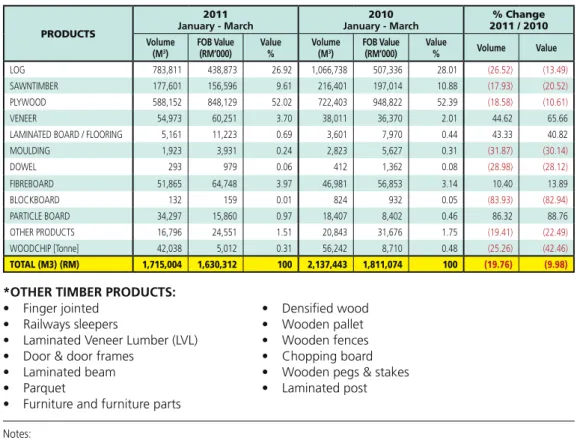
For the first quarter of 2011, the value of logs and timber products exported decreased by 10% as compared to the same period of the previous year. There were decreased in the overall volumes of logs and timber products exported.
Respective decreases in export volumes were logs (13%), sawn timber (21%), plywood ( 11%), moulding (30%), dowel (28%) ,block board (83%) and woodchips (42%).
However, there were respective increase in the value of veneer (66%), laminated board (43%), fibreboard (14%) and particle board (89%).
Plywood remained the major contributor accounting for 52% @ RM0.8 billion of the total export value followed by logs (27% @ RM 0.4 billion) and sawn timber (10% @ RM0.2billion). (Table 1)
market
JANUARY-MARCH
The four-day tour saw the participants attended the briefing by Jurong Town Corporation on the overview of the Corporation as well as its vision and mission. Some participants also had the opportunity to visit Gottwald as well as Liebherr Group’s offices and warehouses to acquire a deeper insight into port technology and cargo handling equipments.
In addition, they did not miss the chance to visit the Urban Redevelopment Authority, Jurong Birds Parks and Marina Base.
Besides being a gesture of appreciation, the tour was also an eye-opener for the participants who acquired new experiences on technological advancement. It is hoped that the staff would continue to serve with utmost dedication and commitment in line with the Corporation’s Quality Policy
“Commited to Render Quality Services Professionally for Customers’ Satisfaction”.
It is also in support of Sarawak Civil Service Philosophy “An Honour To Serve”.
SUMMARY
Due recognition is given to the staff for their continuous contribution, commitment and dedication.
The tour aimed at exposing the participants on high technologies and green concept in the country.
It is hoped that the staff would continue to serve with utmost dedication and commitment.
STIDC never neglected its social obligation
and the welfare of its employees
t Singapore Study Tour participants
STUDY TOUR
D
espite its heavy responsibilities towards the wood-based industry in Sarawak, STIDC never neglected its social obligation and the welfare of its employees. Due recognition is given to the staff for their continuous contribution, commitment and dedication in realising the Corporation’s role as the leader and catalyst of the industry.In appreciation of the staff’s contribution, the Corporation organised a study tour to Singapore on 3rd-6th May 2011. The tour was participated by 33 staff.
Singapore, a clean and green garden city is renowned for its technological advancement.
The tour therefore aimed at exposing the participants on high technologies and green concept in the country.
performance
Export Value of Logs &
Timber Products
For the first quarter of 2011, the value of logs and timber products exported decreased by 10% as compared to the same period of the previous year. There were decreased in the overall volumes of logs and timber products exported.
Respective decreases in export volumes were logs (13%), sawn timber (21%), plywood ( 11%), moulding (30%), dowel (28%) ,block board (83%) and woodchips (42%).
However, there were respective increase in the value of veneer (66%), laminated board (43%), fibreboard (14%) and particle board (89%).
Plywood remained the major contributor accounting for 52% @ RM0.8 billion of the total export value followed by logs (27% @ RM 0.4 billion) and sawn timber (10% @ RM0.2billion). (Table 1)
market
JANUARY-MARCH
Logs
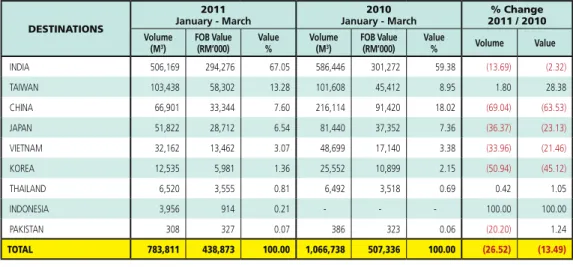
The volume of logs exported decreased by 27% to 0.8 million m3 from 1.1 million m3 and the value also decreased by 13% to RM439 million from RM507 million for the first quarter of 2011 against that of similar period in 2010.
India remains the number one importer of the State’s logs which comprises 65% @ 506,169 m3 of the total export. This was followed by Taiwan (13%, 103,438 m3) and China (9%, 66,901 m3).
However ,export of logs to India for the first three month decreased at 506,169 m3 from 586,446 m3 which dropped by 14% in comparison to the
corresponding period in 2010. Volume of logs to China also decreased by 69% from 101,608 m3 to 103,438 m3. Despite of the overall decrease, export of logs to Taiwan was increased by 2% from 101,608 m3 to 103,438 m3 from January to March 2011 compared to similar period in 2010.
These top three imported contributed 86% and 88% of the total export volume and value from January to March 2011 respectively.
Average FOB unit value of logs increased by 18%
from RM476 to RM560 for the 1st quarter of 2011 compared to similar period in 2010. (Table 2)
Plywood
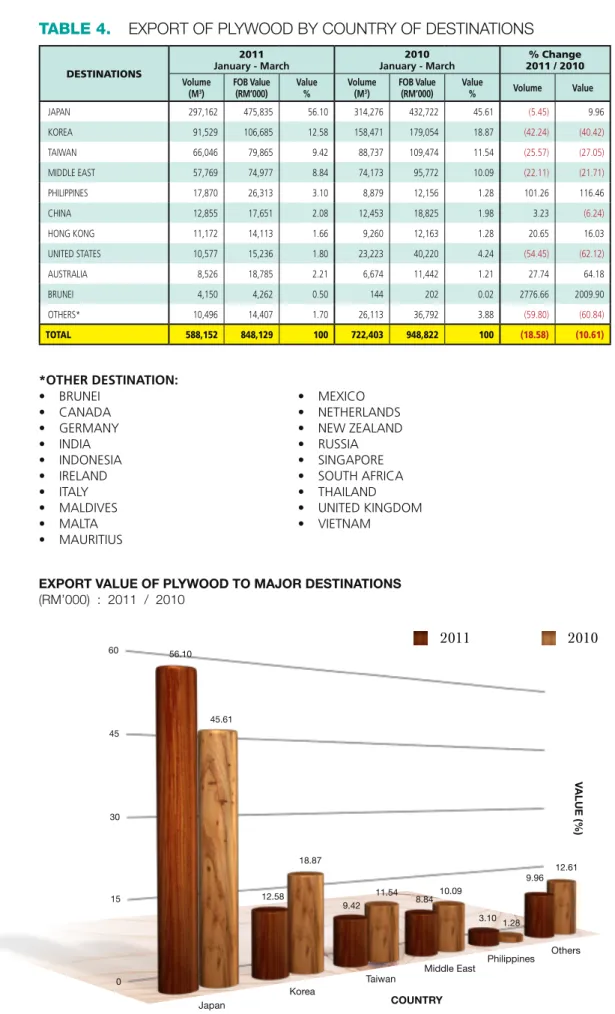
Plywood export from January to March 2011 at 588,152 m3 was lower than that of 722,403 m3 exported for the corresponding period in 2010.
Plywood sales at RM848 million contributed 52%
of the overall revenue obtained from the export of logs and timber products for the period.
Japan remained the number one importer of the State’s plywood with the purchase of 297,162 m3 from 314,276 m3 constituting 51% of the volume exported for the 1st three months of 2011. Other big time plywood importers were Korea that made purchases of 16% at 91,529 m3 and Taiwan (11%
at 66,046 m3).
Export of plywood to Japan decreased by 5% from 314,276 m3 to 297,162 m3, followed by Korea (42%
from 158,471 m3 to 91,529 m3) and Taiwan (26%
from 88,737 m3 to 66,046 m3) for the 1st quarter 2011 compared to that of similar period in in 2010.
Export of plywood to Japan, Korea and Taiwan constituted 77% of the overall exported volume and contributed 78% to the overall value of product from January to March 2011.
The average price of plywood increased by 10%
from RM1,313 to RM1,442 for the 1st quarter of 2011 compared to similar period in 2010.
Sawn Timber
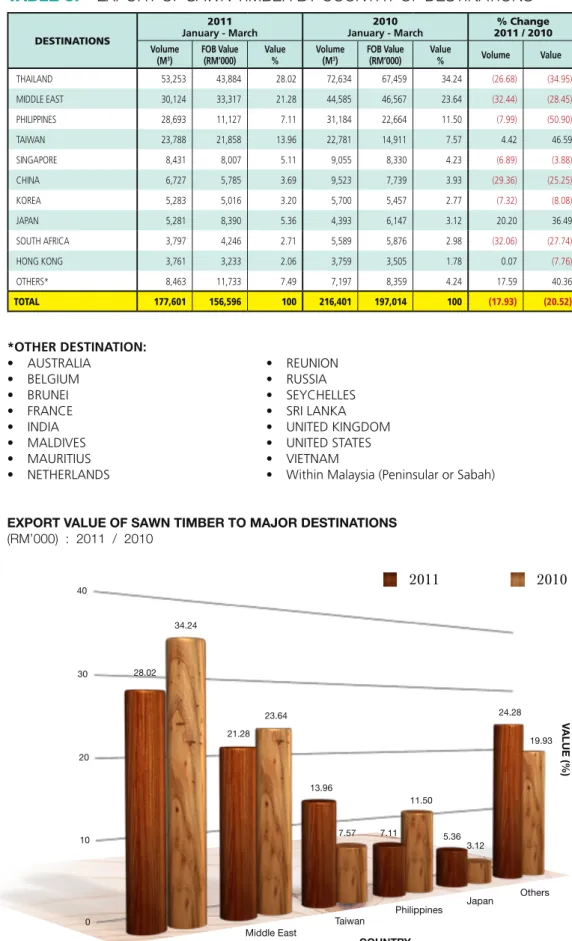
Volume of sawn timber export in January to March 2011 decreased by 18% to 0.178 million m3 from 0.216 million m3 and the value also decreased by 21% to RM 157 million from RM197 million compared to that of similar period in 2010.
Thailand maintained its position as the number one purchaser of the State’s sawntimber for the first three month of 2011 by purchasing 30% of the overall volume at 53,253 m3, followed by Middle East (17%@ 30,124 m3) and Philippines (16%@28,693 m3).
There were decreased by 27% in the volume of sawntimber exported to Thailand from 72,634 m3 to 53,253 m3, followed by Middle East by 32%
from 44,585 m3 to 30,124 m3 and Philippines by 8% from 31,184 m3 to 28,693 m3 for the first quarter 2011 compared to similar period in 2010.
Consequently, export of sawntimber to India, Middle East dan Philippines constituted 63% of the total volume and contributed 56% to the total revenue obtained from the sale of sawntimber affected from January to March 2011.
The average price of sawntimber increased by 12%
from RM847 to RM951 for the 1st quarter of 2011 compared to similar period in 2010. (Table 3)
Other Timber Product
Other timber products includes veneer, dowel, moulding, particle board, fibreboard, block board, laminated board, woodchip and other timber products (mention in Table 1). Value of these export of products was at RM188 million accounted for 12% of the overall value of logs and timber products exported during the 1st quarter of 2011.
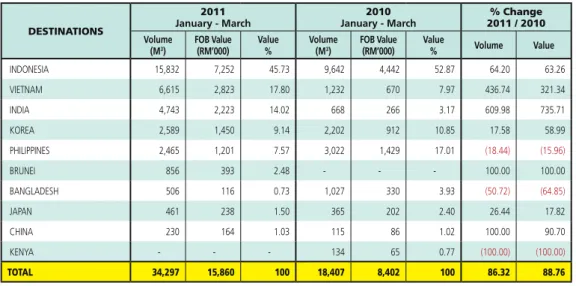
There was respective decrease in volumes of moulding (32%), dowel (29%), block board (84%) and woodchips (25%). In spite of the overall decrease in export volume, there were in increase for veneer (45%), laminated board (43%), fibreboard (10%) and particle board (86%) from January to March 2011 compared with similar period in 2010. (Table 5 & 6)
Future Outlook
By the end of March 2011, the average unit prices of timber products such as moulding, dowel, fibreboard, blockboard and particle board remain stable whereas logs, plywood, and veneer was quite encouraging. They were respectively higher in the unit price of log (18%) followed by veneer (15%), plywood (10%), blockboard (6%), fibreboard (3%), particle board (1%) and dowel (1%) for January to March 2011 compared to the previous year. However unit price of woodchip was lower by 23% then followed by sawntimber (3%) and laminated board (2%) for the first quarter of 2011 compared to that similar period in 2010.
Total production of logs in the first quarter of 2011 also decreased by 28% from 2.5 million m3 in first quarter 2 010 to 1.8 million m3 in the first quarter 2011. It was affected by bad weather and to some
extent caused by ongoing flooding
or impoundment of the Bakun
hydroelectric dam in the upper Rejang River Basin in the central region. The Bakun dam’s impoundment had caused flooding of timber roads, beyond the dam and also caused shallowness of the river below the dam, thereby hampering the transportation of logs from the several concessions within the vicinity areas. (Source: The Star)
However, Sarawak timber industry could expect to enjoy an estimated 10%-15%
growth in plywood export this year due to the sudden increase of demand from Japan.
Such forecast was made in line with the recent earthquake and tsunami that hit Japan’s northern province of Sendai, where close to 10 timber factories located at Ishinamako, Ofunato and Miyaki city area were devastated. The reported damages included 6 plywood mills, one particle board mill and one pulp and paper mill. (source: Borneo Post)
Japan will construct around 30,000 units of temporary houses in two months as a temporary shelter for its affected population. Additional purchase may not easy but the Malaysian suppliers will give priority to supply timber to the affected regions in Japan. (Source: Japan Lumber Reports)
In addition, the price of plywood is expected to increase up to 15% in 2011 following a 10%
hike last year 2010. Analysts cited several factors as contributing to the rise in prices, including lulls in production and difficulties in sourcing raw materials caused by recent wet weather. Besides that, it is anticipated that the demand from Japan will increase substantially as it tries to rebuild all those affected buildings and structures after the devastating earthquake and tsunami in March.
(source: Borneo Post)
The export performance for the first quarter 2011 was declining but it would be expected to improve gradually in the second quarter 2011.
PRODUCTS
2011
January - March 2010
January - March % Change
2011 / 2010 Volume
(M3) FOB Value (RM’000) Value
% Volume
(M3) FOB Value (RM’000) Value
% Volume Value
LOG 783,811 438,873 26.92 1,066,738 507,336 28.01 (26.52) (13.49)
SAWNTIMBER 177,601 156,596 9.61 216,401 197,014 10.88 (17.93) (20.52)
PLYWOOD 588,152 848,129 52.02 722,403 948,822 52.39 (18.58) (10.61)
VENEER 54,973 60,251 3.70 38,011 36,370 2.01 44.62 65.66
LAMINATED BOARD / FLOORING 5,161 11,223 0.69 3,601 7,970 0.44 43.33 40.82
MOULDING 1,923 3,931 0.24 2,823 5,627 0.31 (31.87) (30.14)
DOWEL 293 979 0.06 412 1,362 0.08 (28.98) (28.12)
FIBREBOARD 51,865 64,748 3.97 46,981 56,853 3.14 10.40 13.89
BLOCKBOARD 132 159 0.01 824 932 0.05 (83.93) (82.94)
PARTICLE BOARD 34,297 15,860 0.97 18,407 8,402 0.46 86.32 88.76
OTHER PRODUCTS 16,796 24,551 1.51 20,843 31,676 1.75 (19.41) (22.49)
WOODCHIP [Tonne] 42,038 5,012 0.31 56,242 8,710 0.48 (25.26) (42.46)
TOTAL (M3) (RM) 1,715,004 1,630,312 100 2,137,443 1,811,074 100 (19.76) (9.98)
tradestatistics
sarawak
TABLE 1. &9103546.."3:0'5*.#&3"/%5*.#&3130%6$54'30.
4"3"8",
EXPORT VALUE OF MAJOR TIMBER & TIMBER PRODUCTS '30.4"3"8", 3.
UÊ }iÀÊÌi`Ê Ê UÊ ,>Ü>ÞÃÊÃii«iÀÃ
UÊ >>Ìi`Ê6iiiÀÊÕLiÀÊ6®
UÊ ÀÊEÊ`ÀÊvÀ>ià UÊ >>Ìi`ÊLi>
UÊ *>ÀµÕiÌ
UÊ ÕÀÌÕÀiÊ>`ÊvÕÀÌÕÀiÊ«>ÀÌÃ
UÊ iÃwi`ÊÜ`
UÊ 7`iÊ«>iÌ UÊ 7`iÊviVià UÊ ««}ÊL>À`
UÊ 7`iÊ«i}ÃÊEÊÃÌ>ià UÊ >>Ìi`Ê«ÃÌ
*OTHER TIMBER PRODUCTS:
Notes:
UÊ LÀiL>À`ÊÊVÕ`iÊÊ>`ÊÊ Ê Ê Ê Ê
UÊ /Ì>ÊvÊÛÕiÊήÊ`iÃÊÌÊVÕ`iÃÊÜ`V «ÃÊÌi®Ê Ê Ê Ê Ê
UÊ /Ì>Ê`iÃÊÌÊVÕ`iÊ>««V>ÌÉ«iÀÌÊÌÊÌÀ>ëÀÌÊ}`ÃÊÜÌ ÊÌ iÊi`iÀ>ÌÊQÕÃÌÃÊiViÀ>ÌÊÀÊ °ÎÊήR
0 15 30 45 60
VALUE (%)
Plywood
Log
Sawn Timber Fibreboard Veneer Others PRODUCTS
52.01 52.39
26.92 28.01
3.97 3.14 3.70 2.01
3.79 3.57 9.61 10.88
2011 2010
DESTINATIONS
2011
January - March 2010
January - March % Change
2011 / 2010 Volume
(M3) FOB Value (RM’000) Value
% Volume
(M3) FOB Value (RM’000) Value
% Volume Value
INDIA 506,169 294,276 67.05 586,446 301,272 59.38 (13.69) (2.32)
TAIWAN 103,438 58,302 13.28 101,608 45,412 8.95 1.80 28.38
CHINA 66,901 33,344 7.60 216,114 91,420 18.02 (69.04) (63.53)
JAPAN 51,822 28,712 6.54 81,440 37,352 7.36 (36.37) (23.13)
VIETNAM 32,162 13,462 3.07 48,699 17,140 3.38 (33.96) (21.46)
KOREA 12,535 5,981 1.36 25,552 10,899 2.15 (50.94) (45.12)
THAILAND 6,520 3,555 0.81 6,492 3,518 0.69 0.42 1.05
INDONESIA 3,956 914 0.21 - - - 100.00 100.00
PAKISTAN 308 327 0.07 386 323 0.06 (20.20) 1.24
TOTAL 783,811 438,873 100.00 1,066,738 507,336 100.00 (26.52) (13.49)
TABLE 2. &910350'-0(#:$06/53:0'%&45*/"5*0/4
EXPORT VALUE OF LOG TO MAJOR DESTINATIONS 3.
0 20 40 60 80
VALUE (%)
India
Taiwan
China Japan Vietnam Others
COUNTRY 67.05
59.38
13.28
8.95 6.54 7.36
3.07 3.38 2.46 2.91 7.60
18.02
2011 2010
DESTINATIONS
2011
January - March 2010
January - March % Change
2011 / 2010 Volume
(M3) FOB Value (RM’000) Value
% Volume
(M3) FOB Value (RM’000) Value
% Volume Value
THAILAND 53,253 43,884 28.02 72,634 67,459 34.24 (26.68) (34.95)
MIDDLE EAST 30,124 33,317 21.28 44,585 46,567 23.64 (32.44) (28.45)
PHILIPPINES 28,693 11,127 7.11 31,184 22,664 11.50 (7.99) (50.90)
TAIWAN 23,788 21,858 13.96 22,781 14,911 7.57 4.42 46.59
SINGAPORE 8,431 8,007 5.11 9,055 8,330 4.23 (6.89) (3.88)
CHINA 6,727 5,785 3.69 9,523 7,739 3.93 (29.36) (25.25)
KOREA 5,283 5,016 3.20 5,700 5,457 2.77 (7.32) (8.08)
JAPAN 5,281 8,390 5.36 4,393 6,147 3.12 20.20 36.49
SOUTH AFRICA 3,797 4,246 2.71 5,589 5,876 2.98 (32.06) (27.74)
HONG KONG 3,761 3,233 2.06 3,759 3,505 1.78 0.07 (7.76)
OTHERS* 8,463 11,733 7.49 7,197 8,359 4.24 17.59 40.36
TOTAL 177,601 156,596 100 216,401 197,014 100 (17.93) (20.52)
TABLE 3. &910350'4"8/5*.#&3#:$06/53:0'%&45*/"5*0/4
EXPORT VALUE OF SAWN TIMBER TO MAJOR DESTINATIONS 3.
U AUSTRALIA U BELGIUM U BRUNEI U FRANCE U INDIA U MALDIVES U MAURITIUS U NETHERLANDS
U REUNION U RUSSIA U SEYCHELLES U SRI LANKA U UNITED KINGDOM U UNITED STATES U VIETNAM
U Within Malaysia (Peninsular or Sabah)
*OTHER DESTINATION:
0 10 20 30 40
VALUE (%)
Thailand
Middle East
Taiwan Philippines Japan Others COUNTRY
28.02 34.24
21.28 23.64
7.11 11.50
5.36 3.12 24.28
19.93
13.96
7.57
2011 2010
DESTINATIONS
2011
January - March 2010
January - March % Change
2011 / 2010 Volume
(M3) FOB Value (RM’000) Value
% Volume
(M3) FOB Value (RM’000) Value
% Volume Value
JAPAN 297,162 475,835 56.10 314,276 432,722 45.61 (5.45) 9.96
KOREA 91,529 106,685 12.58 158,471 179,054 18.87 (42.24) (40.42)
TAIWAN 66,046 79,865 9.42 88,737 109,474 11.54 (25.57) (27.05)
MIDDLE EAST 57,769 74,977 8.84 74,173 95,772 10.09 (22.11) (21.71)
PHILIPPINES 17,870 26,313 3.10 8,879 12,156 1.28 101.26 116.46
CHINA 12,855 17,651 2.08 12,453 18,825 1.98 3.23 (6.24)
HONG KONG 11,172 14,113 1.66 9,260 12,163 1.28 20.65 16.03
UNITED STATES 10,577 15,236 1.80 23,223 40,220 4.24 (54.45) (62.12)
AUSTRALIA 8,526 18,785 2.21 6,674 11,442 1.21 27.74 64.18
BRUNEI 4,150 4,262 0.50 144 202 0.02 2776.66 2009.90
OTHERS* 10,496 14,407 1.70 26,113 36,792 3.88 (59.80) (60.84)
TOTAL 588,152 848,129 100 722,403 948,822 100 (18.58) (10.61)
TABLE 4. &910350'1-:800%#:$06/53:0'%&45*/"5*0/4
U BRUNEI U CANADA U GERMANY U INDIA U INDONESIA U IRELAND U ITALY U MALDIVES U MALTA U MAURITIUS
U MEXICO U NETHERLANDS U NEW ZEALAND U RUSSIA U SINGAPORE U SOUTH AFRICA U THAILAND U UNITED KINGDOM U VIETNAM
*OTHER DESTINATION:
EXPORT VALUE OF PLYWOOD TO MAJOR DESTINATIONS 3.
0 15 30 45 60
VALUE (%)
Japan
Korea
Taiwan Middle East Philippines Others COUNTRY
56.10
45.61
12.58 18.87
8.8410.09
3.10 1.28
9.96 12.61 9.42
11.54
2011 2010
DESTINATIONS
2011
January - March 2010
January - March % Change
2011 / 2010 Volume
(M3) FOB Value (RM’000) Value
% Volume
(M3) FOB Value (RM’000) Value
% Volume Value
TAIWAN 30,472 33,778 56.06 17,496 16,789 46.16 74.17 101.19
CHINA 8,587 7,031 11.67 2,229 1,689 4.64 285.19 316.28
PHILIPPINES 6,816 7,726 12.82 2,156 2,310 6.35 216.15 234.46
KOREA 6,085 6,312 10.48 12,089 10,216 28.09 (49.66) (38.21)
JAPAN 2,473 3,903 6.48 1,802 2,711 7.45 37.19 43.97
AUSTRALIA 520 1,485 2.46 169 1,519 4.18 208.19 (2.24)
SINGAPORE 21 15 0.02 34 25 0.07 (38.77) (40.00)
THAILAND - - - 2,037 1,111 3.05 (100.00) (100.00)
TOTAL 54,973 60,250 100 38,011 36,370 100 44.62 65.66
TABLE 5. &910350'7&/&&3#:$06/53:0'%&45*/"5*0/4
EXPORT VALUE OF VENEER TO MAJOR DESTINATIONS 3.
0 15 30 45 60
VALUE (%)
Taiwan
Philippines
China Korea Japan Others
COUNTRY 56.06
46.16
12.82 6.35
10.48 28.09
6.48 7.45 2.49 11.67 7.30
4.64
2011 2010
DESTINATIONS
2011
January - March 2010
January - March % Change
2011 / 2010 Volume
(M3) FOB Value (RM’000) Value
% Volume
(M3) FOB Value (RM’000) Value
% Volume Value
UNITED STATES 128 426 43.51 160 530 38.91 (19.95) (19.62)
AUSTRALIA 71 174 17.77 83 169 12.41 (14.63) 2.96
UNITED KINGDOM 39 136 13.89 39 151 11.09 (0.08) (9.93)
NETHERLANDS 18 87 8.89 - - - 100.00 100.00
INDIA 17 77 7.87 17 66 4.85 2.76 16.67
SWITZERLAND 17 74 7.56 16 63 4.63 8.31 17.46
CANADA 2 5 0.51 8 25 1.84 (78.47) (80.00)
DENMARK - - - 13 66 4.85 (100.00) (100.00)
GERMANY - - - 16 87 6.39 (100.00) (100.00)
JAPAN - - - 39 152 11.16 (100.00) (100.00)
SOUTH AFRICA - - - 20 53 3.89 (100.00) (100.00)
TOTAL 293 979 100 412 1,362 100 (28.98) (28.12)
TABLE 6. &910350'%08&-#:$06/53:0'%&45*/"5*0/4
EXPORT VALUE OF DOWEL TO MAJOR DESTINATIONS 3.
0 12.5 25 37.5 50
VALUE (%)
United States
Australia United Kingdom
Netherlands India Others COUNTRY
43.51 38.91
17.77
12.41
8.89
- 7.87
4.85 8.07
32.75
13.89 11.09
2011 2010
DESTINATIONS
2011
January - March 2010
January - March % Change
2011 / 2010 Volume
(M3) FOB Value (RM’000) Value
% Volume
(M3) FOB Value (RM’000) Value
% Volume Value
JAPAN 732 1,285 32.69 523 834 14.82 39.88 54.08
AUSTRALIA 282 714 18.16 1,021 2,444 43.43 (72.33) (70.79)
KOREA 255 517 13.15 877 1,514 26.91 (70.96) (65.85)
TAIWAN 184 517 13.15 62 187 3.32 195.29 176.47
BELGIUM 64 192 4.88 29 48 0.85 118.95 300.00
SINGAPORE 56 53 1.35 21 25 0.44 165.48 112.00
GERMANY 56 103 2.62 26 41 0.73 112.95 151.22
NETHERLANDS 49 35 0.89 - - - 100.00 100.00
UNITED KINGDOM 46 136 3.46 41 133 2.36 12.03 2.26
SEYCHELLES 42 30 0.76 31 28 0.50 36.86 7.14
OTHERS* 157 349 8.88 192 373 6.63 (18.24) (6.43)
TOTAL 1,923 3,931 100 2,823 5,627 100 (31.87) (30.14)
TABLE 7. &910350'.06-%*/(#:$06/53:0'%&45*/"5*0/4
EXPORT VALUE OF MOULDING TO MAJOR DESTINATIONS 3.
UÊ CANADA UÊ CHINA UÊ DENMARK UÊ INDIA UÊ ITALY
UÊ MAURITIUS UÊ SOUTH AFRICA UÊ TURKEY UÊ UNITED STATES
*OTHER DESTINATION:
0 12.5 25 37.5 50
VALUE (%)
Japan
Australia
Korea Taiwan Belgium Others
COUNTRY 32.69
14.82
18.16 43.43
13.15
3.32 4.88
0.85 17.96
10.66 13.15
26.91
2011 2010
DESTINATIONS
2011
January - March 2010
January - March % Change
2011 / 2010 Volume
(M3) FOB Value (RM’000) Value
% Volume
(M3) FOB Value (RM’000) Value
% Volume Value
JAPAN 35,586 50,142 77.44 31,326 43,151 75.90 13.60 16.20
INDONESIA 3,419 3,028 4.68 6,849 6,066 10.67 (50.08) (50.08)
PHILIPPINES 3,326 2,854 4.41 2,291 1,656 2.91 45.17 72.34
INDIA 2,497 2,032 3.14 632 365 0.64 295.07 456.71
THAILAND 1,882 1,692 2.61 412 452 0.80 356.91 274.34
VIETNAM 1,331 1,223 1.89 71