A STUDY ON ACADEMICIANS’ TURNOVER INTENTION IN HIGHER LEARNING INSTITUTION
Lim Geok May (21320)
Bachelor of Business Administration with Honours (Marketing)
2011
Faculty of Economics and Business
N U E IV
R S IT I MA LAYSIA S A
R A A W K U N I M AS
Faculty of Economics and Business
A STUDY ON
ACAMECIAN’S TURNOVER INTENTION IN HIGHER LEARNING INSTITUTION
LIM GEOK MAY
This project is submitted in partial fulfillment of
the requirement for the degree of Bachelor of Marketing with Honours
Faculty of Economics and Business UNIVERSITI MALAYSIA SARAWAK
2011
Statement of Originality
The work described in the Final Year Project, entitled
“A Study on Academician’s Turnover Intention in Higher Learning Institution”
is to the best of the author’s knowledge tat of the author except where due reference is made.
1 APRIL 2011
__________________ ___________________
Lim Geok May 21320
ACKNOWLEDGEMENT
First of all, I would like to dedicate a deepest thanks to my supervisor, Dr Jamal Abdul Nassir Shaari for his clear guidance, patient supervision, beneficial advices, suggestions, and comments that given to me in finishing this final year project.
Then, I would like to thank the lecturers and staffs of all the faculties in UNIMAS for their helps and co-operations that contributed to my study.
Additionally, I would like to thank my parents for their moral support, encouragement, and valuable recommendations for me to complete the study in Unimas as well as finishing the final year project.
Lastly, I am interested to thank my friends too for their valuable suggestions and generous support throughout my study in Unimas.
i TABLE OF CONTENTS
LIST OF TABLES vii
LIST OF FIGURES viii
CHAPTER ONE: INTRODUCTION
1.0 Background 1
1.1 Theoretical Framework 4
1.2 Definition of Key Terms 5
1.3 Problem Statement 7
1.4 Research Objectives 9
1.4.1 General Objective 9
1.4.2 Specific Objective 9
1.5 Rational of Study 9
1.6 Scope of Study 10
1.7 Organization of Chapter 11
CHAPTER TWO: LITERATURE REVIEW
2.0 Introduction 13
2.1 Definition of Job Satisfaction 14
2.2 Definition of Key Terms 14
2.2.1 Job Satisfaction 14
2.2.2 Pay 15
ii
2.2.3 Opportunities for Personal Growth 16
2.2.4 Recognition 16
2.2.5 Satisfaction among Colleagues 17
2.2.6 Satisfaction on Working Environment 17
2.2.7 Task-oriented Leadership 17
2.2.8 People-oriented Leadership 18
2.2.9 Gender 18
2.2.10 Organizational Tenure 19
2.2.11 Turnover Intention 19
2.3 Relationship between Variables 20
2.3.1 Relationship between Job Satisfaction and Turnover Intention 20 2.3.2 Relationship between Pay and Turnover Intention 22 2.3.3 Relationship between Opportunities for Personal Growth and
Turnover Intention 24
2.3.4 Relationship between Recognition and Turnover Intention 25 2.3.5 Relationship between Satisfaction among Colleagues and Turnover
Intention 26
2.3.6 Relationship between Satisfaction on Working Environment and
Turnover Intention 27
2.3.7 Relationship between Leadership Style and Turnover Intention 27 2.3.8 Relationship between Demographic Factors and Turnover
Intention 29
2.3.9 Relationship between Organizational Tenure and Turnover
iii
Intention 30
CHAPTER THREE: RESEARCH METHODOLOGY
3.0 Introduction 32
3.1 Conceptual Framework 33
3.2 Definition of Key Terms 35
3.3 Research Design 36
3.4 Population 36
3.5 Sampling 38
3.5.1 Sampling Method 38
3.6 Data Collection 39
3.6.1 Research Instrument 39
3.6.1.1 Questionnaire 39
3.6.1.2 Pre-Testing: Pilot Test 41
3.7 Data Analysis 42
3.7.1 Descriptive Statistics 42
3.7.2 Independent Sample T-test 43
3.7.3 Reliability Analysis 43
3.7.4 Correlation 43
3.7.5 Regression 44
3.8 Research Hypothesis 46
3.9 Conclusion 46
iv CHAPTER FOUR: RESEARCH FINDING
4.0 Introduction 47
4.1 Analysis of Respondent’s Demographic Profile 47
4.2 Descriptive Statistic 49
4.3 Independent Sample T-test 54
4.4 Pearson Correlation Coefficient 55
4.5 Hierarchical Regression 59
4.6 Reliability Testing 61
4.7 Findings for Hypothesis Testing 66
4.7.1 Hypothesis Testing for Pay 67
4.7.2 Hypothesis Testing for Opportunities for Personal Growth 67 4.7.3 Hypothesis Testing for Satisfaction among Colleagues 68 4.7.4 Hypothesis Testing for Satisfaction on Working Environment 68 4.7.5 Hypothesis Testing for Recognition 69 4.7.6 Hypothesis Testing for People-oriented Leadership Style 69 4.7.7 Hypothesis Testing for Task-oriented Leadership Style 70
4.8 Summary 72
CHAPTER FIVE: DISCUSSSION
5.0 Introduction 73
5.1 Background of Study 73
5.2 Discussion on the Respondents’ Demographic Profile 74
5.3 Discussion on the Descriptive Statistics 75
v
5.4 Discussion on the Independent Sample T-test 76
5.5 Discussion on the Pearson Correlation Coefficient 79
5.6 Discussion on the Hierarchical Regression 80
5.7 Discussion on the Hypothesis Testing 82
5.7.1 Hypothesis Testing between Pay and Employee Turnover Intention 82 5.7.2 Hypothesis Testing between Opportunities for Personal Growth
and Employee Turnover Intention 84
5.7.3 Hypothesis Testing between Satisfactions among Colleagues
and Employee Turnover Intention 86
5.7.4 Hypothesis Testing between Satisfactions on Working Environment
and Employee Turnover Intention 87
5.7.5 Hypothesis Testing between Recognition and Employee
Turnover Intention 88
5.7.6 Hypothesis Testing between People-oriented Leadership Style
and Employees Turnover Intention 89
5.7.7 Hypothesis Testing between Task-oriented Leadership Style
and Employee Turnover Intention 90
CHAPTER SIX: CONCLUSION AND RECOMMENDATION
6.0 Introduction 91
6.1 Conclusion 91
6.1.1 Findings 91
vi
6.1.2 Contribution of the Study 92
6.2 Limitation of the Research 93
6.3 Recommendation 93
REFERENCES 94
APPENDIX
vii LIST OF TABLES
Table 3.1 Degree of Pearson Correlation Coefficient 44
Table 4.1 Respondents’ Demographic Profile 48
Table 4.2 Mean for Pay 50
Table 4.3 Mean for Opportunities for Personal Growth 50
Table 4.4 Mean for Satisfaction among Colleagues 51
Table 4.5 Mean for Satisfaction on Working Environment 51
Table 4.6 Mean for Recognition 52
Table 4.7 Mean for People-Oriented Leadership 52
Table 4.8 Mean for Task-Oriented Leadership 53
Table 4.9 Mean for Turnover Intention 54
Table 4.10 Independent Samples Test for Gender 55
Table 4.11 Correlation Analysis 56
Table 4.12 Hierarchical Regression Analysis (1) 59
Table 4.13 Hierarchical Regression Analysis (2) 59
Table 4.14 Job Satisfaction, Gender and Organizational Tenure towards
Employee Turnover Decision 60
Table 4.15 Summary of Hypothesis Testing Result 71
viii LIST OF FIGURES
Figure 1 Two-Factor Theory by Frederick Irving Herzberg, 1959 4
Figure 2 Conceptual Framework 33
ABSTRAK
KAJIAN TERHADAP NIAT ATAU KEINGINAN PERLETAKAN JAWATAN OLEH PARA AKADEMI DI PERGURUAN TINGGI
Oleh Lim Geok May
Para akademi merupakan saluran yang amat penting di mana-mana organisasi termasuk universiti untuk terus maju. Para akademi boleh dibahagikan kepada dua kumpulan, iaitu akademi yang berpuas hati dan akademi yang tidak berpuas hati.
Kebiasaanya, para akademi yang berpuas hati akan terus berkhidmat di organisasi berkenaan manakala para akademi yang tidak berpuas hati terhadap kerja mereka akan terfikir atau berniat untuk meletak jawatan dan mencari pekerjaan yang baru pada masa yang akan datang. Oleh itu, kepuasan seseorang akademi adalah penting kerana ia merupakan pengukur kepada peletakan jawatan yang sebenar. Faktor- faktor yang menyumbang kepada kepuasan kerja akan dikenalpasti di mana ia akan mempengaruhi seseorang akademi itu berniat untuk meletak jawatan pada masa yang akan datang.
Dalam kajian ini, didapati kebanyakan para akademi tidak mempunyai niat untuk berhenti kerja pada masa yang akan datang. Faktor-faktor seperti bayaran, kepuasan terhadap tempat kerja, kepimpinan berorientasikan kemanusiaan tidak berpengaruh kuat atau mempunyai hubungan yang negatif terhadap niat untuk berhenti bekerja di perguruan tinggi manakala faktor-faktor seperti peluang untuk memajukan diri dan pengakuan oleh majikan tidak berpengaruh langsung terhadap niat untuk berhenti bekerja di perguruan tinggi.
ABSTRACT
A STUDY ON ACADEMICIAN’S TURNOVER INTENTION IN HIGHER LEARNING INSTITUTION
By Lim Geok May
Employee is the asset for an organization to move forward. It is seen as the “blood”
for an organization in order to success. Employees fall under two categories, which are satisfied employees and unsatisfied employees. Satisfied employees generally tend to be more productive as compared to the unsatisfied employees (Oshabemi, 20002; Hom and Gritteth, 1995). Therefore, satisfaction of the academicians is crucial because it is the determinant of the actual turnover for an organization.
Factors which contribute to the employees job satisfaction would be determine as it would affect the intention to turnover in an organization.
Through this study, it is found that most of the respondents do not have intention to leave their current organization. Factor such as pay, satisfaction on working environment, and people-oriented leadership style has weak negative association towards turnover intention among academicians in higher learning institution.
However, opportunities for personal growth and recognition are not significantly affect turnover intention. Last but not least, satisfaction among colleagues and task- oriented leadership style has little or no association towards turnover intention among academicians in higher learning institution.
1 CHAPTER 1 INTRODUCTION 1.0 Background
Employee is the asset for an organization to move forward. It is seen as the “blood” for an organization in order to success. Employees fall under two categories, which are satisfied employees and unsatisfied employees. Usually, satisfied employees tend to be more productive compared to the unsatisfied employees (Oshabemi, 2000a; Hom and Griffeth, 1995).
Without employees, an organization would not be able to perform well in any industry such as manufacturing and services. Services industry in this context is also applied to the higher learning institution. Employees are fall under two categories in the higher learning institution which are line authority and staff authority, which could indirectly, reflects the staff work in line or staff departments (Daft, n.d.). Line authority refers to the employees who have formal authority to direct and control their subordinates whereas staff authority advice, recommend, and counsel in the staff specialists’ area of expertise (Daft, n.d.). Line authority refers to the academicians whereas staff authority refers to the admin staffs in this research. University is the place where teaching and learning activities get involved.
Higher learning institution in this research refers to the public universities in Malaysia.
There are 21 public universities in Malaysia. This is the place for the students to meet up
2
their lecturers in order to gain knowledge. The responsibilities of lecturers which are fall under the line authority are not just lecture, but they also conduct their own research as well. Public universities get their financial support from the government and it is considered as a non-profit organization. It is said a non-profit organization because education and government sectors fall into the list of non-profit organization.
Job satisfaction is defined as the “pleasurable or positive emotional state resulting from the appraisal of one’s job or job experience” (Locke, 1976). Besides, according to Berry (1997), job satisfaction is defined as the individual’s reaction to the job experience to certain job that are doing and repeating in their daily live. There are various factors which can affect job satisfaction. Generally, satisfied employees are more committed and would stay in the organization. On the other hand, dissatisfied employees are likely to have the intention to quit and leave their current job (Oshabemi, 2000a; Hom and Griffeth, 1995).
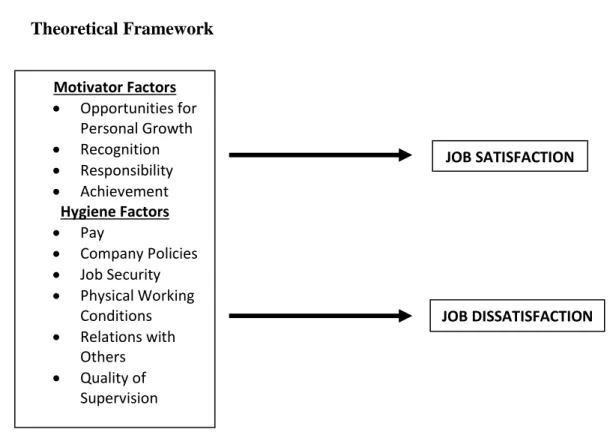
There are various factors which could lead to job satisfaction and job dissatisfaction. In this study, Two-Factor Theory by Frederick Irving Herzberg (1959) will be used to examine the factors that would lead to job satisfaction and job dissatisfaction. It is divided into two parts, which are the motivator factors and the hygiene factors. This can be seen in the Two-Factor Theory by Frederick Irving Herzberg, 1959 below:
3
The component of the motivator factors would lead to job satisfaction. Motivator factor are something that is related to the work itself such as promotion opportunities, opportunities for personal growth, recognition, responsibility, and achievement.
However, hygiene factors are characterized as the extrinsic factors which would lead to job dissatisfaction. Hygiene factors are something that is related to the working environment such as quality of supervision, pay, company policy, physical working conditions, relation with others, and job security.
As a conclusion, according to Two Factor Theory by Frederick Herzberg, motivational factors do not lead to job satisfaction but would hinder from job dissatisfaction. Any improvement on hygiene factors would only prevent the employees from being dissatisfied.
Motivator Factors
Opportunities for Personal Growth
Recognition
Responsibility
Achievement Hygiene Factors
Pay
Company Policies
Job Security
Physical Working Conditions
Relations with Others
Quality of Supervision
JOB SATISFACTION
JOB DISSATISFACTION
4
Shields and Ward (2001) say that unsatisfied employees will end up having the intention to quit from their current job. Turnover intention is referring to “the idea of leaving the current organization or post” (Mobely, 1978). There are various factors which would affect the academicians have the intention to quit their current job such as the pay, opportunity for personal growth and so forth.
1.1 Theoretical Framework
Figure 1: Source: Two – Factor Theory by Frederick Irving Herzberg, 1959
Referring to the Figure 1, the motivator factors such as promotion opportunities, opportunities for personal growth, recognition, responsibilities, and achievement would lead to job satisfaction. On the other hand, the hygiene factors such as pay, company policies, job security, physical working conditions, relations with others, and quality of supervision would lead to job dissatisfaction. Each of these factors shows how an
Motivator Factors
Opportunities for Personal Growth
Recognition
Responsibility
Achievement Hygiene Factors
Pay
Company Policies
Job Security
Physical Working Conditions
Relations with Others
Quality of Supervision
JOB SATISFACTION
JOB DISSATISFACTION
5
individual react to their job satisfaction differently. One might think that pay is the most crucial factor in their job satisfaction although this might not be true. This kind of different views is supported by the discrepancy theory which suggests that a worker will only feel satisfied when they feel what is important rather than the fulfillment or unfulfillment of their needs and of course, according to Berry (1997), job satisfaction will only occur when a person receives is less than what he or she actually wants.
Hence, motivator factors do not lead to job satisfaction but would hinder from job dissatisfaction. Any improvement on hygiene factors would only prevent the employees from being dissatisfied.
1.2 Definition of Key Terms
Opportunities for personal growth refer to the opportunities to gain a better achievement or Promotion, refers to the “availability of opportunities for career advancement” (George, 2000).
Recognition refers to the act of recognizing because of one has done something useful.
Pay refers to the salary, the value that is given to the employees for what they have sacrificed.
Relations with others refers to the relationship with others, either between the employees itself or to the management.
6
There are various factors which will lead to job satisfaction, which include opportunities for personal growth, and recognition (Herzberg, 1959). Employee will get satisfied if they get the personal growth opportunity. In this research, opportunity for personal growth is referring to the academicians who get the equal chances to better improve themselves, for instance, being invited to attend certain trainings and meetings which are carried out by their own faculty. If academician have the equal chances to have the personal growth opportunity, thus, they would be more satisfied compared to others who might not have the chances to have an opportunity for personal growth.
Besides that, academicians would feel satisfied if they are being recognized by others.
The overall increasing grade of the students would make the academicians feel satisfied with their job. Thus, this would directly bring a sense of happiness towards their job and feel satisfied with their current job.
However, factors such as pay and relation with others will lead to job dissatisfaction.
According to Frederick Herzberg (1959), pay would directly affect job dissatisfaction.
This is because perhaps there is a gap between the expectation and perception of the employees towards their current job. However, if the academician is being overpaid or being paid equally, or they think that their pay is more compared with what they had done, thus, the academician would feel satisfied with their current job. In this case, the employees might only satisfy with the pay but they are not satisfied with the job itself.
7
Also, in the Two-Factor Theory by Frederick Herzberg (1959), relationship with others would directly lead to job dissatisfaction. However, in this context, relationship with others is a crucial factor in a working environment to ensure all the procedures which involved different departments can be done smoothly and effectively. Thus, a good relationship with others in a working environment would lead to job satisfaction.
According to Carrell et al., (1998); Lemmer, (1996), employees need a friendly and good working environment to experience job satisfaction.
Thus, the purpose of this study is to examine the job satisfaction among the academicians towards the turnover intention in higher learning institutions.
1.3 Problem Statement
The issue of reducing turnover in an organization is not a new issue anymore which can be seen in schools and universities. There is a research done by Tshannen-Moran et al., (1998) stating that teacher satisfaction is a crucial issue because there are lots of teachers are leaving their job. From the above literature, of course there are differences between teacher and academicians. Obviously, academicians lecture, doing research and giving consultation which teachers do not do. Therefore, this literature is being used in this study is to test whether this would apply in academicians in higher learning institution.
Nevertheless, there are various types of academicians which are bonded-permanent, non-bonded permanent, contract or part time.
8
Besides, there is the fact about high turnover in public university which is admitted by government (Morris, Yaacob, & Wood, 2004). Moreover, there is also another similar research by Netemeyer et al., (1990); Brown and Peterson (1993) stating that job satisfaction is either directly or indirectly related to turnover intentions. Performance would also decrease because of dissatisfied teachers. This is supported by a research done by Mohd. Sharuddin Arifin (1997) stating that turnover in an organization would lead to low organizational performance.
Today, both private and public organizations are finding it is difficult to retain employees. In order for the organization to actually reduce the turnover rate, the organization has first to understand and analyses the factors which contributes to the job satisfaction. This is because turnover might occur when the academicians feel unsatisfied with their current job. Although public universities are non-profit organization but operation costs still exist. Hence, turnover is very costly for the organization to acquire new employees, ranging from the interviewing session to the training session. This is supported by Griffeth et al., (2000); Kinicki et al., (2002); Price, (2001); Mobley, (1982), which stated that employee turnover is expensive for an organization which incurs both direct and indirect cost. This is because lecturers are important sources to produce competence workforce equipped with knowledge and skills according to the Ninth Malaysia Plan.
9
Hence, the aim of this research paper is to study the relationship between job satisfaction and the dominant factor towards turnover intention in higher learning institution.
1.4 Research Objective
1.4.1 General Objective
To investigate the relationship between job satisfaction and turnover intention among academicians in higher learning institution.
1.4.2 Specific Objective
To investigate how strong is the relationship between job satisfaction and turnover intention among academicians in higher learning institution.
1.5 Rational Study
This research on job satisfaction and turnover intention can help the higher learning institution to identify the main factor in job satisfaction because academician is an important source to produce competence workforce equipped with knowledge and skills in this fast changing environment. Thus, some adjustments and corrections on the policies and procedures can be made in a particular organization. Moreover, the
10
information regarding turnover intention is crucial because organization is able to predict turnover of their employees in the future in a particular organization.
In addition, there are only a few studies done in this area especially in Malaysia context.
One best way to retain current academicians is by understanding their job satisfaction in order to manage absenteeism and estimate actual turnover. Job satisfaction is crucial because according to Oshabemi, (2000a); Hom and Griffeth, (1995) stated that dissatisfied employees would probably quit from their current job and on the other hand, satisfied employees would probably stay in the organization.
This in turn will help the organization to improve certain area of their organization to retain the current employees before the employees are actually resigned from the current job. It is important to retain the current employees because acquire new employees costs a lot, ranging from the interviewing session to training session.
1.6 Scope of Study
This study has been limited to the investigation of only the relationship between job satisfaction and turnover intention and to identify the dominant factor of turnover intention among academicians in higher learning institution in Malaysia. This research will be conducted at higher learning institution such as UNIMAS.