ASEAN CONVERGENCE
Towards an ASEAN Identity:
Discourses on Communication and Culture
Alexander G. Flor Benjamina Gonzalez-Flor
ASEAN CONVERGENCE
Towards an ASEAN Identity:
Discourses on Communication and Culture
ASEAN CONVERGENCE
Towards an ASEAN Identity:
Discourses on Communication and Culture
Alexander G. Flor Benjamina Gonzalez-Flor
Faculty of Information and Communication Studies University of the Philippines
OPEN UNIVERSITY 2019
ASEAN Convergence Towards an ASEAN Identity:
Discourses on Communication and Culture Alexander G. Flor and Benjamina Paula G. Flor Faculty of Information and Communication Studies
This eBook is licensed under a
Creative Commons Attribution-NonCommercial-NoDerivatives 4.0 International License (see www.creativecommons.org)
The text may be reproduced for non-commercial purposes, provided that credit is given to the original author(s).
To obtain permission for uses beyond those defined in the Creative
Commons license, please contact University of the Philippines Open University Faculty of Information and Communication Studies at [email protected] Published by:
Faculty of Information and Communication Studies University of the Philippines
OPEN UNIVERSITY
Los Baños, Laguna 4031, Philippines Tel/Fax: (6349) 536 6014
Email: [email protected]
ISBN: 978-971-767-221-2 (Softbound) ISBN: 978-971-767-222-9 (EPUB) First edition, 2019
Managing Editor: Ma. Gian Rose D. Cerdena
Associate Editor and Book Layout Artist: Bernabe M.Remoquillo Language Editor: Ma. Gian Rose D. Cerdena
Book Cover Designer: Bernabe M. Remoquillo Production Coordinator: Jennifer P. Pareja
Icons from the cover made by Bernabe M. Remoquillo Printed in the Philippines
to our friends and colleagues Narong Sompong Jumnongruk Udomsade
Djuara Lubis Hafied Cangara Phiengphaneth Chantalangsy
Acknowledgement
Our sincere thanks to: the University of the Philippines Office of the Vice President for Academic Affairs, for supporting this knowledge sharing project through the Academic Productivity Improvement (API) facility; Chancellor Melinda Bandalaria, who championed Massive Open Online Courses (MOOCs) and Open Educational Resources (OERs) at the UP Open University; and the ASEAN Studies Program of the UPOU Faculty of Management and Development Studies.
The authors also wish to acknowledge the contribution of the following: our artist-illustrator, Bernie Remoquillo;
our associates, Gian Rose Cerdena, Emely M. Amoloza, Margaret Jarmin-Suarez and Jennifer Pareja; our students, Ayo Ujorongbe, Phonevilay Keopaseuth, Ruth Moselle Tumangil, Angel Magsino, April Camacho and Ailyn Capuno who assisted in data gathering and analysis; and our
peer reviewers from Chulalongkorn University, Sukhothai Thammathirat University and the Colombo Plan Staff College who, while remaining anonymous, have substantively made us reconsider our respective positions reflected in these chapters.
Foreword
ASEAN Convergence is a volume that explores the ASEAN identity from the perspective of communication and culture.
It was prepared as an eBook for a Massive Open Online Course (MOOC) on the same subject offered by the Faculty of Information and Communication Studies through UPOU’s MODeL platform. This open educational resource may now be used as a reference for DEVC 242. Media and Communication from an ASEAN Perspective, offered under the Master of Development Communication Program cross-listed as AS 231 in the UPOU Faculty of Management and Development Studies.
DEVC 242/AS 231 was conceived as a specialized course in the Master of ASEAN Studies (MAS) Joint Program of the five open universities in Southeast Asia: the UP Open University;
Universitas Terbuka in Jakarta; Sukhothai Open University in Bangkok; the Hanoi Open University; and the Open University of Malaysia. The MAS was meant as a major initiative for the regionalization of education in the ASEAN region. Hence, this course takes on a regional outlook on communication. By communication, we refer to information and communication technologies and media (traditional, mass and new media).
The book is made up of four papers independently prepared by the authors, hence, the individual chapter ascription. These chapters argue that a prerequisite to ASEAN Integration is an ASEAN identity, a sense of self that extends beyond the concept of regionalizing ten independent nations. That sense of self is formed and crystalized through communication.
As Luhmann asserts in his Theory of Society (1997), the entire social world is constituted through communication and through communication only. ASEAN as a regional body
ASEAN CONVERGENCE
Towards an ASEAN Identity:
Discourses on Communication and Culture
CONTENTS
Communication, Culture, and the
Collective Mind: A Theoretical Framework For The Extra-Economic Dimension of ASEAN Integration
Alexander G. Flor
Ten Countries, One Nation?
Benjamina Gonzalez-Flor
The ASEAN Media Landscape
Benjamina Gonzalez-Flor
Carving ICT Industry Niches within the ASEAN in A Globalized Higher Educational and Knowledge Environment
Alexander G. Flor
APPENDIX A
ASEAN Agreements/Policies on Communication
APPENDIX B Course Guide
Faculty of Management and Development Studies UP OPEN UNIVERSITY
1 19
51
69
88
105
ADB Asian Development Bank
AIBD Asian Institute for Broadcasting Development
ANEX ASEAN News Exchange
APEC Asia-Pacific Economic Cooperation ASEAN Association of Southeast Asian Nations BBC British Broadcasting Corporation
CNN Cable News Network
COCI Committee on Culture and Information
Devcom Development Communication
EU European Union
F2F Face-to-face communication
GIS Geographic Information System
HBO Home Box Office
HDI Human Development Index
HDR Human Development Report
HPI Human Poverty Index
IBM International Business Machines
ICT Information and Communication Technologies ICT4D Information and Communication Technology
for Development
ISP Internet Service Provider
IT Information Technology
K+12 Kindergarten to 12th grade
KM Knowledge Management
MAGS My ASEAN Guide Supporter-mobile
MIS Management Information Systems
MTV Music Television
NAFTA North American Free Trade Agreement Pace Conference Parliamentary Assembly of the Council
of Europe
PC Personal computer
PNA Philippines News Agency
SEAMEO South East Asian Ministers of Education Organization
TADS Trans boundary diseases
TCON Ten Countries, One Nation
TNA Thai News Agency
TV Television
UNDP United Nations Development Programme UNESCO United Nations Educational, Scientific and
Cultural Organization
UPLB University of the Philippines Los Baños UPOU University of the Philippines Open University
US United States
USA United States of America
WIVS Worldviews, ideologies, values, and social structure
XML Extensive Markup Language
List of Acronyms
came before the societal communication process that would have constituted the community, formed it as an entity, or developed it as an organism. Conception precedes birth.
Convergence comes before formation. However, in this case, conceptualization of the ASEAN identity came later in the day.
Nevertheless, it is never too late as the four chapters of this book maintain.
ALEXANDER G. FLOR
University of the Philippines Open University BENJAMINA GONZALEZ-FLOR
University of the Philippines Los Baños
COMMUNICATION, CULTURE, AND THE COLLECTIVE MIND:
A THEORETICAL FRAMEWORK FOR THE EXTRA-ECONOMIC DIMENSION OF ASEAN INTEGRATION
1Alexander G. Flor2
INTRODUCTION
In 1995, as the inaugural lecture for a Metro Manila Commission Professorial Chair on Development Communication, I gave a presentation titled
Communication, Culture, and the Collective Mind. The paper was inspired by a seven-year, seven-country study that we were conducting with Dr. Godwin Chu of the East West Center Institute of Culture and Communication. The underlying thesis of that paper is that history was a function of what Chu referred to as the “national character.” It was dictated by a zeitgeist, a ghost of the times; Collective Mind, if you will. And that this Mind is molded by societal communication. This is the gist of the course, Communication and Media from an ASEAN Perspective, which I have developed and am teaching for both the Master of Development Communication and ASEAN Studies Programs. The course title itself appears counter-intuitive since I cannot grasp the concept of an “ASEAN perspective.”
1 Paper presented during the Second International Conference on ASEAN Studies (ICONAS2), 3-5 August 2015 Chulalonkorn University, Bangkok, Thailand.
2 Alexander G. Flor, Ph.D. is Professor of Information and Communication Studies, University of the Philippines, OPEN UNIVERSITY.
In my professorial lecture, I cited European
integration as a product of the Collective Mind. When the countries of Europe decided to formally integrate as the European Union from its initial status as a geopolitical association under the European Commission, there was an element present that we do not see in the case of the ASEAN. That element is a center that would hold a union together.
The initial group of countries in the European Union was predominantly Christian in outlook. This common worldview is absent in the case of the ASEAN. Many Thai Muslims identify themselves more with Malaysia than Thailand. The same may be true with many Filipino Muslims. Perhaps, the Timorese seceded from Indonesia because of the exclusion they felt with their Christian cultural roots from mainstream Muslim Indonesian culture. On the other hand, the Thai, Lao, Vietnamese and Burmese hardly identify themselves with one another even if all of them share the Buddhist faith.
And Catholic Philippines does not identify with anyone else for that matter. Ideology-wise, there are significant differences within ASEAN. There is socialism (Mekong Subregion), emergent fundamentalism (Malaysia- Indonesia-Brunei), communitarianism (Singapore), authoritarianism (Myanmar) and libertarianism cum oligarchy (Philippines) represented in the region, hardly bi-polar outlooks.
At present, one cannot discern a Collective ASEAN Mind. It is difficult to conceive of a distinct ASEANess compared to Asianess or Europeaness. The ASEAN concept appears to lack a genuine socio-cultural dimension. By definition, it is an association wherein membership is determined geographically rather than
ideologically. Further, it does not extend to individuals nor the populace (there are no ASEANs, only Filipinos, Vietnamese, Indonesians, Thais nor, at most, Southeast Asians). Hence, the ASEAN sense of self is non-existent.
The lack of an ideological center is manifested in the manner by which the ASEANization discourse plays out even in this forum, where participants attach different meanings to the concept. ASEAN does not have a center, a Collective Mind that may hold this Integration together.
THE COLLECTIVE MIND
Historians refer to it as the zeitgeist, the ghost or spirit of the times, determining social outlook and historical events. Psychologists, specifically those associated with the Jungian school of thought, call it the Collective Unconscious. Marxists allude to it as class- consciousness. The concept of the Collective Mind is nothing new. It is an extension of the holistic principle that nature has a built-in tendency to produce wholes from the ordered grouping of units. It may follow that an “ordered grouping” of individual minds give way to a Collective Mind.
In 1928, the British physicist Sir Arthur Eddington wrote in his book, The Nature of the Physical World:
The idea of a Universal Mind or Logos would be, I think, a fairly plausible inference from the present state of scientific theory; at least it is in harmony with it.
Exploring the unconsummated but possible unification of Europe, Baigent, Leigh and Lincoln (1982) wrote:
A Europe of this sort would constitute a new and unified political force in international affairs - an entity whose status would ultimately be comparable to that of the Soviet Union, or the United States. Indeed, it might well emerge stronger than either, because it would rest on deep-rooted spiritual and emotional foundations, rather than abstract, theoretical or ideological ones. It would appeal not only to man’s head, but to his heart as well. It would draw its strength from tapping the collective psyche of Western Europe, awakening the fundamental religious impulse.
Such a program may well appear quixotic. But history by now should have taught us not to underestimate the potential of the collective psyche, and the power to be obtained by harnessing it.
Recent history provide many illustrations of the manifestation of the Collective Mind: the rise of the Ayatollah Khomeini in Iran in 1979; the people power revolution in the Philippines in 1986; the toppling of the Iron Curtain in 1990; the Arab Spring of 2011. These are concrete illustrations of the power of the collective psyche. Such a force without the benefit of an army, a political party and logistical support are able to topple modern, superbly equipped and well-funded regimes.
Perhaps, the most recent and most extensively written accounts on collective psychology may be found in literature dealing with Sarkar’s Progressive Utilization Theory (1959). In the book, The Great Depression of the 1990’s (1986), Southern Methodist University economist
Ravi Batra describes the four general types of collective mentalities forwarded by Sarkar. Towsey (1986), another student of Sarkar, writes:
Why do people keep voting for politicians who obviously do not have their best interests at heart? Why is there a worldwide trend for democratic countries to vote in conservative and reactionary governments even when those governments make no secret of their monetarist policies which leave the majority of people worse off? Why are young people taking up smoking in increasing numbers when the ill effects are better known than ever? Why was Coca Cola, the global symbol of capitalist culture, amongst the first Western commercial products to be marketed in communist China? There are apparently simple answers to these questions. . . But there is more here than the simple answers suggest. A more subtle phenomenon is involved;
little known but beginning to attract the attention of historians, sociologists and political scientists, this is the phenomenon of the Collective Mind.
Politicians would be the first to brush away talks about the Collective Mind. Yet their calling is the most concrete manifestation of its existence. Much of politics deals with the manipulation of the Collective Mind. The next to deny its existence are the behaviorists, and the scientific and dialectic materialists.
Indeed, collective consciousness has become a recognized factor in Marxists-Leninist social dynamics.
Progressive ideologies have even extolled on the dialectic superiority and social desirability of class-consciousness
over individual consciousness. Yet, their theoreticians would argue that class-consciousness exists at the individual level. Extending this concept further to an actual “Mind” of society would be taking it out of context.
Scientific and dialectic materialists reject its existence mainly because one cannot find a material basis, a
physical “brain” wherein the social psyche resides. Like the behaviorists, they contend that mind is a product of physical, biological, and chemical processes in the brain and the central nervous system. “How does this Collective Mind function? What ideas does it generate,”
they would ask.
Idealists, on the other hand, would argue that
consciousness may be equated with idea, and idea may be equated to mind. How can we ascertain the existence of the Collective Mind? By the same manner by which we are sure of our individual mind’s existence. Cogito, ergo sum. By experiencing it. By being conscious of it. And to those who experienced it, corporeal proof would seem inutile.
The Collective Mind is at work whenever a group, or a collective, functions as one. It could be subtly discerned in rallies, parades, in the celebration of the holy mass, even in rock concerts. Experiences such as these have demonstrated and brought to popular awareness this prime force in social dynamics. Perhaps, the most moving aspect of these events is the exhilaration and inspiration that these afford to all those who participate in and witness it. It is a feeling difficult to describe, a feeling of oneness with the multitudes that are there and a grand realization of being an integral part of a profound social force.
What exactly is the Collective Mind? Before this question can be answered, first, we should note that there is not one statement on the nature of the mind, which is generally acceptable to all branches of contemporary science, even among neurologists themselves. The conservative belief that mind is a product of neurological processes, that it is created by the body -- specifically, the brain (Damasio, 1994).
This theory has been challenged by respected neurologists such as Wilder Penfield, the founder of the Montreal Institute of Neurosurgery. In his book, The
Mystery of the Mind, Penfield describes how his research has led him to the conclusion that mind is made up of an entirely different essence altogether and, supporting Descartes’ assertion, that the mind is independent from the brain.
Some scientific treatises have adopted a middle path.
The first forwards a Concentric Theory of Consciousness (Greenfield, 1995) that acknowledges the dependence of the mind on the brain but suggests that its workings are guided by networking behavior and “gestalts”
parallel to social interactions. The second comes from the co-discoverer of the structure of DNA, Sir Francis Crick (1994). He offers in his book, The Astonishing Hypothesis, that although the mind is a by-product of the simultaneous, high-frequency firing of neurons in different parts of the brain, it is in the meshing of these frequencies that it is produced. In other words, the mind is not a function of fixed electro-chemical processes but of interrelationships between these processes.
Psychologists likewise come to a disagreement on this point depending upon their professed tradition, i.e., behaviorism, Freudianism, transpersonalism or
differentialism. Psychologists from the psychosynthesis tradition refer to the mind as the distinctly rational aspect of the human psyche from whence conscious thought and reason arise as in “the polarity between the mind and the heart. “ If such is the case, then social systems cannot have a mind since the Collective Psyche can be characterized as everything but rational (as in instances of mob rule).
One popular view is that the mind is a quality that emerges or comes into being when organisms reach a certain level of complex ity in development (Kobler, 1986).
If we may relate this to the systems view that society is an organism, then the possibility of it developing a mind becomes less far-fetched.
Fritjof Capra writes in The Turning Point:
Because the systems view of mind is not limited to individual organisms but can be extended to social and ecological systems, we may say that groups of people, societies, and cultures have a collective mind, and therefore also possess a collective consciousness. We may also follow Jung in the assumption that the collective mind, or collective psyche, also includes a collective unconscious. As individuals, we participate in these collective patterns, are influenced by them, and shape them in turn. In addition, the concepts of a planetary mind and a cosmic mind may be associated with planetary and cosmic levels of consciousness.
Fritjof Capra represents another sector that may lend a measure of qualified support to this argument
- the physicists, if only for their refutation of scientific materialism at the quantum or sub-atomic level.
Physicists have observed that elementary particles are not solid material objects but “patterns,” “interconnections”, or “sets of relationships.” In other words, matter is not made up of concrete materials but of “abstractions,” as the physicist Niels Bohr puts it. Indeed, the quantum physics of Heisenberg, Planck and Bohr has forwarded a new association between matter, energy, and information.
In fact, a novel theory known as the Superstring Theory just falls short of proposing that matter, energy, and thought may have sprung from the same cosmic stuff altogether. Hence, mind may be a dormant property of all things.
Sarkar’s cosmology is not inconsistent with this view. He maintains that every cell in the human body, every object - even a sand particle - has an independent mind, although it is in an extremely undeveloped and unexpressed state.
Generally, contemporary science accepts that mind is some form of energy since thoughts are physically observed as waves (i. e. alpha, beta, theta). Similarly, the Collective Mind is the synergy produced by the individual minds that make up a social system, not unlike what quantum physicists refer to as relationships, patterns, and abstractions. As Jan C. Smuts and the Organicists declare, the whole is greater than the sum of its parts, and the determining factors in nature are these
“wholes.” Society cannot be reduced to the individuals who comprise it. The Collective Psyche, as a distinct force in social dynamics, exists and its corpus is the social system.
THEORETICAL FRAMEWORK
How does the Collective Mind relate to communication? How does it relate to culture?
We submit that the collective psyche has three dimensions. This is what we refer to as the social dynamics triad. Social dynamics is a function of a triad of factors – societal communication, culture, and social policy. The triad concept here relates to the continuity of these three variables, that is, their interrelations are in the nature of a continuum.
Within this triad, not unlike the “all seeing eye” on the apex of the pyramid printed on a one-dollar bill, is the Collective Psyche, the social mind that we discussed at length earlier. In effect, this triad of factors represents dimensions of the Collective Psyche.
The validity of enumerating three dimensions that are not mutually exclusive may be questioned. As a matter of fact, it would be difficult to draw the line between communication and culture. The anthropologists among us would argue that communication is subsumed
under culture. On the other hand, the communication scientists among us would say that culture is nothing but the expression of collectivity, expression being part of communication. We could argue ourselves blue in the face without ever reaching a consensus.
However, these are not operationalized variables but constituent concepts. In fact, we propose that these three dimensions exist in a three-way continuum.
Dimensions of the Collective Psyche
The conscious dimension is societal communication.
This encom passes sectoral communication, mass media, inter and cross cul tural communication. Its point of intersection with social policy is at the sectoral communication end. Its point of intersection with culture is at the indigenous communication end.
The intuitive dimension is culture. This includes society’s con cepts of morality and virtue, values, perceptions (of family, environment, religion, land, etc.) and worldview. Its point of intersection with social policy is at the perception level.
The influence of culture on social dynamics is no less pro found as may be deduced from Chu (1989). Similarly, relating culture to the collective psyche form part of the gist of Senate Committee Report No.415 (Shahani et al, 1989).
The rational dimension is social policy. Within this category are the national ideology, the Constitution, the laws of the land, the social agenda, and the leadership.
Societies as Living Systems
Systems theorists such as Emery define living systems as systems made up of living organisms. Any social system is a living system by virtue of the fact that it is made up of live interacting human beings. Hence, organizations, gangs, clans and communities are living systems. We may add that these social systems have their respective collective mentalities and their own sub- cultures developed in various degrees depending upon
their cohesiveness. Society, being a macro-system is an organism with a distinct, albeit often dormant, psyche. Its subtle expression is called culture.
Miller, the high priest of general systems theory, posits that all living systems, from the smallest protozoa to the largest organization, perform certain critical functions or processes that are necessary for their existence and survival. Communication, the transfer of information from one point in time or space to another, is one of these critical functions. According to K. Thayer (1968), another leading systems theorist, communication is “a dynamic process underlying the existence, growth, the behavior of all living beings… Communication is as fundamental to the living system. . . as the ingestion and consumption of food and fuel to run its physical and physiological machinery.” Obviously, this statement likewise applies to social systems and collectives. Communication allows an individual to acquire a sense of self. Mass communication allows a society to acquire a sense of self.
Communication is one of the major variables of social transformation and should thus be employed to achieve the highest social goals at the shortest amount of time.
This argument originated from the writings of Lasswell (1948), Lerner (1963) and Schramm (1967). Theories such as the Agenda-Setting Function of Media and the Media Dependency Model are suppor tive of this line.
Contemporary studies (e.g. Flor, 1989) and current events have contributed to the validation of the Media Dependency Theory of DeFleur and Ball-Rokeach (1982).
This model proposes that correlations exist between the degree of societal stability, the centrality of information of media systems, and media dependency. This dependency in turn brings about certain effects on the audience, which feedback on societal stability and media systems.
At the empirical level, we may relate this to the Gulf War. This crisis situation has a direct bearing on the degree of societal stability. Decreased stability has prompted a change in programming among television networks all over the world. The shift is particularly felt in the United States and the Philippines, wherein public affairs/ special events programs have preempted entertainment programs. This may be interpret ed as an increase in the centrality of information offered by media systems. Media dependency has likewise increased, prompting CNN to declare that Americans have become TV ad dicts overnight.
The effects are particularly obvious in terms of consumer behavior. Panic buying has become wide- spread, which has feedback on societal stability as well as the media systems. In the Philippines, panic buying has increased the prices of prime commodities. In the US, on the other hand, both advertisers and network executives have voluntarily withdrawn their scheduled commer cials because these might be found by the public to be in “poor taste.”
PROPOSITIONS
This paper forwards that every society, every social system, every collectivity, has a mind, a Collective Psyche.
The degree of development of this Mind is directly proportional to the degree of collective consciousness among the individuals who make up the social system.
Culture, being the manifestation of collectivity, is the expression of this Collective Mind.
Communication, among other things, is the basic mechanism of integration into any social system or collectivity. What the anthropologist calls acculturation
or what the sociologist calls socialization, is only
achieved through communication. A child learns about his culture and is subsequently acculturated through subtle messages transmitted to him by his environment.
Similarly, an individual newly transplanted into a different community gets to socialize only after a series of
communication-initiated rites and rituals.
Social control and consequently social equilibrium, twin concepts of Talcott Parsons, are likewise functions of communication. The Collective Mind is not only sustained by, but manifested as culture through
communication. Furthermore, communication contributes to the regeneration or the disintegration of culture and subsequently, society.
By virtue of the above propositions, communication and culture are inextricably linked. One cannot study communication without touching upon culture. Similarly, the study of culture oftentimes becomes an attempt to study communication patterns such as in the case of linguistics.
The central factor in this conceptual schema, however, is the Collective Mind in whose workings culture is
possible. The psychology of the Collective Mind is, in effect, the science of social dynamics. Since the state of the social psyche is a func tion of communication, it follows that social transformation is likewise determined by communication.
At the macro level, this may be exemplified by relating cultural dominance (at times called cultural imperialism) and communication. Communication between
and among cultures is of two types: cross-cultural communication and inter-cultural communication. The
difference between these two is the manner by which each is initiated. In the communication scientist’s jargon, cross-cultural communication is “one-way,” while inter- cultural communication is “interactive.” In other words, one is imposed while the other is a natural process of exchange.
Insofar as social dynamics is concerned, cross-cultural communication results to any of the following: cultural diffusion, cultural subservience, or cultural integration.
On the other hand, inter-cultural communication results to cultural convergence. This is not to say, however, that dominance is achieved through the manner of communication. Dominance or social power is equated to social will, a property of the Collective Mind. The degree to which a culture succumbs to the onslaught of cross-cultural communication is a function of the strength and magnitude of its Collective Mind, variables that are inversely related to the decadence of society.
In terms of collective psychology, cultural diffusion and subservience mean the absorption of one Collective Mind by another. Cultural integration refers to the integration of individual minds to the dominant Collective Psyche.
Cultural convergence means the unification, the merging of Collective Minds.
We can apply these propositions within the context of cultural convergence of the 11 Southeast Asian nations and deduce the fate and outcomes of ASEAN Integration.
REFERENCES
Batra, Ravi. 1986. The Great Depression of the 1990s.
Simon and Schuster, New York.
Baigent, Michael, Richard Leigh and Henry Lincoln. 1982.
The Holy Blood and the Holy Grail. Corgi Books, London.
Capra, Fritjof. 1982. The Turning Point: Science, Society and the Rising Culture. Simon and Schuster, New York.
Chu, Godwin. 1989. Studies of Cultural Change in China and Thai land: Some Preliminary Findings. Limited circulation paper. East-West Center Institute of Culture and Communication, Honolulu.
Crick, Francis and Christof Koch. 1994. The Astonishing Hypothesis: The Scientific Search for the Soul.
California Institute of Technology.
Damasio, Antonio. 1984. Descartes Error. University of Iowa.
DeFleur and Ball-Rokeach. 1982. Theories of Mass Communication. Fourth Edition. Longmen Inc., New York.
Eddington, Sir Arthur Stanley. 1928. The Nature of the Physical World. Oxford University Press, Cambridge.
Flor, Benjamina G. 1989. Media Dependency During Crisis Situations. MS Thesis. University of the Philippines at Los Baños.
Emery, F.E. and E. Trist. The Causal Texture of
Organizational Environments. Human Relations, Vol.
18, No.1.
Greenfield, Susan A. 1995. Journey to the Centers of the Mind: Toward a Science of Consciousness.
Oxford University Press, Cambridge.
Shahani, Leticia. 1989. Moral Recovery Program:
Building a People - Building a Nation. Committee Report No.415. The Philippine Senate.
Thayer, K. 1968. Communication and Communication Systems. Richard D. Irwin, Inc, Homewood, Illinois.
Towsey, Michael B. 1986. Eternal Dance of Macrocosm.
Proutist Publications, Copenhagen.
TEN COUNTRIES, ONE NATION?
1Benjamina Gonzalez Flor2
INTRODUCTION
Collectivity is a cultural manifestation of homogeneity, at least at a certain level. The ASEAN community as a phenomenon adheres to imaginary borders that set these countries apart. While community building is possible politically and economically, much needs to be done socio-culturally.
Since the vision of the ASEAN is to have One
Community, it implies that the Ten-member country must have a common understanding of being a citizen of this amalgamation. Such coming together cannot be left to policy decision-makers alone or entirely be decided on by its political leaders if the ideal state cannot be communicated to each and every citizen of the ASEAN community. Farmers, housewives, students, teachers, technocrats, scientists, and policymakers cannot be treated in isolation, because each one has the right to know and understand the implication of being a member of a consummation that happened between and among heads of countries or have been agreed upon in their behalf.
1 Best paper awardee, International Conference on ASEAN Studies, 2-4 August 2015, Chulalongkorn University, Bangkok, Thailand.
Findings derived from a class project, DEVC 215 (Communication and Culture) for the first semester of SY 2014-2015 of UP Los Baños composed of Ayo Ujorongbe (Nigeria), Phonevilay Keopaseuth (Lao PDR), and from the Philippines, Ruth Moselle Tumangil, Angel Magsino, April Camacho, and Ailyn Capuno.
2 Benjamina Gonzalez Flor, Ph.D. is Professor of Development Communication, University of the Philippines Los Baños.
Brunei Darussalam, Cambodia, Indonesia, Lao PDR, Malaysia, Myanmar, the Philippines, Thailand, Singapore, and Vietnam have forged to be one through the efforts of their leaders to strengthen economic growth in Southeast Asia. Little did they know that their constituents have limited, if not have any, idea on the expectations or implications of what it means to be a member of the ASEAN community. For policymakers, this is nothing to be wary about, but for an ordinary citizen of each member country, this could be an added layer of confusion especially among indigenous groups and the grassroots, which comprise a relatively large proportion of the ASEAN community.
The diverse cultural profile of each country when combined together is unthinkable, given the inherent differences and idiosyncrasies they possess. Each member country has their own worldviews, ideologies, values, and social structures that make them different from other countries. Putting them together as one is not only absurd but also seems impossible. However, these arguments are no longer up for debate since the ASEAN had been in existence since 1964. It envisions creating political-security, economic, and socio-
cultural community by 2015. The vision would like to ensure a strong, peaceful, stable, and prosperous region. “The grand goal is to transform the 10-member organization into a genuine ASEAN community” (www.
asean.org). Despite the provision, it seems that this is not happening. By definition, a community refers to a
“group of people having cultural, religious, ethnic, or other characteristics in common” (Dictionary.com). Thus, what is of value right now is how to create an ASEAN culture that will truly depict who is an “ASEAN national”
as perceived by the world.
Therefore, the questions needing some answers are: How can ASEAN culture be contextualized using communication as lens? What are the cultural determinants of ASEAN integration; and what are the ways for cultural integration?
REVIEW OF RELATED LITERATURE
Studies about ASEAN cultural integration are limited if not nil, since the plan for integration was more focused on economic affairs. However, little has been done, if none at all, to ensure socio-cultural integration. This review will look at cultural integration through communication. Hence, a discussion on the cultural determinants of communication with ASEAN as context will be theorized. The cultural determinants of communication in point include worldviews, ideologies, values, and social structures or WIVS. Each of these determinants will be discussed separately and will end with how these concepts can hasten or impede ASEAN integration through communication.
Worldview. Worldviews deal with a culture’s most fundamental beliefs about its place in the cosmos, beliefs about God, and beliefs about the purpose of life, nature of humanity, and nature (Sarbaugh, 1987).
According to Pope Paul VI (1967), “there is more to progress than economic growth. Genuine progress must be complete. No one can be left out. No part of anyone can be left out.” Alkire (2007) forwards that “despite being neglected in the post-war Western-centered development discourse, religion remains a significant force in public and private spheres.” Deneulin and Rakodi (2011) further add that “religion is a key aspect
of the majority of the world’s population (more visible in the global south), and it influences millions of people’s lives in multi-level ways.” James (2009) concurs that religion can offer an alternative to a secular development discourse, bringing back focus on the human being as its center, revising its values, meanings and goals, and links into people’s sense of well-being. Eilers (2009a) emphasizes that religion is an integral part of the social system; it should have the potential for grounding values beyond individualism, power, and consumerism.
The worldview tabulation of ASEAN countries (Magsino, 2014) reveals varied perceptions about the world. A Moslem-dominated country like Indonesia strongly believes in God and a penchant for social justice; Malaysia is marked with an acceptance of fate and a belief in self-discipline, and a respect for ritual and Islam. Brunei Darussalam, on the other, prides the concept of God, revelation, religion, and morality.
The Philippines, being predominantly Christian, has a transpersonal worldview where human beings are seen as part of a bigger collectivity. Singapore puts premium on community support and respect for the individual, while Thailand looks at group orientation, which sees that group welfare supersedes individual concerns.
Vietnam that cannot be outdone takes comfort from their traditional values stemming from Confucianism.
Lao PDR practices Buddhism Philosophy and like its neighboring country, Myanmar highly regards the monks.
Cambodia adheres to “The Noble Eightfold Path” of:
right views, right intention, right speech, right action, right livelihood, right effort, right mindfulness, and right concentration.
It can be implied then that human beings by nature are governed by trust, fear, belief, or faith in a supreme being to guide one’s behavior regardless of what religion one belongs to. Some people are born to a specific religion, but others get to choose as they reflect on its epistemology. Worldviews as cultural determinant may be a deterrent to ASEAN integration since all nations have their respective beliefs as to how one should live their lives. How then can the ASEAN be integrated in this regard?
Ideology. Ideology as cultural determinant refers to the press system that always takes on the form and coloration of the social and political structures within which it operates (Siebert and Schramm, 1956). Hewison (1999) summarizes the political ideology of Southeast Asia as follows: Brunei (absolute monarch); Vietnam and Laos (authoritarian post-socialist regimes); Myanmar (military-dominated dictatorship); Indonesia (crumbling authoritarianism); Singapore and Malaysia (electoral authoritarianism); Thailand and the Philippines (various versions of elected representative governments);
and Cambodia (unclassified oddity). Currently, much have changed. Myanmar, Laos, and Cambodia have embraced democracy or in transition. Post-conflict societies find it difficult to mainstream democratic processes given their historical roots. Efforts from these countries, however, show that leaders try to implement the tenets of true democracy to some degree. Thus, the press systems in these countries also vary.
Of the cultural determinants, perhaps ideology is the most sensitive and complex. It is something that people do not openly discuss, but should be taken into account if the intention is to have One Community, which the press normally talks about. The power that
media and communication have in any form of society can be explained by the concept of media imperialism.
Media imperialism refers to the use of media to advance the interests of a dominant country over a subordinate nation; or of a dominant organization or group of people over subordinated and marginalized groups.
Critical theorists such as Habermas (German), Schiller (American), Beltran, and Bordanave (South American) have extensively theorized on media imperialism.
Transnational media like CNN, BBC, Hollywood, Bollywood, MTV, HBO, and Koreanovelas are some of the examples that display the power of information societies and the ways in which they tell the audience what to watch, what to think, what to consume, how to dress, how to look, what to eat, and so on. In most cases, people’s decisions in life are being taken based on the information that is being transmitted by commercial media culture, and recently also by social media. Think about it, why so many people from different Asian countries “worship” Chinese/ Korean styles?
Or, why are people obsessed with buying expensive branded clothes and accessories (promoted as coming from the “West”…but produced in most ASEAN
countries)? Media culture and the world of advertising indeed play a strong role in driving consumers’ decisions on what to buy, what to choose, how to look, and so on.
The Structural Theory of Imperialism formulated by Johann Galtung in the 1970s, takes as a point of departure the key fact that inequality between and within nations exists at all levels of human existence and it is difficult to eradicate these inequalities and bring about change. In the context of the ASEAN, how should the press system work? With the advancement in ICT (Information and Communication Technology), the
likelihood of communicating with each other is hastened, but what information to disseminate is something that should be decided on. It is not only the message that should matter, but also the manner, and who should receive those messages. What does this imply? For the Asian media, this consolidation and transnationalization of media means is a tough competition. The challenge, therefore, is to find niche and add value in providing news, information, and entertainment to targeted audiences. Beyond competition, however, both Asian and global media companies have a stake in the
continued economic progress of countries in the region, which translates into greater and sustained purchasing power of the people. Temptations to sensationalize and exaggerate issues or even demonize some countries must be mitigated with some sense of responsibility, if not in moderation, for the common good.
Values. Values are set of beliefs about what is important or unimportant, good or bad, right or wrong - that
strongly influence what, when, how, and with whom one does those things (Sarbaugh, 1987). Values are material or immaterial things that people regard as important.
What is important to Cambodia may not be important to the Philippines for instance. According to Eilers (1987), people’s behaviors as offshoots of values are reflections of learning and acculturation. Meaning, most of these are inborn or inherent among cultures. Suffice to say that values vary from culture to culture. However, Lasswell (1948) had developed a value classification framework with eight categories that could perhaps lead to a better understanding of ASEAN culture: power, respect, rectitude, affection, wealth, well-being, skills, and enlightenment. With these categories, no doubt, the Magic 10 has different values.
The first category is power. Lasswell describes power as the strongest political value in cognizance of the ability to participate in decision-making, especially when it comes to politics. Some follow a democratic form of government, while others employ “democratic-like”
since they still practice their authoritarian, monarchial, or communism roots. These differences in political power will definitely affect relationships.
The second category is respect. It refers to how one treats or regards another. This could refer to matters like religion, belief systems, or anything that is important to the person, or in this case, country. In countries like Cambodia, Lao PDR, Myanmar, and Thailand, Buddhism is prevalent. Hence, respect for monks is highly regarded. In the Philippines, being predominantly Catholic, Filipinos give high regard to the priest, the bishop, or the pope by kissing their ring as show of respect. In Buddhist countries, walking alongside the monks is prohibited; normally people give way to them.
One cannot also sit beside them inside a tuktuk or bus as a sign of respect. In Thailand, when the King or the Princess is in front, one cannot look at them straight in the eye as a show of respect. In Lao PDR, when the minister is about to enter the building, one has to step aside to give way to him/her as a show of respect. In these countries, the “nop” or placing hands together in a prayer like position with tips of fingers touching the forehead with the head bowed, is given to the king or Buddha; for teachers or high officials, the fingers touch the tip of the nose and arms are in triangle form just above the waist that comes with saying “sawadee kha”
in Thai or “sabaidee” in Lao as a form of greetings. In the Philippines, respect is shown to elders by putting their hands on one’s forehead or kissing their hand and saying
“mano po” or saying the words “po” or “opo” when
talking to people with high regard. This could sound strange to some foreigners because unlike in European countries, greetings are shown by a handshake or beso- beso (rubbing the cheeks of each other). In Buddhist countries, one cannot enter a temple in shorts or
sleeveless; in like manner, entering the mosque is not for everyone. The Catholic Church also prohibits wearing spaghetti straps or mini skirts inside, especially when attending church services. These are practices that ASEAN member nations should be familiar with not only because they want to show respect, but also because one should value what member countries do to have a harmonious relationship. Respecting one another’s practices no matter how strange, is having an open mind, thus could possibly embrace each other’s values.
The third category is rectitude. This refers to behavior that is correct, upright, and honorable. All 10 nations value rectitude. Each country upholds righteousness, which more often than not, is bound by their religion.
Thus, religion plays a key role in building a community.
While each religion carries their own beliefs and
practices, one thing common is the belief in a supreme being, which is enough to guide the moral values of a nation. However, sometimes, rectitude is relative
especially if a national is an atheist. Fear of God guides a person’s uprightness.
The fourth category is affection. It alludes to how one likes or loves something. Visits to different ASEAN countries like Cambodia, Lao PDR, Thailand, and
Indonesia revealed citizens’ attitudes towards foreigners.
They are warm and loving people. Word of mouth also conveys that Burmese are the same warm and loving people, so are the Filipinos. Singaporeans are a bit formal and reserved, much like Vietnamese and Malaysians even in department stores, hotels, or malls.
The fifth category is wealth. As the name suggests, assets can make or unmake a country. This is precisely the reason why ASEAN integration was envisioned.
Country leaders want to synergize their efforts to gain a foothold on economic growth in this part of the region.
Some members are rich while others are not so rich.
Wealth, however, does not only refer to economic or material possessions. Each country’s culture is wealth in itself. Its people are its wealth. These can serve as showcase to visitors to these countries. Each one can brag about their cultural heritage, artifacts, customs, and traditions, especially their ecotourism sites. However, according to Accenture.com, there are several factors that need to be addressed such as: the lack of an effective supra-national authority; strong nationalism;
persistent political tensions and instability; wide disparity in social economic progress; and ambiguity in building an ASEAN identity. How then, can this be leveled-off?
The sixth category is well-being. Etymologically, well- being refers to one’s state of being healthy, happy, or comfortable. The question now is “what is the status of the well-being of the ASEAN?” Well-being can refer to status of climatic conditions, health risks, environment, disasters –manmade or natural–, and mental health.
A landlocked country like Lao PDR is vulnerable to airborne and water diseases. Transboundary diseases or TADS from neighboring countries can easily spread to the Greater Mekong Sub-region, given their geographical location. With climate change, all countries can be
greatly affected, but others like the Philippines bear the brunt more. According to Hashim et al (2012), looming chronic disease epidemics in all regions remain to be a challenge. In the poorest countries, non-communicable diseases kill more people than do communicable, maternal and perinatal conditions combined. These deaths mostly occur before old age.
The seventh category is skills. Skills refer to one’s abilities and capacities to perform a given function or role. The ASEAN needs a complex labor force to propel its economy. However, with differing levels of skills and the cultural differences of workers, how can integration materialize especially if a foreign worker gets a higher pay compared to the locals? At present, all 10 countries have adopted K+12 as basic education system. This implies that learning standards or competencies across countries are the same, and can be assumed as equal.
Is this the case? Fernandez and Powell (2010) noted that there is a gap between skills acquisition and business needs in the region.
The last category is enlightenment. This refers to education. Education is being valued by all ASEAN member nations. However, there is that grim reality that quality could be a problem. It is assumed that shifting to K+12 can remedy the condition to some degree, but there is no guarantee that this will be the case.
Differences in content, manner of teaching, instructional materials provided, learning resources, and teacher- student relationship may pose as a problem. A graduate student from Lao PDR studying in the Philippines, for instance, cannot directly ask a teacher for guidance because this is something that is frowned upon in their country. In the Philippines, students are encouraged to discuss their problems or clarifications inside or outside the classroom. This is not seen as a gesture of weakness but learning, unlike in Laos. Hence, it becomes more difficult for a student to study abroad because of this cultural view of education.
Social Structures. Social structures are equated with social institutions: family, religion, education, government, economics (Eilers, 1987); and are
dependent on types of society (tribal, peasant, modern). Filbeck (1985) as cited by Eilers, defines social institutions as “a comparable, durable system of interrelated folk ways and laws organized around a given function of society.” Looking at the social structures, one can surmise the parallelism with what cultures value. Given the role social structures play in a country’s culture, what similarities and differences can be drawn among the ASEAN?
Eilers (1987) further forwards that social institutions such as governments, economics, education, family, and religion have five basic functions: maintenance of law and order; production and distribution of goods and services; dissemination of knowledge and skills especially for the next generation; procreation and nurture of the young, including the establishment of obligation and privileges of kinship in view of providing for the aged in society; and provision of a rationale for group cohesion, including an explanation of one’s ultimate destiny as a member of the group. Government promulgates laws; economics takes care of wealth;
education provides enlightenment; the family, as the basic unit of society, is the nurturing ground for culture;
and belief in God as moral guidance of society. Filbeck (1987) categorizes societies into three types: tribal, peasant, and modern. Tribal society involves a holistic interrelation between the government, economy,
education, family, and religion. Peasant society depends on the urban elite; and modern society is where “social institutions of government and economics share
the heaviest and most important functional load in maintaining the society.”
WIVS, then, can be assumed as breakers or makers of ASEAN Integration. While this is the case, it should
not stop here. There must be a way for integration apart from economic, while the contention of the study is cultural.
CONCEPTUAL FRAMEWORK
Given the cultural determinants of communication, it can be assumed that ASEAN integration can be made possible through understanding and embracing each country’s worldviews, ideologies, values, and social structures using multimedia platforms. Making known to the different nationalities in the region the intent of being an ASEAN community, however, needs a more concrete approach. Education and participation are keys to
ensure holistic integration. Such process is what is called as development communication or devcom. Professing devcom as cure-all is not the intention of this paper, but using it as an approach to educate the ASEAN community about its nature and expectations is.
Development Communication as defined by Dr. Nora Quebral (2012), the mother of devcom, is the “science of human communication linked to the transitioning of communities from poverty in all its forms to a dynamic, overall growth that fosters equality and the unfolding of individual potential.” The discipline imbibes a process that aims to capacitate and empower people through strategic messages for specific audiences. Unlike mass communication, devcom focuses on intended groups, in this case the ASEAN Community, towards social transformation that will eventually lead to behavior change. Transformation cannot happen overnight.
It is a process that involves social mobilization if the community was contiguous using face-to-face or mediated communication. In the case of the ASEAN, face-to-face may not be possible physically, but can
be done electronically. This approach, also called as
“communication for planned social change,” may be seen as appropriate, given the groundwork that needs to be done to ensure that citizens of the ASEAN community are well aware of what their leaders have planned for them. Access to information to educate every citizen is what is needed, both young and old.
In order to ensure timely, relevant, and substantive dissemination of information, multimedia platforms like MAGS (My ASEAN Guide Supporter-mobile or electronic apps), ASEAN alerts (on mobiles); ASEAN dictionary, ASEAN newspaper, and an ASEAN website have to be developed not only to inform but to educate ASEAN nationals, if this label is to be observed. The geographical location being close to each other should be considered since environmental health needs to be taken care of as well. Understanding each other’s language, the basic information that is communicated by using the various media platforms may ease integration.
Knowing how to say “thank you, welcome, greetings, or how are you, how much, or what is your name” are useful phrases to start a conversation on. Making the 10 languages available on electronic gadgets such as mobile phones, tablets, netbooks, laptops, or PCs can assist travelers to be more familiar with their community despite their origin.
In due time, if these interventions are in place, there is no doubt that ASEAN integration may come into fruition not only in pushing economic growth, but bringing their people as one. The warm Laotians, Burmese, Thais, Cambodians, Indonesians, and Filipinos can influence the serious and reserve Singaporeans, Vietnamese, Malaysians, and Bruneians if they become familiar in speaking their language. Knowing how to speak their language to some degree can indeed make
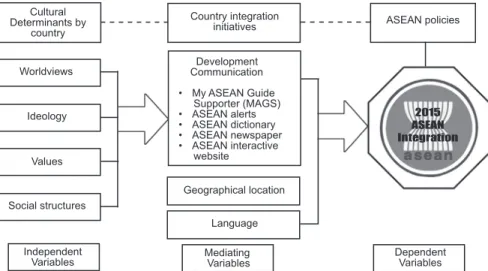
a community. While English is the assumed lingua franca, there is a high possibility that ASEAN nationals can learn each other’s language especially Singapore, Malaysia, Indonesia, and Brunei who speak Bahasa Melayu; Laos and Thailand perfectly understand one another; while Cambodia, Myanmar, Vietnam, and the Philippines have to learn all these languages. These can also be integrated in the curriculum as one of the foreign languages that students can take, and with the aid of multimedia access, this could be learnt faster. This integration should be seen as participatory. The ASEAN Secretariat may be tasked to act as clearinghouse or administrator of MAGS, wherein citizens of each country can beef up the database on information that they think everyone should be familiar with. The signs, symbols, hymn, or clothing may very well be featured using these applications. Figure 1 presents the conceptual framework of the study.
Cultural Determinants by
country Worldviews
Ideology Values Social structures
Independent Variables
Country integration initiatives Development Communication
• My ASEAN Guide Supporter (MAGS)
• ASEAN alerts
• ASEAN dictionary
• ASEAN newspaper
• ASEAN interactive website
Geographical location Language Mediating
Variables Dependent
Variables ASEAN policies
2015 ASEAN Integration
Figure 1. Ten Countries, One Nation (TCON) Integration Framework:
A Socio-Cultural Perspective
MATERIALS AND METHODS
The study employed a purely descriptive research design using secondary data with key informant interviews as triangulate measure. This was a class project for DEVC 215 (Communication and Culture) that the author handled during the first semester of SY 2014-2015. The six students were asked to research about how ASEAN integration can be realized, given that the assumption for such to occur in 2015 using communication and culture as lens. The Lao student specifically interviewed some students from the 10-member country who are studying in UPLB. A research of the literature was conducted to establish how cultural determinants of communication like worldviews, ideology, values, and social structures can hasten or hamper ASEAN integration. The results were analyzed and synthesized in this paper as
context of TCON. The author did the implications and interpretations of the results as well as the approaches that can be considered in mainstreaming TCON.
RESULTS AND DISCUSSION
There is no doubt, worldviews, ideology, values, and social structures vary. Such variation, however, should be seen as strength rather than a weakness.
The belief in God is a common characteristic of the 10-member country despite the differing denominations.
They all respect a supreme being that is above all men. They are also fatalistic, which should be revered because fear of something like belief on a mighty ruler can guide a moral and upright life. The worldviews of the ASEAN countries can serve like a shield to protect each
other’s rights and practices. The differences in beliefs may affect social behavior, but understanding these worldviews can broaden perspectives and ultimately build a multicultural society who harmoniously lives in diversity. Having an open mind to others’ cultures will not only strengthen the relationships among its constituents, but can also synergize its potentials to become a greater nation. Through constant exchange of information and intercultural communication (meaning each other’s country will imbibe one another’s culture), there is no doubt ASEAN integration will no longer be a lip service, but a policy that is understood by everyone.
The differing ideologies like democracy, authoritarian, monarchy, and communism definitely can affect
integration but if the 10 nations can agree to have a national policy that will be observed, then, ideologies can be sorted out. This can be done if each member country can use multimedia
platforms to share information to increase knowledge
about each other. Close collaboration should not be limited to higher ups, but the grassroots as well. The different media platforms can be used to beef up information access and heightened awareness about ASEAN countries being one. Having an ASEAN flag alongside the national flag
in schools and local government offices can perhaps educate students and citizens what ASEAN means.
ASEAN signs, symbols, or logos can be used to promote the integration, like what Singapore is doing. Singapore’s
disembarkation form for visitors includes the ASEAN logo indicating their membership. Other member countries can do the same. Making the logo visible in strategic locations and publications can educate a larger audience at any one time. Localizing ASEAN integration through multimedia platforms can also hasten integration.
One must also think about the speed of new media or digital media in transmitting and sharing information. For example, a tweet that goes instantly viral like memes can increase knowledge, affect attitudes, or change behavior towards a phenomenon. Therefore, the content that is being shared by the media and through digital media may have a strong impact in shaping the ASEAN identity and its cultures.
It is worth to learn more about memes since these are part of popular and everyday culture. Even if the term
“meme” was coined by Richard Dawkins (1976) long before the digital era, this concept incorporates some of the most fundamental aspect of the Internet and of participatory culture and Web 2.0. Limor Shifman (2014) defines memes as:
Pieces of cultural information that pass along from person to person, but gradually scale into a shared social phenomenon. Although they spread on a micro basis, their impact is on the macro level: memes shape the mindsets, forms of behavior, and actions of social groups.
This attribute is highly compatible to the way culture is formed in the Web 2.0 era, which is marked by
platforms for creating and exchanging user-generated content. Memes can be empowering or damaging. Given
the diverse cultural contexts of ASEAN countries, they may lead to intercultural misunderstandings and conflict if there is a violation in the use of signs, symbols, or language from one culture to another. Thus, it is very important to become media literate, use the media responsibly and critically, and understand which content is being shared in information societies. One example of an Internet meme is the video “Gangnam Style” which became the first YouTube clip to be viewed more than one billion times. Thousands of its viewers responded by creating and posting their own variations of the video.
“Gangnam Style” and its parodies and imitations are one of the most famous examples of an Internet meme: a piece of digital content that spreads quickly around the web in various iterations and becomes a shared cultural experience. How can memes be used to promote
ASEAN integration?
The media encompasses all the channels of communication, through which information and knowledge are disseminated and shared with one or more individuals. There are different forms of media:
mainstream media, community media, and new
media. Mainstream media consists of radio, TV, print or newspapers; community media are smaller and community-based, for example, community newspapers, localized radio programming, cable TV, wall newspapers, puppet shows, theater, or community communication channels. Terry Flew (2005) defines new media as digital media. Digital media covers media content that combines data, text, sound, and images stored in digital formats and distributed through networks such as broadband optic fiber cables, satellites, and microwave transmission systems. New media such as World Wide Web sites generate old content into digital format.
Social media is another form of media that, compared to