The purpose of the program is to document HACCP application in the fish processing industry in the region and provide a useful platform for sharing information and experiences on HACCP application among the ASEAN Member States. Japanese Trust Fund Project on the Application of HACCP in the Fish Processing Industry in Southeast Asia.
HACCP IMPLEMENTATION
PROBLEMS/ DIFFICULTIES ENCOUNTERED
FUTURE DIRECTIONS
CONCLUSION
INTRODUCTION
CAMBODIA
Thor Sensereivorth, Kong Chea Department of Fisheries
The monetary value of marine and aquaculture production is about US$250-300 million, which is about 8-10% of the total national GDP of US$2,800 million.
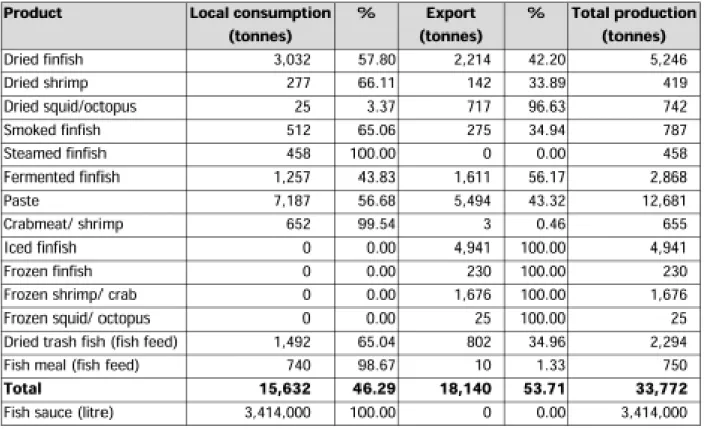
FISH PROCESSING INDUSTRY
Traditional processing technology
Thousands of tons of these products are produced every year from the Tonle Sap-Great Lake, where the fish are caught by medium and large scale fishermen. The production of fish sauce is also part of large-scale processing enterprises, providing work for about a dozen men in each enterprise.
Modern processing technology
Marketing and distribution of fish products
The significant amount of marine fish and fishery products, especially high-value fish, shrimp and cephalopods, exported to Thailand and Vietnam is probably underestimated. Cambodia still needs to obtain approval from the European Union Commission to export fish and fishery products to EU markets.
STATUS OF HACCP IMPLEMENTATION
DIFFICULTIES ENCOUNTERED
STRATEGIES AND POLICY FOR IMPROVING HACCP IMPLEMENTATION
CONCLUSIONS
Consisting of a total of 17,500 islands with a coastline of about 81,000 km, Indonesia has land areas of over 2 million square kilometers and 5.8 million square kilometers of sea water.
INDONESIA
Setia Mangunsong Director
Production trends
Production includes marine fish, inland open water fish, brackish water fisheries and freshwater fisheries.
Trade on fishery products
Annual fish consumption per capita
Fish processing industry
FISH INSPECTION AND QUALITY CONTROL SYSTEM
In the MOU, the Directorate General for Fisheries (DGCF) took over responsibility for inspection and quality control of fish and fish products. The fish inspection and quality control program administered by the DGCF includes the development of fisheries standards, hygiene and sanitation, of which the DGCF has adopted the CAC FAO/WHO - Codes of Practices for infrastructure, environment, facilities, plant personnel and operation of fish processing plants.
Current legislation and jurisdiction
This restriction of market access prompted the government to establish a Memorandum of Understanding (MOU) between the Minister of Health and Agriculture to jointly establish a mandatory Fish Inspection and Quality Control Regulation in 1975, based on the Health and Hygiene Acts of 1960 and 1962 respectively. . Accreditation program related to Fish Inspection and Quality Control Laboratories under the jurisdiction of the National Agency for Standardization.
INSPECTION AND QUALITY CONTROL AUTHORITY
The Directorate of Inspection and Development of Fish Processing performs services for the inspection and control of fish quality. Provincial laboratories directly perform quality control of fish, including certification of fish products for inspection and control of fish quality.

Certification body
At the provincial level, fisheries services are operationally assisted by the Sub-Directorate of Fish Inspection and Quality Control to coordinate local inspectors to carry out surveillance, inspection and quality control on a daily basis, while fish inspectors attached to the head office supervise and monitor the conduct of local inspectors and periodically cross-inspect processing plants. The National Center for Quality Control and Fish Processing Development acts as a reference laboratory to provide oversight to provincial laboratories in terms of analytical methods, processing technology development and training.
IMPLEMENTATION OF HACCP IN THE FISHERY INDUSTRY
The implementation of HACCP in fisheries must be supported by appropriate legislation that will regulate the relationship between the government and the private sector. The role of the government, particularly the fisheries inspectors, and the benefits to be gained by the private sector through the use of the new system should be clearly defined.
EXPECTED GOALS IN IMPLEMENTING HACCP
The development of the program is partially funded under Phase II of the ASEAN-Canada Post-Harvest Fisheries Technology Project and the USAID-supported Agribusiness Development Project. It deals with the hygienic and sanitary aspects of h a n d l i n g a n d p r o c e s i n g t e c h n i q u e s , construction, facilities and equipment, personnel and self-regulating quality control management in the fish processing plant.
IMPLEMENTATION OF HACCP IN SMALL/ MEDIUM SCALE FISH PROCESSING UNIT
Covers hygiene and sanitary aspects during harvesting and loading, transport or handling on board a fishing vessel before further handling and processing stages. Its implementation applies not only to government fish inspectors, but also to the processing plants in their self-regulatory quality control, to improve preventive measures at critical control points.
Inspection and Quality Control Supervisory Programme
Certificate of competence required by the plant quality control supervisor issued by the Directorate General for Fisheries. As shown in Table 6, most export-oriented fish processing plants, including canning, freezing, chilling, drying, and shrimp/fish cracker processing, have implemented SSOPs and GMPs.
OTHER ISSUES
Quality Certificate or Health Certificate for Export Products issued by the Provincial Laboratory and Inspection Services. The General Directorate of Capture Fisheries has taken the necessary actions to face all those challenges by making policies that are consistent with the HACCP system and other p r e p e r e m e n t i s u e d b bodies, such as FAO/WHO 3.
LAO PDR
Souryasack Chayavong Department of Livestock and Fishery/
STATUS OF FISHERY IN LAO PDR
STATUS OF FISH PROCESSING INDUSTRY
SOME MEASURES AND FOOD STRUCTURE CONTROL
There was no food law in Lao PDR before, only some regulations and decrees related to food control to solve food safety problems. Fish processing plants do not understand the relationship between food hygiene and the quality of the final product.
PROGRESS OF HACCP IMPLEMENTATION
Currently, only three provisions on food quality control activities issued by the Prime Minister's Council in December 1991 have been used as stronger benchmarks for regulating all activities related to food processing and safety.
FUTURE DEVELOPMENT
This value consisted of RM5.45 billion in marine and aquaculture landings and RM81 million in ornamental fish production, obtained from 1.4 million tonnes of marine and aquaculture catch and 338 million ornamental fish.
MALAYSIA
Hamdan Jaafar Research Officer
DEVELOPMENT OF FISH PROCESSING INDUSTRY IN MALAYSIA
While traditional and SME-scale processing caters to the domestic market, these medium and commercial fish processors cater to urban and export markets.
National Policy and Programme on Seafood Safety
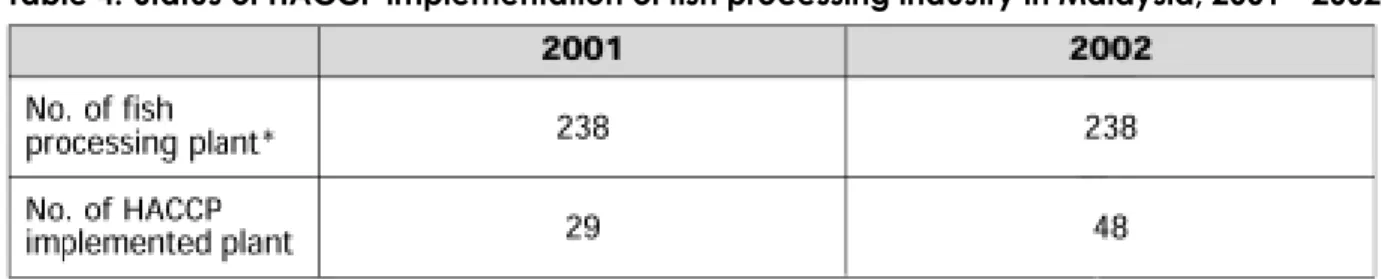
As of January 2002, there are 238 medium-sized and commercial fish processing plants operating in Malaysia (Table 4). The objective was to create awareness of the importance of implementing HACCP in the fish processing industry in order to ensure food safety and increase export trade.
FUTURE DIRECTION
Lack of understanding of the background information on the processing of fish and fishery products and regulations in importing countries, e.g. EU) on the understanding of the actual implementation of HACCP and later on the requirements for verification and audit.
MYANMAR
Tin Hla* and Thein Htut**
PRESENT STATUS OF FISH PROCESSING INDUSTRY
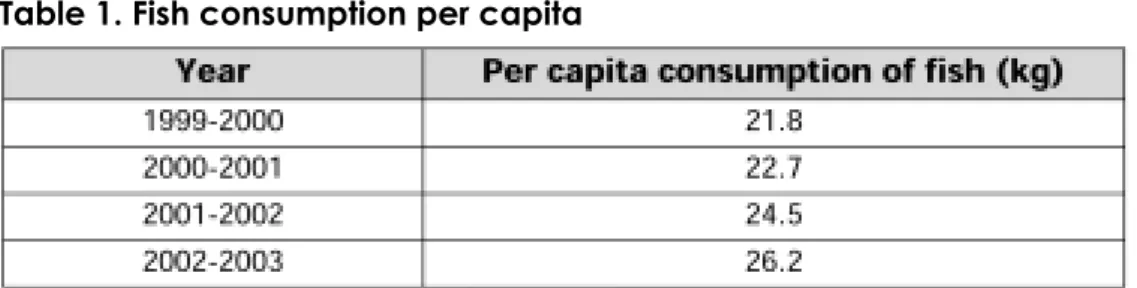
Fish and fish products are exported in a few forms, such as fresh, chilled, frozen, dried and salted.
IMPLEMENTATION OF HACCP IN THE FISH PROCESSING INDUSTRY
NATIONAL PROGRAMMES, REGULATION AND POLICIES
L a c k o f F A O a n d H O - a p p r o v e d l a b equipment and techniques needed to support food safety certification system - Lack of risk assessment and hazard needed for. To complete HACCP training in fishing and aquaculture procedure for boat crew and farmers respectively.
BACKGROUND
PHILIPPINES
Consuelo C. Baltazar
Within this program, development efforts are focused on expanding and revitalizing productivity programs and providing support systems through The participation of the private sector is vital for the realization of the goals of this program.
ACCREDITATION PROGRAMME FOR HACCP IMPLEMENTATION
PROGRESS ON HACCP IMPLEMENTATION
In 2002, a significant number of fish processing companies were added to the list of HACCP-certified companies. This can be attributed to the increased number of training and technical assistance made available to the private sector.
Products manufactured under the HACCP system
New products added to the HACCP implemented list include frozen tilapia, smoked marinated milkfish and jarred sardines.
Export of fish and fish products
HACCP training conducted
SOCIO-ECONOMIC BENEFITS OF HACCP IMPLEMENTATION
ISSUES AND CONCERNS ON HACCP IMPLEMENTATION
NEW STRATEGIES AND DIRECTIONS
SINGAPORE
Ira Hariono Senior Research Officer
FISH PROCESSING INDUSTRY IN SINGAPORE
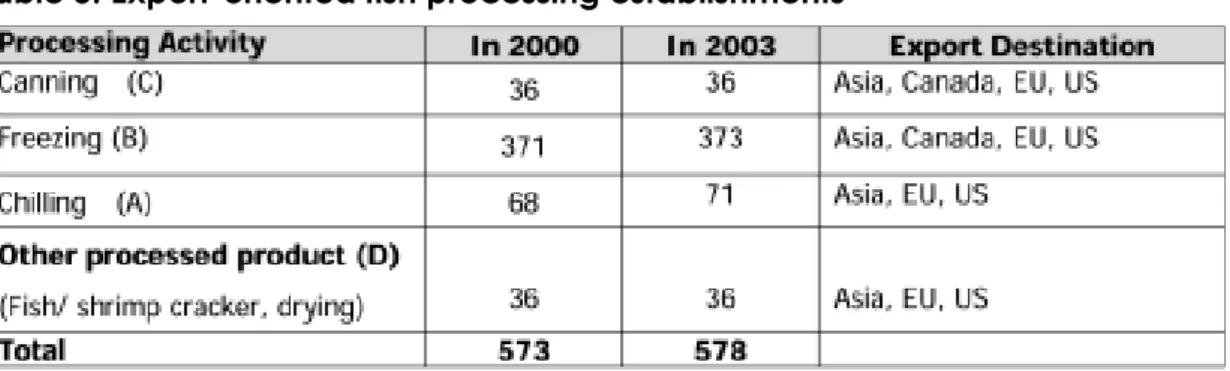
Export-oriented fish processing establishments
Local fish processing establishments
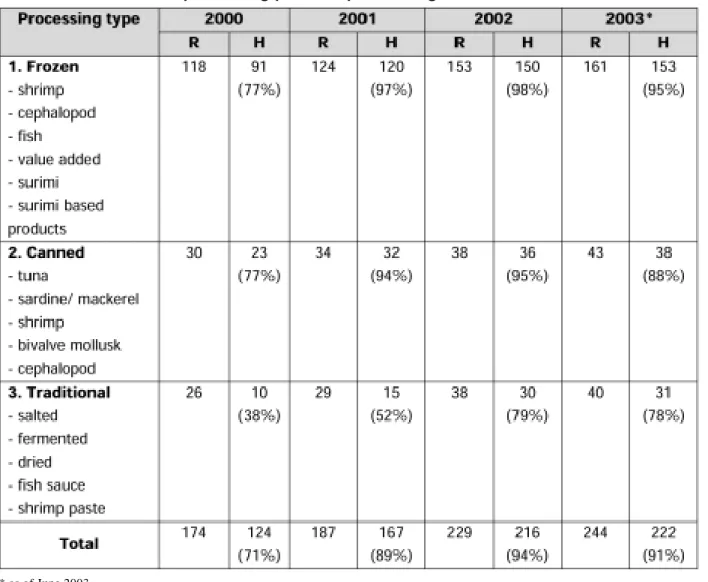
Status of fish processing industry in Singapore from year 2000 – 2003
AVA’S APPROACH TO THE HACCP IMPLEMENTATION IN FISH PROCESSING INDUSTRYThe number of fish processing establishments in
The implementation of HACCP in local companies is noticeably slower than its export-oriented counterparts. Although many fish processing companies recognized the usefulness and importance of HACCP to ensure product safety and quality, but the implementation of HACCP has generally been quite.
THAILAND
HACCP, which stands for Hazard Analysis and Critical Control Point, clearly states its approach to food safety, which is to identify relevant hazards and establish control measures to prevent them. Since the process of designing such control measures requires a judgment based on science, the HACCP system, if developed and implemented effectively, can guarantee product safety (although not 100%) and has become acceptable worldwide for improvement of food safety.
Suwimon Keerativiriyaporn Director
The new HACCP regulations, 21CFR 123 USFDA and EU Directive 94/356/EC, place the responsibility on fish processors to identify hazards that are likely to occur and to establish critical control points to prevent or reduce contamination.
PROGRESS MADE IN THE APPLICATION OF HACCP
When the submitted documents are deemed satisfactory in accordance with food safety requirements, DOF will proceed to in-plant audit to verify their compliance. The first edition will be valid for 6 months and will then be consistent with its later rating records.
FISH PROCESSING INDUSTRY IN THAILAND
Processors are also required to establish a system that allows the product to be traced back to the source of the raw material. In addition, too many CCPs also cause more problems for processors to maintain the effectiveness of their HACCP system, as too many factors need to be taken care of and checked, especially for.
EXPORT OF FISH AND FISH PRODUCT
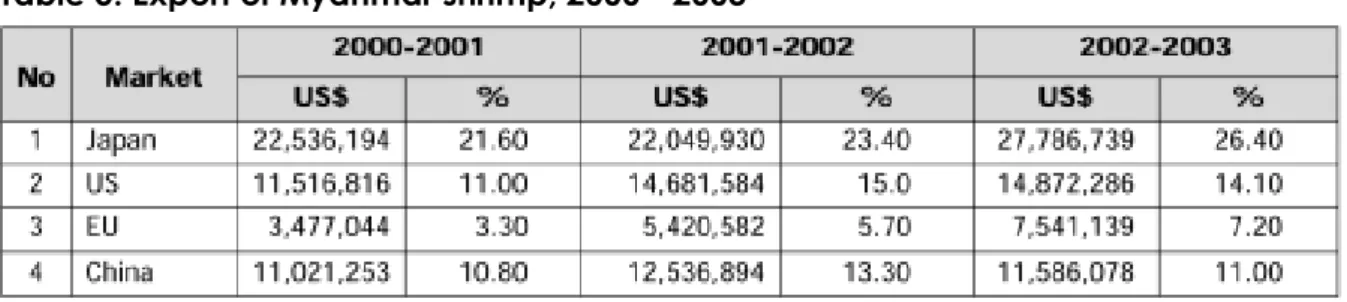
It is trivial to note that the application of HACCP increases the amount of export. Shrimp exports were fairly stable from 1999 to 2001, but fell dramatically in 2002, especially to the EU market, which decreased by more than 50% from previous years (Table 2).

SUMMARY OF PROBLEMS IN IMPLEMENTING HACCP FROM 2000 TO 2003 AND STRATEGIES TO OVERCOME PROBLEMS
Previously, the safety of finished products was the entire responsibility of the processors. Strengthening the HACCP implementation of the traditional product manufacturers and upgrading them to meet the requirements 5.
VIETNAM
The Ministry of Fisheries of Vietnam (MOFI) with its executive authorities - National Fisheries Inspection and Quality Assurance Center (NAFIQACEN) and Fisheries Resource Protection Department, is the competent agency to control the food safety and quality of fishery products from farm, catch, to wholesale'.
Tran Thi Dung Senior Expert
FISH PROCESSING INDUSTRY IN VIETNAM
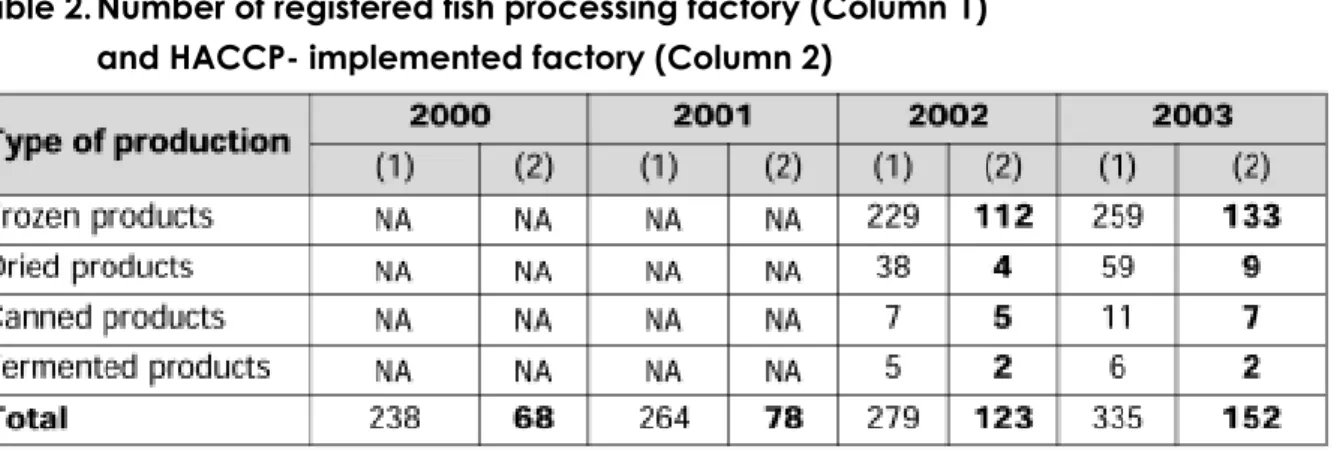
At the same time, the number of fish processing factories has steadily increased from 238 factories in 2000 to 322 factories by June 2003. Canned and fermented fish products are the smallest group, although the production volume and the number of fish processing plants are increasing gradually.
HACCP IMPLEMENTATION IN THE FISH PROCESSING INDUSTRY
On the other hand, class C and D institutions are required to improve the environments and the HACCP program as recommended by NAFIQAVED inspectors.
OTHER ISSUE
HACCP TRAINING
Lack of qualified personnel to develop and implement HACCP program in the fish processing establishments. Difficulty in developing HACCP programs in traditional fish processing establishments due to lack of risk assessment of traditional fish products.
NATIONAL STRATEGY
HACCP is widely recognized; its application in Vietnam's fish processing industry still faces some hurdles. The Vietnamese government will continue to introduce and encourage the implementation of HACCP in the fish processing industry.
BRUNEI DARUSSALAM
Hazard analysis worksheet
Product description
Flow diagram of production of fermented fish paste (prahok)
Flow diagram of production of dried anchovy
Flow diagram of production of dried fish
Flow diagram of production of fish cracker (keropok ikan)
Flow diagram of production of shrimp paste (hmyn ngapi)
Flow diagram of production of pasteurized sauteed tiny shrimp
1. Acquisition of raw materials Paralytic fish shell toxin (PSP) 2. Cooking/adding vinegar Growth of pathogen and spore forming bacteria 3. Pasteurization Growth of vegetative and non-spore forming bacteria.
Flow diagram of production of fish ball
Flow diagram of production of dried shrimp
Flow diagram of production of fish sauce
However, implementation of HACCP is voluntary and as the local fish processing industry mostly supplies the domestic market, there is little 'pressure' to do so. The following is a summary of the status of HACCP implementation in the fish processing industry in Southeast Asian countries.
The following is a summary on the status of the implementation of HACCP in the fish processing industry in the Southeast Asian countries collated
Programs such as seminars, talks as well as financial and technical assistance were made available to industry to encourage HACCP implementation. As of mid-2003, there are approximately 12,500 registered fish processing establishments, of which 339 are export-oriented, with 263 having implemented HACCP.
To date (2003), two fish processing companies involved in exports have achieved product certification and are in the process of working with their companies. Since 1999, one of the commercial companies, which is located in Phnom Penh and exports to the United States, has implemented HACCP plans for its products such as frozen shrimp, freshwater fish, fillets, IQF cooked freshwater snail meat.
SUMMARY
Training for fish processors is provided in states and departments where fish processing plants are located. AVA currently licenses approximately 90 fish processing plants, of which 15 are approved for export to the EU.