The Education Research Program (ERP) of the University of the Philippines Center for Integrative and Developmental Studies (UP CIDS) expresses its greatest gratitude and appreciation to the following individuals:. Planning Officer, Ministry of Education – Region VII). Aida Yuvienco (Information Systems Consultant and former Director, .. Information, Communications and Technology Service, Department of Education). Victoria Mayo (Schools Division Office, Ministry of Education - Capital Region) .. Romylyn Metila Assistant Professor, School of Education, UP Diliman).
Aida Yuvienco (information systems consultant and former director, .. Information, Communication and Technology Service, Ministry of Education).
Introduction
Given these factors affecting society and education, we therefore revised the purpose and mandate of the ERP to make its vision, mission and objectives (VMG) more relevant in the context of existing reforms or those expected to be institutionalized in the near future. The updated VMG will frame the research agenda and methodologies of the UP CIDS ERP for 2019 to 2024 (see Box 1 on opposite page). It builds on previous works of the ERP, while highlighting emerging issues.
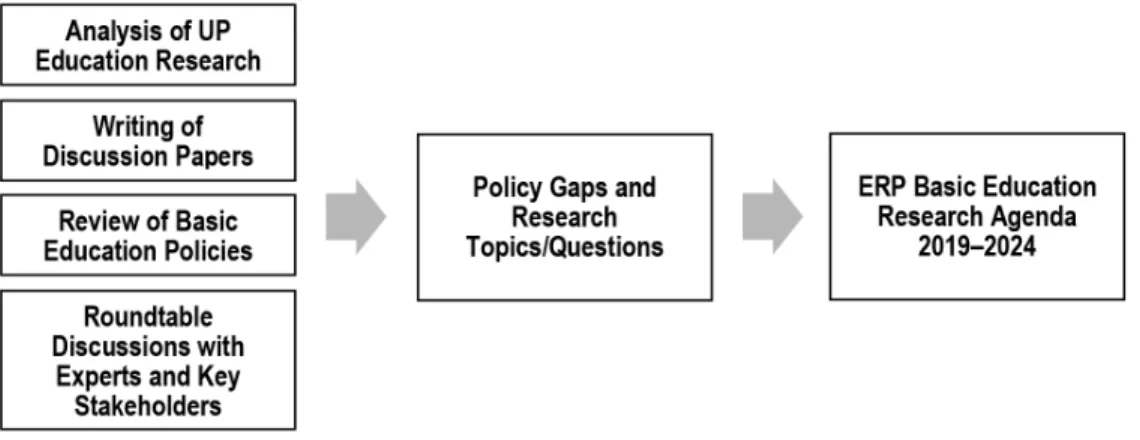
In addition, a thorough review of the University of the Philippines' contributions to educational policymaking helped define the directions of the research agenda. Educational research conducted by the University of the Philippines has been collected and organized in a database. The database was designed to be able to filter content according to UP unit, year of implementation, type of research (e.g. journal articles, funded research, unpublished research, conference papers, books and book chapters), title, author and topic research.
The data from these discussion papers provided the first set of topics for formulating the ERP research agenda. The product of all these processes is the research agenda that will guide the work of the teachers, students and researchers of the Education Research Program.
Philippine Basic Education
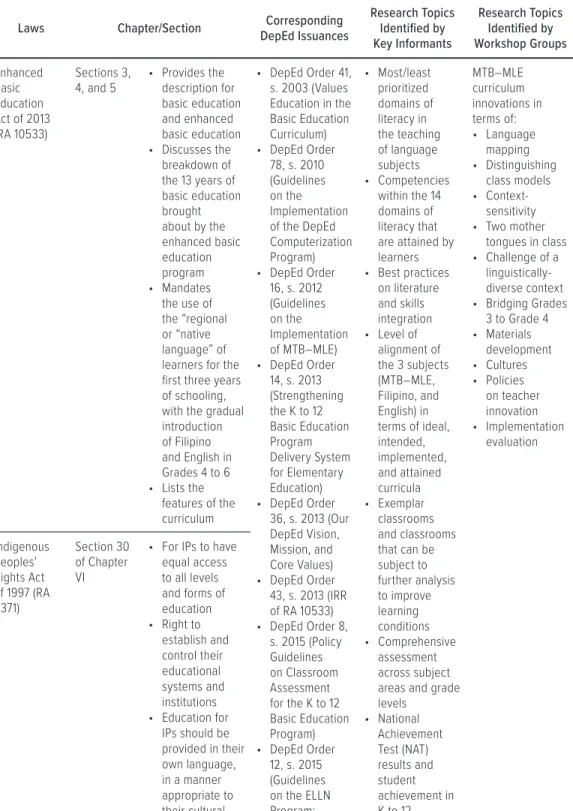
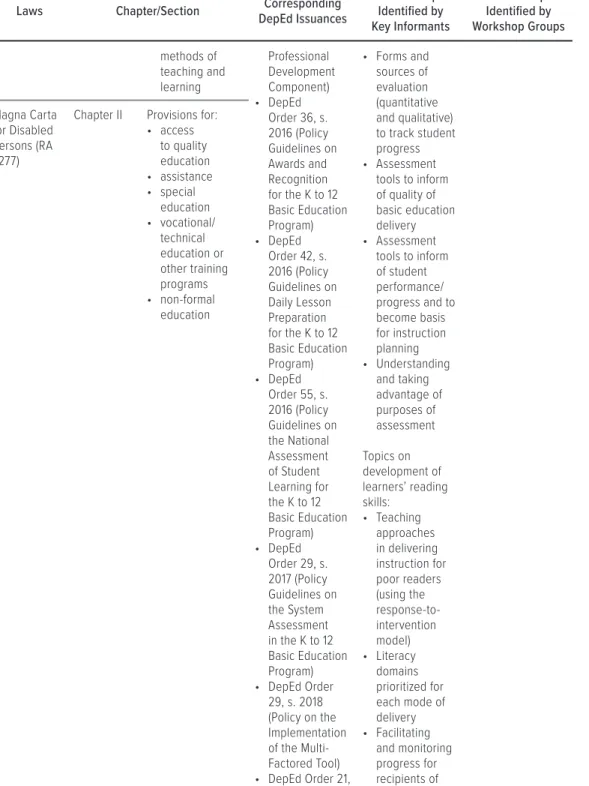
Discusses the breakdown of the 13 years of basic education that the expanded basic education has brought about. Discusses the division of the 13 years of basic education that the expanded basic education program has brought about. 2019 (Policy Guidelines on the Implementation of Enhanced Alternative Learning System 2.0) outlines the rules for implementing the enhanced ALS at various levels of governance in terms of curriculum, delivery, assessment and capacity building programmes.
2017 (Framework for the Pilot Implementation of the Alternative Learning System–Education and Skills Training [ALS-EST]), DepEd Memo 144, p. Creation of the ALS Task Force and appointment of its members) DepEd Order 21, p. Policy guidelines for K to 12 Basic Education Program). Muslim Education or Madrasah Education is also part of the list of inclusive education programs.
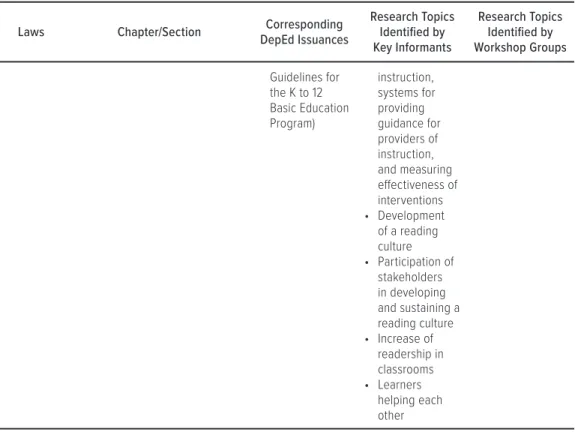
Implementation of Basic Education Madrasa Programs for out-of-school Muslim youth and adults). KKMF will promote, supervise and coordinate with relevant agencies regarding the implementation of the Madrasa education system. A summary of the relevant laws and policies and the identified research topics and questions are in Table 2.8 (on page 36).
National Adoption and Implementation of the Training and Development (T&D) System, and designation of the National Educators Academy of the Philippines (NEAP) as the interim agency responsible for the operationalization of the T&D System) DepEd Order 2, s. Teacher Induction Program Policy) DepEd Order 11, s. Implementation of the NEAP Transformation) FIGURE 2.8 • Timeline of existing laws and DepEd expenditures on teacher professional development. 2016 (Policies and Guidelines for the Implementation of the Public Assistance Program for Students and Teachers in Private Education, Effective School Year 2016–2017).
Research topics identified by workshop groups (Detailed . Guidelines for the Implementation of the SHS Voucher Program).

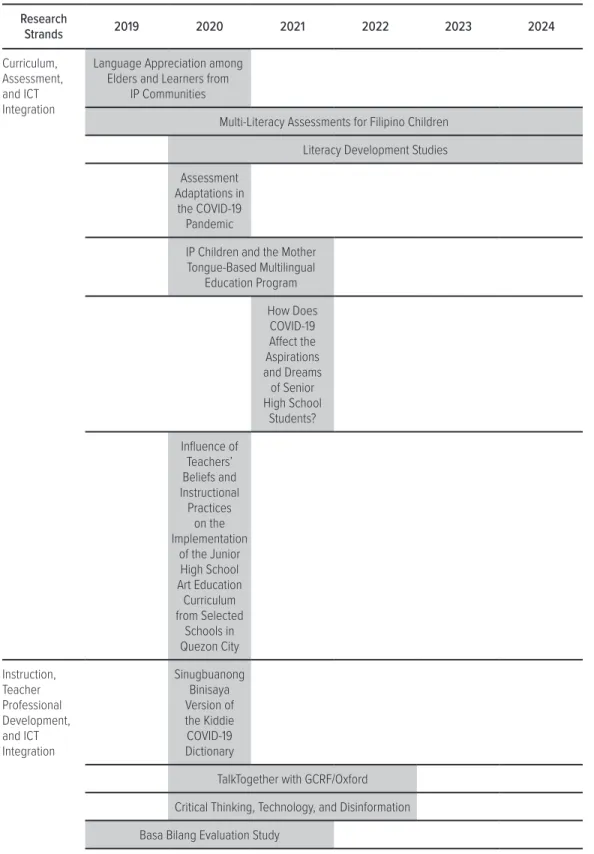
Categories of inquiries in this area include studies on curriculum implementation in relation to the planned curriculum, implementation of innovations that have been successful in this area, support for learners and the role of ICT in program delivery. The purpose of this project is to develop a toolkit that would measure the literacy skills of Filipino children in the MTB–MLE program and provide insight into their literacy development and difficulties. Studies of literacy development must continue during the pandemic to advise education policy on how to improve literacy among students.
Implementation of Junior High School Art Education Curriculum by Selected Schools in Quezon City. Gender disparities in basic education outcomes in the Philippines remain unresolved and the consensus that boys are disadvantaged compared to girls persists. Sinugbuanong Binisaya is the second most spoken language in the Philippines, after Tagalog with less than three million speakers (PSA 2018).
The ERP will be a partner in the implementation of a three-year research project on supporting oral language development in early learners. Studies show that the presence of technology causes a dramatic increase in the scale and speed of disinformation spread, and one way to reduce its effects is through awareness that it is a threat (Lagarde and Hudgins 2019). The ERP partnership with the Knowledge Channel Foundation, Inc. KCFI) through the Basa Bilang Project, which aims to explore the impact of technology-mediated learning on literacy development among primary school students in the school division of Sta.
Rosa Laguna, will continue but with a different focus on how to support and sustain literacy learning in the early grades during COVID-19. This section discusses research on how schools are improving and becoming environments that optimize learning, especially in the age of 21st century technologies and the challenges posed by the COVID-19 pandemic. It also seeks to establish the schools' strategic directions in the context of the world's knowledge economy.
Tools to Work' and 'Living in the World'. Findings show that although eight of the ten themes identified in development reflect 21st century constructs, more schools. Although these are partially consistent with 21st century learning , the rest of KSAVE's 21st century learning constructs have not yet been articulated in the strategic directions of most schools.Among the objectives of the study will be to identify the exit points that SHS students choose to embark on after graduation , interviewing students, teachers and other stakeholders about the SHS experience and identifying the problems that schools face in implementing SHS.
APPENDIX
ERP Research Agenda (1999–2004)
Research and Development Program of the ADB-supported Philippine Non-Formal Project (DECS–BNFE and Literacy Coordinating Council of the Philippines). The Algebra of Weaving Patterns, Gong Music and Kinship System in the Kankanaey of the Mountain Province. Enrichment of the educational programs in the Cordillera Administrative Region (DECS–CAR) through the incorporation of usable indigenous knowledge in the formal and non-formal curricula.
Research collaboration on basic education with UP Integrated School, UP Rural High School, UPHS Cebu and UPHS Iloilo. Towards rationalization of higher education research: Analysis and assessment of higher education research at the national level. Assessment of the extension and volunteer service contributions of UP units, faculty and students (with the UP Oblation Corps).
Development of professional and theoretical materials on learning and cognition (to be written in Filipino). Commission on Higher Education (CHED) - UP Clearinghouse for basic and policy research in higher education. Organization and implementation of the ECCD system (in anticipation of the entry into force of the ECCD law).
National Educators Academy of the Philippines [NEAP] as the interim agency responsible for the operationalization of the. 2012 (Act on Implementing Rules and Regulations of Republic, No. 10157, otherwise known as the Act on Kindergarten Education). 2015 (Guidelines on the establishment and . Implementation of the results-based performance management system in DepEd).
2017 (Guidelines for the Allocation and Use of the Human Resource Training and Development Fund [HRTD]). 2017 (Framework for the Pilot Implementation of the Alternative Learning System – Education and Skills Training [ALS – EST]). 2018 (Establishment of the Alternative Learning System – Education and Skills Training Project Management Team [ALS – EST]).
The Authors
Editorial Office: Lower Ground Floor, Ang Bahay ng Alumni, Magsaysay Avenue, University of the Philippines,. The Editor-in-Chief and Program Editors ensure that contributions to the UP CIDS Public Policy Monograph Series contain research findings on issues that are consistent with the core agenda of the research programs under the University of the Philippines Center for Integrative and Development Studies (UP CIDS). The responsibility of the editor-in-chief and program editors is toward high standards of scholarship, the generation of new knowledge that can be used for the public good, and the dissemination of such information.
Established in 1985 by UP President Edgardo Angara, the UP Center for Integrative and Development Studies (UP CIDS) is a political research unit of the university that connects disciplines and researchers across the different units of the UP system. It is mandated to encourage collaborative and rigorous research that addresses issues of national importance by supporting researchers and securing funding, enabling them to produce outputs and recommendations for public policy. This is done through the dissemination of research-based knowledge through activities such as forums, symposia and conferences and through its public policy-oriented publications.
These research activities are implemented by the twelve (12) research programs of the Center and the Network of Local Regional Studies (LRSN), which consists of research centers at the universities of UP. ABOUT THE PROGRAM The Education Research Program (ERP), one of the oldest UP CIDS research programs, aims to contribute to a deeper understanding of education and social issues arising from the reform by consolidating research.