NARUTRAT BOONYASITTISOPON
A THEMATIC PAPER SUBMITTED IN PARTIAL FULFILMENT OF THE REQUIREMENTS FOR THE DEGREE OF MASTER OF MANAGEMENT
COLLEGE OF MANAGEMENT MAHIDOL UNIVERSITY
2021
COPYRIGHT OF MAHIDOL UNIVERSITY
THE IMPACT OF CALORIES LABELING ON CONSUMERS’ BUYING BEHAVIOR
was submitted to the College of Management, Mahidol University for the degree of Master of Management
on
September 11, 2021
……….….…..………
Assoc. Prof. Randall M.Shannon, Ph.D.
Advisor
……….….…..………
Assoc. Prof. Vichita Ractham, Ph.D.
Dean
College of Management Mahidol University
……….………….…..………
Mr. Narutrat Boonyasittisopon Candidate
……….….…..………
Assoc. Prof. Astrid Kainzbauer, Ph.D.
Chairperson
……….….…..………
Asst. Prof. Pornkasem Kantamara, Ed.D.
Committee member
ACKNOWLEDGEMENTS
This thematic paper became a complete document with the support and help of many people. I am grateful to everyone, especially my advisor Assoc. Prof. Randall M. Shannon, who reviewed and commented from the start of this article to the end.
In addition, there were kindly interviewers who sacrificed their time to answer questions in order to provide an informative study. This includes sources of information such as researches, journals, and even information from agencies such as the WHO, which is as useful as the CMMU's powerful research tools, allowing data from multiple perspectives to formulate this study.
Ultimately, this article would not be complete without my friends and family. My family was the inspiration for this study. As my parents are elderly, our society is entering a future aging society that needs better living and food. My friend for giving me some advice and encouragement in this study.
Narutrat Boonyasittisopon
THE IMPACT OF CALORIES LABELING ON CONSUMERS’ BUYING BEHAVIOR
NARUTRAT BOONYASITTISOPON 6249102
M.M. (GENERAL MANAGEMENT)
THEMATIC PAPER ADVISORY COMMITTEE: ASSOC. PROF. RANDALL SHANNON, Ph.D., ASSOC. PROF. ASTRID KAINZBAUER, Ph.D., ASST. PROF.
PORNKASEM KANTAMARA, Ed.D.
ABSTRACT
The objective of this research aimed to study factors as calorie labeling and nutrients information affecting the food and beverage purchasing behavior of customers in Bangkok who exercise and take into account their own health. This research is qualitative research using data obtained from in- depth interviews to understand the way of life of people entering the aging society in the future to improve the quality of life and health.
To study customer buying behavior, this study focused on five variables: social norms, perceived value as personal benefits, life satisfaction, health benefits, the importance of health, convenience and lifestyle, brand trust, brand reputation, price, and promotion.
At this study, only those who exercised regularly were interviewed. This is because it is seen that this group of people is likely to be a healthy group of people and behave suitable for the aging society, including the control of nutrients and calories in meals. The results of the study show that in addition to the aforementioned factors, there is another factor that ultimately causes people to exercise and food controlled, namely illness. The number of calories on a food menu or on a label has very little effect on food choices. People would like to see more specific nutritional numbers in order to be able to more effectively control that nutrient and reduce symptoms of ailments, such as the amount of fat to control weight.
In terms of recommendation, influencers are not very effective but they can build awareness about that kind of product, in this case, health food. The second is the food benefits that restaurants and food packaging should show the number of nutrients they need to promote in their products. It can influence customers' buying behavior more than calorie counting. The last factor is price and promotions that affect the frequency of purchase. If it is expensive, you will not go to that shop very often. Moreover, proper daily dietary information and proper nutrition information for patients have a profound effect on dietary choices.
KEY WORDS: Calorie and nutrient information / Label / Customers buying behavior / Exercise / Price and promotion
31 pages
CONTENTS
Page
ACKNOWLEDGEMENTS ii
ABSTRACT iii
LIST OF TABLES vi
LIST OF FIGURES vii
CHAPTER I INTRODUCTION 1
1.1 Background 1
1.2 Problem statement 2
1.3 Objectives 3
CHAPTER II LITERATURE REVIEW 4
2.1 Social Norms 4
2.2 Perceived Value 4
2.2.1 Personal Benefits and life satisfactions 4 2.2.2 Health Benefits and the important of health 5
2.2.3 Convenience and lifestyle 6
2.3 Brand Trust 6
2.4 Brand Reputation 6
2.5 Price and Promotion 7
CONTENTS (conts.)
Page
CHAPTER III RESEARCH METHODOLOGY 8
CHAPTER IV FINDINGS AND DATA ANALYSIS 10
4.1 Analysis Method 10
4.2 Finding from Interview 11
4.2.1 Social norms 14
4.2.2 Perceived Value 14
4.2.3 Brand value 16
4.2.4 Price and promotion 16
4.2.5 Other variables 17
CHAPTER V CONCLUSION AND RECOMMENDATION 21
5.1 Conclusion 21
5.1.1 Similarities 23
5.1.2 Differences 23
5.2 Recommendation 24
5.2.1 Influencer 24
5.2.2 Health Benefit 24
5.2.3 Price and promotion 25
5.2.4 Recommendation for future research 25
5.3 Limitation 26
REFERENCES 27
APPENDICES 29
BIOGRAPHY 33
LIST OF TABLES
Table Page
4.1 Names and ages of 10 interviewees in the young group (19 – 39 years) 10 4.2 Names and ages of 10 interviewees in the older group (over 39 years) 11
LIST OF FIGURES
Figure Page
1.1 Geographic of populations aged range in the world 1
1.2 Thailand population aged range in 2020 2
1.3 Obesity in Asian 3
3.1 Proportion of Thai population with overweight 9
5.1 Consuming behavior patterns that lead to need, calorie numbers, and other nutritional information.
21
CHAPTER I INTRODUCTION
1.1 Background
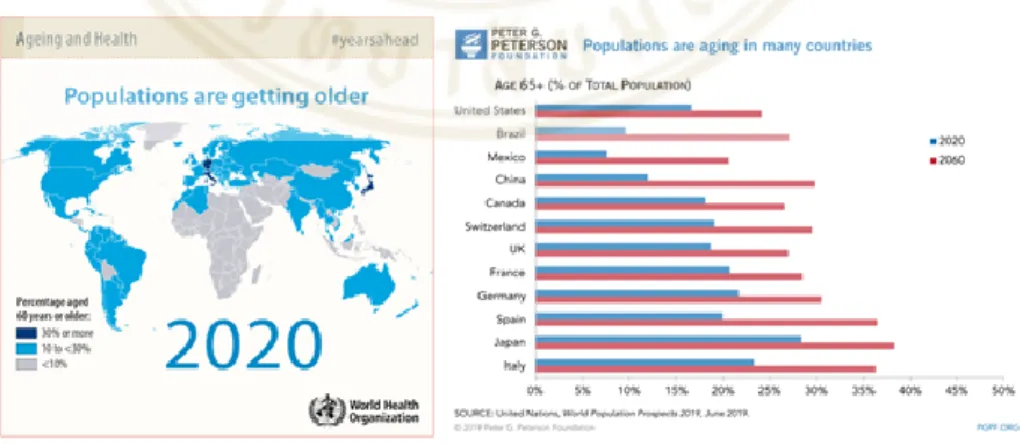
In the near future, Thailand and most countries in the world will become an aging population in this era. Most people plan not to have children, so their location and life should change to suit their circumstances. The number of older people will continue to increase until they become the majority of the population in the country and around the world in the future as we can see in figure1 show the geographic of the world that highlight the countries which have people who are over 65 years old will become more than 30% of their population (https://www.who.int, 2020). WHO shows the proportion of people aged 60 years and older was 1 billion in 2019 and will be doubled in 2050.
The information of WHO also shows more details of information comparing between 2020 and 2060 that show many countries will have more percentage of aging populations. In some countries such as Spain, Japan and Italy the aging will over than 35% of their population (https://www.pgpf.org/, 2019). This changing is required the adaptations in every aspect; health, social care, housing and transportation.
Figure 1.1 Geographic of populations aged range in the world
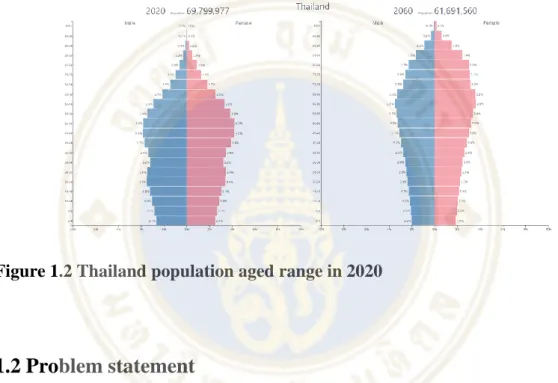
Looking back in Thailand, we find that Thailand is also facing an aging society problem. According to the 2020 population figures, people aged 45-54 years old are the majority of the country's population but on the other hand, the proportion of the population under the age of 25 is much smaller. All of this information that Thailand is entering an aging society in the future. This is in line with estimates, for example in 2060 where the majority of the population over the age of 60 will be the highest and the proportion will decline to close to that of the inverted pyramid in figure 2 (https://www.populationpyramid.net, 2019).
Figure 1.2 Thailand population aged range in 2020
1.2 Problem statement
Due to the incoming aging population in Thailand, we have to focus on the Thai lifestyle, such as food, living activities, and the like. Eating behavior is another factor that we need to be very important because, according to the data in figure 3, Thailand is the third in ASEAN for people with the most obesity (https://theaseanpost.com/, 2020). Thailand is also currently one of the countries with the highest obesity prevalence in Asia overtook wealthier countries such as the Republic of Korea, Japan, and Singapore. Thais are increasingly obese due to their current dietary habits and data shows that Bangkok people are most at risk of obesity than other regions as they can find the restaurant like fast food and street food that never inform the nutrition information (https://worldpopulationreview.com/, 2021).
Figure 1.3 Obesity in Asian
Therefore, we should think about how to manage and find a solution to keeping the majority of people in our state’s health and wellness. Thailand has a lot of restaurants including street foods but they don’t have any information on nutrition for customers as mentioned to consider before ordering. They have to guess what you get from that meal. It may not be good for the health of the consumer. Therefore, they become one of the main concerns of the aging population that they have to manage and maintain good health. The nutritional and useful information, including the calories of each meal, will influence your decision to buy that meal.
1.3 Objectives
To study the factors that can attract the elderly and those who care about healthy food. The nutritional information, including the number of calories contained in food, especially in the restaurant menus that a portion of Bangkok residents chooses to use, affects the food choices or not. The ordering of foods with proper nutrition numbers can be used to address problems, to reduce dietary concerns for the nation's overall aging population, or to strengthen a healthy food business whether it is clean food, organic food or something like that.
CHAPTER II
LITERATURE REVIEW
2.1 Social Norms
In terms of consumption, people have different lifestyles. Consumers interested in healthy food love to taste new foods with exciting and trendy features that can be featured on social media, another one looking for the best in terms of value for money. (Rujipongtharin, 2016) However, the two groups had similar preferences. They love sharing and recommending their favorite food or restaurants to other influencers, whether YouTubers or bloggers have more influence on their ordering decisions than nutrition facts or calorie counting. The study found that behavior or lifestyle had a significant effect on food choices, including eating out habits that appear to be more harmful especially for health-conscious people. While those behaviors continue to affect those around them, it was found that a number of parents consider calories before ordering food for their children. (Todd et al., 2010 and Kiszko et al., 2014)
2.2 Perceived Value
2.2.1 Personal Benefits and life satisfactions
Health care trends from diet or exercise are becoming more and more popular in this city. Making consumer products more open to people who love health, whether it is a dietary supplement, whey protein, vitamins, including a healthy food business but the food choices of most people do not take into account the nutritional value. For the most part, teenagers consider tasting the most important factor in their food choices (Elbel et al., 2011), while adults look for comfort rather than consumption by considering nutritional information (Wisdom et al., 2010)
Labels, on the other hand, can help consumers identify better options for their health. Nutrition labels are useful labels that still require consumers to understand the meaning of different nutrients in order to identify healthy options (Ikonen et al., 2019). Therefore, we expect descriptive labels to provide more powerful information about products, which can help consumers differentiate between healthy and bad choices. (Cecchini & Warin, 2016 and Newman et al., 2018).
2.2.2 Health Benefits and the important of health
When we talk about food in a capital city like Bangkok, it is inevitable that there are many street food and fast-food restaurants. Most people have eaten meals from such restaurants. Research (Swartz et al, 2011) in the United States found that calorie menu labeling and nutritional information were ineffective in reducing calorie intake and ordering from fast-food patrons. In Thailand, (Rujipongtharin, 2016) consumers are not interested in information on nutrition labels but after a healthy trend, they choose what they eat more carefully, and they pay more attention to nutrition labels as it helps them make healthier choices. Food labels have become one of the most important factors in choosing a consumer's menu. Same as the study of nutritional label on cereals (Begum, 2015), customers will check nutrition labels before purchasing products, especially those concerned with their health.
However, some of the unhealthy food trends associated with eating out appear to be on the decline, perhaps due to more healthy food trends and restaurant options (Todd et al., 2010), as well as online food ordering channels. Most of the time, they'd rather provide nutritional and calorie information in the dining room and online rather than by any other means. However, survey respondents said labels can sometimes affect their food choices (Martinez et al., 2012).
The perception of healthy and unhealthy trends has different views on wellness stores (Rujipongtharin, 2016). Consumers perceive health stores at a higher level than non-consumers in areas such as quality, freshness and taste. By the way, (Kodali & Telaprolu, 2016) they found that consumers read food labels to compare brands and did not consult nutritional information.
2.2.3 Convenience and lifestyle
For the group of people working in the capital, although they like trying new food because of their busy lifestyle (Rujipongtharin, 2016). They want food that is easy to find and convenient in everyday life as well as research, it has been found that food shopping places in supermarkets, shopping centers and hypermarkets are most often due to the convenience and wide selection on the one place, but there are only a handful of people buy food in specialty shops, markets, and farm shops (Stávková et al., 2007).
2.3 Brand Trust
When dining at restaurants, they found that labels were effective in selecting food options for customers (Kiszko et al., 2014). Restaurant brands can represent the type of food and the approximate calorie content of the food, for example, a salad shop should have fewer calories, making it difficult for some people to estimate calorie intake. Another example, they found that adults and teens eating at Subway assessed their calorie intake lower than other affiliates (Block et al., 2013).
2.4 Brand Reputation
In addition to personal benefits such as taste, comfort, atmosphere, and social trends are often considered more than nutritional qualities when choosing a mea.
(O’Dougherty et al., 2006 and Stewart et al., 2006) but research in Thailand has found a different way of behavior that health stores have relatively low loyalty to any brand, new entrants are likely to grab a portion of the market. (Rujipongtharin, 2016)
They researched that quality is a key factor in attracting consumers to branded products (Kodali & Telaprolu, 2016). Studies have shown that branded products are recognized as of good quality, although sometimes unbranded products provide the same satisfaction as branded products but customers still want to buy branded products.
2.5 Price and Promotion
They compared the income of the low-income population; it was less likely to take advantage of calorie labels to choose low-calorie foods while those living in wealthier communities. It is the group most likely to use this information (Kiszko et al., 2014).
With the healthy trend, there are a lot of restaurants selling healthy food as they can set reasonable prices as they see customers willing to pay more for higher quality and fresher food (Rujipongtharin, 2016). Therefore, promotions are not the main factor in deciding on restaurants and menus as customers want to get more value by trade-off them for a higher price. However, the promotion is more attractive, which does not dilute the brand image.
CHAPTER III
RESEARCH METHODOLOGY
The qualitative research will be a research method in this study to find the impact of calorie labeling on consumers' buying behavior because it requires the target group to provide details that can meet the needs of the researchers so that they can study how to improve the effectiveness of the menu or label in food, nutrition, and consumer products. Hence, we can use these benefits to entice consumers to see the importance of health. The useful information about nutritional values and which calories should be influenced by consumer considerations.
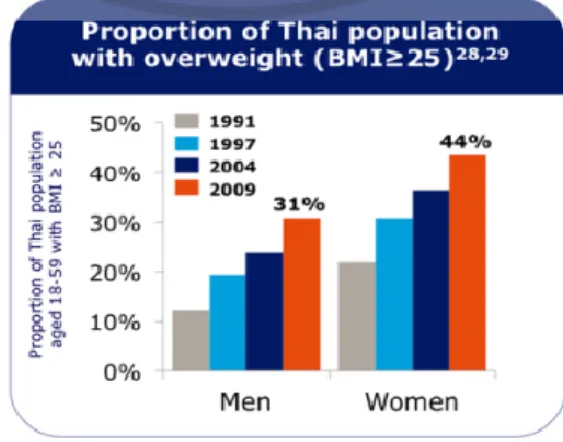
With concern for the health of an aging society, the author separated the sample into two groups in this research. The interviewees were 10 Thai consumers who value their health, exercising regularly, whether it be fitness or outside activities, more than three times a week to make sure they are really health-conscious. They were divided into two groups; Younger (19 - 39) and older (over 39), as WHO data shows that the vast majority of Thais are overweight and obese between the ages of 40-59, regardless of gender (Jitnarin et al, 2011) but if you look deeper into the data above, it is found that women in Thailand have a higher proportion of overweight than males (https://www.thailand.um.dk, 2011).
Figure 3.1 Proportion of Thai population with overweight
The samples were divided into two groups according to different age groups to analyze the behavior of different ages when they were given nutrition and calorie information of each menu, whether it would affect the consumer's decision. The first group, the elderly are consumers today that restaurant owners can use the research results to develop to suit these groups. The younger group will be the next generation or future customers who will have different perspectives on how to maintain their health that will get the different result from the elder group.
CHAPTER IV
FINDINGS AND DATA ANALYSIS
4.1 Analysis Method
The analysis of in-depth interviews could explain the health concern behavior of people who exercise regularly. The study criteria indicated that interviewees had to exercise more than three times a week to ensure the majority of people were healthy which consumption will affect the way of life that supports the aging society in the future. In this study, the young and older groups had different reasons and dietary conditions, however, their eating habits may be related to the health they would like to keep in good condition.
Table 4.1 Names and ages of 10 interviewees in the young group (19 – 39 years)
No Name of interviewees Age
1 Khun Baimhon 28
2 Khun Napaporn 34
3 Khun Nichapa 33
4 Khun Parn 39
5 Khun Pichai 39
6 Khun Saralee 30
7 Khun Sathittham 33
8 Khun Sirilak 28
9 Khun Vutimeth 37
10 Khun Yannawit 34
Table 4.2 Names and ages of 10 interviewees in the older group (over 39 years)
No Name of interviewees Age
1 Khun Boriboon 45
2 Khun Chaiyapan 49
3 Khun Methee 42
4 Khun Phawat 43
5 Khun Phongphan 54
6 Khun Pongsarun 49
7 Khun Preeda 45
8 Khun Saksri 46
9 Khun Tapakorn 41
10 Khun Theetinun 47
The 20 interviewees for 20 case studies were able to link semi structured questions based on variables of problem statement such as social norms, perceived value, brand value, and price, as well as calorie labeling on food menus that affected the behavior of consumers in choosing food in each meal.
4.2 Finding from Interview
A discussion interview was initiated to find the motivation of workouts to determine that it was practicable in this study. The main target audience is people who exercise more than three times a week, who are somewhat anxious in many ways to take care of themselves. Food consuming control is a popular remedy they try to go along with exercise. In this study, we were able to see the motivation for exercise for many reasons, most of which extend to eating habits.
First of all, everyone talks about getting fit and healthy. It is the first word that indicates how they feel better when exercising, such as going to the gym, running, playing football and the like before they think about nutrition and food control including information for choosing the menu in each meal.
“I would like to stay healthy and keep fit” (Khun Pichai and Khun Parn and most people in young group)
“I concern about my health after I got the result of annual physical checkup, so I need to keep fit to get the stronger health” (Khun Phongphan)
Both groups mention the same word that they would like to be fit and healthy however, the deeper reasons for exercise came from three other reasons such as body shaping, hobbies and health problems.
Body shaping, they would like to control the weight and body shape that we can find the majority in the younger group. Khun Napaporn said “I want to keep myself fit and be healthy. My inspiration is myself in the past, which is stronger and in better shape than now and also an influencer on Instagram who I follow.” She can be a representative of the younger age group that values their appearance like most of them in the young group.
“Because it keeps me fit and does everything actively. Moreover, it’s the best way to cope with stress from my work.” (Khun Sirilak)
“I feel fat. That time, my weight was about 100 kg, so I tried to do the exercise by running to control my weight.” (Khun Yannawit)
All of them love to exercise but the motivation to exercise is different. Khun Napaporn mentioned influencers as part of the variables but Khun Sirilak said that exercise can reduce stress and increase concentration in life. Khun Yannawit loves to do the activity as running to see his improvement from his training. However, all of them enjoy healthy and low-calorie foods. Therefore, the interview results can explore more details of each variable.
The second reason for exercising is their hobbies that we can find most in older groups. They love to exercise and want to make healthy food choices.
“Exercise has made me refreshed and relaxed, and the activity can be done with my friends who can chitchat and build relationships better than working environments.” (Khun Preeda).
“Exercise is my hobby, but I just came back to doing it often after I got sick and would like to maintain my health to get better through this activity. Moreover, food control is the most important thing to me because exercise alone cannot help me stay healthy all the time. Eating habits are also important to me.” (Khun Theetinun)
Surprisingly, the results of interviews among young people are rarely found as a hobby. They tend to focus more on other things, such as shape or strength, than view it as a hobby.
The last group is people who have previously been in poor health, which we can see in both groups, but they are more relevant to the elderly. They found that exercise and food control can be healthier and can improve the quality of life. Most young people have office syndrome, and exercise can help cure it.
“I was Anorexia Nervosa, Carnophobia or something like that. I came back to running and found it made me better and I loved it. Except for exercise, I am concerned about healthy food and my preferences.” (Khun Saralee).
“I have a backache and other pain from office syndrome so I went to fitness to do Pilates. I feel better from this illness and relaxation. Office syndrome makes the quality of life worse.” (Khun Nichapa and Khun Sathittham)
“I got sick for a long time but after trying to manage my time, I have enough time to exercise. Office syndrome and other illnesses were significantly reduced. Food control, rest and relaxation are key factors in staying healthy.” (Khun Methee)
Healthy life has become a priority for Bangkok workers. Work-life balance is one of the trends in this generation that can modify healthy behaviors. However, the results of the interviews showed that exercise was insufficient to maintain a healthy diet, and therefore food of different characteristics had to be controlled, with variables able to cover all their behaviors.
4.2.1 Social norms
In this digital age, social media is the primary channel of promoting products and services at the lowest cost, so we see many influencers like food bloggers and YouTubers who can influence others to dine and do activities. Khun Baimhon (young group) said “I have seen the influencer from social media, but I didn't follow them to that location because the location is a bit far from my place.”
“Bebe is my influencer. She is an exercising girl concerned about body and food so she presented the food product more than the restaurant.” (Khun Sirilak)
"I don't have any influencer or channel, but if someone sends me a link, I will see it." (Khun Pongsarun and Khun Saksri)
The influencers have impact with younger group more than older that shown many of the youngers have seen bloggers and YouTube channels, but most of them fail to attract interviewees to restaurants. However, they are able to generate restaurant awareness for consumers that they have a chance to go to that restaurant in some events or convenience. They will follow a restaurant due to the type of food rather than other factors such as ambience and price. As everyone cares about their health, they want to choose foods that are healthy for the body. However, social trends can attract consumers to the restaurants that make people come to taste them.
4.2.2 Perceived Value
Health benefits, or the importance of health, are the variables that most affect the purchasing behavior of health-conscious consumers, as most of the emphasis is on the benefits of foods that should be low in calories and low in sugar to control weight and body shape. Khun Chaiyapan (older group) said “The value that affects food choices the most is a benefit. I worry about it because I want to be healthy.”
“Choose the food that have benefits to my health such as vegetables, milk and meat but I try to reduce carbohydrate and also low calories and sugar”
(Pongsarun)
“Food benefits for our health, our preference and price have attracted me respectively” (Khun Vutimeth and Khun Baimhon, young group)
The following values are emotional or personal benefits and prices on this topic can be chosen to prefer food at the valuable cost of food.
“My tastes and preferences have the greatest influence on food choices.
Focus on the quality of the ingredients at a great price.” (Khun Preeda)
“Food that I feel good with it. I will try and then if it’s delicious, it will be my favorite and has more affect to my decision making” (Khun Sathittham)
The last perceived value is the convenience that we can refer to the location of the restaurant and time of purchase in case of seasonal items. This value is less important when compared to other values, if we think about it, most convenience stores are fast food stores where everyone eats a few times but when referring to meals at home, it is very important for interviewees because they can control the cleanliness, the quality of the ingredients and the cooking process. Khun Napaporn said “Mostly I eat at home because I can add more vegetables and what I like more when I’m cooking by myself and avoid MSG, salty and oily food, mostly food in the restaurant is more carb and very low veggies. Street food only for when I don’t have time and more convenience.”
“I always eat at home because of convenience and my wife can do the good cook that we can choose the ingredient by myself” (Khun Tapakorn and most interviewees in older group)
Delivery service is another factor in the convenience variable that they can order and eat at home without being able to meet their needs in a healthy process.
Overall, both groups focused on the benefits of food the most, with preference being the second factor, while convenience was equally important. In a rushing situation and convenient location, they can eat anything, including fast food but not often because they do not meet nutritional requirements.
4.2.3 Brand value
Brand value can consist of a brand trust and reputation. Restaurant brands can convince consumers of the quality and taste that famous brands are delicious, as well as the brand awareness that can entice consumers to want to taste them. Khun Sirilak said “That's right. Because the famous brands make me wonder why these are becoming trends and why people are interested in them. That made me want to try it.”
"I always try new brands or famous brands. I think brand names have strengths in quality." (Khun Saralee and Khun Parn)
“The brands of restaurants and shops influence where they can be easily found, which makes it easier to make choices. There is more effect, as in the type of restaurant and favorite food.” (Khun Preeda)
“Each brand is unique in many ways, for example, it has a wide variety of products. This brand has a low price. This brand is of good quality. This makes it easy to choose a restaurant.” (Khun Theetinun)
In terms of favorite brands, some people would love to go there but don't go often. The interviewees will go once a week if possible. They have a favorite brand in each type of food. In their insights, younger groups have the opportunity to choose different restaurants where they will change their types to avoid the monotony and new experiences.
4.2.4 Price and promotion
Prices and promotions have little impact on this. They always think of value for money, which the quality of the food should be reasonable for the price. However, if they are expensive, they won't go there very often like Khun Nichapa said “I have a benchmark of prices that depend on the type of food. I choose which one I like more than promotions, but the price is not too expensive compared to the value.”
“Promotion will have an effect on me. I always find the cheapest price for my food.” (Khun Baimhon and Khun Tapakorn)
“The focus is worth it, but if it is expensive like Omakase that costs around 10,000 baht, I won't eat.” (Khun Preeda)
“Price has an effect on my decision. If the quality and standard are quite the same and the location is convenient as well, they will choose the cheaper one.
However, I was looking for something valuable.” (Khun Boriboon)
Another effect on prices is membership cards, according to interviews, the vast majority of the younger group does not have membership cards, as they often change the restaurant as mentioned above but there will be a card only to the merchant that provides benefits. As for the elderly, the membership card has a lot of influence in choosing a merchant. If this is the type of food they want to eat, most will choose to eat at restaurants that have membership cards.
For Fuji restaurants that I visit often, I would like to know the benefits of the membership card. So, I was going to reserve my benefits. (Khun Pichai)
“No membership cards. I only have a MK card because of the discount and can attract him for better benefit or keep the benefits.” (Khun Sathittham)
“I only have membership cards for certain restaurants that they like to go and go often but this is not a reason to choose a restaurant.” (Khun Boriboon)
Most interview results show that membership cards do not influence restaurant decisions. They still choose restaurants based on their food types and preferences before membership benefits.
4.2.5 Other variables
The information described above are variables that may influence consumers' purchasing behavior. This study wanted to know the effects of nutrition or calorie labels. However, the most important information interviewees needed to know is nutrition, as everyone wants a food controlled that should contain all types of nutrition with special needs, such as: its low in fat, sugar, sodium and high protein.
“I tend to estimate the amount of nutrition.” (Khun Saralee)
“Focus on protein and low carbohydrates.” (Khun Yannawit)
“All nutrition is very important to me. I really need to consume 5 food groups.” (Khun Phawat and Khun Methee, and many people from older group)
“It’s very important to me. When I buy my meal from 7-11, I always read the nutrition information label as I choose it with high protein, low calories and low sugar.” (Khun Chaiyapan)
If you look at the results of the interview, younger groups tend to focus on the specific nutrients they want to consume or avoid such as protein, carbohydrate, sugar, sodium, oil and other things. Older groups are not just specific but want to consume all 5 groups. However, most of them would like to know the ingredients of the nutrients but the results of the interview showed that they still know this information only on food and beverage packaging in supermarkets but almost no nutrient components, including calorie number, are found on restaurant menus. They found them at MK Suki and Santa Fe steak, as well as healthy juice shops. However, it is possible to estimate the amount of nutrition and calories searched and read on the Internet or use an app that provides approximate nutrition information.
“Reading and calculating the number of nutrients by myself, it’s not exactly a number but good to know.” (Khun Napaporn)
“I checked it from google, so I don't know the current meal.” (Khun Parn)
“I have a benchmark number of nutritional calories.” (Khun Preeda)
“Look at the package label or estimate it by myself.” (Khun Saksri)
And it comes to the point of this interview how it affects food choices, including ordering food in that restaurant when calorie numbers are displayed on products or menus. It was found to have a big effect on food choices but it might not affect their purchases. The interviewees said they sometimes wanted to eat a high- calorie diet. This is acceptable because they do not eat often.
“It has an impact on my decision on that meal however, if it doesn't override her perception, she will accept that. But if I intend to come and eat this food, I don't think too much about those numbers. I gradually went on to control other meals instead.” (Khun Saralee)
“Yes, if it's too much I'll change the menu but if I want to eat it is an exception. I’ll balance by doing more activities.” (Khun Yannawit and Khun Nichapa)
“The number of calories affects the choice of a menu. If it is showing, it makes me aware, but if I would like to eat, then eat anyway.” (Khun Tapakorn)
And the last scenario, the number of calories still affects food choices.
Which if there is such a number, it will choose a similar menu or food instead. Khun Sirilak, Khun Theetinun and Khun Chaiyapan said respectively “For example, Sausages that are sold in 7-11, I will compare between the regular sausage and lean sausage.
And definitely I will select the lower calories one.”, “It has little effect on me. If I could choose a menu, I'd choose one that had fewer calories or fewer negative effects on my body.” and “For example, there are 2 brands of milk. I’ll choose the brand that lower calories, sugar and high protein.”
So, except for the number of calories they would like to know, other nutrients they want to control and manage, such as sugar, sodium, and the like. It becomes more information that they would like to know in each meal. Khun Napaporn said “I want to know the ingredients in each meal to know the nutrients to avoid fat.”
“Besides nutrients, I would like to know the ingredients, chemicals, preservatives and expiration dates.” (Khun Pongsarun)
Last but not least, the number of calories and other nutrients have affected the choice of food to consume. Khun Preeda said “The number of calories and other nutrients can help consumers control the number of foods that can balance your health.”
“The number of calories can help me to control it” (Khun Parn)
In addition to knowing how many nutrients they need to control; it can also make them perform more activities to make up for the amount of food they consume in that meal.
“I will exercise harder, longer or more often when I just had a high calorie meal.” (Khun Sirilak).
“I will maintain activity and food consumption so that I can control calories and cholesterol.” (Khun Yannawit and Khun Saksri)
Finally, a study of how calories on the menu affects most people concerned about their health and exercise, finding that they worry about the nutrients at each meal.
But there are still small groups that care about health but do not control consumption.
Try to do activities or be careful with a health check.
“I don’t control the nutrients in my food but only look at the calories I try to compensate for my activities.” (Khun Pichai)
“The number of calories does not affect me because my health is good, but I'm only concerned with calories. However, I will have more control in the future as I get older.” (Khun Sathittham)
“Calories affect me less. I focus on complete nutrition in every meal.”
(Khun Phawat)
“I think that if I can choose any type of food, it is enough to take care of my health. Calculating numbers of nutrients makes life difficult.” (Khun Phongphan)
CHAPTER V
CONCLUSION AND RECOMMENDATION
5.1 Conclusion
This study aimed to understand the information consumers need when choosing food either at restaurants or in general stores. In Thailand, food menus at most stores do not contain nutritional or calorie numbers, which are essential to health- conscious and food-controlled people. This makes some consumers get nutrients that are not suitable for their body, making them healthy and obese beyond the standard as well.
In order to obtain information appropriate for the aging society in the future, interviewees should have concerns about their own health in order to understand how older people live, which requires good care and nutrition. However, elderly-specific interviews may not be able to analyze and predict future behavior. Therefore, we have to separate the interviewees into youth ages 19-39 years old and over 39 years old as they are the most proportionate age group in Thailand today who will become older people in the future.
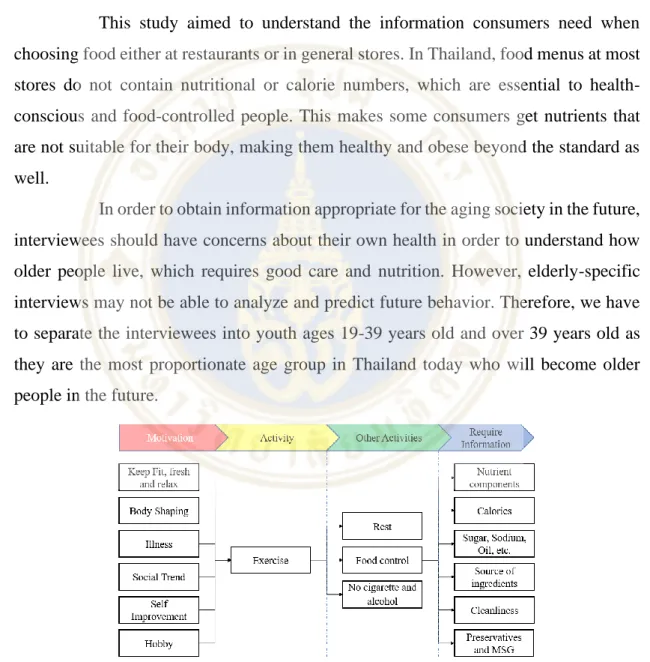
Figure 5.1 Consuming behavior patterns that lead to need, calorie numbers, and other nutritional information
The interview begins with asking about exercise motivation, which has resulted in two large groups of people wanting to stay in good shape and exercise to get fit since earlier. However, all interviewees responded in the same opinion that exercise alone failed to achieve the desired fitness and that only a small minority did not regulate dietary intake but compensate by exercising as consumption received.
When it comes to eating behavior, most of the things that affect the purchase or eating take into account the benefits of food, along with individual preferences, convenience, comfort, and reasonable price respectively. Since the people interviewed are health-conscious, they are most interested in eating the food they need and benefit themselves. It was found that these groups of people have very little frequency of using fast-food restaurants, while most buffets run once a month. Another interesting study found is that most people prefer eating at home, which is reasoned by being able to control the quality of the food, including the cooking process and comfort.
Influencer-based consumption behavior is present in very small amounts as most do not follow a specific person. There may be some follow-ups depending on the occasion and the convenience. While the factors that led to the follow-up because of the type of food more than other factors such as atmosphere or price.
Restaurant brands have some effect on food choices. As interviewees believe that well-known brands tend to have good food quality and taste, each brand can reflect their standards and prices as well. In addition, social trends influence the choice of restaurants because they want to experiment according to society's story.
From the interviews, it was found that price influences restaurant choices in terms of frequency of use. If the restaurant has a price that is suitable for the quality and is not too expensive, it will make consumers come to the service more often. But if the price is higher than their benchmarks, it will lead to fewer people coming to use the service. If you look at the membership card, the interviewees do not give much importance to the membership card as they do not use the same restaurant very often but if there is a membership card in that store, it will lead to persuasion to use the service as well to reserve the benefits of being a member.
Finally, the objective of the study was to examine how nutritional or calorie numbers affect consumers' purchasing behavior, and it was found that most interviewees would like to see nutritional numbers at every meal because they wanted to control and
manage their consumption. Their calorie intake can have a huge effect on their food choices. Interviewees who exercise regularly but not food-controlled, exercise more when they eat a lot of food that day instead of controlling. Most would like to know how harmful nutrients such as sugar, starch, fat, sodium, and the like are harmful to the body and how much they should be consumed per day in order to control the amount they need in order to control their intake to be healthy.
In summary, for the clarity of the similarities and differences of the interview results between young and the older group as follows
5.1.1 Similarities
● Motivation to exercise - They would like to stay healthy and fit.
● Eating behavior - Emphasizing the benefits of food, preferences, convenience and price respectively.
● Influence - They don't have a specific Influencer. They can only recommend the type of food, but cannot induce them to that restaurant.
● Brand - Famous brands make them believe in quality that reflects the standards of their products and services.
● Price - Price influenced the decision of the restaurant. If the price is quite expensive, it will affect the frequency of eating in that restaurant or menu.
5.1.2 Differences
From the interviews, the only difference was found to be exercise motivation. Interview results showed that the need to stay in shape was found in the young group but the prevention of illness was found in the older group, with some youth turning to exercise due to office syndrome.
Therefore, illness has become one of the key factors in exercising people before their nutritional intake is ultimately regulated.
5.2 Recommendation
Based on the findings of qualitative research, which provides information and behavior for restaurant owners and food and beverage industry stakeholders, to get the information customers need to make informed food and beverage purchasing decisions, develop and design menus and packaging for show nutritional information and knowledge to increase engagement and interest.
5.2.1 Influencer
Social media is a popular channel for promoting products and services. In this case, it was found that people were not interested in the channel, so they did not have to exert more effort to promote it. However, influencers on fitness and health can build awareness and trends of food and health products but it may not be able to attract more people to your store and restaurant, as these customers value their convenience locations as well.
Therefore, if an influencer is to be used to promote products and services, there has to be a distinct difference so that the audience perceives the exclusivity that cannot be found anywhere else that is convenient for them, which may make them willing to travel for new experiences.
5.2.2 Health Benefit
Most interviewees focus on foods that should be healthy, so your menu information should show ingredients that can attract customers, such as 0% calories, low sugar, low sodium, high protein, and the like. They should show the amount of nutrients people should consume every day. Customers will be able to know the right amount to eat in that meal.
Another way to get people who care about their health is to provide visualizations to compare the calories of each dish and the activities they enjoy doing to make up for the larger meals.
5.2.3 Price and promotion
In this case, price is not the main focus of the interviewee's topic, but prices can dictate the group range that owners should think about your restaurant's location, which focuses on low or high prices. If your brand is focused on high-income customers, they will visit your store at a lower frequency than low-cost restaurants. Interviewees looked at the price that was worth the quality of the food. Another issue is the subject of promotions, where competitors with the same target audience should be followed whether or not they launched a promotion. Therefore, make sure to distinguish and show your strengths such as the healthy benefits that can attract this target audience to your store.
5.2.4 Recommendation for future research
This qualitative research focuses on the impact of calorie number on customer buying behavior, that the pattern of this research is relatively narrow for health-conscious people, therefore, in the future, research results should be expanded to other target groups who do not like to exercise but they would like to take care of their health by consuming foods that have proper nutrition to support the aging society.
Illness was a new factor in the results of this interview, among other variables. It was found that many people turned to exercise while the younger group turned to exercise due to illness from office syndrome. Older groups also exercised because they didn't want to get sick. This can be studied how exercise helps get rid of that disease. Will eating the right foods with good nutrition help me recover from my illness? Any activity can cure that disease other than taking medication. In this case, the interviewee used Pilates as a form of exercise or running as therapy. If I don't like exercising, is there any way to heal it?
In addition to exercise, the menu or label can be suggested that this menu is suitable for those suffering from that disease, as an alternative to purchasing or ordering that particular meal.
5.3 Limitation
The limitation is the time constraint that makes this study specific to health- related groups. The interview was discussed with 20 people in two ages who were unable to find out the behavior of that generation. Another factor is income to consider in the study, as most organic or good-quality foods are often expensive, which may be one of the reasons some people are unable to make the right choices for their lives.
Location is another factor that may influence consumption behavior as this is an interview with a group of people living in Bangkok, if it is a group of people living in different provinces, the behavior may be different.
REFERENCES
Begum, V. (2015). Effects of Kellogg's Nutritional Label on Consumer Buying Behaviour in Dubai, UAE. Procedia - Social and Behavioral Sciences, 211.
http://doi.org/10.1016/j.sbspro.2015.11.159
Block, J., Condon, S., Kleinman, K., Mullen, J., Linakis, S., Rifas-Shiman, S., &
Gillman, M. (2013). Consumers’ estimation of calorie content at fast food restaurants: cross sectional observational study. BMJ (Online), 346(7912), 14–14. https://doi.org/10.1136/bmj.f2907
Elbel, B., Gyamfi, J., & Kersh, R. (2011). Child and adolescent fast-food choice and the influence of calorie labeling: a natural experiment. International journal of obesity (2005), 35(4), 493–500. https://doi.org/10.1038/ijo.2011.4
https://ageconsearch.umn.edu/record/150622
https://www.ijsr.net/search_index_results_paperid.php?id=ART20182842 Kiszko, K. M., Martinez, O. D., Abrams, C., & Elbel, B. (2014). The influence of calorie
labeling on food orders and consumption: a review of the literature. Journal of community health, 39(6), 1248–1269.
Kodali, S. & Telaprolu, N. (2018) "Food Label and its influence on Consumer Buying Behavior: A Review of Research Studies", International Journal of Science and Research (IJSR), 7(6), 386-390.
Loureiro, M.L. & Rahmani, D. (2013). Calorie labeling and fast food choices in surveys and actual markets: some new behavioral results. 2013 AAEA & CAES Joint Annual Meeting, Washington, DC, August 4-6, 2013, Agricultural and Applied Economics Association (AAEA),
Martinez, O. D., Roberto, C. A., Kim, J. H., Schwartz, M. B., & Brownell, K. D. (2013).
A Survey of undergraduate student perceptions and use of nutrition information labels in a university dining hall. Health Education Journal, 72(3), 319–325. https://doi.org/10.1177/0017896912443120
McGuire S. (2011). Todd J.E., Mancino L., Lin B-H. The impact of food away from home on adult diet quality. ERR-90, U.S. Department of Agriculture, Econ.
Res. Serv., February 2010. Advances in nutrition (Bethesda, Md.), 2(5), 442–443. https://doi.org/10.3945/an.111.000679
Prathiraja, P., & Ariyawardana, A. (2011). Impact of Nutritional Labeling on Consumer Buying Behavior. Sri Lankan Journal of Agricultural Economics, 5, 35–46.
http://doi.org/10.4038/sjae.v5i0.3475
Rujipongtharin, N. (2016). Consumer behavior towards healthy fast food shops in Bangkok. https://doi.org/10.14457/TU.the.2016.401
Swartz, J. J., Braxton, D., & Viera, A. J. (2011). Calorie menu labeling on quick-service restaurant menus: an updated systematic review of the literature. The international journal of behavioral nutrition and physical activity, 8, 135.
https://doi.org/10.1186/1479-5868-8-135
APPENDICES
Appendix A
:The in-depth user guide interview questions are shown below in each variable.
Exercise Motivation
1. How often do you exercise? (Interview results will be analyzed when doing the exercises two more times a week.)
2. Why do you exercise? What was your inspiration and what did you like?
3. Besides exercise, what other ways do you take care of your health?
4. What affects your food choices (e.g., benefits, influencers, brand, price and promotion)? And why?
Perceived Value
5. What kind of food habits do you usually have? (at home, restaurant, street food, other (please specify)) Why? (personal benefits, health benefits, convenience)
6. Do you eat fast food or junk food very often?
7. How often do you eat Buffet?
8. Do you eat fruits and vegetables? What do you choose to eat? (Preference or seasonal or convenience)
9. Do you eat alone or with family?
10. How often do you decide on a restaurant?
Social Norm
11. If talking about eating, do you have an influencer or YouTube channel to follow? Does he influence your eating habits?
12. How often do you go to the restaurants they recommend?
13. Most of them go to that restaurant because of what kind of food or atmosphere or other?
Social Norm
14. Does the brand of restaurant affect my choice of eating? How?
15. Do you have a favorite restaurant? And how often do you go?
Price and Promotion
16. How do prices affect restaurant selection?
17. Do you always have a restaurant membership card? Do those cards affect your restaurant choice?
The importance of Nutrients and Labeling
18. How important is good nutrition to you? Please give an example
19. Have you ever been to a restaurant or bought a meal that shows nutritional numbers or calorie numbers? What kind of restaurant is that restaurant?
20. How do you know the number of nutrients and calories in each meal?
21. If the food menu shows the number of calories. How it affects the menu selection or not and how?
22. Other than nutritional numbers or calorie numbers. Would you like to know anything else that will affect food choices?
23. Information about nutritional or calorie numbers on the food menu. How will this affect your health care?
Personal Information
24. What is your name?
25. How old are you?