Percentage of cumulative variance in each component of the characteristics of youth with social creative thinking. 51 Table 4.9 Factor loading and descriptions of each variable of the characteristics of youth with social creative thinking in the component of fluency. 52 Table 4.10 Factor loading and descriptions of each variable of the characteristics of youth with social creative thinking in the component of imagination.
53 Table 4.11 Factor loading and descriptions of each variable of the characteristics of young people with social creative thinking in the processing component.
INTRODUCTION
- Background and Significance of The Problem
- Research Objectives
- Scope of the Study
- Expected Benefits
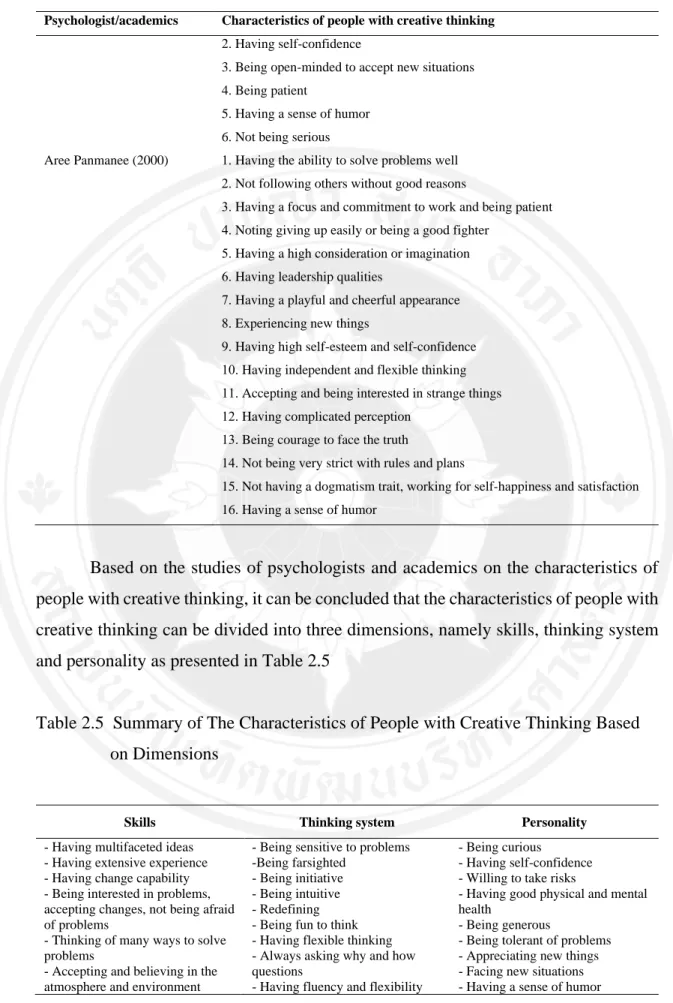
Garison (1954 cited in Office of the Civil Service Commission, 2016) described the characteristics of people with creative thinking as follows.
CONCEPTS, THEORIES, AND RELATED RESEARCH
Concepts of Creative Thinking
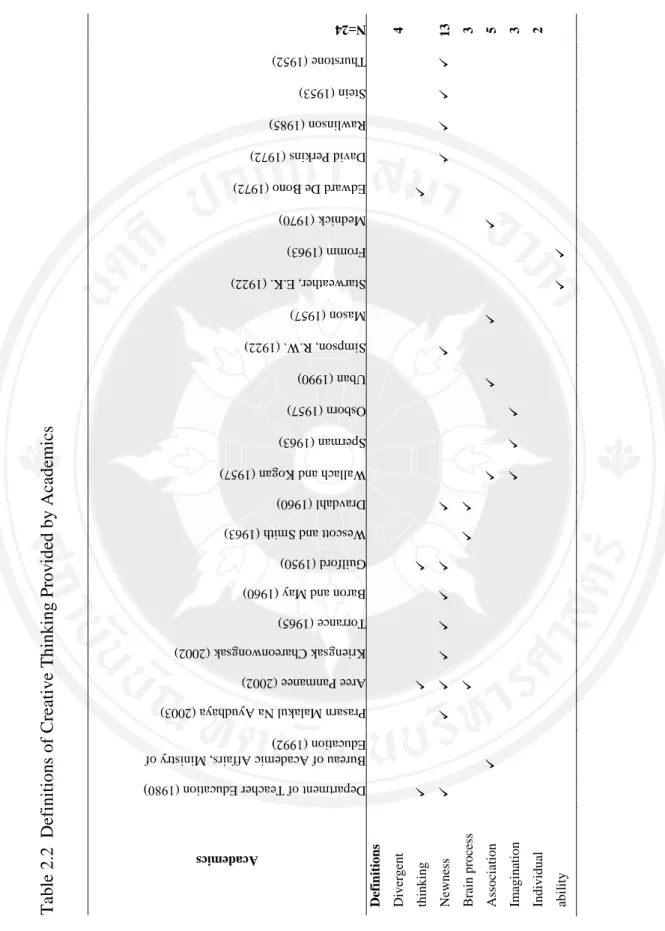
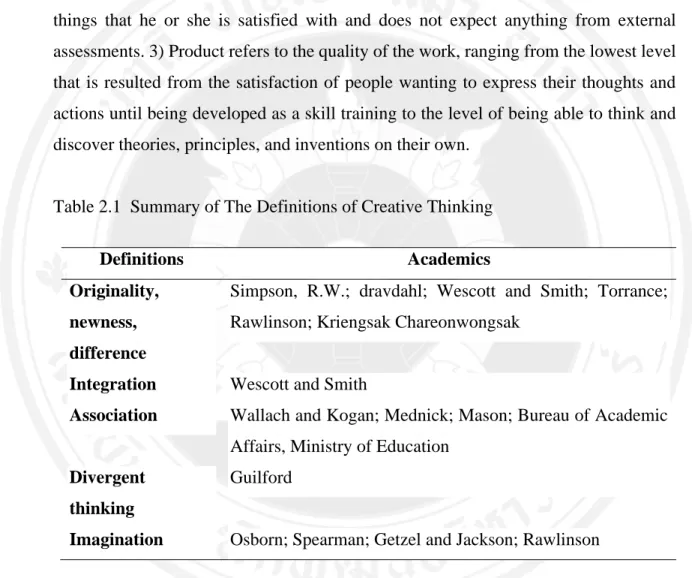
Guilford (1950) defined creative thinking as the ability of the brain to think in many ways and directions. Mednick (1962); Wallach and Kogan (1965) thought of creative thinking as the ability to think of things that are continuous in a chain called "association". Starkweather (1964) and Fromm (1963 as cited in Office of the Civil Service Commission, 2016) defined creative thinking as an idea that shows non-conformity.
Academics and psychologists have defined the unique identities of creative thinkers as follows.
Concepts of Creative Thinking Promotion
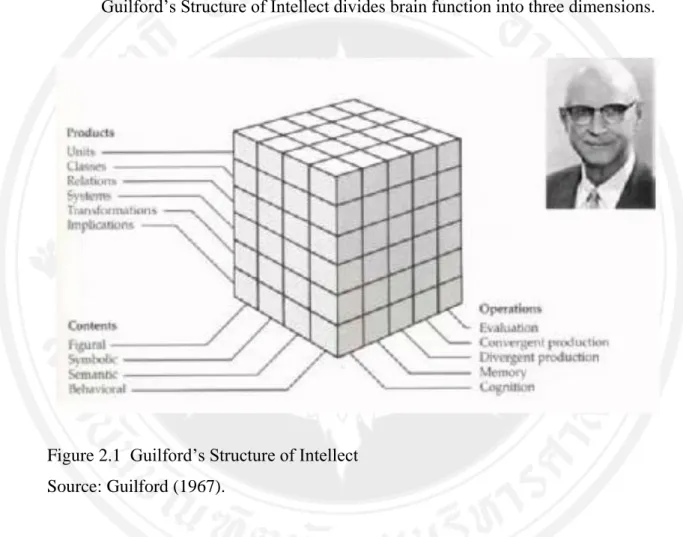
Cognition (C) is the brain's ability to interpret when it sees a stimulus and perceive it and tell what it is. Memory (M) is the ability to gather knowledge and information that can be remembered when needed, such as memorizing multiplication formulas and identification numbers. Divergent thinking (D) is the ability to think in response to a variety of stimuli with many different aspects.
Convergent thinking (N) is the ability to come up with the best answer from the given information or stimulus and there is only one correct answer.
Related Research
Conceptual Framework
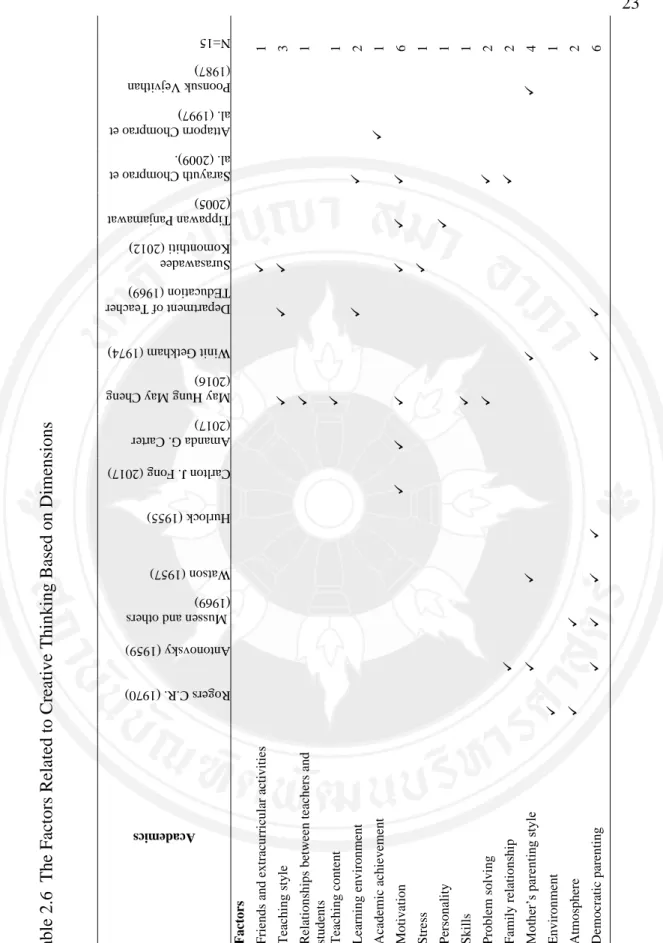
The roles of the family in promoting the creative thinking of youths were as follows.
RESEARCH METHODOLOGY
Research Methodology
Target Groups and Key Informants
Data Collection
Assessment of Research Tools’ Quality and Data Verification
It is also the first school in Thailand to send students to compete in the World Creativity Festival, creating a network of schools that offer teaching and learning to encourage students to have creative thinking. It provides teaching and learning that promotes creative thinking and sends students to participate in the World Creativity Festival since 2016. It has sent students to participate in the World Creativity Festival for the first time in 2016, and has a gold medal from the elementary level won.
A creative thinking assessment was used to collect data on characteristics of creative thinking youth (originality, fluency, flexibility, elaboration, intolerance of problems, imagination, use of technology), methods or processes for promoting creative thinking and problems, and obstacles in creativity. thinking promotion in Thailand in order to analyze the elements of creative thinking youth and creative thinking promotion methods or processes of Thai youth. In-depth interviews were conducted with the target groups and key informants to achieve a proper understanding in the study. The topics of the interviews included approaches to promote creative thinking and the synthesis of the success factors in promoting creative thinking in Thai youth. Research objectives The issues to be analyzed Research methods .. youth creative thinking in Thailand 4.0 era.
The researcher constructed and evaluated the quality of the research tool used for data collection according to the following steps. Small group discussion was used to study the promotion of creative thinking, the development of creative thinking and the success factor of the promotion of creative thinking, in order to obtain comprehensive information and clearer explanation of the characteristics of thinking. creative. Consistency can be checked and accuracy can be confirmed with reality through a comparative examination of the results obtained by the two research methods.
The reliability and validity of the research results can therefore be constructed using a triangulation method. It is the method of checking the accuracy and consistency of the data obtained through the collection of relevant documents, observations and in-depth interviews with key informants.

Data Analysis
The data was also analyzed and interpreted and then categorized into the issues for which answers were sought. The researcher conducted qualitative data analysis following the above steps to obtain accurate and clear research results appropriate to the context of the area. Logical analysis and context were used, which was an interpretation of conclusions from concrete data and phenomena.
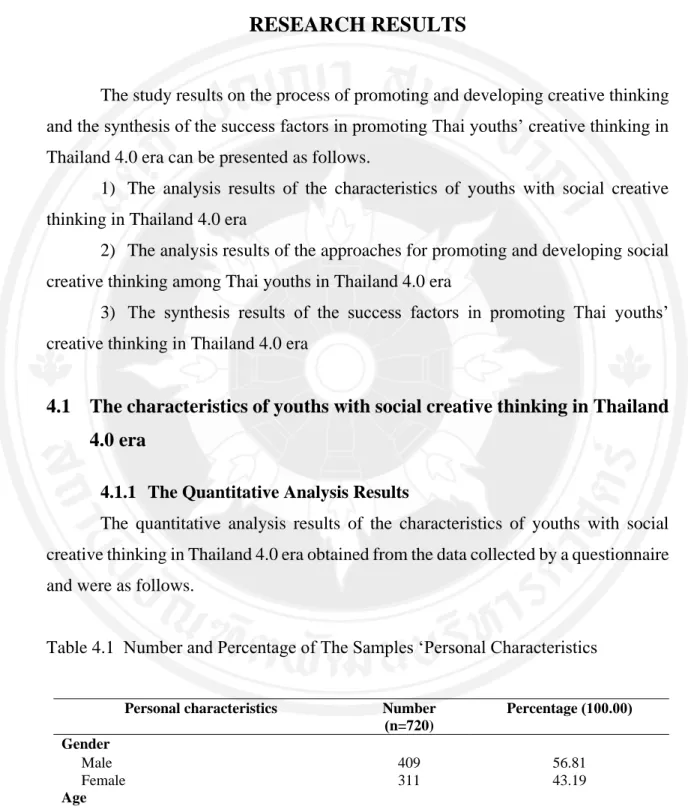
RESEARCH RESULTS
The characteristics of youths with social creative thinking in Thailand 4.0 era 43
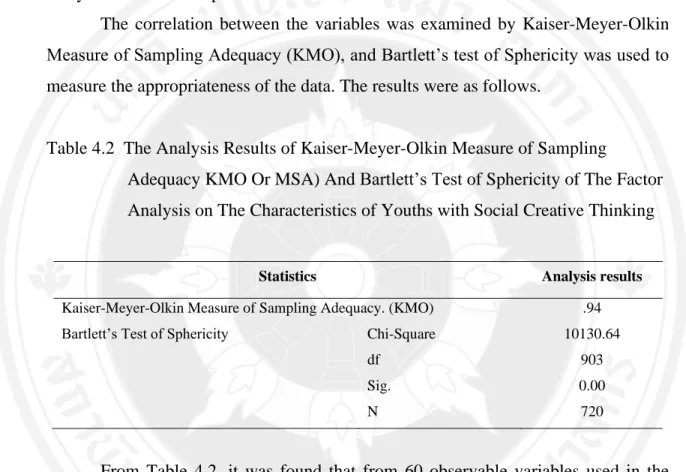
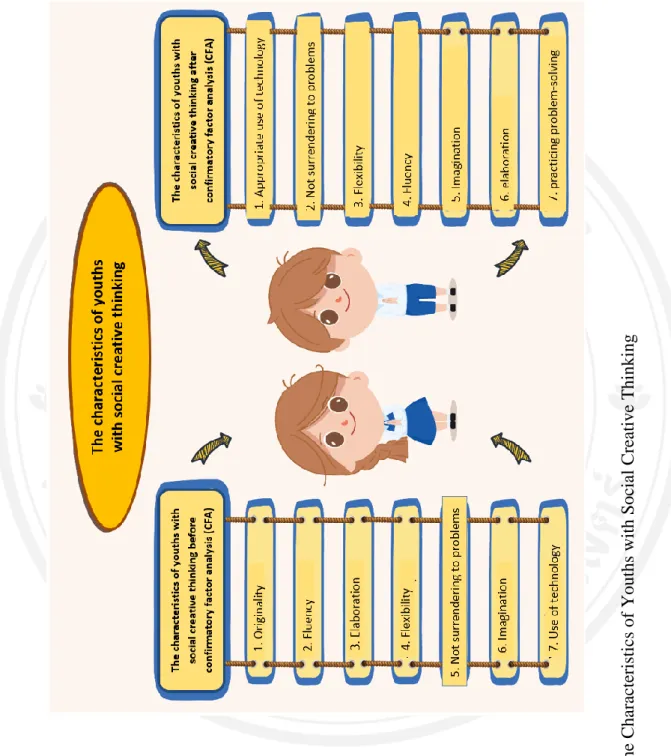
The exploratory factor analysis (EFA) was used for the factor analysis of the characteristics of youth with social creative thinking in Thailand 4.0 era. Adequacy KMO or MSA) and Bartlett's test of sphericity of the factor analysis on characteristics of young people with social creative thinking. From the exploratory factor analysis, 7 components of characteristics of youth with social creative thinking and 43 variables were obtained.
From Table 4.6, the appropriate use of technology can be described by 7 variables, observed from the factor loading of the indicators related to the characteristics of youth with social creative thinking. From Table 4.8, the component of flexibility can be described by 7 variables, observed from the factor loading of the indicators related to the characteristics of youths with social creative thinking. From Table 4.9, the component of fluency can be described by 7 variables, observed from the factor loading of the indicators related to the characteristics of youths with social creative thinking.
From table 4.10, the component of imagination can be described with 5 variables, observed from the factor loading of the indicators related to the characteristics of young people with social creative thinking. Most of the school leaders have had a clear policy to promote and stimulate creative thinking. The confirmatory factorial analysis was used to analyze the characteristics of youth with social creative thinking.
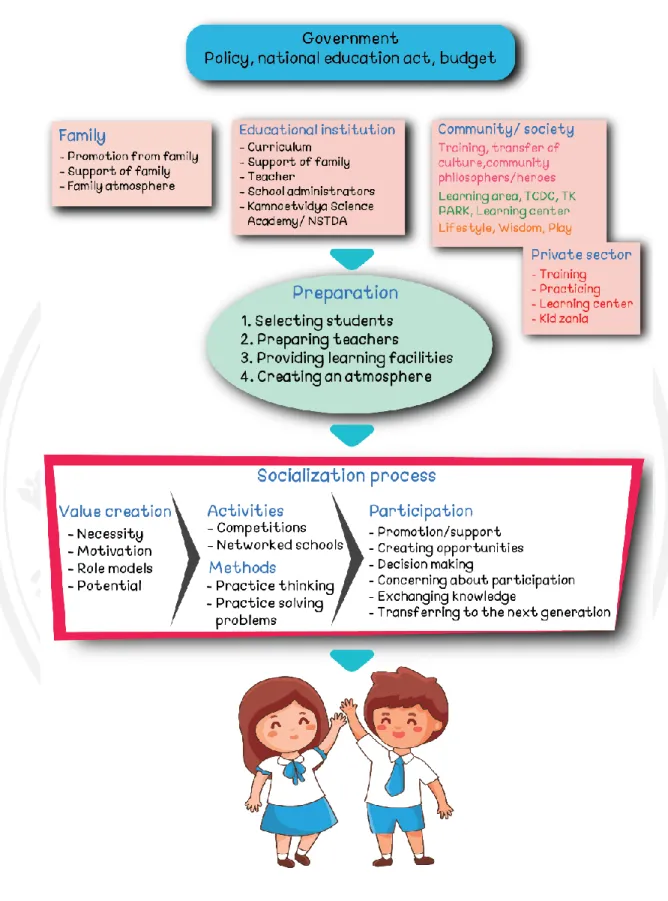
Based on the survey results, youth promotion of social creative thinking in Thailand 4.0 era consists of the following factors.
CONCLUSION, DISCUSSION AND RECOMMENDATIONS
Conclusion of the Study Results
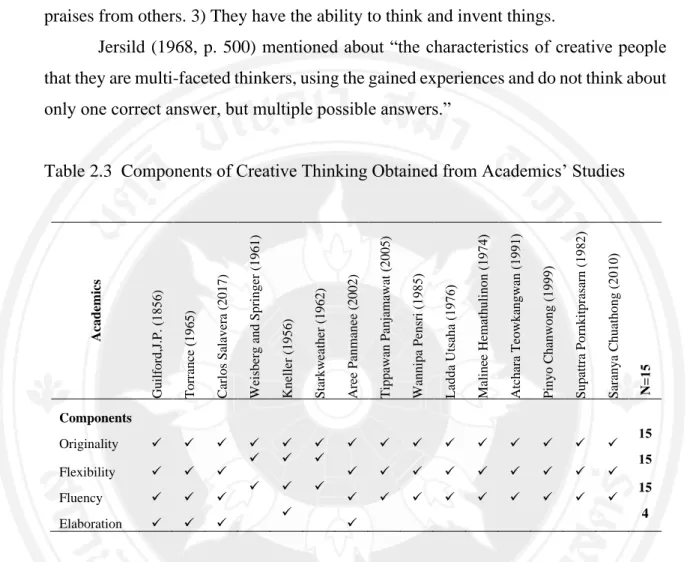
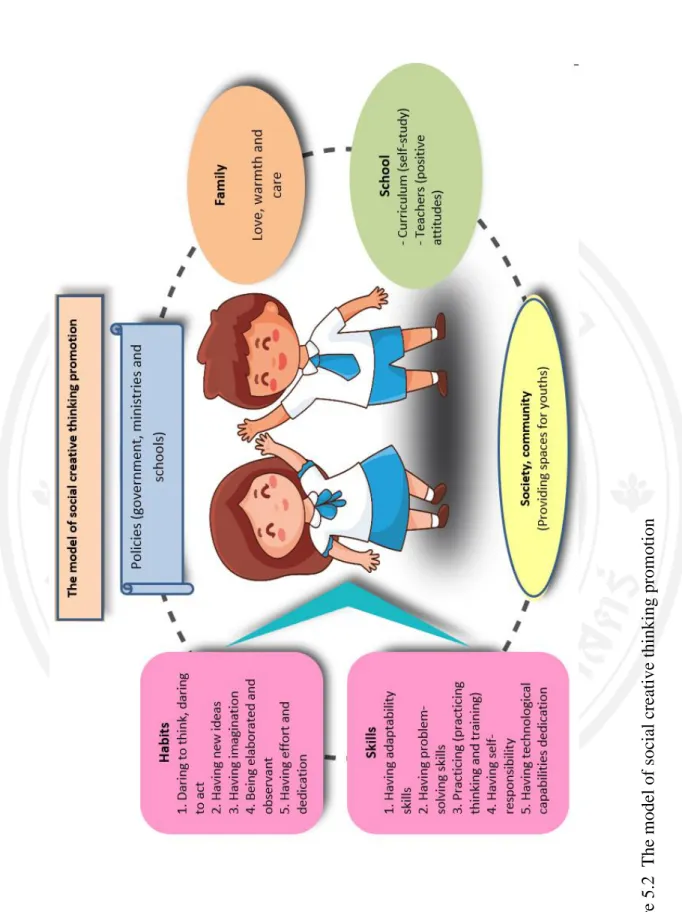
It can be concluded that these 7 components can be characteristics of young people with social creative thinking with 48.43%. According to the correlation coefficient of youth with social creative thinking of 7 components, each component had a significant correlation at the 0.01 level. The skills of youth with socially creative thinking included 1) adaptability skills, 2) problem-solving skills, 3) practicing thinking, analyzing and acting, 4) self-responsibility, and 5) the ability to learn new technologies.
The results of the analysis of approaches to promoting and developing social creative thinking and the results of the synthesis of success factors in promoting creative thinking of Thai youth in the era of Thailand 4.0 collected from in-depth interviews and focus group discussions can are summarized as follows. There should be activities to stimulate children to practice using creative thinking in solving problems. To successfully promote creative social thinking in young people, school administrators must have a clear policy to promote creative thinking.
Regarding teachers, most of them were knowledgeable and competent (27.60%), followed by improving teaching to encourage and stimulate creative thinking. Regarding the implementation of approaches to encourage creative thinking in schools, it can be concluded that for the curriculum and teaching methods, most schools have encouraged students to have self-learning and often organized activities to encourage and stimulate thinking creative. such as science camps. Classrooms or areas and budget support are provided to foster and stimulate creative thinking.
The success factors in promoting Thai youth's social creative thinking come from the central policy with a clear relationship of the vision, the leadership of administrators and the clear policy. Action plans and preparations of staff, learning media or classrooms that promote creative thinking are also required.
Discussion
Regarding Thailand's ability to promote and encourage Thai youth to think creatively, it is possible that Thailand will be able to empower youth to think creatively if the country's governing bodies recognize the importance of clear policies and action plans. Based on confirmatory factor analysis (CFA), there were still 7 components of young people with creative thinking. This research topic is a new academic topic that examines social creative thinking with reference to original creative traits that other researchers have studied before.
To promote young people's creative thinking within the family, this should start with providing love and warmth, and creating a family atmosphere in which family members can talk, discuss and ask questions with each other. If the family can help organize a private space and supplies that can stimulate creative thinking in children, it will help children to be creative. Especially those who will encourage this at the age of learning will stimulate the development of creative thinking.
Spaces, materials and books that promote creative thinking or classrooms should be provided to allow students to use their imaginations freely. Communities also support facilities that promote and stimulate creative thinking whether in sports, art or cultural performances. Young people also want the community to provide materials, equipment and media that encourage them to use their creative thinking in solving problems.
The success factors in promoting social creative thinking of young people in the era of Thailand 4.0 are as follows. Furthermore, it is possible that Thailand will be able to empower young people to think creatively if the country's administrators recognize the importance of having a clear policy and action plan.
Recommendations
An investigation into the gender differences in creative thinking abilities among grade 8 and 11 students. Bukhlikp̣hāph læa khwām khid s̄r̂āngs̄rrkh̒ k̄hxng nis̄ it nạkṣ̄ụks̄ʹā radạb xudmṣ̄ụks̄ʹā krungānıkhr enhạr nạb xudmṣ̄ụks̄ʹā krungā phrity. Krṇī ṣ̄ ụks̄ʹā p̄hl s̄ạmvthṭhı̒ kār wād p̣hāph rabāys̄ī d̂ān khwām khid nāmṭhrrm læa khwānḡr kād khwānḡr kād khwānḡr khid īyn d̂wy chud kickrrm wād p̣hāph rabāys̄ī k̄hxng nêkreīyn thī̄̀ bkphr̄xng thāngkār dī ̂yin [A case study of the abstract thinking and creativity of students with drawing and creativity disabilities] .
Kār khid s̄r̂āngs̄rrkh̒ h̄lạkkār thvs̄ʹḍī kār reīyn kār s̄xn kār wạdp̄ hl pramein p̄hl [Evaluation of the theory of teaching the principles of creative thinking]. Development of a package of synectics learning activities to enhance creative thinking of Mattayom 3 students in visual arts (Unpublished Master's thesis). Development of an online lesson with synectic activities to improve undergraduate students' creative thinking.
Openness to experience as a moderator of the relationship between intelligence and creative thinking: A study of Chinese children in urban and rural areas. Khwām khid s̄r̂āngs̄rrkh̒ k̄hxng nầkṣ̄ụks̄ʹā ṣ̄ilpkrrm chận pī thī̄̀ 4 withyālắy pheāa ch̄khṣ̄ụks̄ʹā ṣ̄ilpkrrm ch̄khṣ̄ụks̄ʹā ṣ̄ilpkrrm l ratnkos̄ inthr̒ [Creativity of students of Fine Arts, 4th year, College Pohchang Rajamangala University of Technology Rattanakosin] (Thesis unpublished master's degree). Kār s̄ạngkherāah̄̒ ngan wicạy keī̄̀yw kạb khwām khid s̄r̂āngs̄rrkh̒ nı pratheṣ̄thịy [Synthesis of research on creativity in Thailand].
Kār perīybtheīyb kār khid xỳāng mī wicārṇỵāṇ læa kār khid s̄r̂āngs̄rrkh̒ rah̄ẁāng nạkreīyn thī̄̀ mī bænn kār. Pạccạy thāng cit s̄ ạngkhm thī̄̀ s̄̄̀ng p̄hl t̄̀x khwām khid s̄r̂āngs̄rrkh̒ k̄hxng nạkreīn chạkreīn ch̄̀h yn s̄ạngkạd.