WARRIORTRADING
I N S I D E T H E M I N D O F A N
E L I T E C U R R E N C Y T R A D E R
CLIFFORD BENNETT
John Wiley & Sons, Inc.
WARRIORTRADING
I N S I D E T H E M I N D O F A N
E L I T E C U R R E N C Y T R A D E R
CLIFFORD BENNETT
John Wiley & Sons, Inc.
Copyright © 2006 by Clifford Bennett. All rights reserved.
Previously published in 2005 by Wrightbooks, an imprint of John Wiley & Sons Australia, Ltd., 33 Park Road, Milton, Qld 4064. First Australian edition © Clifford Bennett 2005.
Published by John Wiley & Sons, Inc., Hoboken, New Jersey Published simultaneously in Canada
No part of this publication may be reproduced, stored in a retrieval system, or transmit- ted in any form or by any means, electronic, mechanical, photocopying, recording, scan- ning, or otherwise, except as permitted under Section 107 or 108 of the 1976 United States Copyright Act, without either the prior written permission of the Publisher, or authorization through payment of the appropriate per-copy fee to the Copyright Clearance Center, Inc., 222 Rosewood Drive, Danvers, MA 01923, (978) 750–8400, fax (978) 750–4470, or on the web at www.copyright.com. Requests to the Publisher for per- mission should be addressed to the Permissions Department, John Wiley & Sons, Inc., 111 River Street, Hoboken, NJ 07030, (201) 748–6011, fax (201) 748–6008, or online at http://www.wiley.com/go/permissions.
Limit of Liability/Disclaimer of Warranty: While the publisher and author have used their best efforts in preparing this book, they make no representations or warranties with respect to the accuracy or completeness of the contents of this book and specifically disclaim any implied warranties of merchantability or fitness for a particular purpose.
No warranty may be created or extended by sales representatives or written sales mate- rials. The advice and strategies contained herein may not be suitable for your situation.
You should consult with a professional where appropriate. Neither the publisher nor author shall be liable for any loss of profit or any other commercial damages, including but not limited to special, incidental, consequential, or other damages.
For general information on our other products and services or for technical support, please contact our Customer Care Department within the United States at (800) 762–2974, outside the United States at (317) 572–3993 or fax (317) 572–4002.
Wiley also publishes its books in a variety of electronic formats. Some content that appears in print may not be available in electronic books. For more information about Wiley products, visit our web site at www.wiley.com.
Library of Congress Cataloging-in-Publication Data Bennett, Clifford, 1959-
Warrior trading : inside the mind of an elite currency trader / by Clifford Bennett.
p. cm.—(Wiley trading series) ISBN-13: 978-0-471-77224-8 (cloth) ISBN-10: 0-471-77224-0 (cloth)
1. Speculation. 2. Stocks. 3. Investments. I. Title. II. Series.
HG6015.B46 2006 332.64—dc22
2005031904 Printed in the United States of America
10 9 8 7 6 5 4 3 2 1
To Ellisa, Ami, and Lucas,
three spirits whom I wish to thank for having paid me the greatest compliment and honor by choosing me as their father.
Their inspiration is never-ending.
To Tena Panizza,
whose belief and love have forever changed my life and set it on a higher course.
v
Acknowledgments vii
Introduction xi
PART I WARRIOR HOMEWORK
CHAPTER 1
WARRIOR FUNDAMENTAL ANALYSIS
3 CHAPTER 2WARRIOR TECHNICAL ANALYSIS
27CHAPTER 3
EMOTIONAL PRICE ACTION
51CHAPTER 4
QUANTUM VIEW
61PART II WARRIOR WISDOM
CHAPTER 5
THE TRUTH OF MARKET SUCCESS
69CHAPTER 6
WALL STREET MEDIA NEXUS
77CHAPTER 7
THE POWER OF MARKET POSITIONING
87 CHAPTER 8CONSENSUS CONCENTRATION, BELIEF, AND REALITY
97PART III WARRIOR IN BATTLE
CHAPTER 9
WARRIOR MIND
105CHAPTER 10
CHOOSE YOUR WEAPON
123CHAPTER 11
BATTLE TACTICS
133CHAPTER 12
TOTAL VICTORY
155Conclusion 165
Index 169
CONTENTS
vii
T
here has never been a book that is an island unto itself, and I would like to thank everyone who has contributed to Warrior Tradingfor their support and assistance.I’m sure all authors have publishers who contribute signifi- cantly to the end result, but I do want to thank Anthony Stone for both his guidance and his patience, and also for recognizing the potential of my original manuscript. I would particularly like to thank Kevin Commins for his steadfast support of the further development and evolution of Warrior Trading.
ACKNOWLEDGMENTS
Know the battlefield terrain; choose your weapon; be the warrior trader.
Be victorious!
Financial markets are a battlefield. As in any combat, it is the true warrior who towers above, reaping the fortunes of
the vanquished.
xi
REMOVE YOURSELF FROM THE HERD
Among the thousands—perhaps millions—of traders in the world today, there is an elite group who amasses immense for- tunes. It is these individuals, and the stories of their wealth and the kinds of lifestyles they enjoy, who inspire millions around the globe to partake in the greatest game on earth: trading in financial markets. These individuals, through focused effort, a constant search for knowledge, immense courage, and concen- trated determination, win out over the throngs of lesser traders.
They are the warrior traders. After more than 20 years of trad- ing in global financial markets, and chatting and discussing mar- kets with the best warrior traders from New York to Switzerland, I feel privileged to have learned a great deal. I feel even more privileged to now have the opportunity to put down in these pages some of the trading secrets I have discovered.
I say “secrets,” but this does not mean the concepts are diffi- cult. Perhaps like the most valuable gifts in life, they are really self-apparent. Yet despite this, they are somehow unseen by the majority. Even those who have discovered some of these secrets usually end up drifting back to their previous, unsuccessful trading styles. In fact, even the best of the warrior traders have to constantly guard themselves against the tendency toward complacency and even arrogance when profits have been grow- ing particularly well for a period. My hope is that the informa- tion in these pages will quickly accelerate traders from beginner
INTRODUCTION
to warrior status; however, it is important to realize at the out- set that this can happen only if warrior status is truly desired.
Once arrived at, the new challenge is staying there.
The most important warrior secret of all:
Your level of success in the world of financial markets is entirely up to you and has nothing to do with what the mar- kets are doing. There will always be bull markets and bear markets. The occur- rence of good or bad luck, if luck exists at all, evens out over time. Great success and the attaining of warrior trader status come about as a result of commitment, a never-ending willingness to learn, stead- fast determination, and that rare ingredient, a touch of humil- ity. Throughout the ages, all great warriors have had these same characteristics.
The global financial markets of today are every bit as vicious psychologically, and sometimes even physically, as the battles the great warriors throughout history encountered. To face these markets, or potential battlefields, warrior traders must be strong.
Mental toughness is not enough, however. To be a warrior, you must understand the deeper reality of processes that to many may seem simple, yet they are not. The warrior trader must not only be knowledgeable in all areas of market theory, but also spe- cialize in one particular style of battle. This one particular style is that which best suits the specific individual. Warrior traders must also take an individualistic approach to these theories. The sub- jects of fundamental economics and technical analysis are scruti- nized in this book in such a fashion.
The opportunity for immense wealth stems directly from the fundamental reality underlying any market. How you success- fully mine for this gold is very different from what you may
INTRODUCTION
xii
The most important warrior secret of all:
Your level of success in
the world of financial
markets is entirely up
to you and has nothing
to do with what the
markets are doing.
have read previously. You may never have read or heard of these subjects being depicted in the manner in which they are here. Some may even think my views are a little brutal, but such is the nature of the battlefield. My aim is to shed light on those whom you will undoubtedly find yourself pitted against on the trading floor and more often now in the faceless and perhaps even more ruthless environment of the electronic marketplace.
Approach these subjects with an open mind, and the pennies will begin to drop—at first slowly and then by the truckload.
This experience is, I believe, within everyone’s reach, but only if they are really prepared to make the effort, to make the jour- ney, both inward and outward.
Almost by definition, a warrior trader attacks markets in a very different way from the rest of the market participants. This is obvious when you think about it—those who are financially enriched beyond what most people can only dream of will natu- rally behave differently from the majority in their arena of choice. Their different behavior allows them to scoop the wealth of everyone else involved. The reason they can keep doing this year in, year out is that the rest of the participants in the market rarely learn the lessons offered. The market is a great and extremely rapid teacher, if only we are willing to listen. In each and every loss, as well as in each and every win, there are pow- erful lessons to be learned. Most market participants believe they are approaching the game in a winning way; that losses are the result of bad luck; that, at most, a small amount of fine- tuning is required in their approach. In the worst-case scenario, some will maintain the ridiculous and odd belief that it was the market that was wrong. The market at large, often described as the “herd” or the “crowd,” never takes the time to step back and consider whether its entire approach to the process might be inappropriate. Reading the same textbooks and coming to a rel- atively uniform understanding of the market, the herd never
xiii
INTRODUCTION
believes that it could be blinding itself. However, the methodol- ogy being so enthusiastically explored and developed by almost all market participants is actually fundamentally flawed. What is different about warrior traders is that they know this—and they seek to use this knowledge to ruthlessly take advantage of the opportunity presented.
Most losing and break-even market participants never consider throwing their entire approach into the rubbish bin where it belongs. This is, in essence, why warrior traders are able to continue to harvest enormous wealth, year after year, from the rest of the market—the roll-up of market losers just continues.
The good news, however, is that anyone who is prepared to open his or her mind to a different perspective of world mar- kets and work assiduously to perfect the art of trading can indeed become a mem- ber of this elite group. You can become a warrior trader.
The purpose here, then, is to intro- duce you to some fresh and different perspectives regarding markets, looking at fundamental and technical analysis, as well as to provoke a discovery of how best to interact and trade with a market as an individual. Some broadly accepted textbook principles will be turned on their heads as we embark on a jour- ney to the core of markets. An enormous number of books and seminars are available on the subject of trading and investing on the share market, and most tend to generalize about what mar- kets “should” do. This book is about discovering and under- standing how markets actually operate in the real world and learning how to trade not just to make a living but to possibly make a fortune—time and time again.
INTRODUCTION
xiv
The good news,
however, is that anyone
who is prepared to
open his or her mind to
a different perspective
of world markets and
work assiduously to
perfect the art of
trading can indeed
become a member of
this elite group. You
can become a warrior
trader.
Even at this stage of the book, you may be starting to see that this makes perfect sense. If mainstream market theorists were on the ball and correct most of the time, there would not be the opportunity for a select few to repeatedly snatch away the chips placed in the market by others. If a person could simply read a book or follow the step-by-step rules of an acknowledged expert to be assured of market success, everybody would do so. In fact, something very different from the arguments of most market theorists is happening in markets, as will be discussed through- out this book. In order to gain the most benefit from this discus- sion, it is important to approach it with an open mind.
However, be warned: It will not be easy to attain this status nor is it simply a matter of following a step-by-step guide. This book will take you on a journey through the characteristics, the knowledge and skills, and the psychological and even Zen-like state required of the true warrior trader. Warrior trading is about the harmonious intersection of oneself with the battle- ground; it is about knowing exactly where you stand in the mar- ket and having the ability to see 360 degrees around you, absorbing everything that is happening and acting to take full advantage of any situation that presents itself.
Markets are very similar to warfare. Just as the warriors of old rode out to battle with the confidence and knowledge to con- quer new lands and foes, so do the warriors of the market thrive on the battleground of the trading floor.
MY JOURNEY TO WARRIOR TRADER STATUS
Perhaps you’re wondering what it is that gives me the right to write this book and instruct you in the techniques used by war- rior traders. I have been trading in markets the world over for more than 20 years. My first profession was the navy. I was a junior officer in the Royal Australian Navy when I realized I
xv
INTRODUCTION
would rather be at the center of things than on the outside pro- tecting what really mattered. I did not know it at the time, but I was swapping one form of warrior for another. The mentality required in the war room of a destroyer is not that different from that required to trade in modern markets. There is a lot of information pouring in very quickly from an array of sources and computer screens, but it all comes to a 50–50 decision—
shoot or not, buy or sell—and the results of your decision are known all too quickly.
My own path through the financial markets of the world has incorporated commodity markets, equity markets, and, in the main, the global currency markets. Foreign exchange is still one of the fastest-growing markets in the world, and is overwhelm- ing the largest financial market in the world. Trading in foreign exchange markets is a great vantage point from which to per- ceive the forests of other markets and the major trends within them, which are increasingly tightly linked. It is well worth not- ing the stong trend today toward the greater interdependence of markets. By this I mean that fluctuations in oil, for instance, can affect the U.S. dollar’s value as well as equity and other markets.
Starting out at the local Australian investment bank Macquarie Bank, I set forth on a journey that would have me traveling the world for some of the top global investment banks, trading in most markets and advising some of the world’s largest institutions—from Coca-Cola to central banks—on their foreign exchange exposure.
Over the years, I have called some great currency market, equity market, interest rate market, and gold market rallies, and equally called some of the greatest bear trends in these markets.
I have traded my own money in the futures pits and traded the tens of millions of dollars placed under my auspices by global investment banks. When central banks have been intervening in markets, I have sold against them and won enormous sums. On
INTRODUCTION
xvi
other occasions, I have lost. But it is the ability to learn from both experiences, and not just celebrate the one and mourn the other, that, I believe, separates warrior traders from the herd of other market participants.
At the end of 2004, my independent currency forecasting and advisory firm, FxMax, which advises several banks and a host of clients all around the world, won the prestigious Bloomberg Global FX Survey. The award was for forecasting, before most even imagined the possibility, a major collapse in the U.S. dollar.
Interestingly, when I spoke at the 2004 Euromoney Foreign Exchange Conference in London early in the year, I became involved in a debate with a member of President George W.
Bush’s economic team. At the time, the Bush administration was decidedly bullish about its currency, though the mantra later changed to allowing the dollar to slide. Still, the bullish U.S. dol- lar argument by this individual was based on the simple assump- tion that the United States was the greatest entrepreneurial nation on earth and, in their assessment, would always continue to draw in huge capital flows and therefore maintain a strong currency. However, as I was quick to point out at the time, the real world of human emotion is not as simple as that.
As comprehensive as the Harvard and other business schools of the world are, the decisions of businesspeople and traders around the world always end up being subjective and emo- tional, whether they acknowledge it or not and whether they like it or not.
It is this warrior insight that can allow you to outperform the people presumed to be the most “in the know” in the world and, likewise, the largest institutions in the world—as I have with my firm.
The fact that a small, independent firm in Sydney can out- perform the largest and most successful investment banks in the world, and by a large margin, only highlights that success in the
xvii
INTRODUCTION
markets is about taking the warrior path and not just, as many assume, about the sheer size of the combatant.
THE VALUE OF WARRIOR TRADING
A lot of people question the value to the community of being involved in financial markets, especially when that role is some- times—or even all the time—speculating purely for profit.
However, it is the participants in a market, those willing to walk on the field of financial battle, who create and reinforce those very markets. Markets ensure that resources are distributed to the most productive endeavors in the most efficient way. The everyday lives of all the members of a community are enhanced by markets, be they the local fruit and vegetable market or the New York Stock Exchange. The improvement in the quality of life for an increasing number of people around the world, albeit imperfectly at times, is due to the explosion in global trade over the last two to three decades, which is entirely due to the opera- tion and support of efficient global financial markets. The more liquid a market is, the greater the volume of activity, the more efficient it is, therefore providing the greatest benefit. Traders add tremendous liquidity, thereby creating far more efficient markets than could otherwise be the case, for everyone.
It has been an honor to participate in these markets for over two decades and to have met some truly inspiring individuals.
Some of these individuals are genuinely wealthy, to a degree beyond the comprehension of most of us. Because of the con- tribution to our local and global communities that the many different market participants make, striving to speculate suc- cessfully in financial markets is a noble cause. Out of this noble pursuit rise but a few legends, and these are the warrior traders.
INTRODUCTION
xviii
IS IT ALL A GAME?
I have seen people manage markets extremely well—such that, although they frequently lose, they always trend to greater and greater profits. However, I have more often witnessed poor management of business exposure or speculative pursuits, and this has often led to companies being forced to lay off a large number of employees, resulting in the ruin of some individuals.
Trading in financial markets is a very real activity indeed, with sometimes serious consequences, and one should not allow the advent of the Internet and online trading, which can be viewed positively for a number of reasons, to lead one to think it is a simple, no-pain game.
A game it is, but a dangerous and challenging one that is extremely complex and for which there is no get-rich-quick scheme. For those who are willing, I believe there is a path to great wealth in financial markets. From my own experience, and that of several emphatically successful traders, I regard that path as a timeless one. It has existed throughout the ages and is most closely associated with the path of great warriors.
I trust this book helps guide you to the prosperous discovery of a greater knowledge and awareness of your own self through the process of trading in financial markets, for there is a true warrior in each of us. Trading in markets is a noble discipline and assuredly has its rightful place in our modern society. It is certainly a challenging pursuit, and in the face of immense chal- lenge we have the opportunity to find our true strength, if we are willing to dig for it and therefore discover tremendous ful- fillment on many levels, including financial.
First, warrior traders have to do their homework, develop a specific technique of battle attuned to their natural strengths, and survey the terrain. Then they must continually fight with all their strength and expertise.
xix
INTRODUCTION
From where I sit, there will always be a minority who succeed beyond the bounds of most people’s imaginings of wild success, and a majority who toil and sweat for little if any return.
Know the terrain, choose your weapon, be the warrior trader.
Clifford Bennett Sydney, Australia Winter 2005
INTRODUCTION
xx
PA RT I
WARRIOR HOMEWORK
C H A P T E R 1
WARRIOR FUNDAMENTAL ANALYSIS
5
F
undamental analysis is the consideration and study of all economic and political factors that may have an impact on a particular market. For an individual stock, such a factor may be the development of a specific technology. For a cur- rency, the fundamental factors are the more macroeconomic forces at play in the host currency economy and relative to other economies.A great example of the power of fundamental forces and the frequent misunderstanding or, worse, excited misinterpretation of them can be found in the movements in the equity, bond, and currency markets of early 2004 that resulted from some com- ments made by the chairman of the U.S. Federal Reserve, Alan Greenspan. Interest rate hikes in the United States were at that time widely expected, and expected to continue through the year. Although the market was a little unsure of the amount by which they would be increased, the consensus seemed to be that rates would rise gradually. Indeed, this was what the chairman had told markets previously.
The excitement came when Chairman Greenspan made a sim- ple remark: that if inflation turned up sharply, the U.S. central bank would have to raise rates aggressively in response. However, he also stated that this was not the expectation. The theorists and writers behind virtually all the fundamental research reports from the major investment banks and brokers around the world suddenly became excited about rates being raised “aggressively”
in the United States. Equities went south at a great rate, as did
bond markets, and the U.S. dollar rallied sharply. Above the din of clamoring commentaries about the intended aggressive rate hikes, I felt like a lone wolf calling out in the wilderness as I maintained that nothing had changed and these market shifts would quickly reverse. All that Chairman Greenspan had done was state the obvious. It is Central Bank Behavior 101: If infla- tion becomes rampant, central banks respond by raising rates aggressively.
Did the chairman expect inflation to be rampant? No, quite the contrary. Did the chairman expect to be raising rates aggres- sively? No. Chairman Greenspan simply stated that the Federal Reserve would respond appropriately if economic conditions were different from what they were forecast to be, which was ongoing low or benign inflation.
A few days later, Chairman Greenspan was forced to reiterate to mistakenly excited markets that inflation was not expected to be a problem and rates would most likely be raised at a mea- sured pace. Of course, the markets did indeed reverse after this announcement. A great deal of volatility in the market and pain for the majority of traders and investors had resulted from a false perception of the true fundamental reality. It is easy to get excited and run with the herd. It is far more profitable to seek out the true fundamentals—the warrior fundamentals.
THE REAL ECONOMIC FUNDAMENTAL FORCES THAT HAVE AN IMPACT ON MARKETS
There are two important points to remember when looking at the fundamental forces that have an impact on markets. First, the real fundamental driving forces of any market are rarely described by the latest economic releases. Neither can they be comprehended though the regular diatribes of additional spin placed on them by the majority of market commentators.
WARRIOR HOMEWORK
6
Second, the economics of a country are a very different animal from the economics of a particular market, just as the economics of a company are entirely separate from the movements of its share price.
Some companies can increase sales during a slowing in the broader economy just as they can in an expanding economy. Of course, expanding sales do not necessarily mean a higher stock price. It really does get complicated. We must always remember that all pricing models for stocks, and all economic theories, are attempts to simplify what is, in reality, complex by nature.
Therefore, every such theory is by definition in error. Such theo- ries are useful as a starting point for understanding the processes in play, but should not be taken as providing the answer. This flies in the face of what we all want to believe and seek to find. It is the strength to accept the reality that contributes to the achiev- ing of warrior trading status. Warrior traders know that almost anything can happen in a market at any time, because in truth almost no one really understands what is
going on despite the detail of their analy- sis. In the end, of course, it is simply the movement of price of a stock and not the competence of the board that determines whether you as a trader make a profit or a loss. Understanding one does not neces- sarily lead to the other, despite the appar- ent connection.
Finding the real fundamental forces that drive any market, as opposed to what the broader market crowd perceives the fundamental forces to be, requires the warrior trader to stand back from the crowd, to keep it simple and keep it hu-
man. Sometimes basic common sense can cut through a highly technical and complex argument to the core of the real issue.
7
WARRIOR FUNDAMENTAL ANALYSIS
Finding the real
fundamental forces
that drive any market,
as opposed to what
the broader market
crowd perceives the
fundamental forces to
be, requires the warrior
trader to stand back
from the crowd, to keep
it simple and keep it
human.
One quick way of standing back from the crowd, of course, is to find a good, real-world, down-to-earth economist or analyst and discuss the issues in some detail—not one who sounds clever, but one who gets it right in a consistent fashion. This is, perhaps, easier said than done, however. As a general rule, economists do not publish their complete track records, and there is usually a very good reason for this. No doubt, all will lay claim to great calls of the past as they attempt to justify their economic credi- bility. But in truth, anyone could do this. Make enough fore- casts, and you are bound to get some right.
I can similarly lay claim to some great financial market forecasts—some over many years; others over shorter periods.
But these would represent just a handful of the forecasts I have made over many years. A few of my forecasts were badly wrong—
although I like to think they were corrected quickly enough to prevent any significant damage. The task of predicting market movements is a subjective process, however, and if ever there was a group with subjective memory skills, it is economists.
These days, I have my own independent research firm, FxMax (www.fxmax.com), and I am able to provide a quantified track record of my forecasting performance—indeed, it is a record that I see as crucial to my firm’s success.
When it comes to the predictions of many banks and financial institutions, however, I believe that their motives are necessarily compromised. Even if a leading market economist with a major investment bank or institution wanted to and even if the econo- mist’s predictions had been successful in the past, it is unlikely that the bank or institution would want to risk the credibility of its brand name on the track record of the average economist.
The truth is that the research produced by the major financial market economists is for marketing purposes only. The main objective of all the commentary and predictive suggestion is to get clients trading. Whether the research was correct or not does
WARRIOR HOMEWORK
8
not affect the profitability of the bank or broker, as long as the research generated interest and trading activity among clients.
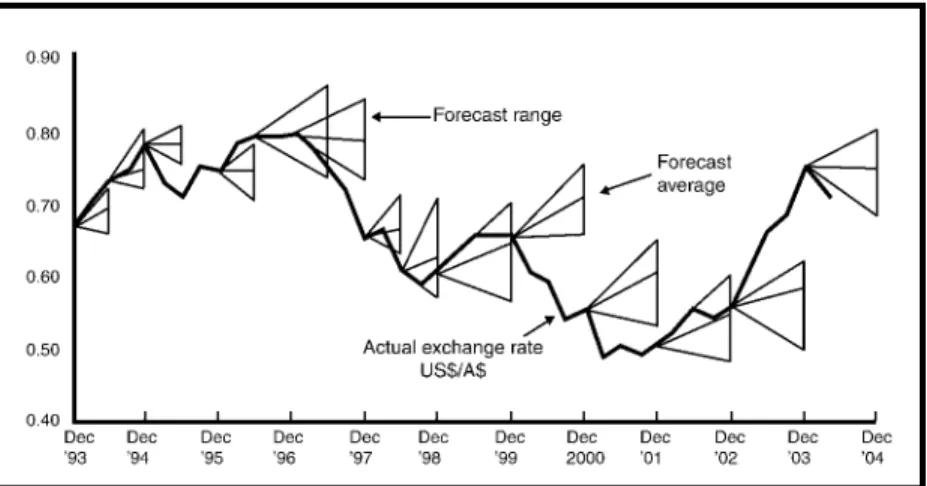
Figure 1.1 shows the forecasts published in the major Aus- tralian daily newspaper The Age as part of its economic survey, which included currency forecasts for the $US/$AUD over a 6- to 12-month period. These forecasts are collected from around 20 different banks, brokers, and financial institutions, as well as from university and economic-policy groups. What is most strik- ing about the forecasts is their inaccuracy.
It is a similar story in all markets around the world. Markets are tough to forecast, especially if forecasts tend to be extrapo- lations of recent market behavior, which is in the main what they are. It is a very interesting phenomenon that the large majority of market research produced trends, on a daily, weekly, and even monthly basis, to follow the direction of the market. As I mentioned before, it is more accurate to say that research reports tend to be led by market movement rather than preempting it.
9
WARRIOR FUNDAMENTAL ANALYSIS
FIGURE 1.1 Currency Forecasts versus Actual (Source: Phillip Spry Bailey, Mastering Foreign Exchange, Wrightbooks, 2004.)
One standing joke among most traders and salespeople in the leading institutions is how brokerages or bank economists/
strategists have a draw on either side of their desks. On one side are all the fundamental and technical reasons for a bull market.
On the other side of the desk are all the fundamental and tech- nical reasons for a bear market. Each morning as these econo- mists/strategists sit down at their desks to write the day’s market commentary, they first look to see whether the market is up or down and then reach for the appropriate draw.
Nevertheless, I believe that if you search hard for market economists who, although they are often out of line with the consensus view of their colleagues, over a period of time show a penchant for getting the market right in a regular fashion, you may just find some truly golden information and forecasts. Real- world economists who use common sense and look out the win- dow to consider the world as it is, rather than purely focusing on textbook theories about how it should be, do exist.
However, it is not simply a matter of my suggesting the names of particularly good economists that I listen to and take notice of. As you know, my area of expertise is foreign exchange, so if I were to give you the name of an excellent French economist who understands the European economy to a very fine degree, it would not help you invest in shares on the NYSE. Even if this was your interest, it should not be assumed that you would read and interpret the same economist in the same manner as I would.
Some of my clients who have been with me for a long time have come to be able to read between the lines, as it were. They can sense when I am less confident or overconfident. They can sense, perhaps before I do, that I am being stubborn about a view.
What you do need is the will to listen and read widely, and to critically analyze the forecasts of various economists and under- stand the motivations behind their predictions. Ultimately, this will lead you to those whose voices ring truest in the market,
WARRIOR HOMEWORK
10
not those who simply talk because a journalist has asked them a question or write because a monthly review is due. Believe me, there is a lot of money to be made from picking the occasions when the consensus is utterly wrong and when the markets have to reverse direction completely. These moments often generate the more significant price movements and lasting trends. It is only real-world market economists who can alert you to such opportunities.
One of my favorite axioms and beliefs about markets is that the most money is to be made when the consensus is wrong. If you think about it, this makes perfect sense. If the consensus view is proven correct by the next batch of data, then the mar- ket will move perhaps a little further in that direction. The movement is invariably less than the market hoped for. This is because everyone who believed in that view of that market had already invested accordingly. One does not wait until after an announcement that one believes will be bullish to buy. You buy now in an attempt to get ahead of the crowd. Well, so does everyone else, and if it is the consensus view, then most market participants will have done so. What everyone doing this does not realize is that they now, like everyone else, have in fact become sellers. Their next action in the market will be to sell after the expected resultant rally. The vast majority of market participants are potential sellers, not buyers, on the good news, should it be as they expect. So when the good news comes out as expected, the level of potential buying interest is not all that great; therefore, the price may move up only a little if at all.
What happens if the news is not as expected? Then all the potential sellers attempt to sell all at once. The market move- ment to the downside will be sudden and dramatic.
As I have said, fundamentals drive markets, there is no doubt about that, and one of those fundamentals is market positioning.
We will discuss this in greater detail in a later chapter.
11
WARRIOR FUNDAMENTAL ANALYSIS
THE REALITY OF FUNDAMENTAL ECONOMICS
Why is economics—that is, the understanding of the real funda- mentals that drive and motivate markets—such a challenge? It is because people make up both economies and companies.
“Ah, but economics is about rules, such as the law of dimin- ishing returns, efficient market theory, and portfolio theory,”
you may say. Well, yes and no. Such so-called laws are merely attempts to generalize about patterns of economic activity that have arisen in the past. But people are emotional, and they also learn and evolve. Therefore, patterns of behavior alter and evolve in an organic fashion. It would require a perfect under- standing of the motivation and thinking of people in today’s society to make a fully accurate assessment and forecast of an economy. Rather a daunting task, I would suggest. Hence, the natural inclination to oversimplify—which is all very well as long as we recognize this process for what it is so that we can see the opportunity from a trading perspective that is then created.
Reductionist Theory and the Reality of Fundamental Economics
Today’s markets are complex, to say the least. Some of the peo- ple who make up an economy are also directly involved in mar- kets (all are indirectly involved), and the level of participation in markets is at a historical high. All participants in a market affect that market’s price action, and as participation is higher than ever and patterns of behavior continue to evolve, new patterns of economic behavior and market price action are also continu- ally emerging.
Hence, the study of one aspect of this complexity—economic activity data—is simply not enough. Economic data are histori- cal and therefore backward looking by definition. While such data undoubtedly give clues to the likely forward path, they do not represent the future at all. As such, any analysis locked too
WARRIOR HOMEWORK
12
tightly into such a perspective cannot succeed. This is why the practitioners of pure economic theory applied to the latest run of data typically have a modest forecast-
ing record. Yet this is precisely the form of analysis that tends to dominate all media reporting on fundamental devel- opments and drive the consensus view.
Most economic models are useful in polite conversation, but they cannot com- pete with the cut and thrust of market realities.
Indeed, this is not just a theoretical affliction facing the economic world.
Quantum physics has demonstrated that
reductionist philosophy—that is, the idea of reducing any sub- ject of study to its smallest constituent components—is flawed.
For instance, Einstein’s theory of relativity works most of the time but not all of the time, and at some levels not at all. Such attempts will ultimately lead to a severe disconnect between expectations and actual events, as the reasoning deduced from the model conflicts with the reality of that future.
Let me explain. As discussed, it is people who make up the economy, not numbers. The confusion among contemporary economists on almost any aspect of any economy is due to the arguably flawed nature of current economic theory. All contem- porary economists are schooled in an approach to the subject that is essentially derived from scientific method. This theory is reductionist philosophy. Essentially, this is a means of under- standing whereby, when looking at competing theories or expla- nations for a phenomenon, it is the simplest theory that should be selected. The predominant approach to a subject is then to break it down, reduce the subject to the smallest possible com- ponents, and so derive a greater understanding of the subject and a concrete mathematical model to explain it—all in the
13
WARRIOR FUNDAMENTAL ANALYSIS
Economic data are historical and therefore backward looking by definition. While such data undoubtedly give clues to the likely forward path, they do not represent the
future at all.
belief that there is a model that explains what is going on. The reality of markets is that no such model exists. Scary perhaps, but true nonetheless. The warrior trader’s willing acceptance of this point allows him or her to respond to fresh developments in a market away from the consensus view more rapidly than other participants, and even to prepare an attack strategy in advance.
The reductionist method is commonly used for predictions and forecasting, based on the explanations derived from prior happenings. Its emphasis is basically on a microscopic approach to understanding, looking to derive a general understanding from the features of a particular.
As the advantages of reductionist philosophy, which certainly greatly accelerated scientific advances in the initial phases, dawned on people, its use quickly spread to the humanities.
However, perhaps it is now being too widely applied.
The introduction of this philosophy and methodology of explaining reality (or the micro) in terms of a reasoning derived from specific and largely isolated theories diverted attention away from some home truths that quantum physicists, in whose field reductionist philosophy has been used most successfully, are increasingly recognizing. In our complex market reality, all things are connected and cannot be successfully approached in isolation. This is exactly what almost all economic theories that have been taught for decades do. They focus on one particular aspect of economic or fundamental behavior in isolation. They then perceive and prove a degree of correlation with another aspect. This is not the full picture of what is going on, however, and a strict adherence to a particular economic principle will only end in market trading losses.
Further, once a subject is exposed to thought and discussion, its behavior is altered by that very analysis. Any group of human beings who begin to question themselves, in particular, why they respond in a certain way to a particular set of events is unlikely to
WARRIOR HOMEWORK
14
respond in the same way in the future once the self-examination has occurred.
Such is also the case in the field of economics, and particularly so when looking at financial markets. Economic theorists striv- ing to understand, in greater and greater detail, the various machinations of modern economies have accomplished only one thing: the sleight-of-hand skill that seemingly enables histori- cally constructed models to follow an economy or market with such rapidity that they seem to be keeping pace with real-world developments—or even to be forward looking. This is not actu- ally the case, however, despite the mass false impression that is achieved through the use of modern communication technology to quickly analyze and explain real-time events. Rarely does such analysis leadthe real-time event, however—a subtle yet awaken- ing distinction that few market participants seem to recognize.
Almost all economic analysis and market analysis of an event that is distributed to the clients of all the banks and brokerage houses the world over is actually in hindsight. It therefore can only come across to the reader as being particularly accurate and insightful in nature. These qualities impress the reader and give the individual confidence in dealing with that bank or bro- ker when trading in these markets. In fact, it is often the case that the research produced is so perfectly formatted, presented, in-depth, and generally impressive that many clients believe it gives them an advantage over other traders and will do almost anything to get that research. Such research has its place in providing the warrior with a broad knowledge of what has occurred recently and historically, but the warrior does not make the mistake of interpreting such analysis as in any way an accu- rate forecast of the future. There are three main types of human creatures in banks and brokerage dealing rooms: economists/
researchers, traders, and salespeople. There is one distinction the managers of such organizations never forget, unless to their
15
WARRIOR FUNDAMENTAL ANALYSIS
peril. That is to keep researchers away from trading, and traders away from research. They are different activities. One is back- ward looking; one is forward looking. It is important not to confuse the two perspectives. Market view and trading are two distinct activities. This is one of the golden nuggets of wisdom possessed by warrior traders.
People and the Reality of Fundamental Economics
As mentioned, the tremendous exposure to and involvement with financial markets by everyday people—their analysis and future probability—impact the economic decisions of those very people. Whereas a decade ago a cut in interest rates would have sounded like good news to the public, simply generating Pavlov dog–like response of increased borrowing and spending, an interest rate cut today may have the entirely opposite effect. The general public may reduce spending as it is alerted to potential economic risks that lie ahead. However, interest rate increases can generate a sense that people “better get that house and car and lock in the loan rates before they go even higher.” So con- sumption can, on occasion, actually increase after an interest rate hike. It is a complex world.
Even the physical sciences are beginning to recognize that everything is an art. E = MC2? Well, almost, most of the time, but not, in fact, always, according to more recent discoveries in quantum physics. As you will learn throughout the pages of this book, any field of study that involves human beings is an art.
Economies are very much about people; therefore, economics as a discipline of understanding is an art. As an art, individual interpretation naturally abounds, and therein lies the opportu- nity to find a valuable real-world economist in your market.
The argument about the reliability of contemporary eco- nomic thought can, in a way, be cut short by the simple recogni- tion that even economists trained in the same school will have a
WARRIOR HOMEWORK
16
different take on which way an economy or market is headed.
Economics really is a very subjective art form. But to tear it down is not to contribute to the financial success of our trading, other than its value in helping us to recognize that the process is flawed and therefore may of itself create opportunities in the pricing of markets.
The Failings of Fundamental Economics
An approach to markets based on contemporary economic prin- ciples and the predictions or writings of those who follow such arguments is, therefore, unlikely to lead to any great financial success, for two main reasons:
1. The analysis provided may well be based on flawed eco- nomic principles in the first place.
2. The analysis provided is subject to, and influenced by, market movement itself. Warrior traders recognize that it is often the recent direction of the price movement that drives the tone of the fundamental research provided by the major houses, rather than the other way around, as they would have us believe.
Ultimately, objectivity is lost.
This is not to say that all market commentaries should be ignored—there are some excellent examples of winning research writers out there. You have to do some mining to find these dia- monds, however. One cannot assume that just because the bank or house name is impressive and distinguished the research will be right more often than it is wrong, and good research needs to do just that and in a manner that encourages profitable trading activity. These winning research writers tend not to be main- stream, preferring instead to utilize additional principles in deriving their market view. The mainstream commentaries have
17
WARRIOR FUNDAMENTAL ANALYSIS
value in providing a guide as to how most of the market is think- ing (or will be thinking). They remain a force to be reckoned with, and, indeed, no trend will be sustained without this con- tributing activity—albeit, usually in the middle or toward the end of a trend, as the crowd catches up and the arguments begin to be justified and revised.
Further, there is a significant time delay between an event on the ground, such as a shift in consumer purchasing or an over- run in production, and that event becoming apparent in the released data stream. In most cases, the data can lag by three or more months. This time lag is so significant that, although sur- prises in economic data may already have corrected themselves at ground level, the discussions of what was happening months ago—an aberration—may still be in progress. Broad consensus views can therefore be far behind reality.
Some would argue that the current data stream is the best we have to work with and, therefore, that is how we should pro- ceed. The problem is that the market generally has no true comprehension of this data-reality gap, and therefore makes assumptions based on data that have a far greater variability than is initially recognized. This means that if you rely on eco- nomic data for a view on an economy, or a market, you are work- ing with dated tools.
Admittedly, this is an overly simplistic description of the enor- mous and deservedly respected art of economics, but it is done to make a point. There are quite capable economists out there who lift their eyes from the textbooks and data in an effort to get an understanding of what is happening in real time, but they are in the minority. It can be difficult for them to be heard.
They are often shouted down by the economist masses who think of their university textbook as a bible and tend to sing in unison, thus drowning some of the more talented independent voices.
To my mind, the majority of economists are like meteorologists
WARRIOR HOMEWORK
18
who don’t look out the window. If they are heavily absorbed in the stream of data and charts on their desks, using proven tech- niques of reasonable success rates in deriving future weather patterns that enable a forecast, but they fail to look out the win- dow as they put pen to paper, then they risk getting it very wrong indeed. If the meteorologist says, “It is going to be rain- ing heavily for most of the day,” and then you, yourself, look out to see that the skies are clear, do you grab your umbrella if you are only going for a short walk? No. Why then do so many traders staunchly follow the market forecasts of economists who are operating in an environment that is essentially art rather than science? Because most traders just read the research pre- sented to them on a daily basis without bothering to look out the window for themselves. Warrior traders sit on the roof and get a feel for the real-world environment for themselves, as well as absorbing the commentaries of proven market artisans.
REAL FUNDAMENTAL FACTORS
There are unquestionably real fundamental forces that do drive financial markets. Looking at the data and perceiving the real fundamental forces behind what is actually happening are two distinct fields of endeavor, however. They
can be successfully married only if the practitioner is mindful of the shortcom- ings inherent in the data.
In applying real fundamentals, oppor- tunities abound for those who question and observe in equal amounts. No doubt about it, on a macro level, markets move
because of fundamental forces acting on them. All major trends are the result of a significant shift in fundamental forces to a new paradigm or an expansion of a previous state of affairs. If there
19
WARRIOR FUNDAMENTAL ANALYSIS
No doubt about it, on
a macro level, markets
move because of
fundamental forces
acting on them.
is a fundamental shock, such as a terrorist attack or major nat- ural disaster, the price shift can be dramatic and sharp.
Additionally, if there is no apparent shift in the fundamentals, the markets can still shift dramatically—although perhaps more gradually. This is because the fundamental forces that cause such movements are a consistent influence. When it comes to considering price action and the work of fundamental forces, I imagine these influencing factors to be similar to the forces that act on the water that is stored in a dam during a period of low water usage. While little or no water may be leaving the dam, water continues to trickle into it. Even though there may have been little price movement for a period of time, it is not the case that the fundamental forces have been dormant. The underly- ing fundamental forces are always still at work. The pressure has been quietly building, and almost anything can now act as a cat- alyst for its release.
Apart from the economic fundamental forces at work upon a market, there are several other large factors that dictate the direction of our markets. The first of these is emotion, which is addressed in the next section. Alongside the weight of funda- mental forces and emotion that daily have an impact on price action are two other major forces: the media and the enormous size of modern-day capital flows.
The conveyance of market information instantaneously via the media reduces the opportunity for objective individual assessment to play its role. The influence of the media is most strongly seen in what is commonly known as the front-page effect.
The essence of this principle is that once a market movement hits the front page of a standard daily newspaper, the unfurling of the market trend being discussed in that story is complete and it is time to go the other way. In other words, once a market shift has become significant enough to make it to the front page, it has effectively been recognized by all market participants, and they will have positioned themselves appropriately. All those
WARRIOR HOMEWORK
20
who want to act have done so. There is only the market crowd who are still coming to terms with the news, and it is these Johnny-come-latelies who, last of all, react to the front-page story. The warrior traders, lying in wait for the gullible crowd, have learned that this situation often represents the last wave of liquidity in which to reverse their winning positions and realize those paper profits.
There is at least one warrior trader of whom I have heard who sits in the Swiss Alps most of the year and trades only when markets hit the front page. A quite important aspect of markets that needs to be recognized is that they evolve, and characteris- tics can shift and change somewhat. For instance, most markets are traded far more heavily today by less professional traders—
that is, traders who do not work for large institutions and are focused more on the big picture such as fund managers, but traders who are in the market for the money they can make today. The day traders tend to react to a greater degree and fol- low media headlines in a herdlike fashion more than the larger institutions. This is not because the large institutions are more clever—far from it. It is a simple function of the role of commit- tees (as discussed later) in large institutions, which slow down their trading response time. Ten years ago one could sell a bull market that had just hit the front page the very next day and do reasonably well. In today’s market, it is often best to wait at least three days, and perhaps longer, for everyone who is going to react to the front-page story to finally do so. The principle remains the same, but the market has evolved to be a slightly dif- ferent animal, and so your trading response has to evolve as well.
The second of these major influences—the enormous capital that is endlessly flowing into stock markets—also provides for a slight variation to the front-page effect theory, which I refer to as the “no doorway is big enough” phenomenon. This situation has come about as a result of the global shift toward private super- annuation that has swept the world during the past 20 years or
21
WARRIOR FUNDAMENTAL ANALYSIS
so. This shift has generated huge parcels of money that continu- ally move around the globe to different markets. Overall, these movements are largely dependent on sentiment and beliefs and rarely have anything to do with reality. They are part of invest- ment or pension funds that are compelled by their investment principles to head into equity, bond, or property markets within a particular country. At other times they are simple currency plays with no other purpose beyond speculation.
While with the front-page effect it is imperative to lead the market and then exit quickly as the situation begins to reinforce itself, one interesting aspect of the huge capital tanks that con- tinue to pour money into the market is that if you get into a trend early, you do not always have to look to get out early, as was once the case. It can take quite a period of time for the now- massive herd of very large players to shuffle through the some- times still relatively narrow market gateway—leaving plenty of time for the nimble warrior to slip through.
The challenge for warrior traders is to escape the pure appli- cation of orthodox economic theory and tread a lesser-known path toward theories of varied principles that may exist in the future, based on a study of broad sociological shifts currently tak- ing place. Clearly, some economists already do this, but it would be preferable for it to be the mainstream, centrist approach of contemporary economic thought.
HOW WARRIOR TRADERS CAN USE REAL FUNDAMENTAL FORCES
If a market goes up, the majority of analysts present the argu- ments for a bull market. If a market goes down, the analysts pre- sent the reasons for a bear market. It is rarely the other way round—that is, analysts will rarely present reasons for a bear market when the market goes up, and vice versa. Economics, as
WARRIOR HOMEWORK
22
it is commonly taught, is a market-following discipline, not a market-leading one.
Certainly, there is much prognostication about the direction of a market, but such predictions are so often incorrect that their originators barely notice the error. By the next day or month, as the market moves differently from the forecast, one can typically find the analysts busy writing papers on why the market did so and how it makes perfect sense after all.
This paradigm leaves a market wide open for successful spec- ulation. This is a fortunate situation for the few warrior traders.
While the majority of participants are enjoying their grand feel- ing of intellectual acceptance among their peers, justifying this with a lengthy dissection of the so-called relevant economic vari- ables, it is often the case that successful speculators have already acted on a different scenario—after which these warrior traders simply wait for the broader market to catch up. The risk/reward of such an approach favors the warrior spectacularly.
There is no doubt the market is driven by the real fundamen- tal forces acting on it. But there is a crucial distinction between the majority of traders and warrior traders, and there is a reason why the market crowd gets it wrong so many times: What the speculators do is accelerate the market in the direction of the net real fundamental forces. Indeed, price movements in the direc- tion of the real fundamentals are always very fast and rewarding.
These successful warrior traders take over, using real funda- mental expectations. They also know only too well yet another important truth about markets: They always overshoot. So if one gets positioned into a fundamentally driven trend early, the warrior reaps the benefit of having had the fundamental insight early and of the overshoot phase, which he or she will be able to grasp as such in real time. The very aggressive warriors will also look to make a profit on the correction to the overshoot, which itself will be exaggerated. After that, the market will tend to
23
WARRIOR FUNDAMENTAL ANALYSIS
narrow in range but in a very random manner. Most warriors play golf during this phase of a big price shift. But getting back to the lack of market understanding of the real fundamentals.
You’re probably thinking, “How is this possible? There is an objective reality as to the state of the economy or economies that can be ascertained and then constructed so as to understand what it is that drives the markets.” Although this is partly accu- rate, the true nature of any economy is completely unknown in real time. Weekly and monthly fluctuations due to natural disas- ters or the political instability that comes with wars, and a great many other variables, leave economists waiting for the more reli- able quarterly data. And yet, even at the monthly level of activ- ity, the data that economists work from will lag significantly behind reality as a result of the time difference between collec- tion and publication. This time lag means that September data sometimes do not appear until early November. Ultimately, then, economists are left dealing with only what they have in front of them: historical, backward-looking data.
Meanwhile, in real time, the market is moving, invariably tak- ing a punt on how future data will unfold. And who is it that leads the market? As you might have guessed, it is the warrior speculators. Just as such individuals would have led the masses into battle in previous ages, orchestrating the terms of the con- test and preparing the ground, so too do these latter-day war- riors lead the market crowd onward, only to take advantage of their position as the thundering hordes seek to climb aboard the next directional wave.
But why is it that the successful warrior speculators lead the way? Primarily, it is because they are of a different mentality.
They think more quickly and act more decisively. They do so because what they want out of the market is not so much to be smarter but to be faster, for they recognize that this is how they get paid. Positioning themselves to get maximum gain from market movements requires that they be there before anyone
WARRIOR HOMEWORK
24
else and know which way the market will turn. Thus, a vital skill required by warrior traders is speed of decision.
The market economists, however, are thorough and cautious in their analysis and consider both sides of the argument, bull versus bear, repeatedly. This leaves those same market econo- mists open to argument and persuasion. The greater your study of economies, the greater your vulnerability to persuasion. The situation arises purely because economies
are so complex, and the perception of them is made ever more complex than even the objective reality because of the impact of a host of theoretical positions, such as reductionist philosophy. There are always many valid bullish and bear- ish fundamental arguments to be made about any economy at any point of time.
But all of this ignores the simple fact that in the midst of this chaotic onslaught of the observation of variables and theoreti- cal application, there perennially exists a subtle, covert, and persuasive force—the movement of the market itself.
Warrior traders, then, for the most part view the broad consensus that too often dominates economic outlooks to be, dare I say, fundamentally flawed. But rather than simply deriding this error, the warrior seeks to turn an opponent’s
weakness into a decisive advantage. Herein exists significant opportunity for those prepared to take up the challenge—
providing, of course, that one does not fall under the influence of the consensus avalanche of argument.
It is absolutely crucial to successful trading in all markets to understand that economics is an art rather than a science, and
25
WARRIOR FUNDAMENTAL ANALYSIS
Warrior traders, then, for the most part view the broad consensus that too often dominates economic outlooks to be, dare I say, fundamentally flawed. But rather than simply deriding this error, the warrior seeks to turn an opponent’s weakness into a decisive advantage. Herein exists significant opportunity for those prepared to take up
the challenge . . .
that good, real-world economists are probably still in the minor- ity. The warrior has to search for positive track records among analysts and not be blinded into accepting without critique the analysis of any broker or bank. To fail to do so is almost certainly to be assured of being part of the market herd—part of the 95 percent of share-market participants who either barely break even or lose.
A lot of time has been spent on this subject; however, this is probably the most significant factor in the success of a warrior trader. The way of the warrior trader is demanding, and it requires the ability to think independently about the state of an economy and seek out real-world economists and analysts.
Finding these allies is invaluable in attaining a real understand- ing of the fundamental forces driving any market.
WARRIOR HOMEWORK
26
C H A P T E R 2
WARRIOR TECHNICAL ANALYSIS
29
TECHNICAL ANALYSIS IS STILL AN ART
Technical analysis looks at the technicals of a share, currency, or market—that is, the charting patterns and technical indicators made up from movements in the actual price of that market—to form an opinion about historical and future price trends. The movements of forces about the battlefield are subject to certain technical limitations, just as they have always been. Battle is a timeless art and one that has always been governed by tech- nique. Fortunately, on the battlefield of financial markets there is a precise art that is an invaluable framework for understand- ing how fast forces can shift and to what extent their power has been expended or reestablished.
Even the best-laid plans for battle, which have incorporated a superior understanding of the majority of forces arrayed, can go awry if some basic principles and understanding of some of the forces at work within the battle have been excluded. One can enter the fight and experience totally unexpected twists and turns—it is important to always remember that the enemy pos- sesses the ability to surprise. For the warrior, it is often the case that the battle may turn, quickly going in the direction opposite to that expected. It takes experience and some expertise in technical analysis to be able to gauge whether a counterattack by the enemy, be they bulls or bears, is a fade, a bluff, or some- thing more sinister and potentially damaging. The true warrior trader is able to triumph through the application of both the
warrior spirit, in accord with knowledge of battlefield tactics, and strategy.
Technical analysis is so often lauded as the “science” of finan- cial markets—so much so that many treat technical analysis as a type of mathematical solution by which share markets and other markets can be deciphered. Not surprisingly, then, many who endorse this analysis will strive endlessly to perfect their trading model. However, this is exactly the same error that pervades the thinking of most market economists—who believe that if they can apply theoretical models more skillfully than others have done, unlimited success and triumph will be their reward. In both cases, generalizations based on past experience and backward- looking data are applied to the current situation. By definition, data used by economists are backward looking, and so too is the price action already established on any chart being read by a deluded technical analyst.
Technical analysts, who so often see themselves as rising above the earthbound thinking of economists, are actually perpetuat- ing exactly the same errors. Both are seeking to make a science of what is an art. The processes of markets, like the processes of society, are so complex and, more important, are evolving so quickly that it is not plausible that a single theory or model could keep pace or accurately predict the future, except on very rare occasions. I argue this despite knowing that there are some tech- nical models that can make prodigious forecasts. But this fact creates a kind of myopia, making us feel as though we have finally discovered that magical key to untold wealth. In reality, what we have discovered is that general theories can sometimes work almost perfectly.
The Art of Using Technical Models
If we look at the price charts of any market and begin to search for examples of the technical analysis theories you have no doubt
WARRIOR HOMEWORK
30
learned and studied in books and articles and the odd seminar, it is easy to start getting quite excited. Examples do abound.
Now for the reality check, however. What we have just done is, with a particular image in mind, search for this image in the charts of markets that cover enormous sample periods. As we do this, we also want to find such images. Our study is, without question, subjectively and even emotionally biased.
Given the vast array of markets and now prodigious price his- tory available to anyone who cares to look, it is not at all surpris- ing that someone teaching Elliott wave theory, for instance, can show you spectacular examples of how perfectly the theory has worked on a variety of occasions. It is difficult not to become excited. Here is someone saying that markets follow these pat- terns, and—Hey! Presto! Look at this!—it works. The problem is that one could probably get a monkey or
a dolphin to generate a curve shape of some form. We could then look for that same shape in terms of historical price action and—guess what?—there would be real-world, accurate examples of our monkey’s or our dolphin’s market curve.
But this does not mean that technical analysis does not work. On the contrary, I find technical analysis extremely useful.
It is important to remember that technical analysis, like eco- nomic fundamental analysis, is an art, and an evolving one at th