The focus is on the impact that the radical transformation of the political and social system in South Africa has on black identity. A reflection on the work of Biko (1978) is used as the key theoretical framework for this study to understand the construction of black identity in the process of encountering whiteness and encountering racism.
Introduction
Background to the problem
Mangcu (2008) argues that the dynamic processes of black identity formation have always been underpinned by black people's encounter with whiteness. Biko's (1978) work is used in this study as an important theoretical framework for understanding the construction of black identity in the process of encountering whiteness and encountering racism.
Focus of the study
Statement of purpose
Significance of the study
Definition of key terms used in the study
Overview of the thesis
In this chapter, I show that in the construction of black identity there is a shift in what it means to be black in contemporary South Africa. In the discussion provided in this chapter, whiteness is shown to be inescapable in the construction of black identity.
Summary
Introduction
Conceptualisation of the psychological impact on black identity
- Self-hate paradigm
- The Nigrescence paradigm
- Parham‟s model
- Helms‟s People of Color Racial Identity Model
- Bulhan‟s three-stage model
- Manganyi‟s theory of Being-black-in-the-world
- The body
- Individual in society
- Being-in-the-world-with-objects/things
- Lambley‟s concept of internalised racism
In this regard, Mama (1995:62) says, “The most important advance Parham makes is to theorize the black person as a dynamic subject. Manganyi (1973:31) comments that "the rise of an individualistic and materialistic ethic is something fundamentally alien to being-black-in-the-world".
Summary
In the stage models, it is clearly evident that it is the individual's responsibility to overcome the problem and challenge that blackness presents. The limitation of the psychological literature is the focus on the individual and the focus on phases.
Introduction
Since postcolonial discourse analysis concentrates on cultural effects, this chapter first looks at some postcolonial literary critics' positions. This chapter is divided into three sections: In the first section I discuss Edward Said and Homi K.
The postcolonial perspective
Orientalism and „Otherness‟
He argues that the European idea of the Orient, the myth of an exotic place, became the Orient. 45 criticizes the external identity of the Orient in the eyes of the people in the West.
Ambivalence of cultural hybrid identities
48 This suggests that racism is not based on false images or stereotypes of the Other or the self, but is an ambivalent process of construction of 'self' in relation to the Other. Consequently, the establishment of a cultural hierarchy of the perceived fixed identities of colonizer and colonized is a necessary feature of colonial dominance.
Hybridity and authenticity
Despite this fraught historical past, Papastergiadis (1997) reminds us of the emancipative potential of negative terms. Bhabha does not separate the construction of the identity of the colonizer from the construction of the identity of the colonized.
Postcolonial and cultural studies‟ conception of identity
Postcolonial and cultural studies theory
For hooks, such a challenge is an opportunity to undermine racism in the guise of being a "genuine black." This leads to a black identification centered on the ambivalence of difference, resulting in the construction of the black other.
Summary
As was evident in the psychology literature, this chapter shows us that there are various ongoing struggles in the construction of black identity. This chapter has seen a discussion of postcolonial perspectives in order to consider the correction of the construction of black identity and the ambivalence present in the construction of a contemporary black identity in South Africa.
Introduction
The last part of this chapter deals with the ethics of this qualitative research study.
Research paradigm
Social construction and identity construction
The argument in this study is that a social constructionist approach challenges the notion that knowledge is based on an objective and unbiased observation of the world (Burr, 1995). One's currently accepted view of the world is therefore a result of constant interaction, negotiation and construction between oneself and others. Human understanding of the world is shaped by discourses – taken-for-granted assumptions that inform the cultural stories of how life should be (Burr, 1995).
Positioning theory
In addition, positioning involves consideration of the storylines constructed as the interactants interpret what is being done. Thus, in stories about discrimination, the perpetrator and victim positions in the stories arise as a result of the self-images that the speakers seek to convey. However, this requires, firstly, a focus on the meaning of the concepts with which the self and the culture are defined.
McAdams‟ autobiographical method
71 examine how identity is related to discourses or repertoires, which in turn make visible some of the ideologies that are prevalent in this context. Second, some attention should also be paid to how the self is negotiated, that is, the practices through which "meanings of the self" are put to use (Bruner, 1990:116). McAdams' empirical work focuses on the process of how the many characters that are aspects of the self are integrated into a life story.
Social constructionism and discourse analysis
- The meaning of discourse
- The social constructionist approach to discourse analysis
- Methodology
- Approval processes
- Selecting of respondents
- Data collection techniques
- Autobiographical interview process
- Interviewing setting
- Discussion of interviews
- Transcribing the interviews
- Organising the interview data
Given the abundance of the theoretical positions, it is difficult to give a concise definition of discourse and discourse analysis. Marshal and Rosseman (1989:54) suggest that, when considering a qualitative sampling strategy, "the best compromise is to include a sample with the widest possible range of variation in the phenomenon, setting or people being studied" . In this first part of the interview, the respondents were asked to give a sense of the story's outline.
Data analysis
Steps taken in analysis
86 by keys; this organizing (or coding) of the material by thematic keys was a preliminary act of the actual process of discourse analysis and deconstruction. Second, there is concern about the operation of some of the features of the discourse that we test with the data. Ideological dilemmas are related to "living" ideologies, according to which members of a culture make sense of the world and events.
Reflexivity
Primarily, reflexivity is used to draw attention to the fact that when someone gives an account of an event, that account is simultaneously a description of the event and a part of the event (due to the constitutive nature of talk) (Burr , 1995:161). Within this framework, it is necessary to take into account not only the experience of the respondents in this study, but also the factors that shape this experience; The knowing position of the researcher in relation to the research respondents must be taken into account (Goodley, 1999). This has to do not only with the power attributed to (or assumed by) the researcher, but also with the inherent danger of becoming self-indulgent.
Ethics
- Autonomy and respect for the dignity for persons
- Nonmaleficence
- Beneficence
- Justice
I made sure that the respondents understood the objectives of the research and that they did so. The first part of the interview included a written aspect, which involved writing an overview of the respondent's life story. 96 One of the first problems I encountered had to do with asking respondents about their experiences of being black in South Africa.
Trustworthiness, credibility, transferability, dependability and confirmability and
- Trustworthiness
- Credibility
- Transferability
- Dependability
- Confirmability
- Authenticity
Lincoln and Guba (1985) argue that this should not be done by those in authority over the doctoral researcher, such as research committee members. Lincoln and Guba argue that "providing a transferability index" is not the researcher's responsibility. According to Lincoln and Guba (1985), confirmability can be achieved as part of an audit to determine reliability; a process supported by reflective journaling.
Summary
To what extent this study builds on previous work and provides a check on the adequacy of previous studies. It has challenged the adequacy of previous explanations of the universality of black identity, which do not account for the complexities of being black in South Africa today. The chapter also provides an overview of the data analysis process as well as the ethical principles practiced in this study.
Introduction
107 The purpose of this chapter is to present a broad description of the way racism pervades the experience of black people in South Africa. Essed's (1991) theory of everyday racism seeks to explore this notion by examining actual women's understandings of racism in everyday life. Applying Essed's (1991) perspective on everyday racism can help us understand Black South African narratives of racism in everyday life.
Philemona Essed‟s theory of everyday racism
Essed's interdisciplinary theory of everyday racism posits that the governing racist ideology becomes routine in the familiar practices that occur in the everyday situations of people of color. 109 Evidence of the extent to which blacks in South Africa experience this is presented in this chapter. In other words, this chapter presents accounts of black people's lived experiences of racism as told in their conversations about living their daily lives in post-apartheid South Africa.
Methodology
- Developing codes and categories
- Definition of codes and categories
This chapter is structured and presented as follows: method, data presentation and discussion of the results. In their autobiographies, respondents indicated whether the experiences were apartheid or post-apartheid, either by a direct mention of the period or by the year in which the incident occurred. There was therefore not one homogenous story, but as I will try to show, parts of the lecture were structured by placing the respondent in certain discourses, which had consequences for the way in which the experience of racism was described and explained.
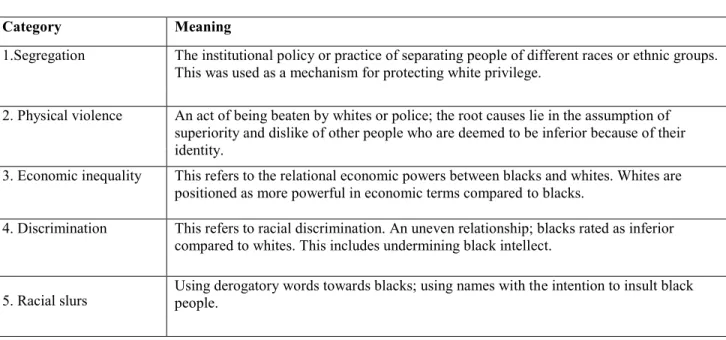
Racial slurs
- Reliability of coding
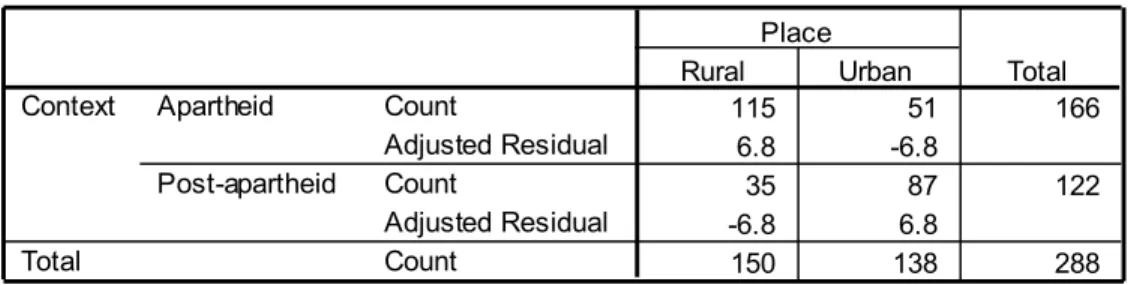
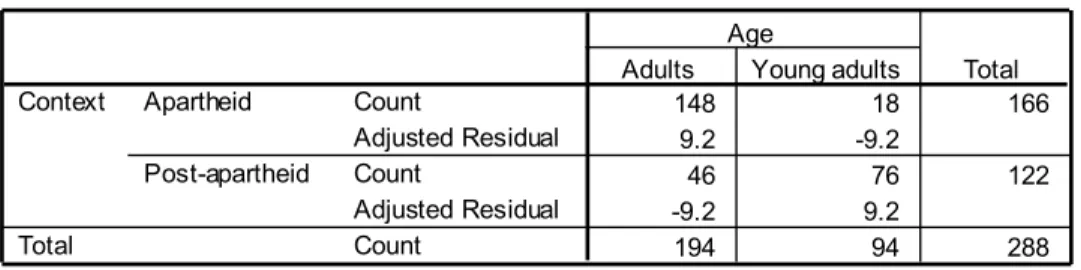
- Description of the sample
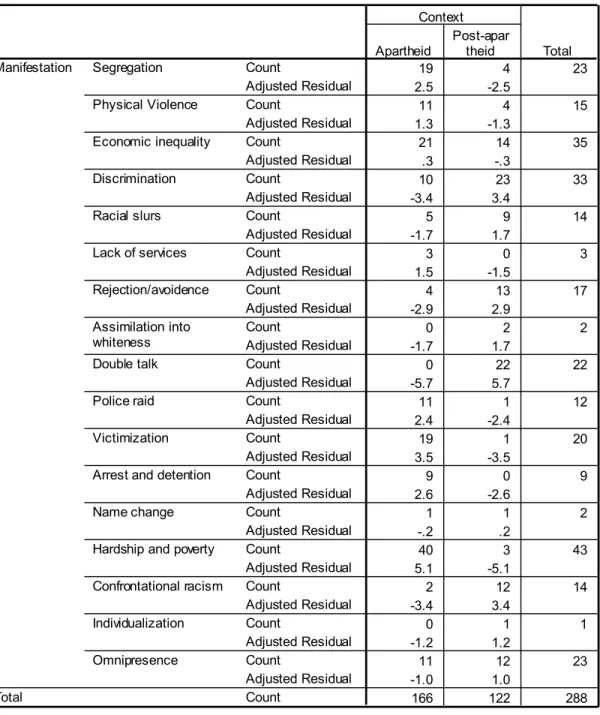
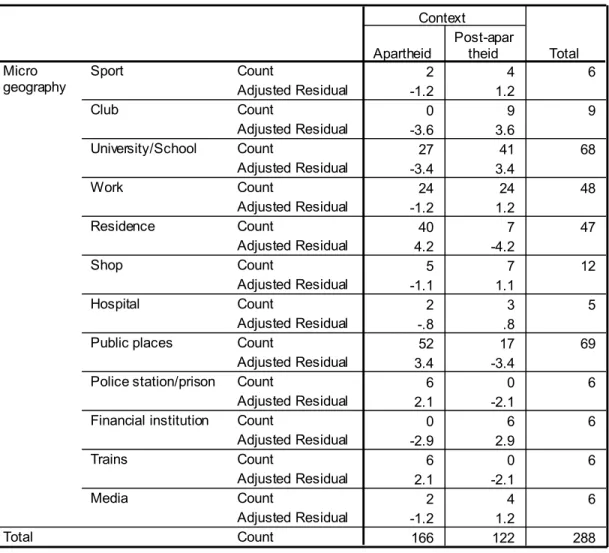
- Descriptive results for the manifestations and micro-geographies of racism
- Manifestation of racism
- Apartheid manifestations
- Post-apartheid racism experiences
- Summary and analysis
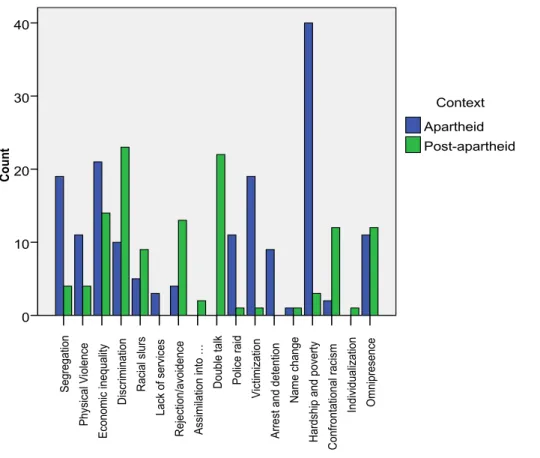
- Apartheid and post-apartheid manifestations
- Discussion
- Summary
The above extract shows us that in the apartheid and post-apartheid context, racism has been pervasive and a way of life for black people. From both respondents we learn that in the apartheid and post-apartheid period, racism is omnipresent, the experience of racism, the background of their lives as black people. Racist slurs remain part of black people's experiences of racism across the apartheid and post-apartheid eras in South Africa.
In post-apartheid South Africa this is not legal, but it is the reality for black people. In post-apartheid times, black people have reporting histories of being appointed as leaders without decision-making powers.
Introduction
The central questions that the data in this chapter address are embedded in research questions 2 and 3 (cf. section 1.4), namely: What discourses form the framework for black people's talk about being black in contemporary South Africa. I show how discourses are positioned to construct a new black identity in contemporary South Africa. In this chapter I show that in black identity construction today there is a variation in the meaning of being black.
Blackness as relational to whiteness
- Black white binary oppositions as black markers
- Stereotyping and otherness as markers of black identity
The following extract shows how respondents use established stereotypes in their construction of black identity. He talks about black identity as being associated with crime, being unhealthy and being negative. The following section shows how these discourses are used to construct other forms of black identity.
Qaba-tshu [deep darkness in people of ochre] versus white-black (diversity in
- Umzabalazo [struggle] is being black
- Defence of a coconut (white-black positioning)
- Coconuts criticised
- Authenticity as a commodity
- Rural versus urban blackness
In this analysis, this essentialism of black identity leads to two ways of constructing black identity as ambivalent. This categorization of black identity becomes the basis for the terms black-black and white-black in this study. I use Nono and Kasong to highlight the ambiguity of the construction of black identity as essential despite its hybrid moments.
Discussion
The same stereotypes used to separate whites from blacks in the construction of authentic blackness have been used to make urban blacks different from rural blacks.
Summary
Introduction
- The lived experiences of everyday racism of black people in South Africa today
- Discourses that frame ways of talking about black identity and blackness in South Africa today207
- The impact on black identity of the historical, political and economic changes in South Africa208
Recommendations
Ethical Clearance Certificate
Consent Form
English Interview Questions
Imibuzo yeNtentwano yesiXhosa
Example 1 of interview transcripts
Example 2 of interview manuscript