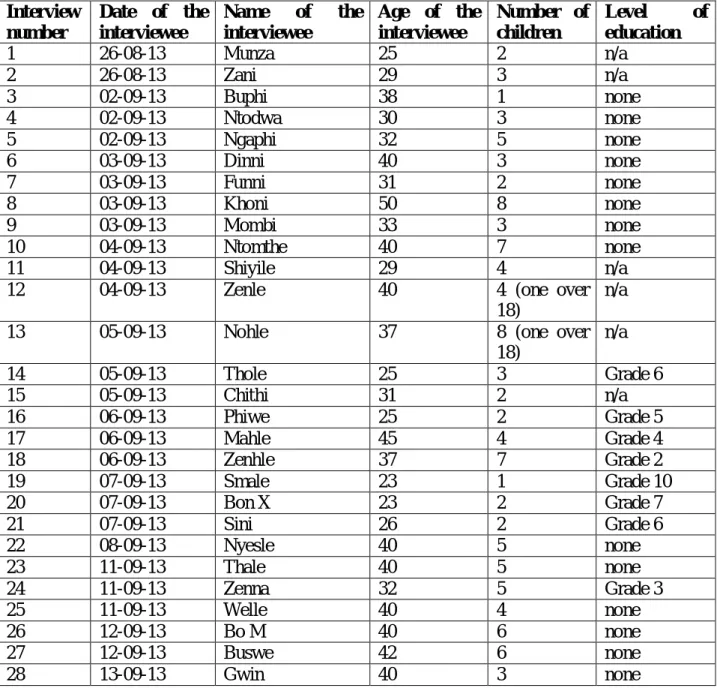
The thesis examines a wide range of literature on social protection from the earlier debates on welfare to current works on social protection as part of development policy worldwide and in the South African context. The study was carried out in Msinga, in the province of KwaZulu-Natal, using interviews and a focus group discussion with some of the women who receive the grant. It also found that the award had generally positive outcomes for the livelihoods of the women who participated in the study.
My greatest thanks go to the women from Ncunjana in Msinga who gave their time and participated in the interviews and focus group discussion.
Introduction
- Background to the Research
- The Objectives of this Research
- The Research Questions
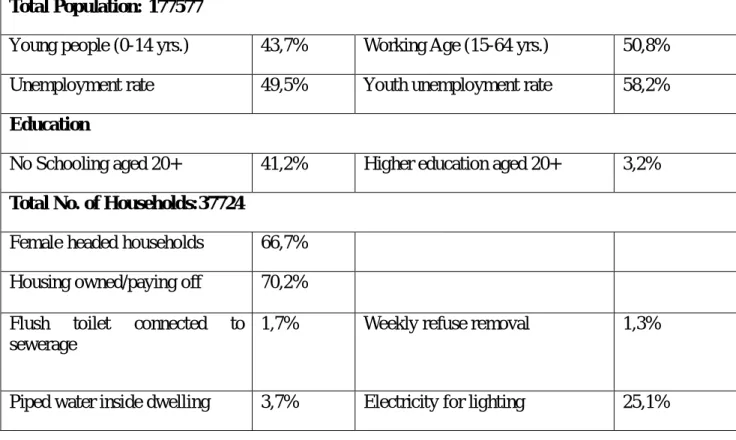
- Background of the study site –Msinga area
- Overview of the Chapters
It is in this context that the study examines the role of child support in the lives of these women, their livelihoods as part of their family unit, the variety of livelihood opportunities they may have and the choices they make regarding those opportunities . To investigate whether and how the Child Support Grant strengthens the asset base and livelihood of women and their families. In exploring these questions, the thesis posits that while child support recipients spend the subsidy on consumer goods, they also spend some of the money on productive assets, such as livestock.
About 50% of the working population – persons aged 15 to 64 who are available for work – are unemployed.
Literature Review
- Introduction
- The Old Debate on Social Welfare
- Social Protection – the New Debate
- Social Protection and Livelihoods
- Cash Transfers as part of Social Welfare to Address Poverty
- The South African Context
This thesis consists of seven chapters, including the introductory chapter, which provides the background of the study and presents the research question that the study is trying to answer.
Conceptual Framework
Introduction
The Sustainable Livelihoods Approach (SLA)
Origins and the Theory behind SLA
The Capability Approach
Agency of people – a definition
SLA and the Vulnerability Context
Assets in SLA
The Concept of Resilience in SLA
Critique of the sustainable livelihoods approach
The Landscape of Households and Livelihoods
Rationale for using SLA in the study
Methodology
Introduction
Sampling method
Interview Guide
Content Analysis
Limitations of the Study
Findings
Introduction
Overview of participants
Household Structure and Size
Household Livelihoods
Participants’ Livelihoods
Employment in the context of livelihood
Children and the Cost of Raising Children
Social Grants in the study area
Child Support Grant
Asset Accumulation
Who makes the decisions?
Discussion
Household formation and positioning of women
Although the household was not the unit of analysis in this study, it provided a basis through which interaction around subsistence and child benefits in particular takes place. In the literature (e.g. in Neves and du Toit (2008); Ellis (2007), households are characterized by people living together in space and time, sharing resources (particularly income) and collaborating in productive activities. Neves and du Toit concluded in their study of rural households in the Eastern Cape that households are “not only formed around reciprocity, but also consolidated around resources” (Neves and du Toit, 2008:3).
There is a clear kinship and sharing between the extended farm and the sub-households of space (residential plots) and resources (arable land, kraal and other natural resources); however, this does not include income. The first is that most studies that have found that income is pooled have referred to the state pension, as the older members of the household take on responsibility for the younger, unemployed members of the household. Second, the organization of the farm into sub-households means that each sub-household is an entity unto itself and therefore only has to share resources with the members of the sub-household.
In this context, it may be easier and more logical for the income to be pooled. Cooperation in productive activities only takes place with members of the sub-household, which in the case of most of the women interviewed happened between the woman, her husband (if he is not in Johannesburg) and her children. It was only in the case of the younger makotis who share a cooking hut with the in-laws that some cooperation took place outside the sub-household, in activities such as fetching and harvesting water or firewood.
For example, the OAP, located in the older member of the household, is more likely to be spread over the whole household (or at least among the members of the household who share the same cooking hut), while the child support allowance and the things he buys , are more likely to consolidate the sub-households as semi-autonomous units. This means that the household and the distribution of consumption and of productive resources are more complex than literature often assumes.
The Child Support Grant, Enabling and Agency
In a study on the impact of child benefits commissioned by the Department of Social Development (DSD), the South African Social Security Agency (SASSA) and the United Nations Children's Fund, it was reported that 51% of people receiving the benefits do not have any other form of income and that the subsidy accounted for almost 40% of total household income, while it contributed about 67% of personal income (Delany, et al 2008). In this study, the grant is the main source of income for many women (and their sub-households) who were part of the study, and where there was other income, the grant still contributed significantly to household income. Although the grant is not similar in its targeting to other types of cash transfers in other parts of the developing world, such as Bolsa Familia in Brazil or Progressa in Mexico, it has a similar dimension in that the cash transfer is a strategic form of social protection that has an impact at the household level and a direct impact on poverty.
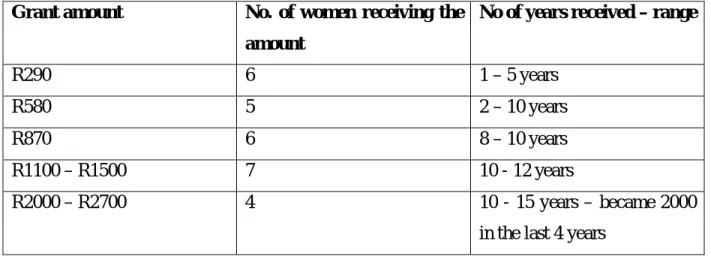
The grant is very small, with the minimum amount received at household level ranging from R280 to just over R2000, but has exceeded general expectations in terms of meeting basic household needs, depending on the number of children in the household receiving the grant. The study, along with other studies, found that the grant money is spent on consumer goods such as food, clothing and other household items, where food is the most important item of expenditure. The study also found that the subsidy is also spent on productive assets such as buying goats and chickens and building houses.
Other studies such as DSD, SASSA and UNICEF (2012) reported expenditure on grants for consumables. These studies have shown that approximately 79% of grants are spent on food, which is then followed by children's education in the form of school fees and school uniforms (Patel, 2011). For example, all women with school-aged children reported spending 'significant' amounts on school-related activities, including school uniforms, sports activities, field trips, pocket money, and a percentage of the grant amount for transportation.
Although this point was not thoroughly explored in the interactions with the women, it seems to indicate that the grant allowed them to make decisions about their children's education by investing in what they felt was a better education for their children. Spending the grant income not only on consumer goods, but also on productive assets shows a departure from the idea that "social assistance payments have exclusively consumption effects that have no impact on productive activity..." (Farrington and Slater, 2006:500).
Livelihoods Security and Assets
Vulnerability and Resilience
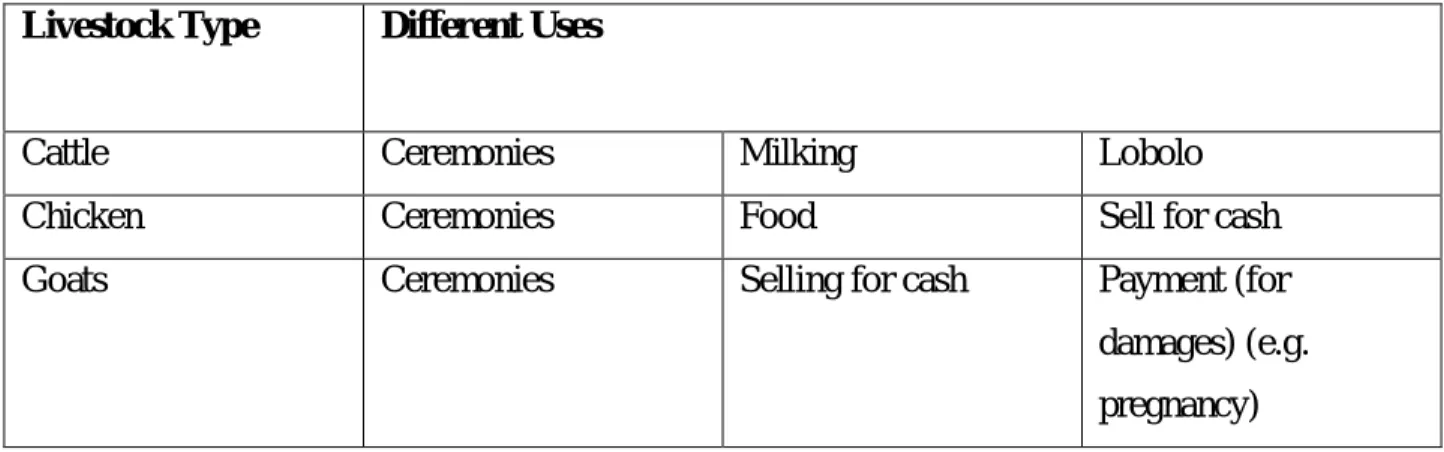
Some of the women in the study harvest wood and straw to sell to neighbors, thus generating income for their families. Livestock also plays an important role in the livelihoods of the women in the study and many of them have managed to herd goats and chickens over the years. The child support grant provides financial capital, which is also re-invested in the accumulation of other assets (livestock, housing), thus increasing the sense of security and strengthening livelihoods.
The diverse nature of livelihood activities and the use of different resources available to them mean that these livelihoods become less vulnerable. Although not specified for this study, women's ability to engage in a variety of livelihood activities while accumulating assets means they have the potential to escape the worst traps of poverty and remain above the 'high risk' level in the long term. It is important to note that the study does not claim that households under investigation are now resilient because of the child support allowance; however, it creates an opportunity to build resilience.
Household livelihood outcomes will be determined by how they use the subsidy, the decisions they make and their ability to act. Hodges et al argue that "the impact of cash transfers (CTs) on poverty depends on how poor people spend the money" (Hodges et al, 2013: 6). This chapter discussed the findings of the study with specific reference to the research questions.
She presented a detailed discussion of the main findings and highlighted some of the points raised by study participants during the interviews and focus group discussion. This chapter has shown that some of the findings are consistent with those of other studies on the impact of the child support allowance.
Conclusion
On the one hand, some studies on the impact of the OAP on labor force participation have found that the rate of labor participation decreases with the receipt of OAP. All the women interviewed are the primary carers of the children for whom they receive the grant. Openness of the developing economies means that they are more susceptible to shifts in global markets, thus necessitating an emphasis on greater social protection.
However, questions remain about the lasting effect of social subsidies in the face of unpredictable crude market changes at national and global levels. Although the study shows that CSG can be spent not only on consumables but also on productive assets, thereby building resilience, the idea of transformative social security shows that there are still gaps in South Africa's social protection system. Hybrid social citizenship and the normative centrality of wage labor in post-apartheid South Africa.
A Critical Examination of the Concept of Welfare Dependency: Its Presuppositions, Underlying Values and Manifestation in Social Policy. Gender and social assistance in the first decade of democracy: a case study of South Africa's Child Support Grant. Assessing the impact of the Child Benefit on child well-being in South Africa: A summary of available evidence.
Labor migration and households: reconsidering the effects of the social pension on labor supply in South Africa. Deserving individuals and groups: the post-apartheid state's justification of the form of South Africa's social assistance system.