
In line with the trend in the United Kingdom, South Africa has indicated an intention to adopt a twin-peaks model of financial regulation to make the financial sector in the country safer and serve the country better. This dissertation seeks to consider the impact of the twin-peaks model of financial regulation on the financial sector in South Africa.
Background
The purpose of the study
Before the financial crisis of 2008 occurred, many jurisdictions tended to take a rather "soft" approach to the financial sector. The purpose of this research is to examine this increased regulation on financial markets since the time of the financial crisis in 2008, with specific reference to the South African response.
Literature Review
The UK government's White Paper on regulatory reform in the aftermath of the crisis argues that the twin-peaks model will place a heavy burden on the financial system.17. Furthermore, it is argued that the regulation of the financial sector in South Africa does not need the twin-peaks model.
Questions to be identified by the research
Methodology
Structure of the dissertation
Chapter four describes the financial crisis and what underlies the crisis. It also touches on various factors that protected the South African financial system from the consequences of the crisis.
Historical overview of the regulation of the financial system in South Africa
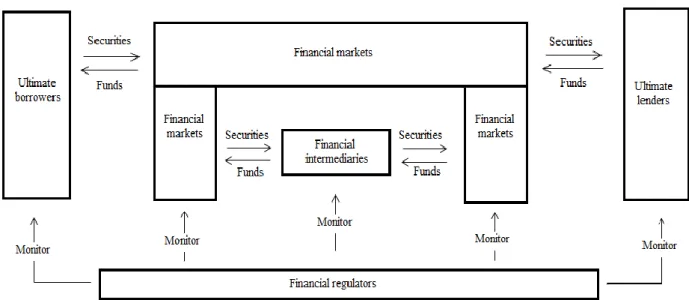
- Lenders and borrowers
- Financial intermediaries
- Financial instruments
- Money creation
- Financial markets
- Primary markets versus secondary markets
- Equity markets versus debt markets
- Cash markets versus derivatives markets
- Foreign exchange markets
- Commodities markets
- Leading regulators of the financial sector in South Africa
- The South African Reserve Bank
- The Financial Services Board
- Johannesburg Stock Exchange Limited
- Central Securities Depository
- The National Credit Regulator
- The leading laws of the financial sector in South Africa
- The South African Reserve Bank Act
- The Banks Act
- The Financial Advisory and Intermediary Services Act
- The Financial Markets Act
One of the most important elements of the financial system is the creation of money. Another important function of the financial system is the creation of money when it is required, as discussed above. South Africa has a number of different regulators, each focusing on a certain aspect of the financial services sector.64 The banking system is regulated by the South African Reserve Bank, and the non-banking system is regulated by the Financial Services Board.
64 L Swart 'The legal framework relating to selected segments of the financial market' (LLM thesis Nelson Mandela Metropolitan University. 81 Handbook on access to information held by the Financial Services Board 'Compiled in terms of section 14 of the Promotion of Access to Information Act, 2 of 2000‟ 1. The FAIS Department of the FSB is responsible for the regulation and supervision of financial service providers100 within the meaning of the FAIS Act.101.
As mentioned above, the JSE is a self-regulatory organization and is responsible for setting its own rules and directives under the Financial Markets Act.120 However, the FSB plays a supervisory role under the FSB Act.121. Under the FSB Act, the CSD (STRATE) is under the supervision of the FSB under the Financial Markets Act.133 However, under the latter Act, STRATE must issue its own rules and directives.134. The main laws that these regulators are responsible for enforcing are the subject of the following section.
Access to Credit
- The Common law
- The Usury Act
- The Credit Agreements Act
- The Consumer Affairs (Unfair Business Practices) Act
- The National Credit Act
The NCA was enacted as a result of the shortcomings of the previous Acts, namely the common law, the Usury Act,173 the Credit Agreements Act174 and the Consumer Affairs (Unfair Business Practices) Act.175 Each of these Acts will be briefly discussed in turn. The general law of contract is the most important aspect of the common law relevant to this discussion. A full discussion of general contract law is beyond the scope of this thesis.
The notice provided, among other things, that the loan was to be repaid over a period of up to 36 months from the date of payment of the loan. As a result of the above abuses, the Minister has decided to issue the second Exemption Notice. This was achieved through the enactment of the NCA, which repealed the Credit Agreements Act.
It was hoped that the introduction of the legislation would go a long way in dealing with the problems that existed in the credit market.
The financial crisis of 2008 and its consequences
The causes of the crisis
With the increased demand for housing, so did the demand for household appliances, and banks' lending increased excessively.257 Banks were encouraged to expand their lending because of the benefit of securitization, which protects lenders against any risk of borrowers defaulting. continue with the refund. .258 Securitization is a financial practice in which different types of assets, such as mortgages, loans, and credit card debt, are pooled, leveled (by rating agencies), and sold as securities.259 The rating levels (also called tranches) are categorized as AAA, AA, A, BBB, BB...etc. from the most creditworthy to the least creditworthy).260 Mortgage-backed securities are called mortgage-backed securities, while those backed by other types of payment rights are called asset-backed securities.261. When bank lending began to increase excessively, the FRB sharply increased the repo rate to meet loan demand.262 However, most borrowers, who could afford to repay their mortgages when interest rates were low, now went bankrupt . on their. The second phase of the problem was attributed to the banks.265 During the lending process, the banks were not careful in their assessment of the creditworthiness of the borrowers; As a result, there was a lot of reckless borrowing.266 When the banks started selling the mortgage-backed securities, many of these securities were rated below triple A.
This meant that they were very difficult to sell as the holder of these securities would have been placed on waterfall payments if the borrowers had defaulted.267 In other words, the holders of the highest tranche (in the case of non-payment of borrowers) would receive interest and principal payments, while holders of the lowest installment would receive only interest payments; when holders of the highest tranche have received all interest and principal payments in full, holders of the next tranche shall begin to receive interest and principal payments.268. To solve this problem, mortgage-backed securities were transformed into structures called collateralized debt obligations (CDOs), which are a type of derivatives.269 The mechanism of CDOs is to create entities called special purpose entities. and lower mortgage payments. - the backed securities are placed in these entities.270 The entities then repackage these securities into new CDOs (CDOs).271 Approximately 80% of these CDOs were rated triple A, and they were sold as such, though originally composed of the lowest. rated tranches of mortgage-backed securities.272 These CDOs were sold to undercapitalized banks and other financial institutions, which took advantage of deregulation of derivatives to hide their risk.273 This was the next phase of the problem as the agencies evaluation failed. The crisis also proved that international financial codes and standards were ineffective and unable to prevent the spread of the crisis worldwide.279.
The crisis culminated in the collapse of a number of financial institutions in the United States, including banks such as Lehman Brothers.280 As a result of the uncertainty, financial institutions stopped lending to each other and interbank financing suffered a lack of liquidity.281 Governments were therefore obliged to bail out systemically important financial institutions (SIFIs) which must not go bankrupt and whose collapse would have led to the destruction of the entire financial system.282.
How the South African financial system weathered the crisis
The CDOs were sold locally and internationally through foreign investors seeking high profits in the US markets.275 The most notable investors were the Norwegian municipalities of Rana, Hemnes, Hattjelldal and Narvik, which invested around $120 million of their taxpayers' money in the CDO 'er.276 The foreign investors made these investments on the basis that the CDOs were triple-A rated securities, when in fact they were not.277 Since most countries hold their foreign exchange reserves in US dollar assets, the unsound securities constituted a part of foreign exchange reserves of investing countries and resulted in the globalization of the crisis.278 This implies that banking regulators were not effective enough, as they could not recognize the reality of the CDO quality. This regulation replaced exchange control regulation with respect to institutional investors in 2008.284 Van Wyk states that the regulation aims to strike a balance between promoting foreign investment and protecting the economy from external shocks. Another important measure which protected South Africa from the crisis was the adoption of strong legislation regulating the credit industry, namely the NCA.285 The Act seeks to ensure an efficient and effective credit market.286 It requires credit providers to assess consumers'.
Regardless, the problems at African Bank underscore the fact that there is a need for government to revisit the issue of regulation in the financial sector.
The Aftermath of the crisis
- South African response to the crisis
The first authority, namely the Prudential Authority, will be responsible for overseeing the prudential supervision of banks, insurers and financial conglomerates. Within the SARB, the Prudential Authority will be established, which marks the first peak of the model.310 The other authority, namely the Market Conduct Regulator, will monitor the market behavior of financial institutions (including bank charges). The Regulator will be created within the FSB, indicating the second peak of the FSB.
The FSB has therefore introduced the "fair treatment of customers" (TCF) proposal,319 which introduces a system of stronger control of the market behavior of financial institutions. In addition to the establishment of the FSOC, the first phase of the implementation of the model will see the establishment of the Council of Financial Regulators (CFR). The establishment of the Financial Services Court, which is envisaged by the draft law on the regulation of the financial sector, is therefore a commendable step in promoting the enforcement of the measures of regulatory authorities.
The court's powers are also not clearly defined, and whether such a court will be able to award damages to injured consumers.
Conclusion
Financial Services Board "Department of Capital Markets" available at https://www.fsb.co.za/departments/capitalMarkets/Pages/Home.aspx, accessed 2 September 2014. FSB Deputy Executive Officer- Division of Insurance, available at http: //www.moneyweb.co.za/moneyweb-financial/2014s-twin-peaks, accessed 20 November 2014. Johannesburg Stock Exchange "about JSE" https://www.jse.co. za/about/history-company-summary, accessed September 3, 2014.
Sabinet Legal available at http://www.sabinetlaw.co.za/finances/articles/financial- sector-regulation-bill-track, accessed 17 November 2014. STRATE Basics of the CSD Industry available at http://www . strate.co.za/about-strate/basics-csd-industry, accessed 4 September 2014. Financial Services Board Strategic Plan available at https://www.fsb.co.za/Departments/informationCenter/Documents/Strategic %20 Plan.
International Organization of Securities Commissions (IOSCO) available at http://www.iosco.org/about/, accessed 2 September 2014.
