DEVELOPMENT OF THE SOUTH AFRICAN COASTAL SHIPPING POLICY: THE PROSPECT
OF MARITIME CABOTAGE
LANGA DLAMINI
B Proc, LLB, MCom (Maritime Studies)
Lecturer, School of Accounting, Economics and Finance, University of KwaZulu-Natal, Howard College
Attorney of the High Court of South Africa
Submitted in fulfilment of the requirements for a PhD degree in Maritime Studies in the School of Law
Supervisor: Judge Malcolm Wallis Co-Supervisor: Professor Trevor Jones
DECLARATION
I, the undersigned, hereby declare that the work contained in this thesis is, unless specifically indicated to the contrary in text, my own original work which has not been submitted before in whole or in part at any other University for a degree.
SIGNED ON 6 NOVEMBER 2020 AT DURBAN, SOUTH AFRICA
_____________________________________
L DLAMINI
ABSTRACT
The Comprehensive Maritime Transport Policy (CMTP) provides the official policy position on maritime issues in South Africa since 2017. It covers a variety of maritime matters relating to shipping conduct on the coast and offshore and extends to the utilisation of landside resources. However, this work evaluates policy provisions pertaining only to coastal shipping and in particular to cabotage.
Cabotage refers to the rights a coastal state reserves for itself to trade vessels of its choice between ports along its coast. The CMTP states cabotage as the official coastal shipping policy in South Africa for the first time in over a century-and-a-half of coastal shipping. However, the CMTP does not state the manner in which cabotage will apply.
In fact, some of its ambitions seem impractical. Through a thorough historical account, the thesis sheds light on why cabotage has never been adopted in South Africa. It also gives the rationale for abandoning in 2017 the laissez-faire position that had existed over many decades.
Given that cabotage presents itself in different forms, the thesis provides an overview of the various cabotage forms by reference to a sample of comparable jurisdictions. It then asks the question: what is the prospect of South African cabotage in light of the continental and international cabotage practice scope? The question directs focus to three issues: the meaning of cabotage; the scope of its application; and the comparative measure for its application. The analysis gleans the likely direction for cabotage implementation from the CMTP and other instruments despite anomalies that exist between what the CMTP sets out to achieve and the proposed legal framework for its implementation. The conclusion is that, given the dearth of shipping capacity in South Africa, coastal trade dependence on feeder cargo and imbalanced cargo trades, the country’s only proper option, when cabotage is adopted, is liberal cabotage. It should be implemented without comparing South Africa to other jurisdictions but must be founded on its own merits and that such should show a ready source of cargo.
ACKNOWLEDGEMENTS
First, to God be all the praise! 1 Peter 4:11
To my supervisors, Judge Malcolm Wallis and Professor Trevor Jones: Thank you for your exceptional guidance. The ship reached shore because of your invaluable contributions. I am truly grateful to both of you for your time, patience and support shown (and felt) in this endeavour.
Deepest gratitude goes to my wife and friend, Noxolo especially for her ready preparedness to condone my “absence” during the course of this work.
Thank you also to my children Sikuwe, Bukhosi, Kwethaba, my brother Ndo and the rest of my family for their patience, encouragement, understanding and prayer.
I thank my formidable mother, uMaDladla, for stewarding my youth with tea-girl resources and for both her and Gogo, uMaShange, for being excellent role models of how to live by faith. Some big shoes I have been left to fill!
Thank you to Prof Marita Carnelley for her firm yet caring hand and for her watchful eye and to Dr Kathy Cleland for her warmth and love. Thank you also to the rest of the
“Cedarwood crew” especially K and R!
TABLE OF CONTENTS
DECLARATION ii
ABSTRACT iii
ACKNOWLEDGEMENTS iv
LIST OF FIGURES xii
LIST OF TABLES xii
ABBREVIATIONS AND ACRONYMS xiii
CHAPTER 1: INTRODUCTION 1
1.1 THE RATIONALE FOR GOVERNMENT INVOLVEMENT
IN COASTAL SHIPPING IN SOUTH AFRICA 2
1.1.1 Socio-economic contribution 4
1.1.2 Job creation 5
1.1.3 Balance of payments 5
1.1.4 Stimulation of the South African domestic merchant
marine 6
1.1.5 Shipbuilding capacity and maritime skills
development 6
1.1.6 Skills transfer 7
1.1.7 Cabotage 7
1.2 RESEARCH QUESTION 8
1.3 OBJECTIVE OF THE STUDY 8
1.4 THE SCOPE OF THE STUDY 9
1.5 RESEARCH APPROACH AND HYPOTHESIS 10
1.6 RESEARCH METHODS 11
1.7 CHAPTER OVERVIEW 11
CHAPTER 2: DEVELOPMENT OF COASTAL SHIPPING 13
SECTION A: EARLY HISTORY 13
2.1 PRE-COLONIAL COASTAL SHIPPING 13
2.1.1 Trade with the East 13
2.1.2 Trade with the West 15
2.2 COLONIAL COASTAL SHIPPING 16
2.2.1 Establishment of colonies and subsequent port
development 16
2.3 DEVELOPMENT OF COASTAL SHIPPING (1900 TO THE
1950s) 21
2.3.1 Conference dominance 21
2.3.2 Sea Competitive Railway Rates 25
2.3.3 Effects of the Depression and the World Wars 26
2.3.4 Overview of the period 27
2.4 CONSOLIDATION AND RATIONALISATION OF THE
COASTAL FLEET (1950 TO 1976) 28
SECTION B: MODERN COASTAL SHIPPING 31
2.5 MODERN HISTORY OF SOUTH AFRICAN COASTAL
SHIPPING 31
2.6 COASTAL CONTAINERISATION (FROM 1977 TO 1985) 31
2.6.1 Milestones of this period 34
2.7 COASTAL MONOPOLY (FROM 1985 TO 2000) 36
2.8 COASTAL SHIPPING IN THE NEW MILLENNIUM 39
2.9 CONCLUSION 40
CHAPTER 3: DOMESTIC AND REGIONAL COASTAL POLICY 45 3.1 DEVELOPMENT OF DOMESTIC POLICY (1996 TO 2018) 46 3.1.1 National Transport Policy White Paper (1996) 46
3.1.2 Draft Maritime Policy (2009 and 2010) 47
3.1.3 Review Report on the South African Maritime
Transport Policy (2013) 48
3.1.4 Green Paper on the South African Maritime
Transport Policy (2015) 51
3.1.5 Draft Comprehensive Maritime Transport Policy 53 3.1.6 Comprehensive Maritime Transport Policy 54
3.1.7 Draft Merchant Shipping Act (2018) 55
3.2 REGIONAL AND CONTINENTAL POLICIES 56
3.2.1 AU maritime instruments 56
3.2.2 The AU Maritime Charter 57
3.2.3 Africa Integrated Maritime Strategy 2050 (AIMS
2050) 57
3.2.4 AU regional agenda 58
3.3 SADC REC STATUS 60
3.3.1 SADC Protocol 61
3.4 CONCLUSION 64
CHAPTER 4: THE ROLE OF CARGO IN COASTAL TRADES 66
4.1 COASTAL ROUTES AND COASTAL SERVICES 66
4.1.1 Container and breakbulk services 67
4.1.2 Feeder services 68
4.1.3 Overview of coastal tonnage 69
4.2 COASTAL CARGO MOVEMENT 69
4.2.1 Overview of domestic coastal cargo 70
4.3 REGIONAL CABOTAGE 86
4.3.1 Limitations of regional cargo data 86
4.3.2 Regional cargo overview 87
4.3.3 Regional commodities 89
4.4 CONCLUSION 90
CHAPTER 5: OVERVIEW OF WORLDWIDE CABOTAGE
PRACTICES 94
5.1 INTRODUCTION 94
5.2 DIFFERENT FORMS OF CABOTAGE REGIMES 95
5.2.1 Restrictive cabotage 95
5.2.2 Liberal cabotage 96
5.3 OVERALL JURISDICTIONAL CABOTAGE PRACTICES 99
5.3.1 Ship registration 100
5.3.2 World deadweight tonnage shares 100
5.4 INFLUENCE OF THE DEGREE OF CABOTAGE
RESTRICTIONS 104
5.4.1 First category 108
5.4.2 Second category 109
5.4.3 Third category 112
5.4.4 Fourth category 115
5.4.5 Fifth category 116
5.5 SUMMARY OBSERVATIONS 118
5.6 CONCLUSION 119
CHAPTER 6: STRICT CABOTAGE PRACTICES: NIGERIA AND THE UNITED STATES OF AMERICA
122 CLASSIC FEATURES OF STRICT CABOTAGE
122 6.1 NIGERIA
124 6.1.1 Period from early 1960s to early 1990s
124 6.1.2 Period from 1993 to 2003
127 6.1.3 The Coastal and Inland Shipping (Cabotage) Act
(“the Cabotage Act”)
128 6.1.4 Challenges of Nigerian cabotage
132 6.1.5 Observations
134 6.2 THE UNITED STATES OF AMERICA
134 6.2.1 Early US coastal restrictions
135 6.2.2 The Merchant Marine Act (“the Jones Act”)
136 6.2.3 US cabotage trade coverage
137 6.2.4 The US cabotage fleet
139 6.2.5 Waivers and exceptions
139 6.2.6 Challenges of American cabotage
141 6.3 SUMMARY
147 6.4 CONCLUSION
147
CHAPTER 7: LIBERAL CABOTAGE
150 FEATURES OF LIBERAL CABOTAGE
150 7.1 AUSTRALIA
151 7.1.1 The Navigation Act 1912
152 7.1.2 Attempts to amend coastal policy
154 7.1.3 Recent developments
156 7.1.4 Latest cabotage position in Australia
157
7.1.5 Potential further amendments to Australian cabotage legislation
159 7.2 SUMMARY
161 7.3 NEW ZEALAND
162 7.3.1 Cabotage reservation for flagged vessels (early 1900s
to 1980s)
163 7.3.2 Maritime Transport Act 1994
166 7.3.3 New-era cabotage (period after 1995)
168 7.3.4 Contemporary New Zealand coastal stance
171 7.4 SUMMARY
172 7.5 CONCLUSION
173
CHAPTER 8: LESSONS FOR SOUTH AFRICA
175 BASIS FOR CABOTAGE UNDER THE CMTP
175 8.1 UNITED STATES OF AMERICA
177 8.1.1 The basis for US cabotage
177 8.1.2 Geography of the US domestic coastal trade
179 8.1.3 The high costs of sustaining US cabotage
181 8.1.4 Coastal utilisation of US-built vessels
182 8.1.5 Engagement of US crews
184 8.1.6 Extrapolating for South Africa
185 8.2 NIGERIA
186 8.2.1 Nigerian coastal trade: distinguishing features
187 8.2.2 Waivers
189 8.3 AUSTRALIA
192 8.3.1 What can South Africa derive from the Australian
experience?
195
8.4 NEW ZEALAND
197 8.4.1 Costs of abolishing cabotage
198 8.4.2 Benefits of abolishing cabotage
199 8.4.3 Observations for South Africa
200 8.5 CONCLUSION
205
CHAPTER 9: CONCLUSION
208 9.1 CONCLUSIONS AND RECOMMENDATIONS
216
BIBLIOGRAPHY 218
Primary Legislation 218
Secondary Legislation 219
Bills 220
Books 221
Conventions/Protocols/Treaties 223
Journals 223
Newspaper/Periodical Articles 224
Organisations 226
Policy Documents 226
Reports 227
Theses 230
Websites 230
White/Green Papers 233
LIST OF FIGURES
Figure Title Page
2.1 Early Arab trade route to Southern Africa 14
2.2 Manufacturing industry’s sugar demand during the period from
1927 to the mid-1950s 27
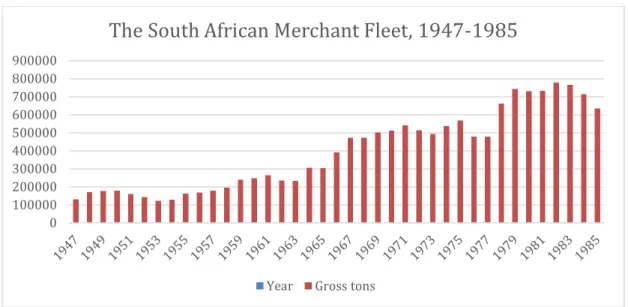
2.3 South African commercial fleet during the period from 1947 to
1985 36
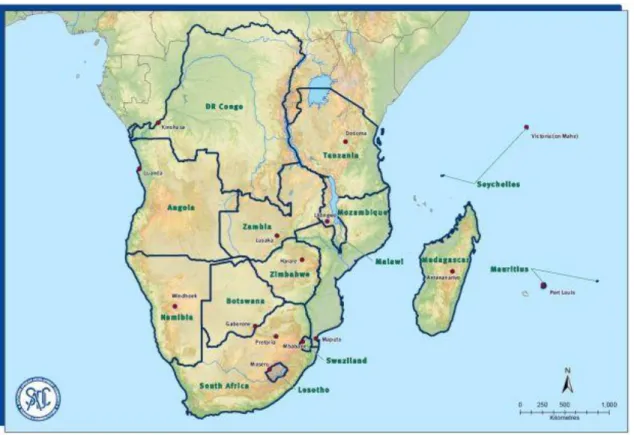
3.1 SADC Member states 61
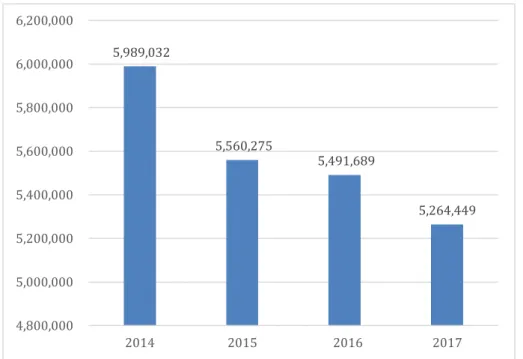
4.1 Non-containerised coastal cargo volumes in million tons (2014-
2017) 74
4.2 Bulk and breakbulk comparison 75
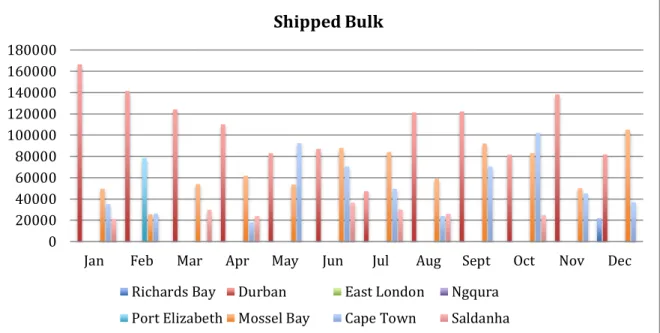
4.3 Shipped bulk monthly average 76
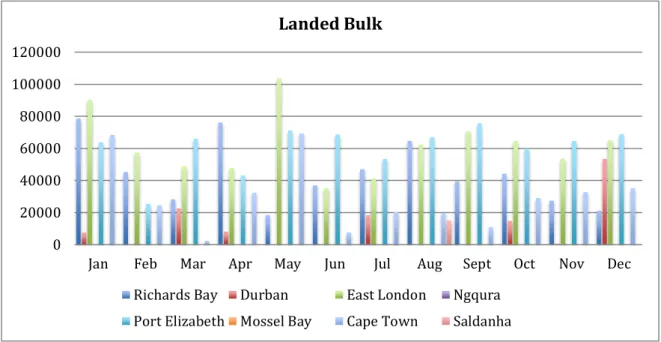
4.4 Landed bulk monthly average 77
4.5 Total shipped/landed coastal TEUs (2014-2017) 78
4.6 Landed annual TEUs 79
4.7 Shipped annual TEUs 80
4.8 Full and empty TEUs (2014-2016) 81
4.9 Full/Empty TEUs – main route 84
4.10 South African seaborne exports (Luanda to Mombasa) 88 4.11 Primary regional cargo exports – South Africa to SADC 89
LIST OF TABLES
Table Title Page
4.1 Overview of coastal and regional routes and vessel deployment 69
4.2 Major coastal commodities 82
5.1 Thirty-five leading maritime nations and South Africa (by dwt) 102
5.2 Cabotage manning and ownership restrictions 105
ABBREVIATIONS AND ACRONYMS
AEC African Economic Community AGSR Australian General Shipping Register AIMS Africa’s Integrated Maritime Strategy 2050 AISR Australian International Ship Register
ASGISA Accelerated Shared Growth Initiative of South Africa
AU African Union
AU Charter (Revised) African Maritime Transport Charter BBBEE Broad-based Black Economic Empowerment bpd barrels per day
BRICS Brazil, Russia, India, China and South Africa (a bloc of countries which have formed a group of emerging economies in order to strengthen trade and other economic ties)
CAATA Comité Andino de Autoridades de Transporte Acuático/Committee of Aquatic Transport Authorities
CAN Community of Andean Nations CEMZA Combined Maritime Zone of Africa CEN-SAD Community of Sahel-Saharan States CMTP Comprehensive Maritime Transport Policy COMESA Common Market for Eastern and Southern Africa CVFF Cabotage Vessel Financing Fund
DIS Denmark International Ship Register dwt deadweight tonnage
EAC East African Community
ECCAS Economic Community of Central African States ECOWAS Economic Community of West African States EEA European Economic Area
EFTA European Free Trade Agreements
EU European Union
FCL Full Container Load FOC flag of convenience FTA Free Trade Agreement
GEAR Growth, Employment and Redistribution (strategy) IGAD Intergovernmental Authority on Development LSBCI Liner Shipping Bilateral Connectivity Index MARAD Maritime Administration (US)
MOT Ministry of Transport MSA Merchant Shipping Act
NASSCO National Steel and Shipbuilding Company NEPAD New Partnership for Africa’s Development
NIMASA Nigerian Maritime Administration and Safety Agency NIS Norwegian International Ship Register
NMA National Maritime Authority NNSL Nigerian National Shipping Line NOR Norwegian Ordinary Ship Register OACL Ocean Africa Container Lines
OECD Organisation for Economic Co-operation and Development OFA Ocean Freight Agreement
PetroSA Petroleum, Oil and Gas Corporation of South Africa RDP Reconstruction and Development Programme REC Regional Economic Community
RORO Roll-on/Roll-off (vessels/containers)
SA South Africa(n)
SACU Southern African Customs Union
SADC Southern African Development Community
SADCC Southern African Development Coordination Conference SAECS South Africa Europe Container Service
SAMSA South African Maritime Safety Authority SAPPI South African Pulp and Paper Industries Sapref South African Petroleum Refineries SAR South African Railways
SASBF Ship Acquisition and Ship Building Fund SCRR Sea Competitive Rail Rates
TEU Twenty-foot Equivalent Unit TNPA Transnet National Ports Authority
UK United Kingdom
UMA Arab Maghreb Union
UN United Nations
UNCTAD United Nations Conference on Trade and Development
US United States
USC United States Code
USSC Union Steam Ship Company of New Zealand
VOC Vereenigde Oost Indische Compagnie (Dutch East India Company)
CHAPTER 1:
INTRODUCTION
The origin of the term ‘cabotage’ is not certain. It seems to have been derived from either the French ‘caboter’ or the Spanish ‘cabo’, which referred to the sailing of ships from cape to cape without entering the high seas.1 Whatever its origins, in modern maritime trade, cabotage refers to shipping restrictions along the coast of a state and to trading limits within its ports. An unintended consequence of cabotage is that it is discriminatory; it keeps foreign flags out of the coastal trade.2
A jurisdiction that practices cabotage allows vessels registered in other jurisdictions uninhibited transit along the domestic coast. Foreign vessels may transit but not trade between ports along the domestic coast, because intra-coastal trade takes place within internal waters, which are ordinarily the preserve of the national fleet. Transiting foreign vessels would normally require permission to trade between domestic ports (in place of a national carrier). Therefore, use of the term ‘cabotage’ refers to the exclusion of foreign vessels or the imposition of restrictions that a coastal jurisdiction3 places over the loading and discharge of cargo between its coastal ports.
Cabotage should not be confused with cargo reservations and flag discriminations.
These generally refer to restrictions placed on certain cargos or to preferential treatment in respect of use of port facilities and sailing rights. Such restrictions do not routinely exclude foreign flags. Cargo reservations could mean that the loading of a specified category of cargo (for instance, government military cargo or aid cargo designated as such for a particular destination) is reserved, as the name suggests, for national carriers.
Under these circumstances, any carrier can carry any other type of cargo to the same destination. Similarly, flag discrimination could be a result of bilateral or multilateral arrangements between countries to load one another’s cargo to the exclusion of others and may include preferential berthing for their vessels.
1 https://en.oxforddictionaries.com/definition/cabotage. (Accessed 11 October 2017). See also http://www.businessdictionary.com/definition/cabotage.html. (Accessed 11 October 2017).
2 A. Odeke, Protectionism and the Future of International Shipping: The Nature Development and Role of Flag Discrimination and Preferences, Cargo Reservations and Cabotage Restrictions, State
Interventions and Maritime Subsidies (1984).
3 It is suggested that the use of the term “jurisdiction” rather than “country” provides a better
description of how cabotage functions because cabotage practice sometimes extends beyond borders of a single country and may reflect collaborative restrictions of several sovereignties.
Cabotage, on the other hand, is more restrictive, since it reserves all coastal trade for the exclusive benefit of the national carrier. It excludes all foreign elements from participating freely in the coastal market. Typically, the exclusion of foreign vessels eliminates foreign competition with a view to promoting the establishment of the domestic fleet on the coast through guaranteed supply and demand.4
Over the years, the concept of cabotage has evolved to refer simply to any form of restrictive practice which reserves a domestic market share for domestic service providers. Therefore, in modern industrial trade, cabotage is no longer confined to the shipping industry.5
In the context of this work it is proposed that, properly defined, cabotage is the reservation of a jurisdiction’s right to engage a merchant fleet of choice wholly or partly excluding others from trading between its coastal ports. It occurs when the coastal jurisdiction, through legislative instruments, exercises its prerogative to dictate parameters for the development of its maritime industry in a manner befitting its economic and social imperatives.
Unlike in other jurisdictions such as the United States, in South Africa cabotage refers to movable property (including animals) and not passengers. Consequently, the thesis focuses on cabotage in the context of trade and not on the carriage of passengers. This will become clearer when dealing with the proposed legislative framework for cabotage in Chapter 3 and in Chapter 8.
1.1 THE RATIONALE FOR GOVERNMENT INVOLVEMENT IN COASTAL SHIPPING IN SOUTH AFRICA
South African coastal policy has remained the same from the time of British rule to Nationalist Party days and throughout the South African democratic years. The various administrations adopted a policy of no cabotage over South African coastal waters. If South Africa has never reserved for itself the right to exclusive coastal trade, the question is then: why is there now a policy shift from having no coastal restriction to cabotage implementation? The answer to this question provides a proper basis for the
4 Odeke op cit note 2 75.
5Cabotage andAviation Rulesrelating toCabotage on International Flights (nd), available at https://www.aopa.org/go-fly/destinations/international-travel/cabotage. (Accessed 16 October 2017).
core question that this work focuses on. The following section therefore attempts to address this question by looking at the government’s rationale for introducing cabotage as gleaned from various draft instruments6 over the past two-and-a-half decades.
The reasons put forward by the government for its perceived sudden interest in coastal shipping in general are not new. Cabotage, shipbuilding, shipping skills transfer, attraction of favourable foreign exchange and job creation, for example, are some of the more commonly advanced grounds for state involvement in coastal shipping.7 Modern proponents of the concept articulate it in a fresh dialect. However, the idea itself is in fact an old idea. The impetus behind the promotion of what in recent years has become known as the “blue economy”8 seems to be generated by the notion that coastal countries derive significant benefits from state-driven shipping investment,9 and that the fruit of such investment will place the country on a path to economic programmes that can boost what Jones aptly calls the “political economy”.10 Grounds for state-driven investment have been differently formulated over time.11 The rationale
6 A fuller exposition of the development of the maritime policy will be dealt with in chapter 3.
7 B.D. Ingpen South African Merchant Ships’ (1979) 23 cites A Golden Opportunity: Controlling our Own Exports. A South African Shipping Company (1916), which was a report that raised the same issues in 1916 during the early days of the Union government.
8 The concept of the Blue Economy was originally formulated by Gunter Pauli and popularised through his book The Blue Economy: 10 Years, 100 Innovations, 100 Million Jobs (2010). Pauli advocates a balance between sustainability of the environment (the sea) with building up social capital while generating income and job creation.
9 See T. Jones ‘Coastal Sea Transport and Intermodal Competition in South Africa’ (1985) 233.
10 Ibid.
11 The overarching rationale for state involvement in the sphere of maritime trade and transportation worldwide can be summarised as follows:
a. State investment can foster, develop and maintain a merchant marine.
b. A domestic merchant fleet provides services that generate earnings in foreign currency and in the process correct the effects of dependence on foreign transport services that generally harm the country’s balance of payments.
c. State capital investment can rejuvenate coastal trade and in turn justify state exploitation of the coast exclusively for the country,
d. The coastal state can harness skills in strategic areas, particularly in seafaring, and other expertise that are exclusively maritime in nature and may extend the benefit further to enhance hinterland projects.
e. In particular, developing countries such as South Africa stand to benefit from state-directed maritime investment as they can stimulate commercialisation of coastal waters and revitalise other natural maritime resources to create employment opportunities.
f. Adopting state-driven maritime investment can position the country to revive its shipbuilding and stimulate related maritime engineering industries.
g. A domestic merchant marine would reduce the country’s dependence for trade on foreign bottoms.
h. An efficient domestic merchant marine provides a ready and reliable means of transport that would be indispensable in times of diplomatic isolation, war and during other foreign-instigated insurrections.
The list is not exhaustive.
for state involvement worldwide is generally around the same issues.12 In particular, the state seeks to implement cabotage as a kind of stimulus which, it is hoped, will possibly regenerate coastal shipping. Cabotage therefore seems to be the basis on which the government of South Africa seeks to re-enter the shipping industry, among other imperatives.
Presented in no particular order, below is a list of reasons for state involvement in coastal shipping in South Africa. The list is derived from various policy documents that government has published over the past 25 years which include the South African Comprehensive Maritime Transport Policy, 2017, hereinafter referred to as the CMTP.
These policies will be dealt with in some detail in chapter 3.
1.1.1 Socio-economic contribution
The government proposes to implement a coastal carriage regime, from which it hopes to recoup a sizeable portion of the revenue derived from the country’s sea trade and transport. The policy drive indicates, in particular, that the government is keen on the benefits that could be generated from its direct involvement in coastal shipping.
For instance, policy drafters have placed emphasis on the need
to facilitate growth and development of South Africa’s maritime transport system in support of socio-economic development of the country whilst contributing in international trade.13
The latest policy document defines “Comprehensive Maritime Transport Policy” as that component of national policy relating to all forms of transport by sea … within which all national maritime assets can develop and be utilised for the socio-economic growth and prosperity of the nation whilst being of service to international shipping and trade.14
Therefore, it appears that the government seeks involvement in the maritime industry not merely to stimulate mainstream shipping commerce but to ensure that state
12 A. Odeke, Protectionism and the Future of International Shipping: The Nature, Development and Role of Flag Discrimination and Preferences, Cargo Reservations and Cabotage Restrictions, State Interventions and Maritime Subsidies (1984).
13 CMPT cover page. Underlined for emphasis.
14 Ibid. 17.
investment in coastal shipping yields economic fruit for social development and the general public good.
1.1.2 Job creation
In a country plagued by chronic joblessness,15 the state is under tremendous pressure to address unemployment. For this reason, maritime policy focuses on the exploitation of the country’s coastal waters for job creation through seafarer employment, shipbuilding opportunities, shore-based activities and in downstream businesses. Furthermore, in the South African historical context, the government seems to be looking to extend the policy to “upliftment” or “empowerment” of formerly socially-repressed and economically – excluded population groups.16
1.1.3 Balance of payments
Approximately 95% of South Africa’s total trade is carried by sea.17 Foreign vessels and operators service virtually all of that trade. Government laments the fact that the country pays about R160bn per annum18 to foreign companies to procure these services.19 The extent to which South Africa relies on sea trade for its economic well- being therefore cannot be overstated. As matters stand, the bulk of foreign shipping companies carry South African trade because the country desperately lacks domestic capacity to carry its own trade.
Observations from comparable jurisdictions, as will be seen in subsequent chapters, point to the need for South Africa to possess a sizeable fleet on its register, consisting of different kinds of ships suitably equipped for movement of homogeneous cargos up and down the coast and between its ports and those of its trading partners. Therefore, South Africa will meaningfully strive to curtail foreign services and thus improve its
15 The unemployment rate stood at 27.7% during the second quarter of 2017. See South African Unemployment Rate (2019), available at https://tradingeconomics.com/south-africa/unemployment- rate. (Accessed 8 August 2017).
16 CMTP 29.
17 Draft South African Maritime Transport Policy, 2009, Ministerial Foreword.
18 SA Maritime Safety Authority Applauded for Ship Registry (2015), available at http://www.samsa.org.za/press-room/news/sa-maritime-safety-authority-applauded-historical-ship- registry-2015. (Accessed 8 February 2016). The South African Maritime Safety Authority reports these figures. It states that 80% of imports are also carried on the back of foreign vessels.
19 Neither the draft instruments nor the CMTP makes the basis for the figure given clear. The assumption is that the R160 billion is calculated based on South African Revenue Services (Customs) figures adjusted for balance-of-payments purposes as published by the South African Reserve Bank. That assumption is not without its own challenges.
balance of payments through seaborne trade only once it has established its own commercial fleet. What, then, is the status of the South African merchant marine?
1.1.4 Stimulation of the South African domestic merchant marine
The South African ship register listed the following commercial vessels during the last quarter of 2015. The vessels were Cape Orchid, Cape Enterprise and Oliphant. The registration of these vessels was hailed as a significant success, given that the South African ship register was shorn of any commercial vessels about 30 years ago. The Oliphant has since been withdrawn from the ship register. Reasons for her subsequent withdrawal have not been made public. Her owners remain the only South African- owned enterprise that could possibly add a vessel to the flag in the foreseeable future.
The lack of a cogent approach to building tonnage capacity becomes more pronounced if one observes stark contrasts in shipping capacity between South Africa and her immediate trading partners. BRICS members, Brazil, Russia, India and China boast a commercial fleet of 172, 1 891, 534 and 2 044 vessels, respectively,20 while South African trails with only two vessels under its flag. Even though it and its economy are far smaller than those of its partners, this is still a dismal picture.
Therefore, the position with regard to South African shipping capacity is simple: the country does not have a commercial fleet. Government bemoans the status quo and seeks policy intervention to avert the perceived corrosive effect that the absence of a merchant marine imposes on the country’s economy.
1.1.5 Shipbuilding capacity and maritime skills development
Closely related to owning ships is the potential for capacity the government sees in the building of such ships. During the halcyon days of South African shipping, two Durban- based companies built eleven commercial vessels in less than a decade-and-a-half for the South African trade. The last ship built on South African shores was the Unicorn Lines-operated (Offshore Supply Vessel) Voortrekker in 1983.
China, Japan and the Republic of Korea have since made tremendous strides towards strengthening their shipbuilding capacities. These countries now dominate the
20 Let’s Talk Maritime (19 January 2019), available at http://www.bdlive.co.za/business/trade/
2013/03/25/. (Accessed 15 February 2016).
shipbuilding market. During the year 2016, these three countries accounted for a total of 91.8% of world tonnage built. Korea took the lion’s share with about 38.1%.21 If South Africa wants to build the fleet through new orders, its ambition depends on the shipbuilding capacity of these countries when only 35 years ago, South Africa had reasonable capacity for building ships.
1.1.6 Skills transfer
The castration of the strength of the South African shipyards had a negative effect on skills that the industry had developed over time. Skills transfer decline and local shipbuilding following the exodus of vessels from the South African register to registers elsewhere in the late 1900s.22 A more readily identifiable casualty of shipping decline was in seafaring, where crews that had been trained on decks of South African coasters had to seek employment offshore, thus leaving a gaping hole in skills transfer in this field.
The government seeks to reverse this state of affairs by resuscitating coastal shipping, shipbuilding and complementary services. It also intends to re-establish skills through specialised domestic maritime institutions for seafarer training and education and related industries.23
1.1.7 Cabotage
The government’s drive to implement cabotage emanates from the notion that South Africa has unexplored potential that government intervention can unlock. This is fuelled by the idea that the exclusive exercise of proprietary rights over the coast will result in significant economic benefits for the country. However, reservation of coastal shipping for the domestic fleet is, by its very nature, solely dependent on the presence of a strong domestic-flagged merchant marine. Therefore, in the absence of a domestic fleet, the government’s enthusiasm to implement cabotage is optimistic.
The list of reasons for state involvement discussed above is not meant to be exhaustive.
It is given simply introduce the reader to the grounds on which government seeks to
21 The World Maritime Fleet in 2017 (10 July 2017), available at
http://unctad.org/en/pages/newsdetails.aspx?OriginalVersionID=1516. (Accessed 10 August 2017).
22 The events leading to the evacuation of the South African register will be dealt with more detail in the following chapter.
23 South African Comprehensive Maritime Transport Policy, 2017, 100–107.
implement cabotage. Since the substance of the issues forms the bedrock of the government’s rationale for cabotage, the reader is alerted to the unavoidable restatement of some of the issues at a later stage, albeit that those will be focused on the development of the policy governing coastal shipping.
1.2 RESEARCH QUESTION
Ordinarily one would look at policy and by dint of interpretation assess the outcome of a particular proposed directive by government and its execution. In the case of cabotage, the cart seems to have been put before the horse. Cabotage has been stated as the official regime to apply over South Africa coastal waters. However, the policy does not provide a blueprint for its application. The core question that this thesis aims to explore is therefore whether the South African maritime policy provides a meaningful platform for the implementation of cabotage. The thesis examines what the probable course for the South African cabotage regime is in view of the experiences of other jurisdictions. Consequently, the thesis looks into the prospect for cabotage in South Africa in light of the CMTP, bearing in mind the challenges that other jurisdictions have experienced in implementing the regime.
The question traverses two distinct areas of commerce that interplay over coastal shipping. These areas are maritime economics and maritime law. It must be noted that the enquiry involves a practical evaluation of cabotage rather than theoretical debates on either economics or legal precedence. Therefore, ancillary questions that arise with respect to maritime economics require an evaluation of tonnage capacity and coastwise cargo to establish a quantifiable basis on which cabotage could apply. Maritime law, on the other hand, looks at policy influences that impact on the legal framework without any discussion of case law. The maritime law enquiry will identify framework misalignments and will deal with instances of potential conflict between the proposed legal framework and policy pronouncements.
1.3 AIMS AND OBJECTIVES OF THE STUDY
The question posited evaluates the policy with reference to three objectives: the definition and nature cabotage; the scope of its application and the comparative measure for its application. The aims of the study are therefore to define cabotage in the South African context; to evaluate the method of its implementation, particularly in light of
regional, continental and international cabotage practices; and to suggest the type of cabotage suitable for South Africa.
The weight of the international character of maritime business, in particular, and its well-established and well-articulated norms, raises questions regarding whether or not the policy aspirations on cabotage are realistic and if in fact they can be achieved. With this in mind, the thesis evaluates the impact of cabotage, taking into consideration the fact that shipping takes place in a highly globalised environment.
1.4 THE SCOPE OF THE STUDY
The impact of cabotage on the South African coast will be evaluated through an analysis of comparable jurisdictions. The approach will glean some context and patterns for cabotage implementation from countries where it is prevalent and from those countries that seek either to revive its application or to abandon it. This will be done through a comparative study of practices of a sample of countries where cabotage has taken centre stage.
The sample countries are Nigeria, the United States of America, New Zealand and Australia. In these exemplars, cabotage presents itself in different forms, from the most rigorous to the most permissive. The choice of these countries bears this consideration in mind. However, no one country or combination of countries is perfectly comparable to South Africa. The sample is therefore meant to cover a broad spectrum of cabotage practices from which South Africa can derive the widest possible range of lessons. The basic reasons for the choice of each of these countries to undergird the discussion advocating cabotage implementation in South Africa are as follows:
• NIGERIA: Nigeria is virtually the only African state with a legislated position on cabotage. Furthermore, the size of the Nigerian economy is relatively comparable to that of South Africa. Therefore, the ability to sustain cabotage can be juxtaposed from Nigeria to South Africa. Moreover, Nigeria can provide important lessons for South Africa because both countries are members of the African Union, which has called on its members to implement regional and continental cabotage. In general, Nigeria also serves as a good example of the operation of cabotage in a developing economy.
• UNITED STATES: Unlike Nigeria and South Africa, the US has a developed economy. However, a discussion on cabotage inevitably involves the US given its prolonged and consistent cabotage practice. Over the years the US government has defended and continues vigorously to defend cabotage as a fundamental policy for the country despite a barrage of criticism for not changing its stance on the policy.
• AUSTRALIA: Material on Australia entails the most recent debate on the retention of cabotage. Australia practises liberal cabotage, which is the opposite of what is seen in both Nigeria and the US. The country began its cabotage journey in 1912 and continued the practice for another 100 years. In 2012 an updated version was introduced. However, in 2015, another amendment was introduced to reverse changes that had been made. The cabotage laws introduced in 2012 thus remain law. Therefore, Australia shows the ebbs and flows of what works from time to time projected over a long period of time.
• NEW ZEALAND: The debate in New Zealand started in 1994 when the government repealed cabotage. The country revisited the matter a decade later and conducted a study with a large stakeholder participation. The New Zealand approach to cabotage promotes consensus between the parties that are affected by the repeal or reintroduction of cabotage. However, the method supports a permissive form of cabotage in which room is given to re-evaluation of the effects of cabotage, for instance, on freight rates in particular and on the economy in general. The New Zealand approach provides latitude for variation that stringent forms of cabotage do not permit. The New Zealand policy approach is similar in a sense to South Africa’s, because like New Zealand, South Africa drives its policies through stakeholder participation and consensus.
1.5 RESEARCH APPROACH AND HYPOTHESIS
The approach of the dissertation is not necessarily to proselytise for or against cabotage.
The study intends to point out the pitfalls of cabotage implementation. Because government has made cabotage a policy, but has not clarified what form cabotage
should take, for instance, the study attempts to show which cabotage forms the country is likely to follow and the challenges that are normally associated with such forms.
The scope of this work requires a discussion of some basic maritime economics concepts. Therefore, it is essential to evaluate South African tonnage capacity and cargo movement at the outset. The hypothesis in respect of tonnage capacity is simple. The country does not have a commercial fleet through which to implement cabotage. With respect to cargo, the picture is more complex. Therefore, a fair amount of effort will be dedicated to evaluating data particularly for the coastwise movement of bulk, break bulk and containerised cargo. An analysis will be conducted to establish the types of cargoes and the volumes shipped and landed within South African ports and in ports in the range between Dar Es Salaam and Luanda. With respect to cargo the research ultimately seeks to establish whether or not sufficient cargo exists to justify cabotage implementation along the coast or in the SADC region.
1.6 RESEARCH METHODS
The thesis is based on an empirical study and a desktop review of academic journals, data from coastal shipping companies and other coastal participants. Various pieces of legislation, policies, treaties and other instruments governing the maritime field relevant to SADC or the continent will be analysed and articulated in a coherent, fluid, precise and objectively verifiable manner. The thesis employed quantitative methods of research to establish the maritime economics basis for cabotage particularly with respect to cargo data. In this regard, data was collated from shipping companies that are typical “coasters” and from Transnet (port terminals). Data analysis was directed specifically to determining the actual types and volumes of cargo moving along the coast (as opposed to mere categories).
1.7 CHAPTER OVERVIEW
Chapter 1 introduces the study and gives the rationale for cabotage. It also provides the blueprint for the study. Chapter 2 sets out the history of the development of coastal shipping in some detail to give a clear context of the issues canvassed in the various documents forming the basis for the maritime policy. Chapter 3 deals with domestic, regional and continental policies relating to cabotage. The chapter shows the correlation between AU and SADC instruments and how these affect cabotage implementation in
South Africa. Chapter 4 focuses on cargo and its trades. It emphasises the central role that cargo plays in cabotage. The chapter details cargo volumes and the types of cargo shipped and describes the trade routes on which domestic and regional cargo moves.
Having adequately described the landscape and cargo base in which cabotage is set to apply, focus shifts to the practice of cabotage. Chapter 5 provides a worldwide overview of cabotage practice. Drawing from the sample of the specific countries chosen, chapters 6 and 7, respectively, discuss strict cabotage (Nigeria and the US) and liberal cabotage (Australia and New Zealand). Chapter 8 analyses lessons drawn from the specific instances of cabotage practices, particularly in the preceding two chapters.
Chapter 9 provides the conclusion and recommendations.
CHAPTER 2:
DEVELOPMENT OF COASTAL SHIPPING
This chapter provides a two-part historical overview of the South African coastal shipping trade. Section A gives early history, while Section B covers modern coastal shipping. The chapter is intended to serve as a canvas against which a proper discussion of the maritime policy and in particular cabotage implementation can take place. Its objective is therefore to explain how coastal shipping was established, expanded and sustained, and in the process, show the circumstances under which the region and South Africa in particular has over the years conducted coastal trade without cabotage.
As a corollary, the narrative will shed some light on the tension that seems to prevail between industry (ship owners in particular) and the government. Currently the former controls coastal trade and the latter coastal waters over which trade operates. It is important to appreciate that the tone of the relationship between these two parties will inevitably impact on the implementation of cabotage.
SECTION A: EARLY HISTORY
This section consists of four parts that respectively discuss pre-colonial coastal shipping, colonial coastal shipping, development of coastal shipping until the middle of the 20th century and consolidation and rationalisation of the coastal fleet.
2.1 PRE-COLONIAL COASTAL SHIPPING 2.1.1 Trade with the East
It is important to start by giving a regional perspective of the history of shipping because that was the approach to shipping before the region was divided up into colonies and colonial borders were established. Southern Africans traded with each and with other African coastal communities and with the island people of Madagascar.1 That trade was predominantly between these Southern African people and the Muslim Arabs.2 The
1 The Rise of the Zimbabwe Civilizations Encyclopaedia Britannica, available at https://www.britannica.com/place/Mozambique/The-rise-of-the-zimbabwe-civilizations#ref932096.
(Accessed 21 November 2017).
2 O., R. & A. Atmore ‘Medieval Africa 1250-1800’ (1975) 6. A typical Arabic ocean trade along the African coast between 1250 and 1400 followed a route from Cairo along the coast to Aden. The route extended from there into the continent’s interior to Ethiopia.
route between Africa and the Arab world that had its roots in Baghdad3 generated much shipping activity in Southern Africa. Trading ports were found in Mogadishu, Malindi and Mombasa, Pemba and Zanzibar. The primary ports on the east coast were Mogadishu and later Kilwa in Zanzibar.4 At Zanzibar, trade branched off to the Island of Madagascar (where foodstuffs and timber were generally traded). An alternative trade route proceeded straight down to Sofala. At Sofala the route turned inwards to Sena.5 Traders sailed further down the coast towards Mozambique and into the Zambezi and Limpopo Rivers for gold, and ivory, and other minerals.6
Figure 2.1: Early Arab trade route to Southern Africa
3 From there it went to Muscat, where it proceeded all the way along the coast (crossing the route from Eden to Calicut). Ibid.
4 O. Oyekan Culture and Customs of Zimbabwe (2002).
5 Ibid.
6 Atmore et al. (note 2).
The Arabs did not advance into the interior until the 19th century.7 They focused on the coast, while the locals8 brought goods from Great Zimbabwe in the interior to the Arabs, who had established harbour towns in Sofala and Sena.9 The basin for this trade was Great Zimbabwe. Therefore, the trade footprint seems not to have extended to what is today known as South Africa.
Trade with the east shows that there were no coastal restrictions for foreigners trading in regional waters. In fact, it seems foreigners and locals established prolonged harmonious trading patterns that even allowed cultural integration. Cabotage was not a practice.
2.1.2 Trade with the West
Europe’s wish to trade with the East was hampered by the need to follow the overland route (the Silk Road) which was under the jurisdiction of various Arab nations. Arab control blocked Western access to India and the Far East. Therefore Europe made efforts to re-establish entry into India. As a result, in 1488, the Portuguese established another route from Europe to India that circumvented Arab overland domination by sailing around the southernmost point of the coast of Africa, the Cape.
During the 17th century, the Dutch also began to sail around the Cape to trade with the East and did so more purposefully. The Vereenigde Oost Indische Compagnie (VOC), commonly known as the Dutch East India Company, sent Jan Van Riebeeck to the Cape, where he and his men arrived on 6 April 1652.10 The VOC wanted to establish a victualling station for its ships that passed through the Cape twice a year from the west to the Far East and back.11 Jan Van Riebeeck formed a council and built a fort to
7 Ibid.
8 The interaction between the locals and the Arabs gave birth to KiSwahili, which is a derivative language of Arabic and Bantu dialects. See, The Rise of the Zimbabwe Civilizations (note 1).
9 The Zimbabwe Kingdom, although inland, had a trade network along the south-eastern African seaboard all the way to India. The route referred to above connects Africa to India through the Arab route at a point between Aden and Muscat. From there it proceeds all the way to the spice lands of Calicut in Kerala province. See T.N. Huffman Mapungubwe and Great Zimbabwe: The Origin and Spread of Social Complexity in Southern Africa 28 (2009) Journal of Anthropological Archaeology 37–54 50.
10 The council had administrative, legislative and judicial powers. It ruled over Dutch Cape between 1652 and 1795.
11 J. Hunt ‘Dutch South Africa Early Settlers at the Cape 1652 to 1708’ (2005).
administer and protect the station from the Khoi and the San people and from European competition, in furtherance of his VOC instructions.12
Van Riebeeck immediately began operating on the coast, transporting salt, wood and cow manure to the fort. He had vessels built specifically for trading by 165513 for seal hunting and for transporting skins from Robben Island. However, Jan van Riebeeck’s ambitions lay in slave trading. He intended to supply some slaves to the Netherlands and to retain some for himself and for the “free burghers” who supplied produce to VOC ships.14 By 1658 Jan Van Riebeeck was utilising bigger vessels received from Amsterdam and had added the west coast slave trade route to his itinerary from the coast of Guinea to the Cape.
There were other types of cargo traded in the Cape. However, slaves remained the primary commodity. High mortality and morbidity rates as well as Batavia’s own requirement for slaves spiked the demand for slaves from the Cape, from where they were constantly needed and trans-shipped to Batavia. These were ideal conditions for a vibrant coastal traffic, particularly between the Cape, Angola and Madagascar.15 The trade environment ensured that the Cape route flourished beyond the original plan of having it as a refreshment station. By the mid-17th century, and despite Batavia’s instructions to make it a mere settlement, the Cape was at this time indisputably a colony. Trade continued at Table Bay under Dutch mastery for the rest of the century, albeit that the Cape remained predominantly a refreshment station for the VOC ships.
The Dutch grip on the Cape began to loosen with the VOC bankruptcy in 1789 predicating a new coastal trading pattern.16
2.2 COLONIAL COASTAL SHIPPING
2.2.1 Establishment of colonies and subsequent port development
12 Ibid.
13 His first-built vessel was the famous Robbejacht. See F. Mason History and Progress of Unicorn Lines (1995) (unpublished work, Seaford Knysna).
14 Ibid.
15 History of Slavery and Early Colonisation in South Africa (nd), available at
http://www.sahistory.org.za/article/history-slavery-and-early-colonisation-south-africa. (Accessed 18 April 2017).
16 VOC Bankruptcy and the British Occupation US Library of Congress, available at http://countrystudies.us/indonesia/9.htm. (Accessed 25 April 2017).
The English took over the Cape at the beginning of the 19th century. Soon after that the English built a garrison town in Grahamstown.17 Consequently, sparsely populated communities started to develop along the east coast, prompting the development of ports to service these communities. The occupation also influenced the resurgence of other small settlements in places such as Mossel Bay18 and Saldanha Bay.19 In 1820 the British established a settlement in Algoa Bay,20 situated along the banks of the Baakens River.21 As these were times of war, imported cargo (arms, uniforms, garrison stores and other cargo and personnel) from Britain landed in the Cape. It was easier to ship cargo up the coast to Algoa Bay than to utilise overland routes that were not always easily accessible. Therefore the route between Table Bay and Algoa Bay represents the first recognisable modern coastal shipping route in South Africa.
The influx of English dwellers and the consequent establishment of English settlements on the east coast invigorated coastal shipping activity. This led to the establishment of the Kowie River port (later to become Port Alfred) in 1841.22 Castle Line and Union Line vessels called at the ports.23 Knysna lagoon developed over the same period. It was used as a timber port. However, very few vessels called at Knysna because entry to the port was difficult.24 Therefore, Mossel Bay gained prominence as the port from where general cargo was carried to Table Bay.25.
The arrival at Table Bay on 16 August 1825 of the Enterprise, the first steam vessel on the South African coast, brought new ideas to the coast.26 In 1838 the Cape of Good Hope Steam Navigation Company ordered the Hope,27 the first paddle steamer built
17 Built in 1811. See History of Cape Town, available at
https://en.wikipedia.org/wiki/History_of_Cape_Town. (Accessed 22 April 2017).
18 Mossel Bay was once the Portuguese watering post. On 3 February 1488 Bartolomeo Dias landed at Mossel Bay. Here they found a spring from which to replenish their water supplies. See Mossel Bay, available at https://en.wikipedia.org/wiki/Mossel_Bay#History. (Accessed 25 April 2017).
19 Also named after another Portuguese explorer, Antonio de Saldanha, who visited the country in 1503. See Saldanha Bay Wikipedia, available at https://en.wikipedia.org/wiki/Saldanha_Bay#History.
(Accessed 25 April 2017).
20 Algoa Bay is located in the vicinity of modern-day Port Elizabeth.
21 A major factor for this establishment was the Kaffir Wars between 1779 and 1878.
22 E. Turpin ‘Basket Work Harbour – The Story of Kowie’ (1983).
23 This occurred before the companies were amalgamated. Amalgamation into Union-Castle Line took place only in March 1900. See Union-Castle Steamship Company (2012) Cayzer Family Online Archive, available at http://www.cayzer.com/Union-castle. (Accessed 24 April 2017).
24 Ibid.
25 B. Ingpen South Africa Merchant Ships – An Illustrated Recent History (1979).
26 The standard types of ships before this time were wind-propelled barques, brigs and schooners.
27 Ingpen (note 24) 48.