State Owned Enterprises: A Policy Analysis of South African Airways (SAA)
Andrew Chilenga 209511423
Supervisor: Dr. Anne Stanton
A thesis submitted in partial fulfilment of the requirements for the degree of Masters in Social Sciences (Policy and Development Studies)
University of KwaZulu-Natal December 2016
i | P a g e
Declaration
I, Andrew Chilenga, declare that:
1. The research reported in this thesis, except where otherwise indicated, is my original research.
2. This thesis has not been submitted for any degree or examination at any other university.
3. This thesis does not contain other persons’ data, pictures, graphs or other information, unless specifically acknowledged as being sourced from other persons.
4. This thesis does not contain other persons' writing, unless specifically acknowledged as being sourced from other researchers. Where other written sources have been quoted, then:
a. Their words have been re-written but the general information attributed to them has been referenced
b. Where their exact words have been used, then their writing has been placed in italics and inside quotation marks, and referenced.
5. This thesis does not contain text, graphics or tables copied and pasted from the Internet, unless specifically acknowledged, and the source being detailed in the thesis and in the References sections.
___________________________________________________________________________
Andrew Chilenga Student Name _________________
Signature
_________________
Date
ii | P a g e
ACKNOWLEDGEMENTS
I would like to thank the following for the various support and roles during my research:
First and foremost I would like to glorify and exalt the Almighty God for the graces He bestowed on me during this study - the strength, the good health and the various kinds of support which I received from numerous people.
Dr. Anne Stanton, my supervisor, for her patience and guidance throughout the research. She pushed and motivated me to complete in the stipulated time. She never got tired of correcting and encouraging me with the work I had to do. Her support is immeasurable and I am deeply indebted to her otherwise I would not have come this far.
Grandparents P.W.B. Chunga and A.P. Chunga, for their love, support and prayers during the entire period of my study at UKZN. The calls to motivate and pray for me while I was at UKZN and the efforts they made to ensure that we kept in communication and the check-ups they did.
Thank you so much, what more would one ask for.
My brothers and sisters, Ntharika, Ronald, Emmanuel, Nontokozo and Ilia, for the encouragements during the study; and aunties and uncle, for the emotional and fiscal support. Dear family, I felt special and loved; and that kept me going.
Thank you to, Regis .O. Wilson,Lulu Magam, Tubesebo Mbumwae, Dr. Emmanuel Obaga and my PMB family, for encouraging words throughout my studies.
I would like to also thank my honours supervisor, Mark Rieker for making me fall in love with Policy and Developmental Studies, as well as his support and motivation during my studies and research.
My friends and collogues in the PODS class, Nontobeko Mtshali, Mnqobi Mtshali, Thobeka Ngwenya, Lindelani Mchunu,Nthabiseng Qalo and Simenyiwe Mchunu. The journey indeed has ended.
iii | P a g e
DEDICATION
My late mother, Pamela Chunga Always in my heart Fondly remembered
iv | P a g e
Contents
Declaration ... i
ACKNOWLEDGEMENTS ... ii
Abstract ... vi
ACRONYMS AND ABBREVIATIONS ... vii
Chapter 1: Introduction ... 1
1.1: Background to the Study ... 1
1.2: Objectives and Research Questions of the Study ... 1
1.3: The Significance of the Study ... 2
1.4: Research Methodology and Methods ... 2
1.5: Structure of the Dissertation ... 4
Chapter 2: Conceptualizing SOEs ... 5
2.1: Introduction ... 5
2.2: State Owned Enterprises ... 5
2.2.1: History, Rational and Purpose of state-owned enterprises ... 8
2.3: Legal and Regulatory Framework for State-Owned Enterprises ... 11
2.4: Advantages and Disadvantages of SOEs ... 14
2.5: Reforms of SOEs ... 15
2.6: New Public Management ... 17
2.7: Governance ... 18
2.7.1: Corporate Governance (CG) ... 19
2.8: State-Owned Enterprises and Corporate Governance ... 21
2.9: Conclusion ... 21
Chapter 3: SOEs in South Africa before and after 1994 ... 23
3.1: Introduction ... 23
3.2: Brief South African History of SOEs ... 23
3.3: THE STRUCTURE AND CLASSIFICATION OF SOES ... 29
3.3.1: Schedule 2 public entities ... 29
3.3.2: Schedule 3 public entities ... 29
3.4: Legislative and Regulatory Framework ... 30
3.4.1: Companies Act (Act 71 of 2008) ... 30
3.4.2: The Public Financial Management Act (Act 1 of 1999) (PFMA) ... 31
3.4.3: Municipal Finance Management Act (Act 56 of 2003) ... 33
v | P a g e
3.4.4: The King Code of Governance for South Africa, 2009 ... 35
3.5: Key SOEs in South Africa ... 36
3.5.1: Eskom ... 36
3.5.2: Transnet ... 39
3.5.4: General Overview of Performance of SA SOEs ... 40
3.6: Conclusion ... 41
CHAPTER 4: SOUTH AFRICAN AIRWAYS (SAA) ... 42
4.1: Introduction ... 42
4.2: History of South African Airways ... 42
4.2.1: SAA Before Apartheid ... 43
4.2.2: SAA During Apartheid ... 43
4.2.3: SAA Post- Apartheid ... 44
4.3: South African Airways as an SOE ... 46
4.3.1: Subsidiaries of SAA ... 47
4.4: SAA’s Legislative Framework and Corporate Governance ... 49
4.4.1: SAA’s legislative and regulatory framework ... 49
4.4.2: The Governance of SAA ... 54
4.5: Analysis of SAA ... 55
4.6: Conclusion ... 59
Chapter 5: FINAL ANALYSIS AND CONCLUDING REMARKS ... 60
5.1: Introduction ... 60
5.2: Analysis of Findings ... 60
5.3: CONCLUSION AND RECOMMENDATIONS ... 64
5.3.1: Recommendations ... 65
5.3.2: Conclusion ... 66
Reference list ... 68
vi | P a g e
Abstract
It is said that the establishment of SOEs is a governance approach adopted by governments to promote economic growth, in order to increase government’s ability to delivery public services, as well as to help develop the state. Of late however, major State Owned Enterprises (SOEs) in South Africa have come under scrutiny, with the media accentuating their shortcomings.
Malfeasance, inept leadership and mismanagement have often been cited as some of the issues that the South African State Owned Enterprises are faced with. There exists an extensive set of frameworks that guides the operations of SOEs, this is in order to make them efficient and effective. Of particular pertinence is the New Public Management approach as well as Good Corporate Governance which suggests that the commercialization of state owned enterprises will lead to making them profitable and essentially promote effectiveness and efficiency. The fact that some of South Africa’s major SOEs still fall short of fulfilling their mandate begs the questions and calls for a need for an examination of how the management of SOEs can be improved.
Given the above context, this study will adopt a two-pronged approach to examine some of the challenges facing SOEs in South Africa. Using the South African Airways as its case study, mainly because for too long SAA has been a drain on South African taxpayers. Furthermore SAA, has been struggling to keep its fleet in the skies with a crippling debt of $1.5 billion and has had to receive a couple of state sponsored bailouts, including a recent 6.5 billion rands ($560 million) guarantee to keep liquidators off its back. The study will begin by conceptualizing SOEs, then move on to examining the different legislative acts and frameworks put in place to ensure the efficient and effective management of the SAA. The study will maintain that one of the major challenges faced by SAA is a problem of governance. Accordingly, the study will proceed to demonstrate how the different frameworks that exist could be implemented in order to ensure the efficient and effectiveness of SOEs in South Africa.
vii | P a g e
ACRONYMS AND ABBREVIATIONS
ANC African National Congress
ARMSCOR (the Armaments Corporation of South Africa) BEE Black Economic Empowerment
DA Democratic Alliance
DFI Development Finance Institution DPE Department of Public Enterprises
GEAR Growth, Employment and Redistribution HACCP Hazard Analysis of Critical Control Points HSRC Human Sciences Research Council
IATA International Air Transport Association IEnvA IATA Environmental Assessment program IoDSA the Institute of Directors in Southern Africa
King III the King Code of Governance for South Africa, 2009 MFMA Municipal Finance Management Act
MRO Maintenance, repair, and operations NDA National Developmental Agenda NGP New Growth Path
NPM New Public Management
OECD Organization for Economic Co-operation and Development PFMA Public Finance Management Act
PRC Presidential Review Commission
viii | P a g e
PwC PricewaterhouseCoopers
RDP Reconstruction and Development Programme SAA South African Airways
SAAIA South African Airways Internal Audit SAAT SAA Technical
SABC South African Broadcasting Corporation
SARHA South African Railways and Harbors Administration SATC South African Travel Centre
SOC State Owned Company SOE State Owned Enterprise
1 | P a g e
Chapter 1: Introduction 1.1: Background to the Study
Large State Owned Enterprises in South Africa have been under scrutiny recently, with the media shedding some light on their shortcomings. Many newspapers are publishing articles on how most of the state’s major SOEs are running at a loss which is forcing government to come to their rescue and bail them out of the financial crisis they are in (McGregor, 2012).
SOEs can also be referred to as state owned entities or companies, which according to Balton (2010) are legal entities that tend to carry out business activities on behalf of the state. The South African government, in its National Development Plan 2030 has identified SOEs as a major driving force for service delivery and structural development. However with some of the SOEs running at a loss this is under threat as stated in the President’s 2016 State of the Nation address.
SOEs in South Africa are legally defined by the Public Finance Management Act (Act of 1999) (PFMA). Section (1) of the PFMA of 1999 (updated in 2008, pp8-10) refers to SOEs as “National Government Business Enterprise” to be “an entity which: (a) is a juristic person under the ownership control of the national executive (b) has been assigned financial and operational authority to carry on a business activity (c) as its principal business, provides goods and services in accordance with ordinary business principles (d) is financed fully or substantially from sources other than the National Revenue Fund or by way of a tax, levy or statutory money”
(PFMA, 1999).
1.2: Objectives and Research Questions of the Study
The objective of this study is to examine the governance issues they face with, with specific reference to the South African Airways (SAA) SOE. SAA is the leading carrier in Africa serving 20 destinations across the continent, as well as major destinations within South Africa, from its hub, Johannesburg. SAA was made a division of Transnet (the South African government's holding company for transportation enterprises) on April 1st, 1990. (referenceforbusiness, no date).
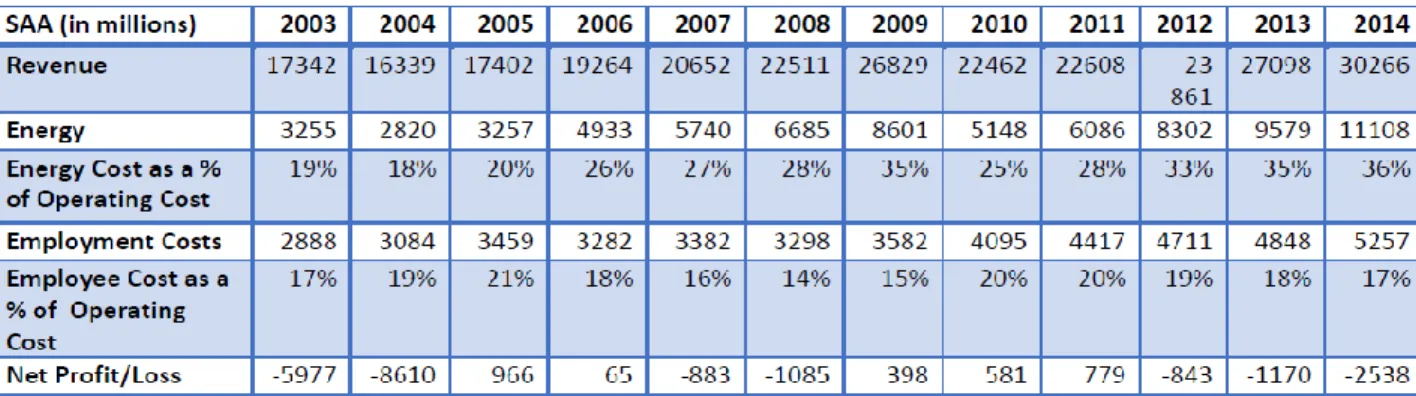
According to different reports, the national carrier, SAA has suffered massive losses and is in serious debt. Its Annual Report showed a loss of R2.6 billion in 2014, which was more than double the loss of R1.2bn in the previous financial year (Mkhwanazi, 2015). The City Press at the end of 2015 claimed that SAA’s losses for the year reached a staggering R4.7 billion. Besides its financial woes, SAA is also accused of corrupt or improper management. A headline by Carine Smith in
2 | P a g e
Fin23 news states “Report shows improper deals behind huge SAA losses”, hinting at corruption at the SOE. Another headline reads “SAA ignored procedure in R14.6 billion contract – report”
just another clear example that some legal frameworks are being ignored. This therefore leads one to question the governance of this SOE.
This mini-dissertation is organized around a number of research questions. The broad questions informing this study are:
Where do State-Owned Enterprises originated from?
What is the rationale for the establishment of State-Owned Enterprises?
What are the benefits/advantages of State-Owned Enterprises?
What are the critiques leveled at SOEs?
What governance strategies have been used to manage SOEs?
What is the background of State-Owned Enterprises in South Africa?
What is the legislative policy framework for SOEs in South Africa?
More specific questions that relate to SAA are:
What was the rationale for the creation of SAA?
What have been some of the governance challenges facing SAA?
What is the legislative policy framework for SAA?
What have been the problems facing SAA’s?
1.3: The Significance of the Study
The study aims to investigate issues plaguing SAA as an SOE in more detail. This is a timeous study because SAA has been running at a loss for the last couple of years, and because in this year’s State of the Nation Address (2016), the President stated that the government intends on doing away with failing SOEs. This study wants to undertake an objective policy analysis of SOEs in general, as well as in South Africa. In order to ascertain the issues of governance in the South African context.
1.4: Research Methodology and Methods
This is a qualitative desktop study. This research consists of mainly of two parts. Firstly, a thorough literature review of the concept of State Owned Enterprises (SOE); and secondly, a case study of the South African Airways (SAA) SOE.
3 | P a g e
This study, in part, uses a case study approach in order to generate an in-depth, multi-faceted understanding of a complex issue in its real-life context. It is an established research design that is used extensively in a wide variety of disciplines, particularly in the social sciences (Crowe, 2011).
The research design of this study draws from case study approaches and stresses the importance of contextual detail and deep description, the function of multiple sources of data, and exploratory explanation-building (Crowe, 2011). Case studies are widely used in organizational studies and across the social sciences, and there is some suggestion that the case study method is increasingly being used and with a growing confidence in the case study as a rigorous research strategy in its own right (Kohlbacher, 2006). This is a relevant approach mainly because this study seeks to explore and give a descriptive analysis of SAA’s governance and corporate issues.
The purpose of the research is exploratory and descriptive, meaning it aims to establish a background on SOEs in South Africa, and analyze the policy framework relating to SOEs.
According to Babbie and Mouton (2001) exploratory studies aim to supply reasonably new information as well as describe events or situations while explanatory aims to provide explanations as to why certain things are occurring.
Legislation and policy documents were gathered, read and analyzed to help establish the legal framework of SOEs in South Africa. Newspaper articles, blogs, and journal articles were used to assist in providing insight into discussions, opinions and debates around the challenges facing SOEs, such as SAA.
Primary sources include newspapers, various reports by government departments (such as the Treasury, the national Department of Transport, and the national Department of Public Enterprises), press releases and theses from academic institutions. While secondary sources used are published books and journal articles.
For data analysis, a thematic analysis approach was used. A thematic analysis approach is a method for: ‘identifying, analyzing and reporting patterns (themes) within data. It minimally organizes and describes your data set in (rich) detail. However, frequently it goes further than this, and interprets various aspects of the research topic.’ (Braun and Clarke, 2006: 79).
4 | P a g e
1.5: Structure of the Dissertation
This dissertation has six chapters. This chapter (Chapter 1) present the introduction of the study.
It describes the rational for the study, research methodology and the structure of the thesis. The chapter also identifies the research questions guiding the study.
Chapter 2 presents the conceptual framework of the study. The chapter is a literature review on SOEs in both developed and developing countries. It provides definitions of SOEs, its premises, benefits and challenges of SOEs. It also examines related concepts such as governance and corporate governance in order to establish a conceptual framework for analyzing SOEs.
Chapter 3 presents a descriptive summary of SOEs in South Africa before and after 1994.
Chapter 4 constitutes the case study of this research. The chapter discusses SAA. It identifies and analyses the legislative and policy framework in which it operates and identifies governance issues.
Chapter 5 presents the overall findings and analysis of the study. It provides a reflection on SAA as a SOE and to what extent it meets its legislative mandate and the governance expectations of SOEs. The chapter also provides recommendations.
5 | P a g e
Chapter 2: Conceptualizing SOEs 2.1: Introduction
This chapter provides the conceptual frameworks of this study. It provides a summary of key definitions on SOEs. This chapter explains the origins and rational of SOEs and the way in which they have transformed over the years. It looks at the legal and regulatory framework that guide SOEs. It also underscores the purposes of SOEs in both developed and developing states, as well as presents information on its strengths and weaknesses. In conceptualizing SOEs this chapter discusses the concept of new public management (NPM) and governance focusing on corporate governance in the process.
2.2: State Owned Enterprises
Before defining what SOEs are it is vital to note that they differ from place to place and that there is no one single definition. When one is defining SOEs one has to differentiate between commercial SOEs and non-commercial SOES. SOEs can sometimes be referred to as state-owned companies, state- owned entities, or state owned enterprises. They all are government owned business entities or publicly owned companies created by government to undertake commercial actions on the behalf of government (Shabalala, 2011).
A non-commercial SOE is a company created and solely owned by government to carry out particular functions on behalf of the government with the main aim of providing goods and services to its citizens (OECD, 2005). In most cases these are agencies of government created to pursue objectives that are not financially driven.
Various scholars suggest that not all SOEs are the same. They are configured differently, hence the expectations are different. It depends on:
the way in which it was established,
its listing on the stock market or not,
the purpose of the enterprise,
state enabled rather than state owned, status of the entity if it is in the public administrative set-up,
as well as governments shareholdings via tools such as government pension funds,
restructuring company and development lenders and asset management
6 | P a g e
(Kowalski, P. et al, 2013).
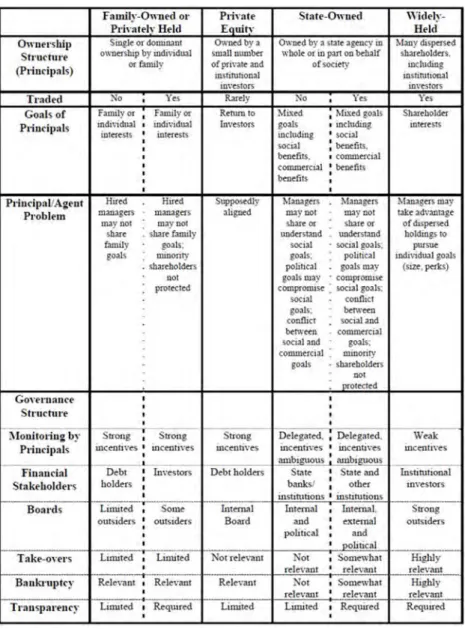
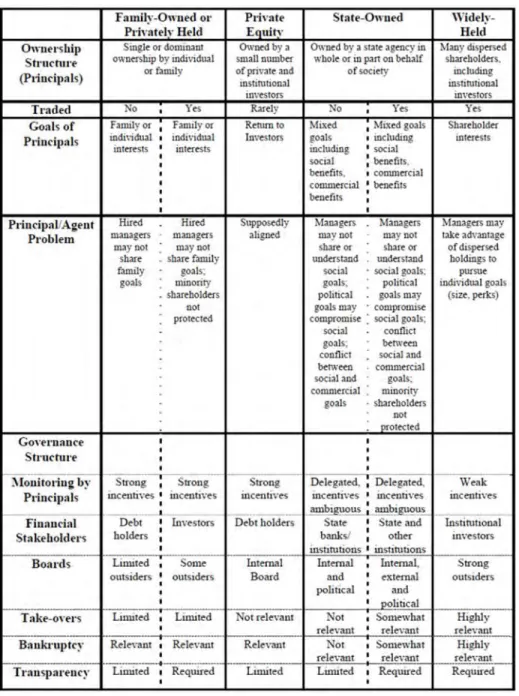
Kowalski argues that the issue of transparency arises with SOEs when government imposes ownership policies which make government as owner have the flexibility to run the entity (Kowalski, P. et al, 2013). Shapiro and Globerman (2012) uses the table below to compare different governance features of other corporate forms in relation to SOEs. They break it down even further using the table to show how corporate governance can be understood.
The table below shows how entities can be managed and governed depending on ownership.
Namely whether SOEs are family-owned, private equity owned, state-owned or widely-held. The table further gives various characteristics or principles that SOEs can or should follow. The various characteristics it talks about are: (i) Ownership structures/Principles, (ii) Goals of principles, as well as governance structures which are divided into; (i) monitoring by principles, (ii) financial stakeholders, (iii) boards, (iv) take-overs, (v) bankruptcy and (vi) transparency (Shapiro and Globerman, 2012).
7 | P a g e
Table 2.1: governing types of entities
Source:Shapiro and Globerman, 2012, pp 42
According to Bantug (2013) SOEs exist in two main categories, depending largely on the activities they offer and engage in. Category one SOEs deliver the essential public infrastructural services, such as: sanitation and water; postal services; power; telecommunication; airports; and broadcasting (Bantug, 2013). Category one SOEs can either engage in commercial or non- commercial activities. With the non-commercial activities being basic services that are rendered to the population or services that can cut down cost to sectors of the public (Bantug, 2013).
Category two SOEs consist of SOEs that are purely commercial. For example entities like banks, air transport, real estate development, shipping and retailing. Both these categories of SOEs are
8 | P a g e
key actors in the economy with the main objective of generating profits (Bantug, 2013). It is also crucial to note that even though commercial SOEs are focused on economic development, they are theoretically tasked at bettering service delivery (OECD, 2005).
2.2.1: History, Rational and Purpose of state-owned enterprises
When looking at the origins of SOEs it is important to note that SOEs are not a recent phenomenon as in developing countries the origins can be traced back to colonialism. But SOEs were long in existence in developed countries (before colonialism). They were created for the purpose of economic development (Turner and Hulme, 1997). According to a 2013 report done by The Organization for Economic Co-operation and Development (OECD), SOEs are seen as vital actors in the development of infrastructure. Turner and Hulme (1997) state that SOEs in developing countries were created by their colonial masters for the main purpose to speeding up economic growth. For example, the United Kingdom established SOEs in their colonies in order to get resources from their colonies back home so as to advance their own economy. This entailed the building of infrastructure in colonies. By 1840 about 80% of railway tracks across the world were private owned, come around 1910 the states owned just under 60% of most of the large railway track networks that were in operation (Stern, 2016).
Even after most of the colonised countries gained independence, the number of SOEs continued to increase mainly because the states needed to develop their infrastructures. When India gained its independence in 1947, their SOEs were actually more than that of Britain, its colonial master (Gang, 2013).
State ownership of most of the utilities rapidly increased in most of Europe during the first decades of the 20th century. Fourie (2011) argues that at the time government was seen as the only sector able to develop the state. This explained why there was an increase in the number of SOEs in most developing countries, including African states. During this time, most private entities were nationalized and controlled by government or state.
Even though China was not colonized, they too have benefited from SOEs. China has made extensive use of SOEs in the last decade. For example according to Zhong (2014) by 2003, China had about 34,280 SOEs and state-holding entities that brought about $658 million gross industrial output. Gang (2013) goes on to state the main SOEs in China not only play a vital part in the country but also at an international level especially in strategic industries and sectors.
9 | P a g e
Montes argues that during the development process in the early 20th century SOEs were seen critical due to three important grounds which are:
1. The scale of long-term capital required in new economic activities, many of which are critical foundations for other new activities, requires state involvement/leadership
2. The size of the risk of new ventures is too high for private entities to undertake for reasons of technology and absence of critical complementary economic activities
3. Private appropriation of benefits from certain new economic activities prevents more widespread access by other private sector parties and requires higher cost than if undertaken by a state enterprise with lower profit requirements and longer-term investment horizons. (Montes, 2014: 51).
SOEs were set-up to aid in the provision of services by the government. They were expected to ensure that the state provides effective and efficient goods and services to the citizens while also providing the state with revenue for further capital investment. SOEs have been created worldwide each with their own public policy agendas, such as the building of basic physical infrastructure in order to provide services like water, electricity. However, this was to be done in a manner that would generate income for the treasury (World Bank Group, 2014). While SOEs have contributed to the economy, it became evident that from the 1970s through the 1980s many SOEs had performed below expectation. SOEs did not generate revenue/profits necessary for capital investment. Compared to private sector operations, SOEs were financially not viable. However, the World Bank pointed out that SOEs (unlike the private sector) serves a multitude of policy aims and goals, many which are not profitable (World Bank Group, 2014).
OECD and World Bank have identified a range of reasons behind the establishment of SOEs, namely to:
Provide public goods (e.g. national defence and public parks) and merit goods (e.g. public health and education), both of which benefit all individuals within a society and where collective payment through tax may be preferred to users paying individually.
Improve labour relations, particularly in ‘strategic’ sectors.
Limit private and foreign control in the domestic economy.
10 | P a g e
Generate public funds. For instance, the state could invest in certain sectors and control entry in order to impose monopoly prices and then use the resulting SOE revenues as income.
Increase access to public services. The state could enforce SOEs to sell certain good and services at reduced prices to targeted groups as a means of making certain services more affordable for the public good through cross-subsidisation.
Encourage economic development and industrialisation through:
- Sustaining sectors of special interest for the economy, and in particular to preserve employment.
- Launching new and emerging industries by channelling capital into SOEs which are, or can become, large enough to achieve economies of scale in sectors where the start-up costs are otherwise significant. This might be seen as an alternative to regulation, especially where there are natural monopolies and oligopolies (e.g.
electricity, gas and railways).
- Controlling the decline of sunset industries, with the state receiving ownership stakes as part of enterprise restructuring.
(World Bank Group, 2014)
State owned enterprises are considered to be a vital element of development in most economies (Buge et al, 2013). SOEs are tasked with providing strategic services and goods to a country’s people (PwC and IoDSA, 2011: 2). Furthermore, according to Fourie (2001: 206), SOEs can contribute by improving the living conditions of the citizens. Balbuena (2014: 6) argues that SOEs mainly focus on the fiscal development of utilities and infrastructure. Other academics go on to write that with SOEs focusing on economic development, they are then seen as relevant entities in rising economies, SOEs have a responsibility to provide strategic facilities that are seen as national interests (Aproskie, et al 2014: 2).
SOEs are significant vehicles for job creation and employment because of the extent of the work they undertake. They provide the citizens with employment opportunities since these are entities they have to employ people to work in these companies (Chavez and Torres, 2014).
11 | P a g e
SOEs further aid in the provision of vital services to the citizens at a rather affordable and cheaper rate, also they protect consumes which are the citizens from being exploited by private companies (Chavez and Torres, 2014). SOEs are often established to ensure that government is in control of the strategic sectors of the country’s economy, in order to avoid the abuse of private industries monopolizing these sectors at the expense of citizens (Buge et al, 2013).
SOEs are often established to remove foreign and private control over the domestic economy. As much as it aims to ensure that revenue generated in the local economy does not leave the country (Chavez and Torres, 2014). SOEs can also help to generate revenue. For example the state might invest in particular sectors and ensure that they have control over entry so as to impose monopolization of prices, this then can result in the state using the revenue acquired as income (Chavez and Torres, 2014). Moreover by establishing new sectors by funnelling money into state entities that are developing so that they can be sustainable.
2.3: Legal and Regulatory Framework for State-Owned Enterprises
The literature on SOEs emphasizes the importance of having a legal and regulatory framework for SOEs in place. In order for key expectations to be communicated there has to be a well-defined regulatory and legal framework that can guide the obligations of SOEs (World Bank Group, 2014).
The primary purpose of regulatory and legal frameworks is to ensure that everyone is clear about the policy direction of the state. The boundaries of, and the relationship between government shareholders the Board of Directors of SOEs need legal reference. The roles and responsibilities of SOE Boards and SOE managers need government oversight and control so as to enforce SOE accountability (World Bank Group, 2014). There cannot be one legal framework for SOEs since they vary in objective and composition. Some SOEs are created as statutory companies having their own legislative Act or other unique legal foundation, while others can be non-corporate enterprises appearing like an SOE or a government sector which at times would fall under public enterprise law (OECD, 2011). Corporatized SOE tend to fall under the jurisdiction of company law. The legal and regulatory frameworks of SOEs are important in ensuring the governance of SOEs (OECD, 2011).
Since there are different types of SOEs, the legal and regulatory framework may at times overlap.
Legal framework can range from either a full-sized application of private law to public law framework or a mixture of both. While, in a few instances SOEs have to comply with constitutional
12 | P a g e
and supranational/ international law (OECD, 2014). When SOEs are listed on the stock exchange, they are subject to listing needs of the exchange as well as other security laws. SOEs that are established by the Act of government as statutory companies, are governed by its own unique statute giving it autonomy such as fiscal authority to acquire specific fees (OECD, 2014). In many states, SOEs are obliged to comply with standard company legislation. This includes codes of corporate governance (OECD, 2011).
However, there is a general critique that legal and regulatory frameworks are outdated because they were established when SOEs were operational as vertically integrated entities with limited competition in the industry. This has caused overlap, at times incompatibility resulting in conflict.
This has led to undermining the accountability of the state, management and other stakeholders of the SOEs (OECD, 2014).
Most legal frameworks were put in place to ensure that there is a regulatory framework that stipulate the extent/limitations of SOEs autonomy in or to pursue commercial activities. However, they have brought about unwanted effects such as; limiting the means to change the capital structures of state enterprises or delay decision making by having long approval procedures for investment and budgets (OECD, 2011). Also they consist of weak corporate governance requirements in areas such as preferred rights, disclosure and boards, they also carry out restrictions that limit the functional freedom of SOEs in vital areas like investments, budgeting, human resources and pricing (OECD, 2014). Other effects could be that they want SOEs to produce profits while tending to social objectives without provisions of funds to meet those objectives, and lastly they do not state how the state should act as a major shareholder as well as they at times overrule general company laws (OECD, 2014).
For an effective legal and regulatory framework for SOEs, the OECD (2014) has identified five recommendations states should follow, which are:
1. An effective legal and regulatory framework must be enforceable and implementable. Any additional good practices should be consistent with existing legal and regulatory frameworks.
2. There should be a clear separation between the state’s ownership function and other state functions that may influence the operating conditions for SOEs, particularly with regards to legal enforcement and market regulation.
13 | P a g e
3. Governments should strive to simplify, streamline and harmonise the legal form under which SOEs operate. Unless there are strong reasons to the contrary, SOEs should be incorporated subject to ordinary company law.
4. Any obligations and responsibilities that a SOE is required to undertake beyond its normal commercial functions should be clearly mandated, disclosed to the public and their costs covered in a transparent manner.
5. Where SOEs and Private enterprises compete (or might compete) in the market place, a level playing field should be ensured and reconciled with economic development objectives. No entity should have a competitive advantage, or disadvantage, purely in consequence of its ownership (OECD, 2014: 6).
When looking at SOEs in developing countries, it is important to note their specific socio- economic and political context. SOEs were adopted in developing countries for different reasons such as ideology, political and economic (Smith and Trebilcock, 2001). Countries tended to form SOEs to help support them in developing their economies as well as have a huge influence on the public, so the larger the SOE the more the influence the government has over the people (Smith and Trebilcock, 2001). SOEs were also used as a tool of income redistribution where by dropping the price of goods which are principally consumed by the poor, mainly in less developed countries from which income redeployment cannot nearly be achieved through the more common income tax (Smith and Trebilcock, 2001).
The main motivation economically for SOEs was capital investment increase, as well as investment in infrastructure. However, this is not the only purpose of SOEs in developing countries. Other purposes include: controlling inflation; protecting developed countries’ economy from external shocks, the effective limitation of industries prone to natural monopolies so that citizens are not forced to pay for prices that are inadequately high as well as ensuring for a more consistent provision of needed good and services (Smith and Trebilcock, 2001).
SOEs are used by government to execute commercial actions for profit as well as important governmental tasks in developing countries where investment isn’t suitable for private sector involvement (Bantug, 2013). Governments in developing countries provide needed goods and services to the people as well as participation in the running of public utilities, money services and other undertakings that are profit oriented using SOEs (Bantug, 2013).
14 | P a g e
In developing countries it is clear that this was hard to keep up. Between 1986 and 1991, SOE saving- investment (S-I) recorded a loss of an average of 1.7 percent of its GDP, meaning they were not able to come up with the required resources to pay for their expansions, operations and maintenance of their debts (Smith and Trebilcock, 2001). The continuous underperformance of SOEs brought about serious issues. Firstly, SOEs obtained an uneven amount of domestic funding, considerably gathering the cost of capital of less developed countries private entities (Smith and Trebilcock, 2001). Also, ineffective levels of production within SOEs led to the removal of assets from economic areas which might have been used wisely elsewhere (Smith and Trebilcock, 2001).
In developing countries, SOEs in Africa tend to produce in the region of 15 percent of the regional gross domestic product (GDP), 6 percent in Latin America and about 8 percent in Asia. SOEs account for about 20-50 percent of the economic value in the North and Middle East of Africa as well as up to 30 percent of the total employment according to OECD (2012), while Kikeri and Kolo (2006) identified that more than 50 percent of the GDP is due to SOEs in some places in Central Asia. This shows how SOEs are vital contributors of GDP in the developing countries.
Ennser-Jedenastik (2014) identified some issues regarding SOEs in developing countries.
Patronage, such as when staff of an SOE are solely appointed because of their loyalty to the ruling elite as opposed to being employed based on merit. Scholars such as Kopecky and Scherlis (cited in Ennser-Jedenastik) explain that party patronage is prevalent in developing countries. In such cases, the dominant political party assigns people into key positions in SOEs which enables the political party to influence the actions of that SOE (2014).
2.4: Advantages and Disadvantages of SOEs
Various scholars and academics have written about the strength and weaknesses of SOEs, for example Tuan (2015) identifies that S0Es are there to make sure the socialist alignment of the economy as well as reserve the economic goals of the nation. Bishnoi (2015) identifies a number of advantages of SOEs. Firstly since most SOEs are controlled and owned by the state basic services and goods are made affordable. Secondly, commercial SOEs, tend to enjoy fiscal freedom since they only rely on government for the primary investment, thereafter they can pursue their mandate responsibilities in the manner they see fit. Thirdly, non-commercial SOEs can supply citizens with much needed services at an affordable and cheaper rates, since such SOEs are not primarily focused on making profits (HOSBEG, no date).
15 | P a g e
HOSBEG (no date) also identifies a number of advantages. SOEs protect citizens from being taken advantage of by private companies, by providing better and cheaper alternatives. SOEs assist the government to take control over some strategic industries of the economy. This is done mainly because if these sectors are not controlled and monitored properly they stand a chance to have major risks to the citizens of the state (HOSBEG, no date). Scholars such as, Bantug, (2013), Kowalski, Buge and Sztajerowska, (2013) and Wong (2004) argue that SOEs have the ability to create jobs for its citizens in the roll-out of goods and services.
Another advantage of SOEs is that they are protected from bankruptcy and takeovers, because the state is the main shareholder (Shapiro and Globerman, 2012). However, this can also be a disadvantage in the sense that the incentive for financial viability is weak since the state guarantees its financial survival through bail-outs and loans.
As much as there are strengths or advantages of SOEs, some scholars such as Ennser-Jedenastik (2014) argue that there are more disadvantages in the SOE system. Agesa (2000) states that SOEs are susceptible to corruption. Besides patronage and nepotism, it is relatively easy for SOEs to procure services and goods without using proper tender channels (Zvavahera and Ndoda, 2014).
In addition, the incentive for procuring value-for-money goods and services is lessened because SOEs know they can rely on government bail-outs.
SOEs are criticized for their poor performance compared with the private sectors. This results in the majority of the population who can afford private sector services and goods to choose them over the SOEs (Kim and Chung, 2007).
Kim and Chung (2007) argue that SOE managers tend to be more interested in trying to maximize their own prestige, resources under their control as well as power. The prevalence of patronage and nepotism and management levels can result in low staff morale. This leads to workers not motivated to work, hence low performance. This is often due to the fact that are not in control or there are no incentive measures in place to try and combat this weakness (Kim and Chung, 2007).
As a result, the call for reform in the public sector, includes SOEs became prevalent.
2.5: Reforms of SOEs
Different types of reforms have been proposed and implemented in SOEs worldwide. Privatization was initially the most popular public sector reform approach. According to Goodman and
16 | P a g e
Lovemen (1991), in the 1980s and 1990s most government in the developed countries decided to sell some or parts of their entities to generate revenue and also free themselves from losses gathered by failing entities (World Bank Group, 2014). This new shift in reforms was worldwide, private sectors procuring anything from prisons, educational utilities, railroads and anything being privatized, in 1990 alone worldwide, government was able to generate over $25 billion from selling state entities to private companies (Goodman and Lovemen, 1991). Developing countries were not far behind in this reform as they too also began selling off state entities either because they followed political and economic ideologies, while others sold them to build their revenue (Goodman and Lovemen, 1991). This reform did improve the performance of the firms in competitive sectors as well as the infrastructural and financial sector respectively (World Bank Group, 2014).
However, Nellis and Birdsall (2005) point out that ad hoc privatization brought about service delivery failure. In some instances it led to the creation of uncompetitive monopolies in the market (Pettinger, 2011). Once the private sector was able to create a monopoly, it had the power to increase user fees charges (Pettinger, 2011). For example, the privatization of health services in developing countries led to an increase in user fees charges, which made health services unaffordable for the majority of the population (Pettinger, 2011). In order to make more profits, private companies often downsized staff resulting in unemployment.
The privatization of successful SOEs resulted in a loss of government revenue because government was no longer entitled to profits and dividends of the entity (Pettinger, 2011).
Furthermore, in some cases privatization led to the fragmentation of industries whereby one large entity breaks up into smaller companies which may weaken overall accountability issues (Pettinger, 2011). Privatization also resulted in increased foreign ownership, resulting in profits and dividends being earned by foreigners which was not reinvested in the local economy. Not only did user fees become more expensive, but profits generated left the country (World Bank Group, 2014). All these factors as well as the global financial crisis of the 2007-2008 brought about economic turmoil within the capital markets thus reducing investor confidence (World Bank Group, 2014). This in turn pushed governments around the world to focus on rather improving the performance of SOEs as opposed to outright privatization (World Bank Group, 2014).
17 | P a g e
2.6: New Public Management
This critique of privatization brought to the fore the philosophy of New Public Management (NPM). SOEs were once again acknowledged as vital tools to provide public goods and services and generate revenue for government.
NPM challenges the old traditional bureaucratic style of public administration typical of the Weberian state (Andrews and Van de Walle, 2013). The traditional bureaucratic approach tended to emphasize the process of governing, submission to hierarchy and adherence to rules rather than focusing on outputs (Haque, 2004). The Weberian approach to governance was criticized for being ineffective, unresponsive and too slow (Andrew and Van de Walle, 2013).
Hood has been identified as the scholar who coined the NPM concept in 1989. (Lynn Jr, 2013:
107). Hood (1991) states that NPM became popular towards the late 1980s and emphasized the importance of management in the delivery of services in the public sector. The NPM paradigm proposed the adoption of managerial practices common in the private sector. Scholars such as Waines (2004) regard NPM as a collection of systematic managerial changes adopted in the public sector. Others refer to it as a toolbox, a menu or a shopping list consisting of various public management approaches (Uwizenyinama, 2009: 11).
NPM refers to reforms in the administration of public management, showing a move towards measurable performance (Lynn Jr, 2003: 107). Haynes (2003:10) explains that NPM is about implementing private sector managing and organizing approaches in the public sector.
Uwizenyinama concurs and mentions that advocates for NPM argue that the public sector should apply principles and techniques of private sector management, and market organization in order for them to be efficient, effective in their provision of public goods and services (2010:10). NPM can thus be viewed as a body of thought in which private sector approaches are implemented in the public sector in an attempt to provide more effective public services.
NPM introduces the practice of performance evaluation. This, it is argued, will make public servants more accountable for their actions or lack thereof. NPM tasks the public sector to formulate indicators of performance and measure outputs. Better performance is likely to be guaranteed when public sectors move to meet objectives rather than focusing on rules (Haque, 2004).
18 | P a g e
NPM emphasizes the need for outcomes and aims to make the public sector more output driven.
The emphasis is on results instead if bureaucratic processes. Parsons (1995:473) believes that NPM came about because there was a need for the public sector to become more business-like in the way government managed their matters. Parson (1995: 473) coined this as the managerialist approach to governance. He referred to the managerialist approach as the shift in which public sectors adopt private sector approaches including reward systems, like performance related pay as well as less rigid working practices (Parsons, 1995: 473).
2.7: Governance
Weiss (2000) contends that governance as a concept needs to be distinguished from government Vagliasindi (2008) defines government as the system by which a state is controlled by a collective group of individuals or people using their power within that state, while governance to him is the way in which power and policies are managed. Weiss (2000) associates governance with the national administration system. Graham, Amos and Plumptre (2003: 1), define governance as,
“how governments and other social organizations interact, how they relate to citizens, and how decisions are taken in a complex world”. The World Bank states governance as “the manner in which power is exercised in the management of a country's economic and social resources for development" (Santiso, 2001: 3).
Furthermore as much as governance is important, good governance is considered to be better.
Abdellatif (2003: 2) quotes Kofi Annan (then Secretary General of the United Nations) when he claimed that: “good governance is perhaps the single most important factor in eradicating poverty and promoting development”. Camerer (1997:1) states that good governance entails elements such as transparency, accountability, and the rule of law. Government should be open and predictable in the way it governs the state. . Other scholars add the need for public participation, equity, responsiveness, consensus orientation as well as effectiveness and efficiency as key elements of good governance (Abdellatif, 2003:5). However even after all these elements the citizens still depends on how the citizens perceives the government’s legitimacy, this is shown by the way government provides and caters to its citizens as well as how government runs its democracy (Camerer, 1997:1).
Abdellatif (2003) identifies nine core characteristics of good governance. First, the rule of law in which government respects and abides the law so they do not overstep on the rights of the people.
19 | P a g e
Secondly, public participation where government seeks to include citizens in decision-making processes. Thirdly, transparency which refers to the responsibility of government to make information available and accessible to its citizens. Information such as how state resources are used. Fourthly, closely linked to transparency is, accountability. Government officials should be held accountable for their (lack of) performance. Fifthly, governance must be to the needs of the citizens. It refers to the time and way government deals with issues or tasks (Abdellatif, 2003:25).
He mentions other characteristic such as equity, strategic vision and consensus orientation (Abdellatif, 2003:25). She further identifies need for governance to promote equity. Governance needs to be guided by, strategic visions and lastly, policymaking should be consensus orientation (Abdellatif, 2003:25). Taken together, these principles, it is argued, will ensure that policy-making and policy-implementation is in the interest of socio-economic development of all the citizens in a country.
The principles of good governance apply to the public sector as a whole. However, besides the public sector, good governance is equally important in the private sector. The concept corporate governance refers to the principles guiding governance in the private sector.
2.7.1: Corporate Governance (CG)
Throughout the world many SOEs have performed poorly mainly due to poor corporate governance (Wong, 2004). The ASXCG Council (2010:3) defines corporate governance the framework of regulations, systems, relationships and procedures inside a corporation and on which power is practiced and controlled in the corporation. Furthermore it goes on to state that corporate governance tends to encompass the fundamental tools by which enterprises, and those in charge are held accountable (ASXCG Council, 2010:3). Corporate governance focuses on how companies determine their objectives and asses their accomplishments. It also considers how companies assess and monitor their risks. The premise is that good corporate governance will improve overall corporate performance ASXCG Council, 2010:3).
Corporate governance has several objectives which are to mitigate or eliminate conflicts of interest between stakeholders, especially between shareholders and managers. It also aims to ensure that a company’s assets are used productively and efficiently, in the interest of its investors and stakeholders (Clayman, Fridson and Troughton, 2010). Clayman et al (2010) argues that if a company fails to establish an effective and operational corporate governance system, it can present
20 | P a g e
a huge operational risk for the company and their investors, and for one to understand the possible risk of an investment in a company, it is vital to know the corporate governance system quality of that company (Clayman, Fridson and Troughton, 2010).
Just like good governance, corporate governance has some core attributes, Clayman et al (2010) have identified five attributes. Firstly, the rights of shareholders and core stakeholders need to be delineated. Second, the responsibilities of managers and directors to the company’s shareholders and stakeholders must be stipulated (Clayman, Fridson and Troughton, 2010). Thirdly, there has to be recognizable and quantifiable measures for accountability when it comes to the performance of responsibility within an entity. Fourthly, fairness and reasonable treatment when it comes to all dealings between directors, shareholders and managers (Clayman, Fridson and Troughton, 2010).
Lastly full transparency and accuracy when it comes to the disclosures concerning performance, financial position, risk and operations (Clayman, Fridson and Troughton, 2010).
Corporate governance ought to provide suitable incentives in order to encourage for management and the board to pursue goals that serve the best interest of shareholders and stakeholders alike (Jesover and Kirkpatrick, 2005). An effective corporate governance system helps give a certain level of confidence required for the proper operation of a market (Jesover and Kirkpatrick, 2005).
However, it is important to note that corporate governance is not an end, but rather it serves as a means to establish confidence within markets and ensure integrity in businesses which is vital for companies that require admission to equity resources for long term investment (OECD, 2015).
The OECD came up with principles to help provide direction for policymakers, market participants and regulators when it comes to improving the regulatory, legal and institutional framework that underpin corporate governance, focusing on SOEs (Jesover and Kirkpatrick, 2005: 128). These principle have been put into six main areas, which are;
I. ensuring the basis for an effective corporate governance framework;
II. the rights of shareholders and key ownership functions;
III. the equitable treatment of shareholders;
IV. the role of shareholders in corporate governance;
V. disclosure and transparency;
VI. responsibilities of the board (Jesover and Kirkpatrick, 2005:130).
21 | P a g e
Corporate governance is also a method of monitoring company performance (Wong, 2004).
Corporate governance can lead to higher levels of accountability and higher profit margins. It can also encourage further and future growth since investors will be more likely to invest in the company (Hemphill and Cullari, 2014). When looking at the benefits to shareholders and stakeholders, corporate governance provides favorable reasons for management and the board to pursue objectives that are in the interest of its shareholders and stakeholders (Wong, 2004).
Corporate governance, if implemented accordingly, will not only benefit the company’s shareholders and stakeholders but in return the national economy (Hemphill and Cullari, 2014).
For example when a company complies with the principles of corporate governance, it can benefit by bettering their access to resources such as capital as well as financial markets. Offering a get out policy as well as ensuring less chances of conflict of interest (Sokol, 2009).
2.8: State-Owned Enterprises and Corporate Governance
Emphasis in reforms of SOEs is on identifying the state as a majority shareholder, and civil society as stakeholders. Just like a company, establish a board in SOE that represents the shareholder and stakeholders’ interests. In doing so this ensures that there is even representation of interests, there is accountability, as well as transparency in decision-making. The state as an owner should allow the SOE boards to be independent as well as allow them to execute their responsibilities without interfering (OECD, 2014).
2.9: Conclusion
This chapter has looked at SOE as a concept. It has shown us that SOEs are government entities that are owned by the state, can either be commercial or non-commercial. It showed that SOEs is not a new concept but that it has been there for a long time. With the main purpose of developing a state so that its population can benefit from the development SOEs bring. It further identified key rationales behind the establishment of SOEs like; provide public goods, improve labour relations and limit private and foreign control. SOEs have their own advantages and disadvantages.
Some advantages for SOEs stating they have a positive impact on the economy, and the social development of a state. While some disadvantages regarding SOEs such as ethnicity and nepotism.
When SOEs do not perform to their best abilities SOEs need to undergo reforms. Privatization has severe shortcomings, hence the call for NPM as opposed to outright full privatization. However before such extreme measure can be taken NPM has to be put in place, this way government can
22 | P a g e
reform their SOEs without having to privatize them as they contribute so much to the economy.
And to ensure that SOEs are being effective governance and good governance practices have to be put in place to support the legal and regulatory frameworks put in place. Corporate governance is also crucial as SOEs are corporate entities that are being functioned by the state, so to address key issues of ownership and how the objective are done corporate governance then becomes a key tool.
23 | P a g e
Chapter 3: SOEs in South Africa before and after 1994 3.1: Introduction
State Owned Enterprises (SOEs) are present in all states worldwide, South Africa is no exception.
This chapter presents a summary of SOEs in South Africa. It first presents a brief history of SOEs in South Africa, focusing on SOEs before, during and post-apartheid. The chapter also presents the legislative framework of SOEs in South Africa, focusing on the policies that guide the operations of SOEs as well as their functions in ensuring SOEs in South Africa function properly.
Lastly it describes some of the main SOEs in South Africa, looking at what they do and how they function and the policies that govern them.
3.2: Brief South African History of SOEs
South Africa, has for some time adopted the use of SOEs as key tools for socio-economic expansion (Fourie, 2001: 205). According to the National Treasury (2013:2) they are twenty one major public entities listed on the PFMA Schedule 2. The existence of SOEs and their primary purpose being to contribute to the South Africa socio-economic development agenda is not something new according to Fourie (2014: 32). He explains that the first SOE in South Africa was created by the Dutch East India Company and was responsible for expanding postal services, which was opened on the 2nd of March 1792 in Cape Town by the then acting governor of the Cape, Johan Isaac Rhenius (Fourie, 2014: 32).
However, other academics contend that the first official SOE in South Africa was the South African Railway, which was established in 1880 (Fourie, 2001). Fourie (2014) cites Jerome and Rangata stating that from the early 1920s, the South African economy was shaped by SOEs. SOEs, were firstly created to improve the import-substitution industries while the functioned as elite franchises. Most SOEs that were created in the 1920s were geared towards strategic industrialization as well as job creation during a period where there were high levels of unemployment according to the Presidential Review Commission (PRC, 2013). From 1948 when apartheid was made official by the National Party, the government made extensive use of SOEs to improve the living conditions of the few in the society and economy (PRC, 2013). However by the 1960s, the apartheid regime became internationally isolated through sanctions which forced the government to adopt economic policies which would make the government self-sufficient. During this period SOEs were aimed at uplifting the socio-economic living conditions of the white
24 | P a g e
minority, by fostering self-sufficiency and develop strategic industries (PRC, 2013). Some of the SOEs that were established during this time were Aventura, South African Broadcasting Corporation (SABC), the Land Bank and the Sasol Science Council (PRC, 2013). The apartheid era (1948 and 1994), was a time of great economic boom for the Afrikaner society in South Africa.
Mostert (2002) states that, the state during apartheid had massive control when it came to the economy. He goes on to further state that, the big state-owned entities established during this period, gave the apartheid state the power to have a huge influence over the economy (Mostert, 2002). SOEs, they were able to provide the minority Afrikaner population with job opportunities and help them develop in the country’s economy allowing them to be able to afford proper schools which were far more advanced than that of the education received by the black majority. The apartheid government establish SOEs in order to consolidate their power, especially over the economy. So SOEs became large monopolies, dominating the economy. The revenue generated by these SOEs were then purely directed at the socio-economic development of the apartheid government's electorate. From the 1976 till mid 80s the political environment became hostile and community protests such as the Soweto uprisings, and the conflict going on in Angola brought about the impetus for the establishment of a stronger State security system (PRC, 2013). One outcome was the establishment of ARMSCOR (the Armaments Corporation of South Africa) (PRC, 2013).
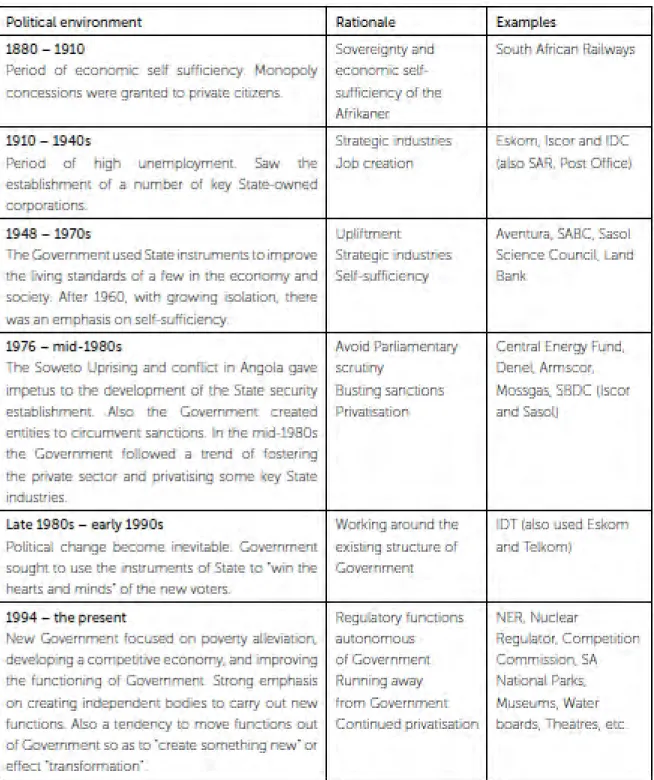
Fourie (2014: 33) shows that towards the late 1980s, a number of SOEs underwent public sector reforms, mainly due to the fact that they had become financially unsustainable, and were being funded from very limited state resource. Some SOEs were outright privatized due to the fact that they were inefficient to the point that they got unwanted criticism against the government by other entities (Fourie, 2014). With a change in regime becoming certain, government looked to use SOEs as instruments to gain new voters, so they worked around already established structures of government (PRC, 2013). A summary of the history of SOEs in South Africa is given in Table 2.1 below.
25 | P a g e
Table 2.1: History of SOEs in South Africa
Source: presidential review committee on state-owned entities volume 2. pp.37
With the advent of democracy in 1994, the ANC-led government was faced with the huge issue of dealing with the high levels of poverty, inequality, high levels of illiteracy, unemployment and
26 | P a g e
other legacies left behind by apartheid and the colonial regimes (PRC, 2013). The features left behind by the apartheid bureaucracy more particular to SOEs were:
Poor and outdated management practices,
Old and aging infrastructural structures,
Duplication, waste and fragmentation,
Absence of outlining state assets and financially sincere balance sheets,
Demotivated stuff and conflict in labor relations,
Absence of control systems, accountability and transparency, (PRC, 2013)
When it came into power in 1994, the ANC-led government of SA implemented its Reconstruction and Development Programme (RDP). The objective of the RDP was to help develop and rebuild the country, to ensure that it meets basic needs, increase human resources, democratize the society as well as the state, and build the economy (Fourie, 2001). The Macroeconomic Strategy which is concerned with the growth, employment and redistribution (GEAR) supported the RDP, since GEAR aimed to help improve government efforts to accomplish the goals and objectives of RDP by transformation of the economy and state structures according to the Department of Public Enterprises (DPE) of 1999 cited by Fourie (2001).
There was a need to reform SOEs since they were underperforming, and even though privatization was seen as a solution, the state still needed to have control over some of the industries in the country (Fourie, 2001). The process of reform tended to focus on a lot of aspects when it came to political, social and economic lives of the community. Since it had the underlying mandate of ensuring that it did abide by the constitutional rule of providing the citizens with fair and equal rights as well as being just, to make sure that the injustice brought about by the former regime was abolished (Fourie, 2001). While in terms of the economy the reform tended to focus on the facilitation of economic increase by growing competition and trying to prevent situations that promote monopoly (Fourie, 2001). This therefore leads to a huge ownership in the country’s economy, to help reduce state debt, assemble private entity capital, as well as promote the competitiveness and capital of SOEs (Fourie, 2001).
27 | P a g e
The government wanted SOEs to be able to contribute to the development and improvement when it came to the living standards of the citizens by bringing about social benefits and sustainable economy (Fourie, 2001). Since the old apartheid regime left some challenges in terms of SOEs as mentioned above. Government had to tackle the immediate issue of infrastructure as well as services which needed to be supplied at higher qualities but lower costs, while services had to be accessible to even the previously disadvantaged groups in society according to the 2000 DPE cited by Fourie (2001). And since Telkom, Eskom, Transnet and Denel where the largest SOEs which had control of 91% of the assets and a turn of 86%, 94% of net income gathered, as well as they employ about 77% of workers when looking at the top 30 SOEs nationwide (Fourie, 2001; PRC, 2013), government thought they should concentrate in trying to reform these four SOEs first.
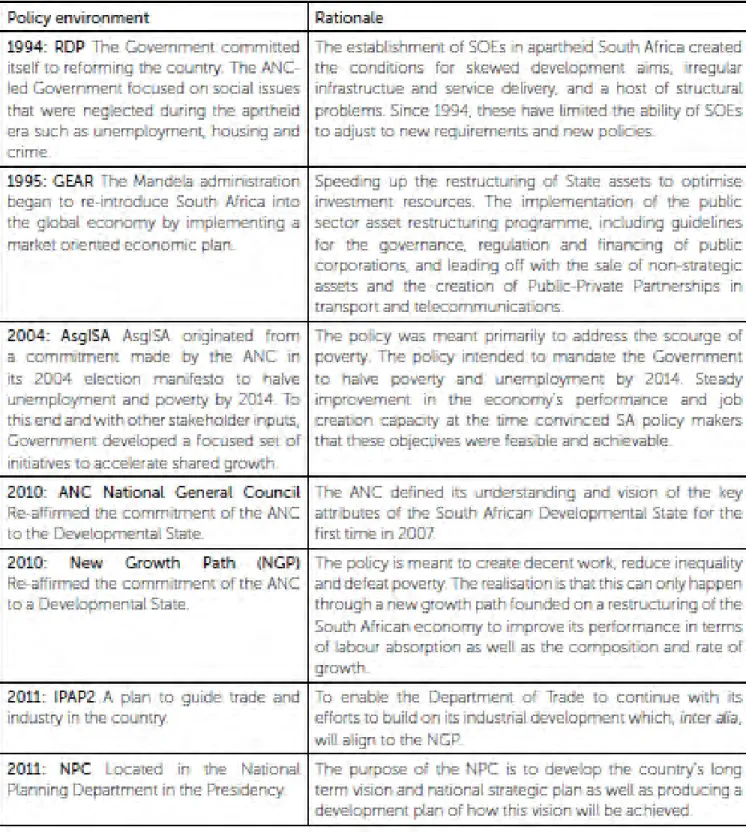
Since the democratization of South Africa in 1994, there have been a lot of policies that have been put up and have had an impact on SOEs, the table below represents an overview of the different macro-policies that are significant and related to SOEs, and the rationale behind these policies.
Since 1994 a number of policies have been brought about to address the economic and developmental growth objectives as well as general strategies, which have knock-on effects particularly on SOEs. It is vital to have an understanding and clarity of South African economic and development policies when looking at the short, medium as well as their long term and how they have an effect on SOEs. The RDP was one of the policies brought about post-1994, it had an impact or an input on SOEs in the sense that one of its objectives was to enhance the capacity and competitiveness of all SOEs. The Growth, Employment and Redistribution (GEAR) framework was introduced by government in 1996. However unlike RDP, the GEAR policy was underpinned by privatization as a tactical imperative trying to strengthen the rather weak economy that came about from the apartheid era.
28 | P a g e
Table 2.2: Summary of post- 1994 policies affecting SOEs
Source:presidential review committee on state-owned entities volume 2, pp.40