UNIVERSITY OF KWAZULU-NATAL
DIGITAL SUPPLY CHAIN DISTRIBUTION OF MUSIC IN THE SOUTH AFRICAN RECORDING INDUSTRY:
DURBAN REGION by
Praveena Ramnandan
Dissertation submitted in fulfilment of the requirements for the degree of Masters of Commerce in Supply Chain Management
College of Law and Management Studies
School of Management, Information Technology and Governance
Supervisor: Dr T.P. Mbhele
2015
DECLARATION
I, Praveena Ramnandan, declare that:
I. The research reported in this dissertation/thesis, except where otherwise indicated, is my original research.
II. This dissertation/thesis has not been submitted for any degree or examination at any other University.
III. This dissertation/thesis does not contain other persons’ data, pictures, graphs or other information, unless specifically acknowledged as being sourced from other persons.
IV. This dissertation/thesis does not contain other persons’ writings, unless specifically acknowledged as being sourced from other researchers. Where other written sources have been quoted, then:
a) Their words have been re-written but the general information attributed to them has been referenced; and
b) Where their exact words have been used, their writing has been placed inside quotation marks, and referenced.
V. Where I have reproduced a publication of which I am author, co-author or editor, I have indicated in detail which part of the publication was actually written by myself alone and have fully referenced such publications.
VI. This dissertation/thesis does not contain text, graphics or tables copied and pasted from the Internet, unless specifically acknowledged, and the source being detailed in the dissertation/thesis and in the References section.
Signed: _________________________
ABSTRACT
The advent of the Internet as a music distribution channel led to significant transformation of the South African music industry at the end of the twentieth century. The Internet and electronic supply chain systems influences customers to migrate from physical product offerings to digital downloading platforms that offer access to digitalised music distribution and quasi-real-time consumption. While technological innovations have enhanced the digital distribution of music online, distribution systems have become a challenge within the supply chain network. This study aims to determine the implications of the paradigm shift in supply chain music distribution from analogue to digital.
This research study has five objectives: firstly, to explore the challenges confronting the supply chain transition from analogue to digital music distribution systems; secondly, to examine the distribution operations processes for the digitalisation of music in relation to the effects of global market demand; thirdly, to evaluate the effects of supply chain value adding innovations in influencing digitalised music distribution and consumption in the recording industry;
fourthly, to establish the extent of technological viability to which the Diffusion of Innovation theory enhances supply chain distribution competitiveness; and finally to assess the relative magnitude of supply chain competence and capability response to digital supply chain music distribution. The researcher selected an exploratory research design to explore digital music distribution in the South African recording industry. Univariate, bivariate and multivariate statistical analysis techniques are employed to analyse the data collected from 217 musicians.
This study reveals several elements arising from the growth of digital music distribution in the Durban region, and makes a scholarly contribution to the promotion of the South African digital music market. The results provides support for: the disintermediation of physical retail stores which are perceived as the driver of digital music distribution; an increase in the number of independent artists and music entrepreneurs; and technologically compatible media devices that encourage more music downloads. The tools provided by the Internet inspire musicians to engage in creative music innovation, thereby creating global competitive standards. The study’s recommendations provides further insight and understanding of the digital music distribution sector.
Key words: Digital music distribution, digital distribution, electronic distribution, disintermediation, music distribution, Durban electronic music
TABLE OF CONTENTS
TITLE i
DECLARATION ii
ABSTRACT iii
TABLE OF CONTENTS iv
LIST OF TABLES viii
LIST OF FIGURES ix
GLOSSARY OF TERMS xi
1 CHAPTER ONE 1
1.1 Introduction 1
1.2 Background of the Study 2
1.3 Problem Statement 3
1.4 Research Questions 4
1.5 Research Objectives 4
1.6 Literature Review 5
1.6.1 Background of the Problem 5
1.6.2 The South African Music Industry 7
1.6.3 Independent Recording Market 12
1.6.4 Recording Industry in Numbers (RIN) 2014: South Africa – A market with long-term
potential 13
1.7 Conceptual Framework 14
1.7.1 Traditional Supply Chain Distribution Practices in the Music Industry versus Digital
Distribution 14
1.8 Theoretical Framework 16
1.9 Significance of the Study 17
1.10 Justification for the Research 18
1.11 Research Methodology 18
1.12 Ethical Considerations 19
1.13 Limitations of the Research 19
2 CHAPTER TWO 20
2.1 Introduction 20
2.2 Conceptual Framework 21
2.2.1 Traditional Supply Chain Distribution Practices in the Music Industry versus Digital
Distribution 21
2.3 Theoretical Framework 22
2.4 Distribution in the Music Industry 24 2.4.1 Traditional Music Distribution in an Intermediate Supply Chain 24 2.4.2 The Disintermediation of the Traditional Distribution in the Supply Chain 27
2.4.3 Reintermediation in the Supply Chain 30
2.4.4 The Future Impact of 3D Printing on the Music Industry 36
2.4.5 Responses to Digital Distribution 37
2.5 Operational Processes 40
2.5.1 Push-based Strategy 41
2.5.2 Pull-based Strategy 42
2.5.3 The Differences between Push and Pull Systems 44
2.5.4 Decoupling Point on Push-Pull Supply Chain 44
2.5.5 The Digital-based Supply Chain-Based Strategy: “Market-Pull” and “Technology-
Push” 46
2.5.6 The next frontier – Internet communications and the implications of digital
distribution for the music industry 48
2.6 Value Adding Innovations Influencing Distribution 50
2.6.1 The Digital Living Network Alliance (DLNA) 51
2.6.2 Shortcomings of the DLNA 52
2.6.3 Different approaches to compatibility: Apple and Samsung 52
2.6.4 Consumer experience of digital technology 54
2.7 Technological Viability and Supply Chain Competitiveness 55
2.7.1 Characteristics of Non-digital Products 55
2.7.2 Technical drivers influencing competitive distribution 56
2.7.3 Technology influences music entrepreneurship 59
2.8 Supply Chain Competence and Capability 62
2.8.1 Supply Chain Competence (clockspeed, response, flexibility) 64
2.8.2 Supply Chain Capability (lean and agile) 65
2.8.3 Supply Chain Competence and Capability Applied in the Music Industry 66
2.9 Conclusion 69
3 CHAPTER THREE 71
RESEARCH METHODOLOGY 71
3.1 Introduction 71
3.2 Research Design 71
3.2.1 Research Approach 71
3.2.2 Sampling Technique 72
3.2.3 Target Population 72
3.2.4 Type of Sample and Sample Size 73
3.3 Data Collection Methods 76
3.3.1 Questionnaire Design 77
3.3.2 Measurement Scales 78
3.3.3 Administration of questionnaire 79
3.3.4 In-house Pretesting and Pilot Testing 79
3.4 Data Analysis 80
3.4.1 Univariate Data Analysis 80
3.4.2 Bivariate Data Analysis 82
3.4.3 Multivariate Data Analysis 86
3.4.4 Reliability and Validity 88
3.5 Limitations of the Study 89
3.6 Conclusion 90
4 CHAPTER FOUR 91
DATA ANALYSIS AND INTERPRETATION 91
4.1 Introduction 91
4.2 Univariate Data Analysis 91
4.2.1 Frequency Distribution 91
4.2.2 Descriptive Statistics 102
4.3 Bivariate Data Analysis 105
4.3.1 Inferential Statistics 105
4.3.2 Cross tabulation 105
4.3.3 Pearson Correlation 108
4.3.4 Pearson’s Correlation Coefficients Analysis 108
4.4 Multivariate Data Analysis 115
4.4.1 Multiple Regression 115
4.4.2 Factor Analysis 131
4.4.3 Reliability and Validity 137
4.5 Conclusion 138
5 CHAPTER FIVE 139
5.1 Introduction 139
5.2 Biographical data 139
5.3 Discussion relating to research objectives 140
5.4 Conclusion 148
6 CHAPTER SIX 150
6.1 Introduction 150
6.2 Conclusions arising from the Major Findings 150
6.3 Recommendations arising from the findings 153
6.4 Contribution to knowledge 155
6.5 Limitations and Delimitations 155
6.6 Opportunities and Directions for Further Research 156
6.7 Summary 156
BIBLIOGRAPHY 158
APPENDICES 174
APPENDIX A: The Digital Living Network Alliance (DLNA) 174
APPENDIX B: Screenshot of the RiSA website being Active then Inactive or offline 179
APPENDIX C: Research Questionnaire 181
APPENDIX D: Frequency Distribution and Raw Data on Statistics 185
APPENDIX E: Letter from the Editor 200
APPENDIX F: Ethical Clearance Form 201
LIST OF TABLES
Table 1.1: Sources on Digital Distribution of Goods, 1999 to 2013 3
Table 1.2: World's Top Ranked Music Markets 6
Table 1.3: South Africa’s Recorded Music Market Share in 2009 8 Table 2.1: Main Activities of Key Stakeholders in the Music Industry 25
Table 2.2: Differences Between Push and Pull Systems 44
Table 2.3: Characteristics of Digital Music Products 56
Table 3.1: Sample Size for a Given Population Size 74
Table 3.2: Composition of Sample 75
Table 3.3: Hypotheses for Cross-Tabulation 83
Table 3.4: Pearson’s Correlation 84
Table 4.1: Descriptive Statistics on Music Distribution 102
Table 4.2: Descriptive Statistics on Supply and Demand 103
Table 4.3: Descriptive Statistics on Supply Chain Competence and Capability 104
Table 4.4: SAmp3.Com and Digital Music Innovation 106
Table 4.5: Music Distributed by and Medium of Distribution 107
Table 4.6: Pearson Correlation: Music Distribution 109
Table 4.7: Pearson Correlation: Technological value-adding innovations – Supply and Demand 111 Table 4.8: Pearson Correlation: Supply Chain Competence and Capability 114
Table 4.9: Correlation Between Variables 115
Table 4.10: Correlations for Multiple Regression on 3 Models 117 Table 4.11: Statistics on Model Summary. ANOVA, Coefficients and Residuals 119
Table 4.12: Collinearity 123
Table 4.13: Residual Statistics 125
Table 4.14: Rotated Component Matrix 132
Table 4.15: Cronbach’s Coefficient Alpha: Combined Dimensions of Digital Music 137 Table 4.16: Cronbach’s Coefficient Alpha: Individual dimensions of Digital Music Distribution
138
LIST OF FIGURES
Figure 1.1: Music Sales in South Africa by Format from 2009 – 2013 9 Figure 1.2: Digital Music Sales’ Market Share in South Africa from 2009 – 2013 10
Figure 1.3: Traditional Supply Chain in the Music Industry 15
Figure 2.1: Traditional Music Value/ Supply Chain 25
Figure 2.2: The Disintermediation of the Traditional Supply Chain in the Music Industry 29 Figure 2.3: Disintermediation of the Record Label and the Retailer 30 Figure 2.4: Reintermediation of the Record Label and the Retailer 32
Figure 2.5: Reintermediation of the Record Label Online 33
Figure 2.6: Reintermediation of the Retailer to Become an E-tailer 34 Figure 2.7: Both the Artist and the Consumer become Distributors 38
Figure 2.8: Push-based Strategy 42
Figure 2.9: Pull-based Strategy 43
Figure 2.10: Push-Pull Supply Chains 45
Figure 2.11: The Impact of Demand Uncertainty and Product Introduction Frequency on
Product Design and Supply Chain Strategy 47
Figure 2.12: Visualisation of How DLNA Devices Come Together 53
Figure 2.13: Overview of Current Digital Music Services 59
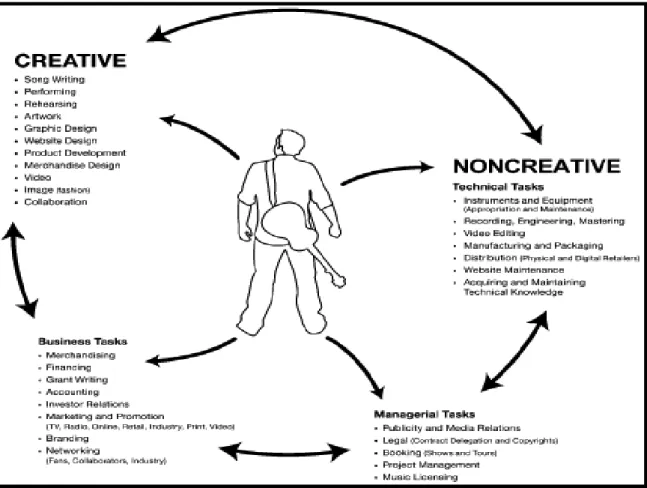
Figure 2.14: The Creative and Non-Creative Tasks of Independent Music Production 61 Figure 2.15: Matching Supply Chain Strategies with Products: The Impact of Demand
Uncertainty and Economies of Scale 63
Figure 2.16: Conceptual Model for Agile Manufacturing 66
Figure 4.1: Distribution by Age 92
Figure 4.2: Distribution by Gender 92
Figure 4.3: Distribution by Race 93
Figure 4.4: Distribution by Educational Qualifications 93
Figure 4.5: Distribution by Artist Category 94
Figure 4.6: Distribution by Tenure 94
Figure 4.7: Distribution by Music Distribution 95
Figure 4.8: Distribution by Medium of Distribution 95
Figure 4.9: Websites Used to Distribute Music 96
Figure 4.10: Distribution by Music Alignment 97
Figure 4.11: Dichotomous Questions Relating to Push-Pull Strategies 97
Figure 4.12: Likert Scale Analysis on Music Distribution 98
Figure 4.13: Likert Scale Analysis - Supply and Demand 99
Figure 4.14: Likert Scale Analysis - Supply Chain Competence and Capability 101
Figure 4.15: Dependent Variable and Independent Variables 116
Figure 4.16: Normal Plot Regression Standardised Residual 128
Figure 4.17: Partial Regression Plot Digital Distribution Value and Music Distribution (Model
1) 129
Figure 4.18: Partial Regression Plot Digital Distribution Value and Supply and Demand (Model
2) 130
Figure 4.19: Partial Regression Plot Digital Distribution Value and Supply Chain (Model 3) 131
Figure 4.20: Eigenvalue Scree Plot 134
Figure 6.1: Scenarios for Digital Music Distribution 152
GLOSSARY OF TERMS
P2P: is an acronym for “peer-to-peer” or “peer=to-peer file sharing.” In a P2P network, the
"peers" are computer systems which are connected to each other via the Internet. Files can be shared directly between systems on the network without the need of a central server. In other words, each computer on a P2P network becomes a file server as well as a client. The only requirements for a computer to join a peer-to-peer network are an Internet connection and P2P software.
Physical format: A format which prepares a disk for a specific type of disk controller, and performs tasks such as sector identification. Such a format will destroy all data on a disk, while a high-level format only resets file-allocation tables so that the operating system sees the disk as empty. In the case of a hard disk, a physical format is usually performed by the manufacturer.
Also known as low-level format.
Product architecture: Product architecture is the scheme by which the functional elements of the product are arranged into physical chunks and by which the chunks interact. This definition links architecture to system-level design and the principles of system engineering. Architecture also has profound implications for how the product is designed, made, sold, used, repaired, etc.
1 CHAPTER ONE
INTRODUCTION TO THE STUDY
1.1 Introduction
The last Look & Listen store in KwaZulu-Natal (KZN) closed its doors for business in 2013.
Look & Listen, the oldest South African music chain store that began trading in 1969 (Shevel, 2014:1) filed a Business Rescue Notice stating that the company was in financial distress and was not profitable for the financial year ending 2013 (Look & Listen, 2014). The company’s managing director reported that fourteen of the chain’s nineteen stores were not achieving their monthly trading targets. Among the reasons stated in the Rescue Notice (Look & Listen, 2014:2) were “escalated migration of customers away from physical product offerings within the music, gaming and movie catalogues to digital downloading platforms.”
This statement is reiterated by Giletti (2012:2) who reported that “rapid growth in the market for digital music has been led by the popularity of online download stores such as iTunes and streaming services. Consumers now have the option to acquire songs from a variety of paid and non-paid legitimate sources, as well as through unlawful channels.” The popularity of Moving Picture Experts Group Audio layer 3, commonly known as MP3 players with their convenient offerings, has taken music distribution to new levels. This research study aimed to determine the effects of the evolving information highway on supply chain distribution channels in the South African recording industry. The research participants are members and non-members of the Recording Industry of South Africa (RiSA). The RiSA is a trade association representing the interests of music producers, and major and independent labels in South Africa (SA) (RiSA, 2014).
Musicians signed with record labels as well as those operating independently are members of the RiSA and enjoy the benefits provided by this umbrella body. According to the International Federation of the Phonographic Industry (IFPI), majority of the 1500 new members of the RiSA are artists that release their own material (IFPI, 2014). These musicians are the potential study respondents and are the units of analysis that constituted the population for the study. However, it is not limited to RiSA members as, nowadays, musicians operate independently as music entrepreneurs in the industry. This is evident in The Future Sounds of Mzansi (Mathambo and Rasethaba, 2014), a contemporary South African music documentary that examines musicians and their entrepreneurial experiences in the music industry in the three major cities of Durban, Johannesburg and Cape Town.
1.2 Background of the Study
Globalisation and changing customer demand places new pressures on supply chains. The Internet and electronic commerce (e-commerce) has changed the way business is conducted.
Nieman, Hough and Nieuwenhuizen (2009:329) observe that the Internet and e-commerce not only create new opportunities for major companies in SA, but have the potential to develop entrepreneurs. Bidorbuy.co.za, Action Gear, Takealot.com, and Loot are leading South African online businesses that offer a cost-effective medium for local and international delivery of a wide range of products to consumers (Thomas, 2015:2). Nieman et al., 2009; and Simchi-Levi, Kaminsky and Simchi-Levi, 2009 observe that the main advantage of e-commerce is that it decreases the cost of creating, processing, distributing and retrieving paper-based information.
Furthermore, supply chain inefficiencies such as large amounts of inventory and delays in deliveries are minimised or become obsolete.
Ramkissoon (2012a:1) notes that “digital music in general has seen the world being exposed to much more music than was ever possible – music from the most obscure places being made available to the most obscure places – and the tiniest bands from a random town whose name we can’t pronounce can now be downloaded by someone who can make them famous by the click of a button.” In acknowledgement of the growth of digital distribution of music, Apple launched its South African iTunes online music store in 2012 which opened a major window of opportunity for local music (Ramkissoon, 2102b:1). Known for its repertoire of music from all major recording labels and numerous independent labels, the iTunes store currently includes musicians such as Arno Carstens, Zulu Boy, Thandiswa, Simphiwe Dana, Stimela, Lucky Dube, Toya Delazy and Idol winners, Khaya Mthetwa and Zahara.
Studies conducted from 1999 to 2013 by the authors listed in Table 1.1 illustrate that the Internet has changed the way in which music and other digital goods are distributed.
Table 1.1: Sources on Digital Distribution of Goods, 1999 to 2013
Author Year Topic
Alves 2004
Digital distribution music services and the demise of the traditional music industry: three case studies on Mp3.com, Napster and Kazaa
Bielas 2013 The rise and fall of record labels
Bockstedt, Kaufman and
Riggins 2005
The move to artist-led online music
distribution: Explaining structural changes in the digital music market
Chircu and Kaufman 1999
Strategies for Internet Middlemen in the Intermediation/Disintermediation/
Reintermediation Cycle
Gallaugher 2002 E-commerce and the undulating distribution channel
Graham, Burnes, Lewis, and
Langer 2004 The transformation of the music industry
supply chain: A major label perspective
Hracs 2012 A Creative Industry in Transition: The Rise of
Digitally Driven Independent Music Production
Klym 2005 Digital Music Distribution
Lam and Tan 2001 The Internet is changing the music industry Macedonia 2000 Distributed file sharing: barbarians at the gates?
McIntyre 2009 Diminishing varieties of active and creative retail experience: The end of the music shop?
Zetner 2008 Online sales, Internet use, file sharing, and the decline of retail music speciality stores Source: Developed by the researcher from literature reviewed.
While this can be attributed to broader shifts in social and economic structures (Byam and Burnett, 2009), the ownership and control of this digital content within supply chain distribution is a significant factor (Pietila, 2009:1). This study examines the extent of this trend of online music channels, the distribution strategies employed by record companies and musicians to cope with these changes, as well as the challenges experienced in this transitional journey.
1.3 Problem Statement
The music industry experienced significant transformation at the end of the twentieth century as a result of new technological development as well as the use of the Internet as a music distribution channel. Increased demand coupled with increased responsiveness provides opportunities for growth through improved distribution. The electronic supply chain systems has caused customers to migrate from physical product offerings within music, gaming and movie catalogues to digital downloading platforms; and offers consumers access to digitalised music distribution and quasi-real-time consumption. Electronic supply chain emanates from the broader e-business and includes the Internet by definition.
While technological innovations have enhanced the digital distribution of music on the Internet, distribution systems have become a challenge within the supply chain network. This study therefore aims to determine the implications of the paradigm shift in supply chain music distribution from analogue to digital by gathering information on musicians’ perceptions of this transition and how it has affected the musician and the industry.
1.4 Research Questions
What challenges influence the supply chain distribution transition from analogue to digital?
What are the relative effects of operational processes and market demand in digitalised music distribution?
How do the supply chain value adding innovations influence digital music distribution and consumption in the recording industry?
To what extent does technological viability enhance supply chain distribution competitiveness?
To what extent does the magnitude of supply chain competence and capability respond to digital supply chain music distribution?
1.5 Research Objectives
This study aims: To explore the challenges confronting the supply chain distribution transition from analogue – brick and mortar – to digital music distribution systems.
To examine the distribution operations processes for the digitalisation of music in relation to the effects of global market demand.
To evaluate the effects of supply chain value adding innovations in influencing digitalised music distribution and consumption in the recording industry.
To establish the extent of technological viability to which the Diffusion of Innovation theory enhances supply chain distribution competitiveness.
To assess the relative magnitude of the supply chain competence and capability response to digital supply chain music distribution.
1.6 Literature Review
The literature review examines the RiSA’s structure, identifies the prominent players in the industry, and a view of digital and physical music sales statistics provided by the RiSA and the IFPI. This is followed by a brief overview of traditional supply chain practices prior to focusing on digital distribution. Research texts, journal articles, peer-reviewed articles and textbooks provided the data for the literature review.
1.6.1 Background of the Problem
World-renowned pop singer Kelly Clarkson’s first album sold over four million copies in 2009.
Two years later, 12 million copies of her second album were sold. However sales of the third album reached only two million. A few years later, four songs were stolen off her fourth album prior to release and released by a hacker on the Internet (Terry, 2009:1). This demonstrates the threat posed by the Internet to musicians, film makers, gaming developers and computer software. While this might be regarded as the normal quirks of show business, for a supply chain professional however, this trend alters traditional approaches to business by changing traditional supply chain management. The supply chain is tested in terms of its capability in adapting to lean and agile systems whilst at the same time, the ability to respond to the changes in the market and industry, will determine its competency.
The digital distribution of music has its origins in unauthorised file sharing in the late 1990s.
Recent developments in digitally compatible audio formats, such as the Apple iPod, the Samsung Soundbar and the Dell Jukebox demonstrate the ever-increasing popularity, drive and demand for media player formats. This has revolutionised the way that music is made available and shared; one can now have a party and celebrate with friends just about anywhere as long as one has a phone or iPod in one’s pocket.
According to Lam and Tan (2001:63), and the Recording Industry Association of America (RIAA) in 2008 Internet-based sales in the United States of America (USA) reached $500 million for compacts discs (CDs) and digital downloads. Napster, one of the earliest peer-to- peer file sharing service providers, has more than 80 million registered users. At the height of its success, there were 250 000 downloads of Napster’s software indicating that the average user has access to approximately 220 songs (Lam and Tan, 2001:63). The company reached its peak between June 1999 and July 2001 (Lam and Tan, 2001:63). The IFPI which ranks countries by their contribution to global music trade revenue (Vermeulen, 2014:2) rates the World Top 10 music markets since 2009 as follows:
Table 1.2: World's Top Ranked Music Markets
Rankings 2009 2010 2011 2012 2013
1 United
States Japan United
States
United States
United States
2 Japan United States Japan Japan Japan
3 Germany Germany Germany United
Kingdom Germany
4 United
Kingdom
United Kingdom
United
Kingdom Germany United Kingdom
5 France France France France France
6 Australia Australia Australia Australia Australia
7 Canada Canada Canada Canada Canada
8 Netherlands Netherlands Netherlands Brazil Italy
9 Italy Italy Italy Italy Brazil
10 Spain Brazil Brazil South
Korea
South Korea
Source: International Federation of the Phonographic Industry (IFPI). (2014) IFPI Digital Music Report 2014 Industry Report. London: International Federation of the Phonographic Industry.
Until 2007, South Africa (SA) showed a steady increase in music revenue (Vermeulen, 2014:2).
By 2009 SA was at number 16 in the world rankings, moving up two places to 14th out of 51 countries in 2010. Preceding 2010, SA had been climbing the world rankings physical format sales chart (Vermeulen, 2014:2). However in 2011, SA moved six places down to the number 20 spot. Smirke (2014:2) notes that while the adoption of digital and streaming services is helping to drive growth in countries like Argentina and South Korea; other countries like SA, Brazil and Mexico have experienced falling revenue from music sales. Smirke (2014:2) adds that sales in SA, the continent’s leading music market, slipped by 11.7% to $63 million in 2013.
The IFPI (2014); and Vermeulen (2014) report that in 2010 digital music accounted for 29% of global music sales; while in 2013 SA’s was ranked 17th for physical format sales and 26th in the overall world rankings.
Bizcommunity (2011:1) quotes the managing director of Musica that noted that Musica’s CD sales dropped from 61% to 48% of its R896 million turnover in 2011. While there has been an increased appetite for music consumption, physical product sales have declined since 2006 (Bizcommunity, 2011:1). Despite Musica’s single highest turnover being attributed to CDs, it has extended its product range to digital video discs (DVDs), video games, books, and other merchandise to make up for the loss of sales.
The impact of the Internet on digital supply chain music distribution has facilitated consumer access. Websites offer paid for and/or free services for the download of single tracks, re-mixed tracks and full albums. In the case of iTunes, the App stores available on their branded products like the iPhone, iPad, iPod and Macs provide for flexible modular storage of music files, together with excellent marketing of the complementary technologies. Consumers now utilise the services of GCloud and iCloud to access music, which is uploaded from their PCs, laptops, Tablets and cellular phones at any time. With this in mind, it is necessary for South African musicians to adapt to these new markets in order to survive.
There is limited research on digital music distribution in the South African context. Pietila’s (2009) article, “Whose Works And What Kinds Of Rewards: The persisting question of ownership and control in the South African and global music industry” focussed on digital rights management, ownership and copyright laws in the industry. However, a considerable number of international studies have been conducted since the 1990s to address transformation of the traditional ways of doing business in the retail sector. In the modern business world, companies are called on to change the way they do business, by providing better quality, more accessible services.
1.6.2 The South African Music Industry
South Africa’s music industry is the most developed in the African continent (IFPI, 2014). The international music industry is dominated by five multinational companies, namely, EMI, Sony, Universal-Vivendi, Time Warner and Bertelsmann (BMG) that control the production and distribution of recorded music (Graham et al., 2004:1087). Four of these companies have subsidiaries in South Africa and held 77% of the market share in 2009 (Pietila, 2009). Bernardo and Martins (2013:5) put this percentage at more than 80%. This network enables South African music to be sold in national and international markets.
Table 1.3: South Africa’s Recorded Music Market Share in 2009
Company Percentage Share
EMI 18.0%
Sony 23.8%
Universal 20.0%
Warner Music Gallo Africa 15.3%
Others (Independent) 22.9%
Source: Informa UK. (2010) The international business newsletter of global music copyright.
[online], available: http://www.informatm.com/pdf/Nov-2006/10/m_c331_110806.pdf [3 May 2014].
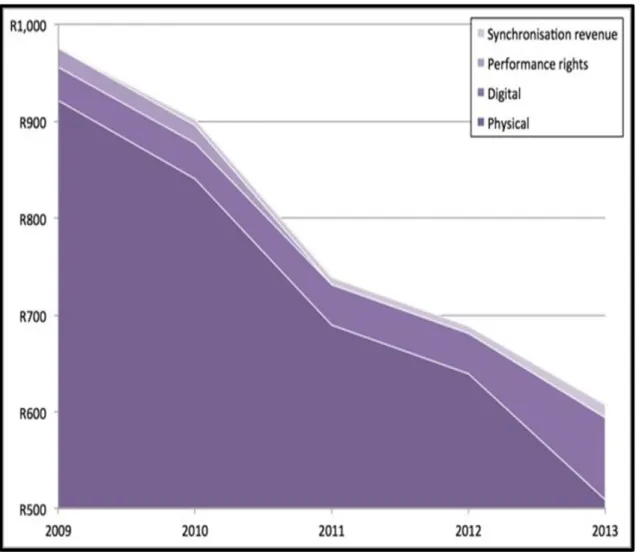
Vermeulen’s (2014:1-4) analysis of the IFPI’s Recording Industry in Numbers 2014 (IFPI, 2014) report, noted that sales of recorded music in physical formats in SA are shrinking faster than the observed global decline. While there is strong growth in digital music sales in the country, the Recording Industry’s report showed that it was insufficient to offset the decline in physical format sales from 2009 to 2014. In 2009, CD sales that constitute the largest portion of physical recorded media in SA amounted to 17.1 million and decreased from 15.9 million units in 2012 to 12.2 million in 2013. On the international front, overall music sales decreased by 4%
from 2012 to 2013 while in SA, combined music sales decreased by 12%.
Figure 1.1 illustrates the dramatic decrease in music sales trade revenues in SA from 2009 to 2013.
Figure 1.1: Music Sales in South Africa by Format from 2009 – 2013
Source: International Federation of the Phonographic Industry (IFPI). (2014) IFPI Digital Music Report 2014. Industry Report, London: International Federation of the Phonographic Industry; Vermeulen, J. (2014) Music sales tanking in South Africa. [online], available:
http://mybroadband.co.za/news/internet/104009-music-sales-tanking-in-sa.html [24 October 2014].
The Recording Industry in Numbers Report (IFPI, 2014); and Vermeulen (2014:2) provide a breakdown of digital sales by format. South Africa’s digital sales growth from 2013 to 2014 was 106.8%. Figure 1.2 illustrates how the country’s digital music landscape has changed since 2013.
Figure 1.2: Digital Music Sales’ Market Share in South Africa from 2009 – 2013
Source: International Federation of the Phonographic Industry (IFPI). (2014) IFPI Digital Music Report 2014. Industry Report, London: International Federation of the Phonographic Industry; Vermeulen, J. (2014) Music sales tanking in South Africa. [online], available:
http://mybroadband.co.za/news/internet/104009-music-sales-tanking-in-sa.html [24 October 2014].
The IFPI (2014); and Vermeulen’s (2014:2) analysis of sales reflect that digital sales increased from 4% in 2102 to 19% in 2013. Ad-supported revenues increased from 7% to 12%, while mobile increased from 18% to 21%. Subscription services like iTunes, Simfy and Deezer entered the market and constitute 6% of total digital sales. Music streaming services have increased since iTunes became the first legal, paying streaming service provider to penetrate the South African market in 2012. Knopper (2014:1) observes that while digital music sales saved the record industry after years of piracy in the past, it recently took a dive due to the increase in
the number of streaming services, including Youtube and Spotify which costs South Africans a R100 per month. On the other hand, Suede (2014:1-2) commented that while, internationally the music industry broke the 12-year losing streak which lasted from late 1999 to 2012 by increasing sales by 0.3%, equivalent to $16.5 billion, music sales in South Africa are very poor and have been for many years. Suede (2014:2) attributes this to the possibility that artists, labels and retailers are not fully disclosing actual sales figures. As the music industry moves from physical format products to downloads and streaming services, the re-introduction of retro vinyls resulted in sales increasing to 33% in 2013 (Knopper, 2014:2). The ranking of the world music markets clearly indicate a decrease in physical format music sales in SA and an increase in digital music sales.
1.6.2.1 The Recording Industry of South Africa (RiSA)
The RiSA, previously known as the Association of the South African Music Industry (ASAMI) and established in 1970, is a trade association that represents the collective interests of producers of musical sound recordings and major and independent record labels in South Africa (RiSA, 2014). The association has approximately 2000 members, including four record labels, Sony Music, Universal Music, EMI and Warner Bros. Records (part of Gallo Records) (Pietila, 2009). The RiSA is responsible for the South African Music Awards (SAMAs) and certifies album sales (RiSA, 2014).
While various rules and procedures govern membership of the RiSA, in practice, applicants (any record company) are not rejected. No current member has been expelled from the organisation. Furthermore, the RiSA is committed to accommodating diversity within its ranks and structures.
According to the RiSA website (2014) the South African Copyright Act of 1978 states that,
“You may not make a copy of a sound recording without the permission of the author.” This is interpreted to mean that it is illegal to covert a CD to MP3 in SA. However, legal proceedings have never been instituted against a party in SA who converted a CD to MP3 format for personal and private use. To protect the rights of members, RiSA offers the following benefits:
Benefits of RiSA membership
Members benefit from the RiSA’s multi-faceted activities, including being part of a body that actively investigates and then supports or opposes legislation and other measures affecting the industry at large.
Members have access to the organisation’s vast information and insight into the state of the South African, African and global industry, new developments, trends and statistics.
Members benefit from the activities of the RiSA’s Anti-Piracy Unit (RAPU). The RAPU was established in 2006. It is housed at RiSA’s secretariat in Johannesburg and is staffed by extensively and stringently trained ex-Police officials. RAPU is only permitted to conduct investigations on behalf of members and in regard to counterfeit products (pirate products) that violate members’ copyrights.
The RiSA’s members also benefit from agreements entered into with the National Organisation for Reproduction Rights in Music in Southern Africa (NORM) and the Southern African Music Rights Organisation (SAMRO).
Members benefit from the royalties collected by the South African Music Performance Rights Association (SAMPRA). The SAMPRA is a national, non- governmental organisation that licences specific copyrights that vest in recording companies that are members of the RiSA to third parties. The copyrights in sound recordings provided for in the Copyright Act of 1978 and administered by SAMPRA, are the rights of communicating such recordings to the public, diffusing sound recordings and the broadcasting of sound recordings.
Entering member/s’ releases for the annual South African Music Awards at a preferential pace compared to non-members.
Source: South African Music Performance Rights Association (SAMPRA) (2014) SAMPRA website. [online], available: http://www.sampra.org.za/about [26 June 2014]; Recording Industry of South Africa (RISA) (2009) RISA. [online], available: http://www.risa.org.za/ [16 June 2014].
The RiSA is recognised by the IFPI as the official National Group for the Recording Industry in South Africa and it thus enjoys international recognition (RiSA, 2014). In summary, musicians are protected against piracy and the replication of their music and membership ensures that their music reaches wider audiences abroad.
1.6.3 Independent Recording Market
The independent music market is an extension of the music market, comprising of musicians and record labels’ employees whom begin their own music label. The number of independent labels in the local market is growing (Pietila, 2009). The SA music sector is energetic, diverse and vibrant with music genres ranging from Rock, to Pop, Alternative, House, Kwaito, Afro-
pop, Afro-jazz, Jazz and Blues. Due to the challenges experienced by local musicians in distributing music abroad, diverse traditional genres have no qualms about recording and distributing independently. This practise has given rise to a high level of entrepreneurship in SA where the kwaito and rock genres have flourished due to musicians assuming control of the recording and production of their music. This has positively impacted national economic development and social exposure (IFPI, 2014).
1.6.4 Recording Industry in Numbers (RIN) 2014: South Africa – A market with long-term potential
According to the IFPI’s Recording Industry in Numbers report released in 2014, SA is a challenging market. The reasons (IFPI, 2014) are as follows:
While many emerging markets showed signs of growth, the value of South Africa’s recorded music fell by 5.8% in 2012, thereby ending its status as a top 20 global market;
South Africa is underperforming. As a major hub for repertoire creation with its music reflecting the diversity of its people and as a country that produces eclectic genres of musicians in English, Afrikaans and Zulu, South African musicians should be flexing their muscles in terms of music sales;
A major problem is the limited development of the digital sector. Digital services accounted for 8% of record company revenues in 2012. Although iTunes entered the market in December 2012, South Africa’s first streaming service, Simfy Africa, only commenced business in September 2012; and
High data charges and low bandwidth are significant barriers to digital music growth.
This creates a distinct digital divide with top end consumers enjoying connectivity equal to that of developed countries while those without digital access still listen to music on pirated discs.
Despite these concerns, the IFPI’s National Group, RiSA’s membership grew from 500 to 2000 in the past five years. Furthermore, many new members are artists who are releasing their own material. This global trend is due to the disintermediation of record labels; today’s artists assume complete control or integrate their music from conception through to production (IFPI, 2014).
Chapter two provides a more detailed discussion on the ways in which local players are addressing the challenges noted above.
1.7 Conceptual Framework
1.7.1 Traditional Supply Chain Distribution Practices in the Music Industry versus Digital Distribution
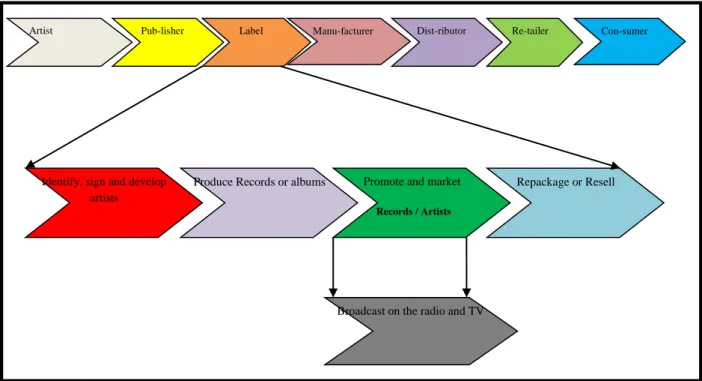
This study focused on the supply chain process of distribution in the music industry. Stevenson (2012:663) describes a supply chain as the internal and external sequence of organisations – their facilities, functions and activities – that are involved in producing and delivering a product or service. Simchi-Levi, Kaminsky and Simchi-Levi (2009); and Stevenson (2012) define supply chain management as a set of approaches used to efficiently integrate suppliers, manufacturers, warehouses, and stores, so that merchandise is produced and distributed in the right quantities, to the right locations, at the right time, in order to reduce system costs while satisfying service level agreements. The sequence begins with basic suppliers of raw materials and extends all the way to the final customer. Facilities include warehouses, factories, processing centres, distribution centres, retail outlets, and offices. Functions and activities include forecasting, purchasing, inventory management, information management, quality assurance, scheduling, production, distribution, delivery and customer service (Stevenson, 2012:664).
According to Kruger, De Wit and Ramdass (2007:583) distribution is the part of the supply chain that ensures that the finished goods reach the marketplace. Steyn (2005:61-76) outlines the five main traditional supply chain operational practices in the South African music industry:
The manufacturing process (just-in-time manufacturing);
Warehousing and distribution (receiving, picking, physical distribution);
Sales and marketing (market push and pull incentives);
Debt collection; and
Management of receivables.
The diagram below depicts a traditional supply chain in the music industry with the facilities, functions and activities contributing to the supply chain management process.
Figure 1.3: Traditional Supply Chain in the Music Industry
Source: Adner, R. (2002) Online music battles: FullAudio vs. Pressplay. [online], available:
http://faculty.insead.edu [7 July 2014].
This study focuses on distribution within the supply chain because the traditional supply chain practice of physical distribution disintegrates when organisations enter the sphere of electronic commerce (e-commerce) or electronic supply chains (e-supply chains). Traditional distribution dealt with the movement of physical products to stores as and when required. In the new e- commerce or digital era, physical products are replaced by digital products. In the music industry, a physical CD is replaced by a digital MP3 file and hence requires a new sphere of distribution. A more thorough discussion of the move from traditional to digital distribution follows in Chapter two with detailed diagrams.
Kruger et al. (2007:582) define e-commerce as a system that enables individuals or organisations to communicate electronically using electronic data interchange (EDI), file transfer protocol (FTP), systems network architecture (SNA), and the daily office duties of using a fax, e-mail and the Internet. E-commerce encompasses more than buying and selling on the Internet and entails electronically mediated transactions between an organisation and any third party, including non-financial transactions such as customer service and support (Chaffey, 2015:6). E-businesses connect people to information and applications; further evolution of software and the Internet will help to connect applications and business processes (Evans, 2003:20).
Artist Pub-lisher Label Manu-facturer Dist-ributor Re-tailer Con-sumer
Identify, sign and develop artists
Produce Records or albums Promote and market Records / Artists
Repackage or Resell
Broadcast on the radio and TV
There can be no doubt that e-commerce has toppled traditional supply chain management practices and this revolution is creating excitement in industry. The South African Ecommerce Awards were held in October 2014. This is the ninth year that South African-based companies that facilitate the buying or selling of products via the Internet were recognised (eCommerce Awards, 2014). These awards are proof that there is growing acknowledgement of electronic businesses and their contribution to the South African economy.
1.8 Theoretical Framework
Researchers have identified three sources of opportunity for the advancement of innovation:
technological change, political and regulatory change, and social and demographic change (Shane, 2014:73). The invention of the laser which created a platform for music to be stored on a CD in 1999 made it possible for music files to be ripped onto personal computers and thereafter uploaded to the Internet. Websites offered streaming music services that enabled consumers around the world to access a newly-released album.
This study employs the Diffusion of Innovation Theory developed by Rogers in 1962. The theory explains how as time goes by, an idea or product gains market share and spread in a specific population or social system. The end result of this diffusion is that people move away from traditional ways of doing things and adopt new ideas, behaviour or products. This means that the person does something differently from the usual way (i.e., the purchase or use digitalised music, acquiring and performing new behaviour, etc.). For the purpose of this study, five factors that influence adoption are used to understand how they influence the adoption of innovation or digitalised music in the recording industry. These are the five concepts of the theory to be used in this study (Tidd and Bessant, 2009:355-359):
Relative advantage: the theory argues that the degree to which an innovation is seen - as better than the idea, programme, or product it replaces - makes it easy to adopt it.
Compatibility: the theory argues that the innovation should be consistent with the values, experiences, and needs of potential adopters.
Complexity: how difficult the innovation is to understand and/or use influences its adoption.
Trialability: the theory argues that the extent to which the innovation can be tested or experimented with before the commitment to adopt makes it easy to adopt.
Observability: the theory states that the extent to which the innovation provides tangible results makes it easy to adopt.
It is noted from Table 1.1 that the diffusion of innovation in the form digital music, has happened a long time ago. The theory of diffusion of innovation, which in this case refers to the diffusion of technology, has been accepted. Thus, this cross-sectional study examined the effects of digital music and the challenges it has posed to music industry. As such, the emphasis is the observability component of the theory in the supply chain and the influence it has on the supply chain system. Hence this study examined the meaning of the theory rather than the elements. This will pave the way for future research and a means of dealing with the challenges posed to the supply chain.
The Diffusion of Innovation Theory guided the sample size selected in the Durban area based on the supplemented spatial diffusion of innovation. According to Hypergeo (2004:1) the notion of spatial diffusion covers all the processes that contribute to movement, to migration inside geographical space and the reaction to the effects created in this space by the movers. This approach was first introduced in geography in 1952 by T. Hagerstrand, after extensive research has emphasised the existence of temporal and spatial regularities in the spatial diffusion of innovation. These studies noted that the larger the emitting centre (Durban), the higher its force of impulse in the diffusion process and therefore the noted descending course of diffusion of numerous innovations in urban networks. This study used spatial diffusion of innovation as a guide to sample selection.
1.9 Significance of the Study
This study is important in determining how musicians in Durban have been affected by the distribution of music as an online digital good. The growth of the Internet and e-commerce has created more exposure for artists. The study examines how the industry has been restructured in order to adapt to these changes, as well as the introduction of new distribution strategies and digital rights management which is not new in the market. However new turnaround value chain driven strategies may give artists more control of their products than previously and encourage music entrepreneurship. The research study is also valuable as it provides insight into the South African market to inform strategies for the supply chain of digital media products such as e- books.
1.10 Justification for the Research
Pietila (2009); and the IFPI (2014) note that the South African Music Industry consists of an eclectic mix of artists and bands from diverse music genres, some of which would normally be exclusive to our country or the regions where the audience resides. In order for talented local artists to gain broader exposure to international markets, it is necessary to adapt to the digital marketplace. Understanding how Durban artists distribute their digital music is the primary objective of this study.
1.11 Research Methodology
The type of research design that will be used in this study is exploratory. Sekaran and Bougie (2010:103); and Cooper and Schindler (2010:102) describe exploratory research as a study undertaken when insufficient knowledge or research is available on problems or research issues that have been dealt with in the past. This research design has been chosen to explore and better understand the subject of digital music distribution in the South African recording industry.
Given the limited empirical and theoretical research on the South African music market, an exploratory design approach was appropriate.
This nature of the study is quantitative. The quantitative aspect serves to answer questions about the relationships among the variables that are measured, deriving meaning from the data that is analysed through use of statistics, diagrams and tables (Sekaran and Bougie, 2010:144). Hence, the source of data in this study will come from questionnaires. The time horizon for this study is cross-sectional since data will be collected at one point in time from all respondents. The target population for this study are musicians in the Durban region. Purposive sampling, together with snowballing will be used as part of non-probability sampling (Creswell, 2014:189). The sample size for this study is 152.
The data required for this research will be collected by means of questionnaires and interviews.
The questionnaires will be set out in different ranges to best collect the data needed, namely using Likert scales and the use of dichotomous questions (Yes/No) as well as the need for ordinal scale.
Univariate data analysis will be used by to find the measures of central tendency and measures of dispersion (Wegner, 2007:98). The second scientific component will be bivariate data analysis. Bivariate analysis constitutes Pearson Correlation which gives the direction, strength and significance of the bivariate relationship among the variables in the study (Cooper and
Schindler, 2010:209). The second tool is cross tabulation that establishes a relationship between two variables. As part of multivariate data analysis, logistics regression will be used to predict the outcomes of the categorical data. Multiple regression analysis is employed to test the regressed effect of each variable. Reliability will be tested using Cronbach’s Alpha which is used to test for consistency, dependability and trustworthy of all data collected (Wegner, 2007:5).
1.12 Ethical Considerations
Ethical clearance is obtained from the University of KwaZulu-Natal’s Humanities and Social Sciences Research Ethics Committee before data collection proceeds. Questionnaires will then be administered to musicians in the Durban region. The researcher will remain objective, fair and impartial throughout the research study. All respondents will be assured of their anonymity and the confidentiality of the information they provide. They will also be informed that they have the right to withdraw from the research process. This protects the respondents and enhances the integrity of the research.
1.13 Limitations of the Research
The scope of this research study is limited to digital music distribution by Durban musicians.
There is a diverse mixture of artists in the Durban area and the selection of participants may not have fully encompassed all talents and experiences. Furthermore, the study’s scope is limited to Durban musicians who belong to labels, are independent artists and social music entrepreneurs in order to cover the eclectic mixture of artists. The transformation of music distribution led to the emergence of music entrepreneurs and it would be disadvantageous to exclude their experiences.
2 CHAPTER TWO
LITERATURE REVIEW
2.1 Introduction
The Fraunhofer Institute of Germany developed an algorithm in 1991 that created a revolution in how music was distributed, stored and consumed. The algorithm known as codec, allowed the compression of digital audio to approximately a tenth of its original size without compromising its audio quality. The newly innovated format enabled information such as the song title and artist’s name to be embedded in the file (Schilling, 2010:183). By 1995 software programs were available that enabled consumers to convert music tracks from physical product CDs to an MP3 (Moving Picture Experts Group Audio layer 3) format file (Alves, 2004:6). This codec allowed for the manipulation of music files, making them easier and more convenient to store and share.
The MP3 file format became enormously popular, especially when it took off on the Internet.
Music in this new format gained popularity when users started sharing their music online (Schilling, 2010:183). This fascinating evolution in the digital world indicates that the Internet created a new medium of music distribution which was easy to access and consumers had the option of either paying or obtaining the files free of charge.
The unauthorised use of file sharing had brought about significant changes in the music industry, specifically the digital distribution of music. As peer-to-peer digital music sharing grew, the digital music value chain emerged. It comprised of file sharing software, Internet connectivity, personal computers (PCs), jukebox software, portable MP3 players, and a volunteer community of users uploading and downloading digital content (Klym, 2005:1). The term ‘peer’ refers to a network-addressable computing element, like a personal computer, laptop, tablet and networked printer (Khambatti, Ryu and Dasgupta, 2003:1). Khambatti et al.
(2003:1) define peer-to-peer systems as “distributed systems in which logically distinct computing elements called peers that have comparable roles and responsibilities, communicate information, share or consume services and resources amongst each other”. It was around this time that the transition in distribution occurred, challenging the traditional supply chain.
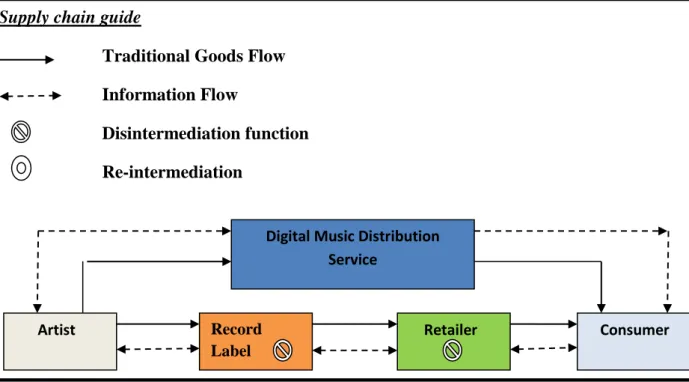
The Internet has changed traditional supply chain distribution in the music industry. The shrinking of music into MP3 formats lead to global sharing of digital music online. File sharing results in the disintermediation of record companies and retail stores. In a traditional supply chain, artists and consumers are directly involved and connected through retail stores. The advancement of the Internet created a disintermediation in record labels because consumers
were now able to retrieve MP3 music files directly from peer sharing websites and not through the traditional supply chain process from the record label cascading down to retail stores. As a result, stakeholders in the traditional supply chain became uncertain of their roles in the emerging digital distribution.
This aim of this research study is to explore the challenges confronting the supply chain distribution’s transition from analogue – brick and mortar – to digital music distribution systems within the supply chain. Furthermore, this research sought to determine the interplay between technical, social, legal and economic dimensions with the intention of understanding how the traditional supply chain has changed.
2.2 Conceptual Framework
2.2.1 Traditional Supply Chain Distribution Practices in the Music Industry versus Digital Distribution
The supply chain process of distribution in the music industry, within the supply chain process, is the focus of this research. Stevenson (2012:663) describes a supply chain as the internal and external sequence of organisations – their facilities, functions and activities – that are involved in producing and delivering a product or service. Simchi-Levi, Kaminsky and Simchi-Levi (2009:1); and Stevenson (2012:664) define supply chain management as a set of approaches used to efficiently integrate suppliers, manufacturers, warehouses, and stores, so that merchandise is produced and distributed in the right quantities, to the right locations, at the right time, in order to reduce system costs while satisfying service level agreements. The sequence begins with basic suppliers of raw materials and extends all the way to the final customer.
Facilities include warehouses, factories, processing centres, distribution centres, retail outlets, and offices. Functions and activities include forecasting, purchasing, inventory management, information management, quality assurance, scheduling, production, distribution, delivery and customer service (Stevenson, 2012:664).
According to Kruger et al. (2007:583) distribution is the part of the supply chain that ensures that the finished goods reach the marketplace. Steyn (2005:61-76) identifies the following five main traditional supply chain operational practices in the South African music industry:
The manufacturing process (just-in-time manufacturing);
Warehousing and distribution (receiving, picking, physical distribution);
Sales and marketing (market push and pull incentives);
Debt collection; and
Management of receivables.
Discussion was diagrammatically explained in Chapter 1 as Figure 1.3 where extensive and depicts a traditional supply chain in the music industry with the facilities, function and activities contributing to the supply chain management process.
This research study focused on distribution within the supply chain because the traditional supply chain practice of physical distribution disintegrates when organisations enter the sphere of electronic commerce (e-commerce) or electronic supply chains (e-supply chains). Traditional distribution dealt with the movement of physical products to stores as and when required. In the new e-commerce or digital era, physical products are replaced by digital products. In the music industry, a physical CD is replaced by a digital MP3 file and hence requires a new sphere of distribution.
Kruger, De Wit and Ramdass (2007:582) define e-commerce as a system that enables individuals or organisations to communicate electronically using electronic data interchange (EDI), file transfer protocol (FTP), systems network architecture (SNA), and the daily office duties of using the fax, e-mail and the Internet. While it is generally considered to refer to buying and selling on the Internet on websites such as Takealot.com, e-commerce encompasses more than this and entails all electronically mediated transactions between an organisation and any third party, including non-financial transactions such as customer service and support (Chaffey, 2015:6). E-businesses help connect people to information and applications. Future evolution of software and the Internet will help to connect applications and business processes (Evans, 2003:20).
There can be no doubt that e-commerce has toppled traditional supply chain management practices and this revolution is creating excitement in industry and raising the bar. The South African Ecommerce Awards Were held in October 2014, the ninth year that excellence was recognised among South African based companies that facilitates the buying or selling of products via the Internet (eCommerce Awards, 2014). These awards are proof of the fact that there is growing concern acknowledgement of electronic businesses and their contribution to the South African economy.
2.3 Theoretical Framework
The increased growth of the Internet raises vital questions about how individuals decide whether and when to adopt an innovation, and how the innovation will be diffused among the population. According to Rangaswamy and Gupta (1999:1) the study of adoption behaviour
and the diffusion process for digital products is based on concepts and theories of individual decision making, and allows one to segment and profile customers based on the time of adoption and on their inclination to adopt an innovation. Traditionally these sectors were known as “innovators” or “early adopters” (Rangaswamy and Gupta, 1999; Shane, 2008). More important however, are the five founding characteristics of the theory of Diffusion of Innovation, as individual characteristics form the constructs of this research.
The Diffusion of Innovation theory seeks to explain how, why and at what rate new ideas and technology spread through cultures. Everett Rogers, a professor of communication studies, promoted the theory in Diffusion of Innovations in 1962 (Rangaswamy and Gupta 1999:1).
Rogers’s theory of Diffusion of Innovation is still used in contemporary research. He identified the five constructs or stages of adoption as awareness, interest, evaluation, trialability and observability. More recently, Tidd and Bessant (2009:355-359) identified the five characteristics as relative advantage, compatibility, complexity, trialability and observability.
These are the five concepts of the theory to be used in this study (Tidd and Bessant, 2009:355- 359):
Relative advantage: the theory argues that the degree to which an innovation is seen - as better than the idea, programme, or product it replaces - makes it easy to adopt it;
Compatibility: the theory argues that the innovation should be consistent with the values, experiences, and needs of potential adopters;
Complexity: how difficult the innovation is to understand and/or use influences its adoption;
Trialability: the theory argues that the extent to which the innovation can be tested or experimented with before the commitment to adopt makes it easy to adopt; and
Observability: the theory states that the extent to which the innovation provides tangible results makes it easy to adopt.
As previously noted from Chapter 1, Table 1.1 it is evident that the diffusion of innovation in the form digital music occurred a long time ago. The theory of diffusion of innovation, which in this case refers to the diffusion of technology, has been accepted. Thus, this cross-sectional study examined the effects of digital music and the challenges it has posed to music industry. As such, the emphasis is the observability component of the theory in the supply chain and the influence it has on the supply chain system. Hence this study examined the meaning of the theory rather than the elements. This will pave the way for future research and a means of dealing with the challenges posed to the supply chain.
The focus of the study is on adopting technology in the diffusion of a digital innovation in the music industry. While the digital distribution of music is not a new concept, it has evolved tremendously in the 21st century. It is noted that the digital environment can influence both adoption behaviour and the diffusion process in significant ways. In such instances, the environment can alter the quality and quantity of information that potential adopters use in deciding whether and when to adopt an innovation (Rangaswamy and Gupta, 1999:2).
Contemporary researchers that apply the Diffusion of Innovation theory are found in the field of social media, more specifically the adoption of Twitter Hashtag (Chang, 2010); mobile banking technology adoption (Al-Jabri and Sohail, 2012); the radio broadcasting industry (Rossman, 2012) and the adoption and diffusion of innovation in conventional industries (Castellano, Ivanova, Adnane, Safraou, and Schiavone, 2013). The digital environment facilitates both word- of-mouth and market-controlled communication, thus directly impacting the diffusion of digital music and complementary technologies; hence the innovation of new ideas and products.
2.4 Distribution in the Music Industry
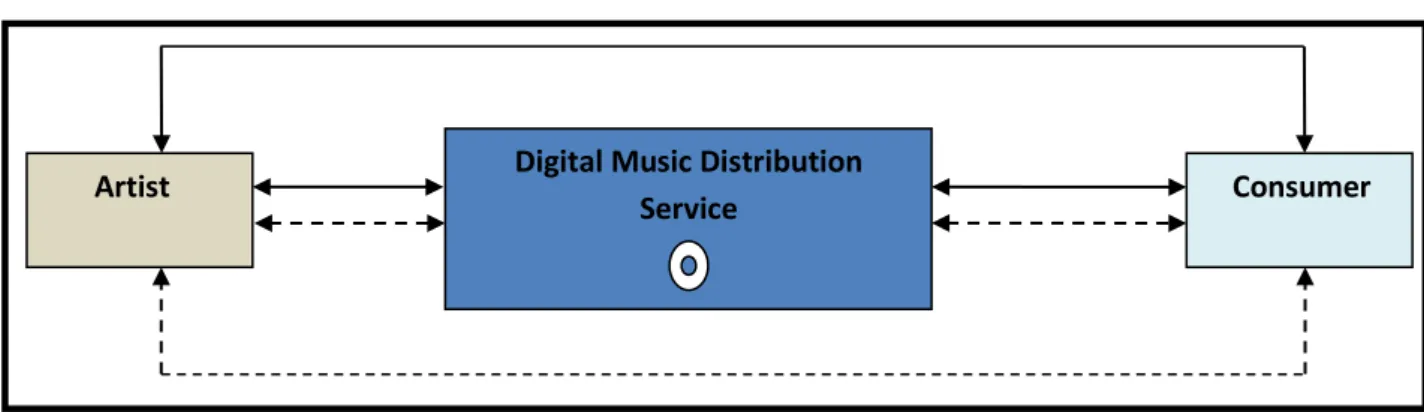
The traditional music supply chain has undergone transformation from the times when brick- and-mortar processes were sequential in nature. Artists disseminated their music to record companies who then sold the music to consumers through physical retail stores. In past years, a vigorous new digital environment has emerged to facilitate and support market changes. The Internet is the most visible manifestation and has transformed the way in which people purchase music (Alves, 2004). The creation of MP3 format digital music files has allowed distributors to sell music on the Internet. The digital environment contains a wide range of computer and communication technologies which when combined, facilitate communication and transactions between buyers and sellers (Rangaswamy and Gupta, 1999), thus supporting non-physical or digital product purchasing.
This section examines the traditional supply chain music industry structure, the role of the Internet as a new distribution strategy and the disintermediation of the traditional supply chain and possible re-intermediation of a virtual supply chain structure.