DIHLABENG INTEGRATED DEVELOPMENT PLAN 2014/2015
DIHLABENG LOCAL MUNICIPALITY INTEGRATED DEVELOPMENT PLAN
Bethlehem, Clarens, Fouriesburg, Paul Roux and Rosendal
DIHLABENG LOCAL MUNICIPALITY INTEGRATED DEVELOPMENT PLAN
2014/2015
DIHLABENG INTEGRATED DEVELOPMENT PLAN 2014/2015
CONTENT LIST CHAPTER 1:
1.1 Introduction and Background 2-3
1.2 Inter-Governmental Planning 4
1.3 Brief Overview 5
1.3.1 Why an Integrated Development Planning Review 5 1.3.2 Integrated Developmental Planning and Budget Process 5-6
1.3.3 Municipal Key performance Areas 7
1.4 Dihlabeng Local MuniciaplityTurn- around Strategy 7
1.5 Millennium Development Goal 7
1.6 Delivery Agreement Outcome 9 7
1.7 National Development Plan 7
1.8 National AIDS Strategy 8
1.9 Provincial Growth and Development Strategy 8
1.10 Free State Spatial Development Plan 8
1.11 Legislative Framework for Local Municipality 9
1.12 Key Sectors 9
CHAPTER 2: REVIEW PROCESS
2.1 Legal background 10
2.2 IDP Process Plan 11
2.3 Summary of Activities 12
2.4 IDP Review Institutional Arrangements 13
2.5 Role Players 14
2.6 Mechanism and Procedures 15
2.6.1 Ward committees 15
2.6.2 Stakeholders 15
2.6.3 Representative Forum 16
2.6.4 Community Outreach meetings 16
2.7 Planning Synchronization 17
2.8 Budget and IDP, PMS process 18 -19
2.9 Summary of issues raised 20
2.10 SWOT analysis 21 -22
2.11 Mayoral Committee 23
2.12 Administrative structure 24
CHAPTER 3: MISSION, VISION AND STRATEGY
3.1 Mission, Vision and Strategies 25
3.2 Key Focus Areas for DLM Local Municipality 26
DIHLABENG INTEGRATED DEVELOPMENT PLAN 2014/2015
CHAPTER 4: Socio Economic Profile
4.1 Geography 27
4.2 Population by Age and Gender 28
4.3 Households Heads around Dihlabeng 29-30
4.4 Educational Skills ,Adult Employment and Occupational profile 31-32
4.5 Dwelling type around Dihlabeng Municipality 32-33
4.6 House-holds Access to Municipal Services 33-34
4.7 Economic profile 35-36
4.8 Economic Sector 37-38
4.9 Town Planning 39
4.9.1 Extension to Residential building 39
4.9.2 Non Residential 40
4.9.3 Land use application 40-42
4.9.4 Development trends 42-44
CHAPTER 5: Priorities issues and Projects
5.1 Water and Sanitation 45-48
5.2 Roads and storm water 49-50
5.3 Electricity 51-55
5.4 Human Settlement 56-59
5.5 Waste Disposal 60- 62
5.6 Social Welfare 62-63
5.7 Local Economic Development 64-66
5.8 Sports, Arts, Recreation and Culture 66-69
5.9 Libraries 69
5.10 Public Safety, Fire, Rescue 70-71
5.11 Environmental Issues 72-74
5.12 Parks and Cemeteries 75-78
5.13 Institutional Development & Transformation 79-81
5.14 Governance Programmes and Projects 82
5.15 Programmes and projects of other spheres of Government 83
5.16 Sector Plans (Municipal Plans) 83
CHAPTER 6: Financial Viability 84-86
CHAPTER 7: PERFORMANCE MANAGEMENT 87
7.1 Principles Governing this Performance Management Systems 88
7.2 Dimension of Performance Management 88
7.3 Managing Organizational Performance Management 88 7.4 Managing Performance of Strategy Implementation 88
7.5 Performance Measures Planning 89-94
CHAPTER 8: Approval 95
DIHLABENG INTEGRATED DEVELOPMENT PLAN 2014/2015
Figures, Graphs, Structures, Drawings, Tables, Maps and Diagrams.
IDP & Budget Process 6
The IDP Review Process 12
Summary of activities 13
IDP Review Institutional Arrangements 14
Role players and terms of reference 15
Community Outreach meetings 17
District Framework guidelines 18
Summary of issues raised by the communities 21
Executive mayoral committee members structure 24
Administration Structure 25
Key focus areas of the municipality 26-27
Socio – economic profile 28
Population by gender 30-40
Tables: New residential building 40
Electricity 53-54
Human Settlements 55-58
Waste Removal 58-60
Sports, Arts and Culture 66-69
Libraries 69
Public Safety, Emergency, Fire and Rescue 70-71
Environmental Issues 72-74
Accelarated Parks Maintenance Plan 75-78
Corporate Services/ Legal Section 79-81
Five year financial plan 82-84
Performance Management 85-91
Page 2
DIHLABENG INTEGRATED DEVELOPMENT PLAN 2014/2015
ACRONYMS
AIDS Acquired Immune Deficiency Syndrome CBO Central Business District
CBP Community-Based Planning
CDWs Community Development Workers CFO Chief Financial Officer
Clr Councilor
DFA Development Facilitation Act DLM Dihlabeng Local Municipality DORA Division of Revenue Act HIV Human Immunodeficiency Virus EIA Environmental Impact Assessment EMP Environmental Management Plan FET Further Education and Training
FSGDS Free State Growth and Development Strategy
GDP Growth Domestic Product
GRAAP Generally Accepted Accounting Practices HDI Historically Disadvantaged Individual ICT Information Communication Technology IDP Integrated Development Plan
IGR Intergovernmental Relations
IT Information Technology
IWMP Integrated Waste Management Plan
KPA Key Performance Area
KPI Key Performance Indicator
LGSETA Local Government Sector Education and Training Authority
LUMS Land Use Management System
MAYCO Mayoral Committee
MDG Millennium Development Goals MFMA Municipal Finance Management Act MIG Municipal Infrastructure Grant
MM Municipal Manager
MPPMR Municipal Planning and Performance Management Regulators
MSA Municipal Systems Act
MTSF Medium-Term Strategy Framework
MTREF Medium-Term Revenue Expenditure Framework NAS National AIDS Strategy
NDP (2030) National Development Plan NKPI National Key Performance Indicator NSDP National Spatial Development Plan
PGDS Free State Provincial Growth Development Strategy
PMS Performance Management System
SCM Supply Chain Management
SDBIP Service Delivery and Budget Implementation Plan SDF Spatial Development Framework
SMME Small Medium and Micro Enterprise SSA Statistics South Africa
USDG Urban Settlement Development Grant VIP (toilet) Ventilated Improved Pitt
WTW Water Treatment Works
PWDs People with Disabilities
Page 3
DIHLABENG INTEGRATED DEVELOPMENT PLAN 2014/2015
CHAPTER 1
INTEGRATED DEVELOPMENT PLAN 1. INTRODUCTION AND BACKGROUND
In terms of the Local Government Municipal System Act 32of 2000,Section 25(1) each municipal council must, within a prescribed period after the start of its elected term, adopt a single, inclusive and strategic plan for the development of the municipality which, inter alia ,links ,integrates and co-ordinates plans and takes into account proposals for the development of the municipality and aligns the resources and capacity of the municipality .As far as the status of the IDP is concerned, Section 35 of the Act clearly states that an integrated development plan by the council of a municipality is the principal strategic instrument ,which guides and informs all planning and development, and all decisions with regard to planning ,management and development in the municipality.
Section 34 of the Act provides for the annual review of the IDP in accordance with an assessment of its performance measurements and to extend that changing circumstances so demand. This document 2014/2015 IDP of the Dihlabeng Local Municipality, which represents the third review as adopted in the 2012/2013 at the beginning of the current term of council .The strategic objectives and targets contained in this document were reached subsequent to extensive systematic and structured internal and external consultation through various public participation mechanisms with the community and stakeholders with the Dihlabeng Local Municipality area of jurisdiction.
The IDP is the key instrument to achieve developmental local governance for centralised , strategic, participatory, implementation orientated ,coordinated and integrated development. Preparing an IDP is not only a legal requirement in terms of the legislation but it is actually the instrument for realizing municipalities‟ major developmental responsibilities to improve the quality of life of the citizens. It seeks to speed –up service delivery by securing a buy-in of all relevant players and provides government departments and other social partners with a clear framework of the municipality‟s development trajectory to harness implementation efforts. n terms of section 26 of the Systems Act, the core components of an IDP are;
The municipal council‟s vision for the long term development of the municipality
An assessment of the existing level of development in the municipality
Council „s development priorities and objectives for its elected term
Council‟s development objectives must be aligned with any national or provincial sectoral plans
A Spatial Development Framework
Council operational strategies
Applicable disaster management plan
Financial plan which must include a budget projection for at least next three years; and
The key performance indicators and performance targets determined in terms of the Performance Management System.
The Revised IDP is based on lessons learned from the previous revision and planning cycle as well as changing environments and focuses on the following:
Alignment with national and provincial issues of importance;
Strengthening the analysis principles of the strategic planning processes;
Ensure better coordination through a programmatic approach and focused budgeting process;
Strengthening performance management and monitoring systems
Page 4
DIHLABENG INTEGRATED DEVELOPMENT PLAN 2014/2015
It is important that the IDP developed by the Dihlabeng Local Municipality correlate with national and provincial intent.
The aim of the first revision is to develop and coordinate a coherent plan to improve the quality of life for all the people living in the area and reflecting on issues of national and provincial importance. One of the key objectives is to ensure that the alignment between National and Provincial priorities, Policies and Strategies and the Local Municipality respond to these requirements. The national and provincial priorities, policies and strategies of importance include amongst others:
Free State Growth and Development Strategies;
Free State Spatial Development Framework;
National and Provincial Spatial Development Perspectives;
National Key Performance Indicators (NKPIs);
National Development Plan 2030 Vision;
In response to new demands and requirements stipulated in legislation, political mandate and situational realities, the Local Municipality embarked on an intense strategic assessment and planning process. Departments and communities played a key role in obtaining a sound understanding of the state of departmental functions and community needs and priorities.
In the end, the Local Municipality as an institution needs to respond within its approved strategic framework to address its development challenges and opportunities through the Council approved Integrated Development Plan (IDP).
Guiding Parameters
An Integrated Development Plan is a constitutional and legal process required of South African municipalities;
however, apart from the legal compliance, there are many advantages and benefits to undertaking the integrated development planning process. These include the following:
P r i o r i t i z a t i o n a n d a l l o c a t i o n o f s c a r c e r e s o u r c e s t o a r e a s o f g r e a t e s t n e e d a l i g n e d t o s p a t i a l b u d g e t i n g .
A c h i e v i n g s u s ta i n a b l e d e v e l o p m e n t a n d e c o n o m i c g r o w t h .
D e m o c r a t i z i n g l o c a l g o v e r n m e n t b y e n s u r i n g f u l l p u b l i c p a r t i c i p a t i o n i n i t s p l a n n i n g , i m p l e m e n ta t i o n , m o n i t o r i n g a n d e v a l u a t i o n p r o c e s s e s .
P r o v i d i n g a c c e s s t o d e v e l o p m e n t f u n d i n g t h r o u g h t h e M e d i u m T e r m R e v e n u e a n d E x p e n d i tu r e F r a m e w o r k .
E n c o u r a g i n g b o t h l o c a l a n d o u t s i d e i n v e s t m e n t b y d e v e l o p i n g l o c a l e c o n o m i c s t r a t e g i e s .
U s i n g th e a v a i l a b l e c a p a c i ty e f f e c t i v e l y , e f f i c i e n t l y a n d e c o n o m i c a l l y .
There are a few main reasons why a municipality should have an IDP:
Utilization of scarce resources.
The IDP assists the municipality to focus on the most important needs of the communities taking into account the resources available. In the process, the municipality must find the most cost-effective and efficient way of providing services and money spent on the causes of problems in its area of jurisdiction.
Expedite delivery of services.
The IDP identifies the least serviced and most impoverished areas and points to where municipal funds should be spent. It should provide mechanisms to ensure that projects and programmes are efficiently implemented and assists developing realistic project proposals based on the availability of resources.
Attract additional funds.
The IDP provides clear development direction and guidelines that in return will attract investors and additional funds to the municipal area.
Strengthens democracy through the active participation of all the important stakeholders in the IDP and Budgeting process, decisions are made in a democratic and transparent manner.
Promotes co-ordination between local, provincial and national government.
The different spheres of government are encouraged to work in a coordinated manner to address the development needs in a local area.
The IDP of a Municipality may be amended if and when circumstances require the amendment but must be reviewed annually regardless if there is changing circumstances or not (Section 34 of the MSA). Both amendment and review of the document must be in accordance with a prescribed process which is described in the Process Plan of particular importance to municipalities and municipal entities is Sections 151 to 164 (Chapter 7) of the Constitution, Local Government: Municipal Structures Act, 1998, MSA, the Local Government: Municipal Finance Management Act, 2003 (MFMA) and the Local
Page 5
DIHLABENG INTEGRATED DEVELOPMENT PLAN 2014/2015
Government: Municipal Systems Amendment Act, 2003. These Acts form the cornerstones for municipal operations, planning, governance and accountability. More specifically, the regulations of these Acts promote effective planning, budgeting, revenue and expenditure management, reporting, oversight, social and economic upliftment, universal access to essential services and effective performance management.
A number of policies, strategies and development indicators have been developed to ensure that all other government activities are aimed at meeting the developmental needs expressed the local government level. In terms of Section 153(b) of the Constitution, municipalities must participate in national and provincial development programmes and if they are required to comply with these programs they must align to these programmes.
1.2 Inter-Governmental Planning
Section 41(1) of the Constitution contains the principles of co-operative government and inter-governmental relations.
„Inter-governmental relations‟ means the relationships between national, provincial and local government. The Constitution states that the three spheres of government are distinctive, inter-dependent and inter-related. They are autonomous, but exist in a unitary South Africa and have to cooperate on decision-making and must co-ordinate budgets, policies and activities, particularly for those functions that cut across the spheres.
Cooperative governance means that national, provincial and local government should work together to provide citizens with a comprehensive package of services. They have to assist and support each other, share information and coordinate their efforts. Implementation of policies and government programmes particularly require close cooperation between the three spheres of government.
The division and allocation of the total government income (revenue) between the spheres of government and within government is regulated by the Division of Revenue Act, 2009 (DORA). The different spheres of government depend on each other for support in project implementation.
In order to implement the principles on cooperative government set out in Chapter 3 of the Constitution, the Intergovernmental Relations Framework Act, 2005 (IGR) was enacted. The Act seeks to set up mechanisms to coordinate the work of all spheres of government in providing services, alleviating poverty and promoting development. It also establishes a line of communication that goes from municipalities to the provinces and directly to the Presidency.
At provincial level the Premier‟s Inter-governmental Forum (PIF) exists which consults on broad development in the province, as well as on the implementation of national and provincial policy and legislation. It also seeks to coordinate the alignment of provincial and municipal development planning and strategic planning.
In many development projects, more than one sphere of government may be involved in implementation. Where necessary, the different organs of state may enter into an implementation protocol that describes the role and responsibility of each organ of state; outlines priorities and desired outcomes; and provides for monitoring, evaluation, resource allocation and dispute settlement procedures. The IGR has been set up to facilitate cooperation and avoid legal proceedings between different spheres of government.
Every department, and every unit within a department, has to develop implementation and action plans based on the overall strategic plan of government. Apart from the Annual Performance Plan, every directorate also has to develop a Service Delivery Improvement Plan.
The relationship between national planning instruments such as the NSDP, provincial plans such as Provincial Growth and Development Strategies (PGDS) and municipal plans (IDP‟s) must be determined in the context of a set of intergovernmental planning principles. These include:
All spheres and organs of state should promote coordinated and integrated planning;
National development priorities and principles should inform planning for all spheres;
Each sphere has its own distinct development tasks and related planning tasks corresponding to the scale of operations and the area of jurisdiction; and
The necessary mutual alignment between national priorities or guidelines, sectoral planning requirements and local needs, conditions and resources must be conducted in the spirit of cooperative governance whereby the plans of one sphere should support those in another.
The shared and common platform critical to alignment is made possible through a coherent set of national spatial guidelines based on the twin concepts of development potential and need.
The normative principles and guidelines embodied in the NSDP provide the central organizing concept for facilitating alignment and serve as the mechanism and basic platform for better coordination and alignment of government programmes.
Page 6
DIHLABENG INTEGRATED DEVELOPMENT PLAN 2014/2015
1.3 B r i e f O v e r v i e w o f t h e P r o c e s s t o D r a f t t h e R e v i e w o f t h e I D P ’ s
Taking into account the Local Municipal strategic assessment results, institutional resources and development profile and realities, it requires a realignment of the IDP and Budget Process Plan.in summary, the IDP and Budget Process Plan involve:
A preparation phase - where departments assessed their situation and identified projects that are needed. The community went through the same process.
A planning phase – taking the strategic directives into account, departments developed more detailed business plans that contain project proposals with costs. Community needs were taken into account but some of the needs that require further investigation are not necessarily registered as projects.
An evaluation phase – the project proposals from the various departments are evaluated through a budget assessment process that assess if the projects are in line with council priorities and strategies. A draft Medium Term Income and Expenditure Framework (MTEF) (Budget) and IDP are prepared and approved before an outreach and participation processes begin.
A participation process – the draft Budget and IDP was discussed across the Municipal Area and community members had the opportunity to engage with the projects and budgets proposed for the Municipality and their areas. A comment period is provided and communities and interested parties provide comments on the draft IDP and Budget.
A finalization phase – taking the comments into account a final IDP and Budget must be prepared and submitted to Council for approval.
1.3.1 W h y a n I n t e g r a t e d D e v e l o p m e n t P l a n n i n g R e v i e w
Local government operates in an ever-changing environment. The dynamic nature of local, district, provincial, national and global environments constantly presents local government with new challenges and new demands. Similarly, the needs of communities of Dihlabeng Local Municipality continuously change.
The five-year Integrated Development Plan of Dihlabeng Local Municipality is reviewed annually so that the municipality can always be confident that it addresses the real and relevant needs and concerns of local communities. This is the third review in the present review cycle from 2012-2017.
This annual review states that; it is also a legislative requirement in terms of the Local Government: Municipal Systems Act, 32 of 2000.
The focus of this year‟s Integrated Development Plan has therefore been on aligning municipal programmes, projects and strategies with:
Community needs and priorities identified in the next five years and present challenges.
Updated statistical information( Statssa)
Adjustment of targets to keep them realistic within the scarce resources.
A Revised Spatial Development Framework and other related sector plans.
1.3.2 Integrated Development Planning and Budget Process
The Dihlabeng Local Municipality annually formulates an IDP/Budget Schedule to guide its development and review processes. This process enhances integration and alignment between the Integrated Development Plan and Budget, thereby ensuring the development of an Integrated Development Plan-based Budget. The IDP/Budget Schedule has been amended to be in line with MFMA Circular 54.
Page 7
DIHLABENG INTEGRATED DEVELOPMENT PLAN 2014/2015
IDP & BUDGET PROCESS
IDP/Budget Process Responsibility
Evaluation Framework for a credible IDP COGTA
Submission of 2014/2015 Budget Strategy and Assumptions to Finance
Standing Committee Municipal Manager
Chief Financial Officer Operating and Capital Budgets which have been adjusted to reflect the Budget
Strategies and Assumptions approved by Council Chief Financial Officer Draft three year budget forecast on Human Resource costs of departments
presented to department
Commencement of Annual Review of tariffs, fees and charges
Liaise with National and Provincial Governments regarding any adjustments to projected allocations for the next three years in terms of Medium Term Expenditure and Revenue Framework
Final date for the submission of the Operating Budget and Capital Budget by directorates
Consolidation of the public inputs on Ward Based Planning IDP Forum
Compilation of consolidated forum report for inclusion in the draft IDP Office of the Municipal Manager
Review of Budget Relat]ed Policies Municipal Manager
Director Manager 2 0 1 4 / 2 0 1 5 D r a f t O p e r a t i n g a n d C a p i ta l B u d g e t s , D r a f t I D P f o r
s u b m i s s i o n t o M a y c o Executive Mayor
Municipal Manager Director Financial Services 2 0 1 4 / 2 0 1 5 D r a f t B u d g e t O p e r a t i n g a n d C a p i t a l B u d g e t s a n d
I D P a d o p t i o n b y C o u n c i l f o r c o n s u l ta t i o n w i t h t h e c o m m u n i t y Executive Mayor Municipal Manager Director Financial Services A d v e r t i s e f o r p u b l i c c o m m e n t s a n d p u b l i c m e e ti n g s Municipal Manager
Chief Financial officer 2014 / 2 0 1 5 O p e r a t i o n a l a n d C a p i ta l B u d g e t s f o r w a r d e d t o
N a ti o n a l a n d P r o v i n c i a l T r e a s u r i e s a n d a n y p r e s c r i b e d n a t i o n a l a n d p r o v i n c i a l o r g a n o f s ta t e a n d t h e w e b s i te P u b l i c m e e t i n g s / c o n s u l ta t i o n s o n t h e f i n a l D r a f t I D P a n d
B u d g e t Executive Mayor
Municipal Manager Directors
Managers L i a i s e w i t h N a t i o n a l a n d P r o v i n c i a l G o v e r n m e n t r e g a r d i n g a n y
a d j u s tm e n t s t o p r o j e c te d a l l o c a t i o n s f o r t h e n e x t th r e e y e a r s C o n s o l i d a te a l l B u d g e t i n p u t s a n d c o m m e n t s f r o m th e
c o m m u n i t y a n d a l l r e l e v a n t s t a k e h o l d e r s Office of the Municipal Manager R e p o r t a n d c o n s i d e r f e e d b a c k r e c e i v e d f r o m c o m m u n i t y a n d
r e l e v a n t s ta k e h o l d e r s
S u b m i s s i o n o f t h e 2 0 1 4 / 2 0 1 5 I D P a n d B u d g e t t o th e M a y o r a l
C o m m i t te e Municipal Manager
Chief Financial Officer P r e s e n t D r a f t S e r v i c e D e l i v e r y a n d B u d g e t I m p l e m e n ta t i o n
P l a n t o t h e M a y c o
A p p r o v a l o f t h e 2 0 1 4 / 2 0 1 5 I D P a n d B u d g e t b y f u l l C o u n c i l Executive Mayor Municipal Manager Chief Financial officer F o r w a r d I D P , B u d g e t t o N a t i o n a l a n d P r o v i n c i a l T r e a s u r i e s Municipal Manager
Chief Financial officer S e r v i c e D e l i v e r y a n d B u d g e t I m p l e m e n ta t i o n P l a n a p p r o v e d b y
t h e E x e c u t i v e M a y o r a n d t h e M a y c o Executive Mayor Municipal Manager S i g n i n g o f th e P e r f o r m a n c e A g r e e m e n t s f o r M u n i c i p a l M a n a g e r
a n d S , 5 6 e m p l o y e e s Executive Mayor
Municipal Manager Directors
Page 8
DIHLABENG INTEGRATED DEVELOPMENT PLAN 2014/2015
1.3.3 M u n i c i p a l K e y P e r f o r m a n c e A r e a ( p o p u l a r m a n d a t e )
All strategic agendas, whether of national, provincial or local government, are underpinned and guided by and designed to satisfy the needs of all local communities. Citizenry of Dihlabeng Local Municipality take the lead in defining and shaping their priorities through a variety of public participation processes and programmes, such as ward-based planning, MAYCO meets the people, Community Development Workers and Ward Committees The following are the key priorities that have been identified from the consultation processes and that have shaped this IDP, informed by the 5 Year Local government Strategic Agenda:
Infrastructure and Services
Local Economic Development
Organizational Development and Transformation
Financial Viability and Management
Good Governance and Public Participation 1.4 Dihlabeng Local Municipality Turnaround Strategy
All Local Municipalities within South Africa were tasked by National Government to prepare Turnaround Strategies with the objective to:
Restore the confidence in the municipalities, as the primary delivery machine of the developmental state at a local level; and
Rebuild and improve the basic requirements for a functional, responsive, accountable, effective, and efficient developmental local government.
The Dihlabeng Local Municipality identified the following strategies at propelling the Municipality to contribute to building the Developmental State:
Provide a democratic and accountable government for local communities;
Be responsive to the needs of the local community;
Ensure the provision of services to communities in a sustainable manner;
Promote social and economic development;
Promote a safe and healthy environment;
Encourage the involvement of communities and community organizations in the matters of local government;
Facilitate the culture of public service and accountability amongst its staff; and
Assign clear responsibilities for the management and co-ordination of these administrative units and mechanisms.
1.5 Millennium Development Goals (MDGs)
The aim of the MDGs is to encourage development by improving social and economic conditions. It provides a framework for the entire international community to work together towards a common end i.e. making sure that human development reaches everyone, ever y where.
Reduce poverty and unemployment by half
Provide the skills required by the economy
Ensure that all South Africans are able to fully exercise their constitutional rights
Compassionate government service to the people
Achieve a better national health profile and a massively reduced preventable causes of death
Significantly reduced the number of serious and priority crimes and cases awaiting trial
Position South Africa strategically as an effective force in global relations.
1.6 Delivery Agreement- Outcome 9
The Municipality responds to the Delivery Agreement: Outcome 9. This outcome intends to ensure a responsive,
accountable, effective and efficient local government system with an intention of restoring the confidence of citizens in the local government sphere.
1.7 National Development Plan
The National Development Plan (NDP) is an annual statement of government‟s priorities for the year. It aims to outline government‟s major plans for the year ahead. These plans are announced in the State of the Nation Address delivered by the President during the opening of Parliament. The NDP is informed by the MTSF, the deliberations of the January Cabinet Lekgotla and the President‟s State of the Nation Address.
Page 9
DIHLABENG INTEGRATED DEVELOPMENT PLAN 2014/2015
The purpose of NDP is to improve the operation of the mechanisms within government to ensure the proper monitoring and evaluation of work being done. Government has identified priority areas, from now up to 2030.
These are to:
Speed up economic growth and transform the economy to create decent work and sustainable livelihoods;
Introduce a massive programme to build economic and social infrastructure;
Develop and implement a comprehensive rural development strategy linked to land and agrarian reform;
Food security;
Strengthen the skills and human resource base;
Improve the health profile of all South Africans;
Intensify the fight against crime and corruption;
Build cohesive, caring and sustainable communities;
Pursue African advancement and enhanced international cooperation;
Ensure sustainable resource management and use; and
Build a developmental state, improve public services and strengthen democratic institutions.
1.8 National Aids Strategy
The strategy is designed to guide South Africa‟s response to HIV & AIDS and Sexual Transmitted Infection (STI) control.
The strategy recognizes the following contextual factors relating to HIV & AIDS and STI transmissions:
That poverty is critical in terms of spreading the epidemic;
That gender and gender based violence is also central to the problem;
That cultural attitudes and practices which are rigid and conservative may result in the increased spread of these diseases;
That stigma, denial, exclusion and discrimination increase peoples un-likeliness to test or seek help once they have contracted these diseases;
That mobility and labour migration increases some peoples likeliness to engage with other partners thus increasing the spread of the epidemic; and
That social fragmentation in informal areas adds to vulnerability of these communities.
The strategy identifies women, adolescents and young adults (15-24 years), children 0-14 years, people with disabilities, men who have sex with men, commercial sex workers, mobile, casual and atypical forms of work, refugees, injecting drug use and incarcerated individuals as those who are most vulnerable to the pandemic. In order to deal with the pandemic the following focus areas are proposed:
Preventions (Priority Area 1);
Treatment, care and support (Priority Area 2);
Research, monitoring and surveillance (Priority Area 3); and
Human rights (Priority Area 4).
1.9 Provincial Growth and Development Strategy
The PGDS also plays an important role in shaping the municipality‟s IDP. The PGDS of the Free State Government is reflected as follows in the municipality‟s four key performance areas:
Stimulate economic development.
Develop and enhance infrastructure for economic growth and social development.
Reduce poverty through human and social development.
Ensure a safe and secure environment for all people of the province.
Promote effective and efficient governance and administration.
1.10 Free Sate Spatial Development Framework
The 2009 Free State Spatial Development Framework primary aims is to guide spatial planning, land development and land use management in the Province.
The objectives of the Free State Spatial Development Framework are to:
Inform on the strategic focus areas (spatially) of provincial departments and service providers.
Foster spatial development in such a way that resources are invested optimally and areas of potential are promoted in a suitable manner.
Identifies the key spatial development issues, main nodes and zones of potential where development could be encouraged, and those natural systems and environmental areas where development should be carefully and sensitively managed.
Page 10
DIHLABENG INTEGRATED DEVELOPMENT PLAN 2014/2015
Provide management principles and criteria for spatial development issues to enable Local and District Municipalities to formulate IDPs within a broad policy framework aligned to national planning strategies.
Give direction to line departments within Provincial Government and other development agencies responsible for investment programmes, infrastructure and development.
Assist to co-ordinate sectoral plans and interdepartmental co-operation.
Manage development in the province towards achievement of a common vision and set of objectives.
Guide as to where development attention could be directed in the province to achieve the most effective benefits in a co- ordinated manner for the ordering of spatial development in areas of opportunity and need.
Provide the framework for the spatial elements of development actions from a provincial perspective.
Is derived from the Provincial Growth and Development strategy.
1.11 Le g i s l a t i v e F r a m e w o r k
C o n s t i t u t i o n o f t h e R e p u b l i c o f S o u t h A f r i c a A c t 1 0 8 o f 1 9 9 6
I t s t i p u l a t e s t h a t a m u n i c i p a l i ty m u s t g i v e p r i o r i t y t o th e b a s i c n e e d s o f i t s c o m m u n i t y a n d p r o m o t e t h e i r s o c i a l a n d e c o n o m i c d e v e l o p m e n t t o a c h i e v e a d e m o c r a ti c , s a f e a n d h e a l t h y e n v i r o n m e n t .
L o c a l G o v e r n m e n t M u n i c i p a l S y s t e m s A c t 3 2 o f 2 0 0 0
S t i p u l a t e s t h e n e e d f o r e a c h a n d e v e r y m u n i c i p a l i ty to d e v e l o p a n d a d o p t a n I D P , w h i c h s h o u l d b e r e v i e w e d a n n u a l l y . I n a d d i t i o n , i t o u t l i n e s t h e I D P p r o c e s s a n d c o m p o n e n t s .
M u n i c i p a l F i n a n c e M a n a g e m e n t A c t 5 6 o f 2 0 0 3
M a k e s p r o v i s i o n f o r a l i g n m e n t b e tw e e n t h e I D P a n d th e M u n i c i p a l B u d g e t. T h e S e r v i c e D e l i v e r y a n d B u d g e t I m p l e m e n ta t i o n P l a n i s t h e m e c h a n i s m th a t e n s u r e s th a t t h e I D P a n d B u d g e t a r e a l i g n e d .
1.12 Key Sector Plans
Beyond the core components of an IDP, as legislated by the System Act, the DLM recognized the need to develop further strategies, policies and plans which seeks to deal with specific issues that will facilitates progressive realisation of the desired developmental strategy . Close examination of all these strategies and plans will show a greater degree of alignment all the guidelines and development directives outlined in the government policy frameworks. Sustainable development is one of the issues that have received consideration. This is viewed as critical as sustainable development seeks to balance social, economic and ecological requirements in a long –term perspective.
During the past few years DLM developed a number of sectoral and operational plans as outlined below under the strategic themes;
Local Economic Development ,Job Creation and Poverty Alleviation
Local Economic Development Strategy
Tourism Development
Agriculture
Environmental Management Framework
Environmental Management
Disaster Management Plan
Spatial Development Plan
Infrastructure Provision and Service Delivery
Water Service Development Plan
Housing Plan`
Waste Removal
Page 10
DIHLABENG INTEGRATED DEVELOPMENT PLAN 2014/2015
CHAPTER 2
2. Review Process
The Integrated Development Plan (IDP) process is a process through which the municipalities prepare strategic development plans for a five-year period. An IDP is one of the key instruments for local government to cope with its new developmental role and seeks to arrive at decisions on issues such as municipal budgets, land management, promotion of local economic development and institutional transformation in a consultative, systematic and strategic manner.
In order to ensure certain minimum quality standards of the IDP Review process and proper coordination between and within spheres of government, municipalities need to prepare IDP review process plan and formulate budget to implement the IDP.
The IDP and Budget Process Plan has to include the following:
A programme specifying the timeframes for the different planning steps;
Appropriate mechanisms, processes and procedures for consultation and participation
local communities, organs of state, traditional authorities and other role players in
the IDP review and budget formulation processes; and
Cost estimates for the review process.
The preparation of IDP process plan is in essence the formulation of the IDP and Budget
Processes set out in writing and require the adoption by Council.2.1 Legal Background
In terms of the Local Government: Municipal Systems Act (Act 32 of 2000), Section 25 (1) each municipal council must, within a prescribed period after the start of its elected term, adopt a single, inclusive and strategic plan for the development of the municipality which, inter alia, links, integrates and co-ordinates plans and takes into account proposals for the development of the municipality and aligns the resources and capacity of the municipality.
As far as the status of the IDP is concerned, Municipal System Act, Chapter 5, Section 35 of the Act clearly states that an integrated development plan adopted by the council of a municipality is the principal strategic planning instrument, which guides and informs all planning and development, and all decisions with regard to planning, management and development, in the municipality. It binds the municipality in the exercise of its executive authority, except to the extent of any inconsistency between a municipality‟s integrated development plan and national or provincial legislation, in which case such legislation prevails.
Municipal System Act, Chapter 5,Section 36 furthermore stipulates that a municipality must give effect to its integrated development plan and conduct its affair in a manner which is consistent with its integrated development plan
It is indeed of paramount importance to focus on the involvement of the masses at a local governmental level .It is now a developed culture of the Dihlabeng municipality , communities and all other key stakeholders to be consulted and engaged in a meaningful way with a view to empower, educate and develop these communities.
Municipal System Act, Chapter 5, Section 27 stipulates that:
Each district municipality, within a prescribed period after the start of its elected terms and after following a consultative process with the local municipalities within its area, must adopt a framework for integrated development planning in the area as a whole;
A framework referred to in subsection (1) binds both the district municipality and the local municipalities in the area of the district municipalities;
The framework must ensure proper consultation, co-ordination and alignment of the IDP Process of the district municipality and the various local municipalities.
DIHLABENG INTEGRATED DEVELOPMENT PLAN 2014/2015
Page 11
2.2 THE IDP REVIEW PROCESS
The review process must consider the assessment of the performance against organizational objectives as well implementation delivery, the recommendations of the stakeholder consultation and public participation, IDP engagement process and also any new information or change in circumstances that might have arisen subsequent to the adoption of the 2013/2014 IDP. Figure2 depicts a schematic representation of the review process to be followed;
IDP Review Process
PREPARING FOR REVIEW
STATUS QUO ANALYSIS
REFINE OBJECTIVES & STRATEGIES
PROJECT FORMULATION AND INTEGRATION
COMMUNITY PARTICIPA TION
IMPLEMENTATION MANAGEMENT & MONITORING
IDP ADOPTION BY COUNCIL
IDP
IMPLEMENTATION
PREPARATION &ADOPTION OF BUDGET
DIHLABENG INTEGRATED DEVELOPMENT PLAN 2014/2015
Page 12
The manner in which review must be undertaken is outlined in the Process Plan which will be tabled by the Executive Mayor and adopted by Executive Council in August 2013.The Process Plan must be done in line with the guidelines set out in the Municipal Systems Act (Act 32of 200).Table below presents a summary of activities and corresponding timeframes to be followed during the review process.
Summary of activities (Activity Plan)
ACTIVITIES Costs
Estimate Quarter 1 Quarter 2 Quarter 3 Quarter 4
June July August Sept Oct Nov Dec Jan Feb March April May PLANNING
Framework Plan (Process Plan) Adoption of Process Plan
PHASE 1.ANALYSIS R40,000
Sector and Spatial analysis Institutional Preparedness
Determine local issues, problems, potentials and priorities
PHASE 2. REFINE OBJECTIVES &STRATEGIES R50,000 Outline vision, mission &goals
Formulate/confirm strategies
Determine IDP &budget strategic objective (Strat Session)
PHASE 3.PROJECT R30,000
Outline prioritized development projects and Set projects Targets
&Indicators
Budget Allocations (Operational and capital)
INTEGRATION R10,000
Integrate inter-sectoral/departmental projects Alignment of projects/Adjustment Budget
APPROVAL/ADOPTION R10,000
Draft Revised IDP tabled to Council Submission of IDP to District and Province Final adoption of IDP by Executive Council IMPEMENTATION & Monitoring Approve SDBIP
Community Participation R60,000
IDP & BUDGET
DIHLABENG INTEGRATED DEVELOPMENT PLAN 2014/2015
Page 13
IDP REVIEW INSTITUTIONAL ARRANGEMENTS
EXECUTIVE COUNCIL
MAYORAL COMMITTEE
MUNICIPAL MANAGER OR IDP MANAGER
IDP STEERING COMMITTEE
IDP REPRESENTATION FORUM
STAKEHOLDERS STRUCTURES
WARD
COMMITTEE
DIHLABENG INTEGRATED DEVELOPMENT PLAN 2014/2015
Page 14
2.5 ROLE PLAYERS AND TERMS OF REFERENCE
In order to give effect to the implementation of the Process Plan, the following internal key role players as presented hereunder, were identified and various roles with responsibilities allocated in order to ensure efficient and effective management of the IDP drafting process .Figure 3.depicts the terms of Reference for internal role players.
Internal Role players
Role Player Terms of Reference
Municipal Council Final Decision-making/Approval of reviewed IDP
Monitoring and Implementation of IDP
Councillors Organizing public participation
Linking IDP process to their constituencies
Executive Mayor and Mayoral Committee Decide on planning process: nominate persons in charge: monitor planning process
Overall management and co-ordination responsibility
Finance and IDP Portfolio Committee Responsible for assisting the Executive Mayor and the Mayoral Committee in their oversight role
Summarizing and processing of inputs from the participation process
IDP Manager Day to day management of the drafting process on behalf of the Municipal Manager
To ensure a properly managed and organized review and planning process Chief Financial Officer Ensure that the Municipal Budget is linked to the IDP
Co-coordinating budget implementation as per IDP
Development of the 5-year Municipal Integrated Financial Plan
IDP Steering Committee Elaboration/discussion of contents of the reviewed IDP
Providing inputs related to the various planning steps
Summarizing/digesting/processing inputs from the participation process IDP Representative Forum Forms the interface for community participation in the IDP of the Municipality
Monitor the performance of the planning and implementation process
Municipal Officials Provide technical/sector expertise and information
Preparing Draft Project Proposal
District Municipality Ensuring vertical alignment between district and local planning.
Sector Department Contribute relevant information on the provincial sector departments‟ plans.
DIHLABENG INTEGRATED DEVELOPMENT PLAN 2014/2015
Page 15
2.6 MECHANISMS AND PROCEDURES FOR PUBLIC PARTICIPATION 2.6.1 Ward Committees and CDWs
The Municipal Systems Act 32 of 2000 forms the pedestal for community and stakeholder participation at local government. One of the main features about the Integrated Development Planning process is the involvement of community and stakeholder organization in the process. Participation of affected and interested parties ensures that the IDP addresses the real issues that are experienced by the residents of a municipality .Chapter 4, section 16 (MSA 32, 2000) explicitly outline the notion of community participation.
To further strengthen community engagements the Dihlabeng Municipality has established 20 Ward Committees and 20 CDWs of which 18 are functional.
Ward committees are key in this process as espoused both in the legislation and they represent the development aspirations and needs of the wards they represent and form an information assimilation /dissemination mechanism between a municipal council and the community.
As part of consultation process of the IDP Review, the municipality will embark on extensive community participation and stakeholder‟s process in all its twenty (20) wards. The participation process must be conducted on ward basis and in the form of public and stakeholders debate on what priority issues are and what appropriate ways and means are of dealing with these priority issues.
2.6.2 Stakeholder Organizations
Stakeholder organizations which represent certain Social, Economic, Gender or environmental interests have to be registered as “Stake holder Associations”
(At municipal level) through which they can participate in the planning process.
Un-organized groups should be presented by “advocates” (e.g. social workers, NGOs, resource persons who have done studies on such groups, etc.).
2.6.3 IDP Representative Forum
The IDP Representative Forum is a structure that institutionalizes and ensures a representative participation in the IDP process. The representative forum represents the interest of its constituents in the IDP process, and is thus required to give feedback to its constituents. The Representative Forum of Dihlabeng must be a fairly representative structure and consists of representatives of the following structures:
Community Based Organizations, Non-Governmental Organizations.
Business Community, Government Sector Departments, Self Help Organizations.
Ward Councillors, Ward Committees and Community Development Workers.
The Representative IDP Forum has to be involved at least once in each major stage of the drafting process 2.6.4 Community Outreach meetings
Ward Councillors, Ward Committee Members and Public Participation Committee will play a crucial role in convening community meetings and communicating with the community about various municipal governance issues. In general, the Public Participation Process in all twenty wards within the municipality depends largely on the involvement of the community. The schedule for community engagement meetings on the IDP Review is depicted
DIHLABENG INTEGRATED DEVELOPMENT PLAN 2014/2015
Page 16
Community Outreach meetings (IDP Review)
Ward Date Time Venue Responsible People
17 08 September 2014
Fateng tse Ntsho Community Hall Management Team, District Representative,
Councilor Mkwanazi
12,13,14 10 September 2014
Mashaeng Community Management Team, District
Representative,
Councilor Radebe, Councillor Seekane,Councillor Tseki
15 15 September 2014
Mautse Community Hall Management Team, Councillor
Sempe,
Councillor Lemako Lemako
20 17 September 2014
Kgubetswana Community Hall Management Team, Councillor M
Mokoena
9,10 29 September 2014
Bethlehem Town Hall Management Team, Councillor R P
Mofokeng, Councilor G J Roetz
18,16 01October 2014 Bethlehem Town Hall Management Team,, Councilor J F
Bonthuys, , Councilor S M Jacobs
2, 8 ,16 03 October 2014 Boiketlong Hall Management Team, Councillor TMH
Mofokeng, Councillor S M Jacobs ,, Councilor S Msimanga
1,5,6 06 0ctober 2014 General Church Management Team, Councillor MA
Mokoena, Councilor M D Shabalala Councillor M J Tshabalala
4,7,19 08 October 2014 Bohlokong New Community Hall Management Team and Councillor P
P Mokoena, TM Mofokeng, Councillor MV Mofokeng
3,11 15 October 2014 Bakenpark Community Hall Management Team Councillor N
NNzimande , Councillor T A Masoeu, All wards 21 October 2014 Bohlokong New Community Hall District Representative, All
Councillors
DIHLABENG INTEGRATED DEVELOPMENT PLAN 2014/2015
Page 17
2.7 PLANNING SYNCHRONIZATION 2.7.1 Framework plan
Each district municipality, within a prescribed period after the start of its elected terms and after following a consultative process with the Local municipalities within its area, must adopt a framework for Integrated Development Planning in the area as a whole;
A framework referred to in subsection (1) binds both the District municipality and the local municipalities in the area of the District municipalities;
Given the contents of the District IDP development framework, the Dihlabeng Municipality developed this process plan with guidance from the District Framework guidelines and the expected deliverables. The following table depicts the key critical elements as espoused in the guidelines;
District Framework guidelines
Focus area Deliverables Responsibility
National and Provincial plans
and priorities Throughout the process of developing the 2013/2014 IDP, a particular emphasis will be on the synchronizing an IDP with the National Development Plan (NDP)2030 vision, Provincial Growth and Development Strategy (PDGS), Outcome 9 Delivery Agreement and other Delivery Agreements, Refined and adopted Local Government Turn-Around Strategy.
Dihlabeng Municipality
Local Government
Developmental priorities Linkage between National and Provincial priorities will be explained in this focus area.
Assistance from the Thabo Mofutsanyana District Municipality and Provincial Department of Cooperative Governance and Traditional Affairs (as a coordinators) will determine implementation of the following Key Performance Areas:
Basic Service Delivery and Infrastructure Development
Local Economic Development
Spatial Rationale (SDF)
Financial Management and Viability Institutional Development and Transformation
Good Governance and Public Participation
Dihlabeng
Municipalities, District Municipality, Cogta and other sector
departments
Municipal target Basic Service Delivery and Infrastructure Development – targets for following services:
Water, sanitation, Electricity, waste management removal etc.
Local Economic Development i.e. SMME development, reviewing of the LED Strategy, Spatial Rationale (SDF) i.e. development of the SDF
Financial Management and Viability i.e. development of the detailed financial plan and strategy.
Institutional Development and Transformation i.e. revision of the organizational organogram (macro and micro), HR strategy.
Good Governance and Public Participation i.e. Capacitate Councillors, Ward Committees and their functionality, Developing the Community Based Planning,
District and local municipalities
Focus area Deliverables Responsibility
Matters for alignment District and local may have to align on bilateral basis for issues that affect both municipalities.
COGTA should play a co-ordinating role in ensuring that all spheres understand the need for alignment with local IDP process
Environmental management , Disaster management, Human settlement and Waste Water Service Plan Waste management, Eskom ,Telkom etc.
Dihlabeng Municipality, District municipality and other sector
departments Principles and approach for
coordination and alignment The municipality will participate in the following IGR forums:
Provincial IDP forums Dihlabeng Municipality
DIHLABENG INTEGRATED DEVELOPMENT PLAN 2014/2015
Page 18
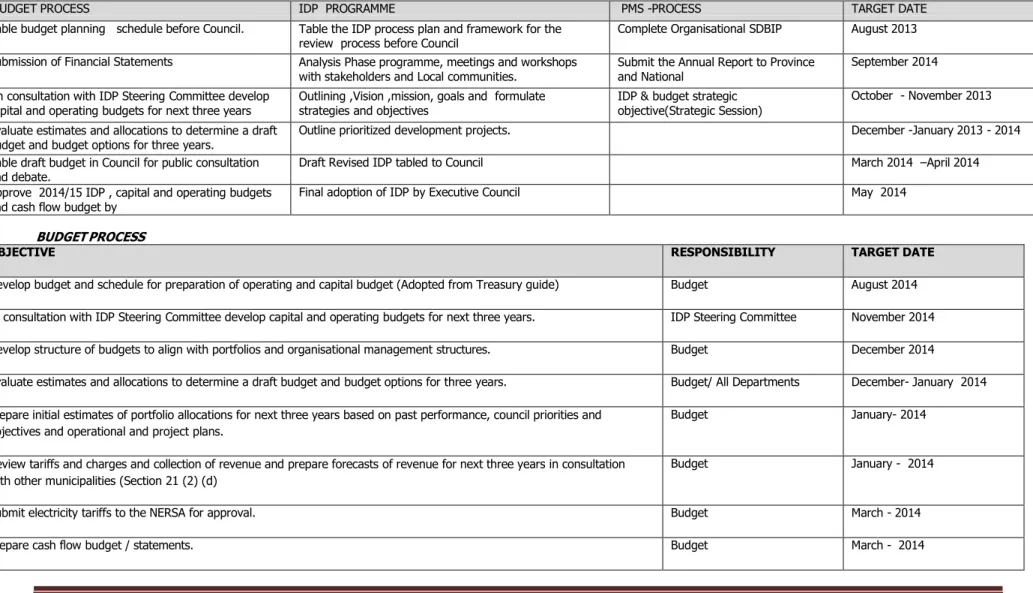
2.8 BUDGET, IDP AND PMS PROCESS
BUDGET PROCESS IDP PROGRAMME PMS -PROCESS TARGET DATE
Table budget planning schedule before Council. Table the IDP process plan and framework for the
review process before Council Complete Organisational SDBIP August 2013
Submission of Financial Statements Analysis Phase programme, meetings and workshops
with stakeholders and Local communities. Submit the Annual Report to Province
and National September 2014
In consultation with IDP Steering Committee develop
capital and operating budgets for next three years Outlining ,Vision ,mission, goals and formulate
strategies and objectives IDP & budget strategic
objective(Strategic Session) October - November 2013 Evaluate estimates and allocations to determine a draft
budget and budget options for three years. Outline prioritized development projects. December -January 2013 - 2014
Table draft budget in Council for public consultation
and debate. Draft Revised IDP tabled to Council March 2014 –April 2014
Approve 2014/15 IDP , capital and operating budgets
and cash flow budget by Final adoption of IDP by Executive Council May 2014
BUDGET PROCESS
OBJECTIVE RESPONSIBILITY TARGET DATE
Develop budget and schedule for preparation of operating and capital budget (Adopted from Treasury guide) Budget August 2014 In consultation with IDP Steering Committee develop capital and operating budgets for next three years. IDP Steering Committee November 2014 Develop structure of budgets to align with portfolios and organisational management structures. Budget December 2014
Evaluate estimates and allocations to determine a draft budget and budget options for three years. Budget/ All Departments December- January 2014 Prepare initial estimates of portfolio allocations for next three years based on past performance, council priorities and
objectives and operational and project plans.
Budget January- 2014
Review tariffs and charges and collection of revenue and prepare forecasts of revenue for next three years in consultation with other municipalities (Section 21 (2) (d)
Budget January - 2014
Submit electricity tariffs to the NERSA for approval. Budget March - 2014
Prepare cash flow budget / statements. Budget March - 2014
DIHLABENG INTEGRATED DEVELOPMENT PLAN 2014/2015
Page 19
Prepare budget information in reporting formats (National Treasury) Budget March 2014
Submit draft budget to National Treasury. Budget March 2014
Table draft budget in Council for public consultation and debate. Budget March 2014
Advertise proposed budget to public for objections. Budget April 2014
Communicate proposed budget to community for comments and inputs. Councillors April 2014
OBJECTIVE RESPONSIBILITY TARGET DATE
Approve 2014/15 capital and operating budgets and cash flow budget by resolution that also notes outer two year‟s projected budgets.
Council May 2014
Submit approved budgets to National Treasury. CFO June 2014
Draft SDBIP (Section 69 (3) (a) Municipal Manager June 2014
DIHLABENG INTEGRATED DEVELOPMENT PLAN 2014/2015
Page 20
2.9. SUMMARY OF ISSUES RAISED BY THE COMMUNITY
Issues highlight in this section are in terms of sectors and not necessarily in terms of functions of department or institutions .these are issues raised during the August /September 2012 and January 2013 community outreach meetings. At a glance the slow pace of finalisation of awarding land for development ,huge housing backlog inaccessibility of heath care facilities poor conditions of roads , need for economic development, recreational facilities and education are also factors that are highlighted as an issues in many areas.
Summary of issues raised by the communities
KEY ISSUES ISSUES RAISED WARD
Education
Need for extension of classes at existing schools
Children are travelling long distance from ward 4,5,6,7 and 19 to Bohlokong and, Motshepuwa for schooling.
Shortage of school transport for children in the farms
High number of drop-outs which need to be assisted to finish schooling Abet school at available venues is needed especially Ward 4,5,6,7 and 19
1,4,5,6,7,9, 10,11, 16,19
Health/Social Shortage of Mobile clinic in all five towns of Dihlabeng and the farms. All 20 Wards Services Need for new clinic to serve new locations ,Ward 4,5,6,7,11,19
Responding time for ambulance results in loss of lives
Long queues at Clinics and Hospital
Need to extend working hours at clinics to avoid overcrowding in all clinics
Home based care is needed for critical patients in all wards
Old age home is needed in Bohlokong
Customer care at clinics and hospitals need to be improved
.Safety and Responding time for police on complaints needs improvement All 20 Wards Security Police patrols needed at hot spots and open spaces
Long distance to police stations from ward 4,5,6,7,8, and 19
Mobile Police stations are needed in our towns
.Sports Upgrading of existing sports grounds with full equipment in Clarens All 20 Wards
&Recreation Need for Youth development programmes
Sports activities in all the units of Dihlabeng
Environment
Illegal dumping sites are increasing Need to increase days for waste removal Rezoning of open spaces into parks Leaking of drainage causes water pollution
All 20 Wards
Spatial Need for sites to build schools in new locations Ward 4,5,6,7,11,19 All 20 Wards Development Need for sites to build churches and crèches
Need for Business sites
Need to avail sites for disable and old age centers
Need for commonages and cemetery sites
Electricity
Upgrading of electricity network to farms and newly developed sites There is a need for electricity connections in majority of the farms around Dihlabeng.
1,2,4,5,6,7,15,17,19,10,11
Roads
Need to upgrade storm water channels to prevent water coming inside the yard All gravel roads must be paved
Need to upgrade the access roads to farms make it difficult to access basic services e.g Mobile clinics and Police services etc.
All 20 Wards
Water
Not enough communal taps at informal settlement Need for water supply for farming communities Need for water tower
5,15,17,19,11,10
Sanitation
Currently we use VIP toilets in Fateng Tse Ntsho and Mautse and there is a need to upgrade sewerage network in Mautse, Kgubetswana and Mashaeng Upgrading of sewer network at Mautse, Paul Roux, Mashaeng and Kgubetswana
17 and 15
Economic 80% of the youth are unemployed in all 20 Wards All Wards development and Need for job opportunities in all five towns of Dihlabeng
Tourism Heritage site (Mokukunu) need to be upgraded to attract tourists
Cultural villages be upgraded in affected areas
Disaster Responding time for fire brigade need to be improved 4,5,6,7,15 Management Need for Awareness campaigns and programmes
DIHLABENG INTEGRATED DEVELOPMENT PLAN 2014/2015
Page 21
2.10 SWOT ANALYSIS
STRENGTHS , WEAKNESSES, OPPORTUNITIES AND THREATS
Strengths
Received unqualified audit opinions from
2011/2012 3
Strong agriculture, mining tourism and government services sectors.
Located on the strategic N4 route/Maputo Corridor
Close proximity to Gauteng – a great tourism source market and export opportunity.
Available labour force
FET colleges to support skills development.
Good road infrastructure
Reasonable priced undeveloped land
Railway lines leading from area to two big cities
Tourism marketing initiatives exists and established tourism attraction e.g. ( Clarens, Basotho cultural village)
Culturally diverse communities.
Weaknesses
Lack of Research & updated Statistics
Need for more cooperation with the private sector.
Need for more involvement of other race groups for the IDP public inputs and consideration
Increasing withdrawal from various public participation groups e.g.
Private Businesspeople, Intellectuals.
Lack of Operational and Capital Budget
Shortage of skills development
Control Room: lack of communications equipment
No support for the finalization of the Disaster Management Plan
Out dated, unreliable fire engine and equipment
No specialized equipment
Lack of skills development
Control Room: lack of communications equipment
Lack of policies and by-laws
Biased application of benefits
Shortage of skilled personnel
Rural communities can‟t be serviced as they are far from towns
Lack of sufficient funding for activities and operational costs
Lack of transport to perform outreach programmes
Leasing the TLB for digging of graves
Lack of maintenance of old graves
Re-selling of reserved graves.
Numbering system of grave not assisting
No professionals in the field of environmental management
Procurement of machinery and equipment
High debtor book.
DIHLABENG INTEGRATED DEVELOPMENT PLAN 2014/2015
Page 22
Opportunities
IDP in future can be made part of LED, as part of a greater planning unit.
Needs to be more focus on financial sustainability and basic service delivery, in partnership with the private sector.
Financial sustainability being inclusive and holistic in order to accommodate all the envisaged projects & programme.
Payment of staff every month
Operational uniform
Payment of staff every month
Improve services delivery
Internal provincial staff has bursaries to study for the profession
Provincial funding can assist with mobile library that can reach the rural areas.
Submission of an annual business plan to the province will assist with funding.
Land available to extend or identify cemeteries
Filling of existing vacancy with professionals
Acquisition of relevant equipment Training
Appointment of skilled person
Partnerships to manage a possibility
Financial expertise available
Restructuring to accommodate new personnel.
Programmes to take place and development of artists.
Arts and culture forums were formed to ensure programmes takes place and they are well supported by the community.
Motivated workers to carry out their work diligently
Sufficient capable staff
Groenvoerlande development, increase revenue
Threats
Matters raised by Public are not being shown on the IDP.
Increasing withdrawal from various public participation groups e.g. Private Business people, Intellectuals.
Need for a specific tool to review the IDP.
Unsafe working environment
Building: Hygienically dangerous to health
Biased handling of disciplinary procedures
No Personnel protective equipment and clothing
Demotivated staff
Unsafe fire engines and equipment
Lack of safety for personnel on patrol during the day and night
Unfair labour practice
We might lose them after they have completed if we don‟t fill the vacancies
Illiteracy rate can be high in rural areas as they don‟t have similar opportunities as other community members
Lack of financial resources for capital
Changing weather conditions
Lack of financial resources
Not the right fence, safety is compromised
Non enforcement of financial regulations or legislation
Non enforcement of financial regulations or legislative limited facilities to use.
actions can be vandalized
Asset management could cause disclaimer
Non collection of revenue leads to inability to meet commitments.
DIHLABENG INTEGRATED DEVELOPMENT PLAN 2014/2015
Page 23 EXECUTIVE MAYCO MEMBERS
THE EXECUTIVE MAYOR Honourable Clr TMH Mofokeng
SPEAKER COUNCIL WHIP CHAIRPERSON MPAC
P.D Lengoabala LU Makhalema L Lemako
MMC MMC MMC MMC MMC MMC MMC MMC
Community Services
FInance LED Corporate Services Public Works Women, Children&Disability Human Settlement IDP/PMS and Monitoring
M.A Noosi M.J Tshabalala C.C Harrington P.P Mokoena T.J Seekane T.J Tshabalala A.L Mkwanazi Tseki Tseki
DIHLABENG INTEGRATED DEVELOPMENT PLAN 2014/2015
Page 24
2.12 Administration Structure
Municipal Manager, Technical Services, Social Services, Corporate Services, Local Economic Development and Finance .The information Technology, Internal Audit Unit, IDP/PMS, Marketing &
Communication. The top-level organogram of the Municipality is depicted in Figure 7
Functional View of Dihlabeng Local Municipality
MUNICIPAL MANAGER
MARKET. &
COMMS. IDP/PMS SECRETARIAT UNIT
MANAGERS IGR ICT INTERNAL AUDIT/
RISK MANAGEMENT
HR Management Budget & Expenditure Town Planning &
Housing
Solid Waste Management
Tourism Development
Labour Relations/
Legal Services
Supply Chain
Management Water & Sanitation Traffic, Fire & Disaster Management
Agricultural Development
Skills Development/
Talent Management