FACTORS INFLUENCING JOB SATISFACTION AMONG HEALTHCARE PROFESSIONALS AT SOUTH RAND HOSPITAL
by
JACKIE MAMITSA BANYANA RAMASODI
RESEARCH DISSERTATION
Submitted in fulfillment of the requirements for the degree of
MASTER OF PUBLIC HEALTH
in the
FACULTY OF HEALTH SYSTEMS MANAGEMENT AND POLICY (School of Public Health)
at the
UNIVERSITY OF LIMPOPO
SUPERVISOR: PROF. SUPA PENGPID CO-SUPERVISOR: MS LINDA SKAAL
2010
DECLARATION
I declare that the work on which this dissertation is based, hereby submitted to the University of Limpopo, for the degree of Master of Public Health, has not previously been submitted by me for a degree at this or any other university, that it is my work in design and execution, and that all material contained herein has been duly acknowledged.
………. ……….
Initials & Surname (Title) Date
Student Number…
ACKNOWLEDGEMENTS
To the most High God who ordained this path for me before I even knew about it and made it possible for me to undertake this journey. Thank you Lord for the strength, wisdom, grace and every provision I needed to make this dream a reality.
My sincere appreciation goes to Prof Supa Pengpid and Ms Linda Skaal for seeing through all the stages of this project. Thank you for your time, guidance, critique and encouragement, I would not have done this without you.
To all the staff at South Rand Hospital. Without their willingness to participate, this project would not have taken off; thank you so much for your kindness.
Finally my sincere gratitude to my family, friends and colleagues for all the support, encouragement and believing in me.
DEDICATION
This dissertation is dedicated to the Almighty God for His grace, provision, and protection and for seeing me through this project; through him all things are possible.
To my beloved and late grandmother, Magdeline Sebokane Ramasodi-Seleki; even in absentia I know this dream is yours too.
To my late good friend and family Dr Thabo Matla, for all the intellectual exchanges we shared.
CONTENTS
Declaration ii
Acknowledgement iii
Dedication iv
List of tables vii
List of figures vii
Abstract viii
CHAPTER 1: BACKGROUND AND INTRODUCTION
1.1 Background 1
1.2 Justification of the study 4
1.3 Research aim 5
1.4 Research questions 5
1.5 Research objectives 5
CHAPTER II: LITERATURE REVIEW
2.1 Introduction 6
2.2 The nature of job satisfaction 7
2.3 Job satisfaction theories 8
2.4 Job design and work environment 12
2.5 The human environment 12
2.6 Findings from other research 12
2.7 Summary 16
CHAPTER III: MATERIALS AND METHODS
3.1 Research design 19
3.2 Study site 19
3.3 Study population 19
3.4 Sampling procedure and sample size 19
3.5 Data collection tool 20
3.6 Data collection method 21
3.7 Ethical considerations 21
3.8 Limitations of the study 22
3.9 Data analysis 22
CHAPTER IV: RESULTS
4.1 Descriptive statistics 24
4.2 Inferential statistics 31
CHAPTER V: DISCUSSION, CONCLUSION AND RECOMMENDATIONS
5.1 Discussion 36
5.2 Conclusion 41
5.3 Recommendations 43
REFERENCES 45
APPENDICES
Appendix A: Permission letter 51
Appendix B: Questionnaire 52
Appendix C: Informed consent 55
Appendix D: Time table and budget 56
Appendix E: Permission letter and ethical clearance 57
LIST OF TABLES
Table 1 Socio-demographic characteristics of respondents 27
Table 2 Level of general satisfaction 29
Table 3 Opportunity to develop 30
Table 4 Level of responsibility 31
Table 5 Patient care 32
Table 6 Time pressure 33
Table 7 Staff relations 34
Table 8 Level of job satisfaction 36
Table 9 Association between socio-demographics and level of satisfaction 37
Table 10 Comparison of factors associated with job satisfaction 38
Table 11 Comparison of dimensions of job satisfaction between clinical staff and
clinical support staff 39
Table 12 Correlations between dimensions of job satisfaction 40
LIST OF FIGURES
Fig .1 Respondents’ level of satisfaction 36
ABSTRACT
Relationships have been reported between job satisfaction, productivity, absenteeism and turnover among healthcare employees and as such it affects employees’
organizational commitment and the quality of healthcare services. The aim of the study was to determine the factors influencing job satisfaction among healthcare professionals at South Rand Hospital. The study was conducted among 103 participants. Self-administered questionnaires were used to collect data from the participants. Data was then analyzed using statistical software SPSS 17.0.
The results showed a low level of job satisfaction. Almost 80% (79.6%) of participants were not satisfied with their jobs, and there was no association between job satisfaction and socio-demographic characteristics. Variables such as opportunity to develop, responsibility, patient care and staff relations were found to be significantly influencing job satisfaction and there was a significant positive medium association between job satisfaction and opportunity to develop, responsibility, patient care and staff relations for both clinical and clinical support staff.
Satisfaction with one’s job can affect not only motivation at work but also career decisions, relationship with others and personal health. Those who are working in a profession that is extremely demanding and sometimes unpredictable can be susceptible to feelings of uncertainty and reduced job satisfaction. Job satisfaction is also an essential part of ensuring high quality care. Dissatisfied healthcare providers give poor quality, less efficient care. Interventions need to be implemented in order to improve the level of job satisfaction among healthcare professionals at South Rand Hospital.
CHAPTER I
BACKGROUND AND INTRODUCTION
1.1 BACKGROUND
The shortage of healthcare professionals in most countries is well documented; it has reached such an extent that some hospitals are offering bonuses to lure healthcare workers from other employers. Every healthcare professional is an important part of the healthcare system, and shortage in any area creates problems for other cadres of workers. Industry-wide shortages create the possibility that patients will receive sub- standard care or even be placed in danger. These shortages also create an environment that is not conducive to retaining the most qualified and experienced healthcare professionals.
The healthcare industry requires a more skilled workforce today as a result of advancement in medical technology and the demand for more sophisticated patient care. Job satisfaction among healthcare professionals is increasingly being recognized as a measure that should be included in quality improvement programmes. Low job satisfaction can result in increased staff turnover and absenteeism, which affects the efficiency of health services.
In many countries employers pay close attention to the subjective well-being of their employees and its impact on their jobs. In Denmark, several companies regularly conduct their own job satisfaction surveys and an employee satisfaction index has been computed for a number of European countries. The European Union has called the attention of member states to the quality aspects of work and highlighted the importance of improving job quality to promote employment and social inclusion (European Commission, 2002).
There is growing consensus that the significant health status challenges facing South Africa cannot be properly addressed without strengthening health systems and
professionals working in those systems. A study on work satisfaction of professional nurses in South Africa by Pillay (2008) indicated overall dissatisfaction among South African nurses and highlighted the disparity between levels of job satisfaction in the public and private sectors. Another South African study found that organizational factors and poor working conditions were strongly associated with job dissatisfaction, while the social aspects of the job were found to be a strong predictor of job satisfaction (Kekana et al, 2007).
The search for enhanced productivity has been a major concern for all organizations in more developed societies. In developing countries the need to optimize productivity is also a consideration. Job satisfaction of employees has been found to be an important factor affecting productivity and has received considerable interest (Collins et al, 2000).
The subject of job satisfaction is particularly relevant and of interest to public health practitioners due to the fact that organizational and employees’ health and well-being rest a great deal on job satisfaction (Adams et al, 2000).This is particularly important because employees in a healthcare delivery system are expected to provide quality patient care while working in a highly stressful environment (Arnetz, 2000).
The evidence from published research points to specific determinants and correlates of job satisfaction and productivity. Various studies have established that dissatisfaction with one’s job may result in higher employee turnover, absenteeism, tardiness and grievances. Improved job satisfaction, on the other hand, results in increased productivity (White, 2000).
Every individual has unique needs and desires that need to be satisfied, which are related to the behaviour they exhibit, and these play a significant role in their preferences in different areas such as their workplace. Social, cultural and job factors all influence employees’ behaviour (Gibson et al, 2000).
Overall job satisfaction is actually a combination of intrinsic and extrinsic job satisfaction. Intrinsic job satisfaction is when workers consider only the kind of work they do and the tasks that make up the job, while extrinsic job satisfaction is when workers considers the conditions of the work, such as but not limited to pay, co- workers, management style and communication.
From the point of view of employees, job satisfaction may reflect benefits that people might be looking for when they take the job; these benefits are usually determined by the employer based on their strategy to be profitable and competitive in recruiting and retaining people. On the other hand job-related factors that affect satisfaction relate to employees’ desire to use their skills and abilities to make a meaningful contribution and to be valued. From an organization’s point of view, they employ people to perform specific tasks in order to achieve their business goals. When organizations finds people who fit their job requirements and are happy with what is being offered, then a win-win situation is created between the employer and the employee.
Many organizational scholars have shown interest in why some people report being satisfied with their jobs, while others express lower levels of job satisfaction.
However, not much is known about which factors influence job satisfaction in hospital staff.
Satisfied employees tend to be more productive and committed to their jobs (Al- Hussami, 2008). In a healthcare setting, employee satisfaction has been found to be positively related to quality of service and patient satisfaction (Tzeng, 2002).
Employees can directly influence patient satisfaction in that their involvement and interaction with patients plays a significant role in quality perception. A number of studies have looked into job satisfaction in the healthcare setting (Seo, 2004; Lyons, 2003; Chu et al, 2003) and the focus was on the need to understand job satisfaction of healthcare providers.
Herzberg and Mausner (1959) suggested a motivation–hygiene theory where factors influencing job satisfaction are separate from those that lead to job dissatisfaction.
Factors leading to satisfaction, describes as motivators, were promotional and personal growth opportunities, responsibility, achievement and recognition. These are factors that are intrinsically rewarding to the individual. Extrinsic factors, described as
“hygiene” factors, leading to job dissatisfaction include pay, physical working conditions, job security, company policies, quality of supervision and relationship with others (Robbins, 2003).
Factors contributing to high levels of employee satisfaction have been identified as:
supportive colleagues, supportive working conditions, mentally challenging work and equitable rewards (Locke, 1983).
1.2 JUSTIFICATION OF THE STUDY
Given the critical role that health care professionals play in determining the efficiency, effectiveness and sustainability of health care systems, it is paramount to understand what motivates them and to what extent they are satisfied by the organization and other contextual variables. Job satisfaction is also an essential part of ensuring quality care, as dissatisfied healthcare providers are likely to give poor quality and less efficient care. According to Tzeng (2002) there is evidence of a positive correlation between professional satisfaction and patient satisfaction.
A number of studies have addressed job satisfaction among health care professionals.
South African studies are limited in that most studies have been conducted among nurses and other individual professions. Given the noticeable lack of studies addressing job satisfaction among different healthcare professionals in a South African public hospital setting, this study will attempt to address the gap in the literature. The information obtained will hopefully assist in identifying factors influencing job satisfaction among healthcare professionals in a hospital setting.
1.3 RESEARCH AIM
The aim of the study is to determine the factors influencing job satisfaction among healthcare professionals at South Rand Hospital.
1.4 RESEARCH QUESTIONS
i. What is the level of job satisfaction among healthcare professionals at South Rand Hospital?
ii. Which factors influence job satisfaction among healthcare professionals at South Rand Hospital?
iii. What is the association between the socio-demographic characteristics of the healthcare professionals and job satisfaction?
iv. What is the relationship between the different dimensions of job satisfaction, namely, general satisfaction, the opportunity to develop, responsibility, patient care, time pressure and staff relations, among healthcare professionals?
1.5 RESEARCH OBJECTIVES
i. To determine the level of job satisfaction among healthcare professionals at South Rand Hospital.
ii. To determine the factors influencing job satisfaction among healthcare professionals at South Rand Hospital.
iii. To determine the association between socio-demographic characteristics and job satisfaction.
iv. To measure the relationship between general satisfaction, the opportunity to develop, responsibility, patient care, time pressure and staff relations, among healthcare professionals.
CHAPTER II
LITERATURE REVIEW
2.1 INTRODUCTION
Job satisfaction is important in predicting systems stability, reduced turnover and worker motivation. If motivation is defined as the willingness to exert and maintain effort towards attaining organizational goals, then well-functioning systems should seek to boost factors such as morale and satisfaction, which predict motivation. A survey of ministries of health in 29 countries showed that low motivation was seen as the second most important health workforce problem after staff shortages (Mathauer et al, 2006).
Previous African studies have identified the most important human resources tools to manage job satisfaction; these include materials, salary, training, the working environment, supportive supervision and recognition (Mathauner et al, 2006). These findings are relatively consistent with those of the “Uganda Health Workforce Study”, where the effects of several job-related factors were evaluated to judge their relative importance in predicting job satisfaction. In order of importance, the following were the most significant contributors to overall satisfaction: job matched with workers’
skills and experience, satisfaction with salary, satisfaction with supervisor, manageable workload and job security (Uganda Ministry of Health, 2007).
Early theory in worker satisfaction and motivation identified compensation as a
“hygiene” factor rather than a motivation factor. This means that basic salary satisfaction must be present to maintain ongoing job satisfaction, but this by itself will not provide satisfaction and increased amounts of salary will not contribute to an increasing level of job satisfaction. However some research done in Africa suggests that salary increases and other improvements in compensation, in the context of highly inadequate pay and benefits, may indeed contribute to workforce retention
(Kober et al, 2006). Against this background, it is imperative to look at the definition of job satisfaction as outlined by different authors.
2.2 THE NATURE OF JOB SATISFACTION
Job satisfaction is a complex phenomenon that has been studied quite extensively.
Various literature sources indicate that there is an association between job satisfaction and motivation, motivation is hard to define, but there is a positive correlation between job satisfaction, performance and motivation, whereby motivation encourages an employee, depending on their level of job satisfaction, to act in a certain manner (Hollyforde, 2002).
Job satisfaction is described at this point as a pleasurable or positive emotional state resulting from the appraisal of one’s job or job experience. Job satisfaction results from the perception that one’s job fulfils or allows the fulfillment of one’s own important job values, providing that and to the degree that those values are congruent with one’s needs. According to Kreitner et al (2002) job satisfaction is an affective and emotional response to various facets of one’s job.
According to Woods et al (2004), job satisfaction can be achieved when an employee becomes one with the organization, performs to the best of their ability and shows commitment; moreover, job satisfaction and performance are positively influenced by rewards. Kreitner et al (2002) identified various factors influencing job satisfaction, such as the need for management to create an environment that encourages employee involvement and manages stress in the workplace.
In order to understand job satisfaction it is useful to distinguish morale and attitude, and their relationship to job satisfaction (Locke, 1968).Morale can be defined as the extent to which an individual’s needs are satisfied and the extent to which an individual perceives that satisfaction as stemming from the total job. Attitude can be defined as an evaluation that predisposes a person to act in a certain way and includes cognitive, affective and behavioural components.
According to Mayer and Botha (2004), in most South African companies there is a low level of employee job satisfaction, resulting in a lack of commitment to performance and the achievement of organizational goals. In South Africa, human resource managers have job satisfaction and productivity at the top of their list of concerns (Grobler et al, 2002). This implies that job satisfaction affects employees’
performance and commitment.
It is therefore imperative that managers pay special attention to employees’ attitudes as job satisfaction can decline more quickly than it develops. Managers need to be proactive in improving and maintaining employees’ life satisfaction and not only satisfaction in the work environment as job satisfaction is part of life satisfaction, meaning an individual’s life outside work may have an influence on one’s feelings on the job(Staw,1977).
The level of job satisfaction across various groups may not be consistent, but could be related to a number of variables. This allows managers to predict which groups are likely to exhibit behaviour associated with dissatisfaction. Older employees are generally satisfied with their jobs although this may change as their chances of advancement get diminished and they face the reality of retirement. Management also tends to be satisfied with their jobs, probably due to better remuneration, better working conditions and job content (Greenberg et al, 1997).
2.3 JOB SATISFACTION THEORIES
We now look at different theories of job satisfaction, to determine how they can be utilized to improve and increase job satisfaction.
2.3.1. Content theories of job satisfaction
The content theory of job satisfaction rests on indentifying the needs and motives that drive people. The theory emphasizes the inner needs that drive people to act in a particular way in the work environment. These theories therefore suggest that management can determine and predict the needs of employees by observing their behaviour.
2.3.2 Maslow’s hierarchy of needs
According to Maslow’s theory (1970), people’s needs range from a basic to a high level. These needs are present within every human being in a hierarchy, namely physiological, safety and security, social, status and self-actualization needs. Failure to satisfy one need may have an impact on the next level of need. Low order needs takes priority before the higher order needs are activated, so that needs are satisfied in sequence. According to this theory, people who are struggling to survive are less concerned about needs on the higher levels than people who have time and energy to be aware of higher level needs.
2.3.3 Hertzberg’s two-factor theory
In the late 1950s Frederick Herzberg developed a theory that there are two dimensions to job satisfaction, “motivation” and “hygiene”. The work characteristics associated with dissatisfaction (hygiene factors) vary from those pertaining to satisfaction (motivators) in that motivators lead to satisfaction, although their absence may not lead to dissatisfaction. The motivators include achievement, recognition and intrinsic interest in the work itself. The continuing relevance of Herzberg is that there must be some direct link between performance and reward, whether extrinsic as in recognition or intrinsic as in naturally enjoyable work, to motivate employees to perform and improve their job satisfaction. The current study will be based upon this theory.
2.3.4 “Hygiene” factors
Hygiene factors are features of the job such as policies and practices, remuneration, benefits and working conditions, corresponding to Maslow’s lower order of needs.
Improving these factors may decrease job dissatisfaction and thus increasing of motivators. Inadequate hygiene factors may lead to dissatisfaction, but at the same time adequate hygiene factors do not necessarily lead to job satisfaction. Hygiene factors need to be tacked first, and the motivators can follow. Organizations cannot afford to ignore hygiene factors as employees will be generally unhappy and thus likely to seek other opportunities, while mediocre employees might stay on, and compromise the organization’s success.
2.3.5 Motivators
According to Herzberg, motivators include job content such as responsibility, self- esteem, growth and autonomy. These satisfy high order needs and can result in job satisfaction. Granting employees more responsibility and creativity in their jobs is an example of a motivator which may encourage them to exert more effort and perform better.
2.3.6 Process theories of job satisfaction
Behaviour is a fundamental indication of an individual’s perception and expectations about a situation and possible outcome of behaviour. Process theories define how and by which goals individuals are motivated. They are based on the assumption that people make conscious decisions regarding their behaviour. The most common process theories are the equity theory, the expectancy theory and the job characteristics model.
2.3.7 Expectancy theory
This theory was developed by Vroom(1964) who asserts that job satisfaction is based on people’s beliefs about the probability that their effort will lead to performance (expectancy) multiplied by the probability that performance leads to rewards (instrumentality) and the value of perceived rewards (valence).This theory is based on the belief that the amount of effort exerted on a job depends on the expected return and may result in increased pleasure or decreased displeasure, and that people may perform their job and be satisfied if they believe that their efforts will be rewarded.
The fundamental principle of expectancy theory is the understanding of individuals’
goals and the linkages between effort and performance, performance and rewards, and rewards and individual goal satisfaction. This theory recognizes that there is no universal principle that explains people’s motivation and is regarded as a contingency model. Understanding what needs a person seeks to satisfy does not ensure that the individual perceives high performance as necessarily leading to the satisfaction of these needs.
2.3.8 Job characteristics model
Bergh and Theron (2000) describe this model as an interactive model that develops employees and the work environment to achieve maximum fit in the work environment. The model asserts that the job should be designed to possess characteristics to enable conditions for high motivation, satisfaction and performance.
There are five core characteristics of the job that influence workers’ behaviour and attitude, namely, skill variety, task identity, task significance, autonomy and feedback.
The relationship between core job characteristics and work outcomes is moderated by employees’ growth-need strength, knowledge, skill, and context satisfaction, therefore the relationship between core job characteristics and work outcomes may differ.
2.3.9 Equity theory
This theory emphasizes the comparison of existing conditions against some standard by using the relationship between two variables (inputs and outcomes). Inputs are what an individual contributes to an exchange, while outcomes represent what an individual obtains from an exchange. Equity theory suggests that individuals assign weights to various inputs and outcomes according to their own perception of relative importance. According to Daft and Noël (2001), equity theory is a process of job satisfaction that focuses on individuals’ perceptions of how fairly they are treated compared to others. This implies that, if people perceive their treatment as less favourable than that of others with whom they compare themselves, they are likely to be less motivated to perform better. This theory therefore posits that people compare the ratio of their outputs to inputs with the ratio of outputs to inputs of others.
2.4 JOB DESIGN AND THE WORK ENVIRONMENT
Job design can be seen as an important factor influencing how employees feel and react to their job, thus affecting their performance and job satisfaction. According to Wood et al (2004), job design can be described as the planning and specifications of job tasks and the designated work settings where they are to be accomplished.
According to Smith (2002), people respond unfavourably to restrictive work environments so it is imperative for organizations to create a working environment that gives employees the ability and freedom to think, engaging and motivating the
workforce to reach a higher level of job satisfaction. Ayers (2005) suggests that the work environment should motivate employees to perform at their best and show commitment to the organization, enhancing work conditions to support the organization’s mission and thus impacting on job satisfaction. The conditions under which jobs are performed can have as much impact on people’s effectiveness, comfort and safety as the intrinsic details of the task itself.
2.5 THE HUMAN ENVIRONMENT
People are an organization’s greatest resource. Attracting and retaining the right people is critical to the success of an organization, particularly service-oriented organizations (McCrarey, 2005).The human environment focuses on human aspects that influence an employee’s performance and job satisfaction. The extent to which employees experience psychological or personal job satisfaction within the job content environment determines the quality and quantity of their outputs (Nel et al, 2004).
2.6 FINDINGS OF OTHER RESEARCH
In 2007, Aleksandra et al undertook a study on job satisfaction among Serbian healthcare workers who work with disabled patients. The study found very low levels of job satisfaction among healthcare workers. The lowest job satisfaction was found among nurses, while doctors were most satisfied with their jobs. More than half the respondents agreed that their working environment was not stimulating and that they did not find their job motivating. One fifth of healthcare workers responded that they had no personal or clinical autonomy, and most indicated that they rarely participated in a decision-making process. Sixty-four per cent felt that they did not have adequate professional development or educational stimulation at their workplace. The study found that job satisfaction was associated with good hospital politics, good interpersonal relationships and a feeling of being able to provide good quality care.
Other studies suggest that there is a strong association between low levels of job satisfaction and organizational factors (for example, Piko et al, 2006). Furthermore various studies conducted among healthcare workers show the importance of interpersonal relationships in job satisfaction (for example, Eker et al, 2004).
In a study conducted by Shah et al (2001) on correlates of job satisfaction among healthcare professionals in Kuwait, the findings revealed a significant relationship between educational level and job satisfaction and respondents with a diploma reported the highest level of job satisfaction. Employees with longer experience were also more satisfied than those with short experience. Provision of orientation to the job was found to be positively associated with job satisfaction; respondents who received orientation and in-service education were more satisfied than those who did not.
A study by Unni et al (2000) in Norway looked at predictors of job satisfaction among doctors, nurses and auxiliaries in a Norwegian hospital; they found that the only domain of work that was significant in predicting high job satisfaction for all groups was positive evaluation of local leadership. The analysis suggested that professional development was most important for doctors, while support and feedback from one’s immediate supervisor was the main explanatory variable for job satisfaction among nurses. Job satisfaction for auxiliaries was equally predicted by professional development and local leadership.
A job satisfaction study among mental health professionals in Rome, Italy, showed that participants were dissatisfied with career prospects, decision latitude, and the availability and circulation of information. In general, mental health professionals working in the Italian National Health Service were not satisfied with their jobs. The findings revealed that job satisfaction increased with increasing age. No difference was found between the levels of job satisfaction among different professional roles (Gigantesco et al, 2003).
Buciuniene et al (2003) study on the job satisfaction of physicians and general practitioners at primary health care institutions during the period of health care reform in Lithuania revealed that there was no significant difference in total job satisfaction between the two groups. However doctors who had a longer service were found to be more satisfied with their jobs. The survey also showed that the participants were most
satisfied with the level of autonomy, relationship with colleagues and management quality, while compensation, social status and workload caused the highest level of dissatisfaction among respondents. The author concluded that the nature of a primary health care doctor’s work and rather low salaries result in low job satisfaction among Lithuanian primary health care doctors.
A study by Ali-Mohammed (2004) in Iran on factors affecting employees’ job satisfaction in public hospitals found a moderate level of general satisfaction among participants. The study also showed that the opportunity to develop was a significant predictor of job satisfaction among study participants. The greater the chances for development within the organization, the greater the likelihood of a higher level of job satisfaction.
Nassab’s (2008) study on factors influencing job satisfaction amongst plastic surgery trainees in the United Kingdom, showed that time pressure was strongly and positively associated with job dissatisfaction. Reduction in working hours may increase job satisfaction; however shift work may imply working unsociable hours and negatively impact on job satisfaction.
“Work satisfaction of professional nurses in South Africa: A comparative analysis of the public and private sectors” by (Pillay, 2008) showed overall job dissatisfaction among participants. However, participants were satisfied with patient care and staff relations. Public sector nurses were highly dissatisfied with salaries, workload and resources, while private sector nurses were moderately dissatisfied with pay, workload and opportunities to develop.
De Stefano et al (2005) study on the relationship between work environment factors and job satisfaction among rural behavioural health professionals in Arizona indicated that the opportunity to develop was an important predictor of job satisfaction, while work and time pressure did not appear to be predictors of job satisfaction.
A study by Ishara et al (2007) on public psychiatric services in Brazil found that general satisfaction was similar among different professional categories though greater satisfaction was observed among technicians, which according to the authors could be associated with their low level of responsibility.
A number of studies have concluded that team work leads to a higher level of job satisfaction, increased patient safety, improved patient care and increased patient satisfaction .A study by Kalish et al (2005) in the USA tested an intervention to promote teamwork and engagement among nursing staff in a medical unit of an acute care hospital. The results of this study indicated that the intervention increased staff relations, improved teamwork and decreased staff turnover.
Job satisfaction of mental health professionals providing group therapy in state correctional facilities by Ferrell et al (2000) in the United States explored how satisfied mental health professionals were with different aspects of their jobs.
Participants in this study appeared to be satisfied with aspects of their jobs that involved patient care, e.g. provision of psychological services, but less satisfied with administrative tasks.
A study by Jain et al (2009) evaluated the level of job satisfaction among dentists and dental auxiliaries in India in relation to different work and environmental factors. The results of the study showed that dentists had higher job satisfaction scores than dental auxiliaries on the opportunity to develop professionally, quality patient care, income and recognition.
A study by Bodur (2001) of healthcare staff employed at health centers in Turkey investigated job satisfaction levels and their causes. The results showed low levels of job satisfaction mainly due to working conditions and salary. No correlation was found between general satisfaction and demographic characteristics.
2.7 SUMMARY
Satisfaction with one’s profession can affect not only motivation at work but also career decisions, personal health and how one relates with others. The literature shows that what contributes to job satisfaction or dissatisfaction is not only the nature of the job but also the expectation of what an individual perceives the job should provide.
Health workers are at great risk of job dissatisfaction generally compared to professionals in other types of organizations. Low job satisfaction impacts on staff turnover and absenteeism, which could reduce the efficiency of health services.
Factors influencing job satisfaction vary in nature as there are personal factors and expectations involved, which tend to generate exceptions, therefore generalizations are risky. The future of the healthcare work environment poses significant challenges for employers and employees. The implication for managers is that if healthcare facilities desire to attract and retain healthcare professionals, they will need to find ways to cater for intrinsic job satisfaction factors as well as additional benefits.
2.7.1 General satisfaction
Job satisfaction among healthcare professionals is an important predictor of individual well-being, general life satisfaction and job performance. Job satisfaction is an important factor in patient care, and there is also evidence to suggest that a high level of job satisfaction results in good patient outcomes and health systems outcomes. Job satisfaction is a complex set of interrelationships of roles, responsibilities, tasks, interaction, rewards and incentives. The reviewed literature indicates low levels of general satisfaction among healthcare professionals. Dissatisfaction with autonomy in clinical decision-making, systems roles, and the amount of time spent with patients and poor salaries were some of the problems identified. What follows looks at some of these factors one by one.
2.7.2 Staff relations
Numerous studies conducted among healthcare professionals point to the importance of interpersonal relationships in job satisfaction, and show that they lead to increased patient safety, improved quality of care and greater patient satisfaction. Highly
functioning teams have also been shown to offer great support to inexperienced staff.
Specifically within healthcare, there has been a growing need to improve teamwork.
Introducing team-building activities has resulted in stronger interpersonal;
relationships, improved staff communication, understanding and clarity of roles as well as greater job satisfaction.
2.7.3 Time pressure
Time is a subjective experience despite the fact that it can be measured. While the quality of time is of great importance so is quantity. Literature shows that perceived time pressure is associated with low job satisfaction among healthcare professionals.
Dissatisfaction about time pressure expressed by healthcare professionals may indicate concerns about autonomy.
2.7.4 Responsibility
Employee participation may enhance motivation through power sharing, and increased responsibility is as a predictor of positive responses. Employee participation can afford individuals an opportunity to make key managerial decisions that have an impact on other employees, thus increasing job satisfaction and performance.
Herzberg’s two-factor theory suggests that intrinsic work factors such as employee recognition and skills development may increase job satisfaction. Increased work responsibility may be related to many factors suggested in the two-factor model as recognition and interpersonal relationships have implications for individuals’ identity.
2.7.5 Opportunity to develop
Career development determines the nature and quality of individuals’ lives, and the social and economic contribution they make. Career development is crucial for an effective labour market. When individuals find a career path that utilizes their full potential, they are likely to be motivated and productive thus increasing job satisfaction. Opportunities to develop afford individuals the prospect of further enhancing themselves and growing within the ranks of their career.
2.7.6 Patient care
The literature suggests that the ability of an organization to support and deliver quality patient care is important to healthcare professionals’ job satisfaction.
Organizational factors such as autonomy, teamwork, management support, workload and staffing levels have a great influence on job satisfaction because they impact on the delivery of quality patient care.
CHAPTER III
MATERIALS AND METHODS
3.1 RESEARCH DESIGN
A cross-sectional survey was used to determine the factors influencing job satisfaction among health care professional at South Rand Hospital.
3.2 STUDY SITE
The study was conducted at South Rand Hospital in the south of Johannesburg, Gauteng, South Africa. South Rand Hospital is a district hospital with 283 beds which plays a pivotal role in supporting primary healthcare and is also a gateway to more specialist care. Because it is a relatively small hospital, it provides level 1 (generalized) service to in-patients and out-patients ideally on a referral from community health centers and clinics. The hospital is situated in Rossettenville thus enabling easy access to patients from different areas.
3.3 STUDY POPULATION
The study population consisted of all health care professionals at South Rand Hospital from all departments and wards at the time the study was conducted. Most participants were females. The study population was multicultural, with mainly black and a few white people. Among the black participants, there were people from different ethnic groups. Most participants lived in Johannesburg.
SAMPLING AND SAMPLE SIZE
3.4.1 Sample size
Since the total number of health care professionals at the hospital was 284, all of them were included in the study. The sample was grouped into two categories: clinical staff
= 246 (doctors and all categories of nurses), and clinical support staff = 38 (pharmacists, physiotherapists, occupational therapists, speech therapists,
radiographers, oral and dental hygienists, and social workers including assistants). For the purposes of sample size calculations, the power of the study was 90% and the level of job satisfaction, being unknown, was at the expected frequency of 50% and worst acceptable results of 45% to obtain the power of 90 at 95% level of confidence;
the calculated sample size using EPI INFO population survey was 163 in total. A simple random sampling method was used to obtain the selected sample. Participants were contacted by the researcher and invited to complete the self-administered questionnaire.
3.4.2 Inclusion and exclusion criteria
The inclusion criteria were all healthcare professionals at the hospital who were available at the time of the study and willing to participate. The exclusion criteria were those who were not available such as those who were on leave and those who decided to exercise their right not to participate.
3.5 DATA COLLECTION TOOL
3.5.1 Components and details of the instrument
A structured self-administered questionnaire was used to collect data from the participants. It consists of two sections. Section A comprised the socio-demographic characteristics consisting of six items, while Section B was adapted from an MSc Psychology thesis by Basson (1994). It consisted of 29 job satisfaction statements measured on a five-point Likert scale (‘strongly agree’ to ‘strongly disagree’). The value of two was given to the highest level of job satisfaction (strongly agree) and the value of minus two to the lowest level of job satisfaction (strongly disagree). The values were then recoded as follows: ‘strongly agree’ and ‘agree’ were given the value of one, while ‘strongly disagree’ and ‘disagree’ were given the value of minus one. Data was then further coded as follows. The value of one was given to a score of
<0 = highly dissatisfied, two to a score of <50 = not satisfied, three to a score of 50-59
= fairly satisfied, four to a score of 60-69 = moderately satisfied and five to a score of
>70=highly satisfied. (Appendix B).
3.5.2 Validity and reliability
To ensure content validity of the instrument, the draft questionnaire was submitted to the supervisor for expert scrutiny regarding the relevance of each item. Pre-testing of the questionnaire was done at Sebokeng Hospital, where twenty self-administered questionnaires were distributed to participants to comment on the clarity of the questions. Two items from the instrument were found to be asked in the negative, which had the potential to allow different interpretations. These items were subsequently reconstructed to improve clarity.
3.6 DATA COLLECTION METHOD
The period of data collection was 12 weeks, between 22 June and 7 September 2008.
Over the 12 week period, a random sample of 163 participants was drawn from the hospital. The researcher was personally responsible for the distribution and collection of all questionnaires. Due to the nature of shift work in a hospital setting the researcher allocated four hours every week to collect questionnaires from day staff and two hours for night staff. The target was an average of 14 questionnaires every week over the twelve week period. Data were then captured electronically for the purpose of analysis.
3.7 ETHICAL CONSIDERATIONS
Ethical clearance and approval to conduct this research was obtained from the Research Ethics and Publication Committee of the National School of Public Health, University of Limpopo, and the Medunsa Research Ethics Committee, MREC/PH/33/2009 (Appendix E).
Permission to conduct the study was also requested from the Chief Executive Officer of the hospital, Mrs. C. Makgetha( Appendix A).The ethical considerations took into account the personal and revealing nature of the study, which required that voluntary, informed consent, using the consent form designed for this study, needed to be obtained from the participants. Prior to administering the questionnaires, the aims and objectives of the study were clearly explained to the participants and written informed consent was obtained (Appendix C).
Confidentiality and anonymity were ensured throughout the execution of the study as participants were not required to disclose personal information on the questionnaire.
Provisions were made to have participants’ concerns relating to the study addressed and misconceptions corrected. Participants were informed that their participation was voluntary and that they could withdraw from the study at any time if they wished to do so.
3.7 LIMITATIONS OF THE STUDY
Important limitations are inherent in a survey of this kind. Firstly, because the survey instrument used was a self-reporting measure, the information presented by participants is based upon their subjective perceptions. Although participants were assured of confidentiality, it is therefore possible that they either over- or under- reported their level of satisfaction. Secondly, even with the high level of participation in this study, there is a possibility that responses of individuals who did not participate may have differed in some manner from those who did in fact participate. The findings of the study may not be generalized to healthcare professionals in other hospitals, as the different environment and circumstances prevailing in other hospitals may impact on job satisfaction. It should also be noted that the study was conducted at a time when doctors were on strike over salaries and working conditions in public hospitals.
3.8 DATA ANALYSIS
Of the 163 questionnaires printed and distributed, 114 were returned (a response rate of 63.19%). Of these, 11 were incomplete, thus 103 questionnaires were available for analysis. Quantitative data from the returned questionnaires were coded and entered into a Microsoft Excel spreadsheet (Microsoft Office, 2003). The statistical software SPSS version17.0 was used to analyze the generated data. Descriptive and inferential statistical analyses were employed. Data were also summarized using graphic presentations for the interpretation of findings. Statistics were based on percentages and frequencies. Association between socio-demographic characteristics and job satisfaction, as well as comparison of the level of job satisfaction between categories
of health care professionals, was assessed for statistical significance using the ‘chi- square’ test of association. Factors influencing job satisfaction were also determined using the student t-test. The relationship between dimensions of job satisfaction was measured using Pearson correlations.
CHAPTER IV
RESULTS
The results are presented in two parts: the first part describes the overall findings of the study in descriptive statistics, while the second part comprises the inferential statistics calculated.
4.1 DESCRIPTIVE STATISTICS
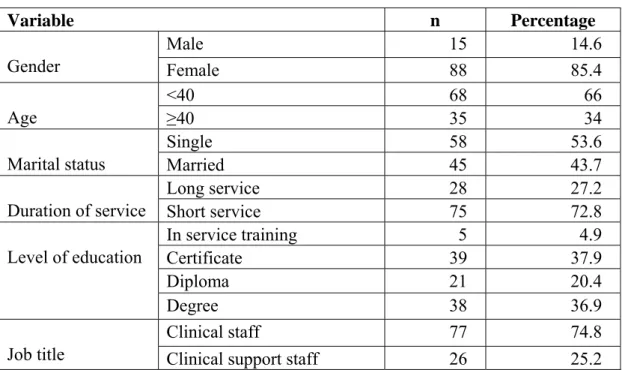
Table 1: Socio-demographic characteristics of respondents
Variable n Percentage
Male 15 14.6
Gender Female 88 85.4
<40 68 66
Age ≥40 35 34
Single 58 53.6
Marital status Married 45 43.7
Long service 28 27.2
Duration of service Short service 75 72.8
In service training 5 4.9
Certificate 39 37.9
Diploma 21 20.4
Level of education
Degree 38 36.9
Clinical staff 77 74.8
Job title Clinical support staff 26 25.2
A total of 103 respondents participated in the study. Table 1 above indicates that the majority of the participants were females (85.4%).The minimum age of respondents was 36 years and the maximum age 63 years. Most respondents were between the ages of 20 and 39 years (66%). More than half (56.3%) of the respondents were single. The study showed that nearly three-quarters of the respondents (72.8%) had a short duration of service at this hospital. With regard to level of education, 38% of the participants were in possession of a certificate while 36.9% had a university degree.
The larger proportion was clinical staff (74.8%) while the remaining 25.2% were clinical support staff.
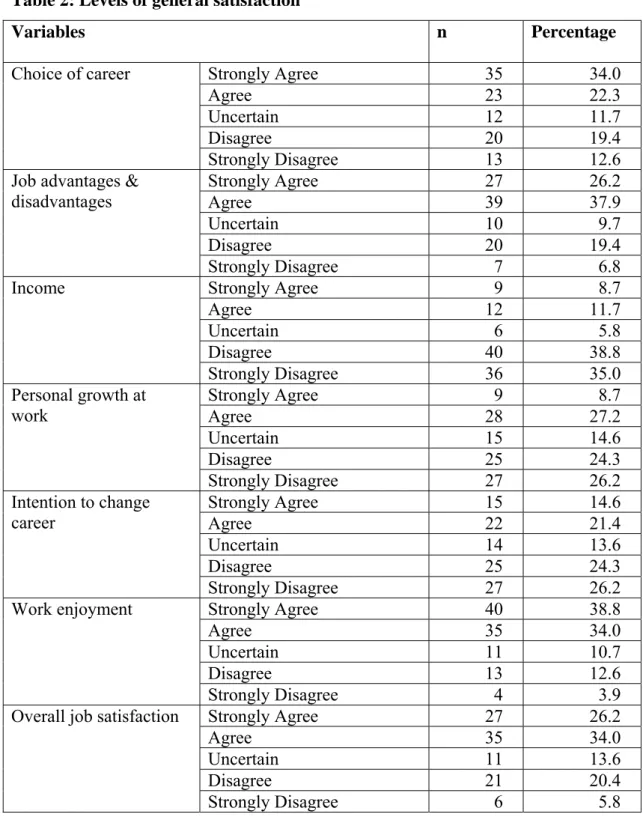
Table 2: Levels of general satisfaction
Variables n Percentage
Strongly Agree 35 34.0
Agree 23 22.3
Uncertain 12 11.7
Disagree 20 19.4
Choice of career
Strongly Disagree 13 12.6
Strongly Agree 27 26.2
Agree 39 37.9
Uncertain 10 9.7
Disagree 20 19.4
Job advantages &
disadvantages
Strongly Disagree 7 6.8
Strongly Agree 9 8.7
Agree 12 11.7
Uncertain 6 5.8
Disagree 40 38.8
Income
Strongly Disagree 36 35.0
Strongly Agree 9 8.7
Agree 28 27.2
Uncertain 15 14.6
Disagree 25 24.3
Personal growth at work
Strongly Disagree 27 26.2
Strongly Agree 15 14.6
Agree 22 21.4
Uncertain 14 13.6
Disagree 25 24.3
Intention to change career
Strongly Disagree 27 26.2
Strongly Agree 40 38.8
Agree 35 34.0
Uncertain 11 10.7
Disagree 13 12.6
Work enjoyment
Strongly Disagree 4 3.9
Strongly Agree 27 26.2
Agree 35 34.0
Uncertain 11 13.6
Disagree 21 20.4
Overall job satisfaction
Strongly Disagree 6 5.8
The reader should refer to the questionnaire (Appendix B) and the exact phrasing of the statements, in order to interpret the results shown in the following tables. Table 2 shows the results from the first section, general satisfaction. The results indicated that 34.0% of participants strongly agreed that if they had to choose a career again, they
would choose the same career. Almost two-thirds (a total of 64.1%) agreed ort strongly agreed that their job had more advantages than disadvantages. Almost three- quarters of respondents (38.8% + 35%) did not think that their income was the reflection of the job they do. While a total of 35.9% of the respondents believed that there was personal growth in their work, over half (24.3% + 26.2%) did not experience any personal growth. The study showed that just over half of respondents (24.3+26.2) had no intention of changing their career. Nearly thirty-nine per cent (38.8%) strongly agreed that they enjoyed their work, with another 34% saying they agreed they enjoyed their work, while only 3.9% strongly disagreed. More than half the respondents (26.2% + 34%) indicated that in general they were satisfied with their jobs.
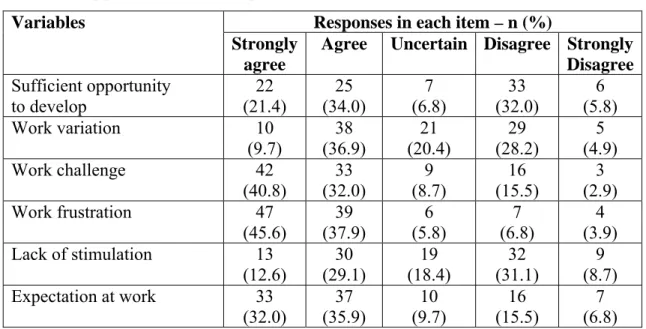
Table 3: Opportunity to develop
Responses in each item – n (%) Variables
Strongly agree
Agree Uncertain Disagree Strongly Disagree Sufficient opportunity
to develop
22 (21.4)
25 (34.0)
7 (6.8)
33 (32.0)
6 (5.8)
Work variation 10
(9.7) 38
(36.9) 21
(20.4) 29
(28.2) 5 (4.9)
Work challenge 42
(40.8) 33
(32.0) 9
(8.7) 16
(15.5) 3 (2.9) Work frustration 47
(45.6)
39 (37.9)
6 (5.8)
7 (6.8)
4 (3.9) Lack of stimulation 13
(12.6)
30 (29.1)
19 (18.4)
32 (31.1)
9 (8.7) Expectation at work 33
(32.0)
37 (35.9)
10 (9.7)
16 (15.5)
7 (6.8)
It can be seen in Table 3 that more than half the respondents (a total of 55.4%) agreed or strongly agreed that there were sufficient opportunities for self-development, while under half (a total of 46.6%) agreed or strongly agreed that they were satisfied with the variation within their work. Nearly three-quarters (a total of 72.8%) reported that they find their work challenging while at the same time a total of 83.5% agreed or strongly agreed that they experienced frustration in their work due to limited resources. The proportions agreeing and disagreeing about lack of stimulation were about the same. However, a clear majority (a total of 67.9%) indicated that too much was expected from them at work.
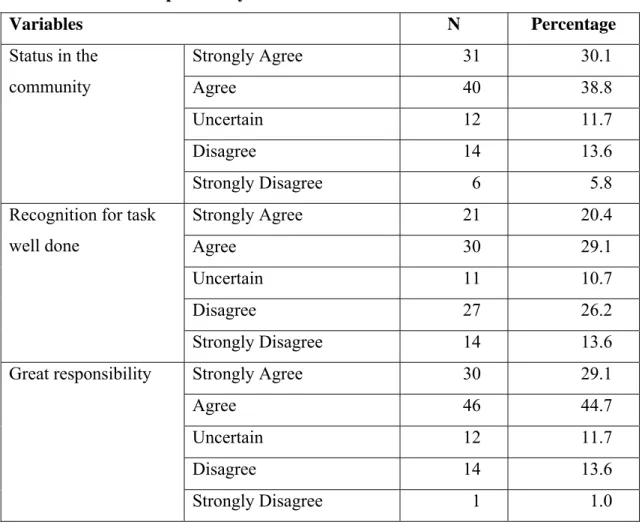
Table 4: Level of responsibility
Variables N Percentage
Strongly Agree 31 30.1
Agree 40 38.8
Uncertain 12 11.7
Disagree 14 13.6
Status in the community
Strongly Disagree 6 5.8
Strongly Agree 21 20.4
Agree 30 29.1
Uncertain 11 10.7
Disagree 27 26.2
Recognition for task well done
Strongly Disagree 14 13.6
Strongly Agree 30 29.1
Agree 46 44.7
Uncertain 12 11.7
Disagree 14 13.6
Great responsibility
Strongly Disagree 1 1.0
The results in Table 4 show that while over two-thirds of respondents (38.8% + 30.1%) enjoyed their status in the community as healthcare professionals, and nearly three-quarters (44.7% + 29.1%) perceive that they carry great responsibility, fewer,
just under half (29.1% + 20.4%), agreed or strongly agreed that they receive recognition for tasks well done.
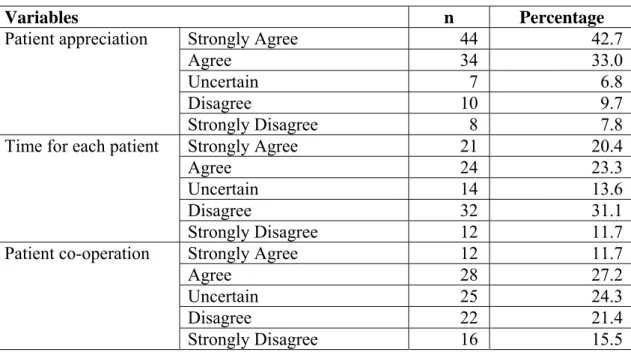
Table 5: Patient care
Variables n Percentage
Strongly Agree 44 42.7
Agree 34 33.0
Uncertain 7 6.8
Disagree 10 9.7
Patient appreciation
Strongly Disagree 8 7.8
Strongly Agree 21 20.4
Agree 24 23.3
Uncertain 14 13.6
Disagree 32 31.1
Time for each patient
Strongly Disagree 12 11.7
Strongly Agree 12 11.7
Agree 28 27.2
Uncertain 25 24.3
Disagree 22 21.4
Patient co-operation
Strongly Disagree 16 15.5
Almost forty-three per cent of participants (42.7%) strongly agreed that the patients do appreciate what they do for them, and a further third (33.0%) agreed. Nearly a third of respondents (31.1%) indicated that they do not have sufficient time for each patient, but overall, if agreed and strongly agreed are combined, and disagree and strongly disagree are combined, opinions on this issue are fairly evenly divided.
Opinions on patient co-operation were also fairly evenly spread.
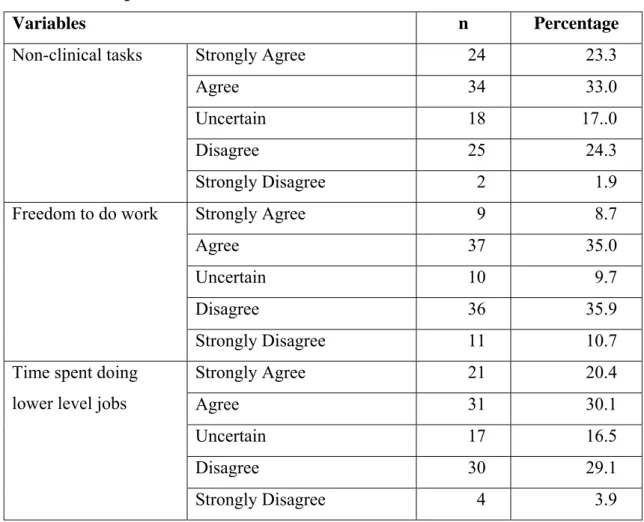
Table 6: Time pressure
Variables n Percentage
Strongly Agree 24 23.3
Agree 34 33.0
Uncertain 18 17..0
Disagree 25 24.3
Non-clinical tasks
Strongly Disagree 2 1.9
Strongly Agree 9 8.7
Agree 37 35.0
Uncertain 10 9.7
Disagree 36 35.9
Freedom to do work
Strongly Disagree 11 10.7
Strongly Agree 21 20.4
Agree 31 30.1
Uncertain 17 16.5
Disagree 30 29.1
Time spent doing lower level jobs
Strongly Disagree 4 3.9
In total well over half the participants agreed or strongly agreed that they have to perform many non-clinical tasks (33.0% + 23.3%). Views about freedom to decide how they do their work were fairly evenly spread. Just over half of all participants agreed or strongly agreed (30.1% + 20.4%) that they spend time doing tasks that could be done by lower cadres.
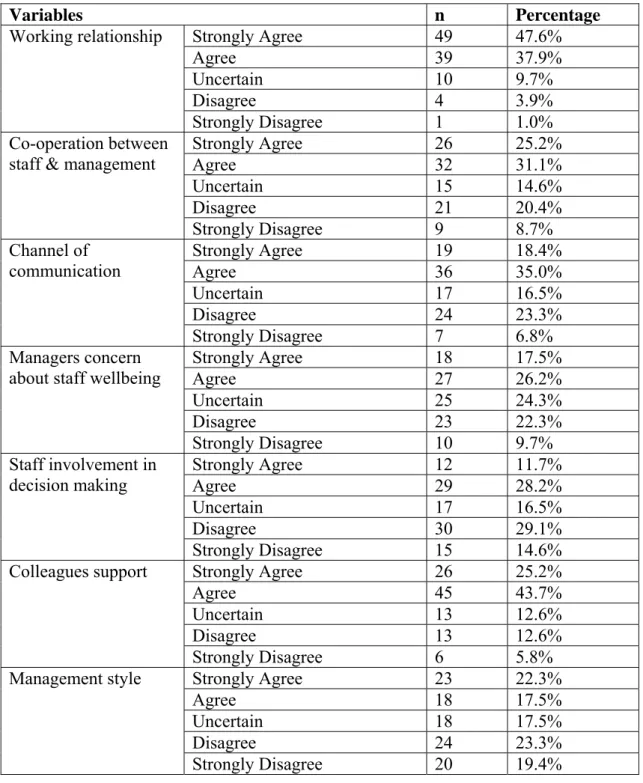
Table 7: Staff relations
Variables n Percentage
Strongly Agree 49 47.6%
Agree 39 37.9%
Uncertain 10 9.7%
Disagree 4 3.9%
Working relationship
Strongly Disagree 1 1.0%
Strongly Agree 26 25.2%
Agree 32 31.1%
Uncertain 15 14.6%
Disagree 21 20.4%
Co-operation between staff & management
Strongly Disagree 9 8.7%
Strongly Agree 19 18.4%
Agree 36 35.0%
Uncertain 17 16.5%
Disagree 24 23.3%
Channel of communication
Strongly Disagree 7 6.8%
Strongly Agree 18 17.5%
Agree 27 26.2%
Uncertain 25 24.3%
Disagree 23 22.3%
Managers concern about staff wellbeing
Strongly Disagree 10 9.7%
Strongly Agree 12 11.7%
Agree 29 28.2%
Uncertain 17 16.5%
Disagree 30 29.1%
Staff involvement in decision making
Strongly Disagree 15 14.6%
Strongly Agree 26 25.2%
Agree 45 43.7%
Uncertain 13 12.6%
Disagree 13 12.6%
Colleagues support
Strongly Disagree 6 5.8%
Strongly Agree 23 22.3%
Agree 18 17.5%
Uncertain 18 17.5%
Disagree 24 23.3%
Management style
Strongly Disagree 20 19.4%
The results show that a good majority (47.6% + 37.9%) reported having a good working relationship with their colleagues. Well over half agreed or strongly agreed (31.1% + 25.2%) agreed that there is an atmosphere of co-operation between staff and management and similar proportions (35.0% + 18.4%) indicated that there is a clear channel of communication. However fewer (26.2% + 17.5%) agreed or strongly
agreed that their managers are concerned about their well-being, while the proportions who believed that management involves staff in decision-making were lower than those who said they did not involve them. Nearly seventy per cent (68.9% taken together) agreed or strongly agreed that they can depend on their colleagues for support, but opinions on management style were more evenly spread.
4.2 INFERENTIAL STATISTICS
In this section, the overall results given above are further analyzed to elicit possible correlations that will contribute to making inferences.
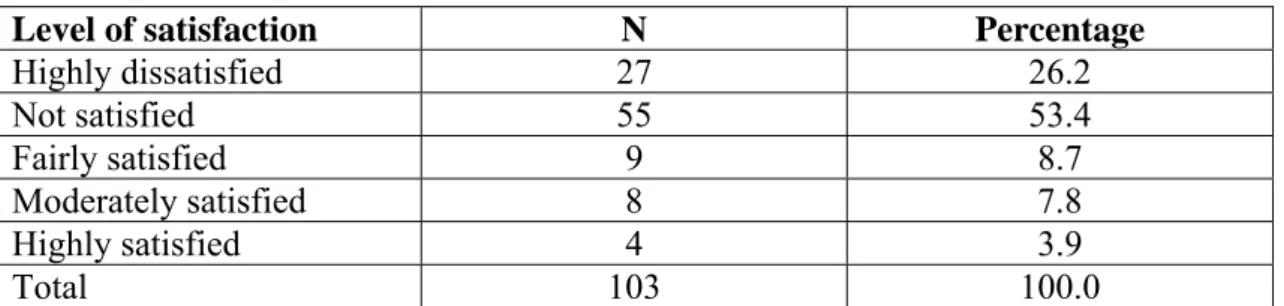
Table 8: Level of job satisfaction
Level of satisfaction N Percentage
Highly dissatisfied 27 26.2
Not satisfied 55 53.4
Fairly satisfied 9 8.7
Moderately satisfied 8 7.8
Highly satisfied 4 3.9
Total 103 100.0
The level of job satisfaction among respondents was tested using the satisfaction questionnaire. The level of job satisfaction was grouped into: 2 = highly satisfied, 1=satisfied, -2 highly dissatisfied, -1= dissatisfied, 0=uncertain. It was then recoded as follows: strongly agree + agree =1 (satisfied); strongly disagree + disagree = -1 (dissatisfied).
For the purposes of this study, respondents who obtained a score of <0 were classified as “highly dissatisfied”, those who obtained a score of 0-49 were regarded as “not satisfied”, a score of 50-59 depicted “fairly satisfied and participants who obtained a score of 60-69 were classified as “moderately satisfied, and a score >70 indicated
“highly satisfied”.
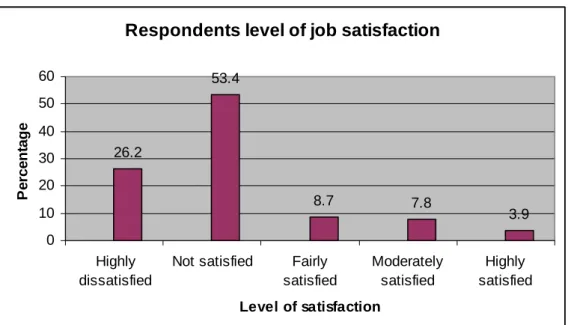
Respondents level of job satisfaction
26.2
53.4
8.7 7.8
3.9 0
10 20 30 40 50 60
Highly dissatisfied
Not satisfied Fairly satisfied
Moderately satisfied
Highly satisfied Level of satisfaction
Percentage
Figure 1: Bar chart depicting the respondents’ level of job satisfaction
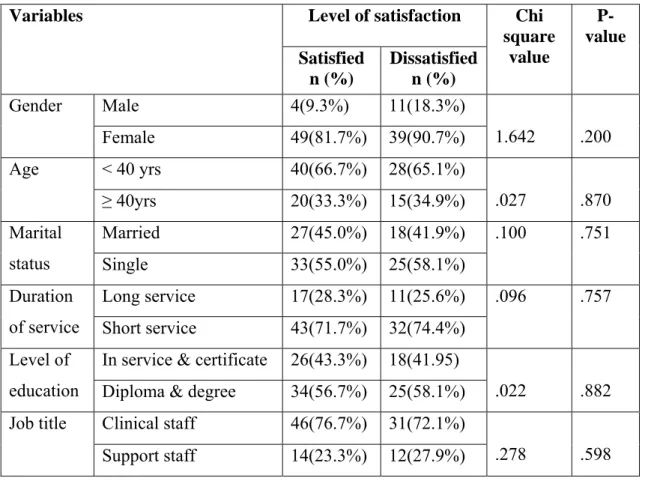
Table 9: Association between socio-demographics and level of satisfaction Level of satisfaction
Variables
Satisfied n (%)
Dissatisfied n (%)
Chi square
value
P- value
Male 4(9.3%) 11(18.3%)
Gender
Female 49(81.7%) 39(90.7%) 1.642 .200
< 40 yrs 40(66.7%) 28(65.1%) Age
≥ 40yrs 20(33.3%) 15(34.9%) .027 .870
Married 27(45.0%) 18(41.9%)
Marital
status Single 33(55.0%) 25(58.1%)
.100 .751
Long service 17(28.3%) 11(25.6%) Duration
of service Short service 43(71.7%) 32(74.4%)
.096 .757
In service & certificate 26(43.3%) 18(41.95) Level of
education Diploma & degree 34(56.7%) 25(58.1%) .022 .882 Clinical staff 46(76.7%) 31(72.1%)
Job title
Support staff 14(23.3%) 12(27.9%) .278 .598
Table 9 above shows chi-square analysis results between respondents’ socio- demographic characteristics and level of satisfaction. The results indicate that there is no relationship and no proportional difference.
Table 10: Comparison of factors associated with job satisfaction Level of satisfaction
Variables
Dissatisfied Satisfied
Chi square
value
P-value
Low 37(53.6%) 32(46.4%) Opportunity to
develop High 6(17.6%) 28(82.4%)
12.122 .000
Low 25(73.5%) 9(26.5%)
Responsibility
High 18(26.1%) 51(73.9%)
21.080 .000
Low 27(61.4%) 17(38.6%) Patient care
High 16(27.1%) 43(72.9%)
12.154 .000
Low 30(42.9%) 40(57.1%) Time pressure
High 13(39.4%) 20(60.6%)
.111 .739
Low 26(57.8%) 19(42.2%) Staff relations
High 17(29.3%) 41(70.7%)
8.444 .004
Table 10 show the chi-square analysis results of factors associated with job satisfaction. The results showed that opportunity to develop, responsibility, patient care and staff relations were significantly associated with job satisfaction. Almost eighty-three per cent (82.4%) of respondents were highly satisfied with the opportunity to develop at their workplace, at p value .000. Almost three-quarters (73.9%) of participants were significantly satisfied with their responsibilities. The results also indicated that respondents were significantly satisfied with the level of patient care and staff relations at p value .004.
Table 11: Comparison of dimensions of job satisfaction between clinical staff and clinical support staff
Variables n Mean Standard
deviation T- value
P- value Clinical support staff 26 1.2308 5.21005
General
satisfaction Clinical staff 77 2.5065 5.78479
-.996 .322
Clinical support staff 26 3.4231 5.39758 Staff relations
Clinical staff 77 2.7013 6.01110
.543 .589
Clinical support staff 26 -.3846 2.48317 Time pressure
Clinical staff 77 -1.0519 2.10823
1.333 .186
Clinical support staff 26 .8846 2.67323 Patient care
Clinical staff 77 1.0519 3.18672
-.240 .810
Clinical support staff 26 1.6154 2.28170 Responsibility
Clinical staff 77 1.8312 2.70186
-.365 .716
Clinical support staff 26 -1.1154 4.40297 Opportunity
to develop Clinical staff 77 -.2597 3.58139
-.992 .323
Table 11 shows the results of mean comparison between clinical staff and clinical support staff with regards to dimensions of job satisfaction. The results show that there is no mean difference between the two groups for all dimensions of job satisfaction.
Table 12: Correlations between dimensions of job satisfaction General
satisfaction
Staff relations
Time pressure
Patient care
Respon- sibility
Opportunity to develop General
satisfaction
1 Staff relations 443** 1
Time pressure .089 .269** 1
Patient care .443** .509** .155 1
Responsibility .576** .427** .264** .514** 1 Opportunity to
develop
.582** .452** .267** .304** .477** 1
** Correlation is significant at the 0.01 level (2-tailed)
Table 12 shows the results of Pearson correlations that measure the relationship between general satisfaction and each individual job satisfaction dimension. Overall, general satisfaction and all the individual components of job satisfaction had a positive medium relationship with each other at a low to medium level. There is no relationship between general satisfaction and patient care. General job satisfaction has a significant positive medium association with staff relations (r = .44), patient care (r
= .44), responsibility (r = .58), and the opportunity to develop (r = .58), all at a p- value of less than 0.01.
CHAPTER V
DISCUSSION, CONCLUSION AND RECOMMENDATIONS
5.1 DISCUSSION
The findings of this study have limited generalizability and may need to be confirmed by further research in other hospitals in South Africa. However numerous studies in different parts of the world such as Iran, Kuwait and Rome do allow for direct comparison with the current study. With this limitation in mind, the study evaluated factors influencing job satisfaction among healthcare professionals in South Rand Hospital and the results highlighted overall dissatisfaction. The finding of a low level of job satisfaction is consistent with the results of the 2003 study by Gigantesco et al in Rome.
Participants reported low satisfaction with salaries, not being involved in decision making, doing a lot of non-clinical tasks and not having sufficient time with patients.
Employees’ needs and motivators vary so it is important to understand what motivates them to perform. In the current study, variables such as the opportunity to develop, responsibility, patient care and staff relations were seen to have a significant influence on job satisfaction. This is not surprising, in that these findings are in line with the two-factor theory proposed by Herzberg and Mausner, which lists the following factors as motivators resulting in satisfaction: responsibility, achievement, recognition and opportunities to develop. Reasons for dissatisfaction in this study were also found to be in line with the hygiene factors responsible for job dissatisfaction, which include salaries, quality of supervision and working conditions.
5.1.1 Level of general satisfaction
The study showed that 26.2% of participants were highly dissatisfied with their job, while more than a third (53.4%) were not satisfied. These findings were supportive of the findings of Jovic-Vranes et al (2007) in Serbia, where the study found a very low level of job satisfaction and a generally low level of any kind of job-related satisfaction in Serbian healthcare workers. Overall dissatisfaction among healthcare
professionals at South Rand Hospital is a cause for concern, given that job satisfaction has implications for the efficiency, effectiveness and sustainability of the South African health system. The results suggest that working conditions at South Rand Hospital do not meet the values and aspirations of healthcare professionals. According to Smith (2002), people respond unfavorably to restrictive work environments therefore it is imperative for organizations to create working environment that enable the employees the ability and freedom to think, engaging and motivating the workforce to reach a higher level of job satisfaction. Ayers (2005) suggests that the work environment should motivate employees to perform at their best and show commitment to the organization, enhancing work conditions to support the organization’s mission and thus impacting on job satisfaction. The conditions under which jobs are performed can have as much impact on people’s effectiveness, comfort and safety as the intrinsic details of the task itself.
Dissatisfaction with income, lack of staff involvement in decision-making, the amount of time spent with patients, working conditions and management style are some of the problems indentified in this study. Similar findings were observed in the job satisfaction study among Serbian healthcare workers. According to the authors, a possible explanation of these findings is that political, social and cultural transition in Serbia combined with the impact of conflict resulted in a deterioration of all aspects of life.
South Africa has dual healthcare system in which the public sector is usually under- resourced and serves the majority of the population, while the private sector accounts for 60% of health expenditure and serves less than 20% of the population. The disparity between these two sectors has increased the burden of the public sector, which is perceived as inefficient, ineffective and unable to deliver quality healthcare.
It is possible that these conditions impact on job satisfaction among healthcare professionals.
Almost nine per cent (8.7%) of respondents in the present study were fairly satisfied with their job and a small proportion (7.8%) was moderately satisfied while only