i UNIVERSITY OF KWAZULU-NATAL
FUNDRAISING COMPLEXITIES FOR HIGHER EDUCATION IN SOUTH AFRICA: A CASE STUDY OF THE UNIVERSITY OF KWAZULU-NATAL
By
Stephen Camden Camp 921360392
A dissertation submitted in partial fulfillment of the requirement for the Degree of Masters of Commerce
Graduate School of Business and Leadership College of Law and Management Studies
Supervisor: Professor Paul Green
2018
ii Declaration
I, Stephen Camden Camp, declare the research reported in this dissertation is my original research. Any work done by other persons has been acknowledged as being sources from persons in text. This dissertation has not been submitted for any other degree or examination at any other university.
Signature.
Date:
iii Acknowledgements
During my Masters journey, there have been many ups and downs and I am most grateful to the support network around me for the encouragement, understanding and input that enabled me to stay focussed, motivated and moving forward. It is thanks to a small group of fantastic people that I finally reached this milestone.
Firstly I would like to express my sincere appreciation to my supervisor, Professor Paul Green. Thank you for all your support, guidance and for sharing your immense knowledge throughout this journey.
I would like to thank UKZN for providing financial assistance and all the respondents who took part in my data collection surveys.
To my partner, Dr Sally Frost, words are insufficient to express the sacrifice, patience and support you have provided during the past year. Without your support, inspiration, encouragement and proofing expertise, this journey could not have been successful.
To my daughter and son, Sarah and Stuart, I really appreciated all your loving words of encouragement and enthusiasm along the way and for understanding the family sacrifices I had to make at times.
iv ABSTRACT
Higher education institutions in South Africa are challenged by rising costs that outrun available revenue. With inflation, reduction of state subsidies and the recent student #FeesMustFall campaign, universities are finding it increasingly difficult to retain their academic credibility, research outputs and core infrastructure maintenance in the face of declining funds. Without substantial and reliable funding, they have no option but to source third stream income, primarily from corporates, trusts, alumni and other philanthropic donors. This takes place in a highly competitive environment as South African university fundraisers compete locally and internationally for funding opportunities. The aim of this study was to gain a better understanding of the fundraising complexities for higher education in South Africa, in particular, via a case study examination of how the University of KwaZulu- Natal (UKZN), through its fundraising office, managed its stakeholders towards generating a third stream of income. The objectives for the study were to investigate the status quo of UKZN’s donor groupings and their donor sentiments in relation to UKZN; to examine how the UKZN Foundation managed stakeholder engagement with its donor community; and to develop a conceptual model of best practice for donor management in a university environment. A qualitative research methodology was adopted whereby an on-line questionnaire was sent to individual, corporate and philanthropic trust donees (external sample of 30 with 19 responses); as well as face-to-face interviews being conducted with UKZN Foundation fundraising staff (internal focus group of five with four responses). Knowledge gained through the study uncovered insights and facilitated a better understanding of the highly competitive environment of higher education third stream fundraising. The study revealed the importance of stakeholder engagement. In terms of donor sentiment towards UKZN, donors indicated they wanted to be heard, they wanted feedback, they needed an inspirational cause and they liked to feel connected to a project.
Stakeholder engagement was hindered internally by a low fundraising culture throughout the university, low staff morale within the UKZN Foundation and projects that were not strategically aligned to UKZN`s broader vision. External hindrances included a damaged UKZN brand owing to student violence and the #FeesMustFall protests, and a sluggish economy. A model of best practice for donor management was presented that focuses on building donor stewardship, enhancing the
v university’s reputation, growing the fundraising investment of the institutional leadership, and optimising the fundraising competencies of Foundation staff. A key recommendation is that the leadership and staff of the UKZN Foundation draft a fundraising strategy document in consultation with key internal and external stakeholders. This document should promote positive donor stewardship as the cornerstone to successful fundraising. The primary benefit of introducing a fundraiser and stakeholder management strategy is to encourage the institution to examine its own competitive positioning, including the status quo of its current stakeholder relationships, their strengths and weaknesses and ultimately, the institution’s overall level of philanthropic fundraising success.
vi Table of Contents
Description Page
Title Page i
Declaration ii
Acknowledgements iii
Abstract iv
Table of Contents vi
List of Figures xii
List of Tables xiv
List of Acronyms and Abbreviations xv
List of Definitions xvii
CHAPTER ONE Introduction 1.1 Introduction 1
1.2 Background 3
1.3 Problem Statement 10
1.4 Significance of the Study 10
1.5 Aim and Objectives 11
1.6 Research Questions 12
1.7 Structure of the Dissertation 12
1.8 Definition of Key Terms 13
1.9 Conclusion 16
CHAPTER TWO Literature Review 2.1 Introduction 17
2.2 The Role of Tertiary Education in the National Economy 17
2.3 Decline in State Funding for Higher Education 18
vii
Description Page
2.4 Philanthropic Funding within Higher Education 23
2.5 Growing Importance of Philanthropic Funding in Higher Education 29
2.6 Philanthropic Donor Patterns for Higher Education in South Africa 33
2.7 Corporate Social Investment and the Impact on Philanthropic Funding in South Africa 45
2.8 Factors Affecting Successful Higher Education Funding 47
2.9 Basic Fundraising Principles 49
2.10 Factors that Hinder Donor Giving and Philanthropic Support 52
2.11 The University of KwaZulu-Natal (UKZN) and the UKZN Foundation 56
2.11.1 UKZN 56
2.11.2 UKZN Foundation 57
2.11.3 The Early Beginnings (1923 – 1925) 58
2.11.4 The Foundation`s First Significant Fundraising Campaign (1929 – 1932) 58
2.11.5 The Constitution and Pre-War Efforts (1933 – 1945) 59
2.11.6 The Start of a Drive on a New Ten-Year Fundraising Plan (1946 – 1950) 61
2.11. 7 The Securing of Funds, Some Early Experiences (1946 – 1950) 62
2.11.8 Challenges of Fundraising from Past Students in the 1950`s 63
2.11.9 Enter the Modern Era 63
2.12 Stakeholder Management Theory 65
2.13 Conclusion 68
viii
Description Page
CHAPTER THREE Research Methodology
3.1 Introduction 69
3.2 Research Aims and Objectives 69
3.3 Research Design 70
3.3.1 Case Study 71
3.4 Population and Sample 72
3.5 Sampling Method 72
3.6 Data Sources 74
3.6.1 Primary Data Sources 74
3.6.2 Secondary Data Sources 74
3.7 Data Collection Methods 75
3.7.1 Face-to-Face Interviews 77
3.7.2 On-line Questionnaire 77
3.8 Data Capture 78
3.9 Data Analysis 78
3.9.1 Thematic Analysis 79
3.10 Reliability, Validity and Trustworthiness of the Research Findings 80
3.11 Ethical Clearance Considerations 81
3.12 Conclusion 82
CHAPTER FOUR Findings and Discussion 4.1 Introduction 83
4.2 Findings 83
4.2.1 Theme 1: Donor Sentiments Towards UKZN – External 84
4.2.1.1 Donors Want to be Heard 84
ix
Description Page
4.2.1.2 Donors Want Feedback 85
4.2.1.3 Donors Need an Inspirational Cause 87
4.2.1.4 Donors Want to Feel Connected 88
4.2.2 Theme 2: Factors that Discourage Donor Philanthropy 88 4.2.2.1 Administrative Inefficiencies 89
4.2.2.2 Communication Inefficiencies 89
4.2.2.3 Brand Inefficiencies 89
4.2.3 Theme 3: Factors that Encourage Donor Philanthropy 92
4.2.3.1 Business Strategy, Corporate Social Responsibility and Investment 93
4.2.3.2 Positive Sentiment 94
4.2.3.3 Ability to Build Relationships 95
4.2.3.4 Academic Programme Leadership 95
4.2.3.5 Detailed Knowledge of the Project 97
4.2.3.6 Passion for the Project 98
4.2.3.7 The Impact of the Donation 99
4.2.3.8 Belief and the Strategic Vision of the Project 101 4.2.3.9 Being Able to be Specific about the Donation 101
4.2.3.10 Ability to be Involved with the Project 102
4.2.3.11 Good Stewardship 103
4.2.3.12 Tangible Project Results 105
4.2.4 Theme 4: Factors that Hinder Fundraising Success 105
4.2.4.1 Internal Barriers that Hinder Fundraising Success 106
4.2.4.2 External Barriers that Hinder Fundraising 108
x
Description Page
4.3 Development of a Model for Best Practice of Donor Management at
UKZN Foundation 110
4.4 Achieving a Positive Culture of Fundraising 112
4.4.1 Alignment of Individual, Fundraising Office and Institutional Values 113
4.4.2 Alignment of Fundraising Support with Institutional Strategic Goals and Projects 114
4.4.3 Structure and Culture 115
4.5 Strategies to Provide Sustainability and Optimisation of Donations to UKZN 115
4.5.1 Getting the Fundraising Fundamentals Right 119
4.6 Factors Important to Successful Fundraising 123
4.6.1 Reputation 123
4.6.2 Leadership 124
4.6.3 Foundation Staff 125
4.6.4 The Donor 127
4.7 Conclusion 129
CHAPTER FIVE Conclusion and Recommendations for Future Studies 5.1 Introduction 131
5.2 Summary of Findings 132
5.2.1 What is the Current Status Quo of UKZN`s Donor Groupings and their Donor Sentiment in Relation to UKZN? 132
5.2.2 How does the UKZN Foundation Manage Stakeholder Engagement with its Donors? 133
xi
Description Page
5.2.3 What Conceptual Model of Best Practice for the Donor Management in a University Environment can be
Extrapolated from Research? 134
5.3 Discussion 135
5.3.1 Donor Perspectives of UKZN 135
5.3.2 UKZN Foundation Management of Stakeholder
Relationships 136
5.3.3 Conceptual Model of Best Practice for Donor
Management 138
5.3.4 Strategies to Optimise Donations into the Future 139
5.4 Overview and Summary 140
5.5 Study Implications for Further Research 141 5.5.1 The Value of Qualitative Research 141 5.5.2 Directions for Further Research 142
5.6 Dissertation Summary 142
References 144
Appendix 1 Gatekeeper’s Letter 159
Appendix 2 Ethical Clearance Approval Letter 161 Appendix 3 Informed Letter of Consent 162
Appendix 4 External Questionnaire 164
Appendix 5 Internal Questionnaire 165
Appendix 6 Turnitin Report 166
xii List of Figures
Number Description Page
1.1 Throughput of Students 6
2.1 Government Expenditure 2016/17 20
2.2 Political Cartoon on #FeesMustFall 22
2.3 South African Universities Streams of Income 26
2.4 Donor Sector Comparisons with UK and USA 27
2.5 Voluntary Donor Support for higher Education in USA 28
2.6 SA Universities Reliant on Student Fees for their Income 31
2.7 Philanthropic Income for Participating Universities 32
2.8 Distribution of Income 2016 34
2.9 Distribution of Income 2013 34
2.10 Distribution of Donors 2016 35
2.11 Income by Donor Sector 2013 36
2.12 Income by Donor Sector 2016 36
2.13 Income by Philanthropic Sector 37
2.14 Distribution of Private Donors 2016 38
2.15 Distribution of Private Donors 2013 38
2.16 Local versus International Private Funding 2016 39
2.17 Local versus International Private Funding 2013 40
2.18 Distribution of Private Income 2013 41
2.19 Distribution of Private Income 2015 41
2.20 Mean Value of Donations and Geographic Source 42
2.21 First Time Donors as a Proportion of All Donors to the University 43
2.22 Philanthropic Donors to Participating Universities 2.23 Distribution of CSI Expenditure by Development Sector: Comparing 1998 to 2017 46
2.24 Category of Education CSI Spend – 2017 46
xiii
Number Description Page
2.25 Type of CSI Education Intervention - 2017 47 2.26 The Elements of an Institution’s Professional Fundraising 51
Operation
2.27 The Stakeholder Map in Higher Education 67 4.1 Shifts in CSI Spend on Education: Comparison from
1999-2017 93
xiv List of Tables
Number Description Page
1.1 Funding of Public Higher Education Institutions in South Africa 8 2.1 Donor Giving in South Africa by Race and Sex 55 4.1 Internal Barriers that Hinder Fundraising Success 107 4.2 External Barriers that Hinder Fundraising Success 109 4.3 Model of Best Practice for Donor Management within a
University Environment 111
4.4 Factors Important to Successful Fundraising 128
xv List of Acronyms and Abbreviations
ASPIHE Annual Survey of Philanthropy in Higher Education BBBEE Broad Based Black Economic Empowerment BEE Black Economic Empowerment
CAE Council for Aid to Education
CASE Council for Advancement and Support of Education CHE Council on Higher Education
CHERTL Centre for Higher Education Research, Learning and Teaching (Rhodes University)
CSI Corporate Social Investment
CSIR Council for Scientific and Industrial Research CSR Corporate Social Responsibility
DHET Department of Higher Education and Training DOE Department of Education
DUT Durban University of Technology DVC Deputy Vice-Chancellor
FET Further Education and Training GDP Gross Domestic Product
HDI Historically Disadvantaged Institution
HEFCE Higher Education Funding Council for England HEI Higher Education Institution
HEQC Higher Education Quality Committee
HESA Higher Education South Africa (now Universities South Africa) NCHE National Commission on Higher Education
NDP National Development Plan
NPHE National Plan for Higher Education NSC National Senior Certificate
NSFAS National Student Financial Aid Scheme
OECD Organisation for Economic Co-operation and Development SADC Southern African Development Community
xvi SARUA Southern African Regional Universities Association
SETA Sector Education and Training Authority TEFSA Tertiary Education Fund for South Africa
TVET Technical and Vocational Education and Training VSE Voluntary Support of Education
UCT University of Cape Town UKZN University of KwaZulu-Natal UNISA University of South Africa
xvii List of Definitions
Basic Education: Also referred to as pre-university, basic education is education below the level of tertiary education. This typically includes primary education along with secondary education.
Broad Based Black Economic Empowerment: A programme in South Africa that seeks to redress inequalities caused by Apartheid. It effects this by providing previously disadvantaged groups with economic privileges previously not available to them. (BEE Partner, South Africa Economic Watch).
FeesMustFall: A student movement founded in 2015 that recognises university education as a public good and operating with the mandate of ensuring university fees are abolished.
Full Cost of Study: All-inclusive university costs including the costs of tuition, accommodation, meals, books and basic necessities.
Heher Commission: The Fees Commission that was established in January 2016 to inquire into, report on and make recommendations on the feasibility of a fee-free higher education. It was chaired by Justice Jonathan Arthur Heher.
Missing Middle: Students who are above the National Student Financial Aid Scheme (NSFAS) threshold and as such don’t qualify for NSFAS funding but for whom university education is still considered unaffordable. (News24)
NSFAS National Student Financial Aid System. A loan and bursary scheme funded by The Department of Higher Education and Training for students who lack funding for university studies.
OECD Organisation for Economic Co-operation and Development. An international organisation formed to strengthen world trade and commit to democracy and solve common problems countries face.
Public Universities: The 26 universities in the Republic of South Africa that are predominantly funded by state funding.
School Quintiles: The classification of high schools from poorest to richest by the Department of Basic Education in order to allocated funds to subsidise each learner.
SETA Sector Education and Training Authority. Their main function is to contribute to the raising of skills, to bring skills to the employed, or those wanting to be employed, in their section (National Skills Authority).
xviii Skills Development Fund: A centralised funding pool whose cash resources are
used to fund training and education in order to reduce skills gap in the economy.
Skills Development Levy: A Levy imposed on companies in order to generate money that will pay for skills development and improvement. The funds raised are paid into the Skills Development Fund
State Funding: Government contribution to the education system at large.
Tax Rebate: A tax benefit granted to a corporate or an individual whereby the taxpayer’s payable tax to SARS is reduced by a specified amount.
TVET Technical and Vocational Education and Training. The 50 Colleges which provide student education and training aligned with a specific job, employment or entrepreneurship.
1
CHAPTER ONE Introduction
_________________________________________________________________
1.1 Introduction
Investing in higher education is unquestionably one of the most effective ways in which to combat severe poverty, stimulate the economy and reduce the ubiquitous inequality in South Africa. Higher education provides citizens, especially the poor, with a real opportunity to transform their lives and break the cycle of poverty. Access to higher education also enables citizens to participate actively and contribute to the national economic growth.
While South Africa, since 1994, has made significant strides in improving access to higher education for students, the reality is that with the spiralling costs of higher education, higher education is now becoming increasingly unaffordable for many families, especially amongst the working and lower middle class (DHET, Presidential Commission on Higher Education and Training, 10 August 2016).
Despite the realisation by the Government of the importance of higher education in growing the economy, in real terms state funding for higher education is steadily declining. The 2015/6 #FeesMustFall campaign exerted additional financial pressures on universities who were already struggling to make ends meet in tough economic times. Higher education institutions are increasingly challenged by escalating cost pressures, which in the long term are threatening to outrun available revenues.
In December 2017, President Jacob Zuma announced that government would introduce fully subsidised free higher education and training for poor and working- class undergraduate students. This would start in 2018 for first-year students at public universities and be phased in over five years. Despite this support for
2 students, there has not been any adjustment or increase in subsidies for institutions of higher education.
It is against this background that South African universities have no option but to seek third stream income in order to retain their academic credibility, programmes, research outputs as well as building and facility maintenance, including improvements to core educational infrastructure such as laboratories, libraries, lecture theatres and student accommodation. The vast majority of the higher educational institutions in South Africa are now committing substantial resources to fundraising and have entered an era where fundraising has become a necessity.
The sources for university third stream funding is primarily from corporates, trusts, alumni and other philanthropic donors. This takes place in a highly competitive environment as South African university fundraisers collectively compete locally and internationally for these funding opportunities.
Globally, universities have invested in establishing fundraising offices in recognition of the crucial role that philanthropy plays in higher education to secure funding from alumni, business and private philanthropy.
This research is based around the strategic fundraising office of the University of KwaZulu-Natal (UKZN), known as the University of KwaZulu-Natal Foundation (UKZN Foundation). It seeks to understand better the complexities of higher education fundraising and to look at ways in which fundraising success could be improved. It further investigates the donor community and their reasons for philanthropically supporting higher educational institutions, in particular the University of KwaZulu-Natal.
Chapter one has thus far provided a brief introduction to the study and will now provide a more detailed background to the topic. Thereafter it will offer a problem
3 statement that will be further investigated throughout the study. The significance of conducting this study and its benefits will be outlined. The aim and objectives of the study – from which the research questions are drawn – will be presented. The limitations of the study will be provided. Finally the chapter will conclude with a breakdown of the proceeding chapters.
1.2 Background
It is globally accepted that higher education is a fundamental ingredient that provides the development and economic stability needed for any successful economy to grow. Much of what is being done at universities is linked to a country’s skills needs, as universities produce the professionals that run the health, education, financial, legal, scientific, agricultural and other sectors, without whom a modern society cannot survive. Universities also have another purpose: at their best they are the crucibles of creativity, the sine qua non of the post-industrial world. While some might view universities as no more than nodes of education, they are in fact microcosms of our society and echo almost every aspect of human efforts to strive for excellence, advancement and innovation in solving challenges in a fast-changing world. Without high quality universities, the thousands of competent graduates they produce and the rich research they engage in, society itself cannot progress.
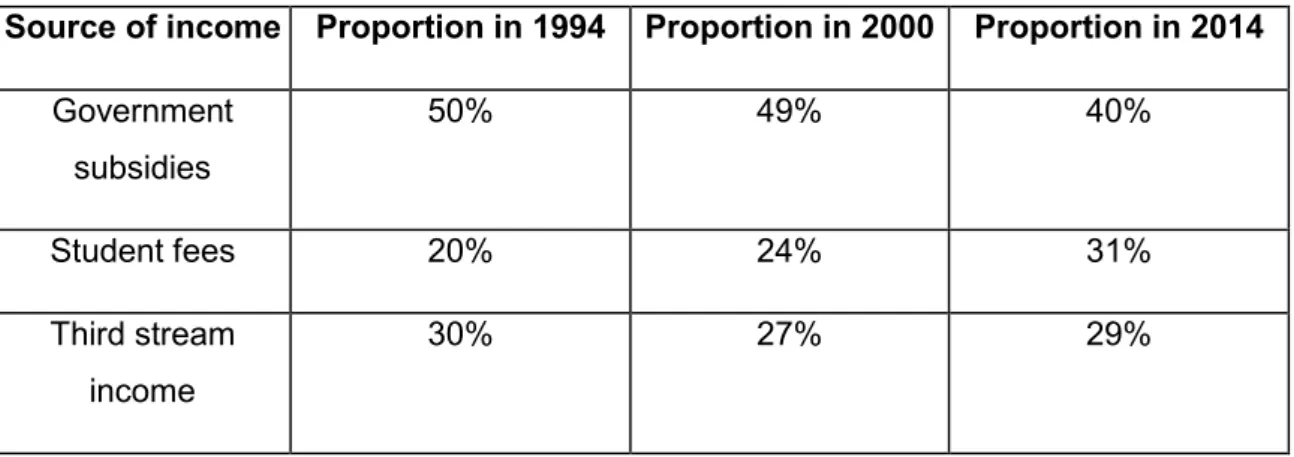
South Africa, a country seeking to develop beyond the state of poverty and inequality that it finds itself in today, is faced by many challenges; some of which are in the higher education sector. The country`s universities are grossly underfunded, sometimes poorly managed and neglected by government. Of the problems facing South African universities, one of the most pressing, according to Archer (2017), is that as institutions they are inadequately funded. State contributions to South African universities declined from 49% at the beginning of the century to 40% by 2012, while the burden on higher education of additional students registering increased from 24% to 31% during the same period (DHET, Report of the Ministerial, Committee for the Review of the Funding of Universities, October 2013). The #FeesMustFall protests and subsequent call for fee-free education is symptomatic of this decline in higher education funding. With less real money
4 available per student, it is hardly surprising that the South African university academic year frequently starts off with student protests demanding free education, lower or capped tuition fees; or that South African universities found themselves on the receiving end of the #FeesMustFall campaign.
Internationally and within South Africa, public universities generally receive funding from three recognised streams of income. These are:
First stream income, i.e. government subsidies. Within the South African context this involves funds from the Treasury, directed through the Department of Higher Education and Training. These are normally based upon a set formula.
Second stream income, i.e. student fees. These are fees paid by either students themselves, or non-government donors and companies who pay the fees on behalf of the students.
Third stream income, i.e. income derived from grants, trusts, foundations, contracts and donations from foreign sources (such as the European Union), private and philanthropic sources.
These three sources of funding work in tandem to create the economic foundations of any university system. What happens in one area will affect what happens in the others (Bozzoli, 2016).
In the last 20 years there has been a significant increase in the number of students entering South African universities – a trend acknowledged by the Department of Higher Education, who at times has forced such increases upon universities.
According to a 2013 higher education funding review:
Various universities are also put under extreme pressure to enrol more students than planned for, especially in instances where the NSC results improve drastically for a particular year and where more students qualify for university entry (DHET: Report of the Ministerial Committee for the Review of the Funding of Universities, October 2013).
5 Whilst the government has expanded the system to increase student enrolments into higher education, they have unfortunately not kept the state subsidy in line with inflation. As student enrolment numbers have increased, in real terms, subsidies have decreased. As classes have enlarged, the numbers of academics have remained stagnant. As poor students have been encouraged to attend in ever larger numbers, financial support for them has grown, but not sufficiently fast enough, (DHET: Funding the Post-School Education and Training Sector and the Feasibility of fee-free Higher Education and Training, October, 2016).
By international standards, South Africa has a very high dropout rate, particularly amongst its undergraduate students. One study of throughput rates for students who began in 2006 and 2007 showed that the total dropout rate in South Africa was 42.2% for three year degrees, 45.4% for four year degrees, and 57.1% for three year diplomas at contact universities (CHE: South African Higher Education Reviewed: Two Decades of Democracy, 2016). By comparison, dropout rates in the 37 member countries of the Organisation for Economic Co-operation and Development (OECD countries) was about 30%. This means they are producing a far greater number of graduates for their investment in universities (CHE: South African Higher Education Reviewed: Two Decades of Democracy, 2016). There are a host of systemic problems which contribute to this high dropout rate. The major one is South Africa’s dismally performing basic education system. The University Funding Review (2013) noted that South Africa’s education system “perform[ed]
sub-optimally” and left students “under-prepared for university education” (DHET:
Report of the Ministerial Committee for the Review of the Funding of Universities, October 2013).
6 Figure 1.1 Throughput of Students
Source: CHE: South African Higher Education Reviewed: Two Decades of Democracy, 2016
Universities find themselves in an untenable position. They are saddled with having both to compensate for the poor schooling system and to produce graduates and research of a high standard with speed and efficiency. To compensate for the educational deficiencies in the students admitted to universities, these institutions are expected to design and create courses for first year students in Mathematics, Science and English that will bring them up to acceptable university standards. This is an area that the state has identified as key to improving university pass rates. As crucial as these programmes are to ensure that ill-equipped students have a reasonable opportunity to pass, none are provided with any additional funding by the state. They are funded from university income. As shown in Figure 1.1, the decline in university subsidies has inevitably led to a fall in funding for such critically important university bridging courses, leaving the dismal dropout rate intact. Low or falling subsidies directly and negatively affect the dropout rate.
7 UKZN has a number of such bridging programmes. The College of Agriculture, Engineering and Sciences’ Access Programme recognises that whilst these learners may not have qualified for entry into the mainstream science and engineering degrees, they may still have the potential to be future scientists and engineers. Approximately 500 students in each year are given an opportunity to gain entry into a science and engineering degree via the Access Programme. This is based on the understanding that these degrees will take an extra year as compared to students who enter through the direct entry route. These students are given additional tuition and academic counselling to enhance their chances of success.
The costs for this to UKZN is R23 million a year and the programme is not subsidised by the state.
In 2010 the World Bank cautioned of the risks associated with increasing student enrolments without adequate funding. Furthermore, the World Bank (2010), found that in a context of, “inadequate public financing and resource diversification, admitting increasing numbers of students results in a deterioration in quality”; and that, with diminishing resources and increasing student numbers, “universities find it increasingly difficult to maintain adequate student-teacher ratios, lecture halls are overcrowded, buildings fall into disrepair, teaching equipment is not replaced, investment in research and in training new instructors is insufficient, and many lecturers are obliged to supplement their income by offering their services in the private sector”.
The knock-on effect of declining student government subsidies cannot be examined in isolation and needs to be seen in the context of the other associated costs for maintaining a healthy higher education sector. University operational costs tend to be more or less fixed. According to Bozzoli (2016), approximately 60% of these fixed costs are accounted for with salaries, electricity and water, municipal rates, costs of running residences, cleaning, internationally priced books, laboratory, IT, field trips and general maintenance costs. In the past ten years, each of these costs have increased at rates exceeding inflation and the falling value of the Rand. Outsourcing
8 of non-core functions has been one way in which universities have attempted to save on fixed costs; however, the 2015/16 #FeesMustFall campaign and student protests effectively brought an end to this. Bozzoli (2016), furthermore points out that the ending of outsourcing has added an estimated further R2–3 billion per annum to university costs.
Student fees are considered to be almost the only sustainable source of income for universities and one on which they are heavily dependent. When this funding balance is distorted for whatever reason, the system undergoes dramatic changes, which can have serious knock-on effects. Given the dramatic growth of student enrolment not aligned with continued inflation adjusted government subsidies, the South African university system has experienced a serious distortion in these income sources over the past twenty years.
Table 1.1 Funding of Public Higher Education Institutions in South Africa Source: PWC report,Moving forward - A review of annual reporting by South African public higher education institutions 2010-2012, September 2014
Source of income Proportion in 1994 Proportion in 2000 Proportion in 2014 Government
subsidies
50% 49% 40%
Student fees 20% 24% 31%
Third stream income
30% 27% 29%
This funding pressure exerted on higher education has been acknowledged by the Department of Higher Education and Training:
9 The underlying cause of the annual increases in university fees is insufficient funding of full-time equivalent enrolments by the state. This, together with higher education inflation which is higher than general levels of inflation, has resulted in institutions needing to balance their books by increasing student fees. (Memorandum from the Parliamentary Office, National Assembly for Oral reply, question 535, 2015).
In order to achieve some level of financial sustainability, the declining subsidies have meant annual fee increases by the universities to pay for the essentials.
Another area of concern for universities is gross student debt. Student debt before provision for doubtful debt was 27.8% of income from tuition fees in 2014, increasing from R3.617 billion in 2012 to R5.451 billion in 2014 – a 50.7% increase. This debt figure did not include NSFAS loans to poor students. Student debt for 2016 has increased with universities reporting that in the wake of the #FeesMustFall campaign it has become increasingly difficult to recover fee payments from students. 2016 figures revealed that 13 South African universities’ gross student debt as a percentage of tuition fees was above the sector average of 27.8%. That of UKZN was sitting at 47.4% (South African Higher Education Reviewed, Two Decades of Democracy, 2016).
UKZN is one of the universities faced by these financial challenges and it has become more important than ever for it to find ways to increase revenue in an effort to counterbalance all the demands. Growth in student numbers without matching growth in subsidy funding, together with other rising costs, has placed pressure on the institution to increase its fundraising efforts to raise third stream income.
Through its fundraising office, known as the UKZN Foundation, UKZN is committed to seek funding for strategic projects.
It is imperative to gain insights into the fundraising success and challenges faced by the UKZN Foundation. Equally important is to understand why donors give towards higher education, in particular those supporting UKZN; and to look for ways in which
10 the Foundation could be more proficient through its on-going endeavours to raise third stream funding.
1.3 Problem Statement
This study is aimed at determining if third stream funding is both source-able and sustainable, given the backdrop of a decline in state funding in higher education. In the preceding section it was shown that the higher education sector is struggling financially to maintain a sufficient level of income from state funding (first stream income) and student fees (second stream income). The increasing reliance of universities on attracting third stream income (private and philanthropic grants and donations) to fund infrastructure and research projects has been noted.
Within this context, the researcher has explored to what extent the UKZN Foundation has been successful in raising third stream income; some of the challenges it has faced; its relationship with its donors; and has considered ways in which it could improve its fundraising strategies.
1.4 Significance of the Study
A significant responsibility rests on the UKZN Foundation to attract critical funds for research, infrastructure upgrades and strategic projects of importance as identified in the UKZN Strategic Plan 2017-2021. By implication, this level of responsibility is shouldered by the Executive Director and fundraising staff of the Foundation, known as Development Officers. Hence, it is important to ensure that employees who occupy these roles presently and in the future, have a solid understanding of the complexities involved in raising third stream income for the higher education sector.
Moreover, it is relevant to explore ways in which this process can be improved within the UKZN Foundation.
Apart from the Annual Survey of Philanthropy in Higher Education (ASPIHE) released by the South African Institute for Advancement, Inyathelo, information
11 about the state of philanthropic support to higher education institutions in South Africa continues to be sparse and scattered. Those few universities who do collect relevant data in a rigorous or organised way for internal purposes, seldom make it available to others and nothing approaching a national perspective is readily available. This lack of information about philanthropic funding to the higher education sector and indeed about all forms of third stream income, has taken on added significance in the context of the growing national crisis in university and student funding and the protest actions which have foreshadowed it.
A case study of higher education fundraising in action based on the UKZN Foundation is significant. As a microcosm, the UKZN Foundation experience provides insight into the complexities of fundraising for higher education in South Africa. In offering some successes and looking at donor sentiments and motivations, it proposes a fundraising model that is relevant to the higher education sector on a macro level.
1.5 Aim and Objectives
The aim of this study was to gain a better understanding of the fundraising complexities for higher education in South Africa, in particular, via a case study examination of how the University of KwaZulu-Natal through its fundraising office.
The objectives for the study were:
1. To investigate the status quo of UKZN’s donor groupings and their donor sentiments in relation to UKZN.
2. To examine how the UKZN Foundation managed stakeholder engagement with its donor community.
3. To develop a conceptual model of best practice for donor management in a university environment.
4. To recommend strategies that will provide sustainability and optimisation of donations to UKZN.
12 1.6 Research Questions
The following research questions were investigated:
1. What is the current status quo of UKZN’s donor groupings and their donor sentiments in relation to UKZN?
2. How does the UKZN Foundation manage stakeholder engagement with its donor community?
3. What conceptual model of best practice for donor management in a university environment can be extrapolated from the research?
4. What strategies will provide sustainability and optimisation of donations to UKZN?
1.7 Structure of the Dissertation Chapter 1 – Introduction
This chapter provided an introduction to the study. This includes the background to the case study and the problem statement which motivated the researcher to conduct the study. It outlines the aim and objectives of the study as well as the research questions that were posed. The chapter highlights the significance of the study and how it will be a beneficial body of knowledge.
Chapter 2 - Literature Review
This chapter contains a critical review of the relevant literature pertaining to the topic. It looks at the current financial challenges faced by higher education in South Africa and how reliant universities have become on generating third stream income.
The research was broadened to include international studies in the area of philanthropic support for higher education, factors affecting successful higher education funding and the growing importance of philanthropic funding in higher education.
The literature review also looks at philanthropic donor patterns for higher education in South Africa, some basic fundraising principles and factors that hinder donor giving and philanthropic support. Finally, it looks at the University of KwaZulu-Natal, the UKZN Foundation and stakeholder management theory.
13 Chapter 3 – Research Methodology
This chapter focuses on the research methodology applied in the study. It outlines the initial research design adopted for the investigation, based on a case study approach. Case study research allows the exploration and understanding of complex issues. It can be considered a robust research method particularly when a holistic, in-depth investigation is required (Zainal, 2007). The data collection strategy used for the case study is then introduced. This is followed by the population and sampling strategy that was applied: how the data was captured, analysed and displayed. Finally, the chapter goes on to review the validation and reliability of the data and concludes by looking at ethical considerations.
Chapter 4 – Results and Discussion
In this chapter detailed findings are provided from both the literature and primary data that were collected and grouped into themes that emerged for the analysis.
These themes were further expounded by linking them to the research questions that were formulated at the start of the study as well as the literature that was reviewed.
Chapter 5 – Conclusions and Recommendations
Chapter 5 draws from the analysis of the study and presents related recommendations and limitations. It provides suggestions for further areas of research that may benefit the UKZN Foundation; and ends with a conclusion of the study.
1.8 Definition of Key Terms
Similar to many professions, fundraising and development practitioners use terms unique to this field. This section lists and defines jargon used in the fundraising environment. The following list is not intended to be exhaustive, but rather serves as a reference point to understand these terms when used by the researcher.
Acknowledgement. Acknowledgement refers to a written expression of gratitude for a donation, gift or service.
14 Advancement Office. This is a term commonly associated with American and European universities, though at times South African universities use it as well. It refers to the fundraising office of the university that is responsible for establishing a range of relationships with external stakeholders such as alumni, donors, community partners, corporate partners, local and national government partners (Weerts, 2007).
Alumni. These are people, normally past students and staff, who are connected to the university by virtue of their past affinity role (Chung-Hoon et al, 2005).
Bequest. This is the transfer by a will of monies or tangible property to a third party.
Campaign. This is an organised effort to raise funds for a project.
Case for Support. The case for support includes carefully prepared reasons why a charitable institution merits financial support, including its resources, its potential for greater service, its needs and its future plans (Temple, 2003).
Corporate Philanthropy. Support through equipment, supplies, monies or other contributions by a business or individual to a charitable institution, sometimes through organised programmes that may also include corporate foundations, constitutes corporate philanthropy (Temple, 2003).
Corporate Social Responsibility and Corporate Social Investment. Corporate social responsibility (CSR) is how companies manage their business processes to produce an overall positive impact on society. It covers sustainability, social impact and ethics, and if done correctly should be about core business – how companies make their money – not just add-on extras such as philanthropy. In South Africa, Corporate Social Investment (CSI) guidelines are legislated and strongly liked to Broad Based Black Economic Empowerment (BBBEE), whereby companies are graded from level one to level four on a BEE scorecard, depending on their level of investment in recognised corporate social investment projects and associated initiatives.
15 Cultivation. This is the process of promoting and encouraging interest or involvement on the part of a potential donor. It is an educative process to inform others about an institution and the reasons why it merits support (Temple, 2003).
Culture of an Organisation. The prevailing values, traditions and social norms of the organisation define its culture. People often describe the culture by saying, “How we do things around here”, to describe what they expect and understand about how things work within the organisation (Chung-Hoon et al, 2005).
Development. This is a term that describes a sophisticated process that begins with the institution’s strategic plan, from which specific financial needs and fundraising goals are derived. Following this, prospects are identified who have the capability and possible interest in supporting those needs. These prospects are then engaged in the life of the institution and informed of its needs and goals. If a good relationship results between the prospect and the development officer, funding will occur and if successful will be followed up by stewardship (Worth, 1993).
Development Officer. This person is the individual responsible for designing and implementing the donor cycle, which includes identification, cultivation, solicitation and stewardship. At the UKZN Foundation, there are four such persons who provide this function, who are known as senior development officers.
Donor. This is anyone who gives something of value to an organisation with no expectation of anything in return (Chung-Hoon, et al, 2003).
Donor Recognition. This is the policy and practice of showing appreciation for a donation. Normally this is done initially by a card, letter or email and subsequently through personalised notes, personal expressions of appreciation directly to the donor, published lists of contributors, publicised media coverage and other appropriate ways.
Donor Relations. A planned programme of maintaining donor interest through acknowledgement, information, personal involvement and other means.
16 Donor Retention. This refers to the ability of the development officers in a non-profit organisation (in this case the UKZN Foundation) to keep their donors making charitable contributions from year to year (Sargeant, 2001).
Endowment. This describes the principal or corpus maintained in a permanent fund to provide income for general or restricted use of an agency, institution or programme.
Gift. A voluntary, irrevocable transfer of something of value without receiving anything tangible in return at the time of the transfer or at any time in the future, is accepted as a gift.
Philanthropy. The donation of a gift or funds to an institution whereby nothing is expected or given in return.
Stewardship. Describes the philosophy and means by which an institution exercises ethical accountability in the use of contributed resources and the positive and active manner it acknowledges the donation.
1.9 Conclusion
This chapter has provided a broad insight into the nature of the study, viz.
fundraising within the higher education context, with the focus being on UKZN as a relevant case study. It has discussed the background to the study area together with the rationale that led the researcher to conduct the study, namely, the increasing reliance of South African universities on third stream income given the decline in state subsidies and guaranteed income from student fees; and by inference, the increasing importance of this third stream source of funding for universities. The intention of this study is to contribute to a better understanding of the complexities involved in fundraising for higher education, specifically in relation to the UKZN Foundation; and ultimately to contribute to the literature that exists on third stream funding for the higher education sector in South Africa.
17
CHAPTER TWO Literature Review
________________________________________________________
2.1 Introduction
This chapter sets out to examine literature that will support the study and aid in explaining concepts around the complexities of fundraising in higher education in South Africa. Its aim is to elucidate the subsequent discussion and results.
Aspects such as the realities of reduced government funding in higher education, trends of philanthropic funding in higher education globally and nationally, the growing importance of philanthropic funding in higher education and challenges affecting successful higher education fundraising are important to appreciate within the relevant theoretical background to this study.
This chapter further looks at an overview of third stream fundraising at UKZN, examines the importance of stakeholder engagement with donors and considers higher education fundraising models of best practice.
2.2 The Role of Tertiary Education in the National Economy
It is universally accepted that tertiary education and skills development are significant determinants of innovation and economic growth, as highlighted by Hawkes et al (2012). Education provides both private and public benefits to Society.
Investment in education enhances the chances of individuals finding work and participating in the labour market. As more individuals acquire education and skills and enter the labour market, aggregate productivity grows, leading to economic growth, (Glewwe, 2002). Studies in labour economics have shown that the level of education of an individual is related to earnings in the labour market.
18 Engelbrecht (2003) makes an important assertion with reference to other studies that have shown individuals with higher education are most likely to access capital and engage in investment activities in both local and international markets, thereby contributing towards economic growth. Furthermore, increasing the proportions of individuals with specialised skills developed at tertiary level allows national economies to adapt to global challenges and take advantage of technological advances that enhance economic growth.
Within the South African context, the National Development Plan, The Presidency (2011) provides a framework to eliminate poverty and reduce inequality by 2030.
The plan acknowledges the critical role of education in improving the social and economic circumstances of the citizenry and enhancing the country’s global competitiveness. According to the National Development Plan (NDP), by 2030 the higher education system is expected to produce university and college graduates with the skills and knowledge to meet the changing needs of the South African economy.First Rand Foundation (2013) points out that the National Development Plan projects over a 30-year period the number of graduates with a minimum bachelor’s qualification will have increased from a baseline of 2.6 million graduates in 2001 to 10 million graduates in 2030.
2.3 Decline in State Funding for Higher Education
The state funding model for Higher Education is based on a formula that combines a performance-based formula, earmarked funding and block grants. These funds are distributed to the institutions of Higher Education that advance government policy priorities, whereby they pay these institutions for delivering teaching and research services as specified in government approved plans. Block grants comprise of: (a) teaching funds calculated by student enrolment and costs per student based on subjects; (b) teaching funds based on agreed outputs; (c) research funds for agreed outputs; and (d) the institution’s enrolment numbers from disadvantaged groups, maximizing enrolment capacity and attaining enrolment consistency with state-designated priority areas. The Higher Education institutions
19 are informed in advance of the total amount of the block grant they will receive, while the earmarked funding is designated for specific purposes.
Despite a realisation by Government for the importance of higher education in growing the economy, in real terms state funding for higher education is steadily declining. Since 1994, funding from the state to support higher education has been on an upward trend, from R11 billion in 2006 to R26 billion in 2013, as highlighted in theHigher Education South Africa (2014), Strategic Framework 2015-2019. While at face value this is generally welcomed, the same report notes, however, that higher education expenditure has actually been declining alarmingly in student per capita terms. In South African Higher Education Reviewed, Two Decades of Democracy (2016), mention is made that the recent review of the funding formula found that although South Africa spends a considerable amount on education, its expenditure on higher education is much lower than the desirable amount which is needed.
Higher education fees have over the past decade consistently increased at above inflation rates. Calitz and Fourie (2016), point out that the cost of a Bachelor of Arts degree at Stellenbosch University has increased by 30% in a decade between 2006 and 2015, which now requires 44% of an average adult’s income to fund. A study carried out by KPMG, Economic challenges to accessing tertiary education and providing tuition-free universities in South Africa (2016) states that from 2009-2015, the consumer price index (CPI) increased at an average of 5.5% per annum, while tertiary education fees climbed by an average of nearly 9% per annum. Furthering this line of thought, KPMG argues, it therefore stands to reason that if household income were to keep pace with headline inflation, it would have increased by 45%
since 2008, while the cost of tertiary education has increased by more than 80%.
The same KPMG report emphasises that the increase in the rate of state support in 2016 was below CPI whereas the operating and personnel costs at most higher education institutions exceeded the value of state support, resulting in added
20 pressure on other revenue streams. The report further points out that there are instances where institutions suffer heavy revenue losses to electricity, water and municipal rates and taxes that have increased far above the official CPI rates.
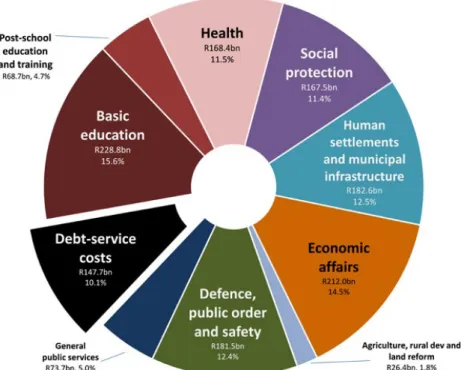
A University of Witwatersrand study; Report of the University Panel on Funding Model(s) for Higher Education in South Africa (2016), highlighted that higher education in South Africa is funded below the Organisation for Economic Co- operation and Development (OECD) and even other African country levels as a proportion of GDP. Currently the South African Government spends just 4.7% of revenue, or 0.75% of GDP, on the post-school education and training sector. The OECD on average spends 1.59% of GDP on higher education, with the UK spending 1.23% and Germany 1.31%.
Figure 2.1 Government Expenditure 2016/17 Source: National Treasury, 2016
21 This funding crisis must also be seen in the context of the increase in university student enrolments, which in the last two decades have grown significantly.
According to the report, South African Higher Education Reviewed: Two Decades of Democracy (2016), there are now almost a million students, which represents an exponential growth from the half million in 1994.
The Department of Higher Education and Training published its White Paper for Post-School Education and Training: Building an Expanded, Effective and Integrated Post-School System (2014), where it anticipates that there will be 1.6 million university students in 2030, up from 931 186 in 2011. This implies an average growth rate in student enrolment of 3.05%.
This decline in Government subsidies has put pressure on the two other sources of income available at universities, i.e. tuition fees and third stream income. The Universities of South Africa, Strategic Framework 2015-2019 (2014) emphasises that while universities have in some instances been able to increase their levels of third stream income, they have by no means been able to compensate for the significant increase in student numbers in proportion to the declining state subsidies, leaving the universities in increasingly worsening financial positions.
Student frustration with the escalating costs of higher education came to a boiling point with the 2016 #FeesMustFall campaign, a nation-wide student protest aimed at convincing Government to eliminate student tuition fees. Under pressure from the
#FeesMustFall protest action, the then Minister of Higher Education, Blade Nzimande announced that universities would be allowed to determine their own fee increase for 2017, but the adjustments could not be higher than 8%. Shortly after the Minister’s announcement student protest action became violent, resulting in R600 million in damages to a number of higher education properties according to KPMG (2016), Economic challenges to accessing tertiary education and providing tuition-free universities in South Africa.The campaign advocating for free education also rejected that the Government had allowed universities to increase fees in 2017,
22 following a 0% increase in 2016. The state has not made any compensation to universities for this shortfall in fees, causing further unplanned financial pressures.
Figure 2.2: Cartoonist Rico Schechter on #Fees Must Fall
Source: Finweek, Weekly Financial Journal, November 12, 2015
While the South African higher education system has experienced considerable growth, this growth has not been met with sufficient funding to enable the higher education sector to be financially sustainable. The government-funded National Student Financial Aid Scheme (NSFAS) has grown exponentially, from R1.3 billion in 1996 to approximately R9 billion in 2014; however, the average amount per student remains well below the real cost of study, (South African Higher Education Reviewed, Two Decades of Democracy, 2016). The higher education system in South Africa is undoubtedly under financial pressure, with a number of institutions struggling to keep the higher education project alive. Much needed resources such
23 as laboratory and engineering equipment and instruments as well as literature in the form of set books, are mostly imported and the weakening of the Rand has not made matters any easier. These effects can be particularly damaging for higher education, which often lack the resources to weather prolonged economic challenges.
In sum, it is evident from the literature that the decline in real terms of state funding in the context of growth of student enrolment, the increasing cost of tuition fees and student frustrations with respect to access and financial aid, have conspired to create an ever widening funding crises for higher education in South Africa. Thus institutions of Higher Education have been forced to seek alternative sources of income through strategic fundraising efforts.
2.4 Philanthropic Funding within Higher Education
Higher education in South Africa is funded by a combination of incomes (first stream income), government subsidies (second stream income) student fees (third stream income), derived from grants, trusts, foundations, contracts and donations from private and philanthropic sources.
Philanthropy is described in the most general of terms as the voluntary use of private assets (finance, property, know-how and skills) for the benefit of specific public causes.
Higher Education Funding Council for England`s report, The Review of Philanthropy in UK Higher Education 2012: status report and challenges for the next decade (2012) states that higher education matters enormously. According to the report, philanthropy is a force for good:
Philanthropic giving to higher education makes a partnership of immense power and value. The responsible use of wealth, solidarity across the community, and shared purpose for worthwhile aims are ideas that resonate in times both of uncertainty and of prosperity. Donors, on all scales, enable
24 remarkable people to achieve significant ends, in shorter timespans, than would otherwise be possible.
Within a South African context, a simple way of determining eligibility of income that may be classified as philanthropic is whether it qualified for a Section 18A Certificate in terms of the South African Income Tax Act No 58 of 1962 (as amended). The key here is eligibility: whether or not an 18A Certificate was actually issued, was the funding eligible for such a Certificate? If the answer is yes, the funding should be recorded as philanthropic income. Institutions should be led by the South African Revenue Services’ (SARS) definition of a bona fide donation:
A bona fide donation is a voluntary, gratuitous gift disposed of by the donor out of liberality or generosity, where the donee is enriched and the donor impoverished. There may be no quid pro quo, no reciprocal obligations and no personal benefit for the donor. If the donee gives any consideration at all it is not a donation. The donor may not impose conditions which could enable him or any connected person in relation to himself to derive some direct or
indirect benefit from the application of the donation.
(http://www.sars.gov.za/FAQs/Pages/255.aspx).
According to Rohayat et al (2016), the growing importance of philanthropy for higher education can be found across the world as institutions embrace philanthropy to satisfy their third stream funding needs.
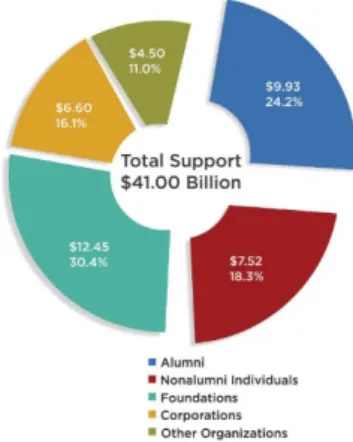
An examination of higher education third stream funding in the USA reveals that state and federal funding of public institutions has declined by 15% over a 20-year period, while income from tuition fees at public and private universities has increased by 5-10% over the same period. (National Centre for Education Studies, 1999; Paul, 2005). The shortfall in declining subsidies is made up by active fundraising, whereby universities have full-time advancement offices dedicated to raising third stream income. According to a press release from the Council for Aid to Education, Colleges and Universities Raise $41 Billion in 2016 (2016), USA universities in 2015 raised $40.3 billion, an increase of 7.6% over the previous year.
Philanthropic giving to higher education in the USA has increased every year since 2010.
25 The Canadian experience has been even more marked with declining government grants and subsidies. According to the Canadian Federation of Students, in the 1960s and 1970s, government covered more than 90% of higher education costs.
By 2013, that figure had decreased to 57%. The state of Ontario has the lowest level of per student funding in Canada. For the period 1992/93 to 2012/13, the provincial grant declined from 74% to 54% of operating revenue. According to a CBC news article (March, 2015), the gap has been filled by increased third stream funding and by tuition revenue through enrolment growth and fee increases.
In Australia and New Zealand the response to declining state subsidies has been to significantly increase revenue from overseas (mostly Asian) student fees. On average foreign student fees constituted 30% of total income in 2009. In recent years philanthropic giving to universities in both countries has also been gathering momentum. The 2016 Charitable Giving to Universities in Australia and New Zealand, identified that institutions in these countries saw strong growth in giving in 2015 with surveyed institutions recording an exponential increase of 26% in new funds sourced (AUD 538.19 million) compared to 2014. Institutions also recorded significant increase in the total number of donors (23%) and alumni donors (16%) in 2015.
Funding higher education in the United Kingdom has undergone changes in recent years with declining state funding, an increase in student fees and a greater emphasis on third stream income. The 2016 Ross-CASE Survey of higher education carried out by the Council for Advancement and Support of Education in the United Kingdom, showed that the total amount of philanthropic income secured in new funds by UK universities had gone up by 23% in the space of a year to £1.06 billion for 2015-16. The Guardian (2017) reported that those working to increase philanthropic giving in higher education commented that £1.06 billion marked a significant landmark and showed that, “philanthropy now represents an important income stream for UK universities and that philanthropic giving is now at the heart of UK university culture.”
In keeping with international trends, South African philanthropy in the last decade has become increasingly important in supporting higher education as more people
26 realise the crucial role that private donations play in the redistribution of wealth in South Africa, which in turn leads to a healthier and more balanced society. In South Africa specifically, higher education philanthropic donors include a number of stakeholder groups, high net worth individual philanthropists, private trusts and foundations, alumni and the private sector.
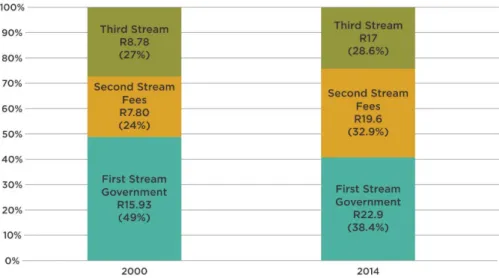
South African universities, as further confirmed by Lewin and Mawoyo (2014), have turned increasingly to third stream income to fund their operations owing to the drop in state funding and the fact that fee income has not kept up with inflation. Between 2004 and 2007, third stream income at South African universities increased by 62%.
According to research conducted by the Centre for Higher Education Research (The State of Higher Education in South Africa, 2009), third stream income accounted for 33% of the income of South African public institutions, up from 28% in 2004.
Figure 2.3 Streams of University Income (ZAR bn), 2000 and 2014
Source: DHET - Annual Financial Statements of Universities and DHET - Annexure 3
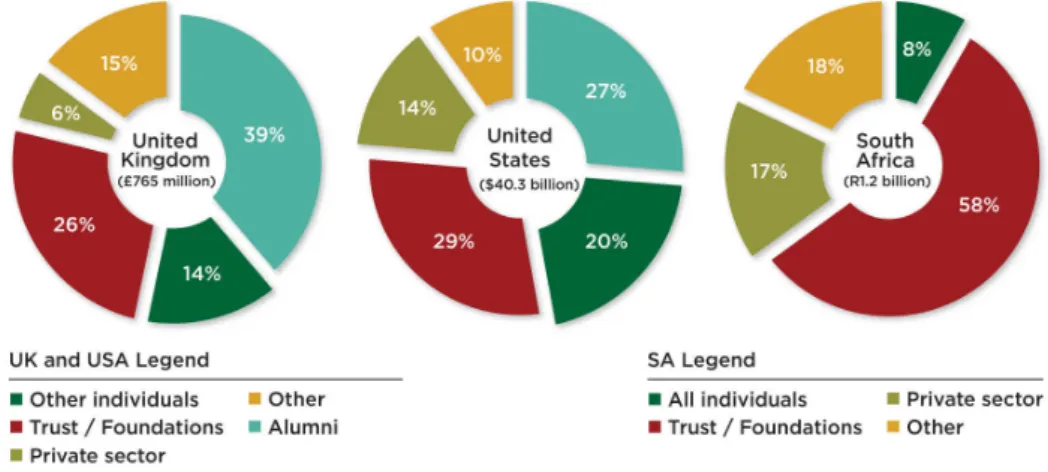
27 How does South African university funding practices compare with international institutions of higher education? According to the 2016 Annual Survey of Philanthropy in Higher Education in South Africa (ASPIHE), while the local quanta are vastly different, there is some degree of comparison between South Africa, the United Kingdom and the USA in respect to philanthropic support to higher education, as illustrated in the figure below:
Figure 2.4: Donor Sector Comparison with UK and USA
Source: 2016 Annual Survey of Philanthropy in Higher Education in South Africa
The ASPIHE report (2016), does however note some significant differences. In the 2015 sample, South African universities were considerably more reliant on trusts and foundations than their counterparts in the UK and the USA: 58% of donor income in South Africa emanated from these sources compared with 26% and 29%
in the UK and USA respectively. Moreover, individual giving comprised a comparatively small proportion of donor income to the higher education sector in South Africa. Only 8% emanated from individuals (whether alumni or not) and bequests, in contrast to 53% in the UK and 47% in the USA.
Total giving by individuals accounted for 8% of philanthropic support for South African universities in 2015, including giving by alumni. In the UK and USA, giving by non-alumni individuals alone comprised 14% and 20% of philanthropic support