The question is asked about the future of the textile industry in the South African economy. The FCU played a major role in the founding of the National Wool Growers Association of South Africa.
NAMIBIA
BOT S WAN A
The impact of the discovery of minerals on the economy of South Africa was great. 34;Determined to remain in South Africa and emboldened by the policies of the Nationalists.
NUMBER OF ESTABLISHMENTS
SALARIES AND WAGES
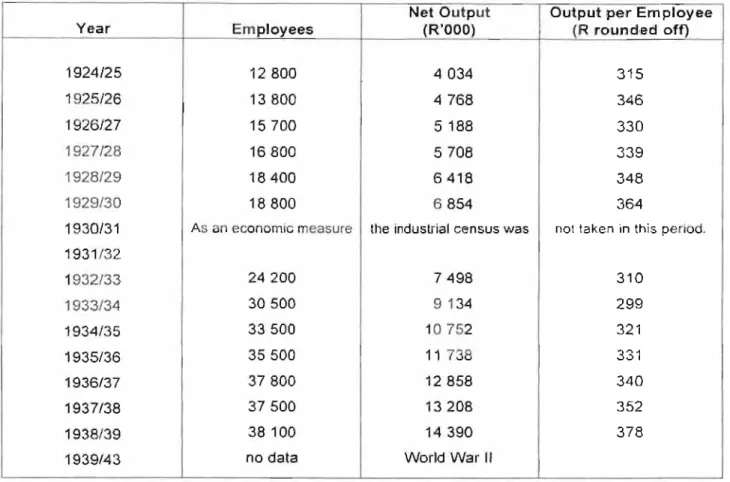
What was also very significant in the blanket industry was "a feature of the financial structure of the industry is that quite a number of mills were started as family affairs or as enterprises founded by a few individuals".77 This was first in the post World. War 11 era that corporate entities invested in the textile industry. Before 1924·25 manufacturing statistics included both private and government affairs, After 1924·25 only private manufacturing affairs were included in the industrial census.
MATERIAL COST AND VALUE OF OUTPUT
Felt and Textiles of Australia now had full control of the South African operation. The finishing, which is determined by the end use of the loom fabric (griege), can include a range of processes, for example calendering, sanforizing, printing, dyeing, mercerizing and stentering (see glossary).
TYPES OF BLANKETS, RUGS AND KAFFIR SHEETING
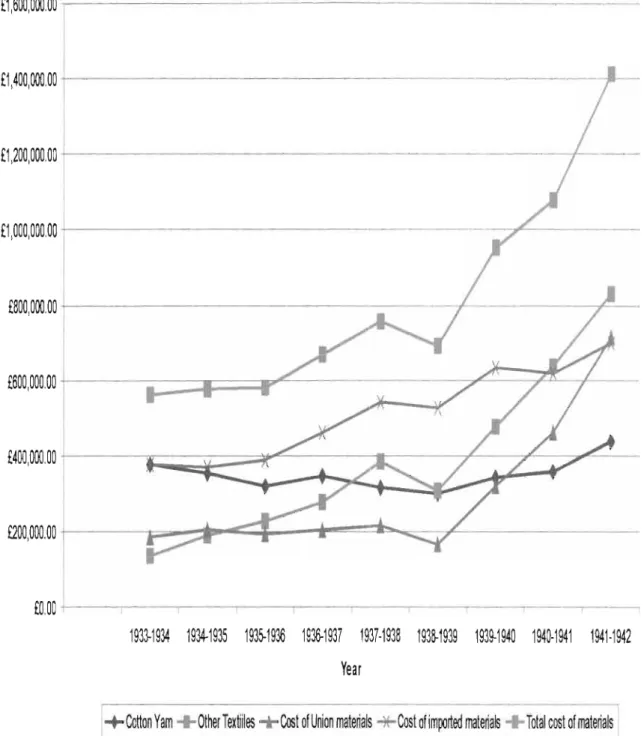
In its investigation, the Board highlighted that the quality of the locally produced heavier blankets, compared to the equivalent imported blankets, was not of the same standard. The industry consolidated from 1933 and gained momentum in the years immediately preceding World War 11, as well as in the early years of the war, when there was a dramatic acceleration in the total cost of raw materials used. It could have been stock building and the realization that the local material, mostly wool, could be used successfully, as shown in 1941/42 in the value of the Union (local) material as a percentage of total cost of material. Table 2) It is not unusual under wartime conditions for price to be of less importance, as providing a product is more important than being.
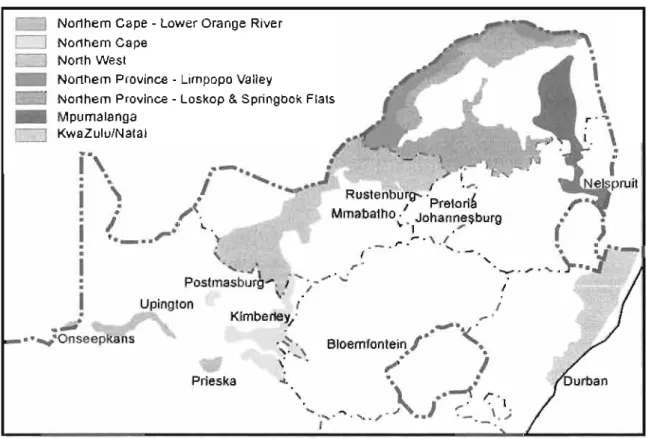
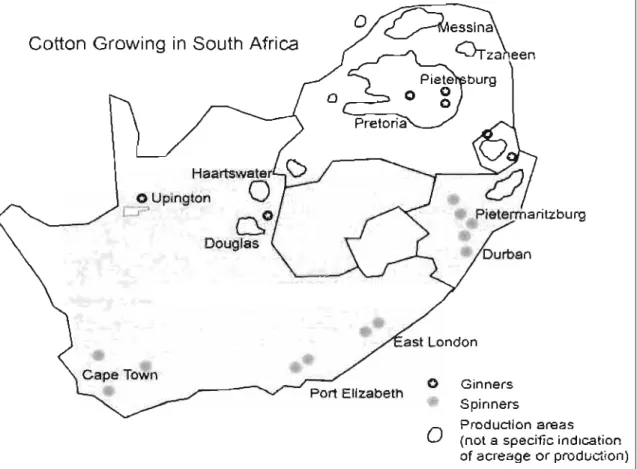
53 Stanley Bloch, retired Managing Director M Bloch & Co one of the largest distributors of kaffir sheets in South Africa Interview conducted in Durban, January 2000. The use of imported material to meet a commercial demand from 1933/34 to 1938/39 provided, was fairly steady and provided for the growth of the industry. Most of the industry was located on the eastern seabed of the cDuntry (See Map Figure 13) where a significant blanket market existed in Natal, Ciskei and Transkei.
The raw materials used were wool and cotton, with the woolen item catering to the more affluent members of the population being produced by Harris in his South African Woolen Mills Ltd. The strength of the local industry lay in the fact that it was located close to its markets. and it was able to produce a product that the market wanted. A weakness was located in the quality produced by local mills compared to the quality of the imported blanket.
REPUBLIC OF SOUTH AFRICA
HARRIS FAMILY
There are no further recorded movements in the capital structure of the Group until 23 November 1927 when the directors were appointed. At the same director's meeting, they were given a 10% bonus and the company's capital. It will be seen that on 28th February 1956 the capital of the Harris Carpet Company was £500,000 divided between convertible notes and securities.
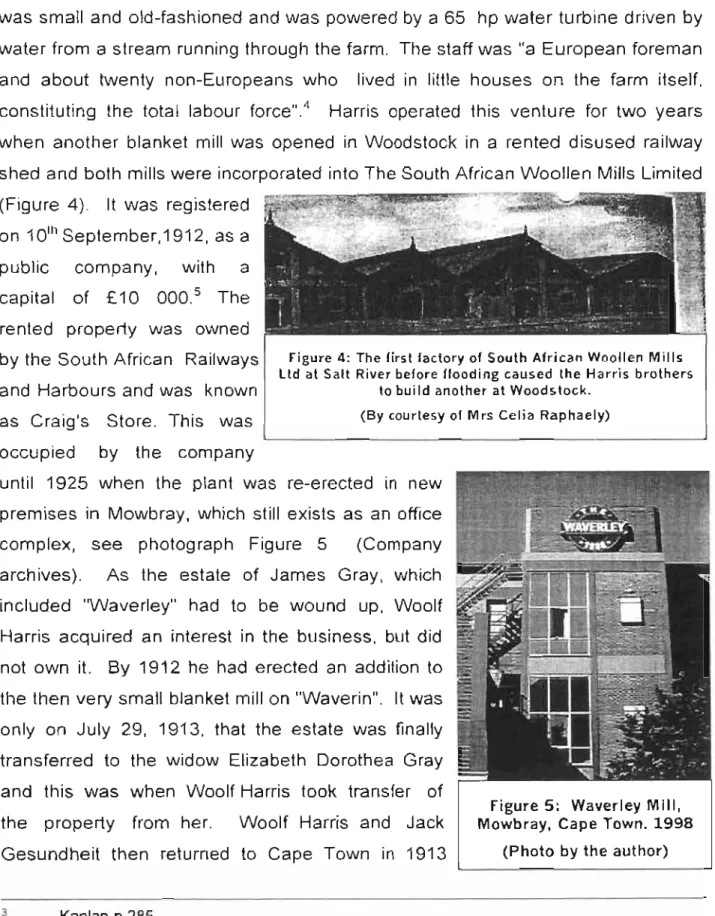
Family control is exemplified at the first meeting of directors in Cape Town in 1913 after the company was taken over on 10 September 1912 with a capital of £10,000. The story of the Harris family continues beyond the completion date (1948) of the thesis to leave no loose ends in the Harris story given Philip Frame's takeover. First mortgage of this company's land in Cape Town and Harrismith.
The looms used by South African Woolen Mills could not be adapted to produce acrylic fiber blankets and the management of the South African Woolen Mills Limited, which was in fact the Harris family, opposed the production of acrylic fiber blankets. Derrick Issacson, interviewed in Sydney, Australia in September 1996, former marketing director of the South African Woolen Mills Limited and cousin of Woolf Harris' daughter, Mrs Raphaely. There is no doubt that the Harris family were the true pioneers of the South African textile industry.
MORRIS MAUERBERGER
This led to him being treated in the operating theater of the Victoria Hospital which he and his wife recently donated." In the joint liquidator's report to creditors, the reasons for the failure of the company were high interest rates, the Asian economic collapse. and the declining world wool markets. He had many opportunities to talk to Frame after work when he visited Cape Town, often in the study of the GoUlieb house in Claremont.
This was the beginning of the Frame Group".34 He was 24 years old when he started his mill, which was no small feat. The constant dissent that arose from this unrest culminated in the formation of the first modern backwoods unions." This was a direct result of the way Frame handled the strike at his mill in 1973.
He was aware of the criticism of this policy from shareholders and financial journalists in the newspaper and business magazines. Added to all of the above was the fact that his own textile background was carpet making from his apprenticeship at ZiUau and his experience in the family business. The contribution Philip Frame made to the South African textile and clothing industry and the country's economy was truly significant.
It is clear that he had no money in the sense of the amount of money required to set up a textile factory, even a small one. Whether he was or wasn't is not in dispute as he was certainly one of the greatest.
CHAPTER 5
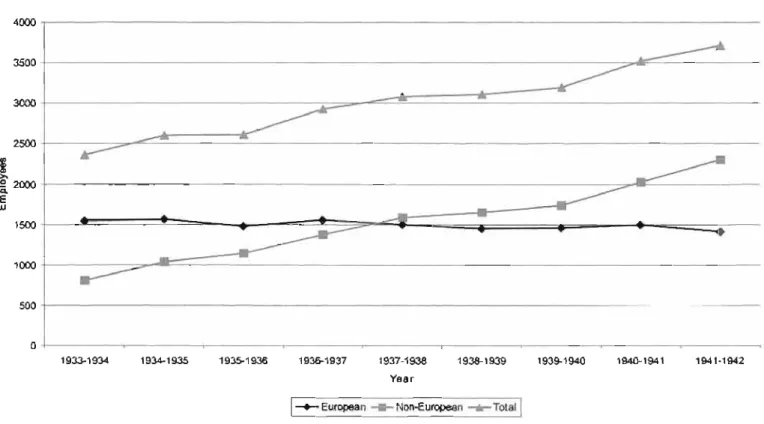
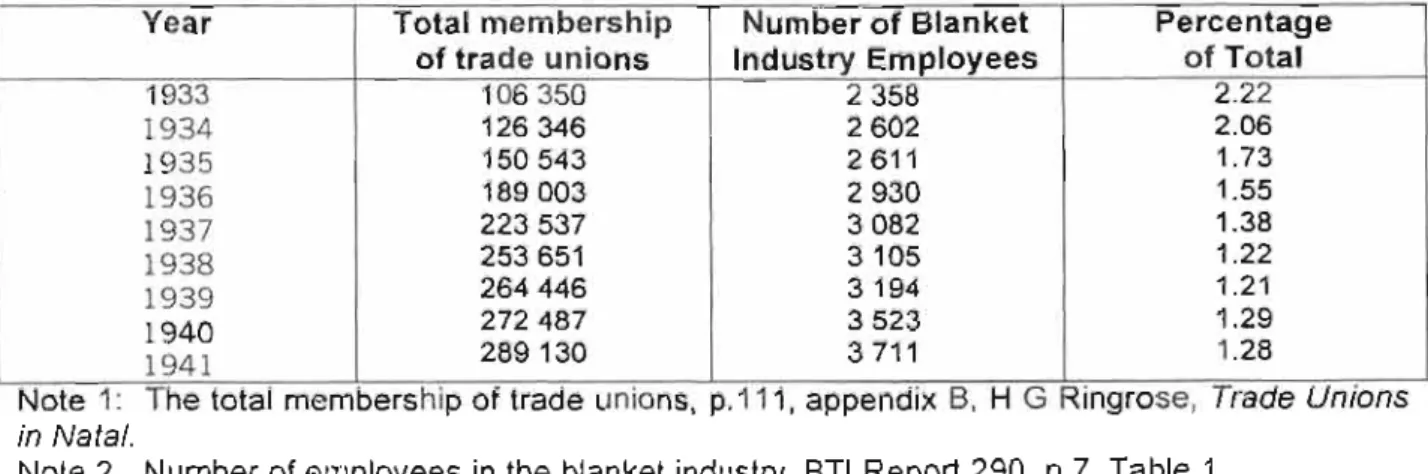
By the turn of the century, the fledgling textile industry in the form of blanket manufacturing was developing, but an industry in the true sense of the word had not yet emerged, so trade unions were slow to develop in this sector. The textile industry spread geographically throughout South Africa and was not concentrated in any one area, whereas, if this was the case, it is conceivable that textile workers would have formed their union much sooner than they did. It was from this mill that the textile trade union movement had to recruit its membership and by 1933 the total number of employees amounted to 2358 and by 1941 the figure was 3 71 1.
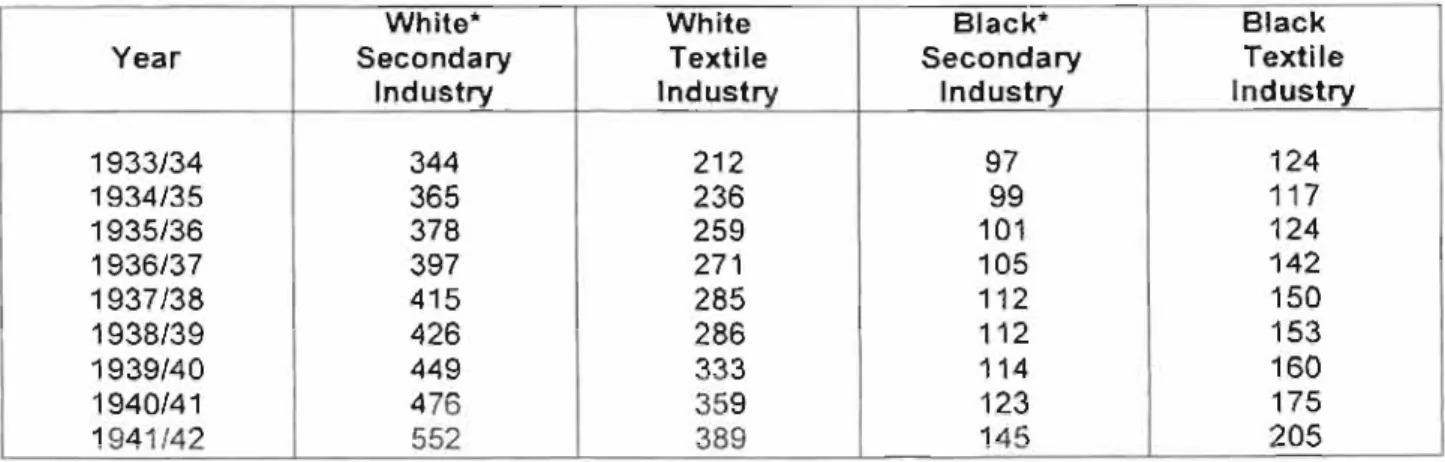
Even if every textile worker had joined the union, and this would have been impossible, it can be seen that the total strength would not be very large. The total membership of all unions composed of all racial groups for the period 1933 to 1941 is shown in Table 1 below, and when the total labor force employed in the textile industry for the same period is compared with the total membership of all unions , it can be seen that the textile unions constituted an extremely small percentage of the total. Improbably, this table illustrates the small membership compared to the total membership of all unions, confirming the relative weakness of textile unions in its formative years.
More than a hundred years ago in 1893, the industrial color bar was already in operation after it was introduced by the Transvaal Volksraad to protect the European workers, laws that would operate at the expense of the indentured Chinese labor as well as black labor.' In 1922, the general strike on the Randen took place with loss of life, with the government ending it by force. Around 1900 it was reported that the textile workers in Cape Town were working a sixty hour week at 7.30. This was accepted as the union was not at the time strong enough to fight for more, but eventually £156 was achieved and shared by nine workers, a long way. under £100 each.7 A schedule was published by the Textile Workers' Union covering the period 1930 to 1959, which reflected the wage increases the union negotiated for its members, in different geographical areas as well as different products made in the textile industry.
THE STORY IN FIGURES
Rosenthal, Industrial Development Corporation of South Africa Ltd The Story of the First Twenty Years, 1960. Industrial Development Act No. 22 of 1940 (Act) (as amended) was approved on 15 May 1940 and signed in English by the Governor-General (Sir Patrick Duncan) of the Union of South Africa. However, the underlying reason for this policy, namely apartheid, was unacceptable in the eyes of the world, as it was a policy to maintain white political power in South Africa.
Malan of the National Party became Prime Minister There have been changes in the IDC Directorate. This was actually the beginning of the Nationalist government's policy of decentralization -- apartheid in action in the textile industry. When completed, (it) will probably be one of the most modern vertically integrated mills in the world."
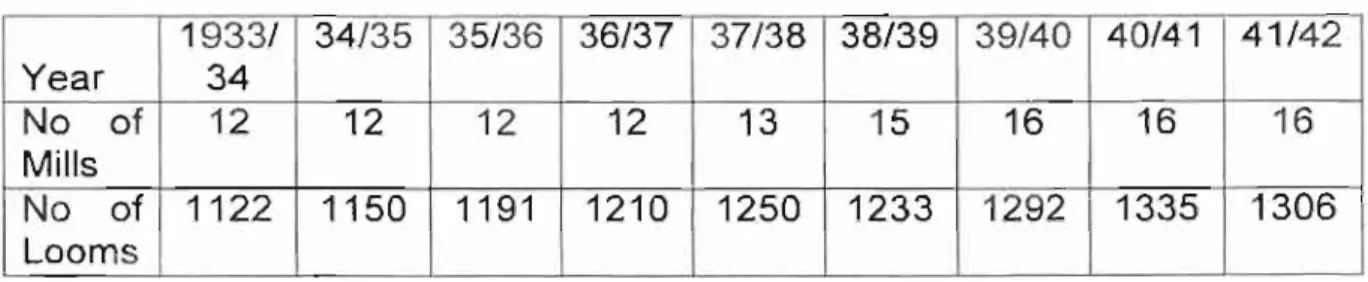
For the first time in the country's history, the manufacturing sector was ahead of the agricultural and mining sectors. The lack of government support was in stark contrast to the policies of the Industrial Development Corporation of South Africa Limited in the post-World War 11 era. Probably one of the most serious limitations the industry experienced was the age of its looms.
In this background, the financing of the mills that made up the industry should be seen. This thesis has examined a number of factors critical to the early development of the textile industry.