
IMPACT OF GLOBALISATION AND TRADE
LIBERALISATiION ON
~HEINDIAN INDUSTRY: A CASE ANALYSIS OF q"HE INDIAN
PW~RMACEUTICALINDUSTRY
Vibha Vishwajit
Supervisor: Prof Elza T
Submitted in partial fulfillment of the requirements for the degree of
MASTER OF S(JS ESS ADMINISTRATION UNIVERStTY OF NATAL
The Graduate School of Business, Faeulf¥:of Managetnenf
University 0 Natal (Durban)
This research has not been previously accepted for any degree and is not being currently submitted in candidature for any degree.
Signed .
Date .
096175
ACKNOWLEDGEMENTS
I wish to express my sincere thanks to people who have provided assistance, guidance and support during the course of this study. In particular I would like to thank the following:
1) My supervisor Professor Elza Thomson, for her supervision and guidance throughout the study
2) Professor M.Williamson, for his guidance during the course of the study
3) Lastly and most importantly, my parents and sister for their patience, continuous support and encouragement throughout the course of the study
111
on the Indian industry with the help of a case analysis of the Indian pharmaceutical industry. The study is broken down into five chapters in order to carry out the process of the study systematically. The first chapter presents the background, motivation and the value of the study. Focus of chapter two, the literature review, which helps in brining out aspects associated with trade liberalisation and globalisation. Chapter three provides an overview of the Indian pharmaceutical industry with references to the global industry. An analysis of the industry against the literature developed in chapter two will be the focus of chapter four. Lastly, chapter 5 is designed to formulate recommendations for the industry, incorporating government's role.
IV
· (
CHAPTER ONE: INTRODUCTION 1
1.1 INTRODUCTION 1
1.2BACKGROUND OF THE RESEARCH 3
1.3 MOTIVAnON FOR THE RESEARCH .4
1.4VALUE OF THE PROJECT 5
1.5PROBLEM STATEMENT 5
1.6OBJECTIVES OF THE STUDY 6
1.7 RESEARCH METHODOLOGY 6
1. 7.1 Case Analysis 6
1.8 LIMITATIONS OF THE PROJECT 6
1.9 RESEARCH SCHEDULE 7
1.10 STRUCTURE OF THE STUDy 7
1.11 SUMMARy 9
CHAPTER TWO: IMPACT OF TRADE LIBERALISATION AND
GLOBALISATION: LITERATURE REVIEW 10
2.1 INTRODUCTION 10
2.2TRADE THEORIES 11
2.2.1 Mercantilism 12
2.2.2 Absolute Advantage 13
2.2.3 Comparative Advantage 14
2.2.4 Heckscher-Ohlin Theory 17
2.2.5 Porters Diamond 19
2.3 THE EFFECT OF TARIFF ON TRADE 20
2.3.1 Small Country Scenario 21
2.3.1.1 Tariff Effects on Importing Country Consumers 21 2.3.1.2 Tariff Effects on Importing Country Producer 22 2.3 .1.3 Tariff effects on Importing Country Government.. 22
2.3.1.4 Tariff Effects on National Welfare 22
2.3.2 Large Country Scenario 23
2.3.2.1 Impact of Tariff on Consumers 23
2.3.2.2 Impact of Tariff on Producers 24
2.3.2.3 Impact of Tariff on Government Revenue 24 2.3.2.4Impact of Tariff on National Welfare 24
2.3.2.5Tariff Effects on World We1fare 26
2.4NON-TARIFF BARRIERS 26
2.5 IMPLICATION FOR INDUSTRY 27
2.5.1 Competition 28
2.5.2 Strategic Alliances 28
2.6OVERVIEW OF GLOBALISATION 30
2.6.1. Globalisation Debate 31
2.6.1.1 Pro-Globalisation 31
2.6.1.2Anti-Globalisation 32
2.7EFFECT OF LIBERALlSAnON AND GLOBALISATION ON WAGES 33 2.8EFFECT OF LIBERALISATION ON INCOME DISTRIBUTION 35 2.9EFFECT OF LIBERALISATION AND GLOBALlSAnON ON POVERTy 36
v
2.12GLOBALISATION AND NATIONAL SOVEREIGNTY .42
2.13 CONCLUSION 44
oJttv.J
CHAPTER THREE: OVERV W OF THE INDIAN PHARMACEUTICAL
INDUSTRY 46
3.1 INTRODUCTION 46
3.2GLOBAL INDUSTRY STRUCTURE 46
3.3OVERVIEW OF THE INDIAN PHARMACEUTICAL INDUSTRY .48
3.3.1 Industry Structure 51
3.3.1.1 Pharmaceutical Sales and Distribution Structure 52
3.3.1.2 Market Share 52
3.3.1.3 Products of The Industry 54
3.3.2Pharmaceutical Industry Prior to the Advent of Indian Patent Act 55
3.3.3 Indian Patent Act 1970 55
3.3.4 Dilution of Drug Policy and Drug Price 1ncrease 57
3.3.5 Trade 59
3.3.5.1 Domestic Trade 60
3.3.5.2 Exports and Imports 60
3.4THE CONSOLIDATION WAVE 62
3.4.1 Strategic Alliances 62
3.4.2 Brand Acquisition 64
3.5 RESEARCH AND DEVELOPMENT 64
3.6CONCLUSION ...•...66 CHAPTER FOUR: CASE ANALYSIS OF THE INDIAN
PHARMACEUTICAL INDUSTRY 68
4.1 INTRODUCTION 68
4.2IMPACT OF TRADE LIBERALISATION 68
4.2.1 Impact of Liberalisation on Drug Companies 68
4.2.1.1 Impact on Competition 69
4.2.1.2 Strategic Alliances 69
4.2.2 Economic Development: R&D, International Technology and Foreign
Investment 73
4.2.3 Reduction of Work Force 74
4.2.4 Prices and Impact on Social Welfare 76
4.3 IMPACT ON PUBLIC SECTOR DRUG COMPANIES 78
4.4EVALUATING INDIAN PHARMACEUTICAL INDUSTRY AGAINST PORTERS
DIAMOND 79
4.4.1 Factor Endowment 80
4.4.2 Demand Conditions 80
4.4.3 Relating and Supporting Industries 81
4.4.4 Firm Strategy, Structure and Rivalry 81
4.5 CONCLUSION 81
CHAPTER FIVE: RECOMMENDATIONS AND CONCLUSION FOR THE
INDIAN PHARMACEUTICALSINDUSTRY 83
5.1 INTRODUCTION 83
5.2RECOMMENDATIONS 84
vi
5.2.1 Strategic Alliances 84
5.2.2 Generic Market 86
5.3 RECOMMENDATIONS FOR THE GOYERNMENT 86
5.4CONCLUSION 87
ABBREVIATIONS X
GLOSSARY XI
REFERENCES XI
INTERNET REFERENCES XIV
vii
FIGURE 1.1: FOREIGN INVESTMENT INFLOWS IN INDIA (US$ MILLION) 4 FIGURE 2.1: ABSOLUTE ADVANTAGE, EXAMPLE OF CHINA AND ZAMBIA 13 FIGURE 2.2: COMPARATIVE ADVANTAGE FOR CHINA AND U.S 15 FIGURE 2.3: DETERMINANT OF NATIONAL COMPETITIVE ADVANTAGE: PORTER'S
DIAMOND 19
FIGURE 2.4: TARIFF EFFECT ON BELGIUM, A 'SMALL' COUNTRY CASE 21
FIGURE 2.5: LARGE COUNTRY CASE 23
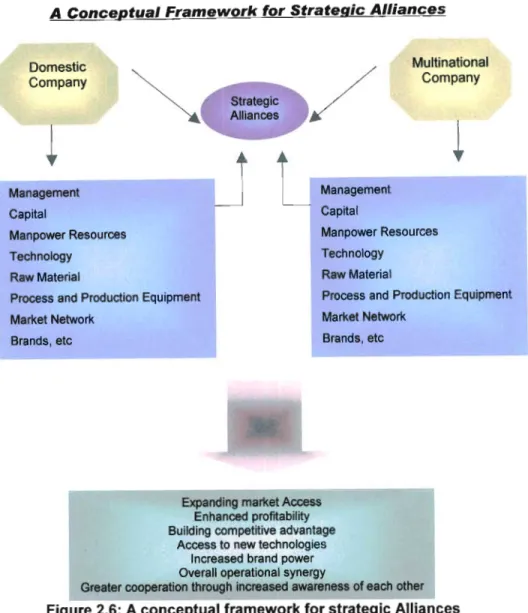
FIGURE 2.6: A CONCEPTUAL FRAMEWORK FOR STRATEGIC ALLIANCES 30
FIGURE 2.7: WAGES AND OPENNESS TO TRADE 34
FIGURE 2.8: CHANGES IN TRADE AND INCOME INEQUALITY 36 FIGURE 2.9: THE GLOBALlSERS AND THE WORLDWIDE INEQUALITY 38 FIGURE2.10: UNEMPLOYMENT RATES IN SUCCESSFUL GLOBALlSERS 41 FIGURE 3.1: STRUCTURE OF THE PHARMACEUTICAL INDUSTRY AT A GLOBAL LEVEL 47 FIGURE 3.2: INDIAN PHARMACEUTICAL MARKET: MARKET SHARE BASED ON COUNTRY
OF ORIGIN 50
FIGURE 3.3: INDUSTRY SALES 51
FIGURE 3.4: PHARMACEUTICAL SALES AND DISTRIBUTION STRUCTURE 52 FIGURE 3.5: MAIN THERAPEUTIC SEGMENTS (IN PERCENTAGE) 54 FIGURE 3.6: PERCENTAGE INCREASE IN THE DRUG PRICES OVER THE PERIOD 1995-
2000 58
FIGURE 3.7: DRUGS AND PHARMACEUTICAL EXPORT 62
FIGURE 4.1: A CONCEPTUAL FRAMEWORK FOR STRATEGIC ALLIANCES 70 FIGURE 4.2: DETERMINANT OF NATIONAL COMPETITIVE ADVANTAGE OF INDIAN
PHARMACEUTICAL INDUSTRY: PORTER'S DIAMOND 79
viii
LIST OF TABLES
TABLE1.1: RESEARCH SCHEDULE 7
TABLE2.1 :GAINS FROM TRADE FOR CHINA AND ZAMBIA 14
TABLE2.2: GAINS FROM TRADE FOR US AND CHINA 15
TABLE2.3: ILLUSTRATION OF HECKSHER OHLlN THEORY USING EXAMPLES OF JAPAN
AND MALAYSIA 18
TABLE2.4: POST1980GLOBALlSERS 34
TABLE2.5: SHARE OF INCOME AND POPULATION ACROSS GLOBAL REGIONS 39
TABLE3.1 PRICE COMPARISONS OF CERTAIN DRUGS IN US & INDIA 52
TABLE3.2: INDIAN PHARMACEUTICAL MARKET: MARKET SHARE OF Top COMPANIES 53
TABLE3.3: PRICES OF SOME OF THE NEW DRUGS INTRODUCED IN1999 IN THE INDIAN
MARKET 59
TABLE3.4: WORLD TRADE IN PHARMACEUTICALS2000 60
TABLE3.5: GROWTH INDICATORS 61
TABLE3.6: SOME TOP PHARMA COMPANY MERGERS IN THE WORLD 63
TABLE3.7: TRENDS IN R&D EXPENDITURE (IN Rs'00 MILLION) 64
TABLE3.8: PERCENTAGE OF TURNOVER INVESTED IN R&D DURING1998-2000 65
TABLE3.9: PERCENTAGE OF DRUG PRODUCTION AND WORLD POPULATION IN SOME
COUNTRIES 66
TABLE4.1 :STRATEGIC ALLlNACES: ZYDUS CADILA 71
TABLE4.2: CO-MARKETING: ZYDUS CADILA 72
TABLE4.3: REDUCTION OF WORKFORCE 76
jy
Bn:
CAGR:
CII:
DPCO:
EXIM:
FERA:
GATT:
GDP:
MNCs:
Mn:
MRTP:
NATO:
TNCs:
TRIPS:
RBI:
Rs:
WTO:
Billion
Compounded Annual Growth Rate Confederation of Indian Industry Drug Price Control Order
Export and Import
Foreign Exchange Regulations Act General Agreement on Tariffs and Trade Gross Domestic Product
Multinational Corporations Million
Monopolies and Restrictive Trade Policies North Atlantic Treaty Organisation
Transnational Corporations
Trade Related aspects of Intellectual Property Rights Reserve Bank of India
Indian Currency; Rupees World Trade organisation
x
GLOSSARY
Autarky: A condition of self-sufficiency. Specifically, it is a national policy of economic independence.
Bulk Drugs: Bulk drugs are medically effective chemicals, derived from four types of raw materials, namely, plant derivatives, animal derivatives, synthetic chemicals and biogenetic derivatives (human insulin).
Consumer Surplus: Consumer surplus measures the difference between what a person is willing to pay for a good and the amount he/she actually is required to pay.
Drug Price Control Order: DPCO controls the domestic prices of major bulk drugs and their formulations with an aim to provide patients with medicines at affordable prices. DPCO ascertains, as per Drug Policy guidelines, the bulk drugs (and their formulations) to be kept under price control.
Foreign Exchange Regulations Act, 1973: An Act to consolidate and amend the law regulating certain payments, dealings in foreign exchange and securities, transactions indirectly affecting foreign exchange and the import and export of currency, for the conservation of the foreign exchange resources of the country and the proper utilisation thereof in the interests of the economic development of the country.
Foreign Direct Investment Direct investment in business operations in a
.
foreign country (includes both direct investment and portfolio investment).
General Agreement on Tariffs and Trade: International treaty that committed signatories to lowering tariff and non-tariff barriers to the free flows of goods across national borders and led to the WTO.
Generic Drug: When a medicine is first developed, the company discovering it is afforded a period of patent protection, usually 10-15 years.
VI
under its chemical, or generic name.
Gini Coefficient The Gini coefficient is a number between zero and one that measures the degree of inequality in the distribution of income in a given society. The coefficient would register zero inequality (0.0
=
minimum inequality) for a society in which each member received exactly the same income and it would register a coefficient of one (1.0 = maximum inequality) if one member got all the income and the rest got nothing.Gross Domestic Product: GDP is the gross domestic product or the income of the economy, C stands for consumption expenditure, I for investment expenditure, G for government spending, and X-M for exports minus imports.
Mean Deviation: refers to the percentage difference between the income of a randomly selected individual and average income across the world.
The Monopolistic and Restrictive Trade Practices Act, 1969: It was first enacted to was enacted, to ensure that the operation of the economic system does not result in the concentration of economic power in hands of few, to provide for the control of monopolies, and to prohibit monopolistic and restrictive trade practices in India.
Producer surplus: producer surplus measures the welfare of a group of firms who sell a particular product at a particular price. Producer surplus is defined as the difference between what producers actually receive when selling a product and the amount they would be willing to accept for a unit of the good.
World Trade Organisation: The World Trade Organisation (WTO) is the global international organisation dealing with the rules and regulations of trade between nations and an organisation that succeeded the General
)(11
Agreement on Tariffs and Trade (GATT) as a result of the successful completion of the Uruguay round of GATT negotiations.
viii
1. Cooper, D.R., Schindler, P.S. 2001. Business Research Methods (Seventh Edition) McGraw Hill, Singapore
2. David Dollar and Aart Kraay, 2001, Growth Is Good for the Poor, World Bank Policy Research Papers, Washington
3. David Dollar and Aart Kraay, 2001, Trade Growth and Poverty, International Monetary Fund
4. Gina Singh, 2003, Prescribed: A Big Dose of India, Business world, 21stApril
5. Hill, W.L., 2003, International Business: Competing in the Global Marketplace(Fourth Edition), McGraw-Hill, New York
6. Hisrich. R. D., Peters. M. P. (2000). Entrepreneurship (Fourth Edition) McGraw-Hill, New York
7. Jones, R. W., 2000, Globalisation and the Theory of Input Trade (First Edition), Massachusetts Institute of Technology, London.
8. Joseph Stiglitz, 2003, Globalisation and its Discontents, (First Edition) Penguin Books India, New Delhi
9. Kapila, R., Kapila, U. 2001. India's economy in the 21stcentury (First Edition). Academic Foundation, Gaziabad
10. Martin Rama, Globalisation and Workers in Developing Countries, World Bank, 2003
11. Matthew J. Slaughter and Phillip Swagel, Does Globalisation Lower Wagesand Export Jobs?International Monetary Fund, 1997
12. Nagesh Kumar.2000. Indian Economy Under Reforms: An assessment of Economic and Social Impact (First edition). Bookwell publishers, New Delhi
13. Panagariya Arvind, 2003, Open up trade, Get Rich, The Economic Time, New Delhi, 23rd April 2003
14. Pugel, T.A., Lindert, P. H., 2000, International Economics (Eleventh Edition), McGraw-Hill, New York
15. Robert Tancer, Srinivas Josyula., 2000, Investment in the Indian Pharmaceutical Industry, Thunderbird, American Graduate School
16. Romila Thapar. 2000. India Another Millennium? (First Edition).
Viking, New Delhi
17. Schiller. B. R., 2000, The Economy Today (Eighth Edition), McGraw- Hill, New York.
18. Sharma., Zackariah.,Thakur, 2002, India 2002 A Reference Annual ( Annual Publication), Publication Division, Government of India, New Delhi
19. Sindhwani Trilok, 2003, The Global Business Game: A Strategic Perspective (Third Edition), Macmillan India Private Limited, New Delhi.
20. Surjit Bhalla, 2003, Poverty, Inequality, and Growth in the Era of Globalisation(First Edition), Penguin Books India, New Delhi
21. Uma Kapila, 2001, Indian Economy Since Independence (Second Edition), Academic Foundation, New Delhi
22. Svend Hollensen., 2001, Global Marketing: A Market Responsive Approach(Second Edition), Pearson Education Limited, England
vii
24. Dialogue for Economic Growth, Confederation of Indian Industries, 2002, New Delhi
25. Drugs and Pharmaceuticals, 25th April 2001, Confederation of Indian Industry, New Delhi
viii
INTERNET REFERENCES
1. http://www.bized.ac.uk 2. http://www.un.org
3. http://www.worldbank.org 4. http://www. wto.org
5. http://www. Indianinfoline.com 6. http://www. Tradeindia.com 7. http://www.niper.nic.in
8. http://www.businessstandards.com 9. http://www.finmin.nic.in
10. http://www.cii.org 11. http://www.Glaxo.com 12. http://www.Cipla.com
13. http://www.Cadilazydus.com 14. http://www.ranbaxy.com 15. http://www.drreddyslab.com 16. http://www.panacea-biotec.com 17. http://www.rpglifesciences.com 18. http://www.wockhardtin.com 19. http://www.globalisationguide.org
1.1 INTRODUCTION
To the surprise of many, although not widely recognised, the global village has arrived. Against the fractured world of early 1980s, truncated into three divergent power and economic blocs, the world at the beginning of the new millennium is marching fast towards a new era, not only in time-scale but reaching out to a new techno-economic rendezvous-of free flow of capital, product and process technology, expertise and knowledge. Whilst almost all segments are registering technological thrust, the twin marvels, telecommunications and information technology, have completely repainted the canvas. Thanks to the Internet, representing the technological matrimony, it is no longer possible for any society to remain shrunk in a shell of national markets which remained highly protected until the conclusion of the global milestone of the World Trade Organization (WTO) agreements and Uruguay Round of trade negotiations.
Every day it can be heard in the news, through academicians, businesses students, and people on the streets, read in the textbooks, and in every single instance the word globalisation seems to bring out either a very skeptic view or indicate how globalisation has helped nations reach the milestones of growth and prosperity.
So, what is globalisation, why is it criticised and what are the reasons for its support?
Globalisation is different things to different people and thus affects individuals, nations, and businesses differently.
2of88
The aspect of globalisation that has been taken into consideration for the purpose of this study is the effect of outward looking policies across nations and its effect on industries within the economy and across nation.
Recent attacks on the globalisation have also translated into attacks on the wisdom of outward-oriented trade policies that the developing countries have embraced with increasing frequency. Skeptics question the ability of liberal trade policies in order to stimulate growth, development and economic prosperity. In addition, they also blame growth failure on the surge of imports from increased openness. Moreover, the outward-oriented trade policies are viewed as detrimental with regards to national sovereignty, employment and poverty.
An alternative view suggests that trade liberalisation and globalisation are responsible for cross border economic interdependence and integration of economies of the world. Globalisation has also acted as a catalyst in opening national boarders to trade, capital, technology and information.
Altogether this has resulted in increased trade and robust growth in the foreign direct investment through transnational and multinational organisations.
Arguments put forward by both, protagonists and the skeptics seem convincing, however, which argument holds true remains to be seen. As far as developing countries are concerned, there is compelling evidence that openness is a necessary condition for rapid growth. Evidence also shows that there are few developing countries that have grown rapidly on a sustained basis without simultaneously experiencing rapid growth in their exports and imports.
It is amazing that some countries have failed to experience economic growth and development even after adopting outward oriented policies?
This and more will become clear as the study unfolds.
Chapter 1
1,2 BACKGROUND OF THE RESEARCH
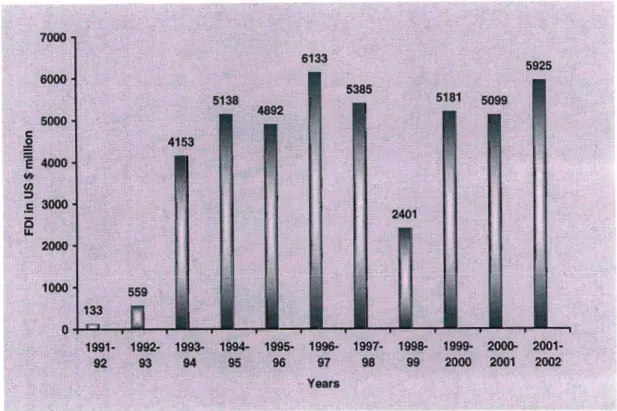
According to Uma Kapila (2001) and Reserve Bank of India, since independence (that is since 1947), India has largely remained a closed economy with its emphasis on producing everything domestically and as a consequence of its adoption of the protectionist policies. India, in the last 10- 15 years has witnessed a transition from closed to an open economy, solely as an outcome of globalisation and WTO policies. This has led to the increased foreign trade and inflow of foreign investment (See fig 1.1 for FDI trends).
The inward looking policies implemented by India until 1991, has acted as protection for domestic firms. However, due to Uruguay round of trade negotiations and WTO policies, India has established various trade liberalisation policies, making the entry of foreign firms easier. It is evident that due to this aspect the domestic firms are facing immense competition from multinational organizations. For long run survival, the domestic firms will have to change their strategic planning. It is evident that strategic alliances such as mergers, acquisitions and joint ventures will be the order of the day in this given scenario.
At present India's economic policies are designed to attract significant capital inflows into India on a sustained basis and to encourage technology collaboration between Indian and foreign firms. Economic policy, especially of the nineties, has removed several constraints on economic growth. India has sought to increase inflows of Foreign Direct Investment (see fig 1.1) with much liberal policies since 1991, after forty years of cautious attitude towards it. Progressive liberal policies adopted in this regard have led to increasing inflows of foreign investment in the country, both in terms of direct investment, as well as portfolio investment (Reserve Bank of India:
2002) Figure 1.1 provides with an illustration of foreign investment inflows into India during the years 1991-2002 (both direct investment and portfolio investment). The new export import policies are more liberal in nature, which
Chapter 1
4 of88
facilitate, economic growth and development. Rationalised tariff levels and removal of quantitative restrictions characterises the current trade policy.
The immediate objective of India as per the EXIM (export and import) policy, announced on 31st march 2001, is to achieve at least 1 percent share of global trade by 2004 (Kumar; 2000)
Foreign Investment Inflows in India (in Us$ million)
Years
Figure 1.1: Foreign Investment Inflows in India (Us$ Million) Source: Reserve Bank of India
With the advent of globalisation and hence trade liberalisation, entry of foreign firms has increased the competition for domestic firms. As a result of this competition, local organisations have been reviewing their strategic planning. Industries such as food, textile, automobile and pharmaceutical all have been affected by foreign competition. Therefore, the domestic firms will have to review their strategies in order to stay competitive.
1..a..MOTIYATION FOR THE RESEARCH
The Indian pharmaceutical industry is one of the most developing industries in India, with increasing exports and imports. Prior to 1970 the Indian pharmaceutical industry experienced the tide of liberalisation when it was
Chaoter 1
still in its infantile stages of development. However, in 1970, the government adopted a protectionist policy in order to protect its infant industries.
Now, once again the domestic pharmaceutical industry will have to face the same situation as it did prior to 1970.
Multinational pharmaceutical companies were responsible for giving the Indian domestic industry a run for its money prior to 1970. Now that the winds of liberalisation have caught India, the international industry has once again moved their attention towards India. However, due to the nature of the industry and sustained growth and development over the last three decades, the Indian industry has emerged as one of the most competitive pharmaceutical players across the globe. Therefore, it remains to be seen what liberalisation and the competition has in store for the domestic industry and India.
This research is undertaken for the above-mentioned reasons, i.e. to evaluate the impact of trade liberalisation and globalisation Indian pharmaceutical industry
..u
VALUE OF THE PROJECTThis study will help formulate recommendations for the Indian pharmaceutical companies which will assist them reassess and re-evaluate their strategies in the light of globalisation, assisting them gain a competitive edge. This study will also highlight the role for the government, which would help India in achieving prosperity, economic growth and development, social welfare and all that globalisation promises.
liPROBLEM STATEMENT
Impact of trade liberalisation and globalisation on the Indian industry: A case analysis of the Indian pharmaceutical industry. The study will also explore the impact of trade liberalisation and globalisation.
Chapter 1
6 of88
1,6OBJECTIVES OF THE STUDY
Toevaluate: -
The impact of trade liberalisation and globalisation.
To determine: -
The effect of trade liberalisation and globalisation on the Indian pharmaceutical industry.
Toestablish:
Recommendations and suggestions for the long-term survival and development of the indigenous pharmaceutical industry and government's role to help achieve the objectives of sustained growth, prosperity and overall development.
UBESEARCH METHODOLOGY
The research is fundamentally qualitative. However, it will involve the collection of data through the use of secondary sources and case studies.
1,7,1 CASE ANALYSIS
Due to the qualitative nature of the research, the methodology used to carry out this dissertation will be case analysis. The information will be obtained through multiple sources of information such as textbooks, journals, Internet etc. A case analysis of the Indian pharmaceutical industry will be undertaken in order to assess the impact of globalisation on domestic companies.
Analysis of competition from foreign players, strategic alliances, and its effect on inflow of capital, employment, poverty and economic growth will be analysed.
1&J-IMITATIONS OF THE PROJECT
No interaction with the pharmaceutical companies, since they weren't prepared to provide information and therefore had to, primarily, rely on the Internet and secondary sources of information.
Chapter 1
With a broad topic of this genre, which tries to cover aspects of an industry and an economy, might leave certain aspects uncovered.
Due to the nature of the study, it was not possible to evaluate more than one industry. However, the pharmaceutical industry might not be truly indicative of all the industries because there are several other factors affecting industries across the economy.
1.9RESEARCH SCHEPULE
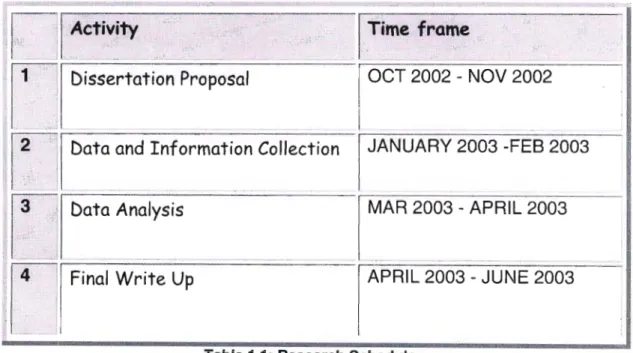
Table 1.1 presents the research schedule. The study will commence with the proposal, collection of data, which will include observing the markets in India and collection of data through all possible sources, data analysis and finally the write up of the report.
Research Schedule
·nLAC~iYity:~:"_"
_ITi~" frQm~
__I ~ ;
DIssertation proposal.. . _I OCT 2002 - NOV 2002Ii
Data and Information CollectionI
JANUARY 2003 -FEB 2003 LJ[Data~nal:is
_ _ 1MAR 2003 -_APRIL~003
.DI
Final Write Up APRIL 2003 - JUNE 2003Table 1.1: Research Schedule
-
I
1.1 0 STRUCTURE OF THE STUDY
The study will be carried out in the form of five chapters; the first chapter will layout the proposal of the study, indicating aspects such as the background, methodology and the value of the study. The remaining four chapters will
Chapter 1
8 of88
carry out the study in systematic manner. The outline of the chapters that make up the study is presented below: -
Chapter Two: Literature Review
Chapter two will covers the theoretical aspects relating to the trade liberalisation and globalisation. International trade theories and models, such as Mercantilism, Absolute Advantage, Comparative Advantage, Hecksher-Ohlin, and Porters Diamond will be discussed to understand the implications of trade and removal of trade barriers. In addition, effects of tariff will also be discussed. Porters diamond, which more or less incorporates all the other models and theories, will be used for the case analysis in chapter 4. Globalisation and related issues such as poverty, national sovereignty, employment, growth and development will be discussed and analysed. Finally, a discussion of the impact of foreign competition due to opening up of borders will be undertaken.
Chapter Three: Overview of the Pharmaceutical Industry A detailed overview of the Indian pharmaceutical industry will be presented in this section. The history, structure of the Indian pharmaceutical industry, global industry structure, how does the Indian industry compare with the global industry, what products and services it provides, will be discussed.
Chapter Four: Analysis of the Pharmaceutical Industry
This chapter will evaluate the Indian pharmaceutical industry against the information developed in chapter three and the
"models" established in chapter two.
Chapter 1
Chapter Five: Recommendations and Conclusion
Recommendations for the pharmaceutical companies in order for the industry to survive the winds of liberalisation and help in making India a global industrial base will be formulated in this chapter. Areas where the industry has a competitive edge will be highlighted. In conjunction with this, certain recommendations for the government will also be presented so as to achieve sustained growth and development.
1Jj SUMMARY
The study is designed to carry out an analysis of the Indian pharmaceutical industry exploring the impact of trade liberalisation and globalisation. There are many speculations as far as the topic of 'globalisation' is concerned.
That is why most economies are reluctant to liberalise. It is strongly felt that globalisation brings with it, poverty, unemployment, and loss of national sovereignty. Whether this is just a speculation, or there is some reality in it, is hard to evaluate, but an attempt will be made to at least try and explore the reality. Lets begin by looking at the impact of trade liberalisation and globalisation and related issues such as poverty, national sovereignty, employment, growth and development.
Chapter 1 Tntt'(')rh.r+in~'j;
CHAPTER TWO: IMPACT OF TRADE LIBERALISATION AND GLOBALlSATION: LITERATURE REVIEW
2.1 INTRODUCTION
What happens when autarkic approaches such as, import substitution behind high tariff walls fail to provide sustainable growth and development?
Well, to answer this question lets look at a simple economic formula: -
GDP
=
C + I + G + (X-M)Which implies higher (X-M) will lead to higher GDP (Schiller: 2000:31-32).
In other words, increase in foreign trade that is exports and imports will lead to high levels of gross domestic product or the income of the economy.
Kautilya further supports this argument; according to him trade is the third pillar of economic prosperity (Sindhwani: 2003). Kautilya stated, as cited by Sindhwani (2003), ''The three principle components of national economics and prosperity are 'krishi' (agriculture), 'pashupalaya' (cattle tending) and
'vanijya' (trade). So, does it imply that, higher trade = higher growth and prosperity? In that case every country must implement this simple economic formula and reach the targets of growth and development? However, this is not the picture that emerges in real life. So, where does the problem lie?
Maybe it lies in what happens after trade? Then, what is the impact of trade on nation and more importantly what is the outcome of much talked about globalisation? Lets try and analyse some of the aspects related to trade liberalisation.
According to the theory, some degree of outward orientation is vital in order to achieve sustainable growth, development, and poverty reduction. This illustrates the underlying factor behind the rapid growth of the world economy witnessed in the recent decade. Growth in international trade has
.. ..,...,....,oz
" ' , " ' "~ ~./>o.. ,.
V'A...,3S""3/ '
e.-;:
_...:~:;... ...~., L. . __ ...~... d u § o q
been driven both by technological development and more importantly, reduction in trade and investment barriers. Most of the developing countries have adopted liberal policies to take full advantage of the opportunities for economic development through trade.
Therefore, the solution to any country's problem with regard to growth and development ought to be trade liberalisation and globalisation.
Unfortunately, according to the skeptics view, whereas on one hand, liberalisation and globalisation have acted as a catalyst for growth, they believe globalisation and trade liberalisation have not turned the tide against poverty (Joseph Sliglitz: 2003). In fact the gap between rich and poor countries and wealth disparities within countries have increased, indicating that the rich have become richer while the poor have become poorer (Surjit Bhalla: 2003).
Consequently, a fundamental question needs to be addressed, that is, whether the shift towards a more integrated and interdependent global economy has acted as an engine for growth or has it led to rise in unemployment and poverty? And what is the affect of trade liberalisation on national sovereignty, Job loss, labour exploitation and environment effects?
Micro economic questions also need to be addressed such as the impact of trade liberalisation and globalisation on the domestic industry/ firms and multinational organisations.
2.2 TRADE THEORIES
In order to better understand the implications of trade and removal of both tariff and non-tariff barriers to trade, it will be worthwhile to look at some of the international trade theories developed by great economists such as Ricardo, Adam Smith, Michael Porters and David Hume. International trade theories examine what trade patterns would evolve if trade were allowed to move freely among countries and how much, in which product and with whom a country will trade in absence of restrictions among nations. In addition, the theories take into account governmental influence with the free
Chapter Two Literature Review
12of88
movement of goods and services among countries in order to alter the amount, composition and direction of trade (Sindhwani: 2003). In an attempt to realise how international trade increases the welfare of its citizens, the principles of Mercantilism, Absolute Advantage, Comparative Advantage and Heckscher-Ohlin and Porters Diamond will be considered.
2.2.1 MERCANTILISM
Mercantilism theory of trade emerged in the 16th century and is one of the first economic doctrines on international trade. The theory is based on the idea that national wealth and power are best served by maintaining a trade surplus, that is exporting more than importing. As Hill puts it, "its principle assertion was that gold and silver were the mainstay of national wealth and essential to vigorous commerce" (Hill: 2003: 142). During this time period gold, silver and other precious metals were the currency of foreign trade and therefore by maintaining trade surplus would accumulate gold, silver and other precious metals and consequently increase its national wealth and political control. Therefore, the aim of the government was to limit imports and to facilitate exports. In order to achieve this, imports were discouraged by tariffs, quotas etc and exports were encouraged by government in the form of subsidies. The belief that trade surplus leads to economic growth and development explains why until recently very many countries around the globe have adopted an import substitution and protectionist policies.
The theory of mercantilism, which encourages countries to hide under the blanket of trade barriers in order to dampen imports and stimulate exports, provides no explanation for why these countries have failed to achieve economic growth and development.
David Hume tried to analyse the weakness of the theory. According to him, if China was trading with Japan and had a trade surplus, the resulting inflow of capital would boost the money supply and generate inflation in China.
Consequently, in Japan, the outflow of capital would deflate the money supply causing deflation leading to lower prices. This would, in turn encourage the Japanese to buy fewer Chinese goods, as they are now more expensive, and would encourage the Chinese to buy more from Japan
Chapter Two literature Review
since their goods are becoming cheaper. Thus the trade balance of Japan would recover and China's trade balance would get worse. Therefore according to Hume, no country can sustain a trade surplus. (Sindhwani 2003)
2.2.2ABSOLUTE ADVANTAGE
A country has an absolute advantage over it's trading partners if it is able to produce more of goods or services with the same amount of resources or the same amount of goods or services with fewer resources (Schiller:
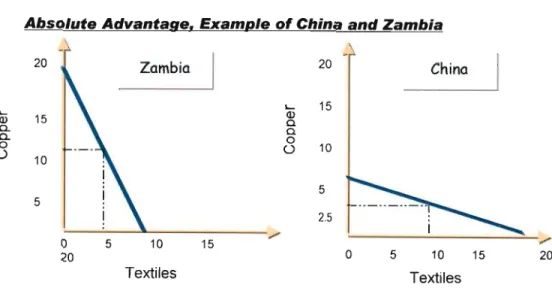
2000:712). Taking an example of Zambia, which has an absolute advantage over many countries in the production of copper. This occurs because of the existence of reserves of copper ore or bauxite. China has an absolute advantage in the production of textile due to its low labour costs.
It can be clearly seen that in terms of the production of goods, there are obvious gains from specialisation and trade. If Zambia produces copper and exports it to China and imports textiles, both the countries would gain from trade by specialising. This further can be ascertained with the use of the production possibility curves of China and Zambia, which will help in assessing the extent of gain from trade.
Absolute Advantage. Example of China and Zambia
20 Zambia 20 China
.... .... 15
15 ID
Q) Cl
0- Cl
0- 0
0 U 10
U 10
5 5
2.5
0 5 10 15 / /
20 0 5 10 15 20
Textiles Textiles
Figure 2.1: Absolute Advantage, Example of China and Zambia
Chapter Two Literature Review
14of88
Gains from Trade for China and Zambia
Production and Consumption without Trade
Copper Textiles
Zambia 10.0 5.0
Cbioa 2.5 10.0
Production with Specialisation
zambia Cbioa
Copper 20.0o
Textiles
o
20.0
ThW~ddoo ~ ~
Consumptioo After Zambia Trades 6 units of Copper for 6 yards of Textile from China
Zambia Cbina
Copper 14.0 6.0
Textiles 6.0 14.0 Increase in Consumption as a result of Specialisation and
Trade
zambia Cbioa
Copper 4.0 3.5
Textiles
1.0 4.0
Table 2.1: Gains from Trade for China and Zambia
Figure 2.1 and table 2.1 helps to illustrate gains from trade and specialisation. It is apparent that countries gain from trade; output of both textile and copper is greater than before and therefore consumers of both China and Zambia will be able to consume more. Table 2.1 shows how consumption in both the countries have gone up relatively as a result of specialisation and trade.
2.2.3 COMPARATIVE ADVANTAGE
What happens if countries like United States or Japan have an absolute advantage in producing all the goods? Does it indicate that they will not benefit from international trade since they can produce all the goods efficiently at home?
According to Ricardo's theory (Sindhwani: 2003), a country has a comparative advantage in the production of goods or services that it produces at a lower opportunity cost than its trading partners. Some
Chapter Two Literature Review
countries have an absolute advantage in the production of many goods relative to their trading partners. Others have an absolute disadvantage, which implies that, they are inefficient in producing all goods and services, relative to their trading partners. The theory of comparative advantage according to Ricardo argues that, put simply, it is better for a country that is inefficient at producing goods to specialise in the production of that good it is least inefficient at, compared with producing other goods (Jones: 2000).
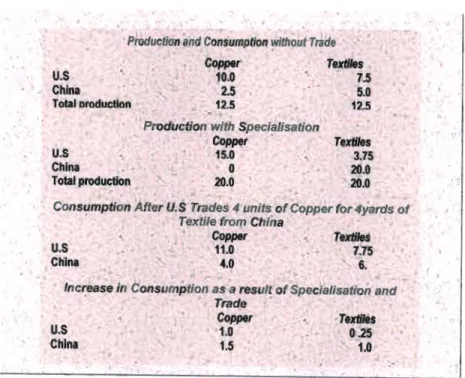
US and China 20
Figure 2: Comparative AdvantageforChina and U.S
/
...
Gla.a.
(,)o
China
3.7 5 7.5 10 15
Textiles
Figure 2.2: Comparative Advantage for China and U.S Gains from Trade for USand China
Textiles 3.75 20.0
..
.0 Production with Specialisationeopp,r ' 15.0o
20.0
Productkm and Consumption~outTrade
Copper Textiles
10.0 7.5
2.5 .... 5.0
12.5 12.5
.'
..
U.S China
TotalDroduction
u.s ~
China •
Toulproduction
. ,
Cons'!mption After IJ.S Trades" units, of Copper for '-yardsof
Textile from China •
, • Copper .. TextileS
U.S 11.0 7.75
China 4.0 '. 6.
~
Increase in Consumption as a result of Specialisation and
• I Trade"
, Copper Textiles
U.S 1.0 0...25
China 1.5 1.0
Table 2.2: Gains from Trade for US and China
Chapter Two Literature Review
16of88
It can thus be derived that after U.S. and China exploit their comparative advantage, in copper and textiles respectively, production of output increases (which can be seen in the table 2.2). Since both the countries are producing more, they can now engage in trade and benefit from it. Thus consumption of copper and textiles increases in both the countries as a result of specialisation and trade.
The essence of the theory is that 'potential world production is greater with unrestricted free trade than it is with restricted trade' (Hill: 2003: 146).
Therefore it can be concluded that unrestricted trade is beneficial for countries across the globe, but the degree to how much each nation actually benefits might differ since model includes many unrealistic assumptions (Jones: 2000): -
There are no transportion costs.
Costs are constant and there are no economies of scale.
There are only two economies producing two goods.
The theory assumes that traded goods are homogeneous Factors of production are assumed to be perfectly mobile.
There are no tariffs or other trade barriers.
There is perfect knowledge, so that all buyers and sellers know where the cheapest goods can be found internationally.
An important Question that arises is that, can this model be applied to the real world scenario, which consists of numerous goods, high transportation costs, volatile exchange rates, immobile resources/factors of production and dynamic environment? Is it realistic to conclude that free trade is mutually beneficial for all the nations across the world? Recent studies undertaken by Sindhwani and the like, suggest that even though the model has
Chapter Two Literature Review
shortcomings, countries can benefit from free trade, which will be analysed using real world examples later in the chapter.
2.2.4 HECKSCHER-OHLlN THEORY
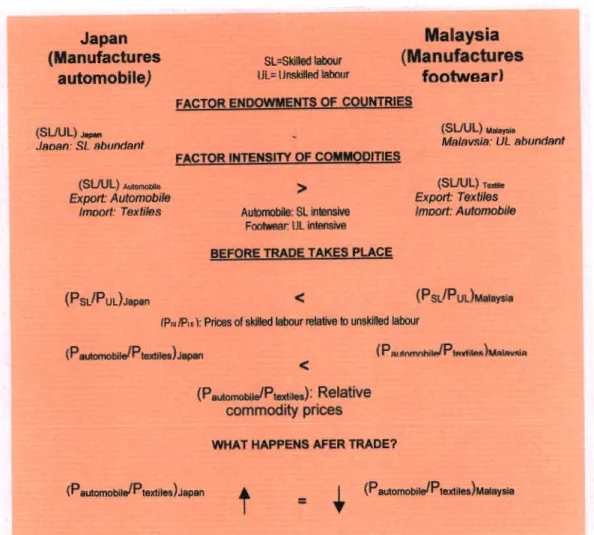
Ricardo's model is based on differences between countries in technology and puts emphasis on the fact that comparative advantage arises from differences in productivity. The Eli Hecksher and Bertil Ohlin theory (1933) as cited by Sindhwani (2003) of factor endowment is based on differences in relative factor endowments across countries and differences between goods in their factor intensity (the proportion in which factors are used). Which means the extent to which a country is enriched in resources such as, land labour, or capital (Internet 1). Therefore a country with abundant labour will have a low labour cost and will export goods that are labour intensive.
Countries such as China, India, Malaysia, Indonesia are endowed with unskilled labour that is why these developing countries produce more of goods that are labour intensive, such as textiles, footwear and agricultural products and the like. On the other hand countries such as, Germany, Japan, United States, excel in the production and export goods which are skilled labour intensive or capital intensive, such as, computer software, automobile, aircrafts etc.
An example of a two-country trade case, Japan and Malaysia, where one is enriched with skilled labour and the other is endowed with unskilled labour respectively will assist in understanding the outcome of trade.
Chapter Two literature Review
18of88
Hecksher Ohlin Theory using examples of Japan and Malaysia
Japan (Manufactures
automobile)
(SUUL) "'-' JaD8n: SL abundant
Malaysia
SL=SkiIIedlabour (Manufactures
Ul= Unskilledlabour footwaarl
FACTOR ENDOWMENTS OF COUNTRIES
(SUUL)IIaI8ysla
Malavsia: UL abundant FACTOR INTENSITY OF COMMODITIES
(SUUL)Automollile
Export:Automobile Imoorl: Textiles
(PsdPudJapan
>
AuDnobiIe: SLintensive Footwear: Ulintensive BEFORE TRADE TAKES PLACE
<
(SUUL)T.- Export: Textiles Imoorl: Automobile
(PsdPUL)Malaysla (P.. IP,. ):Pricesofskilledlabour relativek>unskilled labour
(Pa,Jlnmnhi.JP_)MaIav!oia
<
(Pautomollile"Ptexliles): Relative commodity prices
WHAT HAPPENS AFER TRADE?
t =
.. (Pautomobiw'Ptextilesh~a1aysiaTable 2.3: Illustration of Hecksher Ohlin Theory using examples of Japan and Malaysia
Since Japan is skilled labour abundant country it will export automobile, which provides it with a comparative advantage over Malaysia. Malaysia will export textiles and import automobile from Japan. As trade opens up it results in factor-Price equalisation, which claims that trade leads to equalisation of returns to factors across countries.
Hence with trade, wages should become equal across countries and the returns to other factors such as land and capital. If this holds true, then why aren't wages in Japan, equal to wages in China, Malaysia or India?
However, wages and prices across the world paint a different picture altogether. Why is it so? In order to answer this question it is important to understand that the strong conclusion we derive from this model depends on assumptions of, no trade restrictions, no transportation cost,
Chapter Two literature Review
homogeneous technology and uniform purchasing power across countries.
These assumptions make the models of international trade theory less applicable to the real world. Nevertheless, they indicate a very fundamental aspect that trade without any restrictions will eventually enhance the growth performance of a country.
2.2.5
PORTERS DIAMONDMichele Porter established Porters Diamond in an attempt to determine why some nations archive international success in a particular industry while others fail in international competition. Why does China do so well in the textile industry? And Japan in the automobile industry? According to porters, the theory that we have established so far, answers only a part of the explanation.
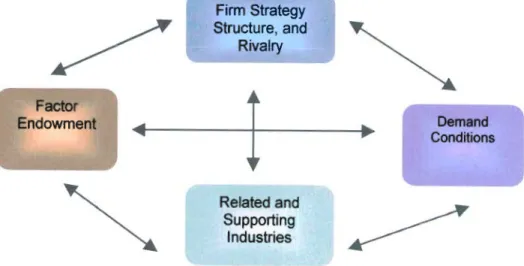
According to Porter (Svend: 2001), four broad attributes of a nation shape the environment in which homegrown firms compete and these attributes promote or impede the creation of competitive advantage (see fig 2.3).
DeterminantofNational Competitive Advantage:Porter'sDiamond
Demand Conditions Firm Strategy
Structure, and Rivalry
Factor Endowment
Related and Supporting
Industries
Figure 2.3: Determinant of National Competitive Advantage: Porter's Diamond (Source: Svend: 2001)
Factor endowment, demand conditions, relating and supporting industries, firm strategy, structure and rivalry are the four attributes that constitute the diamond. According to Porters, firms are most likely to succeed in industries
Chapter Two Literature Review
20 of 88
where the diamond is most favorable. He also stated that, " the diamond is mutually reinforcing system" (Hill: 2003: 159). The four attributes are interlinked and the effect of one aspect spills over on to the others. For instance, Porters states (Hill: 2003) that, ''favorable demand conditions will not result in competitive advantage unless the state of rivalry is sufficient to cause firms to respond to them".
In addition to this, according to him two very important variables such as chance and government also play a very essential role in influencing national demand. For example, innovation of the cell phones reshaped the entire telecommunications industries and provided opportunity for nation's firms to succeed over others. Similarly, government policies and regulations can improve national advantage or can do the total opposite.
It is interesting to see how all the theories have some weaknesses but still bring out a very important aspect, which can be of great importance in the real world scenario. All the models signify the relevance of trade and how countries across the world can benefit if they engage in trade, by specialising, by capitalising on their factor endowments or by realising where their comparative advantages lie.
2,3 THE EFFECT OF TARIFF ON TRADE
At this point it becomes essential to look at the effect of tariff since, our goal is to try and assess how the liberalisation of trade helps or impedes the development and economic growth of a country. It is argued that tariff not only lowers world welfare but also the welfare of nations imposing these tariffs. In addition to this, it is also believed that nations can achieve something better without the imposition of tariffs as compared to what they can achieve through the imposition of tariff (Pugel: 2000).
Simple supply and demand diagrams help to illustrate the welfare effects of tariffs on producers, consumers and the nation as a whole. This will help in order to evaluate whether the arguments by the trade protestors hold true.
For example, they claim trade rules are biased toward the interests of producers.
Chapter Two literature Review
2.3.1 SMALL COUNTRY SCENARIO
The small country scenario means that the country's imports are a very small share of the world market, so small, that even a complete elimination of imports would have an imperceptible effect upon world demand for the product and thus would not affect the world price. Thus, when a small country implements a tariff, there is no effect upon the world price (Hill:
2003).
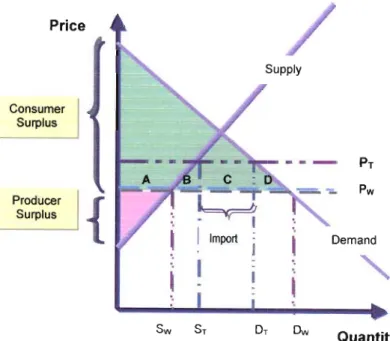
Lets consider a market in a small importing country such as Belgium that faces an international or world price of Pw in free trade for rice (figure 2.4).
At Pw, domestic demand is Ow, domestic supply is Sw and imports equal to the difference between Ow and Sw (See figure 2.4).
Tariff effect on Belgium. a Ismall' country case
Consumer Surplus
Producer Surplus
PT Pw
Sw ST DT Dw Quantity
Figure 2.4: Tariff effect on Belgium, a 'small' country case
When a specific tariff is implemented by Belgium (a small country) it will raise the domestic price by the full value of the tariff. Consequently, the price in the Belgium rises to PT as a result of the imposition of tariff. In this case the tariff rate would be, PT - Pw(see fig 2.4).
2.3.1.1 TARIFF EFFECTS ON IMPORTING COUNTRY CONSUMERS
Consumers of the product in the importing country are worse-off as a result of the tariff. The increase in the domestic price of both imported goods and
Chapter Two
Literature Review
22 of 88
the domestic substitutes reduces consumer surplus in the market. Which can be seen in the figure 2.4, where loss of consumer surplus equals A+B+C+D (Pugel: 2000).
2.3.1.2 TARIFF EFFECTS ON IMPORTING COUNTRY PRODUCER
Producers in the importing country are better off as a result of the tariff. The increase in the price of their product increases producer surplus in the industry (+A in figure 2.4). The increase in price also induces an increase in output of existing firms (and perhaps the addition of new firms), an increase in employment, and an increase in profit and/or payments to fixed costs.
2.3.1.3 TARIFF EFFECTS ON IMPORTING COUNTRY GOVERNMENT
The government receives tariff revenue as a result of the tariff (+C in figure 2.4). Who will benefit from the revenue depends on how the government spends it. These funds help support diverse government spending programs, therefore, someone within the country will be the likely recipient of these benefits.
2.3.1.4 TARIFF EFFECTS ON NATIONAL WELFARE
The aggregate welfare effect for the country is found by summing the gains and losses to consumers, producers and the government. The net effect consists of two components: a negative production efficiency loss (B in figure 2.4), and a negative consumption efficiency loss (0 in figure 2.4). The two losses together are typically referred to as 'deadweight losses'. Since, there are only negative elements in the national welfare change, the net national welfare effect of a tariff must be negative. This means that a tariff implemented by a "small" importing country will eventually result in reduced national welfare.
Therefore it can be concluded that whenever a "small" country implements a tariff, national welfare falls and the higher the tariff, the larger will be the loss in national welfare. In addition, the tariff causes a redistribution of income.
Producers and the recipients of government spending gain, while consumers lose. Due to the fact that the country is assumed "small," the tariff has no effect upon the price in the rest of the world. Therefore there
Chapter Two literature Review
are no welfare changes for producers or consumers around the globe. Even though imports are reduced, the related reduction in exports by the rest of the world is assumed to be too small to have a noticeable impact.
2.3.2 LARGE COUNTRY SCENARIO
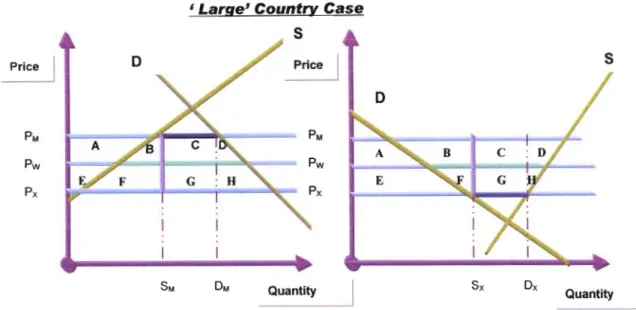
Lets assume that there are only two trading countries, one importing 'large country' and one exporting country. The supply and demand curves for the two countries are shown in figure 2.5. Pw is the free trade equilibrium price.
At that price, the excess demand by the importing country equals excess supply by the exporter.
I Large' Country Case S
Pw
Px
o
Pw Px E
Quantity
Figure 2.5: Large Country case
Sx Dx
Quantity
The quantity of imports and exports is shown as the green line segment on each country's graph. When a large importing country implements a tariff it will cause an increase in the price of the good on the domestic market and a decrease in the price in the rest of the world. Suppose, after the tariff, the price in the importing country rises to PM and the price in the exporting country falls to px. If the tariff is a specific tax then the tariff rate would be equal to the difference between PMandPx (Figure 2.5).
2.3.2.1 IMPACTOFTARIFF ON CONSUMERS
Consumers in the importing country suffer a reduction in welfare as a result of the tariff. The increase in the domestic price of both imported goods and
Chapter Two
Literature Review
24 of 88
the domestic substitutes reduces the amount of consumer surplus in the market, equivalent to the area A+S+C+D (Figure 2.5).
Consumers in the exporting country experience an increase in welfare as a result of the tariff. The decrease in their domestic price raises the amount of consumer surplus (+e see figure 2. 5) in the market.
2.3.2.2 IMPACTOFTARIFF ON PRODUCERS
Producers in the importing country experience an increase in welfare as a result of the tariff, producer surplus increases by the area A (in figure 2.5).
The increase in the price of their product on the domestic market increases producer surplus in the industry. The price increases also induces an increase in output of existing firms and perhaps the addition of new firms, increase in employment, and increase in profit.
Producers in the exporting country experience a decrease in welfare due to tariff. The decrease in the price of their product in their own market reduces producer surplus in the industry equivalent to the area e,f,g,h in figure 2.5.
Decline in price also induces a reduction in output, employment, and in profit and payments to fixed costs.
2.3.2.3 IMPACTOFTARIFF ON GOVERNMENT REVENUE
The government receives revenue as a result of the tariff. Who benefits from the revenue depends on how the government spends it. Typically the revenue is simply included as part of the general funds collected by the government from various sources. In this case it is impossible to identify precisely who benefits. However, these funds help support many government spending programs, which presumably helps most people in the country, as is the case with public goods. Thus, someone within the country is the likely recipient of these benefits.
2.3.2.4 IMPACTOFTARIFF ON NATIONAL WELFARE
The aggregate welfare effect for the country is found by summing the gains and losses to consumers, producers and the government. The net effect on importing country consists of three components: a positive terms of trade
Chapter Two literature Review
effect (G in figure 2.5), a negative production distortion (8 in figure 2.5), and a negative consumption distortion (0 in figure 2.5).
For the reason that there are both positive and negative elements, the net national welfare effect can be either positive or negative. The interesting result, however, is that it might be positive. This means that a tariff implemented by a "large" importing country may raise national welfare.
The aggregate welfare effect for the exporting country is found by summing the gains and losses to consumers and producers. The net effect consists of three components: a negative terms of trade effect (g in figure 2.5), a negative consumption distortion (f in figure 2.5), and a negative production distortion (h in figure 2.5).
Since all three components are negative, the importer's tariff must result in a reduction in national welfare for the exporting country. However, it is important to note that a redistribution of income occurs, i.e., some groups gain while others lose. In this case the sum of the losses exceeds the sum of the gains.
Usually, if a "large" country implements a small tariff, it will elevate national welfare but if the tariff is set too high, national welfare will fall. One important thing to remember is that there will be a positive optimal tariff that will maximise national welfare.
However, it is also important to note that everyone's welfare does not rise when there is an increase in national welfare. Instead there is a redistribution of income. Producers of the product and recipients of government spending will benefit, but consumers might end up loosing. A national welfare increase implies that the sum of the gains exceeds the sum of the losses across all individuals in the economy. Economists generally argue that, in this case, compensation from winners to losers can potentially alleviate the redistribution problem.
Chapter Two literature Review
26 of 88
2.3.2.5 TARIFF EFFECTS ON WORLD WELFARE
The effect on world welfare is found by summing the national welfare effects in the importing and exporting countries. By noting that the terms of trade gain to the importer is equal to the terms of trade loss to the exporter, the world welfare effect reduces to four components: the importer's negative production distortion (B in figure 2.5), the importer's negative consumption distortion (0 in figure 2.5), the exporter's negative consumption distortion (f in figure 2.5), and the exporter's negative production distortion (h in figure 2.5). Since each of these is negative, the world welfare effect of the import tariff is negative. The sum of the losses in the world exceeds the sum of the gains. It can be concluded that an import tariff results in a reduction in world production and consumption efficiency. In other words trade liberalisation increases production and consumption efficiency and therefore national welfare.
Protecting industries through tariffs is costly on consumers. World Bank Reports (Internet 3) established that, consumers pay, on average, $155,000 for every job "saved" in a protected industry. At the same time, such protectionist measures harm economies by diverting resources away from the most productive sectors. For example, in United States, steel tariffs raise the cost of steel, harming automobile manufacturers and other steel consuming industries, which employ 10 times as many workers as the steel manufacturers. These productive sectors of the economy also benefit when trade opens new markets across the globe for their products. Expanding trade means more output, which in turn leads to employing more workers.
Consequently, liberalisation of trade and elimination of tariffs lead to increased employment, lower prices leading to growth and development in the long run.
Even though many tariff barriers have been flagged in the last few decades, leading to a more integrated world, countries continue to use many mechanisms to restrict imports. Non-tariff barriers such as quotas,
Chapter Two literature Review
Gambar

Garis besar
Dokumen terkait
Hasil simulasi menunjukkan bahwa pada “program panen awal”, yaitu: tahap awal dari FTA ASEAN – China dimana hanya sektor pertanian dan kehutanan yang diliberalisasikan,
Several policy alternatives were simulated which include single policies and their combinations: (1) removal of beef import tariffs for beef imports from Australia and New
Grounded on the background above, some problems are formulated: 1) How big and significant is the impact of government foreign debt, private sector foreign debt, foreign
Category Ratio Code Name of Financial Ratio 1 Cash Flow Ratios CFO 5 Cash flow from operations to Net Working capital 2 Activity and Efficiency Ratios TO 2 Fixed Assets Turnover
The Impact of Behavioral Aspects on Investment Decision Making Ninditya Nareswari 1*, Alifia Salsabila Balqista 2, Nugroho Priyo Negoro 3 1*,2,3Jurusan Manajemen Bisnis, Fakultas
By using Indonesian stock market data, the results show that 1 technical analysis signal generates big- ger lower return for late earlier reporting, and 2 reporting lag positively
Circumvention Cycle: Indonesia as a Third Country DJBC, 2021 Based on Figure 1, Indonesia is "used" by exporters from China as a transit point to change the country of origin by
Number of Instagram User Activities Based on Interest Figure Content Interaction Content Interaction Content Interaction Figure 2 10 Account 6 Account 11 Account Figure 3 92 Account
